1. Why use this guide?
Use this guide for advice on how to find records at The National Archives, and to a lesser extent in other archives, of Merchant Navy shipwrecks, including passenger ships. The records covered include those that document the complete loss of ships through sinking as well as those lost to damage, whether as part of a military conflict, a result of natural disaster or any other accident. Some of the records will allow you simply to establish that a ship sunk or was wrecked, others can provide more detail, such as the circumstances of the incident and the number on board who died, if any.
Very few records exist from before the 19th century.
You can also consult our guide to births, marriages and deaths at sea.
2. How to conduct a search at The National Archives
The National Archives is not always the best place to begin a search for records of sunken and wrecked ships. Some of the other archives listed in section 5 may prove to be better places to start but, nevertheless, there are significant numbers of records within our collections as well as some very useful publications in our library.
A search here will almost certainly require a visit to our reading rooms in Kew where you can consult library books and original documents. Most of the records we hold for lost ships are not available to download or view online but you can, however, make a start online by searching our catalogue.
We recommend you follow these steps, in the order shown, when searching for records of the loss or damage to a specific ship:
Step 1: Consult newspaper reports, Wreck Site or published books
Before visiting us, look for reports of shipwrecks in old newspapers or search the online Wreck Site database, a free-to-use website with details of over 200,000 shipwrecks worldwide. This may be the easiest way of establishing the date and circumstances of the loss, if they are known, and could equip you with vital facts in your search for records.
The most comprehensive source for archived newspapers is the British Newspaper Archive. Local libraries usually provide access to archived copies of local newspapers and those in coastal towns and cities are more likely to contain accounts of offshore wrecks. They may also provide access to online versions of national newspapers, including The Times Archive, also available online in our reading rooms. Shipping newspapers are a useful source but are more likely to exist only in larger reference libraries, particularly in the major port cities.
The following books are available at our library in Kew, as are those listed for the First and Second World Wars in the subsequent sections of this guide. They are the best place to start on a visit to our reading rooms and may remove the need to consult original documents altogether.
- Larn, R and Larn, B, Shipwreck Index of the British Isles (Lloyd’s Register of Shipping, 1995-2002). These six volumes are the most comprehensive listing of wrecks in UK coastal areas up to the end of the 20th century. Organised by county and date, with a ship name index, among the details provided with each listing are the name of the captain, the number of crew on board and lost, if any, and the origin and intended destination of the voyage.
- Hocking, C, Dictionary of Disasters at Sea during the Age of Steam, 1824-1962 (Lloyd’s Register of Shipping, 1969). Two volumes listing ships in alphabetical order with a short description of the disaster and the date, among other details. Includes Royal Navy as well as merchant ships.
- Hooke, N, Modern Shipping Disasters, 1963-1987 (Lloyds of London Press, 1989). A sequel to Hocking’s Dictionary of Disasters at Sea, presented in the same format.
- Marx, R, Shipwrecks of the Western Hemisphere, 1492-1825, (David Mckay Co, 1975). Covering shipwrecks in the Caribbean and all over the Americas, several thousand losses are listed in date order and briefly described. The book includes a ship name index.
- Grocott, T, Shipwrecks of the Revolutionary and Napoleonic Eras (Caxton, 2002). Contemporary newspaper accounts of both merchant and military ships wrecked. Organised by date but with a ship name index.
Step 2: Search the catalogue with ship’s name and one other search term
Though the records of ship losses are not always identified by the ships’ names in our online catalogue, it is worth trying to locate those that are at an early stage of your search.
Search our catalogue using the name of the ship plus one of the following words:
- sunk
- sinking
- loss
- wreck/wrecked
- torpedo/torpedoing/torpedoed
- damage
- attack
Step 3: Consult lists of wrecks
There are not many of these and they exist primarily for the First and Second World Wars but where they exist they can provide the quickest and easiest way to locate an original record of a lost or wrecked ship. See sections 3 and 4 for the detail.
Step 4: Consult merchant shipping registration records
The registration system established by the Merchant Shipping Acts of 1786, 1825 and 1854 required a ship’s loss to be officially recorded. The Transcripts of Registration transmitted to the Registrar of Shipping for 1786 onwards, held in series BT 107-BT 109, with indexes in BT 111, show when the registry was closed on a vessel. This may simply have been because the vessel was retired or sold to a foreign power but it does include removals for ships that were lost or went missing and the 19th century records often also include the date and place of any incident that led to a loss. Of particular value in a search for wrecked ships among these records are the duplicates of forms showing ships removed from the register, 1890-1998, in BT 110.
Step 5: Search through records which contain incidental references to losses
There are many records which were not created specifically to record losses but which do, nonetheless, either formally record losses or contain incidental references to them. Using these records for details of a wreck is bound to be quite time consuming and should be considered a last resort if you have followed the steps above and still need information. The principal records to search through are:
- Ships logs, 1857-1972, in BT 165.
- Agreements and crew lists, 1861-1994, in BT 99 and for 1747-1860 in BT 98.
- Reports and depositions concerning shipwrecks among customs correspondence and papers held in the CUST collections.
- Board of Trade and Ministry of Transport wrecks files, 1854-1969 in MT 9. An 1854 Act empowered the Board of Trade to conduct inquiries into the loss of British merchant ships, though this power was very seldom used. Few of these reports have been preserved, but MT 9 contains those which have. Search with the term ‘wreck’.
- Reports of losses and accidents in the out-letter books of the Board of Trade Marine Department, 1851-1939 in MT 4, with indexes in MT 5. Other reports of inquiries into losses and accidents, 1867-1990 are in MT 15.
- The Treasury Solicitor’s files in series TS 18 cover the business of many government departments and may include details of claims for the cargoes of lost ships.
3. Additional records and books of First World War losses
You can find records of First World War losses by following the steps in section 2 but in this section we present publications and records focussed specifically on the war.
Books
The following books are available at our library in Kew and are the best place to start when conducting a search at The National Archives:
- Tennent, A J, British Merchant Ships sunk by U-Boats in the 1914-1918 War (Starling Press, 1990)
- Williams, D, Wartime Disasters At Sea: Every Passenger Ship Lost in World Wars I & II (Patrick Stephens, 1997)
- HMSO, British Vessels Lost at Sea 1914-1918 and 1939-1945 (Patrick Stephens, 1988)
Lists of losses
Among the most straight-forward way to find official documentation of shipwrecks and losses is to consult one of the following lists:
- A complete list of British merchant and fishing vessels sunk or damaged by enemy action from 1914 to 1920 in MT 25/83-85. This list is among the correspondence and papers of the Ministry of Shipping from 1917-1921 in MT 25.
- List of merchant ships wrecked, broken up or sold abroad, 1908-1918 in BT 167/55
Narrative accounts
The records used to compile the Official History of the First World War are held in ADM 137 and contain much material on the losses of individual merchant ships.
Search with a ship’s name and the word ‘loss’, ‘torpedoing’ ‘sinking’ or any of the other keywords suggested at Step 2 in section 2 of this guide.
Insurance records
War risk insurance records in BT 365 include records of claims for the values of ships’ cargoes lost during the First World War. The claims themselves were made between 1914 and 1929.
Search by ship’s name in in BT 365.
4. Additional records and books of Second World War losses
You can find records of Second World War losses by following the steps in section 2 but in this section we present publications and records focussed specifically on the war.
Books
The following books are available at our library in Kew and are the best place to start when conducting a search at The National Archives:
- HMSO, British Vessels Lost at Sea 1914-1918 and 1939-1945 (Patrick Stephens, 1988)
- Lloyd’s War Losses of the Second World War (Lloyd’s of London, 1989) in two volumes
- Rohwer, J, Axis Submarine Successes 1939-1945 (Patrick Stephens Ltd, 1993)
- Williams, D, Wartime Disasters At Sea: Every Passenger Ship Lost in World Wars I & II (Patrick Stephens, 1997)
Narrative accounts
The records used to compile the Official History of the Second World War are held in ADM 199 and contain much material on the losses of individual merchant ships. In particular there are:
- Interviews with survivors of lost or damaged merchant vessels in ADM 199/2130-2148
- Convoy lists in ADM 199/2184-2194
5. Beyond The National Archives: where else to look for information and records
Lloyds Marine Collection
The Lloyd’s Marine Collection is a major source of information about merchant shipping disasters and includes records of official inquiries into losses. It is based at the Guildhall Library in the City of London. Details of the collection are published in D. T Barraskill’s A Guide to the Lloyd’s Marine Collection and Related Marine Sources available at The National Archives library and the Guildhall Library itself. It includes a list of further sources of information about marine losses.
The National Maritime Museum, Caird Library
The Caird Library at the National Maritime Museum hold the original Board of Trade Wreck Registers from 1854 to 1898. These provide details of wrecked British vessels, including the name, official number, port of registry, port number and year of registration, tonnage, name of managing owner and master. In addition, it gives the date and place of wreck, some idea of the cause, and the number of lives lost.
The British Library
As well as the British Newspaper Archive, the British Library holds the largest readily accessible collection of printed Admiralty charts in its Map Library.
The India Office Records at the British Library contain information about the loss of British East India Company ships. Details of East India Company ships are also listed on the Three Decks website.
The Shipping and Mercantile Gazette (for 19th century accounts)
The Shipping and Mercantile Gazette was published daily and contains details of ships’ voyages alongside articles of all kinds from the world of shipping and includes details of wrecks and summaries of casualties.
UK Hydrographic Office database
A comprehensive database of wrecks containing over 60,000 records, of which approximately 20,000 are for named vessels, is maintained by the UK Hydrographic Office. Though focussed mainly on UK territorial waters the database includes information on a small number of wrecks in other areas. The same office holds an extensive collection of British Admiralty Charts and other hydrographic charts.
6. Further reading
Huntress, K, Checklist of Narratives of Shipwrecks & Disasters at Sea to 1860 (Iowa State University Press, 1979). A guide to contemporary accounts of losses
Pickford, N, The Atlas of Shipwreck & Treasure (London, Dorling Kindersley, 1994)
Rohwer, J, Allied Submarine Attacks of World War Two: European Theatre of Operations 1939-45 (Greenhill, 1997)
This guide provides a brief overview of resources at The National Archives that can help you to trace your family history from the Caribbean, predominantly after immigration to the UK but, to a lesser extent, after emigration or forced movement to the Caribbean. It is an introduction to the sorts of records we hold, with links to guides providing more detailed advice on how to find the records in our collection.
The records held at The National Archives
As with all documents held here, the records we hold related to people from the Caribbean are historical records of the UK central government. Most of these records relate to the British Caribbean, encompassing the British colonial territories in the Caribbean before and following their independence.
In general, we do not hold the internal administrative records from the Caribbean, such as registers of births, marriages and deaths or land ownership, which would have remained in place after independence. However, this guide does provide some advice on where to find these records.
Quite often record titles, descriptions and the documents themselves use language that is now out of date and sometimes offensive, but once records are transferred to us, we don’t alter them. The terminology used by the people that created the records is part of the story they tell.
How to get a search for records started
Before you begin a search, you should see if there is a guide to the records you are looking for. This guide is designed to help you do that. Throughout this guide you will find links to the more detailed advice you will need to search a specific set of records.
Records are arranged by the government department that created them, then by the type of record, such as passenger lists or military service records, and by date.
There are no ‘case files’ containing all the information about a single person. For any individual, there may be several different types of records which relate to them, each of which will have to be searched for separately.
The documents themselves may be in different formats, from handwritten registers, printed lists, or large sheets of parchment, each representing one aspect of a distinct set of records.
How to view records
This guide provides links to many other guides. Each of these guides will indicate whether the records they cover have been made available online (charges usually apply). The online copies are accessed either directly from our website or from the websites of our commercial partners, including Ancestry and Findmypast.
Many records have no online version and to see these you will need to consult them at our building in Kew or pay for copies to be made and sent to you. The search for records held at Kew begins by using keywords and dates to search our online catalogue. The catalogue contains short descriptions of the records and a document reference for each – you will need the document reference to see the record itself or to request copies.
For more guidance on searching or browsing our catalogue, visit our Discovery help pages.
Records of arrival in the UK
The records most likely to have been created and kept to reflect a person’s migration from any other country to the UK are those documenting their arrival.
The majority of people arriving in the UK from the Caribbean, or from anywhere else, up until the 1960s arrived by ship. Passenger lists, recording all travellers on any inter-continental ship voyages, are therefore the most widespread records of arrival. We hold incoming passenger lists for 1878-1960, including lists for the Empire Windrush. Anyone who travelled from the Caribbean and first arrived in a European port before onward travel to the UK will not be listed in these passenger lists.
Outside of these years there is much less chance of there being an archived record of arrival, though documents known as ‘certificates of arrival’ were issued during the 19th and early 20th centuries, when immigrant numbers from the Caribbean were much lower than they became.
Consult our guide to immigration and immigrants for advice on finding passenger lists and the small number of other records of arrival kept at The National Archives.
P&O compiled passenger lists for its ships, but most have not survived as they were disposed of when no longer legally required. The only surviving lists are in the P&O Archives at the National Maritime Museum in Greenwich.
See our Windrush 75 portal for some context on the people travelling from the Caribbean who became know as the Windrush generation and learn more about Empire Windrush passenger lists.
Records of UK citizenship
Up until 1949 citizens of any colony or dominion in the British Empire, including those in the Caribbean, were automatically considered British subjects but this changed with the British Nationality Act 1948. After the Act, people in the British Commonwealth could register their British citizenship to remain British citizens, whether or not they actually moved to the UK, though those who did move to the UK were more likely to register than those who didn’t. Anyone who moved from the British Caribbean to the UK after 1949 may have registered their citizenship.
For advice on how to find records of registration, and other records of British citizenship, consult our guide to naturalisation, registration and British citizenship.
Records of births, marriages, deaths and relatives in the UK
Births, marriages and deaths in the UK are usually recorded in one or two ways: on registers and on certificates. At The National Archives we do not hold any certificates and only a few registers. You are usually better off searching for a birth, marriage or death record elsewhere. There are details of where you should start your search in our guides to births, marriages and deaths in England and Wales and births, marriages and deaths in Scotland and Ireland.
Census records
The most popular source for tracing relatives at The National Archives are the census records. The census is a head count of everyone in the country on a given day. We hold the censuses for England and Wales from 1841-1921. Most censuses include details of family relationships, marital status of individuals as well as their age, address and where they were born.
In the 1921 census, the most recent census held here, there were 9054 people recorded as born in the West Indies.
For advice on how to search in the available censuses and more about them, read our guide to census records.
Wills
You may find details of an individual in a will if they were the testator (the person who made the will), the executor (the person/s who carries out the testator’s wishes, usually a relative, friend or close associate) or a beneficiary but also, in the case of enslaved people, who were regarded as the property of slave owners, as part of the estate. The wealthier the individual, the more likely it was that they left a will.
At The National Archives we only hold wills proved before 1858. However, you cannot search for wills with any name other than that of the testator. Our guide to wills before 1858 contains the details.
We also publish guidance on where to go for wills since 1858.
Records of NHS and railway workers
The National Archives is not the best place to find information about the careers and employment of individuals, however we do hold some records for a very small number of professions.
Many Caribbean workers came to the UK in the 1940s and 1950s as part of the Windrush generation. Many of those arrivals came to work for the newly established National Health Service (NHS). For advice on the limited number of NHS personnel records we hold, none more recent than 1984, and for advice on where else you can look for career records of individuals, consult our guide to doctors and nurses.
In the 1950s and 1960s, London Transport operated a scheme to recruit employees directly from the Caribbean. Use our guide to railway workers for advice on locating records of staff who worked for the railways in the UK, though almost all of our records are for people who worked for private railway companies that ran the networks before nationalisation in 1947.
Military and maritime records, 17th to 20th centuries
Pre-20th century military and maritime records
The British Army and the Royal Navy had a substantial presence in the Caribbean from the 16th century onwards, creating and defending the territories colonised by the British, and British merchant ships. Troops from the Caribbean, including the West India Regiment were also deployed in other colonial conflicts, particularly in Africa. Both armed forces used enslaved Africans as labour but also as combatants. The British Army presence included troops recruited in Britain, and local ‘militia’ that were recruited in the Caribbean. The Royal Navy recruited from around the world, including the Caribbean.
To begin searching for individuals who worked for the Royal Navy before the First World War see our guide to Royal Navy ratings up to 1913 and our guide to Royal Naval dockyard staff.
Finding individuals who served as soldiers in the Caribbean before the 20th century is easier if you can identify whether they served in a local ‘militia’ or as part of the British Army. Our guide to British Army soldiers before 1913, lays out the key records for that group. We have some, but far fewer records on the history and the personnel of the militia – see our guide to Militia. Some militia records were retained in the Caribbean. For a more detailed history of the army and militia in the Caribbean please see Guy Grannum’s book, Tracing Your Caribbean Ancestors.
We have records relating to those who worked on commercial ships, known as the Merchant Navy, in the 19th century, including those who joined those ships in the Caribbean. See our guide to Merchant seamen in service before 1914.
Twentieth-century military and maritime records
Inhabitants of the Caribbean were enlisted into British and allied armed forces through a variety of routes. Some enlisted in the Caribbean itself in the local militia (see above), others travelled to the UK, or the US or Canada, and enlisted there. For the first half of the 20th century only white men (of ‘European descent’) were eligible to take combatant roles or become officers in the British armed forces. There were notable exceptions to this during the First and Second World Wars.
If you know that an individual served in the British or allied armed forces in the First or Second World War but don’t know more details about their military service, it may be helpful to consult online ‘roll of honour’ compilations before beginning more detailed searches in our records. See, for example, the Imperial War Museum’s Lives of the First World War database or the Caribbean Roll of Honour website.
The following guides offer advice on finding military and maritime service records of individuals:
Many individuals from the Caribbean worked on British-registered commercial ships, as part of the Merchant Navy. We have a number of guides to searching the records of the Merchant Navy. This includes guides to those doing regular work on merchant ships and those who were involved in the war efforts during the First and Second World War. A good place to start is our guide to merchant seamen serving since 1918.
Records of migration to the Caribbean, 16th to 20th centuries
There are records of British migration to the Caribbean from as early as 1573 up to 1960. These include outgoing passenger lists for the period 1890-1960. However, in general, there are not many records of emigrants beyond passenger lists and it can be difficult to locate individuals in those few other records that exist. You are more likely to find a record of an emigrant in the destination country. Use our guide to emigration and emigrants for more detailed advice.
After the abolition of slavery in 1834, indentured labourers were sent to the Caribbean, many from India and China and sometimes in large numbers, to plantation colonies producing high value crops such as sugar. Consult our guide to Indian indentured labourers for advice on finding records. This guide does not cover Chinese indentured labourers but provides some advice on how to locate these records within our collection.
From the 17th century onwards British armed forces, including the Army and the Royal Navy were stationed across the Caribbean. For records related to the careers and movement of these individuals please see the section above on military and maritime records.
The National Archives holds some records which relate to colonial interaction with the indigenous peoples of the Caribbean but they are dispersed across a variety of collections and are very difficult to search within so are not a very practical resource for tracing individuals.
Enslaved people and slave owners, 16th to 19th centuries
Use our guide to slavery and the British transatlantic slave trade for an overview of records held at The National Archives that shed light on the slave trade, slavery and unfree labour in the British Caribbean. These are administrative records which span the 16th to 19th centuries. The subject matter includes the transportation of enslaved people and campaigns for the abolition of the slave trade and there are also records of related court cases.
Consult our guide to enslaved people and slave owners for advice on how to find a record of an enslaved individual using the ‘slave registers’, which span the years 1813 to 1834. These records typically list the enslaved person’s name, year of birth, owner’s name, colony and sometimes parish where resident.
Use the Legacies of British slave-ownership website to search for the name of a slave-owner, estate or firm.
Records of births, marriages and deaths in the Caribbean, 16th to 20th centuries
Baptisms, marriages, and burials for the British Caribbean were generally carried out by the local Christian church until the advent of civil registration. The original parish records will usually be held by the respective Caribbean country.
You can, however, search for some records online through subscription services such as Ancestry.co.uk and Findmypast.co.uk (charges apply). Many of the Caribbean’s parish records have been digitised by the Church of Jesus Christ of Latter Day Saints and are available at FamilySearch.
Similarly, civil registration records, including those of birth, marriage and death, of people living in former overseas territories are still held in the respective country. The National Archives holds a few registers of British citizens who were born, married or died in Caribbean islands, listed in our guide Births, marriages, and deaths at sea or abroad.
Pre-independence Caribbean censuses, 17th to 20th centuries
The National Archives holds copies of all surviving British Caribbean censuses up to the 20th century. These records provide an overview of populations in the British Caribbean, sometimes broken down into categories of age, gender, race and status (whether free or enslaved) but are not the equivalents of modern censuses in the UK and details of individuals are usually scant or absent altogether.
There are, however, some census-type lists from the 17th, 18th and 19th centuries which detail the names of individuals (most often the heads of households), held within our Colonial Office collections. For more information about locating Caribbean census records, please refer to Guy Grannum’s Tracing Your Caribbean Ancestors.
Wills proved in the Caribbean, 15th to 20th centuries
Wills record how a deceased person wishes their possessions to be distributed. Since enslaved people were regarded as the property of a slave owner, they may also be named in a will.
While a part of the British Empire, most wills were proved locally in the respective country, but some residents sent their wills to England or Scotland to be proved. For wills proved locally, you will need to contact the respective Caribbean archive for advice on how to locate these records.
Records of land ownership in the Caribbean, 15th to 20th centuries
In general, we do not hold records of land ownership. You will need to contact archives in the respective countries for advice on how to locate these records.
The National Archives holds some documents and correspondence which mention land owners in the West Indies. See our guides to American and West Indian colonies before 1782 and Colonies and dependencies from 1782 for further advice.
Further reading
Guy Grannum, Tracing Your Caribbean Ancestors (Bloomsbury, 2012)
Walton Look Lai, Indentured Labour: Caribbean sugar: Chinese and Indian migrants to the British West Indies, 1838-1918 (John Hopkins University, 1993)
Paul Crooks, A tree without roots: the guide to tracing British, African and Asian Caribbean ancestry (Arcadia, 2008)
Royal Museums Greenwich. “Research guide V5: African Caribbean Family History.” Royal Museums Greenwich, https://www.rmg.co.uk/collections/research-guides/research-guide-v5-african-caribbean-family-history. Accessed 11 Nov. 2024
P&O Heritage. “Passengers and Emigration.” Available at: poheritage.com
Goldsmiths, University of London. “Windrush Passenger list.” Available at: gold.ac.uk
Royal Museums Greenwich. “Windrush history: the ships that shaped Britain.” Available at: rmg.co.uk .
ArcGIS. “Mapping Caribbean Migration.” Available at: arcgis.com
1. Why use this guide?
This research guide will help you find records relating to the Troubles in Northern Ireland held at The National Archives. The Troubles conflict in Northern Ireland lasted over thirty years from the late 1960s. We show you how to search for records in our online catalogue to locate files on the conflict and signpost various record series that you may find useful. We suggest potentially useful documents and search terms but the guide is not exhaustive.
There are terms in this guide that you may find upsetting or offensive but which may prove necessary search terms to make the best use of our word-searchable catalogue if you want returns with the most comprehensive results. It is not our intention to cause offence and the inclusion of these terms should not be taken as The National Archives favouring any side in the conflict.
The records were created by UK government departments and they therefore reflect the priorities, policies and perspectives of successive UK Governments on the conflict.
While many of these records concern events and Troubles-related incidents that occurred within Northern Ireland, others also document events that occurred in mainland Britain and sometimes events that occurred in the Republic of Ireland and continental Europe.
Most of the records covered in this guide cannot be viewed or downloaded online. To view these records, you will need to either visit us at Kew or pay for copies. Alternatively, you can pay for research.
2. What records can I view online?
Most of the records available online represent high-level government and parliamentary discussions and activity.
2.1 Cabinet papers
Read our research guide to Cabinet and its committees for advice on searching our catalogue for cabinet papers.
The archived Cabinet Papers site has themed pages which you can browse, some with links to downloadable documents.
2.2 Parliamentary papers
Search Proquest UK Parliamentary Papers. This is a subscription website you can access on The National Archives’ computers by visiting us at Kew. You may also be able to access it via a large reference library such as a university library.
This collection includes full texts of House of Commons Parliamentary Papers. It also includes some House of Lords Sessional Papers, local, private, and personal acts, and journals of the Houses of Lords and Commons.
2.3 Hansard
Discussions in Parliament can be found in Hansard. Our research guide to Hansard details different ways of accessing the reports and records of Parliamentary debates.
2.4 Legislation
Search legislation.gov.uk for policy created by Westminster and Northern Ireland. You can search for pieces of legislation that were significant to incidents during the conflict, such as the Special Powers Act. Public Acts of Parliament are all online from 1988 to present. Before that they are not all available online.
2.5 Newspapers
It is always best to start online if you are looking for newspapers or articles relating to the Troubles. A growing number of websites provide access to digitised newspapers, for example:
- British Newspaper Archive (charges apply)
- The Gazette website (includes the Belfast, London, and Edinburgh Gazette)
- The Irish Newspaper Archive
- British Library Newspapers
- The Irish Times Newspaper Archive
Local libraries may have their own subscriptions to these online archives that you can use.
3. Searching our catalogue for original records and how to view them
The National Archives holds a large number of open and closed files that relate to the Troubles in Northern Ireland. Though a small percentage are viewable online, most are not. For those records held by The National Archives available only in their original paper form, you will need to use Discovery, our catalogue, to search for them. To view these records, you will need to either visit us at Kew or pay for copies. Alternatively, you can pay for research. If you want to see a closed record, you can submit a FOI request.
Some records ‘retained’ by government departments will also appear in the catalogue. These records are not kept at The National Archives and viewing requests must be directed to the relevant government department listed in the catalogue.
If the catalogue description states that the records are held at another archive you will need to contact that archive directly for access arrangements.
Use the main catalogue search or the advanced search page. Try the search strategies outlined below in this section. You can view a breakdown of any record series by clicking on the link and scrolling down through the series description to ‘Browse by Reference’. The following sections of this research guide highlight specific types of records on the Troubles, including political, security and legal records, and help you to search for these kinds of records in more detail.
The advanced search option allows you to build your searches more precisely by restricting dates and other criteria from the start. Other sections of this guide will give you some ideas about which National Archives departments and series to search within. For more information about using our catalogue effectively see Discovery help.
3.1 Contested language and terminology
Quite often record titles and descriptions use language that is now out of date and sometimes offensive, but once records are transferred to us, we don’t alter them. The terminology used by the people that created the records is part of the story they tell.
Words that you might contest depending on your perspective and the incident or individuals described, like ‘extremism’ or ‘extremist’ or ‘terrorist’ or ‘terrorism’, for example, are used.
Contested place names in Northern Ireland will also reflect the British perspective. Using ‘Derry’ will not reveal records in the catalogue as the record creators used ‘Londonderry’. Factor this in when using the catalogue to search for files.
The records and the catalogue have been compiled in the English language. The catalogue does not recognise Irish orthography and accents on letters in the alphabet. Irish names included in documents have often been anglicised by the record creators.
3.2 Search using broad terms
You will uncover a wider range of records if you search the catalogue using broad terms. Try using combinations of words as search terms such as:
- Talks AND Northern Ireland
- Unrest AND Northern Ireland
- Terrorism AND Northern Ireland
- Peace AND Northern Ireland
To narrow search results, use the date, government department and other filters on the search results page.
3.3 Search using specific search terms
If you are interested in a specific aspect of the Troubles, you should use more focused terms such as:
- Nationalists or Republicans
- Unionists or Loyalists
Combine these terms with ‘Northern Ireland’ or specific location you are interested in, such as ‘Belfast’.
A useful glossary of terms relating to the Troubles has been compiled by the CAIN archive (see section 7 for further information).
3.4 Search in specific record series and departments
The list below contains links to key record series that you can search within our catalogue, helping you to target your searches more precisely. These are series within departments that produced the largest number of records on the Troubles and Northern Ireland. By clicking on the series links you will arrive on the respective ‘series description’ pages from where you can search the series, using keywords.
You can use the advanced catalogue search to target the records of one or more entire departments (for example, the Ministry of Defence or the Prime Minster’s Office). Use the department reference, which is always a letter code, to do this (the code for the Ministry of Defence, for example, is DEFE, and for the Prime Minster’s Office it’s PREM).
CJ 3 – this series contains files of the Home Office which were transferred to the Northern Ireland Office on its establishment in 1972.
CJ 4 – this series contains files of the Home Office which were transferred to the Northern Ireland Office on its establishment in 1972.
CJ 5 – this series relates to registered files of the UK Representative in Northern Ireland and the Northern Ireland Office from 1969-1972.
WO 305 – holds Army unit historical records and reports created by the War Office and Ministry of Defence.
ADM 202 – files relate to Royal Marine Commando unit diaries and HQ papers created by the Admiralty and Ministry of Defence.
DEFE 13 – holds records created in the Private Office of the Minister of Defence and by junior ministers, mainly concerned with strategic or political issues from 1950-2007.
DEFE 24 – this series contains registered files and branch folders created and used by branches within the Army departments of the unified Ministry of Defence.
HO 287 – the files relate to Home Office functions and responsibilities in the field of police matters from 1917-2005.
HO 291 – the files relate to the functions and responsibilities of the Home Office about the preparation of legislation and the administration of the law, as well as overall management of the criminal justice system.
FCO 87 – this series contains records of the Republic of Ireland Department dealing with UK relations with the Republic and in particular the relationship between Northern Ireland and the Republic.
PREM 13 – contains correspondence and papers (1964-1970) from the Prime Minister’s Office from Harold Wilson’s Premiership.
PREM 15 – contains correspondence and papers (1970-1974) from the Prime Minister’s Office from Edward Heath’s Premiership.
PREM 16 – holds correspondence and papers (1974-1979) from the Prime Minister’s Office which cover the Labour administration.
PREM 19 – contains correspondence and papers from the Prime Minister’s Officer (1979-1997).
CAB 128 – files consist of Cabinet conclusions from 1945 onwards, including the Confidential Annexes.
CAB 129 – files consist of Cabinet memoranda in the CP and C file series.
CAB 130 and CAB 134 – files contain Cabinet miscellaneous committees minutes and papers.
Getting an understanding of the departments involved can help to inform further searches.
4. Political process
4.1 Civil rights movements
To search for files on the Civil Rights Campaign, search our catalogue using keywords such as ‘civil rights or ‘human rights’ combined with ‘AND Northern Ireland’, or ‘discrimination AND employment.’
CJ 3 and CJ 4 – include files on civil rights marches and activity, civil rights organisations, civil rights complaints and the administration of justice and civil rights organisations.
You can also search by name of a specific human rights organisation. For example, search the ‘European Commission on Human Rights AND Northern Ireland’.
HO 325 – contains files that relate to specific organisations such as the Northern Ireland Civil Rights Association.
4.2 Politicians and political parties
To search more specifically around political parties in Northern Ireland and their activities during the Troubles, search across record series using the name of the political party, such as ‘Ulster Unionist Party’ or ‘Social Democratic and Labour Party’.
The names of many of the people involved in politics or the peace process during the Troubles are well known and you can search by name. Using the name of a person as a search term will search across all record series but will only show a file that has been catalogued with the name of the person. Many names will appear in the content of the records that do not appear in the catalogue titles or descriptions.
A useful glossary of political parties in Northern Ireland and their activities during the Troubles can be found here. It has been compiled by the CAIN online archive (see section 17 for further information).
4.3 Northern Ireland Assembly
For files on the Northern Ireland Assembly during the conflict, try searching ‘Assembly’, ‘elections’, ‘government’, or ‘devolution’ AND Northern Ireland.
For records on the introduction and machinery of direct rule and the governance of Northern Ireland during the conflict, try searching for ‘direct rule’, ‘contingency planning’, ‘constitutional options’ AND Northern Ireland.
4.4 Northern Ireland peace process
To find records related to earlier events prior to the formal peace process in the 1990s, Search our catalogue using terms such as ‘Anglo-Irish Agreement’ or ‘Sunningdale’ as keywords.
FCO 87 contains overseas reactions to the Anglo-Irish Agreement (15 November 1985) and reactions from the Irish government.
To locate files on the Brooke-Mayhew political talks (April 1991 to November 1992), use terms search as ‘Brooke talks’ as a keyword.
To search for files on peace movements in Northern Ireland that campaigned for an end to the conflict, try searching using keywords such as ‘peace’ combined with ‘Northern Ireland’. If you are interested in a particular peace organisation, try searching for the name of the group. For example, ‘Women’s Peace Movement AND Northern Ireland’.
4.5 Peace process (1993 to present)
To search for peace or political talks, try searching using keywords such as ‘talks AND Northern Ireland’, ‘political talks AND Northern Ireland’, ‘inter-party talks’ as search terms.
Narrow the dates of your search to the talks you are interested in which largely started from 1991.
Files on issues that were central to the peace process can be searched using keywords. For example, weapons decommissioning can be found by searching ‘arms decommissioning’ AND Northern Ireland’, files on parading issues can be found using ‘parades’, ‘processions’, ‘marches’ AND Northern Ireland.
4.6 The Good Friday Agreement/ Belfast Agreement (signed 10 April 1998)
PREM 49 and CJ 4 – contain records that relate to multi-party talks that resulted in the signing of the Good Friday Agreement, and information on peace agreements.
FO 93 – contains treaties signed between the Government of Great Britain and Northern Ireland and the Government of Ireland in 1998 following the signing of the Good Friday Agreement. Consult our guide to Foreign Office and Foreign and Commonwealth Office records from 1782 for advice on locating records of treaties.
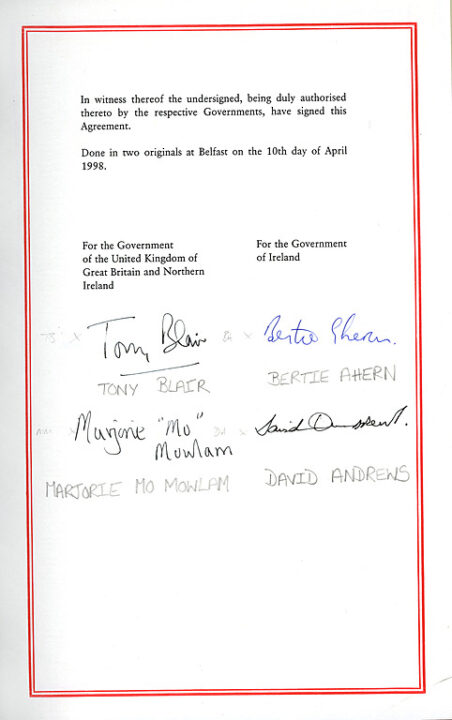
Image of signatures of Tony Blair, Bertie Ahern, Marjorie Mowlam and David Andrew on the British-Irish Agreement 1998 (catalogue reference: FO 93/171/33)
5. Security forces and paramilitaries
5.1 How to conduct a general search
Use the advanced search option in our catalogue to search within the records of one or more of these departments.
- Ministry of Defence (DEFE)
- Northern Ireland Office (CJ)
- War Office (WO)
- Prime Minister’s Office (PREM)
- The Foreign and Commonwealth Office (FCO)
A keyword searching can be a good way to begin. Try searching by:
- Deployment
- Troops
- Paramilitary
- Operation
To search for records that relate to the deployment and operations of British troops, try searching our catalogue using ‘deployment AND Northern Ireland’ or ‘army AND Northern Ireland’ as keywords.
PREM 13 – contains discussions on the deployment of British troops in Northern Ireland at the Prime Minister’s Office.
FCO 87 – includes the reaction from the Republic of Ireland government on the deployment, operations, and actions of British troops in Northern Ireland.
5.2 British Troops in Northern Ireland (1969-2007)
This guide contains advice on locating records of British unit war diaries and operational records, as opposed to records of individual soldiers. These records are varied, sometimes incomplete and held in a variety of places.
How to locate unit diaries and other operational records
If you use the Advanced search option you can focus your search by entering an appropriate date range and/or the reference for a particular department. Many records are not viewable online. To view records which are not online you will need to visit The National Archives at Kew or pay for research.
- WO 305 – includes unit diaries, army headquarter diaries, detachment reports and orders, and post-tour reports of the British troops stationed in Northern Ireland and the Ulster Defence Regiment.
- ADM 202 – contains unit diaries, detachment reports and orders for Royal Marines stationed in Northern Ireland.
Not all the records have been given specific or detailed descriptions in our catalogue (some, for example, may be catalogued as ‘Miscellaneous’, or other generic descriptions) so keyword searches will not always find everything on that subject.
Nevertheless, keyword searching can be a good way to begin. Try searching by:
- Name of unit. If you are looking for war diaries or other records related to specific British Army regiments and other units – these are often recorded in our catalogue using abbreviations so try a variety of terms when searching (for example, ‘Regt’ as well as ‘Regiment’).
If you do not know the name of the unit, try searching within the series for ‘headquarters AND Northern Ireland’ or search ‘Northern Ireland AND WO 305’ and narrow the date range of your search
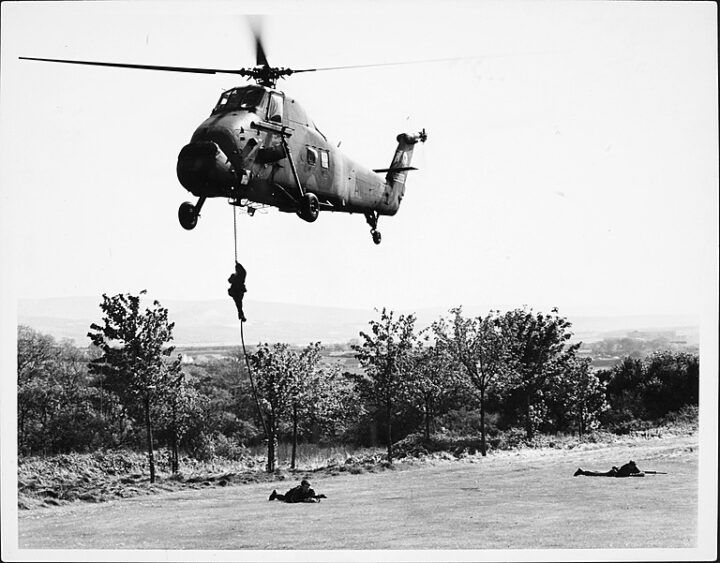
Image of Commando Royal Marines training Northern Ireland 1976 (catalogue reference ADM 202/611)
5.3 Northern Irish security forces
For records on the security forces in Northern Ireland, search for the name of the organisation, for example ‘Royal Ulster Constabulary’ or ‘RUC’ or ‘Ulster Defence Regiment’ or ‘UDR’.
DEFE 70 – contains information on Northern Irish security forces, for example, try searching our catalogue for ‘Ulster Defence Regiment’.
Often files on Northern Ireland security and army in the DEFE 70 series are catalogued simply as ‘Northern Ireland’.
5.4 Paramilitaries
The National Archives holds British government files on paramilitaries. Use our catalogue to search for records on paramilitaries. You can also search using the name of Republican or Loyalist paramilitary groups, for example ‘Irish Republican Army’ or ‘IRA’ or ‘Ulster Volunteer Force’ or ‘UVF’.
You can try searching for individual members of paramilitary organisations in the catalogue, but unless they are well known, you are unlikely to find them by searching their names.
A useful glossary of Republican or Loyalist paramilitary groups active during the Troubles has been compiled by the CAIN archive (see section 7 for further information).
CJ 4 – contains records relating to the activities of paramilitary groups.
Army unit and army headquarter diaries include reports on the activities of loyalist and republican paramilitaries throughout the conflict. See section 5.2 for more information.
Search for allegations of collusion between the British government and various paramilitaries by searching ‘paramilitaries AND Collusion’.
5.5 Violent incidents
The records held at The National Archives do not usually focus on victims of Troubles related incidents. Try searching using keywords and the terms ‘victims’ AND Northern Ireland’ to highlight records that contain information on victims at a high level.
Violent incidents occurred throughout the Troubles. For records on violent incidents, you can use general search terms like, ‘violent incidents’, ‘shooting’, or ‘internal security’ or AND Northern Ireland.
FCO 87 – contains records on major bombing incidents.
CJ 4 – contains records on major bombings and violent incidents.
If the incident occurred in Northern Ireland search within:
Unit diaries can provide a useful insight into reports of all types of violent incident that occurred during the conflict. See section 5.2 for more information.
- DEFE 70 – contains analysis of bombing patterns and other patterns of violence in Northern Ireland.
Information on bombings and other violent incidents that occurred in mainland Britain often generated files from multiple government departments, including the Metropolitan Police.
If you are searching for a bombing that occurred in a particular place, search our catalogue using the location and the word ‘bomb’.
You can find lists of major violent incidents relating to the Troubles here which has been compiled by the CAIN online archive (see section 7 for further information).
6. Legal
6.1 Internment
To search for files on internment, narrow the date range from 1971 to 1975 and try searching ‘Internment AND Northern Ireland’, ‘special powers AND Northern Ireland’ or search for an internment location, such as ‘Long Kesh’.
CJ 4 – contains records that relate to internment and the treatment of detainees and allegations of ill-treatment by security forces. Try searching using ‘European Commission on Human Rights’ and ‘Red Cross’ as keywords.
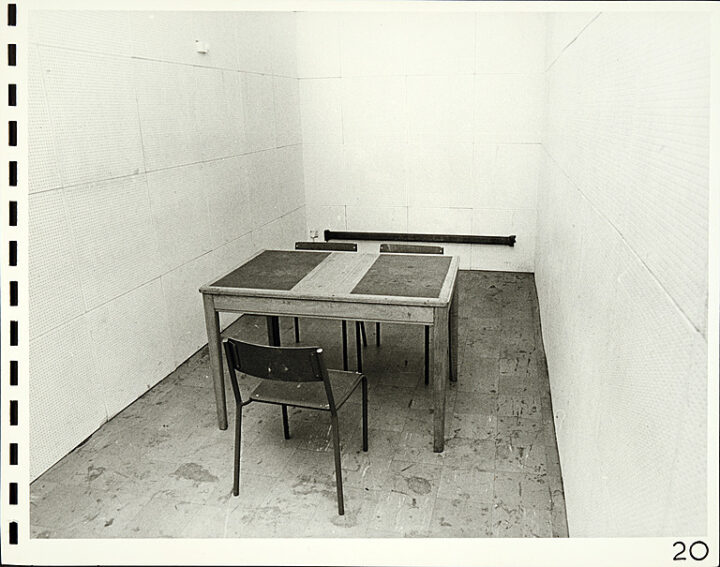
image of Police holding centre interview room, RUC Holywood, Co Down 1972 (catalogue reference: CJ 4/435/2)
6.2 Court cases
If a violent incident associated with the Troubles occurred in England, often court cases contain witness depositions from victims. Consult our guide to Criminal court cases: an overview for advice on locating court records.
6.3 Prisons and prisoners
For records that relate to prisons in Northern Ireland and their role during the Troubles search our catalogue using ‘Prisons AND Northern Ireland’ as keywords.
If you are interested in a specific prison, refine your search to the prison name for example ‘Maze’, ‘Armagh’, or ‘Maghaberry’.
CJ 4 – contains files on prisoners, prison escapes, and prison protests including hunger strikes. Access to some of these records remains closed.
HO 325 – holds files on the transfer of prisoners. Access to some of these records remains closed.
6.4 Extraditions
Search for ‘extradition AND Northern Ireland’ or if you know the name of the individual who was extradited or considered for extradition for Troubles-related incidents to or from the UK to other countries, you can search for their name and ‘extradition’ in the catalogue.
6.5 Inquests
To search for records that relate to inquests into Troubles-related deaths and legal issues surrounding the administration of inquests, search for ‘inquests AND Northern Ireland’ across record series.
CJ 4 – contains a small collection of files on individual inquests, search for the name of the individual to which the inquest relates in this record series.
6.6 Investigations and Inquiries
Search within HO for records on government and police investigations into Troubles-related incidents. For example:
HO 287 – contains police files on investigations into bombings, including complaints and discipline procedures in relation to bombing investigations.
HO 504 – contains files in the Inspectorate of Constabularies records on the Inquiry into the Guildford and Woolwich pub bombings.
To search for government inquiries related to the Troubles, try searching our catalogue using keywords such as ‘Inquiries AND Northern Ireland’.
If you know the specific title of the inquiry and the date of the publication, you can use these in your search.
7. Records in other archives
Many other archives and libraries have large collections of written, visual, and audio material relating to the Troubles which include:
- Public Record Office of Northern Ireland
- Linen Hall Library
- National Museums Northern Ireland
- The Prisons Memory Archive
- The National Archives of Ireland
- The Troubles Archive
8. Further reading
- CAIN online archive: Conflict and politics in Northern Ireland
- Writing the ‘Troubles’ (wordpress.com)
- Divided Society
9. Printed resources
Many books have been published about the Troubles in Northern Ireland. Use our library catalogue to see what is available to consult at Kew.
Paul Bew and Gordon Gillespie, Northern Ireland: a chronology of The Troubles, 1968-1999 (Dublin, 1999)
Paul Bew and Gordon Gillespie, The Northern Ireland peace process 1993-1996: a chronology (London, 1996)
Marianne Elliott, When God took sides: religion and identity in Ireland, unfinished history (Oxford, 2009)
Thomas Hennessy, The Northern Ireland peace process: ending The Troubles? (Dublin, 2000)
Thomas Hennessy, The evolution of The Troubles. 1970-72 (Dublin, 2007)
David McKittrick and David McVea, Making sense of The Troubles (London, 2012)
Claire Mitchell, Religion, identity, and politics in Northern Ireland: boundaries of belonging and belief (Aldershot, 2006)
Margaret M. Scull, The Catholic Church and the Northern Ireland Troubles, 1968-1998 (Oxford, 2019)
This is a guide to searching for records of criminal court cases in England and Wales.
Over the centuries there have been many different types of criminal courts, some of which no longer exist and others that continue to this day. The courts have always been organised into a hierarchical structure. We have published guides for each of the different kinds of courts whose records we hold at The National Archives. This guide will help you to determine the court and therefore where to look for the records, whether at The National Archives itself or elsewhere.
Most of the court records we hold are not online and to see them you will need to consult them at our building in Kew or pay for copies to be made and sent to you.
How the records are arranged
Records are arranged by the court that created them, then by the type of record, such as indictments or depositions, and by date. For any case there may be a number of different types of records, each of which will usually have to be searched for separately. There are relatively few court transcripts (records of what was said in court) – they tend to exist more for cases that go to appeal.
How to search for records
In general, you cannot search for records of criminal court cases by the names of defendants or anyone else involved in the case, though there are some exceptions to this, notably with Crown court records held at The National Archives. Usually you will need to know when and where a trial took place to have any hope of finding records. To search for records, follow these steps:
Step 1: Establish which court heard the case and when.
Consult the following to try to establish these two key facts:
- Newspapers. If you know when the trial took place but don’t know which court they were heard in, you may find the missing details in local newspaper reports. Newspapers reported on some criminal cases and the reports are often more informative than the court records themselves. Consult the British Library Newspaper Library or the appropriate local county record office.
- Criminal registers and calendars. These records of convicted criminals can provide the place and date of their conviction and many are searchable online by name. Search at Ancestry.co.uk for criminal registers 1791-1892 (£) and at Findmypast.co.uk for criminal registers, calendars and other related records 1770-1935 (£).
Step 2: Establish where the records for the court type are held
Once you know the court, use the following sections of this guide to locate advice on where to find records for that type of court. We have listed the different types of criminal courts by period, each with brief details of where to find the respective records. Click on the links to be directed elsewhere or to one of our guides.
Step 3: Consult the respective research guide
Use our guides for search advice on each of the courts whose records we hold. Searches at The National Archives usually begin in our online catalogue. A successful catalogue search will unearth short descriptions of the court records and a document reference for each – you will need the document reference to see the record itself or to request copies. For more guidance on searching or browsing our catalogue, visit our Discovery help pages.
Criminal courts and their records since 1972
On 1 January 1972 the Crown Court system was born, replacing assize courts. This was part of a complete restructuring of the local courts structure which saw petty sessions and quarter sessions courts abolished too. The structure now looks like this, from bottom to top:
Magistrate courts are at the base of the pyramid. They deal with the majority of all criminal (and civil) cases, estimated at 95%. These are the less serious, or ‘summary’ offences, such as drunk and disorderly behaviour, criminal damage or common assault, some of which can carry a prison sentence, though rarely more than six months.
Magistrate court records are not held at The National Archives. Search for these records at:
- the courts themselves (records are generally held by the courts for between three and six years after the case)
- the Courts and Tribunal Service
- county and city record offices (use our catalogue to search for records held by ‘other archives’, using ‘magistrates’ and either a city, town or borough as your keyword search terms)
Crown courts tend to be used for the more serious criminal trials. Crown court records are held in one of three places:
- At the Crown court itself – the courts keep their own records for around three to six years.
- The Courts and Tribunal Service – go to the Freedom of Information request section.
- The National Archives – Crown court records should arrive in our repositories twenty to thirty years after the case was heard but this is only sometimes the case. Use our Crown courts guide for advice on all Crown court records including those of the Old Bailey, the most famous Crown court, also known as the Central Criminal Court.
Supreme Court of Judicature: Queen’s Bench Division deals with appeal cases previously handled by a lower court. See our guide to King’s/Queen’s Bench Division for advice on records up to 1988. For records since 1988 contact Courts and Tribunal Service.
Court of Appeal records can be for civil or criminal cases. For guidance on records of criminal appeal cases see our guide to records of criminal court appeal cases.
Supreme Court of the United Kingdom was established in 2009 as the final court of appeal and the peak of the court pyramid. It replaced the House of Lords as the highest appeal court in the land. For records of either the Supreme Court or House of Lords cases, contact the Parliamentary Archives.
The Find Case Law service provides public access to recent judgments from the England and Wales High Court, the Court of Appeal, the Supreme Court and tribunal decisions from the Upper Tribunals. The service will be expanded to include more courts and tribunals and a greater range of judgments will be added. For more information see the website.
Criminal courts and their records from 1876 to 1971
In 1875 the central courts in London were amalgamated into the Supreme Court of Judicature, consisting of a High Court and a Court of Appeal. The lower courts hierarchy, which had been in place since the medieval period continued up until 1971. From bottom to top, the court hierarchy was as follows:
Petty sessions were at the base of the pyramid, where minor offences were dealt with by mostly unpaid, non-professional judges known as Justices of the Peace (also known as magistrates). The records are held in local archives. Use our Find an archive tool to search for the location and contact details of local archive offices or search our catalogue using the phrase ‘petty sessions’ plus the name of a county, city or town, ensuring you select the ‘Other archives’ catalogue results filter.
Quarter sessions were held four times a year and were also presided over by Justices of the Peace. Quarter sessions records are also held in local archives. Use Find an archive to search for the location and contact details of local archive offices or search our catalogue using the phrase ‘quarter sessions’ plus the name of a county, city or town, ensuring you select the ‘Other archives’ catalogue results filter.
Assize courts were where the more serious criminal trials tended to be heard, taking place at least twice a year and presided over by professional judges. See our guide to the criminal assizes for advice on finding records, though there is a separate guide for records of the Old Bailey (Central Criminal Court).
Supreme Court of Judicature was established in 1875, bringing the central courts under the same banner but separated into divisions. The King’s Bench Division (or Queen’s Bench Division) replaced the Court of King’s Bench and became the highest court in England and Wales for criminal cases. See our guide to records of King’s/Queen’s Bench.
The Court of Appeal was also established in 1875. The criminal division of the Court of Appeal was established in 1966 (before then a criminal appeal had to be submitted to the Secretary of State for Home Affairs). Its records can be for civil or criminal cases. For guidance on the records of criminal appeal cases see our guide to records of criminal court appeal cases.
Criminal courts and their records from 1485 to 1875
From bottom to top, the court hierarchy was as follows (most of the records up until 1733 are in Latin):
Petty sessions where minor offences were dealt with by mostly unpaid, non-professional judges known as Justices of the Peace (also known as magistrates). See search advice in previous section.
Quarter sessions were held four times a year and were also presided over by Justices of the Peace. See search advice in previous section.
Assize courts where the more serious criminal trials tended to be heard, taking place at least twice a year and presided over by professional judges. See our guide to the criminal assizes for advice on finding records, though there is a separate guide for records of the Old Bailey (Central Criminal Court).
The central courts in London, which consisted of the Court of King’s Bench and the Court of Star Chamber (up until 1642), were at the peak of the pyramid. These courts handled cases referred up the chain from the lower courts.
Criminal courts and their records from 1194 to 1484
The origins of the modern English legal system were established when the Court of Common Pleas emerged in the late 12th century. It sat in Westminster Hall. During the late 12th and 13th centuries, small groups of judges were sent from the central courts at Westminster to the counties of England to preside over local courts known as eyres. We hold some of the records created by these courts – see our guide to General Eyres 1194-1348. Records will be in Latin.
1. Why use this guide?
Use this guide if you are looking for an appeal against a criminal conviction in England or Wales after 1848.
Prior to the establishment of the Court of Criminal Appeal in 1907 convicted criminals had no right to appeal against their conviction although they could petition for a reduction of their sentence. See our guide to Criminal Transportation for more information.
Criminal convictions could be reviewed on points of law from 1848 by the Court for Crown Cases Reserved but cases could only be referred to the court by trial judges.
This guide mainly focuses on records of the Court of Criminal Appeal, from 1907, and the Appeal Court, from 1966.
2. How do I search for records?
Most appeal case records held at The National Archives give very few details about the original case and only briefly note the decision on appeal.
Only a 2% random sample of records were preserved after 1927.
You can search for some records by name using advanced search in our online catalogue, Discovery, but often you will need to browse records by date. If you need advice on how to browse, read our Discovery help pages.
The National Archives may not be the best place to start your research, especially for more recent cases (1995 onwards). Recent court documents are with the Ministry of Justice but full judgments and court transcripts may be available via online legal databases (subscriptions may be required).
Significant cases are likely to have been published in The Law Reports, giving basic facts. From 1884 Law reports were published in The Times (charges apply) which you can view free of charge at The National Archives, Kew.
3. The Court for Crown Cases Reserved (1848-1907)
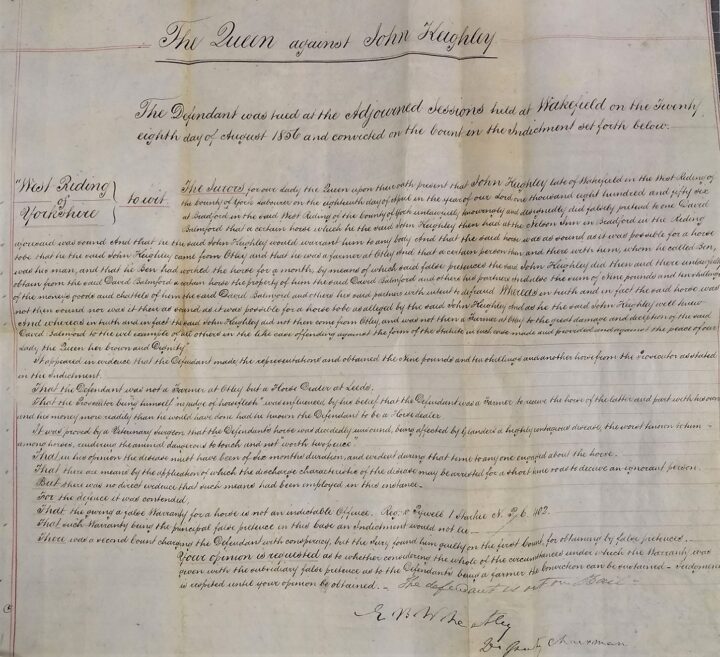
KB 30/2 is a box of pleadings referred to the Court for Crown Cases Reserved. The image shows a referral from Yorkshire West Riding assizes as to whether selling a diseased horse as healthy is an indictable offence.
In 1848 the Criminal Law (Amendment) Act established the Court for the Consideration of Crown Cases Reserved which was presided over by Judges of the High Court. Cases could only be referred to the court by the trial judges and its function was to make judgments on points of law. It did not allow a retrial nor could it alter a sentence but it could quash a conviction.
This court’s order books only survive for 1853-1859 and are in KB 31.
The pleadings of the court for 1848-1888 are in KB 30 but do not give the results of cases.
You can browse both record series by year, but not by name.
Draft pleadings submitted from the Central Criminal Court are in CRIM 11 with the judgments and orders made in response in CRIM 12.
4. The Court of Criminal Appeal, 1907-1966
The Court of Criminal Appeal was established in 1907 and heard appeals in criminal cases, both on the verdict and on the sentence.
Registers of the Court of Criminal Appeal, from 1908 (but with a gap from 1910-1913) are in J 81. Search these by date. For later years there are multiple pieces for each year, you will need to order each piece as your case could be in any of them.
They contain:
- the name of the applicant
- date and place of conviction
- the offence, sentence, type of appeal
- whether leave to appeal and legal aid was granted
- the outcome
Some earlier files of cases originally heard by the Central Criminal Court that went on to appeal, such as the Crippen case of 1910 and the Casement case of 1916, are in CRIM 1. Search these by name of defendant and charge.
Selected case files are in J 82 (1945-2011) and include formal notices of Appeal and shorthand notes of the original trial. You can search these by name of accused or charge.
Transcripts of proceedings in selected criminal cases, brought by the Director of Public Prosecutions, some of which went on to appeal, are in DPP 4 (1846-1958). Search by name and offence/charge.
A selection of judges’ notebooks from Court of Appeal and Court of Criminal Appeal proceedings are in J 130 (1916, 1947-1984). Apart from one relating to Roger Casement’s trial in 1916, these start in 1947. You can search by judge’s name and sometimes by area of law or type of court.
5. Criminal appeals after 1966
In 1966 the Court of Criminal Appeal was merged with the Appeal Court, sitting in two divisions, one civil and the other criminal.
Selected case files continue in J 82 up to 2011. You can search these by name of accused or charge.
Judge’s notebooks continue in J 130 up to 1984.
The Find Case Law service provides public access to recent judgments from the England and Wales High Court, the Court of Appeal, the Supreme Court and tribunal decisions from the Upper Tribunals. The service will be expanded to include more courts and tribunals and a greater range of judgments will be added. For more information see the website.
6. Appeals to the House of Lords
Records relating to cases heard by the House of Lords on appeal are held with records of the Parliament’s Archive Collections now at The National Archives.
Copies of judgments made by the House of Lords on appeal from the Court of Appeal, together with petitions of appeal, are in KB 34/1 for the period 1885-1906.
The highest court of appeal for criminal cases in England, Wales and Northern Ireland is now the Supreme Court.
7. Records in other archives
The Guildhall Library holds various collections of published law reports.
The British Library and the Law Society Library hold indexes to Court of Appeal transcripts.
8. Further reading
Visit the National Archives’ shop for a range of publications relating to courts and the legal profession.
Pattenden, English criminal appeals, 1844-1944: appeals against conviction and sentence in England and Wales (Clarendon, 1996)
Lord Justice Cohen, ‘Jurisdiction, practice and procedure of the Court of Appeal’, Cambridge Law Journal, volume 11, number 1 (1951)
1. Why use this guide?
The National Archives has a significant collection of records relating to the production and regulation of film by government. However, it is unlikely to be the best place to start if you are trying to research film more generally.
This guide will help you to research:
- government as a film-maker for cinema and television
- government regulation of and support for the film industry
Most of the films made by the UK Government are held elsewhere – notably at the British Film Institute (BFI) and the Imperial War Museum (IWM). This is changing with the advent of digital film (see section 2.2).
Government has used film to educate, inform and influence populations at home and abroad. Some examples of areas covered by government-made films are:
- recruitment and training of armed forces personnel
- war-time propaganda
- public information – for example around health and child-care
- information about industry and agriculture
- promotion of Britain and the Commonwealth abroad
2. Government film-making bodies
Since the 1920s, a number of government bodies have fulfilled the government’s film-making remit. Most of them are described here.
2.1 Empire Film Unit 1926-1933
The Empire Film Unit was part of the Empire Marketing Board and shared its remit to promote trade across the Empire. The Film Unit employed some pioneering film makers such as John Grierson, Basil Wright, Harry Watt, Paul Rotha and Evelyn Spice.
2.2 General Post Office (GPO) Film Unit 1933-1940
The GPO Film Unit was established in 1933 as part of the Public Relations department. At that time, the GPO was the largest UK employer and was responsible for developing a national communications infrastructure. The films, such as the highly acclaimed Night Mail (1939), were a way of promoting understanding and good customer relations.
2.3 Colonial Film Unit 1939-1955
The Colonial Film Unit was part of the Colonial Office’s Public Relations department. Films contributed to the publicity and propaganda about the colonies in Britain and abroad.
2.4 Crown Film Unit 1940-1952
The GPO Film Unit became part of the Ministry of Information (MOI) in 1940 and at this point changed its name to the Crown Film Unit. The unit produced propaganda and information films during the war, and continued to use and develop the documentary format. When the MOI closed in 1946, the unit became part of the Central Office of Information.
2.5 Ministry of Information 1939-1946
The Ministry of Information (MOI) incorporated the Crown Film Unit and produced wartime propaganda and information films including Humphrey Jennings’ Words for Battle (1941) and Listen to Britain (1942).
2.6 Central Office of Information 1946-2011
The Central Office of Information (COI) was responsible for the production of numerous films looking at subjects relating to life in the United Kingdom and parts of the former British Empire.
3. Where you can see films produced by government
Government films produced by the Empire, General Post Office, Colonial and Crown Film Units, and the Central Office of Information have been collected and preserved by three main institutions. These are The National Archives, the British Film Institute and the Imperial War Museum, with the BFI holding the largest collection. Some films are available to view online from these organisations. The British Universities Film and Video Council has also made some government films available online.
3.1 The National Archives
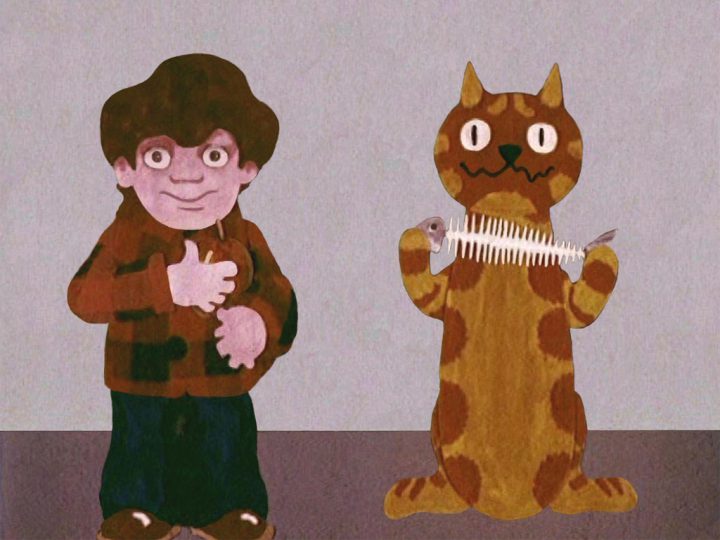
A still from one of a series of animated public information films, known as the ‘Charley Says’ films, produced by the Central Office of Information.
A selection of public information films produced by the Central Office of Information between 1945 and 2005 are available as an archived exhibition in the Web Archive. They were part of national campaigns to increase public awareness of various health, safety, welfare, education and rights issues. Many of the films were aimed at children and were shown during breaks in children’s television programmes.
The films are held in record series INF 32. You can see the full list by browsing through INF 32 in our catalogue. Some of the films are also available online through the British Film Institute (BFI).
The National Archives also has some born digital films. To date, this is a small part of our collections but is likely to grow. Examples include:
- Films from the London Organising Committee of the Olympic and Paralympic Games (LOCOG) in record series LOC 5
- Video evidence from the Iraq Inquiry in record series CHIL 2
- Video evidence from the Inquiry into the death of Alexander Litvinenko in record series LITV 2
To find digital films in our catalogue, search it using the file endings MOV, WMV, MP4 or MPG as search terms, adding a date range to narrow your results. To search using all of these terms at the same time, copy and paste the Boolean search below into the search box in our catalogue, again using the date fields to help target the search:
“MOV” OR “WMV” OR “MP4” OR “MPG”
You can also use the advanced search page to construct searches. For example, you could use the ‘any of these words’ boxes to enter up to three of the file extensions as your search terms.
3.2 British Film Institute
The British Film Institute (BFI) has its own archive, the BFI National Archive, in Berkhamsted, Hertfordshire. It holds a substantial collection of government films covering many aspects of life in Britain.
Some can be viewed in the BFI Free collection online. To see those not available online you will need to contact the BFI to make arrangements to view films for research. Alternatively, you can buy collections of government films on DVD from the BFI shop.
Some of the government films at the BFI archive are preserved and presented by the BFI on behalf of The National Archives (as opposed to being part of the BFI’s own collections). You can view descriptions of these collections in our catalogue, as follows:
- Public Information Films produced by the Crown Film Unit 1940-1952 in series INF 33. These include short information and documentary films, as well as longer drama documentaries. During the Second World War, films were used to inform and influence the public. Post-war films covered the British Empire, health and medicine, science, the natural world, arts and culture, and everyday life in towns and the countryside.
- Films produced by the Ministry of Information and Central Office of Information 1931-2011 in series INF 34. These films cover health and welfare, industry and culture, crime prevention, food and farming, and the environment.
- Films made by government departments and agencies 1900-2011 in series CD 1.
- Films produced by the National Coal Board and British Coal Corporation in series COAL 105. Includes the long running cinemagazine ‘Mining Review’ 1948-1992.
3.3 The Imperial War Museum
The Imperial War Museum’s (IWM) film collection includes many government films, some of which can be viewed online. Search the IWM film collection using film title, director, production company or lead cast members. Otherwise, try searches for terms such as:
- Crown film unit
- GPO film unit
- COI (Central Office of Information)
- GOV
- War Office/Army
- Air Ministry/Royal Air Force/RAF
- Admiralty/Royal Navy
3.4 British Universities Film and Video Council (BUFVC): Learning on Screen
The British Universities Film and Video Council website has over 600 examples of the cinemagazine production, ‘Roundabout’. These were made between 1962 and 1974 to promote Britain specifically to audiences in Asia.
4. Sources for researching government involvement in film-making
In this section of the guide you will find advice on how to search for records that document government involvement in film-making, including policy and regulation documents, contracts, commentary on films and so on. Here we help you focus your searching in record series and departments likely to produce the most fruitful and comprehensive results. However, it is also worth trying some speculative searches across our catalogue as records relating to film are scattered among many departments.
Try searching the catalogue using terms such as ‘film’ and ‘cinema’. You can focus your search by adding dates. On the search results page, use the filters on the left to select criteria to make your results more relevant.
If you’re looking for files on regulation you could add relevant department references such as BT for Board of Trade, FV for Department of Trade and Industry or T for Treasury.
Similarly, to find files relating to film commissioning and production from specific government departments, use the department reference to narrow down your search results – for example WO for War Office or FO for Foreign Office.
If you don’t know the department reference go to the catalogue advanced search option and in the section headed ‘Held by’, select ‘Search The National Archives’. This opens up additional search options. In the section headed ‘Records by government department creators’ you can enter the name of a department and find the relevant reference.
Use our Discovery help pages or watch a tutorial on our Archives Media Player for advice on how to construct a search.
4.1 Ministry of Information and Central Office of Information
A number of series from the Central Office of Information and its predecessors contain references to film production and policy. In particular, the series below are useful. Click on the link in the list to get to the series description page in our catalogue. Then either click on browse to see descriptions of files in the series, or enter search terms to look for something specific from that series.
- Crown Film Unit files in INF 5
- Film production documents in INF 6 (see below)
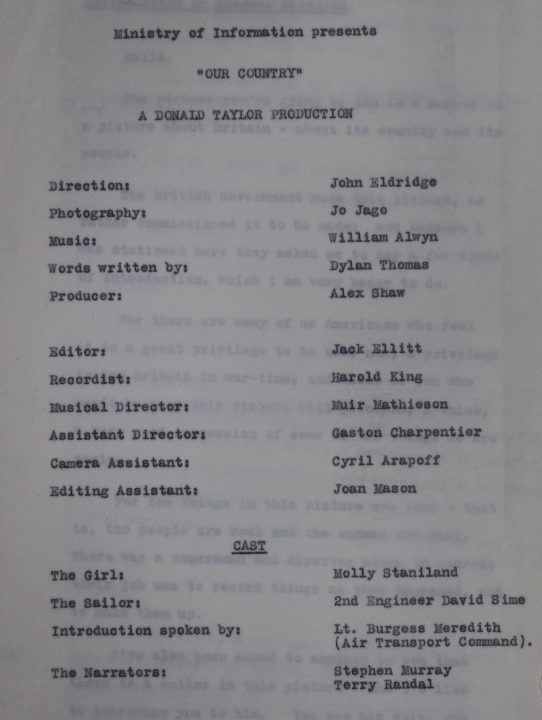
A production document from a 1944 Ministry of Information film called Our Country, narrated by Dylan Thomas (document reference INF 6/630).
These cover a selection of the films made or commissioned by the Crown Film Unit, Ministry of Information and Central Office of Information. Some relate to films held at the British Film Institute and Imperial War Museum. Some files are rather bare, but others contain a wealth of useful information. They can include:
- commissioning letters signed by the writer or contractor concerned
- offer and acceptance of contract
- music licence
- music cue sheet
- commentary
- shot list
- shooting script
- notification of completion
Names of well-known writers, artists and directors can appear in production files. During the Second World War, many now-famous writers and artists worked for the Ministry of Information and some well-known directors began their careers working on government-commissioned films. You might come across names of such people when consulting the physical production files, but they are unlikely to appear in the descriptions of files in our catalogue.
- Monthly divisional reports in INF 8
- Music scores from selected films in INF 15
- Empire and General Post Office Film Library Correspondence in INF 17
- Annual service reports in INF 18
4.2 Foreign Office and the Overseas Information Service
After the Second World War, the newly formed Central Office of Information (COI) worked with the overseas information services of the Foreign Office, the Commonwealth Relations Office and the Colonial Office, to produce films to promote Britain abroad. As television grew in popularity, films were increasingly made to be broadcast over this medium.
In particular, the cinemagazine format was used, consisting of ‘hard information’ such as political interviews and ‘soft information’ such as segments on fashion trends.
Cinemagazine titles included:
- This Week in Britain 1959-1980
- Calendar 1960-69
- Roundabout 1962-1974
- London Line 1964-1979
Selected production files from cinemagazines are in record series INF 6.
To find out more about the development of policy and practice in this area:
- Search our catalogue using search terms such as ‘overseas information service’ and ‘overseas television service’.
- Select records held by ‘The National Archives only’
- Apply dates to your search
- Refine your results using the filters on the search results page
4.3 The armed forces
The armed forces have used film for their own internal purposes such as training and recruitment, as well as for propaganda. The War Office was at times also asked to provide support for commercial films by loaning equipment and making personnel and locations available.
The First World War was the first time that film had been used for propaganda. In 1916 a War Office Cinematograph Committee was set up and operators were sent to combat zones to record events. These were made into newsreels as well as longer features.
The government also produced ‘film-tags’. These were short films – usually about two minutes long – for home audiences. They were attached to the end of longer films, and usually carried a message such as ‘Save Coal’ or ‘Buy War Loans’. It was estimated that film-tags were seen by about 10 million people.
To find files relating to the armed forces and film:
- Go to the advanced search of our catalogue
- Enter WO, AIR or ADM (the references for War Office, Air Ministry and Admiralty records) in the ‘search for or within references’ box
- Search with keywords such as film, kinema and cinema; combining ‘film AND’ with some of the following keywords may also prove worthwhile:
- unit
- section
- operation
- campaign
- provision (includes providing support for commercial films)
- training
- warfare
- catalogue
4.4 The British Council
The British Council was responsible for developing cultural and commercial links between the UK and other countries. To find records relating to the use of film in this area, search our catalogue using terms such as ‘British Council’ AND film.
4.5 The National Coal Board and British Coal Corporation
Coal mining was an important aspect of the UK’s industrial policy after the Second World War, and hundreds of thousands of workers were employed in the industry. The films created by the Coal Board were intended to inform and encourage support for the coal mining industry by the British public.
Search our catalogue with terms such as ‘Coal AND film’ to find records relating to the National Coal Board film-making policies and processes.
5. Sources for researching government regulation and support of the film industry
5.1 The Board of Trade
The Board of Trade files are a rich source of information about the regulation and support of the film industry. To get a sense of what you might find, try browsing through the Films subseries of BT 64.
Following the 1927 Cinematograph Films Act, exhibitors and distributors had to use a percentage (or quota) of British made films. Search our catalogue for reference to the film quotas.
Board of Trade files include records of bankruptcies amongst directors and film companies, and cinemas going bust. Use the advanced search function in our catalogue to search within files from the Board of Trade (reference BT) with terms such as:
- film AND dissolved
- cinema AND dissolved
- director AND bankruptcy
- cinema AND bankruptcy
5.2 The Eady Levy and British Film Fund Agency
The Eady Levy was a tax on box-office receipts introduced to help the British film industry compete against American producers. It was voluntary when it was first introduced in 1950 but became compulsory under the 1957 Cinematograph Films Act.
Funds raised by the levy were managed by the British Film Fund Agency which allocated them back to exhibitors and to makers of ‘British-made’ films. To qualify as British-made, films had to be mostly shot in the UK or the Commonwealth with a largely British cast and crew.
To find files relating to the Eady Levy and British Film Fund Agency, search our catalogue using a date range and keywords such as:
- Film levy
- British Film Production Fund
- British Film Fund Agency
Alternatively, use the advanced search page and focus on collections from the Board of Trade (BT) and its successors, the Department of Trade and Industry (FV) and the Department of Trade (PJ). Enter your search terms and then add these department codes, (BT, FV, PJ) in the references search boxes to restrict your results to those departments only.
5.3 National Film Finance Corporation
The National Film Finance Corporation (NFFC) made loans to independent producers where there was a reasonable expectation of commercial success. The organisation was initially set up in 1949 with the intention of boosting the British film industry so that private investment would return. In the end, the NFFC continued to make loans until 1985 when it was wound up.
To find files relating to the NFFC, search our catalogue using keywords such as:
- National Film Finance Corporation
- NFFC
5.4 The Treasury and the Inland Revenue
The Treasury and the Inland Revenue played a part in supporting and raising taxes from the film industry. Use the advanced search option of the catalogue, and in the ‘search for or within references’ box enter ‘T’ for Treasury or ‘IR’ for Inland Revenue to restrict the search to records from those departments. Then search using keywords such as film or cinema.
5.5 The Home Office
The Home Office was sometimes drawn in to public debates around controversial films, particularly where they caused social disruption as with Rock Around the Clock in 1956.
Search record series HO 300, which includes files relating to censorship and licensing of entertainments, with keywords such as ‘film’ or ‘cinema’.
The Home Office Committee on Obscenity and Film Censorship was set up in 1977 to review the laws concerning obscenity, indecency and violence in publications, displays and entertainments, and to review the arrangements for film censorship.
Record series HO 265 contains evidence and papers from this committee and is described in significant detail in the catalogue. To find evidence submitted by film related bodies and numerous other organisations and individuals that submitted evidence to the Committee on Obscenity and Film Censorship, search within HO 265 using keywords such as film, cinema or cinematograph. Alternatively, try browsing the series.
6. Legislation
Legislation has been used to:
- regulate licensing and safety issues in cinemas
- define suitable and unsuitable content for adults and children
- regulate production and exhibition of films, protecting the UK film industry from US competition
- establish support for the film industry with loans through the National Film Finance Corporation
Search our catalogue for files relating to regulation of the film industry using search terms such as:
- film regulation
- cinema regulation
- film quota
- film industry
- film tax
Search Legislation.gov.uk for the text of various Cinematograph and Film acts.
Search Hansard for the text of Parliamentary debates on film and cinema regulation.
Our research guide to Hansard details different ways of accessing the reports and records of Parliamentary debates.
Some of the key Acts that affected the industry are:
- 1909 Cinematograph Act – government’s first attempts to regulate the running of cinemas with an emphasis on fire safety due to the use of flammable nitrate film. The Act was strengthened to give local authorities greater powers to regulate safety following the 1929 Glen Cinema disaster in Glasgow.
- 1927 Cinematograph Films Act – for a 10 year period, cinemas were required to show a quota of British films; these were defined as films where 75% of salaries went to British Subjects including a British writer. Films produced throughout the British Empire were covered by the Act
- 1932 Sunday Entertainments Act – regulated Sunday opening for cinemas
- 1938 Cinematographic Films Act – extended the quotas introduced by the 1927 Act, but this time excluded nations in the British Empire.
- 1952 Cinematograph Act – prohibited children from watching ‘unsuitable’ films.
- 1957 Cinematograph Films Act – introduced the Eady levy which took a percentage of box office takings and invested them back into production including through the Children’s Film Foundation Limited
- 1960 Films Act – consolidated previous Acts from 1938 onwards and made it illegal for distributors to force cinemas to take poor quality films along with their blockbusters by putting them together in bundles
- 1985 Cinemas Act – the most current legislation regulating licensing and operation of cinemas. Repealed previous Acts and abolished quotas (which had been suspended since January 1983)
7. Further reading and other resources
7.1 Publications
Cinema and the State: the Film Industry and the British Government 1927-1984 by Margaret Dickinson and Sarah Street
The Projection of Britain: a History of the GPO Film Unit by Scott Anthony and James Mansell
Protecting the People: The Central Office of Information and the Reshaping of Post-War Britain 1946-2011 by David Welch
Projecting Britain: The Guide to British Cinemagazines edited by Emily Crosby and Linda Kaye
British Film Industry 1980, BFI Library Services leaflet available as a PDF
Films for the Colonies: Cinema and the preservation of the British Empire by Tom Rice, University of California Press, 2019
Empire and Film (Cultural Histories of Cinema) by Lee Grieveson and Colin McCabe, British Film Institute, 2011
7.2 Online articles
A Technicolor Ride Through the 60s and 70s by Linda Kaye (BUFVC website)
War Office Official Topical Budget newsreels BFI, screenonline.org.uk
Empire Marketing Board Film Unit BFI, screenonline.org.uk
GPO Film Unit BFI, screenonline.org.uk
Crown Film Unit BFI, screenonline.org.uk
History of the British Film industry parliament.uk
History of the BBFC (British Board of Film Censors) bbfc.co.uk
List of allied propaganda films of World War II Wikipedia
Files relating to the production or reception of many mainstream British or international films, held at The National Archives compiled by Jo Pugh for Your Archives, available on webarchive.nationalarchives.gov.uk
7.3 Websites
British Board of Film Classification (BBFC) – the independent regulator with responsibility for the award of film classifications.
British Council film archive – this website has a collection of over 100 short documentaries about wartime Britain, made by the British Council during the 1940s.
BFI National Archive – the British Film Institute promotes and preserves film making and television in the UK. The BFI collections database contains information collected by the BFI since 1933. It holds over 800,000 film titles – including television programmes, documentaries, newsreels, as well as educational and training films. You can search the database in different ways:
- in the simple search function, search for films by title
- in the advanced search function, select ‘Film and Television works’ in the ‘search in’ section and then enter terms like Central Office of Information or COI in the ‘production company’ section
- in the advanced search function, select ‘Persons and institutions’ in the ‘search in’ section and enter terms like Central Office of Information or COI in the ‘name’ section
British Universities Film and Video Council (BUFVC) – the leading resource for the study of newsreels and cinemagazines. The News on Screen database allows you to search for stories, production documents, cinemagazine series or people.
Colonial Film: Moving images of the British Empire – this website holds detailed information on over 6000 films showing images of life in the former British colonies. Over 150 films are available for viewing online and over 350 of the most important films in the catalogue are presented with extensive critical notes written by the project’s; academic research team.
7.4 Blogs
The ‘spider’ man’s legacy in British animation by Jez Stewart and Andrew Janes
From Pinewood with love by Keith Mitchell
The Archivists’ Guide to Film: The Bridge on the River Kwai by Sarah Castagnetti
The NHS on film by Patrick Russell
The NHS on film: files from the campaign that launched the National Health Service by Chris Day
7.5 Podcasts
The National Archives goes to the movies by Jo Pugh
The last thing we need is a sequel: post-war cinema at The National Archives by Jo Pugh
With some minor exceptions The National Archives does not hold records of hospital patients. This guide provides general advice on what happens to National Health Service (NHS) patient records, where they are held and who can access them.
Medical records are highly confidential. You can normally access your own medical records, as can a person properly authorised by you. If you are seeking access to recent records of a former patient who has died, you may have some limited rights of access if you are their surviving personal representative, as defined under the terms of the Access to Health Records Act 1990. In both cases, you may be asked to provide appropriate identification.
For more information about current NHS organisations and policies relating to patient information, see the NHS website or the NHS Wales website.
How long are patient records kept for?
The great majority of local NHS records (other than GP patient records) are held by the NHS for a relatively short period of time, often no longer than eight years and very rarely longer than 30 years. Some records are held for longer and this usually depends on the kind of treatment and type of illness. You can find more details in the NHS Records Management Code of Practice. The Code of Practice permits some variations between NHS organisations. This information can usually be found on the policies or Freedom of Information sections of the hospital’s website.
Where to go for records and advice
Records from the last 20 years
If you are seeking access to records less than 20 years old, you should contact your GP or the data protection or patient information manager at the hospital, clinic or other NHS centre where the treatment took place.
If this is closed and the institution had no obvious successor body, the only alternative may be to contact the legacy records teams of NHS England or NHS Wales.
Records older than 20 years
A small proportion of records of local NHS bodies, including hospitals and clinics, are retained, for broadly historical purposes, under the Public Records Act 1958. These are usually held by local authority public archive services.
You can search our catalogue, which lists historical records held not just at The National Archives but at archives all over the UK, to find contact and collection details of local archives – search by county, city, town or other place name. It may also direct you to more detailed online catalogues maintained by the local archives themselves.
For most NHS institutions these records will not include individual patient files, but may include less detailed documents, such as admission and discharge registers. Material containing information about identifiable patients will not normally be accessible to the public for a period of 100 years except as noted above.
The vast majority of these historical records are available only in their original paper form – they are very unlikely to be available online or in any other digital form. If you are entitled to access them, you should be able to view them where they are held or ask for copies to be made and sent to you.
Records from closed hospitals and other NHS institutions
If the NHS organisation no longer exists, records are likely to have been transferred to a new NHS organisation performing similar functions in the area, which in turn may have transferred some records to a public archive service. This can be difficult to trace over time.
You may be able to find them by using data archived from the Hospital Records Database
This database had not been consistently updated since the 1990s and does not provide current information.
1. Why use this guide?
Use this guide if you are looking for records of a civil (non-criminal) court case heard in the King’s/Queen’s Bench Division of the High Court (also known as the Supreme Court of Judicature) or its predecessor, the Court of King’s Bench. The records cover 1702-1998.
Examples of the sorts of cases heard in this court, which became a branch of the Supreme Court of Judicature when the latter was created in 1875, include:
- Breach of contract
- Debt
- Personal injury
- Medical negligence
- Libel
- Slander
- Wrongful arrest
The formal documents, such as plea rolls and rule books, are in Latin before 1733, except during the Commonwealth period from 1653 to 1660.
2. What was the Court of King’s Bench?
The King’s Bench was the highest court of common law, with jurisdiction over both civil and criminal cases. Civil cases were usually dealt with on the ‘Plea side’ of the court while criminal cases were dealt with on the ‘Crown side’. See our guide to criminal cases of King’s Bench 1675-1988 for more advice on records of criminal cases.
The court became one of the three divisions of the Supreme Court of Judicature, better known today as the High Court, when it was created in 1875.
3. How to search for and view records: an overview
The advice in this guide is split into two timelines. For records up to 1874/75 consult sections 4 to 7. For records from 1875 onwards consult sections 8 to 17.
If you don’t know the date or at least the year of a case, your research at The National Archives is unlikely to get very far. In some instances, therefore, it may make sense to start your research elsewhere. Equally, if you are looking for court transcripts or full judgments (in other words, more than just the outcome of a case; the full wording of the judgment summarising the case and the reasons for the judge’s decision) you will very rarely find them among the official court records held here.
3.1 Starting your research elsewhere
Newspapers, especially The Times, can often provide the date and the name of the parties and include reports on court hearings. Read our newspapers guide for advice on where to go to find old newspapers.
Unreported judgments (where there is no law report) are given for recent cases on subscription-based law websites and databases, many of which are described and linked to on the Inner Temple Library site (under ‘Research & Training’ and then ‘Research FAQs’). Again, these contain full judgments.
3.2 Starting your research at The National Archives
Our King’s Bench records, in the vast majority of cases, are not viewable online. To view them you will need to visit The National Archives at Kew or pay for copies to be sent to you. The exceptions are the contemporary indexes described in section 4.1 and the Daily Cause Lists described in section 12.2, both available online.
Though court transcripts and full judgments very rarely form part of the official court records, there are verbatim accounts of what was said in court for a number of King’s/Queen’s Bench cases among contemporary pamphlets in British Trials 1660-1900, available on microfiche at The National Archives in Kew.
For most cases you will need to use our online catalogue and consult printed indexes and other finding aids in our reading rooms to locate records. Civil cases in these indexes are distinguishable as those described as ‘party or parties’ versus ‘party or parties’, such as Smith v Jones. As well as the names of the parties, you will usually need to know at least an approximate date of a case to have a chance of finding any records – unless you are prepared to leaf through dozens, perhaps hundreds of documents and rely on large slices of luck. Some of the resources described in 3.1 may help you to establish dates.
For some civil ‘party v party’ cases, where a case has been referred or appealed from a lower civil court, such as a county court, you will need to search among the King’s Bench Crown Side records.
4. Searching for Plea (Judgment) Rolls, 1702-1875
These records set out the nature of the action and give the final judgment order. For civil cases between the years 1702 and 1875 they are the records most likely to reveal details of what a case was about. Be aware though, that from about 1760, regular filing of the rotuli (strips of parchment that make up the rolls) in court for each case by attorneys, declined.
Search for Plea Rolls in KB 122. There are several types of indexes that will help you to locate records in KB 122. Which ones you use will depend on the time period, as follows:
4.1 Searching for records up to 1839
Follow these steps:
- Step 1: Search KB 122 by the year of the case
The document description in our catalogue for each KB 122 piece provides a Docket Book reference (an IND 1 reference). It is the Docket Books that serve as the index to Plea (Judgment Rolls) up to 1839.
- Step 2: Click on the IND 1 link within the online document description to order the corresponding docket book (you will need to visit our building in Kew to see it)
The Docket Books are arranged by the initial letter of the name of the defendant (for example, under Jones for the case of Smith v Jones).
- Step 3: Find the case in question by searching for the name of the defendant – when you have located the entry, note the internal rotulet (strip of parchment) number. They are available online, free of charge, for the years 1702 to 1800 on the Anglo-American Legal Tradition
- Step 4: Return to your search results for KB 122 in our online catalogue to order the rolls for the term in question. There are sometimes several Plea (Judgment) Rolls per term for each year, but our catalogue does not specify which of the rolls covers which range of rotulet numbers so you will need to order all the KB 122 documents for any given term.
KB 122 records are stored offsite and take three working days to produce.
4.2 Searching for records from 1839 to 1852
To search the rolls from Trinity term 1839 to 1852 use the Entry Books of Judgments in series KB 168. They are arranged chronologically by dates of payment of the fees of the various legal processes.
They give the date, county, names of plaintiff, defendant and attorneys, nature of entry, fee paid and the sum in dispute with damages in cases of debt and costs.
Use the indexes within KB 168 to locate a record by the name of the defendant, as follows:
- Step 1: Search with the word ‘index’ and the year in KB 168 – this will provide the document reference
- Step 2: Consult the index
- Step 3: Find the name of the defendant – this will provide you with an accompanying page number for the Entry Book itself
- Step 4: Search with the year only in KB 168 – this will provide the document reference for that year’s Entry Book which you can then consult.
4.3 Searching for records from 1853 to 1862
Though for this period there are no indexes, you can use the Entry Books of Judgments in KB 168 (see 4.2, above) to find the legal term and year for a case.
You can then search by year in KB 122 to find a Docket Book reference covering that year, arranged by legal term. There are two volumes per year in the docket books, also arranged by legal term. This will provide a full reference, such as IND 1/6142.
4.4 Searching for records from 1863 to 1875
Also for the years 1863 to 1875 see index IND 1/6650.
4.5 Searching for Rule Books, 1603-1877
Search for Rule Books in KB 125.
The entries in the Rule Books are in chronological order under the days on which the orders were made. You can locate an entry by the name of the plaintiff, though only between Michaelmas term 1792 to Hilary term 1802 (outside of 1792-1802 you can only search by year/term), as follows:
- List & Index Society volume 232 Catalogue of Index Volumes (IND 1) – also available for consultation at The National Archives Library (ask for it in the Map and Large Document Reading Room).
- The catalogue should provide the appropriate IND 1 index volume references
- The indexes themselves are arranged by the initial letter of the name of the plaintiff
5. Searching for Affidavits, 1734-1874
Affidavits (voluntary statements under oath) begin in 1734 (earlier Plea Side affidavits have not survived). Only a small sample has been preserved, consisting of those that were considered of interest and others relating to questions of property title called ‘actions of ejectment’.
They are in series KB 101.
Search our online catalogue for all surviving affidavits up to 1848 (none survive between 1848 and 1872) in KB 101 with the surnames of the parties and corresponding year. However, from 1873 to 1874 just the year is given in the catalogue and therefore must be browsed by date. The cases of ejectment can be identified in the catalogue by the fictitious name of the first named plaintiff and the abbreviation ‘dem’ standing for ‘at the demise of ’ (at the transfer of).
6. Searching for Depositions, 1792-1875
Depositions are sworn statements of persons under examination by the court but chosen by the parties in the case. The only surviving depositions prior to 1800 are in the case Taylor v East India Company. There is little material before the 1850s.
Depositions are in series KB 144.
Other than the Taylor case, above, it is not possible to search for depositions by the name of defendant or plaintiff. Instead, you will need to browse KB 144 by date.
Many of these depositions were taken abroad, most of them concerning shipping matters. There are a few supporting documents attached such as newspapers.
See section 10 for details of further depositions for the years 1871 to 1880 (in J 16).
7. Other records up to 1874
- Writs up to 1874 in KB 137 (writs commence a case or court process).
- Documents, including docket rolls and writs, from the 18th and 19th centuries in KB 140.
- Entry books of final judgments on posteas and inquiries up to 1837 are included in KB 139 and contain basic details for many cases heard, especially for cases heard at the civil assize courts.
- Account books of money paid in and out of court up to 1837 are also in KB 139.
- Warrants of Attorney to confess judgment 1802-1825 are in KB 128. These are written authorities given to an attorney or attorneys appointed by a defendant.
- Congnovits, 1825 to 1852 which are signed and witnessed acknowledgements by defendants in actions that they had no defence, are in KB 133.
8. Pleadings 1875-1998
The main source of records for cases from 1875 to 1998 are the pleadings, which include the statement of claim, defence and judgment order.
8.1 November 1875 to March 1880
Records for these years are in J 55 along with pleadings for cases in the Court of Common Pleas and the Court of Exchequer. These pleadings can be searched by the names of the parties in our online catalogue.
8.2 April 1880 to 1942
For these years pleadings are in J 54 (along with the pleadings for many Chancery Division cases). They are arranged monthly, in quarterly divisions of the year, under the initial letter of the name of the plaintiff (they appear in our catalogue as alphabetical ranges – for example, J 54/642 covers cases for April to June 1890 for plaintiffs whose names begin with the letters P to R). They are then arranged by date of filing which is usually within a few days after final judgment.
Search J 54 by year, then browse your search results (sort them by ‘Reference’) for the right alphabetical sequence.
The pleadings for the King’s Bench Division case concerning the Titanic have been digitised.
8.3 1902 to 1998
There are further pleadings, motions for judgment and orders in KB 16 for the years 1902 to 1984. These include special cases (opinions of the court on point of law) which have internal indexes up to the year 1966 and separate indexes from 1977. There particularly contain arbitration and town and country planning cases.
There are small samples of pleadings for 1979 to 1998 under references J 54/2461-2495 catalogued under the year and initial letter of the plaintiff.
9. Depositions, 1871-1991
Depositions are statements made on oath.
Only selected samples of depositions for King’s Bench Division cases were selected for preservation at The National Archives. Most of them are held along with samples of Chancery Division cases in series J 17. They cover the years 1880 to 1925 and 1960 to 1991 (nothing survives for 1926-1959).
9.1 1871 to 1880
Depositions for these years are in J 16. Most of them are from 1875.
Search J 16 by the year of a case to locate document references.
9.2 1880 to 1925
Search J 17 by year for depositions between 1880 and 1925. Document references for these years are also arranged by range of initial letters of the name of the plaintiff.
9.3 1960 to 1991
Search J 17 by names of either party to locate depositions from 1960 to 1991.
10. Affidavits, 1881-1895
Affidavits are sworn written statements.
The only surviving affidavits for the King’s Bench Division are for 1881 to 1895. The remainder were destroyed.
These records are held in series J 4, along with Chancery Division affidavits. They are held off site so you will need to provide three days notice before you can see them at our building in Kew.
Follow these steps to locate a record:
- Search J 4 using the initial letter of the plaintiff (for example, for Green v White search with G) and the year the case took place.
Your search results will consist of a number of document descriptions for affidavits from that year (for example, for G in 1890 there are eleven references: J 4/3868 to 3878). Each description contains a number range and an index reference.
- Note the index reference which appears within the document descriptions – this will be an IND 1 reference.
In our example, the index reference for J 4/3868 to 3878 is IND 1/14794.
- Consult the IND 1 index at the National Archives in Kew
A search for Green v White in IND 1/14794 tells us that the affidavit number is 1.
- Returning to your original J 4 search results in the online catalogue, find the document description with the number range which includes your affidavit number.
For affidavit number 1, the reference in J 4/3868 (covering 1 to 250).
- You can now consult the affidavits (following the three-working-days notice period).
11. Reports and Certificates from 1875
Officials working for the judge, known as masters, produced reports and certificates on some King’s Bench cases. These are found in series J 57. Most of the records in this series are for Chancery Division cases.
Follow these steps to locate a record:
- Search J 57 using the initial letter of the plaintiff (for example, for Green v White search with G) and the year the case took place.
Your search results will consist of a number of document descriptions for reports and certificates from that year Each description contains an index reference.
- Note the index reference which appears within the document descriptions – this will be an IND 1 reference.
- Consult the IND 1 index at the National Archives in Kew – it should provide the appropriate month.
- Returning to your original J 57 search results in the online catalogue, you should now be able to determine the appropriate J 57 reference.
- You can now consult the documents (following the three-working-days notice period).
12. Cause Books, 1875-1989, and Daily Cause Lists, 1884-2008
12.1 Cause Books, 1875-1989
Cause Books provide one line of detail for each case, consisting of the following:
- Names of the parties
- Names of the solicitors
- Type of court case
- Outcome of the case (from 1909 onwards)
Cause Books, commonly called Green Books, are held in series J 87. There are usually several Green Books for each year, each one covering a specific range of dates
There are indexes to the J 87 records, one for each year, arranged by the first letter of the plaintiffs’ names. The indexes are held in series J 88 and cover 1935 to 1989.
Search J 88 by year or year range.
There are also similar Cause Books in series J 168 for 1879 to 1937. They are held off site so you will need to make an advance order before you can see them at our building in Kew.
Search J 168 by year or year range. From 1880 they are arranged in cause number order and initial letter of the plaintiff’s surname for each case but there is no way to find the number unless you have personal copies of court documents.
12.2 Daily Cause Lists, 1884-2008
The Daily Cause Lists list the cases to be heard. They provide proof of the existence of a legal case and identify the relevant court. Sometimes the lists are annotated to show whether a case was part heard or finished, the time taken on a hearing and very occasionally the outcome.
They are in series J 97 for 1884 to 2008 and are reproduced in the Times Digital Archive (£) up to 1 May 1940. You can view the Times Digital Archive free of charge at The National Archives in Kew.
13. Revenue cases from 1875
There are revenue cases heard at the King’s Bench Division, King’s Remembrancer. Equity proceedings in the Court of Exchequer refers to earlier revenue cases heard in the Court of Exchequer.
E 186, for the years 1911 to 1919, are petitions for appeals and associated records under the terms of the Finance Act 1909-10. See Valuation Office survey: land value and ownership 1910-1915.
E 188, for the years up to 1917, contain miscellaneous petitions and related records relating mainly to appeals against Inland Revenue assessments for estate or succession duty. See Death Duties 1796-1903.
E 187 for the years 1911 to 1915 are petitions and orders relating to petitions concerning the assessment of annual licence values of licensed premises made by publicans and others.
E 205 for the years 1905 to 1931 are petitions and associated records for compensation for non-renewal of liquor licences.
14. Official Referee cases from 1875
Some cases heard at the King’s Bench Division are referred to Official Referees (specialist judges). Most of these cases are commercial disputes and are referred on questions of a technical or a particularly detailed nature.
We hold the following records relating to these referred cases:
- Judges notebooks, 1944-1994. Search J 114 by surname of judge and by year.
- Case files, 1962-1992. Search J 115 by names of parties and date.
- Minute books, 1959-1996. Search J 116 by year. The documents have their own indexes.
15. Other records from 1875
15.1 Bills of costs
J 131 are both King’s Bench and Chancery Division Bills of Costs dealt with by the taxing masters for the years 1913 to 1994. These records are arranged by the name of the taxing master.
15.2 Court Funds
J 342 are accounts for the years 1931 to 1968 which include indexes 1883-1975 arranged by name of suitors. These records relate to funds transferred to, paid in or deposited in court. See Funds in court.
15.3 Writs
Writs commence a case or court process. They survive for the years 1880, 1890, 1900, 1910, 1920 and 1930 under references J 89/25/1-465 with indexes for 1880 to 1910 in J 89/25/466-468. They include the particulars of claim.
15.4 Orders and judgements made by judges
There are additional judgment orders for the years 1875 (November to December), 1880, 1890, 1900, 1910 and 1920 under references J 89/13/1-13/235.
15.5 Orders of Course
Orders of Course give details of arbitration agreements. They survive for 1879 and December 1889 to July 1891 under references J 89/17/1-2.
16. Cases heard at District Registries from 1875
King’s/Queen’s Bench cases are held at the Royal Courts of Justice in London. However, since 1876 cases have also been held at courts called District Registries, based in cities and large towns in England and Wales. A high proportion of cases are initiated at District Registries. For example 40 per cent of cases were in the year 1910.
Records of district registries, especially minute books, are among the assize court records. See Civil court cases: assize courts for more details.
A small number of records of district registry cases are selected for permanent preservation by the Ministry of Justice and transferred to local authority county and city archives.
17. Records of cases from the last couple of decades
For records of cases from the last couple of decades up to the present, you should contact the Ministry of Justice.
Queen’s Bench Division files are retained for seven years at the court, after which most are destroyed (there may be a delay in this process) with only a small sample being selected, retained and stored by the Ministry of Justice before their eventual transfer to The National Archives.
If you are an academic researcher and you require access to court and tribunal records still held at by the Ministry of Justice then you can apply for permission to access records through HM Courts and Tribunal Service.
18. Further reading
John Hamilton Baker, An Introduction to English Legal History (Oxford Press 2007)
William Tidd, The practice of the Courts of King’s Bench and Common Pleas in personal pleas and ejectment ……. 2 vols (London, 1790-1828)
Archbold’s Practice of the Court of the Queen’s Bench…….2 vols (London, 1819-1885) (for the 20th century consult the various editions of the Annual Practice and Supreme Court Practice)
This is a guide to searching for records of British Army officers who served after the First World War, including service in the Second World War.
Officer ranks covered by this guide include Lieutenant, Captain, Major, Colonel, Brigadier and General.
Consult our guide to British Army soldiers of the Second World War for advice on finding records of non-commissioned officers and other ranks.
How to get started
Many of the officers in service immediately after the First World War will also have seen service during the First World War. To uncover details of an officer’s service in the First World War you should begin by searching for the following three types of records:
- First World War Service record: If it survives it is likely to be the most detailed record for an officer that you will find but they are available only at The National Archives and are not online. See our guide for more details.
- Medal records: Low on detail but all soldiers of all ranks who served in a theatre of war were issued with at least one campaign medal; some were also awarded medals for gallantry and meritorious service. See our guides to campaign and service medals and to gallantry medals.
- Unit war diaries: Among the records available online, unit war diaries hold the most promise for a picture of an officer’s time at war. You will need to know which unit, often a battalion, an officer served with to effectively search these records. Our guide to British Army operations in the First World War gives more information. If you do not know the exact unit in which he served you may be able to find out by consulting the medal records.
Whether other records survive or ever existed for an officer depend upon a number of variable factors. If, for example, an officer was wounded or taken prisoner, records may survive recording these events.
Online records
Recommendations for military honours and awards, 1935–1990
Search the recommendations for military honours and awards (£) to personnel of the British Army and dominions’ armies (WO 373). Each recommendation provides a summary of the action or deed carried out by the person who earned the award. They include, but are not limited to, recommendations for the following honours and awards:
- Victoria Cross (VC)
- George Cross (GC)
- CBE, OBE and MBE
- Distinguished Service Order (DSO)
- Military Cross (MC)
Official announcements of commissions and gallantry awards in the London Gazette
Search the London Gazette, the official journal of the British government, on The Gazette website for announcements of British Army officers’ commissions and gallantry awards.
British Army casualty lists, 1939–1945
Search the daily British Army casualty lists (WO 417) on Findmypast.co.uk (£). These cover British Army officers, other ranks and nurses. They state the individuals’ rank, service number, date of becoming a casualty and type of casualty. It sometimes gives the unit/battalion number – you can use this to locate a unit war diary.
The term ‘casualty’ covers anyone in the British Army who was killed, wounded, missing, or was a prisoner of war.
British Army Lists
Search the British Army Lists 1882–1962 by name on the Fold3 website (£) – you can search the lists at Ancestry.co.uk (£) but for images of the lists you will need to go to Fold3.com. These online versions include all the First World War lists, originally published at monthly or quarterly intervals.
Monthly Army Lists contain lists of officers by regiment and include details of:
- promotions and appointments
- deaths of officers, with date and cause
- regiment’s location
Quarterly Army Lists feature lists of regular army officers by rank in seniority order and include details of:
- promotions, with dates
- gallantry medals
- war service since April 1881 (in January issue only, 1909–1922)
Prisoner of war records from the Second World War
See our guide to records of British prisoners of the Second World War for details of the POW records available online.
Records available only at The National Archives in Kew
To access these records you will either need to visit us, pay for research (£) or, where you can identify a specific record reference, order a copy (£).
Service records, 1922–1963
British Army officer records are currently being transferred to us from the Ministry of Defence. These records can only be requested from us using a full record check via our Request a Military Service Record search service. We recommend waiting until December 2026 to submit a request. By then, we will have received and processed most of these records and will be in a better position to search for it. We do, however, hold records for the Grenadier and Welsh Guards.
Second World War unit war diaries
Read the advice in our guide to records of British Army operations in the Second World War on unit war diaries. All units, from battalions and brigades to divisions and whole armies, maintained a daily record of events during the war.
Operations records after the Second World War
Read our guide British army operations after 1945 for advice on finding unit war diaries and historical reports from 1946 onwards.
Famous and notable army officers
Search by name among the service records of a few notable individuals (WO 138), such as Wilfred Owen and Field Marshal Douglas Haig, in our catalogue.
Records in other archives and organisations
Sandhurst registers, 1783–1964
Visit the Sandhurst Collection website to search by name and download (£) the registers of cadets who attended the Royal Military Academy Sandhurst 1783–1964. These contain the cadets’ dates of attendance and may also include other personal information such as date of birth, school attended, religion and their father’s profession.
Indian Army records
Records of officers in the Indian Army are held at the British Library.
Other resources
Service records, 1964–present
Visit the GOV.UK website for information about how to request a summary of a service record from the Ministry of Defence (MOD). These are available to next of kin and members of the general public on request to the MOD, provided the subject is no longer living. An administrative fee applies.
Printed British Army Lists
Consult the official published Army Lists to trace an officer’s career in the British Army. These are the original printed versions of the online lists described above. There are monthly lists (1798–1940), quarterly lists (1879–1922 and 1940–1950) and half-yearly lists (1923–1950), as well as the ongoing modern Army List (1951–), for the regular army in this period. All the monthly lists and the quarterly lists for 1940–1950 include officers of colonial, militia and territorial units. All lists contain dates of commission and promotion.
Other books
Choose from a wide selection of First World War books at The National Archives’ shop. The following publications are available at The National Archives’ Library at Kew:
The Cross of Sacrifice: An Alphabetically Compiled record of British Officers who Died in Service of Their Country, Identifying Where They Died and are Commemorated by S D and D B Jarvis (Roberts Medals, 1993)
Commissioned Officers in the Medical Services of the British Army 1660-1960 by A Peterkin (The Wellcome Historical medical Library, 1968)
1. Why use this guide?
This is a guide to finding records of soldiers who served with the British Army in the Second World War. This may include soldiers who enlisted before the Second World War but whose service extended into war time. The ranks covered include Private, Lance Corporal, Corporal, Sergeant, and Warrant Officer – but not commissioned officer ranks. Most British Army service records from the Second World War have only recently been transferred from the Ministry of Defence (MOD) to The National Archives as part of the Ministry of Defence service records project. The scale of this transfer means that not all of the millions of records transferred are yet searchable in our catalogue or viewable in our reading rooms.
Refer to our guide to Women in the British army for information on ATS records.
2. How to get started and what’s online
There are three types of records which should exists for most soldiers and it usually makes sense to begin by searching for these (advice on how and where to search appears later in the guide):
- Service records: Usually the most detailed record of a soldier’s time in the army.
- Medal and honours records: Most soldiers were issued with campaign medals awarded for service during conflict; some soldiers were also awarded medals for acts of gallantry and meritorious service.
- Unit war diaries: You will need to know which unit, often a battalion, a soldier served with to effectively search these records; in most diaries only officers are mentioned by name.
Whether other records survive or ever existed for a soldier depend upon a number of variable factors. If, for example, a soldier was wounded, or imprisoned as a POW or received an army pension, there may be records for these.
Of all the possible records that may exist for a soldier, only a small proportion are viewable online:
- Campaign medals (see Medal and Honours section)
- Recommendations for military honours and awards, 1935–1990 (see Medal and honours section)
- Announcements of the award of gallantry medals and honours (see Medal and honours section)
- British Army casualty lists, 1939–1945 (see Other records section)
See Section 4 for information on the selection of service records available online.
3. Abbreviations and acronyms used in the records
Many of the records covered in this guide contain a lot of obscure military abbreviations and acronyms and can be hard to decipher as a result. There are, however, some resources available online and at our library in Kew that can help you to interpret them.
This official list of MOD Acronyms and Abbreviations published on the GOV.UK site contains thousands of terms in current use but many were in use during the Second World War. The Government of Canada also publishes a list of military abbreviations used in service files, many of which are applicable to British records.
Though not affiliated with The National Archives, the independent Researching the Lives and Records of WW2 Soldiers website also contains a very useful list of Second World War abbreviations and acronyms.
The following books are available at our library in Kew:
4. Service records
A service record is usually the most detailed record of a soldier’s time in the army. The types of documents that are most commonly found within service records are:
- Attestation forms – documents signed when first recruited or upon transfer between units
- Statement of service – outlining an individual’s postings whilst in service
- Discharge forms – issued when a soldier left the regiment
- Supporting correspondence of a wide variety
The vast scale of the recent transfer of British Army Second World War service records from the MOD to The National Archives means that only a small proportion are available online (through Ancestry), searchable in our catalogue or viewable in our reading rooms. You should try to locate a document reference for a service record yourself first and if you are unable to we will try to locate it for you. Once you have a document reference you can order a copy of the record.
Follow these steps:
Step 1: A selection of service records have been digitised. You can search these records of non-commissioned officers and other ranks on Ancestry.co.uk (charges apply).
If you have been unable to find an individual, please move to Step 2.
Step 2: Search our catalogue by surname, service number or year of birth, or by a combination of any of these, or use the search box below:
Search tips:
- If you have a service number, try searching with that alone
- Try using just the year of birth (some records do not have a full date of birth)
- Try variations on the spelling of the last name
If you locate a document reference whose description matches the details you are looking for, you can request a copy of the record directly from the catalogue.
Step 3: If you are unable to find a record at Step 1 or Step 2, you can request a search for a military service record using one of the following two forms (charges may apply):
Form 1: For a deceased person born before 1940
Form 2: For a living person, or your own record, born before 1940
Scots Guards regiment
The Scots Guards retain their own records in their own archive. To apply for a Scots Guard service record from before or after 1945, call, email or write to their Regimental Archives.
5. Medal and honours records
World War Two campaign medal records
World War Two army medal cards are available to search and download through Forces War Records (charges apply).
The medal cards are application cards, known as C.S. 20, which soldiers of the British Army and other units administered by the War Office could fill out and send to the War Office after the war to claim the campaign medals that they were entitled to. There are approximately 1.7 million cards for personnel from various army units. Read the blog on Forces War Records for more information.
The cards are in boxes with many cards having closed information, access to individual cards is only available online.
Post 1945 campaign medals
Contact the Ministry of Defence Medal Office for records of post-Second World War campaign medals. There are also details of how to apply for a medal if you meet the criteria.
Recommendations for military honours and awards, 1935–1990
A recommendation is a full statement, usually supplied by a commanding officer, of why a medal or any other honour should be awarded to an individual. Each recommendation provides a detailed summary of the action or deed carried out by the person who earned the award. Search for online images of recommendations for military honours and awards (£) (WO 373) on our website.
Announcements of the award of gallantry medals and honours
Almost all gallantry awards to British nationals are publicly announced in the official government newspaper, the London Gazette. This public announcement is often the only record that survives of an award. Search the London Gazette on The Gazette website for the official announcements of British Army soldiers’ gallantry awards.
6. Unit war diaries
All units, from battalions and brigades to divisions and whole armies, maintained a daily record of events. Though they do not always record details of individual soldiers, they provide a timeline and details of the operations, actions and movements of a soldier’s unit.
To search for diaries, read the advice in our guide to records of British Army operations in the Second World War on unit war diaries. You will need to know which unit, often a battalion, a soldier served with to effectively search these records.
To access these records you will either need to visit us, pay for research (£) or, where you can identify a specific record reference, order a copy (£).
7. Other records
This section covers other records of British Army soldiers held at The National Archives and some of the other official records of individuals held by other archives and organisations.
British Army casualty lists, 1939–1945
Search the online daily British Army casualty lists (WO 417) on Findmypast.co.uk (£). These cover British Army officers, other ranks and nurses. They state the individuals’ rank, service number, date of becoming a casualty and type of casualty. It sometimes gives the unit/battalion number – you can use this to locate a unit war diary.
The term ‘casualty’ covers anyone in the British Army who was killed, wounded, missing, or was a prisoner of war.
Grenadier Guards registers and papers
Search in WO 437 by record type and year range for various records of Grenadier Guards, including:
- discharge registers
- registers of deserters
- attestation forms
- enlistment registers
- muster rolls and pay lists
- description books
The series covers records from the middle of the 18th century onwards. You can also consult a list of the WO 437 records covering 1939-1945.
Royal Artillery gunners on Defensively Equipped Merchant Ships (DEMS)
Browse WO 436 for Maritime Record Cards of Royal Artillery personnel who served on Defensively Equipped Merchant Ships, or DEMS. The cards are arranged in alphabetical ranges by surname with a separate sequence for officers at WO 436/38. The records detail the ships which individuals served on, and the ports where they joined and left.
For further information on movements of ships read our guides to Merchant Ship movement cards and to Crew lists, musters and log books.
A separate series, WO 435, contains cards for ships listing the artillerymen who served on board.
Records of soldiers from French Tchad
This collection consists of the service records of individuals of Chadian origin who had originally served as part of the Third Fighting French battalion of de Marche, part of Free French forces in Africa during the Second World War. The individuals included in this collection had deserted the Free French and were eventually integrated as a Pioneer Company in the British Army.
Search WO 426 by surname, service number and year of birth for the available records.
Soldiers’ effects ledgers, 1901–1960
Search the soldiers’ effects ledgers (£) covering April 1901 to March 1960 (from The National Army Museum) by name or regiment on Ancestry.co.uk. These list monies owed to a soldier who died in service.
You may be able to purchase a transcript from the ledgers which usually show
- full name
- regimental number
- date, and sometimes place, of death
- next of kin and monies paid to them
Ledgers from 1901 to 1914 also show the soldier’s trade and date of enlistment.
Courts martial registers
British Army courts martial registers covering the Second World War are held at The National Archives and contain the name, rank, regiment, place of trial, nature of charge and sentence for each prisoner. There are several series of records containing registers for courts martial held in the United Kingdom and overseas (‘Home’ and ‘Abroad’). Click on the series references below and search by year:
- WO 86 (1829-1979) – District Courts Martial registers (Home and Abroad)
- WO 90 (1796-1960) – General Courts Martial registers (Abroad)
- WO 92 (1666-1704, 1806-1960) – General Courts Martial registers (Home)
- WO 213 (1909-1963) – Field General Courts Martial and military courts registers (Home and Abroad)
For more advice see our guide to British Army courts martial records.
Absent Voters Lists, 1918–1925 and 1939
Search for a soldier by name in the Absent Voters Lists, taken from electoral registers held at the British Library, on Ancestry.co.uk (£) and Findmypast.co.uk (£).
The Absent Voter Lists enabled servicemen and women away from home to vote by proxy or by postal application. They record the address, service number and regimental details of each person.
8. Other resources
Books
The following book, available in The National Archives’ reference library, is one of the most detailed reference books for Second World War records held at the The National Archives, formerly known as the Public Record Office. You can also search our shop for a wide range of history titles.
John Dennis Cantwell, The Second World War: A Guide to Documents in the Public Record Office (Public Record Office, 1998)