1. Why use this guide?
Use this guide to find records relating to English maritime personnel, ships (primarily those in service to the Crown for war) and naval administration from the late 12th to the early 16th century.
‘Ships’, in the medieval sense, was a term which applied specifically to large, deep-hulled sailing vessels, such as cogs and hulks. This guide also covers records of other sailing craft such as barges and ballingers.
Most of the records that date from prior to the mid-15th century are written in Latin, with the rest in French or English.
The majority of the records are not available online. In most cases, to search for (and view) them you will need to visit us at our building in Kew.
2. The navy in the medieval period
During the medieval period England did not possess a navy in the modern sense. There was no permanent fleet specifically assigned for defensive and offensive operations at sea in service to the realm. Ships were raised for military service on an ad hoc basis according to the policies and needs of the English Crown.
The closest thing medieval England had to a navy in the modern sense were those ships which the monarchy directly owned or held shares in. These fleets were not permanently maintained and for much of the medieval period (with the exception of the reigns of Edward III and Henry V) were modest in size.
The raising and financing of fleets by the Crown was administered by royal officials in co-operation with local officials of maritime counties and ports or with admirals assigned to oversee and raise fleets in designated regions.
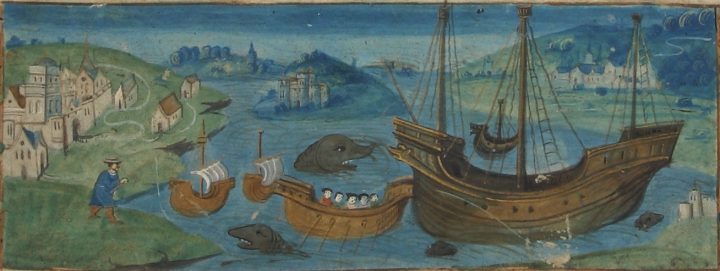
Detail from the illuminated border of the Treaty of Amiens between England and France, 18 August 1527. Catalogue reference E 30/1113. The full image is available through our Image Library.
Very few naval battles actually occurred during the Middle Ages, primarily because the role of the navy was usually to aid the army: transporting troops or supplies to theatres of war, for example, or to garrisons in castles and towns within the British Isles and on the continent.
Soldiers made up the majority of fighting manpower for naval expeditions, with support from ships’ crews, but there were no specialist troops trained specifically for naval warfare before the mid-17th century.
3. What kinds of records does The National Archives hold?
There are no records that equate to modern service records for this period, nor was there a separate body for managing naval administration – the Admiralty was not created until much later.
Instead, royal clerks and officials in the departments of the Exchequer and Chancery oversaw and handled the administration of naval business during the medieval period and it is primarily in the records of these two departments that most of the information on maritime personnel and administration from this era is found.
Records of Crown administration and expenditure on shipping and maritime operations in our collections begin at the end of the 12th century in the Pipe Rolls and appear in other kinds of records from the early 13th century.
The records we hold can contain information on:
- the service of individual ships
- ships’ crews (as collectives rather than individual crew members)
- royal expenditure for expeditions
- the raising, requisition and supply of fleets and vessels for Crown service
- wages, payments and expenses to maritime personnel
- maintenance of ships in Crown hands and other logistics such as the victualling trade
- evidence of shipping capacity and resources in ports maritime communities and individuals living in them
4. Online records
Only a very small proportion of records, and a larger proportion of resources for finding records, are available to view online, as described in the table below.
| Type of record | What will you find? | Record series | How to view |
|---|---|---|---|
| Data extracted from central and local customs accounts and port books, navy payrolls and shipping surveys in State Papers | Information on the merchant voyages undertaken by ships’ masters and theirs vessels, both within the British Isles and abroad between 1400 and 1580 | E 122, E 190, E 101, E 403, SP 15 | Search the database on the Merchant Fleet of Late Medieval and Tudor England website, either by the names of vessels and ships’ masters or a specific port |
| Gascon rolls with accompanying English calendars | Information on maritime trade, transport and supplies to and from English-held Gascony in the 14th and 15th centuries | C 61 | Search The Gascon Rolls project (1317–1468) for free |
| Ancient petitions in special collections | Contains petitions from merchants, mariners and others from maritime communities | SC 8 | Browse and download SC 8 from our catalogue for free |
| Muster rolls and related records of army personnel that served on naval expeditions | Lists of soldiers extracted from several record series at The National Archives providing evidence of soldiers who served on naval expeditions between 1369 and 1453 | E 101, C 71, C 76, C 61 | Search on the Medieval Soldier Database at www.medievalsoldier.org for free |
| The Calendars of Patent Rolls and Close Rolls |
Orders appointing and instructing officials to commandeer or decommission vessels, to provide them with supplies or to investigate complaints or crimes; in C 66 there are also licences issued to merchants to ship or purchase goods; and grants of protection and safe conduct for individuals and vessels | C 66 and C 54 | View Calendars of Patent Rolls for free at the Hathi Trust Digital Library and the Calendars of Close Rolls on the British History website (institutional subscription required) |
| Original archival material on ships and crews collated by the universities of Hull and Southampton | Data on the ships and crews of merchant vessels during the 14th century | N/A | UK Data Service Re-share (institutional subscription required; The National Archives does not subscribe to this resource) |
5. How to search for and view original records
To view original records at The National Archives you first need to find document references in our catalogue. A search for an individual’s or ship’s name in the online catalogue will rarely find a relevant document reference for records from this period. In most instances, to get a document reference you will need, instead, to consult printed and published finding aids, including calendars, containing summaries of the records. These finding aids are available at our building in Kew.
Most of The National Archives document references for these records begin either with E or C, indicating that they are records of the Exchequer or Chancery respectively.
If you can find, or already have, exact document references then you can order copies of records to be sent to you without having to visit us.
The following sections of this guide provide more detailed help on how to locate document references.
6. Maritime personnel
No formal service records for individual mariners were created in the medieval period so any information you find on individual maritime personnel will usually be very limited in detail.
There are no crew lists for this period; we do hold a small number of ships’ musters providing the names of individual crew members, mainly for royal ships. The majority of records in which maritime personnel are mentioned only name the master of the ship and record the number but not the names of other crew members.
To find evidence of naval service to the Crown you may have to consult a large number of different record series. Searching with an individual’s name on our catalogue will rarely find a relevant record.
Use the advice in the table below to search the record series most likely to contain information about individuals.
| Type of records | Record series | Search advice |
|---|---|---|
| Accounts of royal officials, musters, contracts, wage payments or other records of ships’ masters and crews performing maritime service in royal expeditions. | E 101, C 47, E 404, E 403, E 372, E 364 | Click on the record series links and search by year range
Search in E 101 and C 47 using keywords like ‘ship’, ‘mariner’ or the name of a royal official Use the published index to E 364 (and 13th and early 14th century material in E 372), especially the ‘Army, Navy and Ordnance’ section See also the advice in section 4 on the Merchant Fleet of Late Medieval and Tudor England database |
| Musters and protections confirming intended and actual service of soldiers serving as fighting personnel in naval expeditions.
Records of the granting of protection and/or safe-conduct for maritime personnel on trade ships or on crown naval operations. |
E 101, C 61, C 66, C 71, C 76 | Search by name on the Medieval Soldier Database for records between 1369 and 1453
Search in C 61 on the the Gascon Rolls Project 1317–1468 website Use the calendars in the Deputy Keepers Reports of the Public Record Office 1883 and 1887 to search the Treaty Rolls in C 76 from the reigns of Henry V and Henry VI Use the online Calendars of Patent Rolls 1232–1509 on the Hathi Trust Digital Library |
| Pardons issued to individuals and ships crews in exchange for military service or in acknowledgement of military service. | C 66 | Consult Calendar of Patent Rolls 1232–1509 online in the Hathi Trust Digital Library |
| Crown orders and appointments of individuals or commissions concerning maritime criminal matters, seizure or sale of ships where masters are named; grants of pardon or licences to masters or mariners; grants of petition made by maritime personnel or communities in which individuals are mentioned. | C 54, C 66 | Consult Calendar of Patent Rolls 1232–1509 online in the Hathi Trust Digital Library
Consult the published sources: Rotuli Litterarum Clausarum in Turri Londonensi asservati 1204–1227 Close Rolls of the Reign of Henry III 1227–1272 Calendars of Patent Rolls 1272–1509 Litter arum Patentium in Turri Londonensi asservati, 1201–1216 |
| Records of legal cases, some of which contain biographical information, in which members of maritime communities are either litigants in the Court of Chancery or deponents in the Court of Chivalry. Soldiers testifying as deponents in some cases in the Court of Chivalry give details of military service and battles that took place at sea. | C 1, C 47/6 | Click on the link to search C 1 by name of plaintiff or defendant.
Proceedings of the Scrope vs Grosvenor case in the Court of Chivalry (C 47/6/2) published in Scrope and Grosvenor controversy in the Court of Chivalry 1385–1390. |
| Pardons issued to individual mariners and whole crews in exchange for military service; miscellaneous correspondence from merchants; masters or mariners to the king; letters from the king to royal or port officials concerning diverse maritime matters. | SC 1, C 47/10 to C 47/16, C 47/20 to C 47/21 | Click on the link to search SC 1 by name of author or recipient of correspondence. |
| Petitions by mariners, ships’ masters and owners and members of maritime communities concerning unlawful arrest or compensation at loss or damage to their vessels and other matters. | SC 8 | Click on the link to search SC 8 by name. |
7. Records of vessels in English ports and in Crown ownership
Records of ships from this period include records of the requisition of vessels over a certain tonnage in ports across England; orders to impress or release certain named vessels; evidence of shipping capacity in ports; inventories of equipment on royal ships; the accounts of royal officials handling payment of wages and expenses and other records.
7.1 Key terms used in the records
Vessels under the direct or nominal control of the English monarchy were known as ‘King’s Ships’ and in the 14th century the office of the clerk of the King’s ships was created to help manage the burden of administration.
You may come across the terms ‘ship of Westminster’ and ‘ship of the Tower [of London]’, both used in the records to identify King’s ships and the latter term sometimes used to describe any warship.
For more terms, see the glossary in the Appendix of this guide.
7.2 Searching for records
See the table in section 4 for advice on searching for records of merchant vessels on the Merchant Fleet of Late Medieval and Tudor England online database.
For original records, use the following keywords to search the record series listed below:
- ‘ship’ or ‘vessel’
- a specific port such as ‘Southampton’ or ‘Cinque Ports’
- a county or region, such as ‘west’, with the keyword ‘port’
- combinations of ‘clerk’ or ‘keeper’ or other offices of naval administration with the terms ‘navy’, ‘king’s ships’ or ‘admiral’ may find financial and administrative records generated by or directed to such officials
Click on the references to search with the series with the keywords listed above.
- Chancery miscellanea in C 47
- Various Exchequer records in E 101
- Exchequer Treasury of the Receipt miscellaneous books in E 36
- Customs accounts in E 122 (c.1272–c.1830) – these records may provide evidence of the number, tonnage and even type of vessels (both native and foreign) in ports around the time of requisition – search by port
You can also try searching with a ship’s name or the master or owner of a ship but this is less likely to find records as very few of the document descriptions in our catalogue contain this kind of detail.
The record series below cannot be searched by keyword in our catalogue so follow the search advice in the table to locate documents:
| Type of records | Record series | Search advice |
|---|---|---|
| Exchequer pipe rolls, 1129-1832 | E 372 | Pipe Roll accounts in E 372 for the late 12th and early 13th centuries have been published with indexes by the Pipe Roll Society. Search for the ‘Great Roll of the Pipe’ in our Library catalogue. |
| Exchequer Pipe Office Foreign Accounts, 1219-1661 | E 364 | Use the published index to E 364, especially the ‘Army, Navy and Ordnance’ section. |
| Close rolls, 1204-1903 | C 54 | Consult Rotuli Litterarum Clausarum (1204–1227); Close Rolls of the Reign of Henry III (1227–1272); Calendars of Close Rolls (1272–1509) |
| Patent rolls, 1201-2012 | C 66 | Consult Litterarum Patentium, (1201–1216); Calendar of the Patent Rolls of the Reign of Henry III (1216–1232); Calendars of Patent Rolls (1232–1509) |
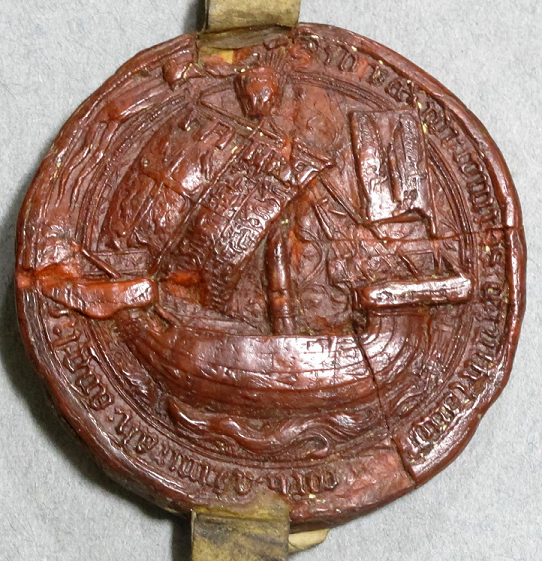
A 14th-century seal depicting a ship. Catalogue reference E 30/333.
7.3 Images of ships in seals
Some medieval seals, used to authenticate documents (such as charters, letters and writs) and also used literally to ‘seal’ documents, contain contemporary impressions of ships. These are primarily seals for the municipal and royal officials of port towns as well as seals for the office of admiralty. The National Archives holds a rich collection of seals and advice on searching for them is in our guide on seals.
8. Records of raising and supplying fleets for Crown service
When raising fleets for Crown service, orders would be sent either to royal officials or, from 1295, to admirals in charge of ports in a particular region, to commandeer ships and mariners for the king’s service.
Orders may also have been sent to local officials in maritime counties and ports to assist in the seizure of ships or to gather supplies for shipment.
These orders were usually recorded or referred to in the Close Rolls (C 54) and Patent Rolls (C 66).
8.1 Searching the rolls for records from mid-13th century onwards
There are published English calendars, available in our reading rooms, for Close Rolls from 1272 and for Patent Rolls from 1232. Find information in the rolls from these years onwards by following these steps:
Step 1: Look for names of royal officials (such as serjeants-at-arms, royal clerks or admirals) or keywords such as ‘ship’ or ‘navy’ in the indexes of the calendars.
Step 2: From the calendar entry referenced by the index, note the year and the membrane. Where there is more than one roll covering a single year, the documents will be divided into parts and so where applicable the correct part in which the entry falls needs to be noted from the calendars.
Step 3: Use the C 54 series search or the C 66 series search to search by year or year range and if applicable by part. Dates will need converting from regnal years to calendar years. Use ‘A Handbook of Dates: For students of British history’, eds. C R Cheney and Michael Jones available in the second floor reading room or online converter tools.
Step 4: From the search results, using the appropriate C 54 or C 66 references, request the roll referred to in the calendar.
8.2 Searching the rolls for records from the early 13th century
For entries in the close rolls and patent rolls that precede the published English calendars use the published Latin transcriptions available in the reading rooms at The National Archives.
8.3 Searching for other records
Other record series contain material on maritime activity in specific areas of English control, such as:
9. Records of royal expenditure for maritime operations
Records of expenditure relating to maritime operations, logistics and service for royal expeditions, towns or garrisons may include information on:
- wages and expenses for maritime personnel (masters, mariners and ship owners) and workers carrying out ship maintenance or construction ( shipwrights, carpenters and suchlike)
- expenses for victuals and apparatus supplied to ships
- maintaining and repairing or commissioning vessels belonging to the king
Click on the series references below to search in each series with keywords like ‘ship’, ‘victuals’ or ‘mariners’:
- E 101 – includes the accounts of Royal Wardrobe and Privy Wardrobe which may contain information on royal expenditure on ships, equipment and weaponry and raising and paying fleets
- C 47
- E 36 – late 15th and early 16th century accounts with details of expenditure on shipping such as victualling or construction of ships some of which have been published: see Oppenheim in the ‘Further Reading’ section below
The following series of Pipe Rolls, chronologically arranged, are not keyword searchable in the catalogue so follow the search advice in the table to locate documents. Accounting for a wide range of expenditure, they include details of royal expenditure on the construction, supply, maintenance and raising of ships.
| Type of records | Record series | Search advice |
|---|---|---|
| Exchequer pipe rolls – accounts by county | E 372 | Pipe Roll accounts in E 372 for the late 12th and early 13th centuries have been published with indexes by the Pipe Roll Society. Search for the ‘Great Roll of the Pipe’ in our Library catalogue. |
| Exchequer pipe rolls – Foreign Accounts (accounts ‘foreign’ to the ordinary county accounts) | E 364 | Use the published index to E 364, especially the ‘Army, Navy and Ordnance’ section. |
10. Records held elsewhere
10.1 County archives
Many local county archives, particularly those in counties with a strong tradition of shipping and seafaring, hold records of:
- ships
- maritime communities
- personnel in administrative and legal records covering certain ports and maritime communities
- local trade
- administrative documents and correspondence sent to local officials concerning shipping and logistics for maritime operations and service to the Crown
- seals
Use our catalogue to search for descriptions of records held in county archives around the country. On the search results page, use the filters on the left hand side to restrict results to ‘Other archives’.
10.2 British Library
The British Library holds illuminated manuscripts with imagery of ships, sailors and naval warfare as well as a small proportion of administrative records such as some wardrobe accounts.
10.3 National Maritime Museum
The National Maritime Museum at Greenwich holds medieval seals from port towns both within and outside the British Isles which contain representations of ships. You can also find letters, manuscripts and original research notes on archival sources amongst their collections.
11. Further reading and resources
11.1 Latin and palaeography tutorials
The majority of the records up until the mid-15th century are written in Latin, with the rest in French or English. You may therefore find our Latin and palaeography tutorials useful.
11.2 Books
The following books are available in our library.
Brooks F W ‘English Naval Forces 1199–1272’ (London, 1932)
Burwash, D.English ‘Merchant Shipping, 1460–1540’ (Newton Abbot, 1969)
Cushway, G ‘Edward III and the War at Sea: The English Navy 1327–1377’ (Woodbridge, 2011)
Flatman, J ‘Ships and Shipping in Medieval Manuscripts’ (London, 2009)
Friel, I ‘Henry V’s Navy: The Sea-Road to Agincourt and Conquest: 1413–1422’ (Stroud, 2015)
Gorski, R ed. ‘Roles of the Sea in Medieval England’ (Woodbridge, 2012)
Hutchinson G ‘Medieval Ships and Shipping’ (Leicester, 1994)
Lambert, C ‘Shipping the Medieval Military: English Maritime Logistics in the Fourteenth Century’ (Woodbridge, 2011)
Nicholas, N H ‘A History of the Royal Navy from the earliest Times to the French Revolution’ (London, 1847), two volumes.
‘Naval accounts and inventories of the reign of Henry VII 1485–8 and 1495–7’ ed. Michael Oppenheim
Roger, N A M ‘The Safeguard of the Sea: A naval history of Britain’ (London, 1997), volume one.
Rose, S ‘England’s Medieval Navy 1066–1509: Ships, Men & Warfare’ (Barnsley, 2013)
Appendix: Glossary of medieval nautical terms
Below is a glossary of nautical terms for items of ship equipment and apparatus found in medieval records held at The National Archives.
There are more comprehensive glossaries in:
- The Safeguard of the Seas: A Naval History of Britain (London, 1997), pp. 589–608
- The Navy of the Lancastrian Kings: Accounts and inventories of William Soper, Keeper of the King’s Ships, 1422–1427 (London, 1982), Appendix V
Bear in mind that the records contain variations in the spelling of many of these terms.
Backstay – ropes/cables to secure the mast to the stern or aft of the ship
Berder – ship’s carpenter
Bonnett – a piece of canvas laced to the foot of a fore-and-aft sail
Bowsprit – a spar jutting from the front of a vessel used for ropes to secure the mast and sail to the front of the vessel
Clencher (‘shipwright clencher’) – a carpenter who fastens overlapping planking using nails and clenches on clinker built ships
Crane line/Crane Lyne – part of tackle used to haul iron darts/gaddes to the top castle to be thrown on enemy ships in battle
‘Diol’ – sandglass or hour glass used to time the ships passage
Forestay – the ropes/cables attaching the mast to the bow or front of the ship usually to the bowsprit
Freightage – transport of goods in bulk
Gaddes – iron spears or spikes thrown from the top castle of ships
Gittons – small flags
Haliers/Halyers – ropes used to hoist or lower the sail on it’s yard
Hauncer/Haunser/Haunsar – large ropes or middle sized cables
Know/Kne (Knee) – piece of timber with two arms at an angle
Mekhoke – possibly a support to hold up spare spars or a lowered mast
Mizzen/Misan/Missan – the mast rearmost sail closest to the aft or back of the ship
Pavis – shield or board fixed along the sides and sometimes the forecastle and poop deck of a vessel
Pollyancre ropes/Pollances – a special type of block and tackle used for hoisting heavy articles
Portage – A ships total carrying capacity
Roll Teldes – roll of awning
‘Rosyn’ – resin
Sail yard/yard – beam hung horizontally to the mast supporting the top of the sail
Shores – wooden beams or props to support a ship when aground
Sounding lead – The metal weight at the end of a sounding line
Sounding line – A weighted line with distances marked off at regular intervals, used to measure the depth of water under a boat
Stroppes – Portions of rope spliced in a circle and put rough a block used for fitting tackle to a rope or amongst the mast and rigging
Tackle – rigging and apparatus for a ship
Tontight – Refers to a unit of cargo capacity or ton weight
Truss/truss pulley – Rope and pulleys used to haul back the yard to the mast and to heave it down as required
Upties – the ropes by which the yard is suspended from the mast head
Wronges – Floor or ground timbers
1. Why use this guide?
This guide will help you to find records held at The National Archives of, and relating to, the British intelligence and security services.
The sensitive nature of intelligence work means that many files, especially those relating to living individuals or covering sensitive material, have been destroyed or retained by the security services themselves and have not been accessioned by The National Archives.
This guide does not cover records from police agencies such as the Special Branch. For advice on Special Branch records see our Metropolitan Police guide.
2. British intelligence agencies
The United Kingdom has several intelligence and security services, often referred to as the agencies. Historically, intelligence was gathered by individual branches of the military. But from 1909 onwards, separate intelligence agencies, operating alongside but independently of the military, have assumed increasingly important roles.
These are separate from police agencies such as the Special Branch or the Anti-Terrorist Branch (SO13) which have now merged to form Counter Terrorism Command (also known as SO15).
The Secret Intelligence Service (MI6) was founded in 1909 as the Foreign Section of the Secret Service Bureau and is responsible for gathering intelligence overseas. It is an agency of the Foreign and Commonwealth Office.
The Security Service (MI5) began in 1909 as the domestic arm of the Secret Service Bureau. It is responsible for protecting the country against threats to national security, which include terrorism, espionage and the proliferation of weapons of mass destruction. MI5 operates under the statutory authority of the Home Secretary, but it is not part of the Home Office.
The Government Communications Headquarters (GCHQ) began as the Government Code and Cypher School (GCCS) in 1919. It is responsible for providing signals intelligence for government and for the prevention and detection of serious crime. Ministerial responsibility for GCHQ lies with the Foreign Secretary.
MI5, MI6 and GCHQ work alongside each other and come under the direction of the Joint Intelligence Committee (JIC). The JIC sets the priorities and co-ordinates the work of the separate intelligence services. It comprises senior officials drawn from the Foreign Office, Ministry of Defence, Home Office, Department of Trade and Industry, Treasury and Cabinet Office, as well as the heads of the MI5, MI6 and GCHQ.
All these agencies work alongside the Ministry of Defence’s own Defence Intelligence Staff (DIS). Prior to the establishment of the DIS, each branch of the military had its own intelligence service (see sections 10, 11 and 12 of this guide).
3. Personnel records
In general, the identities of individuals who worked for the security and intelligence services are protected and therefore records of them are not made available to the public as freely as those from other branches of government. Records of individuals who are still alive usually remain confidential and are retained by the agencies themselves.
For more detailed information on records of individuals for a specific agency see the following sections of this guide.
4. How to search for records
The advice in this section will help you to make a start with your research. Consult the following sections of this guide for further search advice specific to the records of the individual agencies.
4.1 Online records
Only a few collections of intelligence records are available online. You can search within these collections by clicking on the links below and searching by keyword and date, unless otherwise indicated:
- Individuals monitored by the Security Service (MI5), the so-called Personal Files (1913-1983) – search in KV 2 by name
- Reports and other papers from the Security Service (MI5) policy files, including the diaries of Guy Liddell 1939-1945, penned by the MI5’s Director of Counter-Espionage – search in KV 4 (not all KV 4 records are online; view a list of all online records in KV 4)
- Security Service (MI5) files, including lists of persons who fought in Spain 1936-1939 – search in KV 5 (not all KV 5 records are online; view a list of all online records in KV 5)
4.2 Original documents
Most intelligence records are not available online and to view them you will need to visit us or pay for copies to be sent to you.
Searches begin in our catalogue, which contains descriptions of each record alongside its document reference. You can search the catalogue using keywords and dates. Use the advanced search option to restrict your search results to records of a specific agency using the following department reference codes (click on the codes for accounts of the formation and history of each agency) for:
- The Security Service (MI5) – KV
- The Secret Intelligence Service (MI6) – HD
- Government Communications Headquarters (GCHQ) – HW
- Special Operations Executive (SOE) – HS
- Joint Intelligence Committee (JIC) – in CAB (records of Cabinet)
- Defence Intelligence Staff (DIS) – in DEFE (records of the Ministry of Defence)
You will also find intelligence records among those of other government departments, primarily:
- Foreign Office (for correspondence, policy and negotiation with other states) – FO and FCO
- Home Office – HO
Bear in mind that there may be overlap between different departments on any given subject or event. For example, a decision made during a conflict may have been informed by the Security Service (KV) and the Foreign Office (FO) and then discussed by the Cabinet (CAB) before being carried out by the Ministry of Defence (DEFE).
There is a very useful summary of source material on pages 277-279 of Twigge, Hampshire and Macklin’s British Intelligence (see Further reading).
5. MI5 and MI6 records
Access to records from MI5 and MI6 is restricted and many are not available publicly – this is especially true for MI6 files. The records are retained under section 3 (4) of the Public Records Act (1958) and Freedom of Information legislation does not apply to them. The National Archives policy on selecting records from the security services gives more information.
See section 4 for some basic advice on how to use our catalogue to search for records.
5.1 MI5 – The Security Service
Records of the Security Service, better known as MI5, are identified at The National Archives by the department reference KV. Some records have been deliberately destroyed whilst others were destroyed by bombing in 1940.
Records from the First and Second World Wars
A significant cross-section of Security Service records cover the World Wars. Among these are:
- Historical reports and policy files – in KV 4
- Second World War diaries of Captain Guy Liddell (head of MI5’s B Division, responsible for counter-subversion) – in KV 4/185-196
- Records of the London Reception Centre at the Royal Patriotic Schools – these files are scattered across KV 2 and KV 4 and are broken down in more detail in our guide to immigration records. The London Reception Centre was established to process aliens arriving in the UK, to gather intelligence from them on conditions in occupied Europe, and to screen arrivals for possible enemy agents.
Personal Files (PF): individuals monitored by the Security Service
These case files include records of suspected spies, renegades, communist sympathisers and right wing extremists. Search by name and download these records online (£) in KV 2.
PF numbers are sometimes found within files. These indicate there would have been a file opened but these files may not necessarily have survived or have been transferred to The National Archives.
Personnel files: individuals employed by the Security Service
It is not possible to get official confirmation of whether someone who is still alive worked for MI5.
If you believe that a deceased member of your family worked for MI5, you can write to the MI5 Enquiries Team to request information.
5.2 MI6 – The Secret Intelligence Service
Although department reference HD is for records of the Secret Intelligence Service, better known as MI6, there are, confusingly, no records generated by the agency held at The National Archives. The only records since 1909, when the agency was created, held in HD are of Polish military intelligence from 1946 and acquired by the agency. No transfers of records are expected in the foreseeable future.
There are archived versions of the MI6 website from 2006 onwards but otherwise the HD record series all pre-date the creation of the agency and are records inherited by rather than created by the agency.
However, reference is sometimes made to MI6 in files from other departments, such as in Foreign Office record series like FO 1093, which provides an illuminating account of the activities and funding of MI6. Search for “Secret Intelligence Service” or “MI6” in our catalogue to reveal some of the related material.
6. Joint Intelligence Committee records
Most records of the Joint Intelligence Committee (JIC) are among the records of the Cabinet, held in the CAB department, though there are some JIC reports held with the Foreign Office collection in FO. Of particular note are the following series:
7. Signals intelligence and code breaking: GCHQ and GCCS records
Signals intelligence – that is intelligence gathered by the interception of electronic signals as well as other means of communication – is, today, handled by the Government Communication Headquarters (GCHQ).
Records from GCHQ and its predecessor, the Government Code and Cypher School (GCCS), are identified in our catalogue by the department reference HW. The majority of the dozens of record series in HW cover the Second World War.
7.1 Basic searches
Browse the records in HW or use the advanced search option in our catalogue to search for records by department reference with keywords such as:
- signals intelligence
- SIGINT
- code-breaking OR codebreaking
- cypher OR cipher
7.2 First World War records
There are very few HW record series covering solely First World War records but the following series are worth consulting for any study of First World War British intelligence:
- Correspondence, working papers and initial drafts of both official and unofficial histories of British signals intelligence in HW 3
- Official intelligence histories of the First World War written by senior Government Code and Cypher School members of staff in HW 7
7.3 Second World War records
There are dozens of record series in HW covering the Second World War.
In 1939 GCCS was moved to Bletchley Park and was renamed Government Communication Headquarters (GCHQ), also referred to as Station X or BP.
Use the advanced search option to restrict your search results to the HW department and search by keywords, such as:
- Bletchley Park OR Station X
- BP
- Enigma (the name of the German cypher system)
- BONIFACE (one of the code names used by GCCS)
- Bombe (the name of a machine used to help decode Enigma messages)
- Ultra (code name for signals intelligence)
8. Defence Intelligence Staff records
The Defence Intelligence Staff (DIS) is a branch of the Ministry of Defence (MOD). As such, its records are identified by the department reference DEFE, the reference for all MOD records held at The National Archives.
See section 4 for advice on how to use our catalogue to search for records across an entire department or target your search to one of the following series within the DEFE department. Click on the series references and search by subject keywords:
- Scientific and technical intelligence in DEFE 21 and DEFE 44
- Defence Intelligence Staff files in DEFE 31
- Intelligence assessments, reports and studies in DEFE 62, DEFE 63 or DEFE 64
- Reports and other papers from conferences and working parties in which the DIS participated, in DEFE 65
- Defence Intelligence Staff Sub-Committee minutes of meetings, correspondence and other files in DEFE 27
- Papers of R V Jones, the Director of Scientific Intelligence, 1939-1954 in DEFE 40
9. Special Operations Executive (SOE) records
Formed in 1940, the Special Operations Executive (SOE) functioned during the Second World War to promote sabotage and subversion and assist resistance groups in enemy occupied territory.
9.1 Personnel records
The records of SOE personnel are closed during the lifetime of the individuals or until their 100th birthday, when it is assumed they will have died. Where no date of birth is known the opening date of the records has been set at 2030, 100 years after 1930, the assumed birth year of the youngest agents in the field in the last year of the war.
Search the personnel files in HS 9 by first name, surname, year of birth or any combination of these.
If you are interested in a closed file and can demonstrate that the person it relates to is deceased, then you can submit a Freedom of Information request. If it relates to you personally you can make a request under Data Protection legislation using the ‘Data protection leaflet’ on our website.
You can also search the original SOE indexes in HS 11 to HS 20, which can list personal and biographical details of agents as well as contain references to the status of individuals who were known to be enemy intelligence officers, collaborators or traitors or who were in enemy hands or safe houses.
9.2 Other records
Read descriptions of the twenty record series which make up the records of the SOE in department HS. Click on the series references between HS 1 and HS 8 and in HS 10 to search that series by country name and/or subject keyword.
Records relating to SOE operations can also be found in the files of other departments, including the Air Ministry (AIR), War Office (WO), Foreign Office (FO) and Prime Minister’s Office (PREM).
10. British Army intelligence up to 1964
The War Office sections responsible for security and intelligence up until 1964 were the Directorate of Military Operations (DMO) and the Directorate of Military Intelligence (DMI). They were replaced in 1964 by the Defence Intelligence Staff (see section 8).
DMO was responsible for outline operational planning up to the time when an operation Commander was appointed. It also collected information about British forces and the armed forces of close allies.
The focus for DMI was the armed forces of enemy countries, distant allies and neutral countries. It was in close touch with military attaches and missions abroad and was interested not only in military details but also in more general historical, topographical and economic information.
The following record series are particularly useful for studies of:
- Late 19th century, First World War and inter-war years intelligence – WO 106
- First World War intelligence – WO 157 – this series contains daily “intelligence summaries”
- First World War intelligence maps – WO 153
- Second World War intelligence – WO 208
11. Naval intelligence up to 1964
The Naval Intelligence Department (NID), a branch of the Admiralty formed in 1886, provided much of the First World War and pre-First World War code-breaking expertise. The deciphering section formed in October 1914 was known as ‘Room 40’. NID was superceded in 1964 by the Defence Intelligence Staff (see section 8).
NID was concerned with all aspects of enemy and allied shipping including:
- plotting shipping movements, particularly of enemy surface cruisers and submarines
- collecting information on the topography of foreign countries, particularly coasts, and on coastal defences
The following record series are particularly useful for studies of:
- Pre-First World War intelligence – ADM 231 – includes printed NID reports on foreign naval strength, coastal defences and so on
- First World War naval intelligence – ADM 137 – includes papers of NID in ‘Room 40’, many of them on signals intelligence
- Second World War naval intelligence – ADM 223
- Second World War intelligence from intercepted German, Italian and Japanese radio communications – DEFE 3 – includes decrypted signals and summaries
12. Air Ministry intelligence up to 1964
The Air Ministry gathered intelligence on enemy aircraft, airfields and bombing targets as well as reports on the effectiveness of allied bombing raids (using aerial reconnaissance) and enemy and allied air activity in general. This work was carried out largely by the Air Intelligence Branch. In 1964 the separate intelligence services for each branch of the military were replaced by a unified service, the Defence Intelligence Staff (see section 8).
The following record series are particularly useful for studies of:
- First World War intelligence – AIR 1 – search for the numerous “intelligence summaries” and “intelligence reports”
- Second World War and the Air Ministry’s Directorate of Intelligence – AIR 40
- Second World War intelligence – AIR 24 – these are RAF Operations Record Books and they contain hundreds of intelligence reports – search simply for ‘intelligence’
- The Air Ministry’s Directorate of Operations and Intelligence and Directorate of Plans 1914-1947 in AIR 9 – search this series for reports and papers by the name of a country or region (for example, East Africa or Pacific), or subject keywords (for example, bombing or chemical warfare)
13. Records in other archives
Visit the webpages of the Consultative Group on Security and Intelligence Records for further help and guidance on intelligence-related records. This group is specifically set up to help the official, archival and academic communities with security and intelligence related material.
The British Library has a collection of intelligence material such as maps, plans and gazetteers on India and SE Asia.
The archives and library at Bletchley Park have a large collection of documents and images relating to the codebreaking work carried on at Bletchley Park.
14. Further reading
14.1 Websites
Consult the history section of the Secret Intelligence Service (MI6) website for information on the organisation’s history and records policy.
Browse the Security service (MI5) website for more information about the organisation.
Browse the history section of the Government Communications Headquarters website for more information about the organisation’s past.
14.2 Books
The following books are all available in The National Archives’ reference library. Use our library catalogue to find a recommended book list. You can buy from a wide range of history titles in our bookshop.
Stephen Twigge, Edward Hampshire and Graham Macklin, British Intelligence (The National Archives, 2008)
Christopher Andrew, The Defence of The Realm: The Authorised History Of MI5 (Penguin, 2009)
14.3 Periodicals
Copies of the Intelligence and National Security journal are available at The National Archives’ Library. Issues of note include:
- ‘100 Years of British Intelligence’, Special Issue, Vol 27, Issue 1, 2012
- ‘Whitehall’s Black Chamber: British Cryptology and the Government Code and Cypher School, 1919-1929’, John Ferris, Vol 2 January 1987, pp.54-92
- ‘Declassification and Release Policies of the UK’s Intelligence Agencies’ and Sir Stephen Lander ‘British Intelligence in the Twentieth Century’, Vol 17 No 2, 2002, pp.7-32
1. Why use this guide?
Use this guide for advice on how to search for Colonial Office correspondence dating from 1820 to 1850 and now held at The National Archives. Colonial Office correspondence is an invaluable resource for studies of the history of the British Empire and the individual countries which were once British colonies.
You can search for references to the records online but you will need to visit us to view the documents themselves. For advice on other types of Colonial Office records see our guide to Colonies and dependencies from 1782.
2. What are the registers and why are they worth using?
Colonial Office staff recorded details of incoming correspondence in registers. They included details of the topic, date and sender. You can use these to locate individual items of correspondence. By reading through the registers, you can identify documents of interest without having to read through all the volumes of correspondence for a particular colony. The Colonial Office registers for this period are in catalogue series CO 326.
These original registers remain vital when searching for Colonial Office correspondence from this period as, with some exceptions, you cannot find individual items of correspondence with a keyword search in our catalogue – the catalogue descriptions are generally not detailed enough.
3. Registers versus indexes
As well as using the registers to find correspondence from this period, you can use the original Colonial Office indexes. The indexes cover correspondence from 1815 to 1870.
Whilst the registers list the incoming correspondence in order of date sent and are a more complete record of the correspondence received, the indexes conveniently group together details of correspondence (date and brief summary) by topic. For example, all the individual items of correspondence on gold mining in the colony of Victoria might be found under the heading ‘gold’ or ‘mining’ in the Victoria index. They therefore provide a very quick method of identifying the relevant correspondence. However, the keyword used may not be obvious and the indexes are not necessarily complete.
4. How to use the registers
There are three steps to locating and using a Colonial Office register.
Step 1: Use the advanced search in our catalogue to locate the relevant register
Sometimes the individual colony is named, but sometimes only the name of region has been used (for example, ‘Africa’ or ‘West Indies’), so it may be best to search initially without a keyword.
Suppose that you are interested in relations on the eastern frontier of the Cape of Good Hope in 1835, when the Sixth Frontier War was in progress.
Search CO 326 for 1835, using ‘register’ as your keyword, as follows:
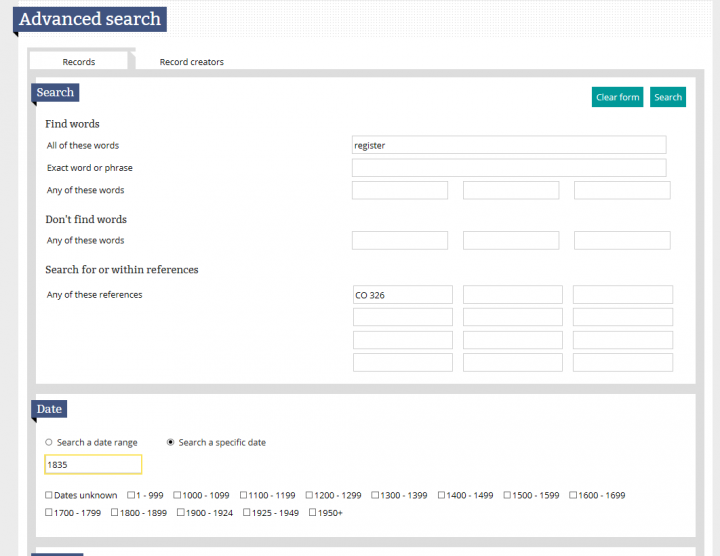
The advanced search page in our catalogue showing a search for a Colonial Office register from 1835. The search is in series CO 326, which contains all the registers for 1820-1850.
Using the drop-down options located above search results, put the results in reference order:
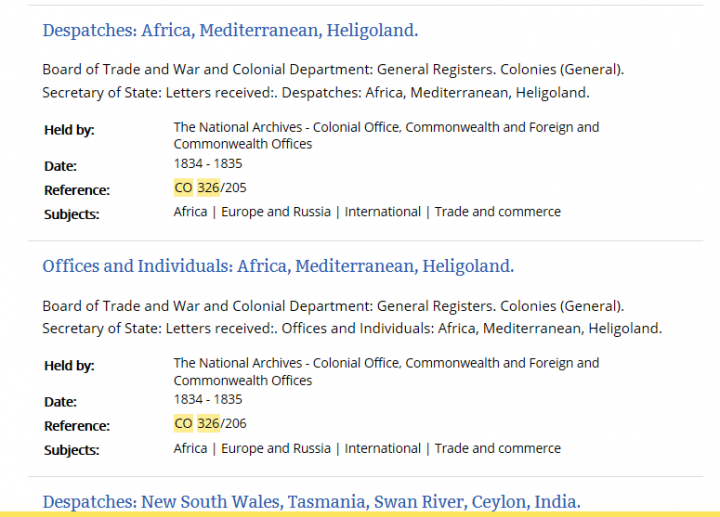
Catalogue search results for CO 326 reordered into reference order.
Two of the registers concern Africa, where we would expect to find entries for the Cape of Good Hope.
CO 326/205 is a register that contains details of correspondence received from the Governor of the Cape of Good Hope (Despatches). CO 326/206 contains details of correspondence received from other government departments, organisations and persons (Offices and individuals).
Step 2: Consult the relevant register of correspondence
Suppose you are interested in researching the correspondence received from the Governor at the Cape of Good Hope.
Order volume CO 326/205 and examine the lists of correspondence for items in which you’re interested. A page from the register in CO 326/205 looks like this:
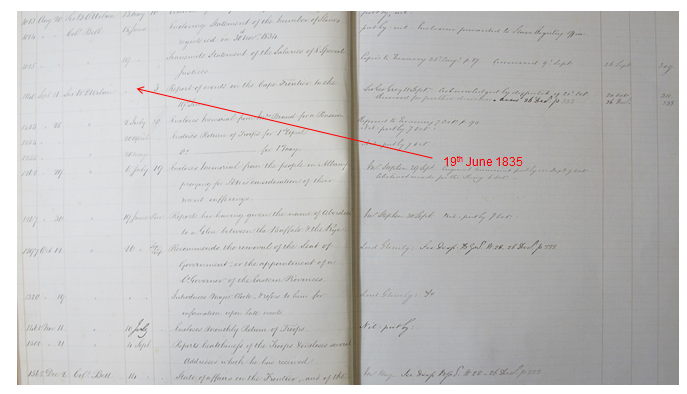
A page from a Colonial Office register for 1834-1835. Document reference CO 326/205.
We see that the page is divided into columns giving the registry number assigned to the correspondence by the Colonial Office clerks. The information recorded consists of:
- The date received
- The sender
- The date of the correspondence
- A brief description of the correspondence
- Actions taken on the correspondence
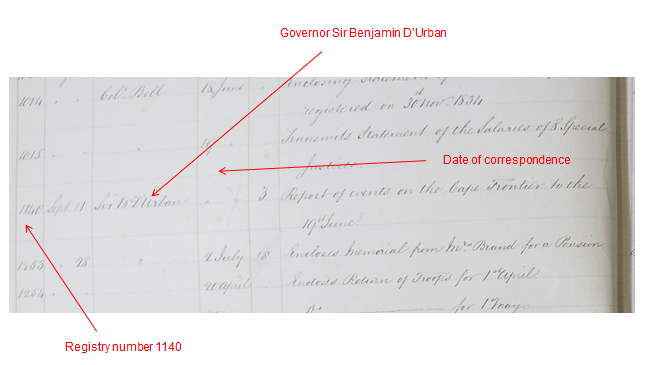
A close-up of the register page illustrated above. Document reference CO 326/205.
There is an item of correspondence, registry number 1140, dated 19 June 1835, from the Governor, Sir Benjamin D’Urban, which is a report of events on the Cape Frontier to 19 June.
Step 3: Finding the item of correspondence
To find the correct volume in the Original Correspondence series, we need three pieces of information:
- The colony (Cape of Good Hope)
- The sender (the Governor), which means that the item will be in a ‘despatches’ volume
- The date sent (19 June 1835)
Find the Original Correspondence volumes for the Cape of Good Hope for 1835 by using the advanced search screen in our catalogue.
Use ‘Original Correspondence Cape of Good Hope’ as your keywords and specify the date as 1835. Put ‘CO’ in the references box, like this:
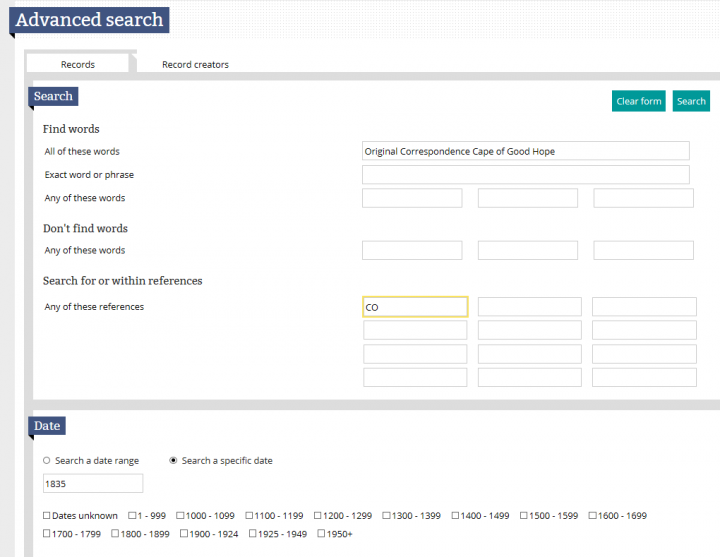
The advanced search page in our catalogue showing a search for Cape of Good Hope correspondence from 1835.
Using the drop-down options located above search results, put the results of the search in reference order:
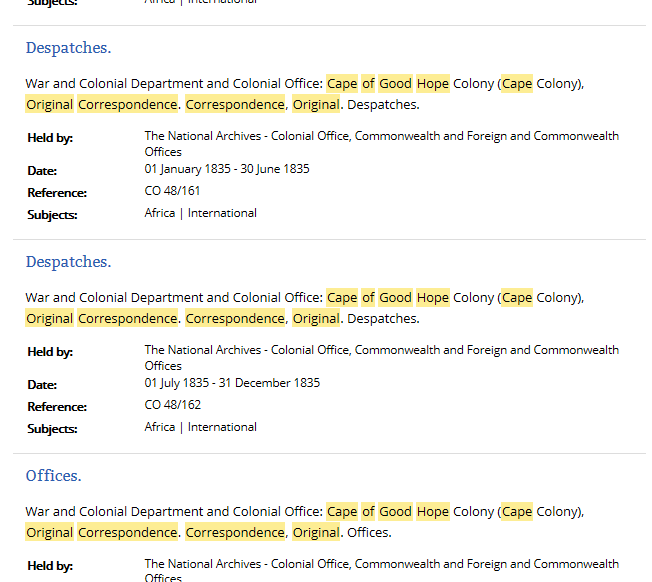
Catalogue search results reordered into reference order.
The date on which the letter was sent was 19 June 1835 and this is covered by volume CO 48/161. When you view the volume you should find the correspondence in date order and stamped with the relevant registry number:
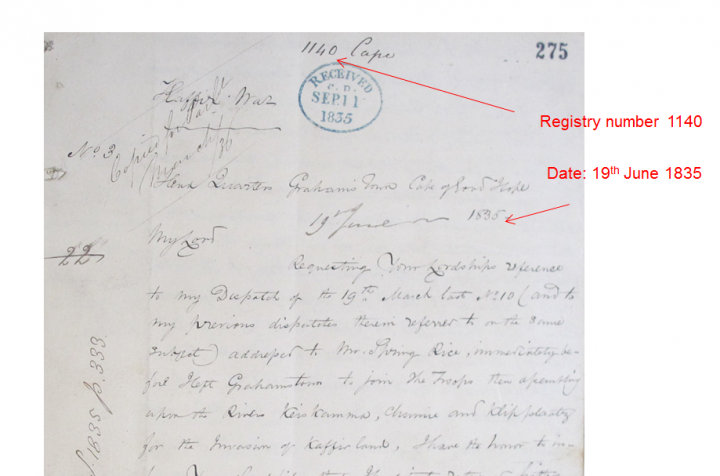
Correspondence sent on 19 June 1835 by the Governor of the Cape of Good Hope. Document reference CO 48/161.
1. Why use this guide?
Use this guide for advice on how to search for Colonial Office correspondence dating from 1850 to 1926 and now held at The National Archives. Colonial Office correspondence is an invaluable resource for studies of the history of the British Empire and the individual countries which were once British colonies.
You can search for references to the records online but you will need to visit us to view the documents themselves. For advice on other types of Colonial Office records see our guide to Colonies and dependencies from 1782.
2. What are the registers and why are they worth using?
Colonial Office staff recorded details of incoming correspondence in registers. They included details of the topic, date and sender and some information to help them to find related correspondence. Colonial Office registers can help you find documents on a subject when the details on our online catalogue are insufficient. They also often give details of the previous and next item of related correspondence. By reading through the registers, you can identify documents of interest without having to read through all the volumes of correspondence for a particular colony.
3. Registers versus indexes
As well as using the registers to find correspondence from this period, you can use the original Colonial Office indexes. The indexes cover correspondence from 1815 to 1870.
Whilst the registers list the incoming correspondence in order of date sent and are a more complete record of the correspondence received, the indexes conveniently group together details of correspondence (date and brief summary) by topic. For example, all the individual items of correspondence on gold mining in the colony of Victoria might be found under the heading ‘gold’ or ‘mining’ in the Victoria index. They therefore provide a very quick method of identifying the relevant correspondence. However, the keyword used may not be obvious and the indexes are not necessarily complete.
4. How to use the registers
There are separate series of registers for each former colony for each year. The registers are divided into three parts according to sender:
- Despatches – from the colonial governor
- Offices – from other government departments
- Individuals – from people or organisations outside of government
Step 1: Finding a register
Suppose we are interested in finding correspondence on the Ballarat rebellion on the goldfields of Victoria (later part of Australia but at the time a separate colony) in the early 1850s. To locate the relevant register, search by the name of the colony and ‘Registers of Correspondence’ for the year or period in which you are interested.
Use the advanced search option in our catalogue to conduct this search:
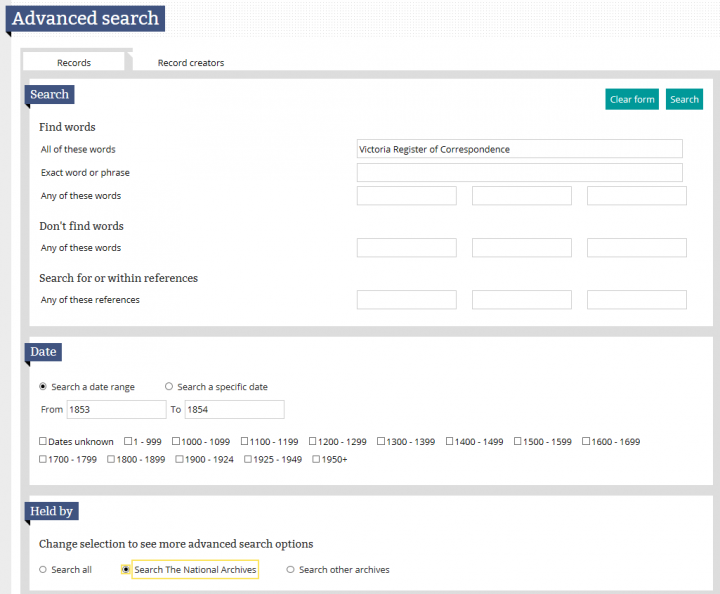
The advanced search page of our catalogue showing a search for the Victoria registers of correspondence from 1853-1854.
This produces the following results:
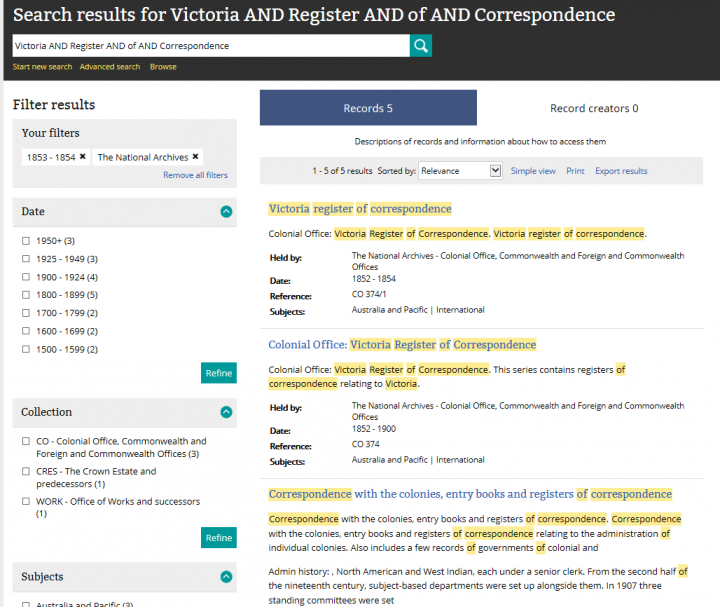
A search results page in our catalogue showing the results of a search for Victoria registers of correspondence from 1853-1854.
The register which we need to view is CO 374/1.
Step 2: Interpreting a register
This is a typical page within the register:
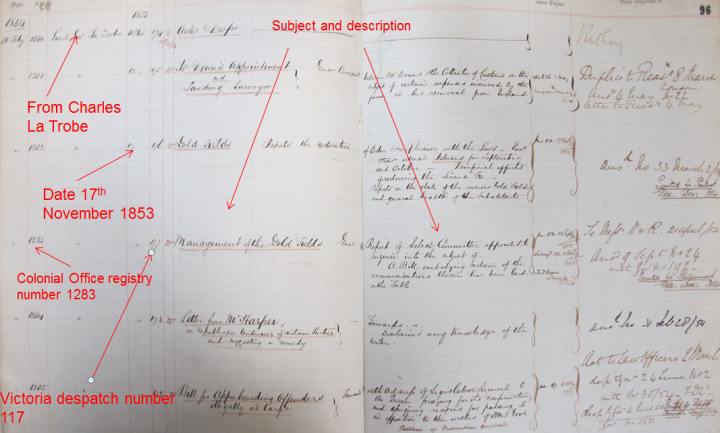
A double page spread from the Colonial Office register of correspondence 1852-1854 for Victoria, at the time a separate colony but later part of Australia. Document reference CO 374/1.
Suppose that we are interested in the third item, register number 1283, which concerns the report of a Select Committee on the management of the goldfields. To locate an item of correspondence, we need three pieces of information:
- The name of the colony: Victoria
- The name and status of the sender: Charles La Trobe, Governor, which means that the correspondence has been filed as ‘despatches’
- The date of the item: 17th November 1853
Step 3: Locating the correspondence
Find the catalogue series for Victoria Original Correspondence with this search:
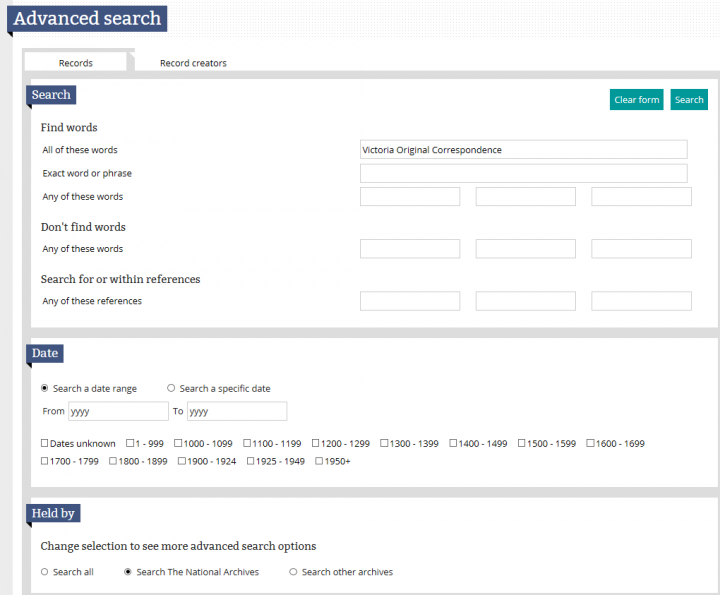
The advanced search page in our catalogue showing a search for correspondence for the colony of Victoria.
This produces the following results:
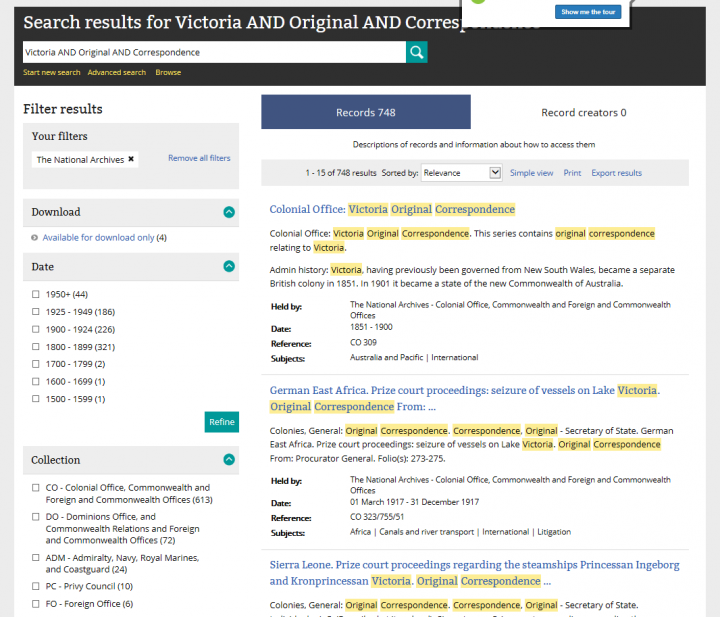
A search results page in our catalogue showing the results of a search for Victoria correspondence.
The series that we need is CO 309. Now search CO 309 for 1853, the year of our item of correspondence:
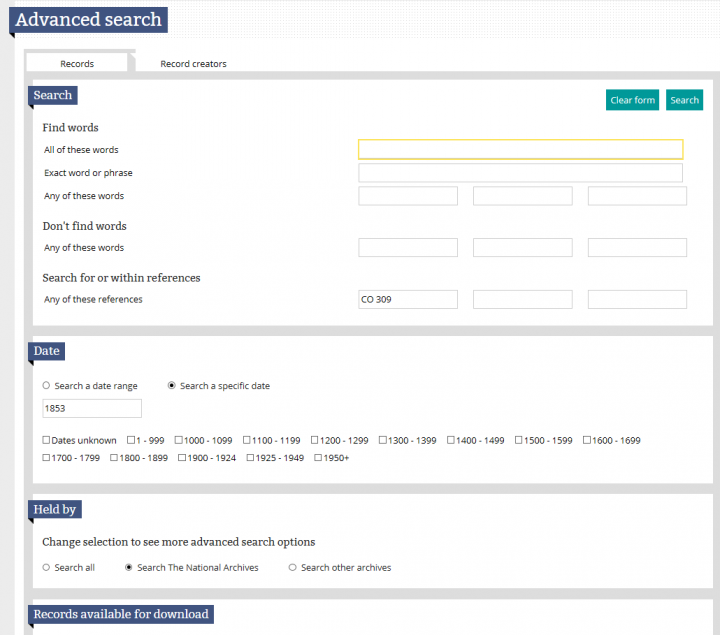
The advanced search page in our catalogue showing a search for 1853 within the record series CO 309 – note that a keyword is not needed.
Using the dropdown menu at the top of the search results, put the results in reference order and scroll down to the relevant date (17 November 1853):
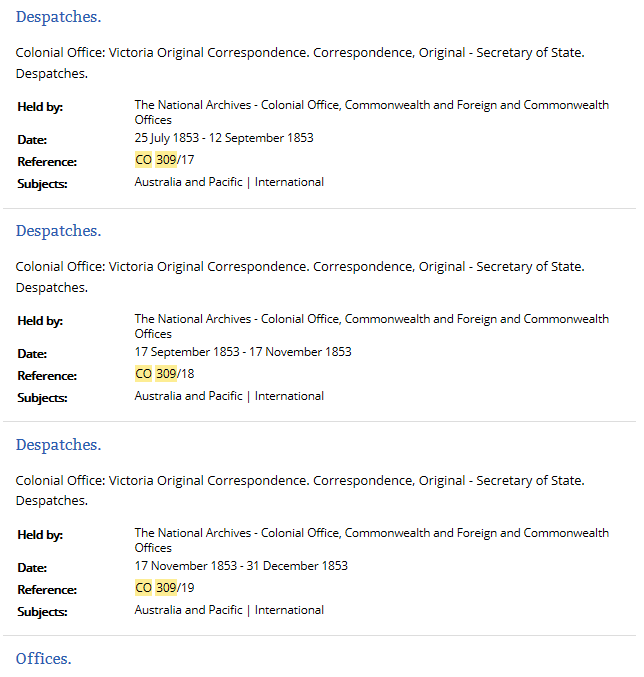
Catalogue search results for CO 309.
We cannot tell from the catalogue if the item of correspondence is in CO 309/18 or CO 309/19 (as they both cover 17th November), so we would need to order both volumes. In fact, the item is in CO 309/19.
Here is the front page of the correspondence:
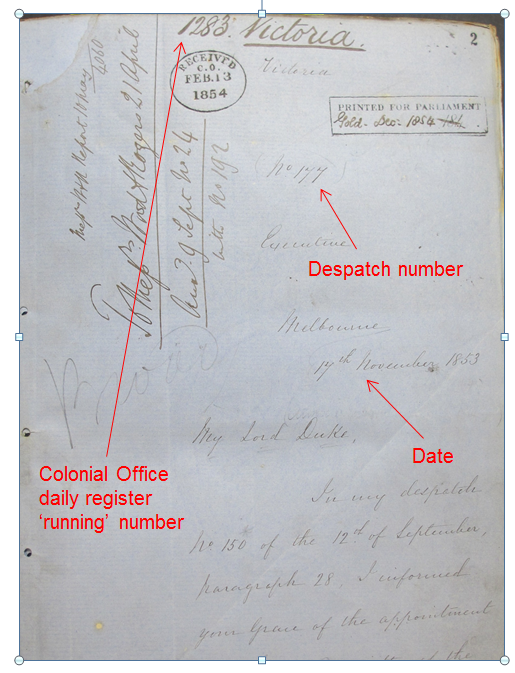
The front page of the correspondence for Victoria covering 17th November to 31st December 1853. Document reference CO 309/19.
1. Why use this guide?
Use this guide for advice on how to search for Colonial Office correspondence dating from 1815 to 1870 and now held at The National Archives. Colonial Office correspondence is an invaluable resource for studies of the history of the British Empire and the individual countries which were once British colonies.
You can search for references to the correspondence on our online catalogue but you will need to visit us to view the documents themselves. Another way to find correspondence from this period is to use the original Colonial Office registers, one set covering 1820 to 1850 and another for 1850 to 1926.
For an introduction to the Colonial Office and advice on other types of Colonial Office records see our guide to records of Colonies and dependencies from 1782.
2. What are the indexes and why are they worth using?
For the period between 1815 and 1870, Colonial Office clerks provided an index to the original correspondence received by the Office. They listed incoming correspondence by subject keyword, giving brief details of the content. For example, all the individual items of correspondence on gold mining in the colony of Victoria might be found under the heading ‘gold’ or ‘mining’ in the Victoria index. They can therefore be used as a means of locating material on a particular topic in correspondence which has not been recorded in our catalogue in detail.
The Colonial Office indexes can be a very useful research tool and they can enable you to locate quickly items on a specific topic over time, but they should be used with caution because:
- The clerks had to decide on which keyword to use. It may be that the correspondence contains information on other topics which are not indicated by the keyword.
- All the correspondence is not necessarily indexed. It appears that only correspondence received from colonial governors was included, but not that received from private individuals or organisation.
- Terminology has changed over the years. For example, ‘indigenous people’ may be ‘natives’ in the index. Be aware of the contemporary usage.
3. Indexes versus registers
As well as using the indexes to find correspondence from this period, you can use the original Colonial Office registers. The registers cover correspondence from 1820 to 1926.
While the indexes conveniently group together details of correspondence (date and brief summary) by topic, providing a very quick method of identifying the relevant correspondence, the registers are a more complete record of the correspondence received, listing the incoming correspondence in order of date sent and recording brief details of content. After 1850, the registers also, usefully, record details of the previous and next related item of correspondence.
4. How to use the indexes
All the indexes have been stored in series CO 714 and there are separate indexes for each colony.
Step 1: Find the relevant index
To find the relevant index, use the advanced search on the catalogue to search CO 714 by name of colony and date range.
For example, suppose that we are interested in quarantines in Barbados between 1830 and 1870, when there were outbreaks of cholera across much of the world. Conduct the following search:
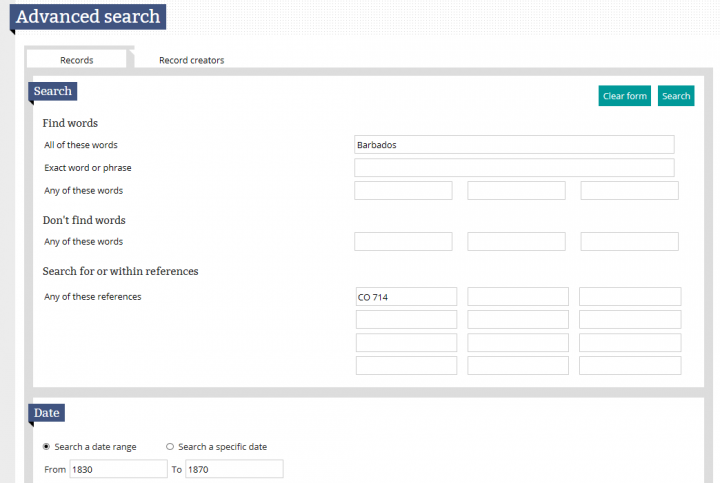
The advanced search page in our catalogue.
Arrange the results in reference order by using the ‘Sorted by’ box to give the following:
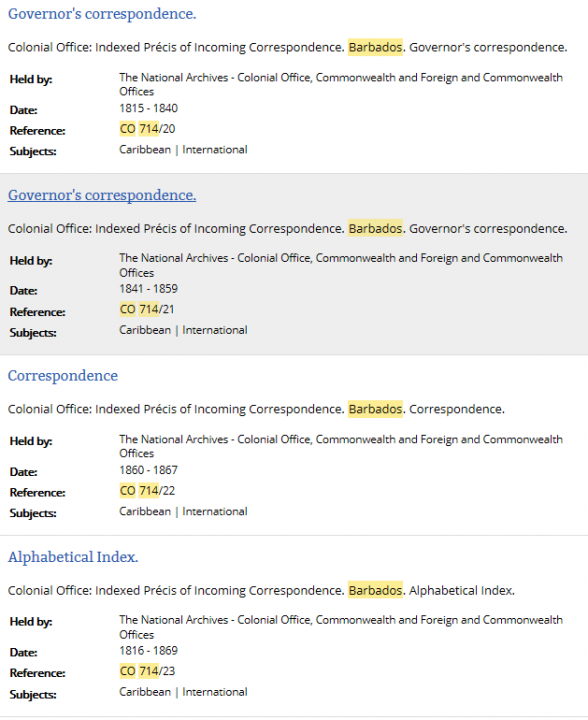
Catalogue search results ordered by reference.
All the volumes are described as ‘Indexed Précis of Incoming Correspondence’, but three are named ‘Governor’s correspondence’ or ‘Correspondence, while piece CO 714/23 is described as an ‘Alphabetical index’. There is some variation in the way these indexes are described on the catalogue, but they contain the same kind of information.
Order volume CO 714/23, the ‘Alphabetical index’. If we look under ‘Q’ for quarantine we find the following page:
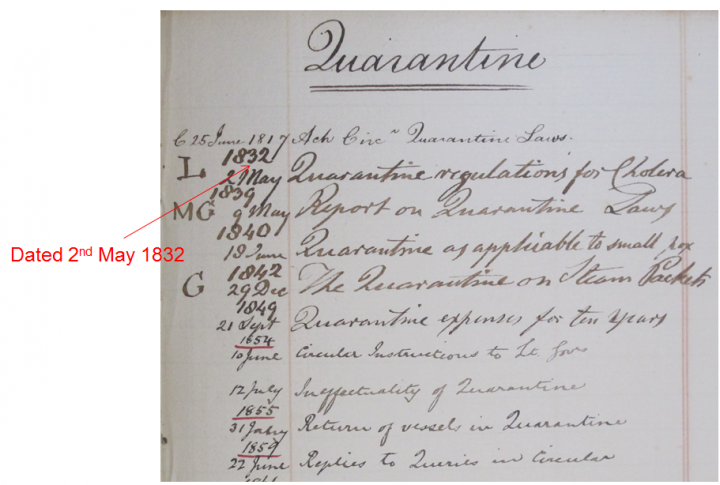
A page of the Colonial Office index. Document reference CO 714/23.
We see that there is listed (among other items) an item of correspondence dated 2 May 1832, which concerns ‘Quarantine regulations for cholera’. We already have enough information from this to locate the correct volume of original correspondence: the colony, year and the sender (the Governor).
If we examine the ‘Governor’s correspondence’ index which covers 1832, volume CO 714/20, we find the following page:
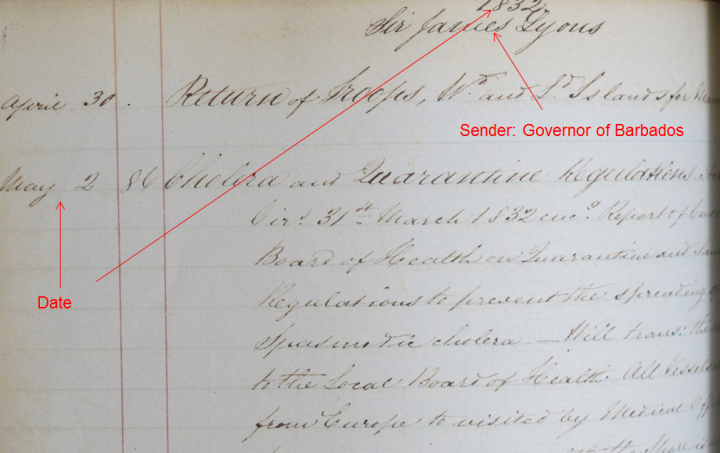
A page from the Governor’s correspondence index from 1832. Document reference CO 714/20.
The entry gives further details about the content of the correspondence, but we do not need it to locate the item in the original correspondence series.
Step 2: Locating the volume of original correspondence
You can find out the Colonial Office original correspondence series for any colony by using the advanced search on our catalogue and searching with the name of the colony, the phrase ‘original correspondence’ and the relevant year.
The original correspondence series for Barbados is CO 28. You can now locate the relevant volume in CO 28 for the year 1832 with this search:
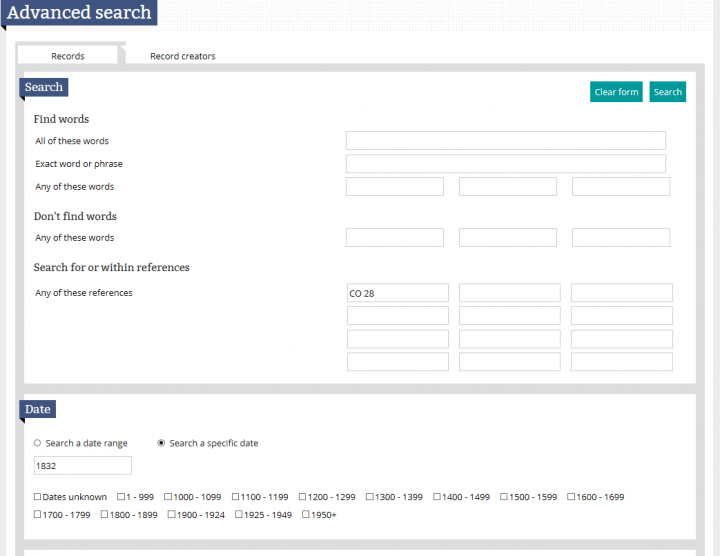
The advanced search page in our catalogue. This is a search for correspondence from 1832 held in CO 28, the series for Colonial Office correspondence form Barbados.
Put the search results in reference order by using the pull-down menu in the ‘Sorted by’ box:
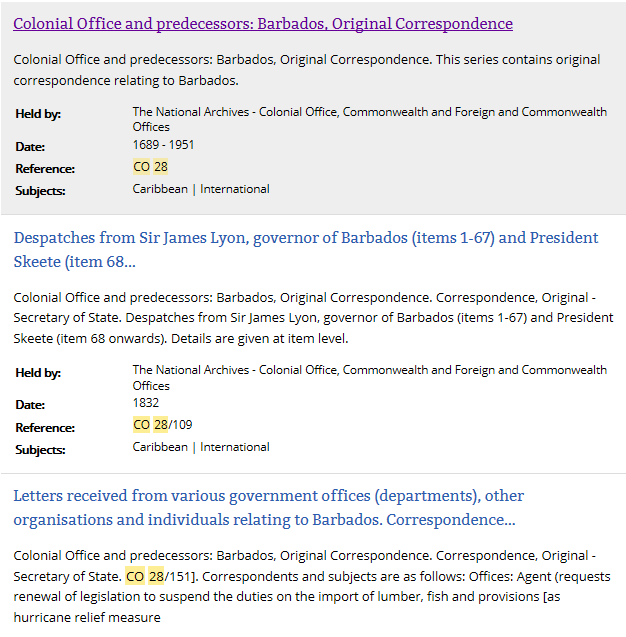
Catalogue search results ordered by reference.
We would expect find the item on quarantine to be in volume CO 28/109, which contains correspondence from the Governor of Barbados, Sir James Lyon, for 1832.
In fact, this volume has been catalogued in detail (this is not usually the case) and we can confirm, by scrolling down several pages to the date 2 May 1832, that the item we need is at CO 28/109/41:
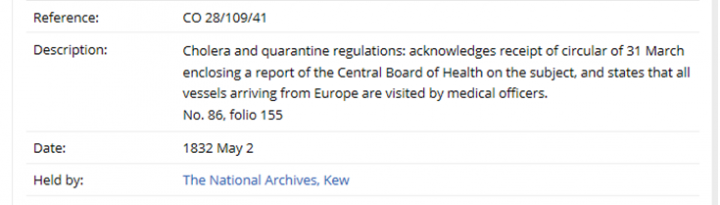
The catalogue description for correspondence sent from Barbados on May 2 1832. Document reference CO 28/109/41.
1. Why use this guide?
This guide will help you to find records of the women’s suffrage movement and of the women and men who campaigned for the cause in the early part of the 20th century.
Our collection reflects the interests of the government and offers an insight into how it responded to civil disobedience and changes to public opinion.
Many other records of suffrage organisations and activities will be held at local or specialist archives some of which are mentioned in section 6.
2. Overview of our collection
2.1 What you might find
The National Archives holds records of central government and the major courts of law. Our collection is a rich source of information about the government’s response to militant activities and civil disobedience such as destruction of property, tax evasion and census boycotts.
Peaceful protest was of less interest to the government, although large demonstrations drew the attention of the authorities even where they were orderly and peaceful. In general, however, you will find more records relating to militant activity.
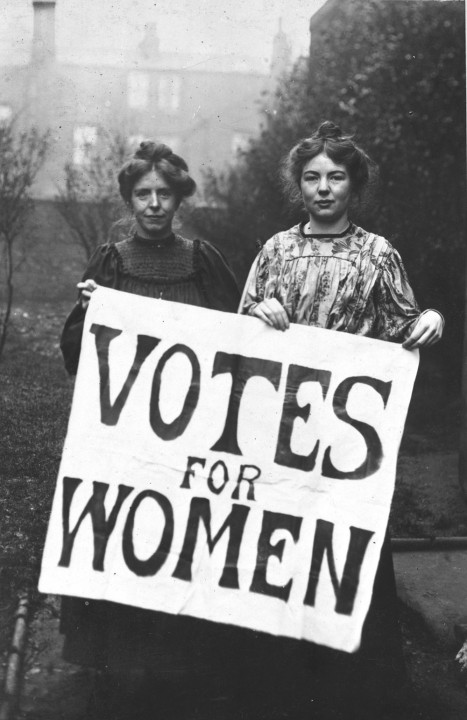
Suffragettes Annie Kenny and Christabel Pankhurst 1906 (COPY 1/494)
2.2 What period do the records cover?
Records are most plentiful for the period from 1905 up to the start of the First World War when many suffrage organisations suspended their campaigns. However, records from other years can also be found; for example where organisations such as the Women’s Freedom League continued to lobby the government on issues even after the start of the war.
2.3 What regions do the records cover?
Our records cover the whole of England and Wales, but the only police records we hold are from the Metropolitan Police force. Records of other police forces are held in local archives
3. What can I view online?
3.1 Suffragette collection
Some of the online records mentioned below have been brought together by Findmypast (£) into their ‘Suffragette Collection’. It includes records of disturbances, arrests and treatment of women in prison.
For more information about what is included look for the section ‘Learn more about these records’ on the Findmypast Suffragette collection browse page (£).
3.2 Cabinet papers
The Cabinet deals with the major issues of the day and the Government’s overall strategy. For more information about the Cabinet, including how to find records from before 1916, see our research guide Cabinet and its committees.
3.3 Census 1911
Search the 1911 census for records of suffrage campaigners and supporters. The census is available on Ancestry (£) and Findmypast (£).
Some suffrage supporters refused to participate in the 1911 census on the grounds that if they were not treated as citizens with a voice, they would not be counted on the census. Others made protest statements on the census forms and some enumerators made comments of their own.
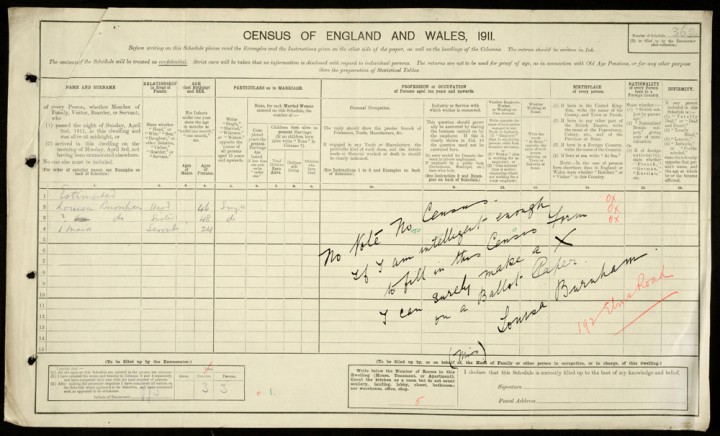
Suffragette Louisa Burnham spoils her entry in the Census 1911 (RG 14/2277/1)
Use the ‘keyword’ field on Ancestry (£) or the ‘occupation’ field on Findmypast (£) to search for entries where activists used their entry to show their support for the suffrage movement.
Our experience is that searching the census on Ancestry produces more results if you are looking for random comments entered by suffragettes and enumerators. However, if you find better results using Findmypast (£) please let us know.
Try searching the census using:
- the names or addresses of known suffrage supporters
- ‘anonymous’ in the name field
- phrases such as ‘no vote no census’ in the keyword field
- wildcard searches in the occupation or keyword field. A search in Ancestry (£) using the wildcard ‘suffrage*’ finds numerous results.
3.4 Home Office amnesty of August 1914 and suffragette arrest records
Search or browse the index of suffragettes arrested between 1906 and 1914 (HO 45/24665) on Ancestry (£).
At the outbreak of the First World War many suffrage groups suspended action, and in response the Government granted an amnesty to suffrage prisoners. In order to implement the amnesty, the Home Office compiled an index of all suffrage campaigners arrested from 1906 to 1914.
This index is the best way to look for individual campaigners whose activity put them on the wrong side of the law. It also illustrates the variety of organisations and individuals prepared to take extreme action in the suffrage cause.
Each entry includes a reference to the original documents (not available online) relating to that person’s arrest and conviction. Where these documents have survived, you can find them by searching Discovery, our catalogue, using HO followed by the reference number.
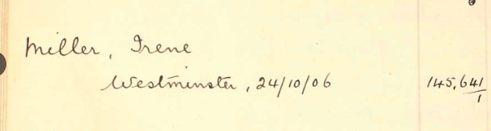
Entry for Irene Miller in the index to suffragettes arrested (HO 45/24665)
For example, the index entry for Irene Miller, arrested at Westminster on 24 October 1906 for knocking on the door of 10 Downing Street, shows the reference number 145641 in the right hand column.
Search Discovery using HO followed by the reference number 145641. This finds the record HO 144/837/145641 which details complaints of treatment in prison by suffragettes. To see these records you will need to visit us, order copies or pay for research to be done on your behalf.
3.5 Parliamentary Archives
Bills in favour of women and the vote were presented on an almost annual basis from 1870 onwards. Bills and other published parliamentary material can be accessed online via Proquest UK Parliamentary Papers. This is a subscription website you can access on TNA computers by visiting us at Kew. You may also be able to access it via a large reference library such as a university library.
3.6 Parliamentary proceedings in Hansard
Hansard is an edited record of what was said in Parliament. It also includes records of votes and written ministerial statements. The report is published daily covering the preceding day, and is followed by a bound final version.
Search the official reports of proceedings in the House of Commons and the House of Lords from the late 19th and early 20th centuries for reference to the women’s suffrage movement.
Our research guide to Hansard details different ways of accessing the reports and records of Parliamentary debates.
3.7 Women in The National Archives
Consult ‘Women in The National Archives’ by Martin Pugh, in the Adam Matthew collection (£). This is available free of charge at The National Archives or in libraries with the relevant institutional subscription.
This lists women’s studies resources in The National Archives together with original documents relating to suffrage in Britain, the Empire and colonial territories.
3.8 Newspaper reports
Search the British Newspaper Archive (£) and the Times Digital Archive (institutional subscription required) for reports in local and national papers relating to the suffrage movement.
3.9 Archival film footage
The National Archives has some film footage related to the suffragette movement available online.
- Suffragette pageant in London 1908
- News footage of buildings destroyed by suffragette protest
- Emily Davison killed at the Derby
Other film is available on the BFI National Archive website.
4. How to search our catalogue for records
4.1 General tips
When you search Discovery, our catalogue, you can apply filters such as dates, record series references and department codes, before your search by using the advanced search option.
Alternatively, you can apply filters after your search using the options on the search results page.
For more advice on searching effectively see Discovery help.
4.2 Keywords
Search Discovery, our catalogue, using keywords such as
- names of known activists (only used rarely in record descriptions so will often not get results)
- suffragist, suffragette or ‘suffrag*’ (a wildcard search)
- names of suffrage organisations (see section 4.5 for examples)
- names of offences committed such as window smashing, disturbances, demonstration
- combinations of the above
Militant suffrage supporters were known as suffragettes and non-militant campaigners were known as suffragists. Often, the government used the terms interchangeably or not at all.
If you find other keywords that bring good results please contact us to let us know.
4.3 Government department codes
Certain government departments were involved in managing the response to the suffrage movement. You can search within records created by these departments by using the associated department code reference in Discovery advanced search.
Use this code in the ‘search for or within references’ fields, along with a keyword and dates (if you wish) in the appropriate fields.
Some examples of department code references you can try are shown below along with the sort of subjects you might find covered by these departments:
- Treasury (T) – tax resistance as a form of protest
- Home Office (HO) – offences and complaints of treatment of suffragettes by police and in prison
- Metropolitan police (MEPO) – arrests of suffragettes
- Prison Commission (PCOM) – prison treatment of suffragettes
- Ministry of Transport (MT) – impact of the suffrage movement on transport
- Cabinet Office (CAB) – discussions about the suffrage movement at the top level of government (see section 3.1)
5. Suffrage organisations, protest action and legislation
5.1 Suffrage organisations
Numerous organisations pressured the government to give women the vote. Parliament.uk has a useful timeline that includes the establishment of many suffrage groups. Search Discovery, our catalogue, using the names of suffrage organisations and the people involved in them to find relevant records. Some of the key organisations are listed below:
- 1866 Women’s Suffrage Committee formed by Barbara Bodichon
- 1867 National Society for Women’s Suffrage formed by Lydia Becker
- 1897 National Union of Women’s Suffrage Societies formed by Millicent Fawcett
- 1903 Women’s Social and Political Union formed by the Pankhursts
- 1907 Women’s Freedom League (WFL) formed by Teresa Billington-Greig and Charlotte Despard
- 1908 Women’s National Anti-Suffrage League (WASL) formed by Mary Ward (Mrs Humphrey Ward)
- 1909 Women’s Tax Resistance League (WTRL) formed by Dora Montefiore
5.2 Protest action
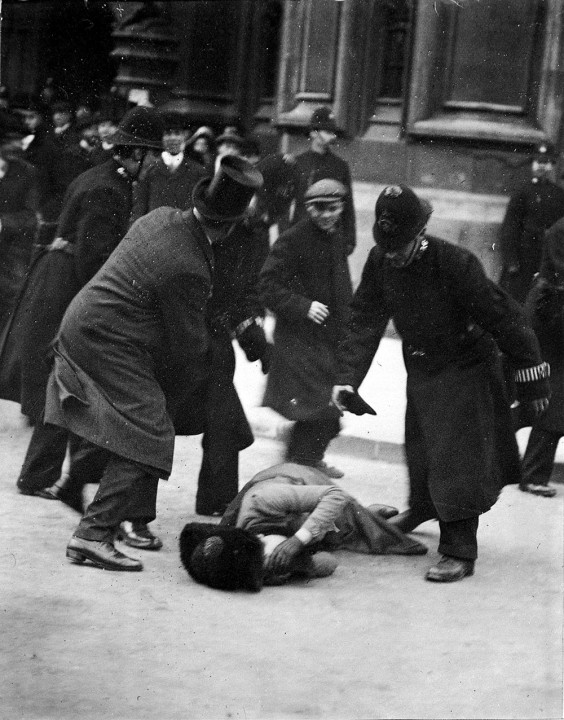
Believed to be suffragette Ernestine Mills at Black Friday demonstration November 1910 (Copy 1/551)
Suffragettes favoured more militant action than suffragists. The most active organisation was the Women’s Social and Political Union led by Emmeline and Christabel Pankhurst.
Action to draw attention to the cause took place across the UK. It included refusing to complete the 1911 census, protest rallies and marches and destruction of property. Many suffragettes were prosecuted and some were imprisoned.
Use the advanced search option in Discovery, our catalogue to search for records relating to arrests, prosecution and treatment in prison. Some of the key protest actions are shown below. The names of the protests and the dates they took place can be useful in searching for relevant records.
Search Discovery using keywords along with department code references MEPO for the Metropolitan Police, PCOM for the Prison Commission and HO for the Home Office. Use these department codes in the ‘search for or within references’ fields, along with a keyword and dates (if you wish) in the appropriate fields.
- 1905 First imprisonment of a suffragette, Christabel Pankhurst
- 1907 First large procession, known as the Mud March, organised by the National Union of Women’s Suffrage Societies
- 1908 (June) Seven processions march through London (see this video clip)
- 1908 (October) The ‘rush on Parliament’
- 1908 (October) Suffragette banner unfurled from the ladies’ gallery in the Houses of Parliament
- 1909 (July) First hunger strike action, by Marion Wallace
- 1910 (November) Black Friday demonstrations outside Houses of Parliament.
- 1912 (March) Women’s Social and Political Union window-smashing campaign in the West End of London leading to 220 arrests
- 1913 (June) Emily Davison killed by King’s horse at Epsom Derby (see this video clip)
5.3 Legislation
Try searching Discovery using the names of Acts of Parliament that relate to women’s suffrage. You could also search more generally around dates legislation was introduced to find records of events that led up to it, debates around it and reactions to it.
From as early as 1832 attempts were made to introduce legislation to give women the vote. Parliament.uk has a useful timeline of key legislation that you can use to inform your research. Some of the most useful are listed below.
- 1913 Prisoners’ Temporary Discharge for Ill-health Act – also known as ‘The Cat and Mouse Act’ (introduced in response to hunger strikes)
- 1918 Representation of the People Act (allowed some women over 30 to vote in national elections) – this represented 40% of total population of women
- 1918 The Parliament (Qualification of Women) Act allowed women to stand as MPs
6. Records in other archives
Two key collections are in the London School of Economics and Political Science (LSE) Women’s Library and the University of Manchester Library: Women’s Suffrage Movement Archives
There are numerous collections of records across the UK. Use the Find an Archive tool to look for local archives or search the Archives Hub for relevant collections.
7. Further reading
7.1 Blogs
- Keeping tabs on suffragettes: the official watch list
- Motoring towards liberation
- The Hunger games
- The working women’s struggle for the vote
- Celebrating democracy for International Archives Day
- Suffragettes in the Parliamentary Archives
7.2 Printed books and articles
Many books are available in The National Archives’ reference library. You can search the library catalogue for titles of interest.
You can also visit The National Archives’ bookshop for a range of publications on women’s suffrage.
- The March of the Women: a Revisionist Analysis of the Campaign for Women’s Suffrage 1866-1914, Martin Pugh (Oxford University Press 2002)
- The Militant Suffragette Movement in York, Kristina Cowman (Borthwick Publications, 2007)
- Sex and suffrage in Britain 1860-1914, Susan Kingsley Kent (Routledge, 1990)
- The Suffragette Movement: An Intimate Account of Persons and Ideals, E Sylvia Pankhurst (Wharton Press, 2010)
- Rise up, women!: The Militant Campaign of the Women’s Social and Political Union, 1903-1914, Andrew Rosen (Routledge, 2012)
- Separate Spheres: The Opposition to Women’s Suffrage in Britain, Brian Harrison (Routledge, 2012)
- Women and the Women’s Movement in Britain, 1914-1959, Martin Pugh (Marlowe & Co, 1995)
- Suffrage and Power: the Women’s Movement 1918-1928, Cheryl Law (I.B.Tauris, 1997)
- Vanishing for the Vote: Suffrage, Citizenship and the Battle for the Census, Jill Liddington (Manchester University Press, 2014)
- Women, Welfare and Local Politics, 1880-1920: ‘We Might be Trusted’, Steven King (Sussex Academic Press, 2006)
- Rebel Girls: Their Fight for the Vote, Jill Liddington (Virago Press, 2008)
- Sophia: Princess, Suffragette, Revolutionary, Anita Anand (Bloomsbury, 2015)
- Women’s suffrage and government control 1906-1922: papers from the Cabinet, Home Office and Metropolitan Police files in the Public Record Office (Adam Matthew Publications, 2000)
8. Other resources
8.1 Audio recordings
The National Archives has recorded podcasts available online.
8.2 Websites
- The National Archives Education pages on suffragette history
- The Parliamentary Archives women and the vote pages
- Woman and her Sphere
1. Why use this guide?
This guide will help you find records of people sentenced to transportation or whose death sentences were reduced to transportation. The National Archives holds records of many criminal trials and convictions – as well as convict voyages, censuses and pardons – and this guide explains how these are indexed and how they can be searched. It also contains background information on the history of criminal transportation.
2. Transportation to America and the West Indies
Before 1776, convicts sentenced to transportation were sent to North America and the West Indies. Few records of these individuals survive, though it may be possible to find records of a conviction in records of assizes or the Old Bailey.
A list of men and women transported to North America between 1614 and 1775 is included in The Complete Book of Emigrants in Bondage 1614-1775 by Peter Wilson Coldham. The list also details where each person was tried.
Bonded Passengers to America, also by Peter Wilson Coldham, gives a detailed overview of all relevant records and published sources in The National Archives. Finding out more about a person transported to North America or the West Indies is likely to be difficult.
Consult our guide to America and West Indies in the calendar of State Papers Colonial for advice on finding records.
The American Revolution of 1776 meant that transportation to North America was no longer possible. Sentences of transportation were still passed, with convicts held in prison while the government considered alternative destinations. The prisons soon became overcrowded and extra accommodation had to be provided in derelict ships (or hulks) moored in coastal waters. The solution was to develop new penal colonies in modern day Australia, and on 13 May 1787 the first fleet set sail.
3.Transportation to Australia
After 1776, criminal transportation was to penal settlements in modern-day Australia, specifically New South Wales and Van Diemen’s Land (modern-day Tasmania). Convicted prisoners could be sentenced to transportation for a set term, 7 or 14 years, or life. Increasingly, during the 19th century, criminals sentenced to death had their sentence reduced to transportation. Transportees could gain limited freedom in the colony through a ticket of leave or conditional pardon. They could only return to their home country on completion of their sentences or if granted a full pardon.
Transportation did not cease until 1868, but it had been effectively stopped as a sentence in 1857 and had become unusual well before that date. During its 80-year history 158,702 convicts arrived in Australia from England and Ireland, as well as 1,321 from other parts of the Empire.
Many more records survive from this period and most records are searchable online.
3.1 Bermuda, Gibraltar, Western Australia and South Australia
Some convicts sentenced to transportation found themselves sent to places which were not penal settlements.
Convicts sent to Bermuda or Gibraltar were employed in work improving or building the dockyards. If they survived they were returned to Britain on completion of their sentences.
In the 1840s the British government started granting some prisoners sentenced to transportation conditional pardons before sending them to places that did not receive convicts. A relatively small number of young offenders were sent from Parkhurst Prison to Western Australia as apprentices.
Pardons were conditional on the convict not leaving until the expiry of their original sentence.
The record sources for pardoned convicts sent to places other than penal settlements are essentially the same as for more conventional transportation.
4. Online records
Criminals, convicts and prisoners, 1770-1934
Assorted records of criminals, convicts and prisoners can be searched on Findmypast.co.uk (charges apply). Though many do not relate to criminal transportation, they may confirm if a prisoner was sentenced to be transported.
The collection includes
- HO 8 Quarterly returns of prisoners – including those on hulks awaiting transportation.
- HO 13 Correspondence and warrants – includes copies of instructions to governors of gaols listing prisoners to be transported and records of pardons.
- HO 17 and HO 18 Petitions – letters and petitions pleading for reductions in sentences or pardons from prisoners, including those already transported. See our guide to Convicted Criminals for more information.
Criminal Registers, 1791-1892
Search Criminal Registers for England and Wales (HO 26 and HO 27) on Ancestry to find details of sentences passed on prisoners.
Convict Transportation Registers, HO 11
Transportation registers list the names of convicts transported on particular ships along with where they were convicted, their crime and sentence.
Registers for 1791-1868 (excluding the third fleet) can be searched by name on Ancestry.
Digital images of the registers can also be downloaded from Discovery but cannot be searched by name of convict. Search or browse HO 11 in Discovery by name of the transport ship.
Lists of convicts and settlers, HO 10
Lists of male and female convicts and pardons can be downloaded from Discovery but are not searchable by name.
Lists give particulars as to
- convict sentences, employment and other information
- lists of pardons granted
- lists of convicts embarked for and arriving in New South Wales
- general musters relating to settlers and convicts
Browse Discovery for lists from
- New South Wales (including 1828 census) from 1788
- Tasmania (Van Diemen’s Land) from 1846
5. Surgeon’s journals, ADM 101 and MT 32
Convicts were transported to Australia on hired merchant vessels and a Royal Navy surgeon was appointed to each vessel to take charge of the convicts and provide medical care during the voyage. The surgeons were required to keep journals and submit them to the Admiralty and many survive in our series ADM 101 and MT 32. As well as describing medical treatment, these journals often contain the surgeon’s remarks on the journey.
Search ADM 101 in Discovery by name of the convict vessel to see if a journal survives.
You can also search ADM 101 using a convict’s name but the journals do not contain complete lists of convicts, only convicts receiving medical treatment are likely to be listed.
A smaller series of journals from 1858-1867 is in MT 32 listed by name of ship and date.
6. Australian sources
A great deal of information can be obtained from Australian websites where data has been compiled from a variety of sources, including some of the records listed above and some from records held in Australia.
Index to Tasmanian convicts, 1804-1853
Search the index to Tasmanian convicts (archives council of Tasmania) by name see some digitised records, including conduct records, indents and descriptions.
The Female Convicts Research Centre
The Female Convicts Research Centre promotes interest in the female convicts of Van Diemen’s Land (Tasmania), by encouraging and facilitating research and has a database of information on female convicts and information on their lives in Tasmania.
Convict records of Australia
The Convict Records website can be searched by name to find when a convict arrived, his crime, sentence and the ship he was transported on. A search online is probably the easiest way to establish if someone was transported.
Trove
Digitised newspapers, gazettes and journals can be searched on the TROVE website.
The Australian Dictionary of Biography
The Australian Dictionary of Biography is Australia’s pre-eminent dictionary of national biography. In it you will find concise, informative and fascinating descriptions of the lives of significant and representative persons in Australian history, including convicts and administrators of the penal settlements.
7. Convicts transported from Ireland
The National Archives of Ireland has a range of records relating to transportation from Ireland to Australia and a searchable database. Records include transportation registers and petitions to the Lord Lieutenant.
Further information can be found in their research guide.
8. Further reading
Some or all of the recommended publications below may be available to buy from The National Archives’ Bookshop. Alternatively, search our library catalogue to see which are available to consult in the reading rooms.
Some or all of the recommended publications below may be available to buy from The National Archives’ Bookshop. Alternatively, search our library catalogue to see which are available to consult in the reading rooms.
Peter Wilson Coldham, The Complete Book of Emigrants in Bondage 1614-1775
Peter Wilson Coldham, Bonded Passengers to America
Charles Bateson, The Convict Ships 1787-1868 (1983)
Alan Brooke, and David Brandon, Bound for Botany Bay: British convict voyages to Australia (2005)
P G Fidlon and R J Ryan (eds), The first fleeters: a comprehensive listing of convicts, marines, seamen, officers, wives, children and ships (1981)
Michael Flynn, The second fleet: Britain’s grim convict armada of 1790 (2001)
Mollie Gillen, The founders of Australia: a biographical dictionary of the first fleet (1989)
David T Hawkings, Bound for Australia (2012)
Robert Hughes, The fatal shore: a history of transportation of convicts to Australia, 1787-1868 (1987)
L L Robson, The convict settlers of Australia : an enquiry into the origin and character of the convicts transported to New South Wales and Van Diemen’s Land 1787-1852 (1965)
R J Ryan (ed), The second fleet convicts: a comprehensive listing of convicts who sailed in HMS Guardian, Lady Juliana, Neptune, Scarborough and Surprise (1982)
1. Why use this guide?
This guide will help you to search for British Army records of soldiers who served between the 18th and early 20th centuries and covers the service of soldiers who were discharged right up until just before the start of the First World War.
Although Britain has had a regular standing army since around 1660, there are few personnel records before the early 18th century.
The advice here applies to records of non-commissioned officer ranks, which include:
- Private
- Lance Corporal
- Corporal
- Sergeant
- Warrant Officer
The Ministry of Defence website gives more detail on British Army ranks. For records of commissioned officers see our British Army officers up to 1913 guide.
2. The surviving records
Finding information on a soldier’s service prior to the First World War presents a different and generally more complicated puzzle than it does from the First World War onwards. Self-contained service records of the kind created and retained for the First World War itself, and subsequently, do not exist. In most cases, a soldier’s service must, instead, be pieced together using the mixture of records that survive. These records typically include regimental muster books and pay lists, discharge papers and pension records. Attestation records were created but relatively few survive and those that do tend to be found only among the papers of those discharged to pensions.
In general, if a soldier died in service or/and did not receive an army pension it is much less likely there will be any detailed record of his service – muster rolls and pay lists may be all that survive.
3. Online records
Many of the most detailed records of soldiers from this period are available online and it is possible to search for these records with no more than a soldier’s name, though you will usually need some way of distinguishing him from other soldiers with the same name, such as his date of birth.
3.1 British Army service, pension and discharge records 1703-1913
Search and download British Army service, pension and discharge records from findmypast.co.uk (£). These records were, in the vast majority of cases, originally retained for pension purposes.
The records include:
- service records from the Royal Hospital Chelsea 1760-1913 (WO 97) – before 1883 these records are usually only for men who were discharged and received a pension; from 1883 to 1913 the series includes soldiers who were discharged to pension and those who were discharged for other reasons, such as termination of limited engagements or discharge by purchase
- records of pension payments 1842-1883 (WO 22)
- Royal Hospital Chelsea admission books, registers and other papers 1702-1933 (WO 23) – view a breakdown of this varied set of records in our catalogue
- soldiers discharged from the Army between 1787 and 1813 and awarded a Chelsea out-pension (WO 121)
- soldiers awarded deferred pensions from 1838-1896 (WO 131)
- Pension records, discharge documents and reports of medical boards on invalids for men who served in foreign regiments 1816-1817 (WO 122)
The records do not usually include:
- documents of soldiers who died in service (see section 8 for these)
- documents of soldiers who were discharged by purchase
See sections 4, 5 and 6 for more advice on pension and discharge records, including how to find those that are not online.
3.2 Campaign medals 1793-1949
Search by name in the campaign medal and award rolls (WO 100) on Ancestry.co.uk (£) for records of medals awarded for service. The medal rolls do not usually contain biographical information. You can also search these records on microfilm at The National Archives at Kew, but you will need to know the campaign and the relevant regiment to use these records.
3.3 Soldiers and militiamen discharged due to disability 1715-1913
Download, free of charge, digital microfilm copies of Royal Hospital Chelsea admissions books for soldier with disabilities 1715-1873. These registers list men awarded out-pensions following their discharge from the regular army or the militia on grounds of disability (WO 116/1-165). See our guide to free online records for advice on how to use digital microfilm.
More records of disability pensions are available in series PIN 71 but these records are not available online – see section 4 for more details.
3.4 Soldiers awarded pensions for length of service 1823-1913
Download, free of charge, digital microfilm copies of admission books from Royal Hospital Chelsea for pensions awarded to soldiers for length of service 1823-1913 (WO 117). See our guide to free online records for advice on how to use digital microfilm.
3.5 Imperial Yeomanry in the Boer War (South African War) 1899-1902
Search for and download attestation and discharge papers (£) from findmypast.co.uk for men serving in the Imperial Yeomanry during the Second Boer War, also know as the South African War (WO 128).
See section 10 for advice on finding other Boer War records.
3.6 Soldiers in the Household Cavalry 1799-1920
Search for and download service records of the Household Cavalry (£), including the Life Guards, Royal Horse Guards and Household Battalion 1799-1920 from record series WO 400.
3.7 Soldiers discharged from the Army in Ireland 1783-1822: certificates of service
Search for and download certificates of service (£) from records series WO 119 on findmypast.co.uk for men awarded out-pensions by the Board of Kilmainham Hospital.
3.8 Royal Hospital Chelsea regimental registers of pensioners who served in Canada 1713-1882
Search the Royal Hospital Chelsea regimental registers of pensioners who served in Canada (£) between 1713 and 1882 from record series WO 97 and WO 120 on Ancestry.co.uk.
4. Beyond online records: searching for records at The National Archives in Kew
There remains a significant number of British Army records for soldiers from this period that cannot be viewed online. To view these records, the most significant of which are highlighted in the following sections of this guide, you will either need to visit us to view them in person at our building in Kew, order copies of records to be sent to you (you will need the exact reference for the record) or pay for research.
Where records have not been digitised you will usually need to know which regiment an individual served in to find records of him. This is especially so if he was, like most soldiers, not discharged to pension.
There are various ways to approach this research but the following steps provide a logical order to follow (assuming the soldier did not die in service):
Step 1: Search for a pension record (see sections 5 and 6)
Step 2: Search for the soldier in muster rolls and pay lists (see section 7)
In the absence of a pension record and without a known date of discharge the best place to start a search is in the muster rolls and pay lists. You will need to know either where in the world he served at any point during his service or at least one of the regiments he served with to make a start.
Of limited detail by themselves, tracing a soldier’s career through the muster lists should lead you to a discharge date and would therefore allow you to find a record of discharge – likely to be the most detailed record available if the soldier did not receive an army pension.
Step 3: Search for a record of discharge (see section 8)
Most soldiers were not discharged to pension and for those that weren’t the number and detail of surviving records is likely to be reduced. There are still, however, records which you can search for.
5. Soldiers discharged to pension
Some of the most detailed documents of soldiers’ service up until the First World War are records that were kept for pension purposes. If an individual received an army pension there is a better than average chance that there will be a record for him.
5.1 The royal hospitals for British Army pensioners
Most of the pre-First World War British Army pension records held at The National Archives originate from the Royal Hospital Chelsea in London and the Royal Hospital Kilmainham in Dublin. These were hospitals set up, in 1679 and 1681 respectively, to administer army pensions and look after army pensioners.
The hospitals in Ireland and England reflected the separate army establishments for the two countries, which did not become joined until the Act of Union in 1800.
From the late 17th century, soldiers who left the army with a disabling injury, as invalids or after completing an agreed term of service, were entitled to a pension from one of these two army veterans hospitals.
In December 1822 the payment of Kilmainham out-pensions was taken over by Chelsea Hospital, whilst in-pensioners remained in Kilmainham until 1929, when the last transferred to Chelsea.
5.2 In-pensioners and out-pensioners
Some ex-soldiers became residents of these veterans hospitals and were known as in-pensioners. Most, however, were out-pensioners, receiving a pension administered by the hospitals but not actually residing in them. Both in-pensioners and out-pensioners are often referred to simply as pensioners, or sometimes Chelsea pensioners.
To be eligible for admission as an in-pensioner a man had to be a life pensioner of the army (that is, in receipt of a service or disability pension), aged 55 or more (unless in receipt of a disability pension) and free from the responsibility of supporting a wife or children.
5.3 How to find out if someone received a British Army pension
It is not always possible to find this out other than by looking for a pension record but a useful alternative source is the census. Many individuals are listed on census records as “Army pensioner”.
Censuses from 1841 to 1911 are available to search and view online. For more details on how to access and search for censuses, see our guide to census records.
5.4 How to search for and view pension records
Many of the most significant series of British Army pension records are now available to view online (see section 2). Some records of this type, however, are not available online. Though some can be found searching with a soldier’s name, in general it will help to know when an ex-soldier was drawing his pension, or, even more usefully, to have at least a rough idea of when a soldier was first granted his pension.
Search for the following records by clicking on the series reference below and searching by soldier’s name:
- Personal case files on pensions awarded for disability arising from service in the Army or Navy before the First World War, including case files for widows of such servicemen, in PIN 71
Search for the following records by clicking on the series references below and using the date boxes to search either by date of admission to pension or by the dates during which an ex-soldier was in receipt of a pension:
- Pension admission books from Royal Hospital Kilmainham 1704-1922 in WO 118
- Soldiers awarded out-pensions following their discharge from the regular army or the militia on grounds of disability in WO 116 – some of these records are available to view online (see section 2)
- Registers of admissions to pensions from Royal Hospital Chelsea arranged by regiment in WO 120. There is a name index for 1806-1836 only, and the volumes for 1839-1843 each have an index included.
Search for the following records by clicking on the references to ranges of piece numbers below and browsing through the range:
- Pensioners’ certificates from Royal Hospital Chelsea 1799-1892 – only a small sample has been retained, in WO 900/9-38
- Pensioners’ certificates from Royal Hospital Kilmainham 1798-1817 – only a small sample has been retained, in WO 900/39-42
- Men discharged with free, free modified, deferred and purchased pensions 1830-1870 in WO 25/3850-3868
6. Soldiers discharged to pension in British colonies and black soldiers
There are discrete sets of records for out-pensioners based overseas.
Records of payments made to pensioners living overseas, whether in British colonies or foreign countries, are held in series WO 22 and WO 23, available to search and download on Findmypast.co.uk (£), as described in section 3.
You can use the ‘Series’ and ‘Additional keywords’ search functions on Findmypast’s British Army Service Records page to search within the records of payments made to British Army pensioners overseas. Select WO 22 and WO 23 from the series list and, to narrow your search further, place a country name in the additional keywords field:
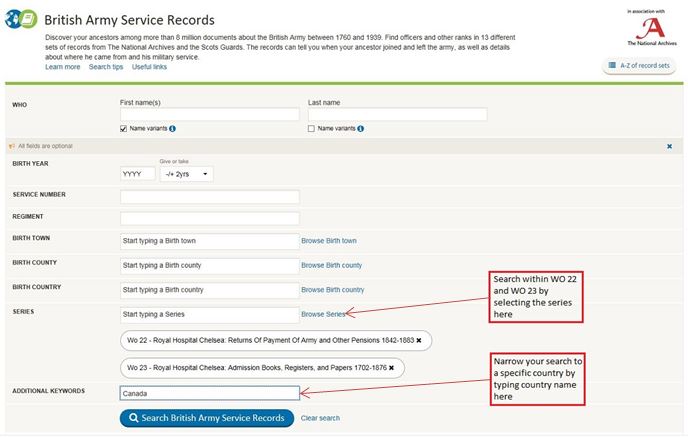
Using Findmypast.co.uk to search for pension records by country of residence
Use Findmypast.co.uk (£) in the same way to search for pension records from a Foreign and Colonial subseries of WO 23 specifically for:
- a small number of Indian Army pensioners (most records for Indian Army pensioners are held by the British Library)
- a small number East India Company pensioners (most records for East India Company pensioners are held by the British Library)
- black soldiers, described in the original records as “negro” pensioners
7. Monthly and quarterly regimental muster rolls and pay lists 1732-1898
Though the appearance of individuals on muster rolls and pay lists are not determiners of whether or not they received a pension, they are particularly useful records for men who were not discharged to pension as they provide the enlistment date, movements and discharge date of all soldiers in the British Army.
Refer to the British Army muster rolls and pay lists c.1730-1898 research guide to find out which series to consult for the period 1732 to 1878. For 1878 to 1898, browse WO 16 to find the relevant regiment or regimental district.
8. Discharge papers 1817-1888
Trying to trace an individual soldier in this way can be time-consuming, with no guarantee of success. The registers are not complete but they are a useful potential source of information. A number of these pieces contain information on soldiers whose discharge document would not be in WO 97 (see section 3).
Discharge dates 1817-1829
- Soldiers who purchased their discharge (and would therefore not have received a pension) in WO 25/3845-3847
Discharge dates 1830-1838
- Register of men discharged at their own request WO 25/3848-3849
Discharge dates 1852-1870
- Soldiers discharged during their first period of service; discharged as ‘incorrigible’, discharged ‘with ignominy’; sentenced to penal servitude or 21 years with militia, 1852-1870 in WO 25/3869-3874
- Soldiers discharged when a regiment reduced its numbers 1856-1857 in WO 25/3879
- Soldiers discharged under the terms of the new Limited Service Act 1866-1870 in WO 25/3883
- Soldiers discharged on return from India 1863-1870 in WO 12/13077-13090
Discharge dates 1871-1888
- On return from India 1871-1878 in WO 12/13091-13105
- General register 1871-1884 in WO 121/223-238
- Gosport discharge depot musters 1882-1888 in WO 16/2284 and WO 16/2888-2916 (there is an index for 1883-1888)
9. Soldiers who died in service
If a soldier died in service the principal personnel records that were retained for soldiers (those used for pension purposes) are less likely to exist. There are, however, some records that were created as a result of a soldier dying in service:
- Records of deaths and the effects (possessions) of dead soldiers in a subseries within WO 25
- Registers of authorities to deal with the effects (possessions) of dead soldiers 1810-1822 in WO 25/2966-2971. These records include:
- regiment
- period of death
- amount of effects and credits
- date of order to agent
- agent’s name
- person applying (usually next of kin) and his or her address
- Soldiers’ effects ledgers 1862-1881 in WO 25/3475-3501 (WO 25/3491-3501 are indexes to WO 25/3475-3490). The National Army Museum holds a set for April 1901-March 1960 (see section 11.3). The ledgers were created as a list of the monies owed to soldiers who died in service. They do not list any personal items that may have been returned to the next of kin. The information they typically contain is:
- full name
- regimental number
- date of death and sometimes the place
- next of kin
- monies paid to the next of kin
- records from 1901-1914 also detail the date of enlistment and trade
- Less informative but still helpful, as they give the regiment, are an index of effects from 1830 in WO 25/2974 and a register of effects and credits 1830-1844 in WO 25/2975
10. Royal Artillery personnel records
Until 1855 ordnance troops, which included the Royal Artillery, were the responsibility of the Board of Ordnance, not the War Office. There are therefore some series of records specifically for Royal Artillery personnel.
10.1 Royal Artillery service records and other papers
Search by name of a non-commissioned officer or soldier in our catalogue within WO 69 for records of the Royal Artillery which include:
- description books
- records of service, including original attestation papers
- registers of marriages and baptisms
- registers of deceased soldiers
- some records of transfer of men to the Army Reserve
- pension registers
- description book of the Royal Irish Artillery 1756-1774
- miscellaneous correspondence
Supplementary records of services are preserved for soldiers in the Royal Artillery, 1791 to 1855, and the Royal Horse Artillery, 1803 to 1863, in WO 69.
- You can search by name in our catalogue within WO 69.
- This series also contains other useful material, up to 1913.
10.2 Royal Artillery pension records 1770-1913
Artillery pensions were paid by the Ordnance Office until 1834, when the Royal Hospital Chelsea took over. The records are in the following series:
| Date range | Description | Catalogue reference |
|---|---|---|
| 1770-1808 | Vouchers for artillery pensions | WO 18/1-147 |
| 1808-1834 | Pension minutes | WO 47/2760 -2851 |
| 1816-1844 | Registers of Ordnance pensions | WO 54/338-493 |
| 1822-1855 | Pension minutes | WO 55/540-572 |
| 1833-1913 | Royal Artillery pensions | WO 116/125-185 |
| 1834 | Registers of current Ordnance out-pensions | WO 23/141, WO 23/143-145 |
11. Second Boer War personnel records 1899-1902
The British forces in South Africa during the Second Boer War, also known as the South African War and sometimes imprecisely referred to simply as the Boer War, consisted of:
- units of the regular army
- militia units
- the Imperial Yeomanry (a volunteer mounted infantry regiment set up largely for service in South Africa)
- forces recruited locally in South Africa itself
Click on the series references below to search or browse these records by unit. These records are of soldiers who enlisted in units locally raised in South Africa.
For records of the Imperial Yeomanry serving in South Africa search for:
- registers and casualty books by regimental number in WO 129
- attestation and discharge documents from WO 128 on findmypast.co.uk (£)
Please note that many soldiers and officers who served in the British Army during the Second Boer War also served in the British Army during the First World War (1914-1918). When this happened, then pre-1914 record of service (including Boer War) is more likely to be among First World War service records.
You can search and download campaign medal rolls (WO 100) at Ancestry.co.uk (£). They list militiamen who received the Queen’s (or King’s) South Africa Medal or the Queen’s Mediterranean Medal, while serving with the regular army.
12. Guards Regiments
Service records of the Coldstream Guards, Grenadier Guards, Irish Guards and Welsh Guards are being transferred to The National Archives, to find a service record request a search using one of the forms below.
Form 1: For a deceased person born before 1940
Form 2: For a living person, or your own record, born before 1940
The Scots Guards regiment has its own archive, see below.
Various registers for the Grenadier Guards, including discharge registers, registers of deserters, attestation forms, and enlistment registers from the middle of the 18th century onwards can be found at The National Archives in WO 437.
13. Records in other archives
Regimental museums do not generally hold records of service of their men and officers, although they often hold other records which can be useful to people researching their military ancestors.
13.1 The Scots Guards
The Scots Guards regiment has its own regimental archive. Enlistment registers of the Scots Guards covering 1799-1939, and 1642-1939 for officers, can be searched on Findmypast.co.uk.
For other records of the Scots Guards contact the regimental archives.
13.2 Household Cavalry
Microfilm copies of WO 400 (see section 2.6) are held at the Household Cavalry Museum Archive in Windsor. It’s best to contact the museum for access conditions before visiting.
13.3 Records of soldiers’ effects 1901-1960
The National Army Museum holds records of soldiers’ effects for April 1901 to March 1960. Those from 1901 to 1929 are available on Ancestry (£). For 1930-1960 contact the National Army Museum directly.
14. Further reading
The following publications are available in The National Archives’ library. Those with a link can be bought from The National Archives’ online bookshop:
Amanda Bevan, Tracing Your Ancestors in the The National Archives (The National Archives, 2006)
Christopher Chant, The Handbook of British Regiments (Routledge, Kegan & Paul, 1988)
Norman K Crowder, British Army Pensioners Abroad 1772-1899 (Genealogical Publishing Co Inc, 1995)
Dan Cruickshank, The Royal Hospital Chelsea: the Place and the People (Third Millennium Publishing, 2008)
Jeremy Gibson and Mervyn Medlycott, Militia Lists and Musters 1757-1876: A Directory of Holdings in the British Isles (Federation of Family History Societies, 2004)
Ian S Hallows, Regiments and Corps of the British Army (Arms and Armour, 1991)
E A James, British Regiments 1914-1918 (Naval & Military Press, 2001)
J M Kitzmiller, In Search of the ‘Forlorn Hope’: A Comprehensive Guide to Locating British Regiments and their Records (Manuscript Pub Foundation, 1988)
M E S Laws, Battery Records of the Royal Artillery 1716-1859 (Royal Artillery Institute, 1952)
Gerry Murphy, Where Did That Regiment Go?: The Lineage of British Infantry & Cavalry Regiments at a Glance (The History Press, 2009)
Mustor (muster) Books and Pay Lists (List and Index Society, 1984)
Roger Perkins, Regiments: Regiments and Corps of the British Empire and Commonwealth 1758-1993: A Critical Bibliography of Their Published Histories (Roger Perkins, 1994)
Robert Pols, Dating Old Army Photographs (Family History Partnership, 2011)
Return of the Names of the Officers in the Army Who Receive Pensions for the Loss of Limbs, or for Wounds (Naval & Military Press, 2002)
William Spencer, Army Records: A Guide for Family Historians (The National Archives, 2008)
William Spencer, Records of the Militia and Volunteer Forces 1757-1945 (Public Record Office, 1997)
Waterloo Medal Roll: Compiled From the Muster Rolls (Naval & Military Press, 1992)
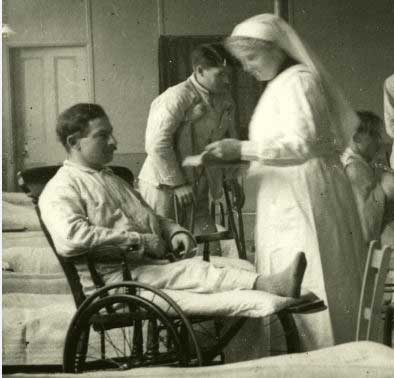
How do I view these records?
Search and download these records on:

You can search and download (£) British Army casualty lists from the Second World War. The term ‘casualty’ covers anyone in the British Army who was killed, wounded or missing.
These are digitised records from The National Archives record series WO 417.
For more information on what these records contain see findmypast.co.uk.
1. Why use this guide?
This guide will help you to find records relating to the experience and influence of black British people in the 20th century. It focuses on the records held here, at The National Archives, that relate to civil rights and race relations. It will also direct you to records held elsewhere.
If you are interested in earlier records, browse our ‘Help with your research’ page to find other suitable research guides. If your interest is family history you should start with the research guides under the family history category.
For the purposes of this guide, we use ‘black British’ to mean Britons with African and Caribbean ancestry. There is ongoing discussion about terminology relating to race, and we welcome your views on our approach.
2. Key events, organisations and legislation
Some key events, organisations and legislation that it might be useful to know about:
- 1919 uprisings in London, Cardiff and Liverpool
- 1931 Dr Harold Moody establishes the League of Coloured Peoples
- 1948 British Nationality Act
- 1948 SS Empire Windrush arrives at Tilbury
- 1958 uprisings in London and Nottingham
- 1962 Commonwealth Immigrants Act
- 1958-1966 Notting Hill Carnival begins (exact date is disputed)
- 1963 Bristol bus boycott
- 1965, 1968 and 1975 Race Relations Acts
- 1967 British Black Panther party established
- 1970 Trial of the Mangrove Nine
- 1979 Royal Commission on Criminal Procedure (led to repeal of the ‘Sus laws’)
- 1981 Brixton uprisings and Lord Scarman report
- 1999 Macpherson Report published following the Stephen Lawrence Inquiry
We know there are records in our collection that refer to some of these events, but we have not found records that relate to all of them. If you come across information in your research that you think would be of interest to other researchers, please email us.
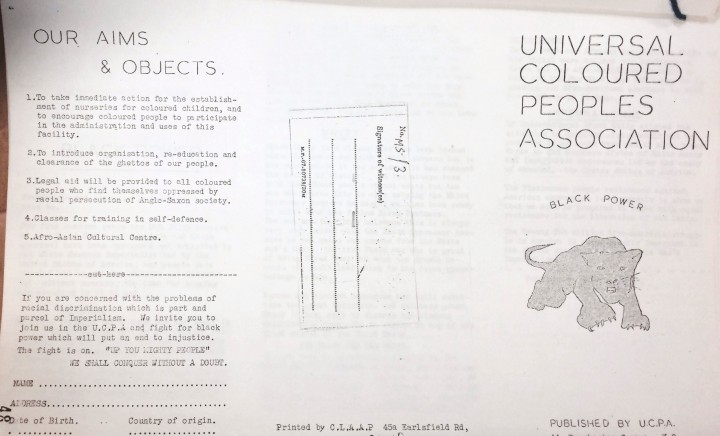
Image of Universal Coloured Peoples Association Pamphlet from MEPO 2/11409
3. How to view records
Discovery, our catalogue, lists records held by The National Archives as well as over 2500 other archives in the UK and some abroad. The arrangements to see records will vary between archives.
For records held by The National Archives, the online catalogue description will indicate whether you can view records online. For records not available online, the catalogue description will include an option to order paper or digital copies to be sent to you.
You can also visit us to do your research here in person – check our website for opening hours, closure dates and details of the two valid forms of ID you must bring to look at original documents. If you can’t visit in person you can request a paid search.
If the catalogue description shows the records are held at another archive you will need to contact that archive directly for access arrangements.
4. What records can I view online?
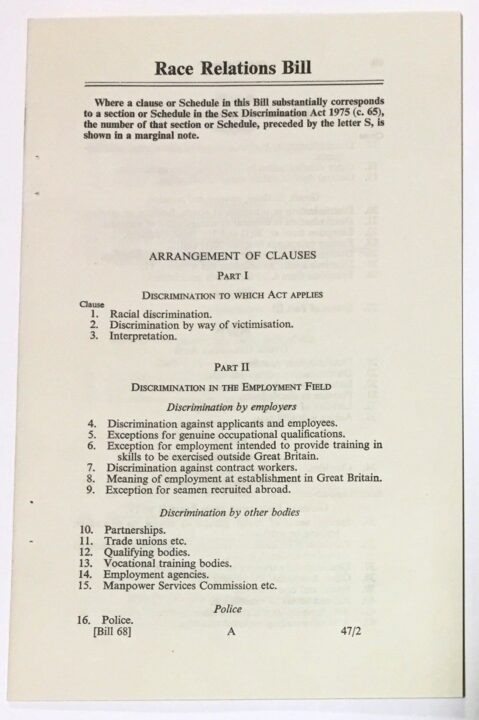
Race Relations Bill 1976 (catalogue reference: AST 18/128)
Some useful collections of records are available online. They represent mostly high level official activity, but there are also some records with a more personal flavour.
4.1 Cabinet papers
Read our research guide to Cabinet and its committees for advice on searching our catalogue for cabinet papers.
The archived Cabinet Papers site has themed pages which you can browse, some with links to downloadable documents. The theme of ‘Law, liberty and society’ covers Cabinet papers on race relations but you might also find useful material under other themes.
4.2 Parliamentary papers
Search Proquest UK Parliamentary Papers for published House of Commons Parliamentary Papers from 1715 to the present, as well as some House of Lords Sessional Papers; local, private and personal Acts; and some Journals of the House of Lords and House of Commons. This is a subscription website you can access on The National Archives’ computers by visiting us at Kew. You may also be able to access it via a large reference library such as a university library.
Discussions in Parliament can be found in Hansard, which is available online on the Parliament website. Please note there are some volumes missing from the online data.
Our research guide to Hansard details different ways of accessing the reports and records of Parliamentary debates.
4.3 Legislation
Search legislation.gov.uk for relevant legislation. This could include specific race relations legislation but also legislation such as the 1824 Vagrancy Act (‘Sus law’) which caused conflict and protest. Please note that not all historical legislation is available online. For more information see our research guide on Original Acts of Parliament and Royal Assent.
4.4 Moving here
Browse the Moving Here website under the Caribbean heading. Sections on working lives, politics and culture and festivals include some digitised original documents. Please note that this website has been archived and is no longer updated so some of the functions may no longer work.
4.5 British Newspaper Archive
Search the British Newspaper Archive (£), also available over Findmypast (£), and The Times Digital Archive (institutional subscription required) for articles relating to political and social history.
Local libraries may have their own subscriptions to these online archives that you can use.
As when searching within other archives you should search using the language of the time to find relevant reports and articles. You can also search for particular people, places and events by name.
5. How our catalogue works
Discovery, our catalogue, contains descriptions of records held by us and over 2,500 other archives across the UK and some abroad.
The record titles and descriptions were written at the time the records were created. Quite often they use language that is now out of date and sometimes offensive, but once records are transferred to us we don’t alter them. The terminology used by the people that created the records is part of the story they tell.
The records relating to the civil rights protests and race relations legislation of the 20th century are relatively easy to identify because the record descriptions often include references to race.
In most other instances there will be nothing in the record description to indicate whether it is specifically relevant to black British history. You will need to be creative and speculative in how you search.
6. Searching our catalogue for records
Use the main Discovery search or the Advanced search page. Try the search strategies outlined below.
The advanced search option allows you to build your searches more precisely by restricting dates and other criteria from the start. Other sections of this guide will give you some ideas about which National Archives departments and series to search within. For more information about using Discovery effectively see Discovery help.
6.1 Using broad searches
Search using broad terms that will produce plenty of results but may not all be relevant. Use the filters on the search results page to narrow down your results by date, government department and other criteria. Try terms such as:
- race relations
- racism
- racial discrimination
- colour bar
- prejudice
- civil rights
- black power
6.2 Using specific search terms
Search more specifically such as around employment, housing and education using terms such as:
- black
- colour and coloured
- Caribbean and West Indian
- African
Combine these terms with: workers, employees, employment, students, tenants, landlords, housing, immigration and immigrants or other words relevant to your research.
6.3 Searching for people and events
Image from back page of Black Power Speaks, Vol. 3 (catalogue reference: MEPO 2/11409)
Search more specifically around people or events, some of which are highlighted at section 2. Try searching for:
- names of activists (though many names that appear in the content of the records do not appear in the catalogue titles or descriptions)
- names of political organisations
- particular protest action such as marches and uprisings (use the search term ‘riot’)
- court cases, legislation and public enquiries
If you come across any material or search terms that might be useful to others interested in this subject we would like to hear from you. Please email us about your research experience.
7. Government policy on race relations
During the 20th century, increased government recognition of discrimination led to changes in policy.
Try searching the catalogue using ‘policy’ combined with relevant terms such as:
- racial or race discrimination
- coloured people
- West Indian, Caribbean, African
- immigration
A general search of the catalogue for ‘race relations policy‘ finds records from key government departments such as:
- Commission for Racial Equality (CK)
- Cabinet Office (CAB)
- Department of Employment (LAB)
- Home Office (HO)
Getting an understanding of the departments involved in policy can help to inform further searches.
Use the Advanced search option in Discovery to search within the records of one or more of these departments in more depth to find records relating to the development and implementation of policy. Discovery help explains how to do this.
8. Civil rights struggles in the UK
Records at The National Archives reflect the government’s response to the civil rights movement in the UK and also that in the United States.
Black Power demonstration in Notting Hill, London 1970 (catalogue reference: MEPO 31/21)
8.1 The government’s response to civil unrest
The British civil rights struggle prompted a backlash from the State and many activists were charged with criminal offences such as riot and disturbance.
Read our overview guides to civil court cases and criminal court cases to learn about what records survive and how to search them.
Alternatively, use the advanced search option in Discovery and search within the records of particular departments such as those listed below. Discovery help explains how to do this.
- Metropolitan Police (MEPO)
- Home Office (HO)
- Director of Public Prosecutions (DPP)
- Assizes (ASSI)
- King’s Bench (KB)
- Central Criminal Court (CRIM)
- Other court records (JUST)
8.2 Civil rights organisations
You can search Discovery for records relating to the various civil rights organisations that formed in the 20th century. Searches for the organisations listed below produce useful results, but there may be other organisations worth searching for.
- Black Power
- Black Panther
- League of Coloured Peoples
- Universal Coloured People’s Association
- Negro Welfare Association
- West African Students’ Union
- West Indian Standing Conference
- Black Unity and Freedom Party
- Campaign Against Racial Discrimination
Image of Black Panther movement newspaper 1970 (catalogue reference: MEPO 31/21)
9. Race Relations Board and Commission for Racial Equality
The Race Relations Board was established following the 1965 Race Relations Act. From 1976 this was replaced by the Commission for Racial Equality. The three record series from these and other bodies dealing with the rights and welfare of ethnic minority communities are:
- CK 1 – copies of annual reports
- CK 2 – minutes and papers of the Race Relations Board and local conciliation committees (including cases brought by individuals under the Act)
- CK 3 – minutes and other files of the Community Relations Council
The description of the CK record series explains in more depth what you might find within these records.
Use the advanced search option in the catalogue to search within records from the Commission.
10. Employment and industrial relations
Black Britons have faced discrimination from employers and Trade Unions. The 1948 Nationality Act actively encouraged Caribbean workers to join the British labour force after the Second World War, but they still faced hostility and prejudice in both housing and employment.
To find records relating to employment and industrial relations, search Discovery using terms such as ‘discrimination’ and use the filters to narrow down your results.
Alternatively, use the advanced search option in Discovery and restrict your search to particular government departments such as those below. Discovery help explains how to do this.
- Board of Trade, Department of Employment and Ministry of Labour (LAB).
- British Transport Commission and British Railways Board (AN)
- Records of the Registry of Trade Unions and Employers Associations (NF)
For collections of records held elsewhere see our research guide on Labour history records held by other archives.
11. Records in other archives
There are many useful records held in archives across the UK. Some relevant collections are shown below but this is by no means a comprehensive list.
- The Huntley Archives at the London Archives
- Black Cultural Archives
- Institute of Race Relations
- George Padmore Institute
- Bernie Grant Archive at the Bishop’s Gate Institute
- Local archives – use the Find an archive tool to search for local archives, or search Discovery and refine your results to select records from other archives.
- Historic England – the Slave Trade and Abolition
- British Library
- The Modern Records Centre – includes the archives of the Trades Union Congress, the Transport and General Workers Union and the Confederation of British Industry.
- Church of England Archives – includes material relating to The British Council of Churches and what are known as Black Majority Churches in the UK.
12. Further reading
12.1 Website reading resources
- Black and white on the buses (about the Bristol bus boycott 1963)
- V&A black heritage pages
- Moving Here website
- Black Cultural Archives (see their subject guides)
- The National Archives blogs
12.2 Printed resources
These books are all available in The National Archives’ reference library. You may also be able to find them in a local library. You can buy from a wide range of history titles in our shop.
Peter Fryer, Staying Power (London: Pluto, 1984)
Clive Harris, Configurations of racism: the civil service, 1945-60
Robert Bloody foreigners: the story of immigration to BritainLondon: Little, Brown, 2004)
Adolph Marcus Garvey 1887-1940 London: New Beacon Books, 1967)
Black history: the present in the past London: Sage, 2003)
Black and Asian Studies Association newsletter (London: Black and Asian Studies Association, 1991)
Panikos Panayi, Racial violence in Britain, 1840-1950 (Leicester University Press, 1993)