This guide contains very brief details of these records. We will be expanding its content soon.
1. Where to go for further support, if you have been affected by the content of these records/and or the events they describe
Records from the Independent Inquiry into Child Sexual Abuse include content that some people may find distressing. If you have been affected by these records, you can find useful advice on looking after your mental health and wellbeing on the NHS Every Mind Matters website and from the mental health charity Mind.
2. How to access records held at The National Archives
The records of the Independent Inquiry into Child Sexual Abuse can be accessed using The National Archives’ online catalogue. Most of the records are held in digital format and (unless closed to public access) are available online.
The National Archives’ online catalogue will indicate the format of the record. If you need further help using our catalogue, please consult Discovery help.
The Independent Inquiry into Child Sexual Abuse records are catalogued within the following series:
- ICSA 1: contains the archived website of the Inquiry. See the section below for links to the UK Government Web Archive.
- ICSA 2: contains the evidence considered by the Inquiry. Search or browse descriptions in our catalogue.
- ICSA 3: contains the administrative (corporate records) of the Inquiry. Search or browse descriptions in our catalogue.
- ICSA 4: contains the archived Twitter (X) channel of the Inquiry. See the section below for links to the UK Government Web Archive.
- ICSA 5: contains the archived You Tube channel of the Inquiry. See the section below for links to the UK Government Web Archive.
- ICSA 6: contains the Inquiry’s archived Truth Project Website. See the section below for links to the UK Government Web Archive.
- ICSA 7: contains the archived Twitter (X) channel of the Victim and Survivor Consultative Panel. See the section below for links to the UK Government Web Archive.
3. UK Government Web Archive resources
The UK Government Web Archive at The National Archives holds other Inquiry resources.
- Independent Inquiry into Child Sexual Abuse (IICSA) (https://www.csa-inquiry.independent.gov.uk/) – Website
- Independent Inquiry into Child Sexual Abuse (IICSA) (https://www.iicsa.org.uk/) – Website
- Independent Inquiry into Child Sexual Abuse (IICSA) – Truth Project
- Independent Inquiry into Child Sexual Abuse (IICSA) – Twitter Archive
- Independent Inquiry into Child Sexual Abuse (IICSA) – Victim and Survivor Consultative Panel – Twitter Archive
- Independent Inquiry into Child Sexual Abuse (IICSA) – YouTube Archive
4. Other sources
Material can be found in the archives of both local authorities and private organisations. This may include reports; reviews; briefings; minutes; notes recordings and correspondence in relation to individuals, organisations, institutions, or public bodies. It may also include material relevant to statutory responsibilities for the care of children in public or private care; material relevant to the development of policy on child protection; or material relevant to the development of legislation on child protection.
A directory of UK archive services can be found on The National Archive website: https://discovery.nationalarchives.gov.uk/find-an-archive
1. Why use this guide?
This guide sets out the context for records of the Grenfell Tower Inquiry that are held by The National Archives. This guide also touches on relevant records that are preserved by the wider archive sector.
The Inquiry was set up to examine the circumstances leading up to and surrounding the fire at Grenfell Tower, in North Kensington, West London on the night of 14 June 2017. The focus of the Inquiry was to investigate the cause and origin of the fire, the means by which it was able to spread throughout the building and how the building came to be in a condition which allowed that to happen. Related matters, such as the responses of the London Fire brigade, the scope and effectiveness of the building regulations and the responses of central and local government to the disaster, formed part of the Terms of Reference.
The focus for this guide is the records of the public inquiry that have been transferred to The National Archives having been selected by the Inquiry Chairman and in line with The National Archives’ Records Collection Policy. The records have been transferred to The National Archives in line with the Inquiries Act 2005, the Inquiry Rules 2006, and the Public Records Act 1958. They have been managed in line with current information rights legislation.
2. Where to go for further support, if you have been affected by the content of these records/and or the disaster
Records from the Grenfell Tower Inquiry include content that some people may find distressing. If you have been affected by these records, you can find useful advice on looking after your mental health and wellbeing on the NHS Every Mind Matters website and from the mental health charity Mind.
3. What was the Grenfell Tower Fire?
In the early hours of Wednesday 14 June 2017, a fire broke out in the kitchen of Flat 16 Grenfell Tower, a high-rise residential building in North Kensington, West London. The fire claimed the lives of 71 people who were present in the tower that night, including the life of a child who was stillborn shortly after his mother had escaped and had been admitted to hospital. Another resident who had escaped from the building died seven months later. A total of 227 people in all (residents and visitors) escaped from the tower.
4. The Public Inquiry
On the morning after the fire the Prime Minister announced that there would be a public inquiry into the circumstances surrounding the fire and on the 28 June 2017 Sir Martin Moore-Bick, a former Lord Justice of Appeal, was appointed to act as the Inquiry Chairman. On 15 August 2017, the Inquiry was formally set up under the Inquiries Act 2005.
The Terms of Reference for the Inquiry were set by the Prime Minister on 15 August 2017 on the recommendation of the Chairman. The Terms of Reference can also be found in the UK Government Web Archive at The National Archives.
The Grenfell Tower Inquiry formally opened on 14 September 2017. The Inquiry was split into two phases. Phase 1 focused on the events on the night of 14 June 2017 and the Phase 1 report was published on 30 October 2019. Phase 2 examined the underlying causes of the disaster, including the decisions made in relation to critical aspects of the design and construction of the cladding system, the adequacy of the regulatory regime and the response of central and local government. The Phase 2 report was published on 4 September 2024.
5. What are these records?
Under the Inquiry Rules 2006 the Chairman of the Inquiry has a duty to transfer custody of the Inquiry record to a government department or to the appropriate public record office, in this case The National Archives, as directed by the sponsoring minister, in this case, the Prime Minister. On the recommendations of the Chairman, the Prime Minister directed that all evidence disclosed to core participants in the Inquiry, together with other documents the Chairman considered significant in explaining the conduct of the Inquiry, be transferred to The National Archives for permanent preservation.
The records of the Grenfell Inquiry have been through the process of appraisal, selection, and sensitivity review before being transferred to The National Archives for permanent preservation in line with the Inquiries Act 2005, the Inquiry Rules 2006 and following the direction and wishes of the Inquiry Chairman.
Evidence was received during both phases of the Inquiry. All documents received as evidence by the Inquiry which were deemed relevant to the terms of reference were disclosed to core participants in the Inquiry throughout its course. Evidence that was referred to in the Inquiry hearings, or referenced in the Inquiry reports or published on the Inquiry website was selected for permanent preservation. These records were selected by the Chairman for permanent preservation and were transferred to The National Archives.
Some of the evidence predates the establishment of the Inquiry itself, sometimes by several decades. Where physical documents were scanned and provided to the Inquiry in digital format, the dates reflect the dates of the original records.
While the Inquiry was using the records they were managed within a document management system and each document was given a unique reference number. Reports, transcripts, and recordings of public hearings may use these unique reference numbers when referring to the records. The unique reference numbers can also be used when searching The National Archives online catalogue or within the UK Government Web Archive.
The contents of the Inquiry website and the recordings of the Inquiry hearings on the Inquiry YouTube Channel have been captured in the UK Government Web Archive.
In addition to those already published on the Inquiry website, certain administrative records of the Inquiry are being transferred to The National Archives. These include the Solicitor to the Inquiry’s letter to all core participants, which explains the conduct of the Inquiry. Administrative records of the Inquiry were managed within shared drives on the Inquiry Google workspace platform. The Inquiry also created video content, and this has been transferred to The National Archives and made available via The National Archives online catalogue.
The Inquiry commissioned and used a physical model of a typical bay of the external façade of Grenfell Tower. This model has also been transferred to The National Archives.
6. Supporting sensitivity and transparency
As part of preparing its records for transfer to The National Archives, the Grenfell Tower Inquiry has undertaken a comprehensive review of the content of each record to ensure they are managed in line with information rights legislation.
All decisions to ‘close’ information, either in whole or in part (i.e. through withholding an item entirely, or through applying redactions) have been made in line with the exemptions set out in the Freedom of Information Act 2000 (Information Commissioner’s Office (ICO) Exemptions). ‘Closed’ information may include things like an individual’s personal data, as defined by data protection legislation, or material which might endanger the physical or mental health or safety of an individual if it were to be disclosed. Where information has been withheld this will be for a defined period of time and records will be reassessed at the end of this period to determine whether the closed or redacted content can be opened to the public. Where records have been closed, this is indicated at record level in our online catalogue. Where the Inquiry has cited the name of an individual in the description field in The National Archives’ online catalogue the name may be used and is searchable in our online catalogue descriptions. This reflects the way that personal data was managed by the Inquiry and reflects the handling of names on the inquiry website.
Because of the potentially distressing nature of some of these records, we have added an advisory note to the relevant online series descriptions and at individual records/pieces.
7. How to access records held at The National Archives
The records of the Grenfell Tower Inquiry can be accessed using The National Archives’ online catalogue. Most of the records are held in digital format and (unless closed to public access) are available online.
The National Archives’ online catalogue will indicate the format of the record. If you need further help using our catalogue, please consult Discovery help.
Grenfell Tower Inquiry records are catalogued within the following series:
GTI 1 contains the archived website of the Inquiry. You can also search the UK Government Web Archive.
GTI 2 contains evidence considered by the Inquiry. Search or browse descriptions in our catalogue
GTI 3 contains the administrative records of the Inquiry. Search or browse descriptions in our catalogue
GTI 4 contains the archived YouTube channel of the Inquiry. You can also search the Social Media Archive.
GTI 5 contains the archived Twitter (X) channel of the Inquiry. You can also search the Social Media Archive
GTI 6 contains a physical scale model of a typical bay of the external façade of Grenfell Tower as commissioned by the Inquiry.
8. Public inquiry reports
The Grenfell Tower Public Inquiry reports can be found in the UK Government Web Archive at The National Archives. For more details, visit the Archive Timeline on the UK Government Web Archive.
The Chairman published his phase one report on 30 October 2019; the phase two report was published on 4 September 2024.
9. Other UK Government Web Archive resources
The UK Government Web Archive at The National Archives holds other Grenfell Tower resources.
On the 26th February 2025, the government published their response to the final report of the Grenfell Tower Inquiry, accepting the findings and setting out their plan to act on all the 58 recommendations. The government response can be found in the Archive Timeline on the UK Government Web Archive.
The Grenfell health and welfare website can be found in the Archive Timeline on the UK Government Web Archive.
The NHS North Kensington Health and Wellbeing information can be found in the Archive Timeline is on the UK Government Web Archive.
10. Other sources
We have provided links to other relevant local authorities’ websites and search facilities, where further information on local projects as well as records that are preserved by the wider archive sector can be found. This list is not exhaustive.
- The Grenfell Tower Memorial Commission has a homepage that brings together the diverse perspectives and experiences of the bereaved, survivors, and the North Kensington community. You can find more information on the Independent Review of building regulations and fire safety conducted in May 2018 on the UK Government Web Archive.
- The Royal Borough of Kensington and Chelsea offers archives and local studies, including a catalogue search and the North Kensington Social Justice Archive project.
- The Bishopsgate Institute has a homepage dedicated to the North Kensington Archive and Heritage project.
- The Royal Institute of British Architects (RIBA) has a section on its website dedicated to the Grenfell Tower fire. This includes RIBA’s statements and responses, actions taken in the profession since the incident, and a searchable main website. RIBA Competitions is also running a competition to design the memorial. Additionally, RIBA has responded to the Grenfell Tower Inquiry report phase 2 on its website. Researchers can find all necessary information if they would like to visit the RIBA library.
The records held at The National Archives
This guide provides a brief overview of resources held at The National Archives that can help you to trace your family history from the UK to its former colonies in Australia and New Zealand.
It is an introduction to the sorts of records we hold, with links to guides providing more detailed advice on how to find the records in our collection.
How to get a search for records started
Most of these records relate to Australia and New Zealand, encompassing the British colonial territories in Australasia before and following their independence.
In general, we do not hold the internal administrative records from Australia and New Zealand, such as registers of births, marriages and deaths or land ownership, which would have remained in place after independence. However, this guide does provide some advice on where to find these records.
Quite often record titles, descriptions, and the documents themselves use language that is now out of date and sometimes offensive, but once records are transferred to us, we don’t alter them. The terminology used by the people that created the records is part of the story they tell.
How to view records
Before you begin a search, you should see if there is a guide to the records you are looking for. This guide is designed to help you do that. Throughout this guide you will find links to the more detailed advice you will need to search a specific set of records.
Records are arranged by the government department that created them, then by the type of record, such as passenger lists or military service records, and by date. There are no ‘case files’ containing all the information about a single person. For any individual, there may be several different types of records which relate to them, each of which will have to be searched for separately.
The documents themselves may be in different formats, from handwritten registers, printed lists, or large sheets of parchment, each representing one aspect of a distinct set of records.
Records of criminal transportation from England and Ireland to Australia
From 1787, convicts were transported to penal settlements in modern-day Australia, specifically New South Wales and Tasmania. They could be sentenced to a set term or life, with limited freedom in the colony.
During its 80-year history 158,702 convicts arrived in Australia from England and Ireland, as well as 1,321 from other parts of the Empire. Transportation did not cease until 1868. Many records survive from this period and most records are searchable online.
For information on how to search these records read our guide to criminal transportation.
For records of criminals transported from Ireland between 1788-1868 consult the advice from the National Archives of Ireland.
Records of emigration to Australia
Records of emigration to Australia from 1784-1950
The National Archives holds records relating to emigration from Britain to Australia. These records tend to refer to both convicts and settlers since, once in Australia, the two were often less distinct than when they set out.
Consult Section 7 in our guide to emigration which offers advice on how to search these records.
You can also search millions of records of settlers who emigrated to Australia online at Ancestry.co.uk (charges apply).
Records of travel to Australia from 1890-1960
To search lists of individuals who sailed as passengers to Australia from 1890 to 1960, consult our guide to passengers.
Bear in mind The National Archives holds no lists of passengers who sailed to Australia before 1890.
Records of child migration to Australia
Tens of thousands of children from the UK were dispatched to Australia and during the 1860s up to the 1920s.
You can find information on how to search these records in Section 10 of our research guide to emigration and emigrants.
Records of travel to Australia after 1960
After 1960, passenger lists are not held by The National Archives when air travel became more common. No air passenger lists have survived. For records of passengers who arrived by sea after 1960 it may be worth contacting the relevant shipping line.
Records of emigration to New Zealand
Records of travel to New Zealand 1890-1960
The National Archives holds passenger lists for individuals boarding at UK and Irish ports travelling to New Zealand from 1890-1960.
For advice on how to search these records, consult our guide to passengers.
Records of emigration to New Zealand 1839-1850
The New Zealand Company, established in 1839, was the first European settlement in New Zealand, acquiring land and settling British emigrants. Information about British emigration to New Zealand can be found in the company’s records, now held at The National Archives.
Consult section 8 of our guide to emigrants for further information.
For further information, see guidance from the Archives New Zealand website.
Records of Australian and New Zealand birth, marriage, deaths
Births, marriages, and deaths
Australian and New Zealand birth, marriage and deaths were generally administered locally. These records can be found at state, county, and city or town level.
You can, however, search for some records online through subscription services such as Ancestry.co.uk, Findmypast.co.uk and Familysearch.org (charges apply).
Census records
Surviving census records will normally be found in the country of origin, and not The National Archives.
The only exceptions are the census records of settlers and convicts in New South Wales and Tasmania 1828.These documents can be downloaded free of charge as Digital microfilm. A name-indexed version is also online at Ancestry.co.uk (charges apply) and at Findmypast.co.uk (charges apply).
Records of Australian and New Zealand military and armed forces records
For the service records of soldiers serving in the Australian and New Zealand army, you will need to contact the National Archives of Australia and Archives New Zealand.
The Australian War Memorial may also hold useful records.
Records of Australasian and New Zealand prisoners of war
For lists of members of the Allied Forces held prisoner in Italian hands, including personnel from the Australian Army and New Zealand Army consult our guide to records of British and Commonwealth prisoners of the Second World War and the Korean War.
Records of Australian and New Zealand land ownership
Records of Australian land grants
In early colonial Australia, Britain considered land to belong to the Crown because it had been discovered and settled by its subjects. The Crown granted land to companies to organise settlements and sometimes to people as a reward for services. The New South Wales original correspondence, entry books and registers contain requests for land grants which are searchable by name, including permissions to emigrate to Australia.
Consult section 7 of our guide to emigration and emigrants for advice on how to search these records.
Although land grants were nominally made in the name of the Crown, most were made and recorded in the respective country. Consult The Museums of History New South Wales website for research guidance to help you to trace a specific land grant from 1788-1856.
Records of New Zealand land grants
Historic land records for New Zealand, relating to Crown grants, indexes and registers for the deeds system are held by Archives New Zealand.
Records of the indigenous peoples of Australia and New Zealand
The National Archives holds some records relating to colonial interaction with the indigenous peoples of Australia and New Zealand.
In general, it would be difficult to use these records to trace individuals, except chiefs or community leaders. However, the records offer some scope for researchers to trace the histories of indigenous communities over time, through colonial military action against indigenous peoples, treaties with European settlers, legal proceedings, maps, and notices in government gazettes.
Conducting searches for the names of individuals or tribes in our catalogue Discovery, will often require attempting multiple different spellings. However, in most cases, to find records with individuals’ names, you would need to do research in our reading rooms with original records directly, as the names won’t be recorded within the catalogue entries for the records.
In common with most of our colonial records, our catalogue reproduces the historical language of the records themselves, even where that language is considered offensive. Identifying records relating indigenous peoples will often require the use of the term’s ‘aborigine’ and ‘natives’, for example. It also requires a creative approach to the spelling of names and place names. For more advice on searching using alternative spellings, consult our Discovery help pages.
These records tend to be found in political, administrative, and visual records and are largely held within records of colonies and dependencies from 1782 and foreign office and foreign and commonwealth office records from 1782
Printed resources
Books available to consult at The National Archives’ Library in Kew include:
Relations in records : a guide to family history sources in the Australian Archives, by Australian Govt. Pub. Service, 1988
Immigration information: a guide to New Zealand holdings of immigration and shipping of interest to family historians, by Archives New Zealand.
You can also try searching The National Archives’ bookshop for related publications which include:
Bound for Australia: A Guide to the Records of Transported Convicts and Early Settlers by David T. Hawkings.
Convicts in the Colonies: Transportation Tales from Britain to Australia by Lucy Williams, 2019.
This guide provides a brief overview of resources at The National Archives that can help you to trace your family history in Ireland. It is an introduction to the sorts of records we hold, with links to guides providing more detailed advice on how to find the records in our collection.
The records held at The National Archives
As with all documents held here, the records we hold of people from Ireland are historical records of the UK central government. The National Archives of Ireland and the Public Record Office of Northern Ireland may also have records relevant to your research.
In general, we do not hold the internal administrative records from Ireland, such as registers of births, marriages and deaths or land ownership. However, this guide does provide some advice on where to find these records.
Language and terminology
Quite often record titles, descriptions, and the documents themselves use language that is now out of date and sometimes offensive, but once records are transferred to us, we don’t alter them. The terminology used by the people that created the records is part of the story they tell.
Researchers working on records older than 60 years should consider the possibility of various surname spellings, especially for Irish ancestors. ‘O’ and ‘Mc’ prefixes are commonly used in Irish surnames prior to the 20th century, but sometimes these are dropped upon a move to England. Many Irish immigrants spoke Irish [Gaelic] as their first language, and anglicisation of surnames by English authorities was common.
The records and the catalogue have been compiled in the English language. The catalogue does not recognise Irish orthography and accents on letters in the alphabet. Irish names included in documents have often been anglicised by the record creators.
How to get a search for records started
Before you begin a search, you should see if there is a guide to the records you are looking for. This guide is designed to help you do that. Throughout this guide you will find links to the more detailed advice you will need to search a specific set of records.
Records are arranged by the government department that created them, then by the type of record, such as passenger lists or military service records, and by date.
There are no ‘case files’ containing all the information about a single person. For any individual, there may be several different types of records which relate to them, each of which will have to be searched for separately.
The documents themselves may be in different formats, from handwritten registers, printed lists, or large sheets of parchment, each representing one aspect of a distinct set of records.
How to view records
This guide provides links to many other guides. Each of these guides will indicate whether the records they cover have been made available online (charges usually apply). The online copies are accessed either directly from our website or from the websites of our commercial partners, including Ancestry and Findmypast.
Many records have no online version and to see these you will need to consult them at our building in Kew or pay for copies to be made and sent to you. The search for records held at Kew begins by using keywords and dates to search our online catalogue. The catalogue contains short descriptions of the records and a document reference for each – you will need the document reference to see the record itself or to request copies.
For more guidance on searching or browsing our catalogue, visit our Discovery help pages.
Records of births, marriages, and deaths in Ireland
Birth, marriage, and death records for Ireland cannot be viewed or ordered at The National Archives.
For advice on how to locate these records, consult our guide to births, marriages and deaths in Scotland and Ireland. Useful advice can also be found at The National Archives of Ireland.
Roman Catholic records may sometimes record the parish of origin of the parents in the case of a baptism. Even where a marriage has already been uncovered in civil records, it can be worthwhile checking the church records. As well as a place of origin in Ireland, the church record may also record the mother’s maiden name.
Wills
Virtually all wills administered in Ireland were destroyed in 1922. However, where any of the property covered by the will was in England or Wales there is probably at least a copy in a UK repository. Consult our guide to wills and administrations before 1858.
For Wills and administrations after 1858, for Northern Ireland, go to the Public Record Office of Northern Ireland (PRONI). For the Republic of Ireland go to the National Archives of Ireland.
Census records
Most 19th-century Irish census returns were lost in the fire at the Four Courts in Dublin in 1922. The 1901 and 1911 censuses, along with a few earlier returns, were the only ones that survived. The records include names, ages, addresses, county, and religion.
The English census returns can provide valuable information about Irish ancestors who resided in England between 1841-1921. These records include names, ages, occupations, addresses and place of birth (this may be simply given as ‘Ireland’ and not include a specific county).
Access the 1901 and 1911 census for Ireland online from The National Archives of Ireland. For step-by-step instructions on how to access the online databases for the English censuses, consult our guide to census records.
Records of travel, migration, and criminal transportation from Ireland
Irish immigration to Britain has a long and significant history, with waves of Irish people migrating for various reasons. Given that Ireland was a part of the British Isles, tracing Irish emigration to Britain can be challenging. There are no passenger listings of those who migrated to Britain from Ireland.
Finding records of the early immigrants who left Ireland for North America, the Caribbean, and Australia between 1635 and 1815 is made easier with the help of guide to emigration and emigrants.
For outgoing passenger lists of people who left Irish ports between 1890 and 1960 and travelled to North America, India, Canada, New Zealand, and Australia, consult our guide to passengers.
The National Archives of Ireland holds records relating to the transportation of Irish convicts to penal colonies in Australia, Tasmania, and the West Indies. For further information consult their webpage.
Records of travel and migration to Ireland
For Incoming passenger lists between 1878-1960 of individuals arriving at Irish ports from North and South America, Africa, Oceania and Asia, consult our guide to passengers.
Military, armed forces and conflict
For advice locating military records consult our guide to military and maritime records: an overview.
Royal Irish Constabulary
Although a unified Irish Constabulary was only brought into being in 1836, the service records held in The National Archives cover the period 1816-1922, including the records of the earlier county constabularies. For each recruit, the General Register records:
- Age
- Height
- County of birth
- Religion
- Marriage date (if during the period of service)
- Wife’s county of birth
- Previous occupation
- Counties to which he or his wife were connected.
For further advice consult our guide to records of The Royal Irish Constabulary, 1836-1922.
Jim Herlihy’s The Royal Irish Constabulary: A Complete Alphabetical List of Officers and Men, 1816-1922 (Dublin 1999) gives a complete listing of members of the Force, with their service numbers.
Records of Irish land ownership
The Primary Valuation of Ireland was published between 1848 and 1864. The Valuation is arranged by county, barony, poor law union, civil parish, and townland, and lists every landholder and householder in Ireland.
Apart from townland address and householder’s name, the particulars given are:
- Name of the person from whom the property was leased known as the ‘immediate lessor’.
- Description of the property
- Area of land
- Valuation
The only directly useful family information supplied is in areas where a surname was particularly common. The surveyors often adopted the Gaelic practice of using the father’s first name to distinguish between individuals of the same name, so that John Reilly (James) is the son of James, while John Reilly (Michael) is the son of Michael.
As things stand, however, it gives the only detailed guide to where in Ireland people lived in the mid-19th century and what property they possessed. In addition, because the Valuation entries were subsequently revised at regular intervals, it is often possible to trace living descendants of those originally listed by Griffith.
Search records of Griffith’s Valuation 1847-1864 on Findmypast.co.uk (charges apply). Copies of the Valuation are widely available in major libraries and record offices in Ireland, both on microfiche and in their original published form.
Irish Poverty Relief Loans 1821-1874
Search the Irish Poverty Relief Loans, 1821-1874 (T 91) by name on findmypast.co.uk ().
Alternatively you can browse by place, county or document reference (such as T 91/10) to locate relevant records. You can find more details about these records on findmypast.co.uk.
Family and landed estate records for Ireland
Although not all estate records survive, or are publicly accessible, these collections often provide a wealth of information about individuals.
Bear in mind these records may still be held by members of a landed family or a legal representative, such as a solicitor or land agent. These archives are private collections and access may not necessarily be given to researchers.
Some family and landed estate records are held by the National Archives of Ireland.
Records in Irish archives
In Ireland, most large cities and counties have a main library which holds local and family history collections. You can locate a county specific main library by an internet search.
The major archives and libraries of Ireland tend to hold large family history collections which include:
Printed resources
Books available to consult at The National Archives’ Library in Kew include:
Irish civil records of births, deaths, and marriages by Ffolliott, Rosemary (Belfast: Irish Genealogical Association, 1981)
An introduction to Irish research: Irish ancestry: a beginner’s guide by Davis, Bill (Birmingham: Federation of Family History Societies, 1998).
You can also try searching The National Archives’ bookshop for related publications which include:
Your Irish Ancestors: A Guide for Family Historians by Ian Maxwell (Pen & Sword, 2008).
My Ancestor was Irish: A Guide to Sources for Family Historians by Alan Stewart, (Society of Genealogists Enterprises Ltd, 2012)
Undaunted: The Irish in Australia by John Wright (History Press, 2012).
The Irish Diaspora by John Gibney (Pen & Sword, 2020).
This short guide provides an overview of maps held at The National Archives with links to other guides and more detailed advice on what maps we hold and how to locate them. For an overview of records relating to land ownership, see our land ownership overview.
Watch our Spotlight On: Maps video for a brief introduction to maps at The National Archives.
What maps does The National Archives hold and why are they here?
The National Archives is not an official place of deposit for maps. This means that our collection of maps is not complete or consistent in its coverage. Local or county archives may be a better source for local UK maps. Some other major libraries that have a more comprehensive collection of maps are listed at the bottom of this guide.
How are the maps arranged and filed?
Maps at The National Archives are not in a single geographical arrangement. This is because the maps were accumulated as part of other government records, such as surveys, and may be kept within series of records that were used for a specific purpose.
Some maps have been removed from the records they were originally in and kept separately and you may see reference to them as extracted maps. Maps are extracted from their original files usually so that they can be stored flat rather than having to be folded into a small file. There are links below to some of the main series of extracted maps and there is more information in the more detailed maps and plans guide. If a map has been extracted from another record, the reference for the extracted map will usually be in the catalogue description of the original record.
How to search for maps
If you are looking for a map of a place start by simply searching our catalogue with a place name and the word map or plan. The difficulty may be in finding the correct place name. Village, parish, town, city, county or region names may be used. Place names and spelling in older maps may be archaic. Our research guides give more advice but are focussed on subjects and are about finding maps used for a specific purpose. Collections of maps used for a national survey may be more complete in geographical coverage but will provide a snapshot of the country at the time of the survey. The appropriate research guide will give more specific instructions on how to search for them.
We also have published guides to maps and a card index available on-site.
Online sources
If you are simply looking for an historical map, digital versions of historical Ordnance Survey, and other maps, can be found online at the following sources
Maps held at The National Archives are not available online unless as part of a digitised collection of records through a third party partner.
Maps of Britain
Sections 5, 6 and 7 of the Maps and Plans guide have more detailed guidance and information but the main sources are covered in the guides listed below.
National Surveys
These provide the most complete coverage of the country. The maps were generally used as keys to other records. Click on the links for more detailed advice.
- Tithe surveys: maps prepared as a key to records of tithe commutations beginning in 1836.
- Enclosure maps: some maps from 1700 onward but mostly post 1845, recording reorganisation or redistribution of land.
- Valuation Office survey: maps used as keys to records of an Inland Revenue survey of the United Kingdom 1910-1915 (records at TNA are for England and Wales).
- National Farm Survey: maps used as a key to a survey of agricultural land in England and Wales between 1941 and 1943.
- Ordnance Survey: some maps, generally used as keys to other records, for example, Valuation Office and National Farm Surveys. Also records relating to the names of features on maps and administrative boundaries. See Other places of deposit below for libraries with more complete collections of OS maps.
Local Maps
Some records may contain local maps used for planning or reference to a particular area but not as part of a national collection.
- Railways and transport: various maps of Britain and overseas, including some Ordnance Survey maps, mainly concerned with railways, canals and transport. There may also be local plans of stations, junctions or bridges. See Section 7 Maps and plans guide.
- Estates: some plans of estates owned by the Crown can be found in many different series of records. See Section 5.3 of the Maps and plans guide lists some of the main government departments. See also Section 6: Manors and Manorial records.
- County maps and town plans: scattered among various series of records, the main guide lists some of the series in which they can be found. See Section 1: Maps and plans guide.
Military maps
The main series of War Office maps is WO 78 and contains maps of the UK and overseas. Extracted maps can be found in MPH 1 and MPHH 1.We also have specific research guides for
World War Two Bomb Census maps are in HO 193, there is full coverage of the London civil defence region but less for other towns and cities. For guidance on finding maps and other records, refer to our research guide, Bomb Census survey records.
Overseas maps
For advice on finding maps used by the Foreign Office, Colonial Office and Dominions Office see our guide to Overseas maps and plans, also refer to Section 9 of the Maps and Plans guide. Specific advice on looking for maps of international borders, or boundaries, can be found in our guide to International boundaries.
Extracted maps can be found in the following main series but many more series are listed in our more detailed guides.
- FO 925 Foreign Office maps and plans
- CO 700 Colonial Office maps and plans Series I
- CO 1047 Colonial Office maps and plans Series II
- CO 1054 Colonial Office maps and plans post 1940’s
Our research guide to Sea charts offers advice on the kinds of charts held at The National Archives.
Plans
Refer to our guides for advice on searching many different series, including those of the Office of Works, who were responsible for many public buildings, palaces and parks.
Other places of deposit
Major libraries, including Legal Deposit Libraries, where published maps are held include:
This is a short overview guide for finding advice on records of land ownership at The National Archives. The sections below cover the main areas of research that may feature records of ownership of land and give links to more detailed advice. The most recent records at The National Archives date from the 1940s.
For current ownership of land in England and Wales go to Land Registry. Registration only became compulsory in 1990 but the Land Registry may have voluntary registrations from 1862.
Some records of land ownership can be found among records at local or county archives. Historical conveyances of land may have been registered at Quarter Sessions, or among municipal records of Boroughs or cities, some local deeds registries existed before 1862. Contact the county or borough archive of the area you are researching for advice.
For an overview of maps at The National Archives, refer to our maps and plans overview.
What do I need to know?
The National Archives is not an official place for registration of ownership of land.Records of land ownership at The National Archives may be of enrolment of deeds for a property in a court or information gathered as part of national surveys. There was no national system of registration of ownership before the Land Registry and it was not compulsory to register deeds, so surveys are a more comprehensive set of records.
For most of these records it will be necessary to visit The National Archives but it may be possible to do some preliminary research before visiting. Detailed guidance on finding records is found in research guidance linked from this overview guide.
Records will present a snapshot of who owned the land at a particular time and not a continuous record of ownership. It may be impossible to trace the continuous ownership of a piece of land or property using only records at The National Archives.
Modern Survey records
Ancient Deeds
Earlier records of ownership of land at The National Archives are deeds, legal records of transfer or ownership of land dating back to the 11th century. Deeds may be found at The National Archives for three main reasons
- the property was in possession of the Crown or government
- the property was the subject of litigation and deeds were presented as evidence in a court
- the deeds were voluntarily enrolled in a court to show transfer or proof of ownership
If you do not know the property you are looking for met one of these conditions, try a speculative search in our catalogue using a place or personal name and the word Deed, you could also put a date restriction on your search. If you do not restrict this search to records held at The National Archives, your search may also find deeds held in local record offices and registered as manorial records (see our guide to manorial records).
The series of records listed in the ancient and modern deeds section below are large collections of deeds found among records of various government departments. The deeds range in date from the 11th to the 19th century, with a few from the 20th century. Many of these deeds are catalogued in sufficient detail to be found using catalogue searches.
We also have research guidance based around searching for enrolment of deeds for a particular purpose in the section Court records. The guidance listed under this section may lead to records not among than those listed in the Ancient and Modern deeds section. Deeds among court records are unlikely to be found by catalogue searching and it will be necessary to follow guidance on using indexes to find them.
Modern records – 19th and 20th century surveys
There were two major national surveys in the twentieth century and in the nineteenth century a survey was carried out to assess liability to tithes (a form of tax).Enclosure of land began in medieval times but became more widespread in the 17th and 18th centuries. The enclosure records at The National Archives are more complete post 1845.
The records of these surveys usually consist of maps used as keys to finding details of individual properties. The headings below link to guidance on finding records.
Census records and the 1939 register record occupancy of property but not ownership.
Valuation Office Survey, 1910-1915
The survey was carried out to assess the value of land for tax purposes. Records at The National Archives cover England and Wales.
National Farm Survey of England and Wales, 1941-1943
A survey of farms and small holdings carried out to assess capacity for food production during war time. Records show if the farmer was a tenant or owner.
Tithes, 19th Century
Tithes were originally taxes intended to support the clergy, beginning in 1836 a survey was carried out in England and Wales to establish where tithes were payable and who owned chargeable property.
Enclosure awards and maps, 18th and 19th centuries
Enclosure records date from medieval times but are more widespread from the 18th century. They show the redistribution of land, combining smaller plots into larger or enclosing formerly common land. Records consist of maps used as a key to the enclosure record itself.
Other 20th century records
Research advice is also available for the following subjects which touch on land ownership.
Land and property requisitioned for war in the 20th century
Advice on researching records of land or properties requisitioned during the first and second world wars.
Land ownership, use and rights: common lands
Common land is land that is privately owned but over which persons other than the owners have some rights.
Public rights of way, roads and other highways
Advice on finding records at The National Archives and elsewhere.
Deeds enrolled in courts, 12th to 20th centuries
Records of ownership of land may have been enrolled and preserved among court records if the ownership, or transfer of ownership, was registered for a particular legal purpose. Sometimes fictional legal actions were used as a means of registering deeds. Other enrolments may have been due to genuine legal disputes over inheritance or ownership, or to establish charitable status.
Catalogue searching
Some deeds were separated from the court records in the 19th century (see the section below Ancient and Modern Deeds), many of these can be found by name searching in our catalogue using names or place names and the word deed. It is worth trying a search before following the guidance below.
Research guides
We have guidance on searching for deeds enrolled in court for a specific legal purpose. Records can be complex and difficult to navigate but if you have reason to believe there may have been an enrolment for one of the following reasons, the guides may help you trace it. You will need to visit The National Archives to follow the guidance and consult the necessary indexes.
These are documents enrolled (registered) in court recording the conditions of a charitable trust, often for hospitals, schools, churches or other institutions.
Conveyances by feet of fines, 1182-1833
Feet of fines record agreements made in court following disputes over property. The disputes were often fictitious and used as a way of recording transfers of ownership in a court.
Enrolment and registration of title, 1227-c1930
This guide covers registration of deeds in various courts. Registration may have been by payment of a fee or legal action and may have been in one of a number of different courts.
Royal grants in letters patent and charters from 1199
Records of royal grants of land either by letters patent or charter.
These were court hearings held on the death of tenants in chief of Crown lands to decide on inheritance of land.
Inheritances and disputes in the Court of Wards and Liveries 1540-1645
The Court of Wards and Liveries oversaw the affairs of orphans of tenants in chief of Crown Lands.
Ancient and Modern Deeds 11th to 19th centuries
The National Archives holds thousands of deeds brought into Crown offices and law courts. Many of these deeds were removed from the records they were originally among and collected together in series based on the office in which they were found. This was done in the nineteenth century, thus the so called “modern deeds” extend only until the 19th century and “ancient” deeds series are from before 1600. Other artificial arrangements include separating large deeds (double capital letters in the series title) and deeds with a fine surviving seal (with a capital S in the series title). The majority of these deeds can be found by searching in the catalogue by place name and the names of the main parties.Because these deeds have been arranged in artificially created series and removed from their original context, it may not be possible to establish the reason they were originally deposited or find if there are related court records.
Deeds that were enrolled in the Palatinates of Chester, Durham or Lancaster may relate to property outside those places.
The following table lists these main deeds series, the office in which they were found and the date range. Click on the reference for the catalogue description of the series, which will give some idea of the sort of deeds that make up the series and provide a search box restricted to that particular series.
Office and series names |
Reference |
Date range |
| Exchequer: Treasury of Receipt | ||
| Ancient Deeds Series A | E 40 | c1100-1603 |
| Ancient Deeds Series AA | E 41 | c1100-1642 |
| Ancient Deeds Series AS | E 42 | c1100-1590 |
| Ancient Deeds Series WS | E 43 | 1271-1513 |
| Modern Deeds Series A | E 44 | 1504 – 1764 |
| Augmentations Office | ||
| Ancient Deeds Series B | E 326
|
c1200-1592 |
| Ancient Deeds Series BX
|
E 327
|
c1100-1543 |
| Ancient Deeds Series BB | E 328
|
1225-1667 |
| Ancient Deeds Series BS | E 329 | 1148-1560 |
| Modern Deeds Series B | E 330 | 1548-1803 |
| Chancery | ||
| Ancient Deeds Series C | C 146 | c1100-1695 |
| Ancient Deeds Series CC | C 147 | c1100-1695 |
| Ancient Deeds Series CS | C 148 | c1100-1603 |
| Modern Deeds Series C | C 149 | C1600-c1800 |
| King’s Remembrancer | ||
| Ancient Deeds Series D | E 210 | c1120-1609 |
| Ancient Deeds Series DD | E 211 | c1101-1645 |
| Ancient Deeds Series DS | E 212 | 1228-1582 |
| Ancient Deeds Series RS | E 213 | 1290-1732 |
| Modern Deeds Series D | E 214 | 1603-1851 |
| Auditors of Land Revenue | ||
| Ancient Deeds Series E | LR 14 | 1223-1730 |
| Ancient Deeds Series EE | LR 15 | 1349-1731 |
| Modern Deeds Series E | LR 16 | 1180 – 1812 |
| Palatinate of Chester | ||
| Ancient Deeds Series F | WALE 29 | 1265-1602 |
| Ancient Deeds Series FF | WALE 30 | 1508-1634 |
| Modern Deeds Series F | WALE 31 | 1410-1815; some 20th century |
| Palatinate of Durham | ||
| Deeds Series G | DURH 21 | 1557-1799 |
| Duchy of Lancaster | ||
| Deeds Series L | DL 25 | c1100-1979 |
| Deeds Series LL | DL 26 | 1277-1770 |
| Deeds Series LS | DL 27 | 12th century-1615 |
| Pipe Office | ||
| Ancient Deeds Series P | E 354 | 1524-1608 |
| Ancient Deeds Series PP | E 355 | 1524-1621 |
Medieval and Early modern records
More general subject based advice is available for earlier records.
Manors and manorial records – Manors were landed estates administered by a manorial court. Some records can be found at The National Archives, others may be in local or private archives.
Landed estates – Advice on searching for records of estates and landed families held at The National Archives and elsewhere.
French lands of the English kings – Records of land in France administered by the English crown.
Domesday Book – The 11th Century survey of landholders in England.
Crown, church and royalist lands 1642-1660 – Records of confiscations of land during the Civil War.
Dissolution of the monasteries 1536-1540 – Records of the appropriation of land owned by religious houses.
Religious houses and their lands c.1000-1530 – Records of grants of land to religious houses.
1. Why use this guide?
This guide will help you navigate records of the Court of Common Pleas, 1194-1874.
If you are researching a person between the 12th and 19th centuries these records can be very valuable. These and other common law (law developed by judges from precedent in previous trials, as opposed to laws made by statute) records are the largest source of dated references to individuals until the start of parish registers.
These records are a rich source of information on:
- the development of common law and the legal process
- the judges, court officials, and local officials
- the lives of the many individual litigants, particularly in relation to property and debt disputes
These records are predominantly sheets of parchment joined together at the top to form large rectangular rolls, and can be difficult to locate and consult. Records before 1733 are in Latin.
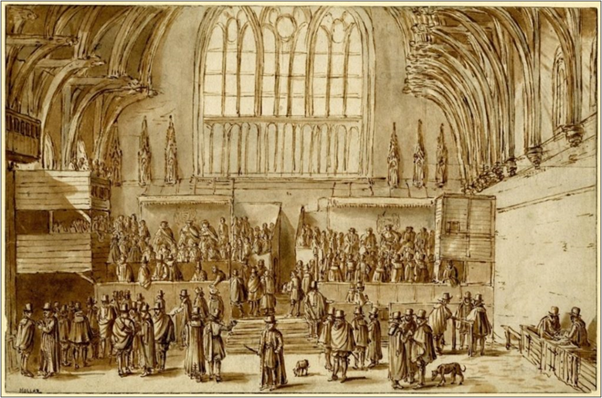
Courts in session at the north end of Westminster Hall. The British Museum, early 17th Century (Creative Commons)
2. What was the Court of Common Pleas?
The Court of Common Pleas was a common law court hearing actions between private individuals against each other.
The court had its origins in the 12th century and sat at Westminster Hall (but also at Shrewsbury in Edward I’s Welsh wars, and on many occasions at York during the Scottish wars of Edward I, Edward II, and Edward III). The court’s jurisdiction was originally unlimited, except that it could not hear actions from the palatinates and the more highly privileged liberties and boroughs. From the reign of Edward I, the court became increasingly limited to civil litigation at common law between subjects. Eventually this limitation became rigid and the court came to be called the Court of Common Pleas.
There was an on-going conflict between the Kings Bench and Common Pleas courts over their respective shares of civil litigation. This was only settled after 1660.
The court was abolished by the Supreme Court of Judicature Act of 1873, and Common Pleas became a division of the High Court of Justice. In 1880, by an Order in Council, the Common Pleas Division was amalgamated with the Queen’s Bench Division of the High Court of Justice.
3. Jurisdiction
The court came to include three main sorts of jurisdiction.
The first and most important was its common law jurisdiction over civil litigation, cases brought between private individuals against each other and begun by original writ from the Chancery. The court had exclusive jurisdiction in real actions, those involving rights of ownership and possession in land; in the older personal actions of debt, detinue, account, and covenant; and finally, in the mixed actions, both personal and real, such as ejectment.
Jurisdiction was shared with the King’s Bench in maintenance, conspiracy, other breaches of statute, trespass, trespass on the case, and their derivatives.
The court also held two sorts of jurisdiction by privilege. Firstly, justices as conservators of the peace could try even criminal cases when the cause of action arose within the court or among its records. Secondly, they had jurisdiction by privilege in suits brought by or against officers of ministers of the court.
4. An overview of the records
The court began recording its proceedings in plea rolls and filing its writs from its foundation at the end of the 12th century. As its business increased new series of files were created for new kinds of writs and instruments, especially in mid-late 16th century.
The different offices of the court developed from the thirteenth century onwards. In 1838, most of these offices were abolished and the duties transferred to five masters, to whom the records of the abolished offices were transferred.
The arrangement of Common Pleas records in our catalogue reflect these different functions. The links below are to divisions in our catalogue corresponding to different aspects of the court’s work. Each division is further divided into series, representing types of document. Individual documents can be found by browsing or date searching within the series.
4.1 Records relating to the Conveyancing of Land and Property Title (1195-1876)
One of the main functions of the court was to provide the means of conveying real property through court procedures involving collusive litigation. The principal means involved were the levying of final concords and the enrolment of common recoveries. This division contains all those surviving documents whose functions were directly related to the conveyancing of property or title before 1833.
Browse the division Records relating to the Conveyancing of Land and Property Title
See our guides to conveyances by feet of fines and to enrolment and registration of title.
4.2 Records relating to Pleas (c 1194-1880)
Records of pleas held in the Court of Common Pleas relate to both legal process, and to the recording of court proceedings.
Browse the division Records relating to Pleas
See sections 5 and 6 below.
4.3 Records relating to Outlawry (c 1500-1870)
Records of the Court of Common Pleas, extracted from the plea rolls, relating to outlawry as process against defendants who failed to appear in court.
Browse the division Records relating to Outlawry
See our guide to outlaws and outlawry.
4.4 Administrative records of officials of the Court of Common Pleas (1654-1875)
Administrative records of officers of the Court of Common Pleas are primarily records of appointment (grants of office or admission to offices), articles of clerkship, and attorneys’ admission to practice in the court.
Browse the division Administrative records of officials of the Court of Common Pleas
Enrolments of the appointment of justices of the court occur intermittently on the patent rolls from Henry III, see our guide to Royal grants in letters patent and charters from 1199.
5. Plea rolls
Plea rolls are both the most informative records of a case in the Court of Common Pleas and the easiest means of access to cases.
These records survive from the beginning of the reign of Edward I until the court’s abolition in the nineteenth century. The main series of plea rolls is CP 40.
Each roll covers a term and is made up from individual rotuli which carry a formulaic record of pleading and process in the court. They do not record what was actually said by the serjeants at law, who had a monopoly of pleading in the court by 1300, and the judges.
‘Year books’, which exist from about 1270 onwards and were principally concerned with reporting cases in the Common Pleas, record reports for the medieval period. Printed versions of some of these ‘Year book’ are available in the Map and Large Document Reading Room at The National Archives. A searchable database of the printed ‘Year Books’ is available online. Manuscript and printed law reports take over reporting for early modern cases.
Each roll is, as in the case of other series of plea rolls, made up of a large number of individual rotuli or rolls, single sheets of parchment normally used on both sides and filed together at the head to make up the whole unit.
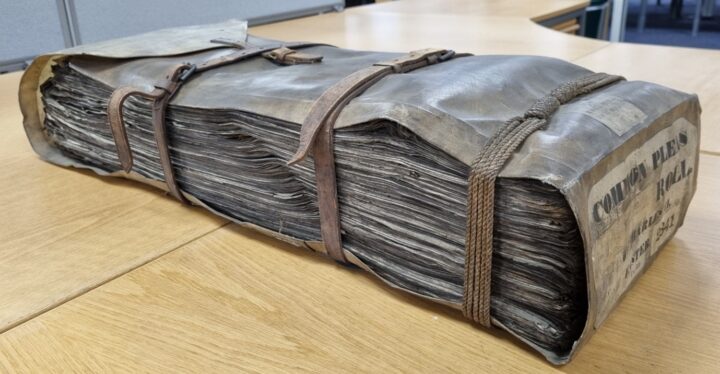
Plea Roll, Easter term 1654, CP 40/2641
From 1290 each rotulus was numbered at the foot, and from 1305 each one also carries the surname of the clerk who compiled it and handed it in. From 1327 until the end of the court’s life in 1875 there is a single, almost unbroken series of rolls made for the chief justice of the court and bearing his name.
The plea rolls reached their greatest size in the early 17th century, and thereafter declined, partly because of a decline in business but also because the attorneys who by then drew them up often failed to hand them in for filing.
Essoin rolls
The plea rolls do not include essoins (excuses for not appearing in a law court) but do contain separate sections for warrants of attorney and for the enrolment of charters and other deeds. Essoin Rolls are in CP 21.
Rex Rolls
From 1272 to 1327 there is an additional but incomplete series of rolls headed ‘Rex’ (CP 23) kept by the keeper of the writs and rolls. The reason for their compilation is not known but they appear to transcripts of plea rolls. During the first 19 years of Edward I there are a few rolls, including the same material, made for junior or puisne justices of the court, but there are no more thereafter.
Recovery rolls
From 1583 pleas of land were removed into the recovery rolls (CP 43), and what we now call ‘plea’ rolls came generally to be known as ‘common rolls’. The two series of rolls were eventually reunited in 1838 (CP 40/3984), and a few enclosure awards were enrolled in the plea rolls during the following 15 years.
Digital images of some of the records in this series are available through the Anglo-American Legal Tradition website. Please note that The National Archives is not responsible for this website or its content.
6. Finding plea rolls
6.1 Searching
To find the plea roll for a particular case, you will need to know in which year and law term (e.g. Hilary, Easter, Trinity, or Michaelmas) the case occurred, as catalogue descriptions for plea rolls in CP 40 only include this information.
For example, to find the plea roll for a case that occurred in Michaelmas term 1598, you would need to search CP 40 for “Michaelmas” in 1598. Instead of the calendar year, you can also search by regnal year, so a search for “Michaelmas” and “40/41 Eliz I” will also identify the correct plea roll, CP 40/1615.
6.2 Using other records to find plea rolls
There are in general no indexes to the plea rolls, although there are a number of contemporary finding aids that can be used to help a search. These include the prothonotaries’ docket rolls in CP 60, 1509-1859. The docket rolls were probably compiled for the collection of fees, but they do give direct references to the rotuli and so can be a useful means of reference. Early docket rolls cover a number of years, by the nineteenth century they are annual.
From the middle of the sixteenth century the termly entries give the county, the names of the attorney, plaintiff and defendant and the kind of entry made. Until 1770 there are three separate series of docket rolls: one for each of the three prothonotaries. In order to check all the entries for a particular term, you have to use all three rolls. There are gaps in each of the three series. No docket rolls survive for the period 1770-1790. From 1791 onwards there is a single series, which ends in 1859. The catalogue descriptions for plea rolls in CP 40 include the corresponding docket rolls for that term.
Between 1859 and 1874, similar information is contained in the Entry Books of Judgments in CP 64.
An entry book of judgments for pleas recorded in the plea roll for 12 Chas II Trinity term to 13 Chas II Easter term (1660-1661), referring to CP 40/2732-2745, can be found in IND 1/6373, which give rotulet numbers of cases reaching judgment.
6.3 Calendars and indexes
Manuscript calendars of entries for medieval plea rolls, compiled in the seventeenth century, can be found in the Map and Large Document Reading Room at The National Archives. Click on the links in the table below for the catalogue descriptions.
| Reference | Regnal year range | Date range |
| IND 1/17114– IND 1/17115 | 1-18 Edward 1 | 1272-1290 |
| IND 1/17125 | John – Henry V | 1199-1422 |
| IND 1/17134 | 25-28 Edward 1 | 1296-1300 |
| IND 1/17167–IND 1/17168 | Edward 1 to 24 Henry VII | 1272-1509 |
| IND 1/17172 | 1-20 Edward II | 1272-1292 |
| IND 1/17174 | Edward IV and Philip and Mary | 1461-1558 |
An index to the recoveries in the plea rolls is in IND 1/17180-17182 covering Henry VIII to Elizabeth I.
7. Further reading
The Court of Common Pleas in fifteenth century England, Margaret Hastings
An introduction to English Legal History, J H Baker
This guide provides an overview of records held at The National Archives that can help you to trace ancestors from North America. The focus is on people who emigrated from Britain to its former colonies in the United States and Canada. We also cover records of non-British settler emigration and slavery in North America though there are far fewer of these. It is an introduction to the sorts of records we hold, with links to more specialist guides where you will find detailed advice on how to find the records in our collection.
This guide does not cover the Caribbean. See our separate guide to Caribbean ancestors.
The records held at The National Archives
As with all documents held here, the records we hold of people from North America are historical records of the UK central government. Most of these records relate to British North America, encompassing the British colonial territories in the United States and Canada before their independence.
In general, we do not hold the internal administrative records from North America, such as registers of births, marriages and deaths or land ownership, which would have remained in place after independence. However, this guide does provide some advice on where to find these records as well as a relatively small number of other post-independence records which may be of use.
Quite often record titles, descriptions, and the documents themselves use language that is now out of date and sometimes offensive, but once records are transferred to us, we don’t alter them. The terminology used by the people that created the records are part of the story they tell.
How to get a search for records started
The search for records held at Kew begins by using keywords and dates to search our online catalogue. The catalogue contains short descriptions of the records and a document reference for each – you will need the document reference to see the record itself or to request copies. For more guidance on searching or browsing our catalogue, visit our Discovery help pages.
Before you begin a search, you should see if there is a guide to the records you are looking for. This guide is designed to help you do that. Throughout this guide you will find links to the more detailed advice you will need to search a specific set of records.
Records are arranged by the government department that created them, then by the type of record, such as passenger lists or military service records, and by date.
There are no ‘case files’ containing all the information about a single person. For any individual, there may be several different types of records which relate to them, each of which will have to be searched for separately.
The documents themselves may be in different formats, from handwritten registers, printed lists, or large sheets of parchment, each representing one aspect of a distinct set of records.
How to view records
This guide provides links to many other guides. Each of these guides will indicate whether the records they cover have been made available online (charges usually apply). The online copies are accessed either directly from our website or from the websites of our commercial partners, including Ancestry and Findmypast.
Many records have no online version and to see these you will need to consult them at our building in Kew or pay for copies to be made and sent to you.
Records of migration to North America
Travel documents and records of arrival
Records of emigrants can be split into two very broad sets of records:
- Records of the journey
- Records created following arrival
Names, ages, occupations, and reasons for migrating to North America are usually included in these records. Our guide to records of emigration and emigrants contains the details.
Child migrants traveling from Britain to Canada, c1860-c1930
Tens of thousands of children from the UK were dispatched to Canada during the 1860s up to the 1920s. You can find information on how to search these records in Section 10 of our guide to emigration and emigrants.
Records of non-British migration to the United States and Canada during the colonial era
Records of non-British settlers in British colonial America and Canada are rare among our records but applications for land grants and correspondence to the Colonial Office and Foreign Office from settlers or settler communities do exist. It is only in exceptional cases, such as disputes over land, that details of individuals are likely to appear.
Section 6 of our guide to emigrants and emigration contains some guidance on tracing these kinds of records, particularly those from the 17th to 19th centuries, but records held in US and Canadian archives are generally a better bet.
North American birth, marriage, and death records
United States and Canadian birth, marriage and death records were generally administered locally. These records can be found at state, county, and city or town level. You can, however, search for some records online through subscription services such as Ancestry.co.uk, Findmypast.co.uk and Familysearch.org (charges apply).
The National Archives holds a few registers of British citizens who were born, married or died in the United States, listed in our guide to births, marriages and deaths at sea and abroad.
Census records from North America
Any surviving formal census for North America will have been preserved in the archives of the respective countries and states within North America. The National Archives holds some partial sets of census records specific to emigration to North America.
The records are primarily lists and directories of people who emigrated from Britain to North America. These records tend to give a person’s name, age, occupation, reason for leaving the country, last place of residence, date of departure, and destination.
For information on how to access these records, consult section 6 of our guide to emigrants and emigration.
Records of indigenous people in North America
The National Archives holds records relating to colonial interaction with the indigenous peoples of North America but, in general, it is very difficult to use these records to trace individuals, except chiefs or community leaders. However, the records offer some scope for researchers to trace the histories of indigenous communities over time, through colonial military action against indigenous peoples, treaties with European settlers, legal proceedings, maps, and notices in government gazettes. There are a few instances of censuses of indigenous peoples (see the section on census records above).
Searching for the names of individuals or tribes in our online catalogue will often require multiple search attempts and variant spellings and the chances of success are slim. In most cases, to pinpoint individual names in the records you will need to come to our reading rooms and leaf through original paper records.
In common with most of our colonial records, our catalogue reproduces the historical language of the records themselves, even where that language is considered offensive. Identifying records relating to indigenous and First Nation peoples will often require the use of the terms ‘Indian’, ‘Native’ or ‘Squaw’, for example. It also requires a creative approach to the spelling of names and place names. For more advice on searching using alternative spellings, consult our Discovery help pages.
These records tend to be found in political, administrative, or military records and are largely held within records of American and West Indian colonies before 1782 and America and the West Indies in the Calendar of State Papers Colonial 1573–1739, and in records of British Army operations before 1913 and Royal Navy operations and correspondence 1660–1914.
For records of indigenous people who served in colonial militias and the British armed forces, please see the section on ‘Military and maritime cecords’ below.
Military and maritime records, 17th to 20th centuries
Individuals born in the territories that became the United States and Canada may have been involved in conflicts related to the British in several ways. The British armed forces were called upon to fight against indigenous peoples in North America during multiple colonial and frontier wars from first contact into the 19th century.
British armed forces were also involved in conflicts against other European powers in North America, notably the French, Spanish and Dutch. The British fought settler American forces during the American Revolution. Finally, Canadian, and American forces were allied with Britain in several wars during the late-19th century (including the Crimea and the South African Wars) and the 20th century (particularly the First and Second World Wars and Korean War).
As this history is complex, individuals may have served in/with British armed forces in multiple ways and it is helpful to try to identify as much detail as possible about the units/forces that an individual enlisted in.
Members of the armed forces born in the United States
We have very few records for members of armed forces who were born in the United States. Most remaining records will be held in archives in the United States itself. There were some exceptions though:
- American born members of the British Army. We have some records of members of the British Army in North America prior to and during the American Revolution. These can be located via our guide to British Army soldiers up to 1913. See also our guide to the American Revolution which provides some advice on locating records of American loyalist compensation claims.
- Colonial American militias soldiers. We have pension records for some American loyalist militias such as the Plymouth Invalids or New Jersey Volunteers. See our guide to Militia records for more details.
- Other records of members of armed forces born in the United States. We have some records of prisoners of war from the Second World War who are listed as members of the United States Army. See our guide to British and Commonwealth prisoners of war of the Second World War and the Korean War for more details.
Members of the armed forces born in Canada
Members of the armed forces who were born in Canada may have enlisted locally in Canada, or they may have travelled to the United Kingdom to enlist there If an individual travelled to the UK to enlist (whether in the British Army, Royal Navy, Royal Air Force or other armed services), then their records will have been treated in the same way as those of British nationals.
If an individual enlisted locally in Canada, then there may be related records in our collections depending on the time period and other factors. There are some records of Canadian militia (troops raised locally in Canada such as the Fencibles, or Canadian Mounted Rifles) up until the First World War in our collections. From the First World War onwards, they are more likely to be in Canada. However, this is not a hard and fast rule and there are notable exceptions:
- Some British medals for bravery were issued to Canadian soldiers until the 1970s. Please see our guide to Gallantry medals to search for these records.
- Canadian prisoners of war who were involved in British conflicts, or in the First or Second World Wars may feature in our records. Please see our guides to Prisoners of War in the First World War and previous wars, and to British and Commonwealth Prisoners of War of the Second World War and the Korean War.
Canadian militia soldiers (and later the Canadian Army)
Soldiers who joined Canadian militia in the 18th and 19th centuries may be mentioned in records in our collections such as muster books, medal registers and pension records. See the guide to records of Militia for more details.
Members of Canadian militia who served in the First World War or Second World War may be mentioned in casualty records, or records of the award of medals. See our guides to British Army soldiers of the First World War for more details of how to search for these. Please note we do not have service records for members of the Canadian militia for this period; these are held in Canada.
Most records relating to soldiers in Canadian militia from the start of the First World War onwards will be held in Canada with the following key exceptions:
- The Royal Newfoundland Regiment (RNR) remained a colonial militia until Newfoundland became part of Canada in 1949. We have more extensive records for the RNR than for other Canadian troops during the First World War and beyond. Search for these using the guides to British Army soldiers of the First World War and British Army soldiers of the Second World War.
Canadian members of naval services
If you are looking for records of Canadian members of the British Royal Navy you should start with the our guides to our naval records. Canadians may have joined the British Royal Navy at any time up to the present.
The Canadian Naval Service was formed in 1911 and any records of those who served in this (or later in the Royal Canadian Navy) will be held in Canada (with exceptions relating to medals and prisoners of war records as noted above).
Canadian members of air services
If you are looking for records of Canadian members of the Royal Flying Corps, Royal Air Force or Royal Naval Air Service, you should start with our guides to the RAF and other air services. Canadians may have joined British air services at any time up to the present.
The Royal Canadian Air Force (RCAF) was formed in 1924 and any personnel records of those who served in this will be held in Canada (with exceptions relating to medals and prisoners of war records as noted above). The activities of RCAF squadrons and individuals in the Second World War can be found in operational records. See our guide to researching Royal Air Force operations for more details.
Records of enslaved people in North American
Before 1780, all 13 British-American colonies participated in the slave trade, and identifying an African American ancestor who was enslaved often requires tracing the slave owner’s family records. In general, these records remain in the United States and can be found in regional state archives and libraries.
Consult our guide to slavery and the British transatlantic slave trade for an overview of records held at The National Archives. These are administrative records which span the 16th to 19th centuries. The subject matter includes the transportation of enslaved people and campaigns for the abolition of the slave trade and there are also records of related court cases.
Historians estimate over 20,000 runaway slaves joined the British during the American Revolution, representing the largest exodus of North American enslaved people. The National Archives holds the ‘Book of Negroes’ – a list of some 3,000 men, women and children bound for Nova Scotia on British ships after the American War of Independence. A searchable online copy is available to browse from the Nova Scotia archives.
Records of private land ownership in North America
Records of land ownership usually include the names of individuals, most commonly of the owners themselves. In early colonial America, Britain claimed land as Crown property, as it had been settled by its subjects. The Crown also granted land to companies for settlement and sometimes to individuals for services.
In general, most land grants were recorded in the respective country and may be accessible in American and Canadian archives. The National Archives holds some partial sets of records which relate to land ownership in North America.
Records such as the West New Jersey Society’s records (1675-1921) detail land tracts in West and East New Jersey, Pennsylvania, New England, and other regions, included in original correspondence, registers, deeds, and claims. These records include names of individuals. For advice searching these records, consult section 6 of our guide to emigrants and emigration.
Consult our guides to American and West Indian colonies before 1782 and Colonies and dependencies from 1782 for more search advice on records of land ownership in North America.
This guide provides a brief overview of records and resources at The National Archives that can help you to trace individuals who either migrated to the UK from Africa or who lived in British colonies in Africa before independence and the end of British colonial rule. It is an introduction to the sorts of records we hold, with links to guides providing more detailed advice on how to find the records in our collection.
The records held at The National Archives
As with all documents held here, the records we hold of people from Africa or of African origin are historical records of the UK central government. Most of these records relate to British colonial territories in Africa before and following their independence. Only around 5% of government records are selected for preservation at The National Archives. The records that contain details of individuals from Africa can be grouped into five broad categories:
- Records of people born in Africa who migrated to the UK. These records will be the easiest to find and use.
- Records of Africans in Africa living under British colonial administration. There are likely to be more records of this kind in the respective national and regional archives on the African continent but there are some significant records of this kind held here.
- Records of migration to Africa. Again, there are more likely to be detailed records in the respective national and regional archives on the African continent but we hold some records.
- Military and maritime records. Hundreds of thousands of Africans served in military units under British command in the colonial period, the First and Second World Wars, while significant numbers of African seamen have served in the British Merchant Navy. These are some of the richest records we hold on individuals.
- Records of people who were enslaved and transported to North America and the Caribbean. Tracing any remaining record of those enslaved in the transatlantic slave trade is very challenging. It will likely require using a variety of archives in the UK, North America or the Caribbean. We provide advice on this below.
It is unlikely that you will be able to piece together a whole family tree or a full picture of the life of an individual using only our records – but we may be able to provide some pieces in the puzzle.
In general, we do not hold the internal administrative records from ex-African colonies, such as records of births, marriages and deaths, which would have remained in place after independence. However, this guide does provide some advice on where to find these records.
Please be aware that record titles, descriptions and the documents themselves often contain offensive language but once records are transferred to us, we don’t alter them. The historical terminology used by the people that created the records is part of the story they tell.
How to get a search for records started
There are no ‘case files’ containing all the information on a single person. For any individual, there may be several different types of records which relate to them, each of which will have to be searched for separately. The search for records usually begins in our online catalogue. The catalogue contains short descriptions of all our records and a document reference for each – you will need the document reference to see the record itself or to request copies.
To find a reference to a record in our catalogue you will need to guess at one or more of the words that have been used in its catalogue description. However, many of the records of the Colonial Office, one of the primary sources of information for this research, are only described in the briefest or most basic terms, making it often impossible to use names as a keyword search. You should also bear the following in mind:
- Clerks recording unfamiliar names of non-British origin may have invented spellings
- Lower levels of geographical knowledge in the past than people generally have today led to multiple forms of inaccuracies in the recording of people’s origins
- There are sometimes mistakes made in the transcribing of the original records to online versions
When using names to search our records you should therefore consider the following techniques:
- Use wildcard searches (use * to replace multiple letters and ? to replace a letter; for example Moh* or Moham?ed to account for different spellings of Mohamed).
- Consider different spellings and scales of descriptions when searching for places names. For example, for today’s Kumasi in Ghana you could try Kumasi, Koomasi, Coomassie, but also Asanti, Asante, Ashanti, Ashantee, Gold Coast and even Africa.
For more guidance on searching or browsing our catalogue, visit our Discovery help pages.
Before you begin a search, you should see if there is a guide to the records you are looking for. This guide is designed to help you do that. Throughout this guide you will find links to the more detailed advice you will need to search a specific set of records.
Records are arranged by the government department that created them, then by the type of record, such as passenger lists or military service records, and by date.
The documents themselves may be in different formats, from handwritten registers, printed lists, or large sheets of parchment, each representing one aspect of a distinct set of records.
How to view records
This guide provides links to many other guides. Each of these guides will indicate whether the records they cover have been made available online (charges usually apply). The online copies are accessed either directly from our website or from the websites of our commercial partners, including Ancestry and Findmypast.
Many records have no online version and to see these you will need to consult them at our building in Kew or pay for copies to be made and sent to you.
Records of people born in Africa who migrated to the UK
Migration to the UK before the 19th century
There have been people of direct African heritage in the UK for at least two thousand years. However, before the 19th century there was no systematic record-keeping of the movement of people. The scattered records held at The National Archives from this period of individuals who arrived in England or Britain from Africa will be hard to find. Where records exist at all, the individual’s origins are likely to be incidental to the reason for the creation of the record, such as a will or a court case, and very unlikely to be of the migration itself. Some of these records are covered later in this guide and in our guide to immigration and immigrants.
Migration to the UK in the 19th and 20th centuries
The records most likely to have been created and kept of a person’s migration from any other country to the UK are transport records documenting their arrival and records of their naturalisation (obtaining citizenship), though not everyone naturalised.
The majority of people arriving in the UK from Africa, or from anywhere else, up until the 1960s arrived by ship. Passenger lists, which recorded all travellers on a ship journey, are therefore the most common record of arrival. We hold passenger lists for inter-continental ship journeys to the UK from 1878 to 1960. Outside of these years there is much less chance of there being an archived record of arrival. Passenger lists for air travel may be held in the archives of the country of departure or by the airline but none are held at The National Archives.
Documents known as ‘certificates of alien arrivals’ were issued to those arriving from overseas during the 19th and early 20th centuries but people arriving from territories under British colonial administration would not have been registered as they were not considered ‘aliens’.
For advice on finding ship passenger lists and certificates of arrival consult our guide to immigration and immigrants.
For advice on records which relate to Britain citizenship, consult our guide to naturalisation, registration and British citizenship.
Birth, marriage and death records
Records of births, marriages and deaths can, between them, establish details of a person’s parents and their birthplaces. In the UK they are kept in various places, but not usually at The National Archives. Consult our guides to births, marriages and deaths in England and Wales and births, marriages and deaths in Scotland and Ireland for advice on how to locate these records.
Census records for England and Wales, 1841-1921
The National Archives holds copies of all UK census records from 1841-1921.
In every census since 1841, people have been asked to state their country of birth and, in most cases, their nationality. Information about individuals in censuses is not made public until 100 years after the census was taken so the most recent census records in which you can trace individuals is the 1921 census.
When searching the census for people born in African countries, use the contemporary names of countries or cities, as they were known in and before 1921, as some have changed since then. The table in our guide to records of other countries provides previous names. We have also published an article on researching Black history in the 1921 Census which might prove useful.
Records of employment in the UK
The National Archives is not the best place to find information about the careers and employment of individuals, with just a few exceptions for a very small number of professions.
Significant numbers of African women came to Britain after the Second World War to work for the newly established National Health Service (NHS). For advice on the limited number of NHS personnel records we hold, none more recent than 1984, and for advice on where else you can look for career records of individuals, consult our guide to doctors and nurses.
For employment in the UK armed forces or merchant navy see the ‘Military and maritime’ section below.
Records of Africans studying in the UK
Many Africans who spent time in the UK prior to the mid-20th century were here as students. If the records of their time as students survive (often they will not) they should be in the archives of the schools, universities, hospitals, or mission societies who were providing their education.
If the UK government or a colonial government was responsible for financing an individual’s education then there may be records of this held here.
Search the following series (by clicking on the series links) to search by an individual’s name for files listing some of those who applied for or received government scholarships:
Records of African political activists in the UK
People who engaged in political activism while in the UK (whether pan-Africanist, anti-colonial, pro-Communist or other causes) may have been monitored by the British police or Security Services.
Try searching the files of the Metropolitan Police in series ‘MEPO’ or the records of the Security Service (MI5) in series ‘KV’ using an individual’s name or the name of a political organisation of which they were a member. There is more search advice in our guide to records of the intelligence and security services.
Wills
You may find details of an individual in a will if they were the testator (the person who made the will), the executor (the person/s who carries out the testator’s wishes) or a beneficiary but also, in the case of enslaved people, who were regarded as the property of slave owners, as part of the estate. However, you cannot search the online indexes to wills at The National Archives with any name other than that of the testator.
For the instructions in a will to be legally carried out, they must undergo a process known as probate. A will is said to have been ‘proved’ once it has gone through probate. Many people did not bother with probate.
At The National Archives we only hold wills proved before 1858. To find someone in a will as a beneficiary you will need to first establish the name of the testator.
See our guidance for where to go for wills since 1858.
Records of people in Africa living under British colonial administration
Birth, marriage and death records
Baptisms, marriages, and burials in British colonies in Africa were generally carried out by the local Christian church until the advent of civil registration. The original parish records will usually be held by the respective African country.
You can, however, search for some records online through subscription services such as Ancestry.co.uk and Findmypast.co.uk (charges apply). Many African countries’ parish records have been digitised by the Church of Jesus Christ of Latter Day Saints and are available at FamilySearch.
Similarly, civil registration records, including those of birth, marriage and death, of people living in former British overseas territories are still held in the respective country. The National Archives holds a few registers of British citizens who were born, married or died in African countries, listed in our guide Births, marriages, and deaths at sea or abroad.
Pre-independence African censuses
The National Archives holds some censuses from African colonies taken prior to independence. Search for them among Colonial Office and Dominions Office series using advice in our colonies and dependencies guide. These records provide an overview of populations in the respective colonies and territories, sometimes broken down into categories of age, gender and race but are not the equivalents of modern censuses in the UK and details of individuals are usually scant or absent altogether.
White ‘Europeans’ are more likely to be mentioned by name than those of African or South Asian origin. One important exception to this rule is in the records we hold of Sierra Leone where the colonial government monitored the ‘re-migration’ of individuals who had been enslaved and transported to the Caribbean, North America and the UK (or their descendants) and who settled in West Africa. Richer censuses and lists of members of this community exist in CO 267,
Records of civil servants
We do not have full lists of people who worked for the British colonial governments in Africa. However, some records of civil servants do survive.
Records of the recruitment and retirement of colonial officials of all ranks can be found recorded in ‘Government Gazettes’ held at The National Archives (archives of countries formerly under British colonial administration may also have copies). These official announcements were produced weekly in each colony. For search advice, see our colonies and dependencies guide and bear in mind:
- you can search for volumes in our catalogue using the terms ‘gazette’ and [name of colony]
- they were indexed on an annual basis, with the indexes included in the final volume of the year
- in the absence of an index you would need to browse all volumes in order to locate mention of an individual
There are additional possible records for high- and mid-ranking officials:
- Colonial Office Lists, available at our library, list the highest ranking civil servants; published annually
- Blue Books – a compendium of statistics and information published annually by colonial governments which includes lists of officials and their posts; search for them using our catalogue using ‘Blue Book’ AND the name of the colony.
The same publications may be available in specialist libraries and archives around the UK and beyond.
We have some records of individuals (White ‘European’ and South Asian) who contributed to pensions through their employment in the colonial civil service. To search for these files search our catalogue using ‘Widows’ and Orphans’ Pension’ AND ‘personnel’ AND [name of colony].
Other professions and businesses
Government Gazettes (described above, among records of civil servants) also include listings for the issuing of business licenses. The name of the business owner and their address usually appear in the listing, though the details included varied depending on the type of license and the period. Those who were practising professions such as medicine (including nurses and midwives), law, or ran businesses such as pharmacies (drugstores) or licensed bars were required to seek licenses.
Wills proved in African countries
Most wills made in British colonies and territories in Africa were proved locally but some wealthy Africans sent their wills to England or Scotland to be proved.
Search for pre-1858 wills proved at the highest probate court in England (the Prerogative Court of Canterbury) using the search box in our guide to wills 1384-1858, including the word ‘Africa’ or the name of an African country or colony in the ‘Place’ or ‘Other keywords’ fields. For post-1858 wills see our guidance on where to go for wills since 1858.
For wills proved locally, you will need to contact the respective African archive for advice on how to locate their records.
Records of ancestral lands and indigenous leaders
The National Archives does not generally hold land registers, the documents that formally record land ownership, from the period of colonial administration in Africa. You will need to contact archives in the respective countries for advice on how to locate these records.
We do, however, hold a range of records that describe episodes in the histories of particular tribes and ethnic groups, their ancestral lands, and biographies of their leaders.
Much of colonial rule in British Africa was legitimated by treaties with traditional authorities. The creation of these treaties often involved extensive documentation including maps and histories of local political authorities and lineages.
Try the following:
- Search our catalogue using the family names or titles of indigenous African elites, particularly royal families.
- Search for treaties with African kingdoms for the 19th century onwards in FO 93 (see FO 93/4 for Central Africa; FO 93/5 for East Africa; FO 93/6 for West Africa).
- Search for Foreign Office records known as Confidential Prints, which can contain summaries of the documentation used to support treaties, by searching in FO 881 using the keyword combination ‘Treaty’ and ‘Africa’.
Records of migration to Africa
Migration from Britain
The most prevalent records for emigrants from the UK are outgoing passenger lists. We hold outward passenger lists from 1890 to 1960. Beyond these lists there is often no other record to search for here and, in general, you are more likely to find a record of an emigrant in the destination country.
Use our guide to records of emigration and emigrants for advice on locating records of British migration to African countries up to 1960, the latest year for which we hold outgoing passenger lists.
Records of South Asian immigrants to Africa
Records of individuals of South Asian origin living and working in Africa will not be easy to find in records at The National Archives. As mentioned above, census-type records, and birth, marriage or death records will be rare, and more likely to be located in the national or regional archives of countries on the African continent.
For those who are seeking ancestors who arrived in Africa under forms of indentured labour, see our guide to records of Indian indentured labour.
For those who arrived in Africa with the Indian Army (or on secondment from the Indian Army), see our guide to records of the Indian Army.
For those who arrived in Africa under contract with railway companies, your best starting point might be any records of those railway companies, either in the UK, or (more likely) on the African continent. These are often held in railway heritage museums.
Military and maritime records
Hundreds of thousands of Africans served in military units under British command in the Second World War and First World War. Troops from Africa were also deployed in pre-20th century colonial conflicts on the African continent and to a lesser extent beyond it. During the era of the transatlantic slave trade, British armed forces used enslaved Africans as labour but also as combatants.
Pre-20th-century military and maritime records
Finding individuals who served as soldiers in Africa before the 20th century is easier if you can identify whether they served in a local ‘militia’ or as part of the British Army. For the latter, see our guide to British Army soldiers before 1913. We have some, but far fewer records on the history and the personnel of the militia – see our guide to Militia. Some militia records were retained by African countries at independence.
The Royal African Corps was formed in 1800 under Colonel John Fraser and we hold muster books and pay lists of this unit from 1800-1819 and 1822-1840. See our guide to African forces under British control for more.
To begin searching for individuals who worked for the Royal Navy before the First World War see our guide to Royal Navy ratings up to 1913 and our guide to Royal Naval dockyard staff.
First World War military records
In the First World War, troops under command of the British fought in various parts of Africa, including East Africa, Nyasaland and Northern Rhodesia, South West Africa, Cameroon, Nigeria and Togoland (modern-day Togo and parts of Ghana).
We hold some records of Africans serving in British units during the war on the African continent, including:
- records of the King’s African Rifles, formed from various East African forces in 1902 and based in Kenya
- the Royal West African Frontier Force, formed from various West African forces in 1900
See our guides to African forces under British control and British Army soldiers of the First World War for search advice. Our First World War overview may also be useful.
If you know that an individual served in the British or allied armed forces in the First World War but don’t know more details about their military service, it may be helpful to consult online ‘roll of honour’ compilations before beginning more detailed searches in our records. See, for example, the Imperial War Museum’s Lives of the First World War database.
There are likely to be more records in archives in South Africa, Malawi, Kenya and West Africa than in the UK. The Commonwealth War Graves Commission is working to produce a full list of African casualties from the First World War.
Second First World War military records
In the Second World War the African presence in British forces was even greater and included those who served in women’s nursing and territorial units in East Africa, individuals of Chadian origin who deserted the Free French and served with a Pioneer Company in the British Army.
If you know that an individual served in the British or allied armed forces in the Second World War but don’t know more details about their military service, it may be helpful to consult online ‘roll of honour’ compilations before beginning more detailed searches in our records.
See our Second World War overview for advice on finding military and maritime service records of individuals.
Merchant Navy records
Many individuals from Africa worked on British-registered commercial ships, as part of the Merchant Navy. We have a number of guides to searching the records of the Merchant Navy. This includes guides to those doing regular work on merchant ships and those who were involved in the war efforts during the First and Second World War. A good place to start is our guide to merchant seamen serving since 1918.
We have records relating to those who worked in the Merchant Navy, on commercial ships, in the 19th century, including those who joined ships at African ports. See our guide to Merchant seamen in service before 1914.
Enslaved people and slave owners, 16th to 19th centuries
It is estimated that over three million Africans were enslaved and transported to the Americas, the Caribbean and elsewhere by British traders between the 16th and 19th centuries.
Tracing any remaining record of individuals enslaved in the transatlantic slave trade is very challenging. It will likely require using different archives in the UK, North America or the Caribbean. Most of the records of this process held at The National Archives describe the enslaved at their destinations and you should use our guide to enslaved people and slave owners for advice on these records.
However, we do hold some records documenting the capture and transportation of enslaved people from West Africa and of British ships’ intercepting slave ships to protect British interests and later to enforce international anti-slavery agreements.
Records of the Royal African Company
The Royal African Company was one of the major transatlantic trading companies that profited from enslavement.
Though you cannot search Royal African Company records online by the names of enslaved people, you can consult the following original documents at our building in Kew which may help you to trace people:
- T 70/1209 (1695-1749) – contains summaries of individual voyages as well as information on those enslaved by the RAC itself
- T 70/1515-1606 (c. 1750-1820) – ‘Detached papers’ which contain information on those who were enslaved by the RAC itself and worked in the RAC’s West African forts
You can also search among its records in T 70 for:
- company accounts
- records of ships and cargoes
- correspondence with African indigenous leaders
- accounts of those who were enslaved to work at the company’s forts in West Africa
Records of the Foreign Office Slave Trade Department
This correspondence contains reports of cases where the Royal Navy seized ships suspected of slaving. Some cases contain details of those who were liberated, occasionally with more detailed personal histories. Search for records in FO 84 by date or event to begin your search and download digital images of the records from our catalogue.
Records of the Slave Trade Commissions
Slave Trade Commissions were legal bodies that adjudicated cases of suspected slaving ships. Their records include registers of ‘liberated Africans’ as well as details of the African interpreters. These record tens of thousands of individuals who were enslaved and subsequently liberated. Search the following series by year and by the location of the nearest court to where the ship was seized (not the origin of the ship or the enslaved people):
Royal Navy ships’ musters
Royal Navy ships that were involved in anti-slaving campaigns sometimes listed liberated Africans in their ships ‘musters’ under the heading ‘supernumeraries’. For advice on finding ships’ musters, see our guide to Royal Navy ratings records up to 1913.
Online databases
Some of our records have been used in the compilation of online databases that bring together biographical information about individuals who were enslaved. See in particular:
- the Slave Voyages website to search their Enslaved Databases
- the Freedom Narratives website to read testimonies of enslaved West Africans
- the Legacies of British slave-ownership website to search for the name of a slave-owner, estate or firm, sometimes the key to unlocking information about enslaved individuals
This is a guide to finding records of soldiers who served with the British Army after the end of the Second World War. The ranks covered include Private, Lance Corporal, Corporal, Sergeant, and Warrant Officer – but not commissioned officer ranks.
Though we hold some service records for soldiers who served after 1945, all service records after 1963, when National Service came to an end in the United Kingdom, are still held by the Ministry of Defence (MOD).
How to get started
To uncover details of a soldier’s service you should begin by searching for the following three types of records:
- Service records: Usually the most detailed record of a soldier’s time in the army. From 1963 these records are still held by the MOD (see below).
- Medal and honours records: Most soldiers were issued with campaign medals awarded for service during conflict. Campaign medal records are with the MOD’s Medal Office. Some soldiers were also awarded medals for acts of gallantry and meritorious service (see below).
- Unit historical records: Records of units rather than specific soldiers. You will need to know which unit, often a battalion, a soldier served with to effectively search these records; in most records only officers are mentioned by name.
Abbreviations and acronyms used in the records
Many of the records covered in this guide contain a lot of obscure military abbreviations and acronyms and can be hard to decipher as a result. There are, however, some resources available online and at our library in Kew that can help you to interpret them.
This official list of MOD Acronyms and Abbreviations published on the GOV.UK site contains thousands of terms in current use, many of them unchanged for decades. The following books are available at our library in Kew:
Service records
A service record is usually the most detailed record of a soldier’s time in the army. The types of documents that are most commonly found within service records are:
- Attestation forms – documents signed when first recruited or upon transfer between units
- Statement of service – outlining an individual’s postings whilst in service
- Discharge forms – issued when a soldier left the regiment
- Supporting correspondence of a wide variety
Service records up to 1963
The vast scale of the recent transfer of British Army service records from the MOD to The National Archives means that only a small proportion are searchable in our catalogue or viewable in our reading rooms, though this number is steadily increasing. To locate a service record dating up to 1963, follow these steps:
Step 1: A selection of service records have been digitised. You can search these records of non-commissioned officers and other ranks on Ancestry.co.uk (charges apply).
If you have been unable to find an individual, please move to Step 2.
Step 2: Search our catalogue by surname, service number or year of birth or by a combination of any of these, or use the search box below.
Search tips:
- If you have a service number, try searching with that alone
- Try using just the year of birth (some records do not have a full date of birth)
- Try variations on the spelling of the last name
If you locate a document reference whose description matches the details you are looking for, you can request a copy of the record directly from the catalogue.
Step 3: If you are unable to find a record at Step 1 or Step 2, you can request a search for a military service record using one of the following two forms (charges may apply):
Form 1: For a deceased person born before 1940
Form 2: For a living person, or your own record, born before 1940
Service records from 1963 onwards
Service records for service since 1963 remain in the custody of the Ministry of Defence and are accessible only to the service personnel themselves or their next of kin. Consult GOV.UK to find out more.
Scots Guards regiment
The Scots Guards retain their own records in their own archive. To apply for a Scots Guard service record from before or after 1945, call, email or write to their Regimental Archives.
Medal and honours records
Campaign medal records
Contact the Ministry of Defence Medal Office for records of post-Second World War campaign medals. There are also details of how to apply for a medal if you meet the criteria.
Recommendations for military honours and awards, 1935–1990
A recommendation is a full statement, usually supplied by a commanding officer, of why a medal or any other honour should be awarded to an individual. Each recommendation provides a detailed summary of the action or deed carried out by the person who earned the award. Search for online images of recommendations for military honours and awards (£) (WO 373) on our website.
Announcements of the award of gallantry medals and honours
Almost all gallantry awards to British nationals are publicly announced in the official government newspaper, the London Gazette. This public announcement is often the only record that survives of an award. Search the London Gazette on The Gazette website for the official announcements of British Army soldiers’ gallantry awards.
British Army unit historical records
Search in series WO 305 for British Army unit records from peacetime, including commanders’ diaries. The dairies and other unit records are focused on the administration and operations of the unit they cover, and generally do not contain information about individual personnel. You will need to know which unit, often a battalion or brigade, a soldier served with to effectively search these records.
To access these records you will either need to visit us, pay for research (£) or, where you can identify a specific record reference, order a copy (£).
Other records
This section covers other records of British Army soldiers held at The National Archives and some of the other official records of individuals held by other archives and organisations.
Grenadier Guards registers and papers
Search in WO 437 by record type and year range for various records of Grenadier Guards, including:
- discharge registers
- registers of deserters
- attestation forms
- enlistment registers
- muster rolls and pay lists
- description books
The series covers records from the middle of the 18th century onwards.
Soldiers’ effects ledgers, 1901–1960
Search the soldiers’ effects ledgers (£) covering April 1901 to March 1960 (from The National Army Museum) by name or regiment on Ancestry.co.uk. These list monies owed to a soldier who died in service.
You may be able to purchase a transcript from the ledgers which usually show
- full name
- regimental number
- date, and sometimes place, of death
- next of kin and monies paid to them
Ledgers from 1901 to 1914 also show the soldier’s trade and date of enlistment.
Courts martial registers
British Army courts martial registers up to 1979 are held at The National Archives and contain the name, rank, regiment, place of trial, nature of charge and sentence for each prisoner. There are several series of records containing registers for courts martial held in the United Kingdom and overseas (‘Home’ and ‘Abroad’). Click on the series references below and search by year:
- WO 86 (1829-1979) – District Courts Martial registers (Home and Abroad)
- WO 90 (1796-1960) – General Courts Martial registers (Abroad)
- WO 92 (1666-1704, 1806-1960) – General Courts Martial registers (Home)
- WO 213 (1909-1963) – Field General Courts Martial and military courts registers (Home and Abroad)
For more advice see our guide to British Army courts martial records.
Other resources
Books
These books are available at The National Archives Library:
Christopher Bate and Martin G. Smith, For Bravery in the Field: Recipients of the Military Medal, 1919-1991 (Bayonet Publications, 1991)
Steve Dymond, Researching British Military Medals (Crowood, 1999)