This guide provides a brief overview of records held at the National Archives for wars of the Napoleonic era.  These are the records of central government, including all branches of the military. You’ll get a sense of the sort of records we hold and links to guides with more details and advice on how to find the records in our collection, including whether records are available online. As this is an overview of records guidance, much of the advice for finding records of the struggle against Napoleon can also be applied to the War of 1812.

How the records are arranged

The original records are arranged at The National Archives by the government departments that created them. Each department’s collection of records is identified by a department code. Four of the most significant for Napoleonic Wars research are:

Numerous other government departments have transferred records to The National Archives. You will find details for many of them in the guides which we provide links to below.

How to search for records

Before you begin a search you should see if there is a guide to the records you are looking for – this guide is designed to help you to do that. Each guide listed below contains the links and advice you will need to search a specific set of records.

Each guide will indicate whether records have been made available online (charges usually apply). The online copies are accessed either directly from our website or from the websites of our licensed partners, including Ancestry and Findmypast.

Some records have no online version and to see these you will need to consult them at our building in Kew or pay for copies to be made and sent to you. The search for records held at Kew begins by using keywords and dates to search our online catalogue. The catalogue contains short descriptions of the records and a document reference for each – you will need the document reference to see the record itself or to request copies.

For more guidance on searching or browsing our catalogue, visit our Discovery help pages.

Records of individuals

Individual service records did not exist at this period, instead surviving records of individuals are likely to be entries in registers such as muster lists or pay books, or documents kept for pension purposes. The research guides will tell you more.

For guidance on Royal Nay or Royal Marines personnel. See our guides to

For guidance on finding records of army or militia personnel, use our guides to

Consult our guide to Prisoners of war in British hands for guidance on finding records of French and American prisoners.

Search the Trafalgar ancestors database for details of ratings who served in Nelson’s fleet at the Battle of Trafalgar on 21 October 1805.

Search or browse Captains’ letters in ADM 1 Admiralty Correspondence  for letters relating to deserters and pressed men, including American seamen pressed on to British ships.

Operational records and maps

Operational records are the orders and correspondence of the War Office and Admiralty directing and recording the conduct of the war. Other records include private papers of officials or senior officers, maps, log books of ships or Admiral’s journals.

Consult our guide to Royal Navy operations and correspondence 1660-1914 for advice on finding Admiralty files and correspondence on naval actions against France and the United States of America. Our guide to Royal Navy ships’ voyages in log books gives guidance on finding log books of individual vessels and also Admiral’s journals.

Our guide to British army operations up to 1913, advises on finding records of military operations in various series of records and includes a section on Private papers of senior officers.

Our guides to Maps and plans, Overseas maps and plans and Sea charts give advice on finding maps in use at the time.

Government policy and strategy, international relations and the aftermath of the war

Foreign Office general correspondence

Browse our catalogue for general correspondence relating to France in FO 27, and the United States of America in FO 5. You will need to use the registers and indexes in FO 605 to access these series. For further guidance on using the registers see our guide to Foreign Office correspondence 1782-1890.

For guidance on finding treaties consult our guide to Foreign Office correspondence since 1782. Delegation archives of the conferences of Paris, 1814 and 1815, and the Congress of Vienna can be found in FO 139. Archives of the American Treaty of Ghent Commission can be found in FO 303.

CO 247 contains correspondence from St Helena covering the period of Napoleon’s imprisonment.

Home front

The Napoleonic Wars were a time of shortage and political unrest in Britain. The government feared political radicalism and revolutionary ideas and used spies and informers to gather intelligence. Home Office records of the time reflect this.

Search HO 42 Domestic correspondence George III for letters to the Home Office on various subjects including suspected spies, army and militia dispositions and supplies (partially catalogued, digital microfilm).

Search or browse HO 40 Home Office: Disturbances correspondence for letters regarding disturbances, such as riots, strikes and political meetings (digital microfilm).

Browse HO 100 for similar correspondence from Ireland.

HO 79 Private and Secret Entry books record letters relating to the secret service, postal censorship and other confidential matters. HO 33/1 is a bundle of correspondence between the Home Office and the Post Office on various matters, including intercepting letters of suspected radicals.

Prompted by high wartime grain prices and fears for the country’s ability to feed itself, the Home Secretary in 1801 requested a survey of arable land in England and Wales. Records are in HO 67 Parish acreage returns.

Search HO 69 Bouillon Papers – Between 1794 and 1815 Philip D’Auvergne, Prince de Bouillon, served as the Senior Naval Officer in Jersey and co-ordinated a French royalist intelligence network for the British government. He was also responsible for the distribution of money offered by the government to French emigres.

Records in other organisations and other resources

The National Archives’ catalogue contains collections and contact details of local archives around the UK and beyond. To locate these records, search our catalogue with keywords, such as invasion or militia, and refine your results to ‘Other archives’ using the filters.

Search for militia records held in other archives by selecting Advanced search in Discovery and the Record creators tab and searching using the term ‘Militia’.

Visit the National Army Museum website for more information on their collections.

Visit the Caird Library and Archive at the National Maritime Museum, Greenwich.

Visit the Archives Nationales or the US National Archives and Records Administration.

1. Why use this guide?

Use this guide for advice on how to find death duty records from 1796 (when several death duties were introduced) to 1903 (when the death duty registry system was replaced).

These records were originally created to record whether or not and how much death duty was paid on the estate of someone who died. Today they are a useful resource for family historians and other researchers as they can provide a wealth of useful information on the deceased, their friends and relations. Information can include:

  • date of death
  • information about the beneficiaries of the deceased’s will
  • names of children of the deceased

For advice on finding a will, read our guides to looking for wills and administrations before 1858 and after 1858. The National Archives only holds wills proved by the Prerogative Court of Canterbury.

2. What are death duties?

Death duties were introduced in 1796 and are equivalent to what we would more commonly refer to today as inheritance tax. The term ‘death duties’ in this guide refers to three taxes:

  • legacy duty
  • succession duty
  • estate duty

3. Record types: indexes and registers

Wills and administrations were processed by the probate courts which, before 1858 in England and Wales, were ecclesiastical courts found across the country, with multiple courts in each county. The probate courts sent a copy of each will and administration to the Inland Revenue where death duty was calculated. The Inland Revenue created registers to record all this incoming information from the courts. There were two main types of register: those for the Prerogative Court of Canterbury and those for all other courts, collectively known as the ‘country courts’. Larger courts might have had a number of registers for each year; smaller courts might have a single register covering more than one year.

There were separate sets of indexes created to help the clerks find entries in the registers at later dates. These indexes are still used today to help family historians and other researchers find the entry they are looking for. Between 1796 and 1811 each probate court was indexed separately.

The National Archives holds both the registers (in records series IR 26) and the indexes (in records series IR 27).

There are other record types and they are described in section 10.

4. Information found in death duty indexes and registers

The information in indexes and registers can include:

  • the court in which a will was proved or an administration granted
  • information about the beneficiaries of the deceased’s will (family relationships were often noted because close relations didn’t have to pay duties on their inheritance)
  • the names, addresses and occupations of the executors
  • what happened to someone’s personal estate (not freehold) after death
  • what the estate was worth, excluding debts and expenses
  • the name of the deceased, with address and last occupation
  • the date (as well as the place) of probate
  • details of estates, legacies, trustees, legatees and annuities
  • the duty paid

Notes were sometimes made on the registers many years after the first entry. They recorded details such as:

  • date of death of spouse
  • date of death or marriage of beneficiaries
  • births of posthumous children and grandchildren
  • change of address
  • references to law suits
  • cross references to other entries

Before 1812 the registers include very brief abstracts of wills. From 1857 there are entries in death duty registers for all estates worth more than £20. However, those worth less than £1,500 didn’t have the taxes collected and not much was recorded about them.

5. How to search for records

Most searches for death duty records at The National Archives will be searches in the death duty indexes in series IR 27 and in the death duty registers in series IR 26, both described in section 3.

Death duty registers from country courts between 1796 and 1811 can be searched directly in our catalogue.

For other registers, you will first need to use the indexes on Findmypast.

5.1 Country court registers 1796-1811

You can search and download country court death duty registers 1796-1811 online, from The National Archives’ website. Not all of the country court registers survive.

5.2 Death duties indexes

To find an entry in the death duty registers you will first need to search the indexes (IR 27) to the registers online, see Step 1 below. The indexes provide you with the details you need to get to the right register.

Step 1: Search for an index entry

Go to findmypast.co.uk (£) and search for digitised images of the original indexes (from series IR 27) by the name of the person who died along with the year of death or the county where the person died, or both.

Step 2: Select the relevant person from search results

From your search results, identify the index entry for the person you’re searching for and click to view an image of the original index and a transcription (the transcription will be easier to read but you will need to view the image to determine whether the entry is for a will or an administration). You will need to pay to view the image and transcription unless you are at an archive or library with an institutional subscription to findmypast (viewing is free at The National Archives).

Step 3: Note the folio or entry number

The index entry and transcription should, between them, indicate whether it was a will or an administration, the court and year in which it was proved or granted and the corresponding folio or entry number in the register. From 1796 to 1811 there will be an ‘entry number’ and in later indexes a ‘folio number’. Note down this number. An index entry with no folio reference means that no tax was payable, in which case there will be no death duty record.

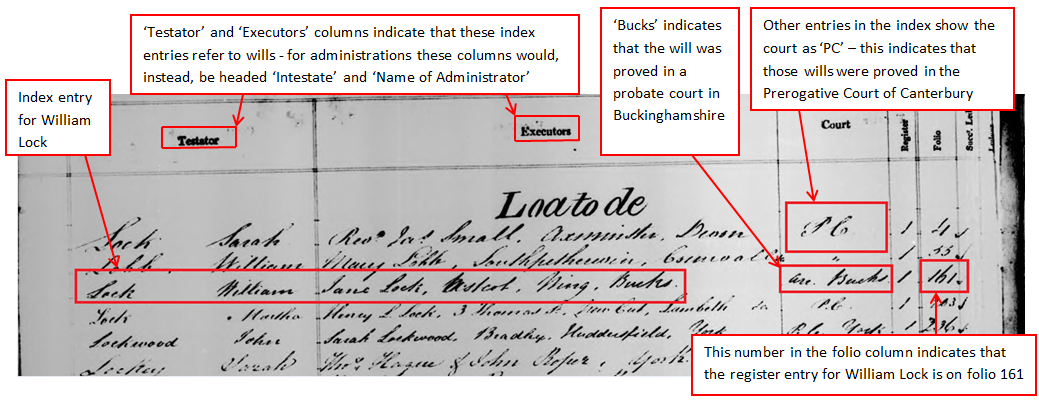
The example used in the image below shows the index entry for William Lock from 1826:

  • The ‘Testator’ and ‘Executor’ columns indicate that this entry refers to a will rather than an administration (entries for administrations would not include these columns and there would, instead, be columns headed ‘Intestate’ and ‘Name of Administrator’).
  • The column headed ‘Court’ indicates where the will was proved or the administration granted. For William Lock the ‘Court’ column entry shows his will was proved in a court in Buckinghamshire. Other entries in this section of the index are listed as ‘PC’ in this column – this indicates that those wills were proved in the Prerogative Court of Canterbury.
  • The ‘Folio’ column indicates the folio in the register for the respective index entry. William Lock’s entry shows that the details of the death duties payable on his estate are shown on folio 161 of the register.
Image of a death duty index entry for William Lock (from series IR 27)

Death duty index entries (IR 27) for wills from 1826, including that of William Lock.

5.3 Death duty registers (country courts and PCC) 1796-1903

Go to IR 26 in our online catalogue – this is the series reference for the registers. Use the search box to search either with the word ‘will’ or ‘administration’ (depending on the type of index entry you found) and in both the date range boxes enter the year that the will or administration was proved or granted. Click ‘Search’.

Step 1: Reorder the references

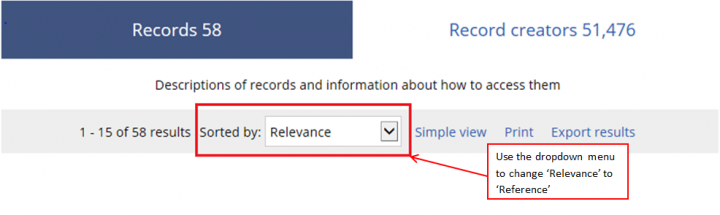
Your search results will be presented to you in ‘Relevance’ order. Change them to display in ‘Reference’ order. This will make it easier to scroll through to the right range of folio numbers.

Screenshot showing the dropdown menu to change from 'Relevance' to 'Reference'.

The dropdown menu displayed above search results allows you to sort your results by ‘Reference’ instead of the default ‘Relevance’.

Step 2: Find the document reference for the folio number

Each document reference covers a range of folio (or entry) numbers in the respective register. With your search results in ‘Reference’ order, scroll to the range which covers the folio (entry) number you noted at Step 3. Note the document reference (in our example, the reference is IR 26/1092).

Step 3: Look through the register

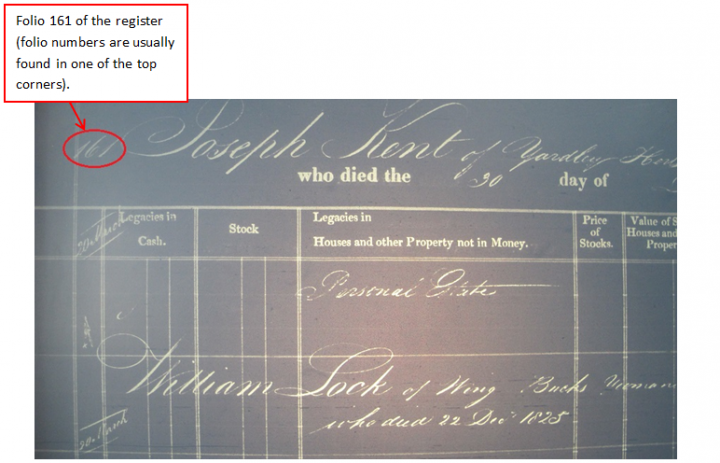
You will need to visit us to see the registers. Once you have found the correct reference for the IR 26 register you located at Step 2, look through the pages to find the folio number you noted down from the indexes in IR 27 (see section 5.2). Folio numbers appear in the top corner of a double-paged spread, usually on the left.

Folio with the folio number highlighted in the top left corner.

First few columns of the register entry for William Lock (IR 26/1092).

If you cannot locate an entry, see section 9 for a list of possible explanations. Alternative sources include the specimen death duty accounts in records series IR 19 – see section 10 for more alternatives.

5.4 Death duty registers (country courts and PCC) 1796-1857

Digital images of death duty registers can be found on the FamilySearch website. They can only be viewed at The National Archives, FamilySearch Centers or other affiliate libraries using the links below. Registers are listed with alphabetical ranges, folio numbers and year, images are viewed by clicking on the camera icon on the right.

6. Understanding references in the registers

Some entries in the registers may lead to other registers or records:

  • References like RR/41/J/12 refer to ‘reversionary registers’, which may be worth examining if the estate you are researching had any of its parts left in trust before 1852. You can browse these descriptions in our catalogue; there are only 11 files. Click on ‘details’ to see the folio range that each covers.
  • A reference like RA 767/46 1 LD refers to ‘residuary accounts’ (in this example 767 refers to the folio number and 46 refers to the year 1846). Most of these have been destroyed, although a few survive in IR 19. To find them, use the IR 19 series search to search with the keyword ‘will’ or ‘administration’ and the relevant year. There are some residuary accounts relating to well-known people in IR 59. To find them, use the IR 59 series search.
  • A reference like SA 85/120 refers to succession duty registers. To find them, use the IR 26 series search. Enter the phrase ‘succession registers’ and the relevant year. Find the file for the right letter and folio range.
  • A reference like Lr  234/16 (number 234 letter for the year 1816) refers to in-letters to the Legacy Duty Office and copies of out-letters in IR 6 which survive for the years 1812 to 1836 only. You can search by year within IR 6 and find the document reference with the relevant range of letter numbers (please note IR 6 documents are stored offsite and take three working days to produce).

7. Understanding column headings and abbreviations in the registers

The table below, based on a register from 1837, explains what the less intuitive column headings in the registers mean, and the information you can expect to find under them. Though the format of the registers changed over time these should cover most column headings that you are likely to come across. There are subsets of column headings which appear within broader overarching headings – the table below covers both types.

Column heading in the register Meaning Abbreviations used in this column
Residence Residence of executors
Description Occupation/rank of executors
Where and when proved Court and date at which the will was proved ArchCt/Totnes/archd’on = Archdeaconry court of Totnes
BishCt/Lichfield / = Bishop’s (consistory) court of Lichfield
ConCt/London = Consistory court of London
ConstEpic/Wells = Episcopal Consistory Court of Bath & Wells
Deans/Lichfield = Dean and Chapter of Lichfield
Ecclesi/St Albans = Archdeaconry of St Albans
ExCt/York = Exchequer court of the Archbishop of York
PC/Cant.y = Prerogative court of Canterbury
PecuC/Biggleswade = Peculiar court of Biggleswade
RuralD/Chester = Rural Dean of Chester
Sum sworn under Approximate value of the total estate
Legacies Description of size and types of items bequeathed in the will annych’d on R and P Est = annuity charged on real and personal estate
chgd = charged
3 P C Cons = 3% Consols
3 P C Red = 3% Reduced bank annuities
Observations Notes on the legacies or other information for the purposes of estimating duty payable
To whom in trust To whom estate is entrusted, that is the executors exors = executors
For what purpose What is to be done with the legacy;
into how many portions it is to be divided;
upon what conditions legatees are entitled to it;
whether the legacies have to be converted into certain forms for payment, etc.
Legatee To whom the legacies are due Resy Legatee = residuary legatee (that is the legatee who receives the remainder of the estate once the claims of the other legatees have been satisfied)
Consanguinity Relationship of the legatee to the deceased for the purposes of calculating the rate of duty payable on the legacy For abbreviations see separate table in section 8.2
Upon what contingency or, if in succession, of equal rate Upon what conditions the legacies are bequeathed and procedures to be followed when the legatee dies – that is, whether the legacy pass to the legatee’s heirs or to other defined persons For abbreviations see separate table in section 8.3
What deemed The form of the bequest; whether an absolute gift or an annuity and whether there are any contingency clauses to the bequest abs = absolute legacy (that is no strings attached)
abs & int = absolute and interest
abswp = absolute legacy with a proviso (conditional grant)
anny = annuity
anny wp = annuity with a proviso (conditional annuity)
dwp = ditto (usually absolute) with a proviso
in deft of appt eqy amg them = in default of apportionment equally among them
Age of annuitant* Age of the annuitant; given in some cases only
Value of annuities and bequests* Value of actual bequests received by legatees or total value of annuities as computed for paying duty
Rate of duty* Percentage of bequest or annuity to be paid as duty according to degree of consanguinity
Date of payment* Date when payments of duty took place
Annuity installments* Value of installments of duty paid on annuities – there were usually four such payments
Total duty* Total duty paid on legacy

*These columns sometimes contain no information, presumably because duty was never paid or because there were insufficient assets to pay for legacies. In place of such information is often a reference such as ‘RA 767/46 1 LD’ which refers to ‘residuary accounts’. These have been destroyed, although a few still survive in IR 19 and IR 59.

8. Other abbreviations used in the registers

8.1 Abbreviations found in various columns of the death duty registers

Abbreviation Meaning
de bonis non /15th Oct 1851/ date of later grant of administration
in resd in residue
not liable the bequests are to relatives too closely related to the deceased for duty to be payable
not subject to Duty legacies are to be paid out of the profits of land charged on real estate sales and are therefore (pre-1805) not liable to duty
P E personal estate
qy query
R A /1448-1837/ Residuary Account, Number /1448-1837/ – reference to accounts of money received as duty. Most of these accounts have now been destroyed, although a few remain in IR 19 and IR 59.
R E real estate

8.2 Abbreviations used to describe relationships (under ‘consanguinity’ in the register)

Abbreviation Meaning
BF brother of a father (uncle)
BM brother of a mother (uncle)
Child or Ch child of deceased
DB descendant of a brother (niece, nephew and so on)
DS descendant of a sister (niece, nephew and so on)
DBF descendant of a brother of a father (that is, cousin)
DBM descendant of a brother of a mother (that is, cousin)
DSF descendant of a sister of a father (that is, cousin)
DSM descendant of a sister of a mother (that is, cousin)
DBGF descendant of a brother of a grandfather
DBGM descendant of a brother of a grandmother
DSGF descendant of a sister of a grandfather
DSGM descendant of a sister of a grandmother
G child grandchild
GG child great-grandchild
G daughter grand-daughter
G son grand-son
SF sister of a father (that is, aunt)
SM sister of a mother (that is, aunt)
Str or Stra or Strag stranger in blood
Stra BL stranger, brother-in-law
Stra DL stranger, daughter-in-law
Stra NC stranger, natural child (that is, illegitimate)
Stra ND stranger, natural daughter (that is, illegitimate)
Stra NS stranger, natural son (that is, illegitimate)
Stra NC (of a daughter) stranger, illegitimate child of a daughter
Stra NC (of a son) stranger, illegitimate child of a son
Stra (sent) stranger, servant of deceased
Stra SL stranger, sister-in-law or stranger, son-in-law
Stra or ‘son’ stranger, natural son (that is, illegitimate)
Stra or ‘daughter’ stranger, natural daughter (that is, illegitimate)

8.3 Abbreviations used in the ‘contingency’ column

Abbreviation Meaning
amg among
attn attains
contingency conditions of bequest
dividds dividends
eqy equally
est estate
int interest
int durg miny prinl when 21 interest on bequest payable during minority of legatee and principal when legatee attains 21 years of age
pble payable
p or princl principal
reversion bequest reverts to another legatee upon a certain condition, for example the death of the first beneficiary
ring etc. mourning ring and other bequests
SER or suc of equal rate succession of equal rate after death of legatee, that is equal division of the bequest amongst the heirs of the legatee
until she attns 21 or marr legacy not operable until the beneficiary reaches the age of 21 or marries
when 21 with accumls legatee to receive principal and accumulated interest on it when he reaches the age of 21 years
with bent of survp with benefit of survivorship, that is if a bequest is distributed between a group of legatees and one dies, the rest are entitled to share out that legacy equally amongst themselves within six months = payment of legacy within this period

9. Why can’t I find an entry?

There are a number of reasons why you might not find a death duty entry:

  • Many of the registers for the 1890s were destroyed by fire.
  • Less valuable estates were often exempt from death duty. From 1858 there should be a record for all estates worth more than £20, but not from before that date.
  • From 1796 bequests to children, spouses, parents and grandparents were not taxable. In 1805 this exemption was reduced to spouse and parents, and from 1815 only bequests to the spouse were exempt.
  • From 1903 onwards only selected files survive; they are in record series IR 59 and all relate to well-known people.
  • Death duties were not paid on a person’s estate if they died as a result of wounds or disease during active service in the armed forces.
  • The starting date of a small number of country court registers is between 1800 and 1805, and not 1796.

Read the IR 26 series description in our catalogue for information on the history and arrangement of death duty registers.

10. Other records

The following record series also relate to death duties – click on the references to search within the respective series:

  • IR 19 – specimen death duty accounts
  • IR 59 – death duty accounts for well-known people; some of these records are closed to the public. Where this is the case the catalogue description will explain how to request access to the record under the Freedom of Information Act 2001
  • IR 6 – correspondence on contentious cases
  • IR 7 – correspondence on contentious cases for Scotland
  • IR 49 and IR 50 – contentious cases reported to the Treasury
  • IR 67 – legacy, succession and probate duty case books
  • IR 62 – precedent files. Files with piece numbers 1-1050 are not kept at Kew and will need to be ordered three days before you plan to visit
  • IR 98/1-9, IR 98/30-31 – death duties cases
  • IR 99 – solicitors’ opinions and reports relating to death duties cases. Files with piece numbered 1-170 are not kept at Kew and will need to be ordered three days before you plan to visit
  • E 188 – miscellaneous petitions relating to appeals against Inland Revenue assessments for estate or succession duty

11. Records in other archives

Copies of wills from the major local probate courts in Cornwall, Devon and Somerset were sent to the respective local archives. See the Somerset Heritage Centre website for more information about the wills they hold.

You can also search our catalogue for records held elsewhere. Refine your results using the filters.

12. Further reading

Use our library catalogue to find a recommended book list.

The books are all available in The National Archives’ reference library. You may also be able to find them in a local library. You can buy from a wide range of history titles in our bookshop.

This guide will help you to search for records of prisoners serving sentences in England and Wales. This includes many prisoners sentenced to transportation during the 19th century and awaiting transportation in hulks (prison ships). A proportion of those sentenced to be transported were never actually taken overseas and would have served all or part of their sentences in hulks or prisons.

Historical records of prisoners in prisons or gaols are held in a number of different places, including The National Archives, prisons themselves and local archives. The records at The National Archives relating to prisoners mostly consist of lists or registers of prisoners among records submitted to the Home Office or Prison Commission. Records of prisons, if they survive, may be found in local or county archives.

For information on somebody currently serving a prison sentence visit the prisons and probation pages on GOV.UK.

Consult our Criminal court cases: an overview guide for advice on finding which court a prisoner was convicted in and how to find records of the court.

Use our guide to Criminal transportation to find out more about records of convicts sentenced to be transported to Australia.

For information on finding records of prison staff use our guide to Prisons and prison staff.

For information on finding historical records of imprisoned debtors, see our guide to Bankrupts and insolvent debtors.

What does it help to know before starting?

Generally, there is no single record at The National Archives recording details of an individual prisoner’s time in prison. There is a small number of records for individual prisoners, usually relating to high profile cases, see the section below on records of individual prisoners. Licenses for early release of prisoners in PCOM 3 and PCOM 4 (available through Findmypast) can also contain information on a prisoner’s time in gaol and previous convictions.

Information on most convicted prisoners is found in registers of prisoners held in a particular prison or hulk, or calendars of prisoners convicted at courts of assizes or quarter sessions. The registers are little more than lists and do not provide much information on individual prisoners, usually:

  • Name
  • Age when convicted
  • Offence
  • Where and when convicted
  • Sentence

Many of the older registers are available online and can be searched by name on our partner websites, more information is in the Online records section below.

More recent records are likely to be closed because of data protection. Closed records will not be available online or searchable by name. It may be necessary to know where the prisoner was convicted or imprisoned and the dates in order to identify a record and submit a FOI request. See the section below on records available only at The National Archives.

Online records

Criminal registers for England and Wales (1791–1892)

Search criminal registers for England and Wales (HO 26 and HO 27), 1791 to 1892, on Ancestry.co.uk or Findmypast.co.uk (charges apply). The registers list all persons in England and Wales charged with indictable offences (tried by jury) showing the county where prisoners were tried and the sentences if convicted; some of the registers may contain personal information respecting the prisoners.

Many prisoners who were originally sentenced to death may have had their sentences ‘commuted’ to transportation for life or to a term of imprisonment.

Prison hulk registers and letter books (1802-1849) on Ancestry

Search by name for convicts held on prison hulks (HO 9) in England 1802-1849 on Ancestry.co.uk (charges apply). The registers contain basic information on the prisoners and where and when they were convicted.

Prison hulks were ships moored near naval bases to house prisoners – often those awaiting transportation. Many prisoners sentenced to transportation were never actually taken overseas and may have served their whole sentence, or a large part of it, on the hulks.

Use our guide to criminal transportation to find more records relating to criminals sentenced to transportation

Criminals, convicts and prisoners (1770–1935) on Findmypast

Search among the assorted records of criminals, convicts and prisoners on Findmypast.co.uk (charges apply) for:

Home Office records including:

  • Home Office: Convicts, Miscellanea (HO 7)
  • Quarterly returns of prisoners on hulks 1824-1876 (HO 8)
  • Criminal entry books, recording correspondence 1782-1871 (HO 13)
  • Criminal petitions 1819-1853 (HO 17) and (HO 18) and registers of criminal petitions (HO 19), see below for more information
  • Registers of Prisoners from National Prisons lodged in County Prisons 1847-1866 (HO 23)
  • Prison Registers and Statistical Returns 1838-1875 (HO 24)
  • Criminal registers, Middlesex (HO 26), and England and Wales (HO 27)
  • Judges’ Reports on Criminals 1784-1830 (HO 47)
  • Newgate Prison Calendar 1782-1853 (HO 77)
  • Miscellaneous Criminal Books 1798-1831 (HO 130)
  • Calendars of prisoners 1868-1915 (HO 140, see below for later records not available online)

Prison Commission records including

  • Various Prison records (PCOM 2)
  • Parole Licences, Male 1853-1887 (PCOM 3) and Female 1853-1887 (PCOM 4)
  • Transfer Papers 1843-1871 (PCOM 5)

Other records include

  • Metropolitan Police habitual criminals’ registers and miscellaneous papers (MEPO 6)
  • Registers of convicts in prison hulks (ADM 6)
  • After-trial calendars of prisoners of the Central Criminal Court (CRIM 9)
  • Treasury Accounts for Convict Hulks 1802-1831 (T 38)

Refer to the series descriptions of the records using the hyperlinks in the list above to learn more about what is contained in the records. For example, calendars of prisoners in HO 140 and criminal registers in HO 26 and HO 27 are registers of prisoners tried at various courts and include those not convicted, while HO 24 includes prison registers from Parkhurst, Pentonville and Millbank Penitentiary, as well as returns from county gaols.

Petitions for clemency (1819-1853)

Search HO 17 (1819-1839) and HO 18 (1839-1853) by name of prisoner on Findmypast. Petitions in HO 17 are also described in some detail in Discovery and a cataloguing project is adding descriptions to HO 18.  Petitions were submitted to the Home Secretary requesting reductions in initial sentences, and sometimes contain background information on the prisoner, their families, their crimes and prison conditions.

The series HO 17 also contains lists of prisoners submitted by prison governors recommending prisoners for pardons for good behaviour.

The series HO 19 records receipt of petitions and some petitions are registered which no longer survive.

Judge’s reports and circuit letters

Other records which may have led to a reduction of sentence can be found through judges’ reports from 1784-1829, which are in series HO 47 and can be searched by name and keyword in our catalogue or among the records digitised on Findmypast.

These can include details of evidence from the trial as well as comments from witnesses, juries and the friends and relatives of the accused.

Licences of parole for female convicts (1853-1871, 1883-1887)

Search by name for licences of parole issued to female convicts (PCOM 4) on Ancestry.co.uk (charges apply). Their contents vary but can include a variety of personal details, reports on behaviour while in prison and (from 1871) photographs.

These are also available through Findmypast.

Photographs of prisoners

The records digitised on Findmypast include albums of photographs of prisoners at Pentonville and Wandsworth prisons and at Oxford Gaol.

The two albums of photographs of prisoners in Wandsworth Prison created in 1872 and 1873 can also be browsed in Discovery at

They can be searched by prisoner’s name in Discovery using the form on this page.

Most records of convicted criminals do not include a photograph.

Prisoners listed in census records (1841-1911)

Search census records (charges apply) for England and Wales from 1841 to 1911 by name of prisoner online. If you find a prison in the census, it will list the names of prisoners present at the time the census was taken.

For advice on finding census returns for prisons see our partner websites.

Records available only at The National Archives in Kew

To access these records you will either need to visit us, pay for research (£) or, where you can identify a specific record reference, order a copy (£).

If the record is closed you will first need to submit a Freedom of Information request. You can make an FOI request for a closed record by selecting the ‘Submit FOI request’ button to the right of the closed record description in Discovery, our online catalogue.

Records of individual prisoners

There are some records for individual prisoners created by the Prison Commission in the series PCOM 8, 1876-1958, and in the Home Office series HO 336, 1936-2008 (most files are closed). The Home Office series HO 144  and HO 291 also contain some files on convicted criminals, as well as more general criminal matters or cases. They generally relate to high profile cases.

Search by name of the prisoner using the search box in the catalogue links and submit an FOI request if the record is closed.

Calendars of prisoners tried at Assizes and Quarter Sessions (1916-1971)

Lists of prisoners tried at county assizes or quarter sessions are in our series HO 140.  Before 1915 they are available online and can be searched by name of prisoner on Findmypast. From 1916 onwards they are not digitised and must be consulted as original records at The National Archives. To identify the record you need, search HO 140 by county and year.

A calendar for a specific year will list only those prisoners tried in that year, if you do not know the year a prisoner was tried, you may need to consult several calendars.

Calendars in HO 140 dated 1930 to 1971 are closed records. If you wish to know if someone is mentioned in a calendar that is closed, you will need to identify the relevant calendar and submit a FOI request.

In 1972 Assize Courts and Quarter Sessions were replaced by Crown Courts and after trial calendars ceased.

Prisoners tried at the Old Bailey or the Central Criminal Court (1815-1849)

Browse HO 16 for returns of prisoners committed for trial at the Old Bailey arranged by date. The returns list charges and the sentences passed, including acquittals and not guilty verdicts.

Recorder’s returns and judges’ circuit letters, from 1816-1840, are arranged by date in series HO 6, and contain more material about the decision to reduce sentences, lists of prisoners and letters from prison governors. They can be browsed by year.

Other records

Various other Home Office series can contain records relating to prisoners.HO 45 and HO 144, Home Office registered papers all of which can be searched on our catalogue. They contain papers on all sorts of subjects including convicts and prisoners.

PC 1 Privy Council Office unbound papers also contains correspondence relating to convicts and criminal matters, refer to our guide for more information.

Useful websites

The Prison History website has a wealth of information on 19th century prisons and local lock-ups, including searchable databases with information on the location of surviving records.The Digital Panopticon  website has searchable information on convicts convicted at the Old Bailey (Central Criminal Court) drawn from a variety of sources.

Videos

Watch the video Tracing your Criminal Ancestors by Chris Day.
1. Why use this guide?

Use this guide to find out how to locate the various records relating to the administration of French lands owned by the English Crown.

At various dates between the 11th and 16th centuries the English crown administered:

  • Normandy
  • Ponthieu
  • Calais
  • the duchy of Aquitaine (later Gascony/Guyenne)

The National Archives (or the Tower of London) does not hold French royal records or private title deeds for the lands held by the English kings. Surviving information of this kind is in the Archives Nationales or the relevant Archives Departmentales in France.

2. How to search the records

The main record series to search within are the Chancery (C) and Exchequer (E).

Many of these records do not have detailed descriptions in Discovery, our catalogue, which makes them difficult to search. Therefore you may need to start by consulting other publications and resources:

  • Some of the records have been transcribed and/or translated fully in published works
  • Others have been summarised in calendars. These calendars will help you identify relevant records

Details of these finding aids are in the sections below. Some of these finding aids are available online. All are available at the National Archives, Kew.

There are a few relevant records, such as wills which you can view online. However, to view the majority of the records (and finding aids) you will need to visit The National Archives at Kew or pay for research.

3. Diplomatic documents and treaties

Many diplomatic documents were printed or transcribed in full in:

For unpublished treaties see E 30 and C 47/27/1-15 (diplomatic documents), and treaty rolls in C 76. These rolls are calendared in part in:

The Liber A and Liber B in E 36/274-275 contain transcripts of diplomatic documents, and there are references to records about Ponthieu in Bishop Stapleton’s Calendar in E 36/268.

4. Chancery rolls

Treaty Rolls are an amalgamation of chancery rolls found to contain diplomatic material. Their content reflects changing periods of foreign policy focus and diplomatic activity for England. They contain administrative material for all lands in France under direct English rule except Gascony and Normandy.

The English Chancery kept separate series of rolls, recording administrative instructions of many kinds, for both Normandy and Gascony.

4.1 Norman rolls

The Norman Rolls are in C 64. Read the C 64 series description for further information on what they contain. They are partially calendared in:

In addition a transcript of:

4.2 Gascon rolls

The Gascon Rolls are in C 61. Read the C 61 series description for further information of what they contain. They are again calendared in Carte. In addition:

A project is currently underway to calendar the remaining rolls to 1468. This will provide online access to images of the original text, accompanied by an English translation.

4.3 Additional Chancery rolls

There are a few entries relating to France on the:

  • Roman Rolls in C 70
  • Close Rolls in C 54
  • Fine Rolls in C 60
  • Patent Rolls in C 66

Most were found and calendared in T Rymer, Foedera, Conventiones, Litterae, et cujuscunque Generis Acta Publica (20 vols, 1704-1735). The printed calendars of the last three series contain indexes to help locate the rest.

Fine rolls, C 60/8-69, which cover 1216-1272, are available online as facsimile images with searchable English translations at Henry III fine rolls. This is part of a free resource in conjunction with King’s College, London.

5. Exchequer accounts

The Exchequer Various Accounts in E 101 include a wealth of useful material, which appears in the E 101 list under the headings:

  • France
  • Army
  • nuncii
  • works
  • Wardrobe and Household

Descriptions in the list such as ‘subsidiary documents’ conceal the fact that the files contain documents with unique information in the form of:

  • warrants
  • receipts
  • indentures

Some of the Declared Accounts in E 351 also contain French material, as do the Foreign Accounts in E 364. The Memoranda Rolls in E 159 and E 368 include scattered references to French matters. Browse these by date.

The Norman Pipe Rolls in E 373, which cover the years from Henry II to John, are transcribed in Magni Rotuli Scaccarii Normanniae, ed T Stapleton, 2 volumes (1840, 1844).

The Pipe Rolls themselves in E 372 also contain some Norman material. Accounts of the treasurer of Ponthieu and Montreuil during the reign of Edward III are in E 315/437-438. See also Ministers’ Accounts in SC 6. For these, consult the List of Original Ministers’ Accounts preserved in the Public Record Office which is available in the reading rooms, Kew.

6. Calais

Calais was in English hands from 1347 to 1558, and from 1453 the town and its march were the last English possessions in France. The National Archives holds a wealth of information about this valuable port and trading centre dating from c.1350 onwards.

6.1 Accounts and financial related records

The Augmentation Office Miscellaneous Books in E 315 include:

  • accounts of the Treasurer of Calais, 1409-1412 (11-13 Henry IV) in E 315/335
  • surveys of Calais, 1555-1556 (2-3 Philip and Mary) in E 315/371-2
  • a rental and terrier of Calais, 1482-1483 (22 Edward IV) in E 315/407

E 36/269-272 contain the controller’s accounts, Henry VII–Henry VIII. The Exchequer Foreign Accounts in E 364 include the accounts of the mayor of the Calais staple and from Gascony. Browse them by date as the rolls are not described in detail in our catalogue.

There are Declared Accounts of the treasurer of Calais, 1542-1545, in E 351/530-535.

There is also material in the Customs Accounts in E 122. Use the search box within E 122 to search by keywords such as ‘Calais’ or ‘wool’, for example.

Indentures covering the safe passage of the wool fleet are enrolled on the Memoranda Rolls in E 159 which you can browse by date.

Rentals and Surveys in SC 12 include several items on the march, Henry V to Henry VIII; and Ministers’ Accounts in SC 6 contain accounts for Calais.

DL 28/2/1-11 comprises of the accounts of the treasurer and controller, 8-19 for Henry VII’s reign.

6.2 Laws, appointments and surveys

You can find:

  • a transcript of laws and charters for Calais during Henry VIII’s reign are in DL 41/407
  • a survey of parishes within the march of Calais in LR 2/88 (draft, with LR 2/59 a duplicate copy)
  • appointments of mayors and constables of the staple during the reigns of Edward III–Henry VI in some of the Staple Rolls in C 67/22-25

6.3 State Papers

A valuable collection of material about Calais during Henry VIII’s reign is listed in Letters and Papers, Foreign and Domestic, Henry VIII, 22 vols (1864-1932). It includes the correspondence of Arthur Plantagenet, Lord Lisle, when deputy of Calais.

The Lisle papers are in SP 3 and have been published separately in The Lisle Letters by M Byrne, 6 vols (1981).

For Calais under Edward VI and Mary (until its loss to France in early 1558) consult:

All volumes are they available in The National Archives’ library and reading rooms, often with unique annotations.

SP 46 (State Papers Domestic, Supplementary) includes a few official and private papers relating to Calais, and is not listed in these calendars. See our guide on State Papers domestic 1547-1649 for help searching these records. You can search all of these 16th century series on State Papers Online (subscription required).

6.4 Deeds

There are some deeds relating to Calais among the various series of Ancient Deeds. A good starting point for accessing these is the Calendar of Ancient deeds.

See also the sources listed in the sections above on:

Exchequer accounts in E 101 and some exchequer foreign accounts in E 364 are particularly useful.

7. Other sources

7.1 Administrative and Legal records

Ancient petitions in SC 8 include a great many petitions from Gascony and Calais. You can search by keyword, for example Calais, and download them via our catalogue. Read the series description of SC 8 to find out more about what they might contain.

Ancient Correspondence in SC 1 is also worth consulting for letters relating to rights in France. Search all 14,000 letters in SC 1 by keyword in our catalogue.

7.2 Financial records

Exchequer, Treasury of Receipt, Books contain several useful volumes on France (E 36/78-83).

There is an isolated writ of John of Gaunt, Duke of Lancaster, from April 1370, concerning a planned expedition to Gascony, in PRO 30/26/71/16.

The wills of many people who died in France, or had property there, are recorded amongst the registers of the Prerogative Court of Canterbury in PROB 11. All Prerogative Court of Canterbury wills are viewable online. They are searchable by name, place, occupation and date.

7.3 Miscellanea

As its title suggests, Chancery Miscellanea, French Possessions (C 47/24/1-17, C 47/25/1-10, C 47/26/1-28), contains a variety of writs, returns, petitions, claims, warrants and letters relating to French regions including Calais, Normandy, Picardy, Gascony, Guienne, Saintonge and Ponthieu.

Duchy of Lancaster Miscellanea DL 41 includes a few scattered documents on various French possessions. Use the search box to search by keywords such as ‘Calais’ or ‘France’ within DL 41.

8. Further reading

Some or all of the recommended publications below may be available to buy from The National Archives’ shop. Alternatively, search The National Archives’ Library to see what is available to consult at Kew.

D Grummitt, The Calais garrison: War and military service in England, 1436-1558 (Boydell, Woodbridge, 2008)

S Rose, Calais: An English town in France, 1347-1558 (Boydell, Woodbridge, 2008)

Clifford J Rogers (ed), The wars of Edward III: Sources and interpretations (Boydell, Woodbridge, 1999)

M G A Vale, English Gascony 1399-1453: A study of war, government and politics during the later stages of the Hundred Years’ War (OUP, Oxford, 1970)

M G A Vale, ‘The ancient enemy. England, France and Europe from the Angevins to the Tudors, 1154-1558’ (Hambledon Continuum, London, 2007)

1. Why use this guide?

Use this guide if you are researching courts of law records in England and Wales and are interested in collections which are held by archives other than The National Archives. The National Archives holds many records of the central or ‘high’ courts of law such as Chancery, King’s Bench or the Supreme Court. It also holds records of the county assizes up to 1971. For research guides specifically on The National Archives court records please see our Criminals, courts and prisons research guidance category.

This research guide briefly describes:

  • how to start searching for records
  • the principal relevant repositories with significant collections relating to courts in England and Wales
  • useful addresses, links and general works of reference

The guide does not cover records of law courts in Scotland or Northern Ireland, whose legal systems are distinct from England and Wales and whose records are found in their respective national and local archives.

2. How to search for court records

There are countless records of courts of law in England and Wales, going back centuries. Where you look for a particular set of records depends upon the court in question.

Search Discovery (£), our catalogue, to find records from over 2,500 archives across the UK, as well as from The National Archives itself. Your search results will include details of which archives currently hold the records.

Click on the title of a result for the contact details of the archive which holds the record – you will need to contact this archive for further information about the collection or the record itself.

Where the keywords you searched for appear in the description of a record, the search results are displayed under the ‘Records’ tab.

Where the keywords you searched for appear in the name of the institution or person that originally created the record (often not the same as the institution or person that currently holds the record), the search results are displayed under the ‘Record creators’ tab. For further tips on searching, see our Discovery help pages.

For manorial courts only, search the Manorial Documents Register (MDR) using our catalogue. From your search results page, click on the record creators tab and refine by manor. Typical cases within the manorial courts system included land use issues and the settling of local disputes, records of which can also be found in county record offices.

The MDR is maintained within The National Archives as an index to the nature and location of surviving manorial records. These include court rolls and books with other papers relating to the administration of Courts Baron and Courts Leet during the medieval and early modern periods.

3. Records recently collected by other archives

Many archives regularly take in new records to add to their collections – this process is known as accessioning. Every year, The National Archives collects information about new accessions from 250 archives across Britain and Ireland. This is known as the annual Accessions to Repositories’ survey. For court records from 1994 to the present consult our Accessions to Repositories pages.

4. Major collections

Besides The National Archives, which holds records of the central or ‘high’ courts of law, the following repositories and institutions hold major collections of court records:

4.1 County record offices

County record offices are the place to find records of:

  • petty sessions, which dealt with minor matters and were presided over by justices of the peace, now known as magistrates courts
  • quarter sessions, which met four times a year and dealt with all kinds of offences
  • county courts
  • some assize courts
  • coroners courts
  • papers of legal cases created and preserved by law firms and individuals

Search Find an archive by county to find contact details for county record offices.

4.2 Diocesan record offices

Diocesan record offices hold ecclesiastical court records. These usually relate to a particular church diocese and record judicial activities of church and Christian institutions. For example:

You can also find diocesan records in local archives. Search Find an archive by town or region to find contact details for local archives.

4.3 Inns of Court

The four Inns of Court in London, where barristers traditionally lodged, trained and practised, each have their own records dating back centuries. Though these are not court records, they may provide insights into workings of courts and the culture that surrounds them:

5. Other useful websites

Ancestry (£) – for online court records covering tax, wills, criminals and land.

Black Sheep Ancestor – use this website to search for criminals and convicts in historical court records.

Findmypast (£) – for Irish petty sessions records.

Old Bailey – the proceedings of the Old Bailey, London’s Central Criminal Court, 1674-1913.

6. Further reading

The following books are all available in The National Archives’ reference library. You may also be able to find them in a local library. You can buy from a wide range of history titles in our bookshop.

Michelle Cale, Law and Society: an introduction to sources for criminal and legal history from 1800 (1996)

J Gibson (ed), Quarter Sessions Records for Family Historians: A Select List (Federation of Family History Societies, 3rd ed, 1992)

P D A Harvey, Manorial records (1999)

David T Hawkings, Criminal Ancestors: A Guide to Historical Criminal Records in England and Wales (2009)

Anne Tarver, Church court records: an introduction for family and local historians (1995)

This guide provides a brief overview of Crimean War records held at The National Archives. These are the records of central government, including all branches of the military. You’ll get a sense of the sort of records we hold, and links to guides with more details and advice on how to find the records in our collection, including whether records are available online.

How the records are arranged

The original records are arranged at The National Archives by the government departments that created them. Each department’s collection of records is identified by a department code. Three of the most significant for Crimean War research are:

Other government departments may have transferred Crimean War records to The National Archives. You will find details for some of them in the guides which we provide links to below.

How to search for records

Before you begin a search you should see if there is a guide to the specific type of records you are looking for – this guide is designed to help you to do that. Each guide listed below contains the links and advice you will need to search a specific set of records.

Each guide will indicate whether records have been made available online (charges usually apply). The online copies are accessed either directly from our website or from the websites of our licensed partners, including Ancestry and Findmypast (£).

Some records have no online version and to see these you will need to consult them at our building in Kew or pay for copies to be made and sent to you. The search for records held at Kew begins by using keywords and dates to search our online catalogue. The catalogue contains short descriptions of the records and a document reference for each – you will need the document reference to see the record itself or to request copies.

For more guidance on searching or browsing our catalogue, visit our Discovery help pages.

Records of individuals

The service record of an individual will usually provide more detail on them than any other single record. Military service records are held separately for each branch of the military and records of officers are held separately from other ranks. The records themselves vary in the detail they contain, from a full service history, to attestation or discharge papers, or entries in a list or register. This is explained in more detail in the research guides. There are guides for each:

Our guide to Muster rolls and pay lists has information on tracing an individual’s service using entries in  regimental records, including those for the British Foreign Legion, Swiss and German nationals (records of the Italian legion no longer survive) recruited specifically for the war.

Consult our guide to British Army nurses to find information on army nurses in the Crimean war.

To find records of prisoners of war, see our guide to British prisoners of war or try searching our catalogue.

Medical Records

To find records of Army hospitals, search our catalogue with the search terms hospital and Crimea or nurse.

Royal Navy Surgeon’s journals are found in the series ADM 101, search using terms Crimea, Therapia, Black Sea.

Royal Navy hospital musters are in series ADM 102, search using terms Therapia, Malta, Lewes (prisoners of war), Belle Isle.

In-letters of the Admiralty Sick and Hurt Board are in the series ADM 97, with registers in ADM 132 and indexes and digests in ADM 133.

Operational records and maps

Operational records are the orders and correspondence of the War Office and Admiralty directing and recording the conduct of the war. Other records include private papers of officials or senior officers, maps, log books of ships or surgeon’s journals.

See our guides to Royal Navy operations and correspondence and Royal Navy ships’ logs for advice on researching the Royal Navy’s role in the war.

Consult our guide to British army operations up to 1913, which includes a section on Private papers, for advice on finding records of the army.

Search in the series WO 28 Records of Military Headquarters using the search term Crimea, or browse the section on Crimea for headquarters’ papers relating to the war.

Browse our catalogue for commanders’ dispatches from Crimea during the war from WO 1/368 to WO 1/384. These are arranged chronologically.

Use our guides to Maps and plans, Overseas maps and plans and Sea charts for advice on finding the maps in use at the time.

Government policy and strategy, international relations and the aftermath of the war

Foreign Office general correspondence: France, Russia and Ottoman Empire (1781–1905)

Browse our catalogue for general correspondence relating to the French, Russian and Ottoman Empires before 1906 in FO 27, FO 65 and FO 78 respectively. You will need to use the registers and indexes in FO 605 to access these series. For further guidance see our guide to Foreign Office correspondence 1782-1890.

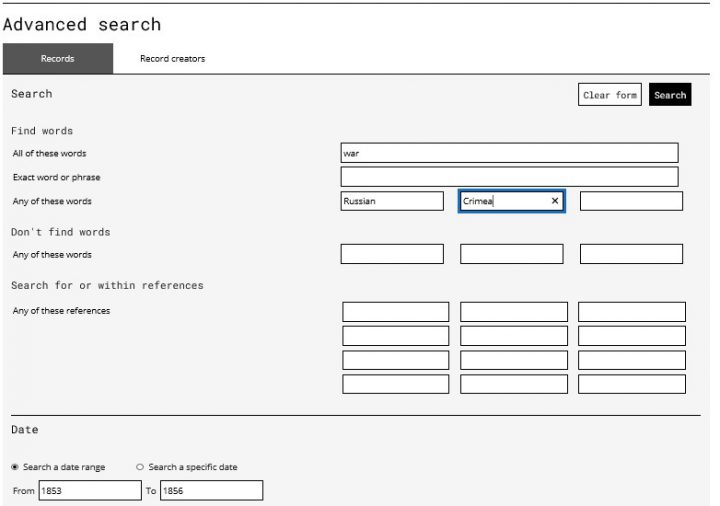
Search in our catalogue to find other records relating to the war using the advanced search, a variety of search terms and restricting the date range, such as in the example below:

An advanced search in Discovery for the word war with either Russian or Crimea. Date range 1853 to 1856.

An advanced search in Discovery for the word war with either Russian or Crimea. Date range 1853 to 1856.

Records in other organisations and other resources

Websites

Search Hansard for Parliamentary debates on the Crimean War.

Our research guide to Hansard details different ways of accessing the reports and records of Parliamentary debates.

Explore The National Archives’ British Battles online exhibition on The Crimean War for an interactive history of the conflict.

Search The Times Archive and the Guardian and Observer Digital Archive to view articles (£) about the Crimean War.

Books

Read ‘The Crimean War, British Grand Strategy Against Russia, 1853–1856′ by Andrew D Lambert (Manchester University Press Manchester, 1991).

1. Why use this guide?

Use this guide for advice on how to find British merchant shipping records known as crew lists and agreements, originally known as muster books, and log books. These records, which collectively date from 1747 to the 1990s, can provide brief details of ships, the voyages they took and their crew. Typically, if you can locate a seaman in a crew list you will find out his:

  • age at the time
  • place of birth
  • job on the ship
  • date and place of joining and leaving the ship
  • reason for leaving the ship, whether discharged, drowned, or otherwise

You should not expect to find any detailed accounts of day-to-day life or the activities of crew or passengers.

Between 1858 and the First World War, the Merchant Navy did not keep registers of its seamen, so crew lists and agreements are the only records you are likely to find of an individual merchant seaman during this time.

2. What are these records?

From the mid-18th century, masters or owners of most British-registered merchant ships were required to keep a record of their crew before the ship left port. This was simply a record of the total number of crew (known as a muster roll), but it evolved into what are known as crew lists and agreements. The list was kept on board and then sent to the Register Office of Merchant Seamen, the central administration office of the Merchant Navy, on the ship’s return to Britain.

The Mercantile Marine Act of 1850 required ships’ masters to also keep a log book to record events on board a ship, which included seamen’s conduct. Log books were deposited after each foreign voyage, or half-yearly for home trade ships. They first appear in the records around 1852; many have been destroyed, with only those recording a birth or death surviving.

3. How to find a ship’s number

With the introduction in 1855 of a central registry, all ships were given an official number as soon as practicable.

To find a crew list and agreement from 1855 onwards, you will need to know the ship’s official number. To find a ship’s official number go to the Crew List Index Project (CLIP) website, which has information about merchant ships from 1855 to 1913, or the Miramar Ship Index website (subscription required) which lists some categories of merchant and naval ships.

You can, however, search for crew lists and agreements using the names of the seamen from 1881, 1891 and 1915 by ship’s number for all other years (see section 8.4 for more information).

Ships did not have an official number before 1855. These earlier records were organised by port of registry and then alphabetically by name of ship (see the respective sections below for advice on finding earlier records).

4. Pre-1747 records

Before 1747 no systematic records of the crew of merchant ships were kept. For pre-1747 records, you need to look speculatively through material from other government departments or courts that may have had an interest in merchant navy affairs, such as:

  • State Papers (SP)
  • Colonial Office (CO)
  • Treasury (T)
  • High Court of Admiralty (HCA)
  • High Court of Delegates (DEL)

Use the advanced search in Discovery, our catalogue, to search for records using the department codes above and relevant keywords such as ‘ships’, ‘shipping’, or ‘manifest’. You are unlikely to find records by searching for the names of ships or seamen, as the records have not been indexed in that way.

Further details of available sources are described in:

5. Muster Books (1747-1834)

In 1747, following an Act of Parliament, a fund for the relief of disabled seamen was set up, using money taken from seamen’s wages. To administer this fund, masters or owners of merchant ships had to keep a muster book, also known as a muster roll, which was filed at the port of arrival with the Seamen’s Fund Receivers.

Muster rolls for this period did not usually record the names of the whole crew but did provide:

  • name of the owner of the ship
  • name of the master of the ship
  • total number of crew members
  • very brief details of the ship’s voyage

However, some lists, appearing randomly during this period, also show:

  • a full list of the names of the crew
  • the amount of money invested in the fund by each crew member (this was calculated on a pro rata basis at 6d per month)

There would have been calculation tables but none of these are thought to survive.

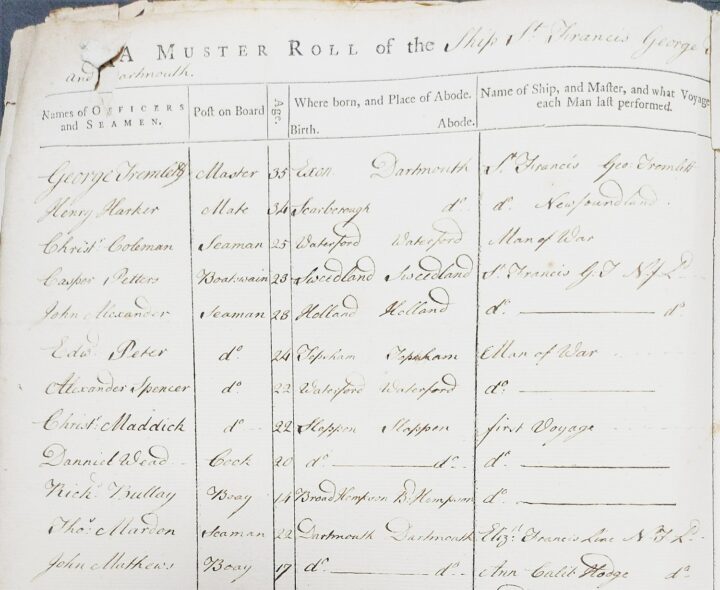
Hand written and laid out in columns the image shows a ship's muster roll 1770-1775 (catalogue reference: BT 98/3)

Image of a ship’s muster roll 1770-1775 (catalogue reference: BT 98/3)

6. How to find muster books

The main record series for muster books is BT 98.

Click on BT 98 to search by date and name of British port where the ship was registered.

Alternatively, browse BT 98/1-139 (1747 to 1853) to view all the ports and years for which there are records in this period.

A few muster rolls survive in other record series. Search for ships registered at:

7. Crew lists and agreements (1835-1999)

In 1835, following the Merchant Shipping Act, muster books were replaced by similar records known as crew lists and agreements. These are not two separate documents but one and the same thing; you may see them referred to simply as ‘crew lists’, or sometimes simply as ‘agreements’. The agreements were between master and crew and are also called ‘Articles of agreement’.

They were filed at the Register Office of Merchant Seamen, the forerunner of the Registrar General of Shipping and Seamen (RGSS). Sometimes a log book, with details of the ship’s voyages (see section 7), was filed along with the agreements and crew lists.

7.1 What crew lists and agreements tell us

Most types of crew lists and agreements give brief details about the ship, its master and voyages at the date of being filed together with the following information for each crew member:

  • first and last names
  • age
  • place of birth
  • ‘quality’ (the seaman’s job on the ship)
  • ship in which last served
  • date and place of joining ship
  • time and place of death or leaving ship
  • ‘how disposed of’ (the nature of the seaman’s departure from the ship, whether discharged, drowned or otherwise)
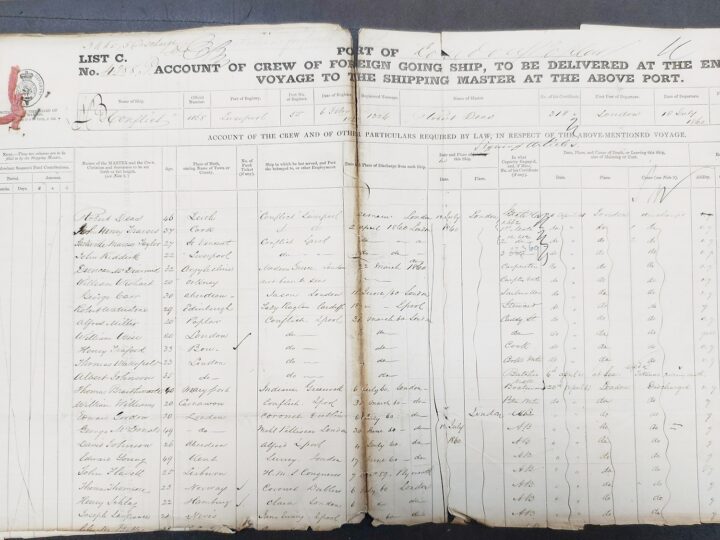
Columns of names and other data, entered in hand, in a ship's crew list and agreements 1861 (catalogue reference: BT 99/4)

Image of a ship’s crew list and agreements 1861 (catalogue reference: BT 99/4)

7.2 Foreign and home voyages

Crew lists and agreements were either for ‘foreign voyages’ or ‘foreign trade’ or ‘home voyages’ or ‘home trade’.

These essentially distinguished between ships sailing in waters around Britain (home) and those sailing further afield (foreign).

In addition, the following types of lists were introduced used between 1835 until 1856:

Agreements for ‘Foreign Going’ or ‘Foreign Trade’ ships (Schedule A)
These agreements had to be filed within 24 hours of the ship’s return to a UK port.

Agreements for ‘Home Trade Ships’ (Schedule B)
These agreements covered coastal and fishing ships. The forms had to be filed within 30 days of the end of June or December.

Crew lists for ships on ‘foreign voyages’ (Schedule C)
A form known as a Schedule C was completed by the master of every ‘Foreign Going Ship’, filed within 48 hours of the ship’s return to a UK port.

Half-yearly crew lists for ships on ‘home voyages’ (Schedule D)
A Schedule D form was headed ‘Accounts Of Voyages And Crew For Home Trade Ship’. Completed by the masters of ships engaged in the coastal or fishing trade, giving the voyages and crew for the preceding half year, and was to be filed within 21 days of the end of June or December.

 Names and Register Tickets of Crew (Foreign Trade) (Schedule G)
A list of the crew, with their Register Ticket numbers, to be filed for a foreign-going ship on sailing.

7.3  The distribution of the surviving lists

After 1861 only a sample of crew lists and agreements and log books are held at The National Archives. Many do not survive at all whilst significant proportions of those that do survive are held at other archives, most notably:

The National Archives holds the following proportions of surviving crew lists and agreements after 1861:

  • 1861-1938: 10%
  • 1939-1950: 100%
  • 1951-1994: 10%

Local archives took some of the records for the period 1863-1913 (see section 12).

8. How to find crew lists and agreements

Use this section for advice on finding crew lists and agreements from 1835 up to 1999.

From 1835 until 1857, crew lists and agreements were organised by port of registry and then alphabetically by ship name (see sections 8.1 and 8.2 for search advice), and then from 1857 onwards, you will need to find the ship’s official number to locate these records (see section 3 for more information).

8.1 1835-1844

There are two main types of crew list for this period:

Schedules C and D
See section 7.2

Crew lists for this period are in BT 98.

Use the search box contained within BT 98 to search by date and name of ship’s port of registry. There are usually several boxes of records for each port of registry, each box containing an alphabetical range of ships’ names. Within each box the lists are randomly arranged.

Alternatively, browse BT 98/140-563 to view all the ports covered for this period and the alphabetical ranges of ships for each port.

8.2 1845-1856

To locate crew lists for these years you will need to know the name of the ship on which an individual seaman sailed.  This is not given in the Merchant seaman registers 1835-1857 until 1854.  A search on our catalogue of all the available crew lists is only practical for small ports.

Crew lists for this period are in BT 98.

Use the search box contained within BT 98 to search by year and name of ship’s port of registry. Any search results will be divided into alphabetical ranges according to the initial letter of the ship’s name

Alternatively, browse BT 98/564-4758 to view all the ports covered for this period and the alphabetical ranges of ships for each port.

From 1845 onwards the following lists were being used:

Schedules C, D and A, B, G.
See section 7.2.

8.3 1857-1860

From 1857 onwards, the records are arranged in BT 98 by ships’ Official Number (ON). The Official Number was allocated on registration, retained for the life of the ship, and was not reused.

You may find a ship’s Official Number from the following published sources available at The National Archives:

See section 3 for more information on how to find a ship’s number.

Use the search box contained within BT 98 to search by ships’ Official Number and date. Each piece in this series covers a number of ships and therefore appears in our catalogue as a range of numbers.

To find the right range for your ship you will need to search using the first two or three digits of the number. For example, for a ship with the number 25820, search using 258* (include the asterisk) as your keyword. This will find BT 98/6795 which covers ships’ numbers 25801-25834 for the year 1860.

8.4 1861-1938

The National Archives has 10% of surviving crew lists between 1861 and 1938 in our series BT 99. You can search in BT 99 using the ship’s official number.

For the years 1881, 1891 and 1915, you can also search in BT 99 using the ship’s name or a merchant seaman’s name.

The National Maritime Museum in Greenwich has the remaining 90% of surviving crew lists for the years 1861, 1862, 1865 and all later years ending in a five, up to 1995. Read their research guide for further advice.

The Maritime History Archive in Newfoundland has the remaining surviving crew lists for this period. This amounts to roughly 70% of the total surviving crew lists and agreements between 1861 and 1938.

You can search their Crew List Index by ship’s official number.

8.5 1915 crew lists

Crew lists for 1915 can be searched by vessel or crew member on the National Maritime Museum’s Crew Lists of the British merchant navy – 1915 page. The search will find transcriptions of crew lists held at The National Archives and downloadable images of the crew lists held at the National Maritime Museum.

8.6 1939-1950

The National Archives holds all the surviving crew lists and agreements for the Second World War and the succeeding years up to 1950. Search by ship’s official number in:

There is also an index to Second World War log books, agreements and crew lists in BT 385.

Search in BT 387 for agreements and crew lists of allied foreign ships requisitioned or chartered by the British government in the Second World War. The records contain details of UK merchant seamen who served on the ships. BT 387 is arranged by ranges of ships’ names therefore you will need to browse the series.

8.7 1951-1994

After 1972 only two 10% samples of crew lists and agreements have been preserved. One sample is held by The National Archives and the other by the National Maritime Museum. The rest, up to 1989, have been destroyed.

Search for crew lists and agreements from 1951 to 1994 at:

The National Archives – search our 10% sample by ship’s number in BT 99.

The National Maritime Museum – holds 10% of agreements and crew lists for 1951-1976. The records held are for years ending with five (1955, 1965, and so on).https://www.rmg.co.uk/collections/research-guides/research-guide-c12-merchant-navy-ship-registration-custom-house-records

Maritime History Archive – holds approximately 70% of the crew lists and agreements for 1951-1976, but the records have not yet been indexed so contact them directly for search advice.

8.8 Crew lists and agreements for celebrated ships (1835-1999)

Search by name of ship in BT 100 for the agreements and crew lists of a selection of celebrated ships.

8.9 Crew lists and agreements held in other archives

Many local archives hold the records relating to their local ports. To identify records held in local archives, search our catalogue and refine your results using the filters. Try search terms such as “ship register” or “registrar general shipping and seamen”. Check the opening hours and contact details for local archives using find an archive.

The National Records of Scotland holds agreements and crew lists under the reference BT 3, covering 1867-1913, for Scottish ships only. The ships are listed alphabetically by name in the paper catalogue. Official logs are found with the agreements and crew lists, where they survive.

The National Archives of Australia has a large number of record series concerning ships’ crews and the merchant navy. They include registers of engagement, articles of agreement, registers of discharge, registers of deserters, and employment history records. All these record series are indexed on the Record Search database

Crew lists and agreements for Indian crew (or lascars) of British registered ships who enlisted on the Indian sub-continent are called Asiatic agreements. They were logged at ports such as Madras and Bombay under the direction of the Serang or Headman of the port. Since the Registry General of Shipping and seamen regulations covered only British seamen, details of engagement, such as length of engagement, could be different, allowing a lascar seaman to be contracted for a period longer than one voyage and sometimes for several years. These agreements are unlikely to be held in any archive in the UK, but if any do survive, they may be in the archives of shipping companies such as P&O or the British India Steam Navigation Company, or in the East India Company Archives held at the British Library.

9. Log Books (1852 onwards)

Agreements and crew lists from the 19th century are occasionally accompanied by ships’ logs and this becomes increasingly common for 20th century records. The Mercantile Marine Act of 1850 required masters to keep a ship’s Official Log to record events on board including:

  • illnesses
  • births and deaths
  • the ship’s ports of call
  • misconduct
  • desertion
  • punishment
  • a description of each man’s conduct

Logs were deposited after each foreign voyage, or half-yearly for home trade ships. They begin to appear amongst the records from 1852 onwards; many have been destroyed; usually only those recording a birth or death have survived.

It is therefore possible, for example, to find records of deaths of soldiers and prisoners of war returning on ships from the Boer War. For the First World War (1914-1918) all surviving logs containing casualties are preserved.

You should not expect to find any detailed accounts of day-to-day life or the activities of crew or passengers.

Often the description of a man’s conduct, listed under the two headings ‘General Conduct’ and ‘Ability in Seamanship’, consisted of nothing more than the letters VG (Very Good). Sometimes, however, other details may be found.

10. How to find log books

Search by ship’s name or number in BT 165 for selected logs covering the periods 1902-1920.

There are a small number of log books in BT 98 and BT 99.

Use the search box contained  in BT 98  to search by date and name of ship’s port of registry. There are usually several boxes of records for each port of registry, each box containing an alphabetical range of ships’ names.

Use the search box in BT 99 to search by name of ship or official number.

11. Discharge certificates

Following the 1854 Merchant Shipping Act, both the master and seaman had to sign a Certificate of Discharge and Character (E-1) on termination of a voyage.

The left hand side of the E-1 certificate was a certificate of character on which the master rated the seaman’s ability and character of conduct (VG, G Fair, Poor). On the right hand side was the certificate of discharge, which had spaces to fill in the name of the ship, official number, port of registry, registered tonnage, port of departure, name of seaman, date of birth, place of birth, capacity, date of entry into crew lists, place and date of discharge.  All fields were usually completed.

The document was signed by the master of the ship and the shipping master of the port, and the seaman would sign their name on the back. The certificate would then be given back to the seaman which is why they can be found in the personal collections of an individual or their family. Very few seem to have been preserved in official archives in the UK, although occasionally a Release (List M) for the whole crew may be found with the crew lists in BT 98.

12. Further reading

Some of the publications below may be available to buy from The National Archives’ bookshop. Alternatively, search The National Archives’ library catalogue to see what is available to consult at Kew.

Christopher T Watts and Michael J Watts, My Ancestor Was a Merchant Seaman (Society of Genealogists, second edition with addendum, 2004)

Simon Wills, Tracing Your Merchant Navy Ancestors (Pen & Sword, 2012)

1. Why use this guide?

Use this guide to find out:

  • how to find records relating to civilian recipients of gallantry medals and awards in the 19th and 20th centuries
  • how to find records of the award of honours (including knighthoods, damehoods, CBEs, OBEs and MBEs) awarded up until the last twenty years or so
  • how to find records of policy relating to the award of gallantry medals, awards and honours

The civilian awards in this guide include those given to merchant seamen and police officers.

2. Searching for official announcements

Awards of medals were announced in the official government newspaper, the London Gazette, available on The Gazette website.

Citations and recommendations are sometimes included in the Gazettes but are rarely found in the documents held at The National Archives.

You can use The Gazette’s own search tips for help with your searching.

3. Searching for other records of medals and awards

Use our catalogue to search for references to records of medals and awards. Very few of the records for civilian medals and awards are available online. To view most of these documents you will need to either visit The National Archives at Kew or pay for copies to be sent to you. Alternatively, you could pay for research.

For general tips on searching the catalogue, use the Discovery help page.

The records we hold of civilian medals and awards are incomplete, scattered and varied. The following search methods will cover most possibilities:

  1. Try a broad, speculative search across our whole catalogue using the medal name and/or the recipient’s name. For example, search for ’empire gallantry medal AND smith’ or ‘edward medal AND thomas brown’. You may need to use abbreviations for medals – so, for example, to search for the George Cross you may need to enter GC as your keyword. Try searching in both ways.
  2. Target your search to a specific department or series within our catalogue. Consult sections 4 to 9 in this guide to find catalogue references to departments (such as HO for Home Office or BT for Board of Trade) or series (such as HO 144 or BT 261) that contain records of specific kinds of medals and awards, then either:
    • Use the advanced search option in our catalogue to search within a department or series using the search criteria specified for each series in sections 4 to 9
    • Click on any catalogue reference link in sections 4 to 9 and use the ‘series search’ box to search using a type of medal or a person’s name or other keywords
    • Browse through a series by clicking on the catalogue reference link and scrolling down to “Browse by Reference”
  3. Search Home Office registered papers 1839-1979 in series HO 45. Use the advanced search in our catalogue, specifying HO 45 in the references box, or use the series search in the HO 45 series description, to search by name, though you may need to include either the word ‘award’ or ‘medal’.

4. Civilian gallantry medals

4.1 Types of medals

The main civilian gallantry medals in the 19th and early 20th centuries were:

  • Albert Medal – for merchant seamen, the Royal Navy and later firemen, miners, railwaymen, the army, and others
  • Edward Medal – for miners, quarrymen and later dock workers and railwaymen
  • Sea Gallantry Medal – for merchant seamen
  • Empire Gallantry Medal – from 1922 for meritorious service – primarily for civilians but also for the military in certain circumstances
  • British Empire Medal – from 1922 for meritorious service – primarily for civilians but also for the military in certain circumstances
  • George Cross – from 1940 for meritorious service, replacing the Empire Gallantry Medal and later the Edward Medal and Albert Medal – primarily for civilians but also for the military in certain circumstances
  • George Medal – from 1940 for meritorious service – primarily for civilians but also for the military in certain circumstances
  • Queen’s Gallantry Medal – from 1974 for meritorious service

In addition, the following medals have been awarded specifically to police officers for gallantry:

  • King’s Police Medal (later the King’s Police and Fire Services Medal, and now the Queen’s Police Medal)
  • Constabulary Medal (Ireland)
  • African Police Medal (later the Colonial Police Medal)

4.2 Where to search for records

The table below refers to awards granted before the changes in the honours and awards system of 1993. All the series shown contain some information on individuals.

Type of medal Series references Announcements and, in rare cases, citations
African Police Medal CO 523 Search colonial and dominion gazettes – use the tips in our research guide on newspapers
Albert Medal BT 97; MT 9 code 6; ADM 171; HO 45; WO 327; BT 261; HO 144
British Empire Medal ADM 1 code 85; ADM 116 code 85; AIR 2 code 30; MT 9 code 6; ADM 171; HO 250; WO 373 Please note, HO 250 is also available to view online via Ancestry (£). Search The London Gazette
Colonial Police Medal Search The London Gazette and colonial gazettes – use the tips in our research guide on newspapers
Constabulary Medal HO 184; HO 45
Edward Medal HO 45; CO 523; HO 178 Search The London Gazette
Empire Gallantry Medal ADM 1 code 85; ADM 116 code 85; AIR 2 code 30; MT 9 code 6; ADM 171; HO 250 Please note, HO 250 is also available to view online via Ancestry (£). Search The London Gazette
George Cross AIR 2 code 30; PREM 2; MT 9 code 6; WO 32 code 50AP; WO 330; HO 250 Please note, HO 250 is also available to view online via Ancestry (£). Search The London Gazette
George Medal AIR 2 code 30; PREM 2; MT 9 code 6; Admiralty ADM 1 code 85; WO 330; HO 250 Please note, HO 250 is also available to view online via Ancestry (£). Search The London Gazette
King’s Medal for Courage in the Cause of Freedom Recommendations for the award of British honours to foreigners for war service. Brief citations are in T 421. Browse for records arranged by country.
King’s Medal for Service in the Cause of Freedom Recommendations for the award of British honours to foreigners for war service. Brief citations are in T 339 Browse for records arranged by country.
King’s Police and Fire Services Medal, & King’s and Queen’s Police Medal MEPO 2; MEPO 7; CO 523; HO 45; HO 178 Search colonial and dominion gazettes using the tips in our research guide on newspapers
New Zealand Cross CO 212 Search the New Zealand Gazette
Queen’s Fire Service Medal Search The London Gazette
Queen’s Gallantry Medal Search The London Gazette
Sea Gallantry Medal MT 9 code 6; Parliamentary papers; BT 261 Search The London Gazette; Proquest UK Parliamentary Papers – a subscription website you can access on The National Archives’ computers by visiting us at Kew. You may also be able to access it via a large reference library such as a university library.

5. Honours Lists and other records of CBE, OBE and MBE

Since the late 19th century the most significant announcements of gallantry awards have been the New Year and Birthday Honours Lists, sometimes known as the Half Yearly or Periodic Honours. Twice a year honours, including the CBE, OBE and MBE (Commander, Officer and Member of the Order of the British Empire), as well as knighthoods and damehoods, are bestowed upon individuals; New Year Honours are announced on 1 January and Birthday Honours on the monarch’s official birthday which, since 1908, has been the first, second or third Saturday in June.

The announcements are published in The London Gazette but do not normally include a citation, just the name of the recipient.

Records that provide the reasons why individuals were awarded honours (known as recommendations) are very scarce. Newspapers are generally a more reliable source. Search the British Newspaper Archive at the British Library.

Use our catalogue to search for references to honours lists in one or more of the following ways:

  1. Try a broad, speculative search across our whole catalogue using combinations of ‘honours’, ‘award’ ‘birthday’ or ‘new year’ as your search terms
  2. Click on one of the two following record series and search using ‘honours’, ‘award’ ‘birthday’ or ‘new year’ as your search terms and enter a year or year range (even in these series recommendations or citations are rarely featured):
    • Prime Minister’s Office Honours Lists and Papers 1915-1967 in series PREM 2
    • Submissions to the Prime Minister concerning Half Yearly Honours Lists 1936-1970 in series T 305, though these records are closed for 75 years from the date of their creation

For recent Honours Lists, from the last decade, go to the GOV.UK website.

6. Civil defence and non-combatant military awards

Use the advanced search in our catalogue to search within the following series or click on the links below and use the respective ‘series search’ box:

  • Non-combatant gallantry awards, 1940-1948 in WO 373 (browse the relevant pieces in WO 373/66-70). Some records can be downloaded and viewed online. The awards include the George Cross, George Medal, Order of the British Empire, British Empire Medal, and the King’s/Queen’s Commendation for Brave Conduct – search with:
    • name of person
    • name of award
  • Second World War Civil Defence Awards Files, 1938-1950 in T 336 – search by:
    • name
    • occupation
    • reason for recommendation
  • Gallantry awards awarded to, amongst other types of people, firemen, policemen and air raid precautions wardens,1940-1949 in the records of the inter-departmental committee on civil defence in HO 250 – search our catalogue by:
    • name
    • occupation
    • reason for recommendation

Please note, HO 250 records are also available to view online via Ancestry (£).

  • Recommendations for awards of the military George Cross, George Medal and British Empire Medal, 1941-1946 in AIR 2 – search with:
    • the recipient’s surname
    • the name of the award (for example, OBE – try with and without fullstops)
    • ‘Code B 30’

7. Merchant Navy and other maritime awards

There is further advice on Merchant Navy medals in our research guide Merchant seamen’s medals and honours.

Use the advanced search in our catalogue to search within the following series or click on the links below and use the ‘series search’ box:

  • Gallantry at Sea Awards for the Merchant Navy, 1856-1981 in BT 261 – search by year or browse the whole series (some records can be downloaded)
  • Second World War Merchant Navy Awards Files, 1939-1947 in T 335 – search by both:
    • name of the individual recipient
    • name of ship
  • Marine Harbours and Wrecks, 1854-1969 in MT 9 – search with combinations of (to find exclusively online records in this series, go to the advanced search, use a wildcard, search within MT 9 and select ‘online collections only’:
    • name (note that initials are sometimes used instead of full first names)
    • date range
    • ‘code 6’, ‘award’ and/or ‘medal’

8. Foreign awards and British awards to foreigners

Foreign awards and British awards to foreigners were handled by the Treaty Department of the Foreign Office but only a limited number of files survive.

  • Before 1906 – use the advanced search in our catalogue to search in FO 83, using ‘medals’ or ‘decorations’ as your search terms (you can also try searching with an individual’s name though many records are not searchable by name); alternatively, search using the search box in the FO 83 series description
  • After 1906 – use the advanced search in our catalogue to search in FO 372, using ‘medals’, ‘awards’ or ‘honours’ as your search terms (you can also try searching with an individual’s name though many records are not searchable by name); alternatively, search using the search box in the FO 372 series description.

For 1906-1951, you may need to consult the Foreign Office indexes in FO 1111 (1906-1919) and FO 409 (1920-1959). For detailed instructions on how to use these resources see our guides to Foreign Office correspondence 1906-1919 and Foreign Office and Foreign and Commonwealth Office correspondence 1920 onwards.

9. Policy records

For policy files on medals, search our catalogue using the medal title or its abbreviation.

Click on the following series references to search for records within each respective series using keywords and dates.

Where codes are quoted, use these as keywords in your search.

  • AIR 1 – Air Ministry: Air Historical Branch
  • HO 45 – Home Office: Registered papers
  • AIR 2 code 30 – Air Ministry and Ministry of Defence
  • WO 32 code 50 – War Office registered files
  • ADM 1 code 85 – Admiralty correspondence and papers
  • MT 9 code 6 – Board of Trade and Ministry of Transport
  • ADM 116 code 85 – Admiralty: Record Office cases
  • T 300 – Treasury and Civil Service Department: Ceremonial Branch
  • T 333 – Treasury:Ceremonial Branch

10. Further reading

Some or all of the recommended publications below may be available to buy from The National Archives’ shop. Alternatively, search The National Archives’ Library to see what is available to consult at Kew.

The Gazette publishes civilian and military awards including the New Year’s Honours.

This is a brief guide to researching someone who served in the Fleet Air Arm. Relevant records are kept in various places. This guide will help you to find out where the information you are looking for might be, and how to go about finding it.

What do I need to know before I start?

Fleet Air Arm personnel service records are not kept at The National Archives.

The Fleet Air Arm is the air force of the Royal Navy.

The Fleet Air Arm was formed on 1 April 1924 from the Royal Air Force squadrons operating at sea.

The Royal Naval Air Service was the original air force of the Royal Navy. In April 1918 it merged with the Royal Flying Corps to become the Royal Air Force.

Online records

Air Ministry Combat Reports (1939–1945)

Search by surname or squadron number and download (£) Air Ministry Combat Reports (AIR 50). The records mainly consist of either a printed Personal Combat Report or a Fighter Command Combat Report.

Records available only at The National Archives in Kew

To access these records you will either need to visit us, pay for research (£) or, where you can identify a specific record reference, order a copy (£).

Squadron diaries (1939–1957)

Browse Discovery, our catalogue, for Fleet Air Arm squadron diaries in ADM 207. You will need to know the squadron number. The diaries sometimes mention people by name.

Records in other archives and organisations

Use the GOV.UK website to find out how to obtain the service record of a Fleet Air Arm officers or ratings.

Other resources

Websites

Look up an announcement of a person’s gallantry award in the London Gazette on The Gazette website.

Browse the websites of the Fleet Air Arm Museum and the Royal Aeronautical Society.

Books

Search The National Archives’ bookshop to see whether any of the publications below may be available to buy. Alternatively, look in The National Archives’ library catalogue to see what is available to consult at Kew.

Bruno Pappalardo, ‘Tracing your naval ancestors’ (The National Archives, 2003)

William Spencer, ‘Air Force records for family historians’ (The National Archives, 2008)

1. Why use this guide?

Use this guide for advice on how to find record sources documenting English foreign policy, international diplomacy and affairs before 1509 held at The National Archives.

These records are not available to view online so to see them you will have to either visit us in Kew or, if you can locate document references, order copies. However, you will probably find that to locate document references you will also need to visit us – there are calendars and indexes held in our building that are likely to prove essential in your search.

Very early records of the conduct of English international diplomacy come mostly in the form of chronicles and fragments of documentation from early Anglo-Norman times, most of which are not held by The National Archives. For these earliest records you may find it more fruitful to search in ecclesiastical archives, county archives, the British Library or the Bodleian Library. Use our Find an archive tool to locate local archives by place name. Many other documents are in the archival collections of the countries with which the English medieval crown negotiated.

2. How foreign affairs were conducted in the medieval period

In medieval England no single official or institution had overall responsibility for foreign affairs. There was no Foreign Office. There was little differentiation between foreign and domestic affairs in the management of government business.

Responsibilities were shared by:

  • the Royal Council, which discussed foreign affairs and formulated England’s policy in consultation with the king
  • Chancery, which dealt with the administration of treaties and letters
  • the Exchequer, which dealt with the financial aspects of diplomacy

Diplomatic missions were frequently undertaken by:

  • the great officers of state
  • leading churchmen
  • major noblemen
  • the king’s personal friends and trusted servants of lower rank

3. An overview of the records and how to get a search started

Diplomatic sources at The National Archives are primarily:

  • accounts (for the expenses of envoys )
  • diplomatic correspondence (scattered in a number of record series, some in artificial Special Collections, or enrolled in the records of Chancery)
  • treaties
  • documents relating to the Royal Council

These documents were usually written in Latin or French using medieval abbreviations.

Often the best way to begin a search is to consult published sources held in our library. Published information about some of the documents, including full transcripts of original texts, is in:

In some instances you may find published sources provide enough information to make consultation of original documents unnecessary. They will certainly make locating document references (which you will need to request the documents themselves) easier and may provide them in full.

Records at The National Archives are held in record series . The series most likely to provide details of and insights into English foreign affairs in this period are listed in the following sections of this guide. To browse through a list of records held in a record series, click on the series links and find the browse ‘by reference’ link on the following page. To locate individual pieces within some record series you will need to use calendars (see next section).

4. How to use calendars to locate records

Calendars summarise the text of original documents. We hold many calendars for the medieval period at our on-site library. Each one covers a specific period and a particular record type (patent or close rolls in C 66 or C 54, for example). With information gleaned from calendar entries you can use our catalogue to identify the original documents on which the calendar entries are based and the accompanying document references which you will need to request and see the documents themselves.

Though some of the calendars provide summaries of their contents in English, others, depending on the date, the publisher and the type of document being summarised, provide entries (or some entries) in the original Latin and French. This is especially the case with calendars published before 1939 and, notably, calendars published by His Majesty’s Stationery Office (HMSO) where comprehensive transcripts of the original text are reproduced.

To locate a document using a calendar, bear the following in mind:

  • Each roll normally covers a regnal year
  • The regnal year is recorded at the top of each page of the calendar
  • A calendar entry summarises the front and back of the respective roll, in the sequence found in the original manuscript
  • Entries for a single regnal year might be broken down into several parts – for example, ‘1 Henry IV, part 1’
  • Once you have a regnal year reference (1 Henry IV, part 1), search for it in our catalogue in the series in question

For example, to locate references in series C 66 for the first and second years of Henry IV’s reign you will need the Calendar of Patent Rolls, Henry IV, vol 1, 1399-1401. It reproduces the text of the rolls for those years and provides you with the regnal year reference cited above: 1 Henry IV, part 1. By browsing from the C 66 description page (look for the ‘browse from here by reference’ link), you will find (after scrolling through a dozen pages) the catalogue references for these rolls, which are C 66/354-365, and the reference for the roll covering 1 Henry IV part 1 is the first in this sequence, C 66/354. With this reference you can use our document ordering system to request the original roll.

5. Chancery documents

Chancery was responsible for supervising and preparing the monarch’s formal instructions, relaying orders to the king’s officers and courts to transact business on the monarch’s behalf.

5.1 Chancery enrolments

From 1199 Chancery enrolments were introduced – a system of creating registers of important official documents. The main record series of Chancery enrolments are listed below. Click on the links to find out more about each record series:

  • C 54 – Close Rolls, including letters of credence to foreign rulers
  • C 61 – Gascon Rolls, which include treaties, truces and appointments of ambassadors in French lands under English rule
  • C 66 – Patent Rolls, from 1201, including letters of safe conduct, protection, the appointments and powers of ambassadors, and negotiations and general correspondence
  • C 67 – Patent Rolls, Supplementary, 1275-1749
  • C 76 – Treaty rolls, which includes enrolments of treaties, letters and other diplomatic material, 1234-1675. Many of them concern the administration of England’s territory in France, but diplomatic correspondence with the Holy Roman Empire and other states is also present. Treaties could also be enrolled on the other rolls mentioned above
  • C 64 – Norman Rolls, including diplomatic letters patent, writs and treaties between English kings as dukes of Normandy and the dukes of Brittany and Burgundy
  • C 70 – Roman Rolls (correspondence to the Pope and cardinals), 1306-1358
  • C 71 – Scotch Rolls, including letters of safe-conduct, treaties, and material on the Scottish succession and Edward I’s diplomacy

There are no useful online catalogue descriptions for most of the series listed above. To locate document references in C 54, C 61, C 66 and C 76 you can consult:

In the absence of calendars, you will need to browse through the other series listed above by clicking on the links and then the browse ‘by reference’ link on the subsequent page.

5.2 Chancery Miscellanea (C 47)

Browse C 47, Chancery Miscellanea, which includes foreign documents many of which are letters, petitions or warrants and a number of documents which are not described in published sources.

Note that:

  • bundles 22-23 Scottish documents, including homage rolls
  • bundles 24-26 concern French possessions of the English kings
  • bundles 27-32 are the main sequence of diplomatic documents

Much diplomatic correspondence was issued under the privy or secret seals in an effort to control the dissemination of instructions, reports and other information. Correspondence issued in this way was intended only for the named individuals or officers to whom it was addressed and not for wider public scrutiny.

Consult also SC 1 which contains ancient chancery and exchequer records. See section on Special collections for further guidance.

5.3 Chancery Warrants (C 81 and PSO 1)

Warrants were the accepted means of issuing authenticated instructions from the king or royal council to representatives of the crown engaged on particular diplomatic or other official activity.

Read the catalogue descriptions in C 81 and PSO 1 for more information about these records.

Locate warrants summarised in:

5.4 Miscellaneous diplomatic documents in DL 34

Some miscellaneous diplomatic documents survive for the period 1129-1596 in the Duchy of Lancaster records in DL 34.

Most of these:

  • date from the 13th and 14th centuries
  • are a miscellaneous collection of records which were inherited by or acquired by the dukes of Lancaster
  • include the treaties of John of Gaunt, duke of Lancaster, as King of Castile and Leon

6. Exchequer documents

Use:

Find documents by browsing by date in:

  • E 28 for Council and Privy Seal records which includes material on the conduct of foreign affairs, Edward III to Elizabeth I (a Chancery series of similar council and parliament material is in C 49)

Browse these record series  by description and date:

  • E 36 books, Exchequer (Treasury of Receipt) especially E 36/186-192, diplomatic documents Edward II to Henry VIII, and the Registrum Munimentorum (Liber A and B, E 36/275) which contains transcripts temp, Edward I of diplomatic documents from John to Edward I
  • E 30, diplomatic documents, Henry I to James I (see below)

The diplomatic documents in E30 contain some of the earliest diplomatic documents in The National Archives and include:

  • original treaties
  • agreements
  • abstracts of agreements and oaths
  • diplomatic instructions
  • some material relating to foreign loans, [1103] to 1624
  • notarial instruments
  • powers to ambassadors to treat
  • royal letters
  • letters of protection and safe conduct

Browse relevant Exchequer accounts in:

  • E101 for the accounts for expenses of ambassadors and nuncii, 1251-1616. It also includes the praestita, or accounts of vouchers or imprests issued for the king’s service abroad, as well as payments to envoys from abroad
  • E 159 for King’s Remembrancer Memoranda Rolls, recording memoranda, copies of other documents, or case papers resulting from all types of business found in other Exchequer series – including diplomatic matters
  • E 164 for King’s Remembrancer Miscellaneous Books, Series I, of particular interest for the campaigns of Edward III
  • E 175 for Exchequer and Parliamentary and Council proceedings, Edward I to James I, including some documents relevant to the council’s direction of foreign policy
  • E 315 for the accounts of Calais, 1409-1412 and of Ponthieu and Montreuil
  • E 361 for Enrolled Wardrobe and Household Accounts, 1257-1548, which might include evidence of payments for specific diplomatic missions
  • E 364 for accounts of nuncii and foreign merchants
  • E 368 for Lord Treasurer’s Remembrancer Memoranda Rolls, 1217-1835 (departmental duplicates of the E 159 rolls)
  • E 372 for Pipe Rolls, which mention the particulars of account of the ambassadors
  • E 373 for Exchequer of Normandy Pipe Rolls, 1180-1203
  • E 405 for Journalia and Tellers’ rolls of receipts and issues, 21 Edward I -1834, summarising income and expenditure, but can supply specific details of the costs of foreign missions, embassies or campaigns
  • E 403 for enrolments and registers of issues, Henry III – 1834
  • E 404 for writs and warrants for issues, Henry II -1837
  • E 403 and E 404 include monies advanced to ambassadors or paid retrospectively

7. Special collections

These are made up of largely artificial groupings of records.

You can search our catalogue within:

  • SC 8 (for Ancient Petitions, Henry III to James I, which includes petitions from Gascony and other French provinces) by using the name of petitioner – digital images are freely available
  • SC 1 (for Ancient Correspondence, Henry II to Henry VI, mainly 13th and 14th century in origin and including ‘domestic’ as well as ‘foreign’ material) by using name of individuals or place

Browse by date and catalogue descriptions which separate the foreign-related content from the domestic content in:

  • SC 7 for Papal Bulls, [1131]-1533 which includes documents concerning relations between the papacy, royal government and the ecclesiastical authorities

8. Transcripts of diplomatic documents

Original English medieval documents held in other European archives were transcribed in the nineteenth century. These transcriptions now form part of The National Archives collection in:

Some of these documents relating to Milan and Venice have been calendared for the medieval period in the following publications:

Use:

9. Further reading

P Chaplais, ‘English diplomatic documents to the end of Edward III’s reign’, in D A Bullough and R L Storey, The Study of Medieval Records (Oxford, 1971)

Henry S Lucas, ‘The Machinery of Diplomatic Intercourse’, in J F Willard and W A Morris, eds The English Government at Work, 1327-1336 (vol 1, Cambridge, Mass 1940)

G P Cuttino, English Diplomatic Administration, 1259-1339 (Oxford, 1971)

J Ferguson, English Diplomacy, 1422-1461 (Oxford, 1972)

D E Queller, The Office of Ambassador in the Middle Ages, (Princeton, 1967)

T F Tout, Chapters in the Administrative History of Medieval England (Manchester 1920-1933)

Calendar of Documents in the Public Record Office relating to Scotland, 1108-1509; W H Bliss, et al

Also in Help with your research