A small percentage of these records are available to view online but, in most cases, to see them you will have to either visit us in Kew or, if you can locate document references, order copies. However, you may find that to locate document references you will also need to visit us – there are calendars and indexes held in our building that may prove essential in your search.
1. Why use this guide?
This guide provides advice on nonconformist records held at The National Archives. There is information on how and where you can find these records, whether searching online or on site at our building in Kew. It covers records from 1559 to 1970 but most of the records referred to date from the 19th century or earlier.
The guide may be useful if you are tracing ancestors who did not belong to the Church of England, particularly between the late 17th and early 19th centuries. It highlights records and other useful resources you should consult for details of births, marriages or deaths recorded outside of the Church of England as well as advice on various other kinds of records that uncover details of nonconformists.
Consult our guide to records of Catholics for more in-depth detail on the records specific to Catholics in England or Britain up until the 19th century.
2. Who were nonconformists and what are nonconformist records?
Nonconformists were people who did not belong to the established church. In England, up until 1533, this meant the Catholic Church, but that then changed when in 1559 the Act of Uniformity made the Church of England the established church. Thus from 1559, the starting point for this research guide, all non-Anglicans were nonconformists. Though Catholics, as well as Jews, were technically nonconformists, references to nonconformists in this guide are to the non-Anglican Protestant denominations, most prominently Baptists, Methodists, Presbyterians and Quakers.
Nonconformist records were therefore records kept by non-Anglican churches or other congregations that recorded details of people who did not belong to the Church of England. Although nonconformist records are, by definition, non-parochial records it should not be assumed that all non-parochial records are necessarily records of nonconformists. Non-parochial records, of which there are a considerable number in the RG collections highlighted below, were registers kept outside of the local parish church but these were not necessarily records of non-Anglicans. Some Church of England records existed outside of the usual parish structure, such as those maintained by Greenwich Hospital.
3. Nonconformist birth, marriage and death registers 1567-1970
Large numbers of nonconformist registers were collected by the General Register Office in 1837, when civil registration began, and again in 1857. Many of these are now kept at The National Archives and are filed under catalogue series codes RG 4, RG 5, RG 6, and RG 8, all available to view on The Genealogist website (£). For more on how these records can be searched, see ‘3.1 Searching the registers’ below.
Birth and baptism registers are most numerous amongst these collections. Though there are a number of burial registers amongst them, in RG 4, RG 6 and RG 8, before the 1850s the vast majority of burials were recorded in the parish registers of the Church of England and so do not appear in these series. There were very few marriage registers amongst these collections since between 1754 and 1837 only Church of England marriages had been legal. However, Quakers were exempt from this law and RG 6 contains exclusively Quaker records.
Though they cover predominantly the 18th and early 19th centuries, these records date back as far as 1567 and right up to 1970. They are registers of various Protestant denominations, though there are some Catholic records included too. Principal amongst them are the Protestant Dissenters’ Registry of Births from Dr Williams’ Library (covering 1716-1837) and the Wesleyan Methodist Metropolitan Registry (covering 1773-1838) which recorded births only and served Wesleyan Methodists throughout England, Wales and elsewhere.
3.1 Searching the registers
To search the registers by the name of an individual go to the The Genealogist website (£), where you can also search by other criteria, using the ‘Advanced Search’ option.
Alternatively, search in Discovery, our own online catalogue. To do so, search by place and date in RG 4, RG 6, and RG 8 (and in RG 4 and RG 8 also by denomination). Place can be a county, town, city or even the name of a chapel. To search by denomination, the terms most likely to return matches are Baptist, Presbyterian, Unitarian, Wesleyan, Congregational, Moravian, Methodist and Independent (and for registers beyond Protestant nonconformist denominations, Catholic and New Jerusalemite). Separate each term with AND. For example, Berkshire AND Methodist.
4. Fleet Registers: clandestine marriages and baptisms in London 1667-1754
An irregular or clandestine marriage was a marriage conducted by an ordained clergyman, but without banns or licence. Although they breached canon law, these marriages might still be legally valid, and could be recognised as such in English Common Law. The marriages were normally performed outside the home parishes of the bride and groom, and originally took place in prison chapels, though they were not necessarily disreputable in any way. Clandestine venues and ceremonies allowed the couple to avoid the trouble and expense of an ecclesiastical licence and afforded them some degree of privacy.
The most notorious of these venues was an area in the vicinity of the Fleet prison in London known as the Liberty of the Fleet and the registers are collectively referred to as the Fleet Registers, though many were maintained by individuals and at locations beyond the Fleet prison and its surrounds. The Fleet Registers record more than 200,000 marriages (and some baptisms) performed in the Liberty of the Fleet but also at the King’s Bench prison, the May Fair Chapel and the Mint, between 1667 and 1754, the year in which Lord Hardwicke’s Marriage Act came into force, making it a legal requirement to be married in the Church of England, though Quakers were exempt from this law. It has been estimated that in the 1740s, nearly 15% of all marriages in England were celebrated in the Fleet. Most of the parties, not surprisingly, came from London and neighbouring counties.
Because of their irregular nature, the registers and notebooks in the Fleet Registers series need to be used with care. The information in them is not always reliable, with some duplicated entries and others that are known to be forged. For more detail on their background, and how to use them, you may like to consult the books listed below (see Further reading), copies of which are available in the National Archives on-site library and in the reading rooms.
4.1 Record series containing Fleet Registers
The Fleet Registers are found in record series RG 7 and take the form of registers and notebooks. The information in them is not always reliable, with some duplicated entries and others that are known to be forged. The series should therefore be consulted with care.
| Description of records | Record series codes | Online access |
|---|---|---|
| Clandestine marriages and baptisms in the Fleet Prison, King’s Bench Prison, the Mint and the May Fair Chapel | RG 7 | The Genealogist website (£) FamilySearch (some indexes only) |
| Registers | RG 7/1 to RG 7/273 | The Genealogist website (£) |
| Notebooks | RG 7/291 to RG 7/835 | The Genealogist website (£) |
| Two registers submitted as evidence to the Prerogative Court of Canterbury, 1726 and 1735 | PROB 18/50 | Not available online – visit The National Archives at Kew to view the original documents |
4.2 Indexes to the Fleet Registers and other resources unavailable online
Below are details of indexes to the Fleet Registers viewable at The National Archives in Kew but unavailable online. These indexes provide the RG 7 reference codes which can then be used to view the record using the ‘Advanced Search’ option on The Genealogist website (£).
| Description of index | Location and notes |
|---|---|
| Clandestine Marriages in the Chapel and Rules of the Fleet Prison. There are 3 volumes but they cover very few registers | Copies available in the reading rooms of The National Archives at Kew |
| Brides and grooms from Hertfordshire | Copies available in the reading rooms of The National Archives at Kew |
| Brides and grooms whose parish of origin was in Kent, Sussex or Surrey | Available in the reading rooms of The National Archives at Kew |
| Index of marriages alleged to have taken place at the Fleet Prison based on claims made in the poor law settlement examinations at St Martin-in-the-Fields in London | Available in the reading rooms of The National Archives at Kew. There is no guarantee that these marriages will be found in the RG 7 registers, since the index is not taken from the registers themselves |
5. Other records with details of nonconformists
Nonconformists appear in records beyond birth, marriage and death registers and there are several records series at The National Archives worth consulting when investigating nonconformist histories. In the late 16th and 17th centuries in particular, non-Anglicans were regarded with much mistrust and suspicion and this is reflected in the kinds of records in which they appear during this period. After 1581, recusancy (refusal to attend the Church of England) became an indictable offence and fines levied against recusants were recorded at the Exchequer. Not all nonconformists were necessarily recusants and those that were prepared to sign oaths of allegiance to the crown can sometimes be found in oath or affirmation rolls. The Toleration Act of 1689 made life for nonconformists a little easier and allowed them to practice their faith more openly but they were required to take out licences to register their meeting locations and records of these licenses provide another source for nonconformist histories.
| Description of record | Catalogue reference | How to search this series |
|---|---|---|
| Recusant Rolls 1592-1691 | E 376, E 377 | Online and by date only |
| Oath or Affirmation Rolls for London and Hampshire dissenters 1696 | C 214/9, C 214/10 | View the original documents at The National Archives in Kew |
| Oath or Affirmation Rolls for Quakers in Colchester 1696 | C 213/473 | View the original documents at The National Archives in Kew |
| Oath or Affirmation Rolls for Nonconformist ministers in Cumberland 1696 | C 213/60, C 213/61 | View the original documents at The National Archives in Kew |
| Oath or Affirmation Rolls for Baptist ministers in London | C 213/170A | View the original documents at The National Archives in Kew |
| Oath or Affirmation Rolls for Quaker attorneys 1831-1835 | E 3/5 | View the original documents at The National Archives in Kew |
| Oath or Affirmation Rolls for Quaker attorneys 1836-1842 | CP 10/21 | View the original documents at The National Archives in Kew |
| Deeds for the establishment of nonconformist institutions contained within Close Rolls: 1736-1902 | C 54 | Use the trust deed indexes at The National Archives in Kew. For more information on these indexes see the Land for charitable use research guide. |
| Deeds for the establishment of nonconformist institutions contained within Close Rolls: 1902-2003 | J 18 | Online and by date only |
6. Nonconformist records and resources in other archives
Most post-1837 nonconformist registers are kept in local record offices and many can be tracked down using the county volumes of the National Index of Parish Registers (see table below). Some nonconformist chapels did have their own burial grounds and many nonconformist burial registers are still kept at the burial grounds themselves.
You can search our catalogue by chapel name or georgraphic location to find what is held in chapel archives. Refine your results using the filters.
| Description of records or resource | Location and access |
|---|---|
| Registers of baptisms 1740-1754 and marriages 1735-1754 at the May Fair Chapel (also referred to as St George’s Chapel, Mayfair) | The original registers are held at the City of Westminster Archives Centre. Transcripts have been published in Publications of the Harleian Society, Volume XV, 1889. They are published online at Ancestry UK (£) |
| A single Fleet Register from 1725-1731 | Within the Rawlinson Manuscripts, held at the Bodleian Library |
| National Index of Parish Registers. Contains a listing of the location and coverage of all parish registers organized by county, covering nonconformist as well as Anglican and Roman Catholic registers |
Copies of these publications are available in the reading rooms at The National Archives at Kew |
7. Further reading
Our shop has a selection of books on religious records for family historians
T Benton, Irregular Marriages in London before 1754 (Society of Genealogists, 2000)
G R Breed, My Ancestors were Baptists (Society of Genealogists, 2007)
D Clifford, My Ancestors were Congregationalists (Society of Genealogists, 1997)
M Herber, Clandestine Marriages in the Chapel and Rules of the Fleet Prison (3 volumes) (Francis Boutle, 1998-2001)
W Leary and M Gandy, My ancestors were Methodists (Society of Genealogists, 1982)
E H Milligan and M J Thomas, My ancestors were Quakers (Society of Genealogists, 1999)
P J Oates, My ancestors were Inghamites (Society of Genealogists, 2003)
A Ruston, My ancestors were English Presbyterians/Unitarians (Society of Genealogists, 2001)
D J Steel, National index of parish registers Vol 1: Sources of births, marriages and deaths before 1837 (Society of Genealogists, 1968)
R Wiggins, My ancestors were in the Salvation Army (Society of Genealogists, 1997)
See also:
County volumes of the National index of parish registers (Society of Genealogists)
1. Why use this guide?
Use this guide for advice on how to find records, or other forms of proof, of a person changing their name. There is advice on the kinds of records that have been created since the 16th century right up to the present day.
You may find that proof of a change of name simply does not exist. Contrary to popular belief, it has always been possible to change your name without having to register the change with the government or any other official body. It is still perfectly legal for anyone over the age of 16 to start using a new name at any time, as long as they are not doing so for a fraudulent or illegal reason.
The National Archives cannot provide legal advice. If you have changed your name and need legal advice on providing evidence of the change, to obtain a passport for example, you will need to speak to a solicitor or to Citizens Advice.
For advice on changing your name by deed poll and ‘enrolling’ the change in England and Wales, go to the Change your name by deed poll page on GOV.UK.
For advice in Northern Ireland visit nidirect or in Scotland refer to National Records of Scotland.
2. A short history of name changing in the UK
Historically, many people preferred not to draw attention to their change of name. When, for example, divorce was more difficult, some people simply took their new partner’s name to allow them to appear married, and to make any children appear legitimate.
Where people did wish to make their change of name more official, they might have made an announcement in the press or made a declaration before a Justice of the Peace or Commissioner for Oaths.
In the 18th and 19th centuries, and to a lesser extent before then, private Acts of Parliament and, more commonly, royal licences were used for official changes of name but these methods were superseded in the 20th century by deeds poll.
2.1 Foreign citizens living in the UK, 1916-1971
In 1916, enemy aliens resident in Britain were forbidden to change their names. In 1919 the ban was extended to all foreigners in Britain and was only removed in 1971. Exceptions to this rule were:
- if a woman took her husband’s name on marriage
- if a new name was assumed by royal licence
- if special permission was granted by the Home Secretary
2.2 Change of name declarations during the Second World War, 1939-1945
During the Second World War, people wanting to change their name had to make a declaration to that effect and publish details in the London, Edinburgh or Belfast Gazette, 21 days beforehand. This was to allow the National Registration records to be altered and an identity card and ration book to be issued in the new name.
The 1939 Register was updated until 1991, and the updates include many changes of name. These are mostly when women changed their surnames on marriage, but name changes for other reasons are also included. A change of name accompanied by the annotation ‘NR230’ denotes a change of name for a reason other than marriage.
The original declarations were destroyed when National Registration was abolished in 1952 but you can search the London, Edinburgh or Belfast Gazettes (see section 4).
3. Deed poll records
A deed poll is a legal contract involving only one party.
If the deed poll was drawn up without the aid of a solicitor, there may never have been any record of it other than the document itself. If it was made by a solicitor, it is possible they may have kept a copy on file, but the file is unlikely to have been kept for more than five years.
A person changing their name can ‘enrol’ their deed poll, creating a permanent record, in the Enrolment Books of the Supreme Court of Judicature (formerly the Close Rolls of Chancery). However, there is a cost for this option and we estimate that less than 1% of changes of name by deed poll are enrolled. Consequently, most deed poll records do not survive.
The National Archives only holds records of deeds poll which have been enrolled before 2003. To locate an enrolled deed poll you will need to visit us to consult the name indexes that are held onsite at The National Archives in Kew (they are not available online). If you cannot visit in person, you can, instead, pay for a search, though for records from 1945-2003 we will do a search for you for free (see below).
If no records survive and you need proof of a change of name, contact a solicitor or Citizens Advice for legal advice.
3.1 How to search for an enrolled deed poll record from 1851-1903
The indexes for this period are held in series C 275, and show only the former name. To get from the indexes to the deed poll records themselves follow these steps:
Step 1: Use our online catalogue to search in C 275 for a document reference to an index. To search, use the word ‘index’ and the year in which the change of name took place (if you don’t know the year, select a range of years).
Step 2: Once you have a C 275 reference (you will have more than one if you don’t know the exact year of the change of name), order the respective index(es) for consultation at Kew.
Step 3: Find the former name in the selected index(es). It will provide a ‘part number’ reference to a document in C 54.
Step 4: Search in C 54 with the part number (expressed as ‘Part 12’, for example) and the year. This will provide you with a full C 54 reference (C 54/15436, for example) with which you can order and view the document.
3.2 How to search for an enrolled deed poll record from 1904-1944
Indexes and the enrolment books themselves for 1904 to 2003 are both in J 18. To find a change of name for these years follow these steps:
Step 1: Find a document reference for the index(es) by searching the J 18 listings in our online catalogue. To search, use the exact phrase ‘index to’ and the year or range of years in which the change of name took place (if you don’t know the exact year, select a range of years).
Step 2: Once you have a J 18 index reference, order the respective index(es) for consultation at Kew.
Step 3: Find either the former or the new name (in some instances they are cross-referenced, in others there is a note) in the selected index. It will provide a part number reference to another document in J 18.
Step 4: Look for your J 18 part number by browsing through J 18 (part numbers appear in ranges). This will provide you with a full J 18 reference (J 18/402, for example) with which you can order and view the document.
3.3 How to search for an enrolled deed poll record from 1945-2003
… online
Step 1: First you need to establish whether the deed poll record was actually enrolled at the Supreme Court of Judicature. To do this, search by name in The Gazette where all enrolled changes of name by deed poll have been announced since 1914. If you find an entry in The Gazette go to Step 2; if you do not find an entry we will not have a record of the change and you may need to speak to a solicitor if you require legal proof of identity.
Step 2: Use our records and research enquiry form to request a free search of our change of name indexes – please include the current name, the former name and year that the name change took place.
Step 3: Allow 10 working days for our team to respond to your enquiry.
Step 4: If we find an index reference for the deed poll we will send you a full J 18 reference – with this reference you can use our record copying service to pay for a certified copy of the deed poll to be sent to you.
… at our building in Kew
Use the J 18 indexes located in our open reading rooms to search either by former name or the new name for a full J 18 reference (J 18/463, for example) with which you can order and view the document.
3.4 How to search for an enrolled deed poll record from 2004 to the present
Contact the Royal Courts of Justice, King’s Bench Division for details of enrolments since the end of 2003 or search by name in The Gazette.
4. Announcements in government gazettes and other newspapers
Some people choose to make announcements of a change of name in local or national newspapers, traditionally and most commonly in The Times. To search for these announcements try The Times Digital Archive (available on site at The National Archives and at other subscribing institutions) or the British Newspaper Archive.
Announcements for the official public record are made in The London Gazette, Edinburgh Gazette or Belfast Gazette. Search The Gazette online by name for change of name announcements of the following kinds:
- enrolled deeds poll 1914 to present (from 1914 all enrolled deeds poll had to be advertised in one of the Gazettes)
- changes of name during the Second World War (see section 2.2)
- changes of name by royal licence (see section 5)
- changes of name granted by special permission from the Home Secretary
5. Royal licences
Royal licences for a change of name were common in the 18th and 19th centuries, but in later years would more commonly be issued only when:
- an inheritance depended on someone taking the deceased’s name
- marriage settlement required a husband to adopt his wife’s name
- a change of name also required a change to a coat of arms
Changes of name by royal licence are announced in government gazettes (see section 4) but The National Archives holds a small number of warrants for royal licences to changes of name in the following series of records (please note they are not searchable online):
There is also some correspondence describing individual examples of changes of name in:
The College of Arms also has records of royal licences. From 1783, applications for a royal licence were either made through, or required a report from the college. Contact them for more information.
6. Private Acts of Parliament
Some changes of name were made by a Private Act of Parliament – usually for the same reasons as those made by Royal licence (see above). This was fairly common in the 18th and early 19th centuries, but since 1907 has only been used once.
Some Private Acts of Parliament are published in printed volumes arranged by year. The National Archives library has a set as do some other libraries. It may be helpful to:
- search the following Chronological Table of Private and Personal Acts (1539-2006)
- confirm if an Act was passed and in which year
- consult the appropriate volume of the printed series of Acts
For more information on where to see copies of Private Acts click on the link and scroll to point 6.
Some Private Acts of Parliament were not printed and are only available as the original manuscript parchment. For more information see our research guide on Original Acts of Parliament and Royal Assent.
7. An index to changes of name 1760-1901
To find a change of name up to 1901 it may be worth consulting An Index to Changes of Name for UK and Ireland 1760-1901 by W P Phillimore and Edward Alex Fry, a copy of which is held in our reading rooms at Kew. A digitised version can also be found on The Internet Archive. This name index provides references to the sources in which the change of name appears, which include:
- Private Acts of Parliament
- Royal Licences published in the London and Dublin Gazettes
- deed poll records
- notices of changes of name published in The Times after 1861 with a few notices from other newspapers
- registers of the Court of the Lord Lyon where Scottish changes of name were commonly recorded
- records in the office of the Ulster King at Arms in Dublin
It does not include:
- changes by Royal licence not advertised in the London Gazette
- changes by deed poll that were enrolled but not advertised in The Times
A name-searchable index to this volume and some other sources is available on The Genealogist (charges apply)
1. Why use this guide?
Use this guide for advice on finding records of:
- coastguard stations
- the administration of the coastguard service
- functions carried out by the coastguard service
We hold administrative records before and after the formation of the Coastguard service in 1822. None of these records are available to view online so to see them you will have to either visit us in Kew or, if you can locate document references, order copies.
Read our guide on Coastguard officers if you are looking for records of a person who served in the Coastguard service.
2. The formation of the Coastguard
The Coastguard was formed in 1822 by the amalgamation of three services set up to prevent smuggling:
- Revenue Cruisers
- Riding Officers
- Preventive Water Guard
In 1831 the Coastal Blockade also became part of the Coastguard.
These four preventive forces employed nearly 6,700 men at the time of amalgamation.
3. How to find records
As the Coastguard has been administered by so many departments at different times, documents relating to the service are widely scattered among public records.
You can locate the majority of records by searching Discovery, our catalogue using the keywords ‘coastguard’ or ‘coast guard’ with the following keywords, depending on the nature of your research:
- ‘minute books’
- ‘report’ or a name of a report
- ‘entry book’
- place name
Or search by:
- name of committee such as ‘Coastguard Representation Committee’
- station name such as ‘Petts coastguard station’
Most are among the papers of the following government departments:
- Boards of Customs, Excise, and Customs and Excise (CUST)
- Board of Trade (BT)
- Admiralty (ADM)
- Treasury (T)
- Ministry of Transport (MT)
- Ministry of works (WORK), for plans
You can refine your search to these collections, and refine by date.
4. Records of coastguard stations
Search our catalogue with the terms ‘coastguard station’ and place name in series WORK 30 (1844-1914) for plans of:
- coastguard stations
- officers’ houses
- gun batteries
- watchrooms
- other structures or cottages owned by the coastguard
Consult also:
- a schedule of deeds and leases in respect of coastguard premises in Great Britain in 1857 in CUST 42/66
- T1 and ADM 1 (index ADM 12) for references to coastguard properties
- ADM 7/7 to ADM 7/39 for a series of registers, which gives information about repairs to buildings and the supply and replacement of equipment (1828-1857)
5. Coastguard annual abstracts, 1828-1854
To find annual abstracts you should browse through series CUST 38. These documents provide statistical information about:
- salaries
- allowances
- travelling expenses
- rents
- cost of buildings
- boats and stores
- accounts of coastguard expenses (1855-1857)
- expenses of Revenue cruisers
6. Other administrative records
Consult ADM 114/11 for instructions, memoranda and correspondence produced in 1856 following the transfer of the Coastguard from the Board of Customs to the Admiralty.
Browse and search by relevant keywords for records in:
- MT 9 (dated before 1906)
- BT 166 for correspondence and papers of the Coastguard and Lifeboat Services dated after 1906
- ADM 120 for policy papers from 1875 to 1940
Search within ADM 1 (index ADM 12) and by relevant key words in ADM 116 for references to all aspect of the service. Read our guide on how to find naval correspondence using the ADM 12 indexes and registers for more information on how to find records in ADM 1. Records are not easy to find and research may be speculative.
7. Useful websites
Use Proquest UK Parliamentary Papers to find information about cottages erected or leased by the Admiralty between 1856 and 1863:
- House of Commons, 1860 XLII 275
- House of Commons, 1861 XXXVIII 133 and 1863 XXXV 157
Proquest UK Parliamentary Papers is a subscription website you can access on The National Archives’ computers by visiting us at Kew. You may also be able to access it via a large reference library such as a university library.
8. Further reading
Read The Ancient and Rightful Customs by E Carson (Faber and Faber, 1972).
Read Coastguard: An Official History of HM Coastguard by W Webb (HMSO, 1976).
1. Why use this guide?
The National Archives holds a huge collection of official trade marks, created by British and foreign businesses between the mid-19th and mid-20th centuries. This treasure trove of thousands of designs and artworks, in the form of drawings, paintings and prints, includes everything from complex illustrations to simple logos. By following the advice in this guide you can find and see the original designs of trade marks submitted to the government for official registration.
The collection presents a rich and colourful history of British commercial graphic design, marketing and manufacturing, for both the home and overseas markets. It provides insights into the tastes and consumer habits of the United Kingdom and beyond in the Victorian, Edwardian and inter-war eras and can be used to help trace the history of specific companies and brands.

The Bass & Co. trade mark, registered in 1876. This representation is held at The National Archives in record series BT 82. The full catalogue reference for this trade mark is BT 82/1.
Among the collection you can find early logos used by British household names like Slazenger, Birds Eye, Colman, Rowntree and many others. We hold copies of countless other designs for lesser known companies, many long since out of business.
For records of trade marks registered since 1938, go to the Intellectual Property Office, known until 2007 as the Patent Office (see section 6).
2. What is a trade mark?

A trade mark registered in 1938 (catalogue reference BT 82/1383, design number 585505). Dekko manufactured cine cameras and projectors between the 1930s and 1950s.
A trade mark is the recognisable symbol of a specific manufacturer or brand, an assurance to consumers of the quality they can expect from a product as well as protection for the manufacturer against fraudulent copying of their products or use of their brand.
As the examples here and throughout the guide demonstrate, trade marks of the kind found in our collection are often characterized by one or more of the following features:
- a word written in a particular style and colour
- a made up word (for example, Lego or Vaseline)
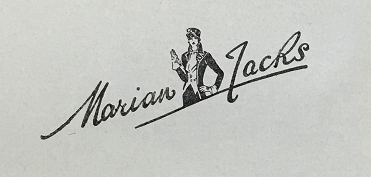
The trade mark for the women’s fashion label Marian Jacks, registered in 1938 (catalogue reference BT 82/1384, design number 585504).
- the use of a common word for a particular type of product, for example a soap called Sunlight registered by the company that became Lever Brothers
- a unique image
- a signature
3. What do we hold?
We hold tens of thousands of the original trade mark designs sent to Stationers’ Hall and the UK Patent Office for official registration – these designs are known as representations.
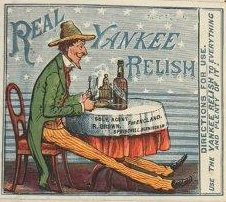
This trade mark for Real Yankee Relish was registered at the Patent Office in 1884 (catalogue reference BT 82/143, design number 35648).
Registers were used to record details of the designs and of the manufacturer or other company registering the trade mark – we hold just four of them plus two indexes. Most of the registers from this period were destroyed under section 6 of the ‘Public Records Act of 1958’.
From 1842 trade mark designs were registered at Stationers’ Hall, in the City of London, and from 1876, at the UK Patent Office. We hold records of trade marks registered at both places but they constitute separate collections.
Before the Trade Marks Registration Act of 1875 there had not been any legislation specifically covering trade marks; registration had taken place under copyright law. Records pre-dating this act, held at Stationers’ Hall, are therefore kept with the rest of our Copyright Office records – see our separate copyright records guide for advice on these records.
Some trade marks were ‘refused’ for a variety of reasons, and we hold copies of many of these refusals too.
To view the representations or registers you will need to either visit The National Archives at Kew or pay for copies to be sent to you.
4. Representations and how to locate them
4.1 About representations
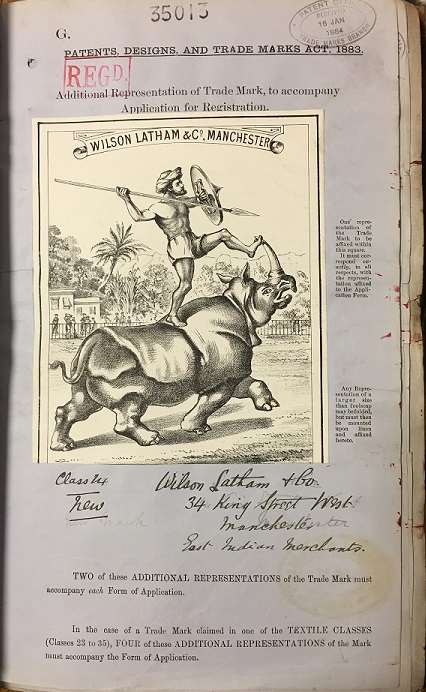
A page from a book of representations registered in January 1884. The registration number for this trade mark is 35013 (stamped at the top of the page) and it was assigned to Class 24 (written below the image, to the left). The catalogue reference for the whole book of representations is BT 82/141.
From 1876 onwards, to use a design as a trade mark with the protection of the law, you had to send a representation of the design to the Patent Office for registration.
Representations came in various forms, many on paper, others printed on fabric, a few on other materials such as tin. Some are detailed painted images, others colourful or monochrome sketches and others just typed single words.
The designs were pasted into books and given a registration number, which was also recorded in the books alongside the designs. They were assigned a ‘class’, within which similar types of products were grouped. There were fifty classes altogether (see Appendix). Further information was occasionally recorded in these books of representations, sometimes at a later date, alongside the representations themselves. Additional details might include:
- details of the owner/manufacturer or agent including their names and addresses
- dates of later changes of ownership, with subsequent names and addresses
- whether the application was accepted or refused
- whether the registration had expired
Some entries contain no additional information at all, and have no corresponding register entry, making it difficult to identify the owner, manufacturer or agent.
4.2 Finding a specific representation
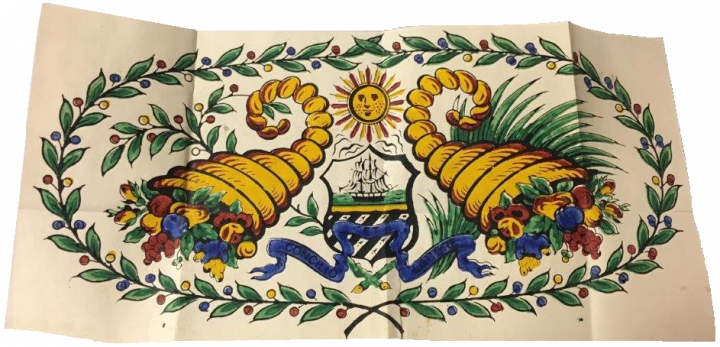
Trade mark registered in January 1884 (catalogue reference BT 82/141, design number 34958).
Finding a representation for a specific company is tricky unless you know what year the trade mark was registered, or are prepared to trawl through dozens, perhaps hundreds, of books of representations.
Start your search by consulting the Trade Mark Journal, first published, by the Patent Office, in 1876. There is a complete set at the British Library, on microfilm. The indexes allow you to search by applicant name, though if you don’t have the year of registration you may have to consult multiple indexes. From these journals you can ascertain the registration number and year.
Once you have a registration number or year, you can begin your search for representations held at The National Archives. Searches begin in our catalogue, in record series BT 82 (1876-1938) and BT 244 (cotton goods only, 1876-1922; see section 4.3).
The representations are listed in the catalogue in ranges of registration numbers and year, along with The National Archives document reference that you will need to request a viewing of any book of representations.
If you only know the registration number:
- Browse through BT 82 until you reach the range of numbers which include yours.
If you only know the date/year of registration:
- Search BT 82 by year; sort your search results by ‘Reference’ using the dropdown menu on the search results page; browse through the results until you reach the range of dates which include yours – if you only know the year of registration you will have to order multiple representation books
If you know the year of registration and the registration number:
- Search BT 82 by year; sort your search results by ‘Reference’ using the dropdown menu on the search results page; browse through the results until you reach the range of numbers which include yours.
The record series descriptions in the catalogue give useful administrative histories that will help you to understand how the records were created.
4.3 Finding a representation for a cotton trade mark
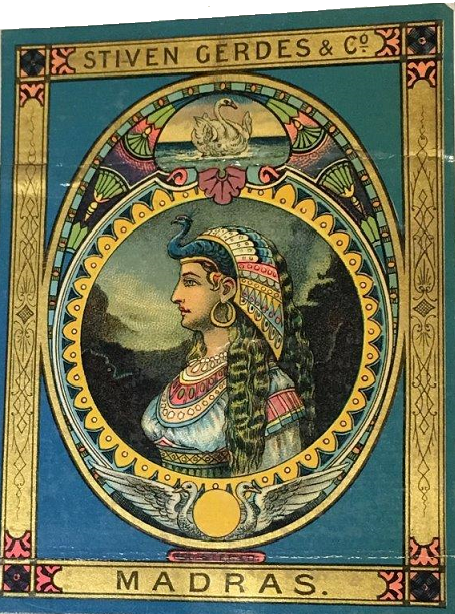
A trade mark for a cotton merchant, known as a cotton mark. This one was registered in 1881-1884 (catalogue reference BT 244/440, design number 27367).
Due to the importance of the cotton trade in Lancashire, the Act of 1875 made provision for the establishment of a branch of the Patent Office to be opened in Manchester in October 1876, to deal specifically with applications for Cotton Marks in classes 23, 24 and 25 (see Appendix). The Manchester office closed after the trade marks acts of 1938, when a single series of representations was resumed in London.
When registering a cotton mark, applicants were required to send one master representation and four copies. A number were held in the Manchester office and the others were forwarded to London for administrative purposes and for inclusion in the registers.
To find a representation for a cotton mark, search either in BT 82 (see section 4.2), which includes representations for cotton and non-cotton classes, or in BT 244 which contains representations of cotton marks registered in Manchester only. Applications received in Manchester were given an ‘M’ number for internal use only.
BT 244 is split into several subseries, one for each of the material classes covering cotton classes 23, 24 and 25 (see Appendix).
If you do not know the date or registration number of the trade mark you will first need to consult the Trade Marks Journals, held at the British Library (see 4.2).
If you know the date/year of registration, to locate a book of representations you should browse through the catalogue listings within the respective material class for the cotton product in question:
- Browse Class 23 representations from BT 244/1 to BT 244/44 (1876-1908)
- Browse Class 24 representations from BT 244/45 to BT 244/436 and BT 244/459-460 (numbers in this class begin with M)
- Browse Class 25 representations from BT 244/437 to BT 244/461 (1876-1920)
- BT 244/453-458 Class 24B (specimen Volumes) for Stripes, Borders, Words, Dogs and Foxes, Dragons heads and mermaids and lastly Coats of Arms.
A number of files were destroyed by enemy action in the Second World War.
5. Registers and how to locate them
Once the representation was received and given a number, an entry was made in a corresponding register with details of the manufacturer and/or company registering the trade mark.
The registers record:
- names and addresses of the owner or manufacturer and/or their agent
- date the trade marks were registered
- the material class the goods were placed under
- the trade mark number issued by the Patent Office
- the material class the goods were classified under (see Appendix)
- subsequent renewals of the mark and the names and addresses of subsequent owners
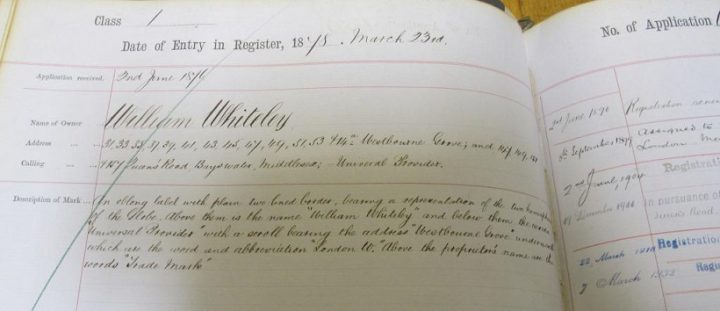
An entry from one of the four surviving registers.
Unfortunately just four specimen registers (and two indexes), all for representations in BT 82, survive. Most registers from between 1876 and 1938 were destroyed under section 6 of the ‘Public Records Act of 1958’. These four registers and two indexes are in BT 900.
Click on the links below to request the registers – they are for trade marks registered…:
- 3 October 1876, in BT 900/16
- 5 October 1876, in BT 900/15
- 1884, in BT 900/17 (an index for registrations from 15 Jan 1884 to 3 October 1884 is in BT 900/20 – the index gives name of applicant, class of goods, page, date of registration)
- 1934, in BT 900/18
- 10 November 1933 to 11 December 1935, in BT 900/19
There are no registers for the representations in BT 244 making it difficult to link a trademark to its owner unless details were written alongside the representations, which they quite often were.
6. Other places to find records of trade marks
You can use our catalogue to search for records held in other archives. Search using the terms ‘trademark’ and ‘trade mark’ (both terms are used in equal measure).
Modern-day trade marks
The Intellectual Property Office (IPO), known until 2007 as the Patent Office, holds the modern-day responsibility for the registration of trade marks. Search the IPO database to find trade marks by name of company or description of trademark. If you find the registration number this way you can then look for the original representation in our records, assuming the trade mark was registered before 1939.
Trade Marks Journal
The ‘Trade Marks Journal’ has appeared continuously, in numbered issues since 1876, published weekly, in which all newly accepted marks are reproduced. Complete sets are available at the British Library on microfilm (the British Library trade marks collection pages offer further guidance).
The publications record details of the trade marks for which protection has been sought and also identify the individuals and/or companies which have made the application, in many cases by applicant name and by type of product.
7. Further reading
Consult our legislation.gov.uk website for the texts of the various Acts of Parliament relating to trade marks.
The following texts are all available in The National Archives library.
A Century of Trade Marks 1876-1976 (HMSO, 1976)
Commerce and Culture: Nineteenth-Century Business Elites, edited by Robert Lee (Ashgate, 2011)
Marks of Excellence: The History and Taxonomy of Trademarks, Per Mollerup (Phaidon, 2013)
Trade Marks and Brands, edited by Lionel Bently, Jennifer Davis and Jane C Ginsburg (Cambridge University Press, 2008)
Appendix: Material classes
The table below shows the 50 material classes established by the Trade Mark Registration Act of 1875. To be granted trade mark protection, applicants had to register their goods under one or more of these classifications.
| Class 1 Chemical substances used in manufacturer photography or philosophical research. |
| Class 2 Chemical substances used for agriculture and horticultural purposes. Examples: Artificial manure, sheep washes. |
| Class 3 Chemical substances used in medicine and pharmacy. Examples: tinctures, extracts, barks, patent medicines, cod-liver oil. |
| Class 4 Raw vegetable and animal substances used in manufactures. Examples: Resins, oils, dyes, tanning substances, fibrous substances (e.g. Cotton hemp, flax, jute). Wool, silk cork seeds glue bone sponge. |
| Class 5 Unwrought and partly wrought metals used in manufacture. Examples: Iron and steel, pig and cast, rough, bar and rail, including rails for railways, bolt and rod, sheets and boiler and armour plates, hoops, wire; Lead, pig, rolled sheet; Copper; Zinc. |
| Class 6 Machinery of all kinds and parts of machinery except agricultural machines and implements, included in class 7. Examples: steam engines, boilers, pneumatic machines hydraulic machines, Locomotives, sewing machines, weighing machines, machine tools, mining machinery, fire engines. |
| Class 7 Agricultural and horticultural implements and machines. Examples: ploughs, drilling machines, reaping machines, thrashing machines, drainage implements, dairy implements, garden implements, cider presses, beehives. |
| Class 8 Philosophical instruments, instruments and apparatus for useful purposes or for teaching. |
| Class 9 Musical instruments. |
| Class 10 Horological instruments. |
| Class 11 Surgical instruments and apparatus. |
| Class 12 Cutlery edge tools. Examples: Knives, forks, scissors, shears, files, saws, corkscrews, tweezers, button hooks. |
| Class 13 Metal goods not included in other classes. |
| Class 14 Goods of precious metals (including aluminium, nickel) and jewellery and imitations of such goods and jewellery. Examples: plate, clock cases, pencil cases, Sheffield and other plated goods, gilt and ormolu work. |
| Class 15 Glass Examples: Window and plate glass, painted glass, glass mosaic, glass for optical purposes. |
| Class 16 Porcelain and earthenware Examples: China Stoneware, terra-cotta, statuary porcelain, tiles, bricks. |
| Class 17 Manufactures from mineral and other substances for building or decoration. Examples: cement, plaster, imitation marble. |
| Class 18 Engineering, architectural and building contrivances. Examples: diving apparatus, warming apparatus, ventilating apparatus, filtering apparatus, lighting contrivances, drainage contrivances, electric bells. |
| Class 19 Arms and military stores, not included in class 20. Examples: cannon, small arms, fowling pieces, swords, shot and other projectiles, camp equipage, military equipment, military accoutrements. |
| Class 20 Explosive substances Examples: gunpowder, gun cotton, Dynamite, fog-signals, percussion caps, fireworks, cartridges. |
| Class 21 Naval architectural contrivances and naval equipment. Examples: boats, anchors, chain cables, windlasses, rigging, logs. |
| Class 22 Carriages Examples: railway carriages, wagons, railway trucks, velocipedes. |
| Class 23 Cotton yarn and thread. |
| Class 24 Cotton piece goods of all kinds. |
| Class 25 Cotton goods not included in classes 23, 24 or 38. |
| Class 26 Linen and hemp yarn and thread. |
| Class 27 Linen and hemp piece goods. |
| Class 28 Linen and hemp goods not included in classes 26 and 27. |
| Class 29 Jute yarns and tissues and other articles made of jute. |
| Class 30 Silk, spun, thrown or sewing. |
| Class 31 Silk piece goods. |
| Class 32 Other silk goods not included in classes 30 and 31. |
| Class 33 Woollen and worsted yarns. |
| Class 34 Woollen cloths and worsted stuffs. |
| Class 35 Woollen and worsted gods not included in classes 33 and 34. |
| Class 36 Carpets, floor cloth and oil cloth. Such as Drugget, mats and matting, rugs. |
| Class 37 Leather and skins unwrought and wrought and hair and feathers. Examples: Saddlery, harness, portmanteaus furs bristles, haircloth wigs, hair mattresses. |
| Class 38 Articles of clothing. Examples: hats of all kinds, caps and bonnets, hosiery, gloves, boots and shoes, other ready-made clothing. |
| Class 39 Paper (except paper hangings, stationery, printing and book binding). Examples: envelopes, sealing wax, pens (including steel pens) ink, playing cards, blotting cases. |
| Class 40 Goods manufactured from India-rubber and futta-percha not included in other classes. |
| Class 41 Furniture and upholstery. Examples: paper hangings, papier-mâché, mirrors, japan goods. |
| Class 42 Substances used as food. Examples: Cereals pulses oils, hops, malt, dried fruits, tea, spices, sago, salt, starch, sugar, preserved meats, honey confectionery biscuits, oil cakes, pickles, vinegar. |
| Class 43 Fermented liquors and spirits Examples: Beer cider wine whisky liqueurs. |
| Class 44 Mineral and aerated waters, natural and artificial. |
| Class 45 Tobacco, whether manufactures or unmanufactured. |
| Class 46 Seeds for agricultural and horticultural purposes. |
| Class 47 Candles, illuminating oils, matches and common soap. |
| Class 48 Perfumery (including perfumed soap). |
| Class 49 Toys, games of all kinds, archery, fishing tackle. |
| Class 50 Miscellaneous, including:
|
This guide will tell you how to look for records of coastguard officers.
What do I need to know before I start?
The Coastguard was formed in 1822 by the amalgamation of three services set up to prevent smuggling:
- the Revenue Cruisers
- the Riding Officers
- the Preventive Water Guard
From 1822 several different departments were responsible for the Coastguards, so Coastguard records are widely scattered in The National Archives.
After 1856 the duties of the Coastguard were defending the coast, providing a reserve for the Royal Navy, and preventing smuggling.
What do I need to know before I start?
Try to find out:
- in which county the person was posted
- the dates of his service
What records can I see online?
Coastguard establishment books and registers (1816-1947)
Coastguard establishment books can be searched by name on Findmypast (charges apply).
Alternatively, browse and download the Coastguard establishment books and registers in ADM 175, free from our website.
These records are not comprehensive, and their covering dates vary.
They include:
- establishment books in ADM 175/1-26 (1816-1918) – you will need to know where the officer was posted
- registers of appointments for England in ADM 175/74-80 (1819-1862); for Ireland in ADM 175/74, ADM 175/99 and ADM 175/100 (1819-1849); and for Scotland in ADM 175/74 (1851-1856)
- index cards of former Royal Navy and Royal Marine ratings in ADM 175/82A-84B (1900-1923)
- record cards showing coastguard service of former RN ratings by service number in ADM 175/85-89
- record cards showing coastguard service of former Royal Marines in ADM 175/90
- discharge registers in ADM 175/91-96 (1919)
- discharge records from 1858 to 1868 in ADM 175/102 (1855-1868)
- indexed service registers for coastguard officers in ADM 175/103-107, 109-111 (1896-1929)
Please be aware that these are very large files and only suitable for download on a fast and unlimited broadband connection.
The establishment books (in ADM 175) used the following abbreviations for coastguard ranks:
- chf officer = chief officer
- boatn = boatman
- chf btman = chief boatman
- permt extn = permanent extraman
- comd bn = commissioned boatman
- tempoy exn = temporary extraman
Campaign medals (1914-1918)
Search ancestry.co.uk (£) for campaign medal for coastguards (ADM 171) who qualified for medals.
Alternatively browse and download campaign medals (ADM 171) on digital microfilm from our website.
Please be aware that these are very large files and only suitable for download on a fast and unlimited broadband connection.
Parliamentary papers
Consult Proquest UK Parliamentary Papers for published reports of coastguard activities. This is a subscription website you can access on TNA computers by visiting us at Kew. You may also be able to access it via a large reference library such as a university library.
Reports can give details of coastguards such as name, age and date of appointment.
Search by year and sessional paper number:
- House of Commons sessional papers 1819 (569) XVII, 77 for a return of officers and men appointed to the Preventative Boat Service between 1816 and 1819
- House of Commons sessional papers 1823 (94) XIV, 293 for Names of Commanders of Revenue Cruisers in Scotland 1822-1823
- House of Commons sessional papers 1825 (95) VXIII, 385 for names of men killed on the Kent and Sussex coast conflicts between Coast Blockage and smugglers
- House of Commons sessional papers 1833 (744) XXIV, 285 for a return of Captains and Commanders in the Preventative or Coastguard Service and Revenue Cruisers on 1 July 1833
- House of Commons sessional papers 1857 XXVII, 253 for returns and allowances of all Chief Officers of the Coastguard with previous service
What records can I find at The National Archives at Kew?
Pensions (1855-1935)
Browse coastguard records in:
- ADM 23 (1866-1923) for pension books which include civil pensions
- PMG 23 (1855-1935) for civil pensions
- PMG 70 (1866-1928) chief officers entitled to Greenwich pensions
- CUST 30 (1811-1910) for information about a man’s career and grounds for retirement
Appointments to Revenue Cruisers of selected naval officers (1816-1831)
Consult ADM 6/56 for Admiralty appointments to Revenue Cruisers (such as lieutenants, masters and boatswains).
Records of preventive officers and Revenue cruisers (17th-18th century)
Consult ADM 1 for references to preventative officers and revenue cruisers. These records are not easy to find. Read Subject and name indexes to Naval correspondence: ADM 12 for information.
To access these records you will either need to visit us, pay for research (£) or, where you can identify a specific record reference, order a copy (£).
What records can I find in other archives and organisations?
Records held locally
Search our catalogue and refine your results using the filters.
What other resources will help me find information?
Websites
Search the name index of British Coastguards from 1841 to 1901 on the GENUKI website.
Books
Search The National Archives’ shop to see whether any of the publications below may be available to buy. Alternatively, look in The National Archives’ library catalogue to see what is available to consult at Kew.
W Webb, Coastguard: An official history of HM Coastguard (HMSO, 1976)
N A M Rodger, Naval records for genealogists (1988)
Consult the Navy Lists for information about officers serving in Revenue Cruisers (part of the Coastguard since 1822) available in research libraries.
This is a brief guide to help you with your research. Records of births, marriages and deaths in England and Wales are kept in various places, but not usually at The National Archives. This guide will help you to find out where else you can look.
What do I need to know before I start?
Birth, marriage and death certificates cannot be viewed or ordered at The National Archives.
All certificates of births, marriages and deaths in England and Wales since 1 July 1837 are obtained from the General Register Office (GRO), see their guide to ordering and paying for civil registration records for information on what records are available.
If you are tracing a birth, marriage or death before 1 July 1837, look for parish registers in local archives.
A search for a certificate will be easier if you know the district where the event is likely to have taken place.
Online records
Indexes to birth, marriage and death registrations (1837 to 2007)
Search birth, marriage and death indexes on freebmd.org.uk. Some commercial websites (£) also have the indexes such as Findmypast and Ancestry. Some websites have more recent indexes than others.
For more information on the indexes see the General Register Office family history page on GOV.UK.
Non-conformist registers (primarily before 1837)
Registers of non-conformist births, baptisms, marriages, deaths and burials are held by The National Archives in record series RG4–RG8 and are available online.
Search BMDregisters (£) for records of:
- non-conformist and other non-parochial births and baptisms, deaths and burials, and some marriages for the 17th to 19th centuries (RG4, RG5, RG8)
- clandestine (irregular) marriages up to 1754 (RG 7)
- Quaker (or Religious Society of Friends) births, marriages and deaths up to 1837 (RG 6)
Note the BMD registers ‘advanced search’ option and ‘RG Books’ tab which will help you to search more specifically.
The non-conformist (RG4, RG5, RG 8), clandestine (RG7) and Quaker (RG6) registers are also available on Ancestry (£) where they can be searched or browsed using the ‘browse this collection’ option on the right hand side of the search page. This allows you to browse by series, place or denomination.
As most non-conformists were obliged to marry in the Church of England between 1754 and 1837, it is possible to find records of their marriages in Church of England parish registers (see below).
Selected church marriage registers (1837–c.1920)
View some church marriage registers from 1837 up to the 1920s on Ancestry (£) and Findmypast (£).
Brompton Cemetery records
Burial records for Brompton Cemetery can searched and viewed for free on the Royal Parks’ Brompton Cemetery database.
The National Archives is the official place of deposit for records of the Royal Parks, including Brompton Cemetery. Original burial registers can be found in the series WORK 97.
Records in other archives and organisations
Birth, marriage and death certificates (1837 to present)
Order birth, marriage or death certificates either from the General Register Office (£), or from the relevant local register office (£).
Indexes to birth, marriage and death registrations (1837 to present)
Use the GOV.UK website to find out which libraries, archives and record offices keep birth, marriage and death indexes on microfiche.
Parish registers (before 1837)
Find the parish register in a local archive to locate baptism, marriage and burial records before 1837.
You can look up the parish using English jurisdications 1851 on the FamilySearch website, or in The Phillimore Atlas and Index of Parish Registers, 3rd edition, edited by Cecil R Humphery-Smith (Phillimore, 2003).
Other resources
Websites
Search for birth, baptism, marriage and some burial records on the FamilySearch website. Geographical coverage is patchy but the index provides a useful pointer to relevant parish registers.
Search for birth, baptism, marriage and burial records on Ancestry (£) findmypast (£) and Deceased Online (£).
Books
Visit The National Archives’ shop for a range of publications on birth, marriage and death records. Alternatively, look in The National Archives’ Library catalogue to see what is available to consult at Kew.
This is a guide to finding records of the Indian Army during British rule. The vast majority of these records are currently held by the British Library.
The army in India during British rule
East India Company Army – before the formation of the Indian Army, the East India Company raised and maintained its own army which consisted of both indigenous Indian and European troops.
Indian Army – formed in 1859, the Indian Army, before 1947 also referred to as the British Indian Army, fought in both world wars. The British Indian Army was made up of both European officers and Indian soldiers.
British Army – also present in India, alongside the British Indian Army.
Online records
Many records held at The National Archives are available online, some of them on partner websites, others on our own website. See the records in other archives and organisations below for more online records.
First World War Indian Army unit war diaries from the Western Front, Mesopotamia and Gallipoli
Search by unit name and number for the war diaries of Indian Army units that served on the Western Front and in Mesopotamia on our website (£) and for units that served in the Gallipoli Campaign at the Dardanelles on Ancestry.co.uk (£).
The original records are held in series WO 95. See below for advice on searching for the war diaries from the same series of units that served elsewhere in the world during the war.
Records available only at The National Archives in Kew
As well as the records listed here, we hold a set of published Indian Army Lists 1903–1939 (more details below), though these records are not exclusive to The National Archives.
First World War Indian Army unit war diaries from Egypt, Palestine and East Africa
Search by unit name and number for document references to unit war diaries, in series WO 95, of Indian Army units which served in Egypt, Palestine and East Africa during the First World War.
Second World War unit war diaries
Indian Army units served in a variety of theatres of war during the Second World War and many of these may be found in our collection. The series you might find the unit war diary in will depend on where it served. Using the advanced search, search by name and number of the unit. A full list of the series in which to find unit war diaries can be found in the relevant section of the British Army operations during the Second World War research guide.
Medal, honours, decorations, and casualty cards relating to the Second World War
These records include entry cards for individuals who served in the Indian Army during the Second World War and received medals, honours, or decorations, or became casualties. Depending on the card, they contain basic information including name, rank, regiment, regimental number, medals issued, and type of injury.
They are arranged in boxes by surname range. Browse the following series to find appropriate ranges of surnames.
- Casualties suffered by officers of the Indian Army, 1939-1945, in series WO 429
- Records of medals awarded to officers of the Indian Army, 1939-1945, in series WO 430
- Records relating to campaign medals issued to other ranks of the Indian Army, 1939-1945, in series WO 431
- Records of honours and decorations awarded to British officers of the Indian Army, 1939-1947, in WO 432
- Records of honours and decorations awarded to Indian nationals of the Indian Army, 1939-1945, in WO 433
Records in other archives and organisations
East India Company Army and Indian Army service and pension records
Search online by name for service and pension records of soldiers who served with the East India Company Army or the British Indian Army on Findmypast.co.uk (£). The original records are held at the British Library.
Other Indian Army records
Contact the British Library for information on Indian Army service records held in the Asia, Pacific and Africa Collection. These also include records of the Honourable East India Company.
Other resources
Websites
The Families in British India Society (FIBIS) has a searchable database and other resources to help trace British ancestors in India.
Indian Army Lists
Trace the careers of Indian Army officers in the quarterly publications of the Indian Army List, available at The National Archives for 1903–1939 and the British Library for 1889–1947.
Information on officers varies but should include:
- rank
- date of first commission/date of entering service
- date of appointment/promotion to current rank
- date of joining regiment
- date of birth
To piece together the complete history of a house you will almost certainly need to contact and probably visit a variety of archives. The National Archives is not usually the best place to start unless you are only interested in who the occupants were in the very specific years for which we happen to have records (most significantly the census years, every ten years from 1841 to 1921; the Valuation Office Survey years from 1910 to 1915; and the year of the 1939 Register). This guide provides some suggestions for where else you can go to find records and what kind of information you might find.
Where to start
The best place to try searching for the history of the ownership and construction of a house is the local archive for the area in which the house is located. This might be a local borough, city or county archive or a local studies centre or library. Typically these archives hold local maps, electoral registers and family and estate papers, all of which can be useful when tracing the history of a house.
To find a local archive, search by place name on our Find an archive page.
Building plans (mid-19th century onwards)
Many local archives have collections of building plans from the mid-19th century providing evidence of how buildings might have looked when new.
Title deeds
Title deeds can help you trace the owners and occupiers of your house but there is no legal obligation to hold evidence of title for more than 30 years (The Law of Property Act, 1925) so deeds older than this may not have survived. If the title deeds to your house are not in your possession, you should contact one or all of the following to see if they hold evidence of title:
- HM Land Registry
- your solicitor
- your mortgage company
- a repository where a solicitor’s collection may have been deposited
- family or estate papers
Our online records
Our own online records can help you to establish who the occupants of a house were on a specific date in a census year or on 29 September 1939 but will reveal little else about the history of a house.
1939 Register
The 1939 Register was taken on 29 September 1939. The information was used to produce identity cards and issue ration books. It was designed to capture the details of every member of the civilian population.
You can search the Register by address and you may be able to establish who lived at that address at the time the Register was taken. The Register is available to search and view on our partner sites Findmypast.co.uk (£) and Ancestry.co.uk (£).
For more details see our 1939 Register guide.
Census records, 1841–1921
Search by address on the census to find out who was living there. Where an address search is not available, browse the census street indexes on Your Archives (now only available in our web archive) to find the relevant document reference and search the relevant census website with that reference.
1871 Census maps
Search and download (£) digital versions of the original Registration District maps from the 1871 census on the Cassini Maps website.
The Genealogist
The Genealogist website (£) offers online access to a variety of location based records. Records can be found by conventional searching and through their Map Explorer feature which allows users to access historic maps of an area and records associated with a location.
Records available only at The National Archives in Kew
To access these records you will either need to visit us, pay for research (£) or, where you can identify a specific record reference, order a copy (£).
Valuation Office Survey records, 1910–1915
Between 1910 and 1915 the Inland Revenue’s newly created Valuation Office carried out a survey to determine the value of land for tax purposes. The records created in the work of the survey can reveal a property’s:
- value
- use (whether as residential accommodation, commercial use or some other use)
- extent (the area covered by the property, the number of rooms and even, sometimes, how the rooms were used)
- owners and occupiers
- tenancy details
The two main types of record created by the survey were ‘field books’ and ‘index maps’. You will need to use the maps to get to the field books. Consult our guide to records of the Valuation Office survey for advice on how to do this.
Working copies of the Valuation Office survey are often kept in local archives.
Tithe maps and apportionments from 1836
Tithe maps and apportionments establish whether a property existed at the time and provide clues about property ownership and occupancy but do not contain details about the property itself.
Use the search box below to search our catalogue by place name for document references to tithe maps (IR30) and apportionments (IR 29).
See our Tithes guide for more detailed advice.
Books
All of the recommended publications below are available at The National Archives’ Library. You can also visit the National Archives’ bookshop for a range of publications on the history of your house.
Tracing History Through Title Deeds by Nat Alcock (Pen and Sword, 2017)
Tracing the History of Your House by Nick Barratt (The National Archives, 2006)
Tracing your house history: A guide for family historians by Gill Blanchard (Pen and Sword, 2013)
Maps for Family and Local History: the Records of the Tithe, Valuation Office Survey and National Farm Surveys of England and Wales, 1836–1943 by Geraldine Beech and Rose Mitchell (The National Archives, 2003)
Sources for the History of Houses by John H Harvey (British Records Association, 1974)
1. Why use this guide?
Use this guide for advice on how to find ‘feet of fines’, documents held at The National Archives that record details of land and property changing hands between 1195 and 1833. Medieval feet of fines are particularly significant as they are often the only surviving record of a conveyance. The use of fines was a means of creating a legal record of land ownership.
For Welsh feet of fines please contact the National Library of Wales.
2. What are feet of fines?
Feet of fines are court copies of agreements following disputes over property. In reality, the disputes were mostly fictitious and were simply a way of having the transfer of ownership of land recorded officially by the king’s court.
The agreements were normally written out three times on a single sheet of parchment – two copies side by side and one copy across the bottom (the foot) of the sheet, separated by an indented or wavy line. The purchaser kept one copy, the seller the other and the final copy – ‘the foot of the fine’ – was kept by the king’s court as a central record of the conveyance. Using one piece of parchment separated in this way gave protection against fraud or forgery as only the genuine copies would fit together – like a jigsaw.
3. The records and what they tell us
Before 1290, agreements reached in court were often recorded on the plea rolls but were sometimes recorded elsewhere. From the reign of Edward III, all feet of fines made in the central courts were made in the Court of Common Pleas.
The feet of fines can prove invaluable for finding information about changing land ownership where other records are not available.
Fines, also known as final concords, are written in a standard form. They are mostly in Latin until 1733, except for a short period between 1650 and 1660 where English was used.
3.1 Information in a foot of fine
Final concords always begin ‘Hec est finalis Concordia’ – ‘This is the final agreement’.
The fine opens with the date, given by regnal year, legal term, and names of the judges. Regnal years and legal terms can be converted into conventional dates by using C R Cheney’s Handbook of Dates.
The key word to look for in the text is INTER, after which the names of the parties are given.
Other abbreviations used include ‘q’ or ‘quer’ – the querent, and ‘def’ – the deforciants.
The property description is formal and not intended for use as a detailed guide to property boundaries.
The sum of money given is, by the 14th century, no longer the actual purchase price but a guide price to the value of the property on the open market.
After 1489, the date on which the fine was ‘proclaimed’ (announced in court) is endorsed on the back of the fine.
3.2 Key terms
Querent – purchaser
Deforciant – seller
Concord – final agreement
4. How to get a search for deeds started
Often the fine is one of a series of conveyancing deeds, some of which may give more detail about the property. These deeds were private documents and are usually kept in local and private archives, although some have ended up at The National Archives.
For deeds at The National Archives search our catalogue using ‘ancient deeds’ or ‘modern deeds’ as your search words. To find the locally held deeds, refine your search results using the ‘Other archives’ filter in the left-hand panel on search results pages. You can also try searching by family name or locality with the word ‘deed’ or ‘deeds’.
Some abstracts of and calendars to feet of fines are online – try searching using ‘feet of fines’ and a county name.
5. How to find feet of fines before 1509
Medieval feet of fines made before the royal courts of law 1195-1509 are in record series CP 25/1 (though feet of fines run from 1195, there are some earlier concords in this series dating back to 1182). Read the series description in the catalogue for a full account of how these records were created and are arranged.
5.1 Starting your search with a person or place
The best way to start looking for a particular person or place is to use the calendars to feet of fines produced by local history societies – these have their own indexes of people and places. Calendars for some periods and counties are available online. Try an online search for ‘feet of fines’ with a county name.
There is no single comprehensive index of people or places but there are some miscellaneous indexes covering particular periods and counties, mainly compiled in the 17th century, in IND 1/7178-7232.
Useful websites include:
- Medieval Genealogy
- British History Online – search for ‘feet of fines’ and a county name (and ‘index’ if that’s what you are looking for)
- Internet archives (texts) – search for ‘feet of fines’
You should find that an entry in a calendar gives you the reference to the original document (CP 25/ followed by other numbers). If you find an abstract of a document on a website you may not need to see the original document.
5.2 Starting your search with a county
If you can’t find what you need using the calendars, browse CP 25/1 in our catalogue. Most series are arranged by county and then in rough chronological order.
There is a subseries called Diverse, varied and unknown counties. This contains files:
- which relate to property in more than one county – ‘divers counties’ files
- where the county is not obvious – ‘unknown counties’ files
- where they were omitted from the main county sequence – ‘various counties’ files
To find all the fines relating to a particular county for a particular period, all these sub-series should be checked.
When you find the right item, make a note of the reference which will be CP 25/1 followed by another number. With this reference you will be able to visit us at Kew and order the original document. Alternatively you can enquire about having copies made and sent to you.
6. How to find feet of fines from 1509-1833
The documents for this period are in series CP 25/2, and are filed in a number of groups by county, regnal year and legal term.
Post-medieval fines were normally taken out in addition to other types of deed transferring the property.
6.1 Starting your search with a person or place
There is no single comprehensive index of people or places, but there are some miscellaneous indexes (mainly compiled in the 17th century) covering some periods and counties, in IND 1/7178-7232 and in IND 1/17217-17268 and IND 1/7233-7244.
You can also try looking for a particular person or place is to use the calendars to feet of fines produced by local history societies – these have their own indexes of people and places.
Abstracts of and calendars to feet of fines are available online for some periods and counties. Search online for ‘feet of fines’ with a county name.
Useful websites include:
- Medieval Genealogy
- British History Online – search for ‘feet of fines’ and a county name (and ‘index’ if that’s what you are looking for)
- Internet archives (texts) – search for ‘feet of fines’
6.2 Starting your search with a city
Some cities may be listed by name. Search CP 25/2 by the name of a city.
You can, alternatively, browse the subseries in CP 25/2 for subseries of towns and cities.
6.3 Starting your search with a county
If you can’t find a calendar covering the county and period you are interested in, use the contemporary chronological indexes to the related Notes of Fines in CP 26/1-14 to identify which feet ought to survive for a particular county in CP 25/2.
- Step 1: Browse the catalogue descriptions of CP 26/1-14 to identify records by period and county.
- Step 2: Consult the notes of fines (allow three working days for this as the records are stored off site) – the notes are arranged by regnal year and legal term and then, within each term, by county, with separate groups for fines relating to properties in more than one county. As with the fines themselves, the index entries are in Latin until 1733. Until 1759, each entry gives the name of the querent (purchaser), the name of the deforciant (vendor) and the name of the place(s) where the property lay. After 1759, only names of county and parties are given.
- Step 3: Once you have found a reference, browse CP 25/2 by hierarchy to find the subseries covering the county in question. Select the subseries and browse it by hierarchy to locate a document by regnal year and legal term (Michaelmas, Hilary and so on).
7. Wales and the Palatinates of Chester, Durham and Lancaster
Feet of fines and related series for Wales, formerly in WALE 2, WALE 3 and WALE 6, are now in the National Library of Wales.
Feet of fines for the Palatinates are in their own series. For
- Chester (1280-1831) browse CHES 31 by regnal year
- Durham (1535-1834) search DURH 12 by date
- Lancaster (1377-1834) search PL 17 by date (the date relates to the session in which the fine was levied in the Palatinate Court of Common Pleas)
8. Further reading
Some of the publications below may be available to buy from The National Archives’ shop. Alternatively, search The National Archives’ library catalogue to see what is available to consult at Kew.
- R E Latham, Feet of Fines, The Amateur Historian, Vol. I, No. 1 (1952)
- J Kissock, Medieval Feet of Fines: A Study of Their Uses, The Local Historian, Vol. XXIV, No. 2 (1994)
- N W Alcock, Old Title Deeds (Phillimore, 1986)
1. Why use this guide?
This guide will help you to find records of the following in the medieval and early modern periods:
- land ownership
- prominent people
- legal and administrative processes concerning land transfer and inheritance
It does not relate to coroner’s inquests or medical examinations which take place after a suspicious death.
2. What were inquisitions post mortem?
Inquisitions post mortem were local inquiries into valuable properties, in order to discover what income and rights were due to the crown and who the heir should be.
These inquiries took place when people were known or believed to have held lands of the crown, and therefore involved individuals of considerable wealth and status. All have been indexed, and many are published in English.
3. Why were inquisitions post mortem held?
Under the feudal system all land belonged to the monarch and was therefore either held by him directly (the royal demesne) or on his behalf, directly or indirectly.
Those who held land directly on the king’s behalf were known as tenants in chief. When a tenant in chief died without an heir his lands escheated to (fell into the hands of) the king. If there was an heir, the king kept the lands until a livery of seisin took place; this involved the heir making a payment, known as a relief, in order to assume possession.
If the heir was under age the king kept the lands until he or she came of age (at 21 for men or 14 for women) and the king received rights of wardship and marriage, collecting the revenues of the estate and disposing of the heir in marriage. He was able to sell these rights to third parties, who were not necessarily the next of kin. These feudal tenures and rights were abolished in the Interregnum, and again by Charles II.
4. What happened at inquisitions post mortem?
It’s important to understand how inquisitions post mortem were held, as the surviving documents reflect their process.
When the chancery heard of the death of a tenant in chief, a writ of diem clausit extremum (‘he closed his last day’) was drawn up, ordering the escheator (the royal official who held the inquest locally) to hold an inquisition in his county.
Depending on the holdings of the deceased, writs could have been issued to the escheators of multiple counties. Each writ gives the name of the deceased and instructs the escheator to take the lands into the king’s hand, to summon a jury of local men to answer a series of questions relating to the extent, tenure and value of the lands, properties and rights of the deceased, and to identity the nearest heir.
Other writs might ask the escheator to certify (de certiorari) the true value of lands. This often happened in cases of dispute, where a previous escheator had not performed his commission, or the value of knights’ fees and advowsons of churches.
The inquisition was held locally, close to the lands which were to be valued.
5. What information do the records contain?
The inquisition return would detail, in order:
- the county
- the name of the escheator
- a list of the jurors
- the name of the deceased and the date of their death
- a brief description of each landholding
- its value (which was often underestimated)
- the tenure by which it was held
This section may include extracts (in English) from a will or an enfeoffment to use (putting the lands into the hands of trustees, in order to avoid the king’s claims to livery and wardship etc., and also to allow lands to be left to people other than the heir at law). Lastly the next heir is identified and their age given. If the heir was of age (over 21, or over 14 for an heiress), the age given may be an estimate.
The next heir was usually one male, one female, or a number of females: lands were split between daughters (who were treated as having an equal claim if there was no male heir), but not between sons. Sometimes a proof of age was recorded in a separate type of inquisition (de aetate probanda).
Widows also had rights of dower in the lands, which continued long after the deaths of their husbands, and there are inquisitions (de assignatione dotis) into this as well. These inquisitions are included with the inquisitions post mortem.
6. What happened to the inquisition documents?
The escheators usually returned the inquisition documents into the Chancery which had ordered them (C 132-142). However, if one had been held under the escheator’s own authority, it was returned only into the Exchequer (E 149-150). The Exchequer also received duplicates (less the jury lists) of those ordered by Chancery.
This was done to support the escheator’s accounts (in E 136) of his administration of land falling into the king’s hands (for however brief a period). After 1540, another copy was sent into the Court of Wards and Liveries (WARD 7). Quite often the Exchequer and Wards inquisitions are easier to read, because they have been used less.
7. Researching inquisitions post mortem at The National Archives
There are various ways to access records of inquisitions post mortem, depending on the date of the inquisition and the current state of publication of its records.
Using Discovery, our catalogue
The Chancery series for Henry III – Henry VI are now searchable on our catalogue, by county, name and peerage title.
Calendar of Inquisitions Post Mortem
There are detailed summaries of the contents of each inquisition in the Calendar of Inquisitions Post Mortem, which cover 1236 to 1447 and is available in our reading rooms. The standards of editing vary, with more details included in later publications. Each volume is indexed: if you want to look at the original documents, note the file reference printed after each entry; for example, E.Inq.P.M. File 49 (15), or C. Edw. III 40 (2).
Understanding the document references
These references need to be converted to a modern format. Those starting with E are Exchequer inquisitions, and convert into a reference such as E 149/49. References starting C are Chancery inquisitions, and differ for each reign. The example given converts from C. Edw. III 40 (2) to C 135/40. Only the first two numbers (C 135/40, E 149/49) are required to order the document, but you need the last number to find the item within a file of inquisitions.
You may also see the entry E. Enrolments & c. of Inq.: these are estreats, or extracts of Chancery inquisitions sent to the Exchequer for information and enrolled there, in E 152. They can supply information for damaged or missing inquisitions.
| Date range | Monarch | Catalogue reference |
| 1236-1272 | Henry III | C 132, E 149 |
| 1272-1307 | Edward I | C 133, E 149 |
| 1307-1327 | Edward II | C 134, E 149 |
| 1327-1377 | Edward III | C 135, E 149 |
| 1377-1399 | Richard II | C 136, E 149 |
| 1399-1413 | Henry IV | C 137, E 149 |
| 1413-1422 | Henry V | C 138, E 149 |
| 1422-1461 | Henry VI | C 139, E 149 |
1447-1485: original documents only
These are searchable on our catalogue by name, title and county. There is also a paper list for 1413-1485 covering series C 138-141 in the standard series lists of the Chancery inquisitions under C 138. These give name, relationship, county and type of inquisition (for example, post mortem, dower, proof of age), as well as the item number to be looked for in the file, once ordered, and the regnal year. Note that they do not give any details of land.
For lists of the lands mentioned in an inquisition, look at the Calendarium inquisitionum post mortem sive escaetarum, IV (1828). This is shelved with the calendars and arranged by regnal year and item number. It does not include the many documents found and added to the series after 1828; not all of these went to the Chancery, so if you also want to check the Exchequer inquisitions, in E 149, try the four manuscript volumes, arranged by the names of the person being investigated. These volumes also contain the details of series E 152and E 153.
| Date range | Monarch | Catalogue reference |
| 1422-1461 | Henry VI | C 139, E 149 |
| 1461-1483 | Edward IV | C 140, E 149 |
| 1483-1485 | Richard III | C 141, E 149 |
1485-1509: published in English
These series are searchable using our catalogue, by name and by the county where the inquisition took place. Restrict the search to record series C 142 and E 150.
Alternatively they are calendared in detail in the Calendar of inquisitions post mortem for the reign of Henry VII, which is available in our reading rooms. The calendar refers to C 142 as C. Series II and E 150 as E. Series II.
1509-c1640: original documents only
From 1540 duplicates of inquisitions were also sent to the newly-established Court of Wards and Liveries. These can be searched by name and by the county where the inquisition took place using our catalogue. Restrict the search to the record series C 142, E 150 and WARD 7 (for 1540-c1640 only).
There is also a series of composite indexes to these record series available in our reading rooms, which give the name, date and county, with references to the three possible copies of the inquisition. These indexes were published as the Index of inquisitions post mortem. Check the front of each volume for the format needed to locate the original documents.
Cheshire, Durham and Lancashire, and the Duchy of Lancaster
The palatine counties of Cheshire, Durham and Lancashire and the Duchy of Lancaster also had inquisitions post mortem. For Henry VIII -– Charles I, they have been included as appendices in the Index of inquisitions post mortem, Charles I and later. The relevant series are:
Because the finding aids for the earlier period are complicated, it’s best to read the introductory notes to each of these series. These are filed in the standard list set.
8. Records of what happened after inquisitions post mortem
If an heir was of age, or once an heir’s age had been proved and dower assigned, land was delivered to the heir, often after a period of wardship if this was deemed necessary. Records of the livery of lands, sale of wardship etc. can be found in the Patent Rolls (C 66).
For more details of how to locate relevant information in this series see the research guide to Royal grants in Letters Patent and Charters from 1199. From c 1540 onwards, it may be worth looking in the records of the Court of Wards (see Land inheritance in the Court of Wards and Liveries 1540-1645). The introductory notes to all these series, filed in the standard series lists, give more information.
9. Further reading
Published inquisitions post mortem
Many local record societies have published translations of inquisitions post mortem for their counties. Ask in our reading rooms for help in identifying what is available using Texts and Calendars.
Useful publications
- Carpenter, ‘Introduction’, Calendar of Inquisitions Post Mortem Preserved in the Public Record Office XXII: 1422-1427 (1-5 Henry VI), ed. Kate Parkin (Woodbridge, 2003), pp. 1-42
- ‘The Fifteenth-Century Inquisitions Post Mortem: a Companion’, ed. Michael Hicks (Woodbridge, 2012)
- ‘The Later Medieval Inquisitions Post Mortem: Mapping the Medieval Countryside and Rural Society’, ed. Michael Hicks (Woodbridge, 2016).