1. Why use this guide?
Use this guide for advice on how to find record sources documenting English foreign policy, international diplomacy and affairs before 1509 held at The National Archives.
These records are not available to view online so to see them you will have to either visit us in Kew or, if you can locate document references, order copies. However, you will probably find that to locate document references you will also need to visit us – there are calendars and indexes held in our building that are likely to prove essential in your search.
Very early records of the conduct of English international diplomacy come mostly in the form of chronicles and fragments of documentation from early Anglo-Norman times, most of which are not held by The National Archives. For these earliest records you may find it more fruitful to search in ecclesiastical archives, county archives, the British Library or the Bodleian Library. Use our Find an archive tool to locate local archives by place name. Many other documents are in the archival collections of the countries with which the English medieval crown negotiated.
2. How foreign affairs were conducted in the medieval period
In medieval England no single official or institution had overall responsibility for foreign affairs. There was no Foreign Office. There was little differentiation between foreign and domestic affairs in the management of government business.
Responsibilities were shared by:
- the Royal Council, which discussed foreign affairs and formulated England’s policy in consultation with the king
- Chancery, which dealt with the administration of treaties and letters
- the Exchequer, which dealt with the financial aspects of diplomacy
Diplomatic missions were frequently undertaken by:
- the great officers of state
- leading churchmen
- major noblemen
- the king’s personal friends and trusted servants of lower rank
3. An overview of the records and how to get a search started
Diplomatic sources at The National Archives are primarily:
- accounts (for the expenses of envoys )
- diplomatic correspondence (scattered in a number of record series, some in artificial Special Collections, or enrolled in the records of Chancery)
- treaties
- documents relating to the Royal Council
These documents were usually written in Latin or French using medieval abbreviations.
Often the best way to begin a search is to consult published sources held in our library. Published information about some of the documents, including full transcripts of original texts, is in:
- Foedera, Conventiones, Literae et Cujuscunque Generis Acta Publica inter Reges Angliae et alios by Thomas Rymer (20 volumes, 1727-1735) which contains many diplomatic documents transcribed in their original language
- Rymer’s Foedera: Syllabus in English with Index, 1066-1654 edited by D Hardy (3 volumes, 1869-1885)
- Letters and Papers, Richard III and Henry VII edited by J Gairdner (2 volumes, 1861-1863)
- Materials for a History of the Reign of Henry VII edited by W Campbell (2 volumes, London, 1873-1877).
- English Medieval Diplomatic Practice (2 volumes) by P Chaplais, (London, HMSO, 1975 and 1982)
- English Royal Documents, King John-Henry VI, 1199-1461 (Oxford 1971)
In some instances you may find published sources provide enough information to make consultation of original documents unnecessary. They will certainly make locating document references (which you will need to request the documents themselves) easier and may provide them in full.
Records at The National Archives are held in record series . The series most likely to provide details of and insights into English foreign affairs in this period are listed in the following sections of this guide. To browse through a list of records held in a record series, click on the series links and find the browse ‘by reference’ link on the following page. To locate individual pieces within some record series you will need to use calendars (see next section).
4. How to use calendars to locate records
Calendars summarise the text of original documents. We hold many calendars for the medieval period at our on-site library. Each one covers a specific period and a particular record type (patent or close rolls in C 66 or C 54, for example). With information gleaned from calendar entries you can use our catalogue to identify the original documents on which the calendar entries are based and the accompanying document references which you will need to request and see the documents themselves.
Though some of the calendars provide summaries of their contents in English, others, depending on the date, the publisher and the type of document being summarised, provide entries (or some entries) in the original Latin and French. This is especially the case with calendars published before 1939 and, notably, calendars published by His Majesty’s Stationery Office (HMSO) where comprehensive transcripts of the original text are reproduced.
To locate a document using a calendar, bear the following in mind:
- Each roll normally covers a regnal year
- The regnal year is recorded at the top of each page of the calendar
- A calendar entry summarises the front and back of the respective roll, in the sequence found in the original manuscript
- Entries for a single regnal year might be broken down into several parts – for example, ‘1 Henry IV, part 1’
- Once you have a regnal year reference (1 Henry IV, part 1), search for it in our catalogue in the series in question
For example, to locate references in series C 66 for the first and second years of Henry IV’s reign you will need the Calendar of Patent Rolls, Henry IV, vol 1, 1399-1401. It reproduces the text of the rolls for those years and provides you with the regnal year reference cited above: 1 Henry IV, part 1. By browsing from the C 66 description page (look for the ‘browse from here by reference’ link), you will find (after scrolling through a dozen pages) the catalogue references for these rolls, which are C 66/354-365, and the reference for the roll covering 1 Henry IV part 1 is the first in this sequence, C 66/354. With this reference you can use our document ordering system to request the original roll.
5. Chancery documents
Chancery was responsible for supervising and preparing the monarch’s formal instructions, relaying orders to the king’s officers and courts to transact business on the monarch’s behalf.
5.1 Chancery enrolments
From 1199 Chancery enrolments were introduced – a system of creating registers of important official documents. The main record series of Chancery enrolments are listed below. Click on the links to find out more about each record series:
- C 54 – Close Rolls, including letters of credence to foreign rulers
- C 61 – Gascon Rolls, which include treaties, truces and appointments of ambassadors in French lands under English rule
- C 66 – Patent Rolls, from 1201, including letters of safe conduct, protection, the appointments and powers of ambassadors, and negotiations and general correspondence
- C 67 – Patent Rolls, Supplementary, 1275-1749
- C 76 – Treaty rolls, which includes enrolments of treaties, letters and other diplomatic material, 1234-1675. Many of them concern the administration of England’s territory in France, but diplomatic correspondence with the Holy Roman Empire and other states is also present. Treaties could also be enrolled on the other rolls mentioned above
- C 64 – Norman Rolls, including diplomatic letters patent, writs and treaties between English kings as dukes of Normandy and the dukes of Brittany and Burgundy
- C 70 – Roman Rolls (correspondence to the Pope and cardinals), 1306-1358
- C 71 – Scotch Rolls, including letters of safe-conduct, treaties, and material on the Scottish succession and Edward I’s diplomacy
There are no useful online catalogue descriptions for most of the series listed above. To locate document references in C 54, C 61, C 66 and C 76 you can consult:
- the Calendar of Close Rolls for the summary of documents and their references in C 54 (the close rolls)
- the Calendar of Patent Rolls for the summary of documents and their references in the C 66 (the patent rolls)
- the published volume of Gascon Rolls for summaries of documents in C 61 (Gascon rolls)
- the published volume of Treaty rolls preserved in the Public Record Office for advice on how to use the treaty rolls in C 76
In the absence of calendars, you will need to browse through the other series listed above by clicking on the links and then the browse ‘by reference’ link on the subsequent page.
5.2 Chancery Miscellanea (C 47)
Browse C 47, Chancery Miscellanea, which includes foreign documents many of which are letters, petitions or warrants and a number of documents which are not described in published sources.
Note that:
- bundles 22-23 Scottish documents, including homage rolls
- bundles 24-26 concern French possessions of the English kings
- bundles 27-32 are the main sequence of diplomatic documents
Much diplomatic correspondence was issued under the privy or secret seals in an effort to control the dissemination of instructions, reports and other information. Correspondence issued in this way was intended only for the named individuals or officers to whom it was addressed and not for wider public scrutiny.
Consult also SC 1 which contains ancient chancery and exchequer records. See section on Special collections for further guidance.
5.3 Chancery Warrants (C 81 and PSO 1)
Warrants were the accepted means of issuing authenticated instructions from the king or royal council to representatives of the crown engaged on particular diplomatic or other official activity.
Read the catalogue descriptions in C 81 and PSO 1 for more information about these records.
Locate warrants summarised in:
- the Calendar of Chancery Warrants preserved in the Public Record Office, 1244-1326 (1927) for the record series C 81 and PSO 1 which will include material such as issue of letters of safe conduct for foreign envoys, appointments of English representatives, letters of protection and sometimes the text of diplomatic letters to be drawn up under the Great Seal
5.4 Miscellaneous diplomatic documents in DL 34
Some miscellaneous diplomatic documents survive for the period 1129-1596 in the Duchy of Lancaster records in DL 34.
Most of these:
- date from the 13th and 14th centuries
- are a miscellaneous collection of records which were inherited by or acquired by the dukes of Lancaster
- include the treaties of John of Gaunt, duke of Lancaster, as King of Castile and Leon
6. Exchequer documents
Use:
- the Calendar of Documents relating to Scotland preserved in her Majesty’s Public Record Office (5 vols, 1881-1986) and other items are transcribed in Documents Illustrative of the History of Scotland (1870) to locate summaries of documents in E 39, Scottish Documents, Henry III to Elizabeth I, which contains documents of similar type to those in E 30 (see below)
Find documents by browsing by date in:
- E 28 for Council and Privy Seal records which includes material on the conduct of foreign affairs, Edward III to Elizabeth I (a Chancery series of similar council and parliament material is in C 49)
Browse these record series by description and date:
- E 36 books, Exchequer (Treasury of Receipt) especially E 36/186-192, diplomatic documents Edward II to Henry VIII, and the Registrum Munimentorum (Liber A and B, E 36/275) which contains transcripts temp, Edward I of diplomatic documents from John to Edward I
- E 30, diplomatic documents, Henry I to James I (see below)
The diplomatic documents in E30 contain some of the earliest diplomatic documents in The National Archives and include:
- original treaties
- agreements
- abstracts of agreements and oaths
- diplomatic instructions
- some material relating to foreign loans, [1103] to 1624
- notarial instruments
- powers to ambassadors to treat
- royal letters
- letters of protection and safe conduct
Browse relevant Exchequer accounts in:
- E101 for the accounts for expenses of ambassadors and nuncii, 1251-1616. It also includes the praestita, or accounts of vouchers or imprests issued for the king’s service abroad, as well as payments to envoys from abroad
- E 159 for King’s Remembrancer Memoranda Rolls, recording memoranda, copies of other documents, or case papers resulting from all types of business found in other Exchequer series – including diplomatic matters
- E 164 for King’s Remembrancer Miscellaneous Books, Series I, of particular interest for the campaigns of Edward III
- E 175 for Exchequer and Parliamentary and Council proceedings, Edward I to James I, including some documents relevant to the council’s direction of foreign policy
- E 315 for the accounts of Calais, 1409-1412 and of Ponthieu and Montreuil
- E 361 for Enrolled Wardrobe and Household Accounts, 1257-1548, which might include evidence of payments for specific diplomatic missions
- E 364 for accounts of nuncii and foreign merchants
- E 368 for Lord Treasurer’s Remembrancer Memoranda Rolls, 1217-1835 (departmental duplicates of the E 159 rolls)
- E 372 for Pipe Rolls, which mention the particulars of account of the ambassadors
- E 373 for Exchequer of Normandy Pipe Rolls, 1180-1203
- E 405 for Journalia and Tellers’ rolls of receipts and issues, 21 Edward I -1834, summarising income and expenditure, but can supply specific details of the costs of foreign missions, embassies or campaigns
- E 403 for enrolments and registers of issues, Henry III – 1834
- E 404 for writs and warrants for issues, Henry II -1837
- E 403 and E 404 include monies advanced to ambassadors or paid retrospectively
7. Special collections
These are made up of largely artificial groupings of records.
You can search our catalogue within:
- SC 8 (for Ancient Petitions, Henry III to James I, which includes petitions from Gascony and other French provinces) by using the name of petitioner – digital images are freely available
- SC 1 (for Ancient Correspondence, Henry II to Henry VI, mainly 13th and 14th century in origin and including ‘domestic’ as well as ‘foreign’ material) by using name of individuals or place
Browse by date and catalogue descriptions which separate the foreign-related content from the domestic content in:
- SC 7 for Papal Bulls, [1131]-1533 which includes documents concerning relations between the papacy, royal government and the ecclesiastical authorities
8. Transcripts of diplomatic documents
Original English medieval documents held in other European archives were transcribed in the nineteenth century. These transcriptions now form part of The National Archives collection in:
- PRO 31/2 for Milan, 1425-1768
- PRO 31/8 for Germany, Portugal and France, c1162-1572
- PRO 31/9 for Rome, 1066-1815
- PRO 31/11 for Spain, 1485-1555
- PRO 31/14, 1202-1797 and PRO 30/25, 1224-1877 for Venice
Some of these documents relating to Milan and Venice have been calendared for the medieval period in the following publications:
- Calendar of State Papers Milan (1385-1618)
- Calendar of State Papers Venetian (1202-1509)
Use:
- the Calendar of Entries in the Papal Registers Relating to Great Britain and Ireland for summaries of entries which may indicate English diplomatic activity at the papal court, or activities of other states that affected English foreign policy
9. Further reading
P Chaplais, ‘English diplomatic documents to the end of Edward III’s reign’, in D A Bullough and R L Storey, The Study of Medieval Records (Oxford, 1971)
Henry S Lucas, ‘The Machinery of Diplomatic Intercourse’, in J F Willard and W A Morris, eds The English Government at Work, 1327-1336 (vol 1, Cambridge, Mass 1940)
G P Cuttino, English Diplomatic Administration, 1259-1339 (Oxford, 1971)
J Ferguson, English Diplomacy, 1422-1461 (Oxford, 1972)
D E Queller, The Office of Ambassador in the Middle Ages, (Princeton, 1967)
T F Tout, Chapters in the Administrative History of Medieval England (Manchester 1920-1933)
Calendar of Documents in the Public Record Office relating to Scotland, 1108-1509; W H Bliss, et al
This is a guide to finding records of civil or Crown servants.
As a general rule, personnel records of civil servants or employees of the British Crown (whether they were based in the United Kingdom or abroad) are not kept for permanent preservation and therefore are not sent to The National Archives. Those that do survive tend to be of people who served in very senior positions.
Some records of civil servants held at The National Archives are not yet open to public inspection. Access conditions are indicated in our catalogue.
For how long do government departments retain personnel records?
For many years the recommended retention period for most civil servants’ employee personnel records was 85 years from the date of birth or five years after death, whichever was later. Guidance to government departments following the 1998 Data Protection Act recommended that records should be retained by the creating government department at least until the person reached 72 years of age. However, the advice to civil service departments now is that documents which have a bearing on pension entitlement should generally be kept for 100 years from date of birth. There are exceptions to all of these rules and variations between departments.
Once retention periods have elapsed records are usually destroyed.
Contact the respective government department for details on how to access their personnel records. Personal information, where it is held, will be subject to the terms of the Data Protection Act 1998.
Online records
Royal Household Staff 1526–1924
The two departments responsible for staff in the Royal Household can be divided broadly between above stairs (Lord Chamberlain’s) and below stairs (Lord Steward’s).
Search for a Royal Household employee from 1526 to 1924 using the Royal Household establishment lists and Royal Household index sheets (£) on findmypast.co.uk.
Civil Service evidences of age (for years of birth between 1752–1948)
Search the index to Civil Service evidences of age (£) records on findmypast.co.uk. The records were originally collected by the Civil Service Commission and are now held by the Society of Genealogists.
Records available only at The National Archives in Kew
To access the records listed in this section you will either need to visit us, pay for research (£) or, where you can identify a specific record reference, order a copy (£). Published resources are for on site consultation only.
Lists of staff in various government departments
Although The National Archives does not hold employment records, there are some lists of civil servants in the records of some government departments. Use the advanced search of our catalogue to search with terms such as ‘staff list’, ‘establishment list’ or ‘register of service’, selecting ‘Search The National Archives’ in the ‘Held by’ section and narrowing search results to a specific department ‘Records by government department creators’.
Senior civil servants in annually published lists
For senior civil and Crown servants the following annually published lists tend to be the easiest to locate and the most likely to record the employment of an individual but the details provided are brief. They usually include the official’s job title, job description, qualifications and any awards. They are all available in The National Archives reading rooms:
- Royal Kalendar (1767–1890) – for senior civil servants across most departments
- British Imperial Calendar (1809–1972) – for senior civil servants across most departments
- Civil Service Year Book (1972–) – for senior civil servants across most departments
- Foreign Office List (1852–1965) – for senior Foreign Office employees, including ambassadors and high commissioners
- Colonial Office List (1862–1966) – for senior Colonial Office employees
- Diplomatic Service List (1966–) – for senior Foreign and Commonwealth Office employees, including ambassadors and high commissioners
- War Office Lists (1863–1964) – for mostly high ranking military and civilian officials of the War Office
- India Office List (1858–1947) – for senior India Office officials
Examination marks and results (1876–1991)
Search the Civil Service Commission examination marks and results in CSC 10. These records relate to all candidates who sat examinations or attended interviews for Civil Service posts, whether home or colonial, held under open and limited competition with appointment through merit.
The Civil Service Commission administered civil service examinations from 1855 onwards.
Application papers of famous or high-ranking civil servants (1836–1976)
Search the Civil Service Commission records in CSC 11 for application papers of people who were, either at the time of application or subsequently, famous or of high rank.
The Civil Service Commissioners’ annual reports (1870–1876)
Browse CSC 4/16–23 for brief details taken from original papers for appointments between 1870 and 1876. Please note that details are brief and will not give personal details.
For example, each entry in the ‘List of all Persons for whom Certificates of Qualifications have been granted by the Civil Service Commissioners for Clerkships and similar appointments, between 1 January 1876 and 31 December 1876’ (within CSC 4/21) provides brief details such as:
- name
- department
- situation (job title)
- date of certificate
Correspondence of the Lord Chamberlain’s department (1710–1902)
Browse LC 1 in our catalogue for correspondence of the department. Registers, including those to this correspondence, are in LC 3.
Accounts of the Lord Chamberlain’s department (1483–1901)
Browse LC 9, LC 10 and LC 11 in our catalogue for accounts of the department. Many of the volumes are indexed.
Warrants of appointment of servants and officers of the Lord Steward’s department (1660–1820)
Browse LS 13/246-267 in our catalogue for Warrants of Appointment.
In 1854 the office of Lord Steward was abolished and its functions were taken over by the Master of the Royal Household, whose records are not open to the public.
Accounts of the Lord Steward’s department (1640–1761)
Browse LS 1, LS 2, LS 3, LS 4, LS 6, LS 7 and LS 8 in our catalogue for accounts of the department. Those relating to the kitchen are in LS 9, and to the royal gardens in LS 10, LS 11 and LS 12.
Lists of senior officials in the Office Holders in Modern Britain series (17th–19th centuries)
The published volumes of the Office Holders in Modern Britain series include lists of senior officials and their appointment dates. These volumes are available online through British History Online (£) and include:
- Officials of the Secretaries of State, 1660-1782
- Foreign Office Officials, 1782-1870
- Treasury Officials, 1660–1870
- Officials of the Board of Trade, 1660–1870
Records in other archives and organisations
The published volumes of the Office Holders in Modern Britain series (17th–19th centuries) include lists of senior officials and their appointment dates. These volumes are available online through British History Online and include:
-
- Officials of the Secretaries of State, 1660-1782
- Foreign Office Officials, 1782-1870
- Treasury Officials, 1660–1870
- Officials of the Board of Trade, 1660–1870
The Royal Archives has references to people employed in the Royal Household from the 18th century, and indexes to names of people employed from 1660 onwards.
Search the Database of Court Officers 1660–1837 on the Loyola University of Chicago website for career details of paid officers and servants of the Royal Household.
Consult the archived website of the BIS war memorial project for names of Board of Trade employees who fought in the world wars. You may find similar lists on the ‘war memorials in other departments page’.
1. Why use this guide?
This guide will explain which kinds of agricultural statistics are held at The National Archives and help you to identify those relevant to your research.
2. Introduction
The earliest agricultural statistics were collected on a relatively ad-hoc basis by the Home Office.
The first time was during mid-1790s when Britain suffered numerous poor harvests and was attempting to calculate the ability of the country to provide sufficient foodstuffs.
A second attempt to collect crop production data was made in 1800. The return designed at this time used pre-printed questions (some were copied out by hand) to force a greater degree of comparable information from those compiling the information. The returns (of varying levels of statistical detail and free text data) are in HO 42/52-55.
In 1801 another crop census was undertaken alongside the first ‘people’ census as the government sought to compare the two sets of data. Both the mid-1790s and 1801 crop returns are catalogued and searchable online – see below for details. The 1800 returns are presently being catalogued.
From 1866 the Board of Trade began collecting and printing agricultural statistics in annual volumes called ‘Agricultural Statistics, England and Wales’. These returns were normally collected in June of each year. You can access these online via Proquest UK Parliamentary Papers. This is a subscription website you can access on The National Archives’ computers by visiting us at Kew. You may also be able to access it via a large reference library such as a university library.
An additional volume, Century of Agricultural Statistics 1866-1966, was printed in 1967.
From 1899 returns of acreage and livestock were made to the newly established Board of Agriculture.
Returns were known as ‘parish summaries’ even when, during the 20th century, the parish was often replaced by other local administrative units.
Until 1917 returns were made on a voluntary basis, but from that date it became compulsory and the figures are thought to be more accurate.
3. Finding records
Search Discovery, our catalogue using keywords such as:
- crop
- agricultural statistics
- parish summaries
- agricultural returns
You can refine your search results by year. Alternatively, use the following record series references to narrow down your search:
- HO 42 – returns from mid-1790s and 1800
- HO 67 – returns from 1801
- MAF 68 – parish summaries for England and Wales between 1866 and 1988
- MAF 410 – county summaries from 1993
- MAF 408 – parish summaries from 1989
A complete transcript of the 1801 returns together with references to the 1790s returns has been published by the List and Index Society. You can find a copy of Home Office Acreage Returns Lists and Analysis in List and Index Society volumes 189, 190 and 195, in The National Archives’ Library.
Summaries for Scottish parishes are held by the National Records of Scotland.
4. What information will I find?
The earliest statistics were gathered in an unstructured format and the detail given in returns is not consistent.
Later surveys used a standard template for returns but this did not guarantee accurate responses, as those completing the forms suspected their answers might result in further taxation.
The parish summaries give the numbers of livestock and the acreage of crops in each parish but not the names of owners or other details of individual holdings.
They are arranged and listed year by year and then by county.
5. Restrictions
After 1917 the information on the surveys was given in confidence. To access it you will need to complete a Form of Undertaking, agreeing not to extract any details which relate to an area comprising less than a group of three holdings.
Parish Summaries datasets are closed for 30 years.
Parish and County lookup tables are closed until 2020 (when the first of the Parish Summaries datasets will become available).
A key to the parish numbers for the more modern returns is available at The National Archives.
6. National Farm Survey
A national farm survey was conducted between 1940 and 1943. It covered every farm and holding of five acres and more, including those of market gardeners, horticulturists, and poultry-keepers. See our research guide on National Farm Surveys 1941-1943 for more information.
Holdings of one to five acres representing less than one per cent of the total area of crops and grass, were subject to a separate survey carried out by the horticultural sub-committees of the County War Agricultural Executive Committees.
7. Further reading
WE Minchinton, ‘Agricultural returns and the government during the Napoleonic Wars’ in Agricultural History Review, vol 1 (1953) p 29
1. Why use this guide?
This guide provides advice on how to find records created by and related to the Court of Star Chamber.
The records, from 1485-1642, cover the whole life of the court, which was abolished in 1641. They are a useful resource for studying the social and economic conditions of the time.
This guide and our online catalogue will help you get started but for any serious research into Star Chamber records and to view the records themselves you will need to visit us.
2. What was the Court of Star Chamber?
Before it became a separate court of law in its own right the Star Chamber had effectively been the judicial arm of the King’s Council. It was named after the star-spangled ceiling of the room where it met in the old Palace of Westminster.
The court presided over criminal cases for the most part but did exercise some civil jurisdiction. The kinds of cases brought before the court included the following, though as every case needed to allege violence for the court to hear the case, there is a reasonable chance that some allegations were fabricated:
- public disorder and riots
- corruption by officials
- corruption of juries
- sedition and libel
- robbery
- illegal hunting
- murder and witchcraft
- forcible entry
- assault
- fraud
- municipal and trade disputes
- disputes over the enclosure of land
For more examples and a little more detail on the court, read the series descriptions for STAC 1 and STAC 2.
3. How the court worked and the records it produced
In the 1530s Star Chamber dealt with about 150 cases a year but its business expanded significantly over the following decades so that by 1600 it was presiding over nearly 700 a year.
Its judges were normally privy counsellors and the judges of the common law courts. They were responsible for administering justice directly and supervising other courts.
A case would proceed as follows, with each stage of the process recorded in official documents, usually rolls of parchment:
3.1 Proceedings
The proceedings, recorded in English, gathered together the details of a case as presented by plaintiff and defendant. Each of the following stages in the proceedings was officially recorded:
- A petition or bill (also known as a pleading) from the plaintiff would be submitted to the court laying out their grievance
- A response from the defendant, known as an ‘answer’
- A response from the plaintiff, known as a ‘replication’
- A further response from the defendant, known as a ‘rejoinder’
- Interrogatories – a set of questions that could be put to the witnesses of either party – in some cases interrogatories seem to have started off the procedure
- Sworn testimony, known as ‘depositions’, in answer to the questions in the interrogatories
See Daniel F Gosling’s ‘The records of the Court of Star Chamber at The National Archives and elsewhere’ in Star Chamber Matters for a fuller description of court process.
3.2 Judgements and other orders
When the court passed a judgement this was recorded as a Decree or Final Order but these records have not survived for the Court of Star Chamber.
3.3 Records of fines ordered by the court
T G Barnes (see further reading) has argued that every Star Chamber case in which at least one defendant was convicted resulted in a fine. Notes of these fines were recorded on the Exchequer memoranda rolls.
4. How to search for records of proceedings
4.1 The records
The original records of proceedings are arranged by reign. More pleadings, which were written on parchment, have survived than proofs of evidence, which were on paper.
Some cases, often those that were settled out of court, are now only represented by a surviving bill of complaint or initial pleadings. Documents relating to a particular case may also be scattered among several bundles of documents. Those relatively few cases now bound into volumes represent an abandoned 19th century attempt to bring together everything relating to a particular case into a single alphabetical series arranged by surname of the principal plaintiff.
The department code for the records of the court is STAC. Records are spread across multiple series, from STAC 1 to STAC 10 (STAC 10 contains Star Chamber miscellanea but includes some stray records of proceedings).
Although these series represent different reigns, documents from a single case can be split between reigns and therefore between series.
4.2 Indexes to the records: our catalogue
Discovery, our catalogue, contains short descriptions of Star Chamber cases. Each description consists of the title of the case in the form of the surnames of the plaintiff and defendant, in that order (for example, Smith v James), and sometimes the subject of the dispute, though this is not given in all series.
Click on the series references below to search for records within the respective date range by the criteria indicated in the final column.
| Assigned reign | Actual date range | Series | Size | Search by |
|---|---|---|---|---|
| Henry VII | 1485-1509 | STAC 1 | 2 vols. | Plaintiff, defendant, subject, place and county |
| Henry VIII | c1450-1625 | STAC 2 | 16 vols,19 bundles | Plaintiff, defendant, subject, place and county |
| Edward VI | Hen VII-Eliz I | STAC 3 | 9 bundles | Plaintiff, defendant, subject, place and county |
| Mary | Hen VII-Eliz I | STAC 4 | 11 bundles | Plaintiff, defendant, subject, place and county |
| Elizabeth I | 1558-1601 | STAC 5 | 982 bundles | First plaintiff and first defendant only. There is no descriptive list of this series (though work is in progress to address this), except for Wales: see 4.3 |
| Elizabeth I | 1558-1601 | STAC 7 | 31 portfolios | Plaintiff, defendant, subject, place and county |
| James I | 1601-1625 | STAC 8 | 314 bundles | [1] Plaintiff, defendant, subject and county [2] See also the descriptive list at The National Archives, which is indexed by the Barnes index for subjects: see 4.4 |
| Charles I | 1625-1641 | STAC 9 | 2 bundles | Plaintiff, defendant subject, place and county |
4.3 Indexes to the records: Welsh and Kent cases
For cases having any connection with Wales see A Catalogue of Star Chamber Proceedings Relating to Wales (Cardiff, 1929), compiled by Ifan Edwards. For cases in Kent see Volume 3 of Kent at Law, edited by Louis A Knafla. These are the only detailed indexes of Star Chamber suits for the reign of Elizabeth I.
4.4 Indexes to records from the reign of James I (the Barnes Index)
For records of proceedings from the reign of James I, held in STAC 8, there are three volumes of indexes, compiled by T G Barnes, allowing you to search by parties, places, offence, and counties. They are very helpful for local history or for the history of offences.
The indexes are held exclusively here at The National Archives in Kew, in the Map and Large Document Reading Room. They are quite difficult to get used to, based on a system of codes, but the codes and how to use the indexes are all explained in the volumes themselves.
4.5 Other resources for finding records
See The Court of Star Chamber and its records to the reign of Elizabeth I by J A Guy (Public Record Office Handbook No 21, HMSO, 1984), which also assigns STAC 10 cases to the correct reign.
5. How to search for judicial and administrative records
It is estimated that ‘one-half of the former archive of the Court of Star Chamber is missing’ (see J A Guy in Further reading) and very few of the administrative and judicial records of the court have survived.
Most significantly, none of the decree and order books, giving final judgements by the court, have survived. In some rare cases decrees and orders (in Latin) may be endorsed on the proceedings (see section 4) and extracts may sometimes be found in collections of private papers of court officials and suitors (see section 8). Among published sources, Rushworth’s Historical Collections contains extracts of selected cases, mainly for the period 1618-1638.
There are, however, some other records that may be worth consulting:
- There is administrative material and council proceedings, as well as court proceedings and much more, in STAC 10
- In William Hudson’s ‘A Treatise of the Court of Star Chamber’, a manuscript copy of which is in STAC 12, there are citations from over five hundred Star Chamber cases
- Bonds, given by defendants to bind them to appear before the court, are in STAC 13 – most are from the reign of Elizabeth
- Filed (returned) writs, designed to ensure the appearance of defendants and witnesses, are in STAC 11 for 1554-1593
- Writ and commission books for 1580-1632 are in PRO 30/38
6. How to search for records of court fines
Fines issued by the court were recorded on the Exchequer memoranda rolls, held in record series E 159.
For the period 1596-1641 there is an unpublished index to these records, listing the names of those fined, held at The National Archives building in Kew, compiled by T G Barnes called ‘Fines in the Court of Star Chamber 1596-1641′. It’s located in the Map and Large Document Reading Room.
The record series E 101 and E 137 also contain some accounts of fines.
7. Other related records
References to Star Chamber cases may also appear in:
- Privy council registers in PC 2
- State papers in various SP series
See our State Papers guides and section 5 of our guide to Privy Council records for advice on searching within these records.
8. Records held elsewhere
There are extracts from the court’s records within the Lansdowne Manuscripts held at the British Library covering the reigns of Henry VIII to Charles I (British Library reference: Lansdowne MS 639).
Also at the British Library, within the Harley manuscripts, are extracts of Star Chamber records from the reigns of Edward VI to James I (British Library reference: Harleian MS 2143 or Harley MS 2143).
9. Further reading
For a general introduction to the court and its records, see Daniel F Gosling, ‘The records of the Court of Star Chamber at The National Archives and elsewhere’ in Star Chamber Matters, ed by K J Kesselring and Natalie Mears (London: University of London Press, 2021), 19-40. This is supplemented by The Court of Star Chamber and its records to the reign of Elizabeth I by J A Guy (Public Record Office Handbook No 21, HMSO, 1984), and T G Barnes, ‘The Archives and Archival Problems of the Elizabethan and Early Stuart Star Chamber’, Journal of the Society of Archivists, ii (1963), 345-360.
Other relevant publications include:
C G Bayne and W H Dunham (eds), Select cases in the council of Henry VII (Vol. 75 for 1956, Selden Society). See Publications of the Selden Society for more details.
I S Leadam (ed), Select Cases before the King’s Council in the Star Chamber, commonly called the Court of Star Chamber (Selden Society, 1903)
G R Elton, Star Chamber Stories (Methuen, 1958)
For publications of Star Chamber cases as compiled by local record societies see E L C Mullins, Texts and Calendars: An analytical guide to serial publications (1958) and Part 2 (1983) of the same publication.
J A Guy, The Cardinal’s Court: the impact of Thomas Wolsey in Star Chamber (Harvester, 1977)
This guide provides a brief overview of First World War records held at The National Archives. You’ll get a sense of the sorts of records we hold and links to guides with more details and advice on how to find and view specific sets of records. There is also advice on some of the related records you can find in other archives and organisations. You can browse through a list of all our First World War guides on our research guides pages. See our First World War 100 pages to explore the rest of our content and coverage of the war, including blogs, podcasts and videos.
What are these records?
First World War records at The National Archives are records once held by central government departments, especially the departments responsible for the British Army, the Royal Navy, the Merchant Navy and the Royal Air Force. Among them are records of service for individuals, operational plans and reports, administrative records of various kinds all the way up to those documenting top level government policy and decision making.These are the original records, most of them paper records, that played some part in the working life of these departments and the branches of the military which they governed.
How to search for and view records
Before you begin a search you should see if there is a guide to the records you are looking for – this guide is designed to help you to do that. Each guide listed in the sections below contains the links and advice you will need to search a specific set of records.
How you search will depend, partly, on whether the records are available online. Some of the online records are available on our own website but others are provided by our licensed partners and there are links to their websites in our guidance where this is the case.
Many records, almost all of which were created on paper, have no online version and to see these you will need to consult them at our building in Kew or pay for digital copies to be made and sent to you. The search for records held at Kew begins in our online catalogue. The catalogue contains short descriptions of the records and a catalogue search means searching for the keywords and dates that match these short descriptions (our guides provide keyword suggestions). Some descriptions are just a word or two, others contain several sentences of descriptive text. You can narrow a search using the advanced catalogue search to target the specific departments and series into which the records are arranged, each one identified by a code. Three of the most significant for First World War research are:
- the War Office, which administered the British Army – department code WO
- the Admiralty, which administered the Royal Navy – department code ADM
- the Air Ministry, which administered the Royal Air Force – department code AIR
Numerous other government departments have transferred First World War records to The National Archives. You will find details for many of them in the guides which we provide links to below.
When you find a description of a record in the catalogue it will come with a document reference – you will need the document reference to see the record at Kew or to request copies. For more guidance on using our catalogue, visit our Discovery help pages.
Records of individuals
Service records
The service record of an individual will usually provide more detail on them than any other single record. However, you can use operational records of the units they served with to paint a broader picture of service (see next section for advice on operational records). Military service records of the First World War are held separately for each branch of the military and then split further by rank, with the records of officers held separately from other ranks. There are guides for each:
- British Army soldiers and other ranks and officers
- Royal Navy ratings, warrant officers and commissioned officers
- Royal Naval Reserve or Royal Naval Volunteer Reserve personnel
- Royal Naval Division personnel
- Royal Marines other ranks and officers
- Royal Air Force personnel – and the services which preceded the formation of the RAF in April 1918, the Royal Flying Corps, with guides to officers and lower-ranked airmen, and the Royal Naval Air Service, with its own officers and lower-ranked servicemen known as ratings
The First World War saw the creation of women’s military units alongside the traditional male forces. For guidance on finding records of women’s service, use our guides to:
- Women in the British Army and British Army nurses
- Women’s Royal Naval Service and Royal Navy nurses
- Women’s Royal Air Force personnel and Royal Air Force nurses
For other records at The National Archives which concern or mention individuals who served with the military during the war read our guides to:
- British military campaign and service medals or gallantry medals
- British and Commonwealth prisoners of war
- Disability and dependants’ pension records
- Death records
In general, the identities of individuals who worked for the security and intelligence services are protected and therefore records of them are not made available to the public. For more information read our guide to records of the intelligence and security services.
Merchant Navy
Compared to military personnel, you are far less likely to find detailed information on an individual merchant seaman who served during the war as the registers that were kept to record service have not survived. See our guide to merchant seamen of the First World War for more detail. We also provide guidance on finding merchant seamen’s campaign medals.
Home Front
The Home Guard was not created until the Second World War but records of individuals on the Home Front in the First World War, for which we have guides, include those of refugees and some records relating to conscientious objectors.
We also have guides to finding records of internees and enemy aliens, and of enemy POWs in British hands.
Operational records and maps
Military and intelligence
Operational records range from the daily reports of small units to the higher echelons of the military commands, or combined operations, and can provide background information not present in records of individuals.
For guidance on finding operational records of the various military services consult our guides to:
- British Army operations in the First World War – for advice on finding battalion war diaries, regimental records and other army operational records.
- Royal Navy operations – for advice on finding records including ship’s logs and the Royal Naval Division.
- Royal Air Force operations – for guidance on records including squadron Operations Record Books, crashes and combat reports.
- Intelligence and security services – for advice on finding signals and intelligence records.
Our huge collection of First World War maps is detailed in one of our two military maps guides.
The National Archives also holds some papers of senior army officers. Browse the diaries of Field Marshal Sir Douglas Haig in WO 256, the papers of Field Marshal Lord Kitchener in WO 159 and PRO 30/57, the papers of General Earl Cavan in WO 79 and the papers of General Sir A J Murray, also in WO 79.
Merchant Navy
There are some surviving ships logs from merchant ships operating during the First World War, providing details of voyages. How to search for records of wrecked or sunk ships is explained in a separate guide.
Home Front
On the Home Front, the Ministry of National Service was set up to oversee maintenance of a sufficient labour force and military recruiting. Find its records by searching or browsing in the series NATS 1.
Our guidance to records documenting land and property requisitioned by the military and the state contains a section on the First World War.
Photographs
Though we do not generally hold photographs of individuals, there are large numbers of photographs depicting elements of military operations, some of them taken as part of the operations themselves, and some from the Home Front too. Consult the First World War section of our photographs guide for more details and advice on how to find photographs at The National Archives.
Government policy and strategy, international relations and the aftermath of the war
The First World War saw the creation of new government offices, the Cabinet Office and the Prime Minister’s Office. For guidance on finding their records see our guides to Cabinet papers and to Prime Minister’s Office records.
There are no guides covering the financing of the war but you can read through the papers of Sir John Bradbury, Joint Permanent Secretary to the Treasury (1913-1919) and chief financial advisor to the government during the war in T 170. Look also at the papers of the Chancellor of the Exchequer’s Office in T 172.
For records covering industrial mobilisation again you will need to go straight to the records as there are no guides specifically on this subject. A good place to start would be the papers of the Board of Trade’s wartime committees in BT 13 and similar records of wartime committees in BT 55.
For guidance on finding records of government concerning the conduct of the war and international relations, see our guides to Foreign Office records and Colonial Office records.
Our only guide specifically targeting records covering the aftermath of the war is for the League of Nations.
Discussions in Parliament can be found in Hansard, which is available online on the Parliament website. Please note there are some volumes missing from the online data.
Our research guide to Hansard details different ways of accessing the reports and records of Parliamentary debates.
Relevant records may be found in published Parliamentary papers. You can access these online at Proquest UK Parliamentary Papers. This is a subscription website you can access on computers by visiting us at Kew. You may also be able to access it at large reference library such as a university library.
Records in other organisations and other resources
Explore our Education pages on The Great War 1914 to 1918 for an interactive history of the conflict.
Find out about the British Army in the First World War on The Long, Long Trail website and through the National Army Museum.
Search The Times Archive and the Guardian and Observer Digital Archive to view articles (charges apply) about the First World War.
Visit the Imperial War Museum website for information on how to access records in their document archive and on the various collections held by the museum relevant to the First World War.
Many local archives hold useful information, including letters, diaries, photographs and the personal documents of service personnel and civilians.
1. Why use this guide?
This guide will help you to find, understand and interpret records of civil disputes heard by the court of Chancery from the late 14th century to 1558. These disputes are known as equity suits. Cases dealt with by the court are wide ranging and include disputes, among many others, over:
- inheritance and wills
- land
- trusts and uses
- debts
- marriage settlements
- apprenticeships
- trade
The records are a rich resource for studying the social and economic conditions of the time. They can provide some of the most detailed insights into people’s lives that we have for this period, generally providing more detailed information than common law records.
Unlike common law records, most of these records are in English.
2. How to search for records
2.1 General search tips
The principal record series for Chancery equity suits before 1558 is C 1, a collection known as the Early Chancery Proceedings.
Most of these records are available online through the Chancery Proceedings pages of the University of Houston’s Anglo-American Legal Tradition website.
To view documents in the other record series that appear in this guide you will need to either visit The National Archives at Kew or pay for copies to be sent to you. Alternatively, you can pay for research.
For tips on searching the catalogue, use the Discovery help pages.
2.2 Searching in the Early Chancery Proceedings
To locate an individual case within C 1, the Early Chancery Proceedings, search by name or subject in the following way:
Step 1: Use the advanced search in our catalogue to search within C 1 by names of plaintiffs or names of defendants (allow for variant spellings, common to these records).
Alternatively, use keywords to search by subject. The kinds of keywords that may find a record by subject include:
- the issue in dispute (for example, money, land, rent)
- the place of the dispute (allow for variant spellings, common to these records)
- the place of abode of either the defendants or plaintiffs, often given as a county or town
You can supplement or replace your search by name or subject with a search by types of plaintiffs, using the following codes in the keyword field:
For female plaintiffs acting without any male plaintiff:
- SFP (single female plaintiff), indicating one woman submitting a pleading alone
- JFP (joint female plaintiff), indicating more than one woman submitting a pleading, though not groups of women, such as abbesses, representing institutions – these are treated as corporate body plaintiffs (see below)
For group plaintiffs:
- CBP (corporate body plaintiff), covering abbeys, colleges, companies and other institutions
- UBP (unincorporate body plaintiff), covering churchwardens, overseers of the poor and representatives of tenants or copyholders
A successful search will locate a C 1 item number, for example C 1/20/35. This will form part of a larger document referred to at The National Archives as a piece, though with these kinds of records a piece is more commonly referred to as a bundle. The piece or bundle number for the item referred to above is C 1/20.
Step 2: Once you have your item number, go to the University of Houston website, select the relevant bundle number and browse through the individual images numbers on that website do not correspond exactly with The National Archives’ item numbers so you may have to scroll through several pages before you find the right image).
2.3 Alternative searches for pleadings
For further records of pleadings not in C 1, use the advanced search in our catalogue to search by name, place or subject within C 3. Or search by the same criteria, plus the keyword ‘chancery’, within STAC 2.
2.4 Alternative searches for depositions
Use the advanced search in our catalogue to search by names of plaintiffs or names of defendants in C 4, as an alternative to C 1, for the mid 15th century to 1558. It may help to include the word ‘deposition’ as one of the keywords in your search.
From 1534 you should also check the series of town depositions taken in London in C 24.
2.5 Alternative searches for decrees, orders and awards
See section 6.
3. Understanding and interpreting the records: dates
As dates often do not appear on these records, and are therefore absent from our catalogue, establishing a precise date can be tricky and sometimes impossible – you may only be able to establish a date range.
As shown in the table below, the bundle number relates to the name of the Lord Chancellor to whom the documents were addressed and can therefore be dated to the years of his chancellorship.
In some cases, however, the Lord Chancellor is not named and instead the document is addressed to, for example, ‘the bishop of London, Lord Chancellor’ which could mean any one of the several bishops of London who had been Lord Chancellor in this era.
| C 1 bundles | Date range |
|---|---|
| 1-82 | 1386-1486 |
| 83-235 | 1486-1529 |
| 236-377 | 1500-1515 |
| 378-457 | 1515-1518 |
| 458-600 | 1518-1529 |
| 601-694 | 1529-1532 |
| 695-934 | 1532-1538 |
| 935-1094 | 1538-1544 |
| 1095-1285 | 1544-1551 |
| 1286-1324 | 1551-1553 |
| 1325-1397 | 1553-1555 |
| 1398-1488 | 1556-1558 |
| 1489-1519 | [1386-1558] |
You may be able to narrow the date down further by consulting the tables given at the front of the Lists of Early Chancery Proceedings preserved in the Public Record Office, available in the reading rooms at The National Archives at Kew.
4. Understanding and interpreting the records: pleadings
4.1 What are pleadings?
Pleadings mark the beginning of a law suit. Anyone wishing to start a suit in Chancery would get a lawyer to draw up a formal ‘bill of complaint’ to submit to the Lord Chancellor – this was also known as a ‘pleading’ and is sometimes referred to as a ‘petition’. It would set out the offences of the defendant. It needed to claim that because of the plaintiff’s lack of resources and power, or some other factor, the common law courts could not deliver them justice. An equitable solution was therefore asked of the Lord Chancellor.
The defendant was required to make a similar written answer to all the points raised. The plaintiff could submit their own response to this answer, known as a replication, which might in turn produce a further response from the defendant, known as a rejoinder. This would continue until the allegations of the bill had been whittled or ‘pleaded’ down to a set of agreed points at issue. These were then used for the next stage, the gathering of evidence.
4.2 What do pleadings tell us?
Pleadings, or bills of complaint, provide the following information about the plaintiff:
- name
- occupation
- rank or status
- place of abode
The lawyer’s name usually appears written by itself in a top corner.
Records of pleadings are usually in English, although the earliest ones may be in French or Latin.
Records in C 1 up until the mid 15th century consist only of the original bill of complaint, with no answer from the defendant. From the mid 15th century onwards they include defendants’ answers.
5. Understanding and interpreting the records: depositions
5.1 What are depositions?
When the pleadings were finished, and the issues in dispute defined, the court commissioned neutral men of substance to gather evidence from an agreed list of people, known as deponents, and report back in writing. Both sides drew up separate lists of numbered questions, called interrogatories, to be put to the deponents under oath. The answers are called depositions.
Depositions do not survive before the mid 15th century.
5.2 What do depositions tell us?
Depositions provide:
- information about the case
- information about the parties involved in the dispute not included in the pleadings
- name, place of abode, age and occupation of each deponent, at the head of his or her deposition
6. Decrees, orders and awards
The final judgment in a case, known as a decree, along with any interim judgements or orders were usually recorded, often in Latin, in Entry books.
Before 1544 there is less likely to be a record but for those decrees, orders and arbitration awards that do exist you will need to look at the back of the bill of complaint (see section 3) for that case.
After 1544, browse our catalogue entries for Entry Books of Decrees and Orders in C 33. The Entry Books list suits by plaintiff v defendant, from A to Z, and are in two sets known as ‘A’ and ‘B’. You may need to look in both to find a case but you should consult the indexes, which are available at The National Archives in Kew:
- 1544-1546 – no indexes
- 1547-1558 – indexes in IND 1/1388-1400
The Chancery Master’s report back to the court often formed the basis for the court’s final decrees. The Masters also sometimes acted as arbitrators. There are a few reports from 1544-1558 in C 38; these are not indexed.
7. Further reading
Visit the National Archives’ bookshop for a range of publications relating to courts and the legal profession.
All of the following publications and transcripts are available in The National Archives Library at Kew.
Transcripts
Many local record societies have published transcripts for their own county. For a list of local record society publications, see Edward L C Mullins, Texts and Calendars: An Analytical Guide to Serial Publications (1978). There is a second volume of the same publication (1983).
C1/1 and C1/2 are printed in full in the Calendars of the Proceedings in Chancery in the reign of Queen Elizabeth to which are prefixed examples of earlier proceedings in that court, namely from the reign of Richard II to that of Queen Elizabeth (Record Commission, 1827, 1830), volumes 1 and 2.
W P Baildon (ed), Select Cases in Chancery, AD 1364-1471 (Selden Society, 1896)
E A Lewis, An Inventory of the Early Chancery Proceedings Concerning Wales (1937)
Other books
J A Guy, The Court of Star Chamber and its records to the reign of Elizabeth I (HMSO, 1985) – see Appendix C for a list of Chancery documents that were misplaced in this series.
W J Jones, The Elizabethan Court of Chancery (1967)
C A Walmisley (ed), An Index of Persons Named in Early Chancery Proceedings, 1385-1467 (Harleian Society, vols. LXXVIII-LXXIX, 1927-1928). This may be useful for providing variant spellings for online searching.
This is an introductory guide to records of deaths of British and Commonwealth servicemen and women in the First and Second World Wars. It will also be useful in researching civilian casualties.
More than one million British military personnel died during the First and Second World Wars, with the First World War alone accounting for 886,000 fatalities. Nearly 70,000 British civilians also lost their lives, the great majority during the Second World War.
Please bear in mind that The National Archives does not hold death certificates.
What do I need to know before I start?
Try to find out:
- the name of the person
- the approximate date of death
- the branch of the armed forces and the unit, if applicable
Online records
Army Roll of Honour, 1939–1945
Search the Army Roll of Honour for details of British Army casualties in the Second World War (WO 304) on findmypast (£).
British Army casualty lists, 1939–1945
Search the daily British Army casualty lists (WO 417) on Findmypast.co.uk (£). These cover British Army officers, other ranks and nurses. They state the individuals’ rank, service number, date of becoming a casualty, type of casualty and sometimes the unit/battalion number within which the individual served.
The term ‘casualty’ covers anyone in the British Army who was killed, wounded, missing, or was a prisoner of war.
Royal Navy registers of reports of deaths on ships (1893–1950)
Download, for free, digital microfilm copies of indexes to registers of reports of deaths on Royal Navy ships in ADM 104/102–108 and the respective registers themselves in ADM 104/109–118 and ADM 104/122–139. The registers include name, age and rank of each seaman, the ship on which they were serving at the time of their death, with the date, place and cause of their death.
Royal Navy registers of killed and wounded (1854–1911 and 1914–1929)
Download, for free, digital microfilm copies of the Royal Navy registers of killed and wounded 1854–1911 and 1914–1929 in ADM 104/144–149. Indexes to these records for 1915–1929 are in ADM 104/140–143. The registers include name, age and rank of seamen, the ship on which they were serving and the date, place and circumstances of their injury or death.
Shipping and Seamen Rolls of Honour, 1914–1918 and 1939–1945
Search the Shipping and Seamen Rolls of Honour for details of people who died or were declared ‘missing presumed dead’ in the service of the merchant marine fleets during the First and Second World Wars (BT 339) on Ancestry.co.uk (£).
Indexes to deaths in the armed forces, 1796–2005
Search indexes to registers of deaths in the armed forces on findmypast (£). The death certificates themselves can be obtained from the General Register Office.
French and Belgian death certificates for British military personnel, 1914–1919
Search for French and Belgian death certificates for British and Commonwealth soldiers and airmen who died outside the immediate war zone (RG 35/45-69) on BMD Registers (£). They are written in French or Flemish and not all records have survived.
Maritime war deaths, 1794–1964
Search selected maritime war deaths (£) on findmypast.co.uk by name. The online collection includes records series BT 334 which cover First and Second World war and ADM 242, ADM 184/43–54 and CUST 67/74 which cover the First World War period.
Royal Navy First World War Lives at Sea database
Search the Royal Navy First World War Lives at Sea database by name, service number and numerous other criteria. The database is continually being updated, and by the expected completion date of November 2018, it will contain information relating to all the Royal Navy officers and ratings that served in the First World War.
The database is being compiled largely from records held at The National Archives and there is no charge for access. It is a joint project between The National Archives, The National Maritime Museum and the Crew List Index Project with the help of a global team of volunteers.
Civilian War Dead, 1939–1945
Search or browse the list of 66,375 civilians killed in the Second World War on Ancestry (£), Commonwealth War Graves Commission or Genuki (for Northumberland, Durham and Yorkshire).
The list was taken from the Civilian War Dead Roll of Honour and includes deaths on board ship and deaths abroad, including civilian deaths in prison camps. The original is held at Westminster Abbey.
Records available only at The National Archives in Kew
Lists of air casualties, 1918
Look in the lists of air casualties and related correspondence in AIR 1/860/204/5/423.
Allied air casualties recorded by German authorities, 1939–1945
Consult German record cards containing details of several thousand deceased allied airmen whose bodies were found by or near to their aircraft, having been shot down. This set of records, in series WO 416, is primarily of prisoners of war held by the Germans during the Second World War, but includes these records of deaths of individuals who were never prisoners of war but died on German or German-occupied soil. For further details, please see the WO 416 series description.
Lists and registers of deaths in the Royal Navy and Royal Marines, 1914–1920
Consult the war graves rolls in ADM 242/7-10 for officers and ratings who died during the First World War. Details include the ship’s name, the cause of death and next of kin.
Enquiries into missing naval personnel, 1939–1945
Search by name, or ship name, the Admiralty Casualty Branch’s enquiries into missing personnel during the Second World War (ADM 358).
Records in other archives and organisations
Royal Artillery and Royal Engineers Other Ranks casualty cards
Search for Royal Artillery and Royal Engineers Other Ranks casualty cards on Findmypast. The cards record details of the casualty, rank and army number. The Royal Engineers cards sometimes include next of kin. They mostly cover the Second World War, but there are some post-war records as well.
Royal Flying Corps and Royal Naval Air Service casualty cards
Visit the RAF Museum for incomplete records of casualties mainly from Britain or the Western Front. Details include the cause of death or injury, type of aircraft involved, and sometimes next of kin.
Records held locally
The National Archives’ catalogue contains collections and contact details of local archives around the UK and beyond. To locate these records, search our catalogue with keywords and refine your results to ‘Other archives’ using the filters.
Other resources
Books
Read ‘Cross of sacrifice’ by S and B Jarvis (1993) for an alphabetical record of officers who died serving in British, Commonwealth and colonial regiments and corps, in all services.
Websites
The Commonwealth War Graves Commission was set up in 1917 to commemorate Commonwealth losses in the First World War; its remit later expanded to include the Second World War. Search the Debt of Honour Register (1914–1921 and 1939–1947) on the Commonwealth War Graves Commission website for a record of civilian and armed services’ war dead.
Consult Soldiers Died in the Great War (1914–1919) on findmypast (£) for records of officers and other ranks killed in the First World War.
Search Marquis de Ruvigny’s Roll of Honour (1914–1918) for biographies of Army, Air Force and Navy personnel killed in the First World War on findmypast (£).
Search for the will of a soldier who died while serving in the British armed forces between 1850 and 1986 on probatesearch.service.gov.uk.
1. Why use this guide?
This guide will help you to find and understand records of the Court of Chancery, which heard civil cases, referred to as equity suits, from 1558 until the dissolution of the court in 1875 (when it was replaced by the Chancery Division of the Supreme Court of Judicature).
These records are among the great treasures of The National Archives, their vast number, very detailed but complex nature and diverse subject matter providing a rich and invaluable resource for social and economic historians of the period.
Cases dealt with by the court are wide ranging and include disputes, among many other kinds, over:
- family inheritance and wills
- land and other property, including trusts and uses
- debts
- marriage settlements
- apprenticeships
- trade and bankruptcy
Research involving these records requires a visit to our site in Kew.
For advice on records from 1876 onwards see our guide to Chancery cases in the Supreme Court after 1875.
2. What was the Court of Chancery?
The Court of Chancery was an equity court, presided over by the Lord Chancellor and his deputies, as opposed to a common law court. The court was used by all walks of life, from labourers and bricklayers to peers of the realm. People turned to the court because it promised a merciful justice not bound by the strict rules of the common law courts (which included, for example, the Court of King’s Bench) and were therefore able to hear more complicated problems.
The procedures followed by the Court of Chancery were quite different to those of the common law courts and involved the gathering of written pleadings and evidence.
3. The nature of the records
Most Court of Chancery records are in English. Many appear, misleadingly, to be transcripts of speeches made in court – in fact these written accounts were themselves what would have been presented to the court for its consideration. Spoken activity before the court was not recorded.
The records fall into five main categories:
- Pleadings: statements made by the parties in a case, collectively known as Chancery proceedings. The initial pleadings are the records most often consulted by researchers today, but behind them, and detailed below, is a huge hinterland of investigation and documentation kept by the court. However, some cases did not proceed beyond the initial pleadings.
- Evidence: depositions (sworn testimonies given by witnesses in a case), affidavits (voluntary statements on oath) and exhibits (physical evidence, mostly documentation) brought before the court.
- Decrees and orders: instructions issued and decisions made by the court in the course of a suit.
- Chancery Masters’ records: records created by court officials carrying out the work of the court in a case.
- Final decrees and appeals against them.
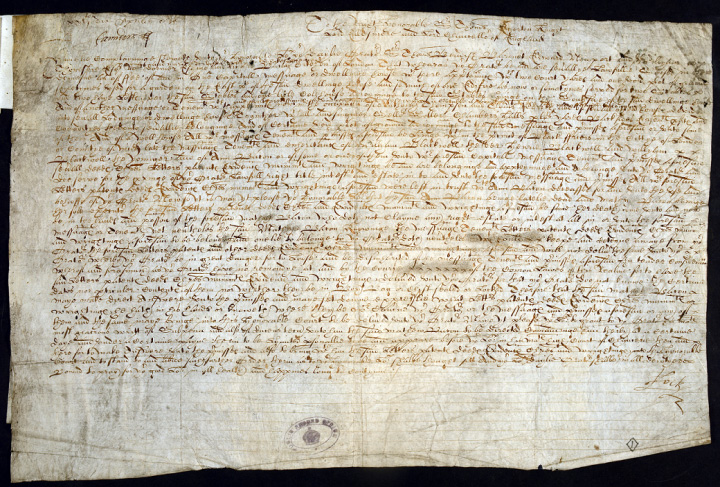
A page from the pleadings in the case of Sir Thomas Bendish, William Shakespeare and others versus Matthew Bacon in 1615 (catalogue reference C 2/JasI/B11/9). The case related to ownership of property in Blackfriars, London.
4. How to search for records
This section provides you with the basic information you will need to search for Chancery records. Consult sections 5 to 10 for more detailed advice on specific record types.
The records of any single equity suit heard in Chancery were not kept together. Instead of being filed by the suit, they were filed by the record categories described in section 3 (and in more depth in sections 5 to 10) and they remain held in these separate files to this day.
You can identify document references for pleadings and some other document types by searching our catalogue. All the main pleadings are searchable in the catalogue at least by surname of the plaintiff and defendant and many by other details – forename, status, occupation and subject.
Beyond the pleadings, the ‘short title’ is sometimes the only description in our catalogue for the records of a case. A short title consists of the surnames of the first named plaintiff and one of the defendants – for example, Smith v Barker. However, the short title can vary depending on whose statements were being recorded, so that several different short titles may exist for the same case. A document entitled Smith v Corbett, for example, may refer to the same case as Smith v Barker. To track a case in the hinterland of Chancery, therefore, you must have some idea of the names of the parties involved.
To find records of the later stages of the suits usually requires the use of contemporary paper ‘indexes’ or other finding aids , only available at The National Archives building in Kew.
5. Pleadings (proceedings)
5.1 What are pleadings?
Pleadings are formal written statements made by the parties in a case. They set out the claims of the plaintiff and the defence of the defendant. Anyone wishing to start a suit in Chancery would first get a lawyer to draw up a bill of complaint to submit to the Lord Chancellor – this would be the first pleading. Pleadings, also referred to as proceedings, were made in the following sequence (though if a dispute was settled out of court, you will find nothing more than a bill of complaint):
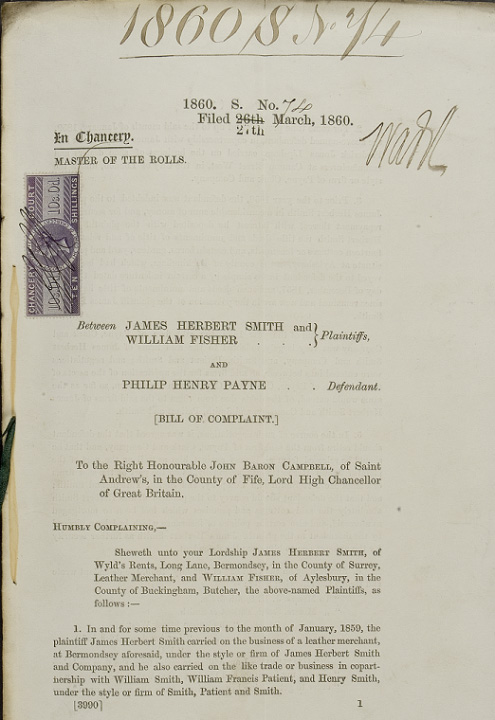
First page of a bill of complaint from March 1860 (catalogue reference C 15/786/S74). The plaintiffs were James Herbert Smith and William Fisher; the defendant was Philip Henry Payne. The ‘short title’ for this case is Smith v Payne.
1. Bill of complaint – often known simply as a bill, this would set out the details in dispute by the plaintiff against the defendant
2. Answer – the defendant’s responses to all the points raised in the bill of complaint
3. Replication – the plaintiff’s response to the defendant’s answer
4. Rejoinder – the defendant’s subsequent response
5.2 What kind of detail do pleadings contain?
As well as the details of the claims and defence, pleadings contain some personal details for both sides in the case.
Pleadings give the plaintiff’s and defendant’s:
- name
- relationships and often family details (for the plaintiff this information is usually found at the beginning of the bill but for the defendant the information can be in the bill and/or the answer
- occupation
- rank
- place of abode
- subject of the dispute
- lawyer’s name (usually appears written by itself in a top corner)
5.3 How to find pleadings
Post-1558 pleadings are held in series C2 to C18. You can use our online catalogue to search all of the pleadings up to 1875. Some catalogue descriptions consist of the short title and document type only, some have the forename and surname of some or all of the plaintiffs and defendants and others also include place and county with some indication of subject matter.
Many local record societies have published catalogues of Chancery proceedings for their own county. Search for “Chancery proceedings” in our catalogue, filtering the search results to local record offices by selecting the ‘Other archives’ filter. For lists of published and printed calendars, catalogues, registers and indexes held by local record societies, see E L C Mullins’ Texts and Calendars (1978) and Texts and Calendars II (1983).
6. Depositions and affidavits
6.1 What are depositions?
When the pleadings were finished, and the issues in dispute defined, the court commissioned neutral men of substance to examine an agreed list of people, known as deponents. The sworn statements made by deponents in response to the questions, or ‘interrogatories’, put to them are called depositions. These provide information about the case and often about the parties involved in the dispute, not included in the pleadings. They also give the deponent’s name, place of abode, age and occupation, at the head of his or her deposition.
6.2 What are affidavits?
Affidavits were voluntary statements made upon oath during the progress of a suit.
6.3 How to find depositions and affidavits
When using our catalogue and other indexes to find depositions and affidavits, you will need to search by the title of the suit, not by the person giving the deposition or affidavit.
The depositions fall into two groups: town depositions taken in London, and country depositions taken elsewhere.
Town depositions: taken in London
| Date Range | Catalogue reference | Search advice |
|---|---|---|
| 1534-1853 | C 24 | Search our catalogue by short title for some town depositions from the mid-18th to mid-19th centuries (C 24/2505 to C 24/2508)
Use the indexes in IND 1/16759 and IND 1/9115 to IND 1/9121 to search by surname of plaintiff, though these are not comprehensive and a speculative search in C 24 can be useful. Use the Bernau Index (available at the Society of Genealogists) to search for records by name of deponents (see also How to use the Bernau Index by Hilary Sharp) |
| 1854- 1880 March | C 15, C 16, J 54 | These town depositions are filed with the pleadings and findable on a name search – see section 5 |
Country depositions: taken in the counties
| Date Range | Catalogue reference | Search advice |
|---|---|---|
| 1558-1649 | C 21 | Search our catalogue by short title – take care as names can be reversed
Use the Bernau Index (available at the Society of Genealogists) to search for records by name of deponents (see also How to use the Bernau Index by Hilary Sharp) |
| 1649-1714 | C 22 | Search our catalogue by short title – take care as names can be reversed
Use the Bernau Index (available at the Society of Genealogists) to search for records by name for deponents in pieces C 22/1-75. (see also How to use the Bernau Index by Hilary Sharp) |
| 1715- 1880 March | C 11, C 12, C 13, C 14 | Country depositions are filed with the pleadings – see section 5 |
In C 23 there are Unpublished Depositions – depositions recorded but never used. These records are currently unsorted.
Affidavits
| Date Range | Catalogue reference | Description | Additional information |
|---|---|---|---|
| 1611-1875 | C 31, C 41 | Affidavits | 1611-1800: indexes are in IND 1/14545-14567. Entry marked with a cross: the original affidavit is in C 31. If no cross: try the copies in C 41, for 1615-1747 only 1801-1875: indexes are in IND 1/14575 -14684. The name listed after the plaintiff and defendant is that of the solicitor, initiating the affidavit |
| 1876 onwards | J 4 | Affidavits | There are indexes in IND 1: check the IND 1 list at The National Archives |
6.4 Interrogatories without depositions
You may find that a record of depositions is not accompanied by the interrogatories to which they were a response. In these instances, and when you cannot find any depositions for a case, it may be worth searching in the following series:
- C 25 (1598-1852) – annual bundles of ‘detached interrogatories’ mostly relating to town depositions
7. Entry books of decrees and orders
7.1 What did entry books of decrees and orders record?
Any orders issued by the court during the course of a case, and the final judgement, are recorded in the entry books of decrees and orders. These books also contain the dates on which the depositions and affidavits were recorded, and the dates of the hearing and the final decree. Decrees and orders before 1733 may be in Latin.
7.2 How to find entry books of decrees and orders
The Entry Books are in two sequences known as ‘A’ and ‘B’. Until Trinity term (June to July) 1629, both ‘A’ and ‘B’ books list suits (by plaintiff v defendant) from A to Z. From 1629, entries for plaintiffs A-K are in the ‘A’ books, and entries for plaintiffs L-Z are in the ‘B’ books.
The way to find an entry book is to use the contemporary annual indexes at The National Archives – these are available in our open reading rooms. There are over 600 indexes in total but none for 1544-1546. They start their year from the Michaelmas term (October to November). This means the dates on the spines are out by one year for the other three law terms. For example, the index listed as 1849 covers Michaelmas 1849 and Hilary, Easter and Trinity terms 1850. From 1860 each index covers a calendar year, not a ‘legal’ year. The reference found in the index has to be matched up to the C 33 series list: make sure the IND volume number matches as well, to ensure that you have the right year.
For cases which did not proceed beyond the bill and answer there will be no orders.
| Date Range | Catalogue reference | Search advice |
|---|---|---|
| 1544-1875 | C 33 | Find entry books using the contemporary annual indexes at The National Archives – these are available in Map and Large Document Reading Room. There are over 600 indexes in total but none for 1544-1546.
Browse through online copies of entry books and indexes for 1544-1650 on the Anglo American Legal Tradition website. |
7.3 Abbreviations found in the decrees and orders
| Abbreviations and their meanings | ||
|---|---|---|
| accott accountant | affdt affidavit | appot appointment |
| Bequed bequeathed | Col Counsel | Cot Court |
| Conson consideration | declon declaration | Excepons Exceptions |
| exor executor | furr further | hrinbefe hereinbefore |
| hrs heirs | incon or inion injunction | indre indenture |
| L C Lord Chancellor | M R Master of the Rolls | Mr Master |
| mre matter | Orar Orator (plaintiff) | Ors others |
| ppr paper | revr revivor | suppl supplement |
| testor testator | tree(s) trustee(s) | wo widow |
8. Chancery Masters and the associated records
8.1 Who were Chancery Masters and what did they do?
In many Chancery suits, the judge referred matters for investigation or action to one or more of the Chancery Masters in Ordinary, eight appointed officials based in London, whose number rose to 12 by the 1860s. These officers of the court, lawyers by trade, would carry out much of the work of the court, under the instructions of the judge. As well as investigating the evidence (including depositions, affidavits and exhibits), assessing costs and administering the estates that were held in the care of the court during the (often very lengthy) course of a suit, they would sometimes themselves act as the arbitrators in the case.
From 1842 ‘taxing masters’ took over the cost assessments from the masters and in 1852 the masters’ other functions were transferred to the judges. The judges then started referring many matters to their chief clerks who soon became known as masters also.
8.2 Masters’ reports and certificates and how to find them
Having done their investigation, the master or masters in a case would send a report back to the court. Draft reports were submitted to both parties who were allowed to review the reports and to submit their response in the way of ‘exceptions’. Longer reports can include detailed material taken from the pleadings and other papers examined by the master, and can provide a very useful summary or overview of a case. The master’s final report often formed the basis for the court’s final decrees.
Masters’ reports can also contain:
- Accounts of arbitrations
- Details of awards of various sorts
- (Until 1842) Accounts of dealings with infants and lunatics placed under the protection of the court (referred to as ‘wards of court’)
The masters also returned short certificates into court, authorising, for example, the delivery of money.
To find specific reports and certificates, you will need to use the contemporary ‘indexes’ in IND 1 at The National Archives. The post-1842 and post-1852 taxing masters’ and clerks’ reports were filed in the same series as the earlier masters’ reports.
| Date Range | Document | Catalogue reference | Indexes |
|---|---|---|---|
| 1544-1605 | Reports: main series | C 38 | No indexes |
| 1606-1759 | Reports: main series | C 38 | IND 1/1878-2028 |
| 1760-1800 | Reports: main series | C 38 | IND 1/10700/1 |
| 1801-1875 | Reports: main series | C 38 | IND 1/14919-14993 |
| 1756-1859 | Oversize documents | C 39 | No indexes |
| 1756-1859 | Exceptions to the reports: appeals by either party | C 40 | IND 1/30785-30786 for 1836-1840 only |
8.3 Masters’ documents
These contain the affidavits, examinations of witnesses, estate accounts, wills and other documents on which the masters founded their reports, together with the drafts of reports. As such, they can be a treasure chest of information.
To find masters’ documents you will need to know the name of the master dealing with the suit. By consulting the decrees and orders this may have become apparent. Once you have a name you will need to go to The National Archives Map and Large Document Reading Room and follow these steps:
- Locate the binder for C 103 in the paper version of the catalogue.
- Find the ‘Alphabetical List of Chancery Masters in Ordinary’ within the binder.
- Note the C series attributed to the records for that master (there will usually be two: one for ‘exhibits’ and the other for ‘documents’). Be aware that each of these C series is named after the last master to occupy the office on its abolition in 1852.
- Use the table below to match the C series with the corresponding IND index, held elsewhere in the Map and Large Document reading room (these are contemporary indexes and it is estimated that approximately 20% of the documents referred to in the indexes are missing – it is not known where they are or even if they have survived).
Pre-1852 documents
| Masters’ name | Catalogue reference | Index |
|---|---|---|
| Master Blunt | C 124 | IND 1/6616 |
| Master Brougham | C 117* | IND 1/6625 |
| Master Farrar | C 122* | IND 1/6624 |
| Master Horne | C 118* | IND 1/6620-6621 |
| Master Humphrey | C 123* | IND 1/6618 |
| Master Kindersley | C 126 | IND 1/6622 |
| Master Lynch (no separate collection) | C 123*; C 124 | IND 1/6618 IND 1/6616 |
| Master Richards | C 121 | IND 1/6626-6627 |
| Master Rose | C 119 | IND 1/6619 |
| Master Senior | C 125* | IND 1/6623 |
| Master Tinney | C 120* | IND 1/6617 |
*The records in these series are stored off site – please allow 3 working days’ notice to see them.
Post-1852 documents
Post-1852 masters’ documents are in the following J series:
- J 23 to J 47
- J 63– 64
- J 66 – 68
As with pre-1852 documents you will need to know the name of the master appointed to a case to determine which J series to consult. Once you have the name you can check it against the masters succession list posted up in the reading rooms at The National Archives to determine the J series.
8.3 Masters’ account books
When the ownership of an estate was in dispute in Chancery, or while the owner was a ward of the court, the master would appoint people to administer the property, often a party in the case. They were supposed to provide annual accounts to the master.
Masters’ accounts books contain the paperwork for the administration of these estates.
- c1750-c1850 – search by name of plaintiff, defendant or the ward in C 101 (includes the early records of Companies (Winding-up) Proceedings.
- 1852 onwards – see the various J series listed in section 8.2.
8.4 Masters’ exhibits
At the end of a suit, the parties normally reclaimed any physical or documentary evidence, known as exhibits, that had been brought before the court. The minority of exhibits that were not claimed form the collection of private papers known as Masters’ Exhibits.
To find exhibits search our catalogue, or, if you know the name of the master, click on the appropriate catalogue reference in the table below (see section 8.3 for advice on how to find this out), and search by the short title of the case (see section 4 for advice on short titles).
You can also search for descriptions of exhibits by keywords, including place names, but this may require some guesswork. Typical descriptions include:
- ‘deeds relating to…’ (followed by a place name)
- ‘will of…’ or ‘probate of…’ (followed by a person’s name)
- ‘inventory’/ ‘inventories’
| Catalogue reference | Masters’ name | Date range |
|---|---|---|
| C 103 | Master Blunt | c1200-1859 |
| C 104 | Master Tinney | 13th century-1856 |
| C 105 | Master Lynch | 1481-1829 |
| C 106 | Master Richards | 13th century-1853 |
| C 107 | Master Senior | c1250-1851 |
| C 108 | Master Farrar | c1220-1847 |
| C 109 | Master Humphrey | c1180-1857 |
| C 110 | Master Horne | 1306-1853 |
| C 111 | Master Brougham | 13th century-1857 |
| C 112 | Master Rose | 1270-1857 |
| C 113 | Master Kindersley | 1235-1837 |
| C 114 | Unknown Masters | 1566-1841 |
| C 115 | Duchess of Norfolk Deeds | 1085-1842 |
| C 116 | Court Rolls(extracted from the other series) | 1295-1808 |
| C 171 | Six Clerks’ Office | c1350-c1850 |
| J 90 | Chancery Masters’ Exhibits These need to be ordered 3 days in advance |
c1700-1918 |
9. Final decrees, appeals and arbitrations
9.1 Enrolled decrees
Decrees and orders could be enrolled in the Decree Rolls, at an extra cost.
| Date range | Catalogue reference | Description | Online access |
|---|---|---|---|
| 1534- 1903 | C 78 | Decree Rolls | Browse the Anglo-American Legal Tradition website for online versions of the whole of C 78
Search our catalogue by short title for limited but accruing data Search by place name for decrees enrolled during and between the reigns of Henry VIII and George III in IND 1/16960A |
| 1534-1903 | C 79 | Supplementary Series | IND 1/16960B (searchable by short title)
Index data on the Anglo-American Legal Tradition website |
9.2 Records of appeals against enrolled decrees
Any appeal against such enrolled decrees or orders would have to be made to the House of Lords and the records are held with the Parliament’s Archive Collections now at The National Archives.
9.3 Unenrolled decrees and records of appeals against them
Not enrolling decrees had its advantages in some cases, as appeals were made back to the Lord Chancellor, and cases could be reopened more easily.
If final decrees were not enrolled, look for them in the decree and order books (see section 7) and for appeals against unenrolled decrees and orders look among the Petitions. These also include ‘ordinary’ petitions, for example for winding up associations or for the appointment of new trustees to administer an estate.
| Date range | Catalogue reference | Description | Indexes |
|---|---|---|---|
| 1774-1875 | C 36 | Ordinary and Appeal Petitions | IND 1/15029-15047 |
| 1876-1925 | J 53 | Chancery Division Petitions | IND 1/15048-15282 |
9.4 Records of cases settled out of court
Many suits were ended outside the court by arbitrations, mediations, compositions and awards of various sorts, made by commissioners, often Chancery masters, appointed by Chancery.
| Date range | Catalogue reference | Description | Additional information |
|---|---|---|---|
| 1544-1844 | C 38 | Reports on arbitrations by Masters | See section 6 |
| 1544-1694 | C 33 | Awards enrolled | See section 7 |
| 1694-1844 | C 42 | Awards not enrolled | No indexes |
10. Cause Books, 1842-1880
Cause books bring together all references to decrees, orders, reports and certificates made during the course of a case, together with the names of all the parties to it and their solicitors and the dates of all their appearances.
The only surviving cause books cover 1842 to April 1880. They are held in series C 32. Indexes for 1860 to 1880 are in IND 1/16727-16747.
Cause Books from April 1880 onwards were destroyed on the recommendations of the Committee on Legal Records chaired by Lord Denning, leaving no primary means of access to the records after 1880.
11. Money ‘in Chancery’
The Court of Chancery has always looked after money and property awarded through the court to people who cannot be found, or are unable to look after it themselves, such as children, or to people with disabilities that mean they cannot make decisions for themselves. This money is known as funds in court, and may be referred to as ‘in Chancery’, and is today administered by the Court Funds Office. For more information see our guide to Funds in Court.
12. Further reading
- Amanda Bevan, Tracing your Ancestors in the National Archives (TNA, 2006) Ch 58
- P W Coldham, ‘Genealogical Resources in Chancery Records’, in Genealogists’ Magazine, vol XIX, pp 345-347 and vol XX, pp 257-260
- D Gerhold, Courts of Equity… A Guide to Chancery and other Legal Records (Pinhorn, 1994)
- Henry Horwitz, A Guide to Chancery Equity Records and Proceedings 1600-1800 (PRO, 1998)
- Henry Horwitz, Samples of Chancery Pleadings and Suits: 1627, 1685, 1735 and 1785 (List and Index Society, vol 257, 1995)
- W J Jones, The Elizabethan Court of Chancery (1967)
- Susan Moore, Family Feuds: An Introduction to Chancery Proceedings (Federation of Family History Societies, 2002)
- Susan Moore, Tracing your Ancestors through the Equity Courts: A Guide for Family and Local Historians (Pen & Sword Family History, 2017)
- G W Sanders, Orders of the High Court of Chancery and Statutes of the Realm (1845)
- H Sharp, How to Use the Bernau Index (Society of Genealogists, 1996)
1. Why use this guide?
This guide will help you to find records held at The National Archives for divorce and separation. You are unlikely to find documents for any divorce since 1937 among our records.
For legal proof of your own divorce, or any divorce in England or Wales since 1858 to the present, go to the GOV.UK website for details of how to request a copy of a decree absolute.
Contact the National Records of Scotland for Scottish divorce records. For proof of a divorce in Northern Ireland, contact the court where the divorce was granted (either the Royal Courts of Justice (Belfast) or a county court). See the Northern Ireland Court Service website to find a court’s contact details.
To see most of the records held here you will either need to visit us or, where you can identify a document reference, order a copy (£). You also have the option of paying for research (£).
2. A short history of divorce in England and Wales since 1858
In 1858 the handling of the legal process for divorce was transferred from the ecclesiastical courts to a newly established civil court, the Court for Divorce and Matrimonial Causes. In 1873 responsibility was passed to a division of the new Supreme Court. All divorce suits took place in London, thus restricting divorce to wealthier couples.
Divorce did not really open up for all classes until the 1920s with the extension of legal aid and the provision of some local facilities. In 1922, ten assize courts were named as suitable for the hearing of certain kinds of divorce and in the years to follow the number of courts hearing divorce cases expanded significantly. In the late 1960s divorce was taken over by the county courts and most divorces now take place at county courts.
3. What can you view online?
The following records are available to view online:
- Divorce case files for England and Wales, 1858-1916 at Ancestry.co.uk (£). The original records are held under reference J 77/1/A1 to J 77/1063/2238
- Newspaper articles covering newsworthy divorce cases 1785-1985 – for these search The Times Archive (£)
- Browse the list of Divorces by private Acts of Parliament before 1858 on the Legislation.gov.uk website
4. Divorce case files, 1858-1972
Each divorce suit created a case file. The National Archives holds case files for all divorces from the Supreme Court 1858-1937 – very few case files survive after 1937.
4.1 What proportion of case files survive?
The survival rate of divorce case files is:
- 1858-1927: almost 100%
- 1928-1937: 80%
- After 1937: less than 0.2%
No case files survive from the district registries set up in 1927.
4.2 What information can I find in the case files after 1858?
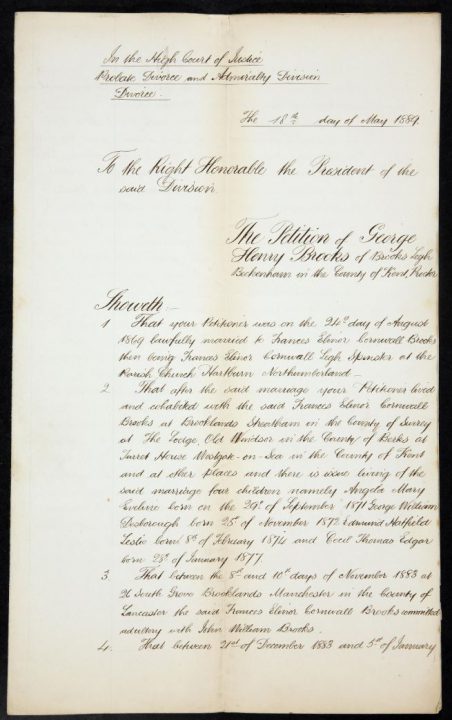
Document reference: J 77/425/2983. Petition of George Brooks.
Case files may contain:
- the original petition and response
- relevant marriage certificates
- birth certificates of children
- a record of the court process
- copies of decrees (from about 1870- c1937)
- evidence (infrequently)
Most files were stripped of the less formal papers, but some full files were kept as examples of how the court operated. These are described as ‘full files’ in our catalogue.
Case files are now destroyed 20 years after the divorce. Within this 20-year period, you can apply to the relevant court for permission to see the file. You can search surviving case files from 1858 onwards by name in J 77. The original indexes are in J 78.
The only record of those cases where the case file has not survived would be the decree held by the court. Contact the Central Family Court for more information.
4.3 How do I search for case files, 1858-1916?
Search and download divorce case files for England and Wales (J 77/1/A1 – J 77/1063/2238) at Ancestry.co.uk (£).
4.4 How do I search for case files, 1917-1972?
Search Discovery, our catalogue, by name of petitioner, respondent or corespondent for divorce suits in England and Wales, both successful and unsuccessful, in J 77.
Very few files survive for the period 1938-1972. Files containing petitions dated after 1972 have not been transferred to the National Archives.
Narrow your search by using double quotation marks to find a person’s full name, such as “John Williams”.
5. Investigations into collusive divorces, 1875-1977
In cases of suspected collusion or deceit, decrees could be overturned.
Registers of divorce cases investigated by the King’s or Queen’s Proctor, from 1875, are in TS 29. They are closed for up to 75 years. You may find examples of collusive divorces in the case files. See section 3 on how to search for case files.
6. Divorce records before 1858
Before 1858, the only way of ending a marriage and allowing re-marriage during the lifetime of a spouse was to get a private Act of Parliament. This was too expensive for most people, who instead found other ways to separate – through custom, the church courts and the common law courts.
See the table below for details of which records are held by The National Archives and which are at local archives.
| Method of separation | Where records are held |
|---|---|
| Private separation | The National Archives (see section 9) |
| Desertion and elopement | Quarter session papers in local archives |
| Wife sale | Quarter session papers and newspapers in local archives |
| Declaration of nullity, annulment or divorce a mensa et thoro by church courts | The National Archives and local archives (see section 10) |
| Full divorce by Act of Parliament | The National Archives |
7. Deed of separation
A deed of separation would be drawn up between the husband and a trustee of the wife (not the wife herself) and provision made for the wife and children.
If you know the names of both parties, you might find a deed of separation in the Close Rolls in C 54.
You may find records of the deed and correspondence among family or estate records. Search our catalogue to see where different collections are held.
Deeds of separation were used even after the Matrimonial Causes Act of 1857, as couples were still unable to end a marriage:
- because of incompatibility
- if adultery could not be proven
- if religious scruples prevented them from divorcing
8. Separations granted via church courts
8.1 Divorce a mensa et thoro
A divorce a mensa et thoro was a legal separation, granted on the grounds of adultery and/or life-threatening cruelty.
You may find a record of these in the Close Rolls in C 54 or decree rolls of Chancery in C 78. In C 78 you may also find:
- disputes over property rights and settlements made at the time of separation
- church orders directing payment of money as maintenance (these could be enrolled up to six months after being made)
You can find some separation settlements in PC 2 indicating that the Privy Council had an interest in ensuring they were adhered to.
8.2 Appeals
First appeals could be heard at the Archbishop’s Court at Canterbury or York. Further appeals were to the High Court of Delegates up to 1834, and the judicial committee of the Privy Council between 1834 and 1858.
On appeal, the case would be suspended in the lower court, and transcripts of all the records transferred upwards. The table below shows where you can find records for each court.
| Appeal court | Where to find records |
|---|---|
| Province of Canterbury’s Court of Arches | Lambeth Palace Library |
| Consistory Court of York | Borthwick Institute of Historical Research |
| High Court of Delegates | The National Archives in DEL 1, DEL 2, DEL 7 |
| Judicial committee of the Privy Council | The National Archives in PCAP 1 and PCAP 3 |
DEL 2 is the main series of cause papers, which include allegations and petitions. The papers are arranged by case and term, and consist of bundles of papers relating to each particular case. Details can include:
- the authorisation of the judges
- a formal statement of the terms of the appeal (usually based on faults in the previous legal proceedings, rather than on the intrinsic justice of the case)
- a note of any appearance by the parties and their statement
- the warrants or motions for hearing
- a copy of the citation
The early papers are often in Latin. Most of the material is in a standard legal form, but there are sometimes personal details about the parties.
The accounts of proceedings can sometimes be very long. The case books in DEL 7 (1796-1834) and PCAP 3 (1834 onwards) contain bound volumes of printed proceedings and sometimes manuscript records of the judgement given.
8.3 Declaration of nullity
The church (consistory) courts of the bishops could grant a declaration of nullity, meaning the marriage was considered invalid from the start. The children became illegitimate and the wife lost her right to inherit from her husband.
You can find consistory courts records in local archives.
8.4 Annulment
An annulment was a form of legal separation which protected the wife’s rights and kept the children legitimate, but neither party could remarry unless the other died. The husband or wife could subsequently apply to the church court for a declaration of nullity.
8.5 Criminal conversation
The husband of an adulterous wife could take out a civil suit of criminal conversation in the Court of King’s Bench or Common Pleas to claim damages from his wife’s lover.
In 1809 the House of Lords ordered that the transcript of a preliminary trial for criminal conversation should accompany every divorce bill brought before it.
You may find reports of sensational trials in newspapers from the late 18th century. The Times (£) covered many in some detail.
9. Full divorce by Act of Parliament
In order to remarry within the lifetime of a spouse, a full divorce by Act of Parliament was required, with proof of adultery or life-threatening cruelty. Instances of Parliamentary divorce can be traced back to the 1540s, but they became more frequent from the 18th century. Around 320 private divorce Acts were passed between 1700 and 1857. Of these, only four were granted to women, who additionally had to prove incestuous adultery or bigamy.
Divorce Acts are private acts catalogued under the reference YHL/PO/PB/1. They were not usually printed so the only text is likely to be the original manuscript on parchment. For more information see our research guide on Original Acts of Parliament. To find a divorce act, search the catalogue for the names of the parties and the word ‘marriage’. (The word ‘divorce’ may not appear because the long title of the Act was usually phrased in the form of ‘An Act to dissolve the Marriage of…’). As well as the Act, you may find related material such as bills and petitions in the House of Lords Main Papers (YHL/PO/JO/10).
Proceedings on Divorce Acts, including evidence from both parties, are usually recorded in detail in the House of Lords Journal. The printed Journals are catalogued under the reference YHL/PO/JO/2. Search or browse the catalogue to find the Journal for the year of the divorce.
A few additional examples of Divorce Acts exist in The National Archives in C 89 and C 204.
C 89/15/20-21 contains the first true parliamentary divorce in 1670, between John Manners, Lord Roos, and Lady Anne Pierpont. This created a precedent for parliamentary divorces on the grounds of the wife’s adultery.
10. Further reading
Websites
Search The Times Archive (£) to view articles about newsworthy divorce cases from 1785-1985.
Browse a list of private Acts of Parliament to check for divorces before 1858.
Books
Visit the National Archives’ bookshop for a range of publications relating to marriage and divorce. The following publications are available in The National Archives’ library.
Amanda Bevan, Tracing your ancestors in The National Archives (7th ed, Kew, 2006)
Lawrence Stone, Road to divorce: England 1530-1987 (Oxford, 1990), 383-416
Articles
Jennifer Aston, ‘An Exceedingly Painful Case’: The Aftermath of Divorce in Mid-Nineteenth Century England and Wales. Family & Community History, 26:1 (2023), 71–91.
Roderick Philips, ‘Divorced, beheaded, died…’, History Today XLIII (1993), 9-12
Griselda Rowntree and Norman H Carrier, ‘The resort to divorce in England and Wales, 1858-1957’, Population Studies XI (3) (1958) 188-233
Sybil Wolfram, ‘Divorce in England, 1700-1858’, Oxford Journal of Legal Studies, 5:2 (1985),155-186.
1. Why use this guide?
Use this guide for advice on finding records documenting pension awards and payments granted to:
- servicemen who sustained disabling injuries during the First World War
- the widows of servicemen who died in the First World War
- the children of servicemen who died in the First World War
Pensions were granted for servicemen who served in the First World War and relatives were able to claim even if the serviceman died from a war related injury many years after the end of the war.
Most of the records covered are for people who served with the British Army, where the majority of casualties were borne, but some cover Royal Navy and Royal Air Force personnel as well as merchant seamen and military nurses and their families.
2. Where have these records come from?
As with all documents held at The National Archives, these records are historical records from UK central government departments. In this case, the departments behind these records were:
- The Office of the Paymaster General – covering pensions granted before 1920, mostly to officers
- The Ministry of Pensions and National Insurance – established in 1916 and covering pensions granted after 1920, the Ministry of Pensions administered war pension and allowance schemes in the UK and overseas for all the services and ranks
3. Where and how to get started
These records cannot be viewed online and to see them or even to simply search for them you may need to visit The National Archives at Kew. However, in most cases you can at least make a start online by searching for document references in our catalogue. If you find references you can pay for copies of the records to be sent to you but you will not be able to view the records beforehand unless you visit us.
To find references, click on the record series links in this guide and follow the search instructions provided. In some instances the only way to search is to browse through the records one by one.
Further information on browsing is available on our search help page.
4. Records covering all branches of the military
4.1 Two percent sample of pension case files, 1920-1989
Pension case files contain papers submitted to support an application for, and the administration of, a pension. Just a 2% sample of pension case files for pensions awarded (or refused) to First World War service personnel has been kept. Case files can be rich in detail, some covering many decades, sometimes because claims were raised thirty or forty years after the end of the war. They can include medical but also social information and they include disability pensions and pensions to widows/dependents. Some files include documents from before 1920.
The sample is held in record series PIN 26 and amounts to over 22,000 files on people from all the military services.
Search in PIN 26 by name or, if that fails, by the name of the disability (not all the record descriptions in PIN 26 include the name of the person). In some instances, the medical terminology used is unfamiliar and you might need to check more than one category. Some abbreviations have been used to describe different types of disabilities so use these, if applicable, when searching:
- CSOM – Chronic Supperative Otitis Media
- DAH – Disease of action of the heart
- GP – Gun-powder injury
- GSW – Gun-shot wound
- ICT – Inflammation of Connective Tissue
- POW – Prisoner of War
- PNO PUO PVO – Pyrexia of unknown origin
- TB – Tuberculosis
- VDH – Valvular disease of heart
PIN 26 has been divided into subseries according to categories such as ‘widows’ and ‘Navy’ and you can target any one of these by viewing the PIN 26 by hierarchy, clicking on the subseries title and then browsing through the records one by one.
Some records mention a ‘selection code’. A key to these is in the printed, paper version of the catalogue available in the reading rooms at Kew – find the PIN 26 binder.
4.2 Two percent sample of widows’ and dependents’ pension case files
Only a 2% sample of pensions awarded to widows or dependents of First World War servicemen, from all branches of the military, have been kept. These are in PIN 82 and the dates of the records themselves cover 1910-1932.
Use the search box contained within PIN 82 to search by name.
Each file contains forms arranged in alphabetical order of servicemen’s name, with his regiment or ship, and cause of death. Read the series description for PIN 82 for full details of what they can contain.
4.3 Pensions awarded to the relatives of deceased officers
These records, of pensions awarded to the relatives (including widows) of deceased officers from all branches of the military are not searchable by name in the catalogue but most contain the original indexes used to locate entries within them. Select the file between PMG 44/1 and PMG 44/7 which matches your search criteria and use its original index, once you have the file in front of you, to find individual entries.
The records generally contain:
- name and address of claimant/recipient
- officer’s name and rank
- date of payment
- officer’s date of birth in some cases
4.4 Temporary disability pensions paid to officers and nurses
Records of temporary pensions paid to officers and nurses in the British Army, Royal Navy and RAF are in series PMG 42.
These records are catalogued by surname ranges according to the first letter of the surname. Browse through PMG 42 to pick out the range that applies to your search. The records contain the following details:
- rank
- officer’s name and address
- date of warrant
- amount paid
5. Records covering only British Army personnel
5.1 Pensions to dependents of deceased officers, 1916-1920
Records of pensions awarded to the widows, children and other dependents of officers killed or missing in action are held in various PMG series and generally contain:
- name and address of claimant/recipient
- officer’s name and rank
- date of payment
- officer’s date of birth in some cases
You cannot search these series online by name. Instead you need to select a file from our online catalogue based either on the year or the range of surnames that it covers, then view it in our reading rooms at Kew, using the original name index within each file to find an entry for an individual. Click on the links below to pick out a file based on year or surname range:
- Pensions granted to the relatives of missing British Army officers in PMG 47/1-3 (each entry describes the claimant’s relationship to the missing officer).
- Pension allowances granted to the children of British Army officers killed in the war in PMG 46/1-4 (the records contain details of the officer’s regiment and who collected the money).
- Pensions paid to the widows of British Army officers in PMG 45/1-6.
- Special grants and supplementary allowances paid to widows and dependants of British Army officers in PMG 43/2.
5.2 Pensions to disabled or invalid officers and men before 1921
For disability pensions before 1921 browse the following series. They are rich in detail but you cannot search them by name.
Browse by date:
- British Army half pay records in PMG 4. For later years records are subdivided by surname initial
- British Army registers of pension payments in PMG 9. For the war period, records are subdivided by an entry/reference number. There is no index so you cannot identify who the numbers relate to
6. Further reading
William Spencer, Family History in the Wars (Kew, 2007)