1. Why use this guide?
This guide provides advice on where to look for records of public rights of way, roads and other highways in England and Wales. The National Archives is not the best place to start looking for these kinds of records and much of the advice in this guide directs you elsewhere.
Each local highway authority (county council or unitary authority) will have records of public rights of way in its area and local archives are therefore the best place to start a search.
The information in this guide is not a statement of law and we cannot provide legal advice of any kind. For advice on property boundary disputes you should consult the Land Registry pages on GOV.UK or contact a legal adviser.
You can find further advice on records of rights of way, highways and related subjects at the following websites and institutions:
- GOV.UK
- IPROW (Institute of Public Rights of Way and Access Management)
- Open Spaces Society
- Byways and Bridleways Trust
- British Horse Society
- Ramblers
2. What are public rights of way and highways?
Public rights of way allow the public to walk, or sometimes ride, cycle or drive, along specific routes over land which may belong to someone else – the land itself is often privately owned.
Though the term highway is popularly used to refer to roads, its legal definition covers any public road, track or path. Historically, a highway, which was also referred to as ‘the King’s highway’, was defined as a public passage for the use of the sovereign and all his or her subjects. The Highway Act 1835 defines highways as ‘all Roads, Bridges (not being County Bridges), Carriageways, Cartways, Horseways, Bridleways, Footways, Causeways, Churchways and Pavements’.
There are further, more detailed and contemporary definitions at Land Registry Title Deeds Online and the IPROW website.
3. Rights of way on maps
In this section you will find advice on the most significant kinds of maps that show rights of way, where they are held, whether at The National Archives or elsewhere, and some advice on how to find them. In section 8 and section 9 of this guide there is advice on some of the other kinds of records that contain maps showing rights of way and highways.
3.1 Definitive maps and statements 1949 to present
A number of public acts since the National Parks and Access to the Countryside Act 1949 (principally The Countryside Act 1968 and the Wildlife and Countryside Act 1981) have required that local authorities produce and, subsequently, review maps and statements showing and defining public rights of way in their area – these are known as definitive maps and statements. Footpaths, bridleways, byways open to all traffic and restricted byways are distinguished on the maps. Formerly, roads used as public paths were shown too.
Local authorities are required to make these resources available for public inspection. Some local archives may also hold old, as well as current, definitive maps and statements.
Contact the local authority directly or search for ‘definitive maps’ in our catalogue, using the filters on the left-hand side of the results page to restrict your search results to ‘Other archives’, as shown:
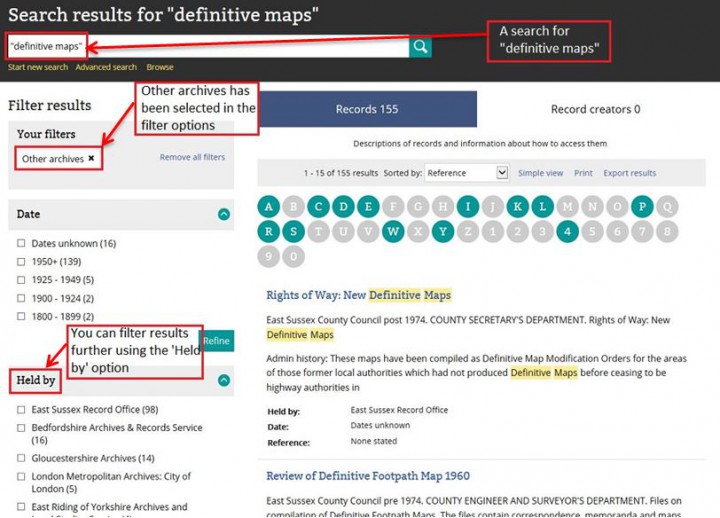
Filtering results after a search for “definitive maps” in The National Archives catalogue.
See the very useful guide to definitive maps (PDF) published by GOV.UK for an in-depth explanation of the maps themselves, rights of way in general and the legal framework that underpins it all.
3.2 Ordnance Survey maps 1951-2009
Until the 1960s, Ordnance Survey maps bore a disclaimer stating that the depiction of any road, track or path does not constitute evidence of the existence of a public right of way.
With the public availability of definitive maps, Ordnance Survey maps at 1:50,000 and 1:25,000 scales, from 1960 onwards, do indicate rights of way including footpaths, bridleways, restricted byways and byways open to all traffic, based on the definitive maps.
Although published Ordnance Survey maps are not sent to The National Archives as a matter of policy, there are some maps among the Ordnance Survey records held here. Those most relevant to rights of way are:
- OS 75 (1951-2009) – definitive maps sent by local authorities to Ordnance Survey for use in preparing published maps – click on the reference and search by county, borough or local authority district
- OS 78 (1959-2007) – public path orders (including definitive map modification orders) sent by local authorities to Ordnance Survey for use in preparing published maps (each of these usually include a map) – click on the reference and search by county
Papers about Ordnance Survey policy regarding the depiction of rights of way are in OS 1 and OS 11.
See section 8 of our Ordnance Survey guide for more information on where to find Ordnance Survey maps.
4. Rights of way and highway legislation
There have been numerous Highways Acts in the UK dating back to the 16th century, most of which contained sections on rights of way. See legislation.gov.uk for Highways Acts since 1835.
Other significant public acts affecting rights of way and highways, all available on legislation.gov.uk, include:
- Countryside and Rights of Way Act 2000
- Wildlife and Countryside Act 1981 (amended and largely repealed the 1949 and 1968 Acts below)
- Highways Act 1980
- Countryside Act 1968
- National Parks and Access to the Countryside Act 1949
Please note not all public Acts of Parliament are available online. For more information see our research guide on Original Acts of Parliament.
5. Records of the removal of right of way status: extinguishments and stopping up orders
When the legal obligation to provide public access along a path, track, road or any other route ceases, the right of way, in legal language, is said to be ‘extinguished’ or ‘stopped up’.
5.1 Records of extinguishments – general
Notices about proposals to stop up or divert public rights of way and highways were, and to a lesser extent still are, usually published in the local press and in the London Gazette. Subsequently a legal order authorising the change is made. These extinguishment or stopping up orders are held in a variety of places.
MT 78 contains a large number of stopping up orders made between 1941 and 1974. Use the MT 78 series search to search this series by:
- name of parish
- name of town
- name of village
- name of Rural District Council
- name of Urban District Council
- for larger towns and cities, name of road or street
Look for stopping up orders in the following series by clicking on the references below and searching with the terms “extinguishment”, “stop up” or “stopping up”:
- Some orders are among the Housing Instruments and Consents in HLG 13; related registered files are in HLG 47.
- Orders made under the Town and Country Planning Acts 1944 and 1947 are in HLG 26 (registers in HLG 66).
- Orders made concerning the creation, stopping up and diversion of footpaths in Welsh counties and county boroughs are in BD 20.
- Orders made after 1956 by Liverpool Crown Court under the Liverpool Highway Act 1835 are in J 108 (earlier orders are in quarter sessions records held locally).
- Orders made by Manchester Crown Court under the Manchester General Improvement Act 1851 are in J 109 (earlier orders are in quarter sessions records held locally).
- licences to stop up footpaths 1852-1876 are in HO 141.
Copies of orders made under the Highways Act 1959 are likely to be held in local archives.
5.2 Records of extinguishments as a result of land requisitioned for war
The exercise of emergency powers to requisition land during the Second World War often affected rights of way over such land. Orders to stop up or divert highways under the Defence (General) Regulations 1939 and other relevant legislation are among the records in MT 78.
Use the MT 78 series search to search this series by:
- name of parish
- name of town
- name of village
- name of Rural District Council
- name of Urban District Council
- for larger towns and cities, name of road or street
Other relevant record series, which you can search by clicking on the references below and searching with the words “extinguishment”, “stopping up”, “rights of way” or “right of way”, include:
- MT 105 – includes a number of files about the closure of rights of way by the War Office under the Requisitioned Land and War Works Acts 1945-1948, including material about the continuing closure of ways across the East Lulworth Ranges in Dorset after the end of the Second World War.
- T 180 – records of the War Works Commission, set up in 1945 to deal with problems arising from the emergency use of private land. Includes a number of files about the closure of highways and footpaths at airfields, ordnance factories and other strategic sites.
- AIR 2 contains a number of applications to the Railway and Canal Commission for authorisation to close rights of way.
5.3 Records of extinguishments and stopping up orders pre-19th century
Click on the references below to search the respective series for pre-19th century stopping up orders (suggested search terms are provided in brackets):
- papers of the Treasury Solicitor from the early 16th century in TS 18 and TS 28 (search with “stopping up”, “rights of way” or “right of way”)
- records of both the proposed closure of old highways and footpaths consequent on enclosure of lands, and also the provision of alternative ways to replace the old roads and paths are in inquisitions ad quod damnum from at least the early 17th century until the 19th century, in C 202 – information can include the dimensions of ways and local field names over which the routes were to pass (there is an index in the printed version of this series, available only at our building in Kew)
There are also some stopping up orders from the late 17th century onwards in KB 16, some with maps and considerable background detail. These records, however, are hard to find as the series has not been described in any detail in our catalogue.
6. Notices of dedication and repair liability 1835-1959
Before 1835 a landowner could declare or, in the conventional legal language, could ‘dedicate’ a road as a public right of way and it automatically became the liability of the public to repair it – whether it was of any great utility or not. This changed with the 1835 Highways Act, Section 23 of which established that if a landowner proposed to dedicate a road or bridleway as a public highway and intended that it would be repaired by the public, notice had to be given in writing to the surveyor of the parish.
Some of these notices survive in local archives but there are none in The National Archives. This element of the law was repealed by the Highways Act 1959.
7. Records of rights of way and highways on land owned by the Crown
The records of the Crown Estate are held at The National Archives under the CRES department code. Some of these records contain information on rights of ways, roads and other highways, particularly when there were alterations to the land that affected rights of way, such as the building of new highways and turnpike roads.
Search for CRES records in our catalogue, particularly in the series listed below. Click on the series codes below to search within that series using the search terms suggested:
- CRES 2 (1513-1913) – by county or place name or the word “roads” or the phrases “right of way” and “rights of way”
- CRES 6 (1660-1918) – by year only
- CRES 35 (1706-1991) – by county or the name of a Crown estate e.g. Windsor or the word “roads” or the phrases “right of way” and “rights of way”
Records include agreements, surveys, correspondence and maps.
8. Roads and rights of way on enclosure documents
Many enclosure awards (legal documents recording the ownership and distribution of ‘enclosed’ land) contain information about the status of roads and other ways, including public paths and occupation roads. They may state who was responsible for their maintenance and for the maintenance of hedges and fences along the boundaries of fields. Some enclosure maps distinguish between major and minor roads but no inferences should be drawn from the absence of such information.
For more information about using these records, see our guide to Enclosure awards.
9. Roads and rights of way in 19th century tithe documents
For an understanding of tithe records and why they were created see our Tithes guide.
Although tithe maps may show rights of way and can provide all kinds of information about roads, footpaths, bridleways and other tracks, they were not compiled with any intention to demonstrate rights of way. Tithe maps and the records of apportionments that go with them should, therefore, be treated with caution when used to try to establish rights of way or public highways. The inferences that can be drawn from the depiction or non-depiction of a route will vary considerably from map to map.
Tithe maps and apportionments can, nevertheless, be rich in detail and some, as well as showing rights of way, can include information about:
- the condition of local roads
- the existence of turnpikes
- recent improvements to roads
- the names of owners of private ways
- whether roads are major or minor
Search for:
- Individual tithe files by parish and county in IR 18 (1836-c.1936)
- Tithe maps by parish and county in IR 30. Most maps in this series were drawn between 1837 and 1845
- Tithe apportionments by parish and county in IR 29. Most records in this series date from between 1837 and 1845
10. Rights of way in Valuation Office Field Books 1910
For an understanding of the Valuation Office survey carried out between 1910 and 1915 and more detailed advice on the records that were created as a result of it, see our Valuation Office survey guide.
The existence of a public right of way could be claimed as part of the initial valuation of the land that took place under the terms of the Finance (1909-10) Act 1910, and many ways are thus recorded in the Valuation Office Field Books. However, it should be noted that it is the mere fact of the existence of a way and not normally its precise location or course which is recorded.
For advice on searching for Valuation Office Field Books see section 4 of the Valuation Office survey guide.
11. Turnpike and toll roads
Turnpike roads were roads whose maintenance was funded by tolls levied on passengers. A turnpike was a gate across a road, usually a minor road or byway, opened to allow those who had paid the toll to pass. Many turnpikes were authorised by local Act of Parliament, and administered by turnpike trusts. Most Local Acts of Parliament from 1797 are online on legislation.gov.uk as enacted in PDF form. For more information see our research guide on Original Acts of Parliament.
From 1814 there was a requirement to deposit plans of turnpike roads with local authorities, contact the local record office to find out if these survive. It was also a requirement from 1814 to deposit these plans in the House of Lords and House of Commons. The Lords set was preserved as Parliament’s record set but some Commons plans also survive. The plans may also contain associated material such as Books of Reference, Lists of Owners, Lessees and Occupiers, and Estimates of Expense. The plans can be found on the catalogue by searching for the name of the road, under references YHL/PO/PB/3 (House of Lords) and YHC/CL/PB/6 (House of Commons).
Discussions in Parliament can be found in Hansard, which is available online on the Parliament website. Please note there are some volumes missing from the online data.
Our research guide to Hansard details different ways of accessing the reports and records of Parliamentary debates.
However most debate on opposed private bills, including turnpike bills, will be found in Opposed Private Bill Committee Evidence, which are manuscript volumes from 1834. These can be found on the catalogue by searching for the name of the road, under references YHL/PO/PB/5 (House of Lords) and YHC/CL/PB/2 (House of Commons).
Turnpikes were managed by turnpike trusts which were set up under individual Acts of Parliament. The last Turnpike Act was passed in 1836. Maintenance responsibility was transferred in the latter part of the 19th century from turnpike trusts to highway boards.
There are large numbers of records relating to turnpikes in local archives and a significant number at The National Archives too. Search our catalogue with the following words and combinations for a variety of related records:
- turnpike
- “road tolls”
- “toll roads”
- roads AND tolls
12. Long distance walking routes
The responsibility for submitting proposals for long distance routes along public rights of way and for making arrangements with local authorities for the establishment of routes lay with the National Parks Commission.
Records of the National Parks Commission and the Countryside Commission are held at The National Archives under the department reference COU.
Search in the following series, in particular, for records related to long distance walking routes:
- HLG 92 (1941-1973)
- COU 1 (1949-1992)
- COU 2 (1950-1968) contains, among other records, minutes of the Long Distance Routes Committee, 1954-1966
13. Further reading
John Riddall and John Trevelyan, Rights Of Way: A Guide to Law and Practice, 4th edition (Henley-on-Thames and London, 2007). This and previous editions are often called the ‘Blue Book’.
Sarah Bucks and Phil Wadey, Rights of Way: Restoring the Record (Ilminster, 2012)
This is a brief guide to help you find records of a hospital. Ministry of Health records held at The National Archives are wide-ranging, although not all records survive. Many records of individual hospitals are held in local archives.
What do I need to know before I start?
The Ministry of Health was created in 1919.
Before the National Health Service was established, provision of healthcare was fragmented with no central control, and voluntary hospitals were charitable institutions.
The National Health Service was established in 1948.
Online records
There are no hospital records available to see online.
Records available only at The National Archives in Kew
To access these records you will either need to visit us, pay for research (£) or, where you can identify a specific record reference, order a copy (£).
Records of the Ministry of Health and related bodies (1798–2001)
Browse MH in Discovery, our catalogue, to find records from the Ministry of Health, the Poor Law Commission and other bodies involved in the provision of healthcare from 1798 to the modern day.
Records in other archives and organisations
Hospital records
Search archived data from the Hospital Records Database to locate records relating to specific hospitals held at The National Archives and other archives.
Records held locally
The National Archives’ catalogue contains collections and contact details of local archives around the UK and beyond. To locate these records, search our catalogue with keywords and refine your results to ‘Other archives’ using the filters.
Your results will show whether the records are held at The National Archives or elsewhere. For records held elsewhere you will need to contact the relevant archive directly to find out how to access their collections.
Other resources
Websites
Browse The Long, Long Trail website for information about military hospitals.
The London School of Hygiene and Tropical Medicine Voluntary Hospitals Database gives access to statistical data on beds, patients, income and expenditure from voluntary hospitals in Britain and Ireland between the 1890s and 1940s.
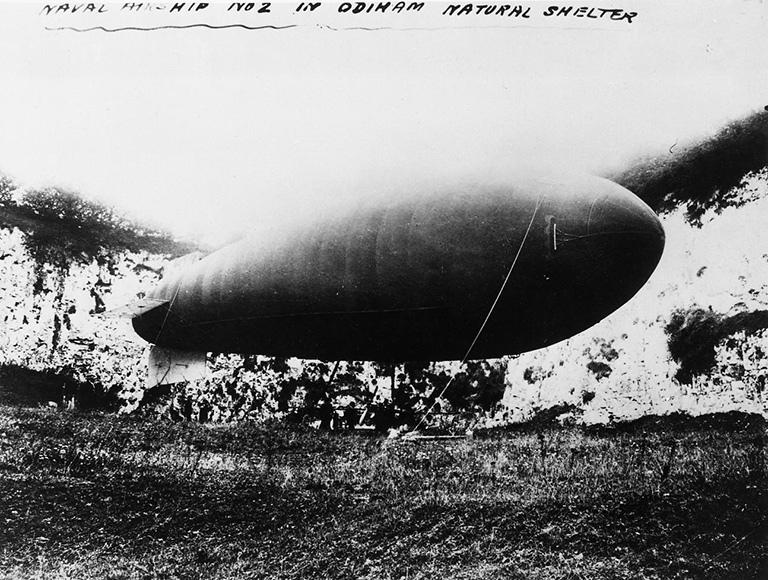
This guide provides advice on how to search for records of Royal Naval Air Service (RNAS) officers. Which sets of records you should consult will depend on the start and finish dates of the officer’s service.
What do I need to know before I start?
The Royal Naval Air Service (RNAS) was founded in July 1914 when the naval wing of the Royal Flying Corps (RFC) was moved out of the RFC and brought under Admiralty control.
On 1 April 1918 the RNAS was merged with the Royal Flying Corps to form the Royal Air Force (RAF).
If an RNAS officer continued to serve in the RAF after April 1918, his record after that date would be kept with the RAF service records.
The service records of officers discharged after 1920 are still kept by the Ministry of Defence.
Online records
RNAS officers’ registers of service (1906–1918)
Search by name and download (£) RNAS officers’ service records (ADM 273).
RAF service records (1918–1920)
Search the Royal Air Force officers’ service records online for RNAS officers who served after April 1918 (AIR 76).
Medal rolls (1793–1972)
Search by name for information about the award of campaign, long service and good conduct medals in the Royal Navy medal rolls (ADM 171) using Ancestry.co.uk (£). These rolls do not usually contain biographical information. Digital microfilm copies of these medal rolls are also available to download and browse from online free of charge.
Records available only at The National Archives in Kew
RNAS officer records held by The National Archives are available online (see above).
Records in other archives and organisations
RAF service records after 1920
Use the GOV.UK website to obtain information about accessing RAF service records after 1920, which are kept by the Ministry of Defence.
Other resources
Websites
Search the Commonwealth War Graves Commission website for details of men and women who died in the First and Second World Wars.
Look up an announcement of a 20th century gallantry award on The Gazette website.
Books
Some or all of the recommended publications below may be available to buy from The National Archives’ Bookshop. Alternatively, search The National Archives’ Library to see what is available to consult at Kew.
Consult the Navy List for an RNAS officer’s service up to the end of March 1918. Search the Air Force List for his service after April 1918.
Read ‘Air Force Records: A guide for family historians’, 2nd edition, by William Spencer (The National Archives, 2008).
1. Why use this guide?
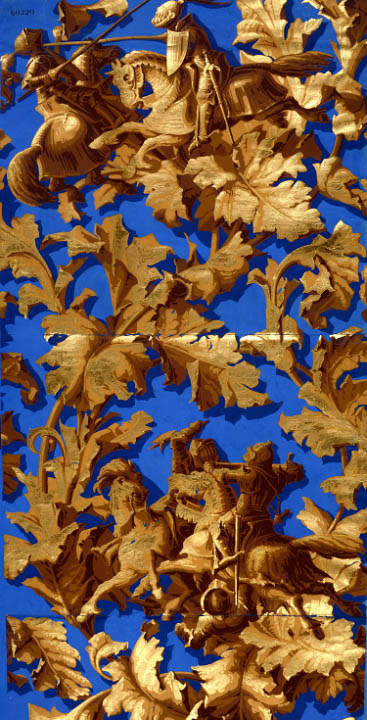
One of the many thousands of wallpaper, or ‘paper hanging’, designs from our collection, this one dated 1849 (catalogue reference BT 43/85/60220).
Among The National Archives’ most visually captivating collections is its stunning array of almost three million designs used for textiles, glasswork, metalwork, ceramics, furniture, wallpaper and other decorative arts and manufactured objects. We hold copies of these designs in the form of drawings, paintings, photographs and product samples, sent to the Designs Registry, part of the Board of Trade, to be registered for copyright protection between 1839 and 1991.
This guide explains how you can locate individual images or samples of these designs, known as ‘representations’, within our collection. There is also advice on how to find other details about each design, including the identity of the copyright owners or ‘proprietors’ – usually the manufacturer or retailer rather than the designer.
As registration was not compulsory, there are many commercially produced designs which you will not find in our records.
See our other intellectual property guides for advice on trade marks, patents and copyright.
For advice on modern-day registrations contact the Intellectual Property Office.
2. What, why and how designs were registered
Until 1839 there had been copyright protection in the UK for some textiles, but most areas of the decorative arts, such as glass, metalwork, ceramics and wallpapers, had no copyright protection at all. This changed with the 1839 Designs Registration Act which provided protection for all ‘ornamental’ designs.
From 1839, to apply for copyright protection you had to submit your design to the newly created Designs Registry, part of the Board of Trade and later to fall under the jurisdiction of the Patent Office. Registration protected the decorative elements of the design from being copied and manufactured without permission. Details of how an item worked – the mechanics of the design – were protected separately, by patents of invention (though patents did slip into the registered design records sometimes).
Today designs are registered with the Intellectual Property Office.
Although the system used for registering designs continued to change as subsequent Acts of Parliament extended and amended design copyright law, from 1842 the process always involved two basic record types: representations and registers.
3. Record types: representations and registers
When a design was submitted for copyright protection, details were added to two different types of records: design registers and representation books.
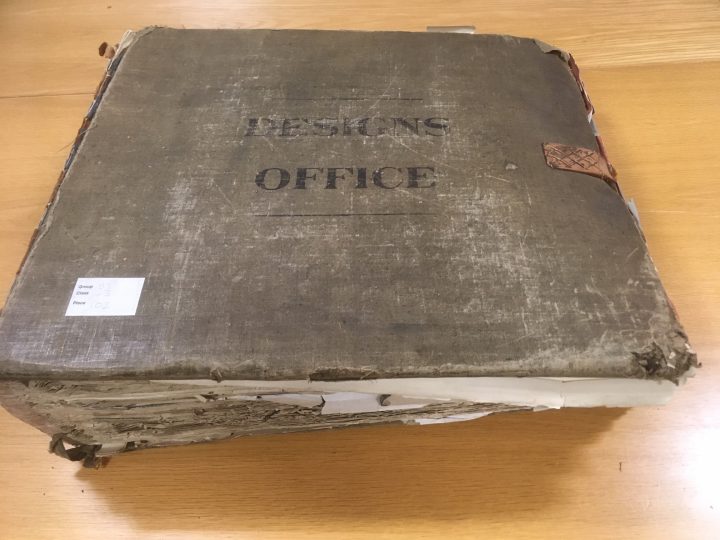
A representations book (catalogue reference BT 43/102).
3.1 Representations
Representations were drawings, paintings, photographs or samples of the design, such as wallpaper or textiles, submitted at the time of registration. We hold representations for around 2,950,000 designs.
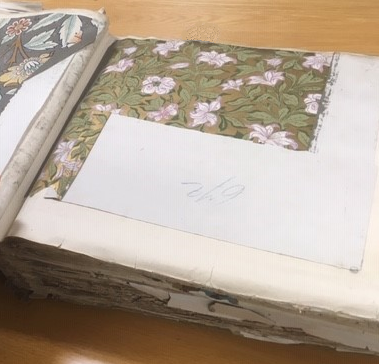
Inside a representations book (catalogue reference BT 43/102).
The representations were pasted into large bound volumes, and later stored in archival boxes, and have a registered design number stamped on them. The same number is recorded in the register so that you can cross refer between the two record types.
3.2 Registers
In the registers were recorded:
- the registered design number
- the name and address of the copyright owner, or ‘proprietor’ (usually the manufacturer or retailer rather than the designer)
- the date of registration
- sometimes a description of the design (for example ‘printed fabric’ or ‘dinner plate’)
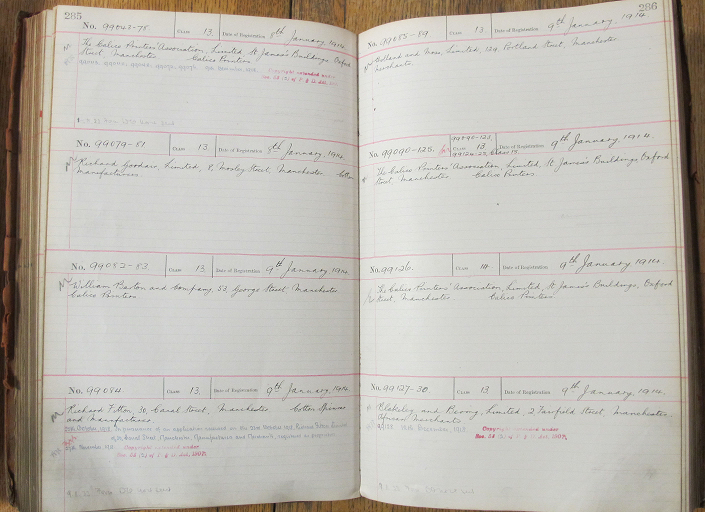
A design register (catalogue reference BT 53/111).
At The National Archives, these registers and representations have been split into various record series, each one determined by the most recent Act of Parliament in place when they were registered.
4. How to locate records: search methods
This section outlines the different search methods you can use to locate registered design records but for advice on which of these methods you can use for a particular period or set of years, see sections 5 to 11.
A search for a representation or register entry for any design begins in our online catalogue. The search methods that you can use depends very much on the date the design was registered and the parliamentary act applicable to its registration. However, if you do not know which date or act apply to a particular design, all is not lost – for some designs from some years you can search using other details you may know about them.
Successful searches will produce catalogue references (which for registered designs always begin with ‘BT’). Once you have found a catalogue reference for a representation or register that you would like to see you will need either to visit us, so that you can see the original in person, or request a copy to be sent to you (£).
Although vast numbers of registered design records survive, there are instances of registration numbers without corresponding records, and of numbers that were not used.
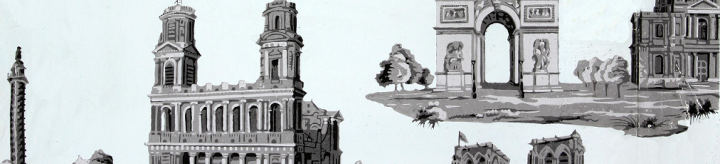
A wallpaper or ‘paper hanging’ design registered in November 1844 by William Evans of Shoreditch in London (catalogue reference BT 43/78/22871).
4.1 Searching by item type or details of owner
Following a series of projects at The National Archives to enhance catalogue descriptions, some of the online catalogue listings for representations and registers contain more detail than others. Where listings have been enhanced the extra details include:
- Description of item (for example, lamp, letter weight or belt)
- Name of proprietor
- Address of proprietor
- Design number
You can search for individual designs using these details for the following design types and their respective record series:
- Designs registered between 1839 and 1842, in BT 42 (see section 5 for more detail)
- ‘Ornamental’ designs registered between 1842 and 1883, in BT 43 (see section 6 for more detail)
- ‘Useful’ designs registered between 1843 and 1884, in BT 45 (see section 8 for more detail)
- Provisional ornamental designs registered between 3 January 1851 and 24 November 1876) and between 11 December 1876 and 27 December 1883, in BT 47 (see section 9 for more detail)
- Designs registered in 1884 and between 28 December 1893 and 9 January 1895, in BT 51
In some instances, you can also search by proprietor using the indexes to proprietors which were created as part of the original records but you will need to visit us to use them. See the tables in sections 5 to 11 for details of which records come with indexes.

A wallpaper design registered by Richard Goodlad and Company of Newcastle-on-Tyne in 1857 (catalogue reference BT 43/97/111263).
4.2 Searching by registered design number
Objects whose design has been registered should have a design number marked on them. However, in the case of wallpaper and textiles, usually used in sections, the design number is unlikely to be visible. If you know or can find a registered design number you should be able to find the respective register entry or representation in our collection, though it will be easier for some than for others.
When searching with a design number, it makes sense to start a search in BT 43 and, if your design is a ‘useful’ design (see section 8) in BT 45, as the designs in these series appear in our catalogue in individual detail, each with its respective design number. This is also true, though to a lesser extent, of BT 42, BT 47 and BT 51, of which only a small proportion has been catalogued in individual design detail. If searching in these series proves fruitless, you’ll need to consult the tables in sections 5 and 8 to 11 and follow the step by step instructions here below:
Search instructions
Let’s suppose we are looking for the representation of a glass vase with design number 523000. If you did not know the date that the design was registered, and in some instances even if you did, you would need to follow these steps:
- Using the tables in sections 5 and 9 to 11 of this guide, locate the design number range within which the number falls (numbers were reused so you will need to consult all the tables as your number may appear in more than one table). In section 11 the range 518644–548919 includes our number, 523000.
- Ensure the number range applies to the right kind of classification for the object. As the table in section 11 indicates, the only classification details we have for the respective design number range is ‘non-textile designs’. So our glass vase fits with this classification.
- Use the table to establish which catalogue references to search within. The table in section 11 indicates that, for representations we should be looking between BT 52/1 and BT 52/55 for our design number range.
- Click on the respective catalogue reference links in the table. For 523000 we need to click on BT 52/1–55.
- Browse through the BT numbers until you get to one for the more specific design number range which includes your number. For 523000 you will need to browse to BT 52/12 (which covers design numbers 522919–523306).
- Click on the catalogue reference for the respective catalogue description page which includes your number and follow the on-screen instructions for your ordering and viewing options. This is the catalogue description page for BT 52/12.
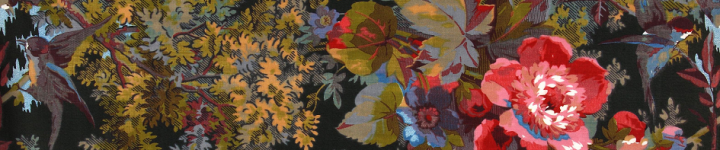
A furniture fabric design registered in 1877 (catalogue reference BT 43/373/313643).
- If you are viewing a representations book or register here at The National Archives in Kew you will need to page through the book until you arrive at the page for your design number.
4.3 Searching using a diamond mark (ornamental designs from 1842 to 1883 only)
Diamond marks were printed, engraved or otherwise marked on an object to authenticate its copyright registration and add a layer of protection against fraud. Diamond marks were only in use between 1842 and 1883 and only for objects registered under the terms of the 1842 Ornamental Designs Act.
If the object you are interested in has a diamond mark, you can use the mark to track down the registered design number and therefore the records themselves – see section 7 for more detail.

A printed fabric design registered in 1882 (catalogue reference BT 43/346/388554).
4.4 Searching in the Official Journal of the Patent Office at the British Library
The British Library holds copies of the Official Journal of the Patent Office, published weekly since the mid-19th century. The journal’s ‘Designs’ section lists registered designs by date of registration, class, design number, and proprietor, providing the address of the proprietor too. It may prove particularly useful when in search of a design registered after 1884 (from which point our own catalogue is short on descriptive detail).
5. Designs registered between 1839 and 1842
These records are for designs registered under the 1839 Copyright of Designs Act.
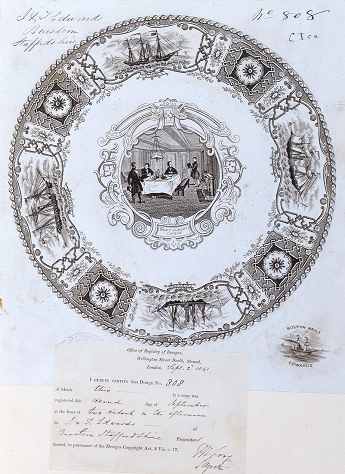
This representation for a plate design (catalogue reference BT 42/4/808), registered in 1841, was classified as ‘other than paper hangings’. The registration certificate is pasted below the representation.
The act classified objects either as ‘paper hangings’ – in other words, wallpaper – or anything ‘other than paper hangings’, which included all other objects, from chandeliers to telescopes.
There were no registers during this short period, but two sets of representations, one of which had a certificate attached which included registration details (see image on the right). To find a specific representation, search in BT 42 with one or more of the following as your keywords:
- description of object – for example ‘hat’ or ‘vase’
- name of proprietor (person registering the item for copyright, usually the manufacturer or retailer and only sometimes the designer)
- address of proprietor
- registered design number
If the search proves fruitless, follow the search instructions in section 4.2.
| Earliest possible date of registration | Latest possible date of registration | Design number range | Classification | Catalogue references for representations | Catalogue references for registers |
|---|---|---|---|---|---|
| 12/08/1839 | 31/08/1842 | 1-1424 | Other than paper hangings with certificates | BT 42/1-6(1) | None |
| 14/10/1839 | 31/08/1842 | 1-1424 | Other than paper hangings without certificates | BT 42/7-13 | None |
| 14/10/1839 | 29/04/1842 | 26-1218 | Paper hangings with certificates | BT 42/14-15(1) | None |
| 14/10/1839 | 29/04/1842 | 26-1218 | Paper hangings without certificates | BT 42/16-17(1) | None |
Notes:
(1) Not all representations survive
6. ‘Ornamental’ designs registered between 1842 and 1883/1884/1885
 This section covers records for designs registered under the 1842 Ornamental Designs Act. This act repealed the 1839 Act (see section 5) and sought to confine registration exclusively to ornamental designs, excluding the practical element of a design – though these would subsequently be covered by another act (see section 8) as well as by patents of design (see our guide to patents of design). In practice, however, many functional designs were effectively registered under the guise of a registration of the ornamental element of the design.
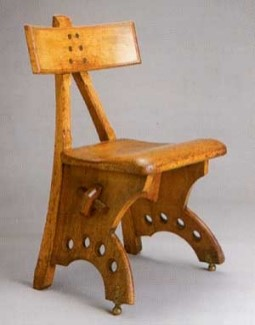
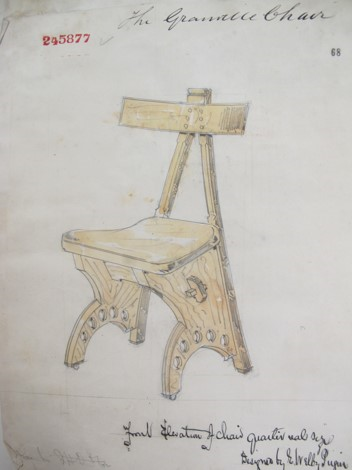
The ‘Granville’ chair and (above) its representation, registered in 1870 (catalogue reference BT 43/58/245877). A typical example of how the registration of the ornamental elements of a design could be used to surreptitiously register the functional elements of the design too.
The design classification codes were expanded under the terms of this act, meaning representations were filed under more precise classification categories, determined by the materials that the designed objects were made of. Although attempts were made to cover everything, the lace and the earthenware classifications became used as miscellaneous categories.
‘Diamond marks’ were another innovation brought into use with this act (see section 7).
To find a representation from this period, search in BT 43 with one or more of the following as your keywords:
- description of object – for example ‘hat’ or ‘vase’
- name of proprietor (person or company registering the item for copyright, usually the manufacturer or retailer and only sometimes the designer)
- address of proprietor
- registered design number
If you don’t have any of these details but your object contains a diamond mark, you can use the classification and date information that the diamond mark provides to find a record (see section 7).
As a last resort, you can, instead, click on the catalogue reference links in the table below for the respective classification type and browse through the record descriptions, though as there are hundreds of thousands of catalogue entries you will need to narrow your browsing range to a smaller range of dates.
| Earliest possible date of registration | Latest possible date of registration | Design number range | Classification | Catalogue references for representations | Catalogue references for registers |
|---|---|---|---|---|---|
| 01/09/1842 | 18/06/1884 | 1425-408896 | Class 1 – Metal | BT 43/1-56 | BT 44/1-5 |
| 07/10/1842 | 22/12/1883 | 1912-408680 | Class 2 – Wood | BT 43/57-59 | BT 44/6 |
| 01/09/1842 | 16/01/1884 | 1461-408895 | Class 3 – Glass | BT 43/60-63 | BT 44/7 |
| 22/09/1842 | 29/12/1883 | 1694-408849 | Class 4 – Earthenware | BT 43/64-74 | BT 44/8 |
| 01/09/1843 | 17/12/1883 | 1452-408445 | Class 5 – Paper hangings | BT 43/75-104 | BT 44/9 |
| 01/09/1842 | 21/12/1883 | 1446-408592 | Class 6 – Carpets | BT 43/105-169 | BT 44/10-11 |
| 21/10/1842 | 11/07/1885 | 2023-400649 | Class 7 – Printed shawls | BT 43/170-180 | BT 44/12 |
| 02/09/1842 | 13/11/1883 | 1462-406857 | Class 8 – Other shawls | BT 43/181-186 | BT 44/13 |
| 05/09/1842 | 27/10/1881 | 1465-372225 | Class 9 – Yarn | BT 43/187 | BT 44/14 |
| 01/09/1842 | 31/12/1883 | 1426-408890 | Class 10 – Printed fabrics | BT 43/188-354 | BT 44/15-27 |
| 10/09/1842 | 24/12/1883 | 1655-408714 | Class 11 – Furnitures (printed fabrics) (1) | BT 43/355-381 | BT 44/28 |
| 21/09/1842 | 31/12/1883 | 1693-408894 | Class 12 (i) – Other fabrics | BT 43/382-406 | BT 44/29-30 |
| 22/11/1853 | 11/12/1883 | 73748-408165 | Class 12 (ii) – Other fabrics (Damasks) | BT 43/407-415 | – |
| 07/10/1842 | 31/12/1883 | 1911-408892 | Class 13 – Lace | BT 43/416-432 | BT 44/31-32 |
| 12/08/1839 | 01/01/1870 | – | Indexes to Proprietors (A-Z) |
– | BT 44/33-38 (2) |
Notes:
(1) ‘Class 11, Furnitures’ were defined as printed fabric designs with a repeat pattern greater than 12 x 8 inches.
(2) The registers in BT 44/33–37 contain indexes of proprietors (volumes A and C–E – volume B is not available). BT 44/38 is an alphabetical register of the proprietors in BT 44/33–37.
7. Diamond marks, 1842-1883
Diamond marks were brought into use with the 1842 Ornamental Designs Act. They were no longer used once the 1842 Act was replaced by the 1883 Act (see section 8).
7.1 What were diamond marks?
Diamond marks were printed, engraved or otherwise marked on an object – for example, on the underside of china or the reverse of printed fabric. The mark was in the shape of a diamond with numbers and letters at specific points to represent the type of material used and the date of registration. However, in the case of wallpaper and textiles, usually used in sections, the diamond mark is not always visible and sometimes it may not be possible to locate it.
Diamond marks demonstrated that a design was registered, that it was designed in Britain and added a layer of protection against fraud. Between 1842 and 1883 they were issued with the registration number when a design was registered by the Patent Office, but only for designs registered under the terms of the 1842 Ornamental Designs Act.
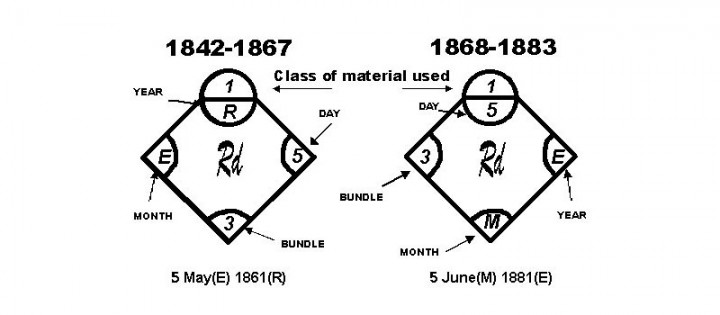
Two diamond marks, one from 1861, the other from 1881. From 1842–1867 letters were marked on the left point of the diamond and numbers on the right. From 1868–1883 letters were marked on the right point of the diamond and numbers on the left.
7.2 How to interpret diamond marks
If the object you are interested in has a diamond mark, you should be able to date the design and therefore the object itself. The fact that a design has a diamond mark at all tells you that it dates from between 1842 and 1883.
Roman numeral codes
The mark at the top of the diamond was a number (usually in Roman numerals, though in the example above it appears as an ordinary Arabic numeral) representing the material the item was made from, as follows:
I Metal
II Wood
III Glass
IV Ceramic
V Wallpaper
VI Carpets
VII–XIII Textiles of various kinds, including dress and furnishing fabrics
Letter and number codes
The number codes on a diamond mark represent the day of registration and the letter codes represent the year or month the design was registered.
Use Appendix 1 to interpret month codes and Appendix 2 to interpret year codes.
7.3 How to use a diamond mark to find a record
With the classification and date information provided by a diamond mark you can use our catalogue to either find an exact record or, more likely, narrow down your catalogue search results to a manageable number. To do this, follow these steps:
- Step 1: Go to the BT 43 series search
- Step 2: Search using the class number as your keyword (for example, Class 4) and the year (in the date boxes) – this will usually return a large number of results
- Step 3: Sort your search results by date using the drop-down list on the search results page (search results are displayed by ‘relevance’ by default)
- Step 4: Once your search results are sorted by date you should be able to scroll through the results to the date displayed on the diamond mark
8. ‘Useful’ designs (inventions) registered between 1843 and 1884
These records are for designs registered under the 1843 Utility Designs Act. This act sought to extend the range of designs that could be protected by copyright law, beyond the strictly ornamental designs covered by the 1842 Act (see section 6). The appearance of designs of utility could now officially be registered under copyright law, thus causing confusion with patent law.
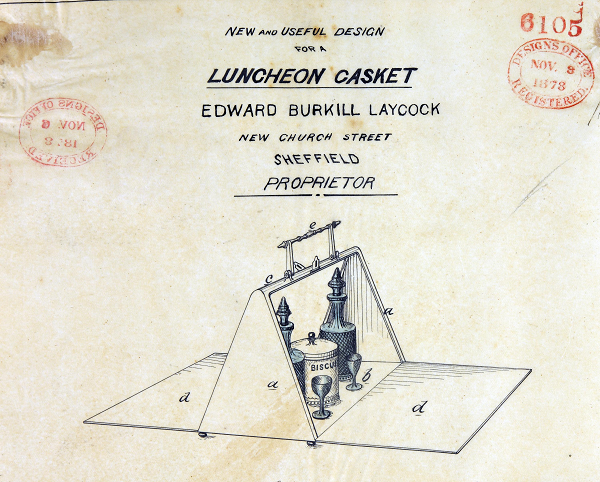
A representation for a ‘luncheon casket’, registered in 1878 (catalogue reference BT 45/29/6105).
Search for representations in BT 45 with one or more of the following as your keywords:
- description of object – for example ‘corkscrew’ or ‘saddle’
- name of proprietor (person registering the item for copyright, usually the designer but sometimes the manufacturer or retailer)
- address of proprietor
- registered design number
| Earliest possible date of registration | Latest possible date of registration | Design number range | Classification | Catalogue references for representations | Catalogue references for registers | Indexes |
|---|---|---|---|---|---|---|
| 01/09/1843 | 30/06/1884 | 1-6740 | Non-ornamental (useful) designs | BT 45/1-30 | BT 46/1-4 | Index to Proprietors’ names in BT 46/5-7 (1)
Alphabetical index to subjects in BT 46/9(2) |
Notes:
(1) Letter A is missing from the index in BT 46/5
(2) Covers registrations from 01/09/1843 to 12/04/1883
9. ‘Provisional’ designs and sculptures registered between 1851 and 1883
These records are for designs registered under the 1850 Copyright of Designs Act. The key developments under this act were:
- designs could be registered and protected for a ‘provisional’ or temporary period of one year
- sculptures could now be registered
9.1 How to search for records of an ornamental design registered under the 1850 Act
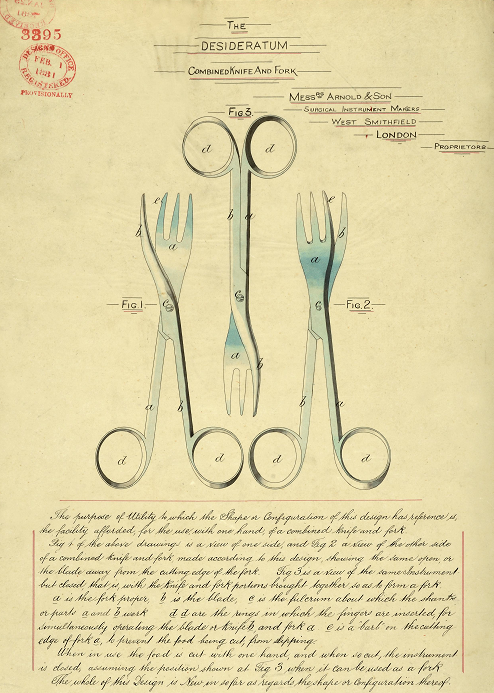
The registered design for Arnold and Son’s ‘Combined Knife And Fork’ (catalogue reference BT 47/9, registered design number 3395).
To locate a representation of a provisional ‘ornamental’ design, search in BT 47 with one or more of the following as your keywords:
- description of object – for example ‘hat’ or ‘vase’
- name of proprietor (person registering the item for copyright, usually the manufacturer or retailer and only sometimes the designer)
- address of proprietor
- registered design number
9.2 How to search for records of a ‘useful’ design or sculpture registered under the 1850 Act
If you know the registered design number, follow the steps outlined in section 4.2.
If you don’t know the registered design number you are left with the herculean task of leafing through the representation books hoping to spot your design – or searching through the registers until you find a description for your design.
| Earliest possible date of registration | Latest possible date of registration | Design number range | Classification | Catalogue references for representations | Catalogue references for registers | Indexes |
|---|---|---|---|---|---|---|
| 03/01/1851 | 27/12/1883 | 1-2025 | Provisional: Ornamental designs | BT 47/1-2 | BT 48/1 | – |
| 02/01/1851 | 31/12/1883 | 1-3819 | Provisional: Useful designs | BT 47/3-10 | BT 48/2 | Indexes to registers, by proprietors’ names, in BT 48/3-4(1) |
| 18/03/1851 | 22/11/1883 | 20-59(2) | Sculpture | BT 47/11 | BT 48/5 | – |
Notes:
(1) The indexes do not cover the the full range of dates shown.
(2) We do not hold records for design numbers 1–19 as they were missing before the records were transferred to The National Archives.
10. Designs registered between 1884 and 1908
These records are for designs registered under the 1883 Patents, Trade Marks and Designs Act. Following this act the Designs Registry, by now part of the Patent Office, all but abandoned the classification system and did not categorise designs according to material or type – except for sculpture.
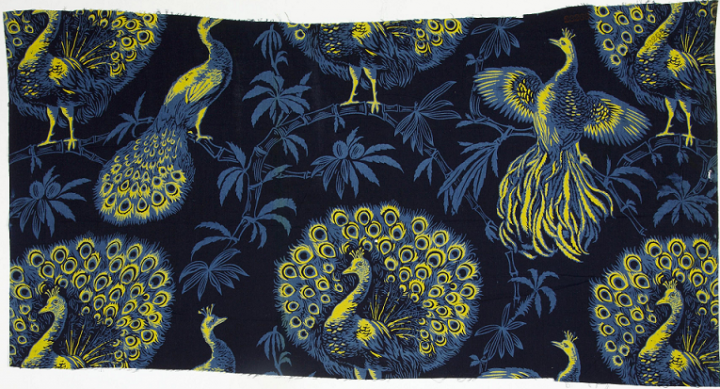
A Christopher Dresser textile design registered in 1885 (catalogue reference BT 50/30, registered design number 23268).
The representations for this period have not been described in our catalogue in descriptive detail so it will be difficult to find a record if you don’t know the registered design number. However, if you find an entry in the registers, which are a little easier to search within, it will provide you with the design number.
10.1 How to search for a register entry
You can search for registers in BT 51 by name or address of proprietor or by object type (see section 4.1) for designs from the following dates:
- 1884 (or browse BT 51/1– BT 51/10)
- 28 December 1893 to 9 January 1895 (or browse BT 51/75–BT 51/79)
10.2 How to search for a representation
If you do know the registered design number (which you can obtain if you find an entry in the registers – see above), follow the steps outlined in section 4.2.
If you do not know the registered design number your chances of finding a record depend upon the remote possibility that you may know the year, or even the month and year, when the design was registered and your willingness to leaf through the representation book covering those dates. You can view the covering dates of books and registers by clicking on the catalogue references below and browsing through the series.
| Earliest possible date of registration | Latest possible date of registration | Design number range | Classification | Catalogue references for representations | Catalogue references for registers | Indexes |
|---|---|---|---|---|---|---|
| 01/01/1884 | 08/01/1908 | 1-518643 | All designs except sculptures | BT 50/1-709 | BT 51/1-173 and BT 53/7-8 | Indexes by name (of submitting firm or person) for 1884-1894 in BT 51/174-175 |
11. Designs registered between 1908 and 1991
These records are for designs registered under the 1907 Patents and Designs Act and subsequent acts. Following this act the Designs Registry classified all designs as either textiles or, for everything else, non-textiles.
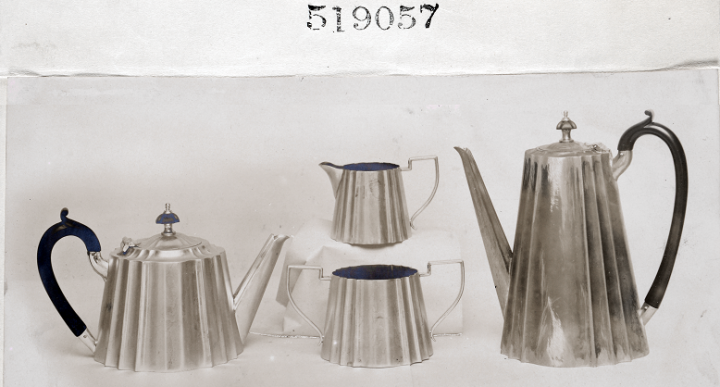
A tea set whose design was registered in 1908 (catalogue reference BT 52/1, registered design number 519057). Representations for non-textile designs came increasingly in the form of photographs.
To search for a record if you do know the registered design number, follow the steps outlined in section 4.2.
If you do not know the registered design number your chances of finding a record depend upon the remote possibility that you may know the year, or even the month and year, when the design was registered and your willingness to leaf through the representation book or register covering those dates. You can view the covering dates of books and registers by clicking on the catalogue references below and browsing through the series.
11.1 Textile designs
| Earliest possible date of registration | Latest possible date of registration | Design number range | Classification | Catalogue references for representations | Catalogue references for registers |
|---|---|---|---|---|---|
| 01/01/1908 | 15/12/1910 | 1-26041 | Classes 13, 14 & 15 | BT 52/56-165 | BT 53/9-10 |
| 21/06/1908 | 1964 | 1-495183 | All textile classes | BT 52/2455-7880 | BT 53/108-195 |
| Sep 1964 | July 1989 | 495184-515454 | All textile classes | BT 52/8163-8664 | BT 53/288-308 |
11.2 Non-textile designs
| Earliest possible date of registration | Latest possible date of registration | Design number range | Catalogue references for representations | Catalogue references for registers | Classified summaries (brief description of design only) |
|---|---|---|---|---|---|
| 08/01/1908 | 09/09/1909 | 518644-548919 | BT 52/1-55 | BT 53/1-8 & BT 51/138(1) | – |
| 09/09/1909 | 31/03/1950 | 548920-861679(2) | BT 52/166-2454(3) | BT 53/11-87(4) | BT 53/88-106(5) (558872-860616 only) |
| 01/04/1950 | 31/03/1968 | 861680-935499 | BT 52/7881-8162(6) | BT 53/196-287 | – |
| Mar 1968 | Jan 1991 | 935500-2012308 | BT 52/8665-9217 | BT 53/309-479 | – |
Notes:
(1) BT 51/138 includes design numbers 517232–520894
(2) For design numbers 600001–620000 there are, as well as representations, registers and classified summaries, also branch entry books, in BT 53/107 – they cover 1912–1913 only
(3) No representations were filed during the First World War period
(4) Only brief details were recorded during the First World War period
(5) BT 53/104 is missing
(6) Held in BT 52/7881 are miscellaneous design numbers 72411, 114769, 114787, 114858, 183063–183065, 183071–183072, 199774, 192389 and some unnumbered representations
12. Further reading and resources
Read Inventions that didn’t change the world by Julie Halls (Thames and Hudson, 2014) and listen to the related podcast.
Read The National Archives’ blog posts on design registers.
Listen to the podcast A momentous question: decorating the Victorian home.
Listen to the podcast Inventions that didn’t change the world: a history of Victorian curiosities.
Appendix 1: Diamond mark month codes
| Month code | Month | Month code | Month | |
|---|---|---|---|---|
| A | December | H | April | |
| B | October | I | July | |
| C | January | K | November | |
| D | September | M | June | |
| E | May | R | August | |
| G | February | W | March |
*R was used during 1–19 September 1857
*K was used for December 1860
*G was used for the month in place of W 1–6 March 1878
Appendix 2: Diamond mark year codes
Year codes for 1842–1867 in alphabetical order
| Year code | Year | Year code | Year | Year code | Year | ||
|---|---|---|---|---|---|---|---|
| A | 1845 | J | 1854 | S | 1849 | ||
| B | 1858 | K | 1857 | T | 1867 | ||
| C | 1844 | L | 1856 | U | 1848 | ||
| D | 1852 | M | 1859 | V | 1850 | ||
| E | 1855 | N | 1864 | W | 1865 | ||
| F | 1847 | O | 1862 | X | 1842 | ||
| G | 1863 | P | 1851 | Y | 1853 | ||
| H | 1843 | Q | 1866 | Z | 1860 | ||
| I | 1846 | R | 1861 |
Year codes for 1868–1883 in alphabetical order
| Year code | Year | Year code | Year | |
|---|---|---|---|---|
| A | 1871 | L | 1882 | |
| C | 1870 | P | 1877 | |
| D | 1878* | S | 1875 | |
| E | 1881 | U | 1874 | |
| F | 1873 | V | 1876 | |
| H | 1869 | W | 1878 | |
| I | 1872 | X | 1868 | |
| J | 1880 | Y | 1879 | |
| K | 1883 |
*From 1–6 March 1878, W was used for the year in place of D
Codes listed chronologically
| Year | Year code | Year | Year code | Year | Year code | Year | Year code | |||
|---|---|---|---|---|---|---|---|---|---|---|
| 1842 | X | 1855 | E | 1868 | X | 1881 | E | |||
| 1843 | H | 1856 | L | 1869 | H | 1882 | L | |||
| 1844 | C | 1857 | K | 1870 | C | 1883 | K | |||
| 1845 | A | 1858 | B | 1871 | A | |||||
| 1846 | I | 1859 | M | 1872 | I | |||||
| 1847 | F | 1860 | Z | 1873 | F | |||||
| 1848 | U | 1861 | R | 1874 | U | |||||
| 1849 | S | 1862 | O | 1875 | S | |||||
| 1850 | V | 1863 | G | 1876 | V | |||||
| 1851 | P | 1864 | N | 1877 | P | |||||
| 1852 | D | 1865 | W | 1878 | D* | |||||
| 1853 | Y | 1866 | Q | 1879 | Y | |||||
| 1854 | J | 1867 | T | 1880 | J |
*From 1–6 March 1878, W was used for the year in place of D.
1. Why use this guide?
This guide will help you find records at The National Archives relating to Royal Navy and Royal Marines operations and actions that took place after 1945.
The guide does not cover records of:
- personnel (for Royal Navy personnel records from this period contact the Ministry of Defence via the Veterans Agency)
- administration or supply
- technological research
You may also want to consult our guide to Royal Navy ships’ log books. Though ships logs and submarines’ logs are not the best records for details of operations, they do include some specific information on particular incidents.
2. Starting your research
2.1 Basic search principles
To view records at The National Archives you must first find document references for the records you are interested in.
Find document references by using keywords to search record descriptions in Discovery, our catalogue.
However, not all records have detailed descriptions in our catalogue and you may have to browse through a {record series[1]} to find a reference. See our Discovery help pages for more advice on whether to search or browse.
Once you have a document reference you can view the record but most of the principal operational records of the Royal Navy for this period are not available to view online. To view these documents you will need to either visit The National Archives at Kew or pay for copies to be sent to you. Alternatively, you can pay for research.
2.2 Use the advanced search option to search with keywords and by dates
Use the advanced search in our catalogue to narrow your search by year, using the ‘Date range’ option, and searching with keywords such as the following:
- name of operation, campaign or conflict (for example, Suez or “Operation Musketeer”)
- battle (for example, Inchon)
- theatre of operations or body of water (for example, Yangtse)
- ship (for example, “HMS Amethyst” or just Amethyst)
2.3 Narrow your search by department
Records at The National Archives are organised by the government department that created them. They all have abbreviated codes and for Royal Navy records the department code is ADM (Admiralty). However, there are many other departments in which there are records on Royal Navy operations, including DEFE, WO, AIR, CAB and others.
Use the advanced search in our catalogue to narrow your search by department code, using the ‘Search within’ option.
3. Specific operations and campaigns
You should be able to find most of our records for operations, campaigns and wars by searching our catalogue using keywords but there are some {record series[1]} that are particularly useful for specific wars. These include:
The Korean War in:
- DEFE 12 for UN Command operations reports
- DEFE 33 for Chiefs of Staff liaison papers
- ADM 316 for 2nd in Command of Far East Command papers
The Cod Wars in:
The Falklands War in:
- DEFE 14 for surrender documents only
4. Overseas fleet and station records
Use the advanced search in our catalogue to search for stations and commands within ADM 1 and ADM 116 using a keyword or phrase such as ‘West Indies’ or ‘South Atlantic’.
There are also some record series for specific stations and fleets. These are:
- Mediterranean Station and Fleet up to 1966 in ADM 121
- East Indies Station up to 1960 in ADM 127
- Naval Commander in Chief, Germany up to 1949 in ADM 228
5. Records of high command – the Cabinet
The Cabinet and the relevant cabinet committees are the most senior strategy and policy decision-making bodies. The Cabinet would generally review such matters as the annual Defence White Paper, Defence Reviews and major decisions concerning significant military deployments.
Most other defence policy matters after 1945 were increasingly dealt with by the Defence Committee (or its successor, the Defence and Overseas Policy Committee).
Read our research guide to Cabinet and its committees for advice on searching our catalogue for cabinet papers. You can also browse these records by date in our catalogue:
- Cabinet minutes (1945 onwards) in CAB 128
- Cabinet memoranda (1945 onwards) in CAB 129
- Cabinet Defence Committee papers (1945-1963) in CAB 131
- Cabinet Defence and Overseas Policy Committee (1963 onwards) in CAB 148
6. Records of high command – Ministry of Defence and related bodies
6.1 The First Sea Lord and the Board of Admiralty
Up until 1964 the Board of Admiralty was the body in command of the Royal Navy, headed by the First Sea Lord.
There are various record series for the Board of Admiralty and one of the most significant for Royal Navy operations in this period is ADM 205, the records of the First Sea Lord.
Use the advanced search in our catalogue to search ADM 205 using keywords.
6.2 The Chiefs of Staff Committee
The Chiefs of Staff Committee consisted of the professional heads of the three armed services. Its role was to provide advice on defence matters to the Prime Minister and government, and from 1958 was led by a Chief of Defence Staff chosen, usually in rotation, from one of the three services.
Search the following:
- Chiefs of Staff Committee minutes in DEFE 4:
- 1947-1969 – use the printed indexes to this series available with the printed version of our catalogue, only viewable at The National Archives building at Kew
- 1970 onwards – use the advanced search online to search for agenda items from these meetings, as listed in our catalogue
- Chiefs of Staff Committee memoranda in DEFE 5:
- 1947-1969 – use the printed indexes to this series available with the printed version of our catalogue, only viewable at The National Archives building at Kew
- 1970 onwards – use the advanced search online to search for agenda items from these meetings, as listed in our catalogue
- Secretary of the Chiefs Of Staff Committee’s standard files in DEFE 32
- Chiefs of Staff Sub Committees minutes and memoranda in DEFE 8 and DEFE 10 (1947 onwards)
- Chiefs of Staff Committee, Planning Staff Reports in DEFE 6 (1947 onwards)
- Registered files – Chiefs of Staff Committee in DEFE 11
6.3 The Defence Board and Defence Council
The Defence Board was created in 1958 and included all the service ministers, the service chiefs and senior officials. This unwieldy body was renamed the Defence Council in 1964 and in wide-ranging reforms officially took over the executive roles previously held by the three independent armed services ministries.
The Board of Admiralty was dissolved and replaced by the Admiralty Board, a sub-committee of the Defence Council.
- Browse our catalogue to find any of the four volumes of Defence Board minutes and memoranda in DEFE 30 (1958-1964)
- Consult the indexes in DEFE 45 (1964-1979) to find Defence Council instructions, also in DEFE 45
- Search or browse the Board of Admiralty/Admiralty Board Minutes and Memoranda by date in ADM 167
6.4 The Ministry of Defence
The Ministry of Defence was formed in 1946 but it wasn’t until 1964 that the Admiralty, War Office and Air Ministry were merged into a single, much larger unified Ministry of Defence headed by a Cabinet minister. Thus the Royal Navy passed under the control of the Ministry of Defence.
As a result, the types of operational and policy documents (that are in ADM 1, ADM 116 and ADM 205 up until 1964-1965), are more likely, after 1965, to be in various DEFE series.
Try a keyword search in our catalogue within the following record series (if this fails it may prove more productive to browse the same series – see our catalogue help for more advice on whether to browse or search):
- Ministry of Defence registered files in DEFE 7
- registered files – Defence Secretariat in DEFE 24
- registered files – Chief of Defence Staff in DEFE 25
- registered files – Branch files, Central Staffs in DEFE 68
- Private Office papers – Ministers and Secretary of State in DEFE 13
- Private Office papers – Permanent Under-Secretary in DEFE 23
7. Courts martial and Boards of Inquiry records
Navy legal records, particularly some courts martial and Boards of Inquiry records provide insights into particular incidents and accidents, including the loss of vessels.
Use the advanced search in our catalogue to search by the names of those on trial or the ship in question, restricting your search to:
- ADM 156 for records before 1964-1965
- ADM 330 for records after 1964-1965
- ADM 178 for records up to 1951
There are also courts martial records in ADM 1 and ADM 116. Search our catalogue in these record series using the phrase “courts martial”.
8. Royal Marines
Unit war diaries, similar to those kept for the British Army, provide a day-by-day operational account for units involved in active duties overseas.
Unit newsletters are internally distributed official magazines written by and for each Commando. They often contain details of operations as well as social and sporting activities.
Search our catalogue using advanced search for:
- unit war diaries (1941-1983) within ADM 202 by name and number of unit
- unit newsletters (1960-1978) within ADM 301 by name and number of unit
- Royal Marine Office correspondence and papers (1761-1983) within ADM 201 using keywords – it’s also worth browsing this series.
9. Fleet Air Arm
9.1 Squadron diaries
Search our catalogue using the advanced search within ADM 207 by squadron number for day-by-day operational accounts of individual squadrons. Some are unofficial accounts and provide varying degrees of detail on recreational and social activities too.
9.2 Operational reports, histories and other accounts
Search our catalogue using the advanced search within ADM 335 for standard operational reports but also for:
- accounts of aircraft trials
- a few squadron histories
- accident summaries from 1967 onwards
Consult ADM 335/1 for a history of the Fleet Air Arm (1912-1965).
9.3 Accident reports until 1962
For records relating to accidents up to and including 1962, use the advanced search in our catalogue to search ADM 1. Use keywords such as “aircraft accidents”.
For accident summaries from 1953 to 1955 see:
- ADM 1/24542-24600
- ADM 1/25320-25360
10. Records in other archives
The following institutions hold considerable archives relating to naval operational matters, including private papers and other donated collections:
In addition, try visiting the following museums for more specialist collections:
You can also search our catalogue to find records held elsewhere. Refine your results using the filters.
11. Further reading
Search The National Archives’ library catalogue for the publications below. You may also want to see what is available to buy from The National Archives’ shop.
Eric Grove, Vanguard to Trident (Naval Institute Press, 1987)
Bill Jackson and Dwin Bramall, The Chiefs: the Story of the United Kingdom Chiefs of Staff (Brassey’s, 1992)
1. Why use this guide?
The National Archives holds over a quarter of a million seals dating from the 11th to the 20th century. Much of the collection, which includes a number of significant royal, government and colonial seals, is from the medieval and early modern periods. Use this guide for advice on how to locate and view these seals.
Images of some of the seals and related records detailed in this guide are available to view online. Others are not and to view these and the original seals themselves you will need to visit us.
2. What are seals and what do they tell us?
2.1 What are seals?
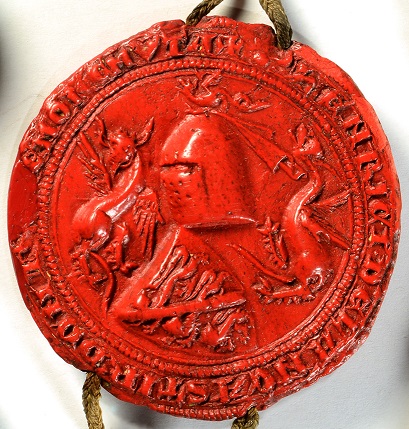
Seal used by Henry of Lancaster, Edward I’s nephew, in 1301 (catalogue reference: E 26/1)
The term seal is usually applied to the impression left by the stamping of an engraved metal die or ‘matrix’ which has been pressed into a material such as wax, but it is also used to refer to the matrix itself. Often bearing their owner’s portrait or coat of arms they were used to authenticate documents (such as charters, letters, writs) in much the same way as we use signatures today.
Seals were also used literally to ‘seal’ documents, fulfilling the same role today as gum on an envelope. They could either be attached to a document by a tag, tongue, cord, or placed directly on the face of the document.
2.2 What do seals tell us?
Seals can tell us much about a seal owner. They speak of authority and legitimacy, and the iconography and legend (around the seal circumference) often suggest something about the status of the owner and how they wanted to be regarded.
They can also provide us with valuable information for historical studies of:
- art
- costumes
- arms and armour
- heraldry
- architecture
- social status
- gender
A seal might also help identify and date the document to which it is attached.
3. Images of seals online
3.1 Seal Moulds Database
The National Archives holds around 6,500 plaster of Paris and silicone rubber moulds of seals in our collection. These were created by the Repairing/Conservation Department of the former Public Record Office from around 1880 to 1995 but were never formally accessioned. You can now see and download images of them for free via our catalogue.
Search PRO 23 by name of the seal owner or by broad category.
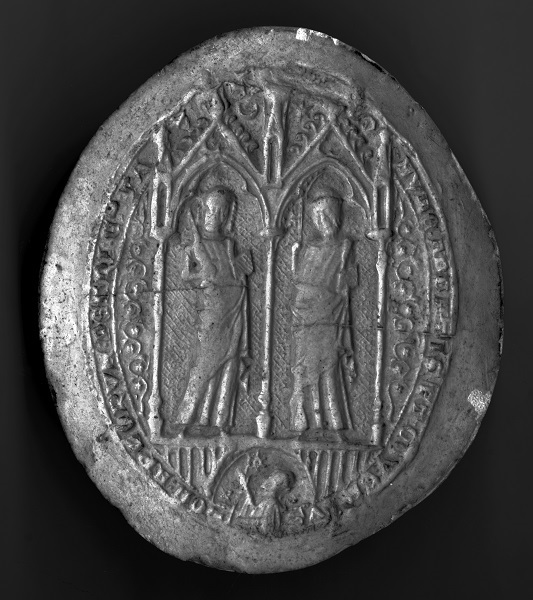
An image from the Seal Moulds Database (catalogue reference: PRO 23/2361)
The document downloads provide both a high resolution digital image of a surviving mould, like the image shown on the left, and information about:
- seal owner(s), both individuals and corporate bodies
- the reference of the parent document from which the seal mould was taken (which you can use to request to view the original at The National Archives)
- the seal’s colour
- the seal’s dimensions
They can be used in conjunction with the seals card index to identify seals in The National Archives’ collection.
3.2 Seals from the Duchy of Lancaster
Search our catalogue using the search box below to locate over 3,000 digitised images of 2,500 seals from the 12th to the 18th century. This is a search in series DL 25 and DL 26.
The seals from DL 25 and DL 26 are mostly personal seals but there are also:
- monastic seals
- ecclesiastical seals
- official seals
- local seals
Search by name, place or descriptive keyword. Each listing in our catalogue contain a description of the design of the seal, for example ‘lion sleeping facing right with four bushes above’ (from the description for DL 25/1336/1067). You can search for seals by matching your search terms to these descriptions.
Search tips:
Use:
- AND to find more than one term in the descriptions of seals
- double quotation marks “” to find exact terms
- the date filter to refine your search
If you wish to start a new search, return to the search box on this page.
4. How to locate original seals at The National Archives
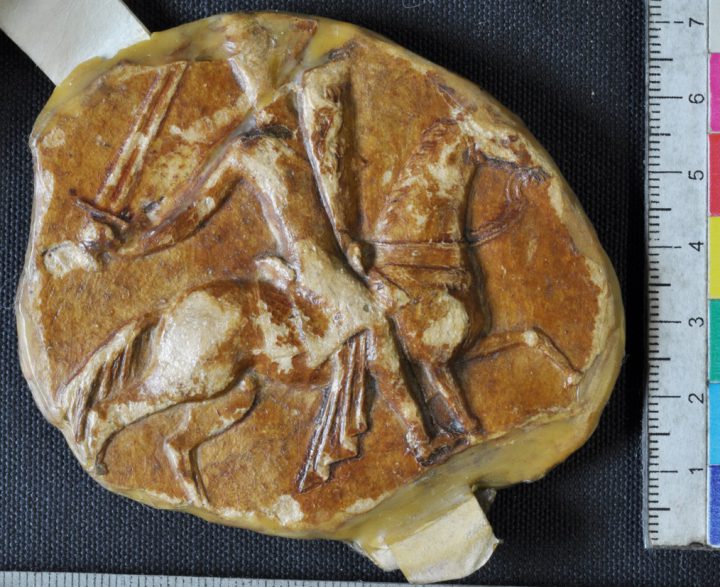
Great seal of Richard I, from 1189 (catalogue reference: DL 10/42)
There is a card index of seals held at The National Archives. You can use it to locate the seals themselves but also for detailed descriptions of the seals.
The cards provide:
- name of the seal owner
- date of the document to which the seal is attached
- colour, shape and size of seal
- device (subject)
- legend (name and title of owner round seal border) of the seal
- additional remarks
The card index is available in two forms:
- the original card index
- digitised versions of the cards (the Digitised Seals Register) available online
4.1 Using the Digitised Seals Register
Search QFA 1, the Digitised Seals Register, by category (but not initially by name of owner). For example, to find the great seal of William II enter the search terms, ‘England’ and ‘Sovereign’. Download the card images (for free) and look for William II in the sequence of reigns.
4.2 Using the original card index
Located in a set of drawers housed in the Map and Large Document Reading Room, the cards are divided into drawers arranged by the following headings:
- England and Wales: ‘Ecclesiastical’, ‘Monastic’, ‘Local’, ‘Private Corporate’ (Oxbridge colleges)
- England and Wales: ‘Royal: Great and Deputed’ and ‘Departmental and Official’ (these two drawers include seals for Scotland and Ireland)
- Official and Corporate seals of Scotland, Ireland, Channel Islands, British Colonies and Dependencies (including many early US seals), France, Germany, Hungary, Italy, Low Countries, Poland, Portugal, Russia, Spain, Switzerland, Scandinavia, USA
- ‘Personal: Armorial: Men’, ‘Personal: Armorial: Women’, ‘Personal: Non-Armorial: Men’ ‘Personal: Non-Armorial: Women’ and ‘Personal: Equestrian
Search tips:
- if you are looking for the seal of a churchman or abbess or prioress look under their bishopric, abbey or other religious establishment, rather than under their family name
- for laymen and laywomen search under ‘Non-armorial’, ‘Armorial’, and, especially if noble, ‘Equestrian’. Also look under any offices they may have held, such as Keeper of the Wardrobe
- titled nobility are indexed under their family name, for example, under ‘Percy’ for the Percys, Earls of Northumberland
- when you find the seal of an individual ensure they do not have a second or third seal in the same or another category. Sovereigns used a host of different seals, so check all the sub-categories listed under Royal. This also applies to queen consorts, princes, and other members of the royal family
The cards also provide:
- a cross reference to the British Museum’s Catalogue of Seals (for seals held by the British Library)
- document references to any further (and sometimes clearer) impressions of the same seal
- references to ‘Wyon’ refer to a publication, The Great Seals of England (1887), by to Alfred Benjamin and Allan Wyon
4.3 Using printed finding aids
Use these three volumes, each with indexes, which provide document references and contain photographic reproductions of the seals:
- Catalogue of Seals in the Public Record Office (1986)
- Personal Seals, vols I and II (1978 and 1981)
- Monastic Seals, vol I (1986)
Use the typescript Catalogue of Seals compiled by PDA Harvey which includes all the online seals from DL 25 and DL 26 as well as those from LR 14 and LR 15. Consult the name and place index to locate records.
4.4 Using the online catalogue
Search our catalogue to locate records using keywords and dates.
The Parliamentary Archives collections include a large number of seals, including seals of individuals on documents such as petitions, the Death Warrant of King Charles I and the Articles of Union between England and Scotland; and Royal seals on Royal Commissions. They can be found by searching the catalogue using keywords and dates.
5. Records held elsewhere
Find other major seals collections at:
- the British Library
- Durham University Library Archives who hold the Durham Cathedral Muniments
A collection of plaster casts are held by the Society of Antiquaries of London.
6. Further reading
Visit the National Archives’ shop for a range of books
Use our library catalogue to find a recommended book list.
7. Appendix 1: glossary of terms
| Glossary | Definition |
| Anonymous seals | Ready-made ‘anonymous seals’ were common amongst men of sub-knightly rank in the Middle Ages. The legends of such seals often consisted of a simple phrase or motto; no owner’s name would appear. Thus, if two individuals are found to be using two identical seals this could mean either one has borrowed from the other or they both own identical seals. |
| Armorial | Design shows shield of arms or shield plus crest (on a helmet) and/or supporters (either side of shield, e.g. the lion and unicorn). |
| Borrowed seals | Seals were often borrowed to authenticate documents. Check the sealing clause in the text of the document to which the seal is attached since the borrowing may be mentioned and the owner of the borrowed seal identified. |
| Counterseal | A smaller (often more personal) seal impressed into the back of another. |
| Departmental | Small official seals used by departments of the central government. |
| Deputed Great Seals | Seals very similar in size and design to the great seal. Used to authenticate documents which had been, or would be, authenticated by the great seal of England. |
| Equestrian | Portrait of person (usually in armour) on horseback. |
| Great Seal | Every sovereign of England (and later Great Britain) since Edward the Confessor has used a large double-sided great seal nearly always depicting him/her on one side enthroned (in majesty) and on the other on horseback (equestrian). |
| In Majesty | The sovereign enthroned usually holding sceptre, sword, orb etc. |
| Legend | The name and title of the seal owner, usually beginning with SIGILLUM, ‘seal of …’ which runs round the circumference of the seal rather like the words on a coin. Personal titles in legends help date seals. |
| Obverse and Reverse | The two sides of a double-sided seal. Both sides are the same size, like a coin. Referred to in seal catalogues as O and R. |
| Paper Seals | As paper became more common in the 15th century the practice arose of laying paper over the wax which was then pressed with a small matrix. |
| Privy Seal (and Signet) | As well as the great seal kept in the Chancery, sovereigns also had a private or privy seal for more personal use. By 1312 this was no longer in the monarch’s control but stayed in the new privy seal office. However, they still needed a private seal of their own, hence the new secret seal or signet. |
| Wafer Seals | In the 19th century, wafer seals made of coloured paper embossed with the seal design and then attached to the face of the document appeared. |
This is a guide to searching for records created by and about individual schools. The National Archives holds the administrative and policy files of the government departments concerned with education, but is not the best source of records for information on individual schools. Records documenting the life of an individual school, where they survive, are most likely to be held by the school itself, by local libraries and archives or, if the school was run by a charity, in the archives of that charity.
There are no records of individual pupils, or teachers, at The National Archives.
Where and how to get started
Your own school records
These records are not held at The National Archives
If you left school more than seven years ago, your school records, including academic reports, examination results and attendance registers, may have been securely destroyed. There is no legal obligation for schools to hold your records for longer than 25 years from the date of your birth.
If you are trying to trace your school records, try contacting:
- The school itself (if you left the school in the last seven to ten years)
- The local county education authority
- The local county archive or record office
The records of a school
Schools hold their own records but for schools that no longer exist you should contact the local county archive, library or record office, or the archives of the charities who ran the school, to see if the records have been deposited there. The National Archives’ catalogue contains details of collections held at local archives around the UK, along with contact details for each archive. You can try a search of our catalogue with the name of a school and restrict your search results to ‘Other archives’ using the filters. Alternatively, use our Find an archive tool to locate a local archive.
Many schools existed as parish, national, Church of England, or voluntary schools, and their records may be found in the papers of their respective parishes. The records of nonconformist churches may also contain some information about individual schools.
The records of schools held at The National Archives listed below are central government records.
Online records
School registers and log books, 1870-1914
Search by pupil’s name or school name in the school registers and log books 1870-1914 on Findmypast.co.uk (£). They include church, board, elementary and some secondary schools in England and Wales.
The records are from local archives, not The National Archives, and include handwritten registers, log-books (diaries recording the daily occurrences at the school, including absences, illnesses, visitors and holidays) and attendance records.
Teachers’ Registration Council Registers, 1870-1948
Search teachers’ registration records on the Findmypast.co.uk (£) for teachers in England and Wales from 1870 to 1948.
These are not National Archives records. Created by the Teachers Registration Council, the original records were deposited with the Society of Genealogists.
Records available only at The National Archives in Kew
To access these records you will either need to visit us, pay for research (£) or, where you can identify a specific record reference, order a copy (£).
Secondary education endowment files, 1850-1945
These are files of correspondence and other papers which include the drafts of schemes, inspection reports and records regarding the sale or transfer of land or stock.
Search our catalogue by name of school or town for secondary education endowment files in ED 27.
Elementary school files, 1854-1984, and secondary school files, 1818-1946
These ‘school files’ are not, in the main, records created by the schools themselves but correspondence about and sometimes from the schools, as well as inspection reports, and typically include information about school premises, trusts and organisation.
Search our catalogue by name of school or town for records of elementary schools (after 1944 the term ‘elementary’ was replaced by ‘primary’ and records of primary schools established before 1966 are included here) and secondary schools in ED 21, ED 35 and ED 161.
Building grant applications (1833-1870)
Search record series ED 103 by name of school or town for building grant applications among the records of the Committee of the Privy Council on Education.
Other resources
Published histories
Many public schools have published histories, which should be available in local libraries or through online booksellers. Some public school archives are listed in our guide to Education history records held in other archives.
Books
Read Education and the State from 1833, Ann Morton (PRO 1997).
In this guide we provide a brief overview of military and Merchant Navy records held at The National Archives. We will help you to understand some of the basic principles of searching for these records and to decide where on our website to go next. There are links throughout this guide to our more in-depth research guides where you can find more detailed advice on how to search for specific types of military and maritime records.
What are these records?
Military and maritime records at The National Archives are records once held by central government departments, especially the departments responsible for the British Army, the Royal Navy, the Merchant Navy and the Royal Air Force. Among them are records of service for individuals, operational plans and reports, administrative records of various kinds all the way up to those documenting top level government policy and decision making. These are the original records, most of them paper records, that played some part in the working life of these departments and the branches of the military which they governed. In some cases there are online versions, most commonly for records of individuals, but in many cases there are not.
How to get a search for records started
Before you begin a search you should see if there is a guide to the specific type of records you are looking for – this guide is designed to help you to do that. In the sections below you will find links to guides on specific categories of military and maritime records. We list only the main sources available in each category but you can also look through a list of all our military and maritime guides. To search for records, except for those provided online by our licensed partners, you will usually need to use our online catalogue. The catalogue contains short descriptions of the records and a search in our catalogue means searching for the keywords and dates that match these short descriptions. Some descriptions are just a word or two, essentially the titles of the original files, others contain several sentences of descriptive text. The more you get used to the format that these descriptions take, the more successful your searching is likely to be.
Our guides provide suggestions for keywords you can use to find different record types as well as guidance on some of the departments and series you should target in your search. The records are arranged by the government departments that created them, each one identified by a National Archives department code. Five of the most significant departments for these records are:
- The War Office, which administered the British Army – department code WO
- The Admiralty, which administered the Royal Navy – department code ADM
- The Air Ministry, which administered the Royal Air Force – department code AIR
- The Ministry of Defence, which replaced these three departments and brought the branches of the military together under one umbrella department – department code DEFE
- The Board of Trade, the parent government department for the Registrar General of Shipping and Seamen which administered the Merchant Navy – department code BT
Each of these departments is split into a large number of series which can be searched individually. A series contains records grouped together and usually linked in some way. A series is distinguished by its own reference, consisting of two parts: the first part is the department code, the second part is the series number. For example, British Army unit war diaries for the First World War form a single series, with the catalogue reference WO 95 – click on this reference to search the series.
A document within a series will have one or two further elements to its reference. For example, the unit war diary for the 10 Battalion Argyll & Sutherland Highlanders, May 1915 to April 1916, has the reference WO 95/1772/1.
How to view records
As well as a short description of its subject matter, each catalogue entry comes with a document reference (also referred to as a catalogue reference) and details of how you can view the record. If there is no online copy, you will need the document reference to see the record itself or to request copies.
Records of individuals
Military
Military service records are held separately for each branch of the military and records of officers are separate from other ranks. The records themselves vary in the detail they contain, from a full service history, to attestation papers or discharge papers, or entries in a list or register. This is explained in more detail in the research guides.
Records of military service after the First World War, including those for service in the Second World War, are just beginning to be transferred from the Ministry of Defence to The National Archives. For general advice, for all services, see our guide to soldiers in service after 1918.
There are guides for:
- Royal Navy ratings before 1913, and First World War
- Royal Navy commissioned and warrant officers
- Royal Marines other ranks and officers
- British Army soldiers before 1913 and First World War
- British Army officers before 1913 and First World War
- RAF personnel
- Indian Army personnel
For records of women’s military or other wartime service, see our guides to
- Women in the British Army and British Army nurses
- Women’s Royal Air Force personnel and Royal Air Force nurses
- Women’s Royal Naval Service (WRENs) and Royal Navy nurses
- Women’s Land Army
Merchant Navy
Records of service in the Merchant Navy are more varied. A number of different sorts of record were used by the Board of Trade to record the voyages of seamen and qualifications of officers. Our guidance therefore covers different date ranges but there may still be several different types of record for each individual seaman within each date range.
- Merchant seamen before 1914
- Merchant seamen of the First World War
- Merchant seamen since 1918
- Merchant Navy officers
For records of passengers on merchant ships consult our guide to Passengers.
Records of ships, squadrons, battalions and other military units
In general, for information on specific units of the military you need to look in ‘operational’ records. They take the shape of logs, record books and diaries recording the activities of air force squadrons, Royal Navy ships and British Army units. As well as containing details of the operations and activities themselves, they can provide background information to supplement service records or, if individual records are not available, fill in for them. The following guides are available for military operational records:
| Pre-First World War | First World War | Second World War | Post 1945 | |
| Royal Navy | Royal Navy operations and correspondence 1660-1914 | Royal Navy operations in the First World War | Royal Navy operations in the Second World War | Royal Navy operations and policy after 1945 |
| Army | British Army operations up to 1913 | British Army operations in the First World War | British Army operations in the Second World War | British Army operations after 1945 |
| Royal Air Force | Royal Air Force operations | |||
For records of movements of merchant vessels consult our guides to
- Merchant Navy ships’ records: crew lists, musters and log books
- Merchant Navy ships’ records: movement cards 1939-1945
Our guide to Ships wrecked or sunk has advice on finding records of shipwrecks and losses of both merchant and naval vessels.
We have incomplete collections of Lloyd’s Register of Ships and the Mercantile Nay List in our reading room.
Also see our guide to Maritime history records held by other archives for information on other archives holding significant collections related to merchant shipping, including the records of shipping companies.
Records of battles and military operations
See the table in the previous section for links to guides with detailed advice on operational records. However, in general, to search for records of the planning of military operations, battles or conflicts, and reports on their outcomes, you can search the catalogue using the name of the battle or the codename of the operation. Alternatively, search with the place or country where the battle or operation took place coupled with terms such as ‘war’, ‘battle’, or, for some 20th century records, ‘conflict’ or ’emergency’, along with appropriate date ranges.
It is usually worth trying alternative search terms, even if the initial search appears successful. In some cases, terminology may have changed since the time the records were created or may not be consistent across all related records. For example, a search for records on the ‘Opium Wars’ using the keywords ‘opium’ and ‘war’ for records from 1839-1860 finds mainly Foreign Office records but no War Office documents. However, related War Office records and more Foreign Office records are found with a catalogue search across the same range of years but using ‘China’ and ‘war’ as keywords (in both instances, note the ‘Collection’ filter on the left hand side of the page for a breakdown of the departments containing matching records).
Consult our overview guides for wars for further guidance on researching records of particular conflicts.
Research and development
For advice on finding records of military research and development, covering weapons technology, military hardware and so on, consult the guides below:
Government policy and administrative records
Worthwhile search strategies for finding records of high level government policy or discussions touching on the military and Merchant Navy include general searches across our catalogue, using a single or a couple of broad keywords as search terms, such as ‘nuclear policy’ or ‘peacekeeping’, and restricting results to specific years ranges or dates. For detailed guidance on records from the early 20th century onwards, see our guides to:
For advice on searching for earlier records see the various guides under our political history (general) index tag.
For the impact of government policy in the British Empire and Commonwealth and in the rest of the world, read our guides to:
As well as the main government ministries overseeing the Merchant Navy and armed forces, many other government departments may have had a stake in government policy and administration and hold relevant records. For example, this search for collections of records related to ‘shipbuilding’ shows wide ranging Government involvement across over a dozen departments.
Further reading
The following publications and many more are available through our library or bookshop
Amanda Bevan, Tracing your Ancestors in The National Archives (The National Archives, 2006)
William Spencer, Army Records: A guide for family historians (The National Archives, 2008)
William Spencer, Records of the Militia and Volunteer Forces 1757-1945 (Public Record Office, 1997)
Bruno Pappalardo, Tracing Your Naval Ancestors (The National Archives, 2003)
N A M Rodger, Naval Records for Genealogists (Public Record Office, 1998)
Bruno Pappalardo, Using navy records (Public Record Office, 2001)
William Spencer, Air Force records for family historians (The National Archives, 2008)
Christopher and Michael Watts, My Ancestor was a Merchant Seaman (Society of Genealogists, 2002)
Kelvin Smith, Christopher Watts, Michael Watts, Records of merchant shipping and seamen (Public Record Office, 2001)
1. Why use this guide?
This guide will help you find records at The National Archives relating to the origins, establishment and consequences of the League of Nations.
The League of Nations began life on 10 January 1920, when the Versailles Peace Treaty, signed in 1919 to formally end the First World War, came into effect.
2. How to find League of Nations records at The National Archives
There are thousands of records on the League of Nations at The National Archives.
Search Discovery, our catalogue, with the search term ‘league of nations’ to find most of these records.
Many government departments dealt with the League of Nations, so you can find records in many parts of The National Archives’ collection. Refine your search by government department, for example:
- Cabinet Office (CAB)
- Foreign Office (FO)
- War Office (WO)
- Treasury (T)
- Board of Trade (BT)
Use a variety of search terms to generate more results, for example:
- league of nations
- peace conference
- disarmament conference
- British Empire Delegation
Read our research guide to Cabinet and its committees for advice on searching our catalogue for cabinet papers.
The archived Cabinet Papers site has themed pages which you can browse, some with links to downloadable documents. In particular, explore the website’s collection of records relating to the League of Nations.
The Parliamentary Archives collections include significant early 20th-century personal political papers featuring League of Nations material, particularly records created by David Lloyd George. These can be accessed using our guide to the Lloyd George papers.
3. Key records
Key records at The National Archives include:
- FO 371/3439 and CAB 1/26/14: reports of an early British Government plan for a league of nations; FO 371/3439 includes a ‘Tentative Draft Convention for a League of Nations’, originating from a private organisation in the USA, the League to Enforce Peace
- CAB 29/1-40: British arrangements for the Peace Conference at Versailles
- CAB 21/217: a typescript history of the British Empire Delegation entitled ‘The Dominions and the Peace Conference’ by Clement Jones
- FO 371/4310: contains the text of the Covenant of the League of Nations – a charter signed in 1919
Some of The National Archives’ records series may be of particular interest, including:
- FO 608: Peace Conference: British Delegation, correspondence and papers, 1918-1920. This series contains information on the creation of the League of Nations. A card index is available in the reading rooms at The National Archives, Kew – reference FO 608/1
- FO 371: Foreign Office political correspondence – this is the series containing the most information on the League of Nations. Read our guide to Foreign Office correspondence 1906-1919 for instructions on how to use the card index to correspondence, reference FO 1111, online.
- PRO 30/52: League of Nations Assembly and Council documents. Includes papers circulated to the Assembly and Council, and journals (with indexes)
- YLG: 20th‑century personal and political papers of David Lloyd George include League of Nations material.
If you want to consult any of these documents, check the ordering and viewing options in our catalogue.
4. Records in other archives
Contact the following organisations if you have enquiries about records they hold relating to the League of Nations:
5. Further reading
You can find a history and description of the organisation of the Foreign Office and its records in The Records of the Foreign Office, 1782-1939, PRO Handbooks No 13 (HMSO, 1969).
Other books of interest:
Samuel Frederick Northedge, The League of Nations: Its Life and Times 1920-1946 (Leicester, 1986)
Donald S Birn, The League of Nations Union, 1918-1945 (Oxford, 1981)
George W Egerton, Great Britain and the Creation of the League of Nations: Strategy, Politics and International Organisation, 1914-1919 (London, 1979)
United Nations Library Geneva, Guide to the Archives of the League of Nations 1919-1946 (Geneva, 1978)
James Avery Joyce, Broken Star: The Story of the League of Nations, 1919-1939 (Swansea, 1978)
George W Baer, Test Case: Italy, Ethiopia and the League of Nations (Stanford, California, 1976)
Frank Hardie, The Abyssinian Crisis (London, 1974)
George Scott, The Rise and Fall of the League of Nations (London, 1973)
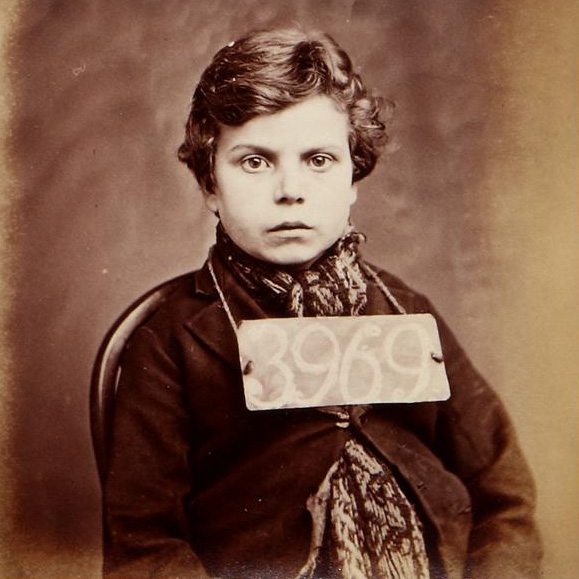
What are these records?
These records are albums containing photos and details of prisoners in Wandsworth prison from 1872 to 1873.
The prisoners’ photograph albums (in volumes PCOM 2/290 and PCOM 2/291) were created because taking a photo of a prisoner made it easier to identify criminals who had been convicted or offenders who went on to commit further crimes.
What information do the records contain?
As well as a photograph, each entry also includes:
- prisoner’s physical description
- date and place of birth
- the crime they committed
- sentence
- place of conviction
- prisoner’s intended residence after release from prison
The entries often give the prisoner’s place of residence before imprisonment.
How do I search the records?
You can search and download the records in Discovery (£) by filling in the form below.
You don’t need to complete every field to find a record.
You may prefer to browse through the albums in PCOM 2/290 and PCOM 2/291.
What do the records look like?
Joseph Charman description
To get an idea of what the records look like, see the prison record below of Joseph Charman, who was convicted for stealing a tame fowl.
He was discharged aged 12 after serving a sentence of six weeks’ hard labour. There is also a note saying ‘5 years ref’, which means he was ordered to serve five years on the Reformatory School Ship Cornwall, which was moored at Purfleet.
Prison record of Joseph Charman (PDF, 0.86MB)
The prison record of John Hearn is written on a slightly different type of form. John Hearn was convicted aged 12 for simple larceny. He had stolen 11 pieces of leather to the value of two shillings and was sentenced to one calendar month’s hard labour.
Prison record of John Hearn (PDF, 0.28MB)
Why can’t I find what I’m looking for?
These albums only include photos of all those sentenced to serve one month or more at Wandsworth prison during 1872 to 1873. If the person you seek served less than one month, you will not find a record here.
The National Archives holds other Wandsworth prison registers containing one-line entries for each prisoner, for the years 1858 to 1879 (PCOM 2/230-289). The registers for 1879 to 1956 are held at The Metropolitan Archives.