
What are these records?
These records in series WO 98 are the registers of the Victoria Cross between 1856 and 1944.
The Victoria Cross (VC) is the highest award available to the armed forces for gallantry in action with the enemy. It was originally made from the bronze cannon captured during the Crimean War (1854-1856). At first it was awarded only to British Army and Royal Navy personnel, but it was subsequently given to members of the other armed forces.
What information do the records contain?
The Victoria Cross registers may contain information about:
- when the award was made
- by whom and to whom the award was made
- if it was a posthumous award
The registers are heavily annotated. They were used when organising the 100th anniversary celebrations of the creation of the Victoria Cross, when many more recipients were still alive.
How do I search the records?
You can search and download (£) the records in Discovery, our catalogue, by filling in the form below.
You do not need to fill out every field to search these records.
Alternatively you can download free of charge a list of the recipients of the Victoria Cross from 1856 up to 1946 (CAB 106/320). This list was produced in 1953 and includes two awards made during the Korean War (1950-1953) and so provides a more complete picture.
What do the records look like?
The examples below illustrate what an entry on the Victoria Cross registers look like. The rank, name and corps of the inidividual are listed, as are the actions for which they are recommended. Hand-written notes can also be seen, providing further details on the individuals awarded the Victoria Cross.
Sidney Godley was the first private to be awarded the Victoria Cross during the First World War. Lieutenant G Bromhead was the basis for Michael Caine’s character in the film Zulu.
Record showing Private Sidney Godley (PDF, 0.82MB)
Record showing Lieutenant G Bromhead (PDF, 0.30MB)
Why can’t I find what I’m looking for?
Of the more than 1,350 awards made, including three bars, only 1,236 people have been recorded in the registers.
Information not contained in the registers
The following table lists those recipients of the Victoria Cross whose names do not appear in the registers. These volumes include all awards gazetted to 1 September 1944.
| Name | Rank | Regiment | Date | Locale |
|---|---|---|---|---|
| Agansing Rai | Naik | 2 Battalion 5th Royal Gurkha Rifles, Indian Army | 26 June 1944 | Bishnpur, Burma |
| Ali Haidar | Sepoy | 13th Frontier Force Rifles, Indian Army | 9 April 1945 | Fusignano, Italy |
| Allmand, Michael | Acting Captain | Indian Armoured Corps attached 6th Gurkha Rifles | 11 June 1944 | Pin Hmi Road Bridge, Burma |
| Archibald, Adam | Sapper | 218 Field Company Royal Engineers | 4 November 1918 | Near Ors, France |
| Auten, Harold | Lieutenant | Royal Naval Reserve | 30 July 1918 | English Channel |
| Badcoe, Peter John | Major | Australian Army Training Team, Australian Forces | 23 February 1967 | Huong Tra, Vietnam |
| Baskeyfield, John Daniel | Lance Sergeant | South Staffordshire Regiment, 1st Airborne Division | 20 September 1944 | Arnhem, Holland |
| Bates, Sidney | Corporal | Royal Norfolk Regiment | 6 August 1944 | Sourdeval, France |
| Bazalgette, Ian Willoughby | Acting Squadron Leader | 635 Squadron, Royal Air Force Volunteer Reserve | 4 August 1944 | Trossy St Maximin, France |
| Beharry, Johnson Gideon | Private | 1 Battalion Princess of Wales’s Royal Regiment | 1 May – 11 June 2004 | Al-Amarah, Iraq |
| Bhanbhagta Gurung | Rifleman | 3 Battalion 2nd Gurkha Rifles, British Indian Army | 5 March 1945 | Tamandu, Burma |
| Bhandari Ram | Sepoy | 10th Baluch Regiment, Indian Army | 22 November 1944 | East Mayu, Arakan, Burma |
| Blake, Frank Gerald | Temporary Major | Highland Light Infantry attached 3 Battalion 9th Gurkha Rifles | 9 July 1944 | Taunghi, Burma |
| Boyle, Edward Courtney | Lieutenant Commander | Royal Navy | 27 April 1915 | Sea of Marmara, Dardanelles,Turkey |
| Brunt, John Henry Cound | Temporary Captain | Sherwood Foresters attached 6 Battalion Lincolnshire Regiment | 9 December 1944 | Faenza, Italy |
| Buckingham, William | Private | 2 Battalion Leicestershire Regiment | 10-12 March 1915 | Neuve Chapelle, France |
| Burton, Richard Henry | Private | 1 Battalion Duke of Wellington’s West Riding Regiment | 8 October 1944 | Monte Ceco, Italy |
| Cain, Robert Henry | Temporary Major | Royal Northumberland Fusiliers attached South Staffordshire Regiment | 19-25 September 1944 | Arnhem, Netherlands |
| Cairns, George Albert | Lieutenant | Somerset Light Infantry attached South Staffordshire Regiment | 13 March 1944 | Henu Block, Burma |
| Carne, James Power | Lieutenant Colonel | 1 Battalion Gloucestershire Regiment | 22-23 April 1951 | Imjin River, Korea |
| Chapman, Edward Thomas | Corporal | 3 Battalion Monmouthshire Regiment | 2 April 1945 | Dortmund-Ems Canal, Germany |
| Charlton, Edward Colquhoun | Guardsman | 2 Battalion Irish Guards | 21 April 1945 | Wistedt, Germany |
| Cheshire, Leonard Geoffrey | Wing Commander | Royal Air Force Volunteer Reserve | July 1944 | |
| Chowne, Albert | Lieutenant | 2/2 Battalion New South Wales Australian Military Forces | 25 March 1945 | Dagua, New Guinea |
| Cosens, Aubrey | Sergeant | Queen’s Own Rifles of Canada, Canadian Army | 25-26 February 1945 | Mooshof, Holland |
| Crowe, Joseph Petrus Hendrik | Lieutenant | 78th Regiment | 12 August 1857 | Busherutgunge |
| Currie, David Vivian | Major | South Alberta Regiment, Canadian Army | 18-20 August 1944 | Battle of Falaise, Normandy |
| Curtis, Philip Kenneth Edward | Lieutenant | Duke of Cornwall’s Light Infantry attached 1 Battalion Gloucestershire Regiment | 22-23 April 1951 | Imjin River, Korea |
| Din, Fazal | Acting Naik | 10th Baluch Regiment | 2 March 1945 | Meiktila, Burma |
| Donnini, Dennis | Fusilier | 4/5 Battalion Royal Scots Fusiliers | 18 January 1945 | Between Roer and Maas Rivers, Holland |
| Durrant, Thomas Frank | Sergeant | Corps of Royal Engineers attached No.1 Commando | 27 March 1942 | St Nazaire, France |
| Eardley, George Harold | Acting Sergeant | 4 Battalion King’s Shropshire Light Infantry | 16 October 1944 | Overloon, Netherlands |
| Foote, John Weir | Captain | Royal Hamilton Light Infantry | 19 August 1942 | Dieppe, France |
| Fraser, Ian Edward | Lieutenant | Royal Navy | 31 July 1945 | Straits of Johor, Singapore |
| Frisby, Cyril Hubert | Acting Captain | 1 Battalion Coldstream Guards | 27 September 1918 | Canal du Nord, Graincourt, France |
| Furness, Christopher | Lieutenant | 1 Battalion Welsh Guards | 17-24 May 1940 | Near Arras, France |
| Ganju Lama | Rifleman | 1 Battalion 7th Gurkha Rifles | 12 June 1944 | Ningthoukhong, Burma |
| Ghadge, Yeshwant | Naik | 5th Maratha Light Infantry | 10 July 1944 | Upper Tiber Valley, Italy |
| Gian Singh | Naik | 15th Punjab Regiment | 2 March 1945 | Kamye, Burma |
| Gort, John Standish Surtees Prendergast Vereker | Acting Lieutenant Colonel | 1 Battalion Grenadier Guards | 27 September 1918 | Canal du Nord, Flesquieres,France |
| Grant, John Gilroy | Sergeant | 1 Battalion Wellington Regiment New Zealand Expeditionary Force | 1 September 1918 | Near Bancourt, France |
| Gray, Robert Hampton | Temporary Lieutenant | Royal Canadian Naval Volunteer Reserve | August 1945 | Onagawa Wan, Honshu, Japan |
| Grayburn, John Hollington | Lieutenant | Parachute Regiment | 17-20 September 1944 | Arnhem, Holland |
| Gurung, Thaman | Rifleman | 1 Battalion 5th Royal Gurkha Rifles | 10 November 1944 | Monte San Bartolo, Italy |
| Hancock, Thomas | Private | 9th Lancers | 19 June 1857 Delhi | |
| Harden, Henry Eric | Lance Corporal | Royal Army Medical Corps attached 45 Royal Marine Commando | 23 January 1945 | Brachterbeek, Holland |
| Harper, John William | Corporal | 4 Battalion York and Lancaster Regiment | 29 September 1944 | Antwerp, Belgium |
| Havelock, Henry Marsham | Lieutenant | 10th Regiment | 16 July 1857 | Cawnpore |
| Hedges, Frederick William | Temporary Lieutenant | Bedfordshire Regiment attached 6 Battalion Northamptonshire Regiment | 24 October 1918 | North East of Bousies, France |
| Hunter, Thomas Peck | Temporary Corporal | 43 Commando, Royal Marines | 2 April 1945 | Lake Comacchio, Italy |
| Insall, Gilbert Stuart Martin | Second Lieutenant | Royal Flying Corps | 7 November 1915 | Near Achiet, France |
| Jackson, Norman Cyril | Sergeant | Royal Air Force | 26-27 April 1944 | Schweinfurt, Germany |
| Jackson, Thomas Norman | Lance Corporal | 1 Battalion Coldstream Guards | 27 September 1918 | Canal du Nord, Graincourt, France |
| Jamieson, David Auldjo | Captain | Royal Norfolk Regiment | 7-8 August 1944 | Grimbosq, Normandy |
| Jones, Herbert | Lieutenant Colonel | 2 Battalion Parachute Regiment | 28 May 1982 | Darwin, Falkland Islands |
| Joynt, William Donovan | Lieutenant | 8 Battalion Australian Imperial Force | 23 August 1918 | Herleville Wood, Chuignes, Somme, France |
| Judge, Karamjeet Singh | Lieutenant | 4 Battalion 15th Punjab Regiment | 18 March 1945 | Meiktila, Burma |
| Kenna, Edward | Private | 2 Battalion New South Wales Australian Military Forces | 15 May 1945 | Wewak, New Guinea |
| Knowland, George Arthur | Lieutenant | Royal Norfolk Regiment attached 1 Commando | 31 January 1945 | Kangaw, Burma |
| Lachhiman, Gurung | Rifleman | 8th Gurkha Rifles | 12-13 May 1945 | Taungdaw, Burma |
| Lassen, Anders Frederik Emil Victor Schau | Temporary Major | General List attached Special Boat Service No.1 SAS Regiment | 8 April 1945 | Lake Comacchio, Italy |
| Leakey, Nigel Gray | Sergeant | 1/6 Battalion King’s African Rifles | 19 May 1941 | Colito, Abyssinia |
| Liddell, Ian Oswald | Temporary Captain | 5 Battalion Coldstream Guards | 3 April 1945 | Lingen, Germany |
| Limbu, Rambahadur | Lance Corporal | 2 Battalion 10th Princess Mary’s Own Gurkha Rifles | 21 November 1965 | Sarawak, Borneo |
| Lord, David Samuel Anthony | Flight Lieutenant | 271 Squadron, Royal Air Force | 19 September 1944 | Arnhem, Holland |
| MacKey, John Bernard | Corporal | 2/3rd Pioneer Battalion, Australian Military Forces | 12 May 1945 | Tarakan Island, North Borneo |
| Magennis, James Joseph | Acting Leading Seaman | Royal Navy | 31 July 1945 | Straits of Johor, Singapore |
| McKay, Ian John | Platoon Sergeant | 4 Platoon B Company, 3 Battalion Parachute Regiment | 12 June 1982 | Mount Longdon, Falkland Islands |
| Muir, Kenneth | Major | 1 Battalion Argyll and Sutherland Highlanders | 23 September 1950 | Songju, Korea |
| Mynarski, Andrew Charles | Warrant Officer 11 | 419 Squadron, Royal Canadian Air Force | 12 June 1944 | Over Cambrai, France |
| Namdeo Jadav | Sepoy | 5th Maratha Light Infantry, Indian Army | 9 April 1945 | Senio River, Italy |
| Nasmith, Martin Eric | Lieutenant Commander | Royal Navy | 20 May – 8 June 1915 | Sea of Marmara, Dardanelles, Turkey |
| Negi, Gobar Singh | Rifleman | 2/39th Garhwal Rifles, Indian Army | 10 March 1915 | Neuve Chapelle, France |
| Newman, Augustus Charles | Lieutenant Colonel | Essex Regiment | 27 March 1942 | St Nazaire, France |
| Norton, Gerard Ross | Lieutenant | Kaffrarian Rifles, South African Forces attached 1 Battalion Hampshire Regiment | 31 August 1944 | Montegridolfo, Italy |
| Osborn, John Robert | Company Sergeant Major | 1 Battalion Winnipeg Grenadiers, Canadian Army | 19 December 1941 | Hong Kong |
| Palmer, Robert Anthony Maurice | Squadron Leader | 109 Squadron, Royal Air Force Volunteer Reserve | 23 December 1944 | Over Cologne, Germany |
| Partridge, Frank John | Private | 8 Battalion Victoria Australian Military Forces | 24 July 1945 | Bougainville, Solomon Islands |
| Payne, Keith | Warrant Officer | 11 Australian Army Training Team, Australian Forces | 24 May 1969 | Ben Het, Kontum Province, Vietnam |
| Purcell, John | Private | 9th Lancers | 19 June 1857 | Delhi |
| Queripel, Lionel Ernest | Captain | Royal Sussex Regiment attached 10th Parachute Battalion | 19 September 1944 | Arnhem, Holland |
| Randle, John Neil | Temporary Captain | 2 Battalion Royal Norfolk Regiment | 4 May 1944 | Battle of Kohima, North East India |
| Rattey, Reginald | Roy Corporal | 25 Battalion Australian Military Forces | 22 March 1945 | Bougainville, Solomon Islands |
| Raymond, Claude | Lieutenant | Corps of Royal Engineers | 21 March 1945 | Talaku, Burma |
| Ritchie, Henry Peel | Commander | Royal Navy | 28 November 1914 | Dar-es-Salaam, Tanganyika |
| Rivers, Jacob | Private | 1 Battalion Sherwood Foresters | 12 March 1915 | Neuve Chapelle, France |
| Roope, Gerard Broadmead | Lieutenant Commander | Royal Navy | 8 April 1940 | West Ford, Norway |
| Salmon, Nowell | Lieutenant | Royal Navy | 16 November 1857 | Lucknow |
| Scarf, Arthur Stewart King | Squadron Leader | 62 Squadron, Royal Air Force | 9 December 1941 | Malaya |
| Shah, Sher | Lance Naik | 16th Punjab Regiment | 19-20 January 1945 | Kyeyebyin, Burma |
| Simpson, Rayene Stewart | Warrant Officer 11 | Australian Army Training Team, Australian Forces | 6 May 1969 | Kontum Provence, Vietnam |
| Singh, Badlu | Ressaidar | 14th Lancers attached 29th Lancers, Deccan Horse, Indian Army | 23 September 1918 | River Jordan, Palestine |
| Singh, Prakash or Parkash | Jemadar | 13th Frontier Force Rifles | 16-17 February 1945 | Kanlan Ywathit, Burma |
| Singh, Ram Sarup | Acting Subidar | 2 Battalion 1st Punjab Regiment | 25 October 1944 | Kennedy Peak, Tiddim, Burma |
| Smith, Ernest Alvia | Private | Seaforth Highlanders | 21-22 October 1944 | River Savio, North Italy |
| Speakman, William | Private | Black Watch (Royal Highlanders) attached 1 Battalion King’s Own Scottish Borderers | 1951 | United Hill, Korea |
| Starcevich, Leslie Thomas | Private | 2 Battalion South Australia Australian Army | 25 May 1945 | Beaufort, North Borneo |
| Stokes, James | Private | 2 Battalion King’s Shropshire Light Infantry | 1 March 1945 | Kervenheim, Rhineland |
| Sukanaivalu, Sefanaia | Corporal | Fijian Infantry Regiment | 23 June 1944 | Bougainville, Solomon Islands |
| Swales, Edwin | Captain | RAF Pathfinder Force, 582 Squadron | 23 February 1945 | Pforzheim, Germany |
| Thapa, Netrabahadur | Acting Subidar | 2 Battalion 5th Royal Gurkha Rifles | 25-26 June 1944 | Bishenpur, Burma |
| Thapa, Sher Bahadur | Rifleman | 9th Gurkha Rifles | 18-19 September 1944 | San Marino, Italy |
| Thompson, George | Flight Sergeant | 9 Squadron Royal Air Force Volunteer Reserve | 1 January 1945 | Over Dortmund-Ems Canal, Germany |
| Tilston, Frederick Albert | Acting Major | Essex Scottish Regiment, Canadian Army | 1 March 1945 | Hochwald Forest, Germany |
| Topham, Frederick George | Corporal | 1 Canadian Parachute Battalion, Canadian Army | 24 March 1945 | Rhine, Germany |
| Trent, Leonard Henry | Squadron Leader | Royal New Zealand Air Force | 3 May 1943 | Amsterdam, Netherlands |
| Tulbahadur Pun | Rifleman | 3 Battalion 6th Gurkha Rifles, Indian Army | 23 June 1944 | Mogaung, Burma |
| Umrao Singh | Havildar | 33 Mountain Battery, Royal Indian Artillery | 15 December 1944 | Kaladan Valley, Burma |
| Upham, Charles Hazlitt (bar) | Second Lieutenant | New Zealand Military Forces | 14-15 July 1942 | Ruweisat Ridge, Egypt |
| Warneford, Reginald Alexander John | Flight Sub-Lieutenant | Royal Navy 1 Squadron Royal Naval Air Service | 7 June 1915 | Over Ghent, Belgium |
| Watkins, Tasker | Lieutenant | 1/5 Battalion Welsh Regiment | 16 August 1944 | Barfour, Normandy |
| Weston, William Basil | Lieutenant | Green Howards | 3 March 1945 | Meiktila, Burma |
| Wheatley, Kevin Arthur | Warrant Officer | 11 Australian Army Training Team, Australian Forces | 13 November 1965 | Tra Bong, Vietnam |
| Wilcox, Alfred Lance | Corporal | 2/4 Battalion Oxford and Buckinghamshire Light Infantry | 12 September 1918 | North East of Laventie, France |
| Wilkinson, Thomas | Temporary Lieutenant | Royal Naval Reserve | 14 February 1942 | Java Sea, off Malaya |
| Wood, Wilfred | Private | 10 Battalion Northumberland Fusiliers | 28 October 1918 | Casa Vana, Italy |
| Wright, Peter Harold | Company Sergeant Major | 3 Battalion Coldstream Guards | 25 September 1943 | Salerno, Italy |
This is a guide to locating records of merchant seamen in service since the end of the First World War, including records from the Second World War, and up to the last decades of the 20th century. These are records of seamen serving on British registered vessels but the seamen themselves need not have been British to appear in the records.
For service records of seamen serving after 1972 go to the Maritime and Coastguard Agency.
What do I need to know before I start?
The records with the most detail
There are three principal sources of service details for merchant seamen up to 1972 (from 1972 go to the Maritime and Coastguard Agency). They are:
- Central Index Register, 1918-1941 (also known as the Fourth Register of Seamen)
- Central Register of Seamen, 1941-1972 (also known as the Fifth Register of Seamen)
- Seamen’s Pouches, 1940-1972 (created primarily as files for paperwork supporting applications for discharge – files can contain paperwork from both the Fourth and Fifth Registers)
If the seaman was only employed temporarily, or was an apprentice, he may not have been issued with a discharge ‘A’ number or a British Seaman’s Identity Card in which case he is unlikely to appear in the registers.
Access to full details of seamen born less than 100 years ago may be restricted.
How to trace a ship
Sometimes the only way to track down a record of a seaman is to trace the records of the ships he served on. You can use the CLIP (Crew List Index Project) website to trace a ship by the:
- ship’s name
- ship’s port of registration
- ship’s official number
How to interpret abbreviations in the records
See our guide to Abbreviations in merchant seamen records for further help interpreting information in these records.
Online records
Central Index Register (aka Fourth Register of Seamen), 1918-1941
Search and download registry cards from the Central Index Register (BT 348, BT 349, BT 350 and BT 364) of merchant seamen employed between 1918 and 1941 on Findmypast.co.uk (£). The originals are held by Southampton Archives.
For details of what sort of information the records may provide read the descriptions of BT 348, BT 349, BT 350 and BT 364 in our catalogue.
The Central Index Register, or Fourth Register of Seamen, was started in 1913 and maintained until 1941. The entries for 1913-1918 were destroyed, therefore the register covers the period from the last two months of 1918 to 1941.
Second World War medals
Search and download (£) records of Second World War campaign medals issued to merchant seamen (BT 395) on our website.
Second World War Roll of Honour
Search the Shipping and Seamen First and Second World War Rolls of Honour (BT 339) on Ancestry (£). The Roll of Honour lists merchant seamen who died in service during the war or who were declared ‘missing, presumed dead’. The information in these records usually includes:
- rank or rating
- name of ship
- date of death or presumed death
Records available only at The National Archives in Kew
To access these records you will either need to visit us, pay for research (£) or, where you can identify a specific record reference, order a copy (£).
Central Register of Seamen (aka Fifth Register of Seamen), 1941-1972
Browse the catalogue descriptions of records from the Central Register of Seamen 1941-1972 in BT 382 (the records themselves were known as CRS 10 forms). Our catalogue descriptions are arranged alphabetically in ranges of surnames.
The registers are filed in eight parts according to the nationality or ‘origin’ of the seamen and other criteria (each part has been assigned its own subseries in BT 382). Select from one of the eight subseries of the register to target your browsing of the series more efficiently (for seamen of European origin you should look for records in both Part 1 and Part 2).
These CRS 10 forms are often referred to as seamen’s docket books and can include the following details (for the full list of possible details see the series description of BT 382):
- date of birth
- place of birth
- rank or rating
- a list of ships and their official numbers with date and place of engagement
- F or H (for Foreign or Home trade voyage)
- date and place of discharge from the ship
Seamen’s pouches, issued 1940-1972 but covering service 1913-1972
Merchant seamen who were discharged from the navy between 1940 and 1972 had their records filed in what became known as ‘seamen’s pouches’. Some of the seamen discharged during this period had been in service as far back as 1913 and the records reflect this. Use the box below to search our catalogue, by name in BT 372 and BT 391 to see if a seaman’s pouch survives. Not every pouch survives and many were destroyed before any were transferred to The National Archives.
Details provided may include:
- surname and initials
- place of birth
- date of birth
- ships a seaman served on
For more details see the series descriptions for BT 372 and BT 391.
In a third series, BT 390, you can browse references to seamen’s pouches for service in the Second World War. They are arranged in alphabetical ranges, though a few describe individual seamen. You can try a search with a specific name and learn something about what the records contains from the BT 390 series description.
Agreements and crew lists, 1861-1994
The National Archives holds the following proportions of agreements and crew lists after 1861:
- 1861-1938: 10%
- 1939-1950: 100%
- 1951-1994: 10%
Use the box below to search for these agreements and crew lists by ship’s official number in BT 99, BT 380, BT 381 and BT 100. For the more celebrated and famous ships you can also search by ship’s name. Discover a ship’s official number at the Crew List Index Project website (CLIP) or the Miramar Ship Index (£).
Not all agreements and crew lists are searchable on our catalogue by ship’s number. You may need to browse catalogue descriptions for records from 1951 onwards in BT 99 as the ships’ numbers are not itemised and are, instead, displayed in ranges.
For more information read Crew lists, agreements and log books of merchant ships after 1861.
Merchant Navy apprentices
Browse the indexes of apprentices registered in the merchant navy in BT 150. Please note the indexes for 1824-1910 are available online; indexes up to 1953 are on microfilm.
Surviving apprentices’ indentures are in BT 151, 1845-1962, and BT 152, indentures for fishing, 1895-1935. Please note only a sample of the indentures was preserved, a two-month sample for every five years except 1960-1962, for which years the sample covers the entire year.
Browse BT 151 and BT 152 by date in Discovery to find your microfilm number.
Merchant Navy gallantry awards for the Second World War, 1939-1947
Search our catalogue by name of person or ship in T 335 to find what the award was, the person’s rank at the time, and the ship they were serving on.
Narrow your search by using double quotation marks to find a ships’s or person’s full name, such as “Sydney Star” or “John Williams”.
Records in other archives and organisations
Merchant seamen serving after 1972
Records of merchant seamen serving after 1972 are not held by The National Archives. For further advice contact the Maritime and Coastguard Agency.
Agreements and crew lists (1861-1994)
Look at the websites of other archives and organisations which hold agreements and crew lists, including the Maritime History Archive in Newfoundland, the National Maritime Museum, the National Records of Scotland, the National Archives of Ireland, and local archives.
Other resources
Books
Read My Ancestor was a Merchant Seaman by Christopher and Michael Watts (Society of Genealogists, 2002).
Read Tracing your Ancestors in The National Archives by Amanda Bevan (The National Archives, 2006).
You can also browse titles at The National Archives’ shop and search for further publications available at The National Archives’ Library in Kew.
1. Why use this guide?
This guide explains what types of records were created as part of the Tithe Survey and how to search for them. It also refers to other records related to tithes.
This guide may be useful if you:
- are interested in an ancestor who once lived in a given parish
- wish to find out more about a particular property
- are researching local history
- require a large-scale map of an area in the mid-19th century
The records of the Tithe Survey may show where people were living and who their neighbours were in early Victorian times. You may also find information on crop acreages, field names, house occupancy, rights of way and parish boundaries.
For information on the use of tithe records in chancel repairs research please see our research guide on Chancel repair liabilities in England and Wales.
You may be able to locate records of the Tithe Survey in other archives. See section Records held in other archives.
2. What was the Tithe Survey?
Tithes were originally a tax which required one tenth of all agricultural produce to be paid annually to support the local church and clergy. After the Reformation much land passed from the Church to lay owners who inherited entitlement to receive tithes, along with the land.
By the early 19th century tithe payment in kind seemed a very out-of-date practice, while payment of tithes per se became unpopular, against a background of industrialisation, religious dissent and agricultural depression. The 1836 Tithe Commutation Act required tithes in kind to be converted to more convenient monetary payments called tithe rentcharge. The Tithe Survey was established to find out which areas were subject to tithes, who owned them, how much was payable and to whom.
For more information on the background of the tithe survey, see Maps for Family and Local History by G Beech and R Mitchell and Tithe Surveys by J P Kain and H Prince.
2.1 How was the Tithe Survey carried out?
The first task of the Tithe Commissioners appointed to oversee the administration of the Act was to discover to what extent commutation had already taken place.
Enquiries were directed to every parish or township listed in the census returns. The results of these enquiries are in the tithe files, which cover the whole of England and Wales, and not only those places where tithes remained uncommuted by 1836. For parishes where tithes were still being paid in kind, the land had to be surveyed and valued, to arrive at total parish rentcharge figures, and to calculate each individual landowner’s liability to pay tithe. Assistant tithe commissioners travelled to these parishes to hold meetings with parishioners about valuations, and to settle the terms of the commutation of their tithes.
These terms were formalized in a document called a tithe agreement, if all parties concurred, or a tithe award, if the assistant commissioner had to arbitrate in a dispute. The agreement or award formed the basis of the tithe apportionment, which was the legal document setting out landowners’ individual liabilities. Each apportionment was accompanied by a map; both were signed by the Tithe Commissioners. Tithe rentcharge then became payable.
3. Overview of key record series
The major record series are:
- Tithe apportionments (IR 29) which provide the names of landowners and occupiers, land use and tithe rentcharge
- Tithe maps (IR 30) which show numbered plots described in the apportionments
- Tithe files (IR 18) which contain the administrative records created while the Tithe Survey was being carried out
See sections on each of the record series in this guide for more information.
3.1 How do the records relate to each other?
The apportionments contain written information about the area shown on the map. The maps provide a graphic index to the apportionments, using plot numbers to link each plot of land shown on the map to its description in the apportionment, which shows how much tithe rentcharge was due on that plot.
A tithe map and apportionment were originally kept together and technically constitute a single document, but have been separated to facilitate use and storage, while in the custody of the Ministry of Agriculture and Fisheries, long before their transfer to the Public Record Office, and now form two record series.
4. Where do I start?
Depending on your research interest you may wish to start by either consulting the tithe map first or the apportionment first.
Those looking for individuals will start by finding the relevant tithe apportionment, in which people’s names are listed. Note the plot number in the column against any names in which you are interested, and then look at the map to see where these plot numbers were located.
If you are interested in a place, look at the tithe map and find the plot number attached to the area in which you are interested. Look up the number in the key at the front of the apportionment, to find on which page this plot number is described.
You can access images of the records on The Genealogist online. See the relevant sections for more search guidance:
5. What can I view online?
You can view the apportionments and tithe maps online at The Genealogist (£).Consult the sections on apportionments and tithe maps in this guide for more advice on how to search the records online.
6. Apportionments (IR 29)
The tithe apportionment was the main record of how tithes were to be commuted, showing how the overall rentcharge for the district was apportioned to individual landowners on the basis of identifiable pieces of land, and how much tithe had to be paid for each plot of land. Details include names of owners and occupiers, size and use of plots of land.
6.1 How do I search the apportionments?
You can view the apportionments online at The Genealogist (£). Search them by a parish or a person’s name. If you are searching by parish, enter the parish name in the ‘keyword’ field.
You can search for a plot number by including it with the parish. Click on the ‘original image’ icon to view the image and/or browse through the apportionment.
Before you can consult the record, you will need to find the document reference using Discovery, our catalogue, searching by place name and IR 29.
For more advice on how to use our catalogue, see Discovery help.
6.2 What can I expect to find?
These documents are standard in format and content.
The apportionment opens with a preamble which usually contains the articles of agreement between landowners and the tithe owner or owners, or compulsory award made by the Tithe Commissioners. It also gives statistics on the overall extent and state of cultivation of the lands in the tithe district, and of any lands exempted on various grounds from payment of tithes, such as commons and roads.
The detailed schedule of apportionment follows. The schedule is a written form which contains columns for:
- names of the landowners
- occupiers
- plot numbers of tithe areas
- name (if applicable), description and type of crop of each tithe area
- how much tithe rentcharge was payable on that tithe area
The summary of schedule lists the landowners alphabetically by surname; names occupiers of their holdings (not listed alphabetically, but usually by the size of the land held); and adds up the rentcharge on individual properties to the global figure due from each landowner to the tithe owner.
A key to the plot numbers
Most tithe apportionments had a numerical key added, showing the page of the apportionment on which a description of each tithe plot appears.
6.3 Altered apportionments and related maps
Changes in ownership and the way land was divided up may be recorded in altered apportionments. Sometimes these were not formally made until several years after the change in ownership, and in many cases, no formal record was made; informal and local agreements may have been made between tithe owners and landowners. Many parishes have no altered apportionment.
Some altered apportionments have maps to show where and how changes had been made. Where there were a number of changes, at different dates, series of numbers may be differentiated by letters or some other sign, either in the original apportionment or in subsequent altered apportionments, as, for example, 22, 22a, 22Aa, A22. You must observe the correspondence of the number in the apportionment with the number on the map. A table explaining the meaning of these numbers and abbreviations found in the Remarks column of the original apportionment is on page 27 of Maps for Family and Local History.
Until 1936, altered apportionments were laced up with the original apportionment; unless it was a large enough document to form a separate roll. Some are to be found with the associated maps. After 1936, altered apportionments were filed separately in the Orders for Apportionment in IR 94.
7. Tithe maps (IR 30)
The primary function of the tithe maps is to provide a graphic index or visual means of reference to the apportionments. Each piece of land liable to tithes was depicted and given a plot number, unique within that parish, by which it could be identified in the apportionment.
Tithe maps are usually manuscript, and are often earlier in date than the earliest Ordnance Survey maps. They may show details such as boundaries, roads, waterways, buildings and woodlands. Occasionally they show other details such as hedges, field names, mines and factories.
7.1 How do I search for tithe maps?
You can access images of the records on The Genealogist (£) online. The Genealogist is currently working on a project to scan the originals in colour, some of which are already available online; others are scans from black and white microfilm.
You can search by place by entering the place name in the ‘keyword’ field for some maps through thegenealogist.co.uk. Click on any map icon from the results list to view the map. Please note you may need to zoom out to view the whole map. Before you can consult the document, you need to locate the document reference using our catalogue by searching for the place name within record series IR 30.
7.2 Looking at the map
The numbers of the tithe areas on the map correspond to those in the schedules to the apportionment. These numbers are not consecutive. Most tithe apportionments of any size had a numerical key added, showing the page of the apportionment where each tithe area appears, to help the user to find the details.
Tithe maps vary in scale, accuracy and size. While water is often coloured blue, inhabited buildings are red, uninhabited ones are grey, and roads are often brown, there is no overall standard or key to conventions which applies to all the maps, and no inference can be made about the inclusion or omission of features or colouring. It must be remembered that the maps were primarily to allow for the administration of the Act to commute tithes.
7.3 Scale and accuracy of maps
At the outset, the Tithe Commissioners sought a uniform and high standard, but had to make concessions, because it was the landowners who had to provide the maps. A provision was inserted a year after the 1836 Act that a map or plan should not be deemed evidence of the quantity of the land, or treated as accurate, unless it was sealed as well as signed by the Commissioners. This created two standards of map, based on their accuracy: ‘first class’ and ‘second class’ maps.
Approximately 1,900 tithe maps (about one-sixth of the whole) were certified by the Tithe Commissioners as first class: they were considered sufficiently accurate to serve as legal evidence of boundaries and land plots.
The second class maps vary in accuracy, from those which narrowly missed a first class seal to some which are little more than topographical sketches.
7.4 Other tithe maps in our collection
A number of original tithe maps were so heavily used that they fell into disrepair. Some of these maps were copied by the Ministry of Agriculture and Fisheries, and in such cases it is these copies rather than the original maps which are now in IR 30.
The original maps, together with a few drafts and earlier versions of tithe maps, are preserved as Tithe Maps Supplementary in IR 77. Although the maps in the two series are not always identical, many of those in IR 77 are in poor condition and you should consult them only when the maps in IR 30 fail to provide the required information.
8. Can’t find a record of apportionment or tithe map?
As tithes were normally commuted as part of the enclosure process, areas covered by enclosure maps often lack tithe maps and vice versa. See our guide to records of Enclosures for more information.
For some areas no tithe maps or apportionments were made. This may have been because the amount of tithe involved was negligible, or because there was a Special Award (see section 10.1) and/or the redemption or merger of the tithe rent charges (see section 10.2). By these means the expense of a formal apportionment and of the preparation of a map was avoided. Tithe files may contain information on such matters and explain the limitations or the absence of an apportionment.
9. Tithe files (IR 18)
The tithe files contain the administrative records of the Tithe Survey.
9.1 What information do they contain?
Contents vary. Some files consist only of a cover and nothing else, apparently due to an appraisal in the early 20th century. When there was agreement between the parties, the files often contain fewer papers; whereas in cases of dispute about the commutation process leading up to an Award they may contain a large number of papers.
Papers are generally filed in a chronological order.
Contents might include:
- surviving correspondence of the Tithe Commissioners, illustrating the commutation process
- the report of the Assistant Commissioner who conducted various meetings in the district, and minutes of meetings
- drafts of the award or agreement and draft maps
- some of the files also contain correspondence and drafts relating to later proceedings under subsequent Tithe Acts; for example, the exchange of glebe land, the sale of tithe barns, and the apportionment and redemption of tithe rentcharge
9.2 How do I search for tithe files?
Search our catalogue by parish name and IR 18 in our catalogue.
Alternatively you can browse the catalogue to locate relevant document reference(s). The records in IR 18 are arranged by county and then by tithe district, broadly (but not strictly) in alphabetical order.
10. Other records
10.1 Awards and agreements
The Awards and Agreements in TITH 2 (sealed originals) generally provide little more information than can be found in the apportionment. The preliminary documents reveal whether the parties acted by themselves or by attorney, and the signature of the parties: material that may interest family historians but has rarely any other significance.
When an award was not followed by an apportionment because the rentcharge was subsequently extinguished by merger and/or redemption (see Deeds of Merger and Redemptions below), the awards were filed separately and known as Special Awards in IR 106.
10.2 Deeds of merger
When the landowner was also the tithe-owner, a situation was created in which an individual was effectively liable to pay tithes to himself. Such a situation was usually resolved by merging the tithes (or tithe rentcharge) in the land – that is to say, extinguishing the liability to pay tithes by virtue of being also entitled to receive them. (For a more detailed explanation of the legal term ‘merger’ see, for example, Jowitt’s Dictionary of English Law, volume 2, 2nd edition, 1977).
Although unity of possession was the most common cause of merger, the Tithe Acts also provided for merger under certain other circumstances. Provision was made for mergers to be confirmed under the seal of the Tithe Commissioners. Many Declarations of Merger in TITH 3 were executed under various provisions of the Acts, thereby making the lands free of rentcharge liability, until by the Tithe Act 1936, all tithe rentcharge was extinguished (see The Tithe Act 1936 below).
A merger, whether of tithes or of tithe rentcharge, might take place before apportionment. In such cases the merger may have been effected by the original agreement or award and not by a separate deed. The instrument under which merger was effected may be important to establish liability for chancel repairs. See guide on Chancel repairs for more information.
10.3 Boundary awards (TITH 1)
Sometimes, particularly in the early stages of commutation, the commissioners had to ascertain and define ancient boundaries between parishes or townships, or to establish new boundary lines, in order to resolve disputes between landowners.
These boundary awards are in TITH 1, made under the Tithe Acts 1839 and 1840. They are usually accompanied by a plan and often include schedules of lands giving names of owners and occupiers.
10.4 Extraordinary tithe rentcharge
As the value of the produce from hops and fruit was greater than that from most other agricultural produce, lands cultivated as market gardens, orchards and so on, were subject to a separate payment in addition to the normal tithe rentcharge. This charge, called an extraordinary tithe rentcharge, was payable only during years when the land was so cultivated.
Such lands were to be found in sixteen counties, but the majority lay in Kent (almost half), Sussex and Herefordshire.
The Extraordinary Tithe Redemption Act 1886 ended this extraordinary charge and enabled its capital value to be ascertained and certified by the Commissioners. Thereafter the land was charged with the payment of an annual rentcharge at the rate of 4% per annum on the certified capital value until the charge was redeemed.
The basic documents in respect of these districts, equivalent to the tithe maps and apportionments for ‘ordinary’ districts, are known as Certificates of Capital Value in IR 95.
A list of the Certificates of Capital Value issued under the 1886 Act was published for Parliament (House of Commons 1890, LV, 353). Each certificate has a map (usually attached, but sometimes filed with the District Record Map in IR 90), which shows those lands subject to the extraordinary rentcharge.
In 1897, a further Act was passed to clarify the intentions of the 1886 Act. Payments under both these Acts were subsequently extinguished by the Tithe Act 1936 and replaced by terminable annuities.
10.5 Redemption of tithe rentcharge
Prior to the Tithe Act 1936 (see Section 13), various Acts made provision for the extinction of liability to pay tithe rentcharge by redemption of the charge. The Tithe Act 1846 (9 & 10 Vic c73) was the first to make such provision.
Until 1918, redemption could be effected only by payment of a lump sum; such redemptions are recorded in the Registers of Certificates of Redemption of Tithe Rentcharge by Lump Sum in IR 109.
The Tithe Act 1918 (8 & 9 Geo V c54) made provision for the redemption of tithe rentcharge by means of terminable annuity payments, initially for a period not exceeding 50 years, but extended by the Tithe Act 1925 (15 & 16 Geo V c87) to a maximum of 60 years.
After 1918, therefore, redemptions may be recorded either in the above-mentioned registers or on the Certificates of Redemption of Tithe Rentcharge by Annuities in IR 102. The latter are similar to tithe apportionments, and may be supplemented by the addition of later apportionments.
They are annotated to show subsequent transactions, but it does not necessarily follow that all subsequent transactions are recorded, since there was nothing to prevent the informal redemption of an annuity.
Lands subject to such annuities can generally be identified by reference to the original tithe apportionment or, where the tithe areas became divided in ownership, by the maps attached to later altered apportionments or orders for apportionment.
10.6 Special Acts
Certain areas were subject to separate Acts of Parliament for tithe purposes. Records relating to
- the London (City) Tithe Acts are in MAF 8
- the Vicar’s Rate in Halifax Act 1877 are in MAF 16 and MAF 76
The tithes payable in Kendal were commuted under the Kendal Corn Rent Act 1834, and records relating to the redemption of this corn rent after 1932 are in MAF 28 and HLG 64.
10.7 Overlap Orders
By the Tithe Act 1860, s34, the Tithe Commissioners were empowered to determine the parish in respect of which tithe rentcharge ought to have been charged, where land had been made chargeable in more than one parish. This power was later extended by the Tithe Act of 1936. Overlap Orders concerning such determinations from 1928 onwards are preserved separately in IR 96.
11. Later records (from 1936 Act)
The Tithe Act 1936 (26 Geo V & 1 Edw VIII, c43) was introduced following the Report of the Royal Commission on Tithe Rentcharge 1934 (whose records are in IR 101), and affected the position in three main ways:
- It abolished all tithe rentcharges payable on land immediately before 2 October 1936 and replaced them with redemption annuities payable for 60 years ending on 1 October 1996, unless redeemed or otherwise extinguished in the meantime These annuities were to be paid to the state by those who had formerly paid rentcharge
- It compensated the former tithe-owners out of Government stock
- It set up the Tithe Redemption Commission with the task, inter alia, of collecting the new terminable redemption annuities for the state. In 1960 the functions of the Commission were transferred to the Board of Inland Revenue
The first task facing the Tithe Redemption Commission in 1936 was to check claims submitted by tithe-owners who had hitherto been entitled to collect tithe rentcharge payable under the Tithe Act 1836. These are preserved as Particulars Submitted by Owners of Tithe Rentcharge in IR 110.
Valid rentcharges were then converted into redemption annuities and the sums to be collected from landowners were calculated.
At the same time, the Commission also undertook to prepare fresh maps for each tithe district, based on modern Ordnance Survey sheets.
Interpretations of each area as shown on the original tithe maps were plotted as accurately as possible in a limited time. Subsequently a programme was begun to check these first interpretations in detail and to establish the accuracy of the rentcharge/annuity conversions and the ownership of the properties concerned, after which the annuities were confirmed and, where appropriate, apportioned by a formal Order. This process was known as ‘District Apportionment’, and resulted in the creation of District Record Maps (in IR 90) and Orders for Apportionment (in IR 94).
The programme was interrupted by the Second World War, modified by the Tithe Act 1951, and abandoned in about 1956, by which time about 5,900 of the 11,830 tithe districts had been dealt with.
District record maps do not exist for all the original tithe districts. Maps were not prepared for districts in respect of which a claim was either not received or, on checking, was found to be invalid. Moreover, until about the early 1950s it was the practice, after an approved period, to destroy the maps of districts in which all annuities had been redeemed or otherwise extinguished.
The whole scheme as envisaged by the 1936 Act was wound up prematurely under the Finance Act 1977.
In 1976, the Government announced that as there were sufficient funds in the tithe account to service the existing redemption stock, and that because of the high administrative costs of the scheme tithe redemption annuities should be extinguished. The Government proposed a normal payment in 1976 followed by a final payment in October 1977 equal to twice the normal payment. Legislative effect was subsequently given to this in the Finance Act 1977.
12. Records of the Tithe Survey held in other archives
The Tithe Acts provided for the making of an original and two copies of every confirmed instrument of apportionment. All were signed by the Tithe Commissioners. The originals were retained in the custody of the Commissioners and are now held by The National Archives. The copies were deposited with the Registrar of the diocese and the incumbents and churchwardens of the parish.
Copies of subsequent altered apportionments and certificates of redemption were to be similarly deposited, as well as a copy of the record of ascertainments. Many of these copies are now held by local record offices.
Find contact details for archives elsewhere using Find an archive.
Many local statutory copies have suffered from neglect and accidental loss or destruction, meaning that they are rarely complete. Nevertheless, for most purposes the local copies may be found as serviceable as the originals.
Great trouble has been taken by some county archivists to create photographic copies of originals where possible and in some cases to create scans of their maps and apportionments available on their websites. In such cases there is rarely any need to consult the originals, unless the Tithe Commission copy is required for legal reasons.
13. Further reading
These books are all available in The National Archives’ reference library.
A range of books can also be purchased from the National Archives’ shop.
G Beech and R Mitchell, Maps for family and local history, chapter 2 (The National Archives Publications, 2004)
Robert Davies, The tithe maps of Wales (Aberystwyth, The National Library of Wales, 1999)
Eric J Evans, The contentious tithe (London, 1976)
Roger J P Kain and Richard R Oliver, The tithe maps of England and Wales – a cartographic analysis and county-by-county catalogue (Cambridge University Press, 1995)
Roger J P Kain and Hugh C Prince, Tithe Surveys (Phillimore, 2000)
Roger J P Kain, An atlas and index of the tithe files of mid-19th century England and Wales (Cambridge University Press, 1986)
P W Millard, The law relating to tithes (3rd edition, London, 1938)
1. Why use this guide?
Use this guide for advice on finding records at The National Archives of:
- British and Commonwealth prisoners of war (POWs) held captive by German, Italian or Japanese forces in the Second World War
- POWs from Allied countries taken prisoner in the Second World War (we hold far fewer of these)
- life in the camps and attempts to escape, both successful and unsuccessful
- British and Commonwealth POWs taken prisoner in the Korean War
Some of these records are available to view and download online but many are not and you may therefore need to visit us in Kew to see documents.
Most of the records are of military personnel but there are some records of civilian POWs held here too.
For records of prison guards and other camp personnel who may have been tried for crimes committed in the camps read our guide to records of war crimes.
2. An introduction to the records held at The National Archives
There is no definitive POW record for any given individual and there are no case files containing all the POW records held for each individual. Instead, for any prisoner, there is usually a variety of possible records and you may need to conduct a series of separate searches before you have exhausted the possibilities. We hold a very wide variety of records specific to POWs but you may also find details of an individual’s time in a camp in their military service records, which themselves require a separate search. Read our overview of Second World War records for links to other guides with advice on service records.
Among the many records specific to POWs at The National Archives are:
- questionnaires completed by liberated POWs revealing personal information as well as prisoners’ experiences in the camps
- individual reports of capture, evasion or escape attempts from prisoners of war camps in central Europe
- escape maps and plans
- records of Merchant Navy prisoners of war
- accounts of conditions and treatment in prisoner of war camps
- records of enquiries into missing personnel and POWs’ recommendations for awards to civilian helpers (Europe only)
Many POW records held at The National Archive have no online version and to see these you will need to consult them at our building in Kew or pay for copies to be emailed to you. The search for records held at Kew can, however, begin online, by searching for document references in our online catalogue.
The following abbreviations for German prisoner of war camps are found in our records:
- Stalag (Stammlager) – in most cases, a camp for NCOs and enlisted men
- Oflag (Offizierlager) – a camp for officers only
- Stalag Luft (Stammlager Luftwaffe) – a camp for Air Force officers administered by the Luftwaffe
- Dulag (Durchgangslager) – a transit camp where captured aircrew were processed and interrogated before being sent to a permanent camp
- Milag and Malag – in most cases, a camp for men of the British Merchant Navy and Royal Navy
3. Online records
Though many records are not available to view online there are some key sets of records that are. They are all covered in this section.
Various selected lists and other records of POWs in Europe and the Far East, Second World War
Among the very wide variety of different prisoners of war records 1715-1945 digitized from National Archives collections on Findmypast (£) there are many from the Second World War. Some of the most significant are listed below – click on the record series links to learn more about the original records:
- Lists of Prisoners of War from the War Office’s Directorate of Prisoners of War (from record series WO 392)
- Japanese Index Cards of Allied Prisoners of War and Internees, partly in Japanese (from record series WO 345) – for help with translation see the Dutch National Archives’ guide on translating Japanese POW cards (this link will download as a PDF file)
- Around 13,500 allied prisoners of war and civilian internees held in Singapore camps (from record series WO 367)
- Registers and other records of POW deaths across Europe and the Far East from the War Office Casualties (L) Branch of the Department of the Permanent Under Secretary of State (from record series WO 361)
- POW lists and rolls from Air Ministry intelligence reports and papers (from record series AIR 40)
- Merchant Navy POW deaths (from record series BT 373)
- Foreign Office and Colonial Office records of POWs
POW liberation questionnaires, Second World War
Search among the POW liberation questionnaires on Ancestry (charges apply), digitized versions of National Archives records from series WO 344. The questionnaires relate to POWs captured by both Germany and Japan.
The online images and indexes on Ancestry exclude individuals born less than 100 years ago. These are available as originals for consultation at The National Archives in Kew. In these instances, browse through WO 344 in our catalogue, ordered by surname ranges, to pick out the range and therefore the document applicable to the name you are searching for.
As well as giving personal details like name, rank, number, unit and home address, these records can include:
- the date and place of capture
- main camps and hospitals in which imprisoned and work camps
- serious illnesses suffered while a prisoner and medical treatment received
- interrogation after capture
- escape attempts
- sabotage
- suspicion of collaboration by other Allied prisoners
- details of bad treatment by the enemy to themselves or others.
In addition, the liberated POWs were given the opportunity to bring to official notice any other matters, such as courageous acts by fellow prisoners or details of civilians who assisted them during escape and evasion activities.
Escape and evasion reports, Second World War
Search The National Archives catalogue for escape and evasion reports in WO 208 by the name of an individual. These are individual accounts of escape attempts or capture, or awards for those who assisted escape attempts. The reports cover prisoners held in Europe and North Africa.
Not all of the records from WO 208 have been digitised and many are therefore not viewable online and won’t be findable with a name search in our catalogue. If you are unable to find an online version, see section 5 below for advice on finding original documents in WO 208.
British Prisoners of War database, Second World War
Search the British Army Prisoners of War, 1939-1945 database on Ancestry.co.uk £ for listings of Second World War British Army, Navy and Air Force POWs. These are not National Archives records.
Among the information you can find on an individual POW in these records is:
- rank
- regiment or other military unit detail
- POW number
- camp type, number and location
Notifications of deaths, 1939-1942
Among the Foreign Returns sent to the General Register Office, held in series RG 32 at The National Archives, are notifications of prisoner of war deaths. You can search for online versions at bmdregisters.co.uk (£). Use the advanced search on the BMD Registers site and search in the following way:
- Enter the names you are searching for
- From the dropdown options in the ‘Search within’ box, select RG 32
- From the dropdown option in the ‘Event type’ box, select Deaths & Burials
- In the ‘Year of Event’ box, type 1940 (records dating from within 5 years of 1940 will be returned)
4. How to search for original records across our entire collection
Many POW records held at The National Archive have no online version and to see these you will need to consult them at our building in Kew or pay for copies to be emailed to you. The search for records held at Kew can, however, begin online, by searching for document references in our online catalogue.
The key to a successful search is knowing what search terms to search with and which record series to search within, though you can try speculative searches across our entire collection from the catalogue homepage. Most of the records are not searchable by the prisoner’s name so you will probably need to try the following keyword search terms instead:
- ‘prisoner of war’
- country names, for example Italy, Germany, Japan, Korea with the term ‘prisoners of war’
- ‘camp’ as a single keyword, or camp name or number
- ‘prisoner of war list’
- ‘awards’ and ‘helpers’
- ‘civilian’ and ‘prisoner ‘, ‘internment’ or ‘internees’
- ship or glider name, aircraft type and number for missing personnel
- type of service, i.e. Royal Air Force and ‘prisoner’ or ‘Merchant’ and ‘prisoner of war’ for merchant seamen PoWs
The above search terms will return higher proportions of relevant results when you target specific record series using the advanced search of our catalogue. Sets of record series collectively make up record departments, most of which represent the central government departments which originally collected and created the records. Use the following reference codes to target specific departments in which PoW records are held:
- WO for War Office records
- AIR for Air Ministry records
- ADM for Admiralty records
- FO for Foreign Office records (use our guide to Correspondence of the Foreign Office, 1920-1951 for more advice on finding FO records)
- CO for Colonial Office records
- DO for Dominions Office records
- MT for Ministry of Transport records
The rest of this guide provides advice on which record series within these large departments are specifically, and in some cases exclusively, series of PoW records and how to search through them.
5. Second World War POWs in Europe and the Far East – name searchable original records
Not all the original records of POWs are searchable by name in our catalogue but a significant proportion are. We have created a bespoke search tool, below, for many of these, covering multiple series, to make searching for POW records in our catalogue by name easier. Search here either by surname only, by surname plus initial/s or by surname and forename/s (try all three alternately as different combinations may return different results):
Below is a list of the record series covered by this search – click on the series links for more details on each series:
- ADM 358, Missing naval personnel
- AIR 40, RAF escapees among records of the papers of the Air Ministry’s Directorate of Intelligence
- AIR 81, RAF missing personnel – these files may contain missing person and casualty action sheets, death certificates, personal letters and correspondence, exhumation reports, investigation reports, questionnaires by repatriated personnel and personal effects of POWs; you can also search these records by the place, date or location of the incident in which air crew went missing or by the type of aircraft (for example, Blenheim)
- BT 373, Merchant Navy prisoners of war – you can also search these records by ship and some of the records are available online at Findmypast (£) – see section 3
- CO 1070, Colonial Office card index of allied internees and some prisoners of war captured in Hong Kong and Malaya (index cards for names A-D are missing)
- WO 208, Escape and evasion reports
- WO 416, German record cards of British and Commonwealth POWs and civilian internees – not all the records in this series are yet open to the public as records remain closed for those born less than 100 years ago
Records of escape and evasion
Among the various records of the War Office’s Directorate of Military Operations and Intelligence held in series WO 208 are a number of different types of files relating to POWs who escaped camps or who evaded capture in enemy territory. Key among these are the escape and evasion reports covering prisoners held in Europe and North Africa. Files in WO 208 include:
- individual accounts of capture, escape attempts or awards for those who assisted escape attempts
- detailed recommendations for honours and awards made to foreign civilians and military personnel who assisted allied escape and evaders (in range WO 208/5451-5460)
- details of individuals who assisted evaders in Belgium and Luxemburg, Denmark, France, Greece, Holland, Hungary, Yugoslavia, Italy and Poland which may provide limited personal information (in range WO 208/5461-5480)
- special questionnaires made by individuals about work of escape committees, escape aids, German Censorship and collection of geographic information which might assist future escape attempts (in range WO 208/5437-5450)
You should use one or both of the following two ways to find an escape and evasion report in WO 208:
- search by name for a reference to a report in WO 208 which you can use to order the original document – if the reference for the report itself does not appear in search results you may find a reference to one of the index cards once used to access the reports and this should, in turn, provide a catalogue reference to the report in WO 208 (each index card listing provides a prisoner’s name, rank, number and corps)
- search by name at Findmypast.co.uk (£) – this should provide either the report itself or a WO 208 index card reference which you can search for in our catalogue which will in turn provide a catalogue reference to the report in WO 208 (as above)
There are other series that cover POW escape and evasion records:
- Reports of Royal Air Force POWs who escaped or evaded capture in AIR 40/1545-1552. These reports include internal indexes. Read our guide on RAF personnel for other records of RAF POWs.
- escape and evasion maps produced by MI9 between 1940 and 1945 in series WO 418. Escape maps and plans can also be found within the escape and evasion reports in WO 208.
Records of liberated prisoners
The two most significant sets of records created to document the experiences and individual details of prisoners were:
- Liberation questionnaires – these were questionnaires put to liberated prisoners to document their experiences. As indicated in section 3, you can search for these questionnaires online at Ancestry.co.uk, though the online images and indexes exclude individuals born less than 100 years ago. The original questionnaires are arranged in alphabetical surname ranges (separately for Germany and Japan). You can browse WO 344 by these ranges.
- Liberation and interrogation reports – these reports may provide more details than the liberation questionnaires. Some contain details of escape attempts, intelligence details and so on. Search for liberation reports by surname and either first name or initials in WO 208 or the search box above. Search results may include other types of documents held in WO 208.
However, not all interrogation reports are searchable by name in our catalogue. If your name search fails then you should try consulting the card index for these records. sorted by prisoners’ names, in the reading rooms at The National Archives. Use the guide ‘reports by prisoners of war, Second World War’ available in the reading rooms for guidance on how to find references and the explanation of the appendices.
Lists of prisoners of war
These are lists held in record series WO 392. Most of the lists are available online at Findmypast (see section 3) but the following is available only as an original document:
- WO 392/21 – Lists of members of the Allied Forces held prisoner in Italian hands, including personnel from the British Army, Australian Army, Canadian Army, New Zealand Army, South African Army, Indian Army, naval forces and air forces.
6. Second World War POWs in Europe – name searchable printed sources
At our library in Kew we hold several printed and published sources which between them provide details of approximately 169,000 British and Commonwealth prisoners of war of all ranks held in Germany or German-occupied territory. They can provide key details which may also prove vital in a search for original documents:
- Prisoners of war, British Army, 1939-1945
- Prisoners of war, naval and air forces of Great Britain and the Empire, 1939-1945
- Prisoners of war, armies and other land forces of the British Empire, 1939-1945 (2nd edn, Polstead, 1990)
For each prisoner they include:
- name
- rank
- service number
- regiment
- prisoner of war number
- final camp location
7. Second World War POWs in Europe – camp reports and prisoner accounts
We hold a variety of records which contain details on conditions and prisoner treatment in the camps. These are not name searchable records and to find records in the series listed in this section you will need to try some of the keywords suggested in section 4.
POW camp reports, 1941-1947
POW reports were compiled by the Red Cross and supply details of camp conditions.
Search by camp name in WO 224 for some details of POW camps. Also browse using our catalogue in:
- FO 916 and WO 224 for reports from various sources on internment camps
- CO 980 and HO 215 for conditions of Far East camps
Consult CAB 101/199 and WO 32/14550 for some reports made by former PoWs.
Prisoner of war accounts in Nazi persecution files
Search among the correspondence and claims files in the Foreign Office claims department records, in series FO 950, for accounts from Britons imprisoned on enemy territory during the Second World War. Search with terms like ‘POW’ and ‘prisoner’ and, less reliably, with the names of individuals.
Some records relating to individuals are closed and the claimants’ names have been withheld under the Data Protection Act. You can request the opening of closed records in FO 950 under the Freedom of Information Act 2000 by filling out our Freedom of Information enquiry form. In your request please specify the series reference FO 950 and the full names of the claimants you are researching.
8. Second World War POWs in the Far East – original records
There are online records of POWs in the Far East (see section 3) but here we cover those that are not viewable online. To see these records you will need to visit our building in Kew or pay for copies to be sent to you.
Many of the sources described in section 5 cover POWs in the Far East, including:
Lists of prisoners of war
These are lists held in record series WO 392. Most of the lists are available online at Findmypast (see section 3) but the following is available only as an original document:
- WO 392/24 – British POWs held in Japan or Japanese occupied territories
Hospital registers for prisoner of war camps in the Far East, 1942-1947
These hospital registers (WO 347) kept by the prisoners of war, provide medical details such as:
- date admitted to hospital
- date of discharge, transfer or death
- sometimes the ailment/ disease admitted for
They also provide personal details such as unit, age and religion.
You will need to start your search by consulting the indexes. Browse the indexes in WO 347/60-200 and choose the relevant surname range. Once you have ordered the document identify the relevant index card and make a note of the two part reference given – for example 1/13. 1 is the book number and 13 the page number. Use this to identify the relevant book within WO 347/14-59, the book numbers run sequentially.
9. Second World War – records of War Crimes
Among the case files of the War Crimes Group (NW Europe), which investigated war crimes, are cases of crimes committed against Allied Prisoners of War. Search in series WO 309 and WO 311 using keywords in relation to the crimes themselves to track down these records.
For further information, consult our research guide to records of War Crimes 1939-1945.
10. Korean War POWs – original records
The following records contain lists of POWs held in Korea:
- WO 208/3999 (1951-1953)
- WO 308/54 (1954)
- DO 35/5853-5863 (1952-1955)
11. Beyond The National Archives: records held elsewhere
Search the Commonwealth War Graves Commission for prisoners of war who died in captivity.
Search the Imperial War Museum for personal records of Allied prisoners of war, including interviews, letters, and diaries.
Search the National Archives of Australia and Australian War Memorial for details on Australian prisoners of war.
Search the Auckland Museum for details of New Zealand prisoners of war.
Search the Library and Archives Canada for details of Canadian prisoners of war.
Search the US National Archives for details of American prisoners of war.
The International Committee of the Red Cross Archives holds lists of prisoners of war and internees of all nationalities for the Second World War. At present they are only taking search requests enquiries that meet certain criteria – see their website for further information.
The Wiener Holocaust Library has a unique collection of material relating to prisoners of war’s experiences in camps in Europe, the USA and in Britain – see their website for more information.
Contact the American National Archives and Records Administration for records of over 100,000 helpers and correspondence files of the Allied Screening Commission, and the routing slips of the Commission’s paying and investigating officers.
1. Why use this guide?
Use this guide for advice on how to find the records of trials held at the Old Bailey, later known as the Central Criminal Court, as well as records of prisoners and convicts tried and held there.
This guide will help you to understand:
- The types of cases heard by the Court.
- The records created, what has survived, and the sorts of information contained in the records.
- How the records were organised and filed, and how that affects how you search for them today.
Note, records relating to trials which took place fewer than 100 years ago may be closed in whole or in part. To view such records you will need to make an FOI request.
2. The history and business of the Old Bailey
The Old Bailey is a criminal court sitting in central London. Since 1834 it is properly referred to as the Central Criminal Court, but its former name, derived from the building in which it sits, remains that by which it is more commonly known.
From 1834 to 1971 the Old Bailey was Assize Court for London, in 1972 the Old Bailey became one of the Crown Courts of England and Wales. This means that it hears criminal cases which must be tried by a judge sitting with a jury. These are the most serious offences, known previously as felonies and now referred to as indictable offences.
Before 1834, the Quarter Sessions for London and Middlesex and for the City of London, dealing with a broad range of less serious offences, were also held at the Old Bailey. Records for these are at the London Archives, see section 7 below for more details.
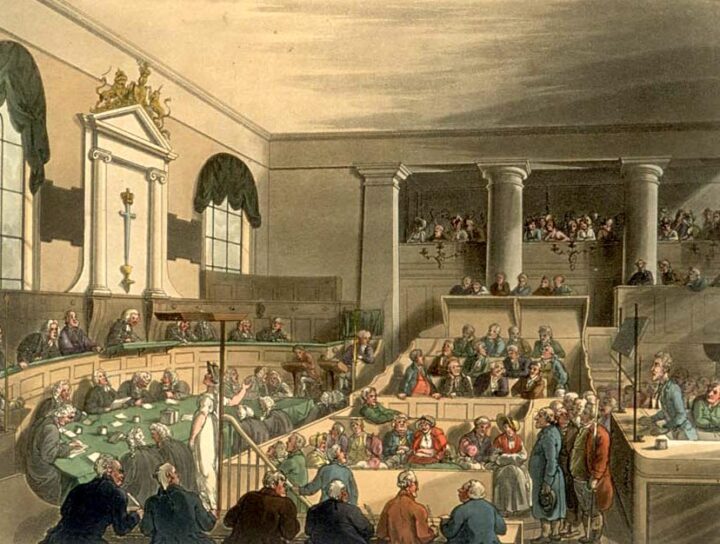
A trial at the Old Bailey in London as drawn by Thomas Rowlandson and Augustus Pugin 1808-1811 (source: Wikimedia Commons).
Though the Old Bailey has always been primarily concerned with London cases, it has come to play a wider role in the Criminal Justice System where there are fears that trying a case in the local area would make it difficult to secure a prompt or fair trial. The Central Criminal Court Act 1856 (19 & 20 Vict., C.16) provided for cases to be transferred for trial at the Old Bailey in these circumstances, meaning that some of the most notorious cases in criminal justice history have been, and continue to be, heard there.
The court’s geographical area of jurisdiction has changed over time, gradually expanding to cover the Greater London area:
| Date | Jurisdiction |
| Before 1834 | City of London and Middlesex – NOT London south of the Thames |
| 1834 – 1963 | London, Middlesex, parts of Essex, Kent and Surrey |
| From 1964 | Greater London area |
Note, for trials of crimes committed in London south of the Thames before 1834 see the records of assize courts for Surrey.
Although the High Court of Admiralty also sat at the Old Bailey, their records are kept separately, see our research guide for more information.
3. Records of trials heard before 1972
3.1 Printed and published materials – transcripts and proceedings
The easiest place to start your research, and the richest potential source of information on specific trials, will be found in printed proceedings and accounts. Old Bailey online and online newspaper accounts are a useful way to establish if a trial was held at the Old Bailey or in another court.
| Source | Information Given | Date Range | How to Search |
| Old Bailey Online | Printed and published proceedings providing summaries of trials and what was said in court. , from reports of a few dozen words to detailed transcripts. They will usually include the names of the defendant, prosecutor, witnesses, the charges, verdict and sentence. | 1674 – 1913 | By defendant name or offence. |
| Newspaper reports, see:
(Free to access in our reading rooms at Kew) Alternatively, visit the British Newspaper Library |
Newspapers often reported proceedings in trials in great detail. | 18th – 20th centuries | By defendant name, location, offence etc. |
| Chadwyck Healey microfiche collection of British Trials 1660-1900
Available in The National Archives reading rooms and in some major libraries. |
Unofficial contemporary accounts of selected trials which were originally published as pamphlets and sold to the general public. | 1660 – 1908 | Use separate but accompanying indexes |
Other, similar, sources of information include:
| Document Type | Information Given | Document Series | Date Range | How to Search |
| Printed Old Bailey Session Papers | As per Old Bailey Online | PCOM 1 | 1801 – 1904 | By date to identify the volume and then use volume index to find the case by defendant name. |
| Printed shorthand notes of proceedings | Will duplicate the information in the printed sessions papers | CRIM 10 | 1834 – 1912 | By defendant name. |
| Transcripts of selected trials | Transcripts of trials for selected cases concerning murder, robbery, treason and sedition. | DPP 4 | 1846 – 1958
1812 – 1963 |
By defendant name or offence. |
3.2 Finding other trial records at The National Archives
A search for trial records held at The National Archives will require a visit to our reading rooms in Kew as none of the records are viewable online – though you can begin your search in our online catalogue.
Different stages or aspects of the trial process are recorded in different types of documents, each of which will typically have been archived separately and may be searched by different means. The key document types/series are set out below.
| Document Type | Information Given | Series | Date Range | How to Search |
| Index to Indictments | Defendant name, charge, date of conviction, sentence, appeal outcome (if applicable). | CRIM 5 | 1833 – 1971 | Browse by year. |
| Indictments | As above and but includes list of jurors and full details of charges. | CRIM 4 | 1834 – 1971 | Using the indexes or browse by date in the catalogue. |
| Court Books | Defendant name, victim name (not always), plea, verdict, sentence, names of jurors. | CRIM 6 | 1834 – 1949 | Browse by year. |
| Depositions | Written records of oral witness statements given under oath. Typically concerned with trials for murder, sedition, treason, riot and political conspiracy and other trials deemed to be of historical interest, but includes a 2% random sample of other trials. | CRIM 1 | 1839 – 1971
1923 – 1966 |
By defendant name or offence. There are alphabetical indexes of depositions in cases sent up from coroners and police courts. |
| Treasury Solicitor files | Case papers of different types relating to cases in which the government law officers (Attorney General and Solicitor General) were involved | Various, including: | Various | By defendant name or offence. |
| Director of Public Prosecution (DPP) files | Case papers relating to cases in which the DPP was
involved from 1879. |
DPP 1 | 1889 – 1930
1931 – 1997
|
By defendant name or offence. |
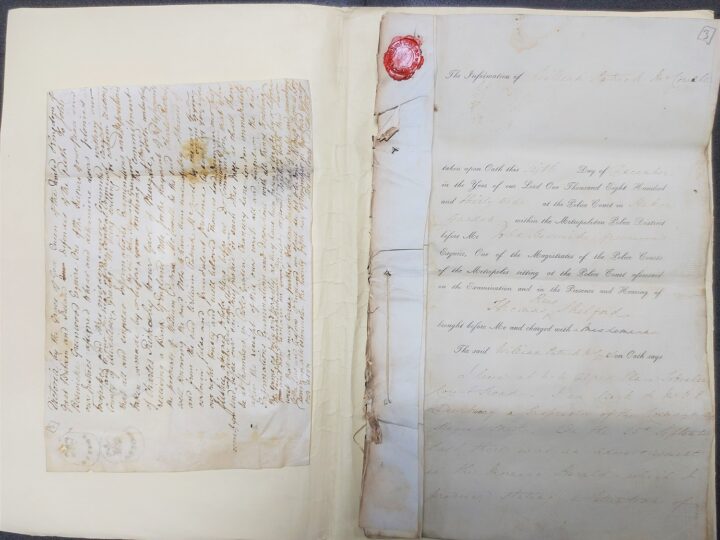
Image of Central Criminal Court deposition case file 1883 (catalogue reference: CRIM 1/1/1)
4. Records of trials heard after 1971
For cases heard after 1971 you may find it useful to consult our research guide on Crown Courts.
4.1 Working out where records will be held
Records are not transferred to the National Archives until at least twenty years after trial and transfer may happen significantly later than this. As a rule of thumb, they remain with the court for seven years and are then transferred to storage with HM Courts and Tribunal Service.
4.2 Finding trial records held at The National Archives
Viewing trial records held at The National Archives will require a visit to our reading rooms in Kew, as none of the records are viewable online, but you can begin your search in our online catalogue.
From 1972 there are two main record types relating to trials heard at the Old Bailey – case files and indictment files. All indictment files are selected for permanent preservation, but more detailed case files are only created for a small number of cases. To understand how these case files are selected see our Operational Selection Policy for Crown Courts.
Almost all indictment files, and many case files will be closed or have closed extracts.
Indictment files
Search for indictment files in our online catalogue in J 268 by date using the indexes in J 336 for 1972-1980 – after that by indictment number (see section 4.3 for guidance on indictment numbers).
All indictment files contain:
- Defendant’s name, sex and date of birth
- Decision re bail or remand
- Dates of committal, trial, conviction and sentence
- Name of judge
- Names of counsel and solicitors
- Offences charged listed as separate ‘counts’
- Plea
- Verdict
- Sentence
- Appeal details and outcomes
Case files
Search for case files in our online catalogue in J 267 by defendant name or offence.
For selected cases (typically the most serious), the records provide:
- Committal proceedings in the Magistrates’ Court
- Court logs (recording brief case histories, such as dates of hearings)
- Police statements
- Copy indictment
- Prosecution evidence
- List of witnesses and their statements and depositions
- List of exhibits produced in court
- Photographs of the crime scene
- Sentence
- Appeal details and outcome
4.3 Identifying the indictment number
You will see that, to find an indictment file, you will need to know the indictment number as indictments are filed by number and not by name. There are three ways of obtaining/working out the indictment number:
1. Search by name for a corresponding case file – this will include the case number, which can then be used to work out the indictment number.
2. If you already have a case number then this tells you the year and number of the indictment as follows:
- The first two digits represent the year of indictment.
- The remaining digits tell you the indictment number.
- So, if the case number is 721717 then the indictment was made in 1972 and the indictment number is 1717.
3. If you do not already have a case number then you can contact HM Courts and Tribunal Service who can provide you with a case number in most cases.
Note, the indictment may have been made in an earlier year than that in which the case was heard, particularly in periods where the courts were especially busy or prone to delays.
4.4 Records of the Director of Public Prosecutions
In addition, you may also be able to find a Director of Public Prosecutions (DPP) file, particularly for the most serious or high profile offences/trials.
Search by date, defendant name or offence in DPP 2 , for case files of the Director of Public Prosecutions, 1931-1997. Papers relating to the prosecution of the case – may include maps, plans and photographs.
Browse by date in DPP 9 for prosecution books of the Director of Public Prosecutions, 1905-1986. These records provide:
- Defendant name
- Police officer
- Prosecuting counsel
- Police court and name of the clerk who conducted the case
- Result of the case
A note on the dates of these records:
- From 1905-mid-1965 the dates given are those of the court sitting
- From 1965-1973 the date refers to the court sessions
- From 1974-1986 the date is the date of committal
5. Records relating to appeals and criminal petitions, 1848-1990
See also our research guide on criminal appeal cases.
There are four main series relating to appeals and criminal petitions, see the table below, but an advanced search within “TS” and/or “DPP” may also yield results.
CRIM 11 Submitted Draft Pleadings, 1848-1893
Draft pleadings of cases originally heard at the Central Criminal Court but reserved on questions of law etc. for the opinion of Judges of the Court for the Consideration of Crown Cases Reserved.
Search by defendant name or offence.
CRIM 12 Received Orders of Court, 1848 – 1908
Certificates from the Court for the Consideration of Crown Cases Reserved in notification of judgments and orders on cases referred to it from the Central Criminal Court.
Also includes a list of cases referred from the Central Criminal Court, 1848 to 1852, and a note of their outcome.
Search by defendant name or offence.
J 81 Court of Criminal Appeal, registers, 1908 – 1990
Contain:
- Appellant’s name
- Offence, place and date of conviction and sentence
- Nature of the application or appeal and its outcome
Browse by date.
J 82 Case files, 1945 – 1998
For selected cases – information as per other case files.
Search by defendant name or offence.
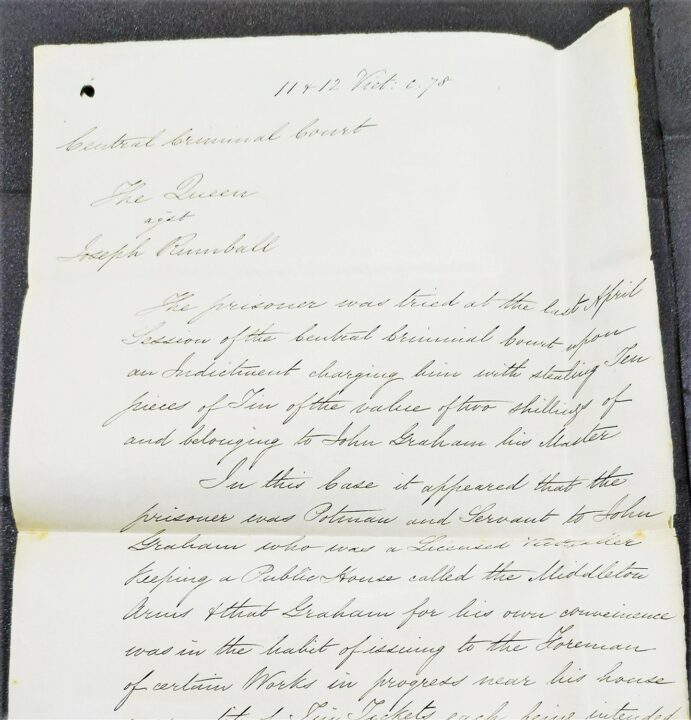
Image of Central Criminal Court draft pleading from 1848 case (catalogue reference: CRIM 11/1)
6. Records of prisoners, 1782-1971
The Old Bailey contains a network of cells used to hold prisoners awaiting trial and those convicted of crimes.
6.1 Lists of prisoners awaiting trial and criminal registers, 1782-1892
The National Archives holds the following records:
| HO 16, Lists of prisoners awaiting trial at the Old Bailey, 1815 – 1849 | Defendant name, charge and outcome of trial.
Browse by date |
| HO 77, Calendars and lists of prisoners at Newgate Gaol, 1782 – 1853 | Printed lists of the prisoners held at Newgate for trial at the Old Bailey. From July 1822 includes results of the trials.
Browse by date – or see digital images available on Findmypast (charges apply). |
| HO 26 & HO 27, Criminal registers, 1791 – 1892 | Lists of defendants charged with indictable offences at Middlesex Sessions – gives verdict and sentence.
Search by defendant name at Ancestry.co.uk (charges apply). |
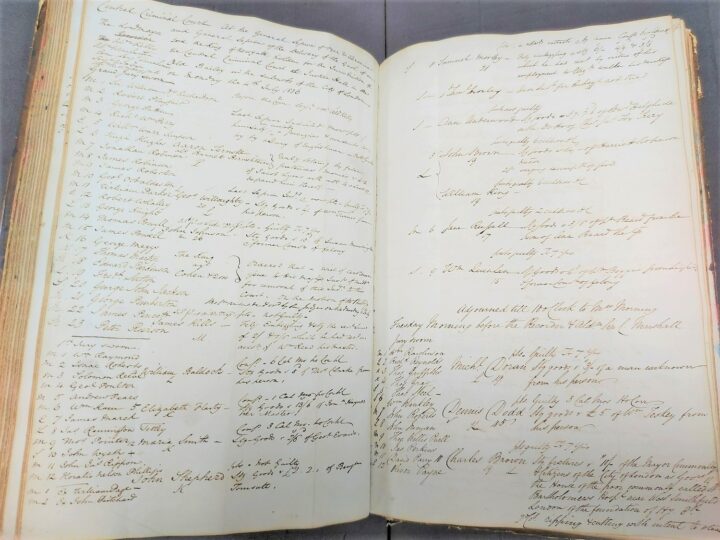
Image of court book from the Central Criminal Court 1834-1837 (catalogue reference: CRIM 6/1)
6.2 Details of prisoners in after-trial calendars, 1855-1971
Records of convicted criminals held prisoner at the court exist in the form of after-trial calendars for the period up to 1971 but many records for the last 100 years are closed for varying periods. Similar records for later periods have not been selected for permanent preservation.
They typically include the following details:
- Name and age of prisoner
- Previous convictions
- Date of trial
- Charges on the indictment against them
- Verdict and sentence
- Details of magistrates and jury
After-trial calendars of prisoners can be searched/browsed by date in our catalogue, Discovery, in the series
CRIM 9, Central Criminal Court after trial calendars, 1855-1949
HO 140, Home Office calendars of prisoners, 1868-1971. Contains:
- Records for London and Middlesex cover Quarter Sessions as well as the Central Criminal Court cases.
- 1868-1897 there are separate sections for the City, Middlesex, Essex, Kent, Surrey and Admiralty jurisdictions.
- After 1898 there are separate sections for London (North of the Thames), London (South of the Thames) and Middlesex.
Calendars for 1855-1915 can also be searched by name and viewed online at Findmypast.
7. Other sources of information
The Quarter Sessions for London and Middlesex, including the Sessions of Gaol Delivery for the City of London and Middlesex, were held at the Old Bailey until 1834. The London Archives holds these records, but we have the following printed and published calendars in our library:
- For Middlesex Quarter Sessions 1549-1688, see Middlesex County Recordsedited by J C Jeaffreson (1886-1892)
- For Middlesex Quarter Sessions 1612-1616, see County of Middlesex Calendar to the Sessions Records 1612-1616by William le Hardy (1935-1937)
- For Middlesex Quarter Sessions 1607-1612 and 1638-1751 see the various unpublished typescript calendars in our library by searching the library catalogueusing the term ‘Calendar to Middlesex Records’
In addition, there are excellent resources, including a wide range of digitised records, freely available at the following websites:
8. Further reading
A range of books can also be purchased from the National Archives’ shop.
The following publications are available at The National Archives library at Kew:
Clive Emsley, The Newgate Calendar (Wordsworth, 1997)
W Eden Hooper, History of Newgate and the Old Bailey (Underwood Press, 1935)
Caroline Jowett, The History of Newgate Prison (Pen & Sword, 2017)
A Knapp and W Baldwin The Newgate Calendar (4 vols) (J Robins and Co, 1824-1828), describing ‘notorious’ cases 1700-1825
1. Why use this guide?
Use this guide for an overview of records held at The National Archives that shed light on the slave trade, slavery and unfree labour in the British Caribbean and North American colonies. The guide is by no means exhaustive, but introduces and illustrates the diverse range of documents related to the transatlantic slave trade held here.
The guide covers records created throughout the trade, from the 16th to the 19th centuries. The wide range of documents, inherited from various government departments, illustrates the extent and impact of the trade at the time.
This is not a history of the transatlantic slave trade. For background history, please see suggested further reading and the Education section of The National Archives’ website.
2. A brief introduction to the slave trade and its abolition
The transatlantic slave trade was essentially a triangular route from Europe to Africa, to the Americas and back to Europe. On the first leg, merchants exported goods to Africa in return for enslaved Africans, gold, ivory and spices. The ships then travelled across the Atlantic to the American colonies where the Africans were sold for sugar, tobacco, cotton and other produce. The Africans were sold as slaves to work on plantations and as domestics. The goods were then transported to Europe. There was also two-way trade between Europe and Africa, Europe and the Americas and between Africa and the Americas.
Britain was one of the most successful slave-trading countries. Together with Portugal, the two countries accounted for about 70% of all Africans transported to the Americas. Britain was the most dominant between 1640 and 1807 and it is estimated that Britain transported 3.1 million Africans (of whom 2.7 million arrived) to the British colonies in the Caribbean, North and South America and to other countries.
Anti-slavery campaigners lobbied for twenty years to end the trade and the Abolition of the Slave Trade Act was passed in Britain on 25 March 1807. It was declared that from the 1 May 1807 ‘all manner of dealing and reading in the purchase, sale, barter, or transfer of slaves or of persons intending to be sold, transferred, used, or dealt with as slaves, practiced or carried in, at, or from any part of the coast or countries of Africa shall be abolished, prohibited and declared to be unlawful’. Slavery was abolished in 1834 but in reality for many of those enslaved it continued until at least 1838 through apprenticeship schemes.
3. An overview of the records at The National Archives
Records held at The National Archives reflect Britain’s involvement in the trade and its abolition through a wide range of records and record series, such was its importance to the country at the time. These include records of the Colonial Office (CO), Board of Trade (BT), Chancery (C), Admiralty records (ADM) and Treasury records (T), among other government departments.
The most important records for the study of Caribbean slavery in The National Archives are in the records of the Colonial Office. There are separate series for each country. The important series include:
- original correspondence: official letters and reports from the governor of the territory to the Colonial Office, and may include newspapers, petitions from slave owners and freemen, reports on slave rebellions, correspondence on local and British laws affecting slaves, statistics on slave populations, reports on slave imports and exports, and court cases against slaves or owners
- sessional papers: reports of the local government on all matters affecting the country and may include grants of freedom and discussions on slave laws
- acts: these contain manuscript and printed local laws
- newspapers and early official gazettes: may contain reports of runaways, notices of slave auctions and sales of property (which may include slaves). The National Archives holds a few collections of colonial newspapers, mostly for the 1830s-1850s. These are in Colonial Office ‘miscellanea’ series, although occasional newspapers can be found as enclosures to governor’s despatches in original correspondence
The Colonial Office records are not well catalogued and will need some time and effort to work through. For further information on how to search these record series, see our research guide on records of Colonies and dependencies from 1782.
However there are relevant records in a wide range of other series. For example, the early stages of the transatlantic trade can be traced in the charters granted by the government to merchants for trade with Africa in goods and then later slaves in the Patent Rolls in C 66.
These charters include the creation of the Company of Royal Adventurers of England Trading with Africa, the largest single British company involved in the transatlantic trade, whose settlements and papers were passed to the Treasury. They are now held at The National Archives in the T 70 series and can be searched by date and often location in Discovery, our catalogue.
Copies of the Acts passed by the British Parliament relating to slavery and the slave trade are available in the library at The National Archives and are usually in major reference libraries. Most relevant laws passed are available through www.pdavis.nl/Legislation.htm and online at Hansard. Most of the legislation relates to the slave trade rather than to slavery itself, as the latter was managed and legislated under local colonial laws.
The original manuscript parchments of the following Acts have been digitised and are available via the catalogue: Abolition of the Slave Trade Act 1807; Abolition of Slavery Act 1833.
| Suggested documents of interest | Catalogue reference |
|---|---|
| Account of English sugar plantations | CO 1/22 no 20 |
| Examples of Barbadian slave laws | CO 30/2 |
| Description of licence granted to the South Sea Company | T 52/26 pp.196-206 |
| Order in Council (1805) regarding slave licences | PC 2/168 pp.227-231 |
4. Records relating to transportation of slaves and goods
Ships involved in the colonial trade were first required to be registered in 1696. Registers survive from 1786 in BT 6/191-193 and BT 107 (indexes in BT 111). Only four volumes for Liverpool, 1739-1774, have survived for ships registered before 1786 because of a fire at Customs House. These registers are held by the Merseyside Maritime Museum.
Prior to clearing from a British port, the master first had to obtain a pass from the Admiralty. These licenses and those relating to travelling in convoy are in ADM 7. At the port, the master of the ship had to provide the collector of customs with a written list of the cargo to calculate duty. The details were written up in Port Books (E 190). Other records may have been collected at the various customs houses (the records of customs out ports are in CUST series), however many have been lost due to fires, riots and war. In addition to customs duty, between 1698 and 1713 British merchants involved in the Africa trade had to pay 10% tax on goods exported to Africa. This tax was levied to maintain the African Company’s forts etc. The duty ledgers are in T 70/349-356.
Ships’ captains maintained log books or journals which described details of voyages. These log books were the property of the ship owners and may survive in local record offices. Very few have been found in The National Archives; those that have are the log books of Royal African Company ships in T 70.
The master also lodged a muster with the collector of customs on the ship’s return, some of these can now be found in BT 98 (for example the muster of the Otter in BT 98/68 no 127). However, only those for Liverpool survive before 1807. Some musters and crew lists may survive in the archives of port towns and cities.
Information relating to goods imported to and exported from Africa can be found in the duty ledgers, accounts and correspondence of the African companies in T 70, especially among records of their forts, factories and settlements on the West Coast of Africa. Other papers can be found in the correspondence and registers of the Board of Customs (CUST 3 and CUST 17), the Board of Trade (CO 388 to CO 391), the Treasury (T 1), and in the Port Books (E 190).
5. Campaign for abolition of the slave trade
Researchers looking at the campaign for abolition will find material in a wide variety of regional collections and personal papers. As the campaigns were organised in different towns and cities across the country, it is well worth searching for sources in local collections.
The formal abolition campaign was launched in 1787. The campaign in Parliament can be followed in printed parliamentary debates and in Parliamentary Papers via Proquest UK Parliamentary Papers. This is a subscription website you can access on TNA computers by visiting us at Kew. You may also be able to access it via a large reference library such as a university library. Parliamentary Papers includes extensive printed reports and evidence from committees investigating the slave trade.
Hansard (Parliamentary Debates) from 1803 is available online. Before 1803 there are unofficial collections of debates. It is often worth checking parliamentary debates for any large event involving the slave trade as it is likely it was mentioned, if not discussed, in Parliament.
Some unpublished Parliamentary papers such as petitions and returns survive in the House of Lords Main Papers (HL/PO/JO/10). These can be found by searching the catalogue for terms such as ‘petition’ or ‘return’ and ‘slave’. Most are not digitised. However two petitions from Manchester in 1806 have been digitised and can be viewed on the Parliament website with lists of names of signatories: Petition from the inhabitants of Manchester in support of the Foreign Slave Trade Abolition Bill and Petition from Manufacturers and Merchants of Manchester against the Foreign Slave Trade Abolition Bill.
Enslaved Africans played a role in abolition with regular and persistent resistance. Search our catalogue, limiting the record series to ‘CO’, and using key words such as ‘slave AND rebellion’ and ‘slave AND uprising’. The abolitionist campaign after 1791 was greatly affected by the slave revolt in Saint Domingue and, after 1793, by the war with revolutionary France. Records relating to both events can be found in The National Archives in series such as T 81, T 64, CO 137, CO 245, ADM 1, WO 1, FO 27 and FO 72.
The Abolition of the Slave Trade Act was passed in Britain in March 1807. But the international campaign against slavery (as distinct from the trade) continued and it was not until 1833 that legislation was passed in the British Parliament starting the process for the abolition of slavery itself. See the following section for further information.
6. Post-abolition of the slave trade
6.1 Records of the anti-slavery movement
After 1807 the British anti-slavery movement entered a new phase. The Society for Effecting the Abolition of the Slave Trade gave way to the African Institution. Papers on the African Institution can be found at the British Library (the Institution’s published Reports). Further research into the congresses can be pursued in FO 27; FO 84/1-2; FO 92/1, FO 92/4, FO 92/7-8, FO 92/17-22; FO 95/9/2; and FO 139/46. Other sources include personal papers that can be found at the British Library and in local archives and repositories. Find these by searching our catalogue and filtering your results to only show those from other archives.
6.2 Diplomatic efforts to suppress the slave trade
FO 84 is the main Foreign Office series relating to diplomatic efforts on the suppression of the slave trade 1816-1892. However, other material relating to Africa is to be found in FO 2 – this overlaps with FO 84 and covers the period 1825-1874 and 1893-1906. Also, each country has a separate general correspondence series in FO series, which have annual headings for the slave trade. See the research guide on Foreign Office and Foreign and Commonwealth Office records from 1782 for further information. Search Discovery, our catalogue, within FO (and particularly FO 84 and FO 2) using keywords such as ‘slave’ and ‘slave AND [name of country]’.
Foreign Office treaties with other sovereign countries and colonial powers are in FO 93 with ratifications in FO 94. These series include treaties with African powers where the Foreign Office handled negotiations. You can find these treaties by searching our catalogue using such keywords as ‘Spain AND slave’ restricting the search in the series or department field to ‘FO 93, FO 94’. Treaties made by naval officers, colonial officials, or governors of chartered companies on behalf of the Crown are in the relevant correspondence series – usually by date of treaty. These are not indexed and you will usually need to know the date of the treaty and the parties involved. Many important treaties have been published in the annual series State Papers, British and Foreign. Treaties relating to Africa, including many made by naval officers and colonial officials are published in Hertslet’s Map of Africa by Treaty. Copies of some treaties have been published as Colonial Office confidential print in CO 879: search our catalogue using keyword ‘Africa’ or names of individual territories.
6.3 Naval records relating the suppression of the slave trade
The Royal Navy played a key role in Britain’s efforts to suppress the slave trade, including seizing ships believed to be involved in the illegal trade. These ships could then be tried at Mixed Commission Courts and vice-Admiralty courts.
ADM 1 contains letters and reports from captains of the several naval stations. In addition it contains correspondence from the Colonial Office, Foreign Office and the Treasury relating to anti-slaving patrols and slaving intelligence and occasionally proceedings of Mixed Commission Courts and vice-Admiralty Courts. The Commander-in-Chief papers are listed separately in our catalogue but you will need to use the registers in ADM 12 for other papers. See the research guide on Admiralty Index and Digest: ADM 12 for more details, and try keyword searches within ADM, with terms such as ‘slave’ and ‘slave AND ship’
Ships’ logs in ADM 51 and ADM 53 give accounts of sightings, chases and the capture of slavers. The musters of anti-slaving ships in ADM 37 sometimes list freed Africans in the section headed ‘supernumeraries’. These records are arranged by the name of the Royal Naval ship and then by date. See the research guide on Royal Navy: operational records 1660-1914 for further information.
Slavers found to be acting illegally were condemned and ships and their possessions could be sold. There do not appear to be many bounty or prize lists awarding payment for anti-slaving activities but occasional lists can be found in T 1, ADM 48 and ADM 1.
6.4 Records of court cases, and further records
For records of the Mixed Commission Courts across The National Archives’ collection, search our catalogue using keywords ‘mixed commission AND slave’. Records of these courts can also be found in the records of the various slave trade commissions.
The most important series relating to cases of illegal slavers outside those of the Mixed Commission Courts are the records of the Slave Trade Adviser to the Treasury. Papers from 1821 are in:
- HCA 35 – Report Book, 1821-1891
- HCA 36 – Unregistered Papers, 1837-1876
- HCA 37 – Registered Papers, 1821-1897
Most records and proceedings of vice-Admiralty courts in the colonies are to be found, where they survive, in the archives of the relevant country. However, some proceedings and other papers, especially those relating to the suppression of the slave trade can be found among the records of the High Court of Admiralty (HCA), Board of Customs (CUST) and the records of the Colonial Office (CO) from the governors, clerks of vice-Admiralty Courts and collectors of customs.
Other papers relating to the suppression of the slave trade are to be found in Treasury and Colonial Office records especially T 1 and CO 267 (for Sierra Leone), and CUST 34 (Board of Customs papers relating to the colonies). Often these are duplicates of what is found in HCA, ADM and FO series, but sometimes these contain papers that have been destroyed from the more likely series.
| Examples of documents of interest | Catalogue reference |
|---|---|
| Records of the slave ship Eliza | BT 98/69, no 264; ADM 7/122 f.101; ADM 7/804; CO 33/23 |
| Papers from the vice-Admirality Court at Sierra Leone (1808-1817) | HCA 49/97 |
| Records of the slave ship Henriqueta (later renamed the Black Joke and used to capture illegal slavers) | ADM 51/3466; FO 84/66 f.203-209; FO 315/65/60; FO 315/31; ADM 1/1; ADM 1/74 |
7. Records of ex-slaves and liberated Africans
7.1 Court and customs records
There are some records relating to ‘liberated Africans’ who were found onboard illegal slavers and freed by vice-Admiralty and Mixed Commission Courts. These ex-slaves were not technically free: able-bodied men were ‘enlisted’ into the military services particularly the army, in regiments such as the Royal Africa Corps and the West India Regiment for unlimited service. Women and children were often apprenticed to local landowners, to the military and to the local government.
There is very little information on individual liberated Africans – very few vice-Admiralty Court proceedings are to be found in The National Archives (see above). Admiralty papers especially ADM 1, and CUST 34, HCA 30 and HCA 49 contain a few lists of the slaves liberated. Two Sierra Leone censuses have information relating to liberated Africans: CO 267/111 (1831) and CO 267/127 (1832-1834). Because the collectors of customs were responsible for looking after liberated Africans, information can sometimes be found in Colonial Office original correspondence series, especially in despatches from the governor, the naval office and the Board of Customs and in CUST 34. A ‘Commission of Enquiry into the state of captured Negroes in the West Indies, 1821-1830’ (CO 318/81-98) was set up to look at the treatment and conditions of liberated Africans in the West Indies and includes some lists of liberated Africans.
In 1817 collectors of customs were required to send annual reports on liberated Africans they received to the Colonial Secretary. No annual returns have been found among Privy Council or Colonial Office records although some returns which pre-date this were printed for Parliament in 1821; others may be found among the Commission of Enquiry schedules in CO 318/81-98.
7.2 Movement of ex-slaves
Schemes were proposed to move liberated Africans from the more densely populated colonies to those which needed labourers such as Trinidad and British Guiana and correspondence relating to these schemes is found in relevant CO original correspondence series, such as CO 295 for Trinidad. An agreement was also made between Britain and Spain to send some free blacks from the Spanish colony of Cuba to British possessions, especially Trinidad. Correspondence relating to this movement for the period 1835-1842 is in CO 318. Key word search these record series using terms such as ‘slave’ and ‘liberated African’, and country names.
| Examples of documents of interest | Catalogue reference |
|---|---|
| Records of female slaves ‘freed’ and apprenticed as domestics | CO 28/85 f 52 |
| Records relating to the establishment of a settlement at Kingstown, Antigua (1831), following overcrowding on Tortola due to the numbers of slaves released by the vice-Admiralty Court | CO 239/25; CO 700/virginislands6; T 1/4303; CO 239; CO 239/13; HCA 49/101; CUST 34/816; HCA 30/816; HCA 30/796; CO 318/82 |
8. The enslaved and resistance
It is important to note that the majority of records of the slave trade are written from the viewpoint of those generally controlling the trade, and very little information is available about enslaved Africans themselves. During transportation across the Middle Passage (the journey between Africa and the Americas), slaves were classed as ‘goods’ and would usually only be noted in ships’ logs on death, if at all. There are few records relating to the Middle Passage because the voyages were private ventures. Some information on African Company slave losses should be found in T 70 which can be searched by date and often location. Following transportation, slaves on plantations were barely noted. Until the introduction of slave registers it is usually only through court cases and correspondence that they are occasionally found.
8.1 Registers and returns of slaves
There are some registers of slaves created to monitor slave holdings and the importation of slaves into British colonies between 1814 and 1822, duplicates of which are in the series T 71. The first registration for each colony is a complete list of all slaves. Subsequent returns usually only record increases or decreases to the slave populations such as births, deaths, bequests, purchases etc. Many of the returns record where the slave was born so it is possible to identify slaves born in another country and several returns indicate if a slave was exported or imported since the last return.
Although Britain transported around 3.1 million enslaved Africans, only around 2.7 million arrived at their destination largely due to deaths while travelling the Middle Passage (the journey between Africa and the Americas). There are few records relating to the Middle Passage because the voyages were private ventures. Slaves were classed as ‘goods’ and their deaths were supposed to be accounted for and noted in the ship’s log. Some information on African Company slave losses should be found in T 70 which can be searched by date and often location.
8.2 Records of government-owned slaves
The British Army and Royal Navy owned and hired slaves as labourers and soldiers, most of whom went to the Corps of Military Labourers and the West India Regiments. CO 318/31 describes army purchases of slaves for the West Indian Regiments including the numbers purchased. There are several files in WO 1 relating to the status of slaves in the Army, especially once they were discharged.
Estates were occasionally passed to the Crown in lieu of government taxes and following court cases. An example is Greenwich Hospital (ADM 65/59), which was managed by a government department for a number of years and took over Golden Vale plantation in Portland Parish, Jamaica in 1793.
For further information on government-owned slaves, researchers should check musters for dockyards, ships, and regiments. It is also possible that some former slaves may have discharge papers or applied for pensions so there may be papers in WO 97 and ADM 29. WO 97 for the period 1760-1854 is searchable online by country of birth and by regiment through findmypast.
8.3 Resistance
It was primarily Africans newly-arrived in the Americas who rebelled against their enslavement. However it was not unknown for Creole slaves to rebel, as was experienced with Bussa’s Rebellion in Barbados in 1816 (CO 28/85) and the last great rebellion in Jamaica over Christmas 1831 and the New Year 1832 (CO 137/184).
Running away was the most common form of resistance, and Caribbean newspapers are full of notices for runaways (for example CO 7/1 – Barbados 1786 & 1789; CO 71/2 – Dominica, 1798; CO 137/14 – Jamaica, 1771-1772; CO 260/48 St Vincent, 1831).
See section 7 above for records of ex-slaves and liberated Africans.
| Examples of documents of interest | Catalogue reference |
|---|---|
| Case of the Zong massacre (1781) | KB 122/479; KB 125/168; KB 168/150 f.53; E112/1528 no 173; E 127/47 |
| First references to Africans (called ‘Negroes’) in Colonial America | CO 1/3 nos 2 and 35 |
| Log of the James describing slave mortality in the Middle Passage | T 70/1211, f.100 |
| ‘Book of Negroes’ – a list of men, women and children bound for Nova Scotia on British ships after the American War of Independence. | PRO 30/55/100 (searchable copy available from Nova Scotia archives) |
9. Records of plantations
Plantation records are the private papers of the plantation owner and their family. As with private papers in general, very few survive. Papers are to be found in local and specialist repositories in the Caribbean, the UK and elsewhere. Search our catalogue and refine your results using the filters. For further information on the whereabouts of plantation papers, see Peter Walne, Guide to Manuscript Sources for the History of Latin America and the Caribbean in the British Isles (1973).
There are few plantation accounts in The National Archives, mostly found as exhibits to equity cases resulting from disputes about land, debts or marriage settlements. These can be found in record series C 103 – C 115 : run a key word search limited to these series, using key words such as ‘plantation’. Private papers are also found in the records of two commissions: the West Indian Encumbered Estates Commission, 1854-1893 in CO 441, and the West Indian Hurricane Relief Commission, 1832-1881 in PWLB 11. Although these commissions were essentially set up after the abolition of slavery, many of the records predate emancipation and have some information on slave holdings.
| Examples of documents of interest | Catalogue reference |
|---|---|
| Plantations in Antigua | CO 700/Antigua2 |
| Map of Barbados with illustration of plantation | CO 700/Barbados9a |
| Martin v Bothall – account of stock including slaves | J 90/399 |
| Blenheim and Cranbrooke plantation accounts | WO 9/48 |
10. Abolition of slavery
Although the slave trade was abolished in 1807, slavery was not abolished until 1834. Those already enslaved remained so, and some records exist in relation to the ongoing situation and the amelioration of slaves.
In 1823, following debates in the British Parliament to improve slave living and working conditions, the Colonial Secretary issued instructions for the governors to send returns of the numbers of slave imported or exported between colonies. These instructions were reissued on a number of occasions until 1830. Most governors sent statistical returns and a few sent nominal returns. These returns are in Colonial Office Original Correspondence series and a few were printed for Parliament and are to be found in Parliamentary Papers.
For other records relating to schemes for the ‘amelioration’ of slaves and ex-slaves, search our catalogue using the terms ‘slave AND amelioration’.
When slavery was abolished, legislation followed which awarded colonial planters twenty million pounds in compensation. Many of the records generated by the Slave Compensation Commission, set up to distribute the funds survive, among them original claims and certificates, counter-claims, commissioners’ hearing notes, and lists of awards. The records of the Office of Registry of Colonial Slaves and Slave Compensation Commission, 1812-1851, are in T 71. AO 14/37-48 documents the awards of compensation made by the Claims Commissions, 1834-1845. NDO 4 includes registers of compensation paid to slave owners 1835-1842
11. Records in other institutions
For further records relating to the transatlantic trade, it is well worth investigating local record offices, particularly in large slave trading ports such as Liverpool, Bristol and London. Some key places to search are suggested here:
- The British Library – records of the East India Company
- Mundus (Internet archive)- missionary records in Africa
- Hakluyt Society – records of 16th and 17th century trading voyages with Africans
- Parliamentary Archives – abolitionist petitions
- Legacies of British slave-ownership database – records of slave-owners
Personal abolitionist papers, publications and plantation papers in the UK can be found by searching our catalogue and refining your results using the filters.
12. Further reading
Some of the publications below may be available to buy from The National Archives’ bookshop. Alternatively, search The National Archives’ library catalogue to see what is available to consult at Kew.
The slave trade and slavery: records at The National Archives
- Guy Grannum, Tracing Your Carribean Ancestors (third edition, Bloomsbury, 2012)
- Access Calendar of State Papers, Colonial: North America and the West Indies from colonial.chadwyck.com
- Acts of the Privy Council, Colonial series (HMSO, 1908-1912)
The enslaved and resistance
- Michael Craton, Testing the chains: Resistance to slavery in the British West Indies (Cornell University Press, 1982)
Transportation of slaves and goods
- Joseph C Miller, Mortality in the Atlantic slave trade: Statistical evidence on causality, Journal of interdisciplinary history, vol 11, 1981, pp385-423
- Bruce L Mouser’s A slaving voyage to Africa and Jamaica: The log of the Sandown, 1793-1794 (Indiana University Press, 2002)
Plantation Records
- HMSO, Journal of the Commissioners for Trade and Plantations (HMSO, 1920-1938)
- Peter Walne, Guide to manuscript sources for the history of Latin America and the Caribbean in the British Isles (Oxford University Press for the Institute of Latin American Studies, University of London, 1973)
Campaign for abolition
- Roger Anstey, The Atlantic slave trade and British abolition 1760-1810 (Macmillan, 1975)
- Reginald Coupland, The British anti-slavery movement (F Cass, 1964)
- Elizabeth Heyrick, Immediate, not gradual abolition (1824)
- Clare Midgley, Women against slavery: The British campaigns, 1780-1870 (Routledge, 1992)
- JR Oldfield, Popular politics and British anti-slavery: The mobilisation of public opinion against the slave trade, 1787-1807 (Routledge, 1998)
Post-abolition
- Norman Buckley, Slaves in red coats: British West India regiments, 1795-1815 (Yale University Press, 1979)
- Thomas B Howell, A complete collection of state trails and proceedings for high treason and other crimes and misdemeanors (TC Hansard for Longman, Hurst, Rees, Orme, and Brown, 1816-1826)
- WEF Ward, The Royal Navy and the slavers (Allen & Unwin, 1969)
Records of ex-slaves and ‘liberated Africans’
- Stephen J Braidwood, Black poor and white philanthropists: London’s blacks and the foundation of the Sierra Leone settlement 1786-1791 (Liverpool University Press, 1994)
- James W St G Walker, The Black Loyalists: The search for a promised land in Nova Scotia and Sierra Leone, 1783-1870 (Africana Publishing Company, 1976), pp413-414
General history
- Roger Anstey, Liverpool, the African slave trade and abolition: Essays to illustrate current knowledge and research (Historic Society of Lancashire and Cheshire, 1976)
- Black History Resource Working Group, Slavery: An introduction to the African holocaust with special reference to Liverpool – ‘capital of the slave trade’ (second edition, 1997)
- Brycchan Carey, Discourses of slavery and abolition: Britain and its Colonies (Palgrave Macmillan, 2004)
- Madge Dresser, Slavery obscured: The social history of the slave trade in an English provincial port (Continuum, 2001)
- Paul Geoffrey Edwards and James Walvin, Black personalities in the era of the slave trade (Louisiana State University Press, 1983)
- David Eltis and David Richardson (eds), Routes to slavery: direction, ethnicity and mortality in the transatlantic slave trade (Routledge, 1997)
- Olaudah Equiano, The interesting narrative and other writings, ed Vincent Carretta (Penguin Books, 2003)
- Peter Fryer, Staying power: The history of black people in Britain (University of Alberta, 1984)
- Paul E Lovejoy, Transformations in slavery: A history of slavery in Africa (second edition, Cambridge University Press, 2000)
- Lowell J Ragatz, A checklist of House of Commons sessional papers relating to the British West Indies and to the West Indian slave trade and slavery 1763-1834 (Bryan Edwards Press, 1923)
- Edward Reynolds, Stand the storm: A history of the Atlantic slave trade (IR Dee, 1993)
- David Richardson, The Bristol slave traders: A collective portrait (Bristol Branch of the Historical Association, 1985)
- Nigel Tattersfield, The forgotten trade: comprising the log of the Daniel and Henry of 1700 and accounts of the slave trade from the minor ports of England, 1698-1725 (Jonathan Cape, 1991)
- Hugh Thomas, The slave trade: The history of the Atlantic slave trade, 1440-1870 (Simon & Schuster, 1999)
- James Walvin, An African’s life: The life and times of Olaudah Equiano, 1745-1797 (Continuum International Publishing Group, 2000)
- James Walvin, Black ivory: Slavery in the British empire (second edition, Wiley-Blackwell, 2001)
- James Walvin, Making the Black Atlantic: Britain and the African diaspora (Cassell, 2000)
- A checklist of House of Lords sessional papers relating to the British West Indies and to the West Indian slave trade and slavery, 1763-1834 (Bryan Edwards Press, 1932)
This is a guide to searching for records primarily of First World War British and Commonwealth prisoners of war (PoWs). There is also some advice on searching for the surviving records of British PoWs captured in previous wars going back as far as the 1790s. The guide does not cover PoWs in British hands.
There are no official or published lists of all PoWs so establishing whether a serviceman was a PoW is not always possible.
The limits of First World War records
An estimated 192,000 British and Commonwealth servicemen were taken captive during the First World War. There is no comprehensive list covering all of these PoWs, and the surviving documents cover only a fraction of those who were captured.
There is a published List of British Officers taken prisoner in the various theatres of war between August 1914 and November 1918. The list covers officers of the British Army, Royal Air Force, the Royal Naval Air Service and the Royal Naval Division. As well as names and rank, the book provides the date the officer went missing, where and when he was imprisoned and the date of his repatriation or death if the officer died while prisoner.
There is very little information anywhere on PoWs who were liberated after the Armistice on 11 November 1918.
Online records
Prisoners of war: selected records, 1715-1945
Search and download a wide variety of selected PoW records 1715–1945 on Findmypast.co.uk (£). They include records from the:
- Napoleonic Wars, 1799–1815 (including lists and accounts of naval and civilian prisoners)
- Crimean War, 1853–1856
- Second Anglo-Boer War, also known as the South African War, 1899–1902
- First World War, 1914–1918
The records are drawn mostly from the Foreign Office, Colonial Office, War Office, Admiralty and Air Ministry. For more details see findmypast.co.uk.
British prisoners of war: interviews and reports, 1914-1920
Search and download (£) interviews and reports concerning 3,000 British PoWs (WO 161) on our website.
These documents primarily concern servicemen who escaped internment, were repatriated before the end of the war, or were incarcerated in a neutral country. Approximately 750 pages of interviews and reports on First World War PoWs of ranks below those of commissioned officers are known not to have survived.
Selected records of prisoner of war deaths, 1914-1918
Search selected PoW death records (RG 35/45-RG 35/69) on bmd.co.uk (£).
They include deaths in:
- military and non-military hospitals
- enemy and occupied territory were notified to British authorities by foreign embassies
- legations
- registration authorities
- American authorities in charge of British internees
The majority of this information is in French.
Prisoners of war cards and lists, 1914-1918
Search by name the First World War prisoner of war cards on the International Committee of the Red Cross archive. These cards were created from lists sent to the ICRC by countries at war. The online material can also include enquiry cards from next of kin, repatriation lists and accounts of PoW camps. Please see their website for more information about this collection.
First World War service records and medal index cards
Upon repatriation, officers were required to detail the circumstances of their capture. If you know an officer was a PoW, their service record may have their capture report with it. In general, service records, especially those of other ranks, contain only minimal details of imprisonment, sometimes limited to dates of capture and/or release – you are unlikely to find any more than this on a medal index card.
For more details see the guides to:
Details of prisoners of war in the London Gazette
Consult the London Gazette on The Gazette website for sporadic mentions and details of British PoWs, especially officers. Includes PoWs from the:
- Crimean War
- South African War
- First World War
Records available only at The National Archives in Kew
To access these records you will either need to visit us to see the documents for free at our building in Kew or, where you can identify a specific document reference, order a copy (£) to be sent to you.
Foreign Office reports, 1915-1919
Use the box below to search Discovery, our catalogue, for correspondence and reports on people who became PoWs during the First World War in FO 383.
Narrow your search by using double quotation marks to find a person’s full name, such as “John Williams”.
Please note, some of these are available on Findmypast (£).
Records of air force prisoners, 1914-1918
Browse AIR 1 for prisoners of war of Royal Air Force, Royal Flying Corps and Royal Naval Air Service.
Records of naval prisoners of war, 1914-1920
Consult ADM 12 for PoWs of Royal Navy, Royal Naval Air Service, Royal Navy Reserve and Royal Navy Volunteer Reserve personnel. Read Naval correspondence using the ADM 12 indexes and digests for more information.
Records of merchant navy prisoners of war, 1914-1918
Browse MT 9 (code 106) for prisoner of war files of merchant navy personnel. Some files are indexed by individual name and/or ship.
Records in other archives and organisations
Search the Commonwealth War Graves Commission for prisoners of war who died in captivity
Search the National Archives of Australia and Australian War Memorial for details on Australian prisoners of war.
Search the Auckland Museum for details of New Zealand prisoners of war.
Search the Library and Archives Canada for details of Canadian prisoners of war
Search the US National Archives for details of American prisoners of war
Lists of prisoners of war held by regimental museums
It is possible that the soldier’s regiment kept or has since compiled its own list of PoWs. Search Find an archive for the location and details of regimental museums.
Other resources
Guide to prisoners of the American Revolutionary War
Read the Guide to the Materials for American History to 1783 by C M Andrews (New York, 1965) for details of British troops captured during the American Revolutionary War and during earlier military and naval actions in North America.
British Army in First World War website
Browse the Long, Long Trail website for information on tracing a person during the First World War.
1. Why use this guide?
Use this guide for advice on how to find records of government policy on technical and vocational further education, as well as the teaching of art, between 1836 and 1997. As well as policy files, you will find advice on records covering the administration of the further education system, how it was funded and the institutions that made it. The guide does not cover records of universities.
We do not hold personnel files on teachers or students – read our guide to records of schools for guidance on this.
2. The evolution of non-university further education in the UK
The first school of design in the UK, the Government School of Design, was established in 1837 and went on to become the Royal College of Art. It marked the beginnings of the development of technical education in the UK, which expanded in the remaining decades of the 19th century, and was largely instigated by the Science and Art Department of the Board of Trade, formed in 1853. In 1856 the Science and Art Department transferred from the Board of Trade to the Education Department and administered grant-aid to art schools (from 1856) and to schools of design and technical schools (from 1868).
The Technical Instruction Act 1889 permitted local authorities to levy rates to aid technical or manual instruction. County and borough councils began to provide technical instruction by day and evening classes.
The Local Taxation (Customs and Excise) Act 1890 diverted ‘whisky money’ from publicans to local authorities for assisting technical education or relieving rates, boosting investment in technical instruction.
By the end of the 19th century continuing education was provided by a variety of bodies in a number of forms:
- day continuation schools
- evening schools and classes
- mechanics institutes
- schools of art
- polytechnics
- university extension lectures
- tutorial classes
- working men’s colleges and courses
Under the 1902 Education Act, changes to conditions attached to government grants encouraged the expansion of technical education. Local Education Authorities (LEAs) took over most of the evening continuation schools.
Major changes occurred after the Second World War. Junior technical schools , commercial schools and schools of art were fully integrated into the revised system of secondary education.
3. How to use this guide and get a search started
A search for documents at The National Archives usually begins in our online catalogue. The following sections of this guide provide links to key record series that you can search within our catalogue, helping you to target your searches more precisely. By clicking on the series links (for example, ED 80) you will arrive on the respective ‘series description’ pages from where you can search the series, using keywords and/or dates/years, or browse the series to see all records in the series in reference order. Series description pages provide information on the arrangement of the records and sometimes some of the historical context in which they were created, as well as suggesting related series you could explore.
Use the advanced catalogue search to restrict your search results to the records of a specific government department, including its predecessors (for example, the Department of Education). Use the department reference, which is always a letter code, to do this (the code for the Department of Education is ED).
Catalogue search results provide short descriptions of our records and a document reference for each one – you will need the document reference to see the record itself. The records covered in this guide are not available to view online so to see them you will have to either visit us in Kew or order copies. Bear in mind that a search in our catalogue will also search for records in other archives around the country – keep your eye on the ‘Held by’ field to establish whether the records are here or elsewhere.
4. The Science and Art department and 19th century developments
Browse our catalogue for:
- surviving correspondence between the Board of Trade and schools of design in BT 1. Browse by date
- the minutes of meetings of the Science and Art Department (1852-1876) in ED 28
- files relating to the Royal College of Art. Browse by hierarchy from ED 23/16, with later material (post 1944) in ED 167
- building grant files in ED 29
- correspondence and papers relating to art and science buildings in WORK 17, with plans in WORK 33
Technical education was considered by several Royal Commissions in the latter part of the 19th century. For full details of the papers of the Royal Commissions below, search Proquest UK Parliamentary Papers for papers of the:
- Royal Commission on Scientific Instruction and the Advancement of Science (Devonshire Commission, appointed 1870)
- Royal Commission on Technical Instruction (Samuelson Commission) which reported in 1884
This is a subscription service available to access at The National Archives. You may also be able to access it via a large reference library, such as a university library.
The bulk of the papers relating to the provisions stemming from the Technical Instruction Act 1889 have been destroyed. Browse surviving files in ED 46.
5. Practical instruction courses
Payment of a special grant for practical instruction in domestic subjects was first authorised under the Code of Regulations for Elementary Schools in 1875. This led to similar arrangements for other practical subjects.
New provisions were introduced in 1906 awarding grants for each course of instruction.
Browse papers relating to the provision of these courses in:
6. Trade schools and vocational courses
The need for preliminary technical education for young people going into particular trades had been accepted from the end of the 19th century.
Trade Schools provided technical courses for two or three years after children left public elementary schools.
Use our catalogue to search by name of school within:
- ED 98 for Junior Technical Schools
- ED 82 for Technical Schools, which provided day or evening classes or part-time or full-time vocational courses
Between 1920 and 1987 Joint Committees oversaw the curricula and the award of National Certificates and Diplomas in vocational subjects. Committee members were drawn from technical colleges, professional bodies, the Board of Education and its successors and teachers’ organisations.
Browse minutes and papers of the Joint Committees in ED 182.
In 1967 the Haslegrave Committee was appointed to review this system.
Browse:
- ED 46/917 for the proposal to set up the Haslegrave Committee
- ED 163 for the committee’s minutes, papers and evidence
- ED 163/35 contains a copy of the report with comments and implementation files in ED 212/52-55 and ED 212/117-119
In 1973, following the Haslegrave Committee recommendations, responsibility passed to the Technician Education and Business Education Councils and the Joint Committees gradually disbanded.
7. Technical colleges
Higher technical education involving prolonged courses of study was encouraged by the provision of a fixed annual grant to technical institutions.
You can search our catalogue by college name within ED 90 for the work and organisation of technical colleges.
ED 90 also contains information on Grouped Course Certificates, a scheme initiated in 1907-1908 and on applications for approval of National Certificate courses.
Browse ED 182 for the records of Joint Committees which administered National Certificate and National Diploma courses until the 1980s.
8. Evening institutes
The merging of evening continuation and evening technical school provision after 1902 resulted in LEAs and other managing bodies providing:
- part-time day and evening courses, including day continuation classes
- courses at works schools and elsewhere in a variety of vocational, domestic, art and general subjects
After 1926 they became known as evening institutes. Search by name of institute within ED 41 for their files. Few papers survive prior to 1918.
9. Day continuation schools
The 1918 and 1921 Education Acts provided for compulsory part-time attendance at day continuation schools by school-leavers between 14 and 18.
The system only ever came into partial operation and attendance reverted to the voluntary system.
You can search by name of school in ED 75 for:
- information on the provision, organisation and curriculum of the schools
- correspondence and minutes on various local arrangements
10. Tutorial classes
Tutorial classes developed as part of a movement to expand facilities for adult education, fusing the interests of the Workers’ Educational Association and the University of Oxford.
The classes were recognised by the Board of Education in Regulations of 1908/1909 and grant-aided.
Consult:
- ED 73 for files on adult education tutorial classes, including material on university extension courses and lectures (note papers relating to recognition before 1924 have been destroyed)
- ED 76 for files on adult education vocation courses. These were designed as short residential courses of one or two weeks, provided by ‘Responsible Bodies’ and subject to the same regulations and conditions as tutorial classes.
- surviving Adult Education Residential College files in ED 68 (few survive before 1930)
- policy files on adult education in ED 80
11. Other technical colleges
Papers of other colleges in the technical field are in:
- ED 166 – major direct grant establishments files
- ED 167 – major art establishments files
- ED 174 – agricultural education files
- ED 164 – papers of the National Training College of Domestic Subjects (which closed in 1961)
12. Inspectors’ reports
Browse ED 114 for HM Inspectors’ (HMI) reports on further educational establishments.
HMI reports on technical schools are also within files of individual institutions (see series listed above)
For further information read our guide on Education Inspectorate reports.
13. Developments since 1944
Until 1956 colleges offering further education were organised on a three tier system of regional, area and local colleges.
Browse:
- ED 155 and ED 46 which contain papers on local authority schemes for the establishment of county colleges
The need for greater collaboration between the universities and local authorities was acknowledged by the Percy Committee on Higher Technological Education.
Its 1945 report resulted in the establishment of national colleges providing training in specialised fields, developed from within existing institutions, with support from particular industries.
Browse:
- ED 46/295-296 for papers of the Percy Committee
- ED 165 for files on the policy decisions leading to the establishment of these colleges and recording their development and progress
In 1956 a white paper on technical education proposed a four tier system adding colleges of advanced technology (CATs). Files on local and regional colleges, including CATs are in ED 168 and ED 166.
14. Robbins Committee on higher education
The Robbins Committee was appointed in 1961 to review full-time higher education.
Its report in 1963 made a number of recommendations including the expansion of higher education, the foundation of six new universities, that colleges of advanced technology and colleges of education should in future award degrees and the promotion of further institutions to university status. Browse:
- ED 116 – minutes of the committee
- ED 117 – papers of the committee
- ED 118 – surveys and evidence submitted to the Committee
- ED 46/941-949 – the setting up of the committee and its workings
The Committee’s report can be found via Parliamentary Papers online (institutional subscription required).
For files on those technical and further education colleges upgraded to technological universities with degree-awarding status search by institution name within ED 168.
15. Henniker-Heaton Committee (1962)
The Henniker-Heaton Committee investigated opportunities for young people under 18 to be released from work to attend daytime technical education courses.
Minutes and papers of the committee are in:
- ED 46/1008-1010
- ED 204/4 which contains a copy of its report
16. Adult education after the Russell Committee 1969-73
The broad issue of non-vocational adult education, including its financing and administration, was considered by the Russell Committee (1969) which reported in 1973.
Browse:
- Adult Education: A Plan for Development in ED 175/25 for all aspects of adult education and encouraged partnership between statutory and voluntary bodies
- agenda, minutes, papers and evidence submitted in ED 175
- records of the Adult Literacy Resource Unit, set up in 1975, and its successors the Adult Literacy Unit and the Adult Literacy and Basic Skills Unit in FL 1-FL 3
Records after 1995 became the Basic Skills Unit records. These have been transferred to the University of London Institute of Education.
17. Further reading
Read Education and the State from 1833 by Ann Morton (PRO, 1997) for further background information and references to other original sources.
1. Why use this guide?
This guide will help you to find records at The National Archives of Royal Navy operations and actions that took place between 1914 and 1918. The advice in the guide can help you to:
- trace the movement of specific Royal Navy ships during the war
- find details of battles fought involving the Royal Navy
- find photographs of ships and other Royal Navy photographs
- access the official naval history of the war
The guide does not cover records of:
- personnel
- administration or supply
- technological research
See our other Royal Navy guides covering the First World War for advice on finding those records.
2. Where and how to start
Very few of these records are available online and serious research will probably require a visit to The National Archives at Kew. However, you can make a start online by searching for document references and descriptions in our catalogue. If you find references you can pay for copies of the records to be sent to you but you will not be able to view the records beforehand unless you visit us.
2.1 Consult the Official History of the Great War
The best way to start your research into First World War naval operations is to consult the volumes of the Official History of the Great War and, in particular, the five volumes on Naval Operations, all available in The National Archives Library at Kew and some other specialist libraries. These publications are based on the official records kept in record series ADM 137, covered in more detail later in this guide. They provide exhaustive details of Royal Navy operations during the war and you can trace specific ships through the index in each volume.
Useful supplements to these five volumes are Charles Ernest Fayle’s Seaborne trade and Archibald Spicer Hurd’s The Merchant Navy, multi-volume works full of references to Royal Navy operations.
2.2 Use keywords to search for records using our online catalogue
To view original records at The National Archives you must know their document references. To locate document references, search our catalogue using keywords that will match the short descriptions assigned to records in the catalogue. The kinds of keywords worth trying include:
- names of battle (for example, ‘Battle of Jutland’ or ‘Jutland’)
- theatres of operations (for example, ‘Dardanelles’ or ‘Singapore’)
- ship names (for example, ‘HMS Valiant’ or ‘Valiant’)
- date or month (for example, ’31 May 1916′ or ‘September 1916’)
- any other keyword you think may describe a document
A successful search will provide you with a document reference. For example, ADM 137/110.
2.3 Search or browse through the key Royal Navy operations record series in our catalogue
The key Royal Navy operations record series are listed in the following section of this guide. Click on the series links in that and the other sections below (for example, ADM 137) to try keyword searches in those specific series.
Not all records are described in detail in our catalogue and finding records with brief or no description is a trickier task. If your keyword searches in specific series are not uncovering records, you could try browsing the entire series in reference order. You can do this by clicking on the series links and then clicking on ‘reference’ near the top of the page.
3. Key record series
Most of the significant records for Royal Navy operations in the First World War are in three principal record series, ADM 1, ADM 116 and ADM 137. There are limits to how much you will find in ADM 1, ADM 116 and ADM 137 using keyword searches in our catalogue, though ADM 1 and an increasing proportion of ADM 137 do contain some records with quite detailed online descriptions, making them easier to find using keyword searches.
3.1 Records used to compile the Official History of the Great War (ADM 137)
The historians who compiled the Official History of the Great War used records from three principal sources:
- The Secretariat of the Admiralty (which they called HS files or ‘cases’)
- The Grand Fleet and other naval commands (which they called HSA files or ‘cases’)
- Naval War Staff, principally the Trade Division (which they called HSB files or ‘cases’)
All these records are now held in ADM 137 and cover actions and complete operations as recorded via telegrams, signals and operational reports from and about:
- ships (formerly HS and HSA files)
- squadrons (formerly HS and HSA files)
- stations (formerly HS and HSA files)
- convoys (formerly HSB files)
- minesweeping (formerly HSB files)
- the naval blockade of Germany (formerly HSB files)
There is a printed key to ADM 137, available at The National Archives at Kew, kept with the printed volumes of our catalogue. This key is a list of all ‘titled’ papers, that is to say, papers grouped together by subject area under a specific title. These ‘titles’ appear in the large ledgers that make up the indexes and digests in ADM 12. The search process is as follows:
Step 1: Browse ADM 12/1519-1624B in our catalogue to the appropriate index or digest code for the year(s) and person or ship in question. You will need to consult the printed Alphabetical Index to Admiralty Digest Headings, available in the reading rooms at The National Archives at Kew, to decide on the appropriate digest code.
Step 2: Consult the appropriate ADM 12 index or digest volume at The National Archives at Kew and find the entry relating to your search.
Step 3: Note the ‘title’ provided with the entry. This can take various forms. Examples of titles include ‘Admiralty’, ‘Foreign Office’, ‘Coast Guard’, ‘Field Officer’ or sometimes an abbreviation or just a letter, such as ‘Cap. L’ or simply ‘B’.
Step 4: Consult the printed key to ADM 137, described above, to work out the HS, HSA or HSB volume number. Note that the key is organised by year and by ‘title’, with titles appearing in alphabetical order for each year.
Step 5: Use the advanced search in our catalogue to search by HS, HSA or HSB number in the ‘Former reference’ field (in the format ‘HS 1426’); in the ‘Keyword options’ field enter an asterisk (*) – you do not need to enter an actual keyword.
Alternatively, browse the printed version of ADM 137. Note that the printed version of ADM 137 is organised by year, with the HS numbers appearing in alphanumeric sequence for each year
3.2 Papers of the Admiralty Secretariat (ADM 1) and the Admiralty’s own ‘case’ files (ADM 116)
These records include, in ADM 1:
- reports of actions
- courts of enquiry documents
- casualty lists
- recommendations for honours and awards, chiefly from individual ships
In ADM 116:
- larger operations and campaigns
- operational reports of the Royal Naval Air Service
- operational reports of the Royal Naval Volunteer Reserve Anti Aircraft Corps
- a set of the Grand Fleet Orders
To explore the full extent of these record series, you will need to consult the indexes and digests in ADM 12 which provide the key to them. For detailed advice on how to do this, consult our guide on Naval correspondence using the ADM 12 indexes and digests.
4. Ships’ logs and ships lost in the war
Click on the following series references:
- to search within ADM 53 by ship’s name for logs of most Royal Navy ships
- to search within ADM 173 by submarine’s name for logs of Royal Navy submarines
For more advice, consult our guide on How to find Royal Navy ships’ voyages in log books.
Locate online records of Royal Navy ships lost at sea between 1914 and 1919 at findmypast.co.uk £. The original records are held in ADM 242/6. You can also consult British vessels lost at sea 1914-1918 at our library in Kew.
5. Station records
You can use our catalogue to search by date for correspondence sent to and from Royal Navy stations.
Click on the following series references, entering the year or years of the records you are searching for in the date field:
Though less likely to contain much material on First World War operations, you can also search the following series:
6. Photographs
Search in ADM 176 by ship’s name for photographs of H M Ships. Alternatively, use the advanced search of our catalogue by placing the word ‘photograph’ in the keywords box, restricting your search by year or years in the date range boxes and searching within ADM 1, ADM 116 and ADM 137. This will uncover some of the photographs in these record series but not all photographs have been listed in the catalogue.
Much larger collections are held by the National Maritime Museum and the Imperial War Museum.
7. Correspondence and other records of the Board of Admiralty
The Board of Admiralty was responsible for the command of the Royal Navy. It consisted of a mixture of admirals and politicians.
Click on the following links to search by year for:
- minutes and memoranda of the Board in ADM 167
- Admiralty Weekly and Monthly Orders in ADM 182
- minutes of the Reconstruction and Maintenance Committees in ADM 116/1745-1799
- Private Office papers of Sir Eric Geddes as First Lord in ADM 116/1804-1810
8. Admiralty publications
Browse ADM 186, or search by year, for:
- printed intelligence reports (which also appear in ADM 137)
- actions and campaigns recorded in the form of monographs, compiled by naval staff
- monthly returns of the distribution of Royal Navy ships
9. Operational records of other naval services
9.1 Royal Naval Division operations
Using the advanced search option, search our catalogue for operational records and unit war diaries of the Royal Naval Division, also known as the 63rd (Royal Naval) Division, using one or all of the following sets of keywords:
- ’63’
- ‘Royal Naval Division’
- ‘(Royal Naval) Division’
Search within:
- WO 95 and ADM 137 for unit war diaries
- ADM 1, ADM 116 and ADM 137 for operational reports
- WO 32, WO 106 and WO 158 for operational records
9.2 Royal Naval Air Service operations
There are some references to files of the Royal Naval Air Service in the ADM 12 index volumes. These refer to records in AIR 1.
Consult the Air Historical Branch indexes, available in the reading rooms at The National Archives at Kew, to find references to AIR 1. See our Royal Air Force operations guide for more advice.
10. Further reading
The following recommended publications are available in The National Archives’ Library. They are all part of the Official History of the Great War, the work of the Historical Section of the Committee of Imperial Defence.
Sir Julian Stafford Corbett and Sir Henry John Newbolt, Naval Operations (Longmans, Green and Co, 1921-1931)
Charles Ernest Fayle, Seaborne trade (John Murray, 1920-1924)
Archibald Spicer Hurd, The Merchant Navy (John Murray, 1921)
Archibald Colquhoun, A History of the Blockade of Germany and of the Countries Associated with her in the Great War (HMSO, 1961)
1. Why use this guide?
The advice in this guide will help you find records at The National Archives covering:
- naval battles
- orders and instructions issued by the Admiralty Board to commanding officers
- naval strategy and policy at times of war and peace
- correspondence sent between branches of the Royal Navy
The guide does not cover records of personnel. For these records see our guides on Royal Navy ratings before 1853, Royal Navy ratings 1853-1923, Royal Navy commissioned and warrant officers.
None of the principal operational records of the Royal Navy for this period are available online.
2. Administration of the Royal Navy
There have been various administrative bodies at the head of the Royal Navy since the 16th century. Details of naval operations are found largely in the records of these bodies and an understanding of their respective roles and overlapping responsibilities may help you in your research. These are the three most significant:
2.1 Board of Admiralty
The Board of Admiralty, the body in command of the Royal Navy for most of the 18th, 19th and 20th centuries, consisted of up to seven members, known as Lords Commissioners or Sea Lords, headed by the First Lord of the Admiralty. Often referred to simply as ‘the Admiralty’, the board acted as the political representatives of the Navy, its members were mostly politicians themselves.
2.2 Secretaries of State
From 1689 to 1782, especially in wartime, broad naval strategy and policy rested with the two Secretaries of State. At times they also dealt with naval operations.
2.3 The Navy Board
Established in 1546, the Navy Board was responsible for the administrative affairs of the naval service and advising the Board of Admiralty.
Until the mid-17th century it covered all aspects of naval administration but its role was gradually reduced until its responsibilities focused largely on:
- the building and repair of ships
- running the dockyards and administering supplies, though not armaments
In 1832 the Board’s duties were absorbed by the Admiralty.
3. Starting your research
More detailed search advice is given below, however, it is best to start with a search for brief descriptions of documents in Discovery, our catalogue.
Almost all the records for Royal Navy operations for this period are filed within our ADM (Admiralty) department code. Use the advanced search to narrow your search to ADM records, and try searching using the following kinds of keywords:
- naval station (for example, ‘Portsmouth’ or ‘Chatham’)
- theatre of operations (for example, ‘Egypt’)
- ship (for example, ‘HMS Megaera’ or just ‘Megaera’)
- war or conflict (for example, ‘Boer War’)
- expedition (for example, ‘Nile expedition’)
Many of the operations records, however, are not described in detail in our catalogue and some have only generic descriptions, such as “In-letters”. In these cases you should either search only by date or browse. See our Discovery help pages for more advice on whether to search or browse.
A successful search or browse will provide you with document references for the records described. To view the records themselves you will need to either visit The National Archives at Kew or pay for copies to be sent to you. Alternatively, you can pay for research.
You may also want to consult our guide to Royal Navy ships’ log books. Though ships’ logs are not the best records for details of operations, they do include some information on particular incidents.
4. Board of Admiralty, c1698 – 1976
The most important source of information on all the activities of the Royal Navy is the correspondence sent to and from the Board of Admiralty found in record series ADM 1, ADM 2 and ADM 13.
4.1 In-letters
The earliest surviving letters received by the Admiralty date from approximately 1698 and are filed in records series ADM 1, Admiralty Board in-letters. ADM 1 includes:
- reports of proceedings – these are the official records of activities submitted by the commanding officers of ships to the Admiralty either monthly or quarterly in both wartime and peacetime
- letters from flag officers and from commanding officers of HM ships, vessels and establishments (please note, letters from lieutenants before 1791 and from miscellaneous correspondents, categorised as “promiscuous” in Admiralty files, before 1801 were lost by enemy action)
Use our guide to finding naval correspondence in ADM 1.
There is another significant collection of Board of Admiralty in-letters held at the National Maritime Museum.
4.2 Out-letters
Use our guide to finding naval correspondence to search the following series for Admiralty out-letters covering the following dates:
- 1660-1688 in ADM 2 – duplicated and supplemented by records in the Pepys Library
- 1689-1859 in ADM 2 – includes formal orders, both to sea officers afloat and naval officers ashore. From 1746 the letters are divided into ‘Public Offices and Admirals’, and ‘Secretary’s Common Letters’
- 1859-1869 in ADM 13
- 1869-1976 in ADM 1 – though the records in ADM 1 are in-letters, copies of replies are included with the in-letters for these dates
4.3 Cases
In about 1847 the Admiralty began the practice of collecting together and binding up all the papers (in-letters, out-letters, minutes and so on) on a particular subject, thereby creating a ‘case’.
Search for case papers in one of the following two ways:
- Click on the following series references – search by keyword, including ships’ names in ADM 7 and ADM 116. You can also search using ‘case’ as one of your keywords
- Use the ADM 12 indexes and digests; consult the advice on finding case files in our guide on finding naval correspondence for more details
4.4 Minutes
Records of decisions taken at the Board, but not of the discussions which preceded them or the motives which directed them are in:
- ADM 3 – minutes of Admiralty Boards and Lord Admirals’ Councils 1689-1802 and ‘rough minutes’ (working papers) 1793-1839
- ADM 167 – Board minutes from 1869
Browse these series by date or use our guide to finding naval correspondence for advice on how to search ADM 3 using the indexes and digests in ADM 12.
5. Secretaries of State correspondence, 1689 – 1782
Correspondence of the Secretaries of State regarding the Royal Navy are in the State Papers series SP 42.
While some papers have been catalogued and can be found by searching or browsing in Discovery, many have not. For indexes to this series consult the Calendar of State Papers Domestic of the Reign of William and Mary, the Calendar of State Papers Domestic of the Reign of Anne and the Calendar of Home Office Papers of the Reign of George III, all available at The National Archives library at Kew.
6. Navy Board correspondence, 1546 – 1832
The correspondence of the Navy Board in ADM 106, though chiefly concerned with the administration of the Navy, contains much material bearing on operations, especially in the 17th century. Click on the series reference to search by keyword within series ADM 106, a large part of which has been described in considerable detail.
Search by keyword in ADM 354 and ADM 359 using the embedded search boxes for detailed descriptions of Navy Board out-letters. The letters themselves are held at the National Maritime Museum.
7. Miscellaneous correspondence, 1563 – 1956
Click on the series reference to search the Admiralty miscellanea by keyword within ADM 7. They contain a variety of correspondence including:
- lists of convoys
- papers on Arctic expeditions
- the slave trade
8. Station and fleet records
Station records vary greatly in character and completeness but usually consist of:
- correspondence exchanged between the station and the Admiralty, other branches of the Royal Navy and ships
- reports of proceedings
Use the table below to find record series for individual stations and fleets.
| Station | Dates | Series | Indexes |
|---|---|---|---|
| Africa | 1797 onwards | ADM 123 | ADM 124 |
| Atlantic | 1902-1910 | ADM 145 | ADM 146 |
| Australia | 1855-1896 | ADM 122 | |
| Brazil (South East America Station) | 1871-1904 | ADM 147 | |
| Channel | 1867-1907 | ADM 144 | |
| China | 1828 onwards | ADM 125 | ADM 126 |
| East Indies | 1808 onwards | ADM 127 | |
| Ireland (correspondence) | 1816-1912 | ADM 149 | ADM 150 |
| Ireland (orders and memoranda) | 1821-1825 | ADM 148 | |
| Mediterranean | 1843 onwards | ADM 121 | |
| Nore | 1805 onwards | ADM 151 | ADM 152 |
| North America & West Indies | 1810-1913 | ADM 128 | ADM 129 |
| Pacific | 1843-1858 | ADM 172 | ADM 155 |
| Plymouth (correspondence) | 1842 onwards | ADM 131 | ADM 143 |
| Plymouth (orders and memoranda) | 1859 onwards | ADM 130 | |
| Portsmouth | 1880 onwards | ADM 179 |
9. How to find the stations and movements of ships
There are various kinds of records that reveal the station, movements and sometimes names of officers of HM ships.
If you know the years of service of a ship, you should be able to find out where in the world it was in service by searching the series below.
Where these records consist of more than one document, search or browse them by year in our catalogue. You should also consult our guide on ships logs.
| Type of document | Date range | Catalogue reference |
|---|---|---|
| Abstracts of ships’ journals | 1736-1795 | ADM 7/569-575 |
| Board minutes | 1869-1894 | ADM 167/1-27 |
| Board room journals | 1796-1829 | ADM 7/229-296 |
| Board room journals | 1842-1880 | ADM 13/105-179 |
| Daily returns to the First Lord | 1812-1830 | ADM 7/502-538 |
| List books | 1673-1893; 1903-1909 | ADM 8 |
| Muster books | 1741-1759; 1772-1804 | ADM 7/413-501 |
| Stations of ships | 1696-1714 | ADM 7/550A |
| Stations of ships | 1802-1804 | ADM 7/557 |
| Stations of ships | 1812-1822 | ADM 7/560, ADM 7/561 |
10. Shipbuilding and repair
10.1 Construction and repair
Browse ADM 180 in our catalogue for descriptions of progress and dimension books, containing date, cost and nature of building, repair and refitting work undertaken on HM ships 1620-1912.
Click on the following series references to search for ships’ books, outlining the history of a ship’s maintenance, by ship’s name in:
10.2 Ships’ armaments
Browse WO 55 for details of ships’ armaments in the Ordnance Board miscellanea, arranged in our catalogue by year only.
10.3 Ships’ specifications and designs
Browse ADM 95/23-82 for reports of ships’ sailing qualities, draught and other particulars 1743-1847.
Go to the National Maritime Museum for the following records previously held at The National Archives:
- ships’ draughts and ships’ covers formerly in ADM 138
- ship building specifications formerly in ADM 168 and ADM 170
11. Further reading
All of the publications below are available at The National Archives’ Library in Kew. Some may be available to buy from The National Archives’ shop.
Andrew Lambert, ‘War at Sea in the Age of Sail’ (Cassell, 2002)
N A M Rodger, ‘The Admiralty’ (Terence Dalton, 1979)
N A M Rodger, ‘The Command of the Ocean: A Naval History of Britain’ (Penguin, 2006)
Randolph Cock and N A M Rodger, ‘A Guide to the Naval Records in The National Archives of the UK’ (Institute of Historical Research, 2008)