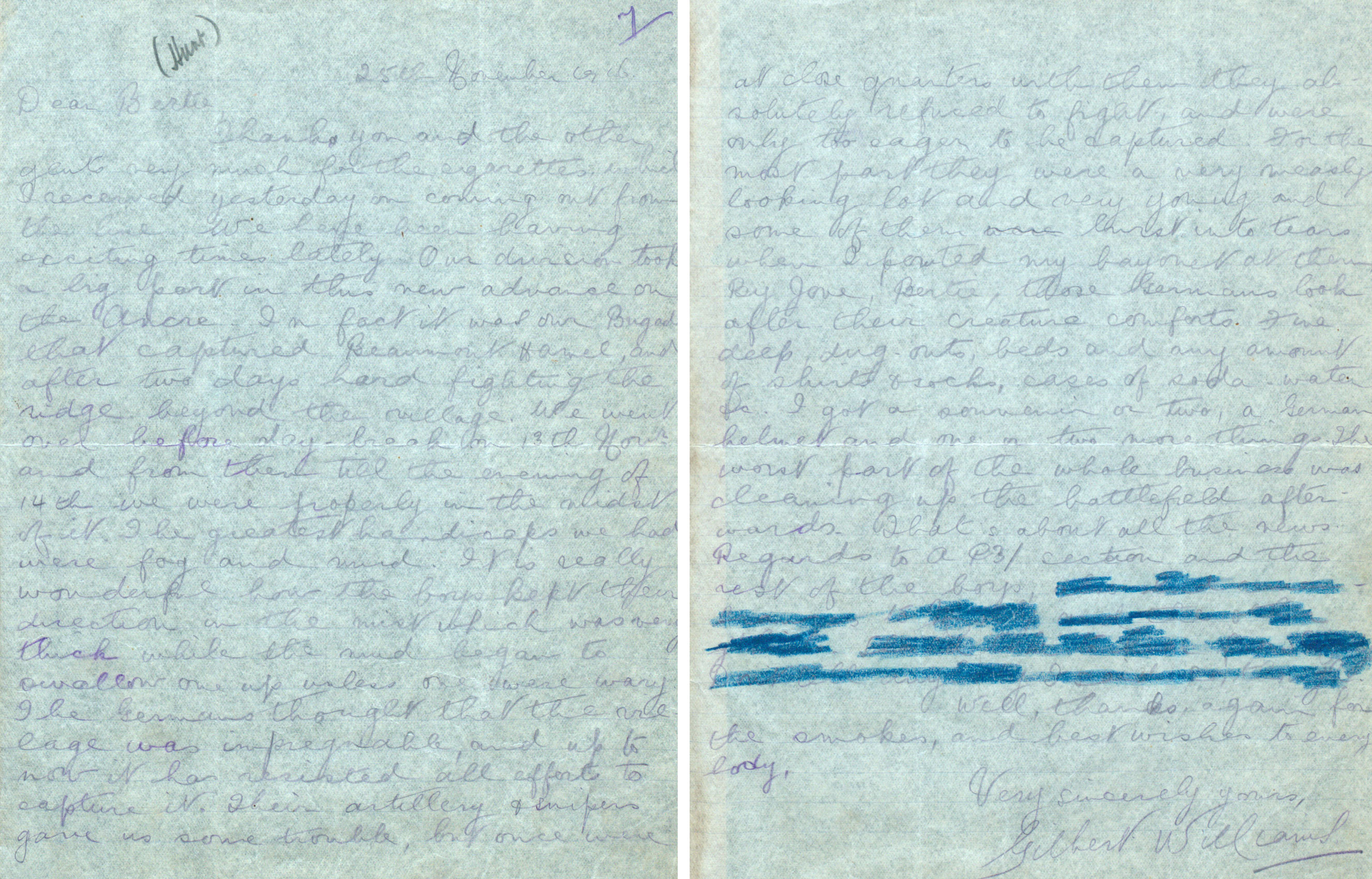
This is one of many letters sent by staff of the Great Western Railway (GWR) Audit office at Paddington who had enlisted to fight in the First World War. (RAIL 253/516)
Gilbert Williams, 25 November 1916, France. Born: 18 April 1894, Regiment: 1/6 Seaforth Highlanders, Regiment number: 2175, Rank: Private, Died: 1967
Note: Williams also fought in Second World War, and returned from war on 15 November 1948.
Transcript
Dear Bertie,
Thank you and the other gents very much for the cigarettes which I received yesterday on coming out from the line. We have been having exciting times lately. Our division took a big part in this new advance on the Ancre. In fact, it was our Brigade that captured Beaumont Hamel, and after two days hand fighting the ridge beyond the village. We went over before day break on the 13th November and from there till the evening of 14th we were properly in the midst of it. The greatest handicaps we had were fog and mud. It is really wonderful how the boys kept their direction in the mist which was very thick while the mud began to swallow one up unless one was wary. The Germans thought the village was impregnable, and up to now it has resisted all efforts to capture it. Their artillery and snipers gave us some trouble, but once we were at close quarters with them, they absolutely refused to fight, and were only too eager to be captured. For the most part they were a very measly looking lot and very young and some of them burst into tears when I pointed my bayonet at them. By Jove, Bertie, those Germans look after their creature comforts. Fine deep dugouts and any amount of shirts and socks and cases of soda water etc., I got a souvenir or two, a German helmet and one or two more things. The worst part of the whole business was cleaning up the battlefield afterwards. That’s about all the news. Regards to the Audit agreements section and the rest of the boys. [Lines censored]
Well thanks again for the smokes, and very best wishes to everybody.
Very sincerely yours,
Gilbert Williams
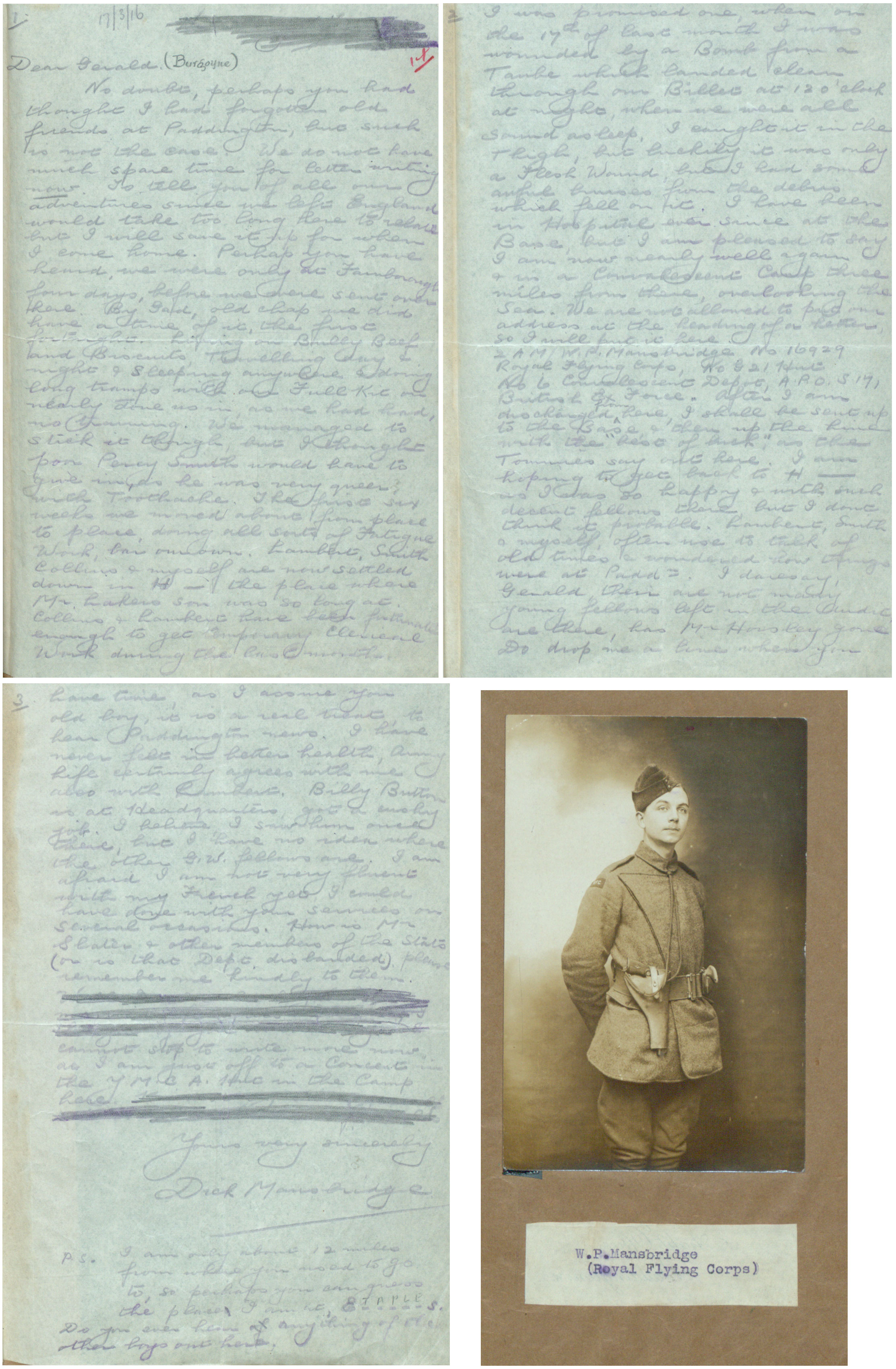
This is one of many letters sent by staff of the Great Western Railway Audit office at Paddington who had enlisted to fight in the First World War. (RAIL 253/516)
William Perrin Mansbridge, 17 March 1916, France. Born: 11 February 1889, Regiment: Royal Flying Corps, Regiment number: 16929, Died: 1973
Transcript
Dear Gerald,
No doubt, perhaps you had thought I had forgotten old friends at Paddington, but such is not the case. We so not have much spare time for letter writing now. To tell you of all our adventures since we left England would take too long here to relate but I will save for when I come home. Perhaps you have heard, we were only at Farnborough four days, before we were sent over there. By God, old chap we did have a time of it, the first fortnight. Living on bully beef and biscuits, travelling day and night and sleeping anywhere and doing long tramps with full kit on nearly done us in as we had no training. We managed to stick it through, but I thought poor Percy Smith would have to give in as he was very queer with toothache. The first six weeks we moved about from place to place doing all sorts of fatigue work, bar our own. Lambert, Smith, Collins and myself are now settled down in H— the place where Mr Laker’s son was so long at. Collins and Lambert have been fortunate enough to get temporary clerical work during the last months.
I was promised one when on the 17th of last month I was wounded by a bomb from a taube which landed clean through our billet at 12 o’clock at night, when we were all sound asleep. I caught it in the thigh, but luckily it was only a flesh wound, but I had some awful bruises from the debris which fell on it. I have been in hospital ever since at the base, but I am pleased to say I am now nearly well again and in a convalescent camp three miles from there, overlooking the sea. We are not allowed to put our address at the heading of a letter so I will put it here:
2AM /W.P. Mansbridge No.16929, Royal Flying Corps No. G 21 Hut no. 6 Convalescent Depot, A.P.O. S.17, British Expeditionary Force. After I am discharged from here, I shall be sent up to the base and then up the line with the “best of luck” as the Tommies say out here. I am hoping to get back to H— as I was so happy and with such decent fellows there, but I don’t think it probable. Lambert, Smith and myself, often used to talk of old times and wondered how things were at Paddington. I daresay Gerald, there are not many young fellows left in the Audit are there, has Mr Horsley gone? Do drop me a line when you have time, as I assure you old boy, it is a real treat to hear Paddington news. I have never felt in better health, army life certainly agrees with me also with Lambert. Billy Button is at headquarters, got a cushy job. I believe I saw him once there, but I have no idea where the other G.W. fellows are. I am afraid I am not very fluent with my French yet, I could have done with your services on several occasions. How are Mr Slater and other members of the Stats. (or is that department disbanded?) Please remember kindly to them. (Lines censored)
Cannot stop to write more now as I am just off to a concert in the Y.M.C.A. hut in the camp here. (Lines censored)
Yours very sincerely
Dick Mansbridge
P.S. I am only about 12 miles from where you used to go to, so perhaps you can guess the place I am at, E- – – – – s. [Etaples]. Do you ever hear anything of the other boys out here?
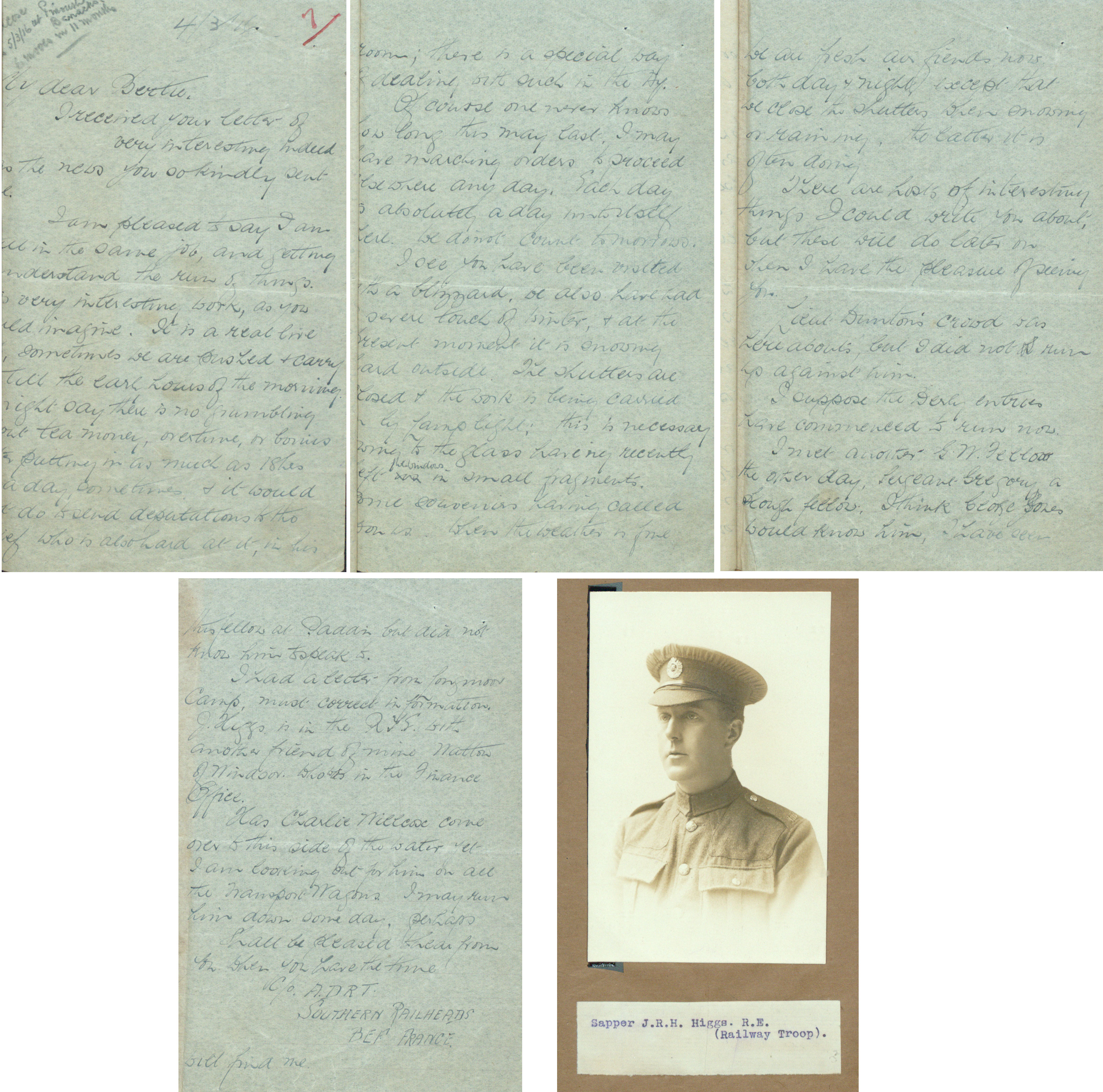
This is one of many letters sent by staff of the Great Western Railway Audit office at Paddington who had enlisted to fight in the First World War.
Mark Anthony Russell, 4 February 1916, France. Born: 30 March 1883, Regiment: Railway Troop, Royal Engineers, Regiment number: 138053, Rank: Sapper, Died: 1965
The photograph shows John Higgs, whom Russell knew and who was also in the Railway Troop, Royal Engineers. (RAIL 253/516)
Transcript
My Dear Bertie
… I am pleased to say I am still in the same job and getting to understand the run of things. It is very interesting work, as you would imagine. It is a real line here, sometimes we are pushed and carry on till the early hours of the morning. I might say there is no grumbling about tea money, overtime or bonus quotas putting in as much as eighteen hours a day sometimes and it would not do to send deputations to the chief who is also hard at it, in his room; there is a special way of dealing with such in the army.
Of course one never knows how long this may last I may have marching orders to proceed elsewhere any day. Each day is absolutely a day unto itself here. We don’t count tomorrow.
I see you have been visited with a blizzard, we also have had a severe touch of winter and at the present moment it is snowing hard outside. The shutters are closed and the work is being carried on by lamplight, this is necessary owing to the glass having recently left the windows in small fragments some souvenirs [shells] having called upon us. When the weather is fine we are fresh air fiends now both day and night except that we close the shutters when snowing or raining. The latter it is often doing.
There are hosts of interesting things I could write you about but these will do later on when I have the pleasure of seeing you. Lieut. Dunton’s crowd was hereabouts, but I did not run up against him.
I suppose the Derby* entries have commenced to run now. I met another GW fellow the other day, Sergeant Gregory, a Slough fellow. I think George Jones would know him. I have seen this fellow at Paddington but did not know him to speak to.
I had a letter from Longmoor Camp. Must correct information. J. Higgs is in the Railway Transport Engineers with another friend of mine, Watton of Windsor who was in the Finance office…
*This was a voluntary recruitment policy in Britain created in 1915. The idea behind it was that men who voluntarily registered would be called to serve in the forces only when necessary. Men were classified according age and marital status, and single men were to be called first.
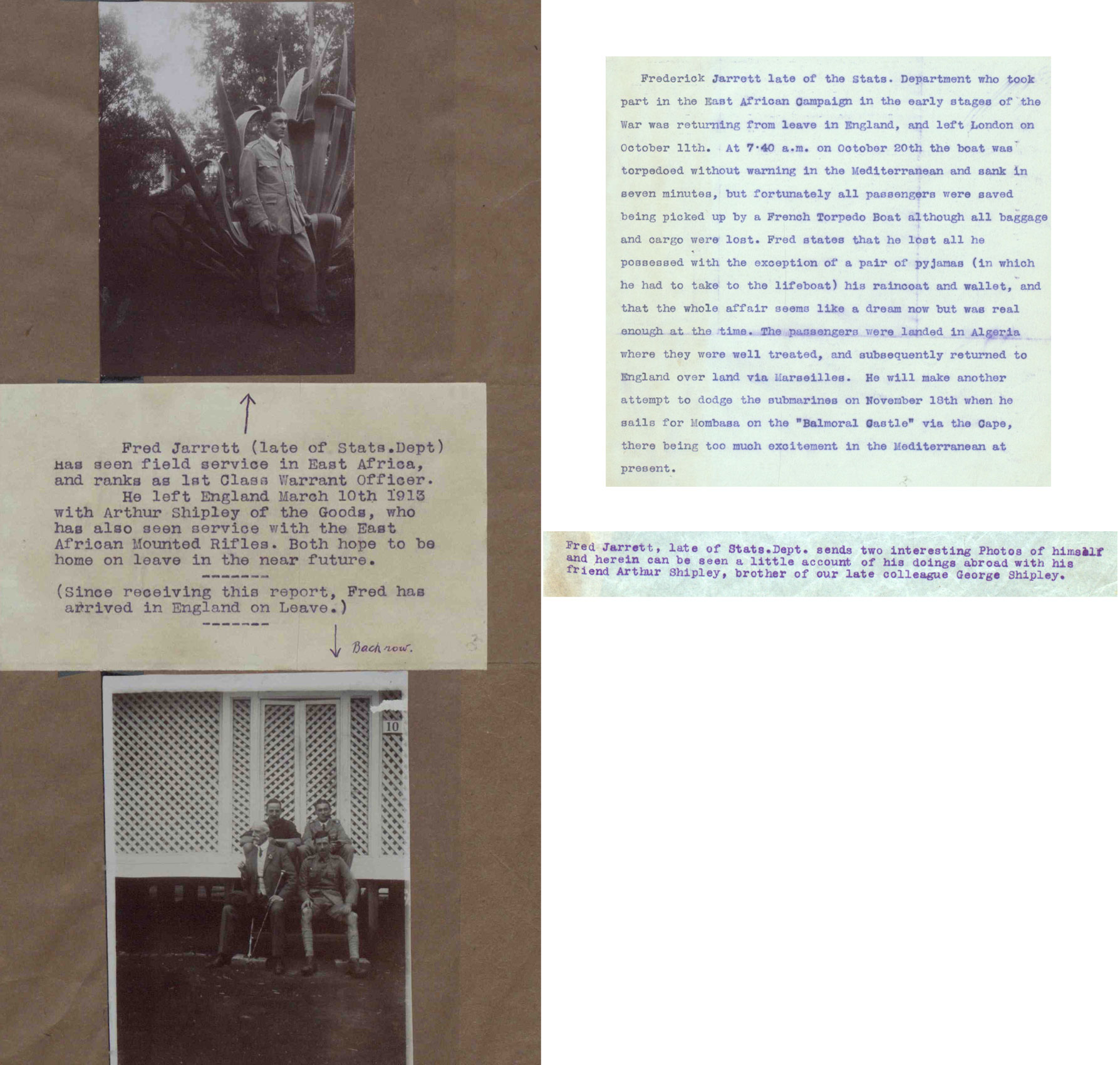
This is one of many letters sent by staff of the Great Western Railway Audit office at Paddington who had enlisted to fight in the First World War. (RAIL 253/516)
Frederick Jarrett, photographs, a typed extract and an account, August-November 1916. Born: 10 June 1891, Regiment: East African Mounted Rifles
Note: In March 1919 Jarrett was promoted to Acting Assistant Chief Accountant of Uganda Railway. In 1935 he became Colonial Treasurer for St Helena.
Transcripts
Photograph caption (left)
Fred Jarrett (late of Stats. Dept) has seen field service in East Africa and ranks as a First Class Warrant Officer. He left England March 10th 1913 with Arthur Shipley of the Goods, who has also seen service with the East African Mounted Rifles. Both hope to be home on leave in the near future. (Since receiving this report, Fred has arrived in England on leave)
Extract of office newsletter (top right)
Frederick Jarrett late of the Stats. Dept who took part in the East African campaign in the early stages of the war was returning from leave in England, and left London on October 11th. At 7.40am, on October 20th the boat was torpedoed without warning in the Mediterranean and sank in seven minutes, but fortunately all passengers were saved being picked up by French torpedo boat although all baggage and cargo were lost. Fred states that he lost all he possessed with the exception of a pair of pyjamas (in which he had to take a lifeboat) his raincoat and wallet, and that the whole affair seems like a dream now but was real enough at the time. The passengers were landed in Algeria where they were well treated, and subsequently returned to England over land via Marseilles. He will make another attempt to dodge the submarines on November 18th when he sails for Mombassa on the Balmoral Castle via the Cape, there being too much excitement in the Mediterranean at present.
Extract of office newsletter (bottom right)
… Fred Jarrett, late of Stats. Dept. sends two interesting Photos of himself and herein can be seen a little account of his doings abroad with his friend Arthur Shipley, brother of our late colleague George Shipley.
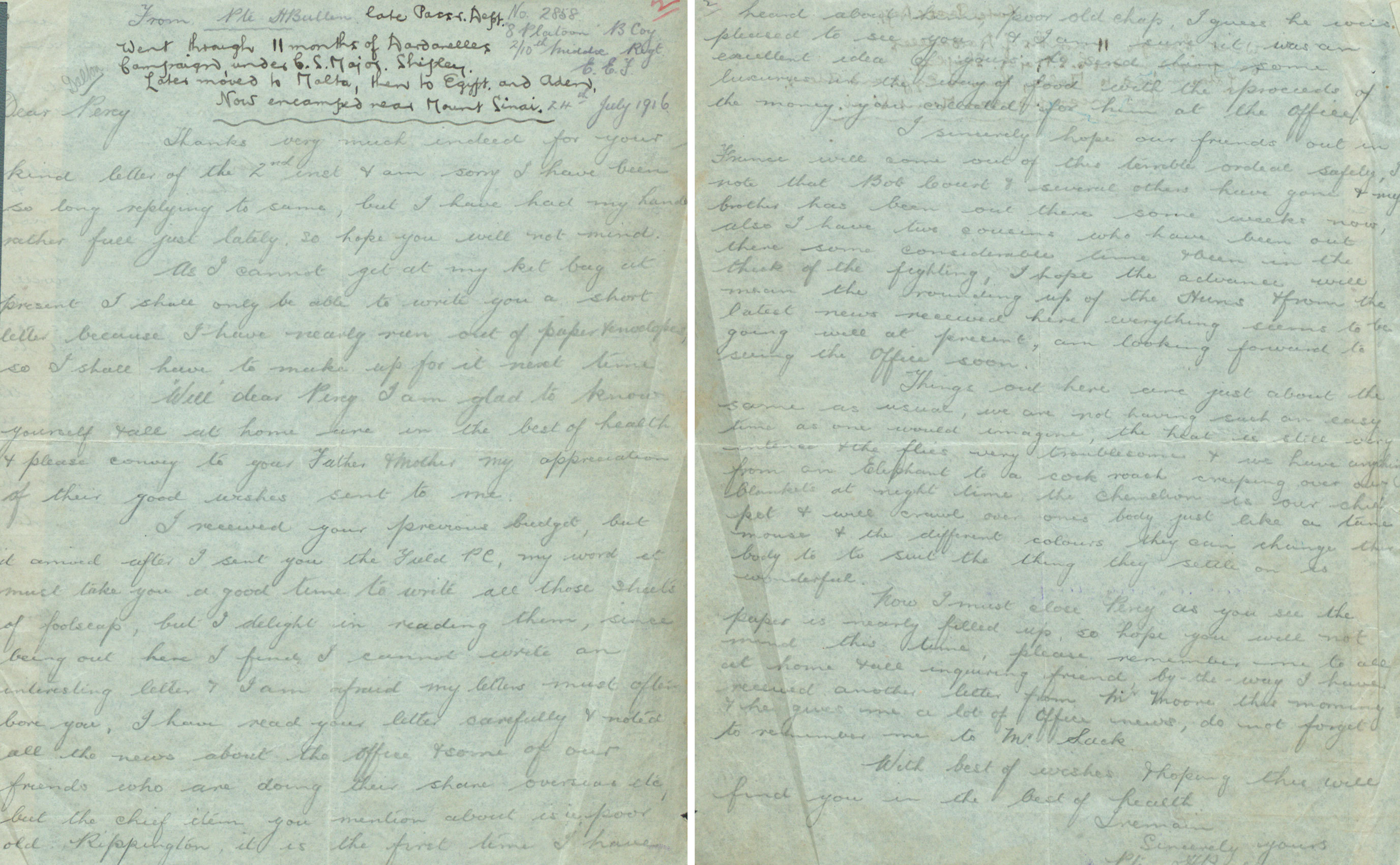
This is one of many letters sent by staff of the Great Western Railway Audit office at Paddington who had enlisted to fight in the First World War. (RAIL 253/516)
Henry Bullen, 24 July 1916, Egypt. Born: 25 April 1893, Regiment: 2/10 Middlesex regiment, Regiment number: 2858, Rank: Private, Died: 1942
Transcript
An employee at the Audit office added the following note at the top of the letter: Private H. Bullen, late of the Passengers dept, went through 11 months of Dardanelles campaign… Later moved to Malta, then to Egypt and Aden. Now encamped near Mount Sinai.
Dear Percy,
…I am sorry I have been so long replying to your letter, but I have had my hands rather full just lately, so hope you will not mind. As I cannot get at my kit bag at present I shall only be able to write you a short letter because I have nearly run out of paper envelopes, so I shall have to make up for it next time.
Well my dear Percy I am glad to know yourself and all at home are in the best of health and please convey to your father and mother my appreciation of their good wishes sent to me.
I received your previous budget, but it arrived after I sent you the field postcard, my word it must take you a good time to write all those sheets of foolscap, but I delight in reading them, since being out here I find I cannot write an interesting letter. I am afraid my letters must often bore you, I have read your letter carefully and noted all the news about the office and some of our friends who are doing their share overseas, but the chief item you mention is poor old Rippington, it is the first time I have heard about him, poor old chap. I guess he was pleased to see you and I am sure it was an excellent idea of yours to send him some luxuries in the way of food with the proceeds of the money you collected for him at the office.
I sincerely hope our friends out in France will come out of the terrible ordeal safely, I note that Bob Court and several others have gone and my brother has been out there some weeks now, also I have two cousins who have been out there some considerable time and been in the thick of the fighting, I hope the advance will mean the rounding up of the Huns and from the latest news received here everything seems to be going well at present, am looking forward to seeing the office soon…
We are not having such an easy time as one would imagine, the heat is still very intense and the flies very troublesome and we have anything from an elephant to a cockroach creeping over our blankets at night time; the chameleon is our chief pet and will crawl over one’s body just like a tame mouse and the different colours they can change their body to suit the thing they settle on is wonderful.
Now I must close Percy as you will see the paper is nearly filled up, so hope you will not mind this time, please remember me to all at home and all inquiring friends… With best wishes…
Private H. Bullen
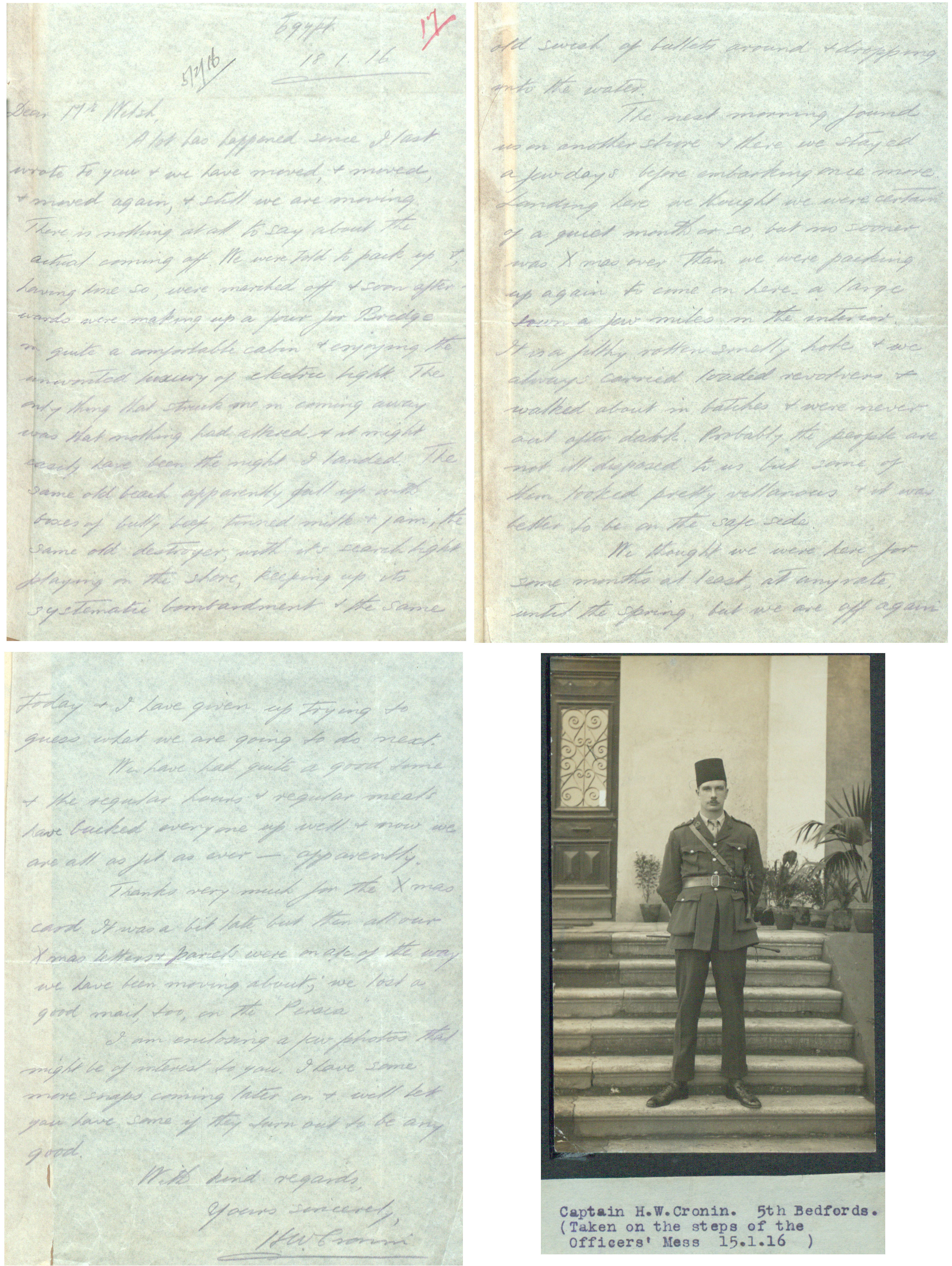
This is one of many letters sent by staff of the Great Western Railway Audit office at Paddington who had enlisted to fight in the First World War. (RAIL 253/516)
Harold William Cronin, 18 January 1916, Egypt. Born: 9 May 1880, Regiment: 4th Seaforth Highlanders; promoted to Lieutenant in 5th Bedfordshire Regiment on 20 May 1915, Died: 2 December 1917 at 35 Casualty Clearing Station in Palestine, leaving £268 19s to his widow
Transcript
Dear Mr Welsh,
A lot has happened since I last wrote to you and we have moved, and moved, and moved again, and still we are moving. There is nothing at all to say about the actual coming off. We were told to pack up, and having done so, were marched off and soon afterwards were making up a four for Bridge in quite a comfortable cabin and enjoying the unwanted luxury of electric light.
The only thing that struck one in coming away was that nothing had altered and it might easily have been the night I landed. The same old beach apparently full up with boxes of bully beef, tinned milk and jam, the same old destroyer, with its search light playing on the shore, keeping up its systematic bombardment and the same old swish of bullets around and dropping into the water. No sooner was Christmas here than we were packing up again, to come on here. A large town a few miles on the interior, it is a filthy rotten smelly hole and we always carried loaded revolvers and walked about in batches and were never out after dark. Probably the people are not ill disposed to us but some of them looked pretty villainous and it was better to be on the safe side…
We have had quite a good time and the regular hours and regular meals have backed everyone up well and now we are all as fit as ever- apparently.
Thanks very much for the Xmas card it was a bit late but then all our Xmas letters and parcels were on account of the way we have been moving about; we lost a good mail, too, on the Persia (S.S. Persia, which was torpedoed and sunk in December 1915). I am enclosing a few photos that might be of interest to you. I have some more snaps coming later on and will let you have some if they turn out to be any good. With kind regards. Yours sincerely,
H.W. Cronin
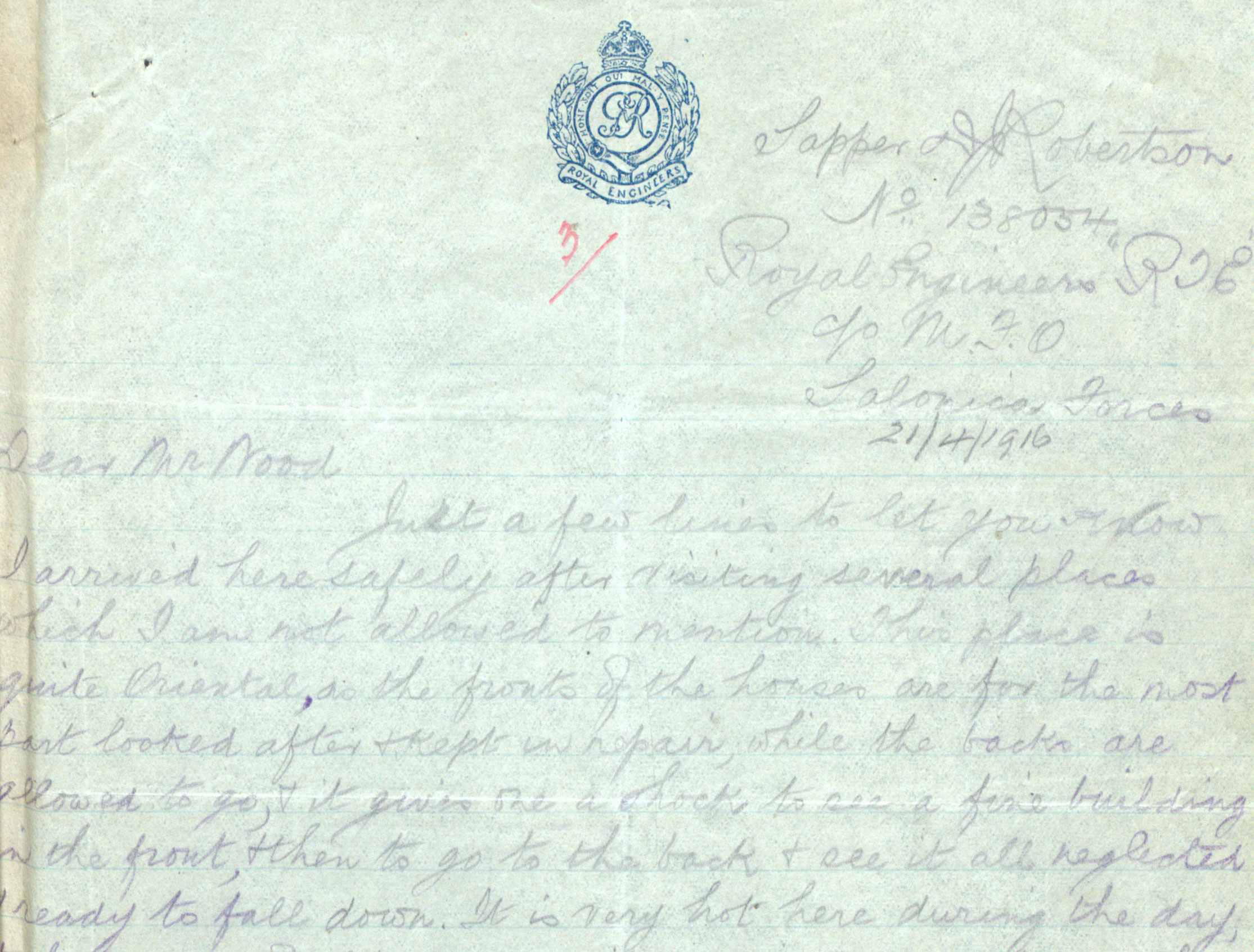
One of the many letters sent by staff of the Great Western Railway Audit office at Paddington who had enlisted to fight in the First World War. The image shows part of the letter; the full transcript is given below. (RAIL 253/516)
David Joseph Robertson, 21 April 1916, Salonika, Greece. Born: 5 January 1877, Regiment: Railway Troop, Royal Engineers, Regiment number: 138054, Rank: Sapper, Returned to office: 5 May 1919
Transcript
Dear Mr Wood,
Just a few lines to let you know I arrived safely after visiting several places which I am not allowed to mention. This place is quite oriental as the fronts of the houses are for the most part looked after and kept in repair, while the backs are allowed to go, and it gives one a shock to see a fine building in the front, and then to go to the back and see it all neglected and ready to fall down. It is very hot here during the day and the swarms of flies and mosquitoes keep one very busy and I dread to think what it will be like in the summer. It seems strange to see oxen drawing carts and donkeys with packs on, but it is a very common sight here. I sometimes have to go to the big steamers in a small pinnace [ship’s boat] and when it is rough it requires some nerve to walk along the sides of barges that are pitching and tossing and then climb up the ship’s side by a rope ladder, but it comes easier in time. It is very mountainous here, and we get a very fine view of Mount Olympus and the snow-capped peaks. I had to go by motor up country the other day and I had to grip the side of the car as the roads are awful and sometimes there is only just room for the car to travel and a sheer drop on the other side. The labourers at the docks are Greeks and when they are taken on in the mornings it is a regular Babel ‘till the Military Policeman uses his persuader (truncheon) right and left and that calms them somewhat. I have not met Mr Cox’s son yet but should I do so I will make myself known to him. I have had to revert to sapper again as there are not sufficient men of our staff for us to remain N.C.O.s but if it is brought up to strength I am promised them again. The first person I saw here was Gray of the Stats (Statistical Department), and we are working together. Trusting that you are quite well and with kindest regards to Messrs Cox, Slater, Rogers and Hunt.
Am yours obediently,
D.J. Robertson
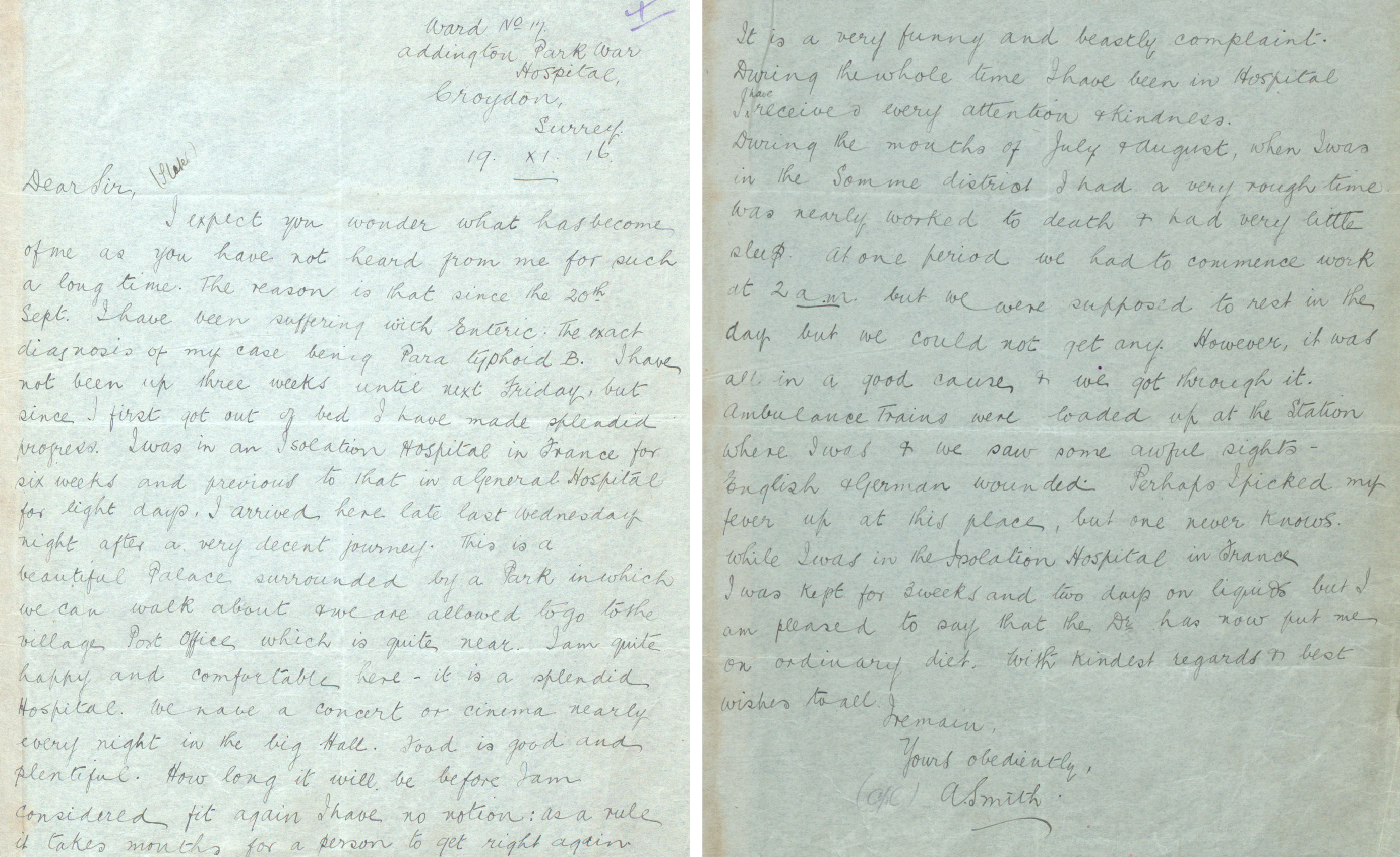
This is one of many letters sent by staff of the Great Western Railway Audit office at Paddington who had enlisted to fight in the First World War. (RAIL 253/516)
Arthur Smith, 19 November 1916, Addington Park War Hospital, England. Born: 8 March 1895, Regiment: Railway Troop, Royal Engineers, Regiment number: 87760, Rank: Lance Corporal, Returned to office: 16 June 1919, Retired: 30 September 1955
Transcript
Dear Sir,
I expect you wonder what has become of me as you have not heard from me for such a long time. The reason is that since the 20th September I have been suffering with enteric (typhoid). The exact diagnosis of my case being para typhoid B. I have not been up three weeks until next Friday, but since I first got out of bed I have made splendid progress. I was in an isolation hospital in France for six weeks and previous to that in a General Hospital for eight days. I arrived here late last Wednesday night after a very decent journey. This is a beautiful palace surrounded by a park in which we can walk about and we are allowed to go to the post office which is quite near. I am quite happy and comfortable here, it is a splendid hospital. We have a concert or cinema nearly every night in the big hall. Food is good and plentiful. How long it will be before I am considered fit again I have no notion, as a rule it takes months for a person to get right again.
It is a very funny and beastly complaint. During to the whole time I have been in hospital I have received every attention and kindness. During the months of July and August when I was in the Somme district I had a very rough time, was nearly worked to death and had little sleep. At one period we had to commence work at 2am but we were supposed to rest in the day but we could not get any. However, it was all in a good cause and we got through it. Ambulance trains were loaded up at the station where I was and we saw some awful sights. English and German wounded. Perhaps I picked my fever up at this place, but one never knows. While I was in the isolation hospital in France I was kept for three weeks and two days on liquids but I am pleased to say that the doctor has now put me on ordinary diet. With the kindest regards and best wishes to all, I remain yours obediently.
A. Smith
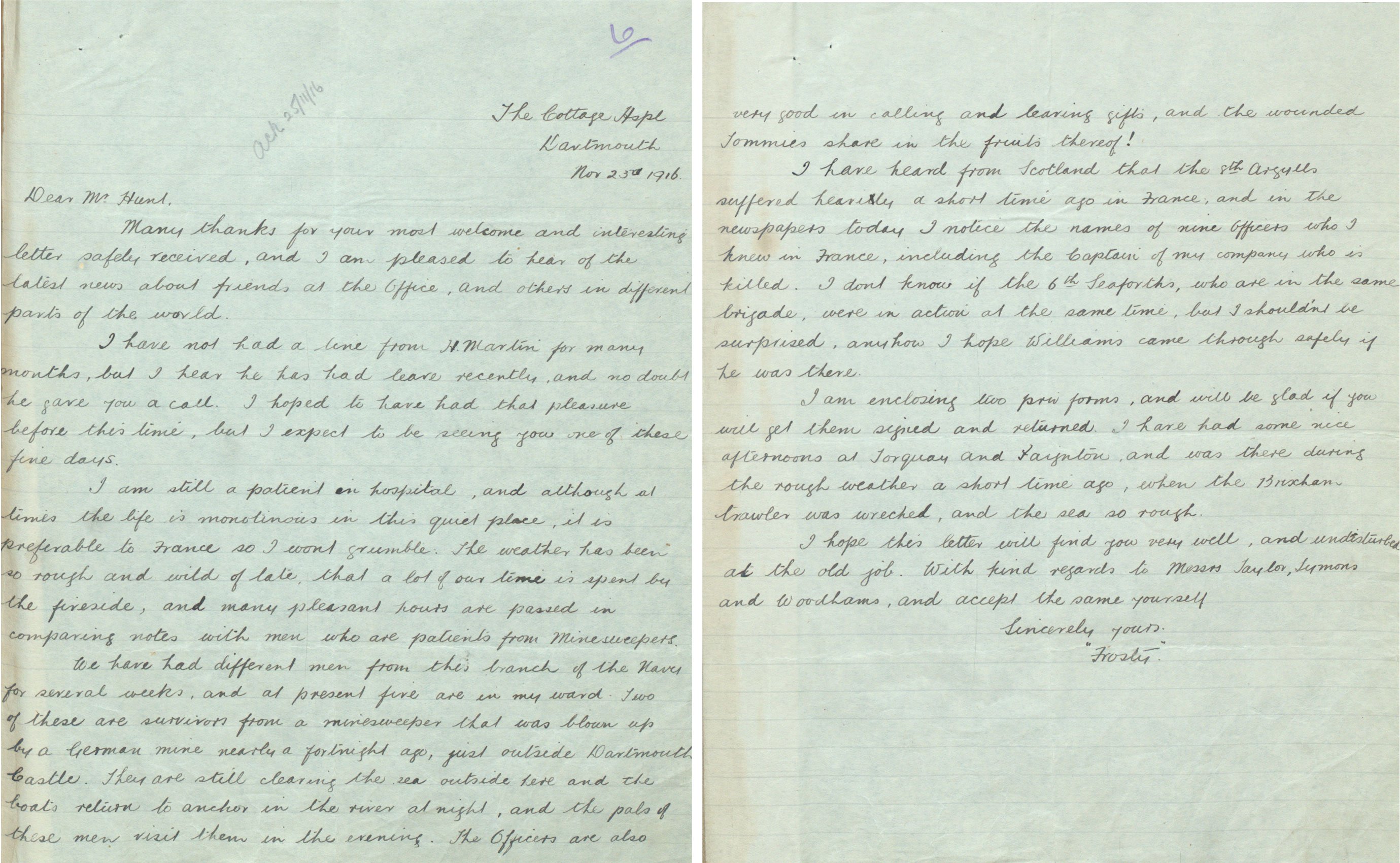
This is one of many letters sent by staff of the Great Western Railway Audit office at Paddington who had enlisted to fight in the First World War. (RAIL 253/516)
R.C.S. Frost, 23 November 1916, Dartmouth, England. Born: 30 January 1888, Regiment: 8th Argyll and Sutherland Highlanders; Duke of Cornwall’s Light Infantry, Regiment number: 1998; 300470, Rank: Private; Second Lieutenant, Died: 1962
Transcript
Dear Mr Hunt,
Many thanks for your most welcome and interesting letter safely received, and I am pleased to hear of the latest news about friends at the office and others in different parts of the world.
I have not had a line from H. Martin for many months, but I hear he has had leave recently, and no doubt he gave you a call. I hoped to have had that pleasure before this time, but I expect to be seeing you one of these fine days.
I am still a patient in hospital, and although at times the life is monotonous in this quiet place, it is preferable to France so I won’t grumble. The weather has been so rough and wild of late, that a lot our time is spent by the fireside, and many pleasant hours are passed in comparing notes with men who are patients from minesweepers.
We have had different men from this branch of the Navy for several weeks, and at present five are in my ward. Two of these are survivors from a minesweeper that was blown up by a German mine nearly a fortnight ago, just outside Dartmouth Castle. They are still clearing the sea outside here and the boats return to anchor in the river at night, and the pals of these men visit them this evening. The officers are also very good in calling and leaving gifts and the wounded Tommies share in the fruits thereof!
I have heard from Scotland that the 8th Argylls suffered heavily a short time ago in France, and in the newspapers today I notice the names of nine officers who I knew in France, including the Captain of my company who is killed. I don’t know if the 6th Seaforths, who are in the same brigade, were in action at the same time, but I shouldn’t be surprised, anyhow I hope [Gilbert] Williams came through safely if he was there.
I am enclosing two privilege forms, and will be glad if you will get them signed and returned. I have had some nice afternoons at Torquay and Paignton and was there during the rough weather a short time ago, when the Brixham trawler was wrecked and sea was so rough.
I hope this letter will find you very well and undisturbed at the old job. With kind regards to Messrs Taylor, Symons, and Woodhams and accept the same yourself.
Sincerely yours, ‘Frosty’.
 How did these men experience the conflict? (1916 - 18)
‘Our family has had to pay the penalty of war that so many thousands of families have done, for I am now the only one out here’
These few words, written by Frederick Ernest Andrews on 16 October 1917 from France, come from this collection of letters from staff at the Audit office for the Great Western Railway (GWR) based at Paddington, London.
What makes this collection of soldiers’ letters so different from all others is the fact that it reveals the stories of a particular group of men who varied in class and education, who were writing back to their colleagues and bosses in the office while on active service during in the First World War. Many men enlisted from the GWR to fight, but these letters come exclusively from those worked at its Audit office. Staff at Paddington covered a range of different roles in insurance, accounting or ticketing for the Great Western Railway.
The letters (RAIL 253/516) belong to the RAIL series (which includes the records of the railway companies) at The National Archives. They are arranged in 12 carefully bound folders, rather like a series of scrapbooks. Starting from August 1915, each part represented what was known as the office newsletter, a collection of letters, photographs postcards, field cards and contemporary newspaper cuttings from those who had gone to fight. Every newsletter opened with a news section listing those who had written and sent photos to the office and those who recently left to company to serve at the front. The totals of all men in khaki from the Audit office were given too. The news section also provided information about those who had died, been injured, visited the office on leave or been promoted. The newsletters were circulated within the office departments and read by men when they came home on leave. Friends or relatives who had been sent their own letters or photographs often lent them or typed them out to be circulated as part of the regular Audit office newsletter.
The Audit office raised enough money through collections and the sale of Christmas cards, to create a temporary roll of honour for the office at Paddington to commemorate those who had fallen in battle by August 1915. Photographs of the Roll of Honour were sent out to several employees as their correspondence reveals.
After the war had ended and troops had returned, the G.W.R. was able to quantify the contribution that it had made to the cause. The contribution made by the Audit office was high: 55.5% of male staff enlisted, whereas the average rate of enlistment across the GWR was 32.6%. This amounted to 184 men, 17 of whom lost their lives.
On 11 November 1922, The Great Western Railway War Memorial, dedicated to all 2,524 staff who had died in battle was unveiled on platform 1, Paddington station.