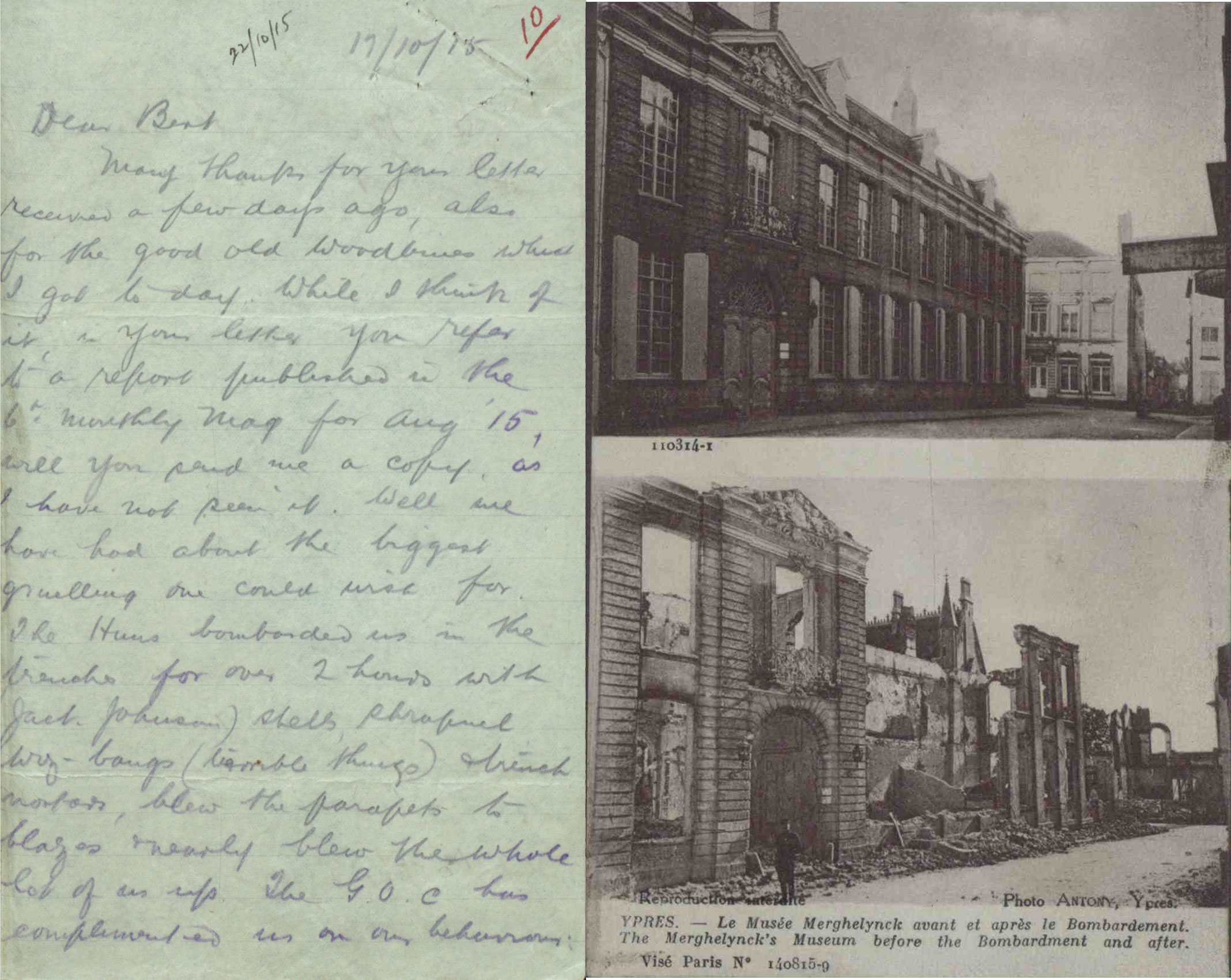
This is one of many letters sent by staff of the Great Western Railway (GWR) Audit office at Paddington who had enlisted to fight in the First World War. (RAIL 253/516)
Jonathan George Symons, 19 October 1915, Belgium. Born: 22 August 1875, Joined GWR: 28 October 1889, Regiment: 13 County of London Regiment (King’s Royal Rifles Corps), Regiment number: 6389, Died: 1941
Transcript
Dear Bert,
Many thanks for your letter received a few days ago, also for the good old Woodbines which I got today. While I think of it in your letter you refer to a report published in the 6th monthly Magazine for August ’15, will you send me a copy, as I have not seen it.
Well, we have had about the biggest gruelling we could wish for. The Huns bombarded us in the trenches for over two hours with Jack Johnson* shells, shrapnel, whizz bangs* (terrible things) and trench mortars, blew the parapets to blazes and nearly blew the whole lot of us up. The General Officer Commanding has complimented us on our behaviour. We are now resting at a place called Vlamertinghe, just south of Ypres and a couple miles North of Poperinghe [Poperinge] in Belgium. We deserve a rest for we have spent thirty-nine days in dugouts and the trenches (except three days) and needless to tell you we are very crummy, which tends to spoil the rest we are having. I never thought I was going to another phase of them after South Africa. I was in Poperinghe (where I met Jackson a few weeks ago)…
The beauty of it out here is we can stand a pal a drink, and also have one with him. I suppose shall have to wait for my increase, being an absentee from the office, anyway they can add it on to my salary as soon as they like for I shall then be able to pay more income tax. I enclose a few postcards. They are showing in each card before and after, or during and after the bombardment of Ypres, so you can guess what the place looks like. Well Bert in conclusion I must tell you that one of our Sergeants who is on leave, posted this in London for me, that’s why I am able to give you a few details. Kind regards to all friends in the Audit,
Your sincere friend,
Jack Symons.
Photo caption: YPRES. – The Merghelynck’s Museum before the Bombardment and after.

Poster for a new housing estate in Poplar, London, which is being advertised as a paid attraction during the 1951 Festival of Britain. (WORK 25/234 E1)
Transcript
New homes rise from London’s ruins…
SEE LONDON’S NEW NEIGHBOURHOOD GROWING
LANSBURY – POPLAR
Admission to neighbourhood free
Special enclosure, show house and flat, 1’6- children 5-15 half price: children under 5 not admitted
For times of opening see newspapers
WATER BUS TO WEST INDIA DOCK PIER, AND THENCE BY BUS – OR BUS FROM ALDGATE EAST UNDERGROUND STATION
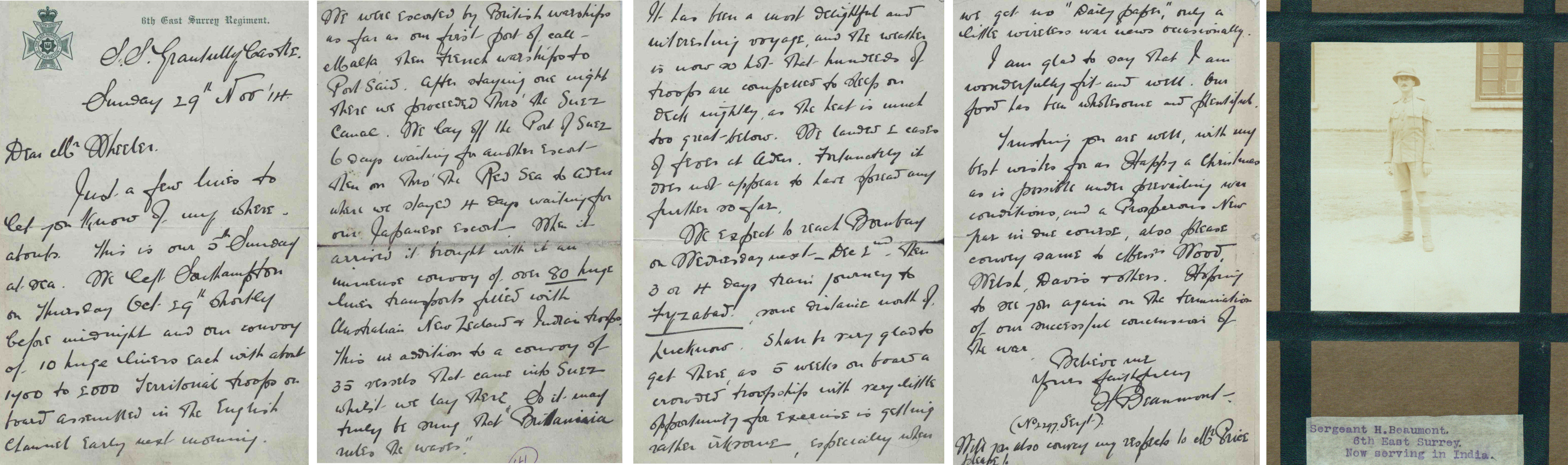
This is one of many letters sent by staff of the Great Western Railway Audit office at Paddington who had enlisted to fight in the First World War. (RAIL 253/516)
H. Beaumont, 29 November 1914, SS Grantully Castle (Beaumont was travelling on a troop ship sailing in convey out to India). Born: 17 October 1873, Regiment: 1/6 East Surrey Regiment, Regiment number: 2297, Rank: Quarter Master Sergeant, Died: 1952
Note: He was a member of volunteer army as a young man. He was a life governor of Richmond Hospital, London and held an MBE (Military Division)
Transcript
Dear Mr Wheeler
Just a few lines to let you know of my whereabouts. This is our fifth Sunday at sea. We left Southampton on Thursday October 29th shortly before midnight and our convoy of ten huge liners each with about 1700 to 2000 territorial troops on board assembled in the English Channel early next morning.
We were escorted by British warships as far as our first port of call- Malta the French warships to Port Said. After staying one night there we proceeded through the Suez Canal. We lay off the Port of Suez six days waiting for another escort then on through the Red Sea to Aden where we stayed four days waiting for our Japanese escort. When it arrived it brought with it an immense convoy of over 80 huge liners transports filled with New Zealand and Indian troops. This in addition to a convoy of thirty five vessels that came into Suez whilst we lay there. So it may truly be sung that “Britannia rules the waves.”
It has been a most delightful and interesting voyage and the weather is now so hot that hundreds of troops are compelled to sleep on deck nightly as the heat is much too great below. We landed two cases of fever at Aden. Fortunately it does not appear to have spread any further so far.
We expect to reach Bombay on Wednesday next, December 2nd then three or four days’ train journey to Fyzabad, some distance north of Lucknow. Shall be very glad to get there, as five weeks on board a crowded troop ship with very little opportunity for exercise is getting rather irksome, especially, when we get no ‘Daily Paper’, only a little wireless war news, occasionally.
I am glad to say that I am wonderfully fit and well. Our food has been wholesome and plentiful. Trusting you are well, with my best wishes for as Happy a Christmas as is possible under prevailing war conditions, and a Prosperous New Year in due course. Also please convey same to Messrs Wood, Welsh, Davis and others. Hoping to see you again on the termination of our successful conclusion of the war.
Believe me, yours faithfully,
H. Beaumont
Will you also convey my respects to Mr Price please?
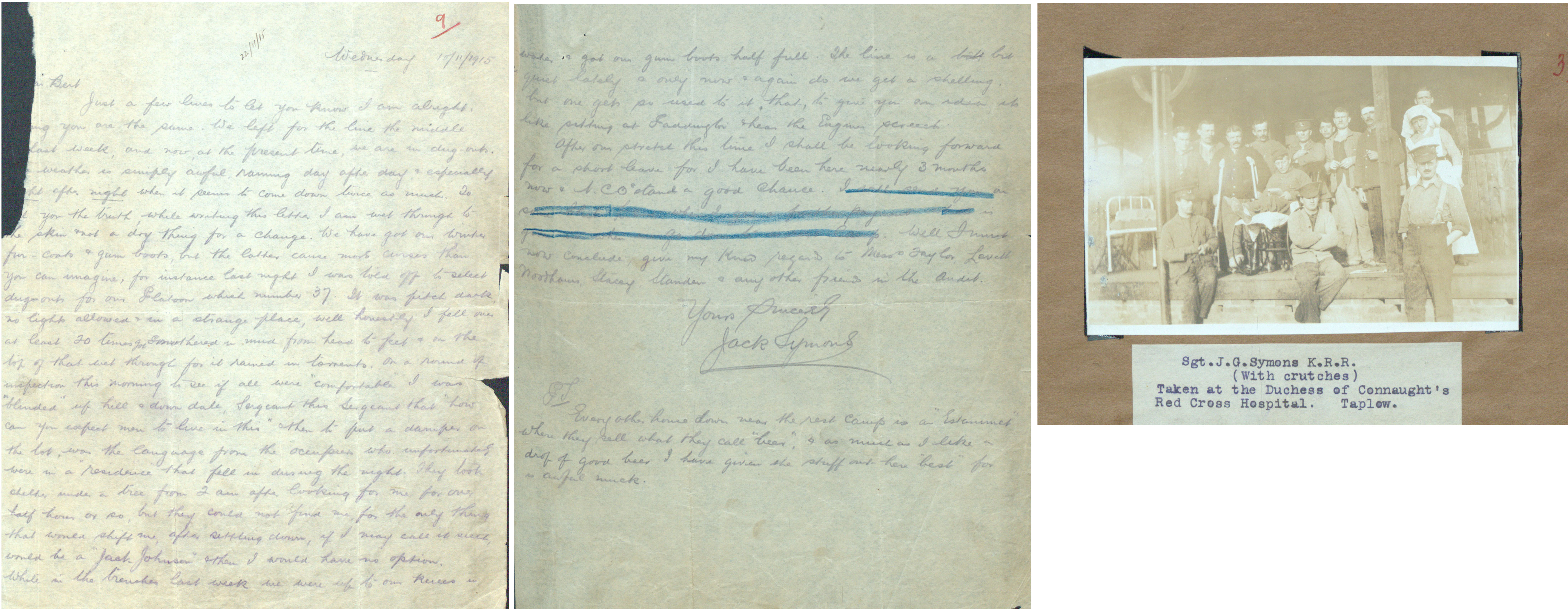
This is one of many letters sent by staff of the Great Western Railway (GWR) Audit office at Paddington who had enlisted to fight in the First World War. (RAIL 253/516)
Jonathan George Symons, 10 November 1915, France. Born: 22 August 1875, Joined GWR: 28 October 1889, Regiment: 13 County of London Regiment (King’s Royal Rifles Corps), Regiment number: 6389, Died: 1941
Transcript
Dear Bert,
Just a few lines to let you know I am alright, hoping you are the same… At the present time we are in dugouts. The weather is simply awful, raining day after day and especially night after night…To tell you the truth, while writing this letter I am wet through to the skin and not a dry thing for a change. We have got our winter fur coats and gum boots, but the latter cause more curses than you can imagine, for instance last night I was sent off to select dugouts for our platoon, which is number 37. It was pitch dark, no light allowed and in a strange place, well honestly I fell over at least 20 times got smothered in mud from head to feet and on the top of that wet though for it rained in torrents. On a round of inspection this morning to see if all were ‘comfortable’ I was ‘blinded’ up hill and down dale, ‘Sergeant this’ and ‘Sergeant that’.
How can you expect men to live in this, and then to put a dampener on the lot, was the language from the occupiers who unfortunately were in a residence that fell in during the night. They took shelter under a tree from 2am after looking for me for half an hour or so, but they could not find me, for the only thing that would shift me, after settling down, if I may call it that, would be a ‘Jack Johnson’ and then I would have no option.
While in the trenches last week John and I were up to our knees in water and got our gum boots half full. The line is a bit quiet lately and only now and again do we get a shelling, but one gets used to it. That, to give you an idea, is like sitting at Paddington and hearing the engines screech.
After our stretch this time I shall be looking forward for a short leave for I have been here nearly three months now and we stand a good chance. Well I must now conclude…Yours sincerely
Jack Symons
P.S. Every other home down near the rest camp is an Estaminet (small French café) where they sell what they call ‘beer’, and as much as I like a drop of good beer I have given the stuff out here ‘best’ for is awful muc.
Photo caption: Sgt. J.G. Symons K.R.R.
(With crutches)
Taken at the Duchess of Connaught’s Red Cross Hospital. Taplow.
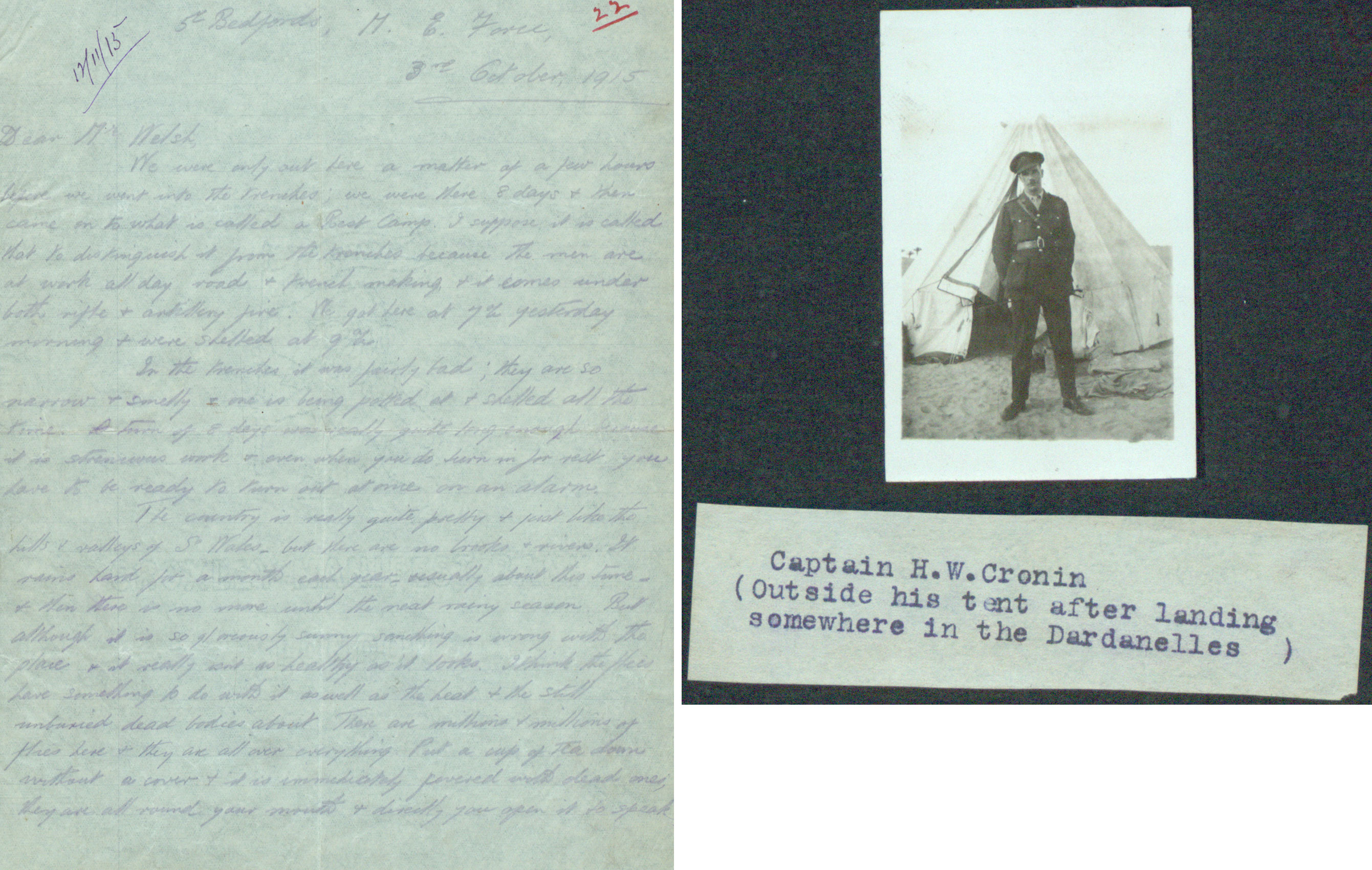
This is one of many letters sent by staff of the Great Western Railway Audit office at Paddington who had enlisted to fight in the First World War. Image shows part of letter. (RAIL 253/516)
Harold William Cronin, 3 October 1915, Dardanelles. Born: 9 May 1880, Regiment: 4th Seaforth Highlanders. Rank: Promoted to Lieutenant in 5th Bedfordshire Regiment on 20 May 1915, Died: 2 December 1917 in Palestine, leaving £268 19s to his widow Muriel
Transcript
Dear Mr Welsh,
We were only out here a matter of a few hours before we went into the trenches; we were there for eight days and then came on to what is called a Rest Camp. I suppose it is called that to distinguish it from the trenches because the men are at work all day road and trench making and it comes under both rifle and artillery fire. We got here at 7 o’clock yesterday morning and were shelled at 9 o’clock.
In the trenches it was fairly bad, they are so narrow and smelly and one is being potted at and shelled all the time. A turn of eight days was really quite long enough because it is strenuous work and even when you do turn in for a rest you have to be ready to turn out at once on an alarm.
The country is really quite pretty and just like the hills and valleys of South Wales, but there are no brooks or rivers. It rains hard for a month each year usually about this time and then there is no more until the next rainy season. But although it is so gloriously sunny something is wrong with the place and it really isn’t as healthy as it looks. I think the flies have something to do with it as well as the heat and the still unburied dead bodies about. There are millions and millions of flies here and they are all over everything. Put a cup of tea down without a cover and it is immediately covered with dead ones, they are all round your mouth and directly you open it to speak or to eat in they pop. It is a game. We have all got nets of course, we should have been worried, no medicine by now if we hadn’t.
We get plenty of bully beef and army biscuits, but bread and fresh meat is still a luxury and it is not possible to buy anything. It must have been a “No Man’s Land” because there are no houses or buildings of any kind to be seen and except the flies, the only living things are green canaries and lizards.
We live in dugouts built up the reverse sides of the hills. They are just holes really, but all the same they can be made very comfortable with a bit of digging and a few waterproof sheets. They are not shell proof by any means and the one I slept in during my first night here was knocked in completely by a shell pitching right into it. Fortunately I was not at home at the time. We have another now and I must try and get a photo of it and let you see what it is like. I must send you one of our
Mess dugout too.
Everything here is named after the Regiment responsible for the making or taking. For instance the road we made from our trenches to this camp is called “New Bedford Rd” and the ridge we took and now occupy is called on the army maps, Bedford Ridge. I have just been filling in and colouring my map and find it is one of the most, if not the most, advanced line of the lot. Standing on that ridge it is possible to see what a lot of country we have taken and now hold, but there is nothing to get wildly excited about. Each position is strengthened as much as possible before another attempt is made to push on and the whole thing is just steady progress. Something might happen suddenly, I only hope it does.
We have had some very big ships out here and they have been bombarding the forts heavily now for some few days, and there are cruisers, monitors etc. standing in the bay helping the land batteries to shell the trenches. You see a flash and then wait a long time before hearing the boom and the shriek of the shell passing over our heads, almost together, then look round quickly and see the burst of the shell in or over the trenches sometimes before hearing the explosion. The first we know of shells aimed at us is the bang of the explosion, and it is too late to get out of the way. Three officers were laid flat on their backs the other day without any hurt except to their dignity and farther on six men were buried without one being injured. It isn’t always like that though.
There is quite good bathing here when we can find time to go. As the beach is in full view of the enemy, and comes under their shell fire, it would not appeal to the nervous. We never keep closer together than ten yards when we are undressing and swimming in hopes that the Turk will not consider one man worth the price of a shell. We have had some casualties through the men keeping too close together, but after washing out of a teacup for a week or more it is worth a bit of risk to get rid of some of the trench dust and smell and feel and look clean again. And really is the best bathing I’ve ever had. The water is quite warm and clear.
All the hospital work is done on board a ship that stands in the bay. If the cases are serious or lengthy they are transferred to one of the hospital ships that calls daily and then go to either one of the bases or back to England. We land troops night or day in spite of the fact that they come under fire so it is possible for a man to be on his way back wounded, by the same ship that bought him from the base, without ever having landed.
We had a grand voyage out. All the officers had either staterooms or 1st Class cabins and the food mostly was just the same as we should have had on an ordinary cruise to India or Australia, wherever it is that the Cruise Line calls. The usual cabin stewards and waiters were in attendance and it was difficult to remember that we were not exactly on a pleasure trip. We did enjoy those two weeks…
Kind regards,
Yours sincerely,
H.W. Cronin, Lieutenant.
I am acting as captain until some of the others come back from hospital.
Photo caption: Captain H. W. Cronin (Outside his tent after landing somewhere in the Dardanelles)

This is one of many letters sent by staff of the Great Western Railway Audit office at Paddington who had enlisted to fight in the First World War. (RAIL 253/516)
Montague Percy Pond, 9 October 1915, France. Born: 13 September 1888, Regiment: Railway Troop, Royal Engineers, Regiment number: 87749, Rank: Sapper, Died: Killed in action on 6 May 1917
Transcript
Dear Dada,
Many thanks for the Slough paper and magazines. Was very sorry to see that Jefferies and How have lost their lives. I heard from Arthur this morning and he tells me that Fred Blane has died of wounds in the Dardanelles. I expect you remember him in the “Windsor Operatic Society”. [Line censored]…
Harold White (Ginger) who lived with Arthur has joined the Royal Artillery Garrison and is now at Plymouth. Arthur has sold the motorbike. Petrol is too expensive he says. Since I wrote last I have been moved to a little village about 2½ miles out of the town I was in then. It is a dead and alive hole with only a few houses and two cafes, only one of which is open. The other has had all the windows blown out.
We expect to move further on still in a day or two. We have changed our truck for a much larger one and have made ourselves very comfortable. It is about 30 feet long, so we have divided it off (with our ground sheets for curtains) at one end to make a bedroom, and the rest of the truck we have fitted up with desks and cupboards. I spent the other evening making a table out of bacon boxes etc. At present we are living very well indeed, with bacon and kidneys for breakfast, steaks and vegetables for dinner, jam and honey etc. for tea and bread and cheese and pickles for supper. Not bad for “active service”. The Post Office cook still does all our cooking. There are four of us on the staff here now. One attached to each of the three divisions, and one learning the work who will probably leave soon to take charge of a division. There have been plenty of aeroplanes over here lately. A German came over the other evening and our people shelled it for about half an hour. I don’t know whether it was brought down or not. I had a nice long letter from Mr Hunt yesterday. He sent me photo of the “Roll of Honour” and told me all the latest Audit office news. Well, I don’t think I have much more to tell you at present so will conclude with love to all,
Yours, affectionately,
Mont.
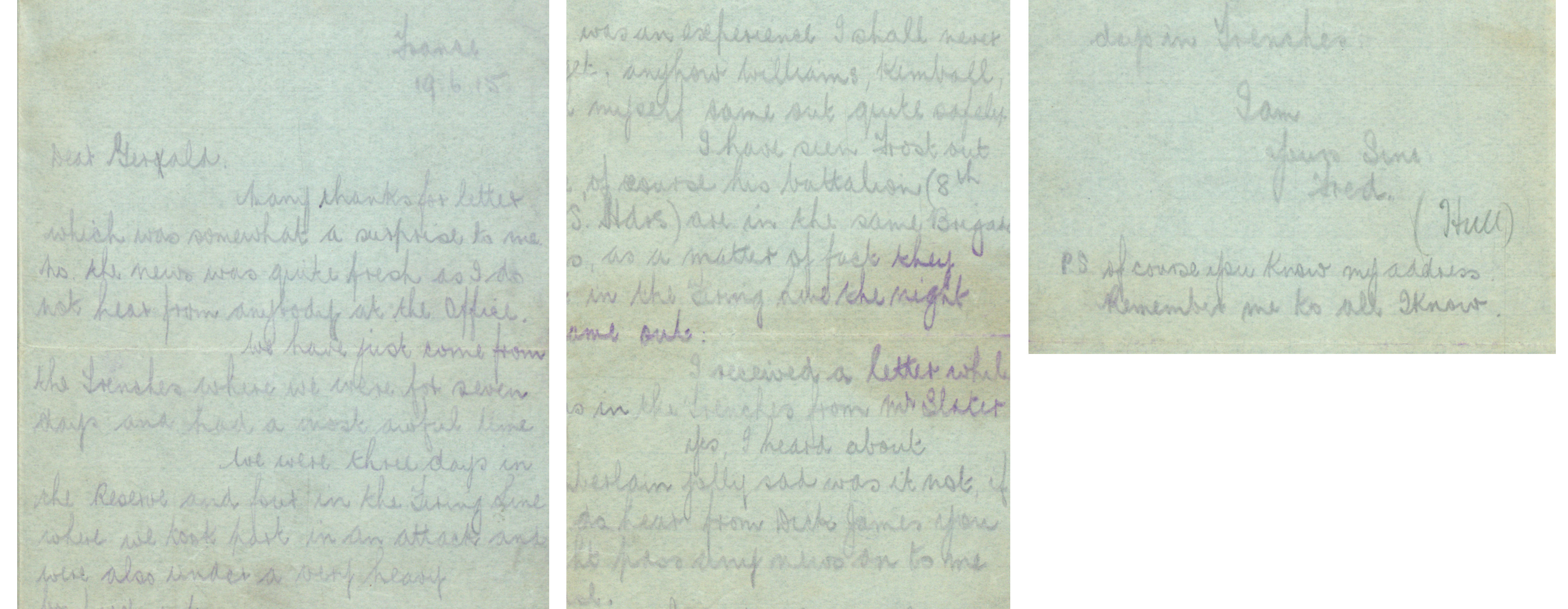
This is one of many letters sent by staff of the Great Western Railway Audit office at Paddington who had enlisted to fight in the First World War. (RAIL 253/516)
Richard Frederick, Hull, 19 June 1915, France. Born: 4 June 1892, Joined GWR: 25 July 1908, Regiment: 1/6 Seaforth Highlanders, 1st Highland Infantry Brigade, Regiment number: 2161, Rank: Lance Corporal, Died: 1974
Transcript
Dear Gerald
Many thanks for letter which was somewhat a surprise to me. No the news was quite fresh as I do not hear from anybody in the office.
We have just come from the trenches where we were for seven days and had a most awful time. We were three days in the Reserve and put in the firing line where we took part in an attack and were also under a very heavy bombardment.
I am sorry to say we had many casualties thirty five killed and one hundred and thirty eight wounded and I can assure you it was an experience I shall never forget. Anyhow Williams, Kemball and myself came out quite safely.
I have seen Frost out here, of course his battalion (8th Argyll & Sutherland Highlanders) are in the same brigade also, as a matter of fact, they were in the firing line the night we came out. I received a letter while I was in the trenches from Mr Slater. Yes, I heard about Chamberlain, jolly sad was it not, if you do hear from Dick James you might pass any news on to me…
Shall be glad to hear from you. I could write more, only am a wee bit tired after seven days in trenches.
I am yours sincerely, Fred Hull.
P.S. Of course you know my address. Remember me to all I know.

This is one of many letters sent by staff of the Great Western Railway Audit office at Paddington who had enlisted to fight in the First World War. (RAIL 253/516)
George Shipley, 6 August 1915, at sea on route to the Dardanelles, Turkey. Born: 18 August 1878, Regiment: 10 Middlesex Regiment, Regiment number: 2594, Rank: Company Sergeant Major, Died: 2 December 1915
Transcript
Dear Nic,
First of all I must thank you and… the others who sent me their kind letters of sympathy in regard to my brother Sam. We all felt it very much at home and it was a great shock to our parents naturally, but it can’t be helped, as he was killed in a good cause.
I suppose you have heard how we left Bedford early on Sunday 18/7/15 and had a lovely trip down the old firm to Keyham, we were well laden and I was glad to get aboard and get to my berth in which I am very comfortable with two other Warrant Officers. The men and Sergeants are on the troop deck and none too comfortable but are jogging along alright now.
The first part of the voyage the sea was very quiet, we passed Gibraltar in a fog at night, so couldn’t see it. We then skirted the coast of Algeria and had a pleasant run to Malta where we stopped a full day. The higher officials went ashore for a few hours (including myself) and had a good time. I cannot mention troops or ships so refrain from doing so but there was a hell of a lot.
Our next stop was Alexandria for three days, where we had another look round including a route march for the Battalion. The sea is fairly rough at this end, rather surprising, but a lovely colour, light blue at day and dark at night. All lights out at 8.00, perfect darkness, there is no twilight to speak of, being dark at 7.30pm.
We then wondered where we were off to but eventually reached Port Said, stopped a day, went ashore, and off we go to the Dardanelles which we expect to reach tonight.
Our kits have been left behind in Egypt and all we have got we stand in. We are now passing through the Aegean sea, full of rocky islands, very much like the highlands of Scotland. Bullen has just lost his helmet over the side, but is otherwise well…
I am in the best of health at present and hope to go through alright. I expect you heard I got married a week before I left, a lot of us did the same thing, it was quite a common occurrence.
Our old boat is a captured German liner and is full up but we have got a Greek crew with a few Portuguese thrown in and so are a mixed lot, especially with Welsh men aboard. How are things going at the office, I have been away nearly a year… I shall be glad to hear from you now and again just to keep in touch… I must close now as they say a mail is being collected before we land… Yours sincerely,
George
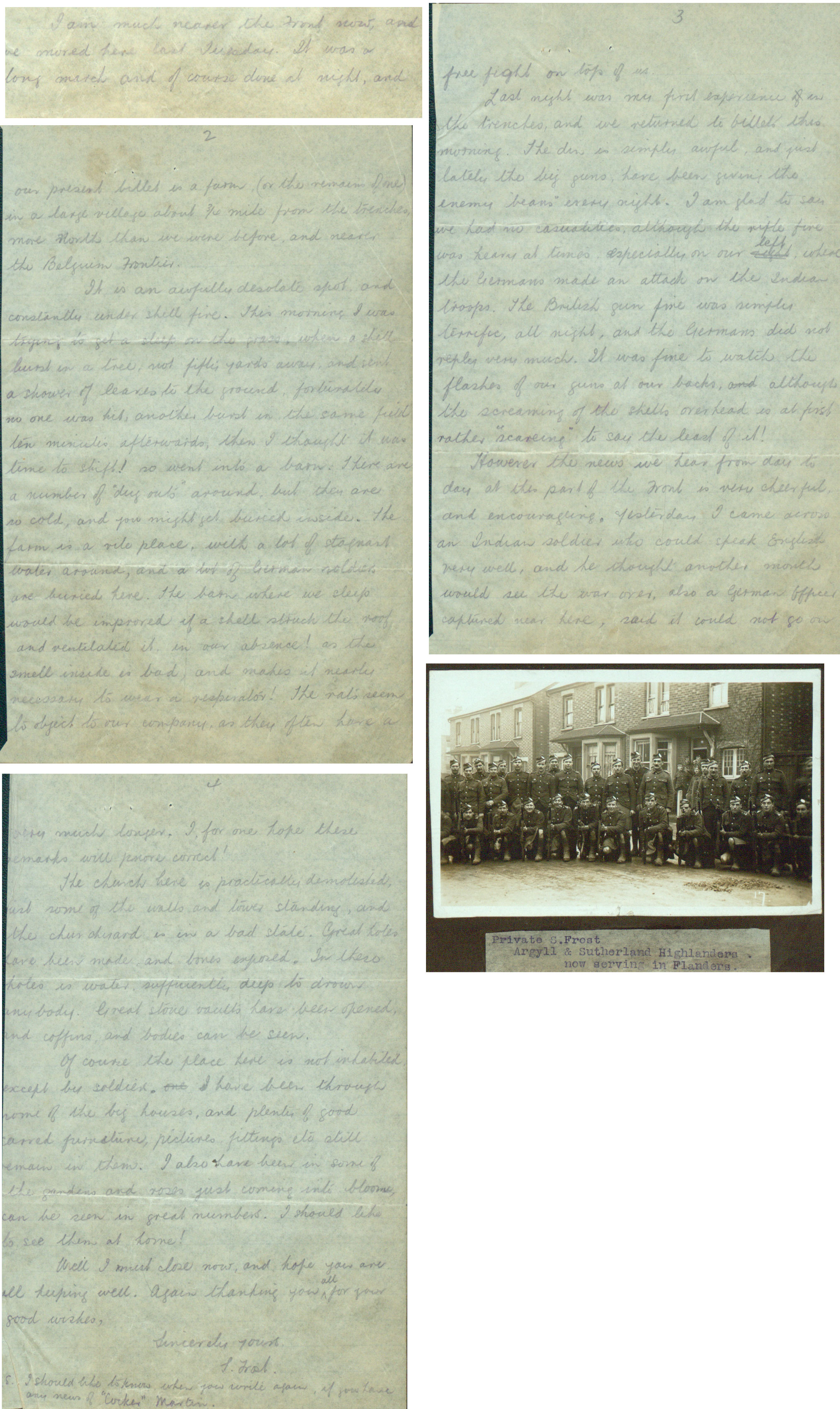
This is one of many letters sent by staff of the Great Western Railway Audit office at Paddington who had enlisted to fight in the First World War. Image shows part of letter (RAIL 253/516)
R.C.S. Frost, 22 May 1915, France. Born: 30 January 1888, Regiment: 8th Argyll and Sutherland Highlanders; Duke of Cornwall’s Light Infantry, Regiment number: 1998; 300470, Rank: Private; Second Lieutenant, Died: 1962
Transcript (extracts)
… I am much nearer the front now, and we moved here last Tuesday. It was a long march and of course done at night, and our present billet is a farm (or the remains of one) in a large village about ¾ mile from the trenches, more north than we were before, and nearer the Belgian frontier.
It is an awfully desolate spot and constantly under shell fire. This morning I was trying to get a sleep on the grass, when a shell burst in a tree, not fifty yards away, and sent a shower of leaves to the ground. Fortunately no one was hit, another burst in the same field ten minutes afterwards, then I thought it was time to shift! So went into a barn. There are a number of dugouts around, but they are so cold, and you might get buried inside. The farm is a vile place, with a lot of stagnant water around, and a lot of German soldiers are buried here. The barn where we sleep would be improved if a shell struck the roof, and ventilated it, in our absence! As the smell inside is bad, and makes it nearly necessary to wear a respirator! The rats seem to object to our company as they often have a free fight on top of us.
Last night was my first experience in the trenches, and we returned to billet this morning. The din is simply awful, and just lately the big guns have been giving the enemy ‘beans’ every night. I am glad to say we had no casualties, although the rifle fire was heard at times, especially on our left, where the Germans made an attack on the Indian troops. The British gun fire was simply terrific, all night, and the Germans did not reply very much. It was fine to watch the flashes of our guns at our backs, although the screaming of the shells overhead is at first rather ‘scaring’ to say the least of it!
However the news we hear from day to day at this part of the front is very cheerful, and encouraging. Yesterday I came across an Indian soldier who could speak English very well, and he thought another month would see the war over, also a German officer captured near here, said it could not go on very much longer. I for one hope these remarks will prove correct!
The church here is practically demolished, just some of the walls and tower standing, and the churchyard is in a bad state. Great holes have been made and bones exposed. In these holes is water sufficiently deep to drown anybody. Great stone vaults have been opened, and coffins and bodies can be seen.
Of course the place here is not inhabited except by soldiers. I have been through some of the big houses, and plenty of good carved furniture, pictures, fittings etc. still remain in them. I also have been in some of the gardens, and roses just coming into bloom can be seen in great numbers. I should like to see them at home!
Well I must close now, and hope you are all keeping well. Again thanking you all for our good wishes. Sincerely yours, S. Frost
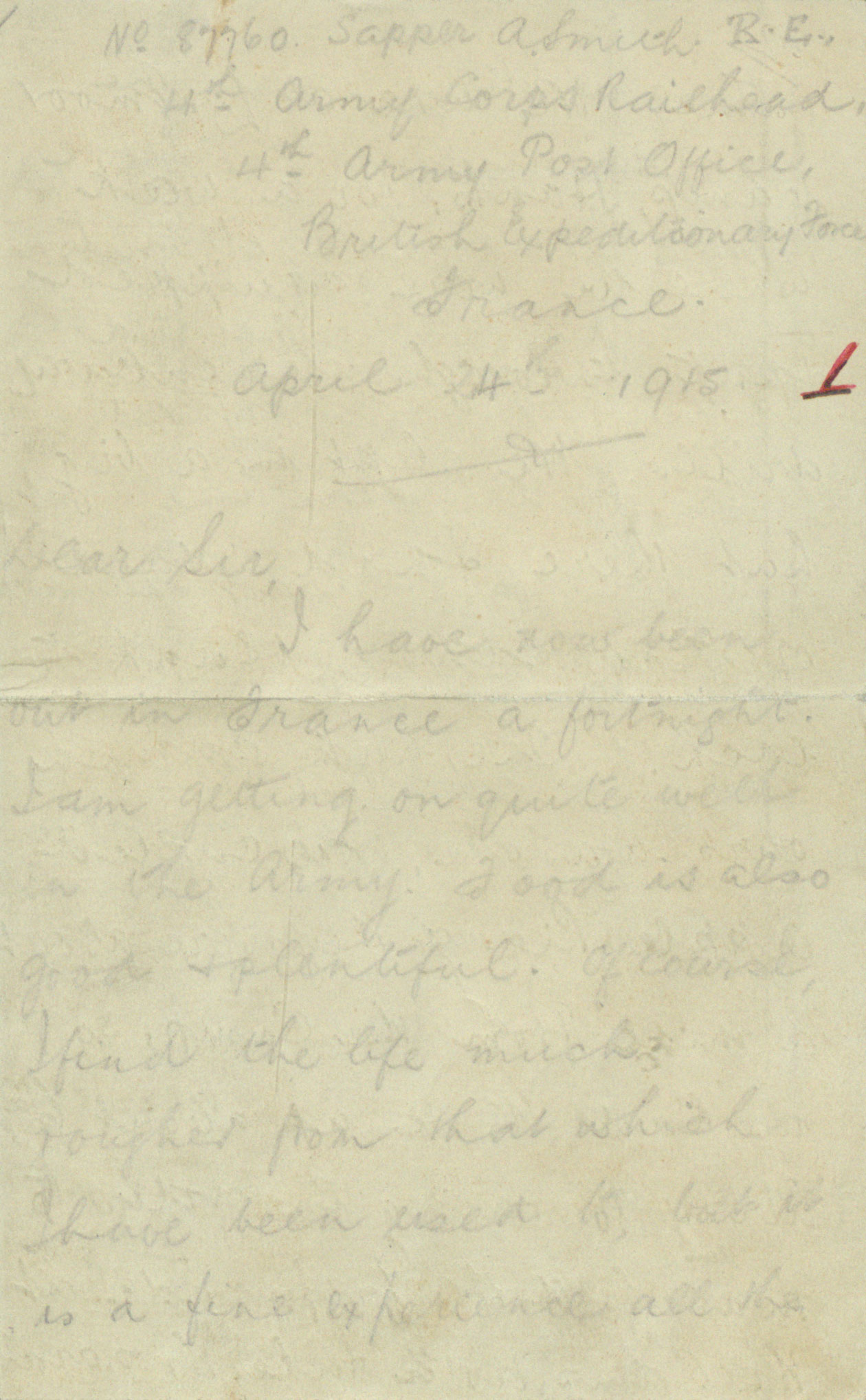
This is one of many letters sent by staff of the Great Western Railway Audit office at Paddington who had enlisted to fight in the First World War. Image shows part of letter. (RAIL 253/516)
Arthur Smith, 4 April 1915, France. Born: 8 March 1895, Regiment: Railway Troop, Royal Engineers, Regiment number: 87760, Rank: Lance Corporal
Transcript
Dear Sir,
I have now been out in France a fortnight. I am getting on quite well in the army. Food is also good and plentiful. Of course, I find the life much rougher from that which I have been used to, but it is a fine experience all the same.
We were at Longmoor camp for a week where we were equipped and put through elementary drills. We slept in a big hut there and had a sack of straw and three blankets each. The huts, of which ours was one, were called Apple Pie and they are about a mile from the camp, so we had to be up about six every morning in order to march down for parade at the camp. The parade was at 7.15am. Some mornings we had an hour’s drill before breakfast. It was about 11pm I should think, when we arrived at Longmoor on 31st March, and consequently we went straight to our hut. No light was provided so we had to fish about for our beds in the dark. Fortunately it was moonlight, and after some time a lantern was brought. We were only too glad when getting up time came the next morning. It was before six. We were marched down to the camp and were inspected by the Sergeant Major and after waiting some time went into breakfast. Roast sausage was the chief item on the menu but to our amazement no knives and forks were supplied for us…Well, the only thing was to convey the sausages to our mouths with fingers.
The nearest thing to a knife and fork that some had was a pair of nail scissors so these were used. Personally I did not know whether to feel shocked or to laugh at the situation; it ended in the latter. We Audit fellows got to one table and we had to have a good laugh before we could eat much. It was a hopeless situation to be in. Don’t let this discourage anyone from coming but I warn him to bring a knife and fork with him. After the first day we were issued with kits and we treasure our knives and forks now. We came across on the mail boat Hantonia from Southampton to Havre. … We had to sleep in huts there on the docks but the sleeping accommodation was better. We Audit fellows were able to keep together till last Saturday night, when Pond and I were sent off to different railheads. He is at 3rd Corps Railhead. We had to travel in horseboxes and during night time. We travelled in this manner Saturday, Sunday and Monday nights. French shunting is severe and we were shaken up. Saturday and Sunday we were about 30 in the trucks, Monday 17.
We were fortunate enough to get out into every town at which we stopped during the day. On Tuesday night another young fellow and I were stranded at a station somewhere in France, and we were instructed by the military authorities to sleep in the goods shed. We had to sleep on the deck of the shed and shunting was going on during the night. This was about the limit, I thought.
I arrived finally at my destination about midday last Wednesday. Now I live in a truck at a small French station. There are two other Sappers and a Lieutenant here. We deal chiefly with gifts and comforts sent to the troops…
We are out in the country. I think this railhead is about seven miles from the firing line. Can hear the guns and see the star shells at night. I must ask you kindly to excuse me for writing in pencil because I have no pen and ink here. Would you mind letting this letter be treated as to the whole of the statistical department, please sir. With kindest regards to all. I am yours obediently,
Arthur Smith