
This is one of many letters sent by staff of the Great Western Railway Audit office at Paddington who had enlisted to fight in the First World War. (RAIL 253/516)
Ronald Arthur William Dyer, 7 August 1915, ‘Somewhere in France’. Born: 11 April 1895, Regiment: 2nd Bedfordshire Regiment, attached to Signal Company, Royal Engineers, 47 Division, Regiment number: 14833, Rank: Private, Died: 1969
Transcript
Letter (extract)
… I must thank you for the cigarettes you sent me, I received them with your letter last night, and I was just on bankruptcy as regards fags, so you can consider you have saved my life. So you are going to have a (pigeon) kill off to reduce numbers, well, they’ll come in handy for the homing pigeon fund, that is if you don’t want them for yourselves. Dad has had my place lime-washed out, he says it looks quite smart again. I think there are only four old birds and two youngsters there now.
The bombs from the Zeps (Zeppelins) shook you up then, they make a nice little row don’t they. I have heard them out here and seen them drop, and a piece of one of the bombs hit me and I was quite 500 yards from where it dropped, of course it did not hurt me, as it was spent. Even the noise from those bombs is not a quarter as loud as one I had drop near me last Saturday, it was a trench mortar bomb and although I was quite 50 yards from it the force of the explosion knocked me over.
Yours very sincerely
Ron
Newspaper cutting
Dyer, Private R.A.W. (14833) 2nd Battalion Bedfordshire Regiment, attached to Signal Company, 47th Division, British Expeditionary Force. Before enlisting, in August last, he was a clerk in the service of the Great Western Railway Company Audit office, Paddington. Has been in France for some time, taking part in the Battle of Neuve Chapelle. At one time he was a member of the Ealing Central H.S. (Pigeon Society) and flew up to Rennes (France) in partnership of a friend, and at the time of enlisting was an hon. member of the society. Private Dyer receives The Homing Pigeon every week from his friend, Mr J.G. Wills.

This is one of many letters sent by staff of the Great Western Railway Audit office at Paddington who had enlisted to fight in the First World War. (RAIL 253/516)
Frederick Ernest Andrews, 16 October 1917, France. Born: 15 November 1879, Regiment: Railway Operation Division, Royal Engineers, Regiment number: 218857, Rank: Sapper, Returned to office: 26 May 1919, Retired: 15 November 1939
Transcript
Dear Mr Slater
Just a few lines to let you know how things are going with me, I have been going to write to before this, but on each occasion I have had to postpone it for some reason or other. I have been at this place since April. It is a fairly large city and has at one time been a very nice place, but it is now a heap of ruins, not a habitable house anywhere and no civilians, it is the nearest railhead to this part of the line and when we first came here things were pretty lively, but Fritz is gradually being pushed back here and has not troubled us for some time now I don’t mind if he has forgotten we’re here. Naldrett, Dawson and Anglesey and several other Audit chaps were up here a short time ago, but their detachment has now been moved to another part of the line, they are on the Light Railway and shift about more.
It was nice to meet some of the old office pals again and I spent several pleasant hours with them while they were here, for I am the only G.W. man in this detachment. McMeeken is in the Railway Transport Officer’s office about three miles from here and I see him occasionally. I was very sorry to hear of the deaths of Pond and Woodhams and no doubt there are other casualties amongst our office chaps but I seldom hear any office news. Our family has had to pay the penalty of war that so many thousands of families have done, for I am now the only one out here, one brother has just been discharged after nine months in hospital, the second one was killed at Ypres about a month ago and the third is now in a London hospital with a bad shrapnel wound in the thigh. I have had a variety of jobs, including navvy’s work, carrying rails and sleepers, guard, point oiler and various other jobs. I am now a checker and number taker which job suits me much better, for it combines a lot of indoor clerical work with outdoor checking and now that we have to face another winter out here, it will be something to spend a little of my time indoors for I still have memories of last winter under canvas, but I shall not be so badly off this winter for we are living in railway vans which will be much warmer. I have now been in France nearly nine months and there does not appear to be any prospect of leave, for there are more here who have been eighteen months without leave and at the rate the R.O.D. men are going at present it will be well into next year before my turn comes.
I understand that north London has suffered rather badly in the recent air raids but I hope you came through all right. My wife and family have had to get away from home, for it was upsetting their nerves and I am pleased to think that they are out of the danger zone. I am keeping fairly fit in health and always manage to keep cheery, which wants a bit of doing sometimes especially now the muddy season has started, but let’s hope this will be our last out here and by this time next year we may be all settling down to civilian life again. Please remember me to Mr Wood, Bert Hunt and all other Audit friends. Yours sincerely
F.E. Andrews…

This is one of many letters sent by staff of the Great Western Railway Audit office at Paddington who had enlisted to fight in the First World War. (RAIL 253/516)
Sidney Smith, 19 March 1916, France. Born: 20 October 1881, Regiment: Railway Operatives Division, Royal Engineers, Regiment number: 218849, Rank: Sapper, Returned to office: 19 May 1919, Retired: 20 October 1941
Transcript
My Dear Elton and all,
I expect you are wondering why I have never written since leaving England. Well the fact is I have never had a chance for it has been a Cook’s Tour since I was last with you. Perhaps I had better try and give you some idea of my adventures from the time we last met. It was not many hours after seeing you all that we were dispatched for France…We landed at a town after a nice long trip… At this spot, a rest camp so called, we spent about a week. What with parades in the daytime for various reasons and employed at the docks all night, unloading flour was the job that came my way you can imagine the rest we had. However we then went on to another base and here owing to illness, we were all isolated for ten days and no letters could be sent. Within a day or two of being released from this I alone of all our boys was packed off to another depot so that was the last I have seen for the time being of our crowd, and have been on my own since. After a couple of nights at this depot I was sent to a point to get experience in the work I came here for. This turned out to be the best thing I had touched for the staff were billeted out and I slept in a feather bed which was great for it was under canvas… I soon found out that my luck was in and that happiness and comfort would be my lot whilst there… Alas my dream was soon dispelled, and after a week of civilised existence, I was sent for by the depot. After another 48 hours there I was sent away again to some other spot, but en route, was detained at a rest camp for two days, apparently owing to the absence of trains to the point I was going…
Covered vans are used here to convey soldiers about. Strange to say the actual truck I made this last journey in I saw again the next day loaded with sick horses, so being used for any purpose you can guess they cannot be compared to the carriages in which we made our daily trips to town and back. To continue my travels, the next day I was sent to the point I am now writing from, and which I think will be my residence for some little time as I have now taken up regular duties. It is a terrible, Godforsaken and desolate spot. There is naught to be seen except shell holes and rats and these latter are an abomination…There is little to be heard here at night except gun fire and rats and one soon gets used to both. I went to a village, the nearest here, about two miles away, on Sunday last and it was really an awful sight to see how it had been smashed by shell fire. You can now I trust realise the reason for my not writing before, in fact I have only written to my wife and father, and have only received one letter from each of them and that was a few days ago. I can tell you that I hunger for news of home after being here a month without a word… It is also almost impossible to buy anything for there is nowhere to get it…
I trust all is well with everyone at 164 and that poor old Sid is alright again. If Miss Welsh’s little affair has come off I wish her the very best of luck and trust she will have all happiness… Please write to me soon some of you. Lots of luck, and good wishes to you all. Your old pal,
Sid

This is one of many letters sent by staff of the Great Western Railway (GWR) Audit office at Paddington who had enlisted to fight in the First World War. (RAIL 253/516)
Montague Percy Pond, 5 April 1916, France. Born: 13 September 1888, Joined GWR: 19 May 1904, Regiment: Railway Troop, Royal Engineers, Regiment number: 87749, Rank: Sapper, Died: Killed in action on 6 May 1917
Transcript
Dear Mr Hunt,
I was very pleased to receive your letter for which many thanks. It took nearly a fortnight to reach me as I have changed about a good deal lately from one division to another and it has followed me around. I am pleased to say I am still keeping very fit and going on in about the same way. I think the last time I wrote we were living in trucks. Well we have now moved into huts about ten feet square, which are very comfortable although not quite as large as the trucks. They are well built and stand about a foot from the ground so keep very dry. We have two of them, one which we use as an office and the other to sleep and live in. We also have a tent which we use for keeping kits etc. in, but we shall probably sleep in it when the weather is a bit warmer.
We have had some lovely weather lately, quite like summer but rather cold at night. We had a great deal of snow last month also plenty of rain and wind, and were over the tops of our boots in mud. We are stationed at a very small village which stands very high (about 600 feet above sea level) you can guess it is a bit breezy at times. It is a one-eyed hole with only two cafes and no shops. We have all our meals cooked at one of the cafes, and we live very well although there is not very much variation in the menu. I have managed to have one or two musical evenings lately. The fiddle I bought appears to be a fairly good one but my fingers are not quite so nimble as they were. I am afraid I shall have to put in a month or two’s practice before I get back to where I was before I came out here. Glad to hear you have taken it up again. We shall be able to get a band for our next ‘lamb’ dinner whenever that will be.
Things do not seem to make much of a move round this way. We get plenty of aeroplanes over and see a good many fights in the air. There have also been a good many shells dropped not very far away from us, but we have managed to dodge them so far although, one of our fellows, who comes from the Midland Railway and who I worked with for some time, has been wounded and sent to base. There is only one G.W. man anywhere near me as far as I know and that is Colcott from Chief Goods Manager’s Office but he is some distance away and I hadn’t seen much of him. I was surprised to hear that Morris had gone into the R.F.C. (Royal Flying Corps) after being rejected for the Infantry. I was also surprised and sorry to hear about Jack Symons. I had heard nothing about it. How did it happen? It must be very quiet at the office now with so many gone. (Censored line). As you say it is quite a change from the old days. I have not yet come across any of those who joined the R.E. (Royal Engineers) Transport lately. Did you know that Arthur Watton has joined?
We had a concert party belonging to one of the divisions stationed round here, staying in the village last week, and they gave us a show two nights running. They had a proper stage with scenery and footlights, everything complete. They were very good indeed. The programme consisted of songs, sentimental and otherwise, also a ‘Sketch’ and some Charlie Chaplin pictures which were very laughable as usual. Well, I don’t think I can tell you much more at present. Please remember me to all at the office.
Kind regards,
Yours sincerely,
M.P. Pond

This is one of many letters sent by staff of the Great Western Railway Audit office at Paddington who had enlisted to fight in the First World War. (RAIL 253/516)
Francis Witt, 28 May 1916, Salonika, Greece. Born: 8 February 1893, Regiment: Royal Engineers, Mediterranean Expeditionary Force; transferred to Office of Superintendent of Line on 15 June 1914, Regiment number: 138069; WR296343, Rank: Sapper, Died: 1970
Transcript
Dear G. [Mr Burgoyne],
I guess you wonder what has become of me after this long silence, but you will see I am a good distance away from the homeland now. I arrived here early in April and since the start have been getting on quite well. You may be interested to know that Gray from your department is also here. It is rather strange that I should rub against him.
The weather is brilliant, cloudless skies day after day, but it is very hot. There are plenty of mosquitoes about. They are very tantalising. A net is practically a necessity for sleeping purposes. I am billeted in a warehouse, it is a very old place, and has stood hundreds of years. I should think, according to its general appearance.
I have not picked up the lingo yet, but French is chiefly spoken, and I much regret not having studied it more when I had the opportunity at home. This town is a queer sort of place as compared with some of the French towns we know, and am sure I shall not wish to see it again when once I leave. The cafés are not so gay as the French, but I manage to have fun occasionally. We have got a piano and gramophone to amuse ourselves with. I hope we shall be able to have another trip to Paris, when the war has cleared up, but of course when is a question nobody can answer yet awhile. Shall be very pleased to hear some news of you, and conclude now with all the best.
Yours sincerely, Frank.
This is one of many letters sent by staff of the Great Western Railway Audit office at Paddington who had enlisted to fight in the First World War.
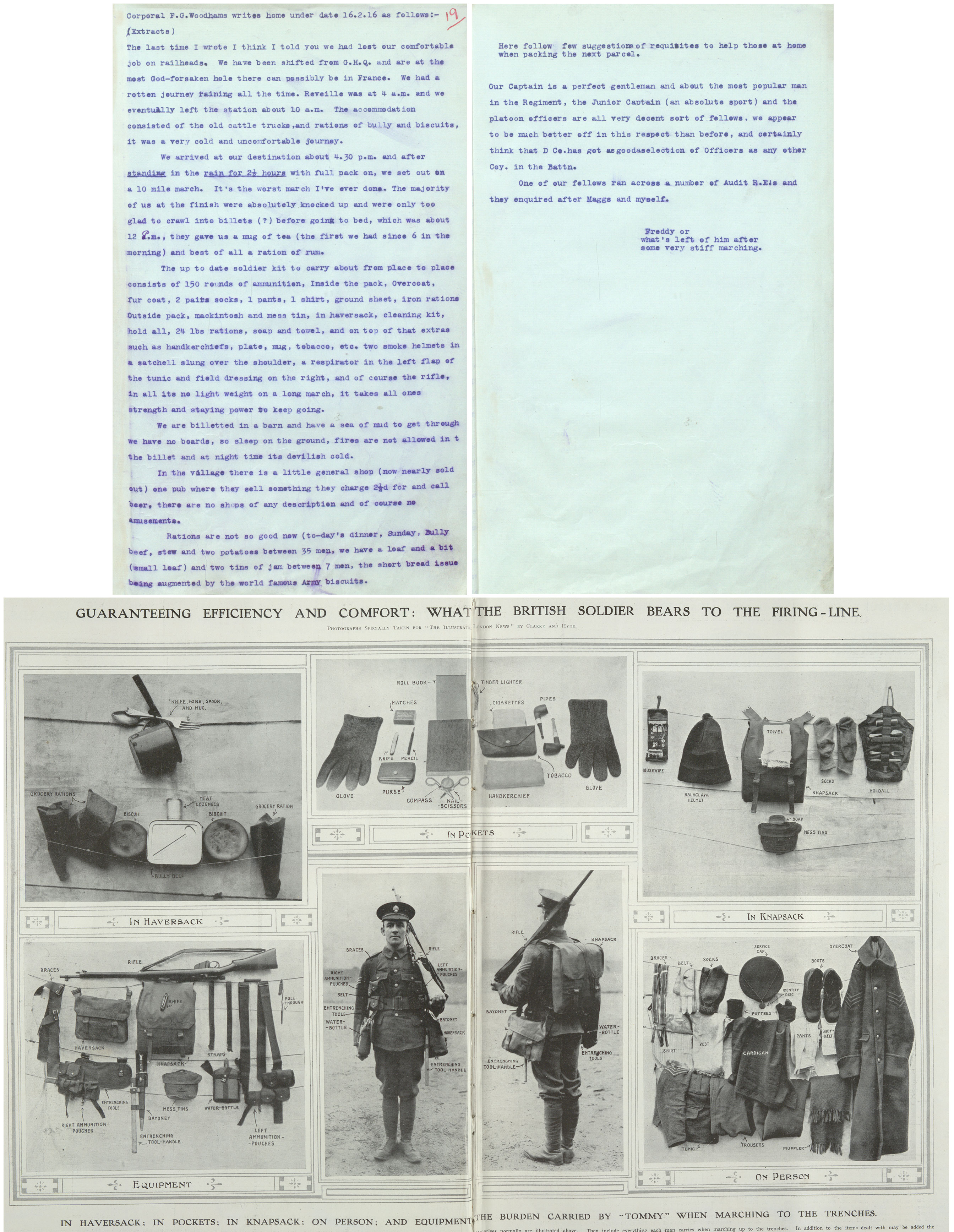
These are typed extracts of a letter that Frederick Woodhams had written to his family (RAIL 253/516). Below that is an article from the Illustrated London News, 1915 (ZPER 34/146s9).
Frederick G. Woodhams, 16 February 1916, France. Regiment: 13 London Rifles, Regiment number: 1383, Rank: Private; Lance Corporal; Sergeant, Died: Killed in action on 16 August 1917, having been struck by shrapnel; prior to this, he had been wounded twice
Transcript
The last time I wrote I think I told you we had lost our comfortable job on railheads. We have been shifted from General Headquarters and are at the most godforsaken hole there can possibly be in France. We had a rotten journey raining all the time. Reveille* was at 4am and we eventually left the station about 10am. The accommodation consisted of the old cattle trucks, and rations of bully and biscuits. It was a very cold and uncomfortable journey.
We arrived at our destination about 4.30pm and after standing in the rain for 2½ hours with full pack on, we set out on a ten mile march. It’s the worst march I’ve ever done. The majority of us at the finish were absolutely knocked up and were only too glad to crawl into the billets before going to bed, which was about 12pm. They gave us a mug of tea (the first we had since six in the morning) and best of all a ration of rum.
The up to date soldier kit to carry about from place to place consists of 150 rounds of ammunition, inside the pack; overcoat, fur coat, two pairs socks, one pants, one shirt, ground sheet, iron rations [emergency food supply]. Outside pack; Mackintosh and mess tin, in haversack; cleaning kit, hold all, 24lbs rations, soap and towel, and on top of that extras such as handkerchiefs, plate, mug, tobacco, etc, two smoke helmets* in a satchel slung over the shoulder, a respirator in the left flap of a tunic and field dressing on the right, and of course the rifle, in all it’s no light weight on a long march, it takes all one’s strength and staying power to keep going.
We are billeted in a barn and have a sea of mud to get through. We have no boards, so sleep on the ground, fires are not allowed in the billet and at night time it’s devilish cold.
In the village there is a little general shop (now nearly sold out), one pub where they sell something they charge 2½d for and call beer, there are no shops of any description and of course no amusements.
Rations are not so good now (today’s dinner, Sunday, bully beef, stew and two potatoes between 35 men. We have a loaf and a bit (small loaf) and two tins of jam between seven men, the short bread issue being augmented by the world famous army biscuits.
Our captain is a perfect gentleman and about the most popular man in the regiment, the junior captain (an absolute sport) and the platoon officers are all very decent sort of fellows. We appear to be much better off in this respect than before, and certainly think that D. Co. has got as good a selection of officers as any other company in the battalion. One of our fellows ran across a number of Audit R.E.s and they enquired after Maggs and myself.
Freddy or
What’s left of him after some very stiff marching.

This image is an extract of one of the many letters sent by staff of the Great Western Railway Audit office at Paddington who had enlisted to fight in the First World War. The image shows part of the letter; the full transcript is given below. (RAIL 253/516).
James Claude Kibblewhite, 1 September 1917, Malta. Born: 14 June 1895, Regiment: 2/13 Battalion London Regiment, Regiment number: 490602, Rank: Sergeant, Died: 20 December 1951
Transcript
Dear Sir,
I trust you will excuse the liberty I have taken in writing you, after such a long absence from England, but the difficulties of active service is my excuse, although I am sorry to say laziness has a lot to do with it.
No doubt you will wonder what I am doing wasting my time in Malta; well, I came here last January through an attack of dysentery followed by constipation, there I remained, and am likely to do so, unless something very unexpected happens.
I have been taken on the temporary staff, and am acting as parade staff sergeant, quite a nice easy position, except when we are receiving or sending troops away.
How are things in general, looking at Paddington, I suppose the office is full of ladies and men who are over the age limit.
I saw a Great Western Magazine a few days ago, and I noticed that a large number of the ‘chiefs’ have retired, also that Artlett has not given up trying to bring sports honours to the Audit with the Bowls team.
The weather here is absolutely glorious, and our camp is right against the sea, we get some lovely bathing and boating, in fact it is almost as good as any resort in England.
We are about ten miles from Valletta, but we can always get a ride in a motor lorry or a gharry (horse-drawn cab) I have only met one G.W. man since I have been here and that is Cowles of the Agreements. He has been here since the Dardanelles; and he is acting chief clerk to the commanding officer of the Company Camp…
I have not given up hope of getting to England yet, as since I have been here I have contracted malaria, also my heart is not good enough to allow me to carry a pack for a while, so I have been marked unfit for over three months, and I may give you all a surprise by walking into the office one of these fine days.
Well, sir, when is the war going to end, I think it would have been all over now, bar the shouting, if it had not been for Russia.
I think the Great Western Railway according to the magazine have reaped a fair share of the awards for bravery etc, on the field.
Well, sir, I trust it will not be long before I have the pleasure of receiving a reply to my letter, and kindly remember me to all that are left of the old room 19… I am, Sir, Yours respectfully,
J.C. Kibblewhite Sgt.

This is one of many letters sent by staff of the Great Western Railway Audit office at Paddington who had enlisted to fight in the First World War.
When James Hyam, also nick-named Fatty, wrote from India he used these three postcards which showed different scenes from Alexandria in Egypt where he had ‘a grand time’ en-route to India. (RAIL 253/516)
James Walter Hyam, 15 April 1918, Roorkee, India. Born: 24 July 1891, Regiment: 11 Hussars, C. Squadron; Royal Field Artillery; Royal Garrison Artillery, Regiment number: 223725; 184963, Rank: Gunner, Died: 1951
Transcript
My Dear Bertie,
Have arrived in India for the purpose of relieving some A1 (military fitness category meaning capable of active service overseas) men here who have been here for a long period. It’s not a bad show here just above Delhi but so d____d hot: risen to 106 degrees in the shade and we have more hot weather just coming. Our parades are as follows 6.30-7.45 and 9 to 10 and finish for day. There is an abundance of sport and grub here. Fancy getting eggs laid too. A supper of say ½ new mutton chop, potatoes, peas, broccoli and tea 4d.
The things that are expensive are goods from England especially English soap, sauces, writing paper and of course we are unable to get English made fags. We had a grand journey from England; route was Southampton to Cherbourg then to Italy. In Italy we went to Alexandria, stayed there three days had a grand time, streets of red lamps etc. and lovely shops. No two houses in main stretch are alike. Then from Alexandria we come to Port Suez by train
then on P. and O. Liner Kaiser I. Hind to Bombay had two days there and that’s a grand place too, lovely wide streets and grand buildings. They have a sea front very much like Hastings and all the big boys have their after dinner drive there and form a queue by shore. Some stuff there too. Lots of Europeans knocking about too. Had a game of footer for the Railway Operatives depot last night, 6pm, with King’s Own and won… But it was so ruddy warm and I felt like a wash out at finish. Kind regards to all. Give Bill Butler my address and ask him to drop a line.
J.W. Hyam, Fatty.
How are the tours going is Frosty still serving?
This is one of many letters sent by staff of the Great Western Railway Audit office at Paddington who had enlisted to fight in the First World War. (RAIL 253/516)
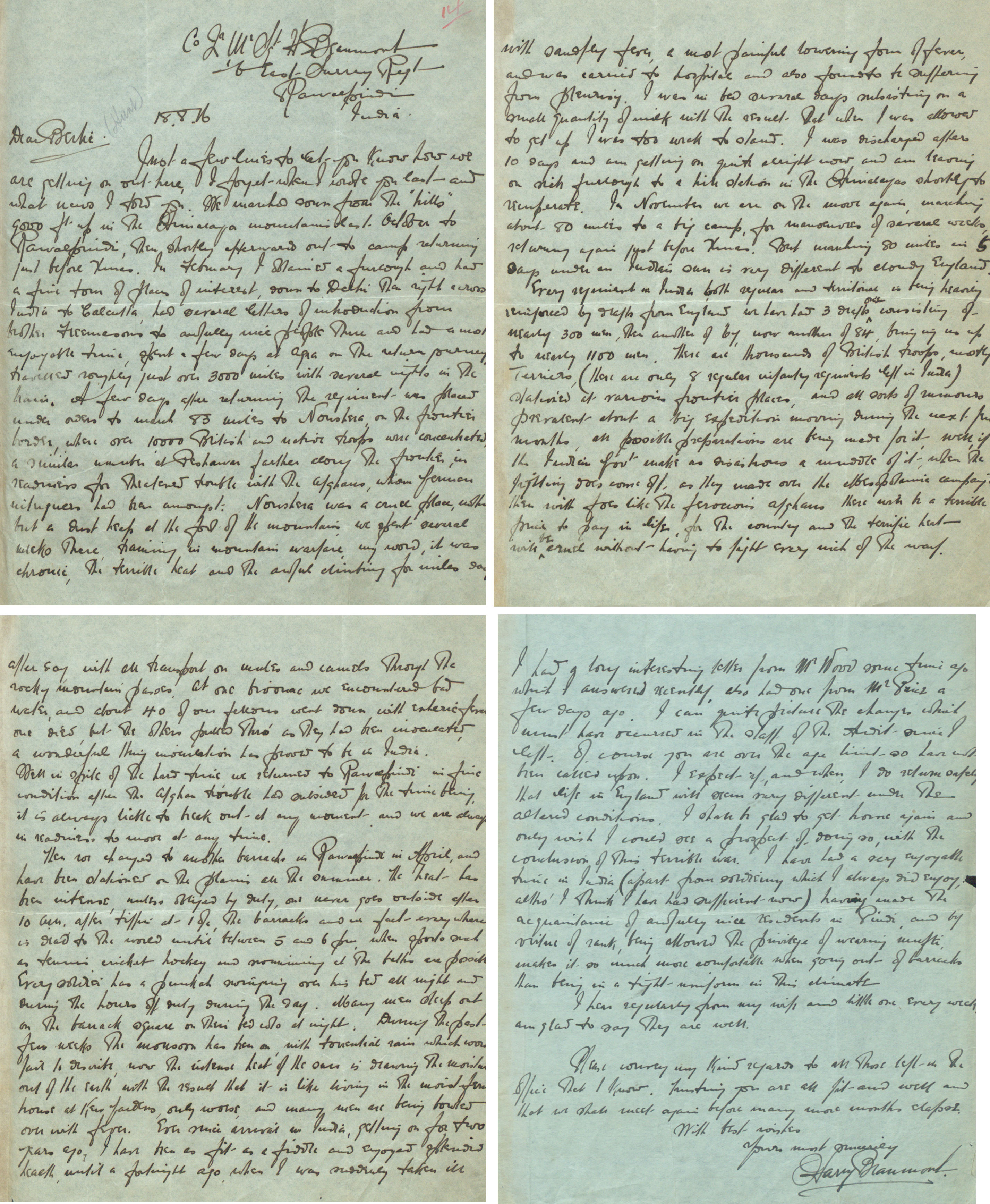
Harry Beaumont, 18 August 1916, Rawalpindi, India. Born: 17 October 1873, Regiment: 1/6 East Surrey Regiment, Regiment number: 2297, Rank: Quarter Master Sergeant, Died: 1952
Note: He was a member of volunteer army as a young man. He was a life governor of Richmond Hospital, London and held an MBE (Military Division).
Transcript
Dear Bertie,
Just a few lines to let you know how we are getting on out here, I forgot when I last wrote you last and what news I told you. We marched down from the hills, 9,000 feet up in the Himalaya Mountains last October to Rawalpindi, then shortly afterwards out to camp returning just before Xmas. In February I obtained a furlough and had a fine tour of places of interest, down to Delhi then right across India to Calcutta, had several letters of introduction from brother Freemasons to awfully nice people there and had a most enjoyable time, spent a few days at Agra on the return journey, travelled roughly just over 3,000 miles with several nights in the train. A few days after returning the regiment was placed under orders to march 83 miles to Noushera on the frontier border, where over 10,000 British and native troops were concentrated, a similar number at Peshawar farther down the frontier, in readiness for threatened trouble with the Afghans, whom German intriguers had been amongst. Noushera was a cruel place, nothing but a dust heap at the foot of the mountain. We spent several weeks there, training in mountain warfare, my word, it was chronic, the terrific heat and the awful climbing for miles day after day, with all transport on mules and camels through the rocky mountain passes. At one bivouac we encountered bad water, and about forty of our fellows went down with enteric fever [typhoid]. One died, but the others pulled through as they had been inoculated; a wonderful thing inoculation has proved to be in India.
Well in spite of the hard time, we returned to Rawalpindi in fine condition after the Afghan trouble had subsided for the time being, it is always liable to break out at any moment and we are always in readiness to move at any time.
Then we changed to another barracks in Rawalpindi in April, and have been stationed on the plains all the summer. The heat has been intense; one never goes outside after 10am; after tiffin at 1 o’clock the barracks and in fact everywhere is dead to the world until between 5 and 6pm, when sports such as tennis, cricket hockey and swimming at the baths are possible.
Every soldier has a punkah (fan) swinging over his bed all night and during the hours off duty during the day. Many men sleep out on the barrack square on their beds at night. During the past few weeks the monsoon has been on, with torrential rain which I would fail to describe. Now the intense heat of the sun is draining the moisture out of the earth with the result that it is like living in the moist fern house at Kew Gardens, only worse, and many men are being bowled over with fever. Ever since arriving at India, getting on for two years ago, I have been as fit as a fiddle and enjoyed exceptional health, until a fortnight ago, when I was suddenly taken ill with sandfly fever, a most painful, lowering form of fever, and was carried to hospital and also found to be suffering from pleurisy. I was in bed several days subsisting on a small quantity of milk with the result that when I was allowed to get up I was too weak to stand. I was discharged after ten days and am getting on quite alright now, and am leaving on next furlough to a hill station in the Himalayas shortly to recuperate. In November we are on the move again, marching about 80 miles to a big camp, for manoeuvres of several weeks, returning again just before Christmas. But marching eighty miles in five days under an Indian sun is very different to cloudy England. Every regiment in India, both regular and territorial, is being heavily reinforced by drafts from England. We have had three drafts one consisting of nearly 300 men, then another of 67, now another of 84, bringing us up to nearly 1,100 men. There are thousands of British troops, mostly Terriers (members of the Territorial army) (there are only eight regular infantry regiments left in India) stationed at various frontier places, and all sorts of rumours prevalent about a big expedition moving during the next few months, all possible preparations are being made for it, well, if the Indian govt. make as disastrous a muddle of it when the fighting does come off as they made over the Mesopotamia campaign, then with foes like the ferocious Afghans there will be a terrible price to pay in life, for the country and the terrific heat will be enough without having to fight every inch of the way.
I had a very interesting letter from Mr Wood some time ago which I answered recently, also had one from Mr Price a few days ago. I can quite picture the changes which must have occurred in the staff of the Audit since I left. Of course you are over the age limit, so have not been called upon. I expect if, and when, I do return safely that life in England will seem very different under the altered conditions. I shall be glad to get home again and only wish I could see a prospect of doing so, with the conclusion of this terrible war. I have had a very enjoyable time in India (apart from soldiering which I always did enjoy, although I think I have had sufficient now) having made the acquaintance of awfully nice residents in ‘Pindi, and by virtue of rank, being allowed the privilege of wearing mufti makes it so much more comfortable when going out of barracks than being in a tight uniform in the climate.
I hear regularly from my wife and little one every week. Am glad to say they are well.
Please convey my kind regards to all those left in the office that I know. Trusting you are all fit and well and that we shall meet again before many more months elapse.
With best wishes
Yours most sincerely
Harry Beaumont

This is one of many letters sent by staff of the Great Western Railway (GWR) Audit office at Paddington who had enlisted to fight in the First World War. (RAIL 253/516)
William Charles Davis, 15 March 1916, France. Born: 12 November 1884, Joined GWR: 12 January 1900, Regiment: Royal Army Medical Corps, Regiment number: 31223, Rank: Lance Corporal; Sergeant, Retired: 1944. Please note that this soldier’s surname is spelled incorrectly as ‘Davies’ in the original document.
Transcript
Sunday
Dear Charlie,
How are things going with you now? I expect like the rest of us will be glad when the better weather sets in for there is no doubt about it, it has been rough lately.
Since I last wrote to you we have shifted to another part of the line and it is a warm shop, for both sides must have all guns they can find and it is nothing but one long duel all day and every day but thank goodness it gives over a bit a night so that one can get on with their work. You see of a night the flashes of the guns can be seen so plainly that is why they do not fire a lot then.
Just on our right our people retook some trenches we had lost, oh what a rough time the poor devils had, snow and mud as much as you like and they had to lay in it for two days and grub could not be got to them. I expect there have been a few more from Paddington called up by now, it seems if the authorities mean to have all the men they want and if they can’t get them one way they will another, and it certainly looks as if they will be wanted for out here. One cannot see any signs of an early settlement. I see by the papers that the air raids have been busy in England again. I suppose you have not seen anything of them yet, has Rory Moore had any more frights? We have the taubes [German aircraft] over our hospital nearly every day or night and I can tell you we got some starts at times. The nearest we have to them since I have been here is just one yard from the main door, at 12.30 it blew in two pairs of double doors and shattered on end of the building to bits but not a great deal of damage to life which after all is the main thing. The arrangements we in work is five or six days up the line and four or five down if you are lucky. Of course at times these arrangements go to pot when there is an attack and we get a warm time and I should like to enlarge on these things but of course you understand I cannot.
Give my kind regards to all and trusting you are well.
Yours Will (Davies)