
The Petition of Mary Quick, wife of Michael Quick, 23 April 1791 (ADM 1/5119/16)
Impressment – the act of taking men into a navy by force with or without notice – was common practice in the 18th century. People liable to impressment were sailors, however non-seamen were sometimes impressed, as in this case.
Transcript
23rd April, 1791
The Petition of Mary Quick, wife of Michael Quick
Humbly Shewth
That your Petitioner’s Husband is a Housekeeper a the Parish of St. Giles and by Trade a Coach Spring Maker, having wrought seven years at that Branch of Business with his Master Mr. Wildey, as it will appear by the annexed Certificate.
That her said Husband is no seaman, nor seafaring man, nor ever worked upon the water, nor in any business relating thereto.—
That notwithstanding thereof the said Michael Quick was impressed into His Majesty’s Sea Service, and now lies on board a Tender [boat, or larger ship used to transport men/supplies to and from shore or to another vessel] in the River—
That your Petitioner with two small children (and she is pregnant with a third) have no other support than the exertions of her said Husband, of which she is deprived by his detention as aforesaid, and which must soon bring her and them to ruin unless he is speedily released therefrom.
Your Petitioner therefore humbly prays that you will be pleased to grant her relief by giving such orders as may be the means of restoring the said Michael Quick to his distressed family and as in duty bound she will ever pray—
Signed by Janet Seton* for Mary Quick
No 26 Tower Street
Seven Dials
23rd April 1791
I believe the whole of what is set forth in this petition to be true and should be very glad if I could contribute to the redress there prayed for— 23rd April 1791, Robert Harries
*I believe the whole of the above Petition to be true and can attest the Petitioner to be a Sober and Industrious Woman, Janet Seton
[A further witness statement from Michael Quick’s employer was also attached in support of the Petition from Mary Quick.]

A petition to King George I from a whaling business (SP 35/19/28)
Transcript
To the Kings most Excellent Majesty
The Humble Petition of Henry Norris, Matthew Featherstonhaugh & Paul Daranda of London Merchants in behalf of themselves & Richard Ridley, Nicholas Ridley, Nicholas Fenwick, Thomas Waters and the Heirs of William Procter deceased of Newcastle Merchants concerned in the Greenland Whalefishery.
Sheweth
That your Petitioners in the years 1717 & 1718 encouraged by severall Acts of Parliament did at their sole expense carry on a trade for Greenland Whalefishery but being of small force were terrified and disappointed by Forreigners even when in possession of their Whale which obliged them to suspend the undertaking after the Loss of several Thousand Pounds.
That your Petitioners being sensible of the great advantage such a trade effectually carried on would bring to the Publick and may also be to particular persons if acting in a Politick Capacity with a Considerable joint Stock are desirous to be incorporated in hope therby to retrieve your Petitioners great losses and establish your said trade to your Advantage of your Nation.
Your Petitioners therefore humbly pray that your Majesty will graciously be pleased to grant them and such others as shall be willing to join with them your Royall Charter for that purpose with such Privileges as your Majesty in your great Wisdom shall judge meet [appropriate]…
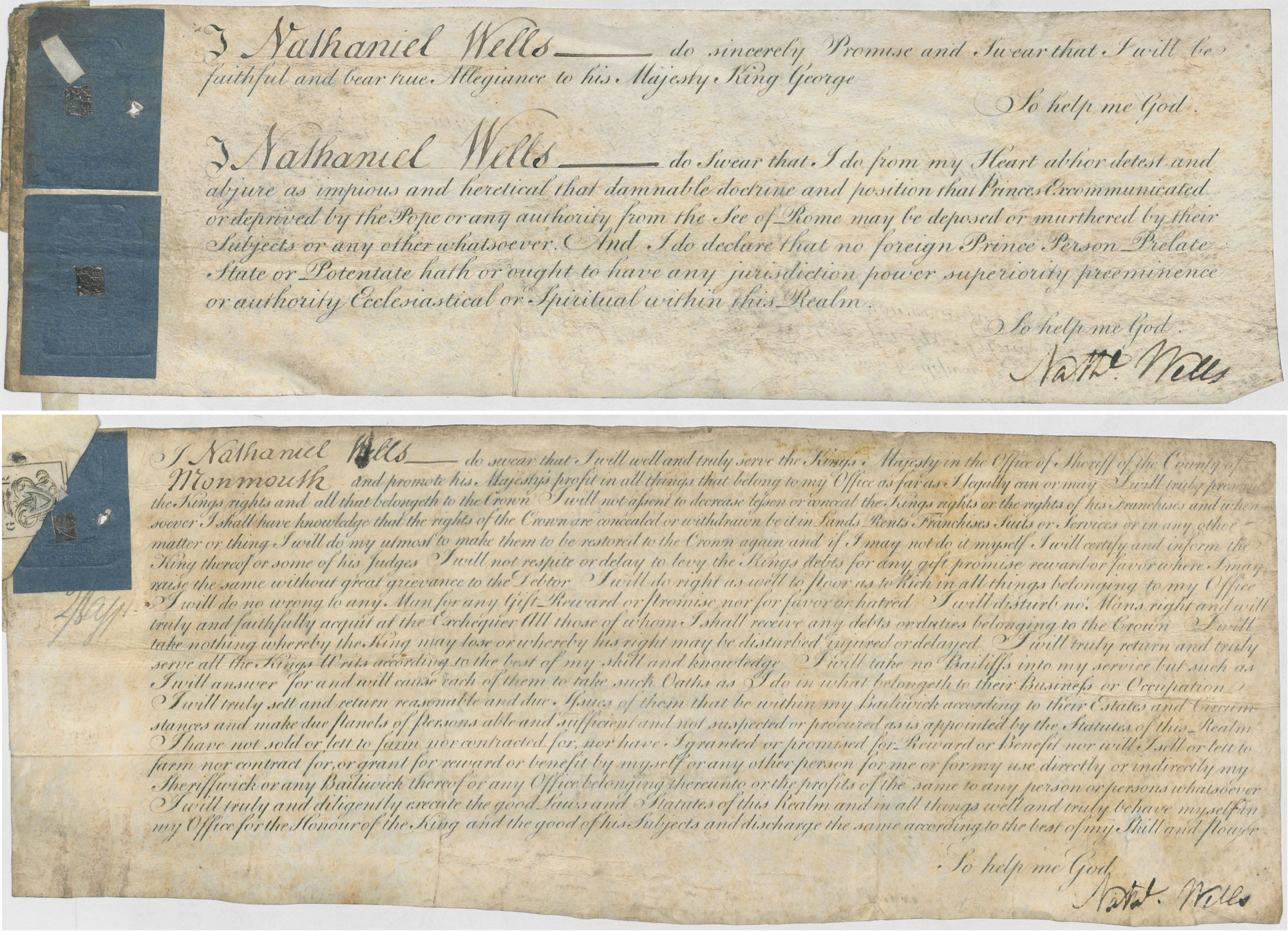
The oath of Sheriff Nathaniel Wells, 1818 (C 202/206)
Nathaniel Wells (1779-1852) was the son of a Welsh slave trader and plantation owner with an enslaved woman. He was educated in London, and on the death of his father inherited his estates. Wells was a magistrate and landowner in Monmouthshire and became Britain’s first black High Sheriff. This is interesting as he would have made judgments on white people at a time when black slaves had no rights in the colonies.
Transcript
Nathaniel Wells_____________ do sincerely Promise and Swear that I will be faithful and bear true Allegiance to His Majesty King George. So help me God.
Nathaniel Wells_______________ do swear that I do from my Heart abhor detest and abjure [reject] as impious [lacking respect] and heretical [against God’s laws] that damnable doctrine and position that Princes Excommunicated or deprived by the Pope or any authority or murthured [murdered] by their subjects or any other whatsoever. And I do declare that no foreign Prince, Person, Prelate [churchman] State or Potentate [ruler] hath or ought to have any jurisdiction [legal] power, superiority pre-eminence or authority Ecclesiastical or Spiritual within this Realm.
So help me God,
Nathaniel Wells
I Nathaniel Wells____________ do swear that I will well and truly serve the King’s Majesty in the Office of Sheriff of the County of MONMOUTH and promote his Majesty’s profit in all things that belong to my Office as far as I legally can or may. I will truly preserve the King’s rights and all that belongeth to the Crown. I will not assent to decrease, lessen or conceal the King’s rights of his Franchises and when so ever I shall have knowledge that the rights of the Crown are concealed or withdrawn be it in Lands, Rents, Franchises, Suits [legal cases] or services or in any other matter or thing I will do my utmost to make them to be restored to the Crown again and if I may not do it myself I will certify and inform the King thereof or some of his Judges. I will not respite or delay to levy the King’s debts for any gift promise, reward or favour where I may. I will do no wrong to any Man for any Gift, reward or promise where I may raise the same without great grievance to the Debtor. I will do right as well to poor as Rich in all things belonging to my Office. I will do no wrong to any Man for Gift, Reward or promise nor for favour or hatred. I will disturb no Man’s right and will truly and faithfully acquit [give] at the Exchequer All those of whom I shall receive any debts or duties belonging to the Crown. I will take nothing whereby the king may lose or whereby his right may be disturbed, injured or delayed. I will truly return and truly serve all the King’s Writs according to the best of my skill and knowledge. I will take no Bailiffs into my service but such as I will answer for and will cause each of them to take such oaths as I do in what belongeth to their Business or occupation. I will truly sell and return reasonable and due. Issues of them that be within my Bailiwick [area over which a bailiff has control] according to their Estates and Circumstances and make due panels of persons able and sufficient and not suspected or procured as is appointed by Statutes of this Realm. I have not sold or let to farm nor contracted for nor have I granted or promised for Reward or Benefit nor will I sell or lett to farm nor contract for or grant for reward or benefit by myself or any other person for me or for my use directly or indirectly my Sherriffwick [area represented by the sheriff or King’s officer] or any Bailiwick thereof or any Office belonging thereunto or the profits of the same to any person or persons whatsoever. I will truly and diligently execute the good laws and Statutes of this Realm and in all things well and truly behave myself in my Office for the Honour of the King and the good of his subjects and discharge the same according to the best of my Skill and Power.
So help me God
Nathaniel Wells

Extract from a letter from Whitehall regarding the funeral arrangements for Lord Nelson, 13 November 1805 (LC 2/40)
Transcript
Whitehall November 13th, 1805
My Lord,
I beg leave to signify to your Lordship that His Majesty in Consideration of the transcendant heroic services performed by the late Lord Viscount Nelson has signified his Royal Pleasure that His Lordships remains should be publickly Interred at St Pauls Church with all the solemnities usual on such occasions. In making this communication to your Lordship, it will at the same time be necessary to apprize you that it is intended that the Body should on its arrival in England be brought to Greenwich Hospital there to lie in State, and thence to be moved by water to the Kings stairs at the Tower, from whence the Procession will proceed with it to St. Pauls…

A hand bill entitled ‘The New Police’, printed in London, 1830 (HO 61/2)
Transcript
The New Police
PARISHIONERS, — Ask yourselves the following Questions:
Why is an Englishman, if he complains of an outrage or an insult referred for redress to a Commissioner of Police!
Why is a Commissioner of Police delegated to administer Justice?
Why are proceedings of this new Police Court unpublished and unknown? And by what Law of the Land is it recognized?
Why is the British Magistrate stripped of his power? And why is Justice transferred from the Justice Bench?
Why is the Sword of Justice placed in the hands of a MILITARY Man?
Consider these constitutional questions: consider the additional burthen [burden]
Saddled on you—consider all these points, then UNITE in removing such a powerful
Force in the hands of Government, and let us institute a Police System in the hands of the PEOPLE under parochial appointments—
UNITY IS STRENGTH;
Therefore,
I Let each Parish convene a Meeting
II Let a Committee be chosen, instructed to communicate with other Parishes
III Let Delegates be elected from each Committee to form a
CENTRAL COMMITTEE,
To join your Brother Londoners in one heart, one hand, for the
Abolition of the New Police!
Elliot, Printer, 14 Holywell Street, Strand

Letter from Horatio Nelson to Lord Spencer, First Lord of the Admiralty from 1794 to 1801 (FO 57/1 f.151)
Transcript
Palermo, April 30th 1799
My Dear Lord,
Mr. Green, His Majesty’s late Consul at Nice after 30 years’ service and this war three times losing his household furniture died at Pisa a few days after the entry of the French into Tuscany, leaving a Wife and four children, the eldest not 9 years of age without the smallest provision for them, having nothing to live upon but his pay as Consul in this miserable situation this poor woman and children were thrown on shore in Sicily. Captain Edmonds of the Pallas has very kindly given her passage in the Pallas, having told her tale, its needless for me to say anything to stimulate your Lordship’s goodness in getting her some small pension. I have only to add that her character is that of an excellent wife and good mother.
Believe me, ever my Dear Lord your obliged Nelson
Lord Spencer

Example of a lottery ticket from 1746 (IR 55/30)
Private lotteries were created by Acts of Parliament. Tickets were sold to people for as much as £10 each (roughly £500 today). A winning lottery ticket could be exchanged for the prize of a fixed annuity or annual payment.
In the 18th century, lotteries were very popular. They raised enough money to build Westminster Bridge in the 1730s and the British Museum in the 1750s.
Transcript
23m 939 Anno 1746
This ticket entitles the Bearer thereof to Six Pounds,
Part of a Joint Stock attended with Annuities after the Rate of
Four Pounds per Centum per Annum to a better Chance
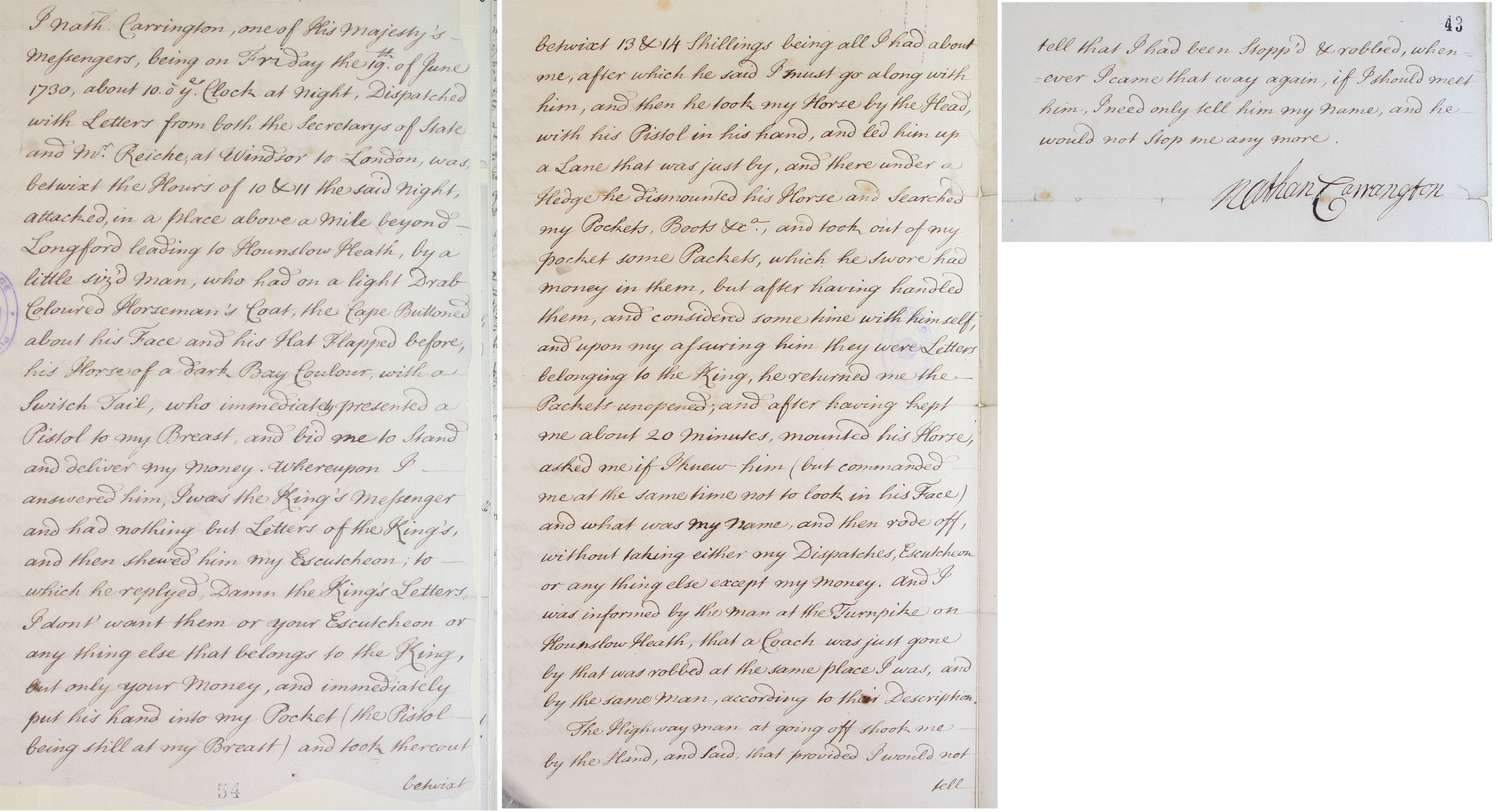
An account of a highway robbery, 19 June 1730 (SP 36/19/54-58)
Transcript
I Nathan Carrington, one of His Majesty’s Messengers, being on Friday the 19th of June 1730, about 10 o’ Clock at Night, Dispatched with Letters from both the Secretaries of State and Mr. Reiche at Windsor to London, was attacked in a place above a mile beyond Longford leading to Hounslow Heath, by a little sized man, who had on a light drab coloured Horseman’s coat, the cape Buttoned about his Face and his Hat Flapped before, his Horse of a dark Bay Colour [reddish-brown body with a black mane], with a switch Tail, who immediately presented a Pistol to my Breast, and bid me to Stand and deliver my money. Whereupon I answered him that was the King’s Messenger but had nothing but Letters of the King’s and then showed him my Escutcheon [coat of arms] to which he replyed Damn the King’s letters. I don’t want them or your Escutcheon or anything else that belongs to the King, but only your Money, and immediately put his hand into my Pocket, (the Pistol being still at my Breast) and took there out betwixt 13 & 14 shillings being all I had about me, after which he said I must go along with him, and then he took my Horse by the Head, with his Pistol in his hand, and led him up a Lane that was just by, and there under a Hedge he dismounted his Horse and Searched my Pockets, Boots etc, and took out of my pocket some Packets, which he swore had money in them, but after having handled them, and considered some time with himself; and upon my assuring him they were Letters belonging to the King, he returned me the Packets unopened, and after having kept me about twenty minute, mounted his Horse, and asked me if I knew him (but commanded me at the same time not to look in his Face) and what was my name and then rode off, without taking either any Dispatches [letters], Escutcheon or anything else except my money. And I was informed by the man at the Turnpike [toll gate] on Hounslow Heath, that a Coach was just gone by that was robbed at the same place I was, and by the same man, according to their Description.
The Highwayman at going shook me by the Hand said, that provided I would not tell that I had been stopp’d and robbed, whenever I came that way again, If I should meet him, I need only need tell him my name, and he would not stop me anymore.
Nathan Carrington

Form that would be completed when a child from the hospital went out to work as an apprentice (CHAR 2/384)
Transcript
HOSPITAL for the Maintenance and Education of Exposed and Deserted Young Children
INSTRUCTIONS to
Upon being put Apprentice to
of
on the
Day of in the Year 18
Who on the Day of
Was Years old Is to serve Master till
Twenty-one Years old.
YOU are placed out Apprentice by the Governors of this Hospital. You were taken into it very young, quite helpless, forsaken, poor, and deserted. Out of Charity have you been fed, clothed, and instructed; which may have wanted.
You have been taught to fear God; to love him, be honest, careful, laborious, and diligent. As you hope for Success in this World, and Happiness in the next, you are to be mindful of what has been taught you. You are to behave honestly, justly, soberly, and carefully, in everything, to everybody, and especially towards your Master and his Family; and to execute all lawful Commands with Industry, Cheerfulness, and good Manners.
You may find many temptations to do wickedly, when you are in the world; but by all means fly from them. Always speak Truth. Though you may have done a wrong thing, you will, by sincere Confession, more easily obtain Forgiveness, than if by an obstinate Lie you make the fault the greater, and thereby deserve a far greater Punishment. Lying is the beginning of every Thing that is bad; and a person used to it is never, esteemed, or trusted.
Be not ashamed that you were bred in this Hospital. Own it: and say, that it was through the good Providence of Almighty God, that you were taken Care of. Bless him for it.
Be constant in your Prayers, and going to Church; avoid Gaming, Swearing, and all evil Discourses. By this means the Blessing of God will follow your honest Labours, and you may be happy; otherwise you will bring upon yourself Misery, Shame, and Want.
N.B. If within Twelve Months after the expiration of your Apprenticeship you shall produce Testimonials of your good behaviour to the satisfaction of the Committee, we shall receive such pecuniary reward (not exceeding Five Guineas) as they shall think you entitled to.

Coloured image of interior plan of the Theatre Drury Lane, built by Henry Holland in 1794 (MPN 1/25)
The theatre could hold an audience of 3,600 on five levels. Sarah Siddons often headlined here.
Transcript
A PLAN of the THEATRE ROYAL, DRURY LANE
March 1794
…
Reference
AA Stairs to Private Boxes
BB Water Cocks
C Iron Curtain
D Kings Box
E Princes Box
FF Stairs from the Stage
GG Doors to sunk Passage between the front Boxes & 1st Circle