
A selection of ‘Regency’ striped silk damask cloth samples, unpriced, 1719 (MFQ (1/134 (8))

Print to show the funeral carriage which conveyed Nelson’s body from the Admiralty to St Paul’s, 14 January 1806 (LC 2/40 f.80)
Transcript
A PERSPECTIVE VIEW
OF THE
GRAND FUNERAL CAR
WHICH CARRIED THE BODY OF THE MUCH LAMENTED
LORD NELSON
From the ADMIRALTY TO St. Pauls in great Procession on the 9th January, 1806
The Coffin, stripped of its velvet Pall [cloth spread over a coffin] and placed on this funeral Car, is supported upon a Platform covered with black cloth and festooned with Velvet richly fringed, decorated with three Escutcheons [shields or emblems bearing a coat of arms] on each side, between which were inscribed the WORDS of SAN JOSEF and L’ORIENT, on A Crown of Laurels and Palm, and on the opposite Side the Words of TRINIDAD AND BUCENTAUR; the centre Festoon [decorative cloth drape] has the Word TRAFALGAR in Gold and the side ones ornamented with Palm Branches; the Festoons on both Sides are ornamented alike. The Body of the Car is an Imitation of the Hull of the Victory [Nelson’s ship], its Head toward the Horses, is ornamented with the Figure Fames, the Stern carved and painted in the Naval Stile [style], with the Word VICTORY under the Lanthorn [lantern], the Coffin placed on the Quarter Deck, with its Head towards the Stern [rear of a vessel], Pall at the Head of the Coffin and the English Jack pendant [Union Jack flag] over the Poop [top of the stern]. The Canopy is formed from a Sarcophagus, supported by four Palm Trees, covered with black Velvet and richly fringed.
On the Cornice in Front is inscribed Nile; on the right side the Motto Hoste Devicto Requievit [The enemy having been defeated, he rested] behind the word TRAFALGAR; and on the other side the Motto: Palman Qui Meruit Ferat [He who has earned the palm, let him bear it, i.e.achievement should be rewarded] and terminates at the Top with a Viscounts Coronet.
So moves the Corpse upon the trophied Bier [frame for carrying a coffin],
Mourn’d by his King! embalm’d with England’s Tear!
To that fam’d Church that lifts its tow’ring Head—
The future Mansion of the Patriot dead!
The Hero’s Manes there in Peace shall rest,
While his loved Image lives in ev’ry breast.
Vide NELSON’S TOMB, a Poem, by W. T .Fitzgerald, ESQ
Designed and engraved by N. Heideloff, published January 14th 1806, for the proprietor, at R. Ackermann’s Repository of Arts, No. 101, Strand where also is published the Funeral Barge with Figures and Descriptions. 2 shillings, Coloured; the Coffin with Explanations, 2s.6d, Coloured; the Banners and Trophies as carried in the Procession, with Pedigree and Explanations, 2s.6d coloured; the Banner of Emblem large, with Descriptions, 1s 6d, Coloured. A large View of the Ceremonies in St. Pauls, with thousands of Figures will be ready about the middle of February.
Vogel, Printer, 13, Poland Street.

Colour print showing the funeral barge that carried Horatio Nelson’s body by river to Whitehall, 1806 (LC 2/40)
It is part of a file that describes the arrangements for Nelson’s state funeral. This event brought thousands of people into the streets of London to honour his memory.
Transcript
THIS SHALLOP*,
Which brought the Body of the ever to be lamented
LORD NELSON
From Greenwich to Whitehall Stairs, on the 8th January, 1806, in one of the greatest Aquatic Processions that ever was beheld on the River Thames, Is upwards of one hundred years old and is the same that attended Her present Majesty from the Continent, and is always used by His Majesty on reviewing the Fleets. She brought the late Duke of York up the river, also landed Her Royal Highness the Princess of Wales, and is designed by Mr. R. Malton, who has been Master of her for many years.
Published as the Acts directs, January 21, at R. Akermann’s Repository of Arts, 101, Strand where also may be had LORD NELSON’S COFFIN, the Funeral Car, and the banners and Trophies as carried in the Procession.
*A vessel for sailing or rowing in shallow waters

Design for Crosby’s ‘Circularly Moving Bookstand’, 1808 (C 73/26 m.20)
Perhaps this reflects the growing interest in interior design and indeed the novel. Circulating libraries were also popular in the period and also contributed significantly to the production of books.
Transcript:
Circularly Moving Book Stand or Case
Drawing No. 1
CROSBY’s PATENT BOOK-STAND.

Cartoon by George Cruikshank published November 1820 by John Fairburn, Broadway Ludgate Hill, London (TS 11/115/326 (33))
The cartoon attacked the Pain and Penalties Bill over the divorce issue in 1820 to deprive Caroline of her position as Queen and dissolve her marriage to George IV. The Pains and Penalties Bill was a way using Parliament without using the formal proofs essential in a court of law. Caroline was allowed to attend the hearing but not allowed to give evidence. However, the Bill was eventually defeated in Parliament. Caroline was, nevertheless, barred from George IV’s coronation and died shortly afterwards.
The caption reads: Boadicea Queen of Britain overthrowing her enemies. Humbly dedicated to Caroline of Britain and Ireland. Caroline of Brunswick, shown as Boadicea, is leading a crowd encouraged by a man calling out ‘come on my lads, Justice, the Queen and Old England for ever’.
Transcript:
[Speech bubble from crowd:]
Come on my lads – Justice, the Queen, and Old England forever
[Speech bubble from Queen:]
DIEU ET MON DROIT.
[Caption:]
Boadicea Queen of Britain overthrowing her enemies. Humbly dedicated to Caroline of Britain and Ireland.
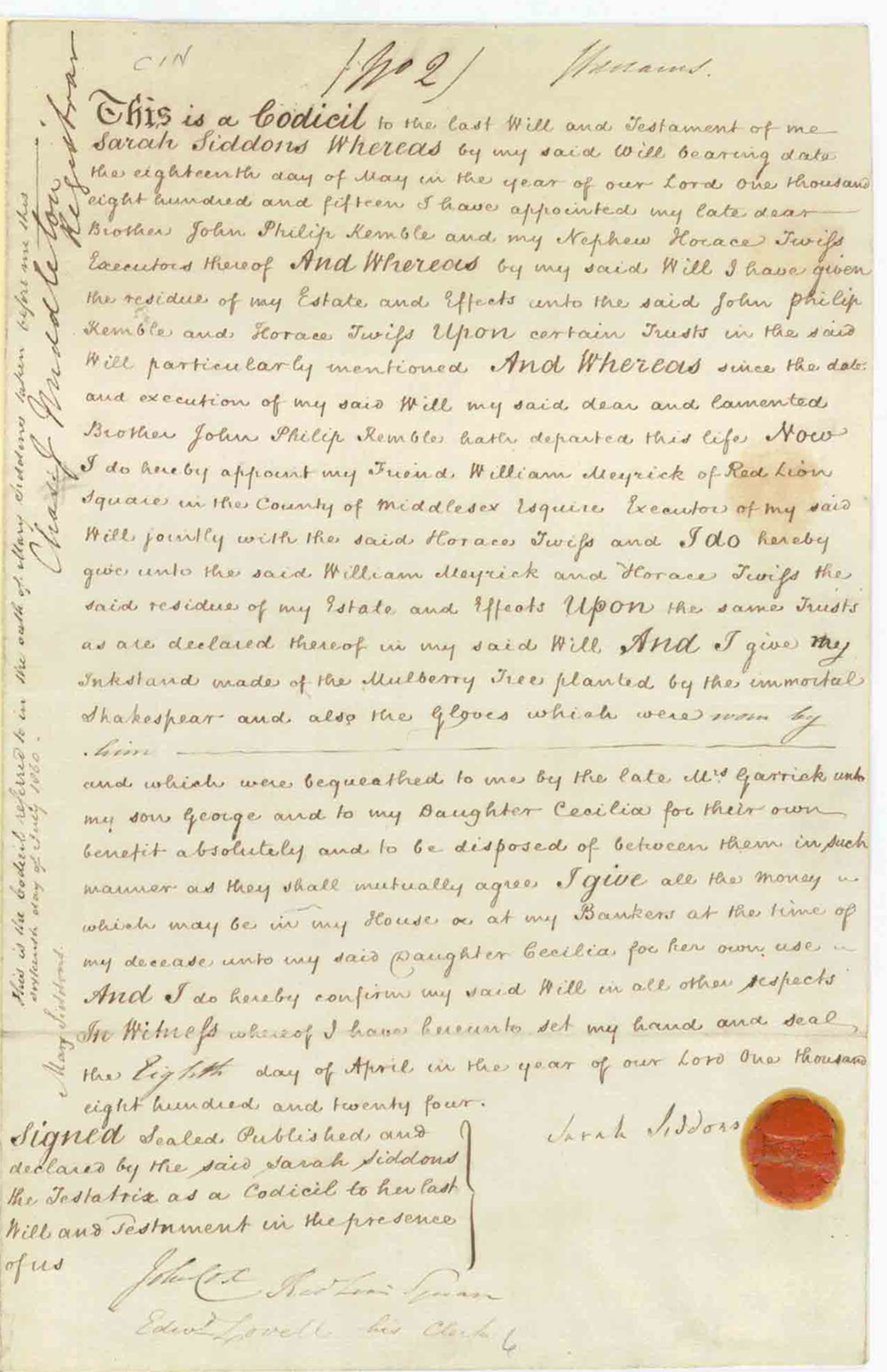
Codicil to the will of Sarah Siddons (1755-1831), the popular tragic actress painted by Thomas Gainsborough, 8 August 1831 (PROB 1/83)
Transcript
This is a codicil [legal instrument made to modify an earlier will] to the last will and Testament of me Sarah Siddons Whereas by my said will bearing date the eighteenth day of May in year of our Lord one thousand eight hundred and fifteen. I have appointed my late dear Brother John Philip Kemble and my Nephew Horace Twiss Executors thereof AND WHEREAS my said will I have given the residue of my estate and effects unto the said John Philip Kemble and Horace Twiss upon certain trusts in the said will particularly mentioned. AND WHEREAS since the date and execution of my said will my said dear and lamented Brother John Phillip Kemble hath departed this life. NOW I do hereby appoint my Friend, William Meyrick of Red Lion Square in the County of Middlesex, esquire Executors of my said Will jointly with the said Horace Twiss and I do hereby give unto the said William Meyrick and Horace Twiss the said residue of my Estate and Effects UPON the same Trusts as are declared therefore in my said will AND I give my Inkstand made of the Mulberry Tree planted by the immortal Shakespear- and also the Gloves which were worn by him———————————————————————————————————————————
And which were bequeathed to me by the late Mrs Garrick unto my son George and to be disposed of between them in such manner as they shall mutually agree. I GIVE all the money in which may be in my House etc. at my Bankers at the time of my decease unto my said daughter Cecilia for her own use. And I do hereby confirm my said will in all other respects. In Witness thereof I have hereunto set my hand and seal the Eight day of April in the Year of our lord one thousand eight hundred and twenty four.
Sarah Siddons [with seal]
Signed Sealed Published and declared to be said Sarah Siddons the Testatrix [female who makes a will] as a codicil to her last Will and Testament in the presence of us
John Cox Red Lion Square
Edward Lovell his clerk

Watercolour showing a section of the Royal Academy, 1790, revealing exhibition room and library (WORK 30/275)
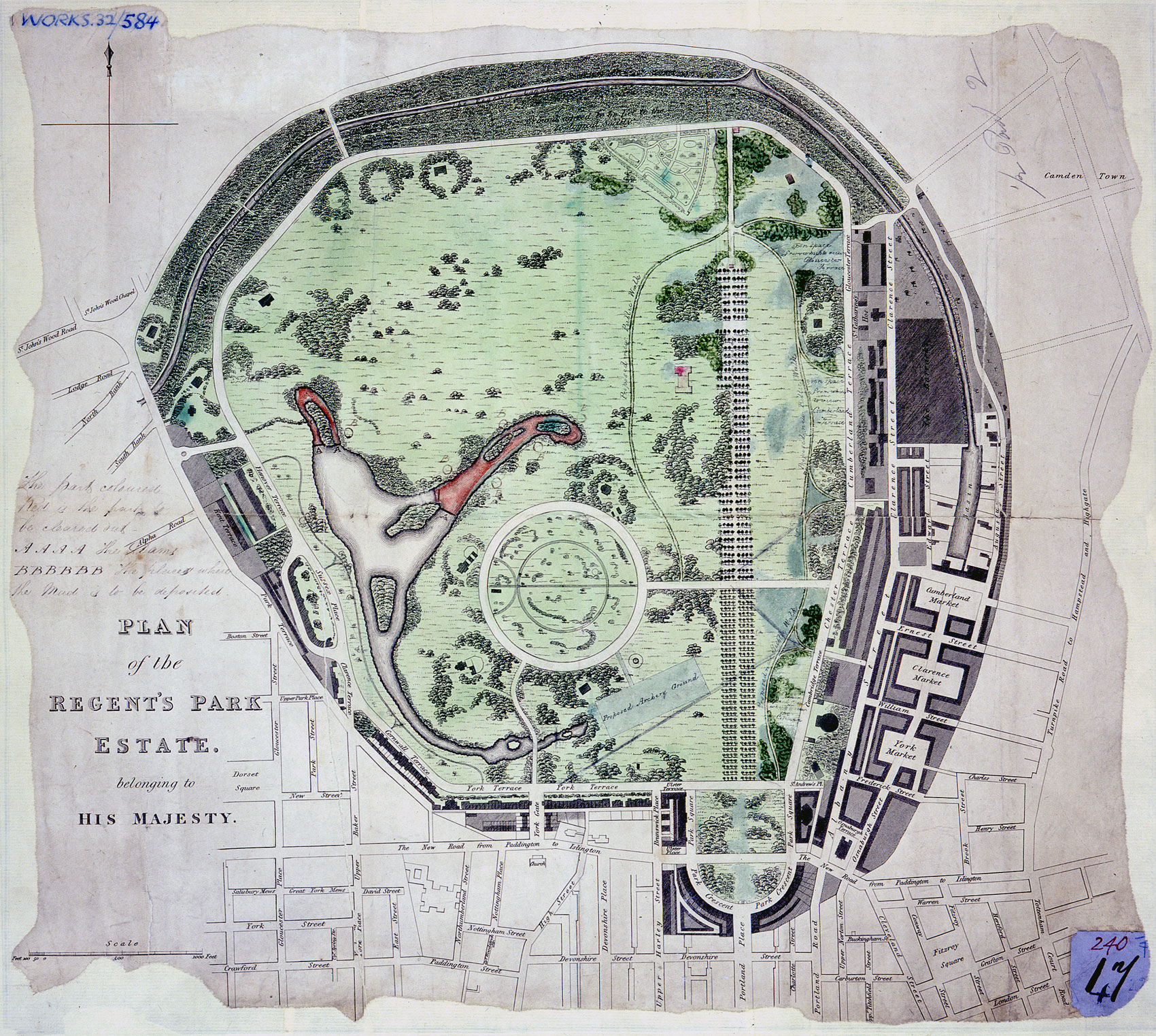
Plan of the Regent’s Park Estate belonging to George IV, 1820 (WORK 32/584)
The plan shows the areas of the ornamental lake to be cleared out. Dams were to be built at location A and the mud deposited at locations labelled B.
Transcript:
PLAN
of the
REGENT’S PARK
ESTATE.
belonging to
HIS MAJESTY.

Image showing inmate in a chained coffin and another in irons a private ‘madhouse’ near Bristol (HO 44/12 f.432)

Record of enslaved people sold by Messrs James Rogers & Co. of Bristol, undated (C 107/6)
The terms ‘Privilege man’ and ‘Privilege woman’ were used to describe those slaves considered more skilled than labouring slaves; they had superior rank, may have been put in charge of others and were worth more.
Transcript
Account Sales of 45 Slaves including an Infant at the Breast received by the Schooner [sailing ship with two or more masts, the foremast smaller than the mainmast] Fly James Walker Master from Sierra Leone on Account of Messrs James Rogers & Co. of Bristol, (C 107/6)
| June 25 | John Longlands | 1 | Privilege Man | 68 | |
|---|---|---|---|---|---|
| 2 | Cargo ditto | 132 | 200 | ||
| William Howard | 1 | Privilege Woman | 66 | ||
| 1 | Stout Girl | 62 | |||
| 1 | Woman | 63 | 191 | ||
| Alexander Walter | 2 | Small boys @ £54 | 108 | ||
| 1 | Very small ditto | 50 | |||
| 1 | Small girl | 54 | |||
| 1 | Very small ditto | 50 | 262 | ||
| Thomas Smith | 1 | Boy | 60 | ||
| 1 | Ditto | 58 | |||
| 1 | Small ditto | 52 | |||
| 1 | Small girl | 50 | 220 | ||
| David Nevin | 2 | Boys @ £54 | 108 | ||
| 1 | Girl | 52 | 160 | ||
| Robert Peart | 2 | Boys @ £58 | 116 | ||
| 1 | Man | 66 | |||
| 1 | Girl | 54 | 236 | ||
| John Wight | 2 | Women @ £64 | 128 | ||
| William Laing | 1 | Boy | 62 | ||
| Thomas McKissock | 1 | Boy | 56 | ||
| Aaron Little | 1 | Man | 66 | ||
| William Shaw | 1 | Man | 66 | ||
| Jonathan James | 1 | Man | 67 | ||
| Thomas Harvey | 2 | Men @ £66 | 132 | ||
| David Cohen | 1 | Woman | 66 | ||
| Isaac Stevens | 1 | Small girl | 54 | ||
| Susannah Fotheringham | 1 | Big boy | 59 | ||
| Mrs Gregory | 1 | Woman & child at the breast | 70 | ||
| 30 | John Lutman | 1 | Woman | 56 | |
| 1 | Girl | 46 | 102 | ||
| July 1 | John Whitaker | 4 | Refuse Men @ £40 | 160 | |
| July 5 | 2 | Ditto Women | 80 | 240 | |
| John Graham | 1 | Small sickly girl | 30 | ||
| 2467 | |||||
| To commission on £2467 @ £5 percent | 123.7 | ||||
| To paid Cap: James Walker his privilege of one slave | 53.5s | 176:12 | |||
| To Cap: Thomas Walkers coast Commissions on £2290:8 | 2290:8 | ||||
| At £6 p £106 | 129.12.11 | ||||
| To cash paid Importers Duty on 45 slaves at 10s per head | |||||
| …paid for Sundries for the use of the slaves | 4.13.3 | £156,16:2 | |||
| Net Proceeds | £2133:11:1 |