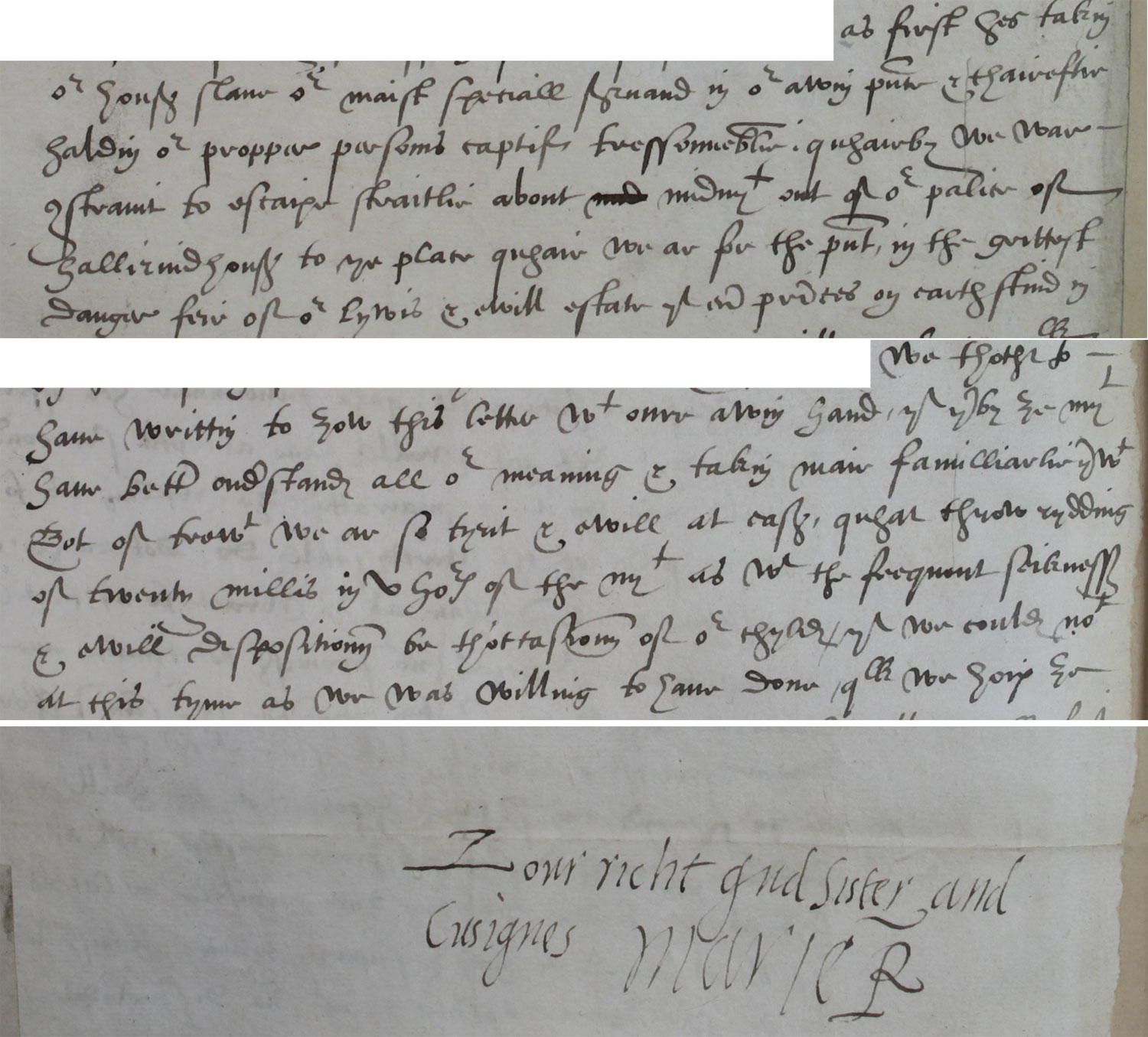
Letter dictated by Mary Queen of Scots to Elizabeth, 15 March 1566 (SP 52/12 f77v)
This letter, which is written in broad Scots, describes the murder in Mary’s presence at Holyroodhouse in Edinburgh of her Italian secretary David Rizzio. The murder had been orchestrated by her husband, Lord Darnley, and a group of Protestant Lords who were jealous of the influence that Rizzio enjoyed over the Scottish queen. It took place on the evening of 9 March 1565 when Mary had been taking supper with Rizzio in her private apartments. Her husband held her down and one of his fellow conspirators pointed a pistol at her belly while her hapless secretary was dragged out of the room, clutching at her hem and screaming for her to save him. He was then stabbed to death, in all receiving 56 wounds. After the murder, Mary was held prisoner at Holyrood but persuaded Darnley to run away with her. They reached Dunbar on 12 March, and it was from here that Mary dictated this letter, breathlessly describing the horrific episode to Elizabeth, to whom she always referred as a ‘sister queen’. Although Elizabeth replied in the same affectionate terms, she never trusted Mary and must have derived some satisfaction from hearing about the collapse of her rival’s regime.
Transcript (excerpt)
‘As first hes takin our houss slane our maist [most] speciall servand in our awin [own] presence & thaireftir haldin our propper personis captive tressonneblie, quhairby [whereby] we war constrainit to escaipe straitlie about midnyght out of our palice of halliruidhouss to the place quhair [where] we ar for the present, in the grittest danger feir of our lywis & ewill [ill] estate that evir princes on earth stuid [stood] in….
We thotht to have writtin to you this letter with oure awin [own] hand, that therby ye myght have better onestand all our meaning & takin mair [more] familliarlie therewit. Bot of trewt [truth] we ar so tyrit [tired] & ewill [ill] at eass [ease], quhat [what] throw rydding of twenty millis [miles] in v [5] horis [hours] of the nyght as wit the frequent seikness & weill dispositioun be th’occasioun of our child/that we could not at this tyme as we was willing to have done…
Your richt [right] gud sister and cusignes [cousin] Marie R.
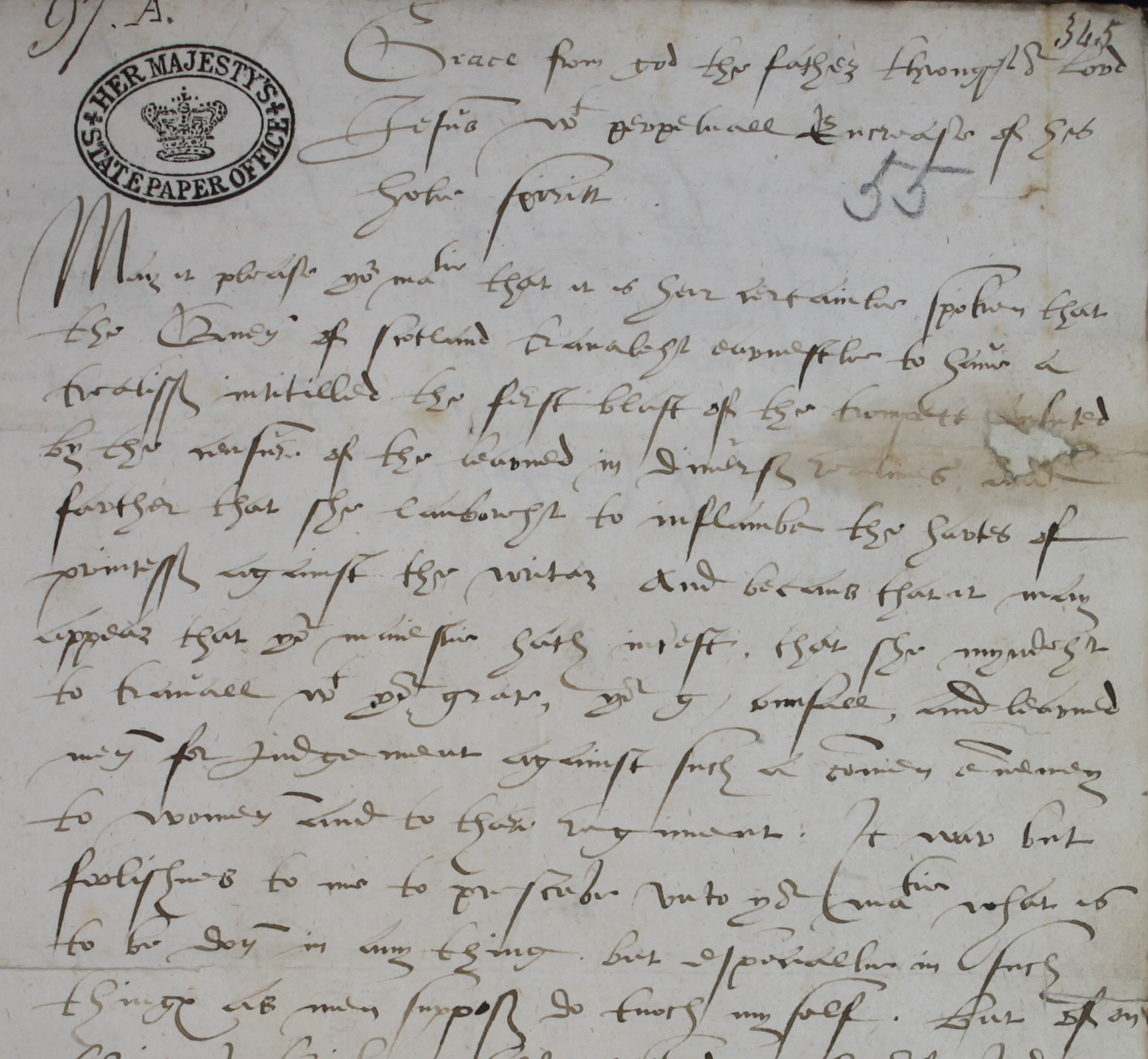
John Knox to Elizabeth, 6 August 1561 (SP 52/6 f.119)
Elizabeth despised John Knox – with good reason. The influential Scottish clergyman and reformer was scathing in his attacks on women. His famous tract The First Blast of the Trumpet against the Monstrous Regiment of Women (‘regiment’ meaning rule or regime), was published just a few months before Elizabeth became queen. In it he declared: ‘To promote a woman to bear rule, superioritie, dominion or empire above any realme, nation, or citie, is repugnant to nature.’ He slammed Elizabeth’s half-sister Mary, who was then queen, as ‘unworthy by reason of her bloody tyranny of the name of woman.’ Knox’s letter to Elizabeth was written a fortnight before Mary Stuart’s arrival in Scotland from France to begin her queenship. Although Mary and Elizabeth would become deadly rivals, they were rare examples of queens regnant in a world dominated by men. Mary shared Elizabeth’s hatred of Knox and, as his letter shows, tried to have it censured.
Transcript (excerpt)
Grace from god the father throught our Lord Jesus with perpetuall Encrease of his holie spiritt.
May it please your majestie that it is heir [here] certainlie spoken that the Quen of Scotland traveleht [travails, or is attempting] earnestlie to have a treatiss intitilled the ferst blast of the trompett [con]futed by the censure of the learned in divers realmes, and father that she lauboreht to inflambe the hartes of princess against the writer And becaus that it may appear that your majestie hath interest, that she myndeht [mindeth] to travall with your grace, your graces counsall, and learned menn for Judgement against such a common enemey to womenn and to thare regiment. It were but foolishnes to me to prescribe unto your majestie what is to be donn in any thing, but especiallie in such thinges as men suppos do tuoch [touch] my self…’
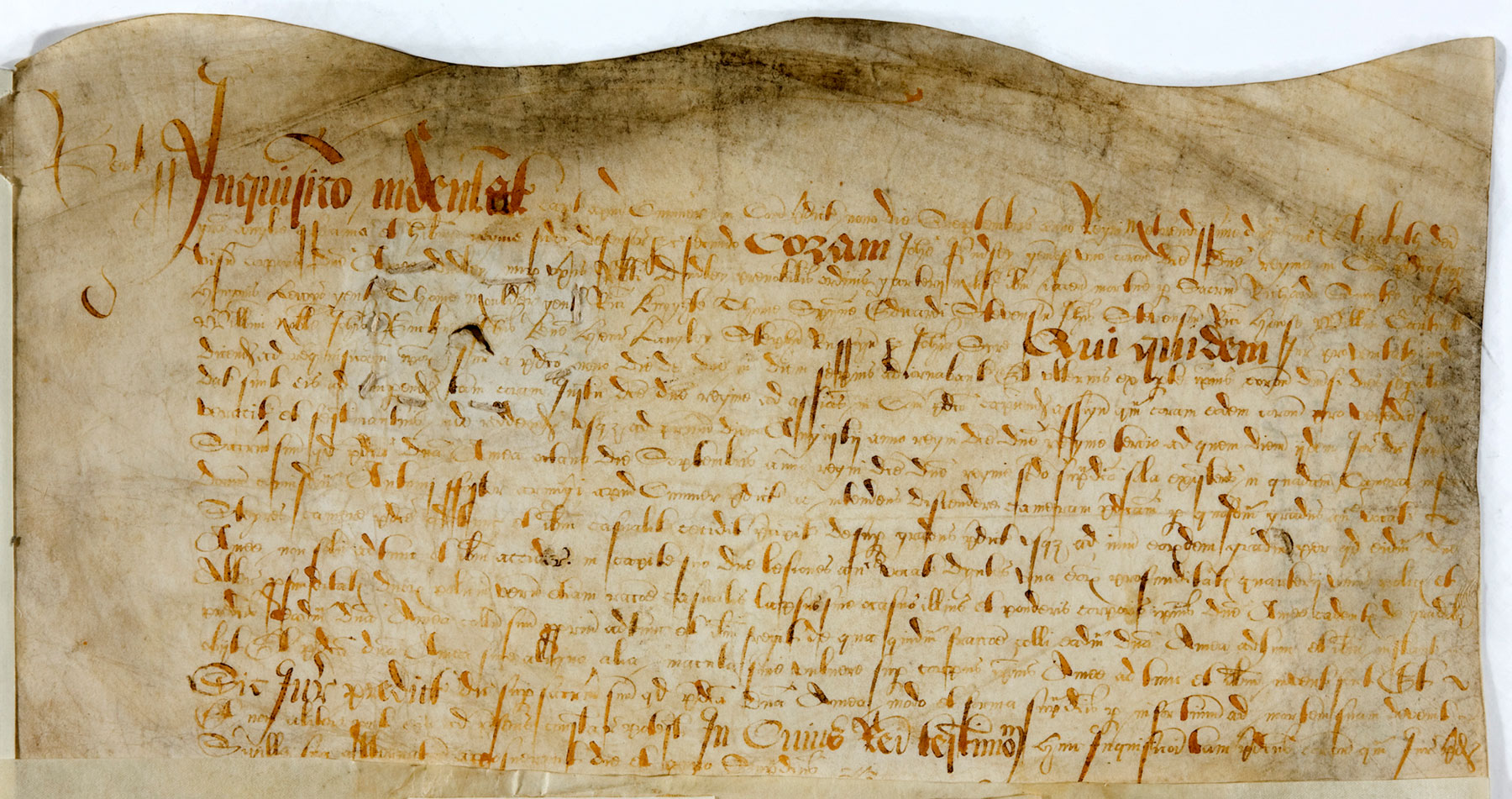
Coroner’s report into the death of Amy Robsart, August 1561 (KB 9/1073/f.80)
For all that she liked to keep foreign suitors in play, Elizabeth was already deeply in love with her Master of Horse, Robert Dudley. Ironically, though, the sudden death of Dudley’s wife in September 1560 removed any hope that the queen might have privately cherished of marrying him. Amy Robsart was found dead at the bottom of a short flight of stairs at Cumnor Place in Oxfordshire. The circumstances were suspicious. Her neck was broken and there were two small wounds to her head. On the day of her death, she had insisted that all of her servants attend the fair that was being held that day in Abingdon. When they returned, they found their mistress dead. Whether it was an accident, suicide or murder has never been resolved beyond doubt. The scandal reverberated not just around the kingdom but across the courts of Europe, so that Elizabeth was obliged to distance herself from Dudley in order to avoid being implicated any further.
Translation from the original Latin
Inquisition as indenture held at Cumnor in the aforesaid county [Oxfordshire] on 9 September in the second year of the reign of the most dread Lady Elizabeth, by the grace of God queen of England, France, and Ireland, defend of the faith, etc., before John Pudsey, gent, a coroner of the said lady queen in the aforesaid county, on inspection of the body of Lady Amy Dudley, late wife of Robert Dudley, knight of the most noble order of the garter, there lying dead: by oath of Richard Smith, gent., Humphrey Lewis, gent., Thomas Moulder, gent., Richard Knight, Thomas Spyre, Edward Stevenson, John Stevenson, Richard Hughes, William Cantrell, William Noble, John Buck, John Keene, Henry Lanlgey, Stephen Ruffyn, and John Sire: which certain jurors, sworn to tell the truth at our request, were adjourned from the aforesaid ninth day onwards day by day very often; and finally various several days were given to them by the selfsame coroner to appear both before the justices of the aforesaid lady queen at the assizes assigned to be held in the aforesaid county and before the same coroner in order there to return their verdict truthfully and speedily, until 1 August in the third year of the reign of the said lady queen; on which day the same jurors say under oath that the aforesaid Lady Amy on 8 September in the aforesaid second year of the reign of the said lady queen, being alone in a certain chamber within the home of a certain Anthony Forster, esq., in the aforesaid Cumnor, and intending to descend the aforesaid chamber by way of certain steps (in English called ‘steyres’) of the aforesaid chamber there and then accidentally fell precipitously down the aforesaid steps to the very bottom of the same steps, through which the same Lady Amy there and then sustained not only two injuries to her head (in English called ‘dyntes’) – one of which was a quarter of an inch deep and the other two inches deep – but truly also, by reason of the accidental injury or of that fall and of Lady Amy’s own body weight falling down the aforesaid stairs, the same Lady Amy there and then broke her own neck, on account of which certain fracture of the neck the same Lady Amy there and then died instantly; and the aforesaid Lady Amy was found there and then without any other mark or wound on her body; and thus the jurors say on their oath that the aforesaid Lady Amy in the manner and form aforesaid by misfortune came to her death and not otherwise, as they are able to agree at present; in testimony of which fact for this inquest both the aforesaid coroner and also the aforesaid jurors have in turn affixed their seals on the day
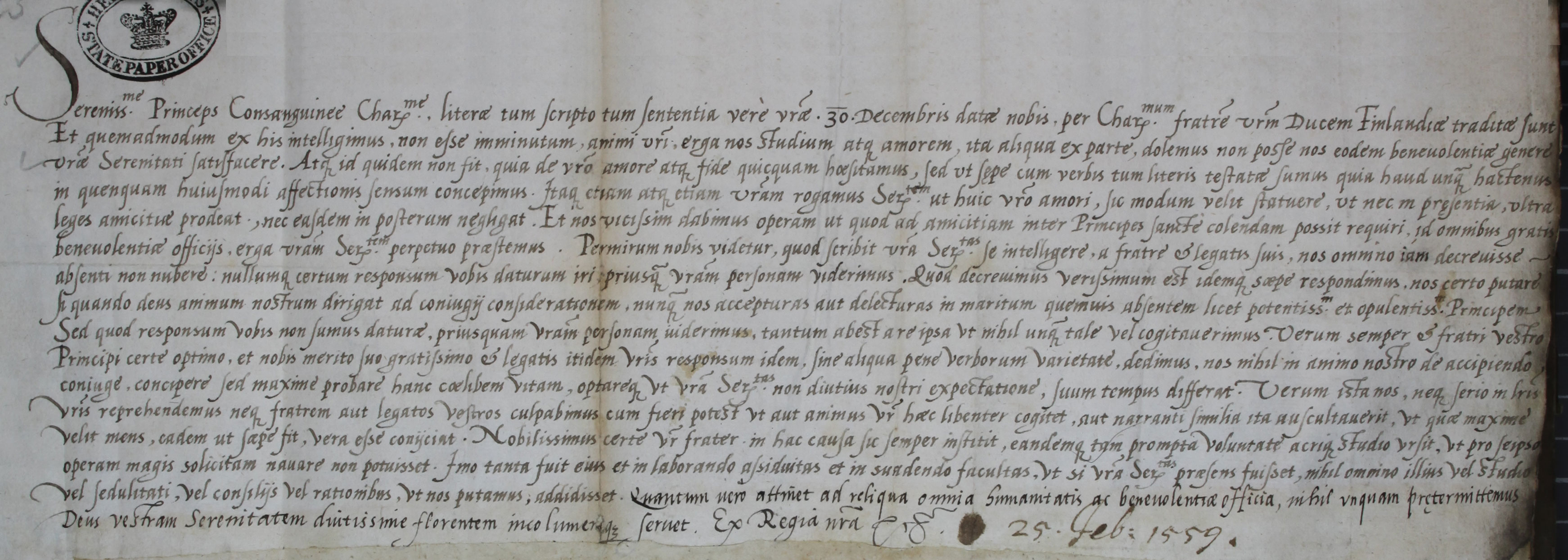
Elizabeth I to King Eric XIV of Sweden, 25 February 1560 (SP 70/11 f.74)
Although Elizabeth showed no inclination to marry, it was not long before the young queen was besieged by suitors. Among the first was the new king of Sweden, Eric XIV. Elizabeth employed what was to become a familiar tactic: she offered ‘fair words’ but no firm promises. But when Eric expressed his intention to visit her, she set aside her accustomed ambiguity. She fired off this letter, which was filled with apparent regret that she could not share his feelings, but made it clear that he should not set foot in England.
Translation from the original Latin
Most Serene Prince, our very dear Cousin,
A letter truly yours both in the writing and sentiment, was given us on 30 December by your very dear brother, the Duke of Finland. And while we perceive therefrom that the zeal and love of your mind towards us is not diminished, yet in part we are grieved that we cannot gratify your Serene Highness with the same kind of affection. And that indeed does not happen because we doubt in any way of your love and honour, but, as often we have testified both in words and in writing, that we have never yet conceived a feeling of that kind of affection towards any one. We therefore beg your Serene Highness again and again that you be pleased to set a limit to your love, that it advance not beyond the laws of friendship for the present nor disregard them in future… I have always given both to your brother, who is certainly a most excellent Prince and deservedly very dear to us, and also to your ambassador likewise, the same answer with scarcely any variation of the words, that we do not conceive in our heart to take a husband but highly commend the single life, and hope that your Serene Highness will not longer spend time in waiting for us.

Sir Thomas Gresham to Elizabeth I, 25 February 1560 (SP 70/11 f.78)
Gresham was one of the wealthiest men in England. In this letter, he writes to inform his queen that he has arranged loans secured on the Antwerp Exchange from 15 bankers (who are listed in the letter), totalling £128,449 3s 4d. This was to help finance the first war of Elizabeth’s reign – her eventually successful attempt to eject the French from Scotland. Given that the Crown’s entire annual income was normally around £250,000, it was a substantial loan. The export of bullion from the Low Countries was prohibited, so Gresham used various subterfuges – such as on this occasion concealing it in some ‘stonne work’ [stonework], along with his letter. He wrote it when he was about to embark for the Netherlands to serve as ambassador to the Duchess of Parma, who was regent. In contrast to her father, Henry VIII, Elizabeth was averse to waging wars, which were ruinously expensive.
Transcript
Yt maye please your most Excellent Majestie to understsand, that for the better profe to your hightnes: for the conveyans [conveyance] of soche bullion and golde as I shall provyde for you, I have sent you this letter inclossed [enclosed] in the stonne worke being no smale comforte unto me: that I have obteyned to the knowledge therof for the better conveyans of your treasure, which thing must be kept as secretlie as your Majestie can devize, for yf yt shulde be knowen or perseved [perceived] in fla[n]ders it were as moche as my liffe and goods were worth, besides the lose that your hightnes shuld susteyne therbie, whiche I shall not let to put in perse havinge no dowght but that your Majestie will have a consideracion of my Service as ther unto aperteyneth…
[There follows a list of the bankers and how much each is lending.]
Other I have not to molest your Majestie withal but I shall most humblie beseche your highthnis to be acomforte unto my pore wife in this my absens in the serviz of your Majestie. As knowest the Lorde whome preserve your noble Majestie in helth and long liffe and long to reigne over us with increas of honour. Ffrom my house in London the xxvth of ffebruarie anno 1559 [1560 N.S.]. By your Majesties most humble and faithfull obedient subject. Thomas Gresham.

Elizabeth’s first speech, Hatfield, 20 November 1558 (SP12/1 f.12)
Elizabeth came to the throne on a wave of popular rejoicing. She was the archetypal Tudor princess: flame-haired, charismatic and authoritative. In short, she was exactly what the country needed after the short but brutal reign of her older half-sister, ‘Bloody’ Mary. Elizabeth had received the news of Mary’s death at Hatfield House, where she had been living for several years. Many of the men and women who formed her household there were rewarded with appointments in the new queen’s court and council. First and foremost was Sir William Cecil (later Lord Burghley), whom Elizabeth trusted above all others. Just three days after her accession, she appointed him her principal secretary. It proved an inspired choice. Cecil’s tight control over the finances of the Crown, his leadership of the privy council, and the creation of a highly effective intelligence service under the direction of Francis Walsingham made him the most influential minister for the majority of Elizabeth’s reign. The queen nicknamed him her ‘Spirit’ and relied upon him utterly.
Transcript
Wordes spoken by her majestie to Mr. Cecille:
I give you this chardge that you shallbe of my privy counsell and content yourself to take paynes for me and my Realme. This judgement I have of you that you will not be corrupted with any manner of gift, and that you wilbee faithful to the state, and that without respect of my pryvate will you will give me that counsaill that you thinke best, And if you shall knowe any thinge necessarye to bee declared to me of secresye, you shall show it to my self only, and assure yourself I will not fayle to keepe taciturnitye therein, and therefore herewith I chardge you.
Wordes spoken by the Queene to the Lordes:
My Lordes the lawe of nature moveth mee to sorrowe for my Sister, the burthen that is fallen upon me maketh me amazed, And yet consideringe I am Gods creature, ordeyned to obey his appoyntment I will therto yelde, desiringe from the bottome of my harte that I may have assistance of his grace to bee the minister of his heavenly will in this office nowe commytted to me, And as I am but one bodye naturallye considered though by his permission a bodye politique to governe, so I shall desyre yow all my Lordes (cheiflye yow of the nobility every one in his degree and power) to bee assistant to me; that I with my rulinge and yow with your service may make a good accoumpt to Almighty God, and leave some comforte to our posteritye in death, I meane to direct all my accions by good advise and counseill, And therfore consideringe that diverse of yow bee of the aintient [ancient] Nobility, having your beginnings and estates of my progenitors kings of this Realme, and therby ought in honour to have the more naturall care for maynteining of my estate and this comon wealthe, Some others have been of Long experience in governaunce and enabled by my father of Noble memorye, my Brother and my Late Sister to beare Office, The rest of yow beeing uppon speciall trust lately called to her service only and trust for your service considered and Rewarded, my meaning is to Require of yow all, nothing more but faithfull hartes in such service as from tyme to tyme shalbee in your powers towards the preservacion of me and this common wealthe, And for counseill and advise I shall accepte yow of my Nobility and suche others of yow the rest as in consultacion I shall thinke meete and shortly appoynt, to the which also with there advise I will joyne to their ayde and for ease of their Burthen others meet for my service; And they which I shall not appoynt let them not thinke the same for any disabilitye in them But for that I doe consider a multitude doth make rather discorde and confusion then good counseill, And of my good will yow shall not doubte using your selves as apperteynethe to good and loving subiectes.
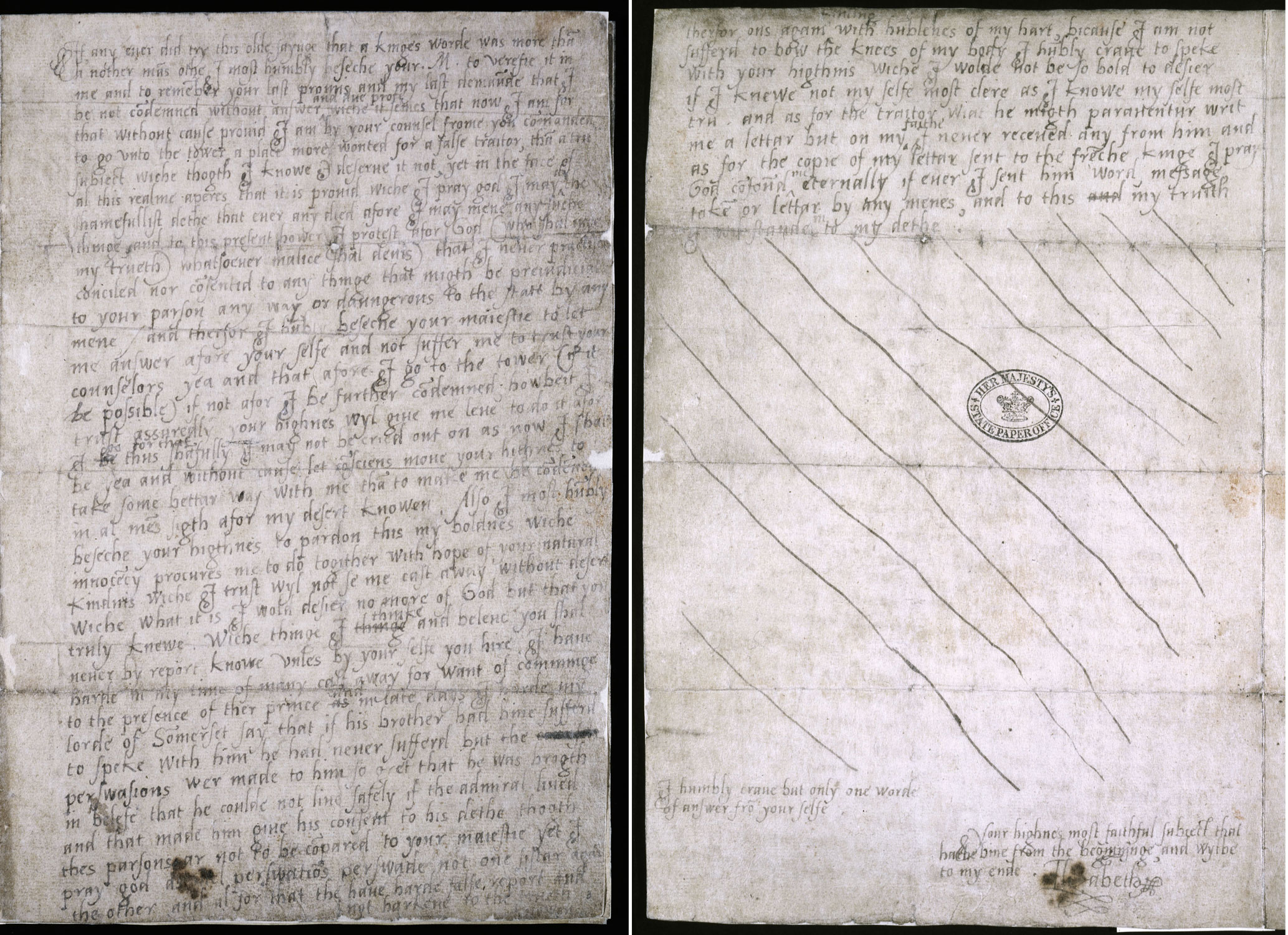
The ‘Tide Letter’, Noon, 17 March 1554 (SP 11/4/2 f.3- 3v)
This was one of the most important letters that Elizabeth ever wrote. She had been imprisoned by her half-sister Mary on suspicion of involvement in the Wyatt rebellion, which aimed to overthrow the queen because of her determination to marry Philip of Spain. Having heard that she was to be taken to the Tower, Elizabeth wrote in a desperate attempt to secure an audience with her sister. Fearing that her enemies might alter the text, she struck lines across the blank space above her signature. It is known as the ‘Tide Letter’ because Elizabeth wrote it deliberately slowly so that the daylight low-tide that enabled boats to pass safely under the narrow arches of London Bridge had turned, sparing her from the Tower for an extra day.
Transcript
[f.3] If any ever did try this olde sayinge that a kinges worde was more than a nother mans othe [oath] I most humbly beseche your Majestie to verefie it in me and to remember your last promis and my last demaunde that I be not condemned without answer and due profe wiche it semes that now I am for that without cause provid [proved] I am by your counsel from you commanded to go unto the tower a place more wonted for a false traitor, than a tru subject wiche thogth I knowe I deserve it not, yet in the face of al this realme aperes that it is provid. wiche I pray god I may dye the shamefullyst dethe that ever any died afore [if] I may mene any suche thynge; and to this present hower I protest afor God (Who shall judge my trueth, whatsoever malice shall devis) that I neither practiced, conciled nor consented to any thinge that might be prejudicial to your parson any way or daungerous to the state by any mene [means]. And therefor I humbly beseche your majestie to let me answer afore your selfe and not suffer me to trust your counselors yea and that afore I go to the tower (if it be possible) if not afor I be further condemned, howbeit I trust assuredly your highnes wyl give me leve to do it afor I goe, for that thus shamfully I may not be cried out on as now I shall be, yea and without cause. Let consciens move your highness to take some bettar way with me than to make me be condemned in al mens sigth [sight] afor my desert knowen. Also, I most humbly beseche your higthnes to pardon this my boldnes wiche innocency procures me to do togither with hope of your natural kindnis [kindness] wiche I trust wyl not se me cast away without desert, wiche what it is I wold desire no more of God but that you truly knewe. Wiche thinges I thinke and believe you shal never by report knowe unles by your selfe you hire [hear]. I have harde [heard] in my time of many cast away for want of comminge to the presence of ther prince and in late days I harde [heard] my lorde of Somerset say that if his brother had hime suffer’d to speke with him he had never suffer’d, but the perswasions wer made to him so gret that he was brogth [brought] in belefe that he coulde not live safely if the admiral lived and that made him give his consent to his dethe. Thogth [though] thes parsons [persons] ar not to be compared to your majestie yet I pray god that evil perswations [persuasions] perswade not one sistar agaynst the other and al for that they have harde [heard] false report and not harkened to the trueth.
[f.3v] Therefor ons [once] again kneling [kneeling] with humblenes of my hart, bicause I am not suffer’d to bow the knees of my body I humbly crave to speke with your higthnis wiche I wolde not be so bold to desire if I knewe not my selfe most clere as I knowe my selfe most tru, and as for the traitor Wiat [Wyatt] he migth [might] paraventur [peradventure] writ me a lettar but on my faithe I never receved any from him and as for the copie of my lettar sent to the frenche kinge I pray God confound me eternally if ever I sent him word, message, token or lettar by any menes, and to this my truth I wil stande in to my dethe.
I humbly crave but only one worde of answer from your selfe.
Your hignes most faithful subject that hathe bine from the beginninge, and wylbe to my ende. Elizabeth.

Princess Elizabeth to Dowager Queen Katherine Parr, c.June 1548 (SP10/2 f.84c)
Elizabeth wrote this letter to Katherine, her last and favourite stepmother, when she was in deep disgrace. With what many people viewed as unseemly haste, Katherine had married her long-standing love, Thomas Seymour, very soon after the death of Henry VIII. Elizabeth went to live with the newlyweds at Chelsea, and although she thrived in the intellectually stimulating environment, she soon found herself at the centre of a scandal. Seymour clearly found the 13 year-old princess an irresistible prospect. He would visit her early in the morning, before she was dressed, and tickle her in bed. At first, Katherine colluded in her husband’s antics, but when she found Elizabeth in his arms she sent the girl away. The episode had a profound effect upon the young princess, reinforcing the need to safeguard her reputation at all costs and strengthening her resolve never to marry.
Transcript
Although I coulde not be plentiful in giving thankes for the manifold kindenis received at your hithnis hande at my departure, yet I am some thinge to be borne with al, for truly I was replete with sorowe to departe frome your highnnis, especially leaving you undoubtful of helthe, and albeit I answered litel I wayed [weighed] it more dipper [deeper] when you sayd you wolde warne me of al evelles that you shulde hire of me, for if your grace had not a good opinion of me you wolde not have offered friendship to me that way, that al men iuge [judge] the contrarye, but what may I more say than thanke God for providinge suche frendes to me, desiringe God to enriche me with ther [their] longe life, and me grace to be in hart no les thankeful to receyve it, than I nowe am glad in writinge to shewe it. And although I have plentye of matter, hire I wil staye [stop] for I knowe you ar not quiet to rede. Frome Cheston this present saterday.
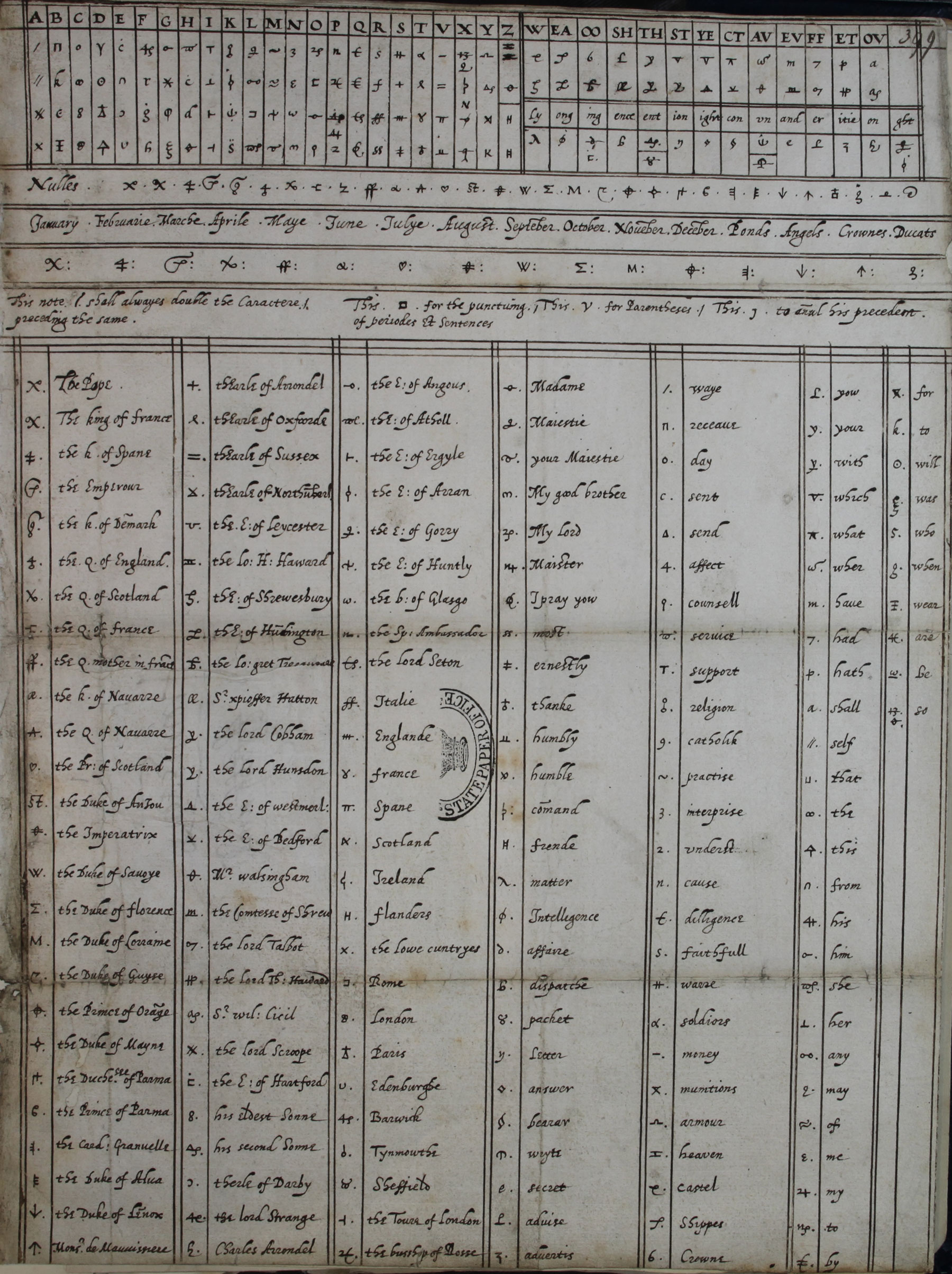
Page of ciphers used by Mary Queen of Scots, c.1586 (SP 53/22 f.1)
After the discovery of the Babington Plot in 1586, Mary’s apartments were searched and all of her papers seized. They included more than 100 ciphers used in her correspondence. Tudor espionage was quite sophisticated and several different codes were used in secret correspondence. One of the most common was to shuffle letters of the alphabet in a certain sequence so that once the key had been worked out the message could be read quickly and easily. Alternatively, individual letters were sometimes substituted with numbers, characters, symbols or signs of the zodiac. Elizabeth’s great spymaster, Sir Francis Walsingham, employed intelligence workers to break these codes. Two of the best known are Thomas Phelippes and John Sommers.
In the cipher shown here, symbols are substituted for letters in particular words, and the names are frequently mentioned. Some of these names make interesting reading. They include the pope, various European rulers, Bess of Hardwick (for many years the wife of Mary’s custodian and a close companion), and the earl of Hertford and his two sons (Mary’s rivals for the English succession).
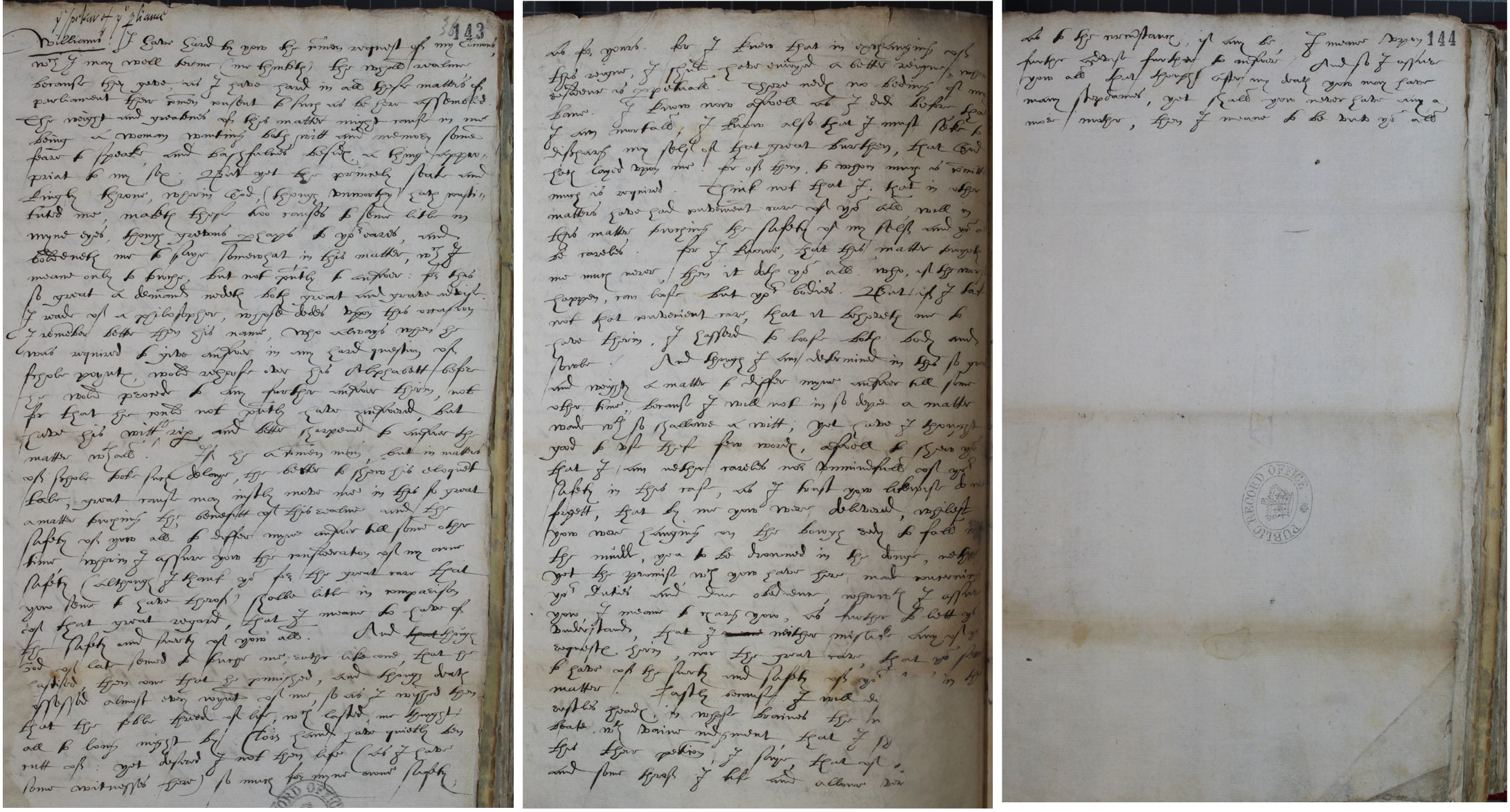
Answer of the Queen to the addresses of both Houses of Parliament delivered to Mr Speaker Thomas Williams, 28 January 1563 (SP 12/27 f.143r-144v)
From the very beginning of her reign, Elizabeth was determined never to marry. In an age when women were considered naturally subservient to, and in need of guidance from men, this was deeply shocking to her advisers and subjects. Moreover, the kingdom needed an heir so it was imperative that the queen take a husband. But having battled so hard for the throne, Elizabeth was not minded to cede any of her authority to a husband. Fully appreciating the diplomatic importance of keeping her various suitors in play, however, she proved a master of procrastination and giving ‘answers answerless’.The matter became more pressing after the queen’s near-fatal attack of smallpox in October 1562, so Parliament again petitioned her to marry. Elizabeth cleverly used her gender to side-step the issue, claiming that she could not respond as a woman ‘wanting wit and memory’, and that she was too bashful to speak of marriage.
Transcript
Williams: I have hard [heard] by yow the common request of my Commons, which I may well terme (me thinketh) the whole realme because they geve, and I have hard [heard] in all these matters of parliament their common consent to such as be hear assembled. The weight and greatnes of this matter might cause in me being a woman wanting both witt and memory some feare to speake and bashfulnes besides, a thing appropriat to my sex. But yet the princely seate and Kingly throne, wherein God (though unworthy) hath constituted me, maketh these two causes to seme litle in myne eyes, though grevous perhaps to your eares, and boldeneth me to saye somewhat in this matter, which I meane only to touche but not presently to answer: for this so great a demand needeth both great and grave advise. I read of a philosopher, whose dedes upon this occasion I remember better then his name, who always when he was required to give answer in any hard question, of schole [school] poyntes, wold rehearse over his Alphabett before he wold procede to any further answer therin, not for that he could not presently have answerd, but have his witt the riper and better sharpened to answer the matter withal. If he a common man, but in matters of schole [school] tooke suche delaye, the better to show his eloquent tale, great cause may justly move me in this so great a matter touching the benefit of this realme and the safety of you all, to differ [defer] myne answer till some other time, wherin I assure you the consideration of my owne safety (although I thank you for the great care that you seme to have therof) shalbe litle in comparison of that great regard, that I meane to have of the safety and surety of yow all. And thoughe God of late semed to touché me, rather like one, that he chastised, then that he punished, and thoughe death possessed almost every joint of me, so as I wyshed then that the feble thread of life, which lasted, me thought, all to longe, might by Clotho’s hand have quietly ben cut off: yet desired I not then life (as I have some witnesses hear) so much for myne owne safety as for yours. For I know that in exchanging of this reigne, I shuld have enjoyed a better reigne, where residence is perpetuall. There nedes no boding of my bane. I know now aswell as I did before that I am mortall. I know also that I must seke to discharge my self of that great burthen, that God hath layed upon me. For of them, to whom much is committed, much is required. Think not that I that in other matters have had convenient care of you all, will in this matter touching the safety of my self and you all be careless. For I know, that this matter toucheth me much nearer, then it doth you all. Who, if the worst happen, can loose but your bodies. But if I take not that convenient care, that it behoveth me to have therin, I hazzard to loose both body and soule. And though I am determined in this so great and weighty a matter to differ [defer] myne answer till some other time, because I will not in so depe a matter wade with so shallowe a witt; yet have I thought good to use these few wordes, aswell to shew you that I am nether careles nor unmindfull of your safety in this case, as I trust yow likewise do not forgett, that by me you were delivered, whilest you were hanging on the bowgh [bough] redy to fall into the mudd, yea to be drowned in the dogne [dung], nether yet the promise, which you have here made concerning your dutis and due obedience, wherewith I assure you, I meane to charge you, as further to let you understand, that I neither mislike any of your requestes herin, nor the great care, that you seme to have of the surety and safety of yourselves in this matter. Lastly because I will discharge some restles heads, in whose braines the needless hammers beate with vaine judgement, that I should mislike this their petition, I saye, that of the matter and some thereof I like and allowe very well. As to the circumstances, if any be, I meane upon further advyse further to answer, And as I assure you all that though after my death yow may have many stepdames, yet shall yow never have any a more mother, then I meane to be unto you all.