1. Why use this guide?
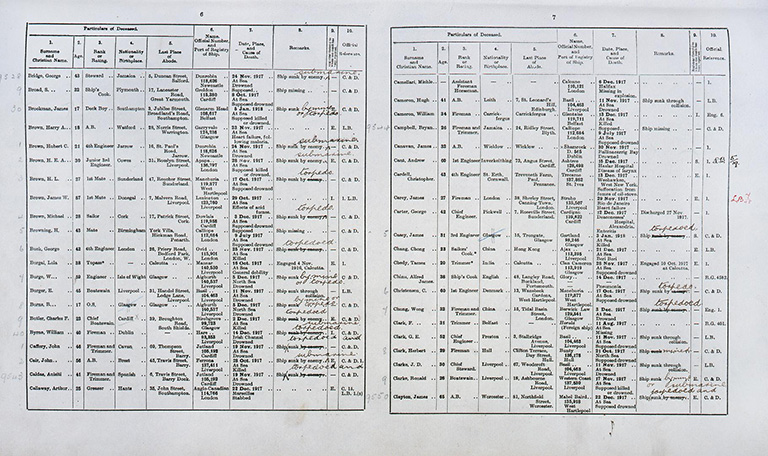
This guide provides a key to abbreviations used in Merchant Navy records from 1835 to 1972. It will help you to interpret Merchant Navy records of various kinds from this period, including registers of seamen, seamen’s pouches and medal records.
Consult the book Records of Merchant Shipping and Seamen, available from The National Archives library, for similar guidance on abbreviations in the records.
For advice on how to find the records themselves, see our other Merchant Navy guides.
2. Abbreviations for Merchant Navy ranks
| Abbreviation | Probable meaning | Abbreviation | Probable meaning |
|---|---|---|---|
| 2 E or 2 Eng | 2nd engineer | KP | Kitchen porter |
| 2 M | 2nd mate | Lman | Laundry man |
| 3 E or 3 Eng | 3rd engineer | L/Boy or L Boy | Leading boy |
| 3 M | 3rd mate | LT | Lamp trimmer |
| 4 E or 4 Eng | 4th engineer | M | Mate |
| 4 Off | 4th officer (4th mate) | MAA | Master at arms |
| 5 E or 5 Eng | 5th engineer | Med O | Medical officer |
| 5 Off | 5th officer (5th mate) | Mstr | Master (captain) of a vessel |
| A or App or Apptce | Apprentice | N Wman | Night watchman |
| AB | Able seamen | Off | Officer |
| Asst | Assistant | OS | Ordinary seaman |
| Bkr | Baker | P or Psr | Purser |
| Bos or Boatn or Bosn | Boatswain (2nd mate?). Also bosun | Pman | Pantry man |
| Brkpr | Barkeeper | P/Boy or P Boy | Pantry boy |
| B R Stwd | Bedroom steward | Plmr | Plumber |
| Btchr | Butcher | Psge Wkr | Passage worker |
| Btmn | Boatman | Ptlman | Patrol man |
| C | Captain (master) of a vessel or cabin | QM | Quarter master |
| C Boy or C/ Boy | Cabin boy or cabin steward | RO | Radio officer |
| Cadet | Company cadet (possibly an apprentice) | RT | Radio telegraphist |
| Cf M | Chief mate (1st mate) | S or Sman | Seaman |
| Ch | Chief | S B Attendt | Sick bay attendant |
| Ck | Cook | Scnman | Section man |
| Clnr | Cleaner | Sig | Signal man |
| Cptr or Cr | Carpenter | Sl Mr | Sail maker |
| Ctring | Catering | Snr | Senior |
| D Boy | Deck Boy | Srgn | Surgeon |
| D H | Deck Hand | Strkpr | Store keeper |
| Dispr | Dispenser | Stwrd | Steward |
| Donkey-man or Dkyman | Donkey-engine operator | Swpr | Sweeper |
| E or Eng or Engr | Engineer | SOS | Senior ordinary seaman |
| EDH | Efficient deck hand | T or Trmr | Trimmer |
| Electr | Electrician | Telgt | Telegraphist |
| Ftr | Fitter | Wman | Winch-man |
| GS | General servant | WO | Wireless operator |
| Gsr | Greaser | Wtr | Waiter |
| Hd | Head | ||
| J Eng | Junior engineer | ||
| JOS | Junior ordinary seaman? |
3. Port numbers for UK ports
For Merchant Navy purposes, every port in the UK has a port number. Port numbers are used on many Merchant Navy records, especially before 1858. Matching the number to the port name could help you to, for example, find a document reference for an agreement and crew list from 1835 to 1857 in series BT 98. For more information on how to find an agreement and crew list read Merchant Navy ships’ records: crew lists, musters and log books.
There is no known key for port rotation numbers (which appear in earlier merchant seamen service records). You may be able to locate which official numbers belong to which ships in series BT 336.
| Port name | Port number | Port name | Port number | Port name | |
|---|---|---|---|---|---|
| 1 | Aberdeen | 50 | Gweek | 99 | Wells |
| 2 | Aberystwyth | 51 | Harwich | 100 | Westport |
| 3 | Aldborough | 52 | Hull | 101 | Weymouth |
| 4 | Arundel | 53 | Ilfracombe | 102 | Wexford |
| 5 | Ayr | 54 | Inverness | 103 | Whitehaven |
| 6 | Baltimore | 55 | Ipswich | 104 | Whitby |
| 7 | Banff | 56 | Irvine | 105 | Wick |
| 8 | Barnstaple | 57 | Kirkcaldy | 106 | Wisbech |
| 9 | Beaumaris | 58 | Kirkwall | 107 | Woodbridge |
| 10 | Belfast | 59 | Lancaster | 108 | Yarmouth |
| 11 | Berwick | 60 | Leith | 109 | Preston |
| 12 | Bideford | 61 | Lerwick | 110 | Gainsborough |
| 13 | Borrowstounness | 62 | Liverpool | 111 | New Ross/Ross |
| 14 | Boston | 63 | Llanelly | 112 | Maryport |
| 15 | Bridgwater | 64 | London | 113 | Alloa |
| 16 | Bridlington | 65 | Londonderry | 114 | Perth |
| 17 | Bridport | 66 | Lyme | 115 | Arbroath |
| 18 | Bristol | 67 | Limerick | 116 | Carmarthen |
| 19 | Campbeltown | 68 | Lynn | 117 | Caernarvon (including Pwllheli,Portmadoc, Barmouth) |
| 20 | Cardiff | 69 | Maldon | 118 | Hartlepool |
| 21 | Cardigan | 70 | Milford | 119 | Tralee |
| 22 | Carlisle | 71 | Montrose | 120 | Runcorn |
| 23 | Chepstow | 72 | Newport, Monmouthshire | 121 | Wigtown |
| 24 | Chester | 73 | Newry | 122 | Ballina |
| 25 | Chichester | 74 | Newhaven | 123 | Folkestone |
| 26 | Cley | 75 | Newcastle-upon-Tyne | 124 | Shields |
| 27 | Colchester | 76 | Padstow | 125 | Strangemouth |
| 28 | Coleraine | 77 | Penzance | 126 | Fleetwood |
| 29 | Cork | 78 | Plymouth | 127 | Peterhead, Fraserburgh |
| 30 | Cowes | 79 | Poole | 128 | Workington |
| 31 | Dartmouth | 80 | Portsmouth | 129 | Lowestoft |
| 32 | Deal | 81 | Port Glasgow | 130 | Teignmouth |
| 33 | Dover | 82 | Ramsgate | 131-146 | probably not used |
| 34 | Drogheda | 83 | Rochester | 147 | Douglas |
| 35 | Dublin | 84 | Rye | 148 | Derbyhaven (and Castletown) |
| 36 | Dumfries | 85 | Scarborough | 149 | Peel |
| 37 | Dundalk | 86 | Scilly | 150 | Ramsey (plus other Isle of Man ports) |
| 38 | Dundee | 87 | St Ives | 151 | Guernsey |
| 39 | Exeter | 88 | Shoreham | 152 | Jersey |
| 40 | Falmouth | 89 | Sligo | 153 | Middlesbrough |
| 41 | Faversham | 90 | Southampton | 154 | Ardrossan |
| 42 | Fowey | 91 | Southwold | 155 | unknown |
| 43 | Galway | 92 | Sunderland | 156 | unknown |
| 44 | Glasgow | 93 | Stockton | 157 | Sunderland |
| 45 | Grangemouth | 94 | Stornoway | 158 | Granton (Edinburgh) |
| 46 | Gloucester | 95 | Stranraer | 159 | Newcastle-upon-Tyne |
| 47 | Goole | 96 | Swansea | 160 | Youghal (S Ireland) |
| 48 | Greenock | 97 | Truro | 161 | Barrow |
| 49 | Grimsby | 98 | Waterford |
4. Port numbers for colonial ports
The following table provides the port numbers for colonial ports.
| Port number | Port name | Port number | Port name |
|---|---|---|---|
| 200 | Halifax, Nova Scotia | 255-256 | |
| 201 | Liverpool, Nova Scotia | 257 | Bombay |
| 202 | Pictou, Nova Scotia | 258 | Calcutta |
| 203 | Yarmouth, Nova Scotia | 259 | Cape Town |
| 204 – 206 | 260 | Cochin, India | |
| 207 | Sydney, New South Wales | 261 | unknown |
| 208 | Hobart Town | 262 | Madras |
| 209 – 210 | 263 | Melbourne | |
| 211 | Launceston, Van Diemen’s Land | 264-270 | unknown |
| 212 | Sydney, Cape Breton Island | 271 | Gasp, New Brunswick |
| 213 – 216 | 272 | Windsor, Nova Scotia | |
| 217 | Kingston, Jamaica | 273 | St Stephen, NB |
| 218 | St Lucia (see 223, 231) | 274 | Digby, Nova Scotia |
| 219 | Montego Bay, Jamaica | 275 | Hong Kong |
| 220 – 221 | 276 | New Glasgow (Pictou), NS | |
| 223 | St Lucia (see 218, 231) | 277 | Moulmein, Burma |
| 224 | Malta (plus Gibraltar ?) | 278 | Lunenburg, Nova Scotia |
| 225 | Louis, Mauritius | 279 | Parrsboro, Nova Scotia |
| 226 – 227 | unknown | 280 | unknown |
| 228 | Miramichi Bay, New Brunswick | 281 | Grand Island, Cape Breton Island |
| 229 | Prince Edward Island | 282 | Weymouth, Nova Scotia |
| 230 | St John, NB (see 243) | 283 – 286 | unknown |
| 231 | St John’s, Nfld (see 244) | 287 | Antigua |
| St Lucia (see 218, 223) | 288 | Cape of Good Hope | |
| 232 | Kingstown, St Vincent, WI | 289 | Medway, Nova Scotia |
| 233 – 235 | unknown | 290 | Port Wallace, Nova Scotia |
| 236 | Bathurst, New Brunswick | 291 | (Ganpboro??), Nova Scotia |
| 237 | Sierra Leone | 292 | unknown |
| 238 – 241 | unknown | 293 | Richibucto, New Brunswick |
| 242 | St Andrews, Newfoundland | 294 | Geelong |
| 243 | St John, NB (see 230) | 295 | St Mary’s, Newfoundland |
| 244 | St John’s, Nfld (see 231) | 296 | Stanley, Falkland Islands |
| 245 | St Johns, Antigua | 297 – 299 | unknown |
| 246 – 249 | unknown | ||
| 250 | Bermuda | Abbreviations: | |
| 251 | Arichat, Cape Breton Island | NB = New Brunswick | |
| 252 | Montreal | Nfld = Newfoundland | |
| 253 | Quebec | NS = Nova Scotia | |
| 254 | Demerara, Guiana | WI = Windward Islands |
5. Abbreviations for destinations
Use the below list to find out which abbreviations refer to which destination(s) of merchant ships.
| Letter | Country |
|---|---|
| A | West coast of Africa and adjacent islands |
| Aust | Australia, Tasmania, New Zealand |
| B | Baltic, Norway, White Sea, Gulf of Finland and Kattegat |
| C | China, Japan and oriental archipelago |
| Cp | Cape colonies, Ascension, St Helena, Natal, Algoa Bay |
| Ct | Coasting trade, including the Netherlands, Belgium, France, from River Elbe to Brest |
| EI | East Indies, Burma, Mauritius, Red Sea |
| FPS | France, (South of Brest), Portugal, Spain (outside Straits of Gibraltar, Azores |
| M | Mediterranean, Black Sea, Sea of Azoff, Adriatic |
| NA | British North America, Greenland, Iceland |
| NP | North Pacific and West coast of North America |
| NS | West coast of Denmark |
| SA | Brazils, River Plate |
| SP | South Pacific and West coast of South America |
| US | United States (East coast and Gulf ports) |
| WI | West Indies and Gulf of Mexico |
| For | Foreign (not further identified) |
6. Central Records Section (CRS) forms and their codes
The table below contains the form codes for many of the forms used by the Merchant Navy to record information. Some of these forms were issued to merchant seamen and references to form codes are found in many Merchant Navy records.
| CRS | Description |
|---|---|
| CRS 1 | Merchant Navy personnel, seamen discharged and immediately re-engaged on articles for further service in the same ship |
| CRS 2 | Transfer from ship to leave and reserve pool |
| CRS 3 | Seaman remaining in the employ of the same management |
| CRS 4 | Entry form to merchant navy reserve pool when not direct from sea-going employment |
| CRS 5 | Advice to manager of employment exchange that a seaman has been instructed to report to his office |
| CRS 6 | Absentee report |
| CRS 7 | Cancelling absentee report |
| CRS 8 | Certificate of discharge from merchant navy service |
| CRS 8A | Right of seamen to appeal against discharge from reserve pool |
| CRS 9 | Instructing a seaman to report for employment in a certain ship |
| CRS 10 | Seaman’s history sheet |
| CRS 11 | Registrar General Shipping forwarding cards, ED350 to merchant navy reserve pool |
| CRS 12 | Merchant navy reserve pool forwarding cards ED350 to Superintendent MMO |
| CRS 13 | Superintendent, MMO forwarding cards ED350 to Ministry of Labour, and subsequent action |
| CRS 13a TE | For action under MIL Circular No 121/ |
| CRS 13a E | For action under M/L Circular No 23/53 |
| CRS 13aEA(2) | For action under M/L Circular No 23/60 |
| CRS 13a SC | Training of youths for merchant navy, M/L Circ 6/94 |
| CRS 14 | Release from merchant navy obligations. Asking applicant for personal particulars |
| CRS 15 | Release from merchant navy obligations. Advising applicant of his liability to register under the Registration for Employment Order, 1941 |
| CRS 16 | Forwarding to the merchant navy reserve pool application for release from merchant navy obligations |
| CRS 17 | Informing applicant of the result of his request for release from merchant navy obligations |
| CRS 18 | Certifying that a former seaman is not now required for service in the merchant navy |
| CRS 19 | Forwarding to merchant navy reserve pool central office an application from a man who desires to be released from the armed forces in order to return to the merchant navy |
| CRS 20 | Acknowledging a request for release from the armed forces and informing application what action he should take if the request is granted |
| CRS 21 | Refusing an application for permission to transfer from the armed forces to the merchant navy |
| CRS 22 | Letter to Admiralty, War Office and Air Ministry asking for a man to be transferred from the forces to an unpaid reserve for service in the merchant navy |
| CRS 23 | Telling local pool that a man has been released from the forces and will report to them shortly |
| CRS 24 | Application to return to seagoing employment. No indication that writer is subject to the Registration for Employment Order. Referring applicant to local pool |
| CRS 25 | Telling applicant who has had no sea service that his application for employment in the merchant navy has been referred to pool |
| CRS 26 | Telling applicant that we are unable to assist him to obtain shore. Directing him to Ministry of Labour employment |
| CRS 27 | Applicant has not been to sea since 31st December 1935. Referring him to Ministry of Labour (ED 10 procedure) |
| CRS 28 | Asking for particulars of a seaman’s age, occupation and last discharge |
| CRS 29 | Telling an ED350 registered man that the Pool have been told of his willingness to return to Merchant Navy at once |
| CRS 30 | Medical Certificate |
| CRS 31 | Asking applicant to produce evidence of acceptability as pilot or observer |
| CRS 32 | Tells Air Ministry (or Admiralty) of a seaman’s release for duty as pilot or observer |
| CRS 33 | Special certificate of release as pilot or observer only |
| CRS 34 | Telling applicant that release has been granted for entry into RAF (or FAA) as pilot or observer |
| CRS 35 | Telling local pool that a release to train a s pilot or observer has not been granted |
| CRS 36 | Telling central pool that a seaman desires release to train as pilot or and asking for their observations observer |
| CRS 37 | Release from armed forces to serve in the merchant navy |
| CRS 38 | Questioning released armed forces man, returning, or still required for the merchant navy |
| CRS 39 | British seaman authorised to serve in a non-British ship |
| CRS 40 | British Seaman discharged from a non-British ship |
| CRS 41 | Application for entry into reserve pool |
| CRS 42 | Failure to notify Registrar General Shipping & Seamen of a seaman serving in a ship or previous evidence of service in merchant navy |
| CRS 43 | Information received of seaman serving in a ship. No CRS form of engagement received |
| CRS 44 | Instructions to report after discharge |
| CRS 45 | Application to return to employment in merchant navy |
| CRS 46 | Return to unit of a released man |
| CRS 47 | Confirming telephone message regarding discharge of seaman, giving reasons |
| CRS 48 | Granting discharge from merchant navy. Advising seaman that CRS 8 will be issued by Registrar General Shipping under certain conditions (and enclosure) |
| CRS 49 | Forwarding to seaman CRS 8 issued by Registrar General Shipping |
| CRS 50 | A certificate of temporary release from pool due to medical unfitness |
| CRS 51 | Loan of seaman from pool for service in a ship to which the Essential Work Order (Merchant Navy) 1942 does not apply |
| CRS 52 | (Tally card; to be attached to NR 110). Slip for attachment to alien seamen’s documents |
| CRS 52A | Revised “Notice” for NR l 10 |
| CRS 53 | British seaman’s identity card |
| CRS 54 | Application for British seaman’s identity card |
| CRS 55 | Report of loss of a British Seamen’s identity card |
| CRS 56 | Transfer of a seaman to national registration and civil rationing |
| CRS 57 | Record of issue of ration cards to a seaman ashore |
| CRS 59 | Forms of receipt and order on photographer |
| CRS 59A | Acknowledgement of application for British seaman’s identity card |
| CRS 59B | Order for photograph |
| CRS 60 | Advising MMO how to set upon seamen’s identity card invalid by National Registration Officer |
| CRS 61 | Seaman’s identity card improperly held, asking National Registration Officer to act |
| CRS 62 | Asking MMO to issue CRS 8 to seaman whose discharge has been recommended by us and central pool |
| CRS 63 | Wanted for desertion abroad |
| CRS 64 | Referring to period of loan in connection with CRS 51 |
| CRS 65 | Action sheet for surrendered or impounded identity cards |
| CRS 66 | Process sheet for national service action |
| CRS 67 | Requesting seaman to call at MMO for conversion of national registration card |
| CRS 68 | Information from national registration that member is holder of unconverted NR 110 number |
| CRS 69 | Instructions to MMO to issue seaman’s unemployment insurance book |
| CRS 70 | Relating to alleged deserters from the army to be used in the merchant navy reserve |
| CRS 71 | Amendment of BSIC |
| CRS 74 | Daily operational pool report of personnel movements |
| CRS 75 | Instructions to seamen whose BSIC is incorrect |
| CRS 76 | MNRP notice of termination of employment |
| CRS 77 | Request for RS3 pouch (internal) |
| CRS 78 | Relating to withdrawal of RS3 pouch from file |
| CRS 79 | For completing record as to latest movement contained in RS3 pouch |
| CRS 80 | Reporting admission of seaman to HM prison |
| CRS 81 | Medical xxamination of certificates engineers and apprentices |
| CRS 81(2) | Medical examination of volunteer apprentices |
| CRS 82 | Report of loss abroad of a BSIC |
| CRS 83 | Temporary identity card for issue abroad |
| CRS 84 | BSIC enquiry form |
| CRS 85 | Medical report on a merchant seaman |
| CRS 86 | Requesting sea cadet to obtain parents consent to enter training school |
| CRS 87 | Wallasey sea school; parents consent to cadet to enter |
| CRS 88 | Wallasey sea school rejection of application |
| CRS 89 | Wallasey sea school preliminary acceptance of cadet’s application to enter |
| CRS 90 | Wallasey sea school final acceptance of sea cadet |
| CRS 91 | Letter to manager, labour exchange relating to application to become a sea cadet |
| CRS 92 | Notification to Inland Revenue of seaman’s departure from pool |
| CRS 93 | Notification to Inland Revenue of opening or closing of articles |
| CRS 94 | Inland Revenue voyage slip |
| CRS 99 | Letter to applicant for training in Wallasey Sea school enclosing forms |
| CRS 100 | Training youths for the merchant navy. Application form |
| CRS 101 | Application form for ribbon 1939/45 Star |
| CRS 102 | Application forwarding a supply of ribbon 1939/45 Star |
| CRS 103 | Letter informing applicant he is not eligible for the 1939/456 Star |
| CRS 104 | Letter to application re 1939/45 Star stating claim is being considered |
| CRS 105 | Letter informing relatives of a deceased seaman that ribbon cannot be issued to them |
| CRS 10 -CRS 108 | Letter explaining procedure for applying for 1939/45 Star |
| CRS 109 | 1939/45 Star |
| CRS 109A | Amendment slip |
| CRS 110 | Application for War medal |
| CRS 111-CRS 117 | Application for 1939/45 Star |
| CRS 118 | 1939/45 Star |
| CRS 119 | 1939/45 Star Chevrons for war service |
| CRS 120 | 1939/45 Star Wound Stripes |
| CRS 121 | Application for clothing coupons by a seaman who has lost his clothing book |
| CRS 122 | Merchant Navy Selection Board. Report of interview |
| CRS 123 | Letters to volunteers with instructions to report to Fireman’s Training school |
| CRS 124 | Instruction to report to Cooks Training school |
| CRS 125 | Volunteer questionnaire |
| CRS 126 | Letter to deck or steward trainee |
| CRS 127-CRS 128 | Entry of men registered under National Service Act |
| CRS 129 | Electoral declaration record card proxy voting |
| CRS 130 | Parliament (Elections and Meeting) Act 1943 |
| CRS 131-CRS 134 | Proxy meeting |
| CRS 135 | Temporary identity card, ex POW |
| CRS 136-CRS 139 | Alteration of income tax coding |
| CRS 140-CRS 141 | Kings badge |
| CRS 142 | Ships Records to CRS section |
| CRS 146 | Release from merchant navy to the building trades |
| CRS 150 | Report of engagements |
| CRS 151 | Report of discharge |
| CRS 152 | Report of engagement advice note |
| CRS 153 | Report of discharge advice note |
| CRS 154 | Seaman to whom a British seaman’s identity card has been issued (or re-issued) |
| CRS 155 | Statement of a seaman seeking to transfer to the national register, the loss of his British seaman’s identity card and for his merchant navy clothing book |
1. Why use this guide?
This guide will help you to find government administration and policy records on elementary and primary schools. The guide does not cover records of individual teachers or pupils, neither of which are held at The National Archives.
The term ‘primary school’ only came into use as a result of the 1944 Education Act. Before 1944 primary schools were called ‘elementary schools’.
The records cover individual institutions established since 1833. State financial involvement in education began in 1833 when annual grants were made available to support the building of schools. Before this date educational initiative was essentially private and often religious.
2. How to use this guide and get a search for records started
There are tens of thousands of records on primary and elementary schools at The National Archives. The records were created by central government departments, most of them by the Department of Education and its predecessors, and continue to be arranged and catalogued in the same way that they were originally grouped and used. To find information on an individual school or education district, therefore, you may need to look across a number of different record series.
A search for documents at The National Archives usually begins in our online catalogue. The following sections of this guide provide links to key series that you can search within our catalogue, helping you to target your searches more precisely. By clicking on the series links (for example, ED 21) you will arrive on the respective ‘series description’ pages from where you can search the series, using keywords (such as the name of a school or its location, though this will not always work) and/or dates/years. Keep in mind that a school may have changed its name. Series description pages provide information on the arrangement of the records and sometimes some of the historical context in which they were created, as well as suggesting related series you could explore.
Use the advanced catalogue search to restrict your search results to all the records of a specific government department, including its predecessors (the Department of Education or the Charity Commission, for example). Use the department reference, which is always a letter code, to do this (the code for the Department of Education is ED and for the Charity Commission it’s CHAR).
Catalogue search results provide short descriptions of our records and a document reference for each one – you will need the document reference to see the record itself. The records covered in this guide are not available to view online so to see them you will have to either visit us in Kew or order copies. Bear in mind that a search in our catalogue will also search for records in other archives around the country – keep your eye on the ‘Held by’ field to establish whether the records are here or elsewhere.
3. Key records
Below are some of the most useful and significant records series for finding information on elementary and secondary schools. You can browse each series by clicking on the reference codes or search within the series using a keyword by going to the advanced search page in our catalogue and restricting your search to the relevant reference code.
School files 1857-1945
Search for school files in ED 21 by school name and by place. Each school in receipt of an annual grant has at least one ‘school file’ with correspondence from and about the school. The files include correspondence about school premises, trusts, inspection and organisation.
School digest files 1854-1984
Search by school in ED 161 for records relating to primary schools established before 1966. The information in these files is similar to that in ED 21, though on the whole later in date, much of it covering the period 1944-1966. These files have been heavily weeded, meaning many documents do not contain all their original information and are often very slim.
Local Education Authority Development Plans 1945-1966
Search by county in ED 152 for Local Education Authorities’ (LEAs) development plans for post-war education in their area, as well as plans for future expansion. These were required under the stipulations of the 1944 Education Act.
Trust deeds and other property records
The National Archives holds various kinds of records of the establishment and foundation of schools. If you are looking for a trust deed, consult the list below, covering the following dates:
- 1736-1925 – trust deeds in C 54 and J 18 (see our guide, Land for charitable uses in trust deeds 1736-1925 for advice on how to search these record series)
- 1856-1925 – trust deeds enrolled with the Charity Commissioners in CHAR 12 (there are indexes in each volume)
- 1903-1920 – enrolled deeds for Church of England elementary schools in ED 191
- 1926-1963 – enrolments with the Charity Commissioners in CHAR 13 (separate place name index in CHAR 13/483-492 and on microfilm at The National Archives at Kew)
Building grant applications 1833-1871
Between 1833 and the Education Act of 1870, local patrons and charities, acting as sponsors to a proposed school, could apply to the Treasury for financial assistance towards school building costs.
Search our catalogue for grant applications in ED 103 by school name or town.
Original applications included detailed plans. These plans are generally preserved in local record offices, but a small number are available in ED 228.
Preliminary statements 1846-1924
Annual parliamentary grants to schools were available from 1846. In order to receive a grant each school had to provide information about its income, expenditure, accommodation, staffing, fees and number of pupils.
Using our catalogue, search surviving preliminary statements for 1846-1924 in ED 7 by county or borough, and after 1924 in the school files in ED 21 by school name and place.
Parish files and the educational census of 1871
The 1870 Elementary Education Act established a national system of elementary education. To ensure that there would be a place for every child, a census was taken of school places. Search educational census returns in:
- ED 2 by parish or place name. These are parish files where there was no school or more than one school in a parish.
- ED 3 by parish. This record series covers only London.
- ED 16 by borough. This record series covers municipal boroughs.
- ED 21 by school name. These are school files where there was only one school in a parish.
- ED 33 by school name. Some returns have been filed with material on independent schools where there was only one school in the parish.
4. Other records
You can browse the record series listed below by clicking on the reference codes or search within each series using a keyword by going to the advanced search page in our catalogue and restricting your search to the relevant reference code.
School history sheets
The Board of Education introduced school history sheets in the 1920s, recording, in summary form, details about each school in England maintained by Local Education Authorities. Details include:
- date of establishment
- status and size of the school
- the sex and age range of its pupils
Search for school history sheets in ED 185 by county.
Funding and finance
Consult endowment files for information on the funding and finance of schools in:
- ED 49 – private endowments for elementary schools (1853-1945)
- ED 27 – includes information on endowments for both elementary and secondary schools (1850-1945)
Records of the Welsh Department of Education
Records for Welsh schools are generally in the same series as their English counterparts. Exceptions are:
- development plans for Welsh LEAs in BD 7 and ED 216
- additional elementary, primary and secondary school files in ED 216 (search by school name or place)
For general administrative and policy files on Welsh education see:
- ED 91 and ED 92
- ED 220 for policy matters post 1944 (many early files in this series were damaged by flooding in 1960 at the Welsh Department’s office in Cardiff)
Records of independent and private schools
- ED 33 (1871-1944)
Records of Poor Law schools and their successors
Poor Law schools were provided and maintained by the guardians of the poor and could be attached to workhouses or run as separate schools. Consult the following series:
- MH 27 (1848-1910) – for district schools (run jointly by several poor law unions in predominantly urban areas).
- MH 12 (1833-1909) and MH 32 (1834-1904) – for correspondence about workhouse schools run by individual unions
- ED 132 (1904-1953) – for poor law schools converted into public elementary schools
- ED 95 (1929-1944) – for local authority schemes for the education of poor law children
Surveys and reports on elementary education
An enquiry into education in England and Wales was conducted as part of the 1851 ecclesiastical census. A very small number of the returns, which were voluntary, survive in HO 129. Small collections of returns survive for Todmorden and Keighley in Yorkshire and isolated forms can be found elsewhere in the collection. To find them use educational census as a search term. Information taken from the educational census forms was used to prepare a report of Commissioners for taking a census of Great Britain for education (1852-3) for Parliament.
A number of other surveys of school provision were presented to Parliament in the 19th century. These records are Parliamentary Papers and can be accessed online (see section 6).
Lists of schools
ED 270 contains various lists of schools giving details about the type of institutions and their status between 1834 and 1985.
Schools’ census (‘Form 7’) datasets 1974-2006
Browse the Schools’ Census returns in ED 267 for information collected on individual primary schools between 1975 and 1994. The information includes:
- pupil numbers by age and gender
- teacher numbers by gender and type
- types of classes taught
See the series description for further details of these returns, which were known as ‘Form 7’ and evolved from details collected since 1945 by the Statistics Branch, found in ED 147/341-351.
Grant Maintained Schools Database 1992-1999
Consult the Grant Maintained Schools Database in ED 278 for details on each school as at March 2000, including information about the type of school, denomination, selection policy and age of pupils. You can find full details of what information is provided in the series description in our catalogue.
5. Records in other archives
Consult the gov.uk website for a register of all educational establishments in England, maintained by the Department for Education.
Consult the numerous surveys of school provision which reported to Parliament in the 19th century. These can be accessed online through Proquest UK Parliamentary Papers. This is a subscription service available to access at The National Archives. You may also be able to access it via a large reference library, such as a university library.
The surveys include:
- the Abstract of Answers and Returns Relative to the Poor (1803-1804)
- the Digest of Parochial Returns (1819)
- Abstract of Education Returns (1835)
- Report of the Commissioners for taking a Census of Great Britain on Education (1852-1853)
- The Royal Commission on the State of Popular Education in England [Newcastle Commission] (1861)
- Return of Schools for Poorer Classes of Children in Municipal Boroughs of Birmingham, Leeds, Liverpool and Manchester; Report on Quality of Education which Schools provide (1870)
6. Further reading
Ann Morton, Education and the State, from 1833, Public Record Office Readers’ Guide No 18 (PRO, 1997)
1. Why use this guide?
Use this guide to find out about records of the British administration in colonial North America (present day United States) and the West Indies.
Britain’s North American colonies were founded and developed during the 17th and 18th centuries. Responsibility for colonial matters fell at various times to the:
- Secretaries of State and Board of Trade (called the Lords of Trade and Plantations)
- Secretary of State for the Southern Department
- Colonial or American Secretary (for the period 1768-1782)
Records at The National Archives can be found in a variety of different series of records of the Colonial Office and other government departments. The records can tell you about:
- the earliest English settlements (rather than settlers) in North America
- Native Americans
- piracy
- the slave trade
- English conflicts with the Spanish and French
Most decisions were made by local officials, rather than the British authorities, and the records they created are kept in American archives. Search for state university archives and libraries or try the following websites to locate appropriate resources:
- The National Archives and Records Administration (NARA)
- Contact information for state archives (on the NARA website)
- Library of Congress
This is not a guide to records relating to colonial settlers. For this sort of research, start by looking at our research guide on emigration. Colonial newspapers are also a useful resource – our research guide on newspapers has more information.
For records relating to Canada, see our research guide on colonies and dependencies.
2. Using our catalogue to find records
For tips on searching the catalogue, use the help page.
Look for mentions in this guide of:
- department references such as CO (Colonial Office) or T (Treasury)
- record series references such as CO 1 or T 77
These will help you to focus your search for relevant records using the advanced search option in our catalogue.
Our catalogue contains descriptions of our records. Some of the records described in this guide are available online (through an academic subscription) but for many that you find references for, you will need to either visit The National Archives at Kew or pay for copies to be sent to you. Alternatively, you can pay for research.
3. Key sources
3.1 Online sources
The best place to start your research is with the Colonial State Papers online collection. This is available to institutions such as universities and public libraries that have subscribed.
The collection combines The National Archives record series CO 1 with the Calendar of State Papers, Colonial and some parts of CO 5 and CO 389 (see below).
3.2 Records at The National Archives
The following record series are available at The National Archives in Kew. Click on the following series references to search for records within each respective series using keywords and dates.
- CO 1 America and West Indies, Colonial Papers 1574-1757
- CO 5 America and West Indies, Original Correspondence 1606-1822
- CO 318 West Indies, Original Correspondence 1624-1951
- CO 323 Colonies, Original Correspondence 1689-1952
- CO 389 Board of Trade, Entry books 1660-1803
- CO 390 Board of Trade, Miscellanea 1654-1799
3.3 Published sources
The Calendar of State Papers, Colonial; North America and the West Indies 1574-1757 is a collection of transcripts and abstracts of original documents bound together in published volumes.
The Calendar brings together papers from different sources, printed in date order. The original papers are in CO1 (up to 1688) and CO 5 (1688 to 1807).
See our research guide on How to use the Calendar of State Papers Colonial, America and the West Indies 1573-1739.
4. What sort of documents can I find?
For each colony there are five main types of record, explained in greater detail in the sections below. They are:
- Original Correspondence with the Secretary of State
- Original Correspondence with the Board of Trade
- Entry Books of the Secretary of State
- Entry Books of the Board of Trade
- Collections of Acts and Sessional Papers of the colonial legislature
For some colonies only there are also
- naval officers’ returns of shipping
- military and naval despatches
- collections of land grants and other materials
5. Original correspondence
These are collections of
- reports, orders and instructions from and to the officials in each colony
- correspondence with officials and other people in the United Kingdom
- correspondence between the Secretary of State and the Board of Trade
There are calendars of the correspondence of the Board with each colony in
- CO 326/1-51 for 1703-1759
- CO 326/52-74 for 1759-1782
Alternatively, use the “Journals of the Board of Trade and Plantations”, available in the reading rooms at The National Archives at Kew, which also provides summaries of original correspondence.
6. Entry Books
Entry Books were used to record correspondence going in and out of the Colonial Office, although from 1700 they only record items going out.
They contain full copies or summarised versions of despatches, letters, reports, petitions, commissions and instructions.
Colonial Office entry books are in CO 324. Browse CO 324 in the catalogue to find relevant books or search the catalogue for ‘entry book’ and then use the filtering options on the results page.
7. Acts and sessional papers
Colonial authorities sent copies of their Acts and Proceedings to the Privy Council for approval or rejection. They were then forwarded to the Board of Trade.
Search the catalogue using keyword expressions such as ‘Maryland Acts’. There will be information in PC 1 and PC 2 but this will not be picked up by a catalogue search and you will need to look speculatively within those record series.
Copies of Acts and Proceedings were kept by the colony itself and you can often find these in US state and university archives (see section 2).
There are also public Acts of the UK Parliament which relate to American and West Indian Colonies. To identify them, search the catalogue for ‘America’ or ‘West Indies’ and narrow the date range as necessary, under the reference YHL/PO/PU/1. They will be published and the text of some may be available via legislation.gov.uk, but they are not all available online. For more information see our research guide on Original Acts of Parliament and Royal Assent.
Other published Parliamentary material such as reports may be found in Proquest UK Parliamentary Papers. This is a subscription website you can access on The National Archives computers by visiting us at Kew. You may also be able to access it via a large reference library such as a university library.
Unpublished UK Parliamentary material on American and West Indian Colonies such as accounts, returns and committee papers may be found by searching the catalogue for ‘America’ or ‘West Indies’ and narrowing the date range as necessary. In particular, a large amount of material relating to America was laid before Parliament during the 1760s-1780s, some of which can be identified by searching for the exact phrase “American Papers”. They include the contemporary copy of the American Declaration of Independence under reference YHL/PO/JO/10/7/542A which has been digitised.
A collection ‘American Papers in the House of Lords Record Office’ was published in a microfilm edition in 1983 with an accompanying guide, and is now digitised and available via a subscription service, British Online Archives.
8. Military and naval despatches
Read our research guides on Royal Navy operations 1660-1914 and British Army operations up to 1913 which explain how to find relevant records.
The best way to identify useful records is to use the List and Index Society Volume LIII: An alphabetical guide to certain War Office and other military records, available in the reading rooms at The National Archives at Kew and in other academic libraries. This provides a comprehensive lists of subjects and names of individuals which are cross referenced to the relevant records at The National Archives.
Alternatively, use the advanced search option in our catalogue and search within the following record series for despatches:
- WO 1, WO 2, WO 3, WO 4, WO 5 – War Office in-letters and miscellaneous papers
- CO 5 Original Correspondence 1606-1822 – contains despatches related to fighting against the French and various Native American tribes
- CO 318 Original Correspondence: West Indies – contains some military despatches
You can search more speculatively by searching within the department references ADM for navy records and WO for army records.
Keyword catalogue searches will only pick up records where the descriptions provide sufficient detail. Because the record series above are not described comprehensively you may not find what you need.
9. Land grants
9.1 Land grants by the Crown
In early colonial America, Britain considered land to belong to the Crown because it had been discovered and settled by its subjects.
The Crown granted land to companies to organise settlements and sometimes to people as a reward for services.
Although land grants were nominally made in the name of the Crown, most were made and recorded in the colonies rather than in London and these records may be available in American state archives.
9.2 Finding records of land grants
American loyalists, whose land had been handed over to the new American government following the American revolutionary wars, tried to claim compensation from the British government.
Records relating to their claims are in
- AO 10 – AO 13 – Claims Commission
- T 50, T 77, T 79 – Treasury
- CO 5 – Colonial Office
There is no comprehensive index of the land grants made in colonial America but references to some grants are in:
- CM Andrews, Guide to the Materials for American History to 1783 in The Public Record Office
- Journals of the Board of Trade and Plantations
- Calendar of State Papers Colonial: America and West Indies
- Acts of the Privy Council, Colonial Series
Alternatively, search the catalogue with relevant keywords such as ‘land grant’ and ‘America’.
You can find indexes to claimants’ names in the List of Records of the Treasury, Paymaster-General’s Office, Exchequer and Audit Department and Board of Trade and other useful material in A Bibliography of Loyalist source material in the United States, Canada and Great Britain. Both items are available in The National Archives’ library.
10. Native American affairs
Records relating to Native American affairs in general, and to large tribes and confederacies not living in any one colony, are in record series CO 5.
The series includes some treaties but there is no index to them. Some are mentioned in the Calendar of State Papers, Colonial and in Andrews’ Guide to the Materials for American History.
11. Records covering all British colonies
The following record series relate to British colonies in general and will contain some information relating to North America and the West Indies:
- CO 323 Colonies General: Original Correspondence
- CO 324 Entry Books
- CO 388 Board of Trade: Original Correspondence
- CO 389 Board of Trade: Entry Books
- CO 390 Board of Trade: Miscellanea
- CO 391 Board of Trade: Minutes
CO 391 includes the Journal of the Board of Trade. Entries from the journal have been published in the Colonial State Papers (up to April 1704) and the Journal of the Commissioners for Trade and Plantations (April 1704-May 1782).
12. Treasury and customs records
Records from the Treasury and the Board of Customs can provide useful information about the colonies. The relevant Customs records are mostly trade statistics.
Use Andrews’ Guide to the Materials for American History Volume II to identify the relevant records from these departments.
13. Further reading
Some of the publications below may be available to buy from The National Archives’ bookshop. Alternatively, click on the links to view the books in The National Archives’ library catalogue and see what is available to consult at our building in Kew.
- C M Andrews Guide to the Materials for American History to 1783 in The Public Record Office (1912) [Some of the references given are out of date and need to be converted into current references]
- O T Barck and H T Lefler, Colonial America (1968)
- H C Bell, D W Parker and others Guide to British West Indian Archive Materials, in London and in the Islands, for the History of the United States (1926)
- B R Crick, M Alman and J W Raimo, A Guide to Manuscripts Relating to America in Great Britain and Ireland (1979)
- K G Davies ed, The Documents of the American Revolution (1972-1981)
- Guy Grannum, Tracing Your Caribbean Ancestors (2012) – also available from our bookshop
- R B Pugh, The Records of the Colonial and Dominions Offices (1964)
- A Thurston, Sources for Colonial Studies in the Public Record Office, Volume I: Records of the Colonial Office Dominions Office, Commonwealth Relations Office and Commonwealth Office (1995)
- P Walne, ed, A Guide to Manuscript Sources for the History of Latin America and the Caribbean in the British Isles (1973)
- Alphabetical Guide to the War Office and other Series (PRO List and Index Series vol LIII, 1931; reprinted 1963)
- Journals of the Board of Trade and Plantations
1. Why use this guide?
Use this guide if you are looking for records of how, when or if a person obtained British citizenship up to October 1986.
For naturalisation certificates after 1 October 1986, and for records of indefinite leave to remain from any date, go to the United Kingdom Visa and Immigration Service.
Do not use this guide for legal advice. For questions about any living person’s rights and status in the UK you should contact the United Kingdom Visa and Immigration Service or seek legal advice from a solicitor. The National Archives cannot provide legal advice of any kind.
2. What is naturalisation?
Naturalisation is the legal process by which a person changes their nationality.
For hundreds of years, foreign nationals living in the UK, and sometimes living abroad, have been able to attain British citizenship through naturalisation.
The criteria and process have changed over the years but for successful applicants the end result has been the same: that person is granted the same legal rights and status of a natural-born British citizen.
Before 1844 naturalisation was granted only by a private act of parliament. The procedure was expensive and only a few could afford it. After 1844, right up to the present day, naturalisation has usually been granted by the Home Office.
Please note that if a woman married a British subject before 1 January 1949, then under section 10(1) of the British Nationality Act and Status of Aliens Act 1914 she would have been deemed to be a British subject upon marriage, and there may therefore be no evidence of her British nationality in our records.
From 1949 onwards, the 1948 Act enabled such women to register their British nationality.
3. What are registrations of British nationality?
From 1949, people in the British Commonwealth could register their British citizenship to remain British citizens – whether or not they actually moved to the UK. Up until 1949 citizens of any colony or dominion in the British Empire were automatically considered British subjects but this changed with the British Nationality Act 1948.
People born in Ireland before 1949 were, likewise, considered British subjects and after the 1948 Act could also register British nationality; however, anyone born in the Republic of Ireland after 1948, seeking British citizenship, would need to apply to naturalise.
4. Record types and the information they contain
The process of naturalisation or registration produces paperwork. Most of the surviving paperwork, up until 1986, for successful naturalisations is now held at The National Archives. There are two broad types: the document declaring someone’s naturalisation and the background papers that were submitted to support their application.
4.1 Naturalisation certificates
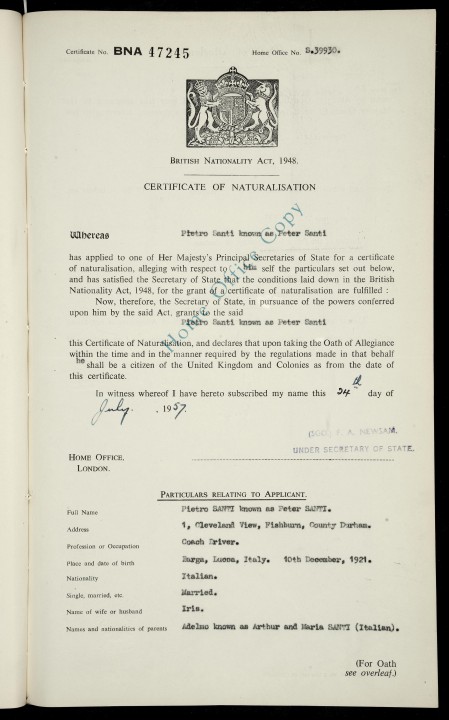
Naturalisation certificate of Peter Santi from July 1957
Issued to all people who are granted British citizenship through naturalisation.
Usually naturalisation certificates contain:
- full name
- residence/address of applicant
- birthplace
- age/date of birth
- parents’ names
- name of spouse (if married)
- occupation
- children with their names and ages (if still of dependent age)
4.2 Indexes to naturalisation certificates
The Home Office indexes to naturalisation certificates cover 1908-1980. From June 1969 the Home Office did not keep a set of duplicate certificates issued in the UK for foreign nationals so the index is the only source of detail until 1980. The indexes contain:
- name
- place of residence
- naturalisation number
- date of issue
4.3 Naturalisation case papers
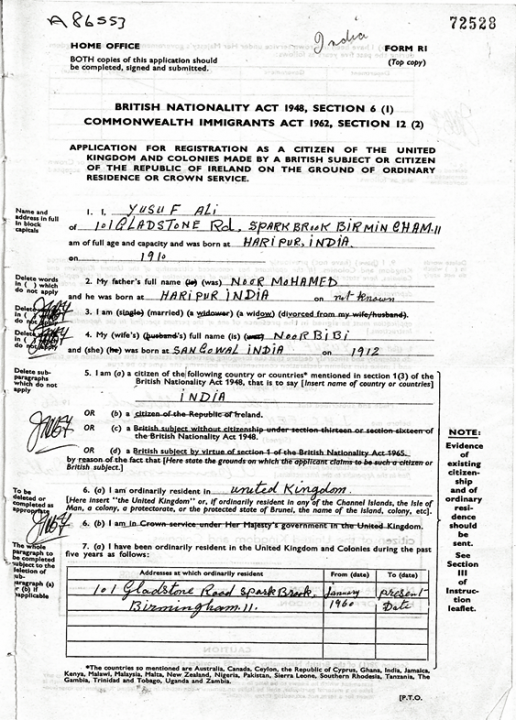
A completed application form for a registration of British nationality from 1966
These are the forms individuals filled out when applying for naturalisation, though they rarely survive if naturalisation was not granted. These papers provide more detailed information on the applicant than the naturalisation certificate itself and may contain all or some of the following information:
- nationality
- profession
- names and ages of spouse and children
- birth date
- birth place
- address of the applicant
- character reference(s)
- police or Mayor’s report (after c.1878)
4.4 Registrations of British nationality
Registrations issued before 1970 tend to be in the form of an application with information similar to naturalisation certificates. From 1970 they tend only to include the full name of the applicant, their date and place of birth.
4.5 Private Acts of Parliament
Before 1844, the only way to become naturalised was by a private Act of Parliament. Applicants were required to take the oaths of supremacy and allegiance, and from 1609 also to provide a certificate confirming they had received Holy Communion according to Anglican rites.
Most acts, usually recorded on parchment rolls, cover multiple individuals and list only names and professions. Acts for a single person can include more detail, such as parents’ names and place of birth. Supporting records may also survive, including petitions, certificates and papers showing the bill’s progress.
4.6 The London Gazette, 1844-1980
Search the Gazette online by name for published announcements of naturalisations.
5. Naturalisation, 1949-1986
This section covers records of foreign nationals becoming British citizens through naturalisation between 1949 and 1986. However, records of British citizenship after 1949 and up to 1981 for people from British colonies and Commonwealth countries, are more likely to be registrations of British nationality – see section 6 for advice on these records.
See section 4 for an explanation of what information the following types of records contain.
5.1 Naturalisation certificates and indexes 1949-1981
Search by certificate number or by name followed by nat* in our catalogue, using the box below, for naturalisation certificates (HO 334) and naturalisation certificate index entries (HO 409). From June 1969 the index is the only source of detail for foreign nationals who naturalised in the UK as the Home Office did not keep a set of duplicate certificates during this period. Sort your search results by date.
5.2 Naturalisation certificates 1981-1986 for people born less than 100 years ago
Apply for duplicate certificates through our Certificates of British citizenship page.
5.3 Naturalisation certificates 1981-1986 for people born over 100 years ago
Search by certificate number or by name followed by nat* in our catalogue, using the box below.
5.4 Naturalisation case papers of foreign nationals who arrived in the UK 1934-1948
These records are of foreign nationals, most of them European, arriving in the UK between 1934 and 1948 and who at some time after their arrival applied for naturalisation. They are held in series HO 405. For details of the kinds of papers they contain see the HO 405 description.
Search our catalogue, using the box below, by last name for these naturalisation case papers.
5.5 Naturalisation certificates issued overseas
Duplicate certificates of naturalisation granted under Section 8 of the British Nationality and Status of Aliens Act, 1914 by the Government of a British Possessions overseas, can be found in HO 334 for 1915 to 1948 and can searched by name on Discovery. These certificates are prefixed by the letter O, indicating “Overseas”. From 1949 until 1980, Certificate “O” denotes an application made by a subject of a foreign state resident overseas. Again, these can be searched by name. A small number of background Home Office papers survive for Overseas Applications for the period 1914 to 1935 in HO 144 and again can be searched by name on Discovery.
6. Registrations of British nationality, 1949-1986
The British Nationality Act 1948 created the new status of citizen of the United Kingdom and the colonies. Under this act, people from former colonies and British Commonwealth countries could register as British citizens.
See section 4 for details of the information that records of registration contain.
6.1 Registrations of British Nationality 1949-1986 for people born less than 100 years ago
Apply for duplicate certificates through our Certificates of British citizenship page.
6.2 Registrations of British Nationality 1949-1986 for people born over 100 years ago
6.3 Registrations of British Nationality made overseas
We do not hold any records of overseas registrations of British Nationality from 1949. There may be a record of the registration held by the British High Commission in the country where registration took place. For contact details of British High Commissions please check the Foreign and Commonwealth Office website. Since most British citizens go on to apply for British passports, details of the certificate may have been submitted with a previous passport application, you may wish to contact HM Passport Office through their website or on 0300 222 0000 to ascertain this.
7. Renunciations of British citizenship
Among the records of citizenship sent to The National Archives from the Home Office are records of people who have renounced their British citizenship.
7.1 Records of the renunciation of British citizenship 1949-1982 for people born less than 100 years ago
Apply for a record of renunciation through our Certificates of British citizenship page.
7.2 Records of the renunciation of British citizenship 1949-1982 for people born over 100 years ago
Search by name followed by the word ‘renunciation’ in our catalogue, using the box below.
8. Naturalisations, 1870-1948
This section covers records of foreign nationals becoming British citizens between 1870 and 1948. The 1870 Nationality Act superseded the 1844 Nationality Act which governed naturalisations up to 1869.
8.1 Naturalisation certificates 1870-1916
Search by name in record series HO 334 on Ancestry.co.uk and download (£) naturalisation certificates and declarations of British nationality for these years.
However, certified copies are available only from The National Archives. If you need a certified copy of a certificate from this period you can request one from our online catalogue. Search for a certificate in records series HO 334 and HO 409 by certificate number or by name followed by nat* using the box below:
8.2 Naturalisation certificates from 1913-1948
Search by certificate number or by name followed by nat* in record series HO 334 and HO 409 using the box below.
8.3 Naturalisation case papers 1872-1934
Search by name followed by nat* in our catalogue, using the box below, for case papers (HO 45, HO 144, HO 382).
8.4 Naturalisation case papers from 1934
Search our catalogue, using the box below, by last name for case papers (HO 405).
The documents are subject to 100 year closure (although access can be requested using our Freedom of Information form) and only about 40% of applications in this series have survived. Files may also contain later correspondence, mostly until the mid-1960s but some as late as 1996.
See section 4 for an explanation of what information naturalisation certificates and case papers contain.
8.5 Private Acts of Parliament
Only around 24 naturalisation Acts were passed from 1845. Naturalisation Acts are private acts catalogued under the reference YHL/PO/PB/1. They were not usually printed so the only text is likely to be the original manuscript on parchment. For more information see our research guide on Original Acts of Parliament and Royal Assent.
To find a naturalisation act, search the catalogue for the name of the individual. Note that ‘naturalisation’ is sometimes spelled as ‘naturalization’. As well as the Act, you may find related material such as bills, petitions and certificates in the House of Lords Main Papers (YHL/PO/JO/10). Be aware that Acts may have naturalised a number of people, while any surviving supporting documents may only be described in relation to the first person mentioned on the Act.
There may also be information in the Journals and Committee Books of the House of Lords showing the progress of the bill. The printed Journals are catalogued under the reference YHL/PO/JO/2 and the Committee Books under YHL/PO/CO/1. Search or browse the catalogue to find the Journal and Committee Book for the year of the naturalisation.
There are some additional records of naturalisations from this period at The National Archives among the following records:
- Parliament Rolls in C 65
9. Naturalisations, 1801-1873
Most foreign settlers in the UK before 1844 did not bother going through the legal formalities of naturalisation and so do not appear in these records. Before 1844 the only way to naturalise was by a private Act of Parliament.
9.1 Naturalisations on close rolls 1844-1873
Naturalisations during this period were recorded, or ‘enrolled’, on documents known as close rolls. The close rolls are in record series C 54.
To work out which pieces in C 54 to look at you will need to first consult the printed index to C 54 which itself forms a separate series, C 275. The index is arranged by year so you will need at least a rough idea of when the naturalisation took place (look at the correspondence and case papers in HO 1 first if you don’t know the year of naturalisation).
To use the index and view the rolls themselves you will need to visit us. On consultation of the appropriate section of the index you may find a name entry for the person who was naturalised, along with a number that will form the key part of your C 54 reference. For more advice speak to staff in the Map and Large Document Reading Room at our building in Kew.
9.2 Naturalisation case papers 1801-1871
Search and download (£) naturalisation case papers (HO 1) for 1801-1871 from our catalogue.
See section 4 for an explanation of what information naturalisation certificates and case papers contain.
9.3 Private Acts of Parliament
Around 378 naturalisation Acts were passed between 1801 and 1844. Naturalisation Acts are private acts catalogued under the reference YHL/PO/PB/1. They were not usually printed so the only text is likely to be the original manuscript on parchment. For more information see our research guide on Original Acts of Parliament and Royal Assent.
To find a naturalisation act, search the catalogue for the name of the individual. Note that ‘naturalisation’ is sometimes spelled as ‘naturalization’. As well as the Act, you may find related material such as bills, petitions and certificates in the House of Lords Main Papers (YHL/PO/JO/10). Be aware that Acts may have naturalised a number of people, while any surviving supporting documents may only be described in relation to the first person mentioned on the Act.
There may also be information in the Journals and Committee Books of the House of Lords showing the progress of the bill. The printed Journals are catalogued under the reference YHL/PO/JO/2 and the Committee Books under YHL/PO/CO/1. Search or browse the catalogue to find the Journal and Committee Book for the year of the naturalisation.
There are some additional records of naturalisations from this period at The National Archives among the following records:
- Parliament Rolls in C 65
10. No evidence of naturalisation
Some people, usually resident in the UK, want to prove that a person never naturalised. The National Archives can help to prove this only by first searching for a naturalisation certificate. If our search is unsuccessful we can provide a ‘letter of no evidence of naturalisation’. Do this by completing a request confirmation of no evidence of British naturalisation form.
11. Naturalisations before the 19th century
The only way to naturalise before the 19th century was by a private Act of Parliament, though there were occasionally public acts passed to enable the naturalisation of specific groups of people at specific times, as was the case for foreign protestants living in America in the mid-18th century (see below).
11.1 Private Acts of Parliament
Around 911 naturalisation Acts were passed between 1544 and 1800. Naturalisation Acts are private acts catalogued under the reference YHL/PO/PB/1. They were not usually printed so the only text is likely to be the original manuscript on parchment. For more information see our research guide on Original Acts of Parliament and Royal Assent.
To find a naturalisation act, search the catalogue for the name of the individual. Note that ‘naturalisation’ is sometimes spelled as ‘naturalization’. As well as the Act, you may find related material such as bills, petitions and certificates in the House of Lords Main Papers (YHL/PO/JO/10). Be aware that Acts may have naturalised a number of people, while any surviving supporting documents may only be described in relation to the first person mentioned on the Act.
There may also be information in the Journals and Committee Books of the House of Lords showing the progress of the bill. The printed Journals are catalogued under the reference YHL/PO/JO/2 and the Committee Books under YHL/PO/CO/1. Search or browse the catalogue to find the Journal and Committee Book for the year of the naturalisation.
There are some additional records of naturalisations before the 19th century at The National Archives among the following records:
- Parliament Rolls in C 65
11.2 Oaths of allegiance
After a naturalisation by Act of Parliament the successful applicant would take the Oath of Allegiance and Supremacy in a court of law, swearing their loyalty to the Crown. There are separate sets of records for these oaths and where to locate them depends on the court where the oath was taken. Quarter Sessions Courts and the Court of Kings Bench were among those courts where the oath was taken:
- Oath Rolls in KB 24
- An oath roll for naturalisation of protestant refugees 1709-1711 in E 169/86
- Quarter Sessions court record, held at local archives
11.3 Foreign protestants living in America 1740-1772
Between 1740 and 1772, foreign protestants living in America could become naturalised British citizens after seven years’ residence. Over 7,000 foreign protestants took advantage of this.
Every year lists of those naturalised were sent to the Commission for Trade and Plantations in London, where they were copied into entry books.
A list of the names in these records is in the published Naturalizations of Foreign Protestants in the American and West Indian Colonies, also available in our library.
11.4 Indexes
The Huguenot Society have published indexes to the records of naturalisations and denizations up to 1900. Some of these indexes are available online on the Internet Archive:
- Letters of Denization and Acts of Naturalization 1509-1603
- Letters of Denization and Acts of Naturalization 1603-1700
- Letters of Denization and Acts of Naturalization 1701-1800
Some of the indexes are also available in our library:
- Letters of Denization and Acts of Naturalization for Aliens in England and Ireland 1603-1700
- Letters of Denization and Acts of Naturalization for Aliens in England and Ireland 1701-1800
Versions of these indexes are held with the printed version of our catalogue at our building in Kew.
12. Denization records, c.1200-1873
12.1 What was denization?
Denization was a legal process granting limited naturalisation to aliens. It granted a foreign national almost equivalent status of native-born Britons and provided them the protection of the law.
However, those granted denization were still subject to alien rates of tax, unable to vote, hold civil or military office or inherit land.
Denization was granted by letters patent and this required a payment, so, as with naturalisation in this period, denization remained the preserve of the wealthy.
12.2 The records
Click on the references below to search by name of applicant for denizations made by letters patent in:
Use the Huguenot Society Indexes and Calendars of Patents Rolls at The National Archives in Kew, looking under words such as ‘denizations’ or ‘indigenae‘, to search for denizations made by letters patent in:
13. Records in other archives
13.1 Huguenot Society records
Consult the Huguenot Society website, which includes information about their archives and details of publications to help you trace individual immigrants (not just Huguenots), including indexes of naturalisations by private Act of Parliament up to 1800.
13.2 Parliamentary papers
Search Proquest UK Parliamentary Papers for indexes of all naturalisations from 1844 to 1961. This is a subscription website you can access on The National Archives computers by visiting us at Kew. You may also be able to access it via a large reference library such as a university library.
13.3 Westminster denization roll
This is held at Westminster Abbey Muniments and Library.
14. Appendix: prefixes to naturalisation certificate and registration numbers
If you know the naturalisation certificate number then you can use the following tables to determine details about the status of the person who applied for naturalisation. The table may also help you work out what you should do to search for a duplicate copy of the certificate.
14.1 Naturalisation certificates issued under the terms of the Naturalisation Act, 1870 and the British Nationality and Status of Aliens Act, 1914
Those issued under both the Naturalisation Act, 1870, and the British Nationality and Status of Aliens Act, 1914, are searchable by name in Discovery, our catalogue.
| Naturalisation Act, 1870 | |
|---|---|
| A | Certificate (ordinary) to a person with five years residence in the United Kingdom during the eight years immediately preceding application for Naturalisation |
| AA | Certificate to person with five years service under the Crown during the eight years immediately preceding application for Naturalisation |
| AAA | Certificate to person in the Diplomatic or Consular Service with five years service under the Crown during the eight years immediately preceding application for Naturalisation |
| B | Certificate to person who has already been granted a Certificate of Naturalisation under the Act of 1844 |
| C | Certificate to a person of Doubtful Nationality with five years residence in the United Kingdom, or five years service under the Crown, during the eight years immediately preceding application for re-admission |
| D | Certificate of re-admission of person to British Nationality with five years residence in the United Kingdom, or five years service under the Crown, during the last eight years immediately preceding application for re-admission |
| E | Declaration made by a person, a subject of a foreign state subsequently naturalised as a British subject, renouncing British nationality |
| F | Declaration by a person, an alien by origin but born within HM dominions, renouncing British nationality |
| G | Declaration by a person, born out of HM dominions of a father being a British subject, renouncing British nationality |
| H | Declaration by a natural-born British subject, renouncing subsequent Naturalisation in a foreign state |
| British Nationality and Status of Aliens Act, 1914 | |
|---|---|
| A and AZ | Certificate (ordinary) granted under Section 2 of the Act, where the names of children are not included |
| B and BZ | Similar to Certificate A, but including the names of children |
| C and CZ | Certificate granted under sub-section (2) of Section 5 of the Act to a minor |
| D | Special certificate granted under Section 4 of the Act to a person with respect to whose nationality a doubt exists, where the names of children are not included |
| DZ | Certificate of Naturalisation granted to a woman who was at birth a British subject and is married to a subject of a state of war with His Majesty |
| E | Similar to Certificate D, but including the names of children |
| EZ | Similar to Certificate DZ, but including the names of children |
| F | Certificate granted under Section 6 of the Act to a person naturalised before the passing of the Act, where the names of children are not included |
| FZ | Certificate of Naturalisation granted to a French national where the names of children are not included |
| G | Similar to Certificate F, but including the names of children |
| GZ | Similar to Certificate FZ, but including the names of children |
| M | Special Certificate granted under Section 4 of the Act to a person with respect to whose nationality a doubt exists |
| O | Certificate granted under Section 8 of the Act by the Government of a British Possessions overseas |
14.2 Naturalisation certificates and registrations issued under the terms of the British Nationality Act, 1948
| British Nationality Act, 1948 | |
|---|---|
| BNA | Application made by a subject of a foreign state resident in the UK – search by name on Discovery, our catalogue for the dates 1949-1971 |
| M | s7 & 18 1948 Act: application for registration of a minor child – submit a search request using our contact form for the dates 1949-1972 |
| O | Application made by a subject of a foreign state resident overseas – search by name on Discovery, our catalogue for dates 1949-1980 |
| R1 | s6(1) 1948 Act: application made by an adult British subject or citizen of the Republic of Ireland, or any of the Channel Islands, Isle of Man, a colony, a protectorate or a protected state to which s8(1) of the Act applied, or a UK Trust Territory, or on the grounds of Crown Service under HM Government in the UK – submit a search request using our contact form for the dates 1949-1972 |
| R2 | s6 (2) 1948 Act: application made by a woman who has been married to a citizen of the UK and colonies – submit a search request using our contact form for the dates 1949-1972 |
| R3 | s6 (2) 1948 Act: application made by a foreign woman who has been married to a citizen of the UK and colonies – submit a search request using our contact form for the dates 1949-1972 |
| R4 | s12 (6) 1948 Act: application made by a person who but for his citizenship or potential citizenship of one of the countries mentioned in s1 (3) of the Act would have become a citizen of the UK and colonies under s12 (4) of the Act – submit a search request using our contact form for the dates 1949-1951 |
| R5 | s16 1948 Act: application to resume British nationality by a person who has ceased to be a British subject on the loss of British nationality by his father or mother in accordance with s12 (1) of the 1914 Act – submit a search request using our contact form for the dates 1949-1959 |
| R6 | s19 1948 Act: declaration of renunciation of citizenship made by a citizen of the UK and colonies who is also a citizen of one of the countries mentioned in s13 of the Act or of the Republic of Ireland or a national of a foreign country – submit a search request using our contact form for the dates 1949-1982 |
14.3 The Immigration Act 1971
For 300,000 to 999,999: Application for naturalisation – submit a search request using our contact form for dates 1973-1982.
14.4 The British Nationality Act 1981
1,000,000 plus: Application for naturalisation – submit a search request using our contact form for dates 1983-1986.
15. Further reading
Some or all of the publications below may be available to buy from The National Archives’ bookshop. Alternatively, search The National Archives’ library catalogue to see what is available to consult at our site in Kew.
Roger Kershaw, Migration Records: A Guide for Family Historians (The National Archives, 2009)
Roger Kershaw and Mark Pearsall, Immigrants and Aliens: A Guide to Sources on UK Immigration and Citizenship (The National Archives, 2004)
The National Archives holds most surviving English and many surviving Irish records of Excise officers. These officers collected taxes levied on home products such as alcoholic drinks, and as a result were sometimes very unpopular.
In 1849 the Board of Excise was amalgamated with the Board of Stamps and Taxes to form the Board of Inland Revenue, and in 1909 the excise responsibilities of the Inland Revenue were transferred to the newly established Board of Customs and Excise.
We do not hold personnel files for the Inland Revenue, but details of Inland Revenue staff can be found in other records. Records of both services are held in several different series, mainly within the CUST and IR departments.
There is no single index of people or places that can be used to find service records, so your search for information may require some patience.
What do I need to know before I start?
Try to find out:
- in which county the person was posted
- the dates of their service
Online records
Parliamentary papers (late 18th century–20th century)
Consult ProQuest UK Parliamentary Papers for published reports of Excise activities. This is a subscription service available to access at The National Archives. You may also be able to access it via a large reference library, such as a university library.
Irish Revenue Police (1830–1857)
Search Irish Revenue Police records 1830-1957 (CUST 111) by name at findmypast.co.uk (£). For more information on these records read the guidance on findmypast.co.uk and the catalogue description for CUST 111.
Records available only at The National Archives in Kew
To access these records you will either need to visit us, pay for research (£) or, where you can identify a specific record reference, order a copy (£).
Entry papers of Excise officers (1820–1870)
Search entry papers of Excise officers by name (CUST 116). Narrow your search by using quotation marks to find a person’s full name, such as “John Williams”.
Excise Board minute books (1696–1874)
The series CUST 47 are the minute books which contain information on the first and later postings of excise officers, with any praise or censure.
These original records are internally indexed and you can view the indexes to names online. For example if you wish to consult the original record CUST 47/345 covering September to October 1785, you can download and view the index to it in CUST 47/345/1.
Alternatively, identify the index you want by year using the search results of indexes to names then consult the corresponding original file.
Pension records and staff lists of Excise and Inland Revenue officers (1642–1970)
Browse CUST 39 in our catalogue for pension records and staff lists of Excise and Inland Revenue officers. These records have not been indexed, so you will need to search records for the relevant years. Most of the Inland Revenue staff files are in CUST 39/235–248. There is also a staff list for 1692 in CUST 109/9.
Excise pay lists for England (1705–1835) and Scotland (1708–1832)
Browse the English Excise pay lists in T 44 and the Scottish Excise pay lists in T 45.
Irish Excise records (1824–1844)
Browse CUST 110 for records of appointments (1824–1833) and the Ireland collection in CUST 119 for records of employment, recruitment and dismissal (1824–1844). These include records of English officers in Ireland as well as Irish officers.
Inland Revenue establishment lists (1869–1920)
Browse IR 147 in our catalogue for details of Inland Revenue officials. It covers staff in England, Wales, Scotland and Ireland. Details include dates of appointment and promotion, salary, place of employment and, in some cases, date of birth.
Records in other archives and organisations
Scottish records
Contact the National Records of Scotland for records of Excise officers in Scotland.
Irish records
Contact the National Archives of Ireland and the Public Record Office of Northern Ireland for some surviving Irish records of Excise officers.
Cornish records
Contact the Courtney Library at the Royal Institution of Cornwall and the Cornwall Record Office, for records about Excise men in Cornwall.
Other resources
Books
Consult Ham’s Year Book, ‘Ham’s Customs Year Book’ and ‘Ham’s Inland Revenue Year Book’, available in major research libraries. These are indexed directories of Customs officers, Excise men and Inland Revenue officials covering 1875 to 1930.
What are these records?
These records are country court death duty registers between 1796 and 1811. They form part of series IR 26 and contain over 66,000 personal names.
A ‘country court’ was any church court apart from the Prerogative Court of Canterbury (PCC). We have digitised the country court registers, not the PCC registers.
In the period 1796-1811 only personal estates valued at £20 or more were liable to death duty – leases, freeholds and real estate were not liable and so will not appear in the registers.
How do I search the records?
You can search (£) the records between 1796 and 1811 in Discovery, our catalogue, by filling in the form below.
You don’t need to complete every field to find a record. Please note the date of probate might be as much as three or more years after the date of death.
Your results will show all instances of the term(s) you searched for within the record descriptions, as this is currently a keyword search.
What information do the records contain?
Details included in these records include:
- date and place of death of the person who died (testator or testatrix)
- value of the personal estate of the deceased
- name and place of abode of the executor or executrix
- names of the inheritors and their relationship to the deceased (the legatees and residuary legatee)
- any special arrangements
- the amount of tax that was paid
Further comments could be added to the registers for up to 50 years after the first entry and so they can include additional information such as:
- date of death of spouse
- dates of death or marriage of beneficiaries
- births of posthumous children and grandchildren
- change of address
- references to law suits
- cross-references to other entries
There are a few things to bear in mind when using death duties as a means of valuing an estate:
- the digitised collection dates from the period when death duties related to personal estate only and excluded freehold property
- the death duties do not deduct debts and expenses
- the register may not be an accurate reflection of personal estate; the valuation figure only provides a record of the bequests described in the will
- the value may not even be accurate
- valuations were expressed in the form of a ‘tax band’, which changed periodically under legislation
What do the records look like?
You might see abbreviations in the registers, some of which have an obvious meaning, such as ‘est’ for ‘estate’. For information on how to interpret the abbreviations, please consult our research guide on Death duties 1796 – 1903.
Why can’t I find what I’m looking for?
The digitised collection does not include Prerogative Court of Canterbury (PCC) death duty registers.
The whole collection of death duty registers in series IR 26 goes up to the year 1903. The registers for the period 1812-1903 have not been digitised, but you can find out how to access them using our guide on death duties 1796-1903.
Other reasons for unsuccessful searches may include:
- the estate was not liable to death duty
- the assets were valued at less than £1,500 (in these cases taxes were often not collected and the register entry was often not filled in with all the details)
- alternative spellings of personal names and place names were used (English spelling had not yet been standardised in this period)
This guide provides an overview of records held at The National Archives relating to other countries and territories, besides those that make up the United Kingdom. The advice here will help you to get your research started. Links to our more specialist guides will help you to take your next steps.
This is not a genealogical records guide and, in general, it will not be useful for tracing ancestors – see our family history category for guidance on this.
For guidance on our military records of international alliances and adversaries you should start with our overview guide to military and maritime records.
What kinds of records do we hold?
As with all records held at The National Archives, those that relate to other countries are historical records created in the everyday business of central government departments or, otherwise, inherited by those departments from elsewhere. Though almost any government department could have created or inherited records relating to one country or another, there are some departments whose core purpose was to manage relationships with, and British interests in, states and territories outside of Britain or, prior to the formation of Britain, England. During the colonial period, some of these departments managed the actual affairs of the territories themselves. The records of these departments, listed below, are usually the best place to start when looking for historical information on other countries in our collections.
Records are not transferred to The National Archives until they are at least 20 years old.
Records of the Foreign Office, 1782-1968
A predecessor of the Foreign and Commonwealth Office, the Foreign Office, created in 1782, was the government department responsible for the conduct of British relations with nearly all foreign states. Records include correspondence between British embassies and consulates around the world with the central office in London. It is one of the largest collections held at The National Archives.
Records of the Foreign and Commonwealth Office, 1968 onwards
Established in 1968 and the direct predecessor of today’s FCDO, the Foreign and Commonwealth Office continued the responsibilities of the Foreign Office but also administered the remaining British dependencies and managed relations with the Commonwealth (previously the responsibility of the Commonwealth Office).
Records of the Colonial Office, 1570-1990
The government department responsible for administering most British colonies as well as ‘protectorates’, in which the British nominally administered on behalf of a local political authority. In some places, British rule, following the First World War, was ‘mandated’, where the authority to govern was issued by the League of Nations. Whatever the status, the government department responsible for British rule overseas was usually the Colonial Office.
Although not established until 1854, our Colonial Office collection includes records of its predecessors from the 16th century onwards. Most of the records die out following the date that each colony gained independence. Though the Colonial Office itself ceased to exist in 1966, some of the records in this collection, notably Government Gazettes, date from as late as 1990. Not included among these records are the records of the colonial governments themselves – these are usually retained by the country at independence.
Records of the Dominions Office, 1843-1990
Established in 1925 and responsible for semi-autonomous territories known as British dominions, which were Canada, Australia, New Zealand, Newfoundland and South Africa and some anomalous territories, such as the ‘High Commission territories’ of Botswana, Lesotho and Swaziland. Includes Sessional Papers, Government Gazettes, Acts, records from various High Commissioners and other document types. The Dominions Office inherited many records of these same places dating prior to 1925.
Records of the State Papers Office, 1509-1782
The predecessor of the Foreign Office and the Home Office. Its records relating to other countries are referred to as State Papers Foreign and to British/English colonies as State Papers Colonial.
Cabinet Papers, 1915 onwards
Records of the Cabinet Office, often collectively referred to simply as Cabinet Papers, cover every major area of government policy and strategy, whether domestic or international. Inevitably, therefore, the Cabinet Office generates significant amounts of written material on Britain’s relationship with other countries as well as its former colonies.
Maps, plans and international boundaries
The National Archives holds tens of thousands of maps of towns, cities, regions and countries around the world. We also hold old plans of buildings, fortifications, harbours, and countless other installations, from all over the globe, many in ex-English and British colonies but others from elsewhere. Many of these maps and plans are held among the records of the offices described above.
Some maps were created to record international boundaries and borders, in many cases supported by other records including treaties, diplomatic despatches and survey data, some dating back centuries, others from recent decades.
Photographs
There are large numbers of photographs held at The National Archives that were taken or collected by British diplomats and other government officials stationed overseas. Most are held among the records of the government departments described above but there are also a great many photographs taken on foreign soil among the records of the various branches of the military.
Where and how to search for records
Searching for records of other countries at The National Archives either begins with keyword searches in our catalogue or with online or sometimes printed indexes, registers or calendars, some available only at our reading rooms in Kew.
Identifying the right department
Records are organised into collections known as departments, each with its own letter reference and usually corresponding to the government department which created them. For example, all Foreign Office records are identified with the department reference FO. Which record departments you search within will, in general, depend upon the relationship that the present-day country had with Britain or England at the time you are interested in – whether all or part of it was a colony, protectorate or dominion or whether it was a foreign power or a colony of a foreign power. There are, however, exceptions to these general rules.
Use the table below to determine which collections of records to go to depending on the nature of the relationship the country or territory had with Britain (or England) at the time that you are interested in. If you are unsure of the relationship, consult the table of present-day countries in the final section of this guide which will also provide you with some search tips, including alternative names and terms which you can search with
Using our catalogue
The easiest way to get started, though not always the most effective, is to try a search of our online catalogue. When using our catalogue to search, you can focus on one or more departments using the advanced search and specify one or more department references. The records of each department are divided up into series, in some cases hundreds of series. You can narrow your search even further by targeting specific series using the table of present-day countries in this guide. More comprehensive lists of series for each country are published in the books Foreign Office Records 1782 to 1986 and Administering the Empire, 1801-1968, available at our library and the latter of the two available to download for free from the University of London Press website.
Using indexes, registers and calendars
In many instances, keyword searches in our catalogue will not get you very far. You will probably need to use additional indexes, registers or calendars to complete or even start your search. Some of these are available online, others are only available at our building in Kew. Whether you need to use them and how you use them is explained in the respective guides listed in the table below.
Finding maps, plans and photographs
You can use our catalogue to search for maps, plans and photographs. See our guides to overseas maps and plans, international boundaries and photographs for detailed advice.
Key to departments and guides
| If you are interested in a country or territory if and when it was… | The best place to start a search for records is in… |
|---|---|
| A British colony except those governed by the India Office (see below for India Office) | Colonial Office collections Department reference: CO For details, consult our guide to Colonies and dependencies from 1782 |
| A British colony or territory governed by the India Office, including present-day India, Pakistan, Bangladesh and Sri Lanka | India Office collections Go to the British Library |
| A British dominion, including South Africa, Canada, Australia and New Zealand | Dominions Office collections Department reference: DO For details, consult our guide to Colonies and dependencies from 1782 |
| A British protectorate or mandated territory, such as Palestine, Mesopotamia (now Iraq) or TransJordan (now Jordan) | Colonial Office collections Department reference: CO For details, consult our guide to Colonies and dependencies from 1782 |
| A colony administered by another country, such as Algeria, a French colony from 1830-1962 | The Foreign Office or Foreign and Commonwealth Office collections relating to the colonial power Department references: FO or FCO Consult our guide to Foreign Office and Foreign and Commonwealth Office records from 1782 |
| An independent country at any point before 1782 | State Papers Department reference: SP Consult our guide to State Papers Foreign |
| An independent country at any point from 1782 until 1968 | Foreign Office collections Department reference: FO Consult our guide to Foreign Office and Foreign and Commonwealth Office records from 1782 |
| An independent country at any point from 1968 until around 20 years ago | Foreign and Commonwealth Office collections Department reference: FCO Consult our guide to Foreign Office and Foreign and Commonwealth Office records from 1782 |
Each record, whether a file of correspondence, a report, map or set of photographs has a document reference (also referred to as a catalogue reference). A successful catalogue search will provide you with one or more document references. A document reference usually has three parts (though four or more are possible): one for the department, one for the series and one for the piece. For example, FO 177/503 is the document reference for the annual report on Peru in 1938 from the British Embassy there. FO is the department, 177 is the series and 503 is the piece.
How to view records
Once you have document references you can request the records themselves via the catalogue. Most of these records have no online version and to see them you will need to consult them at our building in Kew or pay for copies to be made and emailed to you, in both instances using your document references to place your request.
The guides listed in the table above indicate where online versions of records do exist. The online copies are accessed either directly from our website or from the websites of our licensed partners, primarily AM Digital and Gale, both of which require institutional subscriptions. There is free access to them at our building in Kew and at some reference and university libraries.
List of present-day countries
Use the list of countries in the table below to get a search started quickly. The table includes some key record series either specific to each country or to the part of the world in which it is located (the Foreign and Commonwealth Office, in particular, organized files into regions as well as countries). For a full list of record series for each country consult the following books, available at our library in Kew: Foreign Office Records 1782 to 1986 and Administering the Empire, 1801-1968 (download for free from the University of London Press website).
The table also provides you with additional terms that you can use (besides the name of the country itself) when searching our catalogue or the registers and calendars you may also need to use (see section above on ‘Where and how to search for records’ for more on this). The ‘Notes’ column will help you understand where and why records were dealt with by one government department or another and how and why the department filed those records.
Usually essential to any search for records dated between 1906 and 1966, but not included in the table, is series FO 371. This is the single largest series of records on other countries at The National Archives and contains correspondence between the Foreign Office’s Political Departments and its representatives all over the world as well as foreign diplomats, politicians and even heads of state. See our guides to Foreign Office correspondence 1906-1919 and 1920 onwards for advice on how to search in FO 371.
Click on a record series link in the table to search that series in our catalogue using keywords. In some cases you will need to browse the series as the descriptions for each record are generic and therefore not searchable with meaningful terms.
A B C D E F G H I J K L M N O P Q R S T U V W X Y Z
|
Country |
Additional names/terms to use when searching |
Some key record series* |
Notes for understanding the provenance of the records |
| Afghanistan | Central Asia | FO 402 FO 983 FCO 37 |
See also the India Office records at British Library |
| Albania | Ottoman Empire | FCO 28 FO 78 |
Part of Ottoman Empire from 1431 |
| Algeria | Algiers Barbary States |
SP 71 FO 3 FO 111 |
French colony, 1830-1962 |
| Andorra | France Spain |
FCO 9 | Under the joint protection of France and Spain until 1994 |
| Angola | Portugal | SP 89 FO 63 FCO 45 |
Portuguese colony, 1655-1975 |
| Antigua and Barbuda | Leeward Islands West Indian Department |
CO 152 CO 156 FCO 44 |
Antigua a British Colony from 1632 Barbuda a British colony from 1661 Joint colony, as Leeward Islands, 1871-1956 |
| Argentina | Buenos Aires and the Argentine Republic | FO 6 FO 118 FO 446 |
Spanish colony, 16th c.-1816 |
| Armenia | Ottoman Empire Soviet Union |
FO 78 FO 406 FO 195 |
Part of Ottoman Empire Part of the Soviet Union, 1922-1991 |
| Australia | New South Wales Queensland South Australia Tasmania Victoria Western Australian |
CO 201 DO 126 FCO 107 |
New South Wales, Queensland, South Australia, Tasmania, Victoria and Western Australian were governed as separate colonies until 1901 |
| Austria | Austro-Hungarian Empire | FO 7 FO 120 FCO 33 |
Part of Holy Roman Empire from medieval period until 1806 |
| Azerbaijan | Russia and Soviet Union | FO 65 | Part of Russian Empire, 1828-1918 Part of Soviet Union, 1920-1991 |
| Bahamas | West Indian Department | CO 23 CO 564 FCO 44 |
British colony, 1717-1782 & 1783-1973 |
| Bahrain | Persian Gulf Arabian Department |
FCO 8 | British protectorate, 1861-1971 See also the India Office records at British Library |
| Bangladesh | East Bengal East Pakistan |
FCO 37 | Part of the British Indian Empire, 1858-1947 Part of Pakistan, 1947-1971 See the India Office records at British Library |
| Barbados | Windward Islands West Indian Department Caribbean Department |
CO 28 CO 32 FCO 44 |
British colony, 1652-1961 |
| Belarus | Russia and Soviet Union | FO 65 | Part of Russian Empire, 1796-1918 Belorussian territories part of Soviet Union, 1920-1991 |
| Belgium | Flanders Kingdom of the Netherlands |
FO 10 FO 123 |
Part of Kingdom of the Netherlands 1815-1830 Independent from 1830 |
| Belize | British Honduras | CO 123 CO 1031 FCO 99 |
British colony, 1862-1964 Renamed Belize in 1973 Independent from 1981 |
| Benin | Dahomey | FO 2 FCO 65 |
Formerly the kingdom of Dahomey French protectorate and territory, 1892-1960 |
| Bhutan | South Asia | FCO 37 | For pre-1949 records see the India Office records at British Library |
| Bolivia | Alto Peru Upper Peru Charcas |
FO 11 | Spanish colony, 1530s-1825 |
| Bosnia and Herzegovina | Ottoman Empire | FO 78 FO 7 FO 536 |
Part of Ottoman Empire from 1463 Part of Austria-Hungary, 1908-1918 Part of Yugoslavia, 1929-1991 |
| Botswana | Bechuanaland | CO 567 DO 145 |
British protectorate, 1885-1966 |
| Brazil | Portugal | SP 89 FO 63 FO 13 FO 128 |
Portuguese colony, 1534-1825 |
| Brunei | Far East and Pacific | CO 943 CO 985 FCO 24 |
British protectorate, 1888-1984 |
| Bulgaria | Ottoman Empire | FO 78 FO 421 FO 469 |
Part of Ottoman Empire, 14th-19th centuries |
| Burkina Faso | Upper Volta Upper Senegal-Niger West African Department |
FO 403 FCO 65 |
Part of French Empire, 1898-1960 |
| Burundi | Ruanda-Urundi East Africa Department |
FO 2 FCO 31 |
Part of German East Africa, 1890-1918 Belgian colony, 1924-1962 |
| Cabo Verde | Cape Verde | SP 89 FO 63 FCO 65 |
Portuguese colony, 15th c.-1975 |
| Cambodia | French Indo-China French Indochina Khmer Republic |
FO 422 FCO 15 FO 1119 |
Part of French Indochina, 1867-1953 |
| Cameroon | German Cameroons British Cameroons French Cameroons |
FO 2 CO 649 |
German colony, 1888-1916 Divided into French and British mandated territories, 1919-1960 |
| Canada | Names of separate Canadian territories and provinces Upper Canada Lower Canada Canada East |
CO 42 CO 45 DO 127 |
Part of British Empire, 1763-1867 Canadian provinces governed as separate colonies until the 1860s and 1870s British dominion, from 1867 |
| Central African Republic | Central African Empire French Equatorial Africa |
FO 2 | Part of French Equatorial Africa, 1910-1958 |
| Chad | French Congo French West Africa French Equatorial Africa |
FO 2 FCO 65 |
French colony from 1920 Independent from 1960 |
| Chile | Chili Peru |
SP 94 FO 16 FO 132 |
Spanish colony, c1540-1810 Part of Viceroyalty of Peru during colonial period |
| China | Far Eastern Department | FO 17 FO 405 FCO 21 |
Hong Kong ceded to Britain in 1842 and returned to China in 1997 Macau settled by Portuguese 1537; returned to China in 1999 |
| Colombia | Columbia New Granada |
SP 94 FO 55 FO 135 |
Spanish colony, 1536-1819 From 1819-1863 part of Republic of Greater Colombia, then Republic of New Granada, then Granadine Confederation and then United States of New Granada |
| Comoros | Comoro Islands Comores |
FO 48 FCO 31 |
French colony and later overseas territory, 1841-1975 (governed from Madagascar during some of that period) |
| Congo | Congo Brazzaville French Congo |
FO 2 FCO 65 |
Part of French Congo Part of French Equatorial Africa |
| Costa Rica | Spain | SP 94 FO 72 FO 21 |
Spanish colony c1524-1821 Part of Confederation of Central America, 1823-1838 |
| Croatia | Holy Roman Empire Austro-Hungarian Empire |
SP 80 FO 7 FO 421 |
Part of Austro-Hungarian Empire, 1526-1918 Part of Yugoslavia, 1929-1991 |
| Cuba | Spain | SP 94 FO 72 FO 420 |
Spanish colony, 1511-1899 |
| Cyprus | Ottoman Empire | SP 97 FO 78 CO 67 |
Part of Ottoman Empire from 1571 British colony, 1878-1960 |
| Czechia | Czech Republic Czechoslovakia |
SP 80 FO 7 FO 817 |
Part of Austro-Hungarian Empire, 1526-1918 |
| Back to top of table | |||
| Democratic Republic of the Congo | Congo Free State Belgian Congo Congo (Leopoldville) Congo (Kinshasa) Zaire |
FO 2 FO 10 FCO 31 |
Belgian colony, 1885-1960 |
| Denmark | Western European Department | SP 75 FO 22 FCO 33 |
— |
| Djibouti | French Somaliland French Territory of the Afars and Issas |
FO 2 FO 27 FCO 31 |
French territory, 1883-1977 |
| Dominica | Leeward Islands Windward Islands West Indian Department |
CO 71 CO 76 CO 152 |
French colony, 1632-1763 & 1778-1783 British colony, 1763-1778 & 1783-1978 Part of Leeward Islands colony, 1871-1939 Part of Windward Islands colony, 1940-1958 |
| Dominican Republic | Hispaniola Santo Domingo |
FO 23 FCO 7 |
Spanish colony, 1496-1797 & 1809-1821 French colony, 1797-1809 |
| Back to top of table | |||
| Ecuador | Viceroyalty of Peru Viceroyalty of New Granada |
FO 72 FO 25 FO 420 |
Spanish colony, c1544-1822 Part of Republic of Greater Colombia, 1822-1830 |
| Egypt | Ottoman Empire United Arab Republic |
SP 97 FO 78 FCO 93 |
Part of Ottoman Empire, 1517-1914 British protectorate, 1914-1922 Part of United Arab Republic, 1958-1971 |
| El Salvador | Salvador | FO 15 FO 66 |
Spanish colony, 1526-1821 Part of Confederation of central America, 1823-1839 |
| Equatorial Guinea | Spanish Guinea Fernando Po |
CO 82 CO 267 FCO 65 |
Portuguese colony, 1472-1178 Spanish colony, 1778-1968 Base for British naval anti-slave trade patrols, 1827-1843 |
| Eritrea | Abyssinia | FO 1 FO 45 FO 401 |
Italian colony, 1890-1941 Part of Ethiopia, 1962-1993 |
| Estonia | Russia and Soviet Union | SP 95 FO 65 FO 418 |
Part of Swedish Empire, 1561-1710 Part of Russian Empire, 1796-1917 Part of Soviet Union, 1944-1991 |
| Eswatini | Swaziland | CO 608 DO 93 FCO 45 |
South African protectorate, 1894-1903 A British High Commission Territory, 1907-1968 |
| Ethiopia | Abyssinia | FO 1 FO 401 FO 1043 |
Italian protectorate, 1889-1896 |
| Back to top of table | |||
| Fiji | Pacific Islands | FO 58 CO 83 CO 86 |
British colony, 1874-1970 |
| Finland | Sweden Russian Empire |
SP 95 FO 65 FO 511 |
Part of Swedish Empire, 1157-1809 Part of Russian Empire, 1809-1917 |
| France | Western Europe | SP 78 FO 425 FO 146 |
— |
| Back to top of table | |||
| Gabon | French Congo French Equatorial Africa | FO 2 FO 27 FCO 25 |
French colony from 1839-1960 |
| Gambia | The Gambia | CO 88 FCO 65 CO 460 |
British colony, 1651-1661 British settlement occupied by the African Company, 1661-1821 Sierra Leone administration, 1821-1888 British protectorate 1894-1965 |
| Georgia | The Russian Empire USSR | FO 65 FO 406 FCO 28 |
Part of the Russian Empire between 1801-1804 Democratic republic of Georgia 1917-1921 Transcaucasian Socialist Federative Soviet Republic 1922-1936 Georgian Soviet Socialist Republic (USSR), 1936-1991 |
| Germany | Prussia German Confederation German Empire |
CO 122 FO 64 FO 244 |
A set of separate states until 1871 Heligoland, now part of Germany, was a British protectorate, 1814-1890 |
| Ghana | The Gold Coast | CO 99 CO 100 FCO 65 |
Settlements under control of English, Danes, Dutch, Germans and Portuguese, 1600 British settlement occupied by the African Company, 1664-1821 Sierra Leone administration, 1821-1866 British colony, 1821-1957 |
| Greece | The Ionian Islands | CO 136 FO 42 FO 32 |
The Ionian Islands, now part of Greece were a British protectorate from 1814-1864 |
| Grenada | Windward Islands West Indian Department |
CO 105 CO 106 FCO 63 |
British colony from, 1609-1650 & 1762- 1779 & 1784-1974 French colony,1650-1762 & 1779-1783 |
| Guatemala | Mexican Empire Confederation of Central America | FO 15 FO 420 FO 254 |
Spanish colony 1519-1821 |
| Guinea | French Guinea French West Africa Rivieres du Sud |
FO 2 FO 27 FO 403 |
Part of French West Africa Independent from 1958 |
| Guinea-Bissau | Portuguese Guinea | FO 2 FO 63 FCO 65 |
Portuguese trading posts established in 17th century Independent from 1974 |
| Guyana | British Guiana West Indian Department |
CO 115 CO 116 FCO 63 |
Settlement occupied by the Dutch West India Company, 1621-1796 Dutch colony, 1802-1803 & 1802-1803 British colony, 1831-1970 |
| Haiti | Saint Domingue Hispaniola |
FO 35 FO 420 FO 866 |
Spain establishes settlements on Hispaniola in 1496 In 1697 Spain cedes western part of Hispaniola (now Haiti) to France A slave revolt leads to independence in 1804 |
| Holy See | Papal States See of Rome Vatican City/The Vatican |
SP 85 FO 43 FO 503 |
Jurisdiction of the Pope; capital is Vatican City |
| Honduras | Federation of Central America | FO 15 FO 39 FO 252 |
Spanish colony, 1524-1821 Independent from 1821 Formed part of the Federation of Central America 1842-1845 |
| Hungary | Ottoman Empire Austro-Hungarian Empire |
SP 80 FO 7 FO 404 |
Part of Ottoman Empire, 1526-1689 Part of Austrian Empire, 1804-1867 Austro-Hungarian Empire, 1867-1918 |
| Back to top of table | |||
| Iceland | Denmark | SP 75 FO 22 FO 962 |
Under Danish control, 1380-1918 Independent from 1944 |
| India | — | DO 105 DO 112 FCO 37 |
British colony, 1858-1947 Records before 1947 are held at the British Library |
| Indonesia | Dutch East Indies | FO 422 FO 480 FCO 15 |
Part of Dutch East Indies, 1799-1949 Independent from 1949 |
| Iran | Persia | FO 60 FCO 8 FO 416 |
Changed its name from Persia to Iran in 1935 |
| Iraq | Mesopotamia | CO 813 CO 696 FO 624 |
Ottoman Empire, 1534-1920 Under British administration from, 1920-1932 |
| Ireland | The Republic of Ireland |
CO 904 CO 785 FCO 87 |
Part of the United Kingdom, 1800-1921 |
| Israel | Palestine | FO 492 FO 1053 FCO 93 |
British mandated territory, 1920-1948 State of Israel declared 1948 |
| Italy | Italian States Names of individual smaller states |
FO 43 FO 45 FO 170 |
Separate smaller states until 1861 Kingdom of Italy declared, 1861 Italian unification completed, 1870 |
| Ivory Coast | French West Africa Côte d’Ivoire |
FO 2 FO 27 FCO 65 |
Part of French West Africa, 1904-1958 Independent from 1960 |
| Back to top of table | |||
| Jamaica | West Indian Department | CO 137 CO 142 DO 200 FCO 63 |
British colony, 1670-1962 Independent from 1962 |
| Japan | Far Eastern Department | FO 46 FCO 21 |
Under Allied occupation 1945-1952 |
| Jordan | Transjordan | FO 78 CO 831 FO 816 |
Formerly part of Ottoman Empire, British administration 1917-1946, then independent. |
| Kazakhstan | Kazhak Soviet Socialist Republic | FCO 28 FCO 176 FO 65 |
Part of Russian Empire and Soviet Union until independence on dissolution of Soviet Union. |
| Kenya | East Africa Protectorate | CO 533 CO 822 FCO 31 |
British administration 1895-1963. |
| Kiribati | Gilbert and Ellice Islands | FCO 32 CO 1036 CO 225 |
British administration as Gilbert and Ellice Islands, then Gilbert Islands until independence as Kiribati. |
| Kuwait | Persian Gulf | FO 1016 FCO 8 |
Part of Ottoman Empire, then administered by British Resident in the Persian Gulf for the pre-independence government of India. |
| Kyrgyzstan | Kirghiz Soviet Socialist Republic | FCO 28 FCO 176 FO 65 |
Part of Russian Empire and Soviet Union until independence on dissolution of Soviet Union. |
| Back to top of table | |||
| Laos | Indochina, Indochine | FO 1102 FO 422 FO 959 FCO 15 |
Part of French Indochina, independent 1953. |
| Latvia | Baltic States | FO 65 FCO 28 FO 419 |
Part of Russian Empire, 1795-1917, independent, Soviet Union 1944-1991, independent. |
| Lebanon | Ottoman Empire The Levant Levant States |
FO 78 FO 1018 FCO 93 |
Part of Ottoman Empire French Mandate 1920-1945 Independent from 1945 |
| Lesotho | Basutoland | CO 48 CO 532 FCO 45 |
British Protectorate, annexed to Cape Colony, independent 1966. |
| Liberia | West and Central African Department | FO 47 FCO 25 |
American Colonisation Society, independent 1848. |
| Libya | Tripolitania | FO 78 FO 76 FCO 93 |
Part of Ottoman Empire, Italian colony 1912-1947, independent. |
| Liechtenstein | Austro-Hungarian Empire | FO 7 FCO 33 |
Part of Holy Roman Empire from 1719 Part of German Confederation, 1815-1866 |
| Lithuania | Baltic States | FO 65 FCO 28 FO 419 |
Part of Russian Empire, 1795-1917, independent, Soviet Union 1944-1990, independent. |
| Luxembourg | The Grand Duchy of Luxembourg | FO 425 FCO 33 |
Independent from 1890 |
| Back to top of table | |||
| Madagascar | Malagasy Republic | FO 48 FO 710 FCO 45 |
French colony, 1897-1958 |
| Malawi | British Central Africa Nyasaland Federation of Rhodesia and Nyasaland |
CO 525 CO 541 FCO 45 |
Governed as British Central Africa Protectorate, 1893-1907 and from 1907 as Nyasaland |
| Malaysia | Malay States Malaya |
CO 717 DO 187 FCO 15 |
Some Malay States under British control from early 19th c. to 1963 Independent from 1963 |
| Maldives | Maldive Islands | CO 54 FCO 37 |
British protectorate, 1887-1965 Part of Ceylon, 1887-1948 Independent from 1965 |
| Mali | French West Africa French Sudan |
FO 2 FO 367 FCO 65 |
Part of French West Africa, 1880s-1959 Independent from 1960 |
| Malta | Southern European Department | SP 86 CO 158 FCO 9 |
British colony, 1814-1964 Independent from 1964 |
| Marshall Islands | Pacific Islands Trust Territories Micronesia |
FCO 107 | Part of Micronesia, a geographical grouping of islands in the Pacific Ocean |
| Mauritania | Mauretania French West Africa |
FO 2 FO 27 FCO 65 |
Part of French West Africa Independent from 1960 |
| Mauritius | Isle de France Ile de France |
CO 167 CO 171 FCO 31 |
British colony from 1814 Independent from 1968 |
| Mexico | Spain | FO 50 FO 204 FCO 7 |
Spanish colony, 1521-1821 Independent from 1821 |
| Micronesia | Pacific Islands Trust Territories | FCO 107 | — |
| Moldova | Moldavia Ottoman Empire |
SP 97 FO 418 FO 786 |
Annexed by Romania in 1919, then USSR Independent from 1991 |
| Monaco | Sardinia | SP 92 FO 67 FCO 33 |
Under the protection of Sardinia until 1861 Under French protection from 1861 |
| Mongolia | China | FO 17 FO 535 FCO 21 |
Part of China from the medieval period Independent from 1921 |
| Montenegro | Ottoman Empire Yugoslavia |
SP 97 FO 103 FCO 28 |
Part of Ottoman Empire until 1799 Independent from 1878 but then part of Yugoslavia from 1929 Independent again from 2006 |
| Morocco | Tangier Barbary States |
FO 174 FO 52 FO 99 |
Spanish controlled northern part of country from 1904 Rest of the country a French protectorate from 1912 Independent from 1956 |
| Mozambique | Mocambique Portuguese East Africa |
SP 89 FO 63 FCO 45 |
Portuguese presence from 16th c. Portuguese colony and then overseas province, 1910-1974 Independent from 1975 |
| Myanmar | Burma | FO 435 FCO 15 |
Part of British India and administered from India Office Separated from India in 1937 and administered from Burma Office Independent fr0m 1948 |
| Back to top of table | |||
| Namibia | South West Africa German South West Africa |
CO 417 DO 119 DO 78 |
German protectorate, 1884-1915 Under South African administration, 1915-1990 Independent from 1990 |
| Nauru | Pleasant Island | DO 83 FCO 24 FCO 107 |
German colony, 1888-1914 Under British, New Zealand and Australian administration from 1919 Independent from 1968 |
| Nepal | Far Eastern Department | FO 766 FO 488 FCO 37 |
Nepal became a nation in the 18th century See also India Office records |
| Netherlands | United Provinces Batavian Republic Low Countries Holland |
SP 77 SP 84 FO 37 FO 238 |
United Provinces of the Netherlands declared 1581 and became Batavian Republic in 1795 Kingdom of the Netherlands created 1815 |
| New Zealand | South West Pacific Department | CO 209 DO 50 FCO 24 |
British settlement began in 1814 British colony, 1841-1907 British dominion from 1907 |
| Nicaragua | Federation of Central America Mosquito Coast |
FO 56 FO 53 FCO 7 |
Spanish colony, 1523-1821 Independent from 1821 Part of Federal Republic of Central America, 1823-1838 |
| Niger | French West Africa French Sudan |
CO 2 FO 2 FCO 65 |
Part of French West Africa, 1904-1922 French colony, 1922-1958 Independent from 1960 |
| Nigeria | Southern Nigeria Northern Nigeria Niger Coast Protectorate |
CO 583 CO 658 FCO 65 |
Northern and Southern Nigeria merged in 1914 as British colony of Nigeria Independent from 1960 |
| North Korea | Democratic People’s Republic of Korea | FO 483 FO 1054 FCO 21 |
Korea divided into North and South in 1948 |
| North Macedonia | Ottoman Empire Serbia Yugoslavia Macedonia |
FCO 175 FO 536 FCO 9 |
Part of Ottoman Empire, 14th-20th c. Part of Serbia then Yugoslavia, 1919-1991 Independent from 1991 |
| Norway | Denmark | SP 75 FO 73 FO 337 |
Ruled from Denmark, 1389-1814 In union with Sweden, 1815-1905 Independent from 1905 |
| Back to top of table | |||
| Oman | Muscat and Oman | FO 54 FCO 8 FO 464 |
Called Muscat and Oman from 1798-1970 British protectorate, 1891-1970 Independent from 1971 |
| Pakistan | India West Pakistan |
DO 106 DO 134 FCO 37 |
British colony as part of India, 1858-1947 Records before 1947 are held at the British Library |
| Palau | Pacific Islands Trust Territories Micronesia |
FCO 107 | Part of Micronesia, a geographical grouping of islands in the Pacific Ocean |
| Palestine | Ottoman Empire | CO 733 CO 742 FO 492 |
Part of Ottoman Empire from 1516 British Mandate, 1921-1948 |
| Panama | Greater Colombia New Granada |
FO 18 FO 55 FCO 7 |
Spanish colony, 1538-1821 Part of various confederations with Colombia and other states until 1903 Independent from 1903 |
| Papua New Guinea | British New Guinea New Guinea Papua |
CO 422 DO 85 FCO 107 |
Northern half: German colony, 1884-1914 Southern half: British protectorate, 1884-1905 Independent from 1975 |
| Paraguay | Spanish America River Plate Countries Latin American Department |
FO 72 FO 59 FO 527 |
Spanish colony, c.1537-1811 |
| Peru | Latin American Department | FO 61 FO 177 FCO 7 |
Spanish colony, c.1535-1821 Independent from 1821 |
| Philippines | Spain South East Asian Department |
FO 72 FO 964 FCO 15 |
Spanish colony, 1565-1898 Under American control, 1902-1942 Independent from 1946 |
| Poland | Eastern European and Soviet Department | SP 88 FO 417 FO 688 |
Divided between Russia, Prussia and Austria, 1795-1815 Part of Russian Empire from 1815 Independent from 1918 |
| Portugal | — | SP 89 FO 63 FO 179 |
— |
| Back to top of table | |||
| Qatar | Persian Gulf | FCO 8 | Part of Ottoman Empire, 1868-1916 British protectorate, 1916-1971, governed from the India Office – records at the British Library Independent from 1971 |
| Romania | Rumania Roumania |
FO 78 FO 104 FCO 28 |
Part of Ottoman Empire as separate regions, Wallachia and Moldovia Independent from 1877 |
| Russia | USSR Soviet Union |
SP 91 FO 65 FO 181 FCO 28 |
USSR formed in 1922 USSR disbanded in 1991 |
| Rwanda | German East Africa Ruanda-Urundi |
FO 2 FCO 31 |
Part of German East Africa, 1884-1916 Belgian colony, 1922-1962 Independent from 1962 |
| Back to top of table | |||
| Saint Kitts and Nevis | St Christopher Leeward Islands Anguilla West Indian Department |
CO 239 CO 184 FCO 44 |
Separate English colonies from 1628 British colony as Leeward Islands, 1671-1958 |
| Saint Lucia | Windward Islands West Indian Department |
CO 253 CO 321 CO 257 |
British colony, 1814-1979 Became part of Windward Islands in 1885 Independent from 1979 |
| Saint Vincent and the Grenadines | Windward Islands West Indian Department |
CO 260 CO 321 CO 264 |
British colony from 1783 Became part of Windward Islands in 1885 Independent from 1979 |
| Samoa | Western Samoa | FO 58 DO 107 FCO 24 |
Western Samoa a German colony, 1899-1914 Governed by New Zealand, 1914-1961 Independent from 1962 |
| San Marino | Italy | FO 45 FO 421 FCO 33 |
Situated in central Italy but independent from 1631 |
| Sao Tome and Principe | St Thomas and Prince | FO 63 FCO 65 |
Portuguese colony, 1493-1975 Independent from 1975 |
| Saudi Arabia | Arabia Hejaz Nejd |
FO 685 FO 464 |
Part of Ottoman Empire, 16th-19th c. Creation of the modern state, unifying kingdoms of Hejaz and Nejd, in 1932 |
| Senegal | French West Africa | FO 2 FO 403 FCO 65 |
French colony, 1895-1958 Independent from 1960 |
| Serbia | Ottoman Empire Yugoslavia Servia |
FO 78 FO 105 FO 421 |
Part of Ottoman Empire from 1459 Part of Yugoslavia from 1929 Independent from 2006 |
| Seychelles | Mauritius | CO 530 CO 470 FCO 40 |
Captured from France by Britain, 1794 British dependency then colony, 1814-1975 Independent from 1976 |
| Sierra Leone | West Africa | CO 267 CO 271 FCO 65 |
British colony, 1808-1961 Independent from 1961 |
| Singapore | Straits Settlements | CO 273 CO 953 FCO 15 |
Part of British-controlled Straits Settlements from 1826 British colony as Singapore from 1946 Independent from 1965 |
| Slovakia | Czechoslovakia Slovak Republic |
SP 80 FO 7 FO 817 |
Part of Austro-Hungarian Empire, 1526-1918 Independent from 1993 |
| Slovenia | Yugoslavia | FO 421 FCO 28 |
Part of Austro-Hungarian Empire Part of Yugoslavia from 1929 Independent from 1991 |
| Solomon Islands | British Solomon Islands | CO 225 FCO 32 FCO 107 |
British protectorate from 1883 Independent from 1978 |
| Somalia | British Somaliland | CO 535 CO 922 FCO 39 |
British protectorate from 1884 Governed from the India Office until 1898 Independent from 1960 |
| South Africa | Cape Colony Orange Free State Natal Transvaal Basutoland |
CO 552 DO 12 FCO 45 |
Governed as separate colonies until 1910 when Union of South Africa established |
| South Korea | Republic of Korea | FO 483 FO 1054 FCO 21 |
Korea divided into North and South in 1948 |
| South Sudan | Sudan | FO 867 FO 407 FCO 93 |
Part of Sudan until independence in 2011 |
| Spain | Castile, Leon, Aragon or Navarre | SP 94 FO 72 FO 185 |
Castile, Leon, Aragon and Navarre were separate kingdoms until late 15th c. |
| Sri Lanka | Ceylon | CO 54 CO 58 FCO 37 |
British colony, 1802-1948 Independent from 1948 See also India Office records at British Library |
| Sudan | Anglo-Egyptian Sudan | FO 867 FO 407 FCO 93 |
Under British rule, 1899-1956 Independent from 1956 |
| Suriname | Dutch Guiana Surinam |
CO 278 FO 37 FCO 99 |
Dutch colony, 1667-1799 & 1818-1954 Part of the Kingdom of the Netherlands, 1954-1975 Independent from 1975 |
| Sweden | Western Europe | SP 95 FO 73 FO 188 |
Under Danish rule, 1397-1523 |
| Switzerland | Western Europe | SP 96 FO 74 FO 192 |
Independent from 1648 |
| Syria | Levant States The Levant |
FO 501 FO 861 FCO 93 |
Levant States roughly modern-day Syria and Lebanon The state of Syria created in 1925 French mandate until 1946 |
| Back to top of table | |||
| Tajikistan | Tadzhikistan Tadjikistan |
FO 65 FCO 28 |
Part of Russian Empire from 1868 and then Soviet Union Independent from 1991 |
| Tanzania | Tanganyika Zanzibar |
FO 54 DO 146 FCO 31 |
Tanganyika a German colony, 1884-1917 British mandated territory, 1919-1961 Independent from 1961 and renamed Tanzania when merged with Zanzibar in 1964 |
| Thailand | Siam | FO 69 FO 422 FCO 15 |
Name changed from Siam to Thailand in 1939 |
| Timor-Leste | Portuguese Timor East Timor |
FO 63 FCO 15 |
Portuguese colony, 1702-1975 |
| Togo | Togoland | FO 2 CO 724 FCO 65 |
German protectorate and then colony, 1884-1914 Divided into British and French colonies from 1916 Independent from 1960 |
| Tonga | Pacific Islands | FO 58 CO 676 FCO 107 |
British protectorate, 1900-1970 Independent from 1970 |
| Trinidad and Tobago | Windward Islands West Indian Department |
CO 925 CO 299 FCO 99 |
Trinidad a British colony from 1802 Trinidad united with Tobago in 1889 Independent from 1962 |
| Tunisia | Tunis Barbary States |
SP 71 FO 335 FCO 93 |
French protectorate, 1881-1956 Independent from 1956 |
| Turkey | Ottoman Empire | SP 97 FO 78 FO 424 |
Republic of Turkey founded 1923 In Foreign Office terminology, Turkey synonymous with Ottoman Empire until 1922 |
| Turkmenistan | Turkestan Russian Empire |
FO 65 FCO 28 |
Part of Russian Empire and then USSR Part of Turkestan until 1924 Independent from 1991 |
| Tuvalu | Gilbert and Ellice Islands | CO 1051 FCO 62 FCO 107 |
British protectorate and then colony from 1892 Ellice Islands split from Gilbert Islands in 1975 Independent from 1978 |
| Back to top of table | |||
| Uganda | Buganda East Africa Company |
CO 536 CO 822 FCO 31 |
British protectorate, 1890-1962 Independent from 1962 |
| Ukraine | Russia | FO 65 FCO 28 |
Part of Russian Empire from 1654 Part of USSR from 1922 Independent from 1991 |
| United Arab Emirates | Trucial States, UAE, Emirates | FCO 164 FCO 8 |
Trucial States until UAE formed 1971 See India Office records until 1948 |
| United States of America | Connecticut, Delaware, Georgia, Maryland, Massachusetts, New Hampshire, New Jersey, New York, North Carolina, Pennsylvania, Rhode Island, South Carolina, Virginia | CO 5 FO 4 FO 5 |
Thirteen separate English colonies until 1775 Declaration of Independence, 1776 |
| Uruguay | River Plate Countries, United Provinces of the Rio de la Plata | FO 505 FCO 7 |
Independent from 1811 |
| Uzbekistan | Uzbek Soviet Socialist Republic | FO 65 FCO 28 |
Part of Russian Empire Part of Soviet Union Independent from 1990 |
| Back to top of table | |||
| Vanuatu | New Hebrides | FO 58 FO 27 FO 534 CO 1060 |
Under High Commissioner for the Western Pacific from 1877, joint Anglo-French administration from 1887, independent 1980. |
| Venezuela | The Bolivarian Republic of Venezuela | FO 80 FCO 7 |
Spanish colony 16th century until independence in 1811. |
| Vietnam | Indochine, French Indochina | FO 27 FCO 15 |
Part of French Indochina from 1887, North and South Vietnam from 1954, The Socialist Republic of Vietnam from 1976. |
| Yemen | Aden Protectorate, Protectorate of South Arabia | CO 725 DO 174 FCO 8 |
British protectorate, 1839-1937 British colony, 1937-1967, independent from 1967. |
| Zambia | Northern Rhodesia, Republic of Zambia | CO 795 DO 154 FCO 45 |
Administered by British South Africa Company from 1895, crown colony from 1924, independent 1964. |
| Zimbabwe | Rhodesia, Southern Rhodesia, Federation of Rhodesia and Nyasaland | CO 767 DO 63 FCO 35 |
Under British influence from 1888, under supervision of British high Commissioner in South Africa from 1898, independent 1980. |
| Back to top of table |
*For a full list of record series for each country consult the following books, available at our library in Kew: Foreign Office Records 1782 to 1986 and Administering the Empire, 1801-1968 (download for free from the University of London Press website).
Records in other archives and organisations
International archives
Visit the websites of archives in the country of interest to find records of their government’s relations with Britain. Records on the colonies of other countries will be held in the archives of the country that governed the colony.
Other resources
Websites
Consult Documents on British Policy Overseas (institutional subscription required) for key documents from the 20th century. The collections have also been published and should be available in many universities and a few public libraries.
Books
Administering the Empire, 1801-1968 by Mandy Banton (University of London Press).
Foreign Office Records 1782 to 1986: An index to country series edited by James Cronan and Keith Mitchell (Lists and Index Society, 2017).
Never Complain, Never Explain: Records of the Foreign Office and the State Paper Office 1500-c.1960 by Louise Atherton (PRO Readers’ Guide No 7, 1994).
The Records of the Foreign Office, 1782–1968 by Michael Roper (Public Record Office Publications, 2002).
1. Why use this guide?
This guide tells you the type of records we hold on courts martial and desertion, and provides you with guidance on how to search for them.
This guide to courts martial and deserters covers:
- different types of courts martial in the 17th, 18th, 19th and 20th centuries and how they were administered
- First World War courts martial (and subsequent pardons)
- where to find records of courts martial at The National Archives
- records of deserters held at The National Archives and elsewhere
If you are looking for courts martial following the Easter Rising, read the guide Ireland’s Easter Rising 1916 instead.
2. What is a court martial?
A court martial is a court convened to try an offence against military discipline, or against the ordinary law, committed by a person in one of the armed services. Courts martial were also used to try civilians when martial law was in force.
2.1 Types of courts martial
Various types of courts martial existed. They are sometimes listed by initials:
General court martial (GCM)
This was army’s highest tribunal, dealing with commissioned officers and the most serious cases involving other ranks. It could only be convened by the Crown or its deputy (for example, the commander in chief, or governors general). At least 13 commissioned officers had to be present if ‘at home’ (serving in the British Isles, Ireland, non-British territories or small British possessions), or five if ‘overseas’ (the British colonies), together with a judge advocate. Decisions were confirmed by the person who issued the warrant (that is, the Crown or its direct deputy).
Field general court martial (FGCM)
This type of court martial was often used in wartime. Only three commissioned officers needed to be present. The decision had to be unanimous for the death penalty to be imposed.
General regimental court martial (GRCM) or district (or garrison) court martial (DCM)
More limited in jurisdiction, these courts could not try commissioned officers or charges carrying the death penalty, transportation or prison sentences of more than two years. It required seven officers at home or five if overseas. Details of the sentence were sent up to the Judge Advocate General’s office. The general regimental court martial was replaced by the district court martial in 1829.
Regimental court martial (RCM)
The regimental court martial was used for ranks other than commissioned officers who were charged with lesser offences. They may be noted in war diaries, but no records were sent to the Judge Advocate General’s Office. Some of the records of these courts may survive among the records preserved by individual regiments.
3. How do I search the records?
Records can be searched by name online at Forces War Records or by consulting original documents at The National Archives.
If the records you require are not online, it would be helpful if you know the rank of the individual, type of court and approximate date before you start your research – this will help you narrow down relevant record series listed in the guide.
3.1 Online records
Some records are searchable online by name and can be viewed on Forces War Records.
See section 4 for more information.
3.2 Original documents at The National Archives
Start your search by identifying relevant records series listed below.
Browse or search relevant record series by date to locate document references using Discovery, our catalogue. The records are not searchable by name on our catalogue.
For more guidance on how to conduct a search or how to browse the catalogue, read Discovery help.
For records which are not viewable online, you will either need to visit The National Archives or order digital or paper copies to be sent to you.
You can order copies from the catalogue description in Discovery (you should register an account in Discovery before you request copies).
4. What can I view online?
Search by name and download the following registers of courts martial online:
| Description of records | Details in the records | Online source | Dates | Catalogue references |
|---|---|---|---|---|
| Field General Courts Martial and Military Courts registers from the Judge Advocate General’s Office | Name, rank, regiment, place of trial, nature of charge and sentence for each prisoner | Forces War Records (£) – you can search for records at Ancestry.co.uk but images of the records are exclusive to Forces War Records. |
1909-1918 |
Series WO 213, pieces 1-25 |
| District Courts Martial registers, Home and Abroad from the Judge Advocate General’s Office | Name, rank, regiment, place of trial, nature of charge and sentence for each prisoner | Forces War Records (£) – you can search for records at Ancestry.co.uk but images of the records are exclusive to Forces War Records. | 1829-1979 | Series WO 86, pieces 1-94 |
| General Courts Martial registers, Confirmed at Home from the Judge Advocate General’s Office | Name, rank, regiment, place of trial, nature of charge and sentence for each prisoner | Forces War Records (£) – you can search for records at Ancestry.co.uk but images of the records are exclusive to Forces War Records. |
1666-1704 & 1806-1930 |
Series WO 92, pieces 1-3 & 8-10 |
5. The Judge Advocate General
Almost all the surviving records of army courts martial came to The National Archives via the office of the Judge Advocate General, the legal officer responsible to the Crown for military law. His duties, and those of the judge advocates answerable to him, were to prepare the case, summon courts martial and administer the oath to witnesses. After the hearing the judge advocate would submit a report of the proceedings to the relevant authority for confirmation. Before 1951 soldiers had no right of appeal, although the confirming officer would often reduce the sentence.
The submitted reports on individual courts martial, 1715-1790, are in WO 71/34-64 for both home and overseas cases. Cases from 1806-1904, to be confirmed at home, are in WO 91. There is a joint index to WO 91 and WO 92, for 1806-1833, in WO93/1A. Other submissions, 1880-1938, are in WO 209.
5.1 Miscellaneous records of the Judge Advocate General
| Type of record | Dates | Catalogue reference |
|---|---|---|
| Statistics | 1914-1954 | WO 93/49 |
| Particulars of death sentences carried out | 1941-1953 | WO 93/40 |
| War trials | 1944-1969 | WO 93/60-68 |
| Changi prisoner of war camp, Malaya | 1942-1944 | WO 93/46-48 |
5.2 Judge Advocate General case index system, 1991-1999
The office of the Judge Advocate General has a database with continuing registers of Army and Royal Air Force court martial cases at home and abroad and cases in civilian standing courts for 1991 to 1999. Browse LCO 60 to find and download cases from this database. It contains the following details:
- date and type of trial
- defendant’s unit
- rank
- service number
- name of the Judge Advocate
- charges brought
- court
In the case of standing civilian court hearings the relationship of the defendant to service personnel is recorded.
6. Registers of courts martial, 1796-1963
The Judge Advocate General’s office compiled registers of general and field courts martial, giving name, rank, regiment, place of trial, charge, finding, and sentence. These are in
- WO 90 (abroad, 1796-1960 – with a volume for India)
- WO 92 (home, 1666-1704, 1806-1960 – with registers for part of the Boer War).
Part of WO 92 is available online – see section what can be viewed online.
An index for 1806-1833 is in WO 93/1A.
Later registers for 1909-1963 are in WO 213 (see section what can I view online).
7. First World War courts martial
7.1 Death sentences
Death sentences were passed by the British Army in courts martial between 1914 and 1924 for offences such as sleeping on duty, cowardice, desertion, murder, mutiny and treason. Death sentences were passed on over 3,000 British soldiers, members of Dominion, Colonial and foreign forces, and several British and foreign civilians. Over 90% of these sentences were later changed to other punishments, such as hard labour or penal servitude.
For all offences except mutiny, see Death sentences passed by the military courts of the British Army, 1914-1924 by G Oram and J Putkowski. This gives lists of sentences by date and surname. Each entry gives a reference number. Add WO to the front of this number, and you have the full National Archives document reference.
Most records of courts martial are in:
- Field General Courts Martial and Military Courts Registers in WO 213 (see section what can I view online)
- General Courts Martial Registers, confirmed at home in WO 92
- General Courts Martial Registers, abroad in WO 90
7.2 Mutinies
Over 2,000 men were charged with mutiny between 1914 and 1922. You may find it useful to consult British Army Mutineers, 1914-1922 by J Putkowski. This lists mutinies by:
- surname
- unit
- mutinies at home by date
- mutinies abroad by date
Each entry gives a full National Archives document reference, including the internal page number. When ordering one of these documents, leave out the page number.
Most records of courts martial of mutineers are in:
- WO 86 – see section 4 for what can be viewed online
- WO 90
- WO 92 – see section 4 for what can be viewed online
- WO 213 – see section 4 for what can be viewed online
7.3 Other offences
For courts martial which did not pass a death sentence, try the records described in section 9, or contact the relevant regimental museum.
7.4 Australian and Canadian forces
Name rolls of courts martial, 1915-1919, contain court martial records of the Australian Imperial Force (WO 93/42) and the Canadian Expeditionary Force (WO 93/43).
8. Trials of commissioned officers, 1668-1993
Commissioned officers could be tried only by general or field general courts martial: these are indexed between 1830 and 1904 in WO 93/1B. The records are mostly in WO 71, which includes original papers in the case (such as warrants, letters and depositions, sometimes described as ‘papers’) as well as entry books of the trial proceedings. There are several series of records in WO 71:
| Type of record | Dates | Catalogue reference |
|---|---|---|
| Papers | 1668-1879 | WO 71/121-343 |
| Papers | 1851-1914 | Destroyed by bombing in 1940: look at the registers instead |
| Proceedings | 1692-1796 | WO 71/13-64 (3 series) |
| Proceedings | 1914-1993 | WO 71/387-1586 (closed for 30-100 years) |
| Special cases and senior officers: papers | 1780-1824, 1879 | WO 71/99-120 and WO 343 |
| Ireland: special returns: papers | 1800-1820 | WO 71/252-264 |
| Irish civilians | 1916-1921 | WO 71/344-386 |
9. Trials of non-commissioned officers and other ranks, 1688-1986
Non-commissioned officers and other ranks could be tried by any of the courts martial, so you may have to look in two sets of records. For the most serious offences tried at general and field general courts martial, the records are as described for officers (see section 8). For less serious offences tried at general regimental and district garrison courts martial, consult:
| Type of record | Dates | Catalogue reference |
|---|---|---|
| Proceedings | 1914-1993 | WO 71/387-1586 |
| Registers: home and abroad | 1812-1829 | WO 89 |
| Registers: home and abroad | 1829-1971 | WO 86 (see section 4 for what can be viewed online) |
| London area: registers | 1865-1875 | WO 87 |
| India: registers | 1878-1945 | WO 88 |
| Registers: field courts martial and military courts | 1909-1963 | WO 213 (see section 4 for what can be viewed online) |
Records of minor offences tried at regimental courts martial are not held by The National Archives, but may be held at regimental museums.
10. Deserters
There are registers of deserters, 1811-1852, in WO 25/2906-2934. Until 1827 they are kept in three series: cavalry, infantry and militia (the latter up to 1820 only). After 1827 they are arranged by regiment. These registers give descriptions, dates and place of enlistment and desertion, and outcome. There are registers of captured deserters, 1813-1845, in WO 25/2935-2951, with indexes up to 1833 in WO 25/2952, WO 25/2953, and WO 25/2954. Deserters who surrendered themselves under proclamation, 1803-1815, are in WO 25/2955. On capture, some deserters were sentenced to imprisonment on the Savoy hulk: there are unindexed registers for the hulk, 1799-1823 (WO 25/2956).
Local newspapers and (for 1828 to 1845) the police newspapers Hue and Cry and the Police Gazette carried details of deserters, giving name, parish and county of birth, regiment, date and place of desertion, a physical description and other relevant information. For deserters in Australia (HO 75) consult Fitzmaurice, Army deserters from HM Service.
11. Other records
| Type of record | Dates | Catalogue reference |
|---|---|---|
| Correspondence of the secretary at war | 1684-1861 | WO 4 |
| Judge Advocate General: letters, etc. | 1696-1850 | WO 72 |
| Judge Advocate General: letter books (indexed) | 1715-1962 | WO 81 |
| Deputation books, recording deputy judges advocate | 1751-1910 | WO 85 |
| Judge Advocate General: registers of in-letters | 1817-1951 | WO 82 |
| Correspondence of the commander in chief | 1833-1857 | WO 3/541-568 |
| Judge Advocate General: charge books | 1857-1948 | WO 84 |
| Documents of the Courts Martial Committee | 1938-1940 | WO 225 |
| Registers of warrants for holding courts martial | 1854-1856 | WO 28 |
12. Pardons for First World War servicemen
Amendments to the Armed Forces Act 2006 have established pardons for any person who was executed for a range of predominantly disciplinary offences committed during the war.
For more details please see Section 359 of the Armed Forces Act 2006. The original records of the offence are held in series WO 71.
13. Records held elsewhere
Records of minor offences tried at regimental courts martial are not held by The National Archives, but may be held at regimental museums.
Some of the records the Regimental court martial (RCM) may survive among the records preserved by individual regiments. Contact individual regiments for more information.
14. Further reading
Some or all of the recommended publications below may be available to buy from The National Archives’ shop. Alternatively, search The National Archives’ library to see what is available to consult at Kew.
Alphabetical guide to War Office and other military records preserved in The Public Record Office (Public Record Office Lists & Indexes: LIII) [covers 1676-1902 and has a large number of entries relating to courts martial procedure. Available at The National Archives]
B Barton, ‘The secret court martial records of the 1916 Easter Rising’ (The History Press, 2008)
R W Bennet,, ‘Military Law in 1839’, Journal of the Society for Army Historical Research, XLVIII (1970), 225-241
C M Clode, ‘Military forces of the Crown’, 2 vols (BiblioBazaar, 1869)
Y Fitzmaurice, ‘Army deserters from HM Service’ (Fitzmaurice, 1988)
G Oram and J Putkowski, ‘Death sentences passed by the military courts of the British Army, 1914-1924’ (Frances Boutle, 1998)
J Putkowski, ‘British Army mutineers, 1914-1922’ (Frances Boutle, 1998)
J Putkowski and J Sykes, ‘Shot at dawn’ (Pen & Sword, 1998)
G Rubin, ‘Murder, mutiny and the military: British court martial cases 1940-1966’ (Frances Boutle, 2005)
J Stuart-Smith, ‘Military law; its history, administration and practice’, Law Quarterly Review, LXXXV (1969), 478-504
F B Wiener, ‘Civilians under military justice’ (University of Chicago Press, 1967)
1. Why use this guide?
This guide will help you to find records created by the Foreign Office since its birth in 1782, and by its successor, the Foreign and Commonwealth Office, and now held at The National Archives.
The records of the Foreign Office provide a wealth of information on British relations with foreign states from 1782 to the present day and can also provide insights into the history of domestic issues in countries around the world.
The guide provides advice on the different ways in which you will need to use our own catalogue as well as the indexes and registers created by the Foreign Office itself to find individual records. There is also advice on how to find treaties dating back to 1695 and now held among Foreign Office records.
2. What were the Foreign Office and the Foreign and Commonwealth Office?
The Foreign Office was created in 1782 and became the Foreign and Commonwealth Office in 1968. It was the government department responsible for the conduct of British relations with nearly all foreign states between those dates (British colonies and dominions were dealt with by separate departments).
From 1968, the Foreign and Commonwealth Office assumed these roles, in addition to administering the remaining British dependencies and managing relations with the Commonwealth (previously the responsibility of the Commonwealth Office).
In September 2020 the Department for International Development was merged with the Foreign and Commonwealth Office to form the Foreign, Commonwealth and Development Office.
For further details, see the administrative histories in Discovery, our catalogue, for departments FO and FCO.
3. Online and published records
Most in-depth research into Foreign Office records requires a visit to our site in Kew. There are, however, some online and published resources which allow you to search for and view a limited number of records without having to visit.
A scattered selection of records have been reproduced either in published volumes or online. These include:
- Foreign Office records on the Adam Matthew website including records on the Middle East (1839-1969 and 1971-1981), Latin America (1833-1969), China (1919-1980), India, Pakistan and Afghanistan (1947-1980)
- Foreign Office (and Colonial Office and Cabinet Office) records showcasing the story of the rich and complex history of the countries located in the Arabian Gulf on the Arabian Gulf Digital Archive. The archive contains material dating from 1820 to 2004. This is a joint project between the National Archives of the United Arab Emirates and The National Archives of the United Kingdom. You can search and download records from the website using OCR keywords, date ranges and document references. The archive is available in both English and Arabic versions.
- Search UK Treaties Online for the text of treaties as published in the UK Parliament Command papers
- Secret Files from World Wars to Cold War (Intelligence and Foreign Policy files 1873-1953)
- Private Office Papers of various ministers and officials (1824-1968) in FO 800 (these are digital microfilm records and are free to download from our website)
- Other digital microfilm records free to download from our website
- Indexes to Foreign Office correspondence between 1906 and 1920, in FO 1111, and between 1920 and 1951, in FO 409
- The published records described in the Further reading section of this guide
4. How to search for original records: getting started
Most Foreign Office and Foreign and Commonwealth Office records held at The National Archives are not viewable or downloadable online. To view them you will either need to visit our building in Kew, find references to records on our online catalogue with which you can order copies, or pay for research to be done for you.
Foreign Office records are held in record department FO and Foreign and Commonwealth Office records in FCO.
To search for records you will need to do one or both of the following, depending on the type of record and the date of the record:
- Keyword searches in our online catalogue
- Use the printed indexes and registers at our building in Kew
For details on when and how to use these resources see the following sections of this guide.
5. General correspondence
The most numerous type of Foreign Office record is general correspondence. There are tens of thousands of records of general correspondence at The National Archives, ranging from letters, both personal and official, telegrams and despatches, to reports, notes and memos and anything else that was sent from one place or person to another in the business of the Foreign Office.
How you search for correspondence depends on when it was created and the changing registry systems of the Foreign Office down the years.
For detailed advice on how to search for general correspondence from different periods see the following guides:
- Foreign Office correspondence 1782-1890
- Foreign Office correspondence 1891-1905
- Foreign Office correspondence 1906-1919
- Foreign Office and Foreign and Commonwealth Office correspondence 1920 onwards
6. Confidential print 1820s-1970s
Consulting confidential print is a good way to gain a summary overview of Foreign Office political correspondence before accessing the extensive, more detailed holdings in the main general correspondence series referred to in section 5.
6.1 What were confidential prints?
From the late 1820s, correspondence of particular significance began to be printed in several copies and distributed to officials in the Foreign Office, to the Cabinet, to other departments and to British missions abroad. These copies were known as confidential print.
By 1906 nearly every important despatch or telegram was printed routinely but the practice of confidential prints died out in the 1970s with the arrival of photocopying.
Confidential prints vary from a single document to a substantial volume of papers, and are numbered individually, roughly in order of printing.
6.2 How to search for confidential prints
A good starting point is the FO Division 2 description in our catalogue which lists record series of confidential prints on particular countries, regions and subjects. To search for specific documents you can either:
Click on the link to any series in the list and search by year using the ‘date range’ boxes.
or
Use the following fields and search terms in the advanced search:
- All of these words: the name of the country or subject of interest
- Exact word or phrase: confidential print
- Search within references: FO
- Date: the dates/years within which the records were created
7. Records from embassy and consular archives
7.1 What do embassy and consular records consist of?
These records include:
- original despatches received from the Foreign Office by British diplomatic and consular posts abroad and draft replies
- local correspondence with the government and other authorities of the foreign state
- correspondence with other British representatives, agents and private individuals
- registers of births, deaths and marriages of British subjects abroad
- consular court records
- commercial records of various kinds
- papers about British churches and cemeteries
- papers about the estates of British subjects
7.2 How to search for embassy and consular records
Please note that not all embassy and consular records have survived.
Basic searches by country and year
Use our catalogue to search for document references with the advanced search, using the boxes to restrict your search results to FO and FCO references, specific years and searching with combinations of the following keywords:
- country name
- either ‘Embassy’, ‘Consulate’, ‘Consular Archives’ or ‘Legation’
Specific subject searches
The only way to search for these records by subject is to visit us at our building in Kew and use the registers of embassy and consulate correspondence that exist from the 1820s onwards.
To use the registers follow these steps:
1. Use the advanced catalogue search to identify a document reference for the relevant register, using the country name AND “Embassy and Consulates” AND “registers” as keywords. You can restrict your search by year or date. With the document reference you can order the document (you can order documents in advance).
2. Once you have the register, select the appropriate section within it (to/from Foreign Office; to/from government of the host country; Commercial, Treaty etc.).
3. Consult the left-hand pages for incoming correspondence, the right-hand page for outgoing correspondence. They look like this:
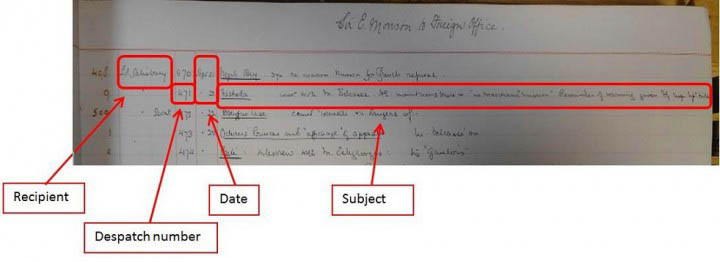
Page from a Foreign Office register for embassy and consular records.
4. Armed with the details of the relevant entries from the register, return to the advanced catalogue search to identify and order the relevant volume of correspondence, using the country name AND “embassy and consulates” AND “general correspondence” as keywords, and restrict to the relevant year.
5. The volumes of correspondence (an example is shown below) are arranged by author and recipient, then by date. Within the relevant volume, look for the despatch number.
Despatch 471 in a volume of embassy and consular correspondence from 1898.
8. Treaties 1695-present
8.1 Records of treaties: ‘Full Powers’, protocols and ratifications
Distinct sets of records were created at different stages of the treaty process, and these are held in different record series.
Before a treaty is made, the parties exchange the Full Powers or authorisations granted to their plenipotentiaries.
The document reciting the agreed terms of the treaty, signed and sealed by the plenipotentiaries of each side is the Protocol.
Following the signing and sealing of the Protocol, ratifications were drawn up, and signed and sealed by the head of state of each party and exchanged, or sometimes deposited in an agreed place if there were several parties.
8.2 How to search for records of treaties at The National Archives
Follow the links in the table below to search the respective series by one or more of the following:
- the state(s) with which the UK signed the treaty
- the subject of the treaty
| Subjects | Dates | Series |
|---|---|---|
| Treaty Protocols (with full powers of other parties, and subsidiary documents, mostly 1775 to 2001) | 1695-2003 | FO 93 |
| Ratifications of treaties (mostly up to 2001) | 1782-2005 | FO 94 |
| Full powers of British plenipotentiaries and entries or drafts of ratifications | 1813-1967 | Pieces within FO 83 |
| Protocols and ratifications of multilateral treaties (mostly from 1969) | 1907-2002 | FO 949 |
| Protocols and ratifications of EEC treaties (mostly from 1973) | 1953-1997 | FO 974 |
| Draft full powers and draft ratification instruments | 1968 onwards | FCO 3 |
| Protocols and ratifications of treaties (mostly from 2001) | 1962 onwards | FCO 85 |
The texts of many treaties as published in UK Parliament Command papers can be downloaded at UK Treaties Online.
9. Private and private office papers
Private and private office papers relating to foreign affairs held at The National Archives fall under three main categories:
9.1 Private papers given directly to The National Archives
These are private papers of diplomats and politicians involved in foreign affairs directly gifted to, or deposited with, The National Archives (previously the Public Record Office).
Browse through our catalogue references for these from PRO 30/1-99 or search for them by name of author or place of origin using the advanced search and entering PRO 30 in the first reference box.
You can also find private papers held in archives elsewhere using our catalogue. Search by author name and click on the record creators tab within your search results.
9.2 Unregistered papers returned to government after retirement
These are unregistered papers of mostly (though not entirely) 19th century politicians, diplomats and officials taken away on retirement but subsequently returned to government.
Search for references to these using the advanced search in our catalogue, searching by surname, year range and entering department code FO in the reference box.
Anthony Eden’s papers (FO 954) are available online.
9.3 Private office papers surrendered to government on retirement
These are the private office papers of mostly 20th century politicians, diplomats and officials surrendered to government on retirement.
Search for private office papers by author surname using the search forms in the FO 800 and FO 794 series descriptions.
Private office papers of officials of the Foreign and Commonwealth Office since 1968 are in series FCO 73.
10. Records of international commissions and conferences
The papers of a large number of bilateral or multilateral international commissions, from 1790-1967 are among the Foreign Office records at The National Archives.
The records of British delegations to international conferences from 1814-1976 are in held in both FO and CAB departments.
Search for the records of a commission or conference using the advanced search , restricting your search to reference FO (and, for conferences, CAB) and searching with one or more of the following terms:
- The name of the commission or conference
- The word ‘commission’ or ‘international conference’ and a geographic reference such as the name of a city, country or region
- The word ‘commission’ or ‘conference’ and a subject reference such as ‘military’, ‘financial’, ‘fisheries’ or ‘slave trade’
See our catalogue series divisions for FO and CAB for further details.
11. Records of wartime departments and missions
We hold records of various departments and missions that operated within the Foreign Office during the First and Second World Wars.
11.1 First World War
Search for references to records created by the following agencies and departments set up by the Foreign Office in the First World War by clicking on the references and using the series-specific search boxes:
- Arab Bureau in FO 882
- Contraband Department in FO 382
- Foreign Trade Department in FO 833
- Jedda Agency in FO 686
- Prisoners of War and Aliens Departments in FO 383
- Restriction of Enemy Supplies Department in FO 845
- Trade Clearing House and War Trade Intelligence Department and Finance Section of the Ministry of Blockade in FO 902
For background details see the description for FO Division 12 to which the above series belong.
11.2 Second World War
Search for references to records created by the following agencies and departments set up by the Foreign Office in the Second World War by clicking on the references and using the series-specific search boxes:
12. Records of the Allied Administration of Germany and Austria after the Second World War
The Foreign Office inherited the records of a number of the organisations through which the Allies administered what are now Germany and Austria after the Second World War. These were:
- The Control Offices, based in London
- The Control Commissions, based in Germany and Austria
- The Civil High Commission, which instigated de facto self-government in West Germany from 1948 until 1955 (when normal diplomatic relations were resumed)
12.1 What kinds of records are held at The National Archives?
The surviving records of the Control Commission for Germany (British Element) are held at The National Archives but are incomplete as only a small percentage of the files were selected for permanent preservation. The overwhelming majority of these are administrative in nature and rarely contain personal details.
In addition to the above, there are numerous files and material on denazification generally including:
- policy and applications
- some name lists
12.2 How to search for records
For a breakdown of the record series relating to the Allied Administration, see the FO Division 14 page.
In addition, the records of the Allied Kommandatura, the four power body that administered Berlin until the end of the Cold War, are in FO 1112.
The file descriptions used by the Control Commission were very broad and this is reflected in the record descriptions in our catalogue. A keyword search of our catalogue is therefore of limited value but it may be worth completing the following fields in the advanced search with the terms provided:
- All of these words: a keyword relevant to your search e.g. censorship
- Exact word or phrase: Control Commission for Germany
- Within references: FO
- Date: 1945 to 1950
You should also consult Akten der Britischen Militärregierung in Deutschland: Sachinventar 1945-1955 (11 Volumes, published by KG Saur 1993). These volumes, available from The National Archives library, provide brief details (in English and occasionally German) of the Control Commission documents for Germany (the “G documents”) as well as the associated National Archives references.
12.3 Looted art
Foreign Office and Treasury documents concerning looted art have been identified and digitised in partnership with the Commission for Looted Art in Europe. To search them use the form in our research guide Looted art 1939-1961.
13. Intelligence records of the Foreign Office 1795-1985
The primary series of records relating to intelligence matters within the Foreign Office are the records of the Permanent Undersecretary of State in FO 1093.
From the FO 1093 series description, search by year and subject or, instead, browse through the document descriptions for the whole series.
Other significant record series include the reports of intelligence agents from 1795-1815 in FO 38 and details of the funding of British intelligence operations before 1909, known as the Secret Vote, in HD 1 and HD 2.
14. Further reading
Some or all of the publications below may be available to buy from The National Archives’ bookshop. Alternatively, search The National Archives’ library catalogue to see what is available to consult at Kew.
Published copies of records
British Documents on the Origins of the War, Documents on British Foreign Policy, Documents on British Policy Overseas (13, 68 and 18 Volumes respectively, HMSO and Routledge, 1926 onwards). Selections of documents (mostly general correspondence) covering the build up to the First and Second World Wars and the Cold War respectively.
British Documents on Foreign Affairs (over 200 volumes, University Publications of America, 1983 onwards). Selection of Confidential Prints from mid-19th to mid-20th century.
British and Foreign State Papers (168 Volumes, HMSO 19th century to 1977). Published copies of major treaties from 1812 to 1967.
Secondary material
FCO Historians, A guide to researching FCO history (Foreign and Commonwealth Office)
Michael Roper, The Records of the Foreign Office, 1782-1968 (Public Record Office, 2002)
Louise Atherton, Never Complain, Never Explain: Records of the Foreign Office and the State Paper Office 1500-c.1960 (Public Record Office, 1994), includes well-explained guidance on how to use the registers and indexes to Foreign Office correspondence
James Cronan and Keith Mitchell, Foreign Office records 1782 to 1986: A guide to country series (List & Index Society, 2017)
1. Why use this guide?
Use this guide for advice on how to find records of the Court of Requests spanning almost the entire life of the court, from 1485 to 1642. The court, known initially as the Court of Poor Men’s Causes, dealt primarily with small-scale civil cases, but occasionally select criminal offences too, including cases regarding the following:
- ownership of property
- inheritance of land and other land disputes
- claims for annuities or other payments (for example, following a will)
- marriage contracts and settlements
- matters of villeinage
- escaped prisoners or people fleeing justice
- forgery and perjury
- riots
These records are a useful resource for studying the social and economic conditions of the time and provide some significant insights into ordinary people’s lives during this period.
2. What was the Court of Requests?
The Court of Requests was established in 1483 to provide easy access for poor men and women to Royal justice and equity. A cheap and simple procedure attracted many suitors, not all of them poor but a significant number of them women.
An offshoot of the King’s Council, the court was set up when the Chancery official responsible for sorting petitions from the poor became clerk of the Council of Requests.
It was attacked by the common law courts whose lawyers resented the loss of business they endured as a result of its popularity.
The records of the court cease in 1642. Although the court was never formally abolished, much of its caseload eventually passed to local small claims courts.
3. How the court worked and the records it produced
Cases heard by the court followed the same procedure as was used in the Court of Chancery. The records can be divided into three broad and sometimes overlapping groups.
3.1 Proceedings
The proceedings, recorded in English, gathered together the details of a case as presented by plaintiff and defendant. Each of the following stages in the proceedings was officially recorded, usually on rolls of parchment:
- A petition or bill (also known as a pleading) from the plaintiff would be submitted to the court laying out their grievance
- A response from the defendant, known as an ‘answer’
- A response from the plaintiff, known as a ‘replication’
- A further response from the defendant, known as a ‘rejoinder’
- Interrogatories – a set of questions that could be put to the witnesses of either party
- Sworn testimony, known as ‘depositions’, in answer to the questions in the interrogatories
3.2 Judgements and other orders
Most cases were either settled out of court or were abandoned because of the cost of litigation. However, for some cases the court would pass judgement called a Decree or Final Order. There are records of these and other orders issued by the court, in both Latin and English, and they usually appear in the records as:
- Orders – court directions and decisions made throughout the life of a case
- Decrees – final judgements, the final verdict of the court
3.3 Other administrative records created during a case
These records are in English and Latin and include:
- Appearance books – records of the appearance of defendants, often through an attorney rather than in person, before the court
- Affidavit books – records of sworn statements made by defendants, plaintiffs and witnesses
- Process books – these contain instructions issued by the court including those compelling witnesses to give evidence and for arrests to be made
3.4 Who were the judges and other members of the court?
Initially, judges of the court were Royal Councillors, under the authority of the King’s Almoner and the Dean of the Chapel Royal. After 1519, when the court began to meet regularly in the Whitehall at Westminster, the Lord Privy Seal, assisted by Masters and (after 1562), Extraordinary Masters of Requests, headed the court, specifically to determine poor men’s causes by equitable means.
Local commissions often dealt with much of the business of the court after the defendant’s answer was filed, and Masters of Requests based their decrees, orders and judgements on returned commissioners’ reports.
4. How to find records of proceedings
Most of the surviving records of proceedings in individual cases are in REQ 2 (case papers relating to Shakespeare are in REQ 4). You cannot view these records online.
Unfortunately, unless you are prepared to search through hundreds of document bundles each containing about 100 cases, you have little chance of finding over half of the cases in REQ 2 (including half of those dating from the reign of James I and all from Charles I) as they have not been indexed or catalogued in any way.
However, using the various indexes and other finding aids listed in the table below you have a much better chance of finding records of proceedings created during and between the reigns of Henry VII and Elizabeth I, and around half the proceedings from the reign of James I.
Use the table to determine which sections of REQ 2 you need to search within and the corresponding index or finding aid.
| Monarch | Date Range | Catalogue ref | How to search |
|---|---|---|---|
| Henry VII – early Edward VI | 1485-1547 | REQ 2/1-15 | Search by keyword using the REQ 2 search in our catalogue |
| Edward VI | 1547-1553 | REQ 2/16-19 | Use the List of Proceedings in the Court of Requests preserved in the Public Record Office and the Supplementary series of lists and indexes of Proceedings in the Court of Requests, Vol 1, available at our building in Kew, to search by parties, subject and/or place.
The lists marked ‘Hunt’s series’ list records in REQ 2/1-40 with a little more detail, including some dates. |
| Mary I | 1553-1558 | REQ 2/20-25 | As above |
| Elizabeth I | 1558-1603 | REQ 2/26-136 | As above |
| REQ 2/137-156 | Consult the manuscript ‘Atkin’s Calendar’, and search by person, subject and/or location using Supplementary series of lists and indexes of Proceedings in the Court of Requests, Vol 1 | ||
| REQ 2/157-294 | Search by person, subject and/or location using the Supplementary series of lists and indexes of Proceedings in the Court of Requests, Vol 2 for bundles 157-203 and Vol 3 for bundles 204-294. Also listed in a further unnamed manuscript list. | ||
| 369-386 | None | ||
| James I | 1603-1625 | REQ 2/295-311 | Search by person, subject and/or location using the Supplementary series of lists and indexes of Proceedings in the Court of Requests, Vol 4. Also listed in a further unnamed manuscript list. |
| REQ 2/387-424 | Search within bundles 387-409 by person, subject and/or location using the Supplementary series of lists and indexes of Proceedings in the Court of Requests, Vol 4. Also listed in a further unnamed manuscript list. | ||
| REQ 2/425-485 | None | ||
| Charles I | 1625-1649 | REQ 2/486-806 | None |
| various dates | REQ 2/807-829 | None |
5. How to find records of judgements, court orders and administrative records
Records as old as these rarely survive in their entirety but, relatively speaking, the judicial and administrative records of the Court of Requests have survived fairly well, unlike, for example, the records of the Court of Star Chamber, a contemporary of the Court of Requests.
However, of those records that have survived, some have not yet been sorted or properly identified and are therefore very hard to find and make use of.
Some of these records are in English, others are in Latin.
5.1 Identified records
The closest you can get to identifying records for a particular case in our online catalogue is to use the table below to help you narrow down the record by type and range of years. These records are held in series REQ 1.
| Records | Monarch | Catalogue Ref | Description |
|---|---|---|---|
| Order and decree books | Henry VII-Charles I | REQ 1/1-38, REQ 1/209 | Orders, decrees, final judgements and, before 1520, appearances |
| Order books | Elizabeth I-Charles I | REQ 1/39-103 | Draft orders, decrees and memoranda |
| Appearance books | Henry VIII-Charles I | REQ 1/104-117 | Records of appearance by defendants, usually by attorney |
| Contemporary indexes to affidavits | 1637-1641 | REQ 1/118, REQ 1/150 | Incomplete |
| Affidavit books | 1591-1641 | REQ 1/119-149 | Signed affidavits (by servers) that process, especially writs of summons, had been served |
| Note books | 1594-1642 | REQ 1/151-170 | Outline records of the progress of suits |
| Process books | 1567-1642 | REQ 1/171-197 | Recording the issue of writs of privy seal, attachments for arrest, appointment of commissions, injunctions, and orders for appearances |
| Witness books | Elizabeth I-Charles I | REQ 1/198-206 | |
| Register of replications | 1632-1636 | REQ 1/207 | |
| Commission book | 1603-1619 | REQ 1/208 | Recording return dates of depositions by commission |
For a calendar of cases recorded in REQ 1 between 1493 and 1538, see Laura Flannigan (ed), Hearings of the Court of Requests (List & Index Society vols 366-367).
5.2 Unidentified records
Some records of the Court of Requests were stored, after 1641, together with records from the courts of Wards and Liveries, Chancery and Star Chamber, at the Treasury of the Receipt of the Exchequer. Forty-four boxes of this material are today held at The National Archives, in record series REQ 3, but remain unsorted. For more details see the REQ 3 series description.
Similarly, records from the Court of Requests may have strayed into the records of the Court of Star Chamber and may therefore be found within the STAC department at The National Archives.
There may also be material, as yet unidentified, in REQ 2/369-386.
6. Further reading
IS Leadam, Select cases in the Court of Requests (Selden Society, XII, 1898)
Sir Julius Caesar, The ancient state, authority and proceedings of the Court of Requests, ed, LM Hill (London, 1975)
Tim Stretton (ed), Marital litigation in the Court of Requests 1542-1642, Camden Fifth Series volume 32 (London, Cambridge University Press for the Royal Historical Society, 2008)
Laura Flannigan (ed), Hearings of the Court of Requests (List & Index Society vols 366-367).