1. Why use this guide?
This guide will help you to find records of royal grants issued to individuals, public bodies or institutions since 1199 and now held at The National Archives. Royal grants cover a wide range of topics including, but not limited to:
- land
- offices
- titles
- pensions
- pardons
- patents for inventions
- licences
- leases of crown lands
- presentations to churches
- rights to hold markets and/or fairs
The guide focuses on the enrolments of grants which were issued under the Great Seal as royal charters or letters patent. There are other records of grants (for example, warrants) but these are not covered in depth here.
Many records for the earlier period are in Latin.
2. What are letters patent and what are charters?
Until early in the reign of Henry VIII, the most solemn royal grants were issued as charters. Other grants could be issued as letters patent. After the eighth year of Henry VIII’s reign, all grants under the Great Seal were issued as letters patent.
Both letters patent and charters were recorded on parchment, consequently sewn together head to tail to form a continuous roll for storage. We thus refer to ‘enrolled’ grants, and to ‘Patent Rolls’ and ‘Charter Rolls’. The individual sections are known as membranes.
2.1 Letters patent
Letters patent were open letters issued under the Great Seal. They cover a huge diversity of subjects, including grants of official positions, lands, commissions, privileges and pardons. Modern patent ‘rolls’ (now in fact, books) contain entries as diverse as the constitution of Southern Rhodesia and the appointment of judges in India.
Most entries are in Latin in the early period but some entries are in English, even in the 16th century. In the 1650s and after 1733 all entries are in English. Letters patent are addressed ‘To all to whom these presents shall come’.
Letters patent relating to Peers will be kept by the individual concerned, but Parliament’s Archive Collections include a very small number of letters patent of individuals relating to Parliament in personal papers collections, including Spencer Perceval and Erskine May. They can be found by searching the catalogue for “letters patent”. Copies of writs of summons can be found among the House of Lords Main Papers. The Parliamentary records of the Clerk of the Crown include a small number of copies of warrants summoning peers to the upper house, some official copies with wafer seals.
2.2 Charters
The most formal royal grants made in the medieval period were issued as Latin charters addressed to the leaders of society, with elaborate lists of named witnesses.
They may be original grants in perpetuity of lands, privileges or other possessions. Often they are a confirmation, or ‘inspeximus’ (a sealed official copy), of earlier grants. In these cases, the earlier texts would normally be repeated in full, sometimes with the addition of further privileges.
3. Search tools and basics
To identify records you will usually need to start by consulting calendars (summaries) and indexes, all of which are available at The National Archives in Kew. Details of these finding aids are provided in the sections below.
The calendars and indexes are usually dated by regnal year (for example ‘1 Richard II’), reflecting the arrangement of the rolls. You will need to convert references in the calendars and indexes into modern document references. Membrane or item numbers will direct you to the right section of the roll. Some references may indicate if the entry is on the ‘dorse’ (d), or reverse side, of the roll. Convert regnal years to calendar years using C R Cheney’s Handbook of Dates.
Entries were made in a highly abbreviated form of Latin, to which C T Martin’s The Record Interpreter is a useful guide. You may also find our Latin tutorials useful.
4. How to search for Patent Rolls
The Patent Rolls run in an almost unbroken series of records from 1201 to the present day. However, there are significant numbers of missing records for the Civil War and Interregnum period (c.1642–1659). Copies are enrolled on the Patent Rolls in C 66.
There are a number of resources which will help you to find records:
4.1 Published patent rolls (before 1603)
Consult the printed transcripts of the original Latin enrolments for the period:
- 1201–1216 in Rotuli Litterarum Patentium (Record Commission, 1835)
- 1216–1232 in Letters Patent of the Reign of Henry III (HMSO, 1901,1903)
After 1232 the Calendars of Patent Rolls (HMSO, 1891–1986) – often abbreviated in secondary sources as CPR – provide a full indexed summary of entries, in English, up to 1595, except for the period 1509–1547 when calendar entries are in Letters and Papers Foreign and Domestic Henry VIII (HMSO, 1862–1932). Digitised calendars of the rolls for the reigns of Henry III and Edward I are now available through British History Online and later reigns are being added incrementally.
Calendars for 1595–1601 have been published by the List and Index Society and more are in preparation.
Calendars do not always give full modern document references. The rolls are identified by regnal year, and then by part number: this can be converted into a modern reference by looking at the C 66 list in the reading rooms, Kew. Membrane or item numbers are internal references which you use to find the entry on the actual roll.
4.2 Manuscript ‘indexes’ from 1603
From 1603, you will need to use the original manuscript indexes and calendars in C 274 which, like the enrolments, may be in Latin until 1733. These indexes are not as straightforward to use as modern indexes.
Those for James I have been published in facsimile by the List and Index Society. Others are only available at The National Archives, Kew. Many have been annotated with the modern document references. There is also a card index at The National Archives for letters patent issued by George V.
The format of these ‘indexes’ varies. In general they are arranged by regnal year and either summarise or index each entry in the order in which it appears on the roll. Indexes to the names of grantees are by the first initial of the surname only.
Grants of:
- commissions may be indexed under C
- naturalisation under ‘Indigen’
- pardons, presentations and proclamations under P
See the C 274 series list in the reading rooms, Kew for more details and information about interpreting and using the indexes.
5. Letters patent not enrolled
Not every document issued under the Great Seal was enrolled. Grants issued to private persons were enrolled for a fee and not all were willing to pay. Some grants were enrolled but never formally issued; others were amended after enrolment or cancelled.
The warrants authorising the use of the Great Seal in C 81-83 provide supplementary evidence for royal grants, some of which were never enrolled.
Read the publication note within the C 81 and C 82 series descriptions to find out how to search these. Browse C 83 by regnal year, please note there can be more than one part per regnal year.
You may sometimes find petitions for grants in:
- Ancient Petitions within SC 8. Use the search box within SC 8 to search by keyword (for example, sheep or sheep AND grant)
- the various State Papers series (SP)
6. Supplementary patent and confirmation rolls
Between 1483 and 1625, confirmations of previous grants were enrolled separately on the Confirmation Rolls in C 56. A manuscript index to these is available at The National Archives.
Some common form patents – letters of protection, pardons, passes for ships and commissions of bankruptcy – were occasionally enrolled separately on the Supplementary Patent Rolls. Browse these in C 67.
7. Royal proclamations and commissions
Up until c.1655 royal proclamations and commissions were enrolled on the back of the Patent Rolls.
From 1595 commissions are more comprehensively recorded in:
- the Crown Office Docket Books in C 231 – searchable by date
- Miscellaneous Books in C 193 – browse by type of book and date
For Royal Commissions relating to Parliament (for example commissions giving royal assent to Acts of Parliament and proroguing Parliament) see our separate research guide on Original Acts of Parliament.
8. Palatinates of Durham and Lancaster
The Palatinates of Durham and Lancaster had their own chanceries, issuing and enrolling letters patent under their own seals.
Those for Durham are in DURH 3 and those for Lancaster are in PL 1. For Durham start by browsing DURH 3 from the enrolments subseries. For Lancaster see the publication note within the PL 1 series description for help on how to search the records.
9. How to search for Charter Rolls, 1199-1517
The original charter is unlikely to be at The National Archives as it would have been issued to the individual or corporate body to whom the grant was made, and may survive with the archives of that family or institution. We do, however, hold some original charters, usually acquired by confiscation, inheritance or purchase, such as the fine collection of Duchy of Lancaster royal charters in DL 10.
From 1199, enrolled copies of charters issued survive with the records of Chancery, in C 53. These may include the text of earlier grants in confirmations, as do the Cartae Antiquae Rolls in C 52.
Published Latin transcripts exist for most of the Charter Rolls for King John’s reign (1199–1216) in the Rotuli Chartarum (Record Commission, 1837). This was printed in record type, copying the abbreviations of the original.
There were no Charter Rolls for the early years of Henry III’s reign (1216–1226) but for later dates there are printed calendars (summaries), in English, in the six-volume Calendar of Charter Rolls (HMSO, 1903–1927) – often referred to in secondary sources as CCR or CChR. Each volume is indexed by place name and personal name. Names of witnesses are not included but there are separate indexes of witnesses for the reigns of Henry III and Edward III.
After 1517 the Charter Rolls were discontinued. Any charters issued, mainly for grants of titles, were enrolled on the Patent Rolls in C 66 (see section 4).
10. Further reading
Some of the publications below may be available to buy from The National Archives’ shop. Alternatively, search The National Archives’ library catalogue to see what is available to consult at Kew.
‘Calendar of Patent Rolls 34 Elizabeth I (1591–1592)’ C66/1379–1394, Second (revised) edition (Lists and Index Society, 2017)
H C Maxwell-Lyte, ‘Historical Notes on the Use of the Great Seal of England‘ (HM Stationery Office, 1926)
R E Latham, ‘Hints on Interpreting the Public Records II Letters Patent’ The Amateur Historian, vol I, no 2 (1952)
C T Martin, ‘The Record Interpreter‘ (London, 1892)
P Chaplais, ‘English Royal Documents‘ (Oxford, 1971)
This guide provides advice on how to search for the records of Royal Naval Air Service (RNAS) ratings.
What do I need to know before I start?
The RNAS was founded in July 1914 when the naval wing of the Royal Flying Corps (RFC) was moved out of the RFC and brought under Admiralty control.
On 1 April 1918 the RNAS was merged with the Royal Flying Corps to form the Royal Air Force (RAF).
The service records of RNAS ratings who served before the foundation of the RAF were kept with the Royal Naval seamen’s service records.
If an RNAS rating continued to serve in the RAF after April 1918, the remainder of his record would be kept with the RAF service records.
Online records
RAF service records (1918-1939)
Search on findmypast (£) the RAF service records (AIR 79), for RNAS ratings who transferred to the RAF when it was formed in April 1918.
RNAS service numbers were prefixed with the letter ‘F’. When they transferred into the RAF, the ‘F’ prefix was removed, the number 2 added and, if the service number contained less than six digits, noughts were added to bring its total number of digits to six. For example, F 1002 became 201002 or F 54559 became 254559.
RAF service numbers between 313001 and 316000 indicate that the airmen served with the Royal Navy before the RNAS was formed in July 1914 and that they transferred from the Royal Navy to the RNAS.
Registers of Seamen’s Services (1853-1923)
Consult the Registers of Seamen’s Services (ADM 188) for RNAS ratings who served before April 1918. You can search and download (£) them on our website.
Individuals who entered the RNAS between July 1914 and March 1918, without prior service in the Royal Navy, were given service numbers prefixed with the Letter ‘F’. For those who had served in the Royal Navy and transferred into the RNAS, the original Royal Navy service number was retained.
Naval medal rolls (1793-1975)
Look in the Naval medal rolls (ADM 171) on Ancestry (£) to consult lists of seamen awarded campaign medals, long service medals and good conduct medals. They are arranged by type of medal.
Records in other archives and organisations
Records held elsewhere
The National Archives’ catalogue contains collections and contact details of local archives around the UK and beyond. To locate these records, search our catalogue with keywords and refine your results to ‘Other archives’ using the filters.
Other resources
Websites
Search the Commonwealth War Graves Commission website for details of men and women who died in the First and Second World Wars.
Look up an announcement of a 20th-century gallantry award in the London Gazette on The Gazette website.
Books
Some or all of the recommended publications below may be available to buy from The National Archives’ shop. Alternatively, search The National Archives’ Library to see what is available to consult at Kew.
Read Air Force Records: A guide for family historians, 2nd edition, by William Spencer (The National Archives, 2008).
1. Why use this guide?
This guide will help you to find records relating to the registration of merchant ships and other records relating to merchant vessels but not to merchant seamen or crews.
Records of merchant ships at The National Archives are often arranged and described in our catalogue by the name of the port of registry and it may be difficult to find details for a ship if you do not have this information.
See section 3 of this guide for information on published registers and links to online sources, which will probably be easier to use than the records in this guide.
If you are looking for records relating to a person this is not the best place to start. Use our guides on merchant seamen and on crew lists and agreements for information on records relating to individuals.
2. Registration of merchant ships
Many different types of registration records have been created over the years. The records covered in this guide are mainly those collected by the Board of Trade from records created locally at ports.
Vessels registered at their home ports and were given a numbered certificate, unique to that port and the year of registration. Numbers began at zero each year for each port, so the same number could be used for different vessels in different years even in the same port. The certificate numbers were recorded in registers and copies sent to the Board of Trade.
From 1854 each ship had an official number in addition to the port registration number.
Registers created by customs officials at ports are kept at local record offices, with the exception of records of the Port of London, which are at The National Archives, see section 6 below.
The National Maritime Museum Merchant Navy research guide has a list of:
- Custom Houses for England, Wales, Scotland, Ireland, the Isle of Man and the Channel Islands
- contact details of the relevant local record office
- dates for which they hold ship registration records
Fires at customs houses means some records do not survive.
For information on port books created to record customs duties, read our guide Merchant trade records: port books 1565 – 1799.
3. Published sources
Information on ships may be more easily found in published registers than in the original records held at The National Archives.
The Crew List Index Project website has information on British registered ships between 1855 and the 1950s, including port of registry, and can be searched by ship’s name or official number.
The Lloyd’s Register Foundation has links to online copies of:
- Lloyd’s Register of Ships, providing information about merchant ships since 1764,
- Casualty returns, recording losses of vessels worldwide between 1890 and 2000.
Incomplete sets of annual directories available to consult in the reading room at the National Archives, include:
- Lloyd’s Register of Ships – copies between 1835 and 1973 are available in the National Archives reading room
- The Mercantile Navy List – 1861-1949 available in reading room.
Copies of these are also held by The London Archives, National Maritime Museum and other archives.
Lloyd’s List, was printed between 1734 and 2013 when it became a digital resource. It provides information on merchant shipping for insurance companies and the maritime industry. Copies can be consulted at The London Archives and National Maritime Museum.
4. How to search our catalogue for records
Click on the links in this guide for more information on how to find records in each series. Different series are arranged in different ways, so you may need to search or browse a series by:
- port of registration
- alphabetical ranges of ship’s names
- numerical ranges of ships official numbers
The official number of a ship can be found on the Crew List Index Project website.
For most of the records in this guide a simple catalogue search using a ship’s name, or its official number, will not be successful. The best way to search through many of the records will be to browse in reference order, usually the same as date order, or hierarchically by sub-series, related records grouped together, for example by place or region. Refer to our Discovery help pages for guidance on searching and browsing.
Very few of the records described in this guide are available online. To view most of the documents that you find references for, you will need to either visit The National Archives at Kew or pay for copies to be sent to you.
5. Board of Trade registers: Transcripts and transactions, 1786-1998
Transcripts are registers compiled centrally by the Board of Trade from copies of registration certificates issued for merchant vessels in their home ports. Initially the transactions were annotations added to the transcripts recording changes of ownership.
From 1854 to 1889, the transcripts and transactions were separate series of registers.
From 1889 they were reunited and all papers relating to a single vessel were kept together.
5.1 Transcripts and transactions, Series I, 1786–1854
The 1786 Shipping and Navigation Act made registration obligatory for certain vessels.
- British ships over 15 tons were registered with customs officers in the ship’s home port
- numbered certificates were issued as proof of registration
- the certificate number was written into a registration book
- a copy of the certificate, known as a transcript, was sent to the Customs House in London or Edinburgh
From 1825, details of ownership, including changes of ownership, known as transactions, had to be noted on the transcripts held in the Customs Houses. Any change of master also had to be noted.
These records are in record series BT 107. They are arranged regionally and then by alphabetical range of port name. For London vessels are listed in port registry number order and individual registers are described in our catalogue by the range of numbers they contain.
They show:
- port registry number
- name of vessel and home port
- date and place of registration
- names of masters
- names, occupations and addresses of owners
- place and date of construction or capture as prize
- name and employment of surveying officer
- nationality of building (British, Plantation or Foreign)
- number of decks and masts
- depth of hold and tons burden
- type of vessel
- whether it had a gallery or figure head
Transcripts sent to the Customs House in London between 1786 and 1814 were destroyed in a fire. The Registration Books for the Port of London for the same period have survived and are in record series BT 107.
Indexes to these records are in the series BT 111 which can be downloaded from our website.
5.2 Transcripts and transactions, Series II and III, 1854–1889
The Merchant Shipping Act, 1854, introduced the official numbering of all newly registered ships and a new series of transcripts and transactions was created.
The transcripts (known as series II) are in record series BT 108 in port registry number order and the transactions (series III) are in record series BT 109.
Indexes to the BT 108 transcripts are in the series BT 111, which can be downloaded from our website.
The records in BT 108 have notes on them which refer to the files in BT 109. The records contain the same information as in earlier transcripts but also show:
- official number
- port number
- names and addresses of builders
- particulars of engines
- names, descriptions and addresses of owners and shares held
5.3 Transcripts and transactions, Series IV, closed registries, 1889–1998
From 1889 all papers relating to a single ship were kept together. These papers are in record series BT 110 and can be searched by ship’s name or official number.
Registry of a ship was closed if the vessel was sold to a foreign owner or sank. The registers are filed by decades, according to the date of closure, and then alphabetically under the ship’s name. United Kingdom registered ships are separate from Colonial.
If a ship was bought back from foreign owners the registry would be re-opened. In some of these cases the papers have been filed under the second date of de-registration.
5.4 Transcripts and transactions, registries, 1994
Registries of ships which were current in 1994 when a digital ships’ register was opened and Customs and Excise ships’ registers were closed are in BT 340.
6. London Port title registers and transfer books, 1818-1994
Title registers for vessels registered in London from 1818 to 1994 are in record series CUST 130. They are arranged by date and registration number with indexes of vessels between 1837 and 1920 at CUST 130/132-136.
They show:
- registered owners
- mortgages
- a description of each registered vessel in registered number order
The series also contains transfer books from 1845 to 1982, recording changes of ownership. Transfer books list:
- name of previous owner
- name, address and occupation of new owner
- number of shares
- date and time of sale
- registered details of the vessel
- where and when built
- type and construction of ship, details of engines
7. Lists of ships 1786-1880 and 1905-1955
Lists of ships registered in UK and colonial ports (referred to as plantation ports) were submitted annually to the Customs House in London, and later to the Registrar General of Seamen, from 1786. The 1854 Merchant Shipping Act made this compulsory for UK ports and plantation ports carried on submitting lists although they were not covered by the act.
These lists are in record series BT 162, by date and whether they refer to UK or Plantation ports, and relate mostly to the period 1786–1880. The lists can be downloaded as digital microfilm.
UK ports also compiled lists of ships on their registers every 5 years – again on an informal basis – but many do not survive. The ones from 1905, 1910, 1920, 1935, 1950 and 1955 are in record series BT 163.
8. First and Second World War records
8.1 British merchant and fishing vessels sunk or damaged by enemy action (1914–1920)
Browse our catalogue in MT 25/83–85 for lists of British merchant and fishing vessels sunk or damaged by enemy action 1914–1920.
8.2 Merchant shipping movement cards (1939–1946)
Search and download surviving merchant shipping movement cards (BT 389) in Discovery, our catalogue, (charges apply) for the Second World War.
8.3. Merchant vessel losses in the Second World War
Casualty registers recording losses of merchant ships during the Second World War are in BT 347/1–7. There is a microfiche card index in BT 347/8 available at The National Archives. These records relate to the ships and do not include crew.
The records are in date order, but if you have the casualty number allocated to the incident it will be easier to identify the right document.
Lloyd’s war losses is available to consult in the reading room and lists ships lost to war causes in date order.
See also Casualty returns on the Lloyd’s Register Foundation website.
9. Fishing boats
The Merchant Shipping Act 1894 required every fishing boat to:
- be lettered and numbered
- have official papers
- be entered on a register
Annual returns were made from each port and are in record series BT 145 by alphabetical ranges of ship’s names.
Transcripts and transactions relating to fishing boats are in BT 110 from 1895
10. Changes of master, from 1894
From 1894 to 1948 changes of master (the master of the ship was the officer in charge) were reported to the Registrar General of Shipping and Seamen and entered into registers. These registers are in record series BT 336 and are arranged in numerical order by the ships’ official numbers. The registers record when and where a new master joined a ship and, if the master changed frequently, can give an idea of the ship’s ports of call.
The registers show the
- official number
- name of the vessel
- port where the master joined
- date on which the master joined
- master’s surname and certificate number
11. Other registers
Some other smaller collections of registry records can also be found at The National Archives
- BT 374, registers of changes of names of ships, 1959 – 1996, arranged by date
- BT 368, 5 bundles of papers of the Shanghai registry of ships, catalogue descriptions include the names of ships, 1875–1919
12. Pre-19th century records
12.1 State papers
State papers can contain information about ships and crew, but finding where a person, ship or incident is mentioned can take a lot of research.
Start by looking in published calendars of state papers – these are summaries of letters and papers arranged chronologically. Most calendars contain indexes to people, places and ships and some can be seen online at:
- British History online (£)
- State Papers Online (institutional subscription required)
You can also find printed copies of the calendars in academic libraries including The National Archives at Kew.
12.2 Trade and customs records
From 1660 the records dealing with registration of ships were created by Collectors of Customs. Customs officers took over this function more formerly in 1701 and this continued until 1994. Many of these records remained at the port and were transferred to local record offices. Amongst those you can find at The National Archives are:
- Port Books (E 122 and E 190)
- Board of Trade Shipping Returns (in many CO series)
- Customs Records (in several CUST series)
You might also find our guide on Port books, 1565-1799 useful.
12.3 Treasury records, 1764–1887
Records from the Treasury can contain information about shipping but finding mention of specific ships is difficult. The two best record series to search within are:
- T 1 Treasury board papers and in-letters containing Shipping Lists, Naval Office shipping returns for plantations, customs and excise returns from North America. For help searching these see our research guide on Treasury papers
- T 64 Miscellaneous records with ships entered and cleared, plantation shipping returns, miscellaneous returns from Scotland
13. Further reading
Christopher T and Michael J Watts, ‘My ancestor was a merchant seaman‘ (Society of Genealogists, second edition with addendum, 2004)
K Smith, C T and M J Watts, ‘Records of merchant shipping and seamen‘ (PRO Publications, 1998)
Register of merchant ships in England, with the names of their masters compiled by Thomas Colshill, surveyor of the Port of London dated 1572 SP 15/22 – in the calendar of State Papers Domestic, Addenda, Edward VI to James I, 1547–1625, (SP 15) Addenda, Queen Elizabeth – Volume 22
British History Online, Guides and Calendars, State Papers Domestic, Calendar
Useful links: Royal Museum Greenwich guide to Merchant Navy: Ship registration and Custom House records
Richard Woodman: ‘A History of the British Merchant Navy’:
vol. 1: Neptune’s Trident: Spices and Slaves 1500–1807
vol. 2: Britannia’s Realm: in Support of the Stat 1763–1816
vol. 3: Masters Under God: Makers of Empire 1816–1884
vol. 4: More Days, More Dollars: The Universal Bucket Chain 1885–1920
14. Websites
Consult the Crew List Index Project (CLIP) website, which has information about merchant ships from 1861 to 1913.
Consult the Miramar Ship Index (charges apply) website, a historical database listing some categories of merchant and naval ships.
Consult the ShipIndex.org (charges apply) website, a database of ships mentioned in books, journals, websites and other resources.
Visit the Lloyd’s Register Foundation Heritage and Education centre website for information on their online and archival resources.
1. Why use this guide?
This guide provides a brief overview of records held by The National Archives that cover research, development and production of ships, arms and other technologies by and on behalf of the Royal Navy in the 19th and 20th centuries.
The records themselves are varied and extensive, with detailed written and visual information reflecting a broad range of topics, from correspondence about ships in construction and ships plans themselves to reports of torpedo trials and mine-sweeping designs.
Contact the National Maritime Museum, which also holds significant collections, to find out about the records you may find there.
2. How to start a search
In the subsequent sections of this guide you will find advice on some specific areas of research, highlighting the respective record series on which a search should focus. However, you may wish to start by trying a much broader search, dipping into our catalogue to see if anything pops up:
2.1 A broad search across our entire catalogue
You can search our catalogue using keywords and dates. Search results will provide short descriptions of the records and document references. The description will indicate how you can order paper or digital copies to be sent to you (very few of these records are available to view online or are available for download). You may prefer to visit us to view the original documents in person.
Keywords can include:
- the type of record, such as ‘technical handbook’, ‘manual’, ‘blueprint’, ‘report’ or ‘plan’
- the name of the establishment that conducted the research, such as the ‘Advisory Panel on Scientific Research’ or the ‘Admiralty Research Laboratory’
- the type of technology or weaponry, such as ‘torpedo’, ‘radar’ or ‘naval aircraft’
- the name of a ship
2.2 A broad search within Admiralty records
To narrow your search a little you can restrict your results to Admiralty records (most, but not all, of the naval research and development records are Admiralty records). Admiralty records at The National Archives are identified by department code ADM – in other words, all Admiralty document references begin with ADM. You can refine your search results to ADM records either by using the filter options in the left-hand panel of the catalogue results pages following a search, or beforehand by using the advanced search of the catalogue.
2.3 A search within the records of a specific research establishment
Naval research and development records are often found within the reports and papers of the various establishments, committees or laboratories created to do the research. If you know the name of a particular establishment, you can search for it in our catalogue. If you do not have a specific establishment name, consult the list of research establishments on the page for one of the ADM Divisions. The list provides the records series for various research establishments – click on the record series reference to search within the records of the respective series. The list is not exhaustive but it will give you an idea of some of the establishments that were created and of the Admiralty’s naming conventions.
3. Pre-20th century research and development
Before the First World War the Royal Navy did not have a central research establishment and often worked in partnership with the private sector.
ADM 1 holds information on 19th century technological developments. Use the name and subject indexes (digests) in ADM 12 to identify relevant ADM 1 records.
For the period before 1850 also browse:
The National Maritime Museum also has major collections, such as warship design records.
From 1852, major subject files, known as case papers, are within ADM 116. They are grouped by subject codes. The relevant codes are:
- 11 (armaments)
- 59 (inventions and suggestions)
- 80.1 (experiments)
- 81 (machinery)
Case files cover a wide variety of technological developments, ship design, mines and even the ‘landship’ (the tank).
4. Technological developments in the 20th century
4.1 The bodies responsible for research and development
The First World War provided a powerful stimulus for R&D (research and development) as it became clear technological superiority was essential to success.
In July 1915, the Board of Invention and Research was established to assess invention proposals made by the public. Numerous sub-committees were also established, on topics such as airships and oil fuel. Look at ADM 116/1601B for the the Holland Report, outlining how the Board drew on the resources of private industry, the National Physical Laboratory and other Admiralty establishments
In 1918 the Directorate of Scientfic Research and Experiment replaced the Board of Invention and Research and co-ordinated the various experimental stations run by the many technical departments. Key records are in ADM 283 and ADM 1.
The technical departments retained responsibility for research, development and production within their own fields. The division of responsibilities are outlined in ADM 213/523.
In 1946 the Department of Scientific Research was re-organised to form the Royal Naval Scientific Service which had four directorates and in the same year the Ministry of Defence was established to co-ordinate the policies of the three armed services. The Defence Research Policy Committee provided advice on scientific matters and reviewed R&D costs and needs.
After 1971, R&D establishments were placed under one Controller in the Executive and greater reliance was placed again on private industry.
4.2 Records of development and design of ships and submarines
For the design of warships, see the Director of Naval Construction’s papers in ADM 229.
Explore, by subject, ADM 137, a collection of material brought together for the official history of the First World War. This contains information on submarine development and detection.
4.3 Records of other technological research and developments
Search or browse for:
- reports of experiments as covered in the minutes of the Board in Invention and Research in ADM 293 (1914-1919)
- National Physical Laboratory reports on work done on behalf of the Admiralty in DSIR 10 (1906-1990) and in DSIR 36 (1884-1957)
- printed confidential reports, monographs and training manuals covering new developments in armaments, engineering, navigation and signals in ADM 186 (1827-1970)
- the Admiralty Research Laboratory’s papers, including papers on camouflage, in ADM 212 (1915-1977)
- committee minutes and memoranda, closed to public access for 50 years, in DEFE 10 (1942 onwards)
- papers of its first chairman in DEFE 9 (1945-1952)
- files of the Central Scientific Defence Staff, which co-ordinated the work of the Chief Scientists of the armed forces, in DEFE 19 (1948 onwards)
Read the catalogue description of ADM Division 12 for an overview of other useful series containing records of research and development for this period.
5. Weapons and munitions
Records on weapon development until 1855 are among the Board of Ordnance records.
From 1891 onwards look within the Naval Ordnance Department records. You can find records on subjects such as inventions and explosive testing (SUPP 6). Technical reports are within various committee and laboratory records so try searching for topics or organisations within ADM.
Browse DEFE 15 for records relating to the development of conventional weapons for all the armed services.
Browse the annual reports of the Torpedo and Mine School in ADM 189 for monographs on the development and operation of mines, minesweepers, net defences, anti-submarine weapons, demolitions and torpedo aircraft.
6. Inventions and inventors
You can find recommendations for awards to inventors (1894-1925) in ADM 245.
In 1919, a Royal Commission was set up to investigate claims by inventors who believed their work had been exploited by the government during the First World War.
You can search for claims within T 173, by name of inventor or company. There is also a subject index which includes ships, torpedoes, submarines and sea-planes.
A similar Commission was appointed in 1946. Its records are searchable by name in T 166, with related material in T 225.
For records on patents and specifications of inventions:
- see our patents research guide
- consult the Design Registers for ‘Useful designs’, BT 45, which includes a number of naval-related inventions – use the subject index in BT 46/9 (1843-1883) to help identify relevant records
7. Other non-Admiralty records
Treasury papers:
- search within T 1, using the T2 and T108 indexes, for the financial implications of naval R&D before 1920
- for 1920-1948 browse Supply files in T 161
- for 1948 onwards browse T 225
- TS 21 and TS 32 also contain some information about Admiralty inventions
Cabinet papers for policy related material:
- search for ‘Committee of Imperial defence’ within Discovery, our catalogue
- browse CAB 90 for the Scientific Advisory Committee (1939-1945)
8. Further reading
Use our library catalogue to find a recommended book list.
The books are all available in The National Archives’ reference library. You may also be able to find them in a local library. You can buy from a wide range of history titles in our bookshop.
This is a guide to finding records of merchant seamen in service before the start of the First World War. Before 1835, central government took little interest in keeping records of individual seafarers, so most of the records covered in this guide date from between 1835 and 1913. For details of seamen in employment before 1835 your best bet is to consult muster rolls or to look elsewhere, perhaps in private collections or old newspapers.
If you are looking for a record of a merchant officer, read our guide on Officers in the Merchant Navy.
What do I need to know before I start?
The black hole in the records: 1858-1913
Between 1858 and the First World War the Merchant Navy did not keep registers of its seamen. This means that for these years the only record you are likely to find of an individual merchant seaman is his appearance in agreements and crew lists, for which you usually need to know the names of the ships he served on.
How to trace a ship
Sometimes the only way to track down a record of a seaman is to trace the records of the ships he served on. You can use the CLIP (Crew List Index Project) website to trace a ship by the:
- ship’s name
- ship’s port of registration
- ship’s official number
There is more advice on finding crew lists and agreements, 1861-1938 in our more in-depth guide to these records.
How to interpret abbreviations in the records
See our guide to Abbreviations in merchant seamen records for further help interpreting information in these records.
Online records
Registers of seamen, 1835-1857
From 1835, the new Register Office of Merchant Seamen (later the Registrar General of Shipping and Seamen) recorded details of seamen in registers. The information came from the agreements and crew lists submitted by the masters of ships at the end of one or a series of voyages.
Search by name in the registers of merchant seamen from 1835 to 1857 at Findmypast.co.uk (£). You may find more than one record for a single seaman, depending on his years of service. These are digitised copies of the following National Archives collections:
- Register of Seamen Series I, 1835-1836 – the originals are in series BT 120.
- Register of Seamen Series II, 1835-1844 – the originals are in series BT 112 (a name index to which is in BT 119). See Appendix 2 for an example of a typical register entry from 1835-1840 and Appendix 3 for an example from 1842-1844.
- Register of Seamen’s Tickets, 1845-1854 – the originals are in series BT 113 (a surname index to which is in BT 114 – though any ticket numbers above 546,000 in the indexes do not appear in the registers). See Appendix 4 for an example of a typical register entry from 1845-1854. There do not seem to be any ‘reported voyages’ in BT 113 for the years 1849, 1850 and 1854.
- Register of Seamen Series III, 1853-1857 – the originals are in series BT 116. See Appendix 5 for an example of a typical register entry from 1853-1857.
The records typically include:
- First and last name
- Age or date of birth (BT 112 gives both)
- Place of birth
- Rank/rating/role (not BT 116)
- Dates of voyages (see Appendix 1 for advice on how to interpret information on voyages)
- Physical appearance (BT 113 only)
- Ships’ names
- Dates and ports of departure (BT 116)
- Port of ships’ registry
- notes on why the seamen left the vessel and where he went (‘how disposed of’)
Merchant Navy apprenticeship records, 1824-1910
Merchant Navy apprentices served their apprenticeship under the terms of an indenture (contract) which usually stipulated a term of four or five years working for a particular master. We hold a sample of these indentures and the original indexes which were used to keep track of them are available online. Search the indexes of Merchant Navy apprentice indentures between 1824 and 1910 (BT 150/1-53) on Ancestry (£). The indexes usually indicate:
- Name and age of the apprentice
- The term of their indenture
- The date their indenture began
- The master to whom they were indentured
- The name and port of registry of the vessel on which they began their apprenticeship
The indentures themselves are in BT 151 and BT 152 but provide little more than the indexes themselves contain. Furthermore, only a sample of these original indentures survive – for more information see Merchant Navy apprenticeship indentures, 1824-1953 below.
Register of duties paid for apprentices’ indentures, 1710-1811
Search the register of duties paid for apprentices’ indentures on Ancestry (£). These records of apprenticeships, from IR 1, are for various professions, including seamen both as apprentices and as masters.
Records available only at The National Archives in Kew
To access these records you will either need to visit us, pay for research (£) or, where you can identify a specific record reference, order a copy (£).
Ships’ muster rolls, 1747-1834
From 1747 masters or owners of merchant ships were required to keep a muster roll giving details of the number of crewmen and the ship’s voyages.
Ships’ muster rolls, recording very brief details of crew, survive for a few ports only:
- Shields and other northern ports from 1747
- Plymouth from 1761
- Dartmouth from 1770
- Liverpool from 1772
- other ports from 1800
Search the muster rolls in BT 98 by date range and port of registry:
We provide more advice on finding muster rolls in our guide to these records.
Agreements and crew lists, 1835-1860
In 1835, following the Merchant Shipping Act, muster books were replaced by similar records known as ‘agreements and crew lists’.
You can search for crew lists and agreements by ships’ port of registry (1835-1844), alphabetical ranges of ships’ names (1845-1856) or numerical ranges of ships’ numbers (1857-1860) in BT 98.
There is more advice on finding crew lists and agreements in our more in-depth guide to these records.
Agreements and crew lists, 1861-1938
The National Archives holds a 10% sample of agreements and crew lists for 1861 to 1938, held in record series BT 99.
Search the agreements and crew lists in BT 99 by the ship’s official number for the period 1861 to 1938. For the years 1881 and 1891 only you can search by official number, ship’s name or name of crewman.
There is more advice on finding crew lists and agreements, 1861-1938 in our more in-depth guide to these records.
Merchant Navy apprenticeship indentures, 1824-1955
Merchant Navy apprentices served their apprenticeship under the terms of an indenture (contract) which usually stipulated a term of four or five years working for a particular master. We hold a sample of these indentures – a two month sample for every five years between 1824 and 1955.
Search for copies of these indentures in BT 151 (all vessels) and BT 152 (fishing boats only) by date and port. There are original indexes to these records in BT 150, available online for the years 1824-1910 (see ‘Online records’ section above). The indentures provide more or less the same information as the indexes and if you have seen an index entry you are unlikely to gain any additional insights form the indenture itself – though they do contain the signatures of the apprentice and master.
Records in other archives and organisations
Agreements and crew lists, 1861-1994
Most agreements and crew lists for this period are held in repositories other than The National Archives. Search at the following:
- Maritime History Archive in Newfoundland holds approximately 70% of the crew lists and agreements for the years 1861-1938 and 1951-1976. You can search these by ship’s official number.
- National Maritime Museum in London holds 10% of agreements and crew lists for the periods 1861-1938 and 1951-1976. In general, the records held are for years ending with five (1865, 1875, and so on) however they do hold some other years too. Contact them directly to find out more.
- National Records of Scotland
- National Archives of Ireland
Other resources
Websites
Search the Apprentices of Great Britain 1710-1774 database on Findmypast.co.uk (£) for indexes to apprenticeships in IR 1.
Consult the Crew List Index Project (CLIP) website, which has information about merchant seamen on British registered ships from 1861 to 1913.
Books
Search The National Archives’ shop to see whether any of the publications below may be available to buy. Alternatively, look in The National Archives’ library catalogue to see what is available to consult at Kew.
Christopher and Michael Watts, My Ancestor was a Merchant Seaman (Society of Genealogists, 2002)
Appendix 1: Interpreting voyage details
Details of the voyages a seaman took are recorded in most of the registers. Some are ‘home trade’ voyages (ships sailing in waters around Britain) and others are ‘foreign trade’ voyages (ships sailing further afield).
‘Home trade’ voyages
Where home trade voyages are recorded in the registers, entries do not simply record a single voyage, but a half year (January to June or July to December) during which the seaman was engaged on a particular ship.
During that period the ship may have been on several voyages. The seaman may have been engaged for some or all of the period.
‘Foreign trade’ voyages
Foreign trade voyage entries record a single voyage during which the seaman was engaged on a particular ship. There may be dates for both leaving the UK (expressed as ‘out’) and for returning to the UK (expressed as ‘home’).
A seaman may have left the UK on one ship and returned on another. Equally, the ship may have departed in one year and returned in the next.
Appendix 2: Example of a register entry 1835-1840 (BT 112)
The registers are of two types. The entries in the earlier registers, part 1 1835-1840 (first image) look slightly different in layout to those from the later period 1842-1844 (second image).
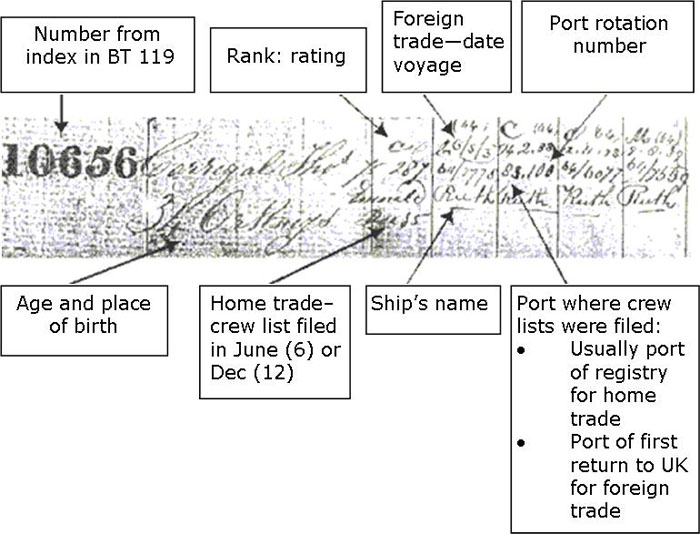
Register of Seamen, Series II, BT 112
Appendix 3: Example of a register entry 1842-1844 (BT 112)
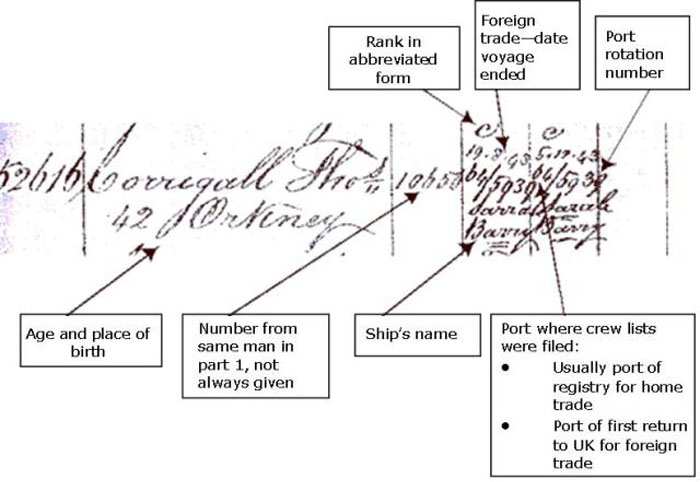
Image of Register of Seamen, Series II, BT 112 part 2
Appendix 4: Example of a register entry 1845-1854 (BT 113)

Image of Register of Seamen’s Tickets, BT 113
Appendix 5: Example of a register entry 1853-1857 (BT 116)
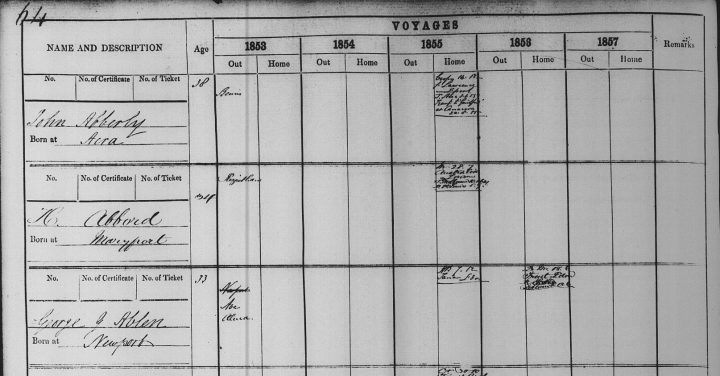
Register of Seamen, Series III, BT 116. Document reference: BT 116/1
1. Why use this guide?
This guide will help you to find records, now held at The National Archives, of religious houses such as:
- monasteries
- nunneries
- priories
- friaries
- hospitals or colleges
The National Archives’ records on religious orders are predominantly financial or legal.
For Cardinal Wolsey’s dissolution of the monasteries 1524–1528 please read our Dissolution of the monasteries guide.
For monastic seals read our Seals research guide.
2. How to search
It is best to start with published and printed sources before searching for original documents. These publications not only contain histories of many religious houses but often provide National Archives document references and suggest places to start your search.
Consult the following publications held at The National Archives library (see also the further reading section):
- Medieval Religious Houses, England and Wales by D Knowles and R N Hadcock (Longman 2nd ed, 1971). This lists all monasteries, friaries, nunneries, hospitals and colleges with their dates, an outline of their history and further bibliographical information
- The Heads of Religious Houses, England and Wales, 940–1216 by D Knowles, C N L Brooke and V C London (Cambridge University Press, 1972) provides information about abbots and priors
- The Victoria County History covers most English counties and has more detailed histories of religious houses. Its footnotes can often provide useful document references
- Monasticon Anglicanum by Sir William Dugdale, 6 vols (Record Commission, 1817–1830) prints a selection of charters and includes engravings of monastic buildings
If you have a document reference, you can request the document using Discovery, our catalogue (either to view the original document by visiting The National Archives at Kew or paying for copies to be sent to you). If you do not have document references, you can search our catalogue using keywords and dates to try finding some. Search using a range of keywords (separating each one with OR, AND or NOT) as religious houses have often been described in multiple ways. For example, search for Quarr AND convent OR abbey.
You can also use the advanced search of our catalogue to help structure your search. You can restrict your search by using the ‘search within’ option and entering some of the suggested departments or series mentioned in the sections below. For further search tips see our Discovery help pages.
A catalogue search, however, will not find everything. In some cases, your only hope of finding a record will be to use the calendars and indexes held at our reading rooms in Kew.
3. Founders and foundation charters
Charters confirm the grants of, for example, lands or privileges. For a time these would have been, in effect, a monastery’s title deeds.
Kings, as well as founding monasteries themselves, often confirmed the foundation charters of other religious houses.
Original foundation charters for monasteries rarely survive; most of the texts have been incorporated into later copies.
To identify relevant charters see:
- for the Anglo-Saxons: Anglo-Saxon Charters, an Annotated List and Bibliography by P H Sawyer (Royal Historical Society, Guides and Handbooks No 8, 1968)
- for the Normans: Regesta Regum Anglo-Normannorum, vol I, 1066–1154, (Clarendon Press) (ed) R Davis and J Whitwell (1913); vol II, 1100–1135, (ed) C Johnson and H Cronne, (1956); vol III, 1135–1154, (ed) H A Cronne and R Davis (1968)
- for Henry II (1154–1189), L Delisle and E Berger, Recueil des Actes de Henri II, 3 vols (Paris, Imprimerie Nationale, 1920)
- for Richard I, L Landon, The Itinerary of Richard I (Pipe Roll Society. New Series Vol 13, 1935). J C Holt and R Mortimer, Acta of Henry II and Richard I (List and Index Society, Special Series, XXI, 1986) which gives a list of royal charters in British repositories
3.1 1199 onwards – the Chancery rolls
From King John’s reign, royal charters of foundation and confirmation are enrolled in the various Chancery rolls. The Crown also issued many inspeximuses validating much earlier grants, some of which are the sole source for the original texts.
Deciding which type of Chancery roll to look at depends on the date and whether it was granted as a letter patent (see Patent rolls) or as a sealed confidential letter (see the Close rolls).
- for the Close Rolls in C 54, see Rotuli Litterarum Clausarum in Turri Londiniensis Asservati, 1200–1227, 2 vols (ed) T D Hardy (Record Commission, 1833–1834) continued in Calendars of Close Rolls, 1227–1509, 62 vols (HMSO, 1902–1963)
- for the Patent Rolls in C 66, see Rotuli Litterarum Patentium in Turri Londiniensis Asservati,1201–1216 (ed) T D Hardy (Record Commission, 1835) continued in Calendars of Patent Rolls, 1216–1509, 55 vols (HMSO, 1901–1916)
- for the Charter Rolls in C 53, see Rotuli Chartarum in Turri Londiniensis Asservati, 1199–1216 (ed) T D Hardy, (Record Commission, 1837), continued in Calendars of Charter Rolls, 1226–1517, 6 vols (HMSO, 1903–1927)
- for grants from 1509 to 1538 see Letters and Papers, Foreign and Domestic, Henry VIII, 22 vols in 37 parts (HMSO, 1864–1932)
- from 1483, monastic houses are common on the confirmation rolls in C 56. An index is available in the reading rooms, Kew
The Cartae Antiquae rolls in C 52 are medieval transcripts of earlier charters (some spurious) and include many foundation and confirmation charters.
- C 52/1–10 are printed in Cartae Antiquae, Vol 1 – Rolls 1–10 (ed) L Landon, Pipe Roll Society New Series Vol 17, 1938
- C52/11–20 are printed in Vol 2 – Rolls 11–20 (ed) J Conway Davies, Pipe Roll Society New Series Vol 33, 1960
3.2 1279 onwards
From 1279 land could only be transferred to the Church after a licence of mortmain had been issued.
Before such a grant was made the Crown issued an inquisition ‘ad quod damnum’ to ensure that its interests would not be prejudiced. These are in C 143 which you can search by keyword.
Inquisitions ‘ad quod damnum‘ from 1485 are filed with Inquisitions ‘post mortem’. These are in C 142 – a separate list of the inquisitions ad quod damnum is available.
Mortmain licences are enrolled on the patent rolls in C 66. To search these use the calendars listed above.
Some payments made for the licences appear on the fine Rolls in C 53. Consult:
- Rotuli de Oblatis et Finibus in Turri Londiniensis Asservati tempore regis Johannis (ed) T D Hardy (Rec Comm, 1835)
- Excerpta e Rotulis Finium in Turri Londiniensis Asservati, 1216-1272 (ed) C Roberts, (2 vols, Rec Comm, 1835–1836)
- Calendars of Fine Rolls, 1272–1509, 22 vols (HMSO, 1911–1963)
Once the licence was finished with it was returned into Chancery and cancelled. Many licences are now among cancelled letters patent in C 266 which you can search by regnal year.
3.3 Papal bulls
Papal bulls confirming monastic foundations can also be useful. From 1198 onwards see Calendar of Entries in the Papal Registers Relating to Great Britain and Ireland: Papal Letter, 1198–1492, 14 vols (HMSO, 1894–1961). (See also the Miscellaneous section below).
4. Estates of the religious orders
Many of the sources described under Foundations also give useful information about endowments.
4.1 Deeds
Cartularies (registers of charters and deeds) are invaluable. Compiled by the monasteries themselves they frequently contain material which is very different from the government charters.
There is a fairly comprehensive list in Medieval Cartularies in Great Britain by R C Davis (Longmans, 1958). The National Archives has a substantial holding but there are many scattered in other public and private collections – search our catalogue and refine your results using the filters.
The Record Commission Transcripts, series II, includes a transcript of the ‘Cartulaire de la Basse Normandie’ (PRO 31/8/140B), a collection of charters granted by English benefactors to the religious houses in Normandy.
4.2 Ancient deeds
These are miscellaneous collections of deeds which contain material created by or relating to religious houses. They are arranged in chronological order and, depending on their age, size and whether they have seals, are organised into various letter codes across several different record series. Typing the keyword term ‘ancient deeds’ into Discovery will bring up all of the relevant series. Alternatively, please consult the table below:
| A = E 40 | AA = E 41 | AS = E 42 | B = E 326 |
| BB = E 328 | BS = E 329 | BX = E 327 | C = C 146 |
| CC = C 147 | CS = C 148 | D = E 210 | DD = E 211 |
| DS = E 212 | E = LR 14 | EE = LR 15 | F = WALE 29 |
| FF = WALE 30 | G = DURH 21 | H = PL 29 | L = DL 25 |
| LL = DL 26 | LS = DL 27 | P = E 354 | PP = E 355 |
| RS = E 213 | WAS = E 43 |
Those series which begin with the letter code ‘B’ contain the largest collection of original deeds and other documents belonging to religious houses, which were inherited by the Crown following the dissolution. The other series, however, should also be consulted.
Many of these series are keyword searchable so try searching for terms relevant to your research combined with the phrase ‘ancient deeds’. For example abbot AND ancient deeds. Restrict your search also by date.
However not all the series are searchable in this way. Therefore if your search is unsuccessful also consult the Descriptive Catalogue of Ancient Deeds, 6 vols (HMSO, 1890–1915). There is also a catalogue of Christ Church, Canterbury deeds and charters in E 36/138. Other deeds have been recorded in book form in Augmentation Office Miscellaneous books (E 315/29–54).
4.3 Other records
Rentals and surveys in SC 11 and C 12 contain rent rolls, registers and valuations of the lands of many religious houses. They are described in Public Record Office Lists and Indexes, XXV.
Conventual leases are leases of lands, offices and other profits made by individual religious houses. Both originals and copies, are in:
- E 118 – search by keyword
- E 303 – search by county
- E 311 – browse by regnal year
- LR 1 – read the series description of LR 1 for an explanation on how it is arranged. This will help you search the series
Court Rolls and related documents of manors owned by monastic houses are in SC 2 and listed in Public Record Office Lists and Indexes, VI. Similar material is in:
- WARD 2. For the earlier period refer to The 6th Deputy Keepers report; for the later period search WARD 2 by keyword.
- the Chancery Masters’ Exhibits (C 103-116). These include the Duchess of Norfolk deeds in C 115 and the Court Rolls in C 116.
Manorial accounts and related documents of lands owned by religious houses are in SC 6 and listed in Public Record Office Lists and Indexes, V, VIII, XXXIV, all available in the reading rooms, Kew. The supplementary List and Index of the lands of dissolved religious houses provide a comprehensive list of manors held by each monastery before the Reformation.
5. Royal benefactions to religious houses
Royal charters and monastic cartularies provide information about royal grants of lands, rights, pensions and so on.
Royal pensions to the religious orders paid out by the sheriffs are noted by county in the ‘elemosina constituta’ section of the Pipe rolls in E 372. For further information see our Pipe rolls research guide.
Alms dispensed by monarchs on their travels are noted in the wardrobe books in Exchequer Various Accounts in E 101. See Public Record Office Lists and Indexes XXXV, under ‘Wardrobe and Household’.
Early Liberate rolls in C 62 contain numerous orders for royal gifts. See Rotuli de Liberate ac de Misis et Praestitis, regnante Johanne (ed) T D Hardy (Record Commission, 1844); and Calendars of Liberate Rolls, 1226–1272, 6 vols (1917–64). Grants of wine are in the butlerage accounts in E 101.
6. Taxation
Most religious houses were liable for taxation and some of the larger ones made sizeable contributions to the Exchequer.
From c.1070 many larger houses which held their estates by feudal tenure were subject to feudal levies, particularly military service or scutage. A useful list of quotas in 1166 is in the ‘cartae baronum’ in the Red Book of the Exchequer (E 164/2 with a few original returns in E 198). This is printed in The Red Book of the Exchequer, Vol I (ed) H Hall, (Rolls Series, HMSO 1897).
Material about their later contributions is in:
- the Subsidy Rolls in E179. Search these on the E179 taxation database. Refer also to Feudal Aids, 1284–1481, 6 vols, HMSO (1899–1921) for further help
- the Testa de Nevill in E 164/5–6. A printed version is The Book of Fees, 3 vols, HMSO (1921–1931)
In 1253 the clergy, including the religious orders, first paid a subsidy to the Crown on the annual values of their benefices: this was repeated in 1288–1291. A record has been preserved in the ‘taxation of Pope Nicholas’ – E 164/13-14. Another copy is in C 270/16 with subsidiary documents in E 179. Use the E179 taxation database to search E 179 by criteria such as place name and type of taxation.
From 1294 clerical subsidies became a regular levy. Records of payments – which were normally tenths – are in the clerical series of E 179. Search for these by diocese on the database. Enrolled accounts of subsidies are in E 359.
6.1 Accounts and returns
Accounts of the temporalities of vacant or forfeited abbeys and monastic bishoprics taken by the Crown until c.1368 are recorded on the Pipe Rolls in E 372. Subsequently they are in E 364. The Pipe Rolls to the 1220s have been published by the Pipe Roll Society, and there is a useful list of the accounts of temporalities in Public Record Office Lists and Indexes XI, pp 131–40, available in the reading rooms, Kew.
Extents and inquisitions are in several series:
- up to 1377 they are in E 143. Read the E 143 series description to find out what they can contain
- after 1377 they are in E 153 and are also in Exchequer Inquisitions post mortem in E 149. These are calendared in the Calendars of Inquisitions Post Mortem, available in the reading rooms, Kew
The accounts of the keepers of the lands are in SC 6. For these refer to List and Index 34 List of Original Ministers Accounts preserved in the Public Record Office.
Chancery certiorari files (C 269/16/1–12) include returns to an enquiry made in 1371 to establish the number of parishes in the kingdom. There is related material in Ancient Correspondence in SC 1. This is indexed in Public Record Office Lists and Index, Supplement, XI.
For other records about ecclesiastical taxation:
- search by keyword within E 135
- consult C 270/7-15 and C 270/30/3
6.2 Corrodies
Many monastic houses had to provide pensions (corrodies) to royal staff and servants. Some are in the patent rolls in C 66, others in Chancery files (C 202, corrodies). They are calendared in Rotuli Litterarum Patentium in Turri Londiniensis Asservati, 1201–1216 (Record Commission, 1835) and continued in Calendars of Patent Rolls, 1216–1509, 55 vols (HMSO, 1901–1916).
7. Miscellaneous
Within Exchequer Ecclesiastical Documents in E 135 and Chancery Ecclesiastical Miscellanea in C 270 you can find a range of material. Many items are connected directly with royal interests – legal, financial and administrative. Others are purely internal to the monasteries. Matters include:
- visitations
- corrodies
- pensions
- appropriations
- foundation licences for chantries
- indulgencies
- tithes
You can search E 135 by monastic house. For C 270 you can only search by date and by letter range. The letter range refers to the first letter of the name of the monastic house.
For writs to ecclesiastical dignitaries inquiring about livings, tithes, litigation and so on as well as the replies to them, browse C 269 by regnal year.
There are household and similar accounts of a number of religious houses in SC 6 and some inventories of the goods and chattels of religious houses are in E 154.
Significations of excommunication record people who were reported to the king because they remained disobedient after being excommunicated. Click on C 85 and use the search box to search by date and province or name of religious house. They contain little personal information about the individuals.
There are a number of papal bulls issued to religious houses in England in SC 7. Search these using keywords.
8. Alien priories
In 13th century England there were about 70 priories and numerous cells dependent on abbeys in France and Flanders. Their lands were seized by the Crown during wars with France. In 1404 the Crown permanently seized their revenues, and in 1414 the priories were formally taken into royal hands. However, the majority of their lands were used to endow new monasteries and colleges both royal and private.
Start by searching our catalogue for keywords such as ‘alien priories OR monasteries’ or ‘alien clergy’. More specifically though:
- E 106 contains much material including extents and inquisitions of their lands, and documents about their administration on the Crown’s behalf
- accounts are in SC 6 and are listed in Public Record Office Lists and Indexes, V
- the accounts of the sheriffs for the lands are on the Pipe Rolls in E 372; see list in Public Record Office Lists and Indexes, XI
- see also C 47/38/5, E 135/22/3 and C 47/30/6
- for alien clergy also see C 269/15 and C 270/17
9. The Knights Templar
The military order of the Knights Templar came to own considerable possessions in England. A survey of its lands in 1185 is in E 164/16 and is also printed in Records of the Templars in England by B A Lees, British Academy, (1935).
When its lands were seized by the Crown in 1307 extents were taken. You can search these by keyword in E 142. The revenues went to the Exchequer: there are accounts in E 358/18–20, with a contemporary index in IND 1/7029.
Some of the lands were subsequently given to royal favourites, but the bulk was transferred to the Knights Hospitaller in 1313. The Patent and Close Rolls are valuable sources for these land grants (see the Foundations section).
10. Further reading
To set the religious houses in their context, D Knowles, the Monastic Order in England, 940–1216 (Cambridge University Press, 2nd edn. 1963) and The Religious Orders in England 3 vols (Cambridge University Press, 1948–59) are invaluable.
Monographs, articles and archaeological reports have also been produced on many monasteries; find these in large local reference libraries.
1. Why use this guide?
Use this guide for advice on records of research and development in the Royal Air Force and in the civil aviation industry now held by The National Archives. You can find out what kinds of records we hold and how to search for them. As with all of our records, these are records created by central government departments, including, in this case, branches of the military. There are tens of thousands of such records and they reflect the activities of many different research establishments and committees, including the:
- Air Ministry, 1918-1964
- Air Registration Board, 1937-1973
- Air Transport Licensing Board, 1960-1972
- Ministry of Aircraft Production, 1940-1945
- Ministry of Aviation, 1959-1967
- Ministry of Aviation Supply, 1970-1971
- Ministry of Civil Aviation, 1945-1953
- Ministry of Supply, 1939-1959
- Ministry of Supply and Aircraft Production, 1945-1946
- Ministry of Technology, 1964-1970
- Ministry of Transport and Civil Aviation, 1953-1959
This guide only covers records held by The National Archives, but there are several collections in other archives, most notably the Royal Air Force Museum.
2. How to use this guide and get a search for records started
A search for documents at The National Archives usually begins in our online catalogue. The following sections of this guide provide links to key record series that you can search within our catalogue, helping you to target your searches more precisely. By clicking on the series links (for example, AVIA 15) you will arrive on the respective ‘series description’ pages which provide information on the arrangement of the records and sometimes some of the historical context in which they were created. From the series description page you can search across the series, using keywords and/or dates/years. Useful keywords for these records include:
- names of aircraft (for example ‘Barracuda II’)
- names of aeronautical organisations (for example ‘Royal Aircraft Establishment’) – bear in mind that these were frequently reorganised so use previous and successor names too where appropriate
- ‘aircraft research’
- ‘prototype’
- ‘drawings’
- ‘specifications’
Use the advanced catalogue search to target the records of one or more entire departments. The departments from which most of the records covered in this guide are drawn were the Air Ministry and the Ministry of Aviation. To target the records of a department you need its department reference, which is always a letter code. The code for the Air Ministry is AIR and for the Ministry of Aviation it is AVIA. Read the AIR catalogue description and the AVIA catalogue description for overviews of the records of these departments.
Catalogue search results provide short descriptions of our records and a document reference for each one – you will need the document reference to see the record itself. The records covered in this guide are not available to view online so to see them you will have to either visit us in Kew or order copies. Bear in mind that a search in our catalogue from the catalogue homepage will also search for records in other archives around the country – keep your eye on the ‘Held by’ field to establish whether the records are here or elsewhere.
3. Air Ministry, 1918-1964, and predecessors
The records of the Air Ministry include records inherited from previous, related government organisations. The Air Historical Branch papers, Series I in series AIR 1 are the most important set of records for the early history of aeronautics, approximately 1897-1919. Use the indexes in the reading rooms at The National Archives to identify relevant records.
The Air Ministry was responsible for developing new aircraft and equipment between the First and Second World Wars, and for civil aviation until 1944.
Some of the key Air Ministry record series for research and development are:
Use AIR 2 to find papers about the development of civil aviation. These files also include some post-1945 material.
4. Ministry of Aircraft Production, 1940-1945
The Ministry of Aircraft Production (MAP) took over responsibility for the procurement of supplies and for the various Air Ministry research establishments.
The main series of records relating to the MAP is AVIA 15. Also consult:
- scientific and technical monographs in AVIA 44
- private office papers in AVIA 9
- unregistered papers in AVIA 10
5. Royal Aircraft Establishment, 1918-1988
Previously called the Balloon Equipment Store, the Royal Aircraft Factory designed and built many types of aircraft and aircraft engines until 1916.
However, this work was transferred to industry in 1916 and the factory focused on research and development. It was renamed the Royal Aircraft Establishment in 1918.
You can find:
- reports in AIR 1, AIR 5 and AVIA 6
- detailed plans and drawings of aircraft in AVIA 14
- department files in AVIA 13
6. Research establishments, committees and councils
Many aeronautical research organisations developed during the 20th century. For example, you can find records of:
- the Royal Radar Establishment in AVIA 7, AVIA 26 and AVIA 36
- the Aeroplane and Armament Experimental Establishment in AIR 1, AIR 5 and AVIA 18
- the Marine Aeroplane Experimental Establishment in AVIA 19
Browse the general records relating to aircraft research in our catalogue, or search for a particular organisation by name.
You can also find records of the Aeronautical Research Council (created in 1945) in DSIR 22-24.
7. British aircraft
Many of the Royal Air Force records held in The National Archives are concerned with the operation and development of aircraft.
There is material on almost every aircraft flown by British air forces until 1946, but there are few detailed plans of aircraft.
Probably the most important source of material on aircraft is the collection of Air Publications (AIR 10). These date from 1913 onwards and include:
- pilots’ notes
- rigging diagrams
- handbooks
- maintenance instructions
Other useful records include:
- Ministry of Aircraft Production files in AVIA 15 – contain a lot of information about Second World War aircraft
- Aeroplane and Armament Experimental Establishment and Marine Aeroplane Experimental Establishment files (see above) – include photographs and diagrams
- SUPP 9/1 – contains specifications and photographs of every type of aircraft used by the RAF during the Second World War
- type biographies in AVIA 46
- Bomber, Coastal and Fighter Commands papers in AIR 14-16 contain documents on the development and use of aircraft
- monthly reports of the Directorate of Research in AIR 60 – many of these contain diagrams of aircraft
- files on aircraft research in AVIA 54 and AVIA 65
8. Foreign aircraft
There is some material on foreign, especially German, aircraft in AIR 1 for 1914-1918 and a little in AIR 10 (1918-1945).
AIR 40 contains:
- details about most air forces in the world during the 1930s and the war years
- information about almost all the aircraft, including jets and helicopters, used by non-Allied air forces during the Second World War
- diagrams, photographs and details of examinations carried out by the Allies on enemy aircraft which crashed in the UK – unfortunately these reports are not complete
- captured drawings of the German V-rockets
You can find detailed specifications and photographs of aircraft used by the USAAF during the Second World War in SUPP 9/2.
9. Airships
Look in AIR 1/728-30 for papers about the development of the airship before 1914. There are also papers on First World War airships in AIR 1 and AIR 2 described under Code 6/1 in the class list.
Look in AIR 11 for useful information about the construction and design of airships in the inter-war period. Drawings are in AIR 12. Also try AIR 5 and AIR 20.
All surviving airship logbooks are in AIR 3, including the logbooks for the R 100 and R 101.
You can find photographs of airship sheds in AIR 59.
10. Further reading
Use our library catalogue to find a recommended book list.
The books are all available in The National Archives’ reference library. You may also be able to find them in a local library. You can buy from a wide range of history titles in our shop.
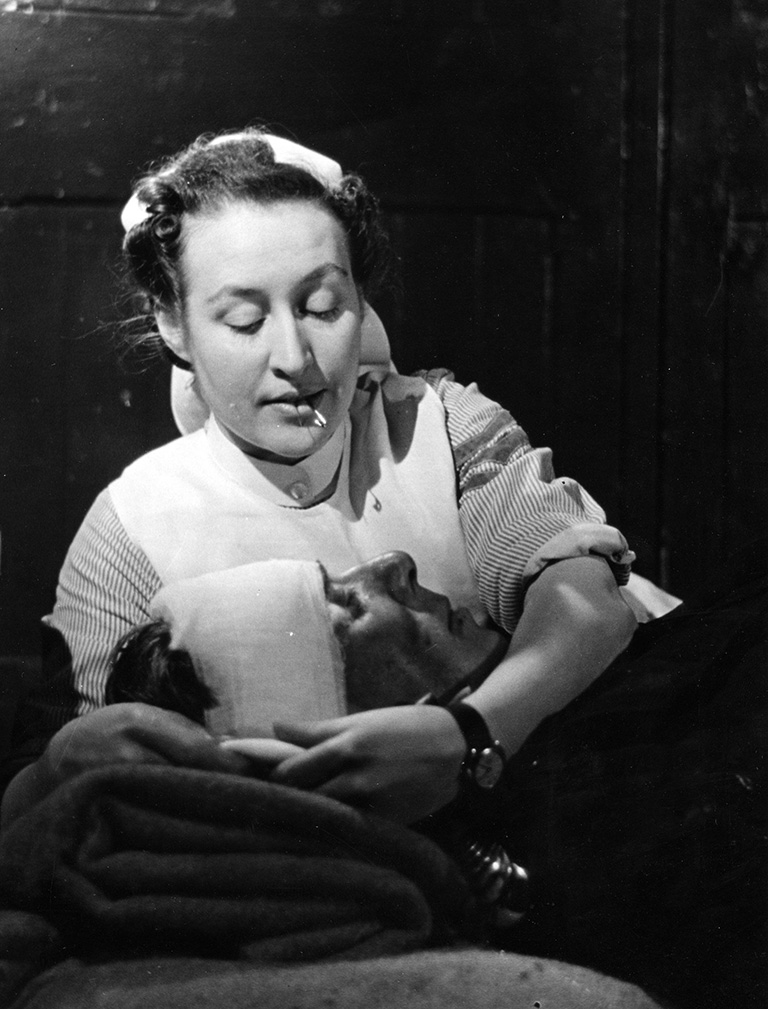
What are these records?
These are over 15,000 First World War service records for nurses in series WO 399 who served in the Queen Alexandra’s Imperial Military Nursing Service, the Queen Alexandra’s Imperial Military Nursing Service (Reserve) and the Territorial Force Nursing Service during the First World War.
The vast majority of the records cover the First World War period only. There are some records for nurses who served before 1914 and some for those who served after the war. There are no records, however, after 1939.
What information do the records contain?
The records can tell you:
- where a nurse trained (especially before the war)
- references relating to their suitability as military nurses
- hospitals, field ambulances, casualty clearing stations or other medical units they served in
- what their superiors thought of them (confidential reports)
- when they left the services
How do I search the records?
You can search and download the records in Discovery. (£)
Use the form below. You don’t need to complete both fields to find a record.
What do the records look like?
The majority of the records are based on pre-printed Army forms, which were then completed in ink or pencil.
The only items not on army forms are the references and any personal letters from the specific individual to the War Office or army nursing authorities.
To get an idea of what the records look like, see the record below of Marjorie Turton (catalogue reference: WO 399/8500):
Record of Marjorie Turton (9.03MB)
1. Why use this guide?
Use this guide if you are looking for British Army or Royal Navy records from the 17th to the 19th century on:
- the building and upkeep of fortifications and barracks
- the supply of military equipment
- the supply of heavy arms
- military maps
- the commissioning, payment, fitting and arming of warships
- payments for military goods and services, salaries and allowances
- daily operations of the Ordnance Board
- personnel of the Ordnance Board
These are records of the Board of Ordnance, responsible for the supply of arms, ammunition and other equipment to the British Army and Royal Navy until the late 19th century.
2. How to search for records
A search for documents at The National Archives usually begins in our online catalogue. Our records are grouped by ‘departments’, each with its own unique catalogue reference (a letter code). Each department is made up of multiple record series, all with their own unique references based on the department reference. Board of Ordnance records are held among War Office files. The department reference for the War Office is WO. The following sections of this guide provide links to the key Board of Ordnance record series within the WO department, helping you to target your catalogue searches more precisely.
By clicking on the series links (such as WO 47) you will arrive on the respective ‘series description’ pages from where you can search the series or browse through record descriptions one by one. However, many of these records are not described in any useful detail in our catalogue which makes keyword-searching trickier and browsing more necessary. Even browsing may reveal very little in some instances and we have created lists of records with more detail than can be found in the catalogue to compensate for this shortfall. These lists are in sections 3 and 4 of this guide.
Some records may have their own internal indexes which will help you locate information.
3. List of ordnance records relating to the Royal Navy
In the absence of consistent and comprehensive record descriptions in our catalogue for Board of Ordnance records we have created the following list of Royal Navy records.
For:
- lists of all guns, ammunition and other equipment issued, see WO 55/1625-1775
- detailed reports from Nelson’s flotilla bombarding Boulogne, see WO 55/1272
- details of armaments of ships preparing for sea, see WO 44/314
- Naval gunnery, chiefly inventions, see WO 44/498-499
- inventories of guns and naval stores at various dockyards, see WO 44/648
- correspondence on proportions of ordnance stores for various classes of ship, see WO 44/649
- details of armament of ships preparing for sea, see WO 44/652
- an alphabetical list of ordnance tenders, giving masters’ names, armaments, ships attached to and dates, see WO 54/673
- a survey of all guns at sea or in forts (known as the ‘Bedwell’s remains’,1589), see WO 55/1659
- issues and remains of Spain, Ile de Rhe and Rochelle fleets, see WO 55/1681-1685
- receipts, remains and issues for sea service and forts, Portsmouth, 1679, see WO 55/1715
- general instructions and duties of ordnance officers, 1716, see WO 55/1739
- establishment books, see WO 55/1743, WO 55/1745 and WO 55/1749
- a very detailed survey of all naval guns, available and required, 1688, see WO 55/1762
- a survey of expenditure, ship by ship, including their dates in commission, 1688-1692, see WO 55/1793
- a list of the whole Navy, including auxiliaries, giving tonnages and details of armament after two alternative establishments, 1703, see WO 55/1803
- alphabetical registers of ships commissioning, paying-off or altering established armament, 1793-1826, see WO 55/1830-1835
- inventories of gunner’s stores on board captured Dutch ships and on land at Colombo and Pte de Galle, 1796, see WO 55/1839
- Portsmouth ordnance office records, see WO 55/1985-2268
- an entry book of orders and warrants, Parliamentary Ordnance Office, 1645-1647, see PRO 30/37/4
4. List of ordnance records relating to the British Army
In the absence of consistent and comprehensive record descriptions in our catalogue for Board of Ordnance records we have created the following list of British Army records.
For:
- a miscellaneous collection of account, delivery, receipt and contract books and of warrants, correspondence and papers relating to the reign of Charles II, see PRO 30/37
- reports from officers and employees at home or aboard about their actions, 1753-1855, see WO 55/1-329
- a report by Major Montresor, on the campaign in Bombay with a collection of miscellaneous accounts of the artillery, see WO 55/283
- warrants, 1568-1855, see WO 55/330-538
- orders, chiefly relating to the military and the internal affairs of the office, see WO 55/539-639
- general and other orders for the artillery, see WO 55/640-713
- engineers’ papers and letter books, see WO 55/714-1063
- artillery papers, see WO 55/1064-1547
- reports on schemes of fortification, see WO 55/1548-1563
- records of lands, rents and buildings, see WO 55/1564-1622
- receipts, issues, remains and stores for the 17th and 18th centuries, see WO 55/1625-1775
- records of the King’s Works at Purfleet, 1793-1834, see WO 55/1941-1982
- plans and statements of ordnance lands and buildings, see WO 55/2269-3037
5. Personnel records of the Board of Ordnance, 1594-1871
The personnel records of the Board of Ordnance are scattered and inconsistent. They are in WO 54 but you cannot search this series by a person’s name in our online catalogue. Instead you can search either by year only (it is usually easier to browse when locating records by year as the records are arranged in year ranges) or by one of the following terms plus a year or range of years:
- Artillery
- Artillery Officers
- Artillery Battalion + Battalion number (for example, ‘Artillery Battalion 7’)
- Engineers
- Sappers and Miners
- Military Artificers and Labourers
- Pensions
6. Minute books, 1644-1856
These minute books include orders given to, discussed and carried out by the Board of Ordnance, including details of Board decisions and resulting action.
Browse WO 47 for the Board minute books as well as entry books of orders, letters and reports. WO 47 is divided into various volumes.
Most of the early Board minutes are not indexed. Browse and narrow down your search by date.
Locate some documents by consulting:
- WO 47/22-26, the ‘minutes, series 2’ (1705-1708) and WO 47/27-33, ‘minutes, series 3’ (1714-1720) which have an index in each volume
- the ‘extracts of minutes, series 2’ (from 1810) which have annual indexes in separate volumes
- the indexes for 1691 in WO 47/2853 and indexes for 1737-1753 in WO 47/2854
- the indexes to the board minutes for 1819-1852 in WO 47/2855-2897
You may also wish to browse WO 45 for correspondence as a point of reference which may refer to the Board minute books by date. See below.
7. Correspondence, 1682-1873
Locate documents by using indexes within WO 44 for the original in-letters.
There are three typescript indexes to WO 44 bound up with the WO 44 series list at The National Archives. They cover the entire class, under three headings:
- officers’ and men’s services
- inventions
- miscellaneous
These indexes cover both names and subjects.
Browse for other correspondence in:
- WO 55 for in-letters including those from artillery and engineer officers. Key records include:
- WO 55/423 for warrants and orders in council from the King and other commanders
- WO 55/459 for warrants from the Master-General to the Lieutenant-General
- WO 55/1661 for receipts and issues of stores, 1642-1646
- WO 46/111-169 for letters kept by various offices and officers of the Ordnance during the 19th century
- WO 46 for out-letters correspondence between the Board, the Master-General and the Lieutenant-General
For Reference books to correspondence (1783-1870), browse WO 45, It contains:
- brief summaries of the in-letters to the Board
- the Board’s action
- the disposal of the paper (if any)
In some ways they may be regarded as brief summaries of Board minutes and used as a quick reference to the minutes, but WO 45 is not strictly an index to WO 47.
The reference books in WO 45 notes for each in-letter are in the following columns:
- reference number (early volumes only)
- date of in-letter
- date of receipt (not at first)
- correspondent
- subject
- officer referred to, and when or any other action taken
- Board’s decision
8. Ledgers, contracts, quarter books, denture books and bill books
These records contain details of:
- payments for goods and services
- salaries and allowances
- inventories of stores or captured munitions
Each item is entered in some detail. Payments for stores delivered by contractors, or for captured munitions returned into store, provide a detailed inventory of the items. These entries provide a wealth of information on the daily operations of the Ordnance Board and on the commercial life of the period.
Use internal indexes to locate relevant documents listed below. Otherwise, browse WO 54 and some earlier volumes which do not have internal indexes to locate documents.
| Document type | Catalogue references |
|---|---|
| Contracts | WO 49/1-16 for original contracts (1783-1835) chiefly for fortifications, WO 49/110-206B for estimates, mostly for fortifications and works (1639 to 1850), WO 49/207-293 for a large number of miscellaneous accounts and financial papers |
| Quarter books | E 407/13, WO 54 (see below) |
| Debenture books | WO 49/17-109 |
| Bill books | WO 50-53 |
| Ledgers | WO 48 |
9. Parliamentary records
There are reports, accounts and other records relating to the Board of Ordnance in published Parliamentary Papers. You can access these online via Proquest UK Parliamentary Papers. This is a subscription website you can access on The National Archives’ computers by visiting us at Kew. You may also be able to access it via a large reference library such as a university library.
10. Further reading
Use our library catalogue to find a recommended book list.
1. Why use this guide?
This guide will help you navigate the Court of King’s Bench records 1200-1702.
If you are researching a person between the 13th and 18th centuries these records are very valuable. These and other common law records are the largest source of dated references to individuals until the start of parish registers.
These records are a rich source of information on:
- the development of common law and the legal process
- the judges, court officials and local officials
- the lives of the many individual litigants, especially their trespasses, criminal acts and financial dealings
- rural gentry, their tenants and officials and the local villages; and their illegal or semi-legal activities (especially in the earlier period)
- urban mercantile classes and local tradesmen and the growth of trade and commerce (particularly so later on)
- London, because of the development of the King’s Bench’s jurisdiction as the local (first-instance) court for Middlesex
There are frequently transcripts of proceedings in local courts, mainly of counties and hundreds, whose own records rarely survive.
The records of appointments of attorneys by litigants give extensive information about their careers and clientele and can be indicative of local social networks.
2. What was the Court of the King’s Bench?
The King’s Bench was the most senior criminal court in England for most of it’s existence, exercising supervisory jurisdiction over all inferior criminal courts. It was based on the principle of pleas heard regularly and formally within the king’s immediate purview even if not always in his actual presence.
The usual mechanism for bringing cases from local inferior courts to the King’s Bench was by means of a writ of certiorari (requiring the record to be sent to King’s Bench for review) obtained by an unsuccessful defendant.
There was an on-going conflict between the Kings Bench and Common Pleas courts over their respective shares of civil litigation. This was only settled after 1660. However, the court’s close association with the king meant it was superior to Common Pleas, taking from it cases where error was alleged.
Before 1536, many regions of Wales operated under a different legal jurisdiction. Welsh cases before this date may therefore be held in other collections. Please see the catalogue description for WALE for more information.
For further background see section 11.
3. An overview of the records
The records consist of various rolls and files which are either:
- Plea side – a case between two private parties
- Crown side – a case between the Crown and subject
They are rich in information but difficult to navigate because
- there are relatively few finding-aids to their contents (there are no indexes at all to the files, and very few to the rolls after 1250)
- some of them are not yet completely sorted or catalogued
- they are written in abbreviated Latin
Frequently the only practical way of searching the rolls not covered by published finding aids is to browse by county and date.
See the further reading section and section 6 for finding aids.
4. Court records: rolls and files
Until the later 17th century the records of the court consist of rolls and files.
4.1 Rolls
From 1200 to 1702 the records of hearings on both the Plea side (between two private parties) and Crown side (between the crown and subject), and minor business such as the casting of essoins and the appointment of attorneys, were written into a long series of plea rolls – KB 27. (See below)
After 1702 they were split into separate Crown series KB 28 and plea series KB 122.
4.2 Files
The legal process behind the material in the plea rolls is recorded in the various series of files. They consist of writs strung together with twisted parchment. These documents are sometimes in a poor condition.
File survival is nowhere near as complete as that of the plea rolls, but it improves in the later 14th century and again in the 16th. Only isolated examples survive from before 1272. (See section 7)
5. Plea rolls and subsidiary rolls
The plea rolls, traditionally called Coram Rege rolls in KB 27 contain the records of proceedings for each case for a given term. They are in formulaic Latin with many abbreviations for stock procedural phrases. You can search the KB 27 rolls online up to the year 1690 at the Anglo-American Legal Tradition website.
From the first half of the 14th century each roll consists of, in the following order:
- a pleas side roll
- a roll of fines and forfeitures (first seen in 1304, regular after 1323)
- a ‘Rex’ roll for crown pleas
- a roll of warrants of attorney
Rotuli for essoins are in some rolls until 1290, but a separate series of essoin rolls starts about 1256 (see section 5.1).
During the 14th century the fines and forfeitures become noticeably longer during sessions away from Westminster, as the issues of Justices of the Peace and other county officials were entered. When the court visited a county during these provincial sessions between 1323 and 1421, it also ‘delivered’ (i.e. heard all cases pending in) the gaols there. The records of the deliveries are filed in the rolls.
Earlier rolls for 1193-1272 are in KB 26. There is a detailed and indexed list of the Henry III rolls in Various Common Law Records (1970) (see further reading).
Essoin rolls
These rolls record the essoins which are allowable excuses for non-attendance. They begin as separate rolls, KB 121, from about 1256 (examples for before 1272 are in KB 26).
The earlier rolls are the most substantial, most covering only one term, but in the 14th century they gradually get smaller with the decline of the King’s Bench share of civil business initiated by writ. Despite the recovery and rapid growth of civil business in the 15th and 16th centuries, essoins continued to decline because cases were based on litigation by bill, in which essoins were not allowed.
After 1390 there are only two rolls, one for the whole reign of Henry V and another, covering the period from 1600 to 1800 (except for one membrane for 1487-1488). For a detailed account of these rolls, see Various Common Law Records (further reading).
Controlment rolls (c.1329-1840)
Controlment rolls in KB 29 were annual memoranda rolls kept for the clerk of the crown so he could check on the crown cases he was concerned with. They were at the core of his reference system, and are cross-referenced in other documents. You can search the Controlment Rolls online up to the year 1691 at the Anglo-American Legal Tradition website.
They begin to survive in 1329, although they may have been begun earlier, and they continue into the 1840s. In their fully developed form (in existence essentially by the reign of Henry VIII) they have three main sections for each term. These were:
- the Bag Roll, which contains a memorandum of every suit or prosecution begun in that term
- Roll of Entries (the controlment roll proper), containing a memorandum of all the proceedings in each case in each term, from appearance to judgment and after
- Special Writ Roll, in which all special writs, such as mandamus, scire facias etc were enrolled in full, with their returns if any were made
Read the catalogue description of KB 29 for further information.
Accounts of issues
A few estreats of King’s Bench fines, sent to the Exchequer between 1317-1738, are in E 101/108-110, 614-17, 667, 681-82.
Feet of fines
Few final concords were made in the King’s Bench, only 119 during the reign of Henry III, the latest known is from 1271. Most are in two files – CP 25/1/284/18-9.
Use the King’s Bench and Common Pleas in the Reign of Henry III (see further reading), as it has briefly calendared (summarised) the records.
6. Searching the rolls
Published sources/finding aids
Until 1250 there are full printed transcripts for all the rolls, except for a few essoin rolls, in Curia Regis Rolls, vols. 1-20 (1923-2006), which include full indexes of people and places, and for subjects in all but volumes 18–20.
From 1250-1390
You can use the judicial writs on files (see section 7) to a limited extent as an index to the plea rolls. Each contain a cross-reference to the rotulus of the plea roll on which its issue was authorised, a practice well-established by 1300. It’s especially effective when checking the writs for one or a few counties, and can provide real assistance in picking up one of the entries in a case.
Search the rolls in KB 26, KB 27, KB 29 and KB 121 by date. Once you have ordered a roll, the only practical way of searching within the rolls not covered by the above publications is by county and date.
In the rolls, county headings are given in the left-hand margin, so going through even a large roll looking for cases for a particular county is relatively quick, especially for a small county or one far from Westminster.
Once you find an entry for a particular case, you can follow it through the rolls backwards to its commencement and forwards to its resolution or, more often, its disappearance.
From 1390-1702
For this period there are quite extensive means of reference to Plea Side roll entries, which were created by court officials for their own use.
To find civil pleas there are Docket Rolls:
- from 1390 to 1656, use IND 1/1322-1384 – you can access most of these indexes, from 1558 onwards, online at the Anglo-American Legal Tradition website
- up to 1702, use IND 1/6042-6096 – you can access indexes from 1656 to 1702 online at the Anglo-American Legal Tradition website
The docket rolls consist of chronological repertories which give:
- a marginal note of the county
- the type of entry on the roll
- plaintiff and defendant names and the plea roll rotulus on which the entry is written
- some rolls also give lists of appearances of attorneys
The only means of reference to the earlier Rex rolls are the Controlment rolls in KB 29. These indicate by term the rotulus number on which a case is entered, or indicate the withdrawal or postponement of cases.
Later there are Great Docket Books of Crown cases in IND 1/6652/1-4, but little remains for before 1660. There are only six terms for Charles I’s reign: Trinity and Hilary 1631, Michaelmas 1639, and Hilary 1646.
There is a typescript list of deeds enrolled in the rolls for 1272-76 (KB 27/1-20), and a manuscript list for the period 1656-1760 (KB 173/1-2). Both are available in the reading rooms, Kew.
7. Files overview
The court’s files of writs and returns survive in great numbers until 1660. The number of file series grew at first slowly but after 1549 very rapidly, reaching their peak about 1630.
There are huge gaps, for varying periods, in most series after 1630-1631. The majority of the files for the last two centuries of the court’s existence were destroyed in the 19th century.
Many of those that have survived and have been identified are only partial, and what remains is sometimes badly damaged.
To identify whether there is a surviving file for the date required, browse or search the various series of files (see suggested series below) by date in our catalogue. Once ordered, the files usually have an established county order (see section 8).
What information can they contain?
Finding file material for a case can add much rich detail to information from the rolls. The files contain:
- lists of pledges for parties to the cases (these can be very informative about social networks if something is known about them from other sources)
- lists of jurors, sworn or unsworn
- records of proceedings in inferior courts, especially county, hundred and borough courts, in cases which were brought into the court on writs of recordare facias
8. Plea Side writ files: litigation by Chancery original writs
The main Plea Side file series is KB 136: the Brevia files. They began during Henry III’s reign, with a few surviving examples in KB 136/1/3 from 1257 onwards.
Their survival is patchy. There are gaps in the sequence of reference-numbers which may later be filled in by as yet uncatalogued material. Check the KB 136 catalogue description to find out how much of a file survives and has so far been identified.
How are they arranged?
The modern numbering of these files reflects the structure of the series, arranged by reign, year, term and return-day.
KB 136/3/4/1/7, for example, is a file from the reign of Edward II (3); from the fourth regnal year (4); from the first term of that year, which in this reign is Michaelmas (1); for the seventh return day of that term, the Octave of Martinmas (7).
Because the amount of business in King’s Bench was lighter than that of the Common Pleas, there are never two files for a single return day. From about 1368 one file often covered up to four return days. From 1607 there are term files, usually two for each term, reducing to one per term in 1642.
In the 13th and 14th centuries the writs within the files are arranged in a fixed county order, which was modified in the 15th century. The original filing order was: Norfolk, Suffolk, Essex, Hertfordshire, Cambridgeshire, Huntingdonshire, Middlesex, London, Kent, Surrey, Sussex, Hampshire, Wiltshire, Somerset, Dorset, Devon, Cornwall, Herefordshire, Worcestershire, Gloucestershire, Oxfordshire, Berkshire, Buckinghamshire, Bedfordshire, Northamptonshire, Rutland, Shropshire, Staffordshire, Warwickshire, Leicestershire, Nottinghamshire, Derbyshire, Lincolnshire, Yorkshire, Northumberland, Cumberland, Westmorland and Lancashire; although as a palatinate Lancaster disappeared from 1351-61 and then permanently after 1377.
The 15th century modifications were: Norfolk, Suffolk, Cambridgeshire, Huntingdonshire, Surrey, Sussex, Essex, Hertfordshire, Middlesex, Nottinghamshire, Derbyshire, Northumberland, Cumberland, Westmorland, and (in any order) Yorkshire, Lincolnshire and Lincoln.
Recorda files KB 145
These KB 145 files are the record of court proceedings of cases in inferior courts which were subsequently transferred to King’s Bench by one of the parties through the issue of a writ of certiorari facias. The earliest file so far identified is from 1327.
The files included both Plea Side and Crown Side recorda, but the latter eventually came to predominate and from 1677 it became a Crown Side file.
Many of the filings which came from broken Recorda files attracted the interest of archivists from the 17th to mid-20th centuries, who arranged them in artificial collections (such as KB 138 and C 47) without realising their provenance.
For the period between about 1320 and 1420, the Recorda files each had a smaller file called Precepta Recordum, attached to its parent by a linking thong, to hold smaller process documents. Only three tethered examples have survived, but many of the separated Precepta files survive and are also in KB 145.
Panella files KB 146 (c.1318–1606)
These were created mainly to hold the records of nisi prius sessions, as juries were increasingly used in the counties before assize courts to decide cases begun at Westminster. Justices returned their verdicts in the form of a Postea, together with names of the people serving on the jury panel, which gave the files their name.
During the 15th century, as litigation became more popular than pleading by original writ, the bills themselves were kept in these files, which sometimes had ‘Bille Finite’ added to their title.
Between 1519 and 1522 the Posteas were removed and arranged in county packets tied with parchment and labelled. Later the contents of the packets mostly became dispersed, and are unsorted, with only a small proportion in their original arrangements. These files are not accessible at the moment.
9. Plea side files: litigation by bill
Through the 15th century bill litigation became increasingly popular. After 1500, and especially between 1549 and 1607, much of the documentation for litigation by bill, principally initiated by what became known as a bill of Middlesex, followed by a writ of latitat, had out-grown the Panella files.
The Panella file had become large and unwieldy, and its now varied contents were hived off into several separate series of files (now KB 147-160) for convenience. From the period after 1500 you need to examine an increasing number of files to trace fully the documentation of a particular case.
From the point of view of the general research value of the material, the Declarations, the Bille and the Panella are much the most important of these series.
Splitting of the Panella files (1503 onwards)
In about 1503 the common bills (of Middlesex) and their related precepts were removed from the Panella files to a new series, the Bille Commune files, KB 148.
Then, about 1519-21, the Panella files lost all their remaining bill material, mainly real Middlesex actions, to another new series of Bille files, KB 147. These files also took over the filing of general orders about the court’s sessions from the Panella files. Panella files stripped of nearly all their content, carried on until about 1598 before ceasing to be kept.
Between about 1520 and 1548 the Bille files also took over:
- latitats returned endorsed ‘non sunt inventi’ or ‘cepi corpora’
- the declared bills, containing the true cause of the action
- final process writs and returns
They also took writs of ‘habeas corpus cum die et causa’ and their returns, probably from the Recorda files.
Splitting of the Bille Commune files (1550-1605)
The Bille Commune series in KB 148 also underwent many changes because of the gradual hiving off of many of its contents to new dedicated file series. KB 148 ends in about 1605, presumably because the entirely formal and purely fictional nature of the remaining contents were considered not worth keeping.
This subdivision process was long and complex.
Stage 1: In about 1550 the latitats returned endorsed ‘Non est inventi’, cases that were leading nowhere, were taken out of the Bille files to a new series of Non Sunt Inventi files, KB 153. This series ends in about 1590, probably because these writs were not worth keeping. They are of little interest unless they happen to mention a person of whom no other record survives.
Stage 2: The continuing Bille files continued to carry supporting process relating to bills, and were renamed Brevia Billarum files (KB 151). They included the jury panels, which made the files increasingly large. In 1571 they were removed to a new series of Panella Billarum files in KB 154.
The cases that the juries were impanelled to decide normally went to nisi prius sessions at the Lent and summer assizes, so the preceding Hilary and Trinity KB 154 term files became huge.
These two were reorganised in 1591 into 38 coverless files, one for each county, labelled with county and term, and wrapped around with thongs to group counties with the same initial letter with separate groupings for the less-used letters, 10 in all. The files for Easter and Michaelmas terms remained as before but were labelled ‘Venire Facias’. The files with panels are important as a source for the study of juries, because they give neat collections of juries for a particular county for a short and defined period.
Stage 3: In 1574 ‘habeas corpora’ writs of various kinds, such as bringing litigants into court for prosecuting or answering suits or making satisfaction, were also removed, to a series of terminal Habeas Corpora files, KB 155.
Stage 4: In 1589 latitats or other writs and precepts returned endorsed ‘cepi corpora’ by the sheriff were removed to Cepi Corpora files, KB 156.
Stage 5: This left the Brevia Billarum files shorn of all their mesne process, leaving only post-judgment writs and returns, so they were renamed Brevia Judicialia files, in effect ‘judgment writs’.
Stage 6: In 1607 they lost the writs of Capias ad Satisfaciendum to another new file series KB 157.
Subdivision of the Bille files (1549 onwards)
The Bille files, having become the main file for bill business, then became subdivided itself. This development may have come about as a result of the appointment of a former filazer, Richard Haywode, as joint chief clerk in 1549. That year the most important documents in the Bille files, the real bills themselves, were removed into a separate files, which soon came to be known as the Declarationes files, KB 152. These are the most important of all the new series, because they ‘declare’ the true cause of the action and are the equivalent of the earlier original writs.
The individual bills in them are undated until 1569, but then they became dated; by 1581 they were also numbered. By 1591 the number of declarations had become so great (8-9,000 a year) that there could be ten files for a single year, so it was decided to file them by the first letter of the plaintiff’s name. Smaller letters were grouped, creating 17 terms per file.
Auxiliary files
There are also four series of auxiliary files for litigation by bill.
1. Cedule files, KB 149, consist of notes (‘cedule’) of commitments to bail, and survive from 1514 onwards. At that point, many cases leading to bail were still initiated by writ and the bail notes are in an already established form. Within 30 years bill cases overwhelmingly predominated, and the formula ‘per recognicionem’ distinguishes real from fictitious bail, and the membranes altered to a pentagonal or hexagonal shape.
Afterwards, as common bail in bill cases became very frequent, the files became too large to have covers and vulnerable to splitting into chunks and loose membranes. By 1607 the files were re-named Baillia communia files. The individual bails are returnable on precise dates, so you can establish the working dates during each term. Within dates, the bails are filed in alphabetical order of attorneys.
2. From 1588 to 1614 docket rolls called Ballia Communia, KB 162, record the issue of bails.
3. In 1572 special (i.e. non-fictitious) bails, sometimes and later universally signed by justices and far fewer than common bails, were removed to a new series of Cedule per Recogniciones files, KB 158.
4. Docket rolls for special bails were kept between 1589 and 1602 (KB 163), but files from 1661 onwards were destroyed under schedule.
Miscellaneous files
Commititur files, KB 159, from 1610-1661 record committals to the marshal’s custody for the execution of court judgments. Satisfacciones files in KB 160 contain the plaintiff’s acknowledgement that the defendant has satisfied him for the adjudged debt and damages. From 1661 both series were destroyed under schedule.
The Warranta Attornata Recepta files in KB 150 are separate filings for warrants of attorney, not filed at the beginning of Brevia files as they were in the Common Bench. The earliest example is from 1463, the latest 1610, and the files add further detailed information about attorneys.
10. Crown Side files: criminal business
10.1 Brevia Regis files, later Brevia files KB 37 (c.1324-c.1692)
KB 37 emerged around 1300 to hold the process documents relating to the growing Crown Side business. They developed in parallel with the ‘Rex’ sections of the plea rolls (KB 27). The files took away material previously held in the older series of Brevia files in KB 136, which then became the equivalent file for the Plea Side of the court. The Brevia Regis files grew large as a result of the steady growth in Crown Side business. This resulted in the creation of the Indictments files (see section 10.2).
KB 37 are term files, arranged in county order like KB 136 (see section 8) and the equivalent Common Pleas Brevia files in CP 52. Internally they used the established county order used in both those other series, but did not adopt the revised order in which the others were arranged during the 15th century. The nature of their own rearrangement, within return days, has not yet been ascertained.
They are listed using the same numeration scheme as the King’s Bench and Common Pleas Brevia. It is not known exactly when the series was begun or ended. In 1598 the files were confusingly re-titled simply ‘Brevia’, in the 1650s translated as ‘A File of Writtes’. They ceased to be kept at an uncertain date after 1692.
10.2 Indictments files KB 9
These files in KB 9 emerged sometime between 1361 and 1385 to hold the main documents generated by the development of the court’s higher criminal jurisdiction, by then fully-formed and exercised both by:
- the court itself at its provincial sessions using trailbaston powers
- by commissioned justices sitting locally who then sent in their files
Earlier the same material was collected in the ‘Middlesex bag’ or filed in the Recorda files.
The first surviving term indictments file is from 1385, with a very good survival rate from 1391 onwards. You can access many KB 9 files, up to the year 1562, online at the Anglo-American Legal Tradition website.
You can browse the files in our catalogue by term until 1675. From 1675 it is separated into two series:
There are also some separate files containing the indictments and related material arising from the court’s oyer and terminer jurisdiction exercised during its provincial sessions. The series also contains another type of oyer and terminer files, resulting from special commissions issued on various occasions between 1351 and 1539 to justices who subsequently returned them to King’s Bench. These were kept separately from the ordinary KB 9 term files. Some smaller oyer and terminer files of that kind were, especially after 1430, filed in one of the term files.
These files are a major source for the study of disorder and related problems during the 14th and 15th centuries. By the end of the latter it had been established that indictments had to include:
- the name and occupation of the accused
- the date and place of the offence
- the name of the victim
- details of the goods stolen or the weapon
- the nature of the offence
The other documents in a file consisted of process relating to the indictments, including jury panels. There are also some medieval coroners rolls collected by the court during its travels, although the great majority are now in JUST 2.
The Controlment rolls provide cross-references to the files in the ‘Bag’ roll, which can sometimes be used as a form of index to the Indictments files, but usually the only practical method of searching is to work systematically through the files.
10.3 Informationes files KB 9
KB 9 also contain informations, bills of accusation brought by individuals suing both on their own behalf and for the crown. They were restricted to use only in cases of trespass against penal statute law.
By the 15th century, statutes took account of informations by prescribing a specific financial penalty of half of any fine to anyone successfully suing on behalf of the crown, and from the 16th onwards this became increasingly common.
There was an increase in informations filings on the term Indictments files during 1616–18, apparently leading to the temporary creation of a separate series of Informations files about 1617. The new series did not last long. From about late 1623 onwards informations are subsequently in the main files once more.
10.4 The Baga de Secretis KB 8
KB 8 is a series of files relating to ‘state trials’, between the late 15th and early 19th centuries, particularly for treason but also for particularly serious felonies. They were kept in a ‘bag of secrets’ stored in a locked closet.
They consisted both of enrolments of the proceedings and related process documentation. The defendants concerned included:
- Sir Thomas More
- Queens Anne Boleyn and Katherine Howard
- Protector Somerset
- Lady Jane Grey
- Archbishop Cranmer
- Guy Fawkes
- the Regicides of 1649 and the Jacobite rebels of 1715 and 1745–6
The courts which tried them were mainly special ones, most with commissions of oyer and terminer , but 17 took place in the court of the lord high steward. However, some of the 18th century ones took place on ordinary indictments in King’s Bench, and eight of the earlier files in the series, between 1477 and 1555, are ordinary King’s Bench indictments files. The presence of these files in the Baga de Secretis leaves gaps in the main series.
They were clearly moved to the bag because of the importance of the individual trials recorded in them, but they also include all the ordinary Crown Side indictments business for the term in question. In some cases it is difficult to be sure which case was thought important enough to justify their transfer to the Baga de Secretis.
You can search some records within KB 8 by the name of the accused. However, the best way to identify relevant records is to use the detailed calendar to the series. This calendar was printed in three parts in appendices to the reports of the 3rd-5th reports of the Deputy Keeper for 1842 to 1844, appendix II, pp. 214-68, 213-97 respectively. It is available in the reading rooms at Kew.
11. The Court’s jurisdiction
The jurisdiction of the Court of King’s Bench evolved over the centuries. It was founded as an alternative to the Exchequer, the Common Pleas and the justices in eyre, to hear pleas that fell within the king’s immediate purview. In 1178 five justices were appointed to carry out this purpose. However, the earliest known plea roll to survive from the court is from 1200, making that the first year for which there is evidence that the court had a distinct existence from any other court.
Suspended from 1215 to 1234 it subsequently had a continuous existence. It was eventually subordinate only to parliament. After 1234 the court was barred by chapter 11 of Magna Carta from hearing common pleas, as they were not to follow the court but had to be held in a fixed place. Therefore it came to specialise in pleas of special interest and concern to the king. For example, those which involved his own property interests, or breach of his peace, or an error of judgment by another royal court.
The distinction of its business from the Common Pleas was not so marked in the 13th century as it later became. The Common Pleas heard cases of trespass and even appeals of felony which later were exclusively appropriated by the King’s Bench. The differentiation of their relative spheres of activity came about gradually.
It advanced markedly in the first half of the 14th century, when a series of developments between 1318 and 1337 led to its recognition as the central court for the criminal law. In 1305 it adopted oyer and terminer r powers, previously only exercised by commissioned itinerant justices. It held numerous and extensive provincial sessions in many counties between 1323 and 1398, with revivals in 1414 and 1421. It then settled permanently at Westminster. Its smaller share of civil business compared to the Common Pleas continued until the 17th century.
By 1640, however, the King’s Bench was attracting most debt business, at the expense of the Common Pleas. From the mid-15th century, the development of the procedural device of the bill of Middlesex, enabled the court to bring in cases from all counties in England by creative use of its first instance jurisdiction in Middlesex, where it sat. It also obtained a share of business in ‘trespass on the case’, which originated in the Common Bench. With this a generalised initial allegation of trespass was supplemented by a ‘declaration’ of the plaintiff’s particular case. The court extended this to debt litigation. Similarly, in the 1560s the court adapted the new trespass device created for leases and ejectment, into an effective means for the recovery of land. This stretched its powers into the property business of Common Pleas.
The growing conflict between the two courts over their respective shares of civil litigation, which became serious in the later 16th century, was only settled in the decades after 1660. The King’s Bench, remained superior to the Common Bench throughout, taking from it cases where error was alleged.
12. Further reading
Some or all of the recommended publications below may be available to buy from The National Archives’ bookshop. Alternatively, search The National Archives’ Library to see what is available to consult at Kew.
For the institutional history of the court, the best short guide (by J B Post) is section 311 of the PRO Current Guide, part I (final edition 1998, published on microfiche), which is available at The National Archives in hard copy.
King’s Bench and Common Bench in the Reign of Henry III, Selden Society Supplementary Series (Selden Society, 2010). Gives a detailed list of sessions, justices and their records term by term throughout that reign.
Various Common Law Records, PRO Lists and Indexes, Supplementary Series, I (Kraus Reprint Co., 1970). Details of all the plea and essoin rolls 1217-72 and lists the court sessions during that period, as well as giving a detailed account of the essoin roll right down to the 18th century.
G O Sayles, Select Cases in the Court of King’s Bench, 7 vols., Selden Society 55, 57, 58, 74, 76, 82 and 88 (1936-71). Long and detailed introductions to the records (except the files, which were not then available) and their contents from 1272 to 1422, with much valuable information about the officials of the court.
M Blatcher, The Court of King’s Bench 1450-1550: a study in self-help. (Athlone Press, 1978). Useful for the rivalry between the court and the Common Bench over their share of lucrative debt litigation.
The Reports of Sir John Spelman, II, ed. J H Baker, Selden Society, XCIV (1978), pp. 352-67. Contains detailed information about the personnel of the court from 1485 to 1597.
J B Post, ‘King’s Bench clerks in the reign of Richard II’, Bulletin of the Institute of Historical Research, XLVII (1974), pp. 150-63, is a detailed study of the court officials in that reign.
C A F Meekings, ‘King’s Bench Files’, in Legal Records and the Historian, ed. J H Baker (Royal Historical Society, 1978), pp. 97-139. Gives a detailed description of the development of the file series (with an explanatory diagram) as well as detailed information about the research value of each series, their survival ranges, and lists of King’s Bench clerks from 1399 to 1547.
R L Storey, The End of the House of Lancaster (Barrie & Rockliffe, 1966) was the first monograph to make extensive use of the King’s Bench Indictments files.
Placita coram domino rege apud Westmonasterium de termino Sancte Trinitatis anno regni regis Edwardi, filii regis Henrici vicesimo quinto : [The pleas of the Court of King’s Bench, Trinity term, 25 Edward I, 1297] by W P W Phillimore and E A Fry (British Record Society. Index Library; v. 19).