1. Why use this guide?
This guide covers records related to art and artists for the 19th, 20th and 21st centuries. It focuses on how to find central government records held by The National Archives but also lists other useful archives.
Archival records are arranged according to the department that created them rather than by subject. Some art related records are held in discrete collections but others are scattered among a variety of written records and many may be undiscovered.
Record descriptions won’t always indicate the presence of art related material so you will need to be prepared for a degree of speculative searching and detective work.
If you find art related records (particularly original artworks) in our collection that you think we are unaware of use the feedback form in our catalogue to let us know. You can find this at the bottom of any catalogue description at record series reference, piece or item level.
2. What can I view online?
- Search for records of the Commission for Looted Art in Europe in record series T 209. Our research guide on Looted Art 1939-1961 explains more about this collection
- Search, or browse categories of our image library for visual collections including drawings, photographs, paintings, designs and posters
- View The Art of War; our online exhibition of war artists’ paintings and illustrations produced for the Ministry of Information. These are from record series INF 3 and were produced for propaganda and publicity purposes during the Second World War
- Browse by name of artist within the Tate Archive Collections for selected online artists’ archives digitised as part of the Archives and Access project
- Search the Visual Arts Database which contains selected listings of collections from a variety of archives and special collections
- Search or browse the Government Web Archive (see section 3)
- Search newspaper archives for reports of exhibitions and interviews with artists. Try the British Newspaper Archive, and The Times digital archive. Some newspapers are also available on Findmypast (£) and Ancestry (£)
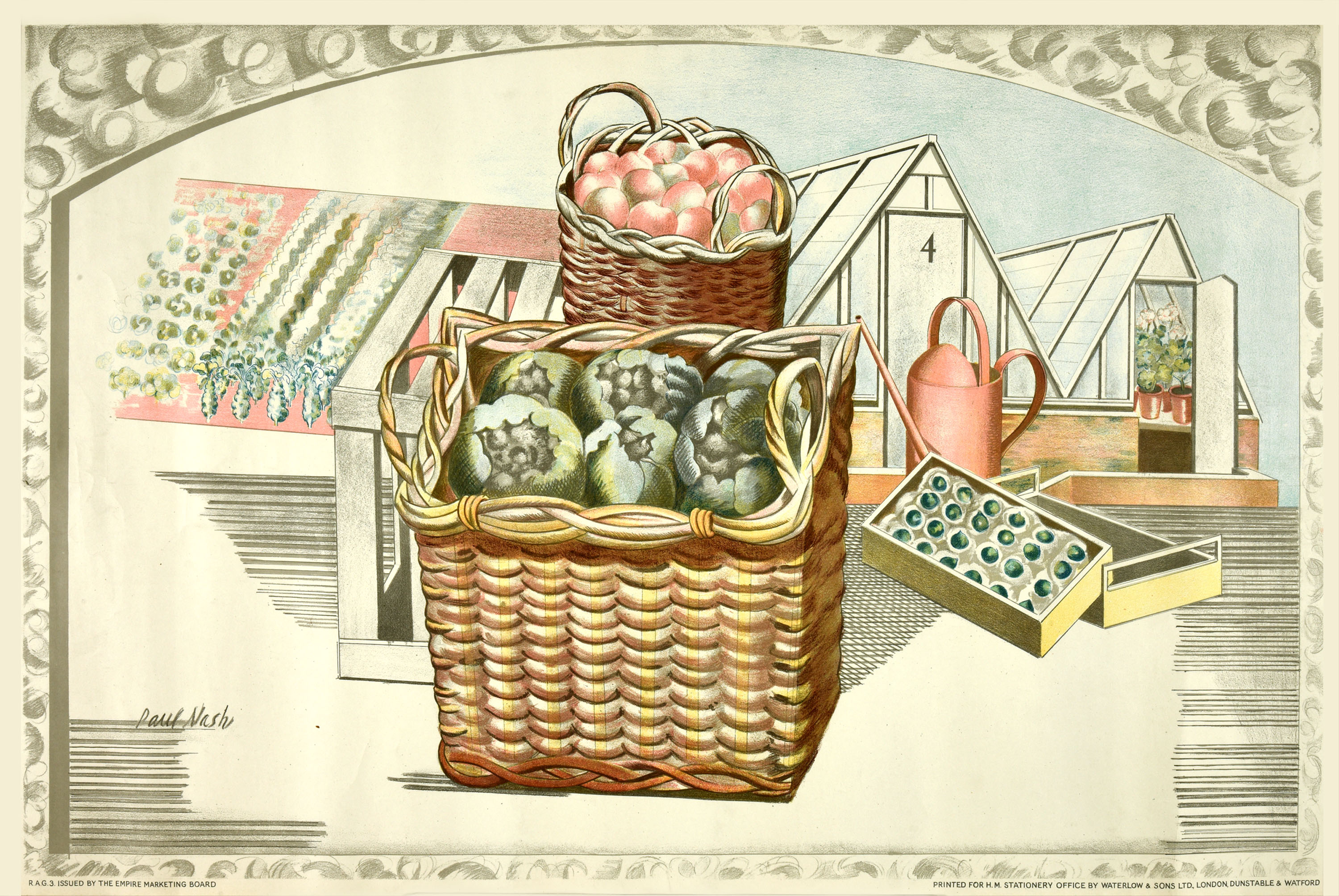
Empire Marketing Board poster by Paul Nash (catalogue reference: CO 956/515)
3. The Government Web Archive, 1996 to present
The Government Web Archive contains government videos, tweets, and websites dating from 1996 to present. You can browse or search for specific websites or twitter accounts such as those for Tate, Heritage Lottery Fund or particular government departments. Alternatively you can search by a keyword, such as ‘exhibition’ or an artist’s name, such as ‘Tracey Emin’.
Another way to find information on the Web Archive is to start in our catalogue. The records of the Department of Culture, Media and Sport and the British Council are good sources of information about cultural matters, but other departments can also have useful records as explained in other sections of this guide.
In our catalogue you can:
- browse entries for departments like the Department of Culture, Media and Sport or the British Council
- use Advanced search and search by keyword within department code reference (such as PF for the Department of Culture, Media and Sport or BW for British Council)
Where you find websites, videos or tweets that are available on the web archive there will be a link to click through to the relevant listings.
4. What does The National Archives have in its collection?
Like other records in our collection, those relating to art and artists have been created or inherited by government departments, agencies and courts of law as part of their everyday business. Those that were selected for permanent preservation became part of The National Archives’ collection.
In general, records relating to artists and artworks at The National Archives appear where an artist was working for the government; either directly or through an agency. Examples of this include where government departments worked with artists on exhibitions or publicity and propaganda material.
There are also non-commissioned artworks in the collection, such as sketches within war diaries or Colonial Office records. In these cases, the artist is not always attributed.
The National Archives also holds records relating to the establishment of many national museums and art galleries as well as various public bodies which have been set up to watch over art education and the export of works of art.
You can sometimes find references to records held in The National Archives within published works. If you are able to visit us you can use our reference library.
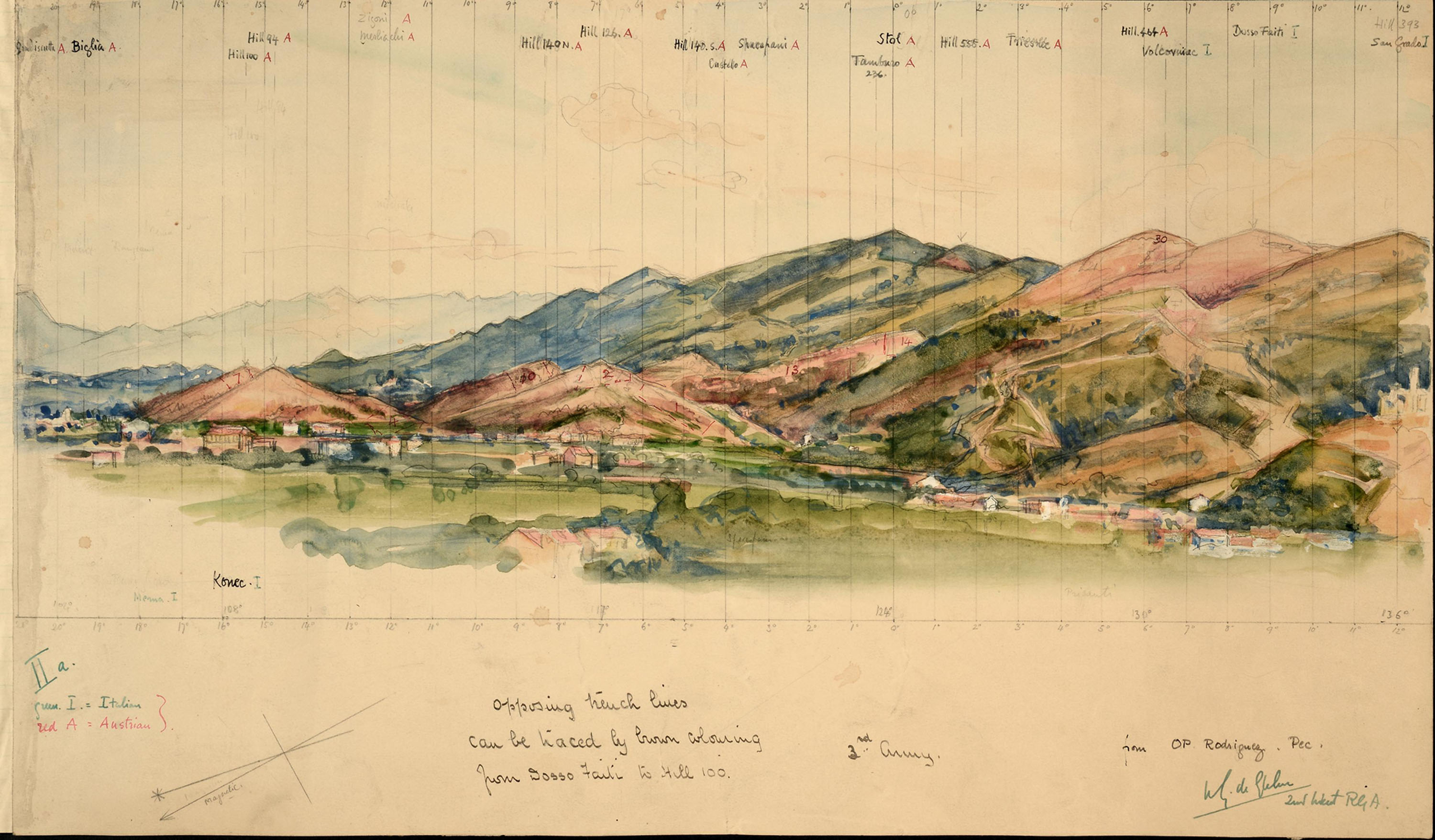
A watercolour sketch depicting view of opposing trench lines from ‘Sosso Trail’ to ‘Hill 100’ (catalogue reference: WO323/2/6B)
5. Searching Discovery, our catalogue
5.1 Using keywords
Search Discovery, our catalogue, to find records from The National Archives and over 2,500 archives across the UK. If you only want to search records held in our own collection you can select ‘Held by The National Archives’ below the main search box.
Try searching for:
- names of artists or artworks such as ‘Barbara Hepworth’ or ‘Contrapuntal Forms’
- names of exhibitions such as ‘Venice Biennale’
- the medium of artwork such as ‘painting’ or ‘sculpture’
- the type of work, committee or project such as ‘Italian Art and Archives Rescue Committee’
- combinations of the above
Bear in mind that the names of artists and art works can be listed in various ways. Try not to restrict your results by entering too much detail at the start. For example, a search (within The National Archives collections only) for ‘Cuneo‘ gets 66 results; ‘Terence Cuneo‘ gets 40 and Terence Tenison Cuneo gets 35.
Artists’ names are not always included in catalogue descriptions, so it is worth searching by an artwork’s name or by the exhibition it featured in as well.
Read the relevant sections below to help you identify document references that you can use when searching.
5.2 Using filters to narrow search results
The search results page allows you to filter your results in various ways. If you select the filter ‘Held by The National Archives’ at any point, you will see other filters become available such as collection and subject.
You can also apply filters such as record series and department code at the start of your search by using the Advanced search option of our catalogue.
On the Advanced search page, you can use taxonomy subjects to refine your searches. If you enter a key word in the ‘find these words’ section; then select search The National Archives in the ‘Held by’ section you will open up ‘taxonomy subjects’. Select ‘Art, architecture and design’ and then search.
For more advice on searching effectively, see Discovery help.
5.3 Understanding the catalogue descriptions
Records are arranged in a hierarchy of departments, series, sub-series pieces and items. Sometimes you will need to look at the descriptions at various levels of the hierarchy to understand more about who created a record, why they created it and what it might contain.
More guidance on how to use our catalogue, see Discovery help.
6. Festival of Britain 1948-1952, and other exhibitions
The National Archives holds administrative records relating to the organisation of exhibitions such as:
- Great Exhibition of 1851 in record series WORK 6 and BT 342
- Festival of Britain 1951 in WORK 25
- Venice Biennale (relating to British exhibitors) in records of the British Council
The Festival of Britain records in WORK 25 contain original graphic designs by Abram Games and others that were submitted for the festival itself as well as for publicity. There is also an extensive collection of photographs of the exhibits at the Southbank site, Battersea (Festival Pleasure Gardens) and elsewhere. A small selection of digital images from WORK 25 are available in our Image Library. The records include correspondence and minutes of the Festival Council, plans and drawings, printed matter and copyright documents. Other archives may hold records of the festival that complement our own.
To search our catalogue more broadly around exhibitions, use the Advanced search option. Enter the name of an artist or exhibition, or just ‘art’ or exhibition’; enter dates where appropriate; and in the ‘search within references’ boxes enter department codes such as:
- BW for British Council
- WORK for Ministry of Works
- FO for Foreign Office or FCO for Foreign and Commonwealth Office (see section 13 for more information)
- INF for Ministry of information
- BT for Board of Trade
You might find records relating to international artists, or exhibitions of British artists held abroad, within Foreign Office files; and where government worked with other organisations, you could find records in local and business archives.
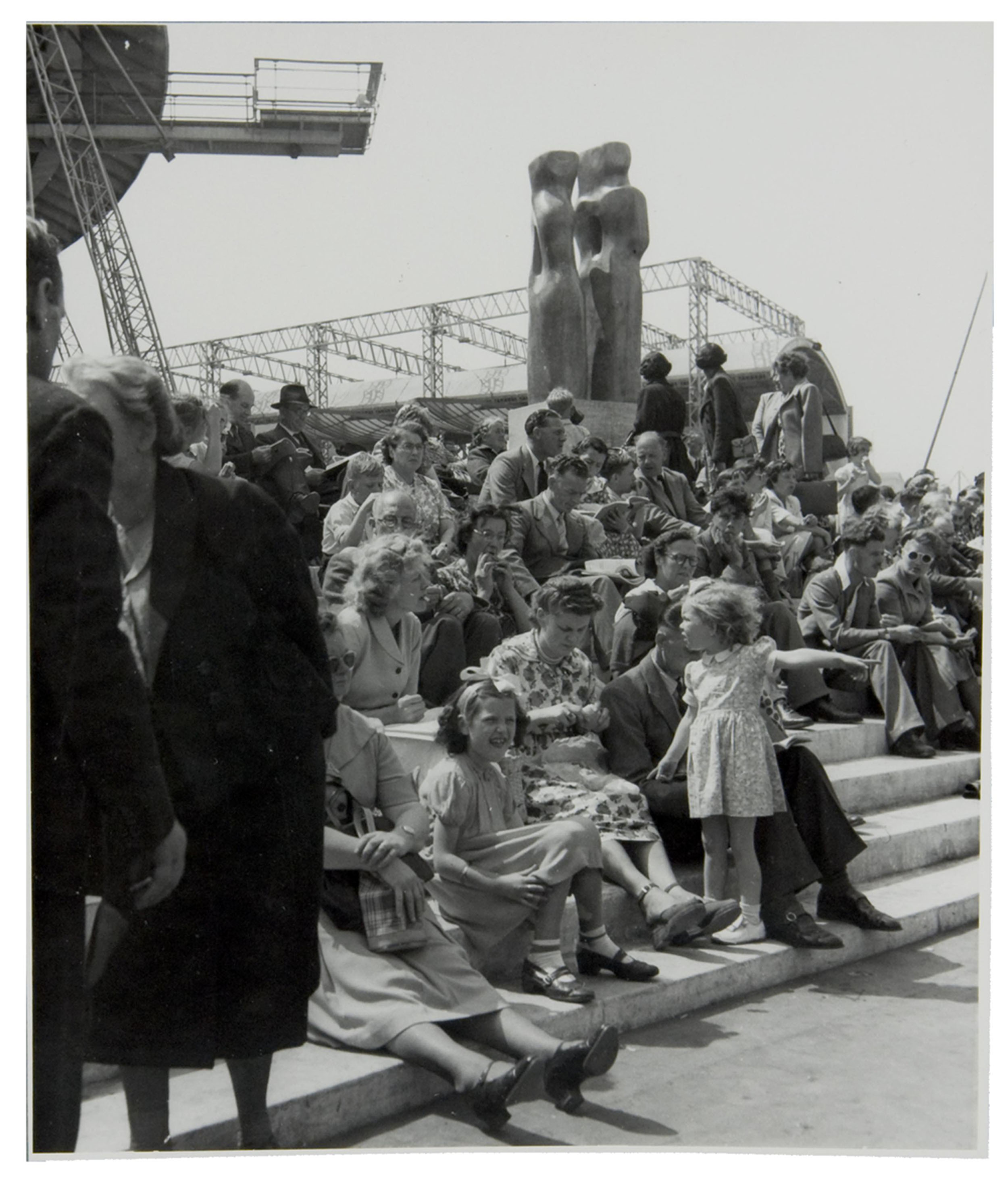
A photograph of a crowd with a Barbara Hepworth sculpture at the Festival of Britain, 1951 (catalogue reference: WORK25/213)
7. Government surveillance of artists
If the government took an interest in an artist or their work there might be mention of it in official records. For example, artists who were suspected communist sympathisers were monitored by the secret service.
Search record series KV2 for surviving personal files. You can search for a specific artist; or try a general search for ‘artist’ and browse the results. For instance, a search for Julian Trevelyan finds two files; KV 2/3931 and KV 2/3932. For more information on these records, see our guide on Intelligence and security services.
8. Copyright records 1862-1911
To protect their work under copyright legislation, artists would submit a registration form to Stationers’ Hall in London. Photographs or sketches of the work being registered were attached to the forms which are now held at The National Archives in record series COPY 1. Our research guide Copyright records of the Stationers’ Hall explains more about these records.
Sometimes a copyright proprietor registered a photograph of an artwork rather than the artwork itself. For example, William Francis Mansell registered copyright for his photograph of Rembrandt’s painting of Jean Pellicorne with His Son Caspar (COPY 1/456/86).
9. Second World War propaganda and publicity 1939-1946
Original paintings and drawings were produced for propaganda and publicity purposes during the Second World War. Search the Ministry of Information records in series INF 3 by name of artist or title of artwork. Some of these records are available in our online exhibition, The Art of War.
Some of the publications in which the art work was reproduced are in record series INF 2.
A selection of posters, booklets, leaflets and promotional material produced by the Ministry of Information, and later Central Office of Information, are in INF 13.
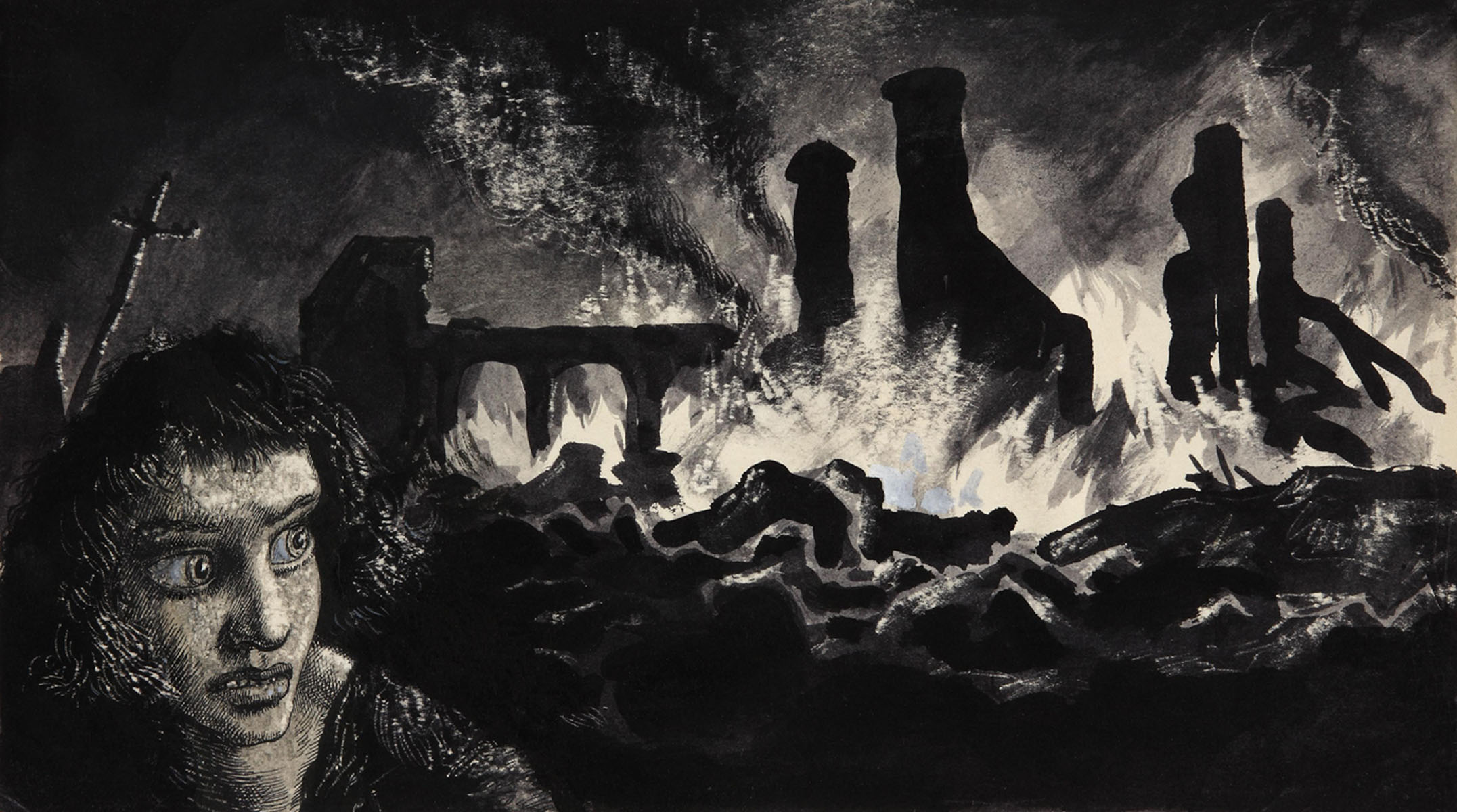
‘Head by Firelight’, a drawing by artist Mervyn Peake for a ‘Horrors of War’ booklet (catalogue reference: INF 3/658)
10. Art for railways and public transport
Artists were sometimes commissioned to create public artworks and publicity material for public transport bodies. You can find information relating to these commissions in records from the British Transport Commission and British Railways Board (department code AN) and in transport periodicals (department code ZPER).
Use the Advanced search option in our catalogue and enter AN and/or ZPER in the box for ‘search for or within references’. In the ‘Find words’ box you can enter ‘sculpture’ or ‘art’ and so on. Alternatively you can search using an artist’s name such as Cuneo or Gill.
11. The Government art collection
Search our catalogue for “government art collection” to find associated records from various archives. Those from The National Archives are mostly within department code WORK and particularly in record series WORK 54.
The Government web archive contains snapshots of the Government Art Collection website (see section 3 for more information about the Government Web Archive).
12. Treasury records
Every area of government action involved the Treasury department at some stage. This would include organisation of exhibitions and commissioning of public artworks.
For advice on using Treasury records in your research consult our research guides on Treasury Board letters and papers 1557-1920 and Economic history in the 20th century.
For records after 1920, you can use the Advanced search option in our catalogue and search by keyword within reference T (the department code for Treasury).
13. Foreign Office records
Correspondence from Foreign Office officials in the UK to their counterparts overseas could cover all sorts of things, including cultural matters. Try searching these records for information about British artists’ exhibitions or visits abroad, as well as foreign artists’ exhibitions in the UK.
See our guides to Foreign Office correspondence 1906-1919 and Foreign Office and Foreign and Commonwealth Office correspondence 1920 onwards for a more detailed explanation of how to search these records.
14. Looted art
Foreign Office and Treasury documents concerning looted art have been identified and digitised in partnership with the Commission for Looted Art in Europe. To search them use the form in our research guide Looted art 1939-1961.
15. Parliament’s Art Collection
Parliament has its own art collection, separate from the Government Art Collection. Parliament’s Archive Collections include records of Parliament’s Curator of Works of Art department and committee records relating to Parliament’s works of art. The Parliamentary art collection itself can be searched on the Parliamentary Heritage Collections website.
16. Other online archive catalogues
As well as using our catalogue, to search for records held in over 2500 archives you might find the following useful:
- The Archives Hub provides a single point of access to descriptions of archives held in UK universities and colleges. At present these are listed mainly at collection level, although where possible they are linked to complete catalogue descriptions
- Archives in London and the M25 area – AIM25 – is a major project to provide electronic access to collection level descriptions of the archives of over 50 higher education institutions and learned societies within the greater London area
- Scottish Archive Network (SCAN) – the project aims to revolutionise access to Scotland’s archives by providing a single electronic catalogue to the holdings of more than 50 Scottish archives
17. Other archives and repositories
These repositories and institutions listed below hold major collections relating to the history of art and artists.
17.1 General repositories
British Library, Manuscript Collections
The British Library holds papers of many of Britain’s foremost artists including William Blake, John Flaxman, William Hogarth, Thomas Gainsborough, William Morris and J M W Turner. The British Library catalogue for manuscript collections is available online.
17.2 Specialist repositories
Bankside Gallery holds the archives of the Royal Society of Painters in Watercolour, founded in 1804, and those of the Royal Society of Painter-Etchers and Engravers.
The British Cartoon Archive is dedicated to the history of British cartooning over the last two hundred years. The BCA holds the artwork for more than 150,000 British editorial, socio-political, and pocket cartoons, supported by large collections of comic strips, newspaper cuttings, books and magazines.
Courtauld Institute of Art The Courtauld Institute’s Book Library holds manuscript collections including the papers of a variety of collectors and patrons, researchers and artists. Many of these were donated to the Institute.
Federation of British Artists holds the records of its constituent societies: the Hesketh Hubbard Society, the New English Art Club, the Pastel Society, the Royal Institute of Painters in Watercolours, the Royal Society of British Artists, the Royal Society of Marine Artists, the Royal Society of Portrait Painters and the Society of Wildlife Artists.
Fitzwilliam Museum Collections of the Department of Manuscripts and Printed Books include: manuscripts of Sir Joshua Reynold’s Adaptation of Talents; and William Morris’s The Earthly Paradise; correspondence and literary papers of John Flaxman; correspondence and papers of Sir Edward Burne-Jones and George Romney; literary manuscripts of William Blake and correspondence and papers of many other artists.
Glasgow School of Art Archives are an excellent resource for art, design, architecture, art education and development of these disciplines along with the many influential people who have taught and studied there. The Archives include the School’s institutional records and a number of archive collections deposited by former staff, students and related organisations. Information on the collections is available online.
Henry Moore Institute The Henry Moore Institute houses and maintains the Leeds Museums & Galleries archive of sculptors’ papers including Henry Moore. Covering the 18th century to the present day, it has a particular emphasis on the 20th century and contains a diverse range of papers relating to British sculptural practice. Information on the collections is available online.
Kettle’s Yard Museum and Art Gallery holds the correspondence between Jim Ede, the founder of the gallery, and contemporary artists. It hosts ‘Recollection’, an expanding oral history archive that reflects how people of all ages think and feel about Kettle’s Yard.
Leighton House Museum The former home and studio of the leading Victorian artist, Frederic, Lord Leighton, is now a museum holding his papers, including correspondence with family and friends.
National Gallery Libraries and Archive The collection includes papers connected with the history of the picture collection and official records of the Gallery.
Scottish National Gallery Research Library The Gallery maintains research files on all items in its collections of pictures, drawings and sculptures. Information on collections held in the National Gallery of Scotland Library is available online.
National Library of Scotland, Manuscript Collections Among the extensive personal collections held by the Library, there are papers of numerous artists, painters and sculptors. The information about the manuscript collections held by the National Library of Scotland is online.
National Library of Wales holds several important collections of papers of artists relating to Wales, including Augustus John, Gwen John, Lord Leighton, Ceri Richards and Sir Edward Burne-Jones.
National Museum of Wales maintains files on artists represented in the collections of the Museum.
National Portrait Gallery Archive is concerned with the history of the Gallery and the history of British portraiture. Amongst the collections are papers of Thomas Phillips, Sir John Everett Millais and George Romney. Information on the papers is available online.
Royal Academy of Arts The Library, established in 1771, holds the archives of the Academy as well as a collection of Summer Exhibition catalogues, the records of the Society of Artists 1759-1807 and the papers of various past members of the Academy. This includes the papers of Sir Thomas Lawrence, sitters’ books of Angelica Kauffmann and Sir Joshua Reynolds and papers of Thomas Gainsborough, Alma-Tadema, Lord Leighton and Walter Sickert. Information on the collections is available online.
Royal Society for the Encouragement of Arts, Manufactures and Commerce also referred to as the Society of Arts and the Royal Society of Arts (from 1908), holds the Society’s records from its foundation in 1754, including minutes and correspondence, original design material and donated papers of members. There is a catalogue available online.
Ruskin Library holds correspondence, literary manuscripts and family papers of John Ruskin, together with many items of Ruskin’s correspondence with prominent figures in the Victorian art world. Information on the collections is available online.
Scottish National Gallery of Modern Art holds personal papers of a number of modern Scottish artists. Information on the collections is available online.
Scottish National Portrait Gallery holds a small collection of personal papers relating to Scottish portrait painters and maintains a reference archive of portrait works held in private collections and research files on items its collections. Information on the collections is available online.
Tate Gallery Archive holds the national archive of 20th century British art. Major collections include the papers of William Holman Hunt, Paul Nash, David Bomberg, Stanley Spencer, Alfred Turner, John Piper, Ben Nicholson and the art historian, Lord Clarke. Other major figures from the British art world represented are Sir Jacob Epstein, Dame Barbara Hepworth, John Minton, Sir Eduardo Paolozzi and Walter Sickert. Interviews with artists, press cuttings and photographs of artists are also held. Information on the collections and a catalogue are available online.
Victoria and Albert Museum, Archive of Art and Design The Archive of Art and Design was set up in 1978 to hold papers which would formerly have been collected by curatorial departments of the Victoria and Albert Museum. The collections have a particular emphasis on the 20th century. Major collections include papers of the publisher Benhard Baer, his correspondence with Lowry, Ben Nicholson, Graham Sutherland, Henry Moore and other British artists and sculptors. The Archive of Art and Design also holds the records of the Arts Council of Great Britain. The Victoria and Albert Museum’s own archive is also located here.
Victoria and Albert Museum, National Art Library, the largest art library in the world, it holds documentary material concerning the fine and decorative arts of many countries and periods. It is also the curatorial department for the art, craft and design of the book. Among the manuscript collections are papers of Sir Edwin Landseer, Thomas Gainsborough, Sir Thomas Lawrence, Dante Gabriel Rossetti and Graham Sutherland as well as many other artists, writers, curators and art critics, societies and dealers. Information on the collections and a catalogue are available online.
Wallace Collection Extensive archives relating to the art and object collections were built up by the Marquesses of Hertford in the 19th century and bequeathed to the nation by Lady Wallace, including a large number of 18th and 19th century sales catalogues, records of founders and trustees. Information on material held by the Wallace Collection is available online. In addition administrative records of the Wallace Collection are held by The National Archives.
William Morris Gallery William Morris lived in this house from 1848-1856. It now holds a permanent collection illustrating his life, achievements and influence. Archival collections include correspondence and writings of William Morris and his associates, such as Arthur Mackmurdo and Frank Brangwyn.
17.3 Overseas institutions
Many collections of correspondence and papers of British artists are held by foreign institutions, especially those in America. Foremost among these are the Huntington Library, California, and the Houghton Library, Harvard University, Massachusetts.
The Find an archive tool includes a list of overseas repositories holding collections relating to British history.
17.4 Local record offices
Local record offices also hold collections relating to art and artists, including family papers of art collectors and patrons, records relating to an artist’s personal background and the papers of local art societies and art clubs.
Addresses and contact details for local record offices in the UK are available via the Find an archive tool.
17.5 Schools of art
Many art colleges hold their own records which contain rich information on art education over the last 150 years. These records are likely to include governors’ minute books, letter books, registers of students, prospectuses and annual reports. Some colleges (such as Edinburgh College of Art) have their own facilities for accommodating researchers; others have deposited their records in local or national institutions.
18. Further reading
Some of the publications below may be available to buy from The National Archives’ bookshop. Alternatively, search The National Archives’ library catalogue to see what is available to consult at Kew.
18.1 The National Archives’ blogs
- Arts and Crafts at the Archives
- Art in the Archives
- Dynamic design: Bloomsbury, Chanel and Art Deco
- The personal and professional life of Barbara Hepworth
- Investigating the letters behind carving and shaping stone (Barbara Hepworth)
- 19th century artist in residence
- The Battle of Vimy Ridge: war art
18.2 Audio and video content (The National Archives)
- Barbara Hepworth: her life and works
- Festival of Britain
- The life and work of Mervyn Peake, by Sebastian Peake
- Arts and inspiration day at The National Archives 2014: Propaganda
- Arts and inspiration day at The National Archives: Design history and material
18.3 Published sources
The principal biographical reference works for artists are the international works by Ulrich Thieme and Felix Becker (edited by Hans Vollmer), Allgemeines Lexikon der bildenden Kunstler von der Antike bis zur Gegenwart (37 vols, 1965-1966), and Emmanuel Benezit, Dictionnaire critique et documentaire des peintres, sculpteurs, dessinateurs et graveurs de tous les temps et de tous les pays par un groupe d’ecrivains specialistes francais et etrangers (10 volumes, 1976).
There is no single English language work comparable. The largest art and artists dictionary in English is Jane Turner (ed), The dictionary of art (34 volumes, 1996).
Researchers might also make use of the series of the Dictionary of British art series, published by the Antique Collectors Club (ACC). The volumes currently available are:
Christopher Wood, Victorian painters (1995)
J Johnson and A Greutzner, British artists 1880-1940 (1976)
Frances Spalding, 20th-century painters and sculptors (1991)
David Buckman, Dictionary of artists in Britain since 1945 (1998)
Other publications by the ACC in a similar useful style include:
Simon Houfe, The dictionary of British book illustrators and caricaturists, 1800-1914 (1978)
Ellis Waterhouse, The dictionary of British 18th-century painters in oils and crayons (1981)
A further general biographical reference work of use generally is Who’s Who in Art, which has been occasionally published since 1927. Also:
Bryans Dictionary of painters and engravers (5 volumes, 1925)
Rupert Gunnis, Dictionary of British sculptors 1660-1851 (1951)
Alan Winsor (ed), A handbook of modern British painting 1900-80 (1992)
Alan Winsor (ed), A checklist of painters in the Witt Library c.1200-1994 (1995)
This is a brief guide to researching British government records on taxation. Tax records are wide-ranging and plentiful, though they can sometimes be complicated and not all survive. Of those that survive, most are available online or at The National Archives.
This guide will help you to gain a general overview of the main sources of the information that exists, and where to find it. The guide is for people interested in the subject of taxation as opposed to those interested in finding a specific person.
Online records
E 179 database of Records of the Exchequer (c.1190–c.1690)
Search the E 179 database by place, tax, document type and date for records relating to lay and clerical taxation in England and Wales.
Cabinet papers
Read our research guide to Cabinet and its committees for advice on searching our catalogue for cabinet papers.
The archived Cabinet Papers site has themed pages which you can browse, some with links to downloadable documents.
UK Parliamentary Papers (1715–present)
Search Proquest UK Parliamentary Papers for sessional papers on taxation in the House of Commons. This is a subscription website you can access on The National Archives’ computers by visiting us at Kew. You may also be able to access it via a large reference library such as a university library. These records are searchable in a number of ways, including by keyword, date and paper number.
Public Acts of Parliament (1801–present)
Search by date for Public General Acts of Parliament as they were originally enacted. This data set is complete from 1988 to present. Before that, it is partial and not all Public Acts are available online.
Records available only at The National Archives in Kew
To access these records you will either need to visit us, pay for research (£) or, where you can identify a specific record reference, order a copy (£).
There are many different records covering taxation at The National Archives. Try searching Discovery, our catalogue with a specific term, name or subject to help focus your search.
The most popular records on the subject of taxation are within series IR, CUST, T and E. To gain an overview of an individual series, read the descriptions within our catalogue.
General records
Search, browse and consult the following series to gain an overview of government records related to taxation:
- Inland Revenue (IR) – mostly general and administrative records on taxes, duties, lotteries and records of estates
- Customs and Excise (CUST) – general and administrative records of the Board of Customs and Excise and its predecessors
- HM Treasury (T) – records of the Treasury
- Exchequer (E) – records of the Exchequer
- Chancery (C) – records of the Chancery and its predecessors
Bear in mind that there is likely to be some overlap between separate series on any given subject. For example, a decision on taxation may have been informed by the Treasury (T), discussed by the Cabinet (CAB) and Prime Minister (PREM) and then carried out by the Inland Revenue (IR).
Records in other archives and organisations
Scottish taxation records
Consult the National Records of Scotland’s taxation records guide to find out what records they hold and how best to access them.
Records held locally
The National Archives’ catalogue contains collections and contact details of local archives around the UK and beyond. To locate these records, search our catalogue with keywords and refine your results to ‘Other archives’ using the filters.
Other resources
Websites
Discussions in Parliament can be found in Hansard, which is available online. Our research guide to Hansard details different ways of accessing the reports and records of Parliamentary debates.
Search The Times Archive and the Guardian and Observer Digital Archive to view articles (£) about some of the public statements and more newsworthy reports on taxation.
1. Why use this guide?
Use this guide if you are looking for records of a civil appeal case in England or Wales after 1875.
The guides focuses primarily on records of the Court of Appeal, the second highest court in the land, established in 1875.
2. The Court of Appeal and its records
The Court of Appeal hears:
- civil cases from the High Court
- appeals from county courts (since 1934)
- appeals from certain administrative bodies, such as the Lands Tribunal, the Patents Appeal Tribunal and the Income Tax Commissioners
Most records relating to appeal cases give very few details about the original case and only briefly note the decision on appeal, without giving reasons.
Written arguments were not submitted to the Appeal Court but the case was argued verbally in the court.
Most appeal case records held at The National Archives give very few details about the original case and only briefly note the decision on appeal.
After 1927 only a 2% random sample of most records were kept and are held by The National Archives.
3. How to find civil appeal cases
The National Archives may not be the best place to start your research, especially for more recent cases (1995 onwards). Recent court documents are with the Ministry of Justice but full judgments and court transcripts are available via online legal databases (subscriptions may be required).
The Find Case Law service provides public access to recent judgments from the England and Wales High Court, the Court of Appeal, the Supreme Court and tribunal decisions from the Upper Tribunals. The service will be expanded to include more courts and tribunals and a greater range of judgments will be added. For more information see the website.
Transcripts of some Court of Appeal (Civil Division) cases can be found on the BAILII website.
Significant cases are likely to have been published in The Law Reports, giving basic facts.
From 1884 Law reports were published in The Times (charges apply) which you can view free of charge at The National Archives, Kew.
You can search some records by name using advanced search but often you will need to browse records by date. If you need advice on how to browse, read our help pages.
It is useful to know which court the appeal came from as this affects where you look for records.
3.1 Cases from the Chancery Division (1875-1955)
For 1875-1955, cases that came from Chancery Division of the High Court should be registered in the Entry Books of Decrees and Orders in J 15. The entry records the referral and there will also be a note of the decision made by the Appeal Court.
Entry books are divided alphabetically by surname and by year. Surnames beginning A-K will be listed in ‘A’ books, surnames L-Z are in the ‘B’ books. Entries within the books are in chronological order, not alphabetical, and there are both printed and written series for each year.
To access these you need to use the Entry Book indexes which are available in the Map and Large Document reading room at The National Archives, Kew. You will need a readers’ ticket to view the indexes.
Registrars’ Court Books and Minutes Books in J 56 also have details of cases heard by the Court of Appeal but from 1927 only a 2% sample has been kept. You can browse them by date or search within the series by name of registrar if known.
3.2 Cases from King’s/Queen’s Bench or Exchequer Division (1875-1926)
If the case came to the Court of Appeal from the Exchequer Division (before 1880) or the Queen’s/King’s Bench Division (after 1880), judgments are noted in the rule books in KB 25. These cover the period 1875-1906 and you can browse them by year.
The rule books have indexes but the entries do not give much detail about the case. They also contain appeals from other courts, mainly county court cases relating to workmen’s compensation after 1897 (see section 3.5).
From 1907-1926, judgments are recorded in the order books in J 70, which are arranged chronologically. Each year then has several parts which each contain an index. You cannot tell which part you need so you will need to order all parts for the year you are researching. No order books have been kept after 1926.
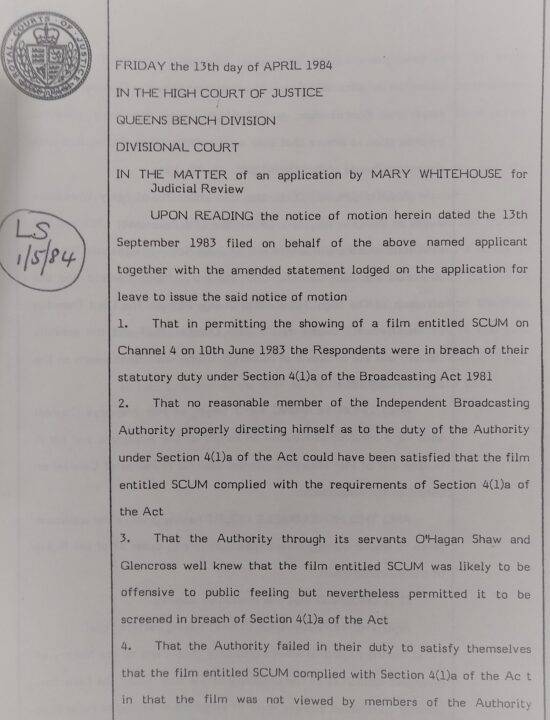
Detail of case file J 157/30, an appeal by Mary Whitehouse concerning the broadcast of the film Scum on Channel 4.
3.3 Selected case files (1981-1995)
For selected civil cases from 1981-1995 you can search by name or browse within J 157. The sampled records cover appeals from all courts. Case files record basic details of the appeals procedure and do not contain much information on the original case or any evidence presented for the appeal.
3.4 Final and Interlocutory Appeals motions (1918-1926)
Interlocutory appeals appeal on an aspect of a case while the case is still proceeding, while the final appeal is on the case as a whole. A motion is an application to the court.
Notices of final appeals to the Court of Appeal for the period 1918-1926 are in J 69, together with copies of the original judgment.
Notices of interlocutory appeals – appeals against procedural orders in the case – are also in J 69, for 1918-1920. They may be endorsed with the Court of Appeal’s ruling or include a copy of its final order.
County Court cases include judges’ notes. Notices of final appeal had to be submitted within six weeks, and those of interlocutory appeals within 14 days of the previous ruling. Only cases from county courts have to give the grounds of appeal.
After 1927, only a 2% sample of appeal notices have been kept. You can search later notices by name of appellant or respondent.
3.5 Workmen’s compensation cases (1875-1951)
Notices of appeal from county courts in workmen’s compensation cases can be found in:
- KB 25 for 1875-1906. You can browse KB 25 by date (see 3.2)
- J 70 for 1907-1926. Browse by date and order all parts for the year of interest
- J 71 for 1910-1951. Browse by date and order all parts for the year
Order books relating to workmen’s compensation appeal cases referred from County Courts are in J 72 and cover 1911-1926.
3.6 Records of the Employment Appeal Tribunal (1976-1988)
Selected case files are in series J 149 and are searchable by surname of appellant and the name of their employers.
Registers of cases are in series J 150, arranged by case number and year.
Transcriptions of judgments of the tribunal can be found on the BAILII website.
3.7 Appeals under the Benefices Act 1898 (1899-1952)
Appeals relating to an ecclesiastical benefice, which was heard by a judge of the Supreme Court and the archbishop of the province are in J 142.
You can search these records by name of appellant (often a vicar/rector) and respondent (title of Bishop).
4. If you can’t find a court of appeal civil case record
You can try looking for a High Court of Justice record which covers the period before the appeal. Only a 2% random sample of all High Court of Justice cases, together with cases considered to be of historical interest, are transferred to the National Archives.
You can search them by name within record series J 83 and J 84.
They can include:
- the Notice of Appeal
- the existing pleadings, orders and evidence submitted to the court appealed from
- the judgment
- in county court cases, judge’s notes
Confidential papers may be closed. Check the record description in our catalogue for further details.
5. Appeals to the House of Lords
Records relating to cases heard by the House of Lords on appeal are held by the Parliamentary Archives.
Copies of judgments made by the House of Lords on appeal from the Court of Appeal, together with petitions of appeal, are in KB 34/1 for the period 1885-1906.
Transcriptions of judgments in the House of Lords can be found on the BAILII website.
In 2009 the Supreme Court replaced the House of Lords as the highest court of appeal for civil cases in the United Kingdom.
6. Records in other archives
The Guildhall Library holds various collections of published law reports. Significant cases are likely to have been published in The Law Reports, giving:
- the basic facts
- arguments and the reason the court may have given for its judgment
The 1884 Law reports have been published in The Times (charges apply).
The British Library and the Law Society Library hold indexes to Court of Appeal transcripts. The Law Society Library will provide copies of individual judgments for a fee
7. Further reading
Visit the National Archives’ shop for a range of publications relating to courts and the legal profession.
Lord Justice Cohen, ‘Jurisdiction, practice and procedure of the Court of Appeal’, Cambridge Law Journal, volume 11, number 1 (1951)
1. Why use this guide?
This guide tells you:
- what the state papers domestic 1642-1660 are, and what information they include
- how to find state papers at The National Archives and elsewhere
- which finding aids and websites can help you search the various state papers
For any state papers domestic for other dates, refer to these guides instead:
- State papers domestic 1547-1649 – note that this covers the last reign of Charles I
- State papers domestic 1660-1714
- State papers domestic 1714-1782
For state papers relating to foreign and Irish affairs see
2. What are the state papers for 1642-1660?
The state papers domestic are the accumulated papers of the secretaries of state relating to home affairs.
They contain information on every aspect of early modern government, including social and economic affairs, law and order, religious policy, crown possessions and intelligence gathering as well as some references to foreign policy.
They may also include private and official letters, musters, reports, commissions and instructions, council orders and correspondence, proclamations, memoranda and draft parliamentary bills.
The state papers for c.1649-1660 covers period of the outbreak of the First Civil War to the Stuart Restoration. They comprise the papers of the Council of State and associated parliamentary committees, which provided the executive government of the country during the period. Information on many state papers for the last years of the reign of Charles I until his execution in 1649 can also be found in the guide State papers domestic 1547-1649.
Important committees included:
- the Committee for the Advance of Money
- the Sequestration Committee
- the Committee for Compounding with Delinquents
- the Committee for Plundered Ministers
- the Committee and Commissioners for Indemnity Committee indemnity
3. How do I search the records?
State papers for this period are only searchable by date on Discovery, our catalogue. The main finding aids instead are published calendars which can be used to trace a particular individual, place or subject.
The easiest way to search the calendars is to carry out a keyword search on State Papers Online (institutional subscription required or free to view onsite at The National Archives at Kew). This not only searches the calendars but also display digital scans of most (but not all) of the documents described in the calendars.
The calendars are also available online at British History Online (£). If you do not have access to these online sources, you can consult the printed version of the calendar of state papers available at The National Archives and in many major reference libraries.
The printed versions have the added benefit of detailed indexes which can provide additional identifying information to help with your search.
More guidance is given below on how to use the printed calendars for records arranged by parliamentary committee.
Some records of state papers exist in other archives; see below.
4. Council of State (1649-1660)
Papers of the Council of State are in SP 18 for 1649-1660, with Council of State Books and Accounts, 1649-1660 in SP 25.
SP 18 contains information on a variety of standing and ad hoc committees, including the Admiralty committee and commissions, in the form of letters, warrants, and orders.
SP 25 includes similar material including books and accounts as well as parliamentary orders. See also PRO 30/17/33 (September 1658 to January 1659).
4.1 Using printed calendars
You can locate most of the printed summaries of records in SP 18 and SP 25), with former references in the Calendar of State Papers Domestic, The Commonwealth, ed M A E Green, 13 volumes, (London, 1875-1886). It also refers to related documents in different record series.
Most documents which appear in the calendar can be ordered using the reference SP 18 and a piece number; this is the Roman numeral at the top of each page which should be converted into Arabic (for example SP 18/28 – Navy commissioners’ papers, 1652).
When an entry in italics and square brackets appears at the end of the summary, a different procedure should be followed: you need to look at the key in the front of the volume for the abbreviation and document reference so you can consult the document.
5. Committee of Both Kingdoms or Derby House Committee (1644-1650)
The Committee of Both Kingdoms or ‘Derby House Committee’ was responsible for the negotiations with the Scots from 1644.The records for Committee of Both Kingdoms or ‘Derby House Committee’ 1644-1650, are in SP 21. After 1649 it was replaced by the Council of State (see above).
See also SP 21/26 and 28 for order and warrant books and SP 63/266 for some references to its sub-committee on Irish affairs.
5.1 Using printed calendars
Committee records within SP 21 are summarised in:
- State Papers Domestic Charles I up to 1649
- Partially in the Calendars of State Papers (Domestic) Series of the Commonwealth
6. Committee for the Advance of Money (1642-1656)
Books and Papers of the Committee for the Advance of Money (1642-1656) are in SP 19.
6.1 Using printed calendars
Use Committee for Advance of Money, 1642-1656, ed M A E Green, 3 parts, (London, 1888) to locate summaries of SP 19.
Volume 1 contains a chronological order of general proceedings (SP19/78-87). Add ‘SP 19’ to an Arabic version of the Roman numeral at the top of the page. For references in square brackets at the end of an entry, substitute ‘SP 19’ for the ‘A’ and add the following number.
The remainder of the calendar contains individual cases with main references given in the right hand margin and lesser material in the left hand margin. For individual cases add SP 19 to the first set of numbers given in both right and left hand margins.
To find out what the abbreviations in the left and right hand columns of the calendar mean, look at the key in the introduction.
Not everything has been included in the printed calendars which exclude references to duplicated material and documents in SP 19/16– 20.
For a more detailed introduction to their arrangement, see the catalogue description of SP 19.
7. Committee and Commissioners for Indemnity (1647-1656)
The books and papers of the Committee and Commissioners for indemnity are in SP 24, 1647-1656.
7.1 Using printed calendars
Use the Calendars of State Papers Domestic Series of the Commonwealth which refers to SP 24.
7.2 Other finding aids
Note that these records are also partially indexed in IND 1/8899–8903. See our catalogue or the paper version of the series SP 24 at The National Archives.
8. Committee for Compounding with Delinquents, Royalist Composition papers (1643-1664)
The records of the Committee for Compounding with Delinquents, Royalist Composition papers are in SP 23, 1643-1660.
The Royalist Composition Papers are the particulars of the estates and personal property of delinquents taken on oath as part of the compounding process and can be found in this record series. Royalists then pay a fine to the parliamentary authorities to recover their (sequestered) estates if they pledged not to take up arms (again) against Parliament.
See SP 28 for related material concerning Parliamentary County Committees.
8.1 Using printed calendars
Use the Committee for Compounding with Delinquents, etc, 1643-1660, ed M A E Green, 5 parts, 1889-1893) to locate summary of records in SP 23.
Alternatively you can access the calendars of the Compounding Committee on British History online (£).
Not all relevant documents are detailed in the calendar entry. The right hand column gives references to those mentioned specifically in the text, while the left hand column refers to related documents not mentioned in the calendar entry. For individual cases add SP 23 to the first set of numbers given in both right and left hand margins.
There is also a one volume alphabetical printed index to the Royalist Composition papers,covering A-F (SP 23/61-227), which includes names not included in the main calendar.
For the index for G-Z, and for place name indexes covering England and Wales in SP 23/61-173, see the front note in the volume and the printed version of the catalogue list for OBS 1/629–636.
9. Sequestration Committee (1643-1653)
This dealt with the confiscation of royalist estates to 1644. Its Books and Papers, 1643-1653, are in SP 20.
9.1 Using printed calendars
Use the Calendar of State Papers Charles I (before 1649) which describes some of the records in SP 20. You can also use the Calendar of the Committee for Compounding with Delinquents as above, since this replaced the Sequestration Committee and took over many of its cases.
9.2 Other finding aids
SP 20 is also indexed by a one volume published index to the sequestration of delinquents’ estates (covering SP 20/1-8). These are selective indexes only.
9.3 Searching our catalogue
A selection of records within SP 20 is searchable by keywords in our catalogue. Try searching by topic, place or name.
10. Other relevant records series
Other relevant related records (which you can access on State Papers Online – institutional subscription required or free to view onsite at The National Archives at Kew) include:
- Committee for Plundered Ministers 1642-1653 in SP 22 (see also SP 23/22 and SP 28/7)
- Trustees for Crown Lands and Fee Farm Rents: Books, 1650-1660 in SP 26
- Parchment Documents, 1650-1659, in SP 27
- Commonwealth Exchequer papers, 1640-1674 in SP 28 – a particularly important collection
- Bills and answers against defaulting accountants, Charles II, in E 113 (for public monies received on both sides)
- Depositions by commission in E 134 which includes interesting depositions, for example those relating to administration of the army
- Parliamentary surveys in E 317 which includes records relating to sales of crown and church property
- Admiralty and Navy Commissioners records in ADM 2, ADM 3, ADM 7 and SP 46/96-98, 114-121
- ‘Shaftesbury Papers’ in PRO 30/24
11. Records held in other archives
Many relevant records (including the Thomason Tracts) are in collections held at The British Library.
The state papers were frequently treated as private property by secretaries of state many of whom incorporated them into their private collections on leaving office. Therefore, you may find state papers held elsewhere.
Try searching our catalogue to see if there are any relevant listed entries held in other archives or private collections.
12. Further reading
Search The National Archives’ bookshop to see whether any of the publications below may be available to buy. Alternatively, look in The National Archives’ library catalogue to see what is available to consult at Kew.
G E Aylmer and J S Morrill, ‘The Civil War and Interregnum, Sources for Local Historians’ (published for the Standing Conference for Local History by the Bedford Square Press of the National Council of Social Service, 1979)
G E Aylmer, ‘The State’s Servants: the Civil Service of the English Republic 1649-1660’ (Routledge & Kegan Paul, 1973)
C H Firth and R S Rait, ‘Acts and Ordinances of the Interregnum, 1642-1660’ (HMSO, 1911)
1. Why use this guide?
This guide will help you find information on the grants of rights for fairs and markets.
It will also suggest some more general records relating to the history of fairs and markets.
2. What can I find at The National Archives?
There is no simple register, at The National Archives or elsewhere, of people who are now entitled to hold markets and fairs.
You can trace records showing an early royal grant of such rights but these may have no bearing whatsoever on present day market rights.
Early markets and fairs were generally held in one of two ways and this affects whether it was recorded in a charter or not.
If they were held:
- by virtue of a specific royal grant, you are likely to find a charter recording it
- by prescriptive right, that is, based on immemorial custom, you may not find any charter evidence
You are also unlikely to find charters for markets and fairs held on the land within the royal demesne.
Most grants before 1733 were in Latin and there may not be a published translation. It is also rare to find details of the exact site or regulations governing the market or fair.
3. Medieval and early modern markets and fairs
3.1 Grants for markets and fairs until 1516
From 1199-1516 royal grants of markets and fairs were generally recorded in charters. You can usually find these in the Charter rolls (C 53). Grants are also sometimes in the Patent rolls (C 66) and Close rolls (C 54).
To find these grants start with the Gazetteer of market and fairs in England and Wales to 1516 (hard copies also available at The National Archives). This provides detailed information on the evidence for markets and fairs, and includes references which you can use to find the original documents in The National Archives. Please note, not all sources referred to in the Gazetteer are available at The National Archives.
You can also find summaries of grants in the printed calendars of Charter rolls, Close rolls and Patent rolls. These are available at The National Archives and major reference libraries.
For 1199-1483 an incomplete list of charters conferring rights over markets and fairs, compiled using documents in The National Archives, is in Appendix XIX of the First report of the Royal Commission on market rights and tolls (1889). Although superseded by the Gazetteer mentioned above, it is useful as it lists the grants chronologically.
3.2 Grants for markets and fairs after 1516
From 1516 royal grants were generally recorded in the Patent rolls (C 66).
There are a number of different types of calendars and indexes to help you search the Patent rolls, all of which are available at The National Archives.
3.3 Markets and fairs in special jurisdictions
The sources mentioned above do not cover grants made by special jurisdictions (notably the Duchy of Lancaster and the Palatinates of Chester, Durham and Lancaster).
To find grants within the Duchy of Lancaster, search Discovery, our catalogue, using the keywords ‘market OR fair’ within the record series DL.
For the Palatinates of Chester (CHES), Durham (DURH) and Lancaster (PL) read the publication notes within their full catalogue descriptions. These provide details of finding aids for the series.
3.4 Clerk of the Market
The Clerk of the Market of the King’s Household exercised control over weights, measures and market prices.
You can find related records in:
- accounts of the Exchequer (E 101 subseries: Marshalsey of the Household)
- Estreats (E 137, especially E 137/144/2)
- various enrolled Chancery series, State Papers Domestic and Lord Steward’s department. These have occasional mentions only
From the 1640s all owners of market rights were fully liable for maintaining their own correct weights and measures.
A few sample indentures of receipts for standard weights and measures from the Exchequer in the late 17th and late 18th centuries are in E 407/88.
4. Modern markets and fairs (late 18th century onwards)
For records of commissions, licences and correspondence concerning markets and fairs, search:
- HO 45 by keywords (‘market’ or ‘fair’, for example)
- HO 141 and HO 152. Choose the relevant file by date. The original documents will include further indexes and classifications
You can also search the London Gazette on The Gazette website for orders to discontinue fairs or alter their appointed days.
Owen’s New Book of Fairs lists the places and dates of markets and fairs held in the 18th and 19th centuries. The published successive editions can be difficult to find; however some are available online.
The First Report of the Royal Commission on Market Rights and Tolls (1889), Appendix XXI, reproduces Owen’s lists for 1792 and 1888.
5. Other records in The National Archives
If you are researching the history of markets and fairs, explore:
- Inquisitions ad quod damnum (C 143). From the reign of Henry III, these inquisitions often preceded royal grants to determine how they would affect existing rights. They are calendared in Lists and indexes XVII and XXII, available at The National Archives
- Investigations into alleged abuses of market rights in
-
- Quo Warranto proceedings (see Placita de quo warranto, Record Commission, 1818)
- the central courts at Westminster, including the prerogative courts such as Star Chamber and the Court of Requests
-
A useful introduction to litigation records, including courts held at markets and fairs themselves, is in C Gross and H Hall, Select cases concerning the law merchant.
Some surviving records of local courts are among the Court Rolls (SC 2). You can use Lists and indexes VI at The National Archives to help identify them. Others are in the appropriate local record offices.
You may also find many incidental references in other enrolled Chancery series, in the Pipe rolls (E 372) and in State Papers Domestic, some of which have been calendared or published.
6. Further reading
Some or all of the publications below may be available to buy from The National Archives’ bookshop. Alternatively, search The National Archives’ library catalogue to see what is available to consult at Kew.
Victoria county history is useful for establishing whether a particular manor was royal demesne at a given date.
A collection of Household Ordinances and Regulations (London: Society of Antiquaries 1790) pp 53 and 150
N J Williams, Sessions of the Clerk of the Market of the Household in Middlesex (Transactions of the London & Middlesex Archaeological Society) xix pt 2, pp 1-14
W Illingworth, Placita de quo warranto (Record Commission, 1818) (Particularly for 1278-1330)
C Gross and H Hall, Select cases concerning the law merchant (Selden Society vols 23, 46 and 49)

What are these records?
These are the service registers of around 110,000 men who joined the Royal Marines between 1842 and 1925. These records, in series ADM 159, were originally created in 1884 but include records created retrospectively for anyone who had joined earlier and was still serving in 1884.
For advice on how to view records of commissioned officers of the Royal Marines, see our guide to records of Royal Marines officers.
What information do the records contain?
The information in these records typically includes:
- date and place of birth
- occupation
- religion
- date and place of enlistment
- physical description
- names of ships and shore stations served on
- details of conduct or promotion
- medal entitlement
How do I search the records?
You can You can search and download (£) the records in our catalogue, Discovery, by filling in the form below.
You do not have to fill out every field to search these records.
If you don’t find a record, try leaving the date field blank.
What do the records look like?
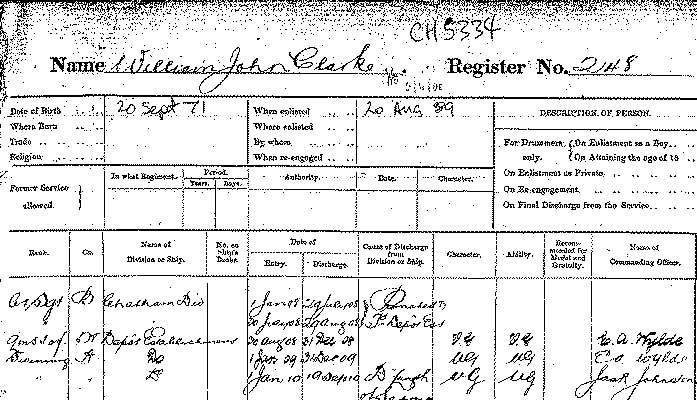
A Royal Marine service record (ADM 159/114)
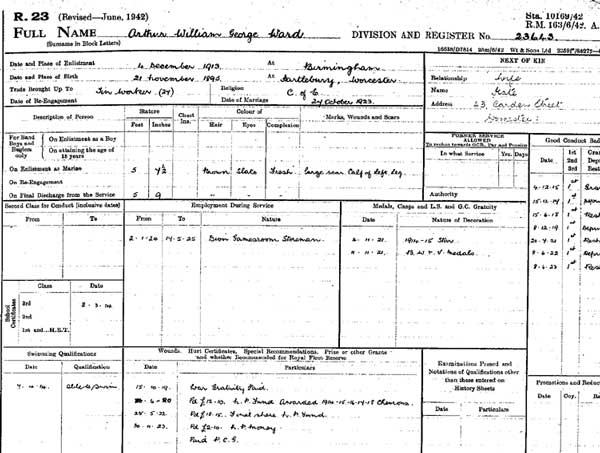
A Royal Marine service record (ADM 159/213)
Why can’t I find what I’m looking for?
If you cannot find a record for a Marine here, it may be for one of the following reasons:
- the person may have been an officer (officers’ records are held alongside Royal Naval officers’ records in series ADM 196)
- the Marine you are searching for had left the service by 1884
- most enlistments after 1925 are still held by the Ministry of Defence
You can also find records for Marines up to 1925 in series ADM 157, by searching in our catalogue: search pieces ADM 157/1-1251 by the Marine’s name.
1. Why use this guide?
This guide will help you to access the principal records of Home Office correspondence at The National Archives – though not all Home Office correspondence was selected for preservation.
Records of Home Office correspondence are vital to the study of late 18th to mid-20th century domestic British history (this guide covers records relating mainly to England and Wales), providing insights into a wide range of subjects relating to daily life. For example:
- administration of the criminal justice and penal systems
- the maintenance of public order
- the regulation of aliens
- naturalisation (the granting of British citizenship) – also see our guide on Naturalised Britons
- the control of explosives, firearms, drugs and poisons
- public health
- poor laws/poverty
- charities
- electoral administration
- civil defence
- fire services
The Home Office and the Foreign Office were formed on 27 March 1782, taking over and dividing the responsibilities of their predecessors, the Northern and Southern Departments. Find out more about the history of the Home Office.
For pre-1782 material covering similar subjects, see the State Papers records. For advice on these records, consult the following research guides:
- State papers domestic 1714-1782
- State papers domestic 1660-1714
- State papers domestic 1642-1660
- State papers domestic 1547-1649
Only a very small number of the records described in this guide are available online. In most cases, to view the records, you will need to either visit The National Archives at Kew or pay for copies to be sent to you.
2. Home Office registers of correspondence
In 1848, to cope with the growing diversity of subjects and the growing number of items of correspondence, the Home Office established a registry system, recording the daily receipt of letters. Correspondence dating back to 1839 was retrospectively registered. The options for searching, therefore, increase for correspondence from 1839 onwards.
The records held at The National Archives, as listed in our catalogue, are the items of correspondence selected for permanent preservation. The registers do not make this distinction and simply record all the letters received by the Home Office at the time. The registers therefore record some letters that have not survived and are not listed in our catalogue, and provide a more accurate picture of the total volume of Home Office correspondence, over time and by subject matter.
3. How to find correspondence up to c.1839 (before the registry system)
There are four main record series containing early general Home Office correspondence, HO 44, HO 42, HO 52 and HO 40. These often overlap both chronologically and in the nature of their content. Depending on the subject and dates of your research, therefore, it may be worth searching all of these series for relevant correspondence. However, the records within each of these series are described in different ways in our catalogue so search methods differ depending on the series and period.
Click on the following series references to search for document references and catalogue descriptions of correspondence in the respective series:
Search HO 44 (1773-1861):
- by keyword (some pieces are described with only a single line of text while others are catalogued in great detail)
Search HO 42 (1782-1820):
- by keyword from September 1789 to 31 December 1799 (described in detail)
- by date only after 1799 (most pieces after 1799 are described only as ‘letters and papers’ – however, the period from 1800 is currently being catalogued in detail and will be keyword searchable in the future)
- records can be downloaded from our catalogue as pdf files
Search HO 52 (1820-1850):
- for 1820-1829 by year range only (there are just five pieces for these years, all described as ‘all counties’)
- for most of 1830 and some of 1832 and 1837 by keyword (described in detail)
- for 1830-1838 by alphabetical ranges of counties (for example, Bedford to Kent)
- for 1839-1840 by alphabetical ranges of place names (for example, A-D, where a letter from Berwick upon Tweed would be filed); in the very last volume there are a small number of papers up to 1850
- records can be downloaded from our catalogue as pdf files
Search HO 40 (1812-1855) – for correspondence regarding disturbances, such as riots, strikes and political meetings (though disturbances are covered in the three series above too):
- by keyword (browse this series to view typical descriptions)
- records can be downloaded from our catalogue as pdf files
Search HO 41 (1815-1916) for Disturbance Entry Books (referencing files in HO 40):
- by date
You can also browse any of these series. For tips on whether to search or browse the catalogue, consult the Discovery help page.
4. How to find correspondence from c.1839-c.1979 (using the registry system)
For some background on the establishment of the registry system see section 3.
The two main series of Home Office correspondence for this period, for which the registers provide the key, are:
However, you do not now necessarily need to use the registers to find correspondence in these two series as most of it can be searched using keywords in our catalogue. That said, a keyword search will not always prove fruitful and even if it does you may find more information on a subject by consulting the registers. Other reasons to use the registers are:
- You may find a fuller description
- You may find a different description
- You may find references to letters (regarding people, events and so on) which do not survive
Search for correspondence from this period in any of the following ways:
4.1 Using just our catalogue
Use the advanced search page in our catalogue, search by keyword (including people, places and subject matters) and restrict your search to references HO 45 and HO 144.
Catalogue descriptions within these series vary significantly, running from a few words to several paragraphs. Finding some records with a keyword search is, therefore, harder than for others.
Use the subject lists at the front of the printed version of HO 45, only available at The National Archives at Kew, for tips on the kinds of keywords useful for searching.
There is a detailed index of subjects covered in Home Office correspondence in the PRO Guide: Part 1, section 401, also available exclusively in the reading rooms at The National Archives at Kew.
4.2 Using our catalogue and the registers
The registers of correspondence are in HO 46, covering 1841 to 1957, and consist of:
- registers of incoming correspondence
- separate registers of special subjects
- alphabetical indexes of correspondents
Use our catalogue to search or browse for a register within HO 46. Consult the register at The National Archives at Kew for a reference to a letter – this reference will take the form of a ‘paper number’.
The paper numbers in the HO 46 registers often form part of the HO 45 reference to which they refer. It is sometimes possible to find the HO 45 reference by entering the paper number in the ‘former reference’ box on the advanced search page. When this is not possible, you may need to consult the packing lists (see section 5.3).
The registry system changed many times over the years and there are therefore distinct sets of registers within HO 46 for different years, as shown below:
- 1839-1849 – HO 46/1A, HO 46/1B and HO 46/1C (these are for letters registered retrospectively once the system of registration began – they are known as OS {Old Series} papers)
- 1850-1871 (up to March 8) – HO 46/2-47
- 1871-1880 – HO 46/48-70 (all incoming papers in this period were registered in a series running from 1 to 100,000)
- 1881-1901 – HO 46/71-133 (in 1880 a new system of consecutive numbers started, with an A prefix; this was followed shortly afterwards by a series with B, V and X prefixes)
- 1902-1948 – HO 46/134-389 (the system of registration in these years was based on a six figure series starting at 100,001)
- 1949-1979 – In 1949 the Home Office ceased to use the HO 46 registry system, instead filing records in subject specific ‘Symbol Series’ (see section 5). However, ‘live’ HO 45 files continued to be updated until 1979. You can find these files by making a keyword search in our catalogue.
4.3 Using the catalogue, the registers and the packing list
Often the only way to find correspondence via the registers is to consult the packing lists. The packing lists are filed with the printed versions of HO 45 and HO 144, and are only available in the reading rooms at The National Archives at Kew. They contain references to the pieces that survive.
The table below indicates which records do and don’t require consultation of the packing list in order to access them. HO 45 and HO 144 are divided into blocks of dates, as shown, and each block has a subject arrangement within it.
For some blocks of years it is impossible to access the records without using the packing list but, in general, it is worth consulting them anyway as it provides a kind of “double check” to the search process.
Once you have a paper number, consult the table below and do one of the following (there are exceptions to these rules – try option 2 if option 1 fails):
1. Enter the paper numbers in the ‘former reference’ box on the advanced search page in our catalogue, placing an asterisk in the keywords box; the search result should provide you with an HO 45 or HO 144 reference code.
2. Find the paper number in the packing list and use both to form your HO 45 or HO 144 code
| HO 45 | 1841-1855 See option 1, above |
1856-1871 See option 1, above |
1871-1878 See option 2, above |
1879-1900 See option 2, above |
1901-1909 See option 2, above |
1910-1919 See option 2, above | 1920-1949 See option 1, above |
|---|---|---|---|---|---|---|---|
| HO 144 | – | – | – | 1879-1900 See option 2, above |
1901-1909 See option 2, above |
1910-1919 See option 2, above | 1920-1949 See option 1, above |
5. How to find correspondence and papers from c.1949 (after the registry system)
In 1949 a new system of filing Home Office correspondence was established, based on sets of files for each subject or function, each distinguished by letter codes, such as POL for Police files. These are known in our catalogue as Symbol Series. This system ran alongside the registry system for about a decade and then superseded it. These Symbol Series, arranged by letter codes, are in separate HO record series.
However, between 1949 and 1979 ‘live’ HO 45 files created before the change to Symbol Series continued to be updated. You can find these files by making a keyword search within HO for the subject you are interested in.
Search for Symbol Series files from the advanced search page in our catalogue, using “symbol” as your search term and searching within HO, or make a keyword search within HO for the subject you are interested in such as “police” or “lotteries” to search for symbol series files.
6. How to find other records of correspondence from c.1782
6.1 Criminal cases
Home Office files on criminal matters 1849-1871 are in HO 12. There are currently no helpful online catalogue descriptions for the records in this series, as a browse through HO 12 will show. However, there are registers of papers in HO 12 in HO 14 – you can browse through HO 14 to find registers by year.
For registers that were kept specifically for criminal cases (from 1899 onwards), search with the term “criminal cases” and by year using the HO 46 series search.
6.2 Foreign nationals in the UK and British citizenship
For the registers that were kept specifically for letters regarding foreign nationals in the UK and British citizenship, use our advanced catalogue search, restricting your search to reference HO 46 and the years you are interested in and searching using “‘Aliens” or “naturalization'” as your keywords.
6.3 Entry Books of out-going correspondence c.1782-c.1967
From its establishment the Home Office kept records of its outgoing correspondence (‘out-letters’) in ‘entry books’ or ‘letter books’. These entry books provide a useful overview of Home Office business in particular areas (especially before the registry system when incoming correspondence is kept in unsorted series). They also provide a more comprehensive account of all of the Home Office’s incoming and outgoing correspondence, as they have not been heavily weeded like the registered papers in HO 45 and HO 144.
Home Office entry books are organised into separate series by subject (for example, Disturbances Entry Books in record series HO 41, or Burials Entry Books in HO 85) and are arranged and described by date. To find entry books, use the advanced search in our catalogue to search within the HO department reference for the subject you are interested in. For example, search for ‘police’ and “entry books”.
6.4 Personal and Private Office papers of Home Secretaries
Browse by reference in HO 317 for files kept in the Private Office of Home Secretaries.
6.5 Large bundles of papers
Search HO 326 by keyword for bundles of papers which, because of their large size, have not been placed with the appropriate file in HO 45, HO 144, HO 291 or HO 287.
7. Further reading
Sir E Troup, The Home Office (Puttnams, 1925)
R R Nelson, The Home Office, 1782-1801 (N C Durham, 1969)
Sir F Newsam, The Home Office (Allen and Unwin, 1954)
1. Why use this guide?
This research guide describes records held at The National Archives of military operations and campaigns undertaken by the British Army and its predecessors from 1660 until the outbreak of the First World War in 1914. The guide provides advice on how to find these records, aiding research into English and British involvement in specific wars and conflicts.
This is not a guide to personnel records – for advice on finding these see our guides to British Army soldiers up to 1913 and British Army officers up to 1913.
A permanent, professional, standing army was not established in England until 1660, following the Restoration. What was then the English Army did not become the British Army until 1707. This permanent Army, sometimes referred to as the Regular Army, consisted of the Guards, and the Horse and Foot regiments.
2. What kinds of records are there?
Records held at The National Archives covering any given war or campaign tend to be spread throughout a number of different record series and types of documents. These varied series of documents are found chiefly within the State Papers department, for military campaigns before 1782, and the War Office department. Amongst the various types of documents that provide insight into Army campaigns are letters and other forms of correspondence, often between officials in central government and military commanders, headquarters papers as well as the private papers of military officials.
3. Published finding aids for campaign records
The major guide to military campaign records at The National Archives is the Alphabetical Guide to Certain War Office and Other Military Records Preserved in the Public Record Office (List and Index Volume 53 [LIII], Kraus Reprint Corporation, 1963). This is an index by subject, name and regiment to the State Papers and War Office records and provides document references for each entry.
Many of the State Papers have been indexed in the various Calendars of State Papers Domestic series, Charles II, James II, William and Mary, Anne (Public Record Office Calendars, 1860-1947). These indexes contain considerable detail and may sometimes preclude the need to consult the original records themselves.
4. Searching by name of war or campaign
You can search Discovery, our catalogue, using the name of a war, battle, campaign, or the country or region in which an action took place.
It will sometimes help to restrict such a search to departments WO and SP. The table below also provides some useful references for specific campaigns.
| Campaign or war | Dates of war | Record series |
|---|---|---|
| Third Dutch War, Flanders campaign | 1672-1674 | SP 44/52 |
| Nine Years’ War (also known as King William’s War) | 1689-1698 | SP 8, SP 87/1 |
| War of Spanish Succession | 1702-1713 | SP 87/2-7 |
| Campaigns in North America and the Caribbean against the French and various Native American peoples | n/a | CO 5 |
| War of Austrian Succession | 1740-1748 | SP 87 |
| Seven Years’ War | 1756-1763 | SP 87, WO 34 |
| Campaigns by the British forces in India 1757-1796 | n/a | WO 1, WO 40 |
| American War of Independence | 1775-1783 | WO 1, WO 36, WO 28/2-10 |
| Peninsular War | 1810-1814 | WO 1, WO 28, WO 107 |
| Opium War | 1840-1844 | WO 1, WO 6, WO 28 |
| Crimean War (aka Russian War) | 1853-1856 | WO 1, WO 6, WO 28 |
| Sepoy Mutiny | 1857-1860 | WO 28 |
| Boer War | 1899-1902 | WO 32, WO 105, WO 108 |
| Various campaigns of the later 19th century | n/a | WO 32, WO 107 |
5. Searching for details of military campaigns in official correspondence
A rich source of information on military campaigns can be found in the letters to and from central government departments and the military commanders in the field. The out-letters, sent from central government, were usually written either by the monarch, the secretaries-of-state who managed military affairs or the senior officers of the Army stationed in Whitehall, namely the Commander-in-chief, the Adjutant-General or the Quartermaster-General.
The table below provides the appropriate records series to search within according to date. Though the records series listed contain information on actions and campaigns of British forces, in many cases the series is not necessarily confined to these subjects and may contain much else besides.
| Dates | Type of correspondence | Record series |
|---|---|---|
| 1660-1828 | Kings’ letters, secretaries’ letters, warrants and other documents | SP 44 |
| 1670-1698 | Papers and letters of William III | SP 8 |
| 1674-1679 | Papers and letters of the Duke of Monmouth | SP 44/41, SP 44/48, SP 44/52 and SP 44/58 |
| 1684-1861 | Out-letters from the Secretary-at-War | WO 4 |
| 1695-1765 | Includes despatches from commanders and reports on both military campaigns and diplomatic negotiations | SP 87 |
| 1702-1711 | Reports and despatches of John Churchill, 1st Duke of Marlborough | SP 87/2, SP 87/3, SP 87/5 and SP 87/6 |
| 1702-1782 | Letters from the Secretary-at-War and the senior officers of the Army and the Board of Ordnance to the secretaries-of-state relating to military affairs | SP 41 |
| 1711-1712 | Papers and letters of the Duke of Ormond, Major General William Cadogan, Henry Watkins and others | SP 87/7 |
| 1714-1782 | Military entry books containing the secretaries’ correspondence on army matters | SP 44/176-203 |
| 1732-1868 | Letters, papers, despatches and reports of battles and campaigns addressed to the Secretary-at-War and its successor the Secretary of State for War | WO 1 |
| 1753-1815 | Letters, despatches, reports of battles and campaigns and papers addressed to the Secretary-at-War and its successor the Secretary of State for War | WO 40 |
| 1758-1855 | Out-letters to the Secretary-at-War and others | HO 51 |
| 1759-1858 | Indexes of correspondence consisting of abstracts of the letter books of the Secretary-at-War | WO 2 |
| 1765-1868 | Out-letters from the Commander-in-Chief | WO 3 |
| 1782-1840 | Letters from the Commander-in-Chief, the Secretary-at-War, the Board of Ordnance and other military departments. Includes correspondence about the French War (1793-1794) | HO 50 |
| 1793-1859 | Out-letters from Secretary-of-State | WO 6 |
| 1794-1840 | In-letters from the Secretary of State for War (and Colonies from 1801). After 1815, following the end of the Napoleonic Wars, the letters are concerned only with the Militia and other domestic military affairs. | HO 30 |
| 1801-1855 | Military correspondence of the War and Colonial Office | CO 323 |
| 1837-1962 | Reports of actions and campaigns in which British forces participated | WO 106 |
| 1855- | Military correspondence of the Colonial Office from 1855, including the affairs of the King’s African Rifles and the Niger and West Africa Frontier Force, which were in peacetime administered by the Colonial Office | CO 445, CO 534, CO 581, CO 582, CO 623, CO 624, CO 641, CO 642, CO 820 and CO 871 |
6. How to find records of Army strength, location and movement
The strength, composition, location and movements of units and formations of the Regular Army and, after 1855, of the whole Army, may be found in these series:
| Dates | Record series | Type of records |
|---|---|---|
| 1661-1846 | WO 24 | Establishments |
| 1683-1852 | WO 5 | Marching orders |
| 1750-1912 | WO 27 | Inspection returns |
| 1754-1866 | WO 17 | Monthly returns |
| 1758- | WO 25 | Embarkation and disembarkation returns |
| 1737-1967 | WO 379 | Disposition and movement of regiments |
| 1803-c.1983 | WO 380 | Designation, establishments and stations of regiments |
| 1859-1950 | WO 73 | Monthly returns |
7. How to find records of Army supplies and finances
The government department responsible for supplying food to the Army was known as the Commissariat, which was run by the Treasury. Records of the Commissariat up to 1855, and the financial affairs of the Army in general, can be found in Treasury Papers T 1, T 27, T 53 and T 54, and from 1855 in T 24.
8. How to find maps and plans
Maps and plans will be found in WO 78 and WORK 43. Most are of forts, barracks and other military establishments, but they include many bearings on operations.
9. How to find records of campaigns in private papers
The private papers of high-ranking Army officers are another useful source for researchers looking for details of particular military campaigns and the British involvement in them. The table below provides the record series references for the private papers of Army officers, or the official papers they collected, which are held at The National Archives.
The records of British Army Headquarters in North America from 1775-1783 are in PRO 30/55, and include papers of the successive commanders-in-chief, Generals Thomas Gage, Sir William Howe, Sir Henry Clinton and Sir Guy Carleton.
| Individual | Relevant service and campaigns covered by papers | Dates of records | Catalogue reference |
|---|---|---|---|
| General Sir Jeffrey Amherst (later Lord Amherst) | Commander-in-Chief in America 1758-1763; Governor of Virginia 1763-1768; Commander-in-Chief at home 1778-1782 and 1783-1795. Military operations in North America during the Seven Years’ War 1756-1763 and the American War of Independence 1775-1783. Relations with and operations against Native American tribes. | 1712-1786 | WO 34 |
| Sir Guy Carleton, 1st Baron Dorchester | These papers comprise records of British Army Headquarters in America from 1775 to 1783. They represent the official notes of General Thomas Gage, Sir William Howe, Sir Henry Clinton, Sir Guy Carleton as successive commanders in chief. | 1747-1788 | PRO 30/55 |
| General Sir Robert Brownrigg | Military secretary to the Commander-in-Chief 1795-1803 and Quartermaster-General 1803-1811. | 1792-1820 | WO 133 |
| General Sir Redvers Buller | Zulu campaign of 1878; Commander of Natal Army in Boer War 1899-1900. | 1872-1901 | WO 132 |
| Major-General Sir James Carmichael Smyth | Senior officer with the Royal Engineers; service in the Cape of Good Hope 1806-1807; service with Sir Thomas Graham’s Dutch expedition and fortifications in the Netherlands and France 1813-1818. | 1805-1838 | PRO 30/35 |
| Colonel R B Colvin | Records of the 20th Battalion, Imperial Yeomanry | 1900-1902 | WO 136 |
| Lieut-General Charles Cornwallis | Service in the American War of Independence from 1780-1782. There are also papers relating to his later service in India. | 1612-1854 | PRO 30/11 |
| Major-General Sir William Eyre | Crimean War 1853-1856 | 1855-1859 | PRO 30/46 |
| Lieutenant-General H G Hart | Ashanti War 1873-1874 | 1838-1875 | WO 211 |
| Field-Marshal Earl Kitchener | The Gordon Expedition and the conquest of the Sudan; the Boer War; tenure of office as Commander-in-Chief, India | 1877-1938 | PRO 30/57 |
| General Sir Galbraith Lowry Cole | Served in Sicily 1806-1809 and commanded the 4th Division in the Peninsula 1809-1815. Official and personal letters and papers. | 1752-1843 | PRO 30/43 |
| General Sir George Murray | Commander-in-Chief in Ireland 1825-1828; Secretary of State for War and the Colonies 1828-1830; Master General of the Ordnance 1834-1835 and 1841-1846. | 1804-1859 | WO 80 |
| General Sir Marmaduke Peacocke | Commander in Lisbon 1809-1814. Garrison and general orders only. | 1808-1814 | WO 134 |
| Major Rice Price | 56th Foot papers and journals, covering a considerable part of the siege of Gibraltar by the Spanish in 1779. | 1760-1827 | PRO 30/85 |
| Field-Marshal Lord Roberts | Commander-in-Chief during Boer War 1899-1902 | 1835-1905 | WO 105 |
| Major J S Rothwell | British Operations in China 1840-1842 | 1884-1891 | WO 273 |
| General Sir George Scovell | Served during the Peninsular War in the Intelligence Branch of the Quartermaster-General’s Department and was for sometime Wellington’s chief cipher officer. Many intercepted French dispatches, campaign diaries and miscellaneous papers. | 1762-1860 | WO 37 |
| General Sir Harry Smith | Served with Rifle Brigade on the Montevideo expedition 1806-1807; in the Peninsular War 1808-1814; in America 1814-1815 and Waterloo 1815. There is a diary covering 1806-1808 and official and private letters from 1813. | 1805-1851 | WO 135 |
| Field-Marshall Lord Wolseley | War with China 1860; Ashanti War 1873-1874; Zulu War 1879; and the Sudan expedition of 1884. | 1860-1885 | WO 147 |
10. Administration and hierarchy of the Army
During the 17th century and after, the commander of the Army, the principal military adviser to the Crown, took the title Captain-General or Commander-in-Chief. This position was filled only when required. The two most senior permanent officers of the Regular Army, responsible for discipline and administration, were the Adjutant-General and the Quartermaster-General. They worked from Whitehall with the Secretary-at-War, a civilian official.
Until well into the 18th century, however, discipline and the control of operations were closely controlled by the King himself. The appointments to field commands, and all orders for field operations, were made in the King’s name by one of the Secretaries of State.
Weapons and ammunition were issued by the Board of Ordnance, which was responsible through its head, the Master-General of the Ordnance, directly to the King (until 1801 Irish regiments at home were similarly supplied by the Irish Ordnance Board). Besides issuing weapons and ammunition, the Board of Ordnance was also responsible for the Corps of Artillery and Engineers, and for the Waggon Train.
In 1854-1855 the office of Secretary-at-War and the entire Board of Ordnance were abolished and the administration of all arms, and of the Commissariat, responsible for supplying the Army with food, was combined in a new department, the War Office. At the head of the War Office was the Secretary-for-War. The Commander-in-Chief was from 1870 subordinated to the Secretary-for-War, and in 1904 abolished.
11. Parliamentary records
Reports, accounts, correspondence and other papers relating to army operations may have been laid before Parliament and can be found in the House of Lords Main Papers. Search the catalogue for the name of a war, battle, campaign, or region. Searching for “American papers” brings up many papers relating to the American War of Independence.
From 1803 onwards, discussions in Parliament on army operations can be found in Hansard, which is available online on the Parliament website. Please note Hansard is a selective record before 1909. There are also some volumes missing from the online data.
Our research guide to Hansard details different ways of accessing the reports and records of Parliamentary debates.
Other relevant records may be found in published Parliamentary papers. You can access these online via Proquest UK Parliamentary Papers. This is a subscription website you can access on The National Archives’ computers by visiting us at Kew. You may also be able to access it via a large reference library such as a university library.
12. Records in other archives
To find records in other archives, search our catalogue and refine your results using the filters. Alternatively you can find contact details for archives elsewhere using Find an archive.
Significant collections are held at:
- National Army Museum
- Regimental museums – listed on the Army Museums Ogilby Trust website
- British Library – for operations in India
13. Further reading
All of the publications listed below are available in The National Archives’ library. Some may be available to buy from The National Archives’ shop.
An Alphabetical Guide to Certain War Office and Other Military Records Preserved in the Public Record Office (List and Index Society Volume 53 [LIII], Kraus Reprint Corporation, 1963)
Roger B Manning, Apprenticeship in Arms: The Origins of the British Army 1585-1702 (Oxford University Press, 2006)
M Roper, Records of the War Office and Related Departments, 1660-1964 (PRO, 1998)
1. Why use this guide?
Use this guide for advice on how to find National Archives records of civil trials held at assize courts. It covers trials in England since 1656 and in Wales since 1843, up until 1971 when assize courts were abolished and replaced by Crown courts.
If you know which county a trial was held in and when the trial took place, use the tables and advice in this guide to determine which National Archives record series to look within for records of the trial.
2. What were assize courts?
Assize courts were based in the main county towns in England and Wales but cases were only heard at the courts twice yearly, and in the 20th century three or four times yearly, when judges from the higher courts in London visited and presided over cases.
Often known simply as ‘the assizes’, the courts heard both civil and criminal cases. Civil cases could include disputes over:
- Land
- Money or debt
- Personal injury
- Negligence
- Libel
From the early 20th century the assizes also handled divorce cases, which had previously been the sole preserve of the central courts in London.
2.1 The timetable
Until the 20th century there were typically just two sittings a year for each assize court, defined as Summer and Lent. Usually the Lent sessions would take place in March or April and the Summer sessions in July or August but there was some flexibility. In the late 19th and 20th century the number of sittings increased to three or four a year in the following order: Winter, Spring, Summer and Autumn.
2.2 Circuits
England and Wales were divided into judicial circuits, each circuit making up the areas covered by a set of visiting judges. Up until 1876 there were six circuits whose composition changed from time to time. These circuits were:
- The Home Circuit
- The Oxford Circuit
- The Midland Circuit
- The Western Circuit
- The Norfolk Circuit
- The Northern Circuit
In 1876 a seventh circuit, the North Eastern, was added.
3. Types of records and what they contain
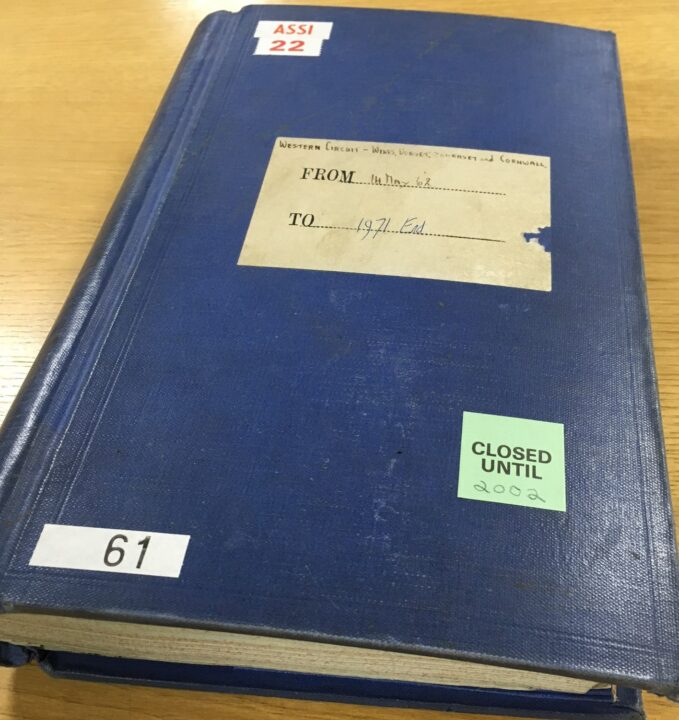
A minute book covering Western Circuit civil trials that took place between 1962 and 1971 (catalogue reference ASSI 22/61).
Assize courts produced over twenty different types of records. They include:
Minute books
Minute books are the primary records for a trial. The assize clerks recorded brief details of a trial in minute books, including names of parties, type of case and judgment order. They also give any judgment orders given on appeal.
Pleadings
These records set out the details of the claim made by the plaintiff and the response or defence from the defendant. They can also include the judgment order.
Judgment orders
Judgment orders in cases – in other words what the outcome of the case was and what the consequences were for the parties involved – are found either in minute books or on a part of the record known as posteas. Posteas were forwarded to the central courts in London and give brief details of the case as well as its outcome. Posteas do not always survive.
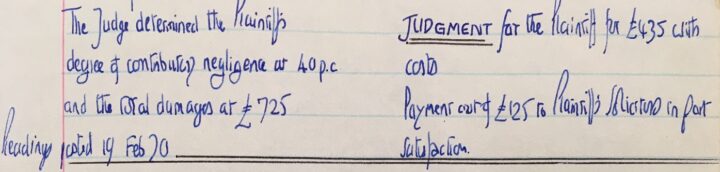
A clip from a minute book showing a judgment order for a trial in 1970 (catalogue reference: ASSI 22/61).
Posteas, which were usually very brief, are only of value if there are gaps in the surviving records of other types – then it may be the only surviving record.
Cause books
Cause in the context of a civil trial refers to the ’cause of action’, in other words the legal basis on which a claimant is suing. A cause of action might be, for example, breach of contract, or fraud.
Cause books and postea books generally record the names of the parties to the cause (that is, the claimants, also referred to as plaintiffs), the names of their legal representatives, the nature of the cause, the verdict, and the amounts of any damages and costs awarded.
Correspondence
This was correspondence of the assize clerks, mostly administrative and concerned with the running of the courts.
Financial records
These records provide details of court fees, meaning the cost of bringing a case to trial, as well as other costs. The person or institution bringing the case to trial pays the fees but these costs, known as Bills of Costs, or a proportion of them, usually end up being paid by the losing side, dependent on whatever the judge orders. that lawyers submit after a case and are assessed by the court.
4. How to search for records
Before you begin you will need to have at least a rough idea of when the trial took place (a range of around ten years but ideally an exact year) and the county or at least the circuit it took place in for a realistic chance of finding any records.
4.1 Searching in the assize court records
The tables in the following sections of this guide provide National Archives record series references for the different types of records that exist for civil trials. There is usually one series for minute books and several others covering all the other record types, whether pleadings, judgment orders, correspondence, financial records or any others.
There are several ways that you can conduct a search:
- Click on the series references in the tables below and search using record types as keywords, such as pleadings, along with dates.
- Click on the series references in the tables below and search by date only, thus ensuring no record is missed.
- Use the advanced search option in our catalogueto search across all assize records (using department code ASSI) by year and/or record type.
For more information on whether to browse or search, see our Discovery help pages.
4.2 Searching in the records of other courts (for details of assize court cases)
Although only of value if there are gaps in the surviving assize records, it may prove necessary to try searching within the records of other courts to which details of assize court trials were forwarded or returned (in some cases it may be the only surviving record). Posteas were forwarded to the central courts in London and contain brief details of the case as well as its outcome.
Use the advanced search to search by year, using ‘postea’ as your keyword and one or more of the department codes below, to search in the following National Archives departments:
- Court of King’s Bench (departments code KB)
- Court of Common Pleas (departments code CP)
- Exchequer (departments code E)
- Palatinate of Durham (department code DURH)
- Palatinate of Lancaster (department code PL)
From 1876 all civil cases heard by the assize judges were held at district registries of the High Court. For pleadings in assize cases from 1876 it is therefore also worth searching in J 54, which covers pleadings in several types of court including district registries of the High Court, by initial letter of the plaintiff’s surname in the advanced catalogue search. For more detail see the advice on pleadings in our guide to Chancery cases in the Supreme Court after 1875.
5. Key to records of civil cases in the English assizes 1656-1971
Click on the series references in the table below to search for records within each respective series using the instructions in section 4.
| County | Date range | Minute books | Other records |
|---|---|---|---|
| Bedfordshire | 1783, 1850-1876 1932-1943 |
ASSI 32 ASSI 14 |
ASSI 34, ASSI 38, ASSI 39, ASSI 15 |
| Berkshire | 1803-1971 1854-1890 |
ASSI 1 ASSI 8 |
ASSI 4, ASSI 9, ASSI 10, ASSI 93 |
| Buckinghamshire | 1783, 1850-1876 1932-1943 |
ASSI 32 ASSI 14 |
ASSI 34, ASSI 38, ASSI 39, ASSI 15 |
| Cambridgeshire | 1783-1971 1870-1890 |
ASSI 32 ASSI 37 |
ASSI 34, ASSI 38, ASSI 39 |
| Cheshire | 1876-1924 1914-1926 1867-1912 1945-1970 |
ASSI 57 ASSI 58 ASSI 60 ASSI 78 |
ASSI 59, ASSI 63, ASSI 66, ASSI 67 |
| Cornwall | 1656-1971 1810-1957 |
ASSI 22 ASSI 28 |
ASSI 24, ASSI 30 |
| Cumberland | 1877-1904 1909-1915 1970-1971 |
ASSI 54 | ASSI 43, ASSI 46, ASSI 47, ASSI 93 |
| Derbyshire | 1932-1943 | ASSI 14 | ASSI 15 |
| Devon | 1656-1971 1810-1957 |
ASSI 22 ASSI 28 |
ASSI 24, ASSI 30 |
| Dorset | 1656-1971 1810-1957 |
ASSI 22 ASSI 28 |
ASSI 24, ASSI 30 |
| Durham | 1938-1971 | ASSI 41 | DURH 19, ASSI 46, ASSI 47, ASSI 93 |
| Essex | 1792-1971 1870-1890 |
ASSI 32 ASSI 37 |
ASSI 34, ASSI 38, ASSI 39 |
| Gloucestershire | 1803-1971 1854-1890 |
ASSI 1 ASSI 8 |
ASSI 4, ASSI 9, ASSI 10, ASSI 93 |
| Hampshire | 1656-1971 1810-1957 |
ASSI 22 ASSI 28 |
ASSI 24, ASSI 30 |
| Herefordshire | 1803-1971 1854-1890 |
ASSI 1 ASSI 8 |
ASSI 4, ASSI 9, ASSI 10, ASSI 93 |
| Hertfordshire | 1792-1971 1870-1890 |
ASSI 32 ASSI 37 |
ASSI 34, ASSI 38, ASSI 39 |
| Huntingdonshire | 1783-1971 1870-1890 |
ASSI 32 ASSI 37 |
ASSI 34, ASSI 38, ASSI 39 |
| Kent | 1792-1971 1870-1890 |
ASSI 32 ASSI 37 |
ASSI 34, ASSI 38, ASSI 39 |
| Lancashire | 1877-1904 1909-1915 1970-1971 |
ASSI 54 | PL 28 ASSI 46, ASSI 53, ASSI 93 |
| Leicestershire | 1864-1875 1932-1943 |
ASSI 32 ASSI 14 |
ASSI 15, ASSI 34, ASSI 38, ASSI 39 |
| Lincolnshire | 1932-1943 | ASSI 14 | ASSI 15 |
| Monmouthshire | 1803-1971 1854-1890 |
ASSI 1 ASSI 8 |
ASSI 4, ASSI 9, ASSI 10, ASSI 93 |
| Norfolk | 1783-1971 1870-1890 |
ASSI 32 ASSI 37 |
ASSI 34, ASSI 38, ASSI 39 |
| Northamptonshire | 1864-1876 1932-1943 |
ASSI 32 ASSI 14 |
ASSI 15, ASSI 34, ASSI 38, ASSI 39 |
| Northumberland | 1938-1971 | ASSI 41 | ASSI 43, ASSI 46, ASSI 47, ASSI 93 |
| Nottinghamshire | 1932-1943 | ASSI 14 | ASSI 15 |
| Oxfordshire | 1803-1971 1854-1890 |
ASSI 1 ASSI 8 |
ASSI 4, ASSI 9, ASSI 10, ASSI 93 |
| Rutland | 1864-1876 1932-1943 |
ASSI 32 ASSI 14 |
ASSI 15, ASSI 34, ASSI 38, ASSI 39 |
| Shropshire (Salop) |
1803-1971 1854-1890 |
ASSI 1 ASSI 8 |
ASSI 4, ASSI 9, ASSI 10, ASSI 93 |
| Somerset | 1656-1971 1810-1957 |
ASSI 22 ASSI 28 |
ASSI 24, ASSI 30 |
| Staffordshire | 1803-1971 1854-1890 |
ASSI 1 ASSI 8 |
ASSI 4, ASSI 9, ASSI 10, ASSI 93 |
| Suffolk | 1783-1971 1870-1890 |
ASSI 32 ASSI 37 |
ASSI 34, ASSI 38, ASSI 39 |
| Surrey | 1792-1971 1870-1890 |
ASSI 32 ASSI 37 |
ASSI 34, ASSI 38, ASSI 39 |
| Sussex | 1792-1971 1870-1890 |
ASSI 32 ASSI 37 |
ASSI 34, ASSI 38, ASSI 39 |
| Warwickshire | 1929-1944 | ASSI 14 | ASSI 15 |
| Westmoreland | 1877-1904 1909-1915 1970-1971 |
ASSI 54 | ASSI 43, ASSI 46, ASSI 47, ASSI 53, ASSI 93 |
| Wiltshire | 1656-1971 1810-1957 |
ASSI 22 ASSI 28 |
ASSI 24, ASSI 30 |
| Worcestershire | 1803-1971 1854-1890 |
ASSI 1 ASSI 8 |
ASSI 4, ASSI 9, ASSI 10, ASSI 93 |
| Yorkshire | 1877-1904 1938-1971 |
ASSI 54 ASSI 41 |
ASSI 15, ASSI 43, ASSI 46, ASSI 47, ASSI 93 |
6. Key to records of civil cases in the Welsh assizes 1843-1970
Click on the series references in the table below to search for records within each respective series using the instructions in section 4.
| County | Minute books | Other Records | |
|---|---|---|---|
| Anglesey | 1843-1924 1914-1926 1867-1912 1945-1970 |
ASSI 57 ASSI 58 ASSI 60 ASSI 78 |
ASSI 59, ASSI 63, ASSI 66, ASSI 67 |
| Breconshire | 1846-1943 1945-1970 |
ASSI 75 ASSI 78 |
ASSI 73, ASSI 77 |
| Caernarvonshire | 1843-1924 1914-1926 1867-1912 1945-1970 |
ASSI 57 ASSI 58 ASSI 60 ASSI 78 |
ASSI 59, ASSI 63, ASSI 66, ASSI 67 |
| Cardiganshire | 1846-1943 1945-1970 |
ASSI 75 ASSI 78 |
ASSI 73, ASSI 77 |
| Carmarthenshire | 1846-1943 1945-1970 |
ASSI 75 ASSI 78 |
ASSI 73, ASSI 77 |
| Denbighshire | 1843-1924 1914-1926 1867-1912 1945-1970 |
ASSI 57 ASSI 58 ASSI 60 ASSI 78 |
ASSI 59, ASSI 63, ASSI 66, ASSI 67 |
| Flint | 1843-1924 1914-1926 1867-1912 1945-1970 |
ASSI 57 ASSI 58 ASSI 60 ASSI 78 |
ASSI 59, ASSI 63, ASSI 66, ASSI 67 |
| Glamorganshire | 1846-1943 1945-1970 |
ASSI 75 ASSI 78 |
ASSI 73, ASSI 77 |
| Merionethshire | 1843-1924 1914-1926 1867-1912 1945-1970 |
ASSI 57 ASSI 58 ASSI 60 ASSI 78 |
ASSI 59, ASSI 63, ASSI 66, ASSI 67 |
| Montgomeryshire | 1843-1924 1914-1926 1867-1912 1945-1970 |
ASSI 57 ASSI 58 ASSI 60 ASSI 78 |
ASSI 59, ASSI 63, ASSI 66, ASSI 67 |
| Pembrokeshire | 1846-1943 1945-1970 |
ASSI 75 ASSI 78 |
ASSI 73, ASSI 77 |
| Radnor | 1846-1943 1945-1970 |
ASSI 75 ASSI 78 |
ASSI 73, ASSI 77 |
1. Why use this guide?
Use this guide if you are interested in finding and understanding records of the Court of Wards and Liveries, which provide insights into:
- land ownership and inheritance in Tudor and Stuart societies
- certain prominent people from the Tudor and Stuart periods
- the legal processes of equity courts
The records are written primarily in English or Latin, but some may be in French or German.
2. What was the Court of Wards and Liveries?
In 1540 the office of Master of the King’s Wards was replaced by the Court of Wards, which assumed complete control of wards and the administration of their lands. The office of Surveyor of the King’s Liveries (1514 to 1542) was joined to the Court of Wards in 1542, becoming the King’s Court of Wards and Liveries. The court was abolished in 1645, but continued to operate through the 1650s until existing wards came of age.
The right of wardship and livery meant that the crown took on responsibility for young orphaned heirs where their father had been a Tenant in chief of the Crown (many people gained this status after they bought ex-monastic land from the Crown). This included having rights over the deceased’s estate where the heir to the estate was under age (21 for a boy, 14 for a girl). The court administered the estate and made arrangements for the care and marriage of the young heirs.
The Crown had the right to the income generated by the majority of the estate until the heir reached adulthood. However, any surviving widow retained the right to some of the land – usually a third. Wardships were usually sold by the crown to the next of kin or the highest bidder, or given to individuals as a reward for services.
3. How to use this guide and find records
A search for documents at The National Archives usually begins in our online catalogue. Our records are grouped by ‘departments’, each with its own unique catalogue reference (a letter code). Each department is made up of multiple record series, all with their own unique references based on the department reference. The department reference for the Court of Wards and Liveries is WARD. The following sections of this guide provide links to the key record series within the WARD department, helping you to target your catalogue searches more precisely. The most useful record series is WARD 9 which contains a wide variety of documents covering all areas of the business of the court.
By clicking on the series links (such as WARD 9) you will arrive on the respective ‘series description’ pages from where you can search the series. However, you cannot search these series using the names of the people involved in a case. Instead, depending on the series, you will need to search using one of the following two methods:
- A keyword search of the series. Use the series search box and search using keywords in the legal process or which describe document types. For example, ‘inquisition post mortem’ or ‘feodaries’ surveys’.
- Browse the series. From the series description page, click on ‘browse from here by reference’ to look through a list of all the pieces in each respective record series to identify an individual piece by regnal year or regnal year range.
An understanding of the court process and the records that were created for each stage in the process will help you to identify the appropriate record series. Use the following sections of this guide to identify the series associated with each stage. The stages, following the death of a tenant in chief who had no adult heir, were as follows:
- writ of clausit extremum issued (a record of the death of a tenant in chief – see section 5)
- inquisition post-mortem carried out by escheator with feodary attending (see sections 6 and 7)
- wardship could be sold (see section 8)
- ward/heir comes of age and ‘sues out his livery’ (see section 9)
Wardship often attracted litigation and there are records for this too (see section 10).
Tracing a single ‘case’ dealt with by the court from beginning to end is difficult because the records for a case are split into different series according to each stage of the process, as described, but also because not all documents have survived.
4. How to view records
By following the advice above on how to find a record you will be able to establish specific document references (for example, WARD 9/565). You will need the document reference to see the record itself. The records covered in this guide are not available to view online so to see them you will have to either visit us in Kew or order copies.
Unfortunately, many useful documents are in a poor condition. Some may not be consulted at all while others you can only view under supervision at specific times.
The affected documents are in:
- WARD 1: decrees, orders, affidavits
- WARD 3: depositions
- WARD 4: extents
- WARD 10: miscellaneous
- WARD 11: miscellaneous
- WARD 12: particulars for, and drafts of leases
- WARD 15: supplementary pleadings
5. Records of the death of a tenant in chief
5.1 What was the process?
A writ of ‘diem clausit extremum or mandamus’ (‘he has closed his last day’) was issued by Chancery to the escheators of the counties where the tenant in chief had held land.
5.2 Series for these records
Consult WARD 9, which contains docket books of some of these writs, in our catalogue and ‘browse by reference’ or by date.
6. Records of inquisitions post-mortem
6.1 What was the legal process?
On the death of every tenant-in-chief, the escheator of the relevant county made an inquisition post mortem report to chancery which identified:
- the size and location of the holdings
- the rents and services due
- the name and age of the deceased
- the name and age of his heir
This information was needed to assess what benefits, such as rents or wardships, might be due to the Crown.
A copy was sent to the Exchequer, and after 1540 to the Court of Wards and Liveries as well.
6.2 Series for these records
Search in WARD 7 by name of deceased for copies of reports. There might also be a copy in Chancery and Exchequer. See the research guide on Inquisitions post-mortem for more information on these records.
7. Feoderies’ surveys
7.1 What was the legal process?
The court’s local representative, the feodary, had to attend every inquisition to prevent fraud. In time he conducted his own survey of the lands, which usually gave a higher value than the jury gave. Feodaries’ surveys provide a useful means of reference if no inquisition post mortem survives.
7.2 Series for these records
Click on the record series links below and ‘browse by reference’ for:
- extents in WARD 4
- feodaries surveys in WARD 5
- receiver generals’, feodaries’ and ministers’ accounts in WARD 8
- miscellaneous books in WARD 9
8. Records of sales of wardships and marriages
8.1 What was the legal process?
People wishing to buy a wardship or to lease some of the lands, put in a petition to the Master of the Wards. If a petition was granted, an indenture was drawn up, between the court and the petitioner, and a fine (sum of money) for the wardship was agreed. The grantee’s name, the fine, and the terms of its payment were entered on a schedule.
8.2 Series for these records
Browse the records series listed below for the following document types:
- Petitions from people wishing to buy a wardship or lease some of the land and indentures resulting from these petitions in WARD 9 and WARD 1
- Counterparts of indentures of wardship and lease in WARD 6
- Grants of wardship and marriage in C 66
9. Records created when an heir came of age
9.1 What was the legal process?
When an heir came of age (at 21 for a boy and 14 for a girl), they were released from wardship. Like all heirs – whether or not they had been wards – they could not receive their inheritance until they had ‘sued out their livery’.
Prominent men of the local area were asked to certify that an heir had reached the appropriate age. The heir then had to pay a sum of money to the crown in exchange for the powers attached to his title and freedom from dependence as a ward. Eventually a warrant was issued for the livery to pass under the Great Seal.
The king would then issue a writ to the custodian of the land requiring it to be released to the heir.
9.2 Series for these records
For:
- information regarding livery in the entry books of livery and in letters patent browse through WARD 9
- grants of livery entered on the patent rolls search in C 66 – use contemporary finding aids, indexed by name, available in our reading rooms in Kew
- writs try the escheators accounts in WARD 7 but these records are scattered in wider, un-indexed collections and are trickier to track down; draft writs are sometimes found in C 81 and C 82
- warrants look in C 82 but there is no index to them
10. Records of litigation
Wardship often led to litigation, usually because the ward’s lands were retained, sold, leased or ‘wasted’ illegally. The table below shows the key steps in litigation and the record series to search for relevant files.
The Court of Wards and Liveries had its own jurisdiction, based on an English bill procedure like that of Chancery and a ward could only sue or be sued in this court. To understand more about the Chancery courts, see the guidance on Chancery equity suits before 1558 and after 1558.
Click on the following series references to search for records within each respective series using keywords and dates. Try:
- using legal terms such as ‘deposition’
- specifying dates where appropriate but note that a date search will not pick up records that are listed by regnal year
Alternatively, browse by reference through the record series.
| Step in the legal process | Explanation | Record series |
|---|---|---|
| Bill or information | The plaintiff submitted a bill or information. If approved, a date was fixed for a hearing and the bill annotated to show this. | WARD 9 |
| Writ of sub pena | This was sent to the defendant and copied into the docket books of privy seals and commissions. The writs can show when the defendant made or submitted his response. | WARD 9 |
| Pleadings | From the end of Elizabeth’s reign pleadings were generally arranged by the initial letter of the name of the plaintiff. | WARD 13, WARD 14, WARD 15 |
| Depositions | Once the pleadings were completed, the court considered the depositions of witnesses which had been taken in response to a list of interrogatories. These were generally conducted by specially-appointed commissions. | WARD 9, WARD 3, WARD 9/296 calendar of commissions, depositions and examinations in cases before the court |
| Evidence | Evidence could be a deed, charter, indenture or will among other things. | WARD 2 (try searching by name as catalogue descriptions are being enhanced) |
| Decisions | Whenever the court made an interim or final decision, it was recorded formally in a decree or order. | WARD 9, WARD 1 |
| Interrupted proceedings | If a particular case was halted at any stage, it is possible to search through entry books of the staying of process and entry books of injunctions which show when this happened. | WARD 9 |
11. Accounts of revenues and expenditure from lands in ward
The revenue raised through wardship and the leasing of lands had to be accounted for. Accounts submitted to the court are of the medieval and early modern ‘charge and discharge’ type where revenue receipts are followed by payments made out of those receipts.
Find accounts by browsing through the following records:
- receiver generals’, feodaries’ and ministers’ accounts in WARD 8
- miscellaneous books in WARD 9
- miscellaneous documents in WARD 10
- miscellaneous records in bundles in WARD 11
12. Further reading
- H E Bell, An Introduction to the History and Records of the Court of Wards and Liveries (Cambridge, 1953)
- J Hurstfield, The Queen’s Wards (London, 1958)
- Richardson, W C, Tudor Chamber Administration 1485-1547 (Baton Rouge Louisiana, 1952)