This is a brief guide to researching records of towns and cities. This guide will help you to identify the key sources of information that will help you with your research.
What do I need to know before I start?
Try to find out:
- any former names of the town or city
- any counties the town or city may have been in
The UK has 69 official cities: 51 in England, six in Wales, seven in Scotland and five in Northern Ireland. [Correct as of April 2020, Postcodes.co.uk]. Despite what many people believe, a town becomes a city only by the award of a royal charter – not by having a cathedral. Dunblane has a cathedral but is not a city. Brighton and Hove is a city but does not have a cathedral.
Town and country planning at a national level developed largely from the public health legislation of the 19th century. The first piece of legislation to contain general planning as distinct from housing provisions was the Housing, Town Planning, etc., Act 1909, which permitted local authorities to draw up planning schemes in connection with the development of new housing areas.
In 1909 the central authority for planning was the Local Government Board and, after 1919, the Ministry of Health. From 1919 district councils were empowered to join together in joint planning committees, and from 1930 county councils were allowed to join such committees or to undertake powers relinquished by district councils.
Online records
Online Historical Population Reports (1801–1937)
Search the Histpop website to consult historical population reports based upon statistics gathered through the census and civil registration.
Charles Booth Online Archive (1886–1903)
Browse the London School of Economics’ Charles Booth Online Archive to view original records from Booth’s survey of life and labour in London.
Records available only at The National Archives in Kew
To access these records you will either need to visit us, pay for research (£) or, where you can identify a specific record reference, order a copy (£).
Board of Health correspondence (1846–1871)
Browse Discovery, our catalogue for records of the General Board of Health and the Home Office in MH 13.
This series contains correspondence with local authorities and government departments relating to the provision and administration of public health, sanitary and other services under the several Public Health and Local Government Acts passed between 1848 and 1871. A few volumes relate to special subjects such as cholera, yellow fever, and metropolitan nuisances.
Housing and Local Government records (1919–1970)
Browse our catalogue for records of the Ministry of Housing and Local Government and related bodies such as the Ministry of Town and Country Planning and the Ministry of Health in HLG.
Records of the Department of the Environment (1951–2006)
Browse our catalogue for records of the Department of the Environment and other related bodies in AT.
The records concern housing, planning, new towns, inner city matters, finance and local government, environmental protection and services, the countryside, sport, recreation and parks, water services, ancient monuments, estate management, construction, and traffic and transport.
Private Bill records
Search our catalogue for names of individual towns and cities to find private bill records in the Parliamentary Archives collections.
Records include local Acts, committee evidence, and deposited plans showing town improvements, streets and paving.
See our guide to Original Acts of Parliament and Royal Assent.
Records in other archives and organisations
Local authority records
Consult records of local authorities and parishes in local archives and libraries.
The National Archives’ catalogue contains collections and contact details of local archives around the UK and beyond. To locate these records, search our catalogue with keywords and refine your results to ‘Other archives’ using the filters.
Other resources
Local libraries and local history societies
Contact the relevant local library or local history society for information on specific towns or cities.
1. Why use this guide?
This guide will help you to find historical government administration and policy records on teacher training which are now held by The National Archives. Teacher training records held here include:
- Local Education Authority files from the early 20th century on training colleges, schemes and courses for teacher training
- Board of Education files on university training colleges and teacher-training departments from the 1960s and before
- central government reports on teacher training centres
- files created by post-war committees, inquiries and advisory groups on teacher training including recruitment, funding and reviews of national teacher training policy
The guide does not cover records of individual teachers or pupils, neither of which are held at The National Archives. Nor does it cover the day to day records of individual training colleges (contact a local record office or school/training college for these) or teacher training certificates (contact the relevant examining body for these).
2. How to use this guide and get a search for records started
A search for documents at The National Archives usually begins in our online catalogue. The following sections of this guide provide links to key record series that you can search within our catalogue, helping you to target your searches more precisely. By clicking on the series links (for example, ED 145) you will arrive on the respective ‘series description’ pages from where you can search the series, using dates/years and keywords such as:
- ‘training’ plus an area or district – for example, ‘Birmingham AND training’
- ‘training’ and the name of a type of institution – for example, ‘University AND training’ or ‘Pupil teacher’s centre’
- a specific institution – for example, Borthwick Training College for Women
Series description pages also provide information on the arrangement of the records and sometimes some of the historical context in which they were created, as well as suggesting related series you could explore.
Use the advanced catalogue search to restrict your search results to the records of a specific government department, including its predecessors (for example, the Department of Education, which created most of the records we hold on teacher training). Use the department reference, which is always a letter code, to do this (the code for the Department of Education is ED).
Catalogue search results provide short descriptions of our records and a document reference for each one – you will need the document reference to see the record itself. The records covered in this guide are not available to view online so to see them you will have to either visit us in Kew or order copies. Bear in mind that a search in our catalogue will also search for records in other archives around the country – keep your eye on the ‘Held by’ field to establish whether the records are here or elsewhere. Read our catalogue search help for more guidance.
3. Pupil-teacher training, 1846-early 1900s
Before the Education Act 1902, the training of teachers was largely carried out under a pupil-teacher system . Originally, pupil-teacher training and education took place at elementary schools under the supervision of the headmaster.
After the Elementary Education Act 1870 training took place at separate establishments called pupil-teacher centres, with teaching practice at elementary schools.
From 1902 regulations for pupil-teacher training were tightened up and secondary education encouraged wherever possible. From 1907 the bursar system gradually replaced the pupil-teacher system .
Browse:
- surviving pupil-teacher centre files in ED 57
- annual reports of the Committee of the Privy Council on Education (PCCE) in ED 17. Inspection reports within PCCE reports 1848 -1854 contain a statement of annual grants paid to schools on account of pupil teachers, naming pupil-teacher apprentices and the year of their apprenticeship
- institution files for pupil-teacher centres which became secondary schools in ED 3
- inspection reports on pupil-teacher centres from 1900 in ED 109
4. Normal schools and training colleges
Originally established by charities (the British Society and the National Society) in the early 19th century, ‘normal schools’ were training schools and colleges. Many came to be modelled on Battersea Normal School, established in 1841. Pupil-teachers aged 18 could apply for the Queen’s/King’s Scholarship Examination (later the Preliminary Examination for the Certificate). Successful scholars had the opportunity of attending training colleges for two or three years. These were residential colleges run by voluntary societies with some government subsidy.
For records about these establishments browse or consult:
- Privy Council Minutes of 1843 and 1844 authorising building grants for separate training colleges in ED 17/1
- building grant application papers in ED 103/140
- endowment files in ED 40
- ED 78 for information about these colleges (few papers prior to 1932 have survived)
- exceptionally, the papers of the National Training School of Cookery are in ED 164
5. Local Education Authority (LEA) training
The 1902 Education Act enabled the provision of training colleges to meet the demand for teacher training places. The Act established the training of teachers as a form of higher education, enabling the new Local Education Authorities (LEAs) to make secondary schools available for the training of pupil-teachers.
In 1904 municipal training colleges were recognised and the following year building grants were made available to LEAs to encourage the provision of training colleges.
Browse:
- LEA files on the supply of teachers in ED 67
- other LEA schemes for teacher training under the 1902 Act in ED 53
- files concerning the LEA provision of short courses for teachers at further education colleges, art schools and evening institutes in ED 61 (material prior to 1935 has not survived)
- the training college building grant files in ED 87
- general policy files on grant aid for training colleges in ED 86
files on training colleges maintained by voluntary bodies, colleges established by LEAs under the provisions of the 1902 Act and a few university colleges providing similar courses in ED 78 - HM Inspectors’ reports on training colleges in ED 115
- papers on the Ministry of Education scheme for the emergency recruitment and training of teachers to meet post Second World War needs in ED 143
6. University training, 1890 onwards
Universities first became involved in teacher training in 1890 when, as one of the recommendations of the Royal Commission on the Working of the Elementary Education Acts (the Cross Commission), ‘day training colleges’ attached to universities were established.
Browse:
- files on university teacher-training departments in ED 81 (no material survives before 1932)
- university and university college files in ED 119 which include information on the distribution of grants for teacher-training
The Burnham Committee on the Training of Teachers in Elementary Schools (1923-1925) recommended greater cooperation between training colleges and universities. This led to the establishment of Joint Examination Board (JEBs) who devised and conducted the final examination for student teachers in academic subjects.
Browse Joint Examination Board files in:
The recommendations of the McNair Report (1944) on the supply, recruitment and training of teachers and youth leaders included the formation of Area Training Organisations (ATOs) to develop a closer relationship between the universities and teacher-training colleges.
Browse:
- the recommendations of the McNair Report in ED 86/94-109
- post-1944 proposals for the formation of ATOs in ED 119
- ATO files in ED 159
7. Post-war training and supply of teachers
The Fleming Committee was set up in 1943 to consider how to meet post-war requirements for teachers. It recommended a provisional scheme for the emergency recruitment and training of teachers in emergency training colleges which ran until 1951.
Consult:
- papers relating to the work of the committee in ED 136/687-688 and ED 143/1-5
- policy papers relating to the scheme drawn up by the committee in ED 143
- representative emergency college files for Alnwick in Northumberland in ED 143/33-34, Borthwick Training College for Women in London in ED 143/35-36
The National Advisory Council on Training and Supply of Teachers (NACTST) was set up in 1948 to review national policy on the training, qualifications and distribution of teachers. Consult:
- ED 86/270-285, ED 86/448-459, ED 192/24-26 and ED 192/71-73 for papers on its activities
- ED 234 for the minutes and papers of the council and its sub committees from 1953-1965
The minutes, papers and report of the James Committee of Inquiry into Teacher Training 1971-2 are in ED 145.
The Teacher Training Agency was established in 1994 to fund the provision of teacher training, contribute to raising the standards and to provide information and advice on teaching as a career.
Browse:
- copies of its annual reports and corporate plans in PB 1
- board minutes and papers (1994-2000) in PB 2
- electronic minutes and papers (2001-2002) in PB 3
8. Teacher pay, pensions and conditions
The interest of central government in teachers has largely been confined to supply, but it has also been concerned with qualification, payment, pensions and conduct.
Consult:
- Teachers Branch registered files in ED 86 and ED 192
- Papers regarding teacher misconduct in ED 104 (closed for up to 75 years)
- Files on teachers’ superannuation in ED 131
- Burnham Committee papers on salaries in ED 108
9. Teachers’ Registration Council, 1902-1949
The Education Act 1899 made provision for the establishment of a register of teachers, following one of the recommendations of the Royal Commission on Secondary Education.
The Teachers’ Registration Council was set up in 1902. The form in which the register was kept led to protests by the National Union of Teachers and it was withdrawn in 1907. The Council was not reconstituted until 1912.
Teacher registration began in 1914, although records include those who started their careers from the 1870s. Registration remained voluntary.
Consult:
- minute books, together with copies of its reports for 1902-1906 in ED 44
- further papers relating to its work in ED 10
- original registration records for the period up to 1947 are available on the Findmypast website (£)
The Teachers Registration Council was superseded by the National Advisory Council on the Training and Supply of Teachers and registration abandoned in 1948. See section on Post war training and supply of teachers.
10. Further reading
Read Education and the State from 1833 by Ann Morton, Public Record Office Readers’ Guide No 18 (PRO 1997).
Copies of the Commission reports mentioned above can be found online through Proquest UK Parliamentary Papers. This is a subscription service available to access at The National Archives. You may also be able to access it via a large reference library, such as a university library.
1.Why use this guide?
This guide helps you find records of nurses and other medical staff who served with the Royal Navy. It includes information about their service, medals, and how the nursing service was organised.
Most service records for military nurses who served after the First World War are held by the Ministry of Defence (MOD). See section 6 for further details.
If the person you’re researching served in a Voluntary Aid Detachment (VAD) during the First or Second World War, contact the British Red Cross Museum and Archives. See section 3.1 for registers of Royal Red Cross recipients.
2. Before you start
Before 1883, nursing in naval hospitals was usually carried out by ex-seamen or marines recruited from shore establishments. These individuals held no formal nursing qualifications.
The Naval Nursing Service was established in 1884 at Haslar (Portsmouth) and Plymouth. It was the first Royal Navy unit staffed by trained nurses. The service expanded to Chatham and Malta in 1897, and to all Royal Naval Hospitals by 1901.
In 1902, it was renamed the Queen Alexandra’s Royal Naval Nursing Service (QARNNS). A QARNNS Reserve of civilian nurses was created for wartime service only.
Most naval nurses in the First and Second World Wars served in the Queen Alexandra’s Royal Naval Nursing Service (QARNNS) which was established in 1902.
The names of matrons and head sisters can be found in the Navy List from 1884. Copies are available at The National Archives in Kew and specialist libraries. For further details, see our guide to Royal Navy commissioned and warrant officers.
3. Online records
3.1 Campaign Medals and Awards
- Royal Navy Medal Rolls, 1793-1955
Royal Navy medal rolls are available to search and download through Forces War Records (charges apply).
- First World War Medal Index Cards, 1914-1920
Search by name or regimental (service) number for First World War army medal index cards (WO 372) on our website (charges apply). Use keywords like Nurse, Voluntary Aid Detachment, or Queen Alexandra’s with a surname.
- Royal Red Cross Recipients,1883–1994
Search and download entries from the registers of recipients of the Royal Red Cross (WO 145/1-3) at Findmypast.co.uk (charges apply). Covers around 9,000 awards for exceptional nursing service. Includes service number, role, and date published in the London Gazette.
- Campaign Medal Rolls, 1793–1949
For records of medals awarded for service before 1914, search by name on the Ancestry (charges apply) website. Lists names but includes limited personal details. Knowing the campaign and nursing service helps.
3.2 Records of Royal Navy Nursing Staff, 1884–1929
The service registers are part of catalogue series ADM 104. You can download and view them by clicking the links in the table below. Each link will take you directly to the relevant entry in our catalogue.
| Date range | Type of record, who it covers and how it is arranged | Details provided | Catalogue reference |
| 1884-1909 | Nursing sisters; the original document has an index | Name, rank, date of birth, date of entry and discharge | ADM 104/43 |
| 1890-1908 | Annual reports of nursing sisters; for each year staff are listed in seniority order | Name, age, hospital where they are stationed, dates of service and very brief comments on character and work | ADM 104/95 |
| 1894-1929 | Nursing sisters; arranged by dates of appointment; the original document has an index | Name, rank, date of birth, date of entry and discharge, next of kin, annual report marks, sick leave, comments on character and ability, training qualifications, and medal awards | ADM 104/161 |
| 1914-1919 | QARNNS Reserves, signed up for wartime service only | Name, date of joining service, civilian hospital in which worked, naval hospital in which stationed, date of discharge | ADM 104/162-165 |
| c.1912-1927 | Nursing sisters’ and ward masters’ establishment book; contains an index to establishment (hospital or barracks); staff are listed in rough date order | Name, rank, date and cause of appointment, date and reason for discharge | ADM 104/96 |
4. Accessing original documents
Our online catalogue displays records using a title, reference number, and brief description. When you search using keywords, you’re searching these descriptions—not the full content of the records. For help using our catalogue, watch our short video guide.
Many records cannot be found using a general keyword search in our online catalogue. To locate the information you need, you may need to consult indexes, registers, or the original physical documents. This often means visiting us in person to carry out the research.
You can visit us in person to continue your research—access to our records is free of charge. Before visiting, please check our website for opening hours and ID requirements. If you can’t visit or would like someone to carry out research on your behalf, you can pay for research.
When you click on a search result, you’ll see whether the record is available online or if you need to view it onsite. You can also request copies directly from the catalogue description page. If a record is held by another archive, you’ll need to contact them directly to find out how to access it.
5. Nurses’ service at the Royal Greenwich Hospital, 1704-1865
Click on any of the reference codes below to open that series in our online catalogue. These records are not available online, so once you’ve found something relevant, you’ll need to visit us in person to view it. See section 4 for more information.
| Date range | Information contained in the documents | Catalogue reference |
| 1704-1864 | Alphabetical lists of nurses | ADM 73/87-88 |
| 1704-1865 | Registers of service; all give name, date of entry and date and reason for leaving | ADM 73/83-86 |
| 1783-1863 | Name, age at time of entry, date of entry, where born, husband’s Christian name, husband’s date of death and in which service employed, amount of pension, whether husband hurt or wounded and on what service, number of children and ages at time of entry; details of husband and family are not completed for early entries | ADM 73/85 |
| 1817-1842 | Ratings’ widows applying for admission to Greenwich Hospital as nurses | ADM 6/329 and ADM 6/331 |
6. Service records,1939-present
To request a summary of a service record from the Ministry of Defence, visit the GOV.UK website. These records are not available to the public, but next of kin can apply for access.
7. Policy and administrative history
To explore the policy and administrative history of the Royal Navy nursing service, click on the reference code below to open that series in our online catalogue. These records are not available online, so once you’ve found something relevant, you’ll need to visit us in person to view it.
To narrow your search, try using keywords such as “nursing services,” “medical,” or “hospitals” — for example.
- ADM 116 – Admiralty: Record Office: Cases, 1852-1965
8. Websites
Browse a curated information about records and related insights about the Queen Alexandra’s Royal Naval Nursing Service (QARNNS).
9. Further reading
Bruno Pappalardo, Tracing your naval ancestors (Public Record Office, 2003) – this title is also available from our shop.
1. Why use this guide?
This guide provides advice on how to find records (primarily staff records) of the London Metropolitan Police. The National Archives has a substantial collection of Metropolitan Police staff records, but not all have survived.
The most recent staff records we hold are pension records dating up to 1993.
The Metropolitan Police Force, created in 1829, was the first modern police force in England (provincial police forces in England and Wales were not established until after the County Police Act of 1839). Its original area of jurisdiction covered a seven-mile radius from Charing Cross in central London. Today it consists of the 32 boroughs of Greater London, excluding the City of London.
Records of the City of London police are held at The London Archives.
Metropolitan Police records held at The National Archives are identified by the department code MEPO (there are 46 separate record series within MEPO). You can browse the department and its composite series in our catalogue for an overview of what we hold.
2. Staff records – online
Significant numbers of Metropolitan Police staff records are available online both through our own website and those of our commercial partners. In some instances there is a fee to view and download these records but there is free access at The National Archives building in Kew.
2.1 Metropolitan Police registers in Discovery
Many of the personnel records are in the series MEPO 4 and can be searched by name (using the keyword search box at MEPO 4) and downloaded from Discovery, our catalogue.
Name details were added to our catalogue from an incomplete index created before records were transferred to The National Archives, so not all records can be found by name searching. If you do not find a record by name searching you can still browse the various types of register listed below in Discovery, find an appropriate register, based on dates of joining or leaving, and download a digital copy to look through.
Some of these records contain more information than others and some information may be duplicated in different records. A summary of the typical contents of each sort of record is below.
Registers of joiners, 1830-1857 and 1878-1933, MEPO 4/333-338
The catalogue descriptions for each register entry contain more information than the registers themselves (information has been added from other records) and in most cases include, along with the full name:
- warrant number (useful to distinguish between officers with the same name)
- date of joining
- date of leaving
Registers of leavers, 1889-1947, MEPO 4/339-351
The details included are:
- warrant number
- rank
- dates of joining and leaving
Attestation ledgers, 1869-1958, MEPO 4/352-360
These registers of joiners contain:
- warrant number
- signature of the new recruit
- the division to which they were assigned
Certificates of service, 1889-1909, MEPO 4/361-477
These records contain:
- a physical description
- date of birth
- trade
- marital status
- residence
- number of children
- name and place of last employer
- previous public service
- surgeon’s certificate
- postings to divisions
- dates of promotion or demotion
- cause of removal/departure from the force
2.2 Other downloadable records in Discovery
Some other records can be downloaded from Discovery but are not name searchable. These are
- Death returns for Metropolitan Police, 1829-1889, MEPO 4/2
- Numerical registers of police warrant numbers, September 1829-March 1830, MEPO 4/31-32. These are in ranges of warrant numbers.
2.3 Metropolitan Police pension registers, 1852-1932
Search Metropolitan Police pension registers by first and last name at Ancestry.co.uk (charges apply). The original records are held in series MEPO 21, whose contents stretch all the way up to 1993 – but records from 1932-1993 are not available online (see section 3.1).
2.4 Abbreviations in the records
You may find the following abbreviations in some of the above records (such as registers of leavers):
- RP – resignation permitted
- RR – required to resign
- CO – Commissioner’s Office
3. Staff records – beyond online records
There are still many Metropolitan Police Force records that are not available online. Searches for these records begin in our catalogue which contains descriptions of each record with its document reference. This section of the guide provides instructions on how to target your catalogue search to specific parts of the collection so that you can locate a document reference with greater ease.
For more speculative or broader searches you can try an advanced search of our catalogue using keywords (for example, the name of an officer or a police station, or broader terms such as ‘discipline’ or ‘promotion’) and dates, ensuring that you include MEPO in the reference field.
To see these original records you will either need to visit us or, where you can identify a specific record reference, order a copy (charges apply).
3.1 Metropolitan Police pension records, 1932-1993
Browse our catalogue in MEPO 21/67-210 for records of Metropolitan Police officers’ and officers’ widow’s pensions after 1932, arranged by date of retirement and pension number. Unless you know a pension number, you should select the record you need by date of retirement.
Records from 1957-1993 (MEPO 21/100-139) are closed and you will therefore need to submit a Freedom of Information request to have a chance of seeing them. Click ‘Submit FOI request’ on the catalogue details page for the closed record.
3.2 Metropolitan Police register, 1829-1836
HO 65/26 is an alphabetical register of metropolitan police officers between 1829 and 1836.
3.3 Selected police files of distinguished officers in the Metropolitan Police Force, 1858-1933
Joining papers of a number of distinguished officers are at MEPO 3/2883-2922. The covering dates are for dates of service.
3.4 King’s Police Medal records, 1909-1951
The King’s Police Medal was awarded to officers for gallantry or distinguished service. It was introduced in 1909 and replaced by the King’s Police and Fire Services Medal in 1940, itself replaced by the Queen’s Police Medal in 1954.
There is a register of officers under consideration for the King’s Police Medal in MEPO 22/2 and files relating to the award of the medal in HO 45 (search with the term “King’s Police Medal”).
See also MEPO 2/1300 and MEPO 7 for mentions of officers who received the medal.
The London Gazette published notifications of awards of the King’s Police Medal – search The Gazette website.
3.5 Metropolitan Police orders, 1829-1989
Browse our catalogue in MEPO 7 for police orders.
Items included are:
- staff news
- promotions
- awards
- retirements
- dismissals
Note that the records are closed for 50 years. If you already know the date of a particular event these might give you more information. The series includes some index volumes.
3.6 Nominal rolls of local constables appointed by Commissioner who hold warrants, January 1875
MEPO 2/143 contains returns, by division, of local constables sworn in and issued warrants. It gives names, date of appointment, place of work as a constable and name of sponsor. Appointments are to parishes, workhouses, canals, dockyards, parks and other places.
MEPO 2/141 contains correspondence relating to the appointments of individual local constables.
4. Special Branch records
The Metropolitan Police Special Branch was formed in 1883. Its remit included intelligence work, anti-terrorism and personal protection of prominent and public figures. It merged with the Metropolitan Police Anti-Terrorist Branch in 2006 to form Counter Terrorism Command.
Records from Special Branch are held in series MEPO 38. You can search the series for records using keywords connected to specific topics, such as ‘extremism’, ‘fascists’, ‘communism’, ‘Irish Republicanism’ and ‘protection’.
5. Other Metropolitan Police Records
MEPO record series also contain details of the administration and organisation of the Metropolitan Police Force. Search using dates and surnames or keywords, or browse using the series links below.
Records relating to police work and investigations can be found in series MEPO 2, MEPO 3 and MEPO 4, and files created after 1969 can be found in MEPO 26 – MEPO 38.
MEPO 5 contains registered correspondence of the receiver, 1829-1974, on a variety of subjects. The files MEPO 5/1-90, 1829-1907, are in registered number order but a subject index is in the paper version of the catalogue for MEPO 5 in the reading room. Later files can be browsed or keyword searched.
MEPO 6 contains Registers of habitual criminals from 1834 to 1959. Documents in this series are generally subject to a 75 year closure period. Selected records are available through Findmypast.
MEPO 20 contains registers of Murders and Violent Deaths in the Metropolitan Police area from 1891 to 1966. Browse and select registers by date range, no records survive for 1910, 1911 and 1918.
Further information relating to the Metropolitan Police and other forces can also be found amongst records of the Home Office.
6. Plans and Photographs
The series MEPO 9 contains architectural plans and drawings of police buildings from 1847 to 1957 can be found in. Search using place names or browse.
The series MEPO 15 contains maps of police districts and their changing boundaries from 1894 to 1972.
MEPO 13 contains photographs originating from the force’s Publication Information Department dating back to 1901.
MEPO 14 contains photographs of police stations from 1857 to 1983. MEPO 14/26 are annotated with histories of the stations.
7. Records in other archives
Metropolitan Police Museum
The Metropolitan Police Museum can be visited for research or a tour by appointment.
Divisional and station records
The Open University has some online images of divisional and station records including some occurrence and charge books. The Wapping Police Station Museum holds Thames Division ledgers.
Police Roll of Honour Trust
Contact the Police Roll of Honour Trust which maintains the Police Roll of Honour and includes a section for the Metropolitan Police
8. Further reading
Use our library catalogue to find a recommended book list.
The books are all available in The National Archives’ reference library. You may also be able to find them in a local library. You can buy from a wide range of history titles in our bookshop.
Appendix 1: The London Metropolitan Police district
The area policed by the London Metropolitan Police has changed over the years:
- The Metropolitan Police Act 1829 defined the Metropolitan Police District as an area about seven miles radius from Charing Cross, London
- The second Act in 1839 extended this to about a 15-mile radius from Charing Cross and included all of Middlesex
- In 1869 this area was divided into four districts, each of which had a number of divisions (see below)
- From 1860 to 1934 the Metropolitan Police also had responsibility for the police of the Royal Dockyards and military stations Portsmouth, Chatham, Devonport, Pembroke and Woolwich
- From 1914 to 1926 they also had responsibility for Rosyth in Scotland
- Today it consists of the 32 boroughs of Greater London, excluding the City of London
Appendix 2: London Metropolitan Police divisions
If you know the division an officer worked in, you can extend your research to include looking at divisional records. Where records mention an officer’s division they often use the following letter codes:
- No. 1 District: G – Finsbury; H – Whitechapel; K – Stepney; N – Islington; and Thames Division
- No. 2 District: D – Marylebone; E – Holborn; S – Hampstead; X – Paddington; Y – Highgate
- No. 3 District: A – Whitehall; B – Westminster; C – St James’s; T – Kensington; V – Wandsworth
- No. 4 District: L – Lambeth; M – Southwark; P – Camberwell; R – Greenwich; W – Clapham
- F Division – Covent Garden
- J Division – Bethnal Green – added in 1886
- Z Division – Croydon – was formed in 1921. Croydon had previously been included in W Division
- Q Division – Wembley – was formed in 1965. Wembley was previously X Division
- Division letter codes I, O and U were never used
Maps of the districts and their changing boundaries can be found in record series MEPO 15.
1. Why use this guide?
This guide will help you to find records of medieval and early-modern taxation (13th century to 1689). These records contain information on central government’s taxation process (assessment, collection, accounting and auditing) but also provide valuable insights into the population of medieval and early-modern England and Wales.
The primary source of information, and the focus for the advice in this guide, is the E 179 database, a resource created by The National Archives to provide detailed searching of series E 179.
The original documents which contain all this information can be difficult to read. You may find our online palaeography tutorials helpful when trying to read them.
2. Taxes in the medieval and early modern periods
Taxes on individuals during the medieval and early modern periods were levied to provide income for specific items of expenditure, such as military campaigns. Each tax was levied separately. Each grant or levy would specify the details of the individual tax, such as the income threshold, any exemptions, the tax rates, the number of instalments (known as ‘collections’), and the dates on which they were to be collected.
Taxes were generally granted by Parliament. However, they could be imposed directly by the monarch, such as feudal and prerogative levies, while others, such as forced loans and ‘benevolences’, were little more than official extortion.
3. The E 179 database
The E 179 database provides information on both lay and clerical taxation records in England and Wales (13th century-1689). By providing information on the nature and content of the majority of the records, the database helps you navigate the records relating to tax assessment and collection in England and Wales before 1689.
Names of individual taxpayers are not included in this database, but the database can be used to identify documents which contain names.
3.1 What can you find in the records?
Records cover:
- fractional taxes (fifteenths and tenths 1134-1624)
- poll taxes
- subsidies
- monthly and weekly assessments
| Type of tax | Type of information recorded |
|---|---|
| Fifteenths and Tenths (1334-1624) | Records predominantly list only places and sums payable with a few exceptions. They may be of limited interest to historians and researchers |
| Poll taxes (from 1377) | Essentially taxes levied on individuals rather than property or wealth, with everyone over a certain age, and not otherwise exempt, being liable to pay a given amount. Therefore surviving records generally include a rather higher proportion of the population, and surviving documents record the names of many individuals |
| Tudor and Stuart subsidies (1485-1689) including ship money and hearth tax |
A tax levied at a given rate (specified in the statute) on the value of an individual’s movable goods or their income from land (whichever greater). Early subsidies were granted at different rates, often with different thresholds meaning records vary greatly.The 1523 and 1543 subsidies had the lowest thresholds, and produced particularly detailed and full lists of taxpayers, large numbers of which survive in E 179. From 1563-1663 thresholds became fixed at a relatively high figure meaning assessments are less extensive but they are a useful source for tracing the fortunes of wealthier citizens. Ship money, introduced in 1634, has few surviving records. Those held by The National Archives are predominantly schedules of arrears from 1634-1635. Analysing them can provide useful insights into pre-Civil War politics. Monthly and weekly assessments followed, and these records contain lists of communities and amounts payable. Hearth tax see section 4 below |
3.2 Limitations of the records
- Surviving medieval taxation records relate entirely to England; the 1536 Act of Union brought Wales into the taxation system
- Methods of central government taxation in this period underwent many changes so the types and styles of documents produced can vary greatly
- Only certain taxes demanded detailed lists of individual taxpayers
- The records will not provide a complete list of the population of a particular place/time, or necessarily an accurate reflection of wealth or status
3.3 How to search the records
The database is searchable by:
- place (administrative divisions have often changed over time: basic details are in the E 179 database, and more specific information is available in reference works such as volumes of the Victoria County History and publications of the English Place-Name Society)
- date
- tax
- document type
You cannot search by names of individuals, but the database can be used to identify documents which contain taxpayer names.
3.4 Reading the records: original documents and transcriptions
As the original documents can be difficult to read it is best to first consult the available transcriptions which exist for many of them, held in The National Archives’ Library. Details of these publications are usually given within the database.
4. Hearth tax 1662-1689
For the detail and quality of their contents, the hearth tax records in E 179 give an unparalleled insight into the composition and nature of 17th century communities, and are a useful supplement to other local records such as parish registers.
Each liable householder was to pay one shilling, twice a year, for each fire, hearth and stove in each dwelling or house. The tax’s complex administration meant assessment and collection methods changed radically over time.
The majority of the surviving documents are from 1662-1666 and 1669-1674 when the tax was administered directly by royal officials rather than private tax collectors. Documentation also varies regionally. The Centre for Hearth Tax Research has produced some transcriptions which can be downloaded from the Hearth Tax Digital website. See the further reading section for more details.
| Key hearth tax documents | Further information |
|---|---|
| Assessments and returns | They contain: – the names of individual householders (sometimes with their status or title) – the number of chargeable hearths, often with the amount payable and occasionally comments- potentially names or number of those exempt |
| Exemption certificates | They contain: – the names and assessments of people who were exempt in a given area, providing useful details to supplement assessments- exemptees included: those too poor to contribute to poor and church rates, or whose property was worth less than 20 shillings/ year Search: – by county – also by place name (parish or hundred) for the following counties: Bedfordshire, Berkshire, Buckinghamshire, Essex, Hertfordshire, London, Middlesex, Norfolk, Suffolk and Warwickshire |
5. Clerical taxation
From the mid 13th century until the Reformation the tenth was the standard fractional levy. The 1291 assessment for the tenth collected became the basis of all clerical taxation until the Reformation. Many annotated copies of this assessment, used by the collectors gathering later taxes, survive. A variety of other subsidiary documents also survive in series E 179, as well as assessment documents for other types of taxes such as poll taxes paid by the clergy in 1377 and 1379-1381.
Clerical grants of subsidies were always requested from both provinces of the clergy, and separate taxes, although generally concurrent, would be granted from both Canterbury and York.
At the Reformation, the clerical taxation system was overhauled completely. In 1534, under the Act of First Fruits and Tenths, a permanent tenth was collected annually from the clergy. This resulted in a new valuation called the Valor Ecclesiasticus. Documents for these are in series E 331-E 344 and E 347.
Most of the post-Reformation documents in series E 179 comprise certificates listing the names of stipendiary clergy who were required to pay a graduated poll tax, or identifying exempt benefices. In 1641, the clergy were taxed with the laity until the Restoration, and in 1664 they agreed to be included in all future grants of taxation made by Parliament.
6. Other records at The National Archives
The records of the Exchequer (E) at The National Archives include series containing documents relating to the assessment, collection and accounting of central government taxation.
The account rolls in E 359 and E 360 contain details of the overall sums collected for a particular tax, and although they rarely include the names of any individual taxpayers, they do give details of the final amounts raised from particular counties, cities, boroughs and other taxation areas.
E 115 and E 179 contain many certificates of residence which were drawn up to reduce the risk of double charging. Covering c1547-1685, they are indexed alphabetically by personal name.
Find contact details for archives elsewhere using Find an archive.
7. Pre-1332 records
Limited records exist for this period but documents relating to medieval feudal taxes are printed in Inquisitions and Assessments Relating to Feudal Aids, 6 vols (HMSO, 1899-1920).
8. Further reading
Most of the following recommended publications are available in The National Archives’ Library.
A range of books can also be purchased from the National Archives’ shop.
J Gibson, The Hearth tax and other later Stuart tax lists and the Association Oath Rolls (FFHS, 1996). A county by county guide to The National Archives and non-National Archive sources
R W Hoyle, Tudor Taxation Records (PRO, 1994)
M Jurkowski, C Smith and D Crook, Lay Taxes in England and Wales, 1188-1688 (Public Record Office, 1998). Provides a general overview of medieval and early-modern taxation, together with details of the terms of individual taxes
H Maxwell-Lyte, Inquisitions and assessments relating to feudal aids, 6 volumes (HMSO, 1899-1920). Includes details of medieval feudal taxes
E L C Mullins, Texts and calendars: an analytical guide to serial publications (Royal Historical Society, 1958; reprinted 1978), and Texts and calendars II: an analytical guide to serial publications, 1957-1982 (Royal Historical Society, 1983), also updated since 1982 online
Websites
Hearth Tax Online run by the Centre for Hearth Tax Research. Their publications page lists volumes published by the British Records Society, of both exemption certificates and assessments
London hearth tax on British History Online
1. Why use this guide?
This guide tells you:
- what the state papers domestic 1714-1782 are, and what information they contain
- how to find state papers at The National Archives and elsewhere
- which finding aids and websites can help you search the state papers
For any state papers domestic for other dates, refer to these guides instead:
For state papers regarding foreign and Irish affairs see the guides:
For state papers regarding the Jacobite risings see this guide:
For papers after 1782 when the Home Office was established, browse record series within the HO department (especially record series HO 42 which is a continuation of the main correspondence of the Secretaries of State after 1782). For more guidance on Home Office correspondence, see the guide on Home Office correspondence 1782-1979.
2. What are the state papers domestic, 1714-1782?
The state papers domestic are the accumulated in-letters and working papers of the secretaries of state, relating to home affairs. They contain information on almost every aspect of the business of government in the eighteenth-century in the form of letters, petitions, intelligence reports, memoranda, orders in council, warrants and newsletters.
State papers are arranged by reign with the date coverage of the records in brackets:
There are also other relevant record series which cover the whole or part of the period.
3. How do I search the records?
Most record series for the period can only be accessed by manuscript calendars and the published List and Index Society volumes held at The National Archives and you can search descriptions for some record series in our catalogue. The period 1760-1775 has been calendared. See below.
3.1 Online records
The descriptions are searchable by keyword on State Papers Online (institutional subscription required or free to view onsite at The National Archives at Kew), and this website provides digitised images of the documents.
3.2 Using Discovery, our catalogue
You can also try searching by keyword(s) in our catalogue. Try searching by:
- name of person, such as ‘Francis Atterbury’
- place, such as ‘Scotland’
- subject, such as ‘South Sea Company’
Once you have identified possible document references, you can view the records online at The National Archives or request a copy.
4. Reign of George I (1714-1727)
The main series is SP 35, covering 1714 to 1727.
The reign of George I was notable for the development of Cabinet government. Most notably these series include:
- records of the Atterbury plot, 1722-1723
- material on the aftermath of the first Jacobite rebellion
- records of early Cabinet meetings
- papers on finance and trade affairs (including the South Sea Bubble)
4.1 Using our catalogue
You can search our catalogue using keywords within SP 35.
4.2 Searching by topic, person or place
Additional descriptions can be found in the four-volume typed calendar published by the List and Index Society (volumes 136, 144, 155, 165 and 173, 1977-1981) with an index of persons and places covering SP 35/1-76 only.
4.3 Searching for ministerial meetings
You can search for records relating to ministerial meetings in the reign of George I in List and Index Society, volume 224, 1987.
It provides lists of office holders and lists of meetings (giving the date, type, those present and chief topic), with references to documents in The National Archives.
It includes documents in SP 35, SP 43, SP 44 and SP 45.
5. Reign of George II (1727-1760)
The main series is SP 36, covering 1727-1760. All aspects of government are reflected in the contents, including:
- papers concerning the Jacobite Rising of 1745 (SP 36/65-104 cover the period 1745-1747, while SP 36/105 covers 1747-1748; see also SP 36/162-163 for later activity)
- domestic intelligence
- law and order
- some orders in Council and some Cabinet minutes
5.1 Using our catalogue
You can search our catalogue using keywords within SP 36. See How do I search the records? for more guidance.
6. Reign of George III (1760-1783)
The main class is SP 37, covering 1760-1783 only. For material relating to George III’s reign after 1783, consult the relevant Home Office record series.
Subjects covered include:
- finance and trade
- colonial policy (especially with regard to America)
- law and order (including the Gordon riots)
- John Wilkes and Liberty
- correspondence with the Treasury
- Irish and Scottish affairs
6.1 Using manuscript calendars
In addition to the standard list, SP 37 is calendared (for 1760-1775 only). Consult the Calendar of Home Office papers of the reign of George III, eds. Joseph Redington and Richard Arthur Roberts, 4 volumes (London, 1878-1899) for a summary of the records. The calendars incorrectly refer to the Home Office in the title. You may need to use the handwritten list (see below) for SP 37 found in our reading rooms to convert the references in the calendar into orderable document references.
Military commissions are omitted, except those issued to commanders in chief, governors of colonies, etc.
The calendars include document references to relevant documents in SO 1, SP 41-42, SP 44, SP 47, SP 54, SP 63 and CO 5.
6.2 Using manuscript lists (after 1776)
For the period after 1776 documents can be traced in the handwritten lists (in our reading rooms at The National Archives) which also include document references to material not in the calendars.
7. Other relevant records
Other series cover the whole or part of the period, some are described online and some in the calendars mentioned above.
- SP 43 contains the correspondence between the secretaries of state written from Whitehall and Hanover during the absences of George I and George II
- SP 44 contains entry books. These include copies for out letters (royal and secretarial), warrants, reports, licences, etc. They cover all aspects of policy including naval and military, legal and ecclesiastical affairs
- SP 41, State Papers Military, covers military policy and expeditions – consult An alphabetical guide to certain War Office and other military records (PRO Lists and Indexes, LIII, 1931) which list many items in SP 41
- SP 87, Military Expeditions
- SP 42 covers naval policy
- SP 54 covers Scotland
- SP 55 covers Scotland, descriptions can be searched using keywords on our catalogue
Georgian Papers Online allows access to a catalogue and digitised images of documents held at the Royal Archives and the Royal Library at Windsor, including personal letters, diaries, account books and records of the Royal Household from the reigns of George I to William IV.
8. Further reading
Search The National Archives’ bookshop to see whether any of the publications below may be available to buy. Alternatively, look in The National Archives’ library catalogue to see what is available to consult at Kew.
See the paper Introductory Notes to each record series list in the Map and Large Document Room at The National Archives.
C M Andrews, Guide to the materials for American history, to 1783, in the Public Record Office of Great Britain, volume I (Carnegie Institution of Washington, 1912)
J M Beattie, The English Court in the Reign of George I (CUP, 1967)
J C Sainty, ed, Officials of the secretaries of state, 1660-1782 (University of London, Institute of Historical Research, 1973)
H Smith, Georgian Monarchy: Politics and Culture, 1714-1760 (CUP, 2006)
1.Why use this guide?
This guide tells you:
- what the state papers domestic 1660-1714 are, and what information they include
- how to find state papers at The National Archives and elsewhere
- which finding aids and websites can help you search the various state papers domestic
For state papers domestic for other dates, refer to these guides instead:
For state papers relating to foreign and Irish affairs see:
2. What are the state papers domestic, 1660-1714?
The state papers domestic are the accumulated papers of the secretaries of state relating to home affairs.
They contain information on every aspect of early modern government, including social and economic affairs, law and order, religious policy, crown possessions and intelligence gathering as well as some references to foreign policy.
They may also include private and official letters, musters, reports, commissions and instructions, council orders and correspondence, proclamations, memoranda and draft parliamentary bills.
3. How do I search the records?
State papers for this period are only searchable by date on Discovery, our catalogue. The main finding aids instead are published calendars which can be used to trace a particular individual, place or subject.
The easiest way to search the calendars is to carry out a keyword search on State Papers Online (institutional subscription required or free to view onsite at The National Archives at Kew). This not only searches the calendars but also display digital scans of most (but not all) of the documents described in the calendars.
The calendars are also available online at British History Online (£). If you do not have access to these online sources, you can consult the printed version of the calendar of state papers available at The National Archives and in many major reference libraries.
The printed versions have the added benefit of detailed indexes which can provide additional identifying information to help with your search.
More guidance is given below on how to use the printed calendars for records arranged by monarch’s reign.
Some records of state papers exist in other archives; see below.
4. State papers domestic for the reign of Charles II (1660-1685)
Most of the papers of this reign are in SP 29 with many warrants, licences, commissions, pardons, etc. in SP 30 (1660-1688).
State Papers Domestic for Charles II in SP 29 contains:
- letters and orders relating to naval policy (including Navy Board Papers 1664-1673)
- post civil war resettlement
- many papers on domestic security and intelligence (including material on the Rye House Plot)
4.1 Calendars
Use the calendars to locate summaries of the records. Most of the papers are calendared in the Calendar of State Papers Domestic Charles II, eds. M A E Green, F H B Daniell, F Bickley, 28 volumes, (London, 1860-1947).
Remember to check the final Addenda volume 1660-1685 too.
Bear in mind that the calendars also refer to documents in the Colonial Office and Admiralty record series, the state papers foreign, the state papers interregnum, docket books and proclamations among others.
Fuller details can be found in the keys pasted into the front of each volume.
As a general principle, where items are numbered in the calendar they are in the main series of letters and papers; this includes those numbered items which include ‘Adm paper’ in square brackets at the end.
From 1667 most references to volume numbers in SP 29 appear in square brackets at the end of the extract. Where ‘Case’ appears in a calendar entry it is referring to an item in SP 30.
5. Reign of James II (1685-1688)
Papers covering 1685-1688 are in record series SP 31.
5.1 Calendars
Consult the Calendar of State Papers Domestic, James II, ed. E K Timings, 3 volumes, (London 1960-1972).
The calendars provide modern references to a variety of documents (apart from volume one which contains a key at the front of the text).
As in the calendars for the previous reign they include references to related material in ADM 77, SO 1, SP 44 and the state papers Ireland among others.
5.2 The Stuart Papers
The Royal Collections Trust holds the Stuart Papers 1579-1823 (the papers of the Old Pretender, Prince James Francis Edward Stuart and of his sons, Prince Charles Edward Stuart, the Young Pretender, and Prince Benedict). These can be viewed online via State Papers Online (institutional subscription required).
6. Reign of William and Mary (1689-1702)
The main series of papers is SP 32 and SP 33, covering the same dates.
Both classes refer to many aspects of government, including:
- finance
- military and naval policy
- Ireland
- intelligence on Jacobite activity
6.1 Calendars
The content of SP 32 is described more fully in the Calendars of State Papers Domestic, of the reign of William and Mary, ed. W J Hardy, E Bateson, 11 volumes, (London, 1895-1937).
For entries before 1698, look for references for relevant entries in the square brackets at the end of each entry. For entries after 1698, look for document references that follows the following format: SP 32/456.
The calendars refer to many record series including:
- SP 42 – State Papers Naval (1689-1782)
- SP 44 – State Papers Entry Books (1660-1828)
- SP 45 – State Papers Office and other Bodies: Various Administrative Records, Precedents and Proclamations (Edward VI – 1862)
- ADM 77 – Royal Greenwich Hospital: Secretary of State’s Newsletters to Lord Derwentwater (1673-1696)
- ADM 78 – Royal Greenwich Hospital: Entry Books of Secretary of State’s Newsletters to Lord Derwentwater (1681-1695)
They may also cross-refer to the Calendars of Treasury Books.
SP 33 is not calendared and includes duplicate Exchequer assessments from 16 counties for grant in aid to the crown in 1692 (a key is provided in the paper version of SP 33 held at The National Archives.
7. Reign of Queen Anne (1702-1714)
The main series of letters and papers is in SP 34.
7.1 Calendars and other published sources
The main series of letters and papers is in record series SP 34, and various supplementary series are described more fully for 1702-1704 only in Calendars of State Papers Domestic, Anne, ed. R P Mahaffy, two volumes (London, 1916 and 1924) and Calendars of State Papers Domestic, Anne, ed. C S Knighton two volumes (Woodbridge, 2005 and 2006).
The last two volumes contain lists of official passes for individuals traveling abroad and for the protection of ships.
For entries before 1698, look for references for relevant entries in the square brackets at the end of each entry. For entries after 1698, look for document references that follows the following format: SP 32/456.
A detailed, indexed list of SP 34, covering the whole reign, is available in the printed version of SP 34 held at The National Archives.
You can also consult List and Index Society vols 258-260 (1995), which contains a published list of SP 34.
8. Supplementary material for the reigns of Charles II and Anne
For relevant records, consult:
- SP 41 for State Papers Military, 1640-1782 (not yet available online)
- SP 42 for State Papers Naval, 1689-1782 (not yet available online)
- SP 44 for State Papers Domestic Entry Books, 1661-1828
- SP 45 for State Papers Domestic Various, Edward VI to 1862
- SP 46 for State Papers Domestic Supplementary, 1361-1829 – for a fuller description of the miscellaneous series see the printed catalogue version of SP 46 at The National Archives
Supplementary material is also in:
- PRO 30/32 Leeds papers, 1661-1717
- PRO 30/70 Hoare (Pitt) 1667-1946
- SO 7 Signet Office King’s Books 1661-1851
- SO 8 warrants for King’s bills, series I, 1661-1800
8.1 Calendars of Treasury books and papers
See the Calendars of Treasury Books and Papers and Calendars of Treasury Books for general information on all aspects of government in the late 17th century, especially military and naval policy.
9. Records held in other archives
The state papers were frequently treated as private property by secretaries of state, many of whom incorporated them into their private collections on leaving office. Therefore, you may find state papers held elsewhere.
Try searching our catalogue to see if there are any relevant listed entries held in other archives or private collections.

What are these records?
These are a selection of service records of ratings who served in the Royal Naval Reserve (RNR) between 1860 and 1955.
There are over 148,000 records for this period. Predominantly these cover the First World War (1914-1918).
The records include Mercantile reservists, Shetland Royal Naval Reservists (service numbers which include L) and reservists in the Royal Naval Reserve Trawler Section (RNR [T] – service numbers which include DA, E, SA, SB or TS). RNR seamen’s records are prefixed or suffixed with these and other letter codes – for further details on RNR service numbers read K J Douglas-Morris, The Naval Long Service Medals (pp.282-283).
The RNR was established with the Naval Reserve Act of 1859 as a reserve force of seamen, extended to include officers in 1862, and men from deep-sea merchant ships who could be called upon during times of war or crisis to supplement the forces of the Royal Navy. By 1890 there were 20,000 men in the RNR.
These records are held by The National Archives in series BT 164 and BT 377.
A small percentage of these records, in BT 377/7, are for seamen born less than 100 years ago, including reservists who saw service in the Second World War, and are therefore not open to public inspection. These closed records can still be identified using the search below but they cannot be downloaded. More records are made available for download each year as the 100 years since date of birth passes.
Under the Freedom of Information Act 2000 you can request a review of a closed record either by writing to our Enquiry Service, The National Archives, Kew, Richmond, Surrey TW9 4DU or by using our online contact form.
How do I search the records?
You can search and download the records of seamen born over 100 years ago in Discovery by filling in the form below.
You do not need to fill out every field to search these records. When searching by service numbers which include letters, leave a space between the numbers and the letters if you are unsure whether the letters should be a suffix or a prefix.
What information do the records contain?
The information in these records can include:
- name
- date of birth as given by the seaman
- address
- parents’ full names
- physical description
- date of enrolment
- training undertaken
- names of ships served on, with dates of joining and discharge from each ship (may also give details of service on merchant vessels)
- period of time actually served
- any engagements not completed and the reason for this
- retainers paid
Seamen with more than one record
Each record covers a five-year term of service in the RNR, so there may be more than one record for a person. A reservist will have a different service number for each term.
For service cards from 1908-1955 (BT 377/7), a reservist’s preceding or subsequent service numbers may be recorded on the card.
Consult associated indexes (BT 377/ 1-6 and BT 377/ 8-27), which are not online and are only available in the reading rooms at our building in Kew, as they may show the multiple service numbers of a reservist. For example, indexes show John Cooper (b1874) has service numbers: x1878, QA 1737, QA 1454, QB 1328, QB 2347, C 1355 and D 2439. The letters indicate his enrolment term and position. These indexes also contain references to reservists who do not appear in BT 377/7.
Read K J Douglas-Morris, ‘The Naval Long Service Medals’ (pp.282-283), for further details on interpreting these service numbers.
What do the records look like?
For 1860-1908 the records were kept either in volumes or on cards. There is also some miscellaneous correspondence in this collection. For 1908-1955 the records are on cards only, some of which can be difficult to read.
Cards (1860-1955)
Some service records have been recorded on a single card. The image you receive will contain both the front and reverse of the card. The top of the card includes:
- rating’s name
- date of birth
- place of birth
- physical description
- date of enrolment names of his mother and father
The lower section of the card entry records a list of ships served on, retainer pay and any training undertaken.
In some instances medal entitlement is also noted on the records.
To get an idea of what the records look like, see the record of Thomas John Sedgman below.
Service record of Thomas John Sedgman (PDF, 0.53MB)
Volumes (1860-1908)
A volume entry covers two pages and has a similar layout and contains much the same information as the card records. In some instances medal entitlement is also noted on the records. To get an idea of what the records look like, see the service record of William Sharp Cobb below.
Service record of William Sharp Cobb (PDF, 0.85MB)
Miscellaneous (1860-1908)
The records held in BT 164/23 form a collection of correspondence and have not been individually indexed. Instead, we have made the whole piece available to download. You can scroll through the document to locate the information you require.
Why can’t I find what I’m looking for?
If you cannot locate a record it could be that:
- the record is in an index only. Some names appear in indexes but there is no card. The indexes are in BT 377/1-6 and BT 377/ 8-27 and can be viewed at the National Archives at Kew
- the record did not survive
- the 1860-1908 record is not among the selected sample
- the record is held in another series
- the record is amongst merchant seamen service records
Books
K J Douglas Morris, ‘The Naval Long Service Medals’ (London: privately printed, 1991)
1. Why use this guide?
Use this guide for advice on how to search for specific items or for specific subjects within the State Papers Domestic, 1547-1649. The State Papers Domestic are the accumulated papers of the secretaries of state relating to the business and affairs of government at home, as opposed to matters abroad. They contain information on every aspect of early modern government, including:
- social and economic affairs
- law and order
- religious policy
- Crown possessions
- intelligence gathering
- some references to foreign policy
2. About the records
State Papers Domestic are made up of a wide range of document types, including private and official letters, musters, reports, commissions and instructions, council orders and correspondence, proclamations, memoranda and draft parliamentary bills.
The main series of state papers for this period (by reign) are:
Tudor dynasty
- Edward VI (1547-1553): SP 10, SP 15
- Mary (1553-1558): SP 11, SP 15
- Elizabeth I (1558-1603): SP 12, SP 13, SP 15
Stuart dynasty
Most of these documents are written in English, although some are in Latin or other European languages. They are written in secretary and italic hands which may be difficult to read. You can find help on reading the documents in our palaeography tutorials.
Dating the documents may be problematic as some mention dates and months but not the year. Names may be illegible or omitted from the text of letters, but may have been included on the reverse by clerks when they were filed.
State papers were frequently treated as private property by secretaries of state, many of whom maintained them in their own private collections on leaving office. You may, therefore, find state papers held elsewhere, most notably the Lansdowne, Harleian and Cottonian collections of The British Library and the Cecil Papers held at Hatfield House.
3. How to search for records
To locate a specific subject, place or individual within the State Papers Domestic you will need to use the published calendars. The calendars provide detailed summaries of the records and are often sufficiently detailed to make consultation of the original documents unnecessary. Some sections of the calendars group together particular types of documents in a tabular form; for example army and naval papers, grants and dockets. The summaries are printed in chronological order, hence the term ‘calendar’, but this convenient organisation does not necessarily reflect the order in which the original documents are filed. The calendars are available online and in printed form.
The calendars help you to establish document references. Once you have these references, you can request the documents themselves using our online catalogue. You can also use the catalogue to search for documents but by date only.
3.1 Using online calendars
The easiest way to search the calendars is to carry out a keyword search at State Papers Online (institutional subscription required or free to use onsite at The National Archives at Kew). Using this resource, you can search the calendars and view online versions of most of the documents that they reference – the state papers themselves.
The calendars are also available online at British History Online (£).
3.2 Using printed calendars
The printed versions of the calendars are available at The National Archives and in many major reference libraries. The printed versions contain detailed indexes with additional identifying information to help with your search – in that respect they offer an advantage over the online calendars.
See sections 4 and 5 for more guidance on the printed calendars and how to use them.
3.3 Using our catalogue to find records held elsewhere
As well as searching at the The British Library for the aforementioned Lansdowne, Harleian and Cottonian collections, and at Hatfield House for the Cecil Papers, you can try searching our catalogue for records held in other archives, including private collections. Our catalogue lists not only our own records but the records of over 2,500 archives across the UK.
4. The printed calendars
The original printed calendars have been published over the course of many decades and are not all completely uniform in their formatting, though the broad principles are the same. Available at The National Archives and in many major reference libraries, we recommend using the following versions:
4.1 For papers from the reigns of Elizabeth I and James I
If you are searching for records from the reigns of Elizabeth I and James I, use the 12 volumes of the:
- Calendar of State Papers, Domestic Series, of Edward VI, Mary, Elizabeth I and James I, ed R Lemon and M A E Green (London, 1856-1872)
4.2 For papers from the reigns of Edward VI and Mary I
Consult the new versions of the calendars for the reigns of Edward VI and Mary I – these versions provide the full National Archives document reference:
- Calendar of State Papers, Domestic Series, Edward VI, 1547-1553, ed C S Knighton (London, 1992)
- Calendar of State Papers, Domestic Series, of the Reign of Mary I, 1553-1558, ed C S Knighton (London, 1998)
4.3 For papers from the reign of Charles I
For records from the reign of Charles I, covering the years to 1649, use the 23 volumes of the:
- Calendar of State Papers, Domestic Series, of the Reign of Charles I, ed J Bruce, W D Hamilton, S C Lomas (London, 1858-1897)
The later papers of the reign of Charles I become less comprehensive with the breakdown of traditional government and reflect the change in authority, becoming the archives of the Parliamentary government as the English Civil Wars developed. When Charles I left London, he transferred his government with him. As a result the ‘royalist’ papers are not complete, and those that survive may be in private collections elsewhere (see section 3.3).
All these calendars omit references to foreign, Irish and Scottish papers, which have their own calendars.
5. How to use the printed calendars
As the summaries of the records in the calendars are usually quite detailed you may find that you can get all the information you need from the calendar itself, making consultation of the original documents unnecessary. Nevertheless, the originals do contain some additional material and can be revealing in other ways too. In some instances the original documents may not actually be available to view and in those cases you will have to view the online versions – though the information from the printed calendars will be useful to find those online versions.
To get from the calendars to the papers you will need to know how to convert references – this section of the guide provides instructions on how to do this (as the calendars for Edward VI and Mary already provide the current National Archives document references no conversion is necessary when using these calendars).
5.1 Converting standard references from the calendars for Elizabeth I, James I and Charles I
Step 1: Locate a calendar entry
Each volume contains an index, allowing you to locate a subject or name in the calendar.
Once you have located an entry of interest you will need to convert the entry into a National Archives document reference. The reference contains a minimum of two parts: the series reference and the piece number.
Step 2: Establish the first part of The National Archives reference: the record series reference
Use the following table to establish the record series reference for most calendar entries:
| Reign | Record series reference |
| Edward VI | SP 10 |
| Mary I | SP 11 |
| Elizabeth I | SP 12 |
| James I | SP 14 |
| Charles I | SP 16 (the calendars refer to a number of other state paper record series, including some interregnum papers in SP 21 and SP 23) |
Step 3: Establish the second part of The National Archives reference: the piece number
At the top of every page in the calendar is a volume number expressed in Roman numerals. The volume number is equivalent to a National Archives piece number. Convert the Roman numeral to a standard cardinal number. For example, the piece number for an entry on a calendar page headed ‘Vol. CX’ will be 110.
Step 4: Note the item number from the calendar
You will see that each entry in a calendar has an item number. Take a note of this number as it will allow you to locate the respective item in the state papers themselves.
Step 5: Locate the full reference either at State Papers Online or in our catalogue
Let’s say you have found a calendar entry from the reign of Elizabeth I, under the Volume CX section of the calendar. This gives you document reference SP 12/110. With this reference you can either look up an online copy of the original document at State Papers Online (institutional subscription required or free to use onsite at The National Archives at Kew), or request the original document itself using our catalogue.
Step 6: Locate the item number in the papers
This can sometimes be tricky as the papers often contain multiple numbering systems, in use at different times over the years. An item number is likely to be handwritten rather than stamped, and it may cover several pages.
5.2 Converting references without an item number from the calendars for Elizabeth I, James I and Charles I
In a few cases calendar entries are not preceded by an item number but instead end with a reference in italics and square brackets, for example [Warrant Book, II, p.189]. In these instances, refer to the following table key to establish The National Archives document reference (these keys also appear at the beginning of each volume). Where no piece number is specified (replaced by ‘x’ below), browse or search the series listing in our catalogue by date to find the appropriate file.
| Old document reference | National Archives document reference |
| Adm. Warrant Books | SP 12/258 |
| Affairs Etrang, transcripts of | PRO 31/3/x |
| Border Papers | SP 59/x |
| Cases, Eliz. | SP 13/x |
| Cases A-H Charles I | SP 17/x |
| Coll Procs Car I | SP 45/10 |
| Coll Sign Man Car I Vol. | SP 39/x |
| Colonial Papers | CO 1/x |
| Conway’s Foreign Letter Book | SP 14/214 |
| Conway’s Letter Book | SP 38/x |
| Co[uncil] Reg[isters] | PC 2/x |
| Docquet(s) | SP 38/x |
| Domestic Addenda | SP 15/x |
| Domestic Addenda, Case H / Case Addenda | SP 13/H |
| Dom. Interregnum / Interregnum | SP 18/x |
| Domestic Correspondence | SP 46/x |
| Dom. Jac I | SP 14/x |
| Dom. Miscell. | SP 9/12 |
| Dom. (Trade) | SP 12/x |
| Flanders Corresp. | SP 77/x |
| France [Entry Book] | SP 104/162 |
| French Correspondence | SP 78/x |
| German Correspondence | SP 82/x |
| Grants of Arms | SP 9/1 |
| Grant Book | SP 14/141 |
| Holland | SP 84/x |
| Interregnum E | SP 21/x |
| Interregnum G | SP 23/x |
| Ireland, Irish Corresp. | SP 63/x |
| Levant Company | SP 105/x |
| Newspaper Collections | SP 9/245 |
| Nicholas’s Letter Book | SP 14/215 |
| Spanish Corresp. | SP 94/x |
| SP Dom. Car I | SP 16/x |
| Transcripts from Rome | PRO 31/9/x |
| Trinity House Certificates | SP 16/16-17 |
| Warrant Books | SP 40/x |
6. Related material
Related material may be in:
- State Papers Scotland, in SP 50– 53
- Border Papers for the north of England to 1603, in SP 59
- State Papers Ireland (see our guide State Papers Ireland, 1509-1782)
- Carew papers, in PRO 30/5 and SP 45
- State Papers Domestic Various, in SP 46
- State Papers Domestic Supplementary, in SP 38-39 and SP 40 (referred to in the calendars mentioned above)
For Parliamentary Council of Sate and parliamentary committees, see our guide on State papers domestic 1642-1660.
7. Further reading
G E Aylmer, The King’s Servants: the Civil Service of Charles I, 1625-1642 (Routledge & Kegan Paul, 1974)
G R Elton, The Sources of History: England 1200-1640 (Hodder & Stoughton, 1969)
Understanding Early Modern Primary Sources, ed. by Laura Sangha and Jonathan Willis (Routledge, 2016)
1. Why use this guide?
This guide will help you to navigate the State Papers Ireland, the key resource at The National Archives for researching the social and religious history of Ireland between 1509 and 1782. All communities are represented in these records, including the Gaelic and Catholic Irish, Ulster Scots, Protestant English settlers and the descendants of the 13th-century Anglo-Normans. State Papers Ireland are also essential for tracing Irish ancestry back to the 16th century.
These records cover all sides of royal government and include correspondence and other papers either written by or representing officials in Dublin, privy councillors serving the monarch in London, and inhabitants of Ireland seeking royal favours or justice.
2. What are the State Papers Ireland 1509-1782?
The State Papers Ireland are made up mainly of correspondence between the monarch’s secretaries of state in Whitehall and the government of Ireland in Dublin.
They are the most important source of information on the governance of Ireland in the early modern period and, in the main, contain official and private letters between the crown’s representatives in Ireland (lead by lord deputy or lord lieutenant) and the monarch’s officials in London.
Sorted and bound chronologically, the papers cover a wide range of subjects, including, but not limited to, the following:
- security
- offices of state
- finance
- trade
- land ownership
- military matters
- ecclesiastical matters
Within the State Papers Ireland it is possible to trace the expansion of the English state from the early 16th century, through the periods of conflict and consolidation of the 17th century, to outright control by the 18th century.
This once disparate set of records was reorganised into a more coherent collection in the 19th century, drawn together from papers held by the former State Papers Office, as well as from the Treasury of the Exchequer and numerous other sources across The National Archives.
State Papers Ireland is made up of eight series:
- SP 60 (12 volumes) – Henry VIII, 1509-1547
- SP 61 (4 volumes) – Edward VI, 1547-1553
- SP 62 (2 volumes) – Mary I, 1553-1558
- SP 63 (480 volumes) Elizabeth I – George III, 1558-1782
- SP 64 (2 volumes) – Maps
- SP 65 (14 volumes) – Folios
- SP 66 (2 volumes) – Cases
- SP 67 (23 volumes) – Entry Books, 1681-1776
The destruction of the Public Record Office of Ireland in 1922 resulted in the loss of the archive of the English government in Ireland from the 13th to the 20th centuries. This guide also highlights where to go to consult records that were housed in Dublin and transcribed before the PROI was destroyed.
3. How to search the records
3.1 Online
All of the State Papers Ireland have been digitised and are available to view on State Papers Online (£), which is free to view at The National Archives or via universities and research institutions with a subscription.
3.2 Calendars
Bundled and bound chronologically, State Papers Ireland are ordered by date. As they are not searchable on our catalogue below piece level, the principal means of accessing the papers remains the published Calendars of State Papers Ireland.
The published calendars cover the period 1509-1670 and then continue unsatisfactorily in the Calendars of State Papers Domestic until 1704, when the printed series ends.
For 1715-1760, there are unpublished typescript calendars of SP 63 at the Public Record Office of Northern Ireland.
From 1760-1775 the State Papers Ireland are included in the Calendars of Home Office Papers of the reign of George III.
3.3 How to convert references in the printed calendars
Each piece number in SP 60-67 is represented in the printed calendars by a Roman numeral at the top of each page which should be converted into an Arabic numeral (for example, vol. CCCX = SP 63/310). The item numbers, which are on the left hand side of each page of the printed calendars and start from 1 at the beginning of each volume, serve only to identify the item within the piece. See section 11 for a key to these margin references.
4. Records from the Tudor period: the reigns of Henry VIII, Edward VI, Mary and Elizabeth
State Papers Ireland for the Tudor period are contained in SP 60-62 and thereafter SP 63 vols 1-215. Calendars of State Papers relating to Tudor Ireland published in the 19th century are considered not fit for purpose on account of the brevity of their entries and the inaccuracy of place name and personal name identification. Ten volumes from 1586 to 1603 can be read on British History Online.
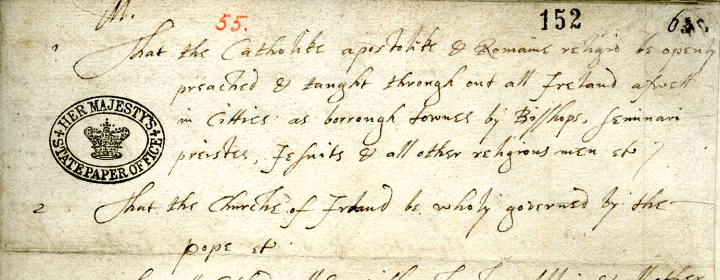
The first two of Hugh O’Neill’s list of War Aims, November 1599 (catalogue reference SP 63/206)
Documents relating to Ireland for the reign of Henry VIII from institutions other than The National Archives are also included in Letters and Papers of Henry VIII. See section 11 for a key to these references.
The Irish Manuscripts Commission has worked to replace the deficient calendars by publishing certain revised volumes with further publications to appear in the coming years:
- 1509-1547 edited by Steven Ellis and James Murray
- 1547-1553 edited by Colm Lennon
- 1566-1567 edited by Bernadette Cunningham
- 1568-1571 edited by Bernadette Cunningham
- 1571-1575 edited by Mary O’Dowd
Other useful sources for Tudor Ireland include:
- SC 11 which relates to monastic lands confiscated by the Crown in 1540-41
- David Heffernan, Reform Treatises on Tudor Ireland, 1537-1599 (Dublin, 2016)
5. Records from the Stuart period: the reigns of James I, Charles I, Charles II and James II
State Papers Ireland for the 17th century continue in SP 63/216-277 (James I and Charles I) and SP 63/303-352 (Charles II and James II). All are available to read on State Papers Online (£) or accessed using the on site computers at The National Archives in Kew (free of charge).
The Calendars of State Papers Ireland for the Stuart monarchs are the simplest means of accessing the records for this period and run from 1603-1670. These printed calendars are more reliable and extensive than the 19th-century efforts for the Tudor period but are not comprehensive. The calendars for 1633-1670 also incorporate records from outside the State Papers series including:
- Signet Office Letter Books from SO 1 authorising the lord lieutenant or lord deputy to pass Letters Patent under the Great Seal of Ireland. Indexes are also in SO 2 and SO 3.
- Docquet Books, which briefly surmise the King’s Bills, in SO 3.
- King’s Bills in SP 39 (which run from 1609-1642 and continue after 1661 in SO 7).
- A small number of records relate to Ireland in the Secretary of State’s Entry Book in SP 44. For the period 1661-1690, there are similar entry books in SP 63 (SP 63/308, 312, 318, 336, 340 and 341).
From 1670 to 1690, there are no specific finding aids for SP 63 and Irish records are incorporated into the Calendars for State Papers Domestic (available on British History Online behind a paywall or available for free in the reading rooms at The National Archives in Kew).
Other useful sources include:
- Irish patent rolls issued by James I and housed in the Public Record Office of Ireland were transcribed in the 19th century and published in 1960 by the Irish Manuscripts Commission
- Transcriptions of Irish Patent Rolls from Charles I’s reign that were housed in Dublin but now destroyed
- Records of draft bills to be approved at Whitehall before presentation to the Irish parliament for 1634-35
- Transcripts of documents related to the governance of Ireland between Elizabeth I and James I’s reign that were housed in Dublin but were destroyed in 1922
- Privy Council Registers (PC 2/27-72) contain voluminous administrative detail on the governance of Ireland. Unindexed digital images for Charles II and James II’s reigns are available to view (free of charge) on the Anglo-American Legal Tradition website and are arranged chronologically by monarch
- The acts of James II’s Irish Parliament of 1689 edited by John Bergin and Andrew Lyall (Dublin, 2017). The papers of the Irish Jacobite parliament were ordered to be burnt in 1695. It passed 35 acts, of which the text of 25 survive and are printed here
6. Records from the Interregnum period: 1649-1660
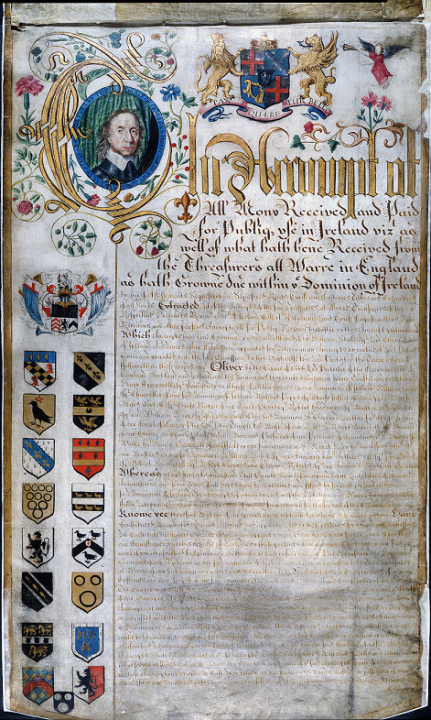
Accounts of public money for use in Ireland 1649-1656, with a portrait of Oliver Cromwell (catalogue reference SP 63/281, folio 1)
State Papers Ireland for the Interregnum run from SP 63/281-302. Administrative matters are covered in SP 63/281-287. These can be supplemented with the Records of the Committee for Both Kingdoms in SP 21/26, SP 21/28 and SP 21/29 and those of the Council of State in SP 25. Alongside them, the Acts and Orders of the Interregnum and the Journals of the House of Commons are the principal sources for the governance of Ireland in this period and both can be found on British History Online.
SP 63/288-302 are papers related to Adventurers’ land claims in Ireland and are summarised in the Calendar for State Papers Ireland 1647-1660. They consist of the receipts given to those who subscribed money to parliament under the Adventurers’ Act of 1642 to support the army in Ireland in return for the promise of land, and the subsequent claims made by subscribers to prove their rights to the claim in 1653 and 1654.
Other useful sources include:
- C 219/44-45 contains Parliamentary writs and election returns for Irish MPs from 1654-56
- The 1641 Depositions database and corresponding multi-volume published versions contain accounts of atrocities committed in the 1640s as well as significant genealogical information
- Sir William Petty’s Down Survey of Ireland sought to measure lands forfeited by Catholic Irish and is replete with genealogical and geographical evidence
- Geraldine Tallon (ed.), Court of Claims 1663. Submissions and Evidence (Dublin, 2006) can be used to trace claims of land ownership after the restoration of Charles II and is a key source for genealogical research
7. Records from the reigns of William & Mary and Queen Anne: 1689-1715
State Papers Ireland for William & Mary’s reign, and that of Queen Anne, continue chronologically from SP 63/353-372. State Papers Ireland are incorporated into Calendars of State Papers Domestic until 1704 (when the printed calendars finish) and are also searchable on British History Online.
‘Entry books’ in PRO 30/26/60 contain lists of civil and military offices and office-holders c.1698-1717.
Privy Council Registers (PC 2/73-84) continue for these reigns and unindexed images are available to read on Anglo-American Legal Tradition website.
8. Records of Hanoverian Ireland until 1782
The State Papers Ireland run from SP 63/372-480 until the Home Office was created in 1782. For the period 1715-1760 there are no published finding aids but the Public Record Office of Northern Ireland holds typescript calendars. From 1760-1775 the State Papers Ireland are included in the Calendars of Home Office Papers via British History Online (£).
By the 18th century, it was established practice for the Lord Lieutenant’s secretary to send ‘public’ dispatches – such as formal acknowledgements and requests or routine military matters – to the Secretary of State for the Southern Department, which was responsible for Irish affairs. The Lord Lieutenant himself would send ‘private’ dispatches, often in his own handwriting, to the Secretary on policy and political issues, sometimes endorsed as ‘secret and confidential’ or ‘most secret’ and this is the correspondence now in SP 63.
Entry books of letters sent from the Secretary of State to the Irish administration are in SP 67 for 1681-1783 with separate warrant books in the same class for 1713-1776 (before 1713 warrants were noted in the entry books).
As with previous reigns, unindexed images of the Privy Council Registers (PC 2/85-128) are available to read on the Anglo-American Legal Tradition website.
Other useful sources include:
- On financial matters, the Lord Lieutenant corresponded directly with the First Lord of the Treasury and this correspondence is not included in SP 63, although letters to the Treasury often duplicated those to the Southern Department. Correspondence with Treasury officials may be found in T 14 and is calendared to 1745 in the Calendar of Treasury Papers and Calendar of Treasury Books and Papers
- Records of Irish Customs Board and the Irish Revenue Commissioners are found in CUST
- Irish parliamentary bills to be approved by the English Privy Council before presentation to parliament are available in C 183
9. Related materials
- The Irish Manuscripts Commission has published all known royal proclamations related to Ireland in a five-volume set: Proclamations of Ireland: 1660-1820 (Dublin, 2013) drawing on numerous sources at The National Archives and elsewhere.
- Throughout the early modern period, numerous Irish people took cases to the English Court of Chancery. You can name-search our catalogue for cases, and the records are particularly rich in land-holding, financial and genealogical detail.
10. Records in other archives
- The Carte Papers at the Bodleian Library are comprised mainly of the papers of James Butler, 1st Duke of Ormond (1610-88) that were gifted to the Bodleian Library in 1728-29 and added to when Thomas Carte himself departed Kilkenny Castle, the Butler seat, with numerous additions. They sit naturally alongside the State Papers Ireland and often provide the other side of government correspondence to Dublin from London. See the Carte Manuscripts website for finding aids and calendars from 1660-88.
- The Carew Papers are housed in Lambeth Palace Library and were collected by Sir George Carew during his period in Ireland as President of Munster for the purpose of writing the history of the island from the reign of Henry II to that of Queen Elizabeth. Printed calendars are available, as are further transcriptions that were not included in the calendars in PRO 30/5.
- For other archives containing Irish material until 1641, see British Sources for Irish History 1485-1641. A guide to manuscripts in Local, Regional and specialised repositories in England, Scotland and Wales edited by Brian Donovan and David Edwards (Dublin, 1998).
- See also Sources for early modern Irish history, 1534-1641 edited R W Dudley Edwards and Mary O’Dowd (Cambridge, 1985).
11. Key to references in the margins of calendars for State Papers
Most documents calendared are from the State Papers Ireland. This is noted in the left-hand margin by the entry.
Where the item is not described as SP Ireland, the references at the side of each entry refer to the following sources:
| Reference appearing in calendar margin | Where to go for the records referred to |
|---|---|
| Entry Book | SP 63/204 |
| Entry Book Ireland, Folios | SP 65/12 |
| Ireland, Folios | SP 65 |
| Irish Maps | SP 64 |
| SP Dom Eliz + volume number | SP 12 /volume number |
For the period 1603-1670, documents are mainly drawn from SP 63, but there are other document sources, as shown in the table below. The left-hand column of the table below lists original references as they appear in the calendars. The right-hand column indicates either the modern National Archives series or other archives and repositories where the documents are held.
| Reference appearing in calendar margin | Where to go for the records referred to |
|---|---|
| Add (Additional) papers | SP 63/240 |
| ACTA Regia Hibernica | Incomplete collection made by Irish Record Commission, Dublin* |
| BM | Dept of MSS, British Library, 96 Euston Road, London NW1 2DB |
| Carew Papers | At Lambeth Palace Library, London, SE1 7JU. (Ed) JS Brewer and WM Bullen: Calendar of the Carew Manuscripts (London 1887) |
| Carte Papers | At Bodleian Library, Oxford. Transcripts at The National Archives under reference PRO 31/1 |
| Conway Papers | Distributed in SP 63 |
| Docquet Book/Docquets | SP 38 |
| Grant Book | SP 14/141 |
| Hanmer Notes | SP 63/21 |
| Ind Warrent Book | SP 14/60 |
| Patent Roles Ireland | Dublin* |
| Philadelphia Papers | Dublin*. Transcripts at The National Archives under reference PRO 31/8/197 -203 |
| Proclamations | SP 14/187 |
| Sign Manual | SP 39 |
| Sy W | (Unidentified) |
| SP Dom(estic) Entry Book | SP 44 |
| SP Dom(estic) Inter(egnum) E | SP 21 |
| SP Dom(estic) Inter(egnum) I | SP 14 |
| SP Dom(estic) Proclamations | SP 14/187 |
| Trin Coll Dublin | The Library, Trinity College, College Street, Dublin 2 |
| Warrent Book | SP 40 |
* Public Record Office of Ireland (PROI), Four Courts Dublin. Contents largely destroyed by explosion and fire in 1922. For description and extent of holdings as of 1919, see Herbert Wood, A Guide to the Records Deposited in the Public Records Office of Ireland (Dublin, 1919) and subsequent Deputy Keepers Reports for accessions to the PROI between 1919 and 1922. Work to digitally recreate the PROI as it was in June 1922 is underway and will be available in 2022 – see Beyond 2022: Ireland’s Virtual Record Treasury.
12. Further reading
There is an extensive bibliography on early modern Ireland. The following publications are among the most accessible, all available at The National Archives’ Library in Kew.
Visit the National Archives’ shop for a range of books.
For introductions to the State Papers Ireland, essays on State Papers Online (£) are very useful starting points.
Overview
- Thomas Bartlett (General Editor), The Cambridge History of Ireland (4 volumes, Cambridge, 2018)
- S J Connolly, Contested Island. Ireland 1460-1630 (Oxford, 2007)
- S J Connolly, Divided Kingdom. Ireland 1630-1800 (Oxford, 2008)
Tudor Ireland
The introductory essays within the Irish Manuscript Commission’s recently published Calendars of State Papers Tudor Ireland provide invaluable insights into the records within these volumes by scholars most familiar with their contents. Other suggested reading includes:
- Jon G Crawford, Anglicizing the government of Ireland: the Irish privy council and the expansion of Tudor rule, 1556-1578 (Dublin, 1993)
- Steven Ellis, Ireland in the Age of the Tudors, 1447-1603: English expansion and the end of Gaelic Rule (Harlow, 1998)
- David Heffernan, Debating Tudor Policy in Sixteenth-Century Ireland (Manchester, 2018)
- Colm Lennon, Sixteenth-Century Ireland. The Incomplete Conquest (Dublin, 2005)
- Christopher Maginn, William Cecil, Ireland and the Tudor State (Oxford, 2012)
Stuart Ireland
- Nicholas Canny, Making Ireland British. 1580-1650 (Oxford, 2001)
- Aidan Clarke, The Old English in Ireland, 1625-1642 (London, 1966)
- Raymond Gillespie, Seventeenth-Century Ireland. Making Ireland Modern (Dublin, 2006)
- Eoin Kinsella, Catholic Survival in Protestant Ireland, 1660-1711 (Woodbridge, 2018)
- Charles Ivar McGrath, The Making of the Eighteenth-Century Irish Constitution: government, parliament and the revenue, 1692-1714 (Dublin, 1999)
Interregnum
- Toby Barnard, Cromwellian Ireland. English Government and Reform in Ireland, 1649-1660 (Oxford, 1975)
- Karl Bottigheimer, English Money and Irish Land. The ‘Adventurers’ in the Cromwellian Settlement of Ireland (Oxford, 1971) which lists all Adventurers in appendix.
- John Cunningham, Conquest and land in Ireland: the transplantation to Connacht, 1649-1680 (Woodbridge, 2011)
Hanoverian Ireland
- S J Connolly, Religion, Law and Power: the making of Protestant Ireland 1660-1760 (Oxford, 1992)
- David Hayton, Ruling Ireland, 1682-1742: politics, politicians and parties (Woodbridge, 2004)
- Ian McBride, Eighteenth-Century Ireland. The Isle of Slaves (Dublin, 2009)