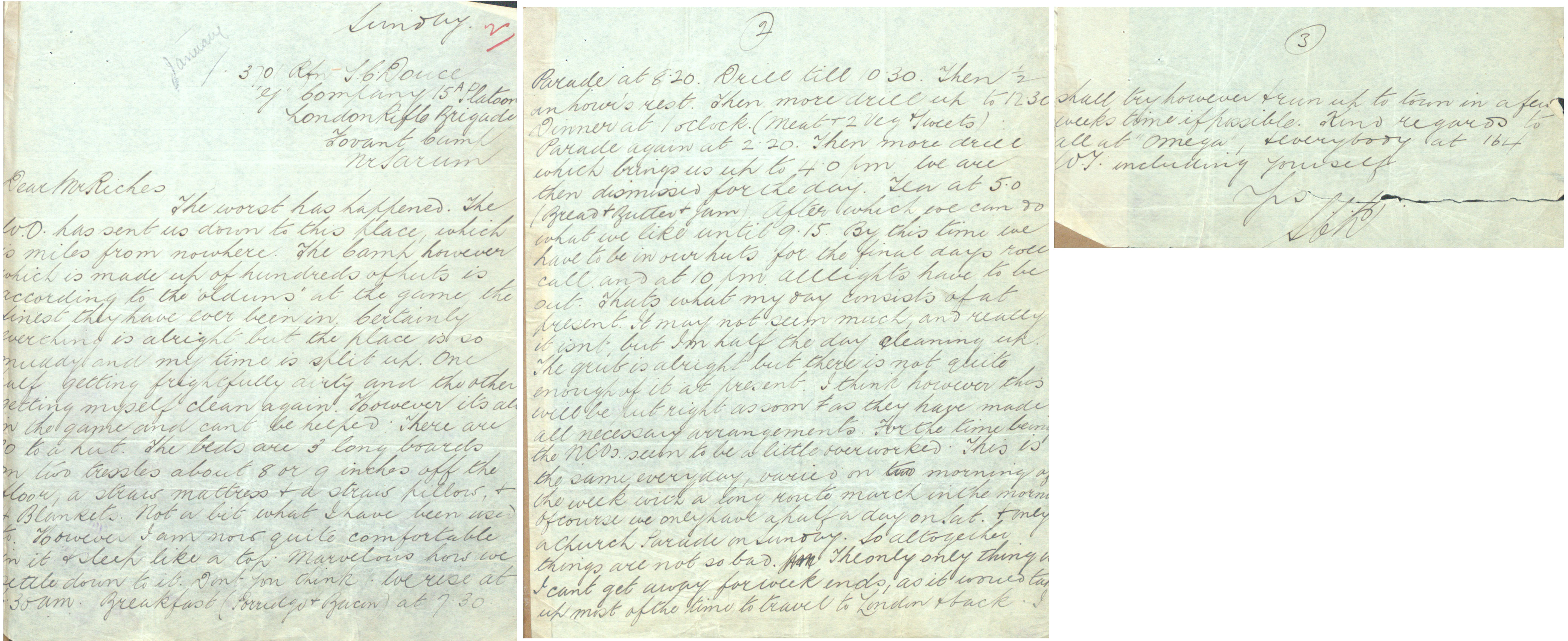
This is one of many letters sent by staff of the Great Western Railway (GWR) Audit office at Paddington who had enlisted to fight in the First World War. (RAIL 253/516)
Sydney Charles Douce, January 1916, Fovant Camp, Wiltshire. Born: 17 November 1882, Joined GWR: 28 November 1898, Regiment: 1/5 London Regiment; 3rd Battalion London Rifle Brigade; Royal Army Medical Corps, Regiment number: 3701; 202204; 536657, Rank: Private, Died: 1933
Transcript
Dear Mr. Riches
The worst has happened. The War Office has sent us down to this place which is miles from nowhere. The camp however is made up of hundreds of huts is according to the ‘old uns’ at the game the finest they have ever been in, certainly everything is alright but the place is so muddy and my time is split up. One half getting frightfully dirty and the other getting myself clean again. However it’s all in the game and can’t be helped. There are twenty to a hut. The beds are three long boards on two trestles about eight or nine inches off the floor, a straw mattress and a straw pillow, and four blankets. Not a bit what I have been used to. However I am now quite comfortable in it and sleep like a top. Marvellous how you think we settle down to it. Don’t you think? We rise at 6.30am. Breakfast (porridge and bacon) at 7.30. Parade at 8.20. Drill till 10.30. Then half an hour’s rest. Then more drill up to 12.30. Dinner at 1 o’clock (meat and two vegetables and sweets). Parade again at 2.20. Then more drill which brings us up to 4pm. We are then dismissed for the day. Tea at 5pm (bread, butter and jam). After which we can do what we like until 9.15. By this time we have to be in our huts for the final day’s roll call and at 10pm. All lights have to be out. That’s what my day consists of at present. It may not seem much, and really it isn’t, but I am half the day cleaning up. The grub is alright but there is not quite enough of it at present. I think however this will be right as soon as they have made all necessary arrangements. For the time being the Non-Commissioned Officers seem to be a little overworked. This is the same every day, varied on two mornings a week with a long route march in the morning. Of course we only have half a day on Saturday and only a Church parade on Sunday. So altogether things are not so bad. The only thing is I can’t get away for weekends, as it would take up most of the time to travel to London and back. I shall try however and run up to town in a few weeks’ time if possible. Kind regards to all at ‘Omega’, and everybody at 164, W.1, including, yourself.
Yours, S.C.D.
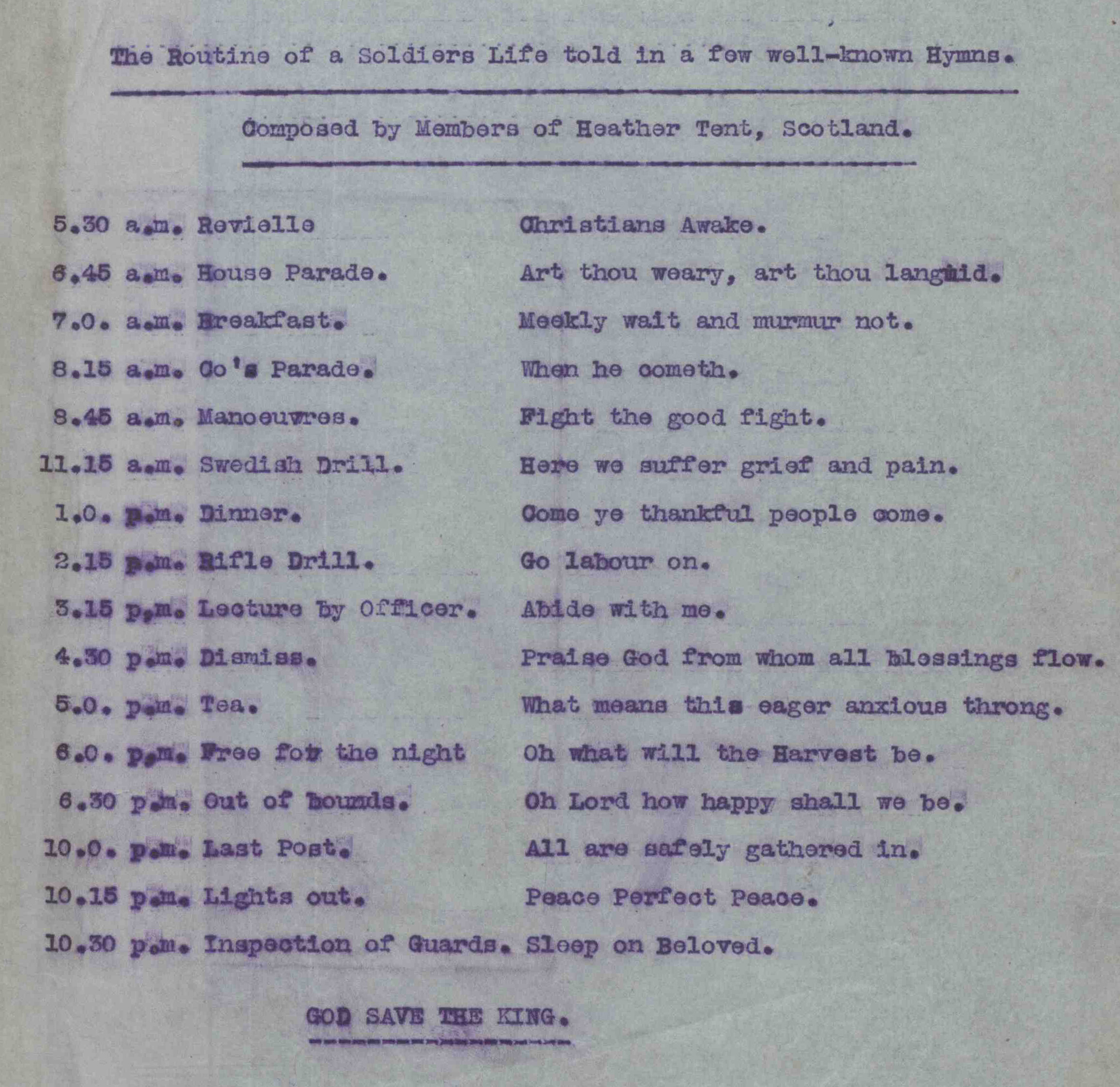
Routine of a soldier’s life told in a few well-known hymns composed by members of Heather Tent, Scotland. This was included in the newsletter for the Great Western Railway Paddington Audit office in May 1916.
It was probably sent in by one of their staff who was training at a camp in Scotland and then typed out by the office. It provided a wonderful insight into the training schedule and possible thoughts surrounding it! (RAIL 253/516)
Transcript
5.30 am Revielle Christians Awake
6.45 am House Parade Art though weary thou languid
7.00 am Breakfast Meekly wait and murmur not
8.15 am Company parade When he cometh
8.45 am Manoeuvres Fight the good fight
11.15 am Swedish Drill Here we suffer grief and pain
1.00 pm Dinner Come ye thankful people come
2.15 pm Rifle Drill Go labour on
3.15 pm Lecture by Officer Abide with me
4.30 pm Dismiss Praise God from whom all blessings flow
5.00 pm Tea What means this eager anxious throng?
6.00 pm Free for the night Oh what will the harvest be?
6.30 pm Out of bounds Oh Lord how happy shall we be
10.00 pm Last post All are safely gathered in
10.15 pm Lights out Peace Perfect Peace
10.30 pm Inspection of Guards Sleep on beloved
GOD SAVE THE KING
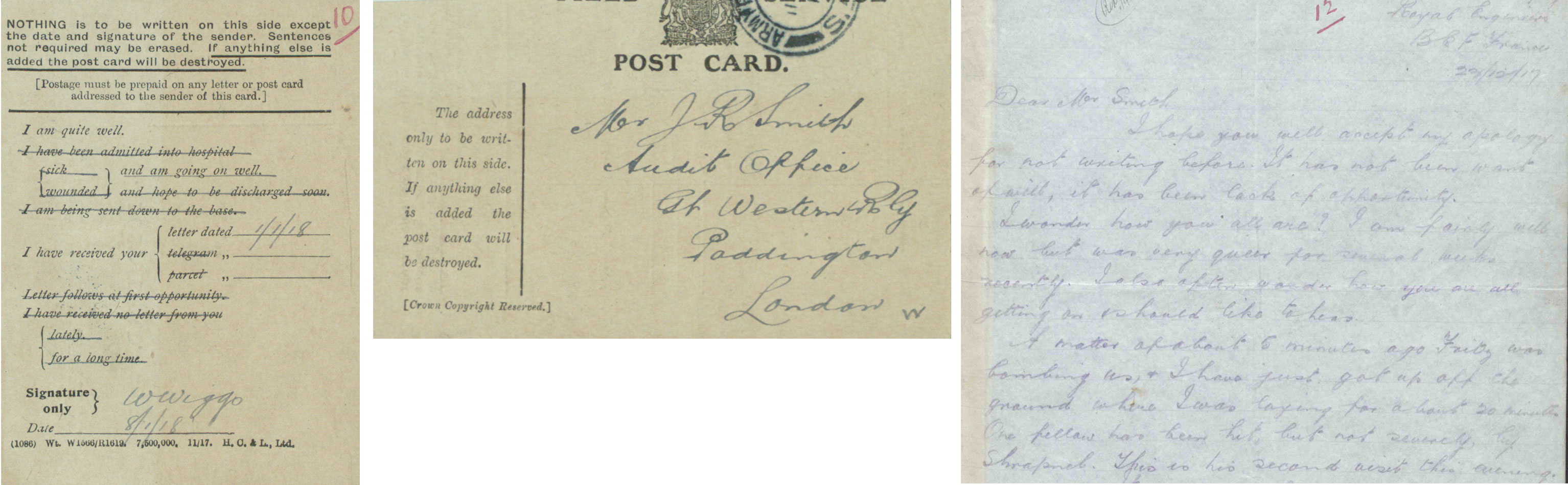
This image is an extract of one of the many letters sent by staff of the Great Western Railway Audit office at Paddington who had enlisted to fight in the First World War. The image shows part of the letter; the full transcript is given below. (RAIL 253/516)
William Charles Frederick Wiggs, letter sent 23 December 1917, field card sent 8 January 1918, France. Born: 2 February 1881, Regiment: Royal Engineers, Railway Troop, Regiment number: 218855, Rank: 2nd Corporal, Died: Oct-Dec 1971
Transcript
Dear Mr Smith,
I hope you will accept my apology for not writing before. It has not been want of will it has been lack of opportunity. I wonder how you all are. I am fairly well now but was very queer for several weeks recently. I also often wonder how you are all getting on and should like to hear.
A matter of about five minutes ago Fritz was bombing us, and I have just got up off the ground where I was laying for about twenty minutes. One fellow has been hit, but not severely by shrapnel. This is his second visit this evening.
It will soon be twelve months since I left you. It seems a very long time ago. I am afraid I have very little I may tell you, so will conclude by asking you to accept my best wishes for the New year and desiring that you will remember me kindly to any enquiring friends. Believe me, dear Mr Smith, sincerely yours,
W. Wiggs
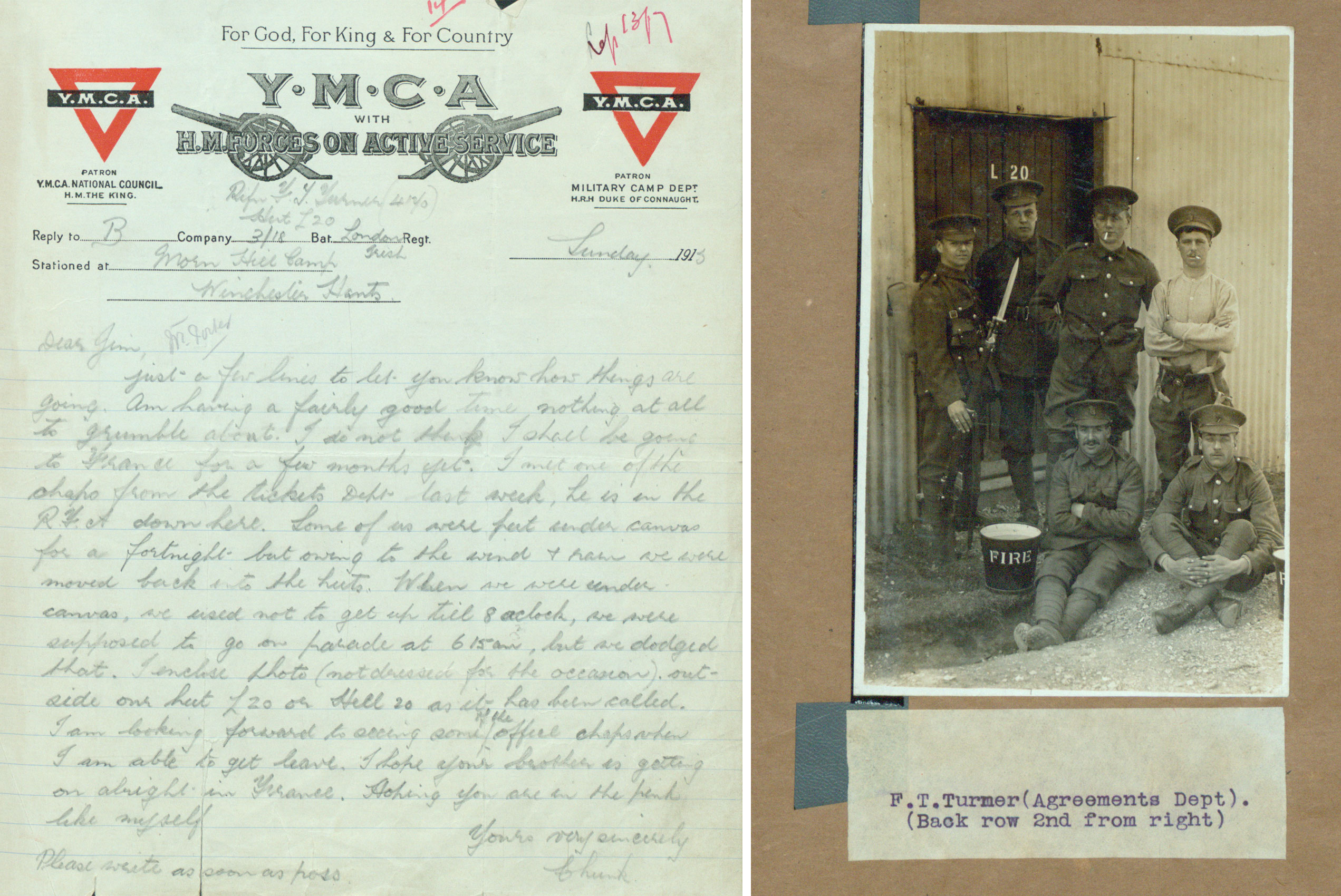
This is one of many letters sent by staff of the Great Western Railway Audit office at Paddington who had enlisted to fight in the First World War. Turner sent a photograph of his hut ‘L20’, which the soldiers referred to as ‘Hell 20’, with his letter. (RAIL 253/516)
Frank Thayer Turner, 13 July 1916, Morn Hill Camp, Winchester, England. Born: 22 October 1897, Joined GWR: 13 April 1912, Regiment: Company 3/18 London Irish Regiment, Returned to office: 5 November 1917. He lost his right arm in the war. Died: 28 May 1937
Transcript
Dear Jim (Mr Porter)
Just a few lines to let you know things are going. Am having a fairly good time nothing at all to grumble about. I don’t think I shall be going to France for a few months yet. I met one of the chaps from the tickets department last week he is in the R.F.C. down here. Some of us were feet under canvas for a fortnight but owing to the wind and rain we were moved back to the huts. When we were under canvas, we used not get up till 8 o’clock, we were supposed to go on parade at 6.15am, but we dodged that. I enclose photo (not dressed for the occasion) outside our hut L20 or Hell 20 as it has been called. I am looking forward to seeing some of the office chaps when I am able to get leave. I hope your brother is getting on alright in France. Hoping you are ‘in the pink’ like myself,
Yours very sincerely
F. Turner
Please write as soon as poss.

This is one of many letters sent by staff of the Great Western Railway Audit office at Paddington who had enlisted to fight in the First World War. (RAIL 253/516)
Sidney Smith, undated, Longmoor Camp, England. Born: 20 October 1881, Regiment: Railway Operatives Division, Royal Engineers, Regiment number: 218849, Rank: Sapper, Returned to office: 19 May 1919, Retired: 20 October 1941
Transcript
Dear Mr Beak and all,
My address shows you I am well in now. Oh it is a different life and comes hard at first, four blankets on the floor and it is hard. I didn’t get used to it until last night which was my first night’s proper rest. The food is fair but served very rough and not enough after the drills you have to go through. The weather has of course been very bad and I am still in the same things as I left London last Monday. I look like a tramp and my collar, of the colour, something like the office grate. I was inoculated last Thursday but was not so bad but some of the fellows felt it. I expect I shall have a time with the next lot but hope I don’t as they have not got much sympathy and of course there is no comfort. A lot of fellows (about four hundred and fifty) have been shifted (Saturday and today) to Bordon and we shall all probably go when we get fitted out as they are making a new camp there with three new companies. It cannot be worse than here which is very dreary and lonely and the nearest village (Liss) is three miles away where several of us went on Saturday and Sunday and had tea. That place is I may say, truly rural. I have had a military hair cut tonight and feel that I look like Bill Sykes. I am afraid none of our young ladies would care to be seen walking up number 1 (platform at Paddington Station) with me as I look at the moment. (censored.)
There is no leave now, only when you get your overseas leave which is generally after six weeks here and when you come back you are the put on the draft so it isn’t long is it? George Jones and Isles will probably stay longer as they are to have false teeth but me, although as you know, I have got a very bad lot of teeth was passed and they are not touching mine. Army ways are funny and I have already found out a lot of which I trust I shall one day be able to tell you.
I forget to tell you we all got split up into different huts when we arrived and mine is about a mile away from the camp. It is very comfortable however much better accommodation than at the camp. Three other of our fellows were put in there with me and I found some others, also some very nice London & North Western Railway chaps, one of whom knew Mr Bryant and all the Fares office chaps. He was the head of the Season Ticket Office at Euston. I might say that they have been very good to me and assisted me more than some of our chaps, one or two of whom I am sorry to say have not done what they might to assist others and I (together with some of the others) have been surprised but of this more anon when we meet. Well I bid you all adieu for the present. I think of you all often and only wish I was back again but it has to be done and one can only hope the end will come soon. I hope poor old Syd Douce is getting on alright as we have not heard how he is. Now good luck to you all and every success and tell them all that could go to keep out of this life as long as they can. Goodnight.
I may say that four of our chaps who were lucky to get their outfit last week were moved to Bordon this afternoon: G. Holloway, Isles, Borrough, G.R.J. Jones. Yours very sincerely,
S. Smith.

This is one of many letters sent by staff of the Great Western Railway Audit office at Paddington who had enlisted to fight in the First World War. (RAIL 253/516)
Kenneth William Sharland, 26 July 1917, Pashan Camp, Kirkee, India. Born: 25 September 1888, Regiment: 1/6 East Surrey Regiment; Bedfordshire Regiment; Bedfordshire and Hertfordshire Regiment, Regiment number: 34173; 32376, Rank: Private, Died: Jan-Mar 1967
Transcript
My dear Mr Biggs
The writing mood is on me so I take the opportunity to send you a few lines to let you know how I am getting on, at the same time hoping that at some future date I may have the pleasure of hearing from you. Your letter is bound to be very interesting to me as I have not seen or heard from anybody at Paddington for over six months.
I left Aldershot on March 16th and travelled as far as Durban via Sierra Leone and Cape Town on the White Star Liner Suevic. This part of the journey was delightful, the food and accommodation was very good for a troopship. Of course this is accounted for by the fact that it is an Australian troopship. Everything was done that could be to make the journey enjoyable for the one thousand seven hundred men on board. We stayed just outside Sierre Leone for three days but were not allowed to leave. We arrived at Cape Town on Saturday afternoon four weeks after leaving Keyham and had a route march round the town the same evening. The next day we were allowed to roam about at will all day and a right jolly time we had although it was very hot indeed for winter. Cape Town is a beautiful place and the inhabitants made our visit very enjoyable.
The patriotism of the South African is wonderful to us after the coolness of the English (especially Aldershot). On the Monday we sailed for Durban arriving there on the Thursday evening after a rather rough journey round the Cape. We did not land till the Saturday afternoon and then bid goodbye to the Suevic. She went on to Australia. We had two weeks at Durban and had a glorious time in a rest camp on Ocean Beach. Every day we went bathing and only had parades up to 12 noon each day. The trams were free to us all over the city and invitations were showered upon us by the English residents. You can rest assured that we were very sorry to leave such a delightful spot, still all good things come to end and we finally had to go on board the Laconia belonging to the Cunard company for four weeks’ misery, we lay in the harbour for one week longing to go ashore before we started on the last stage of our journey to India. This ship was actually lousy (infested with lice) and we had to put up with a shirt inspection every day. The food was bad and very little of it and to back it all up the canteen was rotten as well. I was glad to get to Bombay and get off such a rotten ship. I lost a stone in weight during that four weeks.
We arrived in India during the monsoon period and have had plenty of rain more than we like I can assure you.
Kirkee is only about hundred miles from Bombay and is about six thousand feet above the sea. We will while here never have the extremes of weather as the climatic conditions are considered to be ideal here.
Strange as it may seem to English people native women do most of the work here, and actually act as bricklayers’ labourers carrying pans of ‘mortar’ on their heads, the men do very little indeed. Sunday is the same as any other day to them. As they have their own religious days when they have what they call Ram Jamees. All cartage is done by oxen and is rather slow and cumbersome. Kirkee Bazar is about three quarters of an hour’s walk from Pashan Camp and is rather interesting but is very dirty, children run about naked and the drainage and dwellings are very bad indeed. Cigarettes made by the Turkish tobacco company Bandra can obtained for eleven annas (former unit of Indian currency) per 100 (eleven pence) and are very good indeed, being better than the Nebka. Poona is the nearest city and is about five miles away. I walked there last Thursday to have a look round, this place boasts of one or two hotels and an Italian restaurant but is otherwise an exact counterpart of Kirkee and quite as dirty. The Italian restaurant is very good and is quite the equal of most London restaurants.
We do not receive a very many letters out here, as the mail is so uncertain, we never know when the next one will arrive.
When you are writing you must let me know all the news, I wonder whether your section will ever be established again as it was before.
Since I came out here I have taken up signalling and find it very useful, there is just a possibility I might be able to learn wireless, if so I don’t doubt that it might be useful to me, when we get back to Blighty if there is half a chance to do so I will cease it.
Our Battalion is at Aden and unless the signalling alters my destination I will eventually find myself there. It is not exactly the place I should choose if I had my own way but of course there is no choice about it.
Well I think I have given you all the news now and am sure you are tired of reading this letter by now, so will close with best wishes to you all from, yours sincerely,
Kenneth W. Sharland
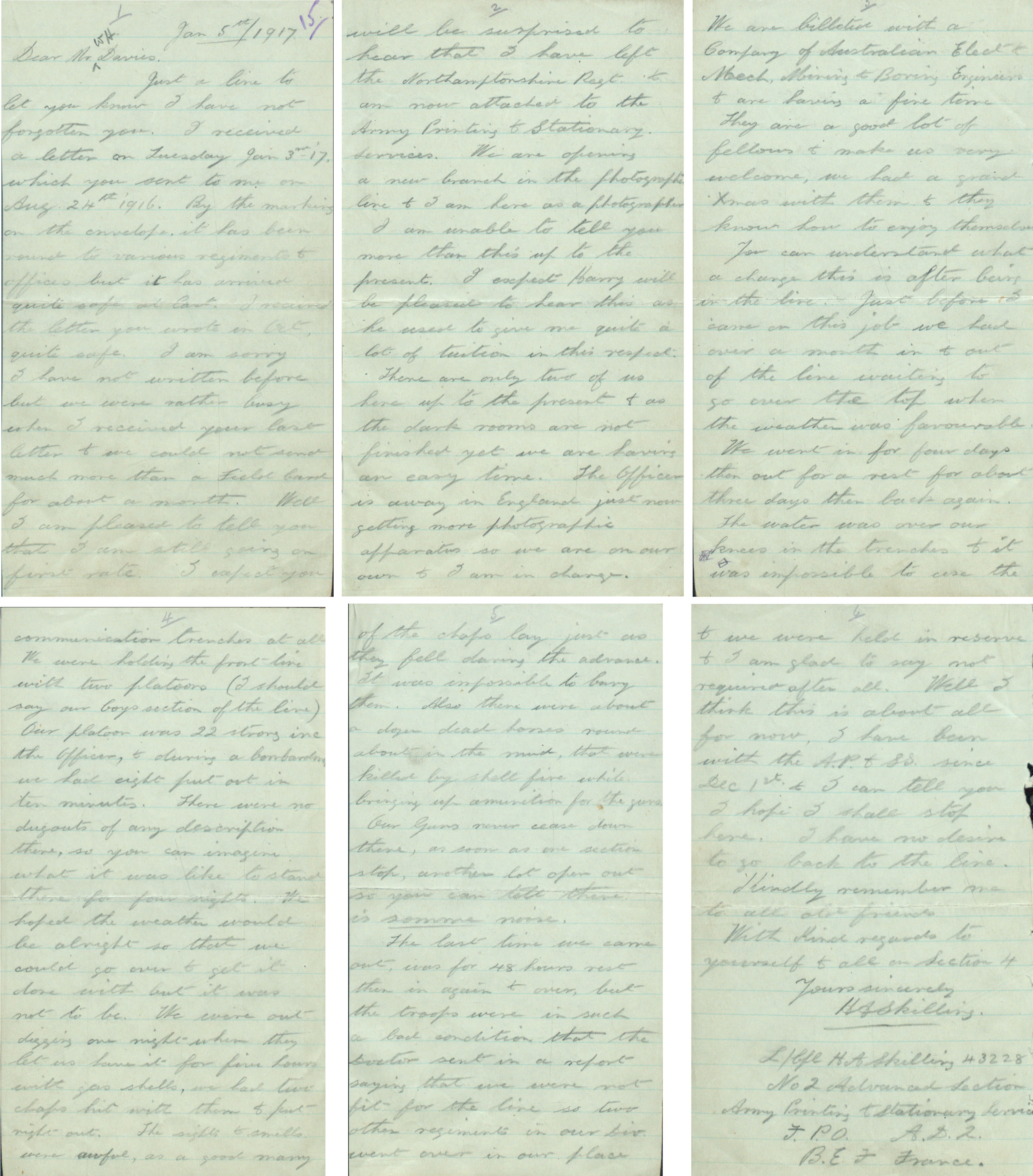
This is one of many letters sent by staff of the Great Western Railway Audit office at Paddington who had enlisted to fight in the First World War. (RAIL 253/516)
Hugh Andrew Skilling, 5 January 1917, France. Born: 17 April 1891, Regiment: 3 Battalion Bedfordshire Regiment; 7 London Brigade Field Artillery, Regiment number: 43228, Rank: Lance Corporal, Died: 1970
Transcript
Dear Mr W.H. Davies,
Just a line to let you know I have not forgotten you. I received a letter on Tuesday 3rd of January 1917 which you sent to me on August 24th 1916. By the marking on the envelope it has been round to various regiments and officers, but it has arrived quite safe at last. I received the letter you wrote in October quite safe. I am sorry I have not written before but we were rather busy when I received your last letter and we could not send more than a field card for about a month. Well I am pleased to tell you that I am still going on first rate. I expect you will be surprised to hear that I have left the Northamptonshire Regiment and am now attached to the Army Printing and Stationary Services. We are opening a new branch in the photography line and I am here as a photographer.
I am unable to tell you more than this up to the present. I expect Harry will be pleased to hear this as he used to give me quite a lot of tuition in this respect.
There are only two of us here up to the present and as the dark rooms are not finished yet we are having an easy time. The Officer is away in England just now getting some more photographic apparatus so we are on our own and I am in charge.
We are billeted with a company of Australian electricians, mechanics, mining and boring engineers and are having a fine time. There are a good lot of fellows and make us very welcome. We had a grand Xmas with them and they know how to enjoy themselves. You can understand what a change this is after being in the line. Just before I came on this job we had over a month in and out of the line waiting to go over the top when the weather was favourable.
We went in for four days then out for a rest for about three days then back again. The water was over our knees in the trenches and it was impossible to use the communication trenches at all. We were holding the front line with two platoons (I should say our boys’ section of the line). Our platoon was twenty two strong including the Officer, and during the bombardment we had eight put out in ten minutes. There were no dugouts of any description there, so you can imagine what it was like to stand there for four nights. We hoped the weather would be alright so that we could go over and get it done with but it was not to be. We were out digging one night when they let us have it for five hours with gas shells, we had two chaps hit with them and put right out.
The sights and smells were awful, as a good many of the chaps lay just as they fell during the advance. It was impossible to bury them. Also there were about a dozen dead horses round about in the mud that were killed by shell fire while bringing up ammunition for the guns. Our guns never cease down there, as soon as one section stop, another lot open out so you can tell there is Somme noise.
The last time we came out, was for forty eight hours’ rest then in again and over, but the troops were in such a bad condition that the doctor sent in a report saying we were not fit for the line so two other regiments in our division went over in our place.
We were held in reserve and I am glad to say not required after all. Well I think this is about all, for now, I have been with the A.P. & S.S. since December 1st and I can tell you, I hope I shall stop here. I have no desire to go back to the line. Kindly remember me to all old friends. With kind regards to yourself and all on Section 4.
Yours sincerely, H.A. Skilling
No. 2 Section Advanced Section
Army Printing & Stationary Service…
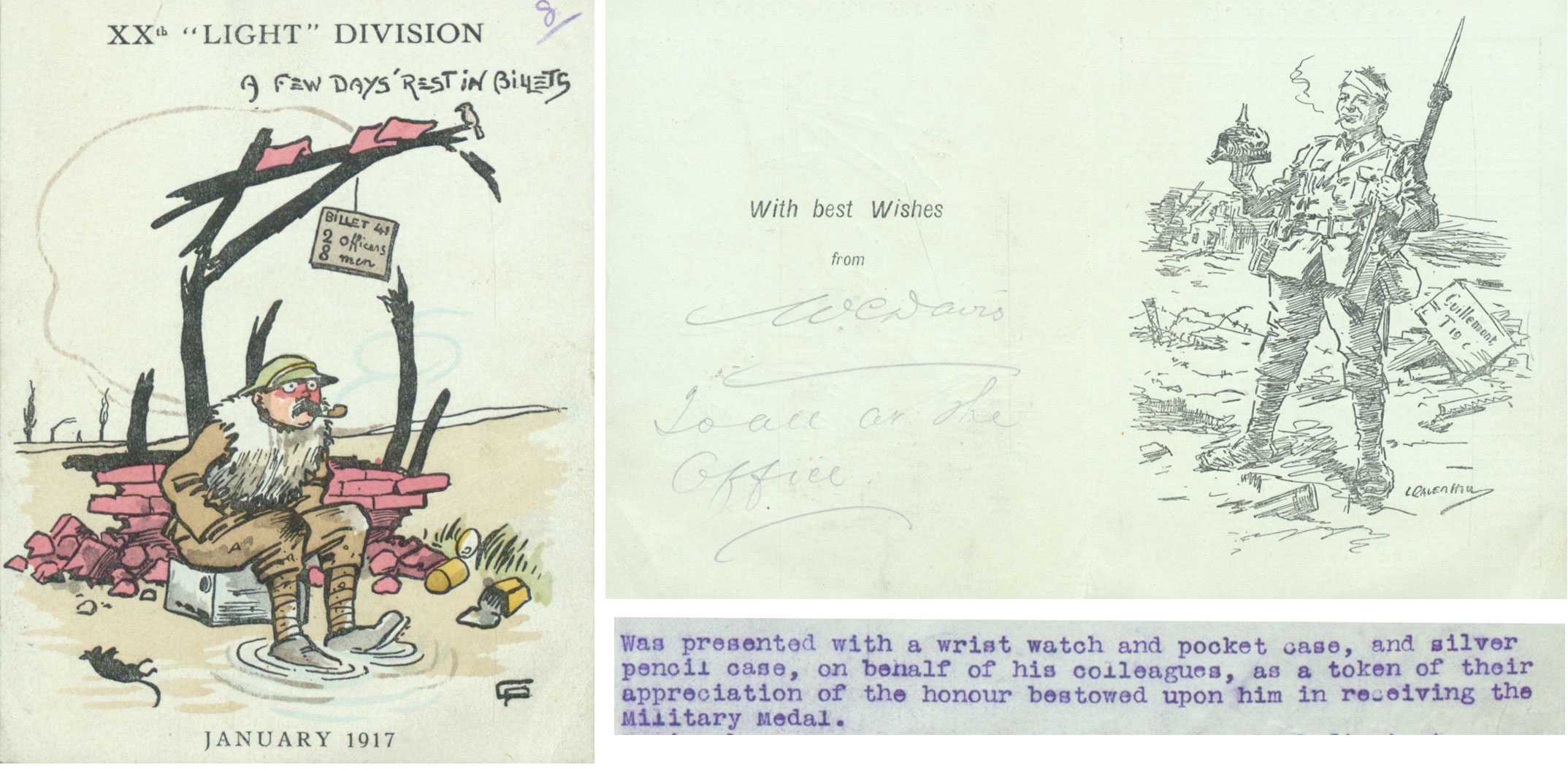
This is one of many letters sent by staff of the Great Western Railway Audit office at Paddington who had enlisted to fight in the First World War.
William Davis sent the card to E.H. Serjent who worked in the Great Western Railway Audit office at Paddington. Davis was also mentioned in the office newsletter for March 1917 for his bravery on the battlefront (RAIL 253/516). Read a letter from William Davis and see his photograph.
William Charles Davis, January 1917. Born: 12 November 1884, Regiment: Royal Army Medical Corps, Regiment number: 31223, Rank: Lance Corporal; Sergeant, Returned to office: 10 February 1919 Retired: 12 November 1944
Transcript
Christmas card:
XXa “LIGHT” DIVISION, A few days’ rest in billets, January 1917.
With best wishes from W.C. Davis to all at the office.
Newsletter (extract):
…. (Davis) was presented with a wrist watch and pocket case, and silver pencil case on behalf of his colleagues as a token of their appreciation of the honour bestowed upon in receiving the Military Medal.
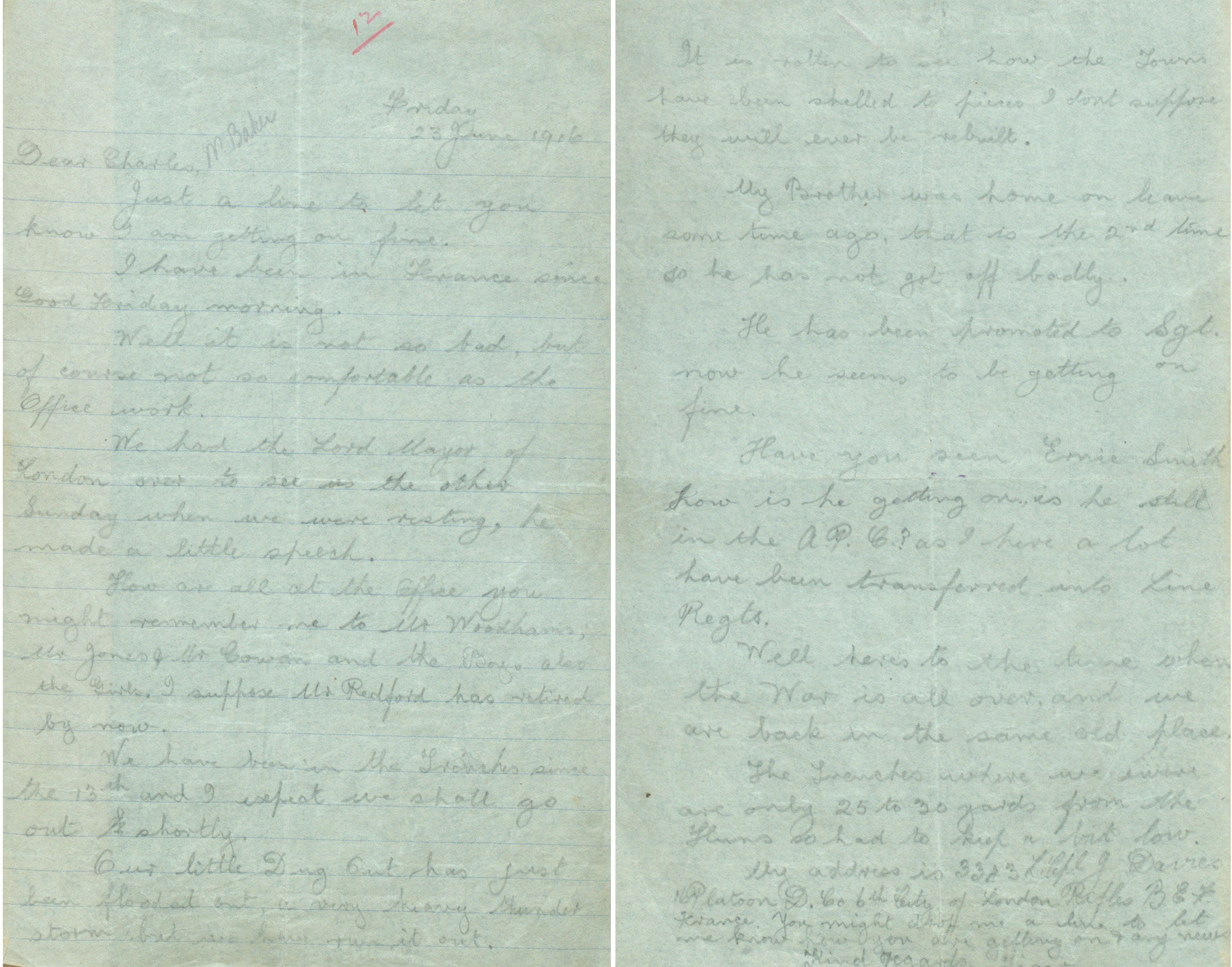
This is one of many letters sent by staff of the Great Western Railway Audit office at Paddington who had enlisted to fight in the First World War. (RAIL 253/516)
James Davies, 23 June 1916, France. Regiment: 6 City of London Rifles, Regiment number: 3343, Rank: Lance Corporal
Transcript
Dear Charles,
Just a line to let you know I am getting on fine. I have been in France since Good Friday morning. Well it is not so bad, but of course not so comfortable as the office work.
We had the Lord Mayor of London over to see us the other Sunday when we were resting, he made a little speech.
How are all at the office? You might remember me to Mr Woodhams, Mr Jones and Mr Cowan and the boys also the girls. I suppose Mr Redford has retired by now.
We have been in the trenches since the 13th and I expect we shall go out shortly. Our little dugout has just been flooded out, a very heavy thunderstorm, but we have run it out. It is rotten to see how the towns have been shelled to pieces. I don’t suppose they will ever be rebuilt.
My brother was home on leave some time ago that is the second time so he has not got off badly. He has been promoted to Sergeant now. He seems to be getting on fine.
Have you seen Ernie Smith? How is he getting on, is he still in the A.P.C. (Army Pay Corps, non-fighting troops)? As I hear a lot have been transferred into line regiments.
Well here’s to the time when the war is all over and we are back in the same old place. The trenches where we were are only 25 to 30 yards from the Huns so had to keep a bit low.
My address is 3343 Lance Corporal J. Davies, No. 1 Platoon D Company, 6th City of London Rifles, B.E.F., France. You might drop me a line to let me know how you are getting on and any news,
Kind regards…
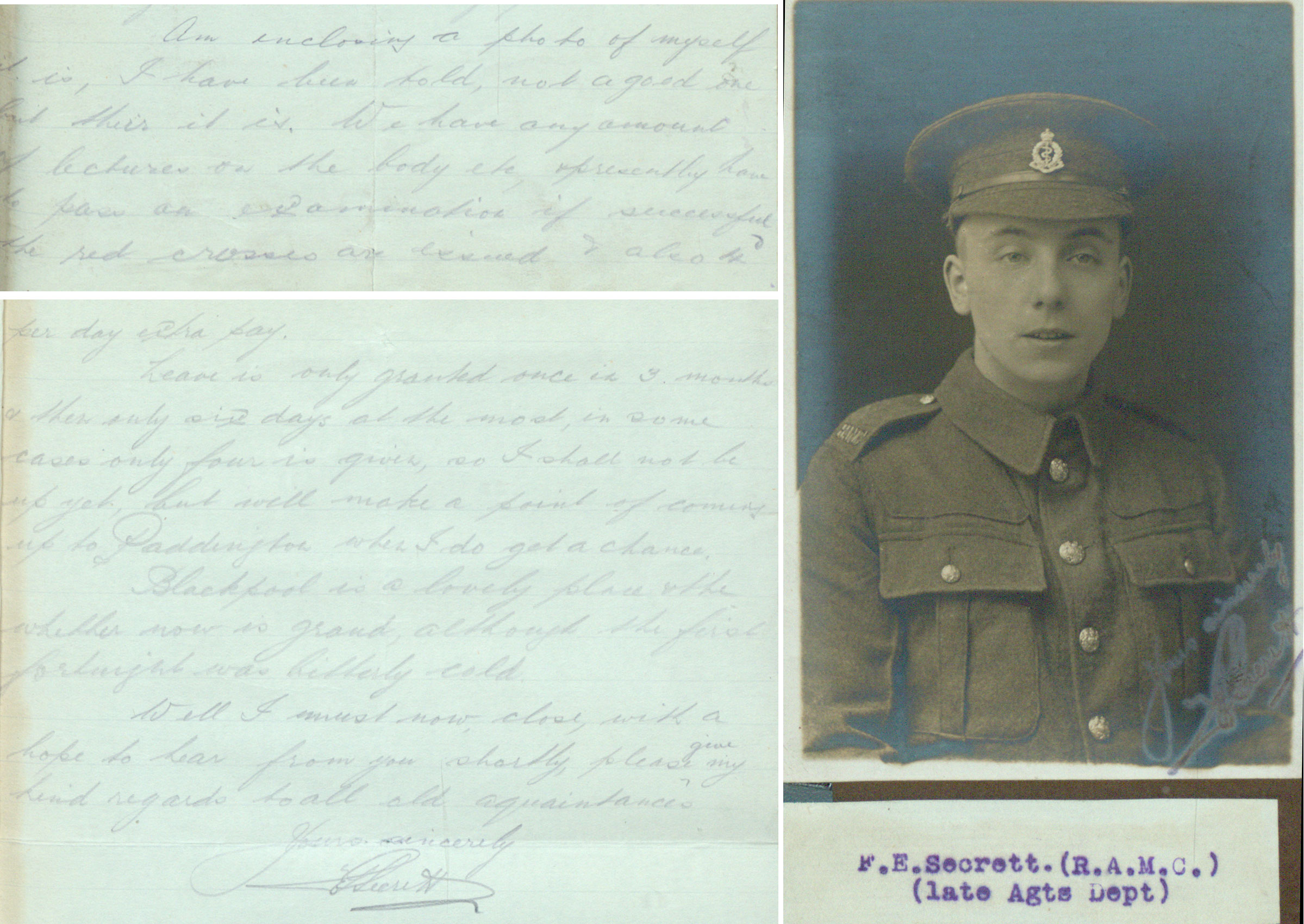
This is one of many letters sent by staff of the Great Western Railway Audit office at Paddington who had enlisted to fight in the First World War. (RAIL 253/516).
From 1916 newly enlisted Royal Army Medical Corps (RAMC) officers were taught how to cope with the types of injuries they would encounter at the front or at a casualty clearing station. They were learnt about hygiene, the prevention of infection and the importance of clean water and safe food.
Frank Edward Secrett, Royal Army Medical Corps, 29 April, 1917, Blackpool training depot, England. Regiment: Royal Army Medical Corps, 97469, Rank: Private, Enlisted: 6 June 1916, Discharged: 21 July 1919
Transcript (extract)
… Am enclosing a photo of myself, it is, I have been told, not a good likeness, but there it is. We have any amount of lectures on the body etc., and presently have to pass an examination, if successful the red crosses are issued and also 4d (pennies) per day extra pay.
Leave is only granted once in nine months and then only six days at the most, in some cases only four is given, so I shall not be up yet, but will make a point of course of coming up to Paddington when I do get a chance.
Blackpool is a lovely place and the weather now is grand, although the first fortnight was bitterly cold.
Well I must now close, with a hope to hear from you shortly, please give my kind regards to all acquaintances.
F. Secrett