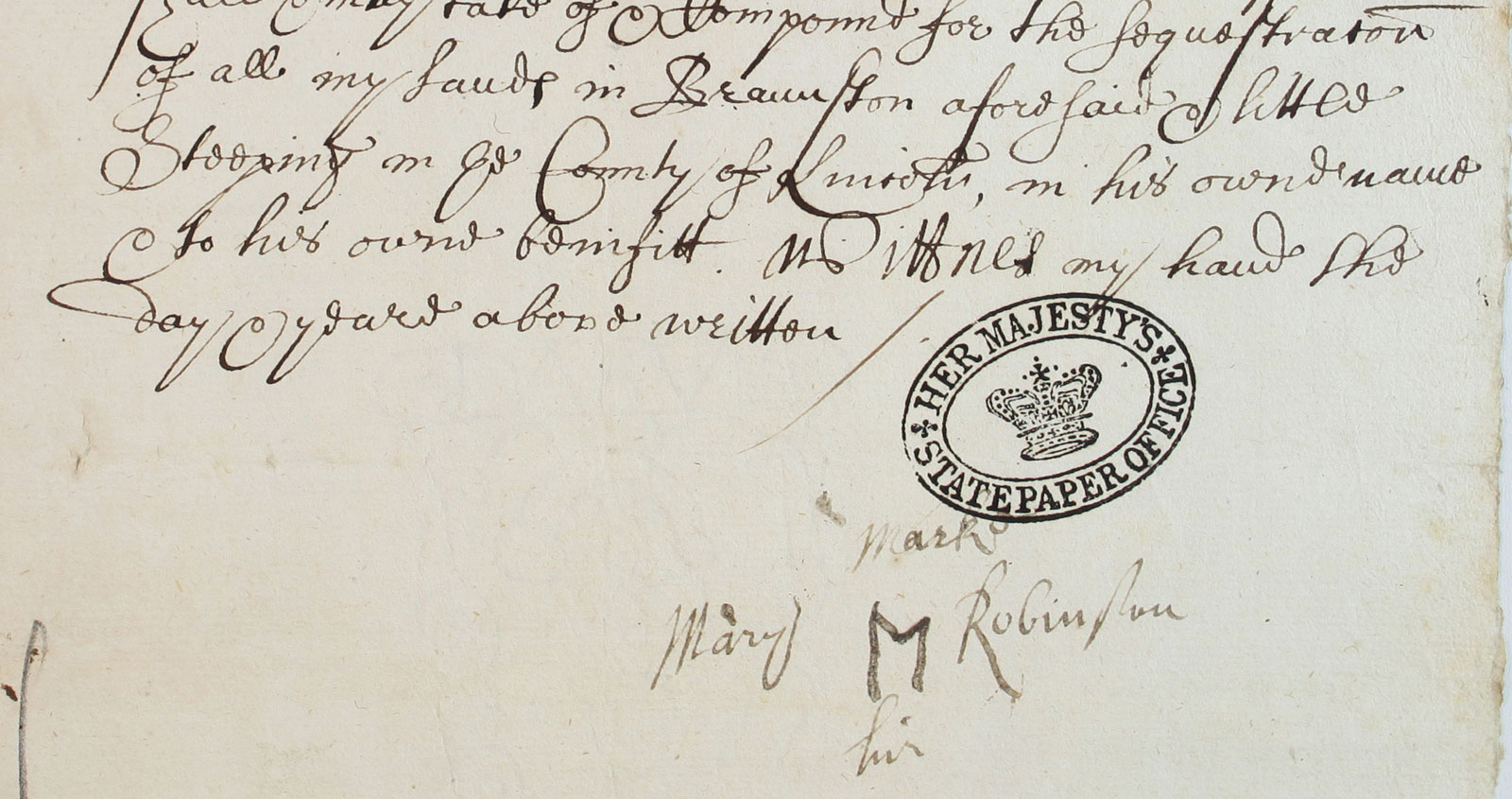
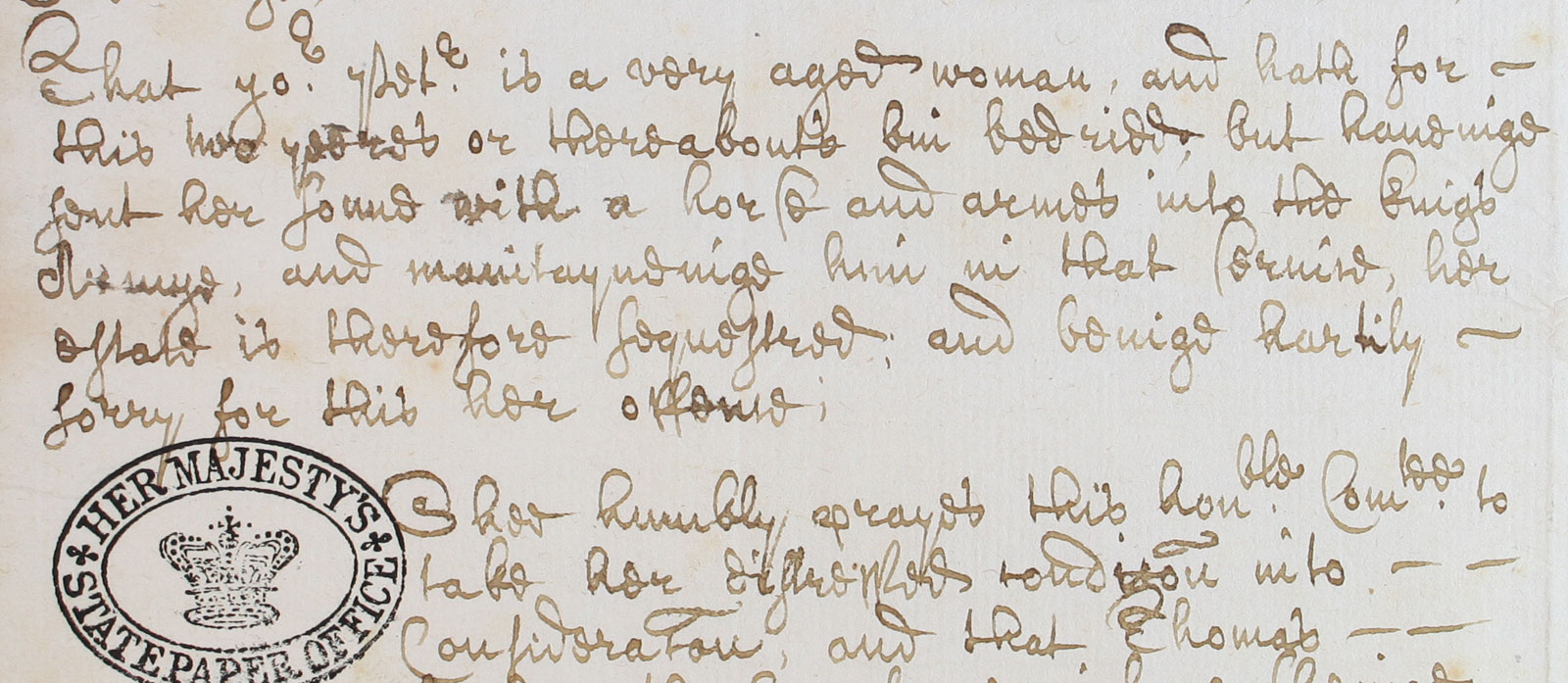
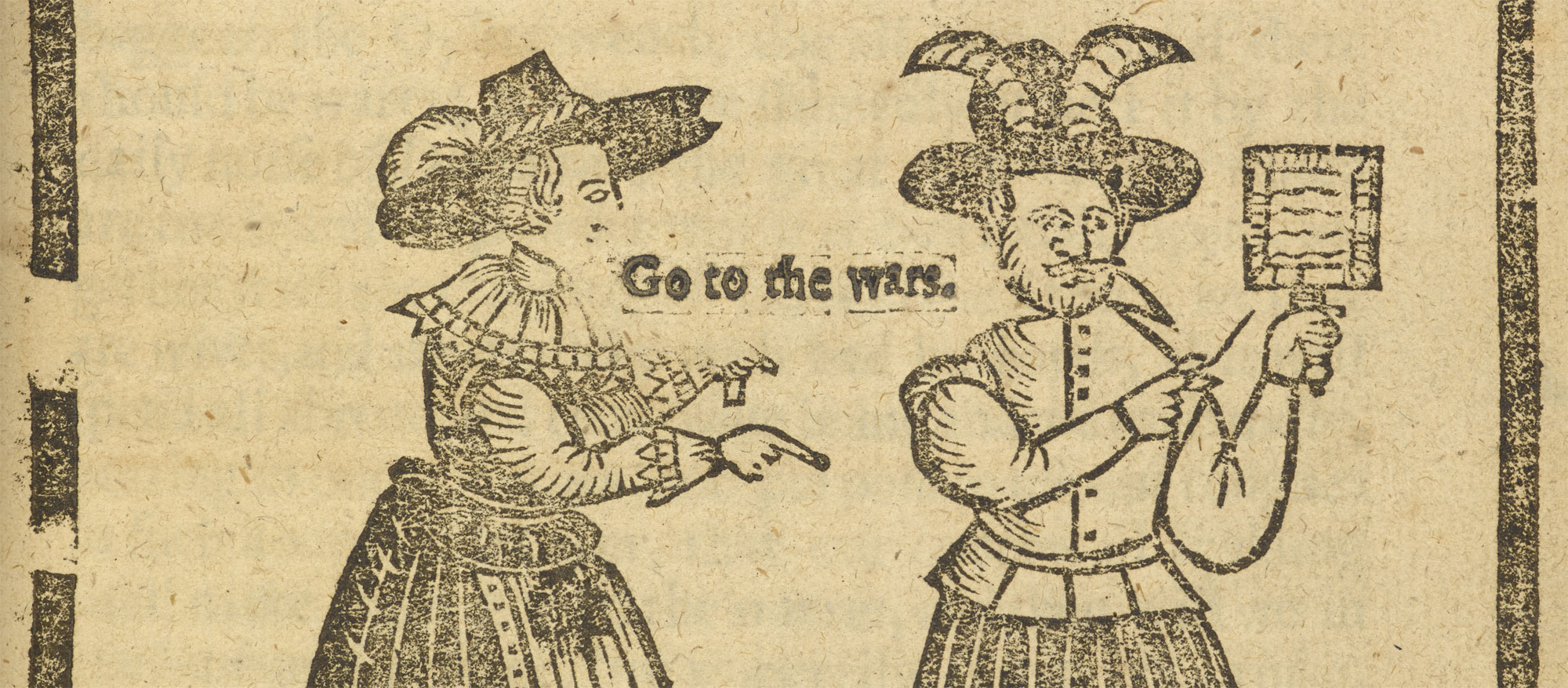
Historians have estimated that during the English Civil wars, 1642-1649 perhaps as many as 7% of the population died as a result of the fighting and from diseases spread by moving armies. People from all parts of society were impacted by these wars, and this included women. Many women were the wives and mothers of soldiers, some of whom never returned from war, as well as carrying out other wartime activities such as nursing.
Use the sources in this lesson to find out about the lives of these women during the English Civil Wars and focus on the different roles that they played. Each original document, or an extract from one, that was created or received by Parliament at the time. Some of the documents contain the words of women themselves, others are about women, but all contain interesting stories about how women participated in the events of this period.
How did these conflicts affect their lives?In 1642 war broke out between King and Parliament. Both sides called up men to fight for them as a result of a series of disagreements about religion and the way that the country should be ruled. During the 1630s King Charles I ruled without calling a Parliament. Many changes and events during this period caused distrust between the King and the people.
In the 1630s the Archbishop of Canterbury, William Laud, endeavoured to reform the church by ensuring that church buildings were made beautiful again and services made more elaborate. William Laud wanted to raise the Church of England to its former glory, but many people thought that he was returning it to the ways of the Roman Catholic Church and how it had been before the Reformation. Puritans, groups of radical Protestants, in particular disliked these changes.
Parliament was one of the main ways that monarchs raised money, by asking for taxes to be raised. As King Charles did not summon a Parliament during this time he had to use alternative ways of finding money. Some of these made him unpopular. For example, he raised money from people across the country via a tax known as Ship Money. However, because this was traditionally raised from coastal counties and only in times when the coastline was threatened, many resented it.
Finally, when rebellion broke out in Scotland in 1637 against Laud’s unpopular prayer book reforms, Charles I was forced to call a Parliament. Relationships between Charles and the MPs were now so strained that they struggled to agree on matters of religion and finance. Some people had also began to question whether the King ruled by ‘Divine Right’ (meaning that his power came directly from God and not from any earthly power). When war broke out in Ireland in 1641 an army was needed to subdue it, but the mistrust had grown so great that neither trusted the other in charge of armed forces. In August 1642 the country descended into civil war.
War was fought between King and Parliament in a series of prolonged campaigns between 1642 and 1651. In 1649 Charles I was executed and rule without a King was established until 1660 when Charles II, his son, returned to England.
‘…if you ever meet a chap that says he wants to go back call him a liar’.
These are words penned by Albert Edwin Rippington, an employee of the Audit Office for the Great Western Railway. Albert, along with many of his colleagues, had enlisted to fight in the First World War. He was wounded in action and wrote about his experiences from his hospital bed back in England. Albert was clearly deeply affected by his time in the trenches, but how typical was his experience?
In the online workshop in your classroom students will explore a range of letters written by soldiers who enlisted from the Great Western Railway to fight. The session gets pupils to compare experiences of war, along with evaluating the strengths and limitations of using letters to learn about soldier’s experiences in the First World War. The one-hour online session is led by an experienced history educator, you only need a microphone, large screen and webcam to take part. Interactive activities encourage students to discuss their ideas and work in groups using high-quality materials provided in advance by the Education team.
Connections to the curriculum:
- KS3: Challenges for Britain, Europe and the wider world 1901 to the present day
- KS4: Edexcel: Option 11. The British Sector of the Western Front
Available as: Online workshop. Find out more about the types of session we offer.
How typical was Albert Edwin Rippington’s experience of war?All activities must be booked in advance.
Tel: +44 (0)20 8392 5365
Fax: +44 (0)20 8487 9202

This is one of many letters sent by staff of the Great Western Railway Audit office at Paddington who had enlisted to fight in the First World War. (RAIL 253/516)
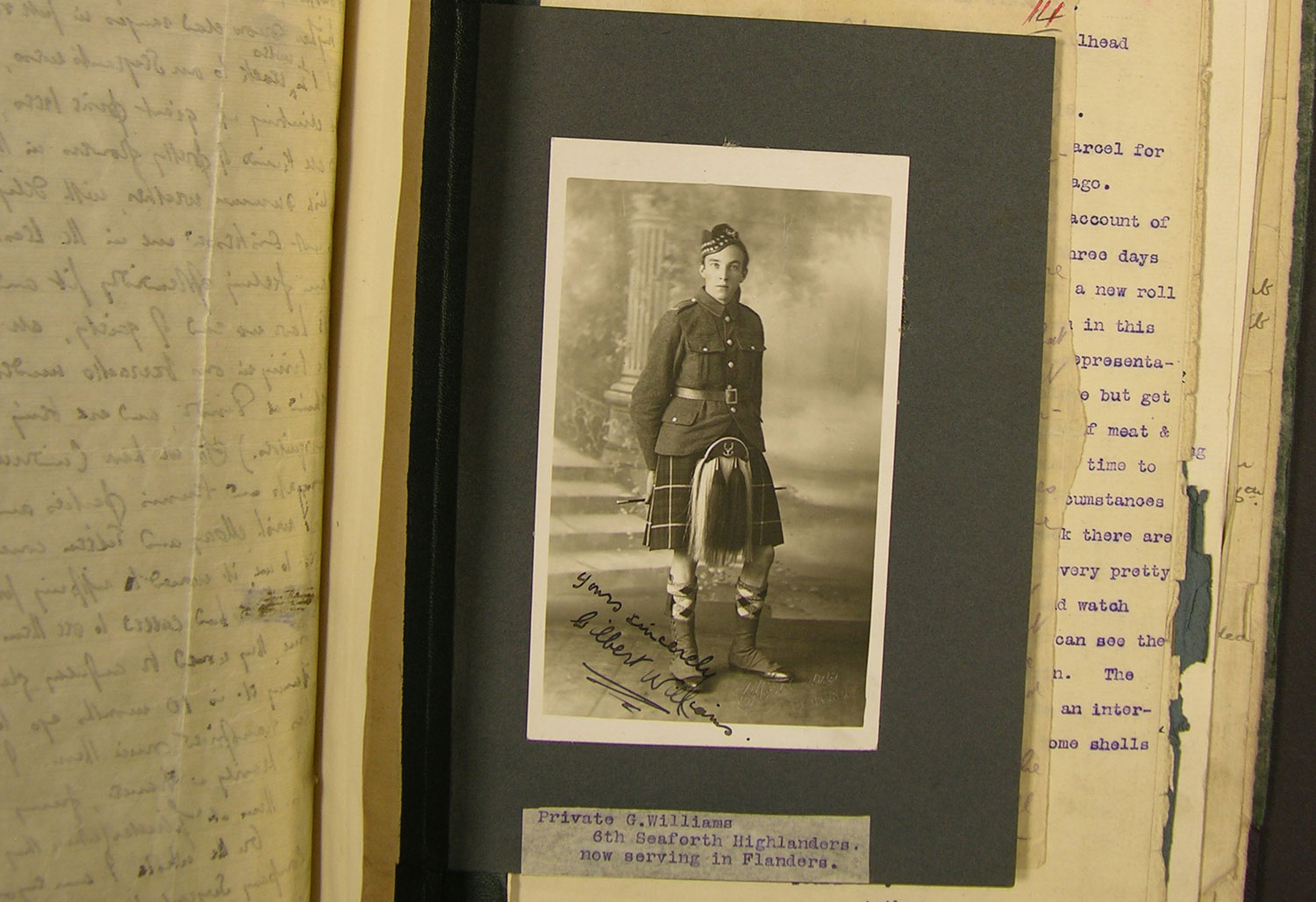
Gilbert Williams, 6 April 1916, France. Born: 18 April 1894, Regiment: 1/6 Seaforth Highlanders, Regiment number: 2175, Rank: Private, Died: 1967. Note: Williams also fought in Second World War and returned from war on 15 November 1948
Transcript
Dear Mr Hunt,
Thanks very much for your letter which I received a week or two ago, also for the magazine.
We are in the trenches just now. In fact we seem to spend about three times as much time in as we do out. Also we are in a pretty warm spot, it was about here, towards the end of last summer that the French and German had some of the fiercest fighting of the war. The country around about is a veritable maze of trenches. The fighting at one time was so fierce that there was only time just to bury the dead in the sides of the trenches, and now that the trenches have crumpled one is constantly seeing the bones of men’s legs or their boots, or skulls sticking out from the sides of the trenches, pleasant, eh? There will be a pleasant smell here in the summer. I only hope we are not here then. In places we are only about twenty yards away from Fritz and company. Consequently all times the air is pretty thick with bombs, grenades and trench mortars. These last are pretty hellish sort of toys. They have an explosion like about ten earthquakes rolled into one. But even these are not the worst we have to put up with. The trenches being so close together there is of course any amount of mining going on. So one never knows when the particular lump of earth one is standing on is going to take a trip through the solar regions. When a mine does go up, there is some excitement knocking about I can tell you. Suppose for instance we were going to explode one, all the artillery in the neighbourhood is ranged on the spot and directly the mine is exploded, there is hell let loose on the crater. Of course as soon as he gets the range the enemy replies, so that the air is fairly full of everything that kills quickly. One can on these occasions always rely on a good many casualties. Since we have been in this spasm there have been five exploded in this neighbourhood, while others are expected to go up at any time. So much for conditions here.
How is everything in town? Pretty quiet I suppose. I see you’ve had the zepps (Zeppelins) over again? Is it a fact that one dropped in the Thames? (Lines censored.) That is about all the news, so will close, kindest regards to everybody. Yours very sincerely,
Gilbert Williams.

This is one of many letters sent by staff of the Great Western Railway Audit office at Paddington who had enlisted to fight in the First World War. (RAIL 253/516)
Donald Stewart Wharton Hambly, 21 September 1916, Felixstowe, England. Born: 9 March 1865 in Plymouth, Regiment: Royal Naval Air Service, Rank: Lieutenant; Captain, Died: April 1 1930
Transcript
Dear Mr Wood.
I had meant to write to you when I could tell that I was definitely settled, but as it now seems that some time must lapse before that happy consummation I decided that I would wait no longer.
Felixstowe is the largest and most important of all the home stations. It is an ‘experimental and educational’ station, i.e. all sorts of machines and inventions are given a chance here and a large number of young officers are taught to fly sea planes. There are between seven hundred and eight hundred men on the station, the greatest proportion being mechanics. So you will readily appreciate that the work of the Stores Officer is no sinecure. Another man was sent down with me for training, he served in Gallipoli with a machine gun section and afterwards worried the Senussi (a reference to Western Desert campaign in North Africa) in an armoured car and as he collected eight machine gun bullets in his anatomy he was sent home and down here for stores work. He is an exceedingly good chap and my great chum. The stores here were being temporarily carried on by the carpenter, a commissioned Warrant Officer and it was quite thought that I or my friend would be appointed, as a matter of fact I was recommended for the post and was halfway through the ‘muster’ (stock taking) and only awaited confirmation from the Admiralty.
But today orders came to ‘stand at ease’ and it appears that some other man is being sent here. It is really no disappointment, as I didn’t care in the least where I am sent, and I have now learnt enough to take over any old stores. I will let you know when anything is decided.
Of the work of the station I cannot of course tell you much, it is all intensely interesting and one really feels quite near the thing. We have had four raids since I was here, and they are truly fascinating. We have a very lively six inch gun, quite near our billet and when she’s busy we begin to enjoy ourselves. The boom of the falling bombs, the crack of our gun, the shriek of its shell and the fantasia of a dozen search lights provide a most excellent entertainment, of course Harwich Harbour and our adjoining Air Station are objectives of the first order.
I shall be very glad to hear from you and to know any changes or events in the Audit office, it all seems very far away and I can’t see myself back there again!
I had forty-eight hour’s leave for my daughter’s wedding on the 23rd of August, she and her husband leave for India on the 23rd instant, a great wrench for me.
I suppose you will have retired before I get back, but I hope we may not altogether lose sight of each other. Regarding this over, it seems all very tame but directly I want to say anything interesting, I am brought up sharp! Kindest regards to you and all my friends in the Agreements.
Yours very sincerely,
Donald S.W, Hambly
A’ hem! I miss the GW magazine. I did not see September number.
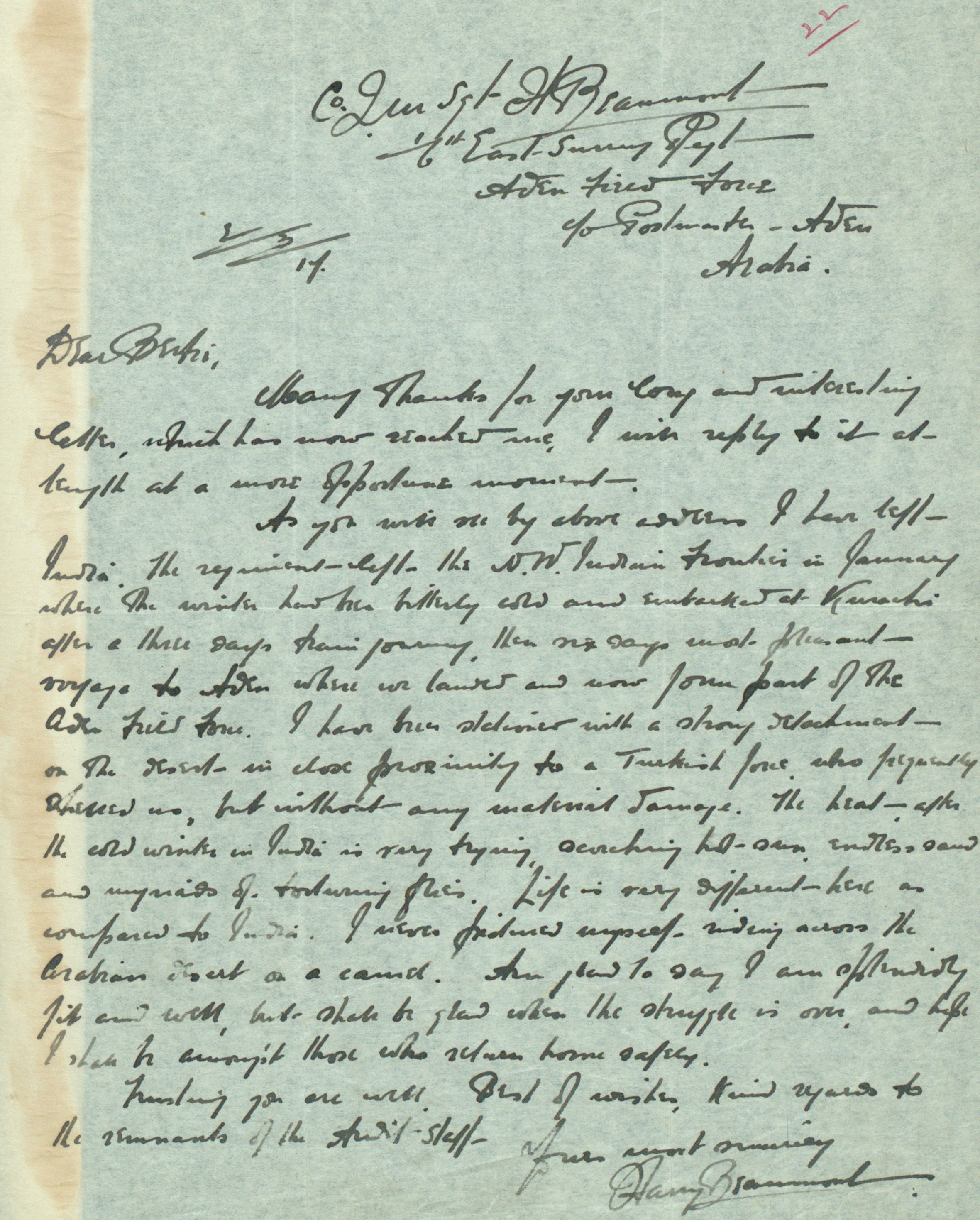
This is one of many letters sent by staff of the Great Western Railway Audit office at Paddington who had enlisted to fight in the First World War. (RAIL 253/516)
H. Beaumont, 2 March 1917, Aratia, Yemen. Born: 17 October 1873, Regiment: 1/6 East Surrey Regiment, Regiment number: 2297, Rank: Quarter Master Sergeant, Died: 1952
Transcript
Dear Bertie,
Many thanks for your long and interesting letter, which has now reached me, I will to it at length at a more opportune moment.
As you will see by above address I have left India. The regiment left the N.W. Indian frontier in January where the winter had been bitterly cold and embarked at Karachi after a three day’s train journey, then six day’s most pleasant voyage to Aden where we landed and now join part of the Aden Field Force. I have been stationed with a strong detachment on the desert in close proximity to a Turkish force who frequently shelled us, but without any material damage. The heat after the cold winter in India is very trying, scorching hot sun, endless sand and myriads of torturing flies. Life is very different here as compared to India. I never pictured myself riding across the Arabian dessert on a camel. Am pleased to say I am splendidly fit and well, but should be glad when the struggle is over and hope I shall be amongst those who return home safely.
Trusting you are well. Best of wishes, kind regards to the remnants of the Audit staff. Yours most sincerely
Harry Beaumont

This is one of many letters sent by staff of the Great Western Railway Audit office at Paddington who had enlisted to fight in the First World War. (RAIL 253/516)
Donald Stewart Wharton Hambly, 3 December 1916, Felixstowe, England. Born: 9 March 1865 in Plymouth, Regiment: Royal Naval Air Service, Rank: Lieutenant; Captain, Died: April 1 1930
Transcript
Dear Mr Wood,
I was very glad to get your letter. Hope your hand is under better control now, although I must say your writing shows little evidence of ‘intractability’.
From what you tell me, I shall be too bashful to enter the portals of Room No. 13 when, if ever, I return. It will be filled with little things in petticoats, with a grey beard or two to keep them in order. I can almost see mirrors on the wall at the end of every desk and tea cups by the side of every ink pot. Dear, dear! What are we coming to!
So far, over here, we have not felt the results of the submarine menace, but we have been told today that we shall not get any more loaf (beet) sugar, but will have to put up with caster. With the exception of this slight hardship, we can hardly complain of our commissariat, and I cannot yet describe to the rigors of war!
A man in the corner of the Mess is playing ‘Home Sweet Home’ on a Japanese fiddle, accompanied by his own grunts. He is a pathetic figure, but I would like to kick him. I have borrowed a fiddle for tonight and then revenge!
Yours sincerely,
Donald S.W. Hambly
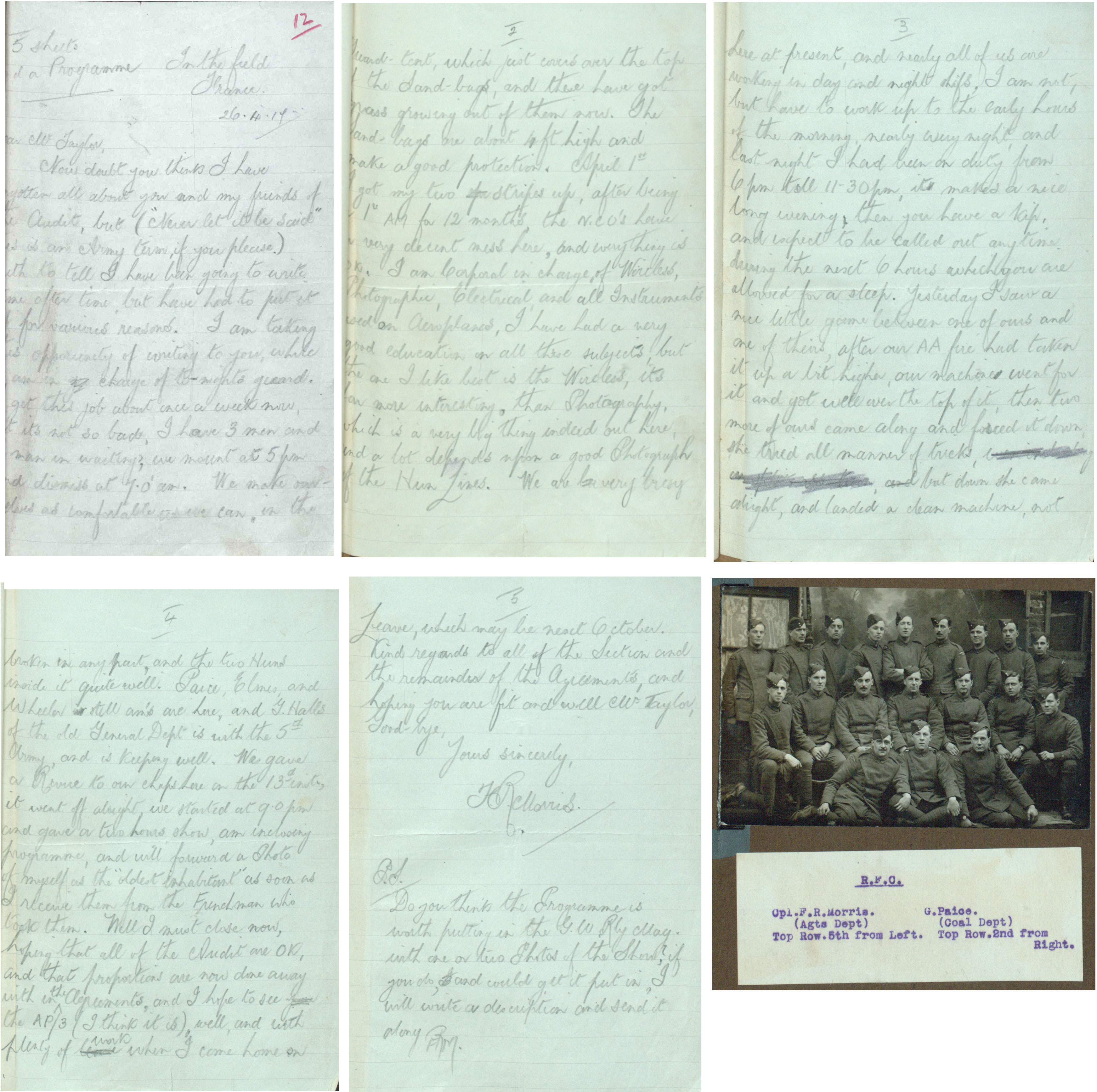
This is one of many letters sent by staff of the Great Western Railway Audit office at Paddington who had enlisted to fight in the First World War. (RAIL 253/516)
Frederick Ronald Morris, 26 April 1917, ‘in the field’, France. Born: 1 April 1893, Regiment: Royal Flying Corps, Regiment number: 16922, Rank: 1st class Air Mechanic, Returned to office: 10 March 1919, Retired: Resigned on 25 March 1925
Transcript
Dear Mr Taylor,
No doubt you think that I have forgotten all about you and my friends of the Audit, but never let it be said (this is an army term, if you please.) Truth to tell I have been going to write time after time, but have had to put it off for various reasons. I am taking this opportunity of writing to you, while I am in charge of tonight’s guard. I get this job about once a week now, it’s not so bad, I have three men and a man in waiting; we mount at 5pm and dismiss at 7am. We make ourselves as comfortable as we can, in the guard tent, which just covers over the top of the sand bags, and these have got grass growing out of them now. The sand bags are about 4ft high and make a good protection. April 1st I got my two stripes up, after being a 1st Air Mechanic for 12 months, the Non-Commissioned Officers have a very decent mess here, and everything is ok. I am corporal in charge of wireless, photographic, electrical and all instruments used on aeroplanes, I have had a very good education on all those subjects, but the one I like best is the wireless, it’s far more interesting than photography, which is a very big thing indeed out here, and a lot depends upon a good photograph of the Hun lines…
Yesterday I saw a nice little game between one of ours and one of theirs, after our anti-aircraft fire had taken it up a bit higher, our machine went for it and got well over the top of it, then two more of ours came along and forced it down, she tried all manner of tricks, but down she came alright, and landed a clean machine, not broken in any part, and the two Huns inside it quite well.
We gave a revue (theatrical show) to our chaps here on the 13th, it went off alright, we started at 9pm and gave a two hours show, am enclosing programme, and will forward a photo of myself as the ‘oldest inhabitant’ as soon as I receive them from the Frenchman who took them…Kind regards to all of the section and the remainder of the agreements, and hoping you are fit and well. Good bye. Yours sincerely,
F.R. Morris
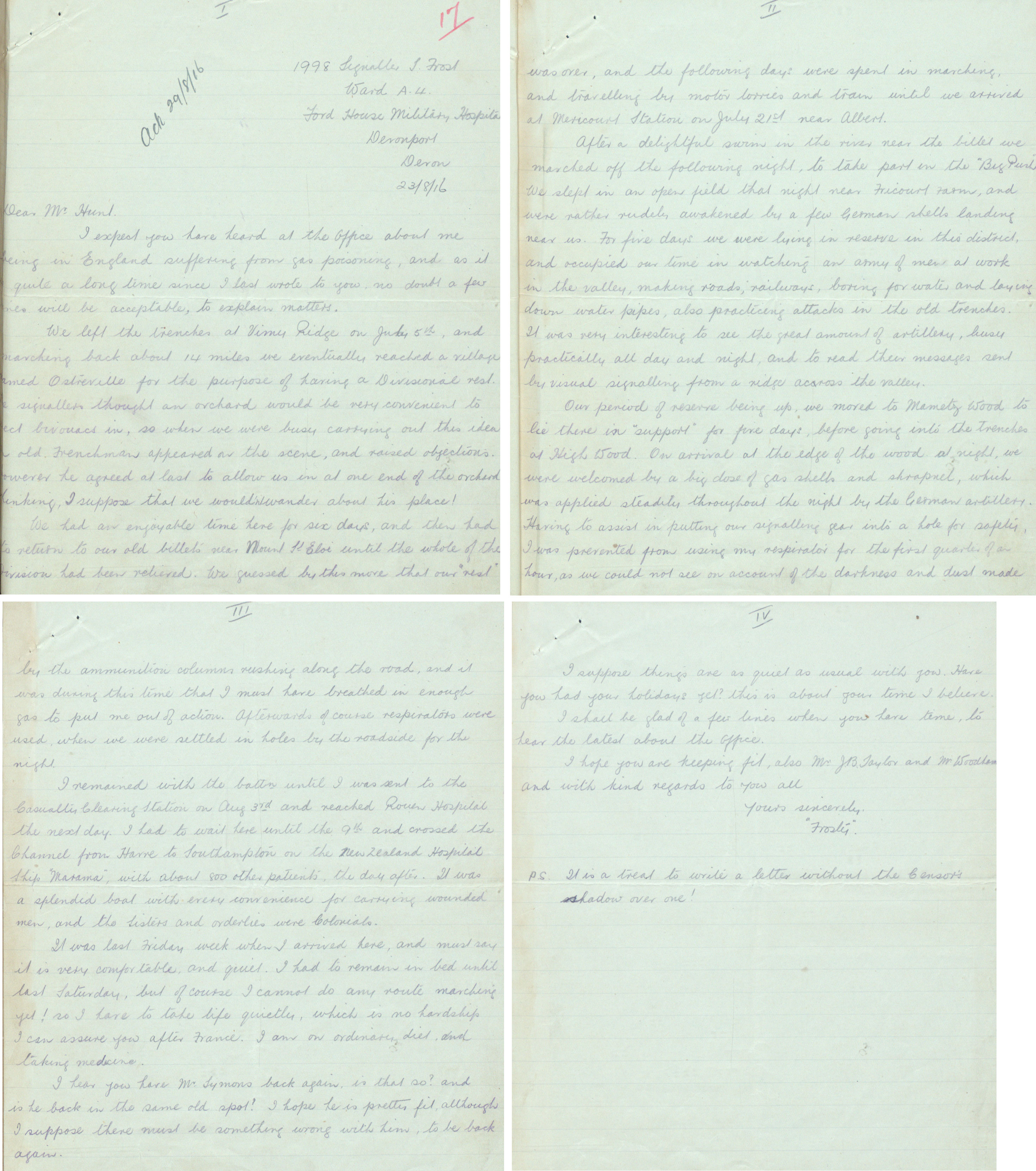
This is one of many letters sent by staff of the Great Western Railway Audit office at Paddington who had enlisted to fight in the First World War. (RAIL 253/516)
Richard Charles Stanley Frost, 23 August 1916, Devonport, England. Born: 30 January 1888, Regiment: 8th Argyll and Sutherland Highlanders; Duke of Cornwall’s Light Infantry, Regiment number: 1998; 300470, Rank: Private; Second Lieutenant, Died: 1962
Transcript
Dear Mr Hunt,
I expect you have heard at the office about me being in England suffering from gas poisoning, and as it is quite a long time since I last wrote to you, no doubt a few lines will be acceptable, to explain matters.
We left the trenches at Vimy Ridge on July 5th, and marching back about 14 miles we eventually reached a village named Ostreville for the purpose of having a divisional rest. The signallers thought an orchard would be very convenient to erect bivouacs in, so when we were busy carrying out this idea an old Frenchman appeared at the scene, and raised objections. However he agreed at last to allow us in at one end of the orchard, thinking, I suppose, that we would wander about his place! We had an enjoyable time here for six days, and then had to return to our old billets near Mount St. Eloi until the whole of the division had retired. We guessed by this move that our ‘rest’ was over, and the following days were spent in marching, and travelling by motor lorries and train until we arrived at Mericourt Station on July 21st near Albert.
After a delightful swim in the river near the billet we marched off the following night, to take part in the ‘big push.’ We slept in an open field that night near Fricourt farm, and were rather rudely awakened by a few German shells landing near us.
For five days we were lying in reserve in this district, and occupied our time in watching an army of men at work in the valley, making roads, railways, boring for water and laying down water pipes, also practicing attacks in the old trenches. It was very interesting to see the great amount of artillery, busy practically all day and night, and to read their messages sent by visual signalling [often using lights] from a ridge across the valley.
Our period in reserve being up, we moved to Mametz Wood to lie there in support for five days, before going into the trenches at High Wood. On arrival at the edge of the wood at night, we were welcomed by a big dose of gas shells and shrapnel, which was applied steadily throughout the night by the German artillery. Having to assist in putting our signalling gear into a hole for safety, I was prevented from using my respirator for the first quarter of an hour, as we could not see on account of the darkness and dust made by the ammunition columns rushing along the road, and it was during this time that I must have breathed in enough gas to put me out of action. Afterwards of course respirators were used, when we were settled in holes by the roadside for the night.
I remained with the battalion until I was sent to the casualty clearing station on August 3rd and reached Rouen hospital the next day. I had to wait until the 9th and crossed the channel from Havre to Southampton on the New Zealand ship Marama, with about 800 other patients, the day after. It was a splendid boat with every convenience for carrying wounded men, and the sisters and orderlies were colonials.
It was last Friday week when I arrived here, and must say it is very comfortable and quiet. I had to remain in bed until last Saturday, but of course I cannot do any route marching yet! So I have to take life quietly, which is no hardship I can assure you after France. I am on an ordinary diet, and taking medicine.
I hear you have Mr Symons back again, is that so? And is he back in the same old spot? I hope he is pretty fit, although I suppose there must be something wrong with him, to be back again.
I suppose things are as quiet as usual with you. Have you had your holidays yet? This is about your time I believe. I shall be glad of a few lines when you have time, to hear the latest about the office. I hope you are keeping fit, also Mr J.B. Taylor and Mr Woodhams and with kind regards to you all. Yours sincerely,
Frosty.
P.S. It is a treat to write a letter without the censor’s shadow over one!