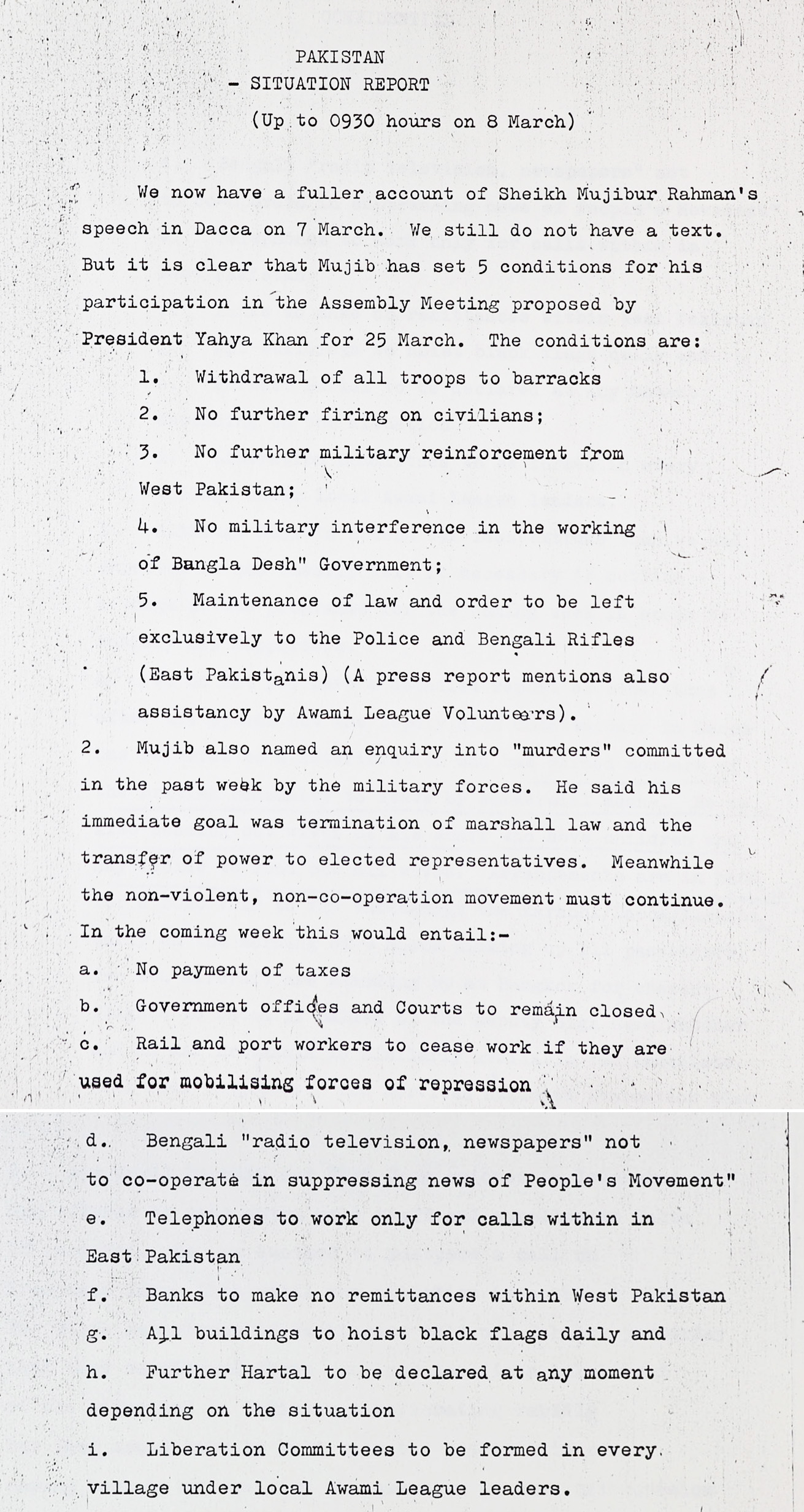
West Pakistan did not accept the 1970 election results (in which the Awami League, led by Sheikh Mujibur Rahman, won), leading to escalating protests in East Pakistan. On 7 March 1971, Sheikh Mujibur held a speech, reported on in source 4.
Pakistan situation report from the British government – up to 0930 hours on 8 March 1971. Catalogue ref: PREM 15/567
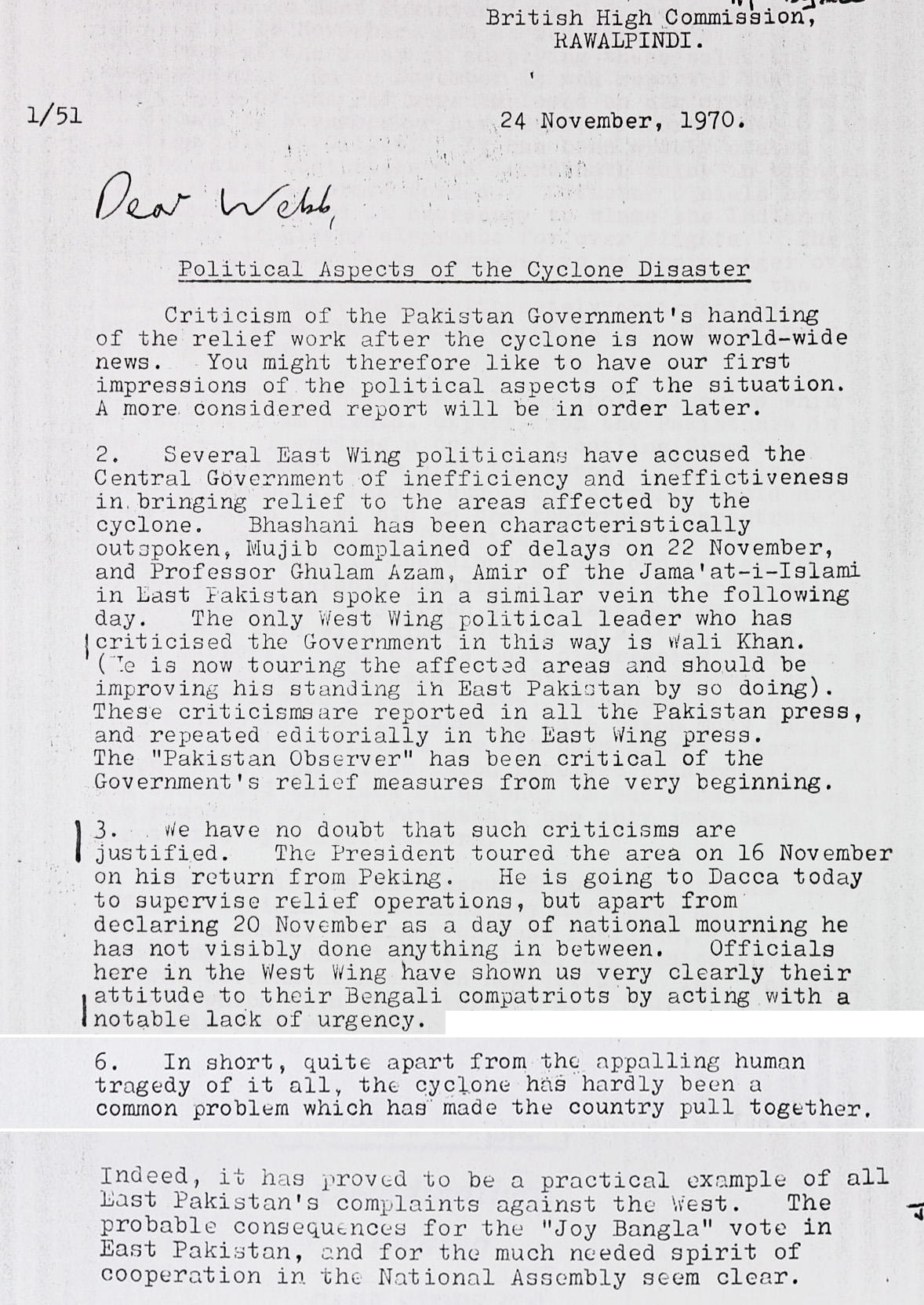
In 1970, the Bhola cyclone struck East Pakistan, killing an estimated 3-500,000 people. This is a British report on how the Pakistan government responded to the disaster.
Letter from the British High Commission in West Pakistan to the Foreign & Commonwealth Office. 24 November 1970. Catalogue ref: FCO 37/719
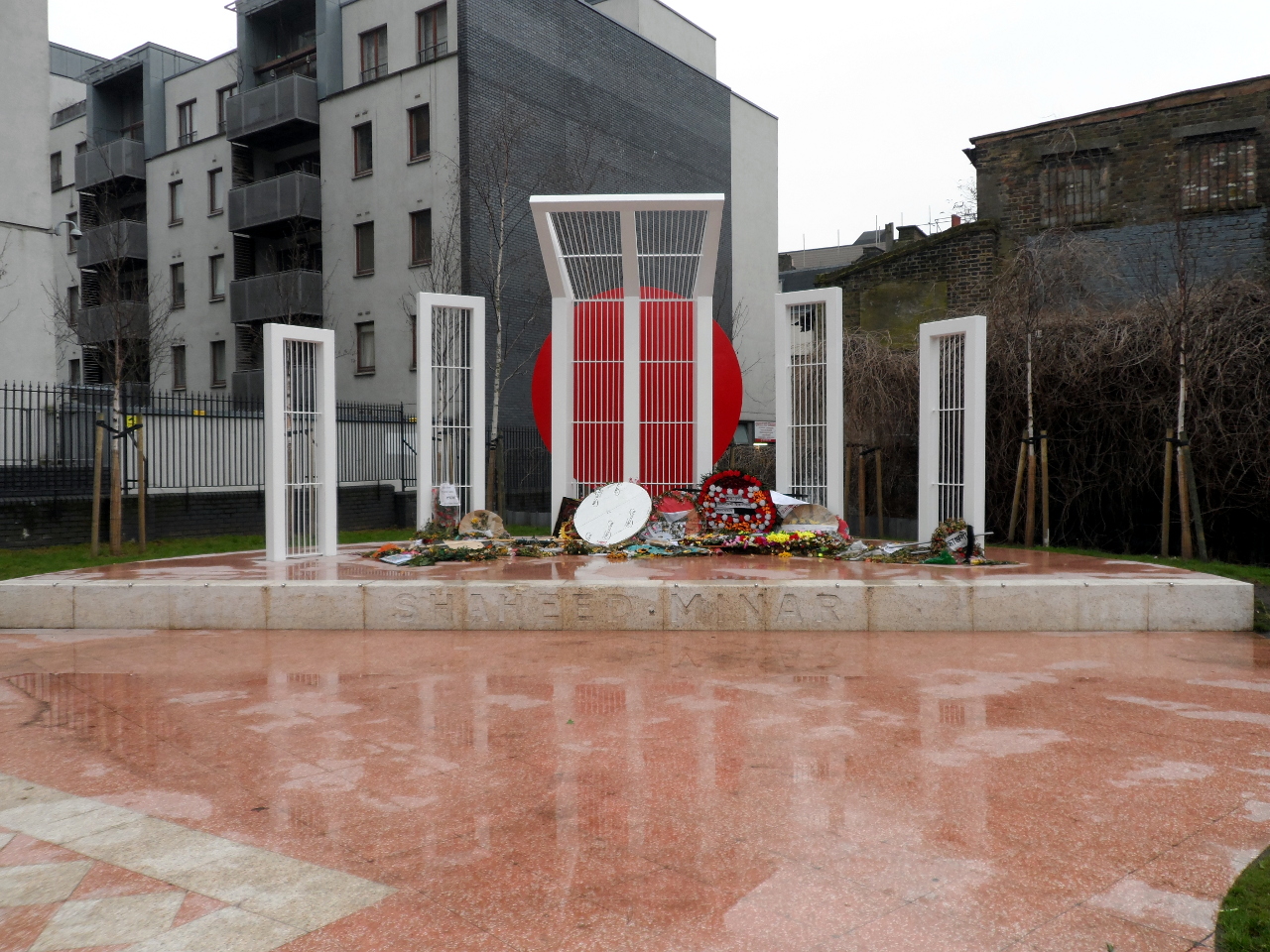
Source 2b is a photograph of the Shaheed Minar (martyrs’ monument) in Altab Ali Park in Whitechapel, London. It is a replica of the same monument in Dhaka, Bangladesh. Photo: Nicholas Jackson, CC BY-SA 3.0.

There are other monuments like this in the UK – try to find out if there’s one near you!
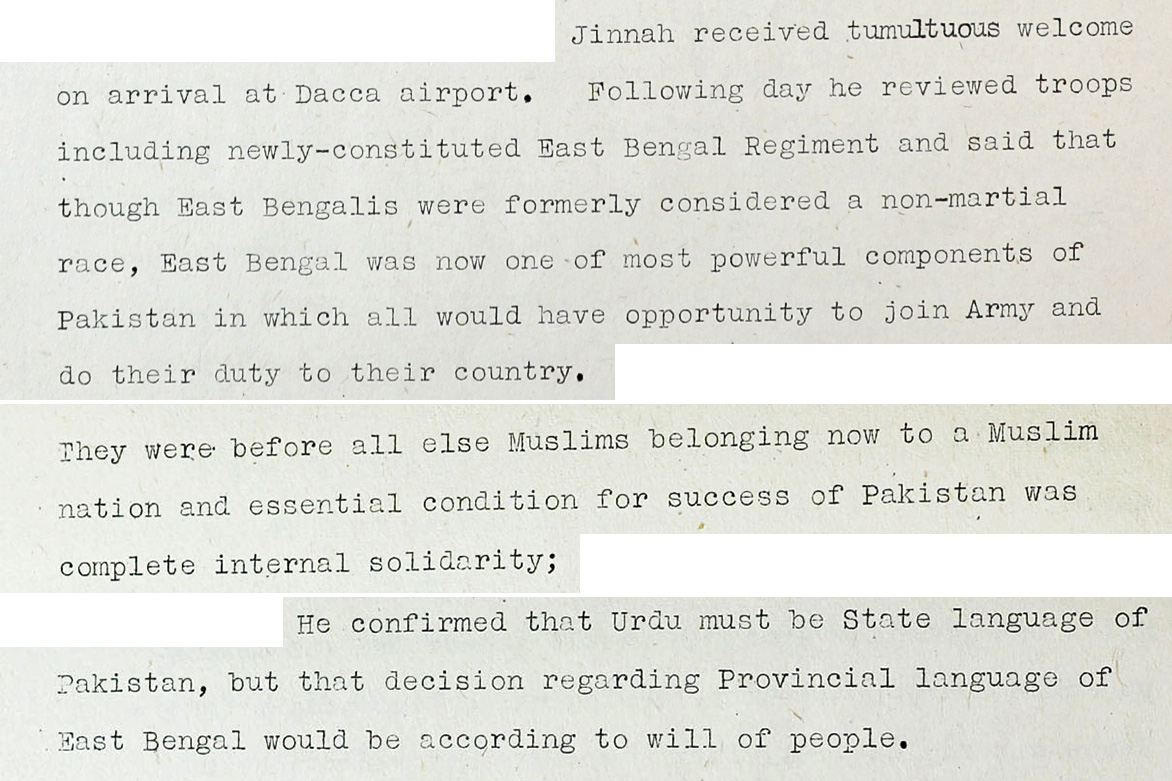
Source 2a describes the moment in 1948 when Urdu was confirmed to be the State language of both West and East Pakistan. This meant that all official business would be done in Urdu.
Report from the British government on the political situation in Pakistan, March 1948. Catalogue ref: DO 142/423
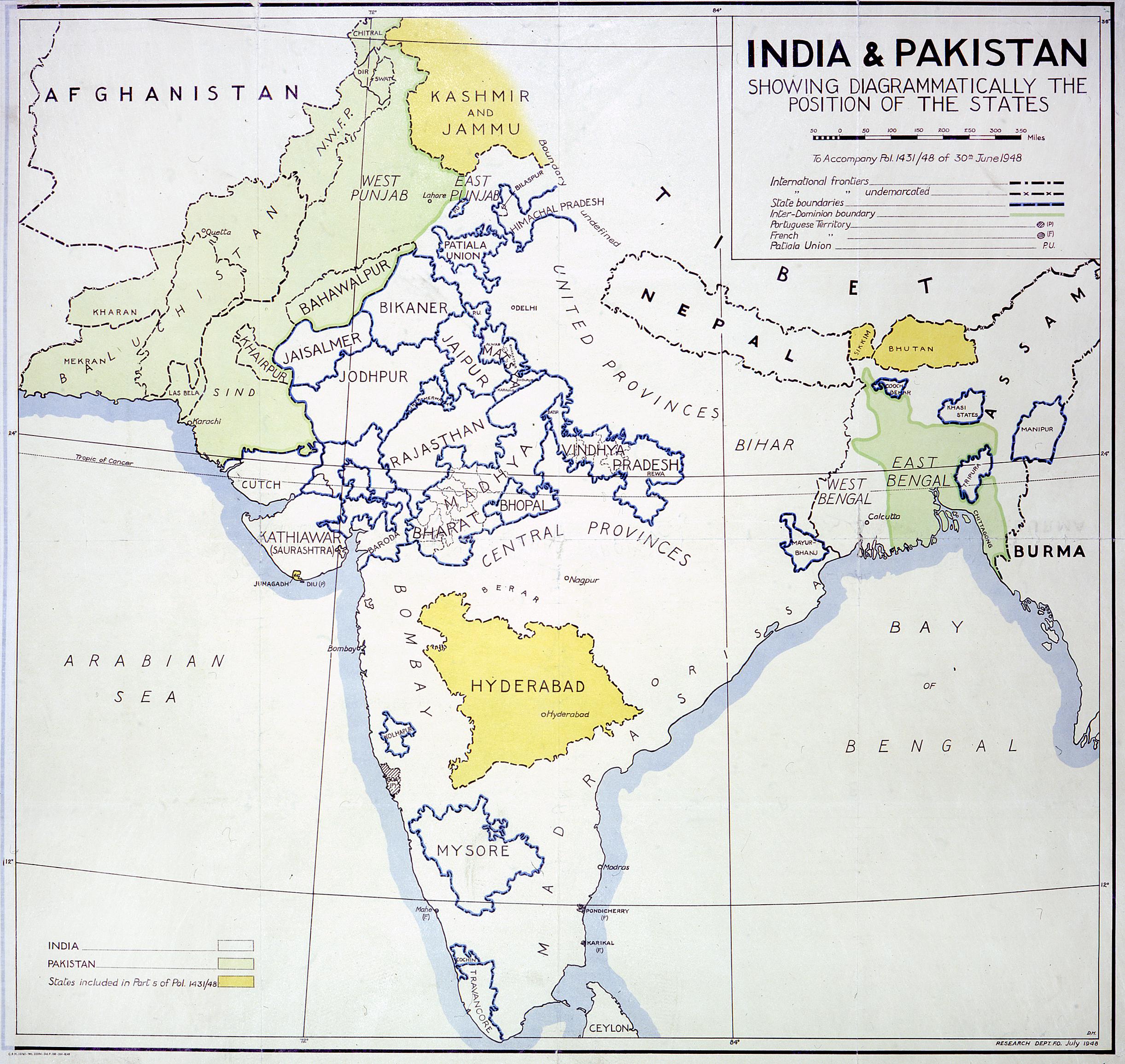
This map shows how British India was divided up after the 1947 partition: into India (majority non-Muslim) and Pakistan (majority Muslim).
India and Pakistan, showing States, and areas allocated to neither new country, 1948. Catalogue ref: MFQ 1/1145
‘British India’, also referred to as the ‘British Raj’ or ‘Direct rule in India’, was part of the British Empire from 1858 until independence in 1947. This independence process was called ‘partition’, because the colony was divided up into two countries: India and Pakistan.
Partition was not inevitable and happened because of long and complicated talks between the British government and elite Indian figures, each with their own political interests. The final borders of the new nations were created in only six weeks by Sir Cyril Radcliffe and were based on Muslim and non-Muslim majority areas. Learn more about partition here.
The new Pakistan was split into two regions that were more than 1,000 miles away: West Pakistan and East Pakistan (today’s Bangladesh). The distance and difference in culture, language, and identity between the two regions, and the fact that West Pakistan held more political and economic power, led to strong tensions and eventually protest movements in East Pakistan.
In 1971, West and East Pakistan fought in the Bangladesh Liberation War. This led to the creation of Bangladesh on 16 December 1971. How can we trace this road to independence through the British reports in The National Archives?
What can British documents tell us about the creation of Bangladesh?We can start the story of the 1971 Bangladesh Liberation War with the poorly planned and tragic ‘Partition’ of British India in 1947, based on religion. The separate north-eastern and north-western areas of the country, which were mostly Muslim, became a ‘united’ Pakistan. The rest of the country, mostly non-Muslim, became known as India. (See source 1: MFQ 1/1145.)
West and East Pakistan shared a religion, but not much else. For decades after Partition, the East Pakistanis (present-day Bangladeshis) were treated unfairly by the West Pakistani government over 1,000 miles away. East Pakistan had more people than West Pakistan but got less money and resources from the government. From the early 1950s, the amount of money earned per person in West Pakistan grew three times as much each year compared to East Pakistan.
In 1948, Urdu became the only state language of both West and East Pakistan (see source 2: DO 142/423). It was imposed on millions of Bengali-speaking people. This led to the rise of the Bengali Language Movement, resulting in mass protests and deaths in Dhaka in 1952.
Bengalis have a rich and proud history and culture focused around language, art, food, fashion, community, family and religion. The 1971 Liberation War can be seen as a struggle to preserve and protect this heritage.
A few key events leading up to 1971 sped up the start of the war:
- Cyclone Bhola in November 1970 devastated East Pakistan. Around 3-500,000 people were killed and many more made destitute. Relief efforts from West Pakistan were minimal (see source 3: FCO 37/719).
- Many East Pakistanis were feeling unhappy and resentful. This led to civil disobedience [refusal to obey the government] and the imposition of martial law [temporary rule by the military]. For many, these were uncertain and scary times.
- There was prejudice and violence between Bengalis and Urdu-speaking minorities (Biharis) in early March 1971.
Maybe the most important event leading up to the war was the 1970 election. The winning Awami League Party was led by Sheikh Mujibur Rahman, who wanted more freedom and independence for East Pakistan. He won the national elections by a clear majority, as East Pakistan had a much larger population than West Pakistan. However, the centralised government in West Pakistan did not accept Rahman as leader. They declared the election results void. This led to the famous and emotional ‘Joy Bangla’ (‘victory to Bengal’) speech by Rahman on 7 March 1971 at a rally attended by thousands, in which he declared an ‘independent’ Bangladesh (see source 4: PREM 15/567). He was later arrested. There were more and more protests by his supporters.
On 25 March 1971, the West Pakistani army invaded East Pakistan, trying to stop these protests. It launched Operation Searchlight, killing many Bengali civilians, intellectuals, students, politicians, and armed forces.
The brutal war that followed lasted for nine months. Estimates for the total number of civilian and military deaths range from 500,000 to over 3 million. Millions of refugees fled to neighbouring India. Groups of Bengali guerrilla fighters (‘mukti bahini’) and regular soldiers – helped by the Indian military – fought back against the West Pakistani army. West Pakistan eventually surrendered on the 16th of December 1971 (known as ‘Victory Day’), leading to the creation of Bangladesh.
You can see how complex the 1971 war was by looking at the many terms used to describe it: Bangladesh War of Independence, Liberation War, genocide, Civil War, or, by many Bangladeshis, ‘mukti juddho’/‘shongram’ (battle and resistance). The war has been immortalised in the symbolism of the national flag of Bangladesh – a dark green background with a red (bloody) circle in the middle.
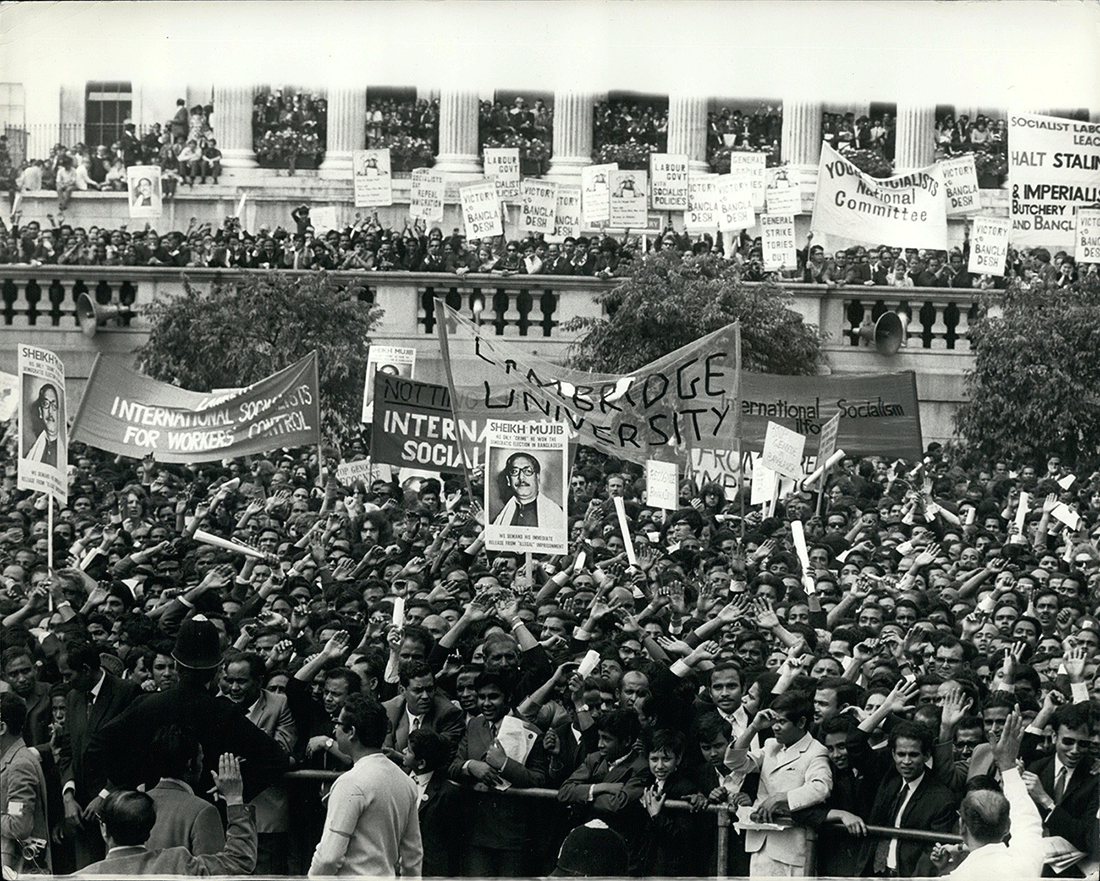
Britain played an important role in bringing global attention to the war. During 1971, as members of the Commonwealth, many thousands of Bengalis were living and working in Britain. It was a harrowing time for many, as they were living far away and were worried about family and kin in East Pakistan. Foreign journalists were expelled from the region before the suppression started, so there was little international coverage of the events of 1971 (see Pakistani journalist Anthony Mascarenhas’ article ‘Genocide’ for a rare example). However, Bengalis in the UK raised funds to help the resistance. They organised peaceful campaigns and demonstrations to bring international attention to the war, such as the ‘Recognise Bangla-Desh Rally’ in Trafalgar Square on 8 August 1971, which drew thousands of people (see source 5a). The British government formally recognised Bangladesh as an independent nation on 4 February in 1972.
Background written by Dr Aminul Hoque MBE (Goldsmiths College, University of London)
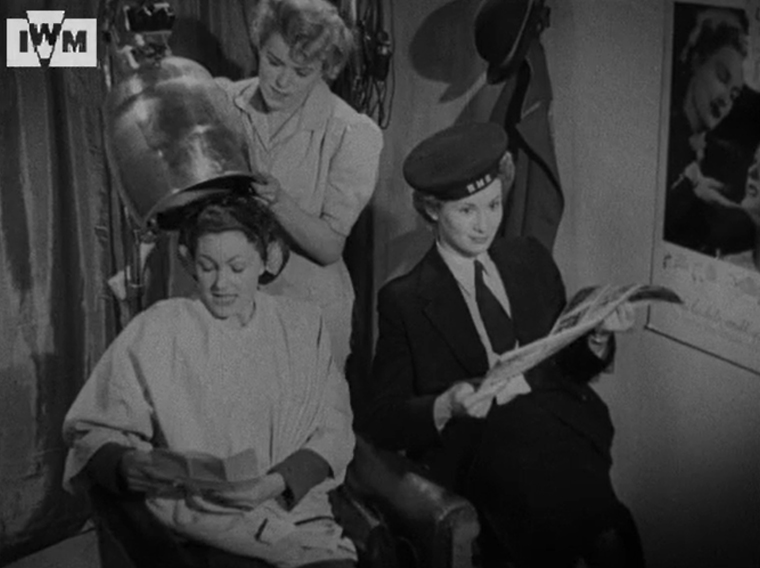
Using film as evidence in history
Take a look at this group of government public information films and two amateur films which were used as propaganda to persuade the Home Front population to support various campaigns to help win the war.
Messaging from the Ministry of Information covered topics like the dangers of ‘Careless talk’, the need to ‘Dig for Victory’ or ‘Make do and mend’. Films were also used to explain rationing, evacuation, recruitment of women and men into civil defence, give advice about safety in the blackout or ensure support from the Empire. Films helped to drive these messages home along with other Ministry of Information leaflets and the posters displayed in shops and shop windows, council buildings or village halls.
Many people take the moving image for granted. They frequently assume that the images they see are a true and accurate portrayal of the events of “what is happening”. Of course this can be in part explained by the fact that the visual image is far more seductive than the written word. This is because we impose our own meaning on what we see. The idea that “I won′t believe it until I see it” is very significant here.
It is important, therefore, to learn to evaluate film as evidence. This can be achieved by understanding more about the process of filmmaking by investigating how the content and nature of a film can be determined by editing, use of montage, choice of camera angles, target audience and so on. Therefore, we must consider how films are produced in order to ask what they can tell us. We must study what films show us and how they show it.
Like all historical evidence, film must be considered very carefully and used with other forms of evidence to build up a picture of a historical event. Questions have to be asked of it:
- Why and when was this film produced?
- Who is the target audience?
- What is the filmmaker trying to tell the audience?
- How might a given story be selective or simplified?
- If there is music, commentary or dialogue how do they influence the nature of the film?
- It is also important to bear in mind that censorship or even sponsorship can also affect the final form of a feature or documentary film.
- What is the impact of technology on the process of filmmaking, have new methods changed the process?
Film is such an important historical source because it was the first form of mass communication in the 20th century. Films can also be sources for understanding propaganda. They can be sources for providing insight into the values, concerns and issues of their times.
Tasks
Watch a film and discuss/answer the questions:
- Select 3 to 5 documents from either of the below Home Front collections to show how they can be used to support the message and content of one or more of the films:
Home Front 1939-1945 (part one)
Home Front 1939-1945 (part two)
- Write a report/record a video to explain your choice of documents.
- What are the advantages of using public information films like these with document sources as evidence for life on the Home Front?
Home Front 1939-1945 (part two)
Home Front 1939-1945 (part one)
The Home Front
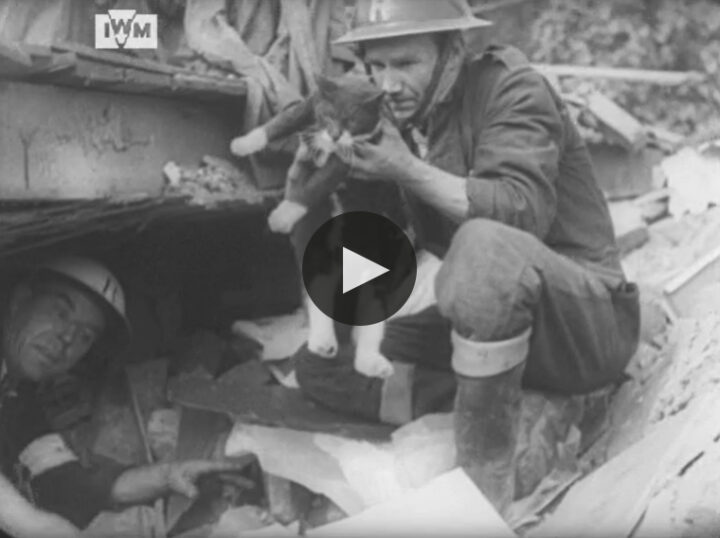
BRITAIN CAN TAKE IT
1940
© IWM (COI 944)
This is a shorter version of the film ‘London can take it’ and was re-edited for a British audience. It is introduced by American journalist Quentin Reynolds and released in 1940.
- How would you describe the tone of Quentin Reynolds commentary?
- How are the city of London and its citizens portrayed?
- What does the film reveal about the role of ARP (Air Raid Precaution) workers?
- What is the main message of the film?
- How is sound and music used in the film to create its message?
- Why is the date of this film’s production helpful in understanding its purpose?
Blackout
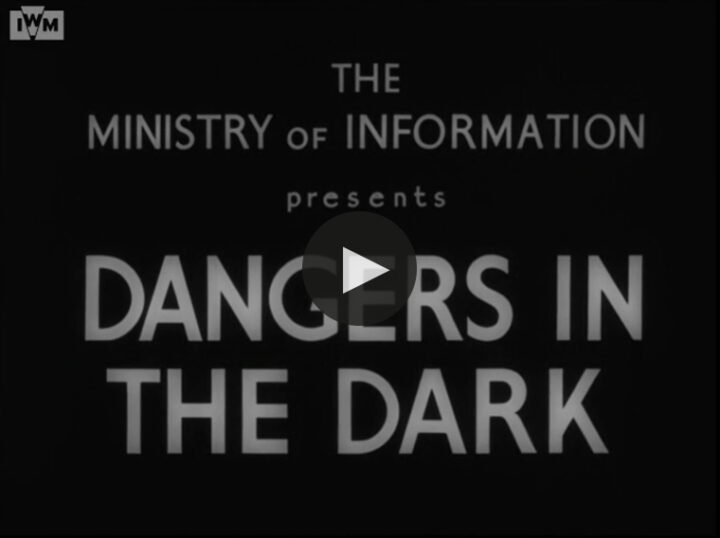
DANGERS IN THE DARK
1941
© IWM UKY 295
This film is about the importance of road safety and the dangers caused by the blackout. Made in 1941.
- Why is the title of this film effective?
- How does the opening of the film try to persuade people of the dangers of the blackout?
- What advice does the film give about the dangers of travelling in the dark?
- Why does the film suggest that being careful in the dark helps the war effort?
- Why do you think this film was made?
Home Guard
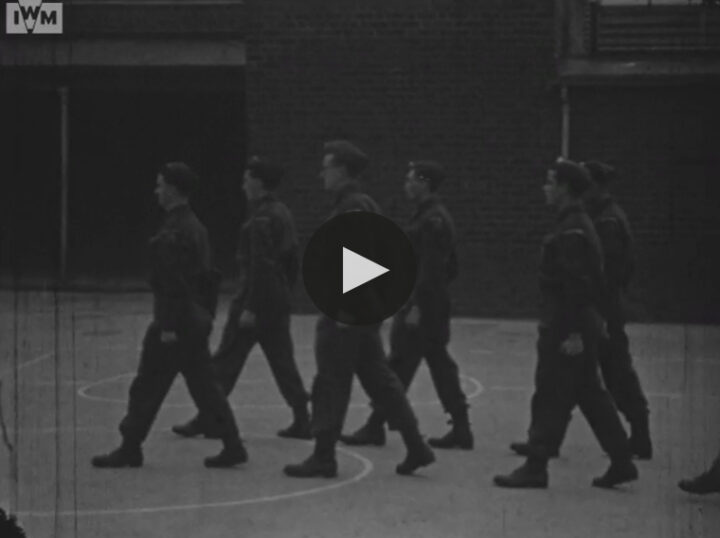
WARWICKSHIRE HOME GUARD TRAINING IN COVENTRY
1942
© IWM MGH 6900
Amateur film made by Lieutenant Leonard Stanley North, a rifle instructor with the Royal Warwickshire Regiment during the Second World War. It shows the Coventry Home Guard in 1941.
- What military skills training for the Home Guard is evident in this film?
- What evidence is given of life outside training in the Home Guard?
- What is the value of using an amateur film like this as evidence of the role and purpose of the Home Guard?
- Can you write your own commentary script for this silent film?
Women at War
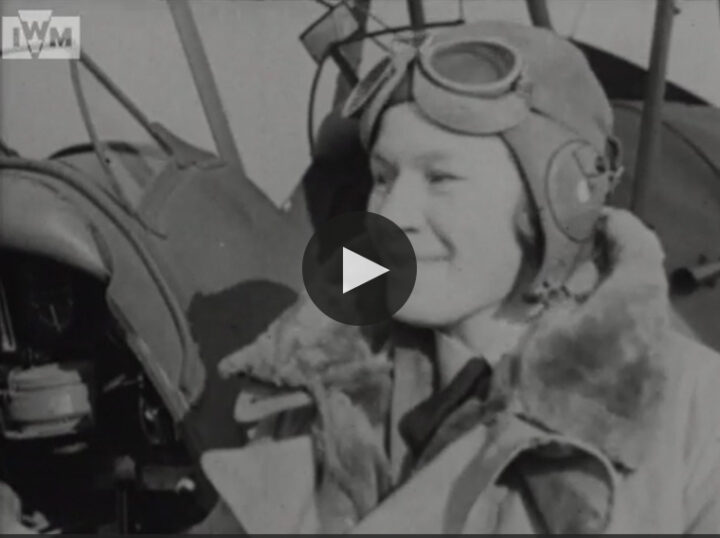
WOMEN AT WAR
1941
© IWM MGH 3728
John Winant, the American Ambassador to Britain introduces film which shows the variety of jobs carried out by British women since the outbreak of war, and thanks America for sending aid to victims of the London Blitz. Made in 1941 and released in Britain and America.
- What ‘told’ and ‘untold’ information does the film provide about women’s lives before the war in the first 3 minutes of the film?
- How are women in the countryside supporting the war effort?
- What is the role of Women’s Voluntary Services?
- What is the role of women in the Land Army?
- What jobs are women carrying out in:
- Women’s Air Transport Auxiliary Service
- Women’s Auxiliary Territorial Service
- Factories
- Civil Defence- Did you spot Princess Elizabeth in this section?
- Transport services
- Communal restaurants
- Why do you think this film was made?
Everyday Life
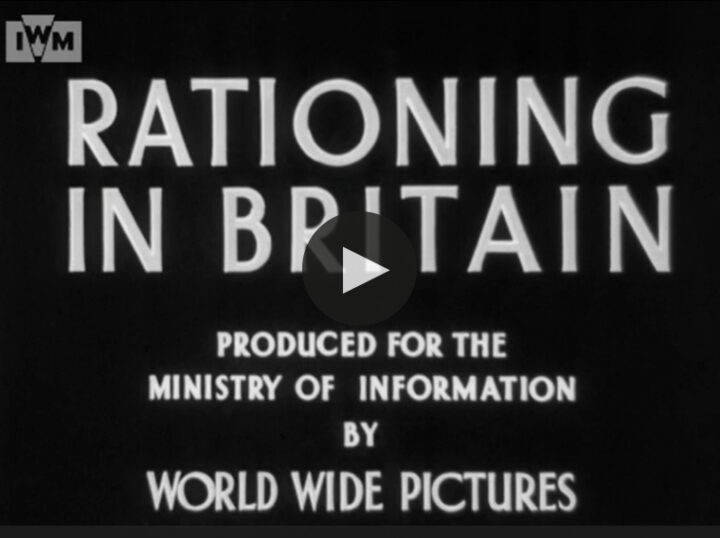
RATIONING IN BRITAIN
1944
© IWM COI 155
The film shows how rationing was experienced by a family of four and how it was designed to create fair shares for all of the population. Film was released in 1944.
- How much food did Britain import before the war?
- Why was rationing introduced?
- How did the rationing system work?
- How did rationing change the buying and living habits of people in Britain?
- What details does the film give about life in 1940s Britain?
- How do know that film has been created to appeal to an American audience? [Clue: think about language; mention of Lend-Lease. A policy from 1941-1945 whereby United States supplied Britain and her allies with food and supplies]
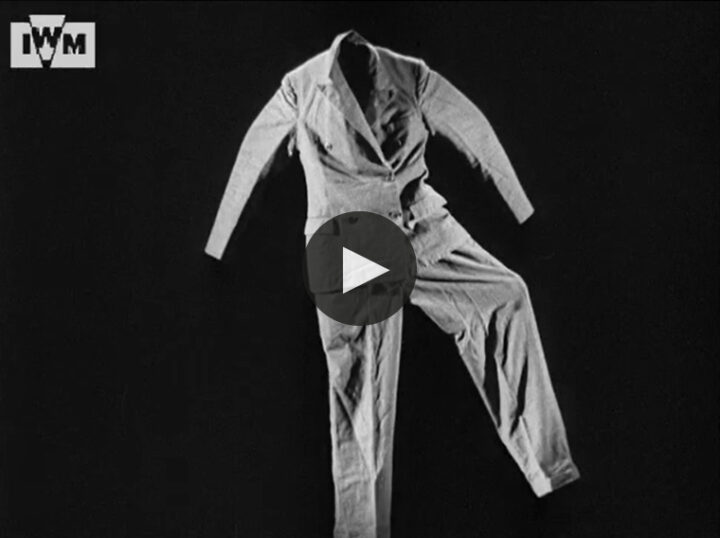
MAKE DO AND MEND
1943
© IWM NPB 13037
This film shows a family discussing the ration system for clothing and suggests how old clothes can be used to make new garments. Released 1943.
- Why do you think this film was made?
- How are women encouraged to make do and mend?
- Who do you think is the audience for this film?
- Do you think the film succeeds in its message?
Careless Talk
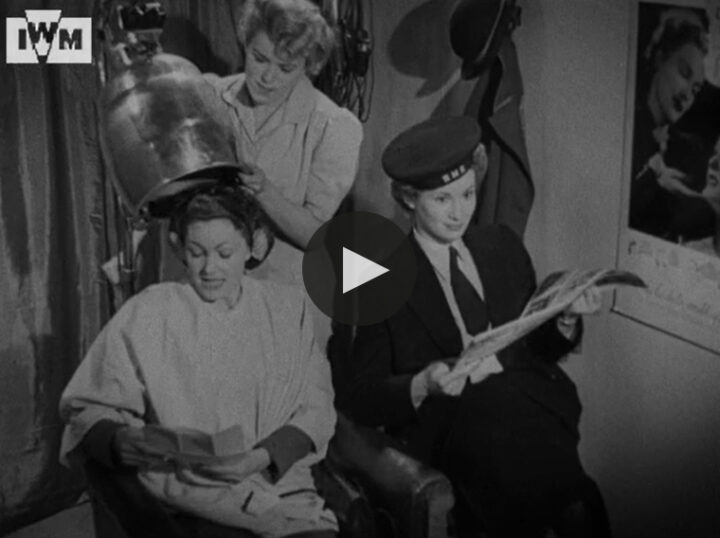
JIG-SAW
1944
© IWM UKY 560
A ‘Careless talk’ campaign film released in 1944. The film shows how small pieces of information can fit together like a jigsaw puzzle to provide the enemy with valuable information which costs lives.
- How does the film create tension at the start?
- What are the different ways in which valuable information be given away according to the film?
- Do you think this film is effective in getting its message over?
- Why does Anne say directly to the audience –‘I hate those talkers’ at the end of the film?
- Is ‘Jigsaw’ an effective title for this film?
The Empire Home Front
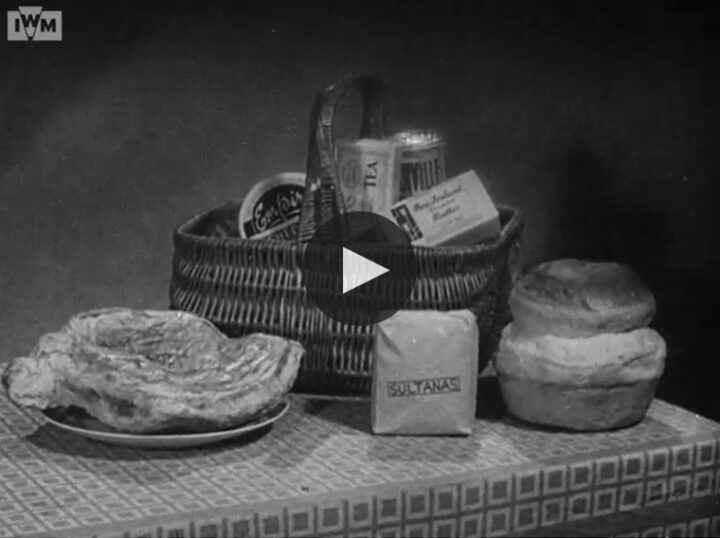
FOOD FROM THE EMPIRE
1940
© IWM COI 258
- Why is there more food production in Britain during war time?
- Why are the ‘British Commonwealth of Nations’ sending food to Britain?
- What goods are sent to Britain?
- Why is a shopping basket used to explain in the film do you think?
- What is the film trying to emphasise about the British Empire’s contribution?
- How does the film infer Britain’s relationship with the colonies in the commentary?
- What does the film reveal about how food reaches Britain and is distributed in war time?
- Who is the audience for this film?
Bombing of Britain

LONDON BLITZ SCENES REVISITED – 1946
1946
© IWM MGH 1354
This is an amateur film shot by a former Auxiliary Fire Service fireman, George Eves. It shows life in London in the years straight after the Second World War. We see the effects of bomb damage on London as well as the start of post-war reconstruction.
- Can you describe the effects of bomb damage on the city?
- Can describe the new post-war prefabricated bungalows?
- Why do you think this film was made?
- Do you think the film has a message?
- Can you write your own script for the film?
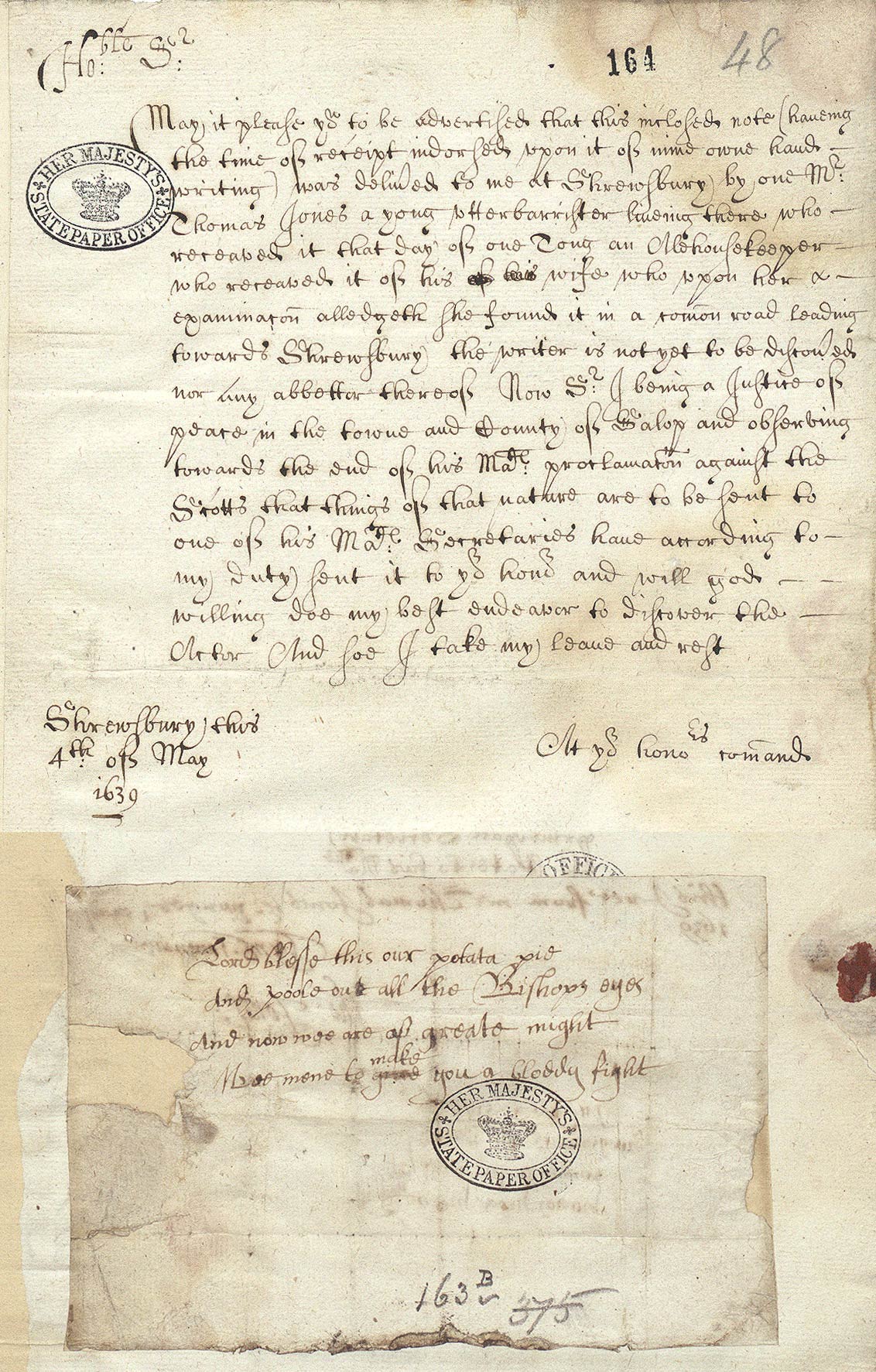
This report was sent from Shrewsbury to Sir John Coke on 4 May 1639 by a local judge. Coke was Secretary of State to Charles I, Catalogue ref: SP 16/420/48.
In 1639 Charles I’s kingdoms were very tense. Charles was facing a major rebellion in Scotland. There was also tension in England. One of the biggest concerns was religion. The Archbishop of Canterbury, William Laud, was bringing in changes to the English church that some people were against.
During the 1630s Charles I and William Laud brought in new types of church services. Charles also gave greater power and wealth to the church. To some Protestants (especially hard-line Protestants, called Puritans), his actions seemed to be making the Church of England more like the Roman Catholic Church. They began to criticise Charles. Charles I had no time for opponents of his policies.
Charles ordered his officials to look out for people who might oppose him. The person being reported in this source was probably a Puritan who was against the changes that Charles and William Laud were bringing into the church.
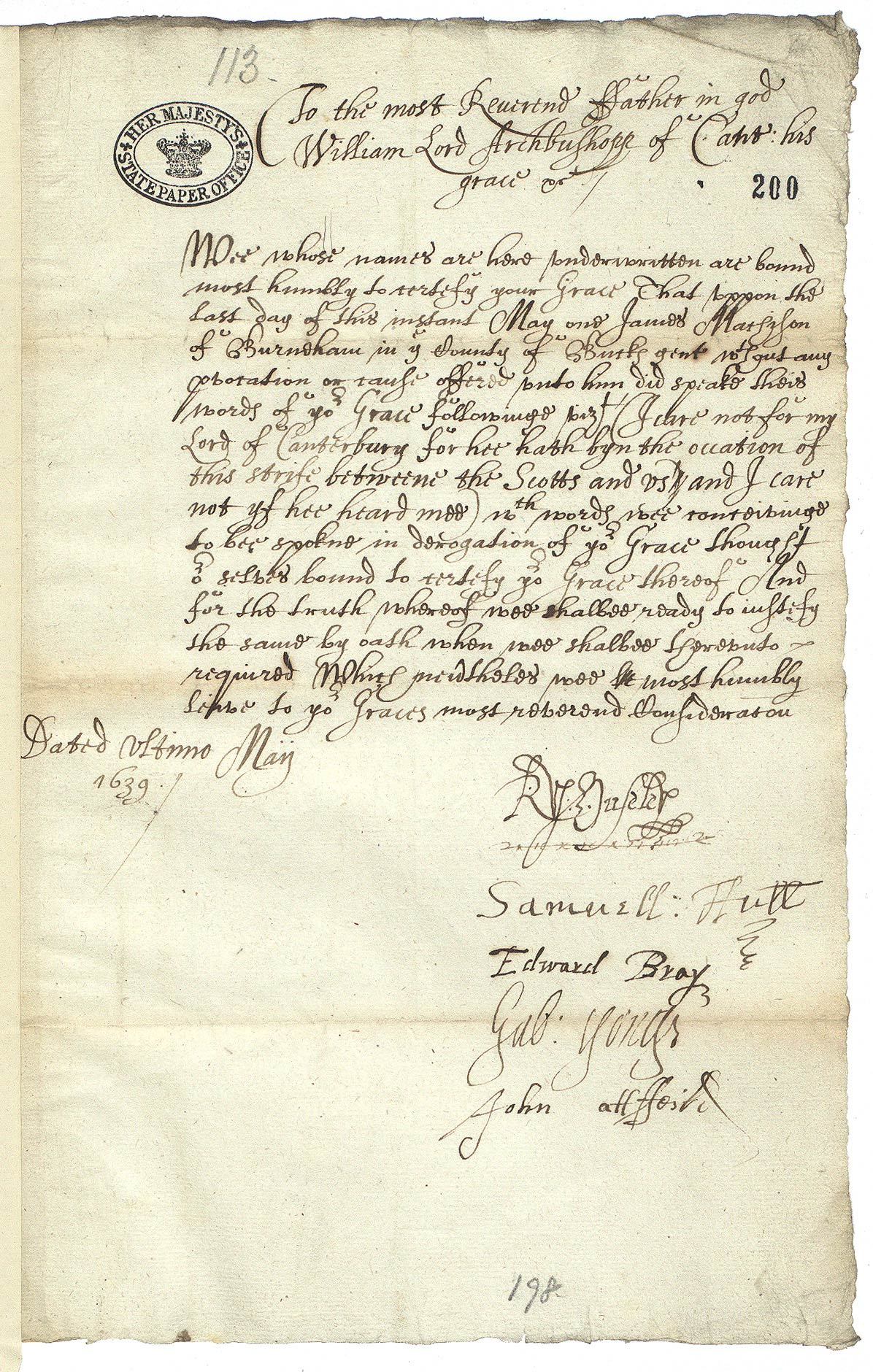
This is a report to William Laud, Archbishop of Canterbury, from some of his informers. Laud had a network across the country that sent him regular reports about what people were saying. Throughout the 1630s Charles I and William Laud tried to change the organisation of the church and how people worshipped in church. As a result, Laud made many enemies.
Laud punished some of his critics harshly. For example, in 1637 William Prynne, Henry Burton and John Bastwick printed pamphlets attacking Laud. All three men were Puritans. They believed that Laud’s changes were making the Protestant Church of England too much like the Catholic Church of Rome. Laud had their ears cut off and their faces branded with a hot iron.
Laud and Charles tried to increase the power of the church in England and Scotland. They also wanted everyone to worship in the same way. Both of these things alarmed many Protestants, particularly the hard-line Protestants known as Puritans. On the other hand, many approved of Laud’s policies. They just disliked the way he clamped down on free speech and treated his critics badly.
Both England and Scotland split from the Roman Catholic Church in the 1500s and became Protestant. In the 1600s the Protestants were still very suspicious of any changes to their church in case the Protestant Church became too much like the Catholic Church.
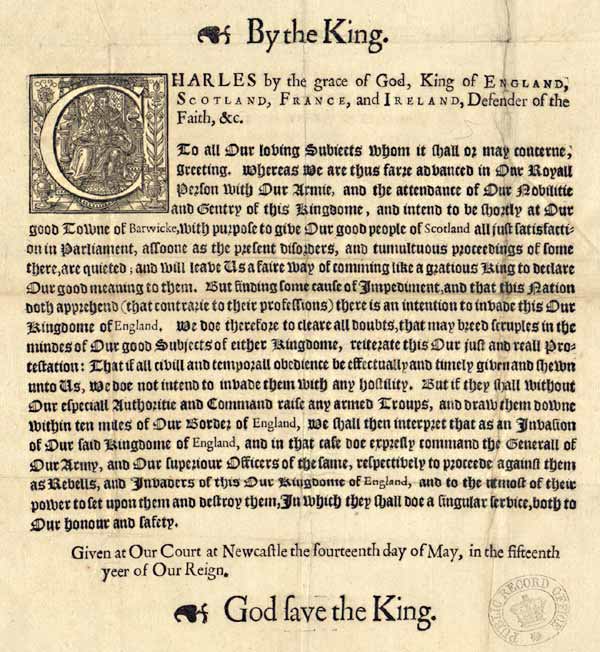
This is an extract from a proclamation, or order, made by Charles I at Newcastle on 14 May 1639 telling people in Scotland what he wanted them to do. He was trying to end rebellion in Scotland. Charles had been facing rebellion from his subjects in Scotland since 1637. The Scots refused to accept changes that Charles wanted to make to the church in Scotland. Charles raised an army to fight the Scots in 1638. By May 1639, when this proclamation was made, Charles did not have enough money to continue the fight. This meant he had to try and reach an agreement with the Scottish rebels.