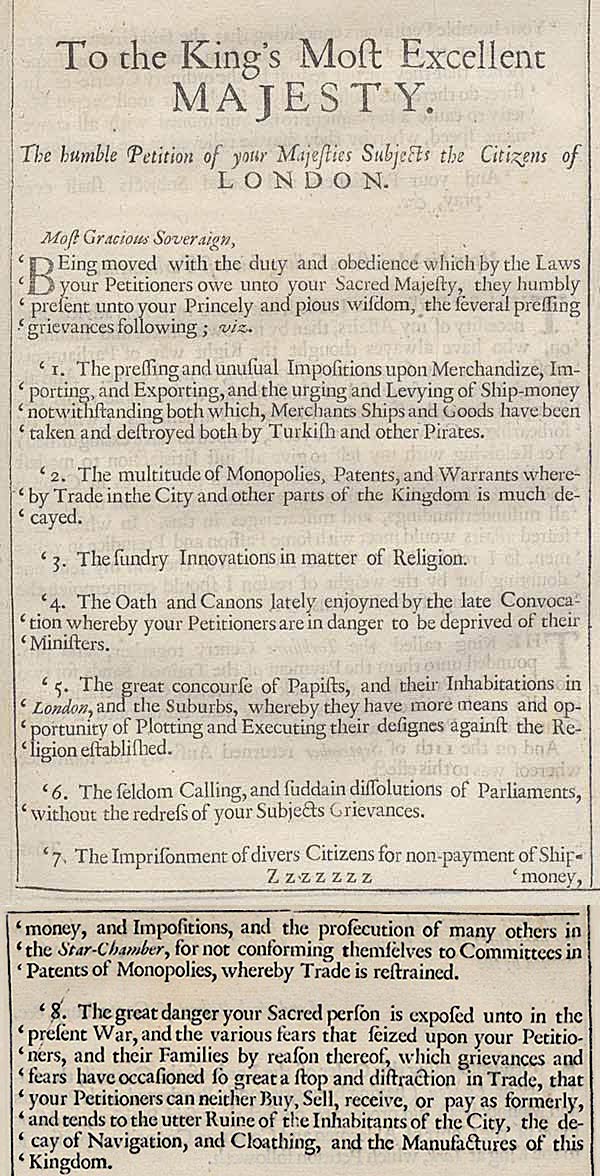
This document is a petition sent to Charles I and expresses the grievances of the City of London I on 24 September 1640, Catalogue ref: National Archives Rare Books Collection (John Rushworth, Historical Collections, Vol III, 1639-1640, p.1263. Published in London, 1680-1701).
The citizens of London were also more politically active than any other part of the country and radical (wanting big changes). This helps to explain why the city sent several petitions to Charles during this period. London had more Protestant hardliners (Puritans) than other parts of the country. It is not surprising that London took the side of Parliament when war broke out in 1642.
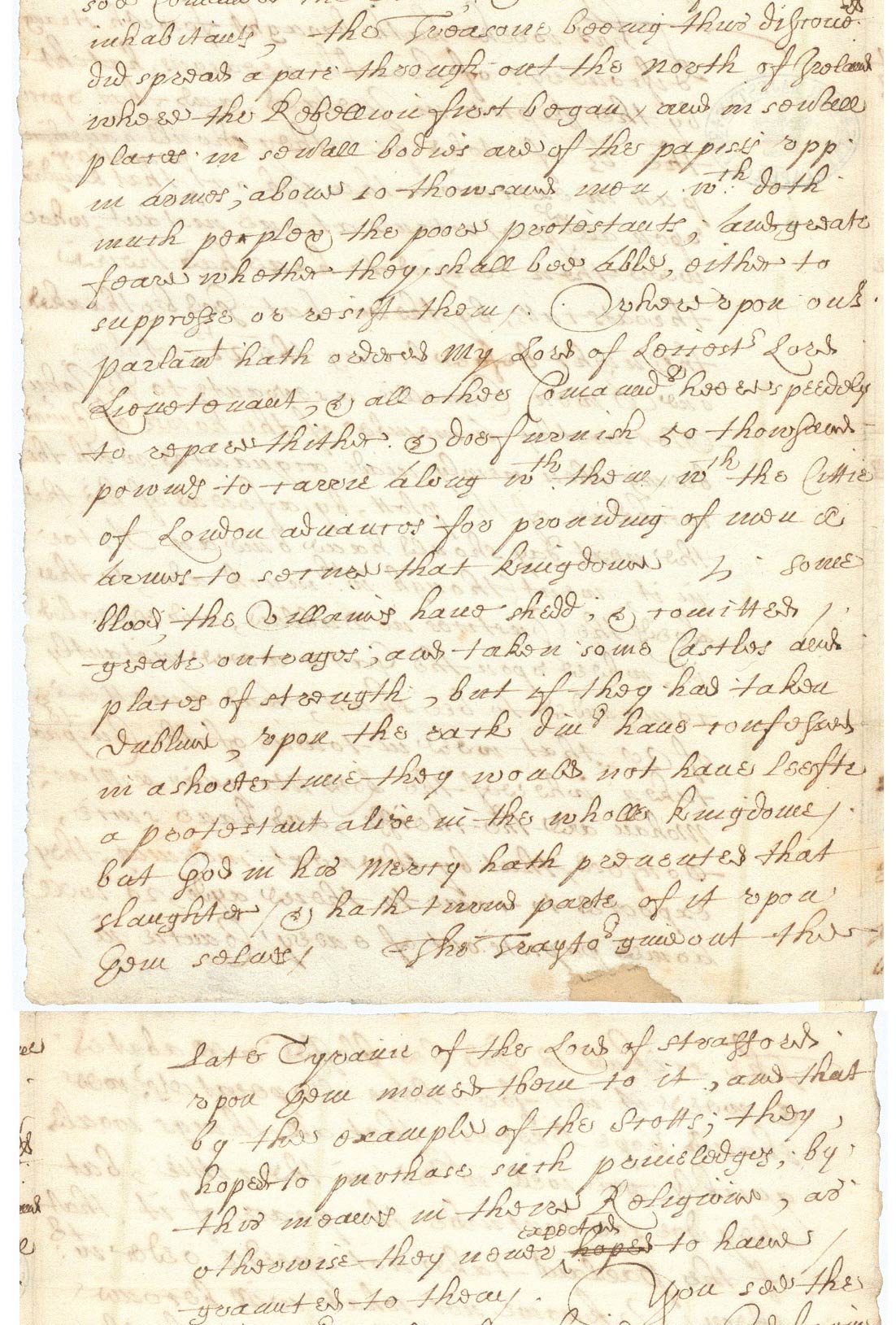
This is an extract from a letter written by a gentleman called Thomas Wiseman to Sir John Penington, a senior commander in Charles I’s navy. The document describes rebellion in Ireland, November 1641, Catalogue ref: SP 16/485/58.
The rebellion in Ireland horrified all English Protestants. Charles I and his MPs agreed that an army had to be sent to Ireland. However, this soon became a difficult issue. Leading opponents of Charles I, such as John Pym, did not trust the king. Pym feared that Charles I would use the new army to crush people like him, rather than the rebels in Ireland. He demanded that Parliament should be in charge of the new army and not the king. The argument was never solved. By the time the civil war started in 1642 Ireland was still in the hands of the Catholic rebels.

The five videos in this series called ‘Civil War People’ have been updated to a greater quality from our focussed topic website English Civil War.
View our videos to find out how a Bishop, Puritan, Scotsman, Irishman or King Charles I himself possibly viewed the prospect of civil war in 1642. Their words help to provide information which supports the document activities. Look at the videos first!
Then, explore a specific linked document activity for each character.
Try and read the original document.
Each document is provided with background information, questions, a transcript and a simplified transcript to help.
Please note that the document used in each activity can also be seen in the topic website English Civil War alongside other documents so you can expand your studies!
Connection to Curriculum:
Key stage 3: The National Curriculum: The causes and events of the civil wars throughout Britain
 How did Britain fight the war at home?
Home Front 1939-1945: Fighting the war at home.
Britain had always prided itself on its island position which made it feel safe from assault. However, around a third of Britain’s food was imported via ships, meaning that the food supply was vulnerable to attack from the air or by sea.
Sir William Beveridge, the Minister of Food, knew that Britain had to be as self-sufficient in food as far as possible. So pasture must be ploughed up and crops such as wheat, corn, barley planted. Farmers were encouraged to turn from raising cattle to sheep because most cattle feed came from abroad whereas sheep grazed on grass.
A number of British farms were inefficient, using old machinery and methods that had not changed in decades. Such farms were requisitioned and – harsh but necessary – the tenant farmers evicted, to be taken over by the Ministry of Agriculture.
At the other end of the chain was consumption, which needed to be controlled and food distributed fairly among the population. Therefore, in January 1940 the issuing of ration books with coupons came into effect. Different food stuffs required a certain number of coupons and this changed according to the season and availability of items. So, it was pointless to take a shopping list, you could only buy what was available. The government tried to help with leaflets and broadcasts giving suggested recipes. Predictably the system did not always run smoothly and there were complaints that men needed more meat because of the heavy work they did.
Though Prime Minister Winston Churchill initially warned that rationing clothes was a measure too far and would lower morale, on 1st June 1941 clothes rationing followed. The move was kept secret until the last minute in an attempt to avoid panic buying. Women tackled the problem with ingenuity. Bedspreads were turned into dressing gowns and the wool from knitted garments was unravelled and re-knitted into warm jumpers for use at home or by fighting men. Women could only buy very plain clothes: frills, pockets and lace trimmings were forbidden and skirt lengths shortened. Men’s suits were made or altered to have very narrow lapels; trousers were shortened as much as they could be without the wearer feeling ridiculous.
The purchase of many other goods was restricted too. Wood was needed to construct and repair planes and for other urgent military purposes, hence the introduction of utility furniture, characterised by the absence of fussy decoration in its design. It looked pleasingly like modern Scandinavian furniture! Rationing was very gradually reduced after the war, but it was not until 1954 that the final foodstuff, meat, was no longer ‘on the coupon’.
Another fundamental shift in society was in regards to the role of women. Despite being American, the ‘Rosie the Riveter’ poster was an iconic symbol of the shift in cultural attitudes towards women. With her hair pushed back under a scarf, and her strong muscular arm holding a spanner, the picture was an encouragement for women to do whatever it took to help the war effort.
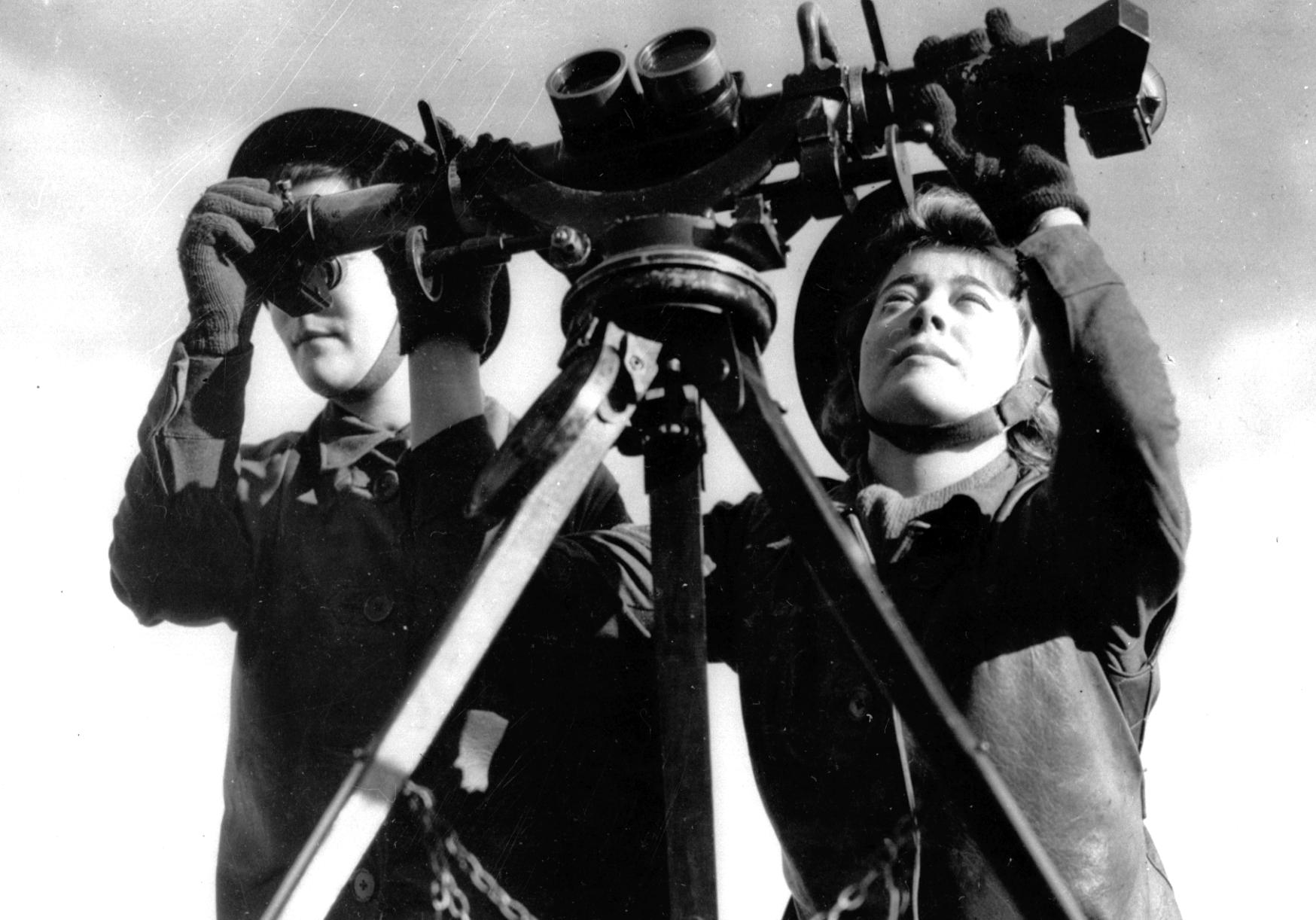
Women were never conscripted to fight, however their contributions to maintaining morale on the home front during these tumultuous years, as well as their service in the Land Army, amongst other organizations, was invaluable. At its peak in 1944, there were over 800,000 ‘land girls’ who engaged in a variety of jobs on the land – driving tractors, killing rats and various other unpleasant roles.
Government propaganda served as a way of persuading people to support various home front campaigns to help win the war. Eye catching posters and leaflets with sharp messaging were produced by the Ministry of Information on a huge array of topics including the dangers of ‘Careless talk’, the need to ‘Dig for Victory’ or ‘Make do and mend’ and others. This information was displayed in shops and shop windows, council buildings and village halls. The Ministry of Information also made films and radio broadcasts to bring its messages home and you can watch some of the films with this document collection. Some of the nation’s most significant artists, cartoonists and film makers produced work for the Ministry of Information.
Despite the destruction of the war, Britain slowly managed to reconstruct the country, and the informal contract between the people and the government began to be realised with the formation of the welfare state.
Juliet Gardiner, author: ‘The Thirties’; ‘Wartime Britain’; ‘Joining the Dots: A Woman in Her Time’.
 How did Britain fight the war at home?
Home Front 1939-1945: Fighting the war at home.
The Second World War has justifiably earned the name a ‘People’s War’ as it involved citizens not just the military.
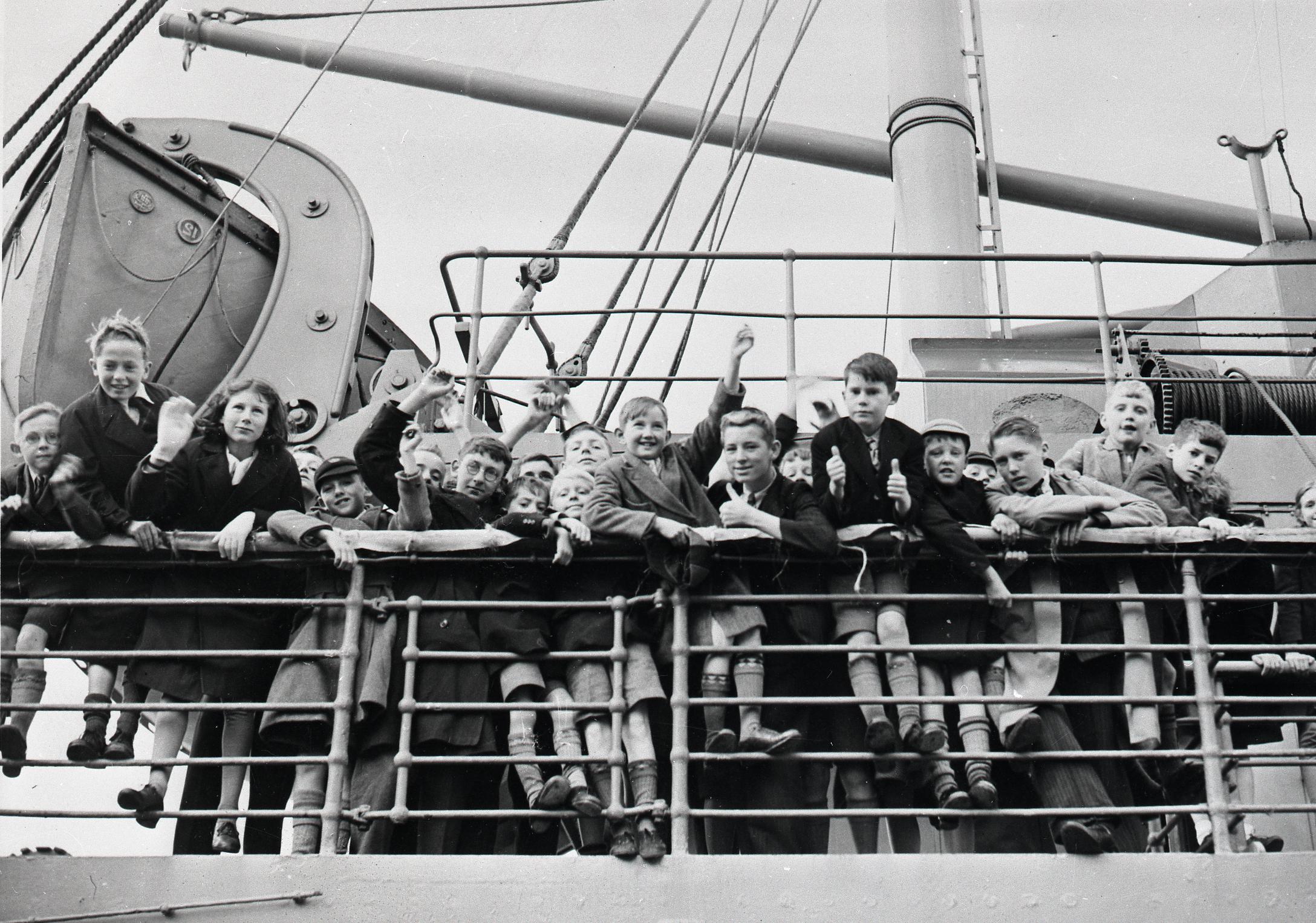
As soon as war was declared on 3 September, 1939 the British government’s first priority was to ‘get the children away’ from industrial areas, overcrowded cities and anywhere that was expected to be among the first targets for German air raids.
Local authorities implemented the plan at once. Mothers could take babies and young children with them, while school age children assembled in their school playgrounds to be marched to the nearest train station accompanied by teachers and volunteers. Children had a luggage label pinned to their coats with their names and destination. On arrival in rural areas – deemed safer from air raids – the children piled out and were met by a crowd of locals who had agreed with the billeting officer to take in evacuees. They walked around picking which child they wanted to take home: pretty little girls were soon chosen while farmers were on the look-out for strong lads to help with the harvest – one child recalled it being like a cattle market.
Evacuation was never compulsory so it presented a dilemma for parents: Should they send their children away to live with strangers for an undetermined length of time, or keep them at home where they might be killed in an air raid? Some children enjoyed being away from home – with space to kick a ball and explore the countryside – while some cried themselves to sleep every night.
When people were asked what they hated most about the war, for most it was the blackout. The government thinking that German technology was more advanced than it in fact was, ordered that no light that might attract attention from the German bombers must show. The blackout lasted from sunset to dawn. During those hours, shops, factories and office buildings had to turn off their lights – while householders were told to use special black out material to replace their curtains, but that was expensive and shops soon sold out. A cheaper option was to paint windows black or, as a last resort, to nail cardboard to the window frames.
Policemen and volunteer Air Raid Protection (ARP) officers would patrol city streets to ensure that regulations were being observed to the letter. If they detected a sliver of light coming from a house, they seemed to rather enjoy bellowing ‘Put that light out!’ Transgressors were likely to be fined up to two pounds for a first offence or up to £50 pounds if you were a repeat offender.
People found it possible to cook by candlelight but reading a book, knitting, attempting to do a jigsaw or tackling a crossword puzzle was impossible. If it was depressing to be indoors, it was hazardous to venture out as street lights had been dimmed, and even if you could buy the batteries for a torch the beam could only be directed at the ground. People bumped into each other, into pillar boxes or walls. Some were so disoriented that they were unable to find their own front door. And you took your life in your hands if you tried to cross the road as car head lights were dimmed, or covered with a sock.
All that summer what George Orwell described as ‘nuisance raids’ during the day became a regular occurrence, but on 7th September 1940 the war took an ominous turn with the first of 57 consecutive nights of bombing and the start of the ‘Blitz’. When the air raid warning sounded at 8 pm and people took shelter in either Anderson shelters, which were provided by the government and free to most of the population who had their own garden. It was not until nearly the end of the war that Morrison shelters were used. These were heavy iron constructions which sheltered people without an outdoor space.
London docks and warehouses were demolished by the bombing. Firemen struggled for days to extinguish the flames, whilst many commodities, like sugar, burned furiously. The people had little choice but to take refuge nightly in underground stations, yet the casualties remained high, with the air raids killing over 43,000 civilians, and seriously wounding 139,000 more.
Britain, however was not the only country to suffer from bombing raids and the threat of invasion during the Second World War. Countries in Britain’s overseas empire came under attack, for example Malta and Australia. As well as making a massive contribution to the allied army and providing resources, the colonial empire protected itself at home with local defence forces and other organisations such as Air Raid Precautions units.
Juliet Gardiner, author: ‘The Thirties’; ‘Wartime Britain’; ‘Joining the Dots: A Woman in Her Time’.
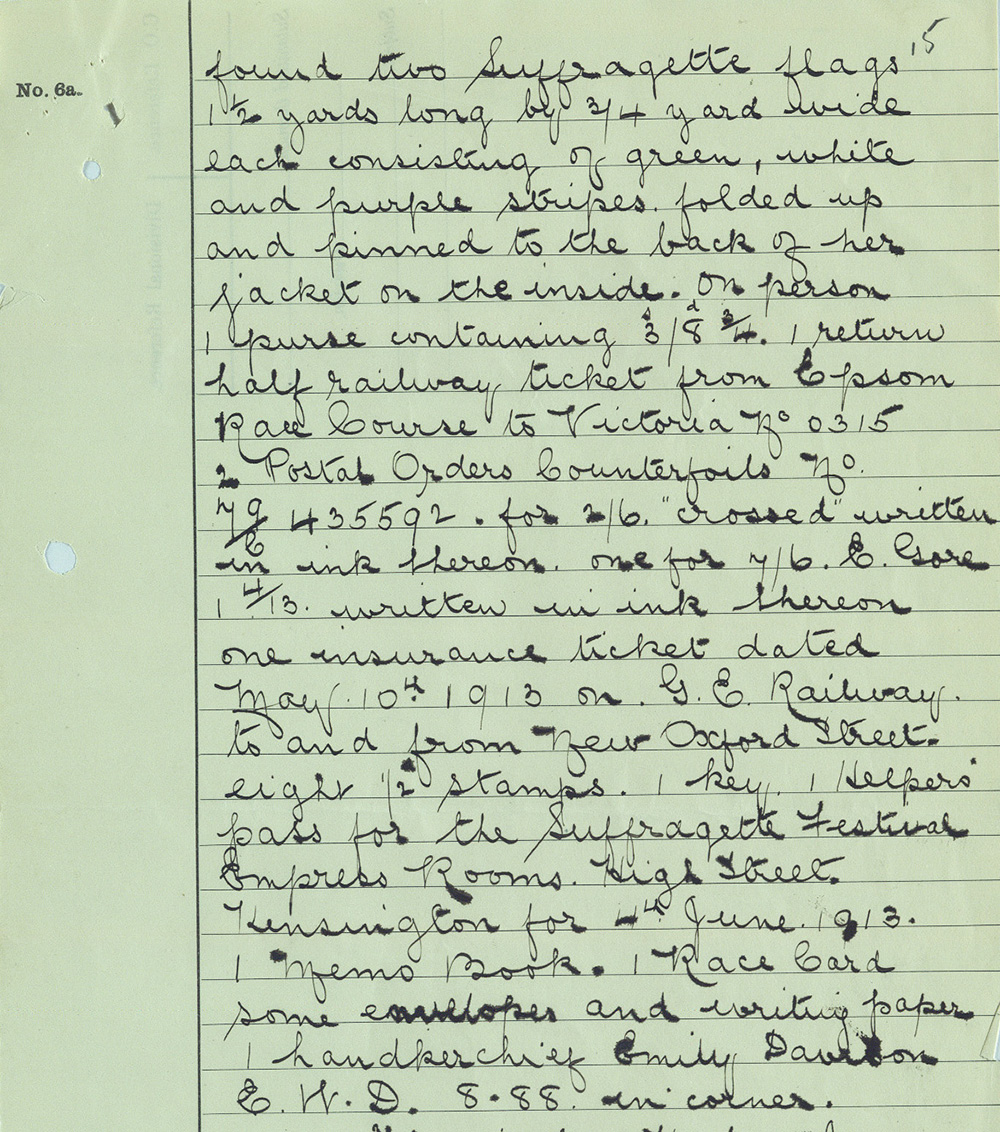
Extract 2 out of 2. A police report on the incident at the Derby, 1913. Catalogue ref: MEPO 2/1551
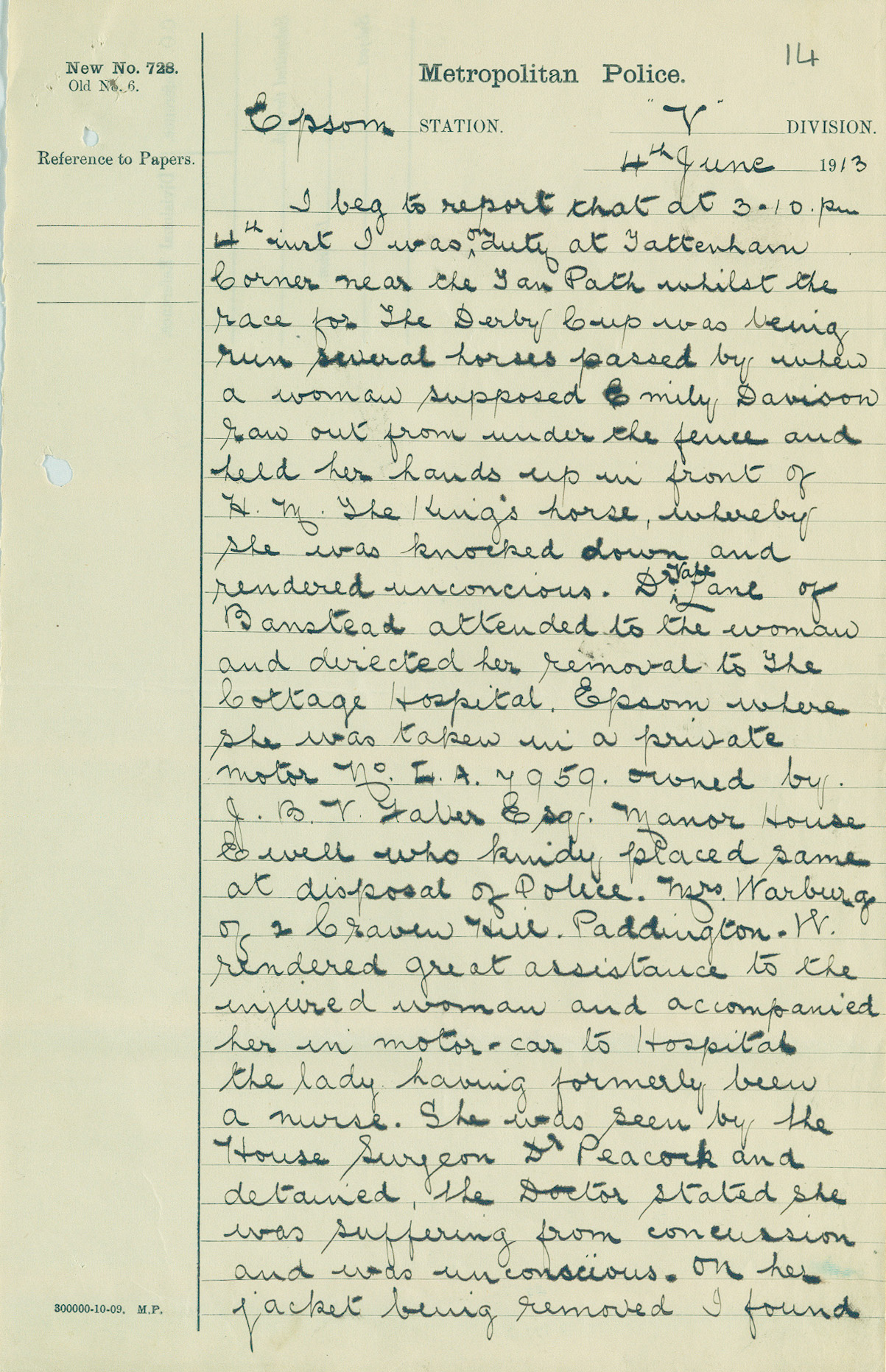
Extract 1 out of 2. A police report on the incident at the Derby, 1913. Catalogue ref: MEPO 2/1551
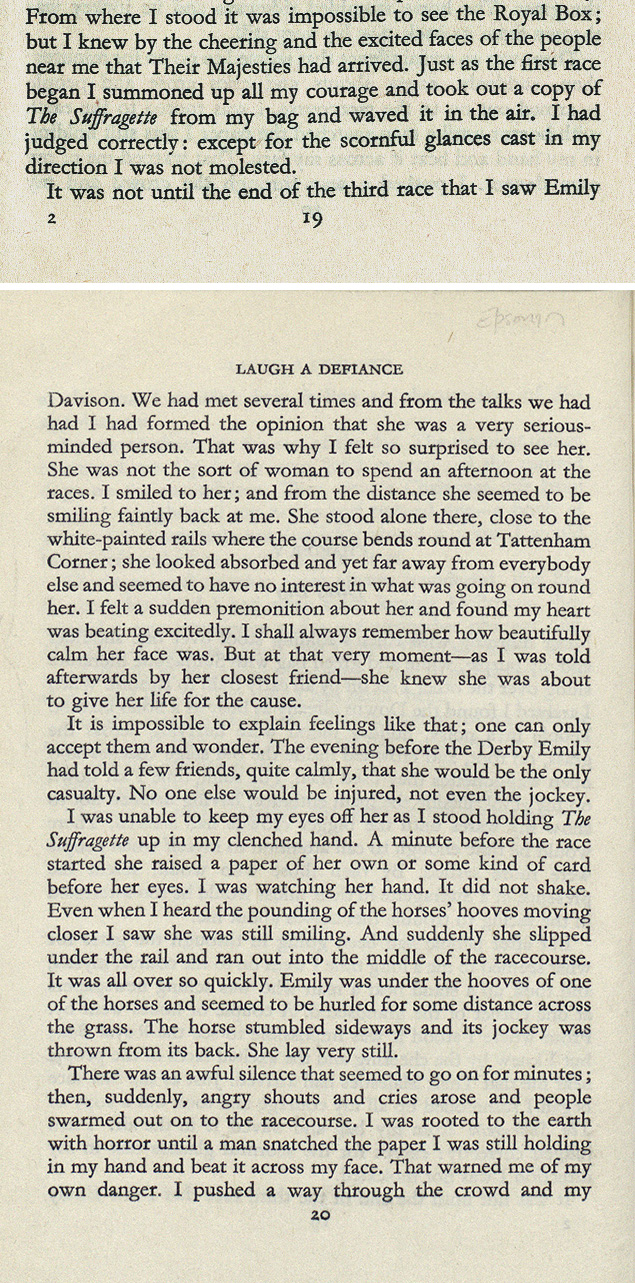
Two extracts from an account by Mary Raleigh Richardson entitled ‘Laugh a Defiance: an autobiography’. Published by George Weidenfeld & Nicolson: an imprint of The Orion Publishing Group, London, 1953.
Mary Richardson was a prominent suffragette present at the Derby who observed what happened to Emily Davison.
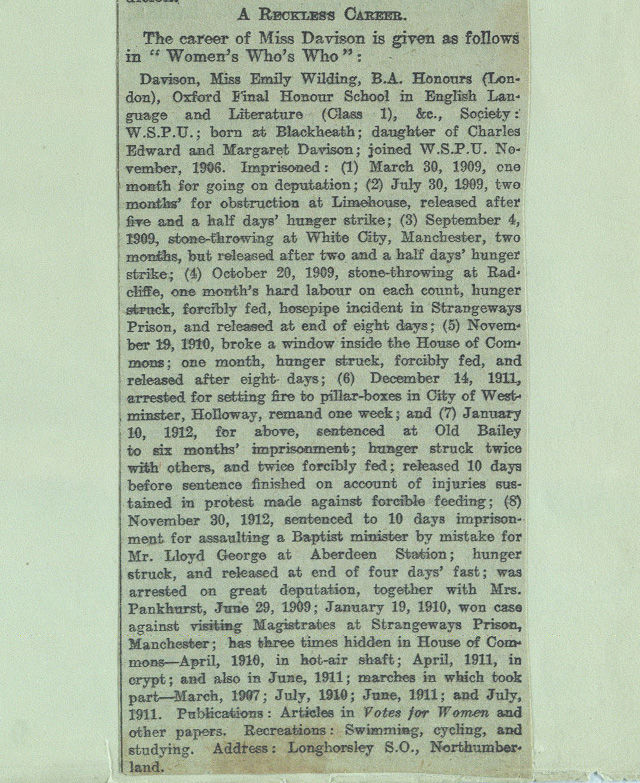
Extract 3 out of 3. Three extracts from an article called ‘Sensational Derby’ in The Morning Post, 5 June 1913, Catalogue ref: HO 144/1150/210696
The Derby is a horse race held each year at Epsom. Suffragist is a term used to describe someone who wants political voting rights given to more people, in this case to women.
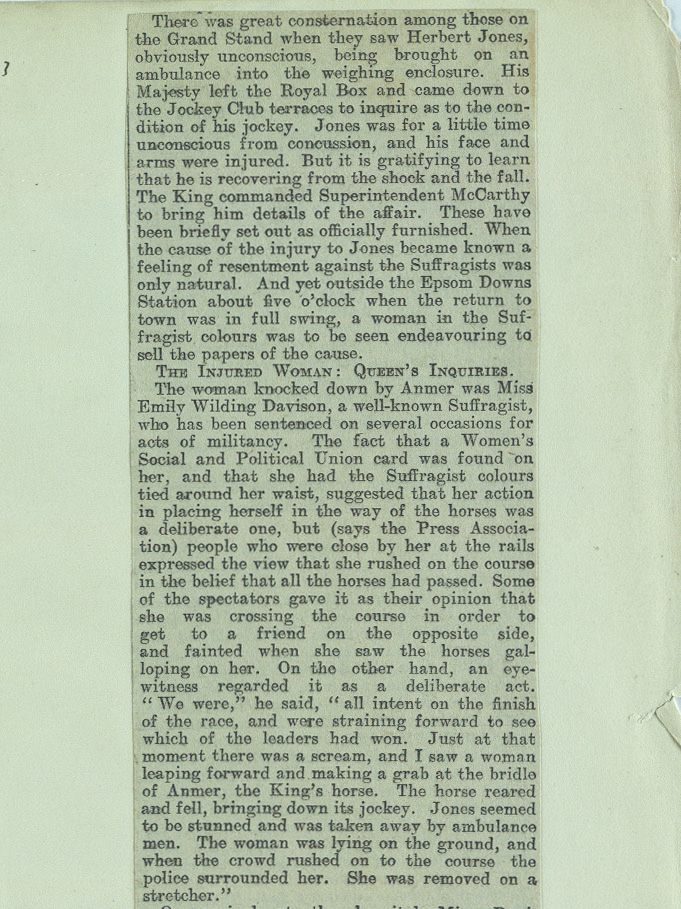
Extract 2 out of 3. Three extracts from an article called ‘Sensational Derby’ in The Morning Post, 5 June 1913, Catalogue ref: HO 144/1150/210696
The Derby is a horse race held each year at Epsom. Suffragist is a term used to describe someone who wants political voting rights given to more people, in this case to women.