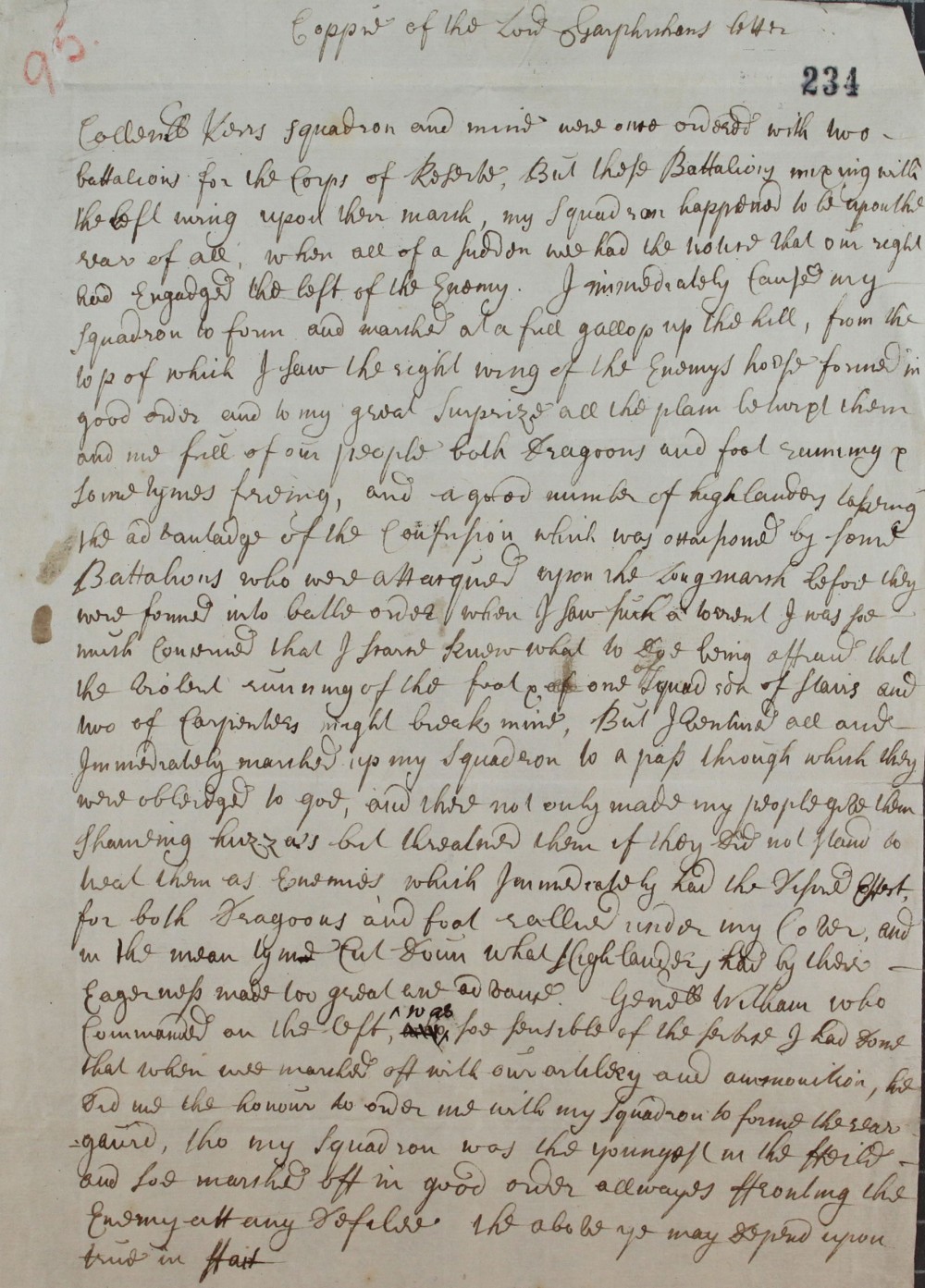
An account of Battle of Sheriffmuir from James Sandilands, Lord Torphichen, Scottish nobleman and army officer, loyal to the English Government, present with his regiment, November 1715 (SP 54/10/95).
Transcript
Coppie of Lord Torphichen’s letter
Collenell [Colonel] Kerrs squandron and mine were once ordered with two battalions for the corps of Reserve. But these Battalions mixing with the left wing upon the march, my squadron happened to be upon the rear of all, when all of a sudden we had the notice that our right had Engaged the left of the enemy. I immediately Caused my squadron to form and marched at a full gallop up the hill, from the top of which I saw the right wing of the Enemy’s horse formed in good order and to my great Surprise all the plain beswept them and we full of our people both Dragoons and Foot running up & sometimes fireing, and a good number of highlanders takeing the advantage of the Confusion which was occasioned by four Battalions who were attacqued [attacked] upon the Long march before they were formed into battle order when I saw such a [crowd] I was soe much concerned that I scarce knew what to doe & being affraid that the violent running of the foot and of one Squadron of Stairs and two of Carpenters might break mine, But I continued all attack and Immediately marched up my Squadron to a pass through which they were obliged to goe and there not only made my people give them shameing huzzars [cheers] but threatened them if they did not stand to treat them as Enemies which Immediately had the desired effect for both Dragoons and foot rallied under my Colours, and in the mean tyme [time] Cut down what Highlanders had by their Eagerness made too great ane advantage, General William who Commanded on the left who was soe sensible of the service I had done that when wee marched off with our artillery and ammunition, he did me the honour to order me with my Squadron to forme the rear guard tho[ugh] my squadron was the youngest in the field and soe marched off in good order allways fronting the Enemy att any [departure].The above you may depend upon true in fact.
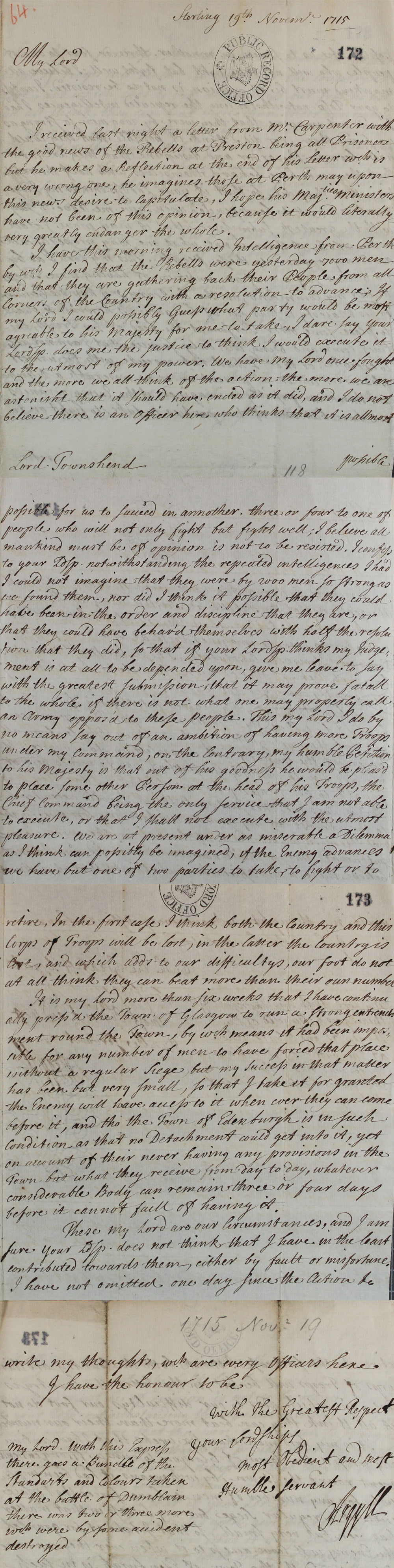
Lord Argyll reporting to Lord Townshend, Secretary of State, describes the degree of resistance after the rebels were defeated at Preston. Argyll says he would need more troops at his command and outlines the difficulties of taking Glasgow and Edinburgh, (SP 54/10/64).
Transcript
Sterling 19th November, 1715
My Lord,
I received last night a letter from Mr. Carpenter with the good news of the Rebells at Preston being all Prisoners but he makes a Reflection at the end of his letter which is a very wrong one, he imagines those at Perth may upon this news desire to capitulate, I hope his Majesties Ministers have not been of this opinion, because it would literally very greatly endanger the whole.
I have this morning received Intelligence from Perth by which I find that the Rebells were yesterday 7000 men and that they were gathering back their People from all corners of the country with a resolution to advance; If my Lord I could possibly guess what party would be most agreeable to his Majesty for me to take, I dare say your Lordship does me the justice to think I would execute it to the utmost of my power. We have, my Lord once fought and the more we all think of the action, the more we are astonisht that it should have ended as it did, and I do not believe there is an Officer here who thinks that it is allmost possible for us to succeed in another, three or four to one of people who will not only fight well; I believe all mankind must be of the opinion is not to be resisted. I confess to your Lordship notwithstanding the repeated intelligences I had I could not imagine that they were by 2000 men so strong as we found them, nor did I think it possible that they could have been in the order and disciple that they are, or that they could have behaved themselves with half the resolution that they did, so that if your Lordship thinks my judgement is at all to be depended upon, give me leave to say with the greatest submission, that it may prove fatall to whole if there is not what one may properly call an Army oppos’d to these people. This my Lord I do by no means say out of an ambition of having more Troops under my command, on the contrary, my humble Petition to his Majesty is that out of his goodness he would be pleas’d to place some other person at the head of his Troops, the Chief command being the only service that I am not able to execute, or that I shall not execute with the utmost pleasure. We are not present under as miserable a Dilemma as I think can possibly be imagined, if the Enemy advances we have but one of two parties to take to fight or to retire in the first case I think both the country and this corps of Troops will be lost, in the latter the Country is lost, and which adds to our difficultys, our foot [soldiers] do not at all think they can beat more than their own number.
It is my Lord more than six weeks that I have continually press’d the Town of Glasgow to run a strong entrenchment round the Town, by means it had been impossible for any number of men to have forced that place without a regular siege but my success in that matter has been but very small, so that I take for granted the Enemy will have accepted to it whenever they can come before it, and the Town of Edinburgh is in such condition as that no Detachment could get into it, yet on account of their never having any provisions in the Town but what they receive from day to day, whatever considerable Body can remain three or four days before it cannot faill of having it.
These my Lord are our Circumstances, and I am sure your Lordship does not think that I have in the least contributed towards them, either by fault or misfortune. I have not omitted one day since the Action to write my thoughts, which are every Officers here
I have the honour to be
with the Greatest Respect
Your Lordships most Obedient and most Humble Servant
Argyll
My Lord with this Express there goes a Bundle of the Standards and Colours [flags which represent different regiments, often used to mark a rallying point] taken at the Battle of Dumblain there was two or three more which were by some accident destroyed.
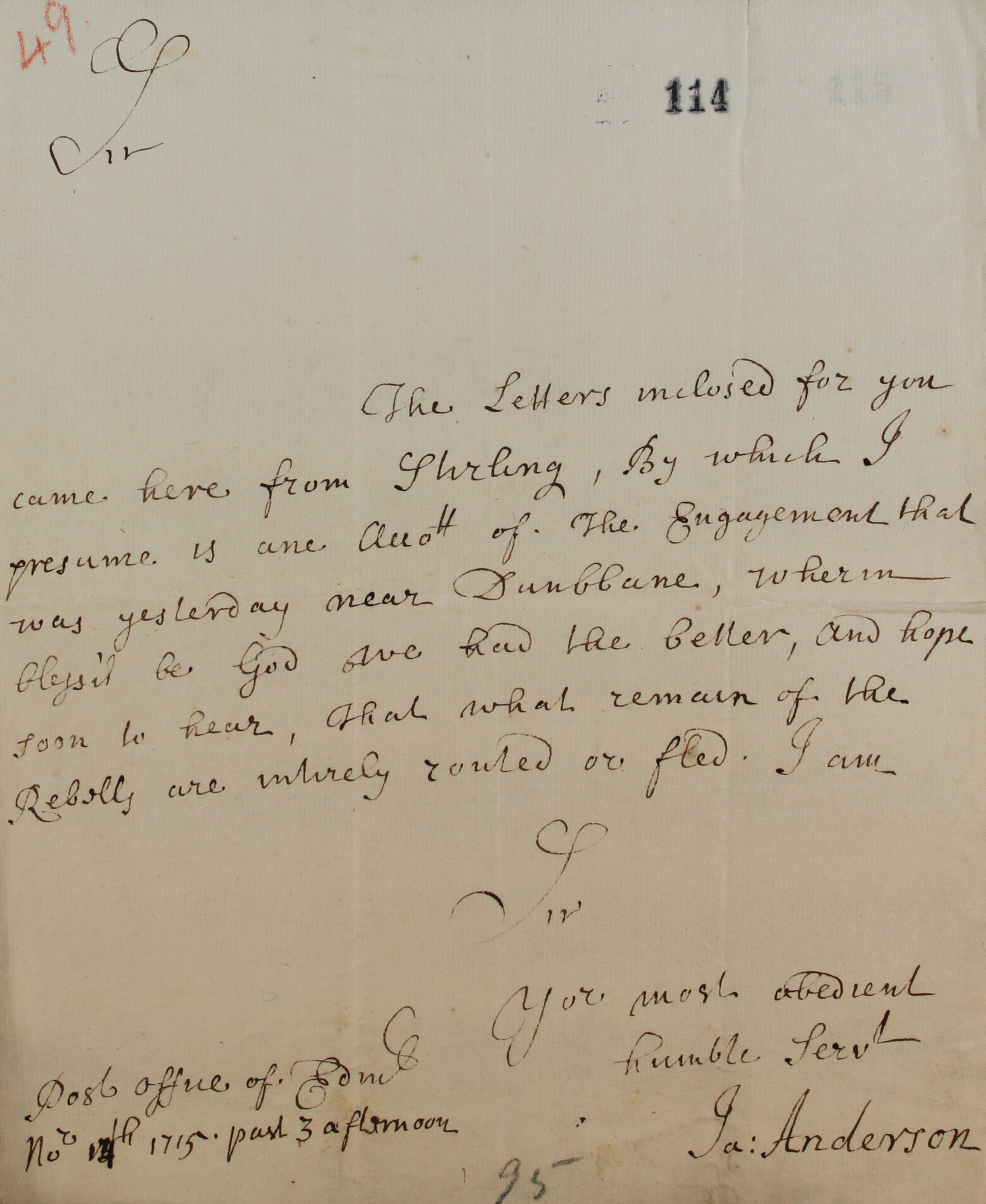
Note from Postmaster Anderson, on Jacobite defeat near Dunblane, 14 November 1715 (SP 54/10 f.49).
Transcript
Sir,
The letters inclosed for you came here from Stirling, By which I presume is one another of The Engagement that was yesterday near Dunblane, where in blesse’d be God we had the better, and hope soon to hear, that what remain of the Rebells are intirely routed or fled. I am
Sir, your most obedient humble Servant.
Ja: Anderson
Post Office of [Edinburgh]
Nov 14th 1715 past 3 afternoon
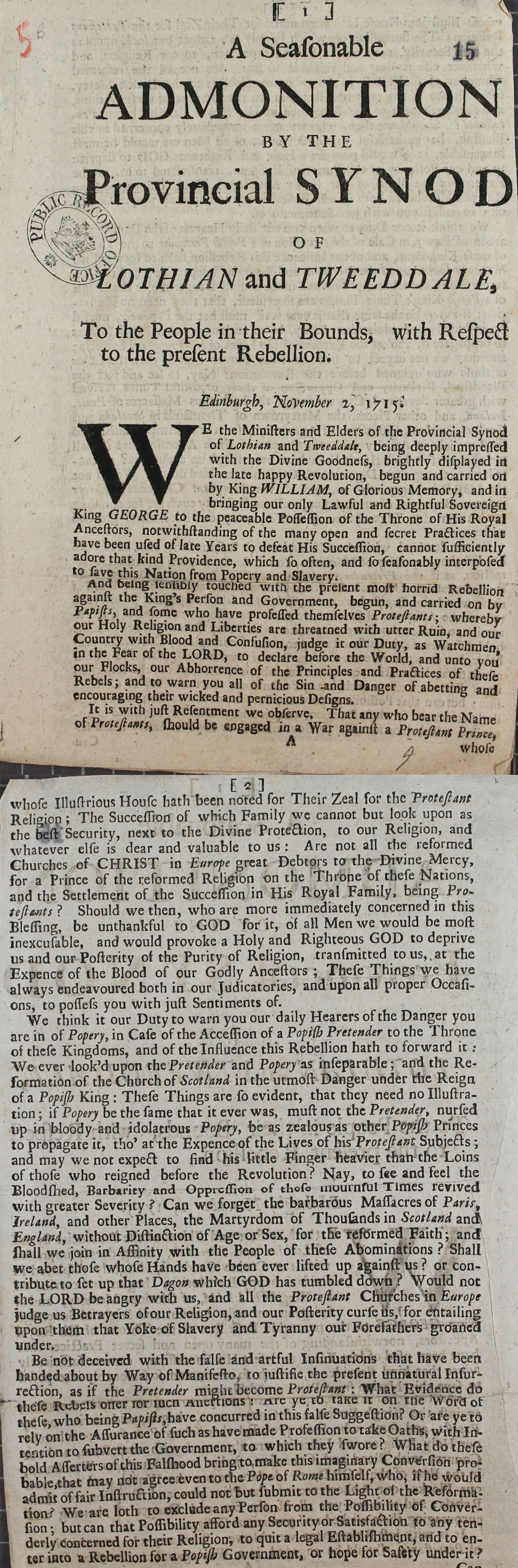
Extracts from a Scottish Church pamphlet addressed to the people of Lothian and Tweeddale, warning them to stick to their Protestant faith and not to be taken in by the Catholic Pretender. It suggests they would never be able to practice their religion freely whatever promises James Francis Edward Stuart made if he became King of England and Scotland. No Protestant should be at war with a Protestant King. 2 November, 1715 (SP 54/10/5B).
Transcript
A Seasonable ADMONITION [warning offering advice]
BY THE
Provincial SYNOD [church council] OF LOTHIAN and TWEEDDALE,
To the People in their Bounds, with Respect to the present Rebellion
Edinburgh, November 2, 1715.
WE the Ministers and Elders of the Provincial Synod of Lothian and Tweeddale, being deeply impressed with the Divine Goodness, brightly displayed in the late happy Revolution, begun and carried on by King WILLIAM [William of Orange], of Glorious Memory, and in bringing our only Lawful and Rightful Sovereign King GEORGE to the peaceable Possession of the Throne of His Royal Ancestors, notwithstanding of the many open and secret Practices that have been used of late Years to defeat His Succession, cannot sufficiently adore that kind Providence, which so often, and so seasonably interposed to save this Nation from Popery and Slavery.
And being sensibly touched with the present most horrid Rebellion against the King’s Person and Government, begun, and carried on by Papists [Catholics], and some who have professed themselves Protestants; whereby our Holy Religion and Liberties are threatened with utter Ruin, and our Country with Blood and Confusion, judge it our Duty, as Watchmen, in the Fear of the LORD, to declare before the World, and unto you our Flocks [people], our Abhorrence [severe dislike] of the Principles and Practices of these Rebels; and to warn you all of the Sin and Danger of abetting [aiding] and encouraging their wicked and pernicious [deadly or destructive] Designs.
It is with just Resentment we observe, That any who bear the Name of Protestants, should be engaged in a War against a Protestant Prince,
whose Illustrious House hath been noted for Their Zeal for the Protestant Religion; The Succession of which Family we cannot but look upon us as the best Security, next to the Divine Protection, to our Religion, and whatever else is dear and valuable to us: Are not all the reformed Churches of CHRIST in Europe GREAT Debtors to the Divine Mercy, for a Prince of the reformed Religion on the Throne of these Nations, and the Settlement of the Succession in His Royal Family, being Protestants? Should we then, who are more immediately concerned in this Blessing, be unthankful to GOD for it, of all Men we would be most inexcusable, and would provoke a Holy and Righteous GOD to deprive us and our Posterity of the Purity of Religion, transmitted [passed down] to us, at the Expence of the Blood of our Godly Ancestors; These Things we have always endeavoured [tried to do] both in our Judicatories [church courts], and upon all proper Occasions, to possess you with just Sentiments of.
We think it is our Duty to warn you our daily Hearers of the Danger you are in of Popery, in Case of the Accession of a Popish Pretender to the Throne of these Kingdoms, and of the Influence this Rebellion hath to forward [encourage] it: We ever look’d upon the Pretender and Popery as inseparable; and the Reformation of the Church of Scotland in the utmost Danger under the Reign of a Popish King: These Things are so evident [obvious], that they need no Illustration [examples]; if Popery be the same that it ever was, must not the Pretender, nursed up in bloody and idolatrous [worship of false idols] Popery, be as zealous as other Popish Princes to propagate [encourage] it, tho’ at the Expence of the Lives of his Protestant Subjects; and may we not expect to find his little finger heavier than the Loins of those who reigned before the Revolution? Nay, to see and feel the Bloodshed, Barbarity and Oppression of those mournful Times revived with greater Severity? Can we forget the barbarous Massacres of Paris, Ireland, and other Places, the Martyrdom of Thousands in Scotland and England, without Distinction of Age or Sex, for the reformed Faith; and shall we join in Affinity [closeness] with the People of these Abominations [shameful conditions]? Shall we abet [aid] those whose Hands have been lifted up against us? Or contribute to set up that Dagon [the fish-god, the national god of the Philistines] which GOD has tumbled down? Would not the LORD be angry with us, and all the Protestant Churches in Europe judge us Betrayers of our Religion, and our Posterity [history] curse us, for entailing [binding] upon them that Yoke of Slavery and Tyranny our Forefathers groaned under.
Be not deceived with the false and artful [clever] Insinuations [hints] that have been handed about by Way of Manifesto [handbills], to justify the present unnatural Insurrection [rebellion], as if the Pretender might become Protestant: What Evidence do these Rebels offer for such Assertions [statements]: Are ye to take it on the word of these, who being Papists, have concurred in this false Suggestion? Or are ye to rely on the Assurance of such as have made Profession to take Oaths, with Intention to subvert [overturn] the Government, to which they swore? What do these bold Asserters of this Falshood bring to make this imaginary Conversion probable that may not agree even to the Pope of Rome himself, who, if he would admit of fair Instruction, could not but submit to the Light of the Reformation? We are loth to exclude any Person from the Possibility of Conversion; but can that Possibility afford any Security or Satisfaction to any tension; but can that Possibility afford any Security or Satisfaction to any tenderly concerned for their Religion, to quit a legal Establishment, and to enter into a Rebellion for a Popish Government, or hope for Safety under it?
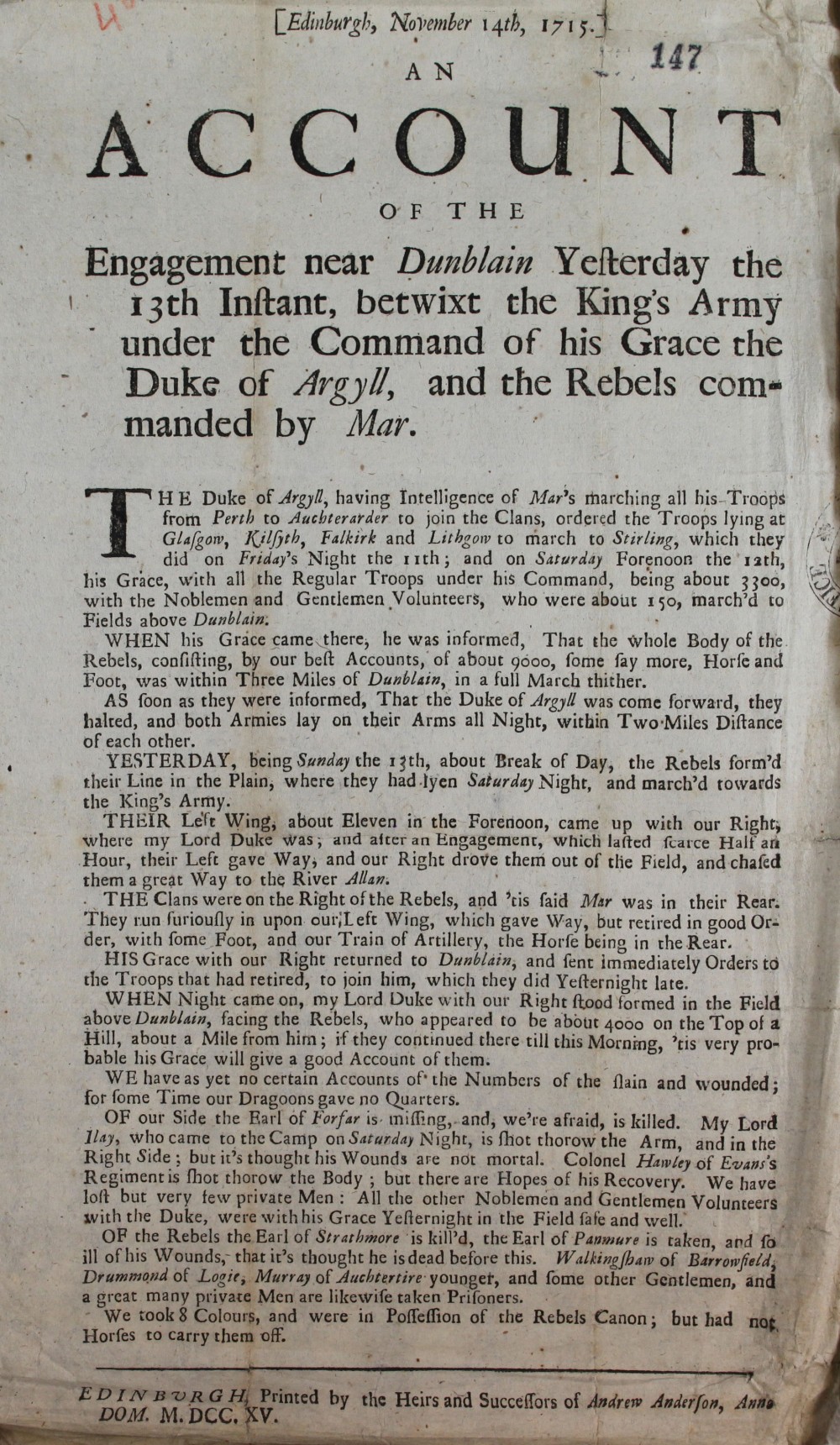
This is an account of the battle of Sheriffmuir from point of view of the Duke of Argyll who led the English army against the Jacobites led by the Earl of Mar. 14 November 1715 (SP 54/10/46A).
Transcript
AN ACCOUNT
OF THE
Engagement near Dunblain Yesterday the 13th Instant betwixt the King’s Army under the Command of his Grace the Duke of Argyll, and the Rebels commanded by Mar.
THE Duke of Argyll, having Intelligence of Mar’s marching all his Troops from Perth to Auchterarder to join the Clans, ordered the Troops lying at Glasgow, Kilsyth, Falkirk and Lithgow to march to Stirling, which they did on Friday’s Night the 11th; and on Saturday Forenoon the 12th, his Grace, with all the Regular Troops under his Command, being about 3300, with the Noblemen and Gentlemen Volunteers, who were about 150, march’d to Fields above Dunblain.
WHEN his Grace came there, he was informed, That the whole Body of the Rebels, consisting, by our best Accounts, of about 9000, some say more, Horse and Foot, was within Three Miles of Dunblain, in a full March thither.
AS soon as they were informed,That the Duke of Argyll was come forward, they halted, and both Armies lay on their Arms all Night, within Two Miles Distance of each other.
YESTERDAY, being Sunday the 13th, about Break of Day, the Rebels form’d their Line in the Plain, where they had lyen Saturday Night, and march’d towards the King’s Army.
THEIR Left Wing, about Eleven in the Forenoon, came up with our Right, where my Lord Duke was, and after an Engagement, which lasted scarce Half an Hour, their Left gave Way, and our Right drove them out of the Field, and chased them a great Way to the River Allan.
THE Clans were on the Right of the Rebels, and ‘tis said Mar was in their Rear. They run furiously in upon our Left Wing, which gave Way, but retired in good Order, with some Foot, and our Train of Artillery, the Horse being in the Rear.
His Grace with our Right returned to Dunblain, and sent immediately Orders to the Troops that had retired to join him, which they did Yesternight late.
WHEN Night came on, my Lord Duke with our Right stood formed in the Field above Dunblain, facing the Rebels, who appeared to be about 4000 on the Top of a Hill, about a Mile from him; if they continued there till this Morning, ‘tis very probable his Grace will give a good Account of them.
WE have as yet no certain Accounts of the Numbers of the slain and wounded; for some Time our Dragoons gave no Quarters.
OF our Side the Earl of Forfar is missing, and we’re afraid, is killed. My Lord Ilay who came to the Camp on Saturday Night is shot thorow the Arm, and in the Right Side; but it’s thought his Wounds are not mortal. Colonel Hawley of Evan’s Regiment is shot thorow [through] the Body; but there are Hopes of his Recovery. We have lost but very few private Men: All the other Noblemen and Gentlemen Volunteers with the Duke, were with his Grace Yesternight in the Field safe and well.
OF the Rebels the Earl of Strathmore is kill’d, the Earl of Panmure is taken, and so ill of his Wounds, that it’s thought he is dead before this. Walkingshaw of Barrowfield, Drummond of Logie, Murray of Auchtertire younger, and some other Gentlemen, and a great many private Men are likewise taken Prisoners.
We took 8 Colours [regimental flags], and were in Possession of the Rebels Cannon; but had not Horses to carry them off.
EDINBURGH, Printed by the Heirs and Successors of Andrew Anderson, Anno DOM. M.DCC. XV.
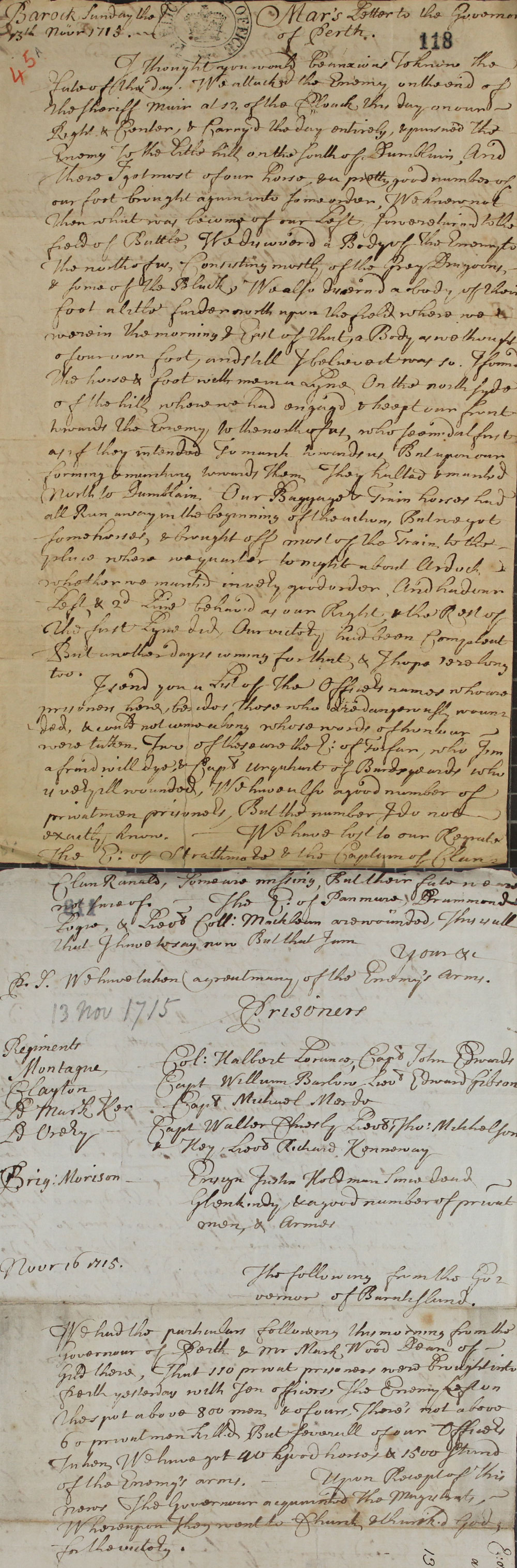
Letter from the Earl of Mar to the Governor of Perth on the battle of Sheriffmuir, giving his view of the battle as a complete Jacobite victory. 13 November 1715 ( SP 54/10/45A).
Transcript
Barock Sunday the 13th November 1715
Mar’s Letter to the Governor of Perth
I thought you would be anxious to know the fate of this day. We attacked the Enemy on the end of the Sheriff Muir at 12 of the Cloack [clock] this day on our Right and Centre, and Carry’d the day entirely, and pursued the Enemy to the little hill on the south of Dunblain [Dunblane], And there I got most of our horse, and a pretty good number of our foot brought again into some order, We knew not then what was become of our Left so we returned to the field of Battle, We discovered a Body of the Enemy to the north of us, consisting mostly of the Grey Dragoons and some of the Black [Dragoons] and We also discerned a body of their foot a little — north upon the field where we were in the morning and East of that, a Body as we thought of our own foot and still I believe it was so. I formed the horse and foot with me in a Line On the north side of the hill where we had engaged and keept [kept] our front towards the Enemy to the north of us, who seemed at first as if they intended to march towards us But upon our forming and marching towards Them they halted and marched North to Dunblain Our Baggage and Train horses had all run away in the beginning of the action But we got some horses, and brought off most of the Train to the place where we quarter tonight about Ardoch whether we marched in very good order, And had our Left, and 2nd Line behaved as our Right, and the Rest of the first Line did, Our victory had been Compleat [complete] But another day is coming for that, and I hope ‘ere long too.
I send you a List of the Officers names who are prisoners here, beside those who are dangerously wounded, and could not come along whose words of honour were taken. Two of these are the Earl of Forfar, who I’m afraid will dye, and Captain Urqhart of Burdsyards who is very ill wounded, We have also a good number of private men prisoners, But the number I do not exactly know.
We have lost to our Regreats [regret] the Earl Of Strathmore and the Captain of Clan Ranald, some are missing But their fate we are not sure of. The Earl Of Panmure, Drummond Logie [Logie-Drummond], and Lieutenant Colonel Macklean [Maclean] are wounded, this is all that I have to say now But that I am yours [Mar]
P.S. We have taken a great many of the Enemy’s army.
Prisoners
Regiment
Montague Colonel Albert Larunce [Laurence], Captain John Edwards
Clayton Captain William Barlow, Lieutenant Edward Gibson
Lord Mark Ker Captain Michael Moret
Lord Orery [Orrery] Captain Walter Chiefly, Lieutenant Thomas Mitchelson [Michelson] and Hey [Hay], Lieutenant ,Richard Heneway
Brigadier Morison Ensign Justin Holdman since dead
Glenkindy, and a good number of private men, and armies
November 16 1715. The following from the Governor of Burntisland
We had the particulars following this morning from the Governor of Perth and Mr Mark Wood Dean of Guild there, That 110 private prisoners were brought into Perth yesterday with ten officers, the Enemy lost on the spot above 800 men and of ours there’s not above 60 private men killed But severall of our Officers taken We have got 40 good horses, and 1500 stand of the Enemy’s arms. Upon receipt of this news The Governor acquainted the magistrate, Whereupon they went to Church and thanked God, for the victory.
Earl Mars Sect of State of the Actions at Dunblane
13 Nov: 1715
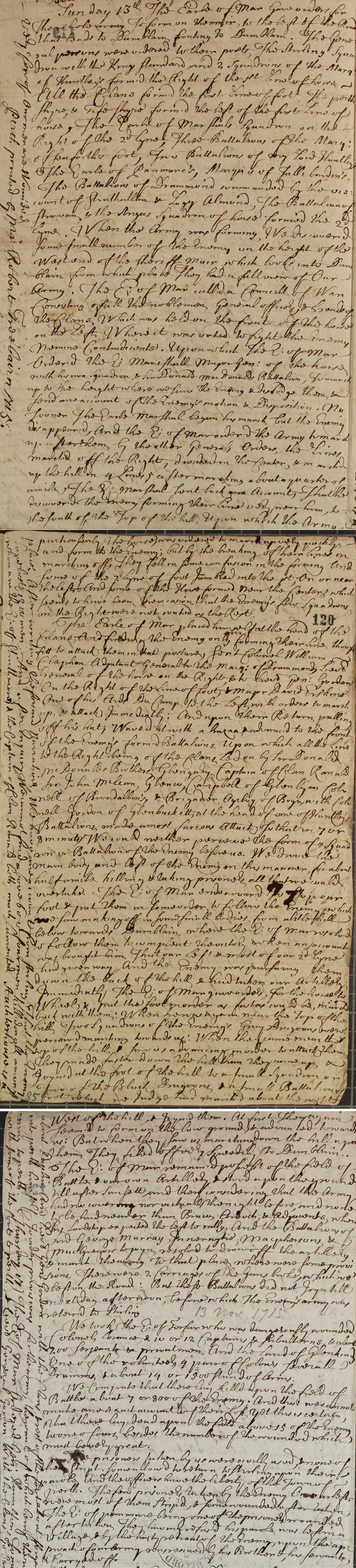
This describes the Battle of Sheriffmuir from a Jacobite point of view and gives details of the losses on both sides. The Jacobites were led by the Earl of Mar and the government forces by the Duke of Argyll, a supporter of the Protestant monarchy. On November 13 1715, the two armies met at Stone Hill near Dunblane. (SP 54/10/45B).
Transcript
Sunday 13th. The Earl of Mar gave orders for the whole army to form on the muir [moor], to the left of the road that leads to Dunblane, fronting to Dunblane. The general persons were ordered to their posts, the Stirling squadron [unit] with the king’s standard [royal flag] and two squadrons of the Marquis of Huntly formed the right of the first line of horses. All the clans formed the first line of foot [infantry soldiers who fought in face-to-face combat]. The Perth Shyre [Perthshire] and Fife Shyre [Fifeshire] formed the left of the first line of horses. The Earl of Marischal’s [George Keith, 10th Earl Marischal c1692-1778] squadron on the right of the second line, three battalions of the Marquis of Senforth’s foot, two battalions of my Lord Huntly’s, the Earl of Panmure’s, the Marquis of Tullibardine’s. The battalions of Drummond commanded by the Viscount of Strathallan and Logiealmond, the battalion of Strowan and the Angus squadron of horse formed the second lines. When the army was forming, we discovered some small number of the enemy on the height of the west end of the Sheriff muir which looks into Dunblane from which place they had a full view of our army. The Earl of Mar called a council of war consisting of all the noblemen, general officers and lairds [lords] of the clans, which was held on the front of the horses on the left. Where it was voted to fight the enemy nemine contradicente [without contradiction; of one mind]. Upon which the Earl of Mar ordered the Earl of Marischal Major General of the horses with his own squadron and Sir Donald MacDonald’s battalion, to march up to the height where we saw the enemy and dislodge them and send an account of the enemy’s motion [movement] and disposition [state]. No sooner the Earl Marischal begun his march but the enemy disappeared and the Earl of Mar ordered the army to march up after them, by the other general’s orders, the lines marched off the right, divided in the centre, and marched up the hill in lines, after marching about a quarter of a mile, the Earl of Marischal sent back an account that he discovered the enemy forming their line very near him, to the south of top of the hill, upon which the army,
particularly the horse, was ordered to march up very quickly and form to the enemy; but by the breaking of their lines in marching off, they fell in some confusion in the forming and some of the second line of foot jumbled into the first, on or near the left and some of the horse formed near the centre which seems to have been the occasion that the enemy’s few squadrons on the right were not routed [defeated & dismissed] as the rest.
The Earl of Mar placed himself at the head of the clans, and finding the enemy only forming their lines thought fit to attack them in that posture[ position], sent Colonel William Clephon, adjutant- general to the Marquis of Drummond, lieutenant-general of the horse on the right and to lieutenant-general Gordon on the right of the line of foot and major David Erskine, one of his aide-de-camp [military officer serving as personal assistant], to the left with orders to march up and attack immediately: and upon their return, pulling off his hat, waved it with a ‘huzzah’ and advanced to the front of the enemy’s formed battalions. Upon which all the line to the right, being of the clans led by Sir Donald McDonald’s brother, Glengarry, captain of clan Ranald. Sir John McLean, Glencoe, Campbell of Glenlyon, Colonel of Broadalbin’s, and brigadier Ogilvy of Boyne with Colonel Gordon of Glenbuckett at the head of one of Huntly’s battalions made a most furious attack, so that in seven or eight minutes we could neither perceive the form of a squadron or battalion of the enemy before us. We drove the main body and left of the enemy in this manner for about half a mile, killing and taking prisoners, all that we could undertake. The Earl of Mar endeavoured to stop our foot and put them in some order to follow the enemy which we saw making off in some small bodies [small groups] from a little hill below towards Dunblane where the Earl of Mar resolved to follow them to complete the victory when an account was brought him that our left and most of our second line had given way and the enemy was pursuing them down the back of the hill and had taken our artillery. Immediately, the Earl of Mar gave orders for the horse to wheel and put the foot in order as fast as could be, marches back with them: when he was again near the top of the hill two squadrons of the enemy’s grey dragoons [British Army] were perceived marching towards us: when they came near the top of the hill and saw us advancing in order to attack them, they made faster down the hill then they came up and joined at the foot of the hill to a small squadron or two of the black dragoons and a small battalion of foot which we judge had marched about
the west of the hill, joined them. At first they again seemed to form on the low ground and advanced towards us: but when they saw us marching down the hill upon them they fled off very speedily to Dunblane. The Earl of Mar remained possessed of the field of battle and our own artillery and stood upon the ground till after sunset and then considering that the army had no covering nor victuals [food] all the night before and none to be had nearer than Braco, Ardoch, and adjacents, where his lordship expected the left to rally and the battalions of Lord George Murray, inner right, MacPherson and MacGregor to join, resolved to draw off the artillery and march the army to that place where were some provisions. There were two carriages of the guns broke, which we left on the road: but those battalions did not join till next day afternoon, before which the enemy’s army was returned to Stirling.
We took the Earl of Forfar who was dangerously wounded. Colonels Laurence [possibly Laurence Oliphant of Gask] and ten or twelve captains and subalterns [officer below rank of captain] and about two hundred sergeants and private men and the Lord of Glenkindie, one of the volunteers, four pairs of colours [battalion flags], several drummers and about fourteen or fifteen hundred foot under arms. We compute [calculate] that there lay killed upon the field of battle about seven or eight hundred of the enemy. And thus we cannot make an exact account of their loss yet this is certain, that those lay dead upon the field above is of the enemy none of ours besides the number of the wounded which must be very great.
The prisoners taken by us were civilly [respectfully] used and none of them stripped, some allowed to return to Stirling upon their parole*. And the officers have the liberty of the town of Perth. The few prisoners taken by the enemy are useless now most of them stripped and found wounded after taken. The Earl of Panmure being one of the prisoners wounded after taken, they having refused his parole, was left in a village, and by the hasty retreat of the enemy, upon the approach of our army, was rescued by his brother and his servants and carried off.
*Parole
This was the word of honour of a prisoner of war who is granted freedom only after promising not to engage in further fighting until formally exchanged by the other side.
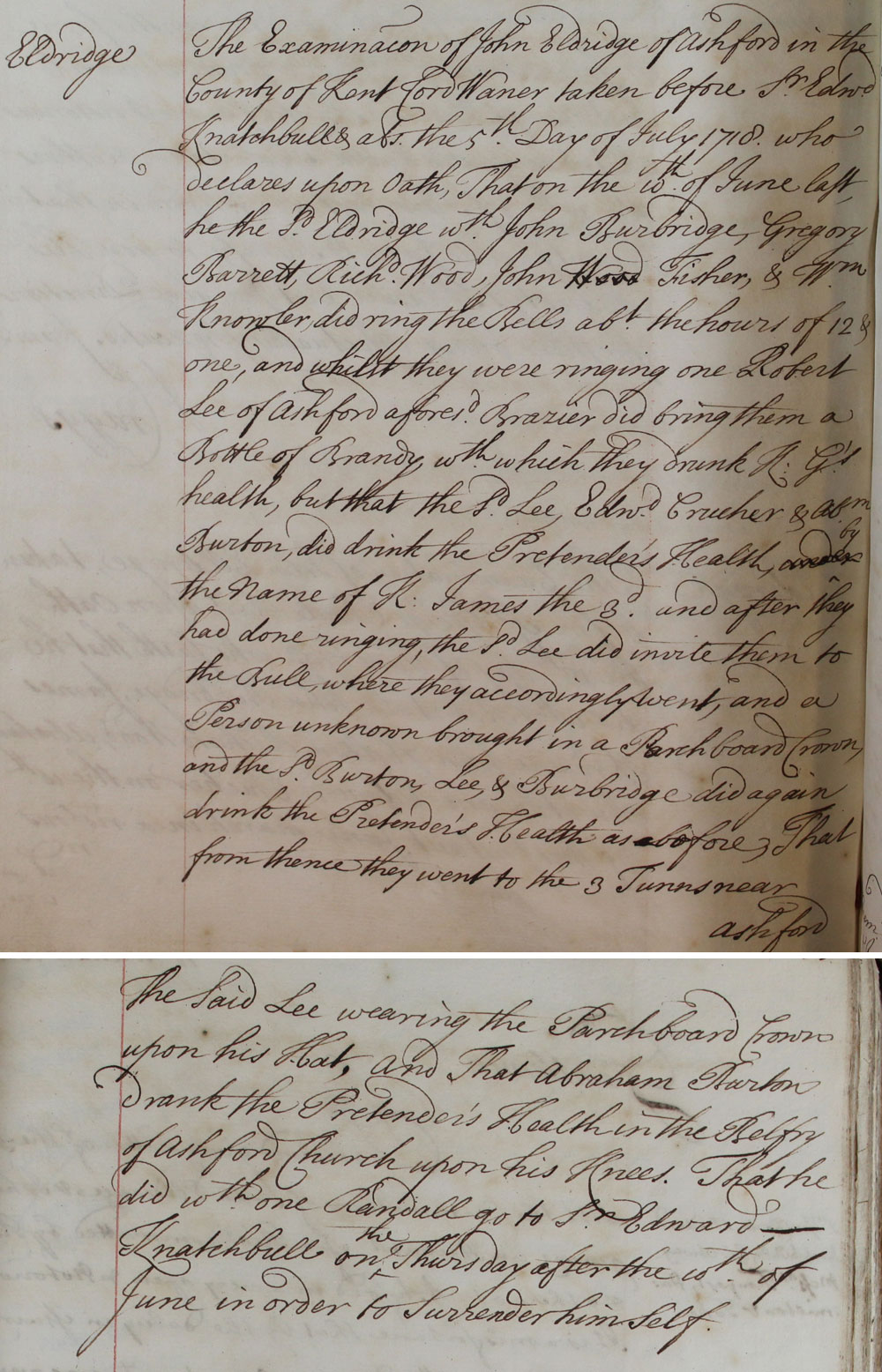
This is a court case heard in Kent about a man called John Eldridge who with others, drank the health of the ‘Old Pretender’ as James III, a protest against the Hanoverian succession. The Jacobites used to drink secret toasts to ‘the King over the water’. Many Jacobite drinking glasses survive today and are engraved with secret symbols, such as the oak leaf, white rose and butterfly. You can see an example on our website. 5 July 1718 (SP 44/79A f.162-3).
Transcript
The Examination of John Eldridge in the County of Kent Lord Waner taken before Sr. [Sir] Edward Knatchbull [Esquire] abs. the 5th Day of July 1718 who declares upon Oath, that on the 10th of June last, he the Sd [said] Eldridge with John Burbridge, Gregory Barrett, Richard Wood, John Wood Fisher & William Knowler did ring the Bells about the hours of 12 & one, and whilst they were ringing one Robert Lee of Ashford aforesaid Brazier [person who makes things out brass] did bring them a bottle of brandy with which they drunk King G.’s [George I] health, but that the said Lee, Edward Crucher & Abraham Burton, did drink the Pretender’s Health, by the name of K: [King] James the 3 [James III, the “Old Pretender”] and after they had done ringing, the Said Lee did invite them to the Bull where they accordingly went, and a person unknown brought in a Parchboard Crown [paper crown], and the said Burton, Lee & Burbridge did again drink the Pretender’s Health as before, That from thence they went to the 3 Tunns near Ashford.
The Said Lee wearing the Parchboard crown upon his Hat, and that Abraham Burton drank the Pretender’s health in the Belfry [bell tower] of Ashford Church upon his knees. That he did with one Randall go to Sir Edward Knatchbull on the Thursday after the 10th of June in order to surrender himself.
Extracts from a Government report on a Jacobite plot involving Christopher Layer, 5 March 1722. A government investigation outlines several plots to put the Old Pretender on the throne in place of George I. (T 64/306).
Transcript
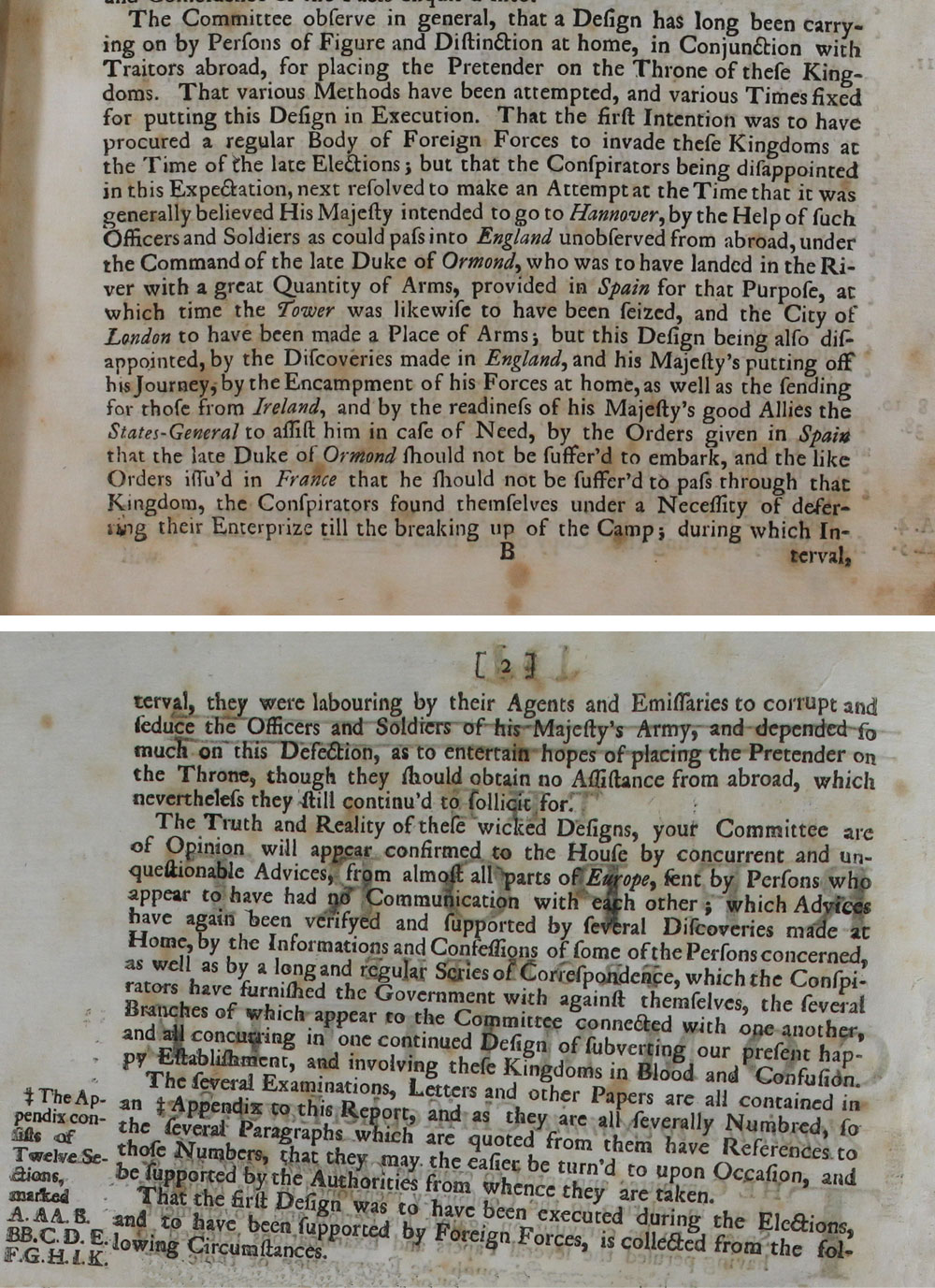
The Committee observe in general, that a Design [plot] has long been carrying on by Persons of Figure [importance] and Distinction at home, in Conjunction [together] with Traitors abroad, for placing the Pretender on the Throne of these Kingdoms. That various Methods have been attempted, and various Times fixed for putting this Design in Execution [action]. That the first Intention [aim] was to have procured [got hold of] a regular body of Foreign Forces to invade these Kingdoms at the Time of the late Elections; but that the Conspirators being disappointed in this Expectation, next resolved to make an Attempt at the Time that it was generally believed His Majesty intended to go to Hannover, by the Help of such Officers and Soldiers as could pass into England unobserved from abroad, under the Command of the late Duke of Ormond, who was to have landed in the River with a great Quantity of Arms, provided in Spain for that Purpose, at which time the Tower [Tower of London] was likewise to have been seized, and the City of London to have been made a Place of Arms; but this Design being also disappointed, by the Discoveries made in England, and his Majesty’s putting off his Journey, by the Encampment of his Forces at home, as well as the sending for those from Ireland, and by the readiness of his Majesty’s good Allies the States-General to afflict him in case of Need, by the Orders given in Spain that the late Duke of Ormond should not be suffer’d [allowed] to embark, and the like Orders issu’d in France that he should not be suffer’d to pass through that Kingdom, the Conspirators found themselves under a Necessity of deferring [putting off] their Enterprise till the breaking up of the Camp; during which Interval, they were labouring [working] by their Agents and Emissaries [messengers] to corrupt and seduce [influence] the Officers and Soldiers of his Majesty’s Army, and depended so much on this Defection [desertion], as to entertain hopes of placing the Pretender on the Throne, though they should obtain no Assistance from abroad, which nevertheless they still continu’d to solicit [request] for.
The Truth and Reality of these wicked Designs [plots], your Committee [George I’s officials investigating] are of Opinion will appear confirmed to the House by concurrent and unquestionable Advices [evidence at the time], from almost all parts of Europe, sent by Persons who appear to have had no Communication with each other; which Advices have again been verified [checked] and supported by several Discoveries made at Home, by the Informations and Confessions of some of the Persons concerned, as well as by a long and regular Series of Correspondence [letters], which the Conspirators have furnished [given] the Government with against themselves, the several Branches of which appear to be the Committee connected with one another, and all concurring [coming together] in one continued Design of subverting [upsetting] our present happy Establishment [government] , and involving these Kingdoms in Blood and Confusion.
The several Examinations [statements], Letters and other Papers are all contained in an *Appendix to this Report, and as they are all severally Numbred, to the several Paragraphs which are quoted from them have References to those Numbers, that they may the easier be turned to upon Occasion, and be supported by the Authorities from whence they are taken. [There is an appendix which lists all the evidence such as statements and letters which is numbered to show where it is used in the report].
That the first Design [plot] was to have been executed during the Elections, and to have been supported by Foreign Forces, is collected from the following Circumstances.
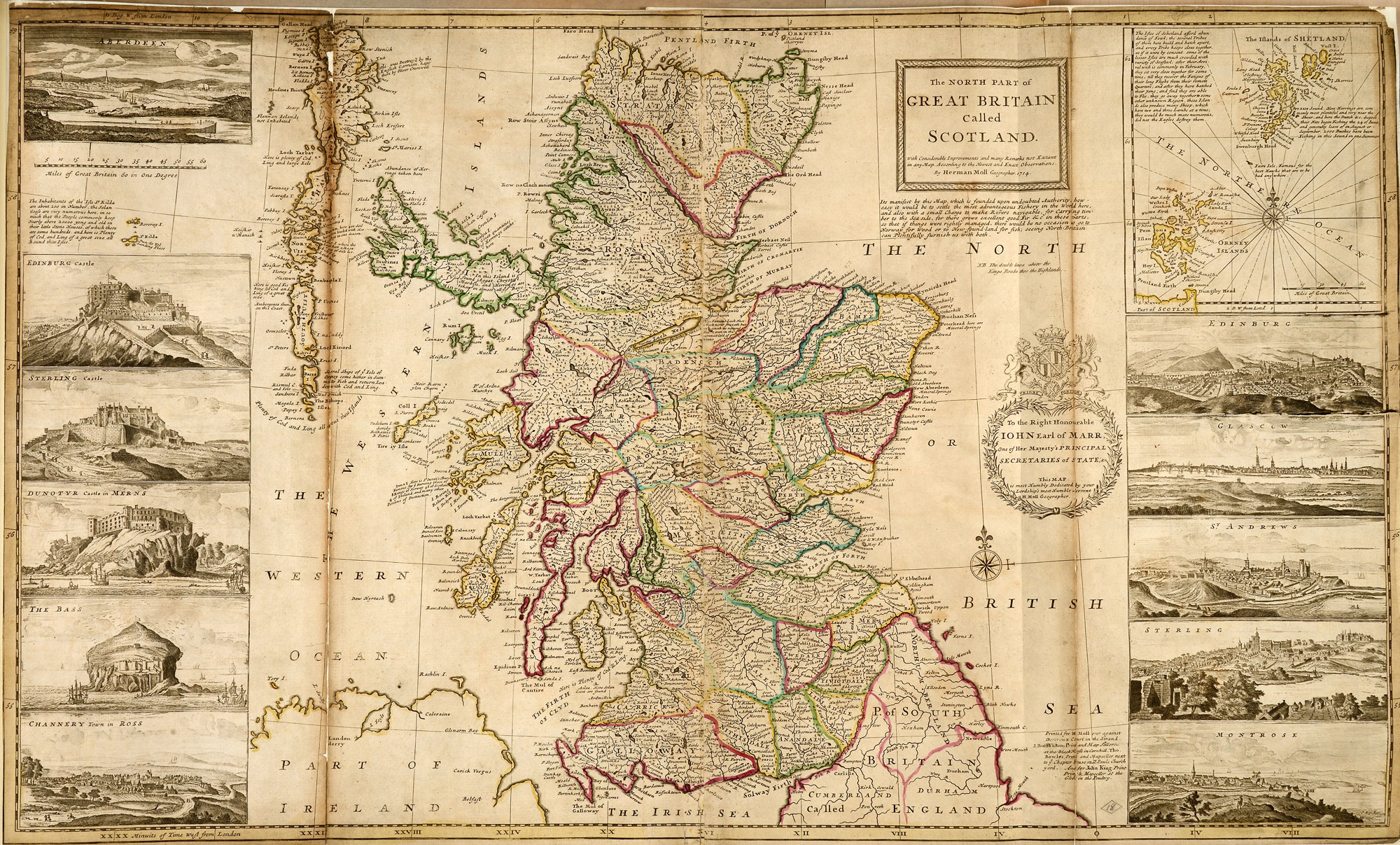
Map of Scotland by Herman Moll, geographer, 1714. The notes on the map suggest that Scotland has many natural resources. (WO 78/419/18).
Transcript
1. The inhabitants of the Isle St Kilda are about 200 in Number. the Solan Geese [large sea birds] are very numerous here, in so much that the People commonly keep yearly about 20000 young and old in their little Stone Houses, of which there are some hundreds and here is Plenty of Cod, and Ling [type of fish] of a great size, all Round these Isles.
2. The NORTH PART OF GREAT BRITAIN Called SCOTLAND. With Considerable Improvements and many Remarks not Extant in any Map. According to the Newest and Exact Observations. By Herman Moll Geographer. 1714.
3. The Isles of [Shetland] afford abundance [many] of Fowl [birds]: the several Tribes of them here build and hatch apart, and every Tribe keeps close together as it were by consent. Some of the lesser Isles are much crowded with variety of Seafowl [sea birds]; after their Arrival [which] is commonly in February, they sit very close together for some time, till they recover the Fatigue of their long Flight from their remote Quarters; and after they have hatched their young; and find they are able to Flie, they go away together to some other unknown Region, these Islands also produce many Sheep, which have two and three Lambs at a time; they would be much more numerous, did not the Eagles destroy them.
4. To the Right Honourable [JOHN] Earl of MARR, One of Her Majesty’s PRINCIPAL SECRETARIES of STATE. This MAP is most Humbly Dedicated by your Lordship’s most Humble [Servant] H. Moll Geographer.
5. Printed for H. Moll over against Deveroux Court in the Strand. J. Bowles is Son. Print and Map Sellers at the Black Horse in Cornhill. Tho. Bowles Print and Mapseller next to the Chapter house in St. Pauls Church yard. And for John King Print & Mapseller at the Globe in the Poultry.
6. Its manifest [shown] by this Map, which is founded upon undoubted Authority [accuracy], how-easy it would be to settle the most advantageous Fishery in the World here, and also with a small Charge to make Rivers navigable, for Carrying timber to the Sea side, for there grows excellent good Fir [pine trees] etc in these parts, so that if things were rightly managed, there would be no occasion to go to Norway for Wood or to New-found-land for fish; seeing North Britain can Plentifully furnish us with both.