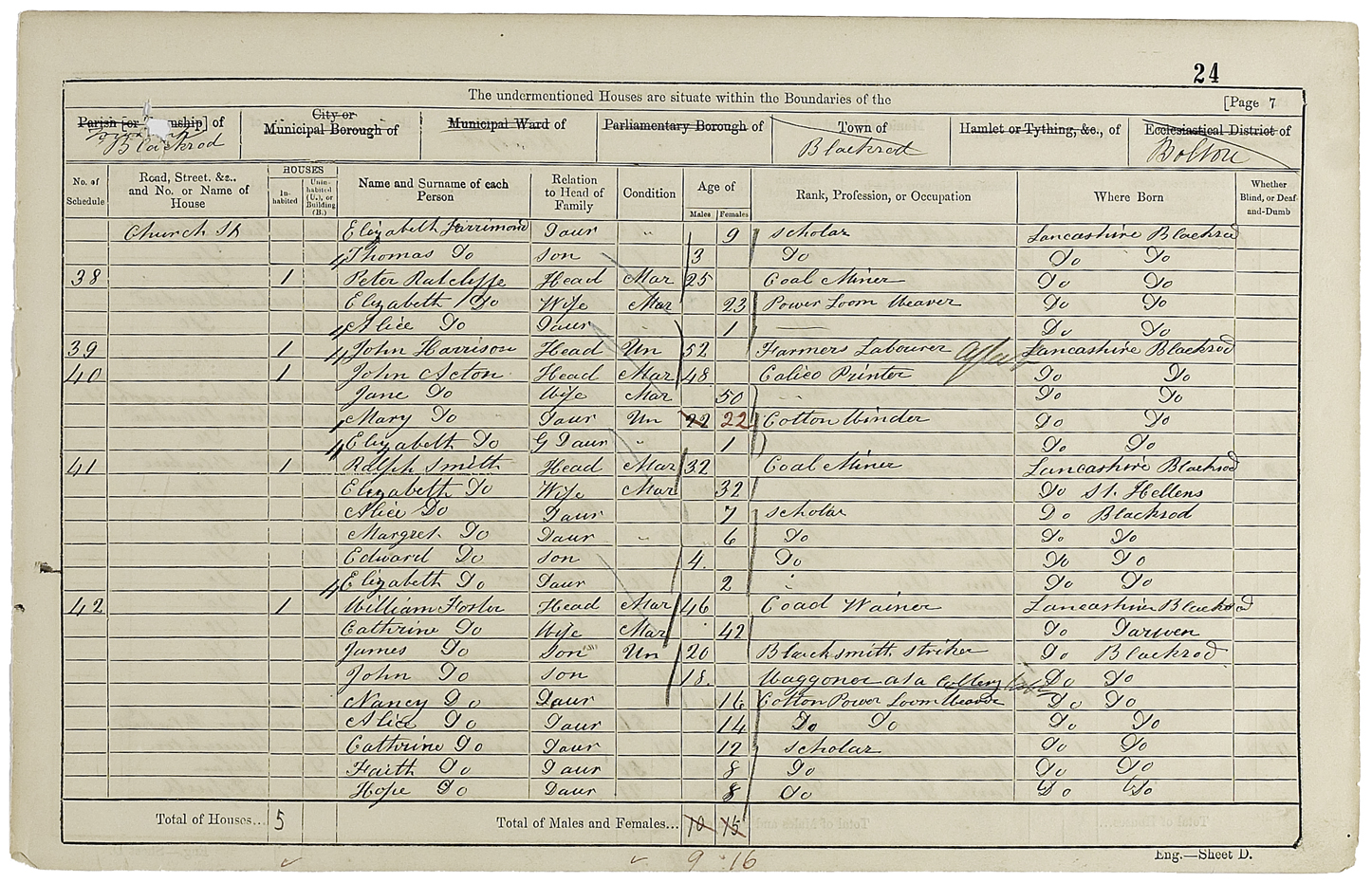
1861 Census return for Blackrod, Lancashire (RG 9/2769)
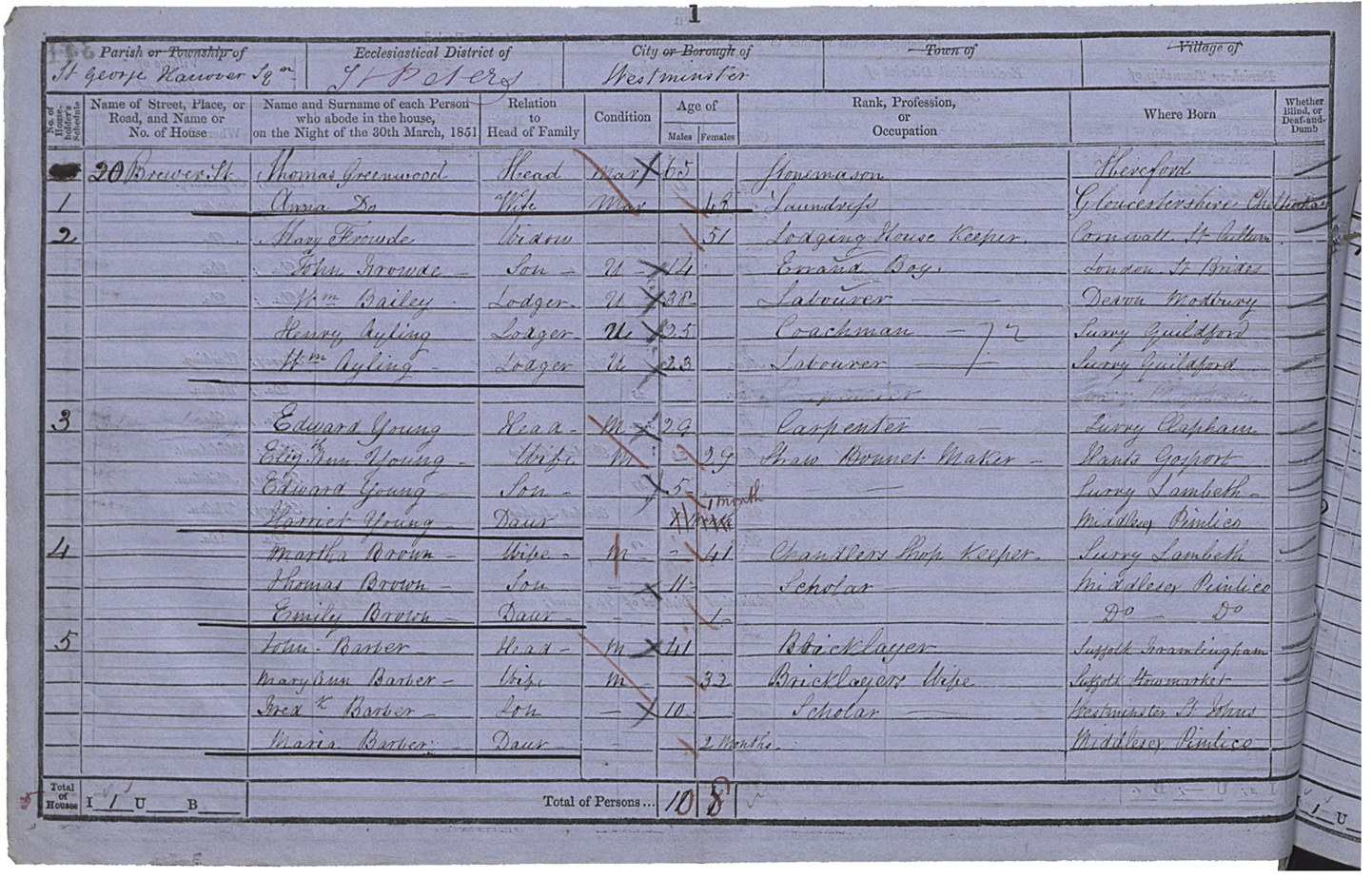
1851 Census return (HO 107/1478)
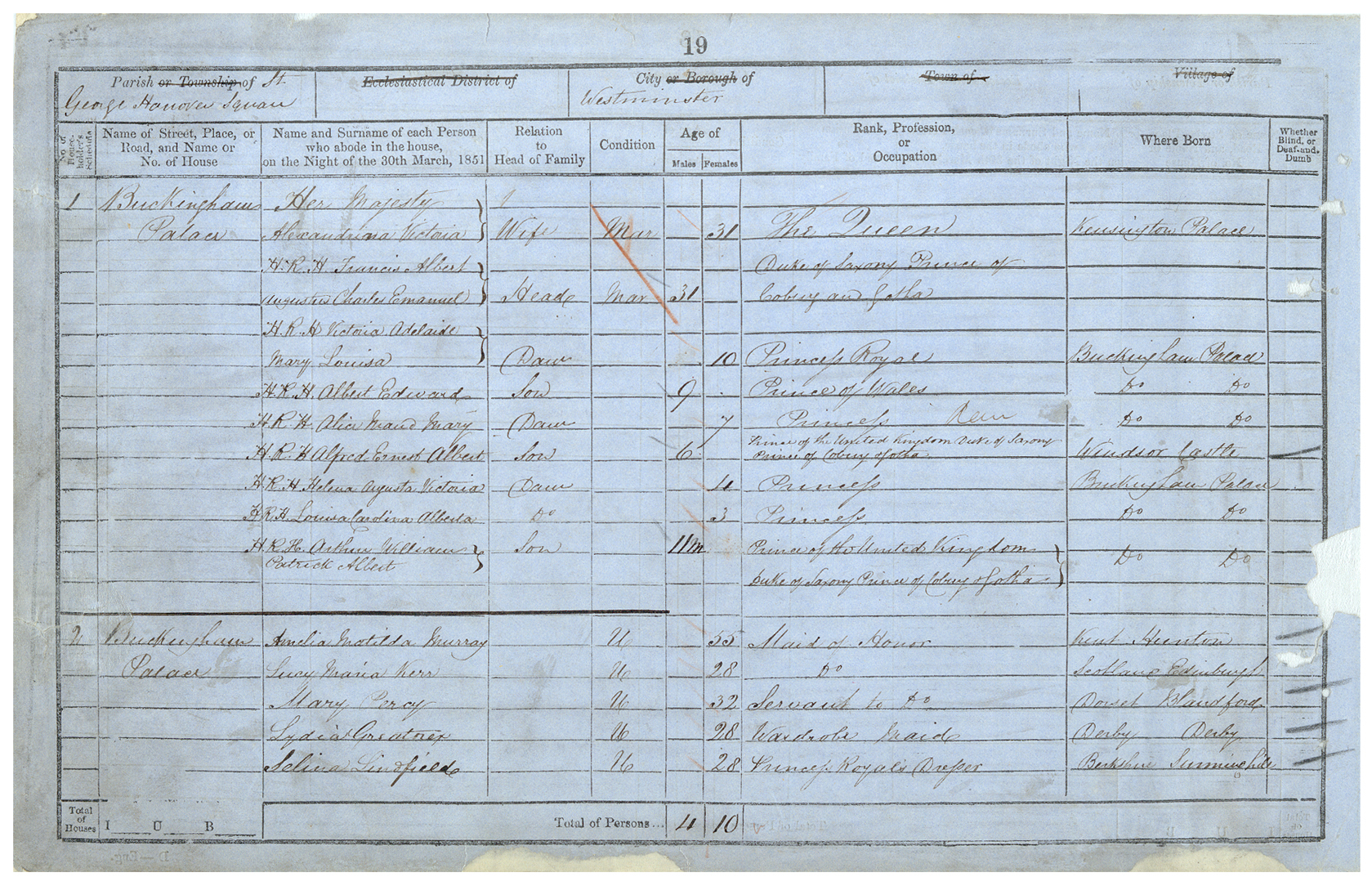
Entry from the 1851 census.
The census is a count of all the people in the United Kingdom on one particular day and is taken every ten years. However, collecting information about a country’s population is not a new idea. The Egyptians, for example, used census information to help them build the pyramids and to give out land following the annual flooding of the Nile. The Domesday Book of 1086 was an early attempt to collect information about who held land in England, but it also provided details about the size of the population.
The first government census in Britain was taken in 1801. It may have been prompted by a book called An Essay on the Principle of Population, written by Thomas Malthus in 1798. Malthus wrote that the population was growing so quickly that the country would soon not be able to feed itself. It would be important therefore for the government to find out how many people it did have to feed.
There has been a census every ten years since, apart from in 1941 due to our involvement in the Second World War. Between 1801 and 1831 the census contained only general information about numbers of people. The 1841 census was the first to list the names of every individual in a household.
After 1851 it recorded the age of each person, their relationship within the family (such as wife, son or daughter) occupation (job) and place of birth. As everybody in the country was asked the same questions we can also use it to compare different areas at the same time or over a period of time. Use this lesson to see what different census records from 1851, 1861 and 1911 reveal about the past.
What can you find out?The country [England, Wales, the Channel Islands and the Isle of Man – Scotland and Ireland were enumerated separately, and are not included amongst our records] was divided into a number of districts, each with its own enumerator (the person who collected the information). Each household was given a form to fill in. On the day after the census night, the enumerator collected these forms. If the form had not been filled in properly, or if the householder could not write, the enumerator filled it in. Prior to 1911, the information on the forms was then copied into an enumerator’s book, which was then sent to the Census Office in London. From 1911, the individual schedules for households and institutions were collected and returned to the Census Office, where the information was extracted directly from this. From 1921, this process increasingly used machines to assist in the compilation of the data.
At the Census Office, the information in the books was checked to ensure it had been filled in properly. Afterwards, clerks went through the books gathering information on age, jobs and birthplace. This information was recorded in tables for a final Census Report.
Yet, ever since census information has been collected, not everybody has been keen to give their details. Census enumerators sometimes found it difficult to collect their forms! Even as late as the 1950s, it was believed that some people were giving false information. However, the rate of compliance is very high.
To encourage people to provide accurate details, the government has promised that the information will be kept confidential. Since 1920, census records have been closed for 100 years. This means that the only census returns that can be seen at the moment are those up to 1911. The 1921 Census will be released in early 2022.
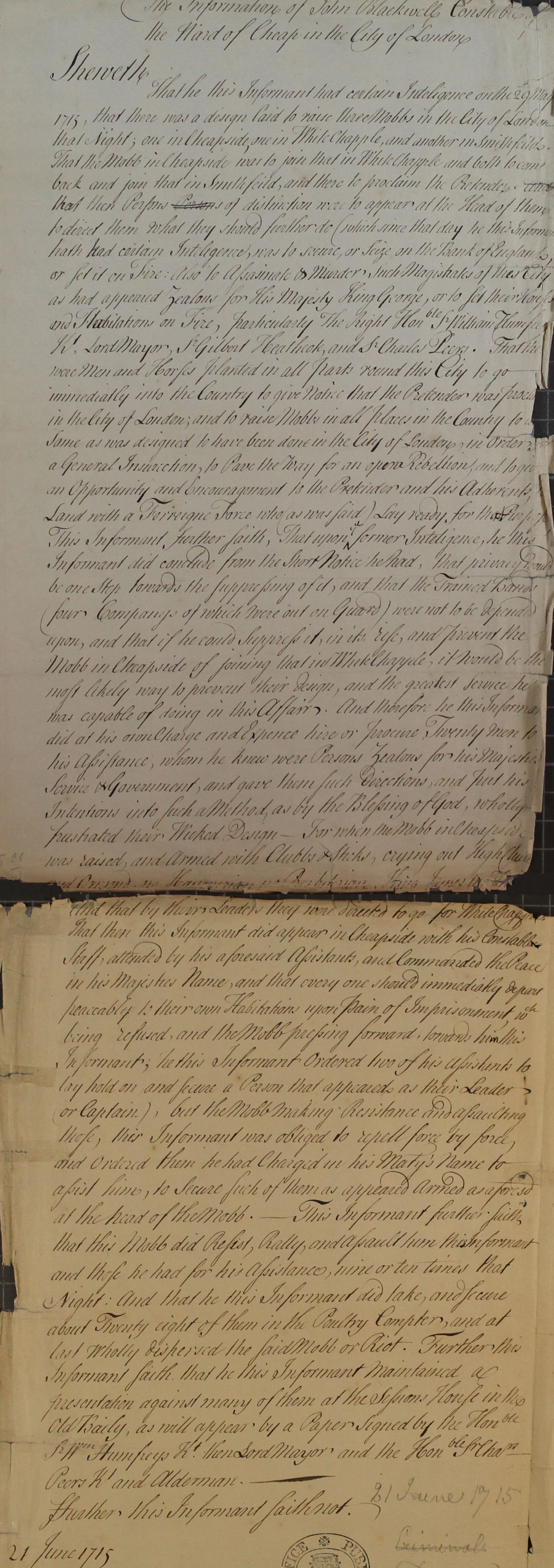
Report from John Blackwell, Constable of the Ward of Cheapside in London, to the authorities, 20 June 1715 (SP 41/5 f24).
This report describes how a London constable found out about a plan in May 1715 to put the ‘Old Pretender’, Charles Francis Edward on the throne. Key judges were to be murdered and the Bank of England seized. There were also plans to spread the disruption outside the city. The report says that Constable John Blackwell used his own money to pay for additional men to stop the London mobs from joining together and the spread of the riot.
Transcript
The Information of John Blackwell Constable of the Ward of Cheapside in the City of
London
Sheweth
That he this Informant had certain Inteligence on the 29th May 1715, that there was a design laid to raise three Mobbs in the City of London that Night; one in Cheapside, one in White Chapple, and another in Smithfields. That the Mobb in Cheapside was to join that in White Chapple and both to come back and join that in Smithfield, and there to proclaim the Pretender and that there Persons of distinction were to appear at the Head of them to direct them what they should further do (which since that day be this Informant hath had certain Inteligence, was to secure, or sieze on the Bank of England or set it on Fire: Also to Assassinate & Murder such Magistrates of this City as had appeared Zealous for his Majesty King George, or to set their Houses and Habitations on Fire, particularly The Right Honorable Sir William Humfrey K, Lord Mayor, Sir Gilbert Heathcote and Sir Charles Peers. That [there] were Men and Horses planted in all parts round this City to go immediately into the Country to give Notice that the Pretender was [proclaimed] in the City of London; and to raise Mobbs in all places in the Country to [?] Same as was designed to have been done in the City of London in Order a General Insurection, to pave the way for an open Rebellion, and to give an opportunity and Encouragement to the Pretender and his Adherents, [to] land with a Foreigne Force who was said) Lay ready, for that Purpose. This Informant, further saith, That upon [that] former Inteligence, be this Informant did conclude from the Short Notice he had, that privacy would be one step towards the suppressing of it, and that the Trained Bands (four Companys of which were out on Guard) were not to be depended upon, and that if he could suppress it, in its rise, and prevent the Mobb in Cheapside of joining that in White chapple, it would be the most likely way to prevent their designs, and the greatest Service he was capable of doing in this Affair. And therefore be this Informant did at his own charge and expense hire or procure Twenty men to his assistance, whom he knew were Person Zealous for his Majesties Service & Government, and gave them such Directions, and put his Intentions into such a Method, as by the Blessing of God, wholly frustrated their Wicked Design- For when the Mobb in Cheapside was raised and armed with Clubbs and Sticks, crying out High Chase
[document damaged]… And that by their Leaders they were directed to go for White Chapple. That then this Informant did appear in Cheapside with his Constable Staff, attended by his foresaid Assistants, and Commanded the Peace in His Majesties Name, and that everyone should immediately depart peaceably to their own Habitations upon Pain of Imprisonment which being refused, and the Mobb pressing forward, towards him this Informant, he this Informant Ordered two of his assistants to lay hold on and secure a Person that appeared as their Leader (or Captain), but the Mobb making Resistance and assaulting those, this Informant was obliged in his Majesty’s Name to assist him, to secure such of them as appeared armed as a force at the head of the Mobb.
This Informant further saith that this Mobb did Resist, Rally, and Assault him this informant and those he had for his Assistance, nine or ten times that Night: And that he this Informant did take, and Secure about Twenty eight of them in the Poultry Compter, [district] and at last Wholly dispersed the said Mobb or Riot. Further this Informant saith, that he this Informant maintained a presentation against many of them at the Sessions House in the Old Bailey, as will appear by a paper signed by the Honorable Sir William Humpreys Kt then Lord Mayor and the Honourable Sir Charles Peers Kt [Knight] and Alderman.
Further, this Informant saith not.
21 June 1715.
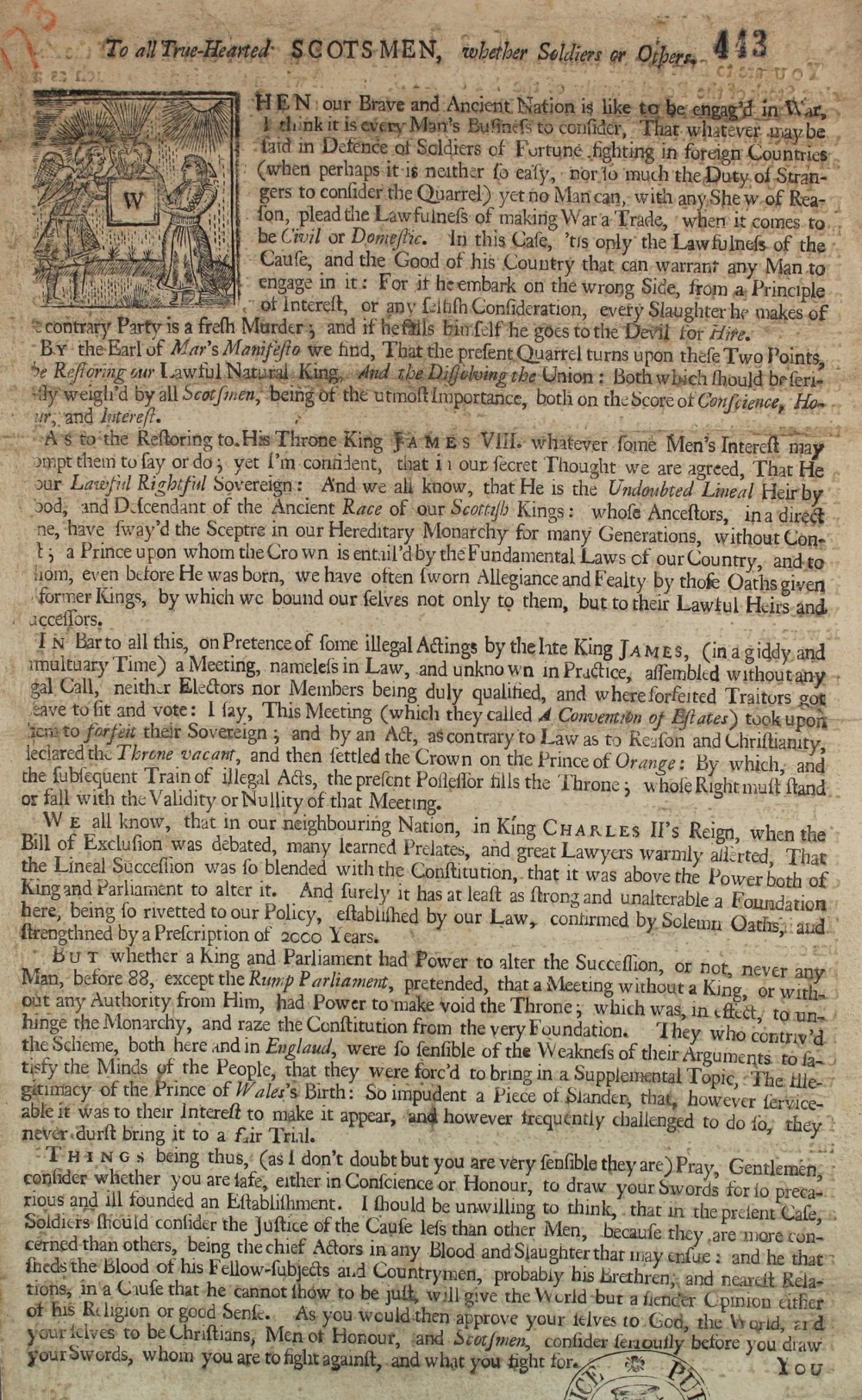
A handbill addressed ‘to all true-hearted Scotsmen’ to restore James Francis Edward, James VIII, to the throne of England, 1 January 1715. The leaflet says that rebellion is justified because James VIII is the true heir to the throne and men need to consider the justice of taking up arms very carefully. (SP 54/10/173).
Transcript
To all True-Hearted SCOTSMEN, whether Soldiers or Others.
When our Brave and Ancient Nation is like to be engag’d in War, I think it is every Man’s Business to consider, That whatever may be said in Defence of Soldiers of Fortune fighting in foreign Countries (when perhaps it is neither so easy, nor so much the Duty of Strangers to consider the Quarrel) yet no Man can, with any Shew of Reason, plead the Lawfulness of making War a Trade, when it comes to be Civil or Domestic. In this Case, ‘tis only the Lawfulness of the Cause, and the Good of his Country that can warrant any Man to engage in it: For if he embark on the wrong Side, from a Principle of Interest, or any selfish Consideration, every Slaughter he makes of a contrary Party is a fresh Murder; and if he falls himself he goes to the Devil for Hire.
By the Earl of Mar’s Manifesto we find, That the present Quarrel turns upon these Two Points, be Restoring our Lawful Natural King. And the Dissolving the Union: Both which should be [seriously] weigh’d by all Scotsmen, being of the utmost Importance, both on the Score of Conscience, Hour, and Interest.
As to the Restoring to His Throne King JAMES VIII. Whatever some Men’s Interest may [prompt] them to say or do; yet I’m confident, that in our secret Thought we are agreed, That He our Lawful Rightful Sovereign: And we all know, that He is the Undoubted Lineal Heir by [blood] and Descendant of the Ancient Race of our Scottish Kings: whose Ancestors, in a direct [line], have sway’d the Sceptre in our Hereditary Monarchy for many Generations, without Cont.; a Prince upon whom the Crown is entail’d [tied] by the Fundamental Laws of our Country, and to whom, even before He was born, we have often sworn Allegiance and Fealty by those Oaths given former Kings, by which we bound our selves not only to them, but to their Lawful Heirs and accessors.
IN Bar to all this, on Pretence of some illegal Actings by the late King JAMES, (in a giddy and tumultuary [lawless] Time) a Meeting, nameless in Law, and unknown in Practice, assembled without any [legal] Call, neither Electors nor Members being duly qualified, and where forfeited Traitors got [leave] to sit and vote: I say, This Meeting (which they called A Convention of Estates) took upon [them] to forfeit [give up] their Sovereign; and by an Act, as contrary to Law as to Reason and Christianity, [declared] the Throne vacant, and then settled the Crown on the Prince of Orange [William of Orange]: By which, and the subsequent Train of illegal Acts, the present Possessor fills the Throne; whose Right must stand or fall with the Validity or Nullity [lack of legal right] of that Meeting.
WE all know, that in our neighbouring Nation [England], in King CHARLES II’s Reign, when the Bill of Exclusion [plan to exclude Charles II’s brother, James, Duke of York from the throne, as he was a Catholic] was debated, many learned Prelates [churchmen], and great Lawyers warmly asserted [declared], That the Lineal Succession was so blended with the Constitution, that it was above the Power both of King and Parliament to alter it. And surely it has at least as strong and unalterable a Foundation here, being so riveted [bound] to our Policy, established by our Law, confirmed by Solemn Oaths, and strengthened by a Prescription [history] of 2000 years.
BUT whether a King and Parliament had Power to alter the Succession, or not, never any Man, before [1688], except the Rump Parliament, pretended, that a Meeting without a King, or without any Authority from Him, had Power to make void the Throne [decide who would be king]; which was, in effect, to unhinge the Monarchy, and raze [bring down] the Constitution [rules of the country] from the very Foundation [core]. They who contriv’d [thought up] the Scheme, both here and in England, were so sensible of the Weakness of their Arguments to satisfy the Minds of the People, that they were forc’d to bring in a Supplemental Topic [an extra argument], The illegitimacy of the Prince of Wales’s Birth [suggestion here that that Charles Francis Edward was not the true son of James II-hence call him the “Old Pretender”] So impudent [outrageous] a Piece of Slander, that, however serviceable it was to their Interest to make it appear, and however frequently challenged to do so, they never durst bring it to a fair Trial.
THINGS being thus, (as I don’t doubt but you are very sensible they are) Pray, Gentlemen, consider whether you are safe, either in Conscience or Honour, to draw your Swords for so precarious and ill founded an Establishment. I should be unwilling to think, that in the present Case, Soldiers should consider the Justice of the Cause less than other Men, because they are more concerned than others, being the chief Actors in any Blood and Slaughter that may ensue: and he that sheds the Blood of his Fellow-subjects and Countrymen, probably his Brethren [brothers], and nearest Relations, in a Cause that he cannot show to be just, will give the World but a slender Opinion either of his Religion or good Sense. As you would then approve your selves to God, the World, and your selves to be Christians, Men of Honour, and Scotsmen, consider seriously before you draw your Swords [take up arms], whom you are to fight against, and what you fight for.
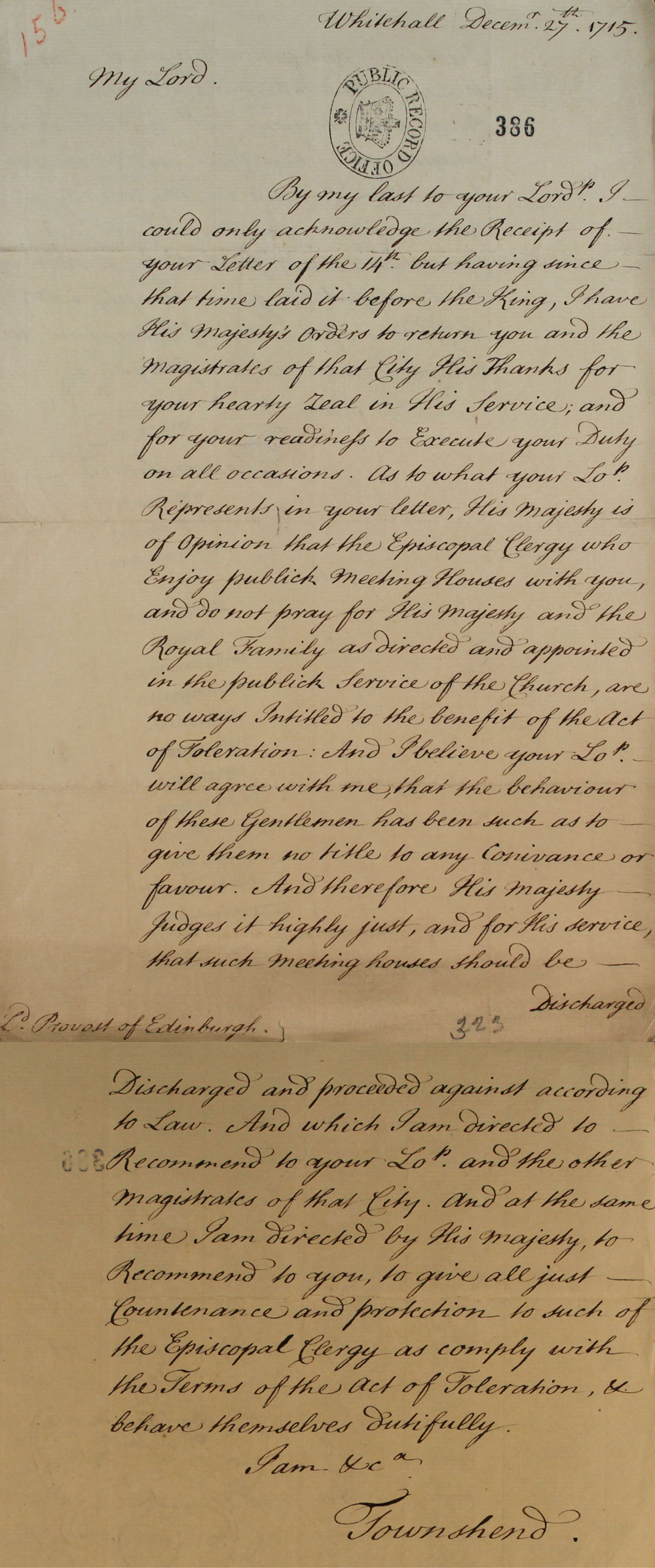
A letter from Secretary Townshend to the Provost of Edinburgh [the chief magistrate] reminding him that legal action will be taken against churchmen who do not pray for the royal family in their services and they will not be to able practice their faith freely as provided by the Toleration Act*, (SP 54/10/156).
Transcript
Whitehall December 27th 1715
My Lord,
By my last to your Lordship I could only acknowledge the Receipt of your letter of the 14th but having since that time laid it before the king, I have His Majesty’s Orders to return you and the Magistrates of that City His thanks for your hearty zeal [enthusiasm] in His Service; and for your readiness to Execute [carry out] your Duty on all occasions. As to what your Lordship Represents [describes] in your letter, His Majesty is of Opinion that the Episcopal clergy [church government by bishops] who Enjoy publick [public] meeting Houses with you, and do not pray for His Majesty and the Royal Family as directed and appointed in the publick Service of the Church, are no ways Intitled [entitled] to the benefit of the Act of Toleration: And I believe your Lordship will agree with me, that the behaviour of these Gentlemen has been such as to give them no title to any Conivance [consent to wrong doing] or favour. And therefore His Majesty judges it highly just, and for His service, that such meeting houses should be Discharged and proceeded against according to Law. And which I am directed to Recommend to your Lordship and the other magistrates of that City, And at the same time I am directed by His Majesty, to Recommend to you, to give all just countenance and protection to such of the Episcopal clergy as comply with the Terms of the Act of Toleration & behave themselves dutifully,
I am Etc.
Townshend
Notes
*The Toleration Act of 1689 made by the Parliament of England gave all non-conformists, except Roman Catholics, freedom of worship, thus rewarding Protestant dissenters for their refusal to side with James II. They had to promise to be loyal to the British ruler and their heirs.
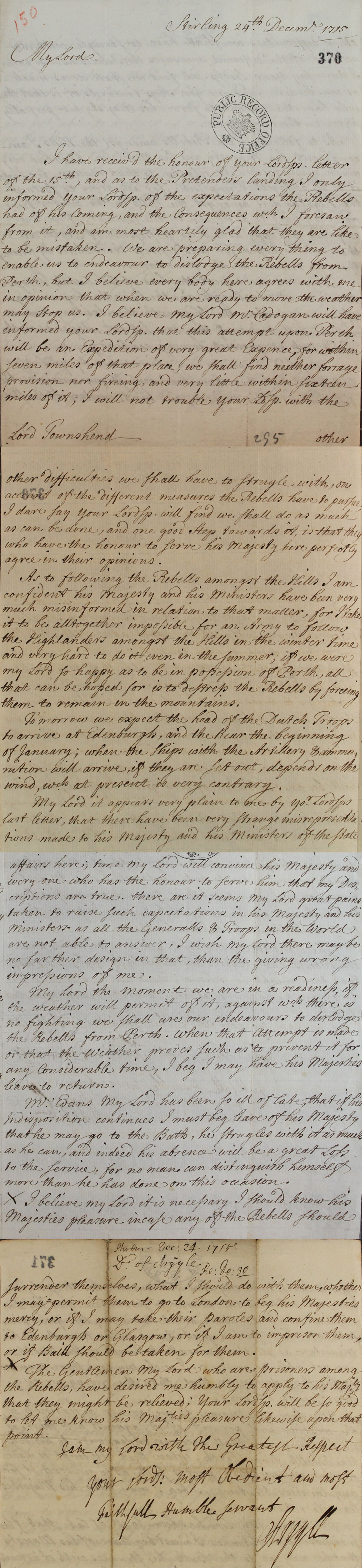
Letter from Lord Argyll to Secretary Townshend. Argyll describes the problems faced fighting in this area and wants to know what action he should take if any rebels surrender. (SP 54/10 f.150)
Transcript
Stirling 24th December 1715
My Lord,
I have received the honour or Lordship’s letter of the 15th, and as to the Pretenders [Charles Francis Edward Stuart] landing I only informed your Lordship of the expectations the Rebells had of his coming, and the consequences which I foresaw from it, and am most heartily glad that they are like to be mistaken. We are preparing everything to enable us to endeavour [aim] to dislodge [remove] the Rebells from Perth, but I believe everybody here agrees with me in opinion that when we are ready to move the weather may stop us. I believe my Lord Mr. Cadogan will have informed your Lordship that this attempt upon Perth will be an expedition of very great Expence, for within seven miles of that place, we shall find neither forrage provision [food found by fishing, hunting or crops to gather] nor fireing [wood for fuel]
And very little within sixteen miles of it, I will not trouble your Lordship with the other difficulties we shall have to struggle with, on account of the different measures the Rebells have to pursue. I dare say your Lordship will find we shall do so as much as can be done, and one good step towards it is that they who have the honour to serve his Majesty here perfectly agree in their opinions.
As to following the Rebells amongst the Hills I am confident his Majesty and his Ministers have been very much misinformed in relation to that matter, for I take it to be altogether impossible for an Army to follow the Highlanders amongst the Hills in winter time and very hard to do it even in the Summer, if we were my Lord so happy as to be in possession of Perth, all that can be hoped for is to destress [disturb] the Rebells by forcing them to remain in the mountains.
Tomorrow we expect the head of the Dutch Troops to arrive at Edinburgh, and the Rear [rest of the troops] the beginning of January; when the ships with the Artillery & ammunition will arrive, if they are set out, depends on the wind, which at present is very contrary [unfavourable].
My Lord it appears very plain to me by your Lordship’s last letter, that there have been very strange misrepresentations [false picture] made to his Majesty and his Ministers of the state of affairs here; time my Lord will convince his Majesty and everyone who has the honour to serve him that my Descriptions are true. There are it seems My Lord great pains taken to raise such expectations in his Majesty and his Ministers as all the Generalls & Troops in the World are not able to answer, I wish my Lord there may be no further design in that, than the giving wrong impressions of me.
My Lord the moment we are in a readiness, if the weather will permit of it, against which there is no fighting we shall use our endeavours [efforts] to dislodge the Rebells from Perth. When that attempt is made or that the Weather proves such as to prevent it for any considerable time, I beg I may have his Majesties leave to return.
Mr. Evans My Lord has been so ill of late, that if his indisposition [ill health] continues I must beg leave of his Majesty that he may go to the Bath, he struggles with it as much as he can, and indeed his absence will be a great loss to the service, for no man can distinguish himself more than he has on this occasion.
X I believe my Lord it is necessary I should know his Majesties pleasure incase any of the Rebells should surrender themselves, what I should do with them, whether I may permit them to go to London to beg his Majesties mercy, or if I may take their paroles [word of honour] and confine them to Edinburgh or Glasgow, or if I am to imprison them, or if Baill should be taken for them.
X The Gentlemen My Lord who are prisoners among the Rebells, have desired me humbly to apply to his Majesty that they might be relieved [released]; Your Lordship will be so good to let me know his Majesties pleasure likewise upon that point.
I am my Lord with the Greatest Respect
Your Lordship’s most obedient and most faithfull Humble Servant,
Argyll
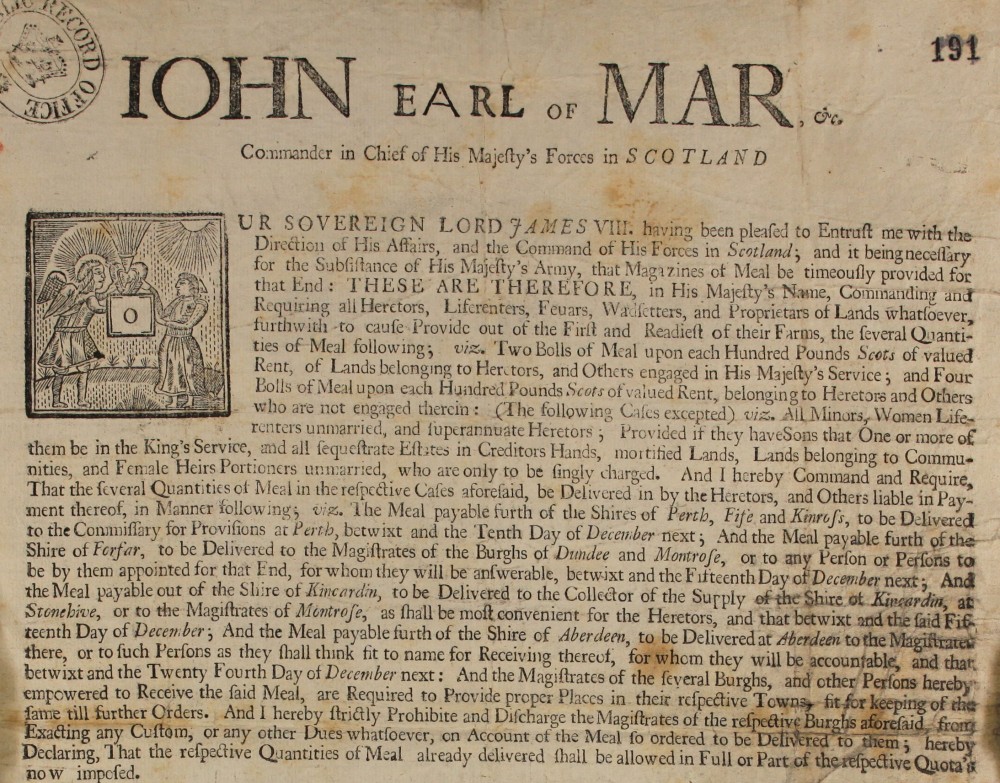
Extract from a handbill from Jacobite commander, the Earl of Mar, asking landowners and tenants to provide grain for the army, 24 November 1715 (SP 54/10/78).
Transcript
[JOHN] EARL OF MAR, &c.
Commander in Chief of His Majesty’s Forces in SCOTLAND
OUR SOVEREIGN LORD JAMES VIII. Having been pleased to Entrust me with the Direction of His Affairs, and the Command of His Forces in Scotland; and it being necessary for the Subsistance [basic needs] of His Majesty’s Army, the Magazines of Meal* be timeously provided for that End: THESE ARE THEREFORE, IN His Majesty’s Name, Commanding and Requiring all Heretors*, Liferenters*, Feuars*, Wadsetters*, and Proprietars [owners] of Lands whatsoever, forthwith to cause Provide out of the First and Readiest of their Farms, the several Quantities of Meal following; viz. Two Bolls of Meal upon each Hundred Pounds Scots of valued Rent, of Lands belonging to Heretors, and Others engaged in His Majesty’s Service; and Four Bolls of Meal upon each Hundred Pounds Scots of valued Rent, belonging to Heretors and Others who are not engaged therein: (The following Cases excepted) viz. All Minors, Women Liferenters unmarried and superannuate Heretors; Provided if they have Sons that One or more of them be in the King’s Service, and all sequestrate Estates in Creditors Hands, mortified Lands, Lands belonging to Communities, and Female Heirs Portioners unmarried, who are only to be singly charged. And I hereby Command and Require, That the several Quantities of Meal in the respective Cases aforesaid, be Delivered in by the Heretors, and Others liable in Payment thereof, in Manner following; viz. The Meal payable forth of the Shires of Perth, Fife and Kinross, to be Delivered to the Commissary for Provisions at Perth, betwixt and the Tenth Day of December next; And the Meal payable furth of the Shire of Forfar, to be Delivered to the Magistrates of the Burghs of Dundee and Montrose, or to any Person or Persons to be by them appointed for that End, for whom they will be answerable, betwixt and the Fifteenth Day of December next; And the Meal payable out of the Shire of Kincardin, to be Delivered to the Collector of the Supply of the Shire of Kincardin, at Stonehive, or to the Magistrates of Montrose, as shall be most convenient for the Heretors, and that betwixt and the said Fifteenth Day of December; And the Meal payable furth of the Shire of Aberdeen, to be Delivered at Aberdeen, to be Delivered at Aberdeen to the Magistrates there, or to such Persons as they think shall think fit to name for Receiving thereof, for whom they will be accountable, and that betwixt [between] and the Twenty Fourth Day of December next: And the Magistrates of the several Burghs, and other Persons hereby empowered to Receive the said Meal, are Required to Provide proper Places in their respective [each] Towns, fit for keeping of the same till further Orders. And I hereby strictly Prohibite [forbide] and Discharge [order] the Magistrates of the respective Burghs aforesaid [mentioned], from Exacting [taking] any Custom [tax], or any other Dues [money] whatsoever, on Account of the Meal so ordered to be Delivered to them; hereby Declaring That the respective Quantities of Meal already delivered shall be allowed in Full or Part of the respective Quota’s now imposed.
Glossary:
Magazines of Meal: storerooms for grain
Heretors: Scottish landed gentry
Liferenters: Permanent tenant farmers
Feuars: The owner of a plot of land or property [in Scotland]
Wadsetters: A person who holds land by a mortgage
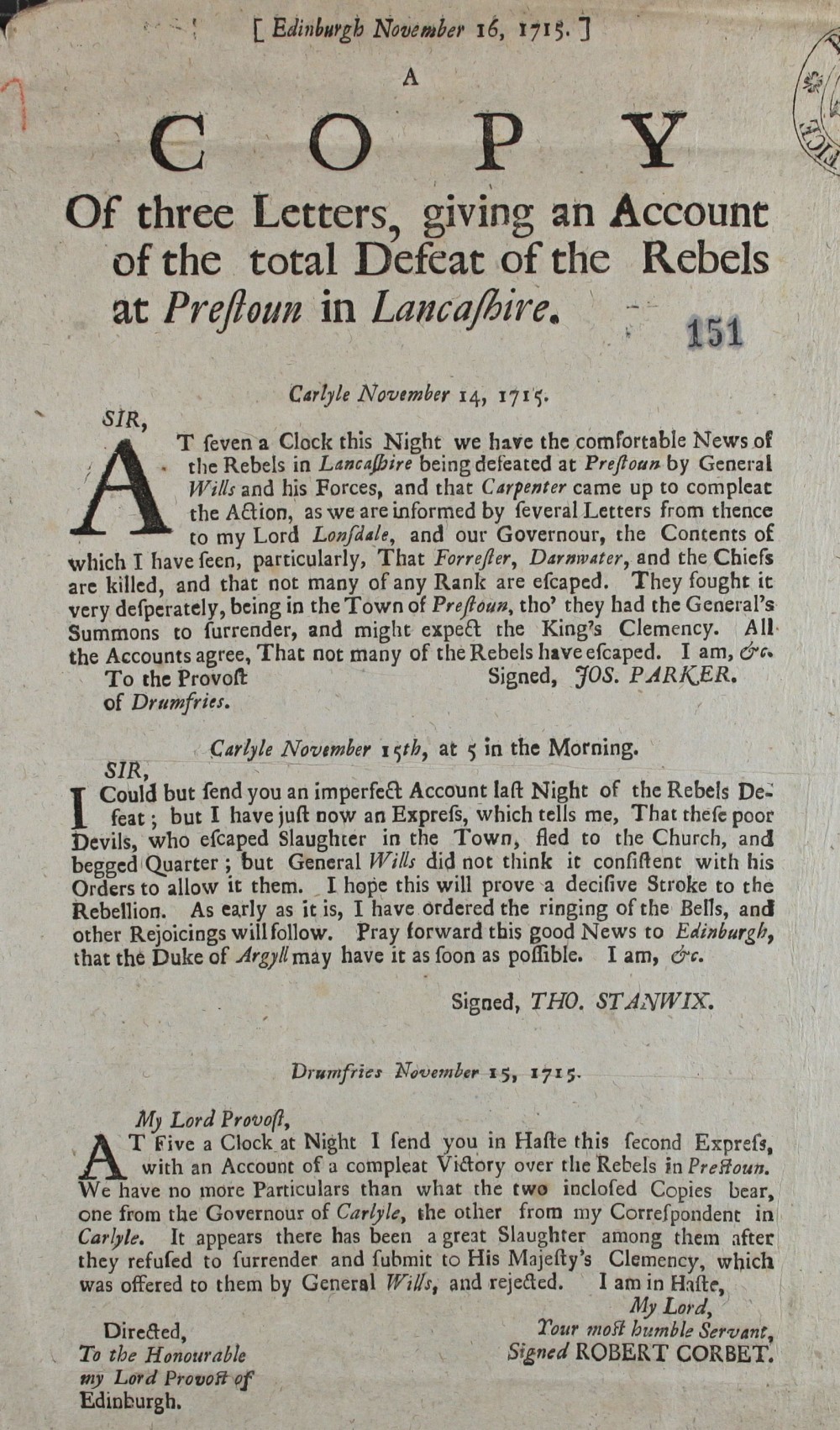
A pamphlet giving three accounts of the defeat of the Jacobites in Preston, Lancashire. The Jacobites had marched into England hoping for support from Catholics in Lancashire, but their forces were surrounded at Preston which ended the rising in England. Over 150 rebels were taken prisoner. (SP 54/10/57).
Transcript
[Edinburgh November 16, 1715.]
A
COPY
Of three Letters, giving an Account of the total Defeat of the Rebels at Prestoun in Lancashire.
Carlyle November 14, 1715.
SIR,
AT seven a Clock this Night we have the comfortable News of the Rebels in Lancashire being defeated at Prestoun [Preston] by General Wills and his Forces, and that Carpenter [General Carpenter] came up to compleat the Action, as we are informed by several Letters from thence to my Lord Lonsdale, and our Governour, the Contents of which I have seen, particularly, That Forrester [Forster], Darnwater [Derwentwater], and the Chiefs are killed, and that not many of any Rank are escaped. They fought it very desperately, being in the Town of Prestoun, tho’ they had the General’s Summons to surrender, and might expect the King’s Clemency [mercy]. All the Accounts agree,That not many of the Rebels have escaped. I am, &c.
To the Provost
of Dumfries. Signed, [Joseph] PARKER.
Carlyle November 15th, at 5 in the Morning.
SIR,
I could but send you an imperfect Account last Night of the Rebels Defeat; but I have just now an Express, which tells me, That these poor Devils, who escaped Slaughter in the Town, fled to the Church, and begged Quarter [lodgings]; but General Wills did not think it consistent with his Orders to allow it them. I hope this will prove a decisive Stroke to the Rebellion. As early as it is, I have ordered the ringing of the Bells, and other Rejoicings will follow. Pray forward this good News to Edinburgh, that the Duke of Argyll may have it as soon as possible. I am, &c.
Signed, [Thomas] STANWIX.
Drumfries November 15, 1715.
My Lord Provost,
AT Five a Clock at Night I send you in Haste this second Express, with an Account of a compleat Victory over the Rebels in Prestoun. We have no more Particulars [details] than what the two inclosed Copies bear, one from the Governour of Carlyle, the other from my Correspondent in Carlyle. It appears there has been a great Slaughter [bloodshed] among them after they refused to surrender and submit to His Majesty’s Clemency, which was offered to them by General Wills, and rejected. I am in Haste,
My Lord, Your most humble Servant,
Signed ROBERT CORBET.
Directed, To the Honourable
My Lord Provost of Edinburgh.