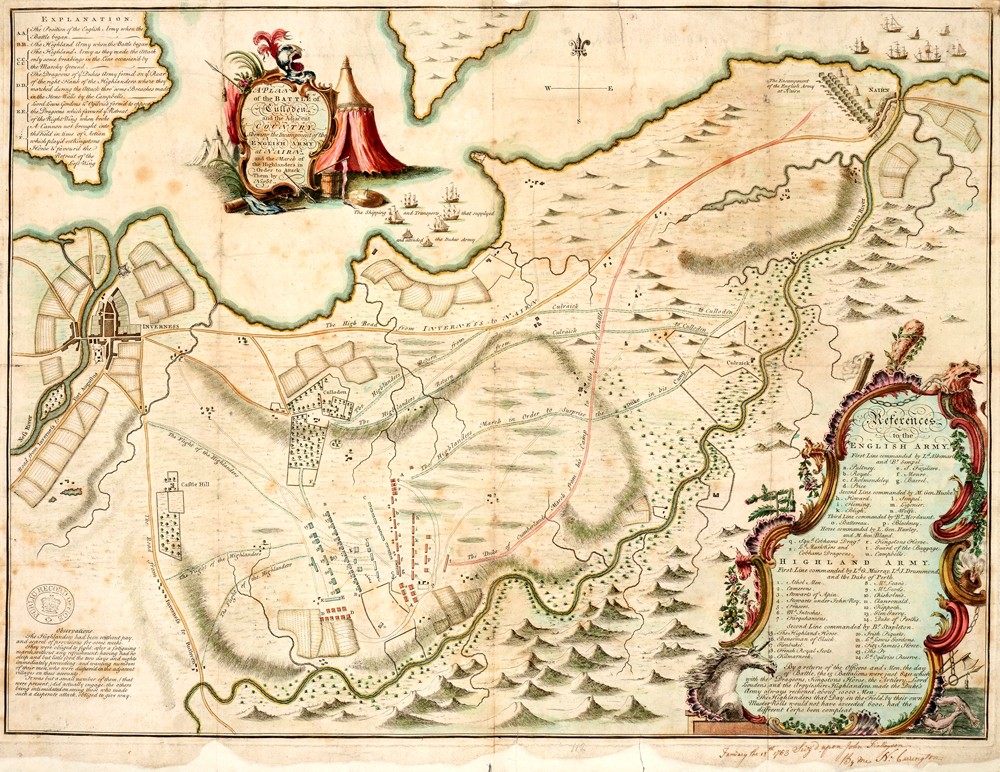
 A serious threat to the Hanoverians?
By Professor Daniel Szechi
Unlike the rebellion of 1715, the ‘45 came out of nowhere. As far as the Whigs, who had ruled Britain as a one-party state since 1714 were concerned, the Jacobite threat was over. But with the rejection of the Tories in England, the continuing persecution of Catholics in Ireland and the on-going sense of betrayal with respect to the Union among a sizeable minority in Scotland, the Jacobite movement remained alive in all three kingdoms.
The Jacobite King James III’s energetic and handsome son, Charles Edward Stuart, (Bonnie Prince Charlie) had also come to represent a bright new hope for many Jacobites. Then in 1739, for the first time in twenty years, Britain became involved in a major European war. Both France and Spain’s interest in supporting a Jacobite revolution was revived, and in 1743-4 the French government secretly allied with King James and the English Tories and planned to launch an invasion of England led by Charles Edward. At the last minute, hesitation on the part of the Tories, bad weather and the action of the Royal Navy prevented the invasion. The relieved British government soon released the Tory leaders swept up in a wave of arrests when news of the French plan broke, and the troops brought over to fight any invasion went back to the war in Flanders. As the months passed and the Jacobites kept their heads down, government control relaxed and life carried on. Meanwhile in France the Jacobite prince was quietly preparing his own daring venture.
Depending on how you view it, Charles Edward’s plan was either foolhardy or brilliant. By 1745 many French merchant companies were involved in financing privateering ventures to attack British shipping. With the help of Irish merchants in Nantes in France, Charles Edward was thus able to prepare a small secret expedition to Scotland without alerting either the British or French governments. On 5 July 1745 his two ships (Du Teillay and Elisabeth), laden with money, arms and Irish troops in French service set sail for Scotland. They were stopped by a patrolling Royal Navy warship and fought a hard action that so damaged the Elisabeth that she had to return to France, but — nothing daunted — Charles Edward sailed on to Scotland and on 23 July landed on Eriskay.
He managed to gain support in Scotland by skilfully presenting the Scots Jacobites with a problem: they could rise to follow him and possibly have to take on the military might of the British government, or they could betray their principles and abandon him to possible capture and death. The first response of many Scots Jacobites was to refuse to act without major French support, but Charles tilted the balance in favour of going it alone to begin with by promising them that he had assurances the French would invade and the English Jacobites would rise if he raised Scotland and invaded England with a Jacobite army. Most Scots Jacobites were persuaded to follow him on this basis, and so began the ’45.
Professor Daniel Szechi is the author of The Jacobites: Britain and Europe 1688-1788.
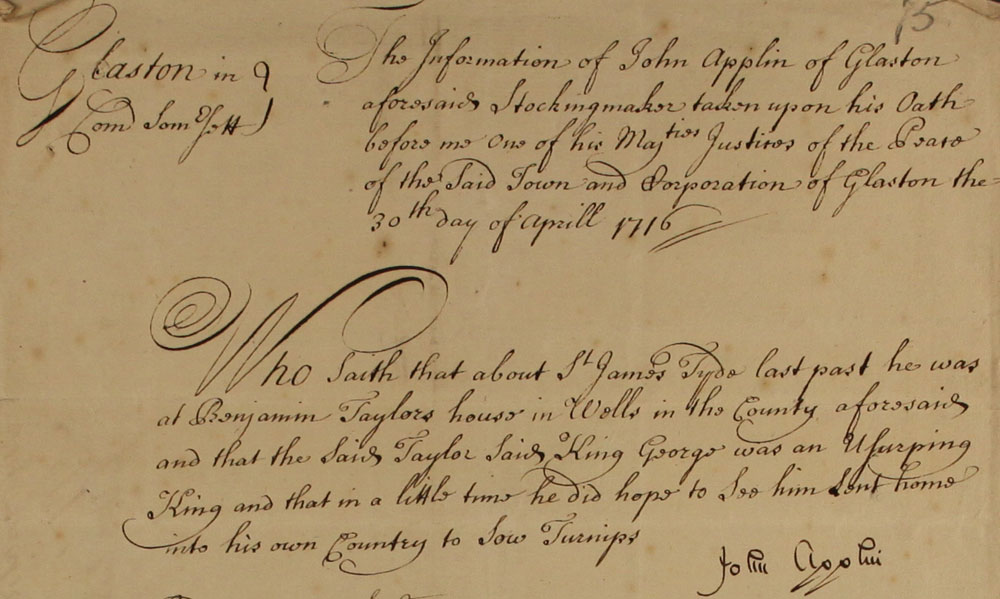
A court case about a man who said that George I was not the lawful king and should be sent home [to Hanover]. 26 July 1716 (SP 41/5 f.44).
Transcript
The Information of John Applin of [Glastonbury] aforesaid Stockingmaker taken upon his Oath before me [John Roode] one of his Majesties Justices of the Peace of the Said Town and Corporation of [Glastonbury] the 30th day of Aprill 1716 [Glastonbury] [County of Somerset] Who saith [said] that about St James Tyde [25th July, 1666 was St James’s Day to mark a sea battle in the second Anglo-Dutch War] last past he was at Benjamin Taylors house in Wells in the County aforesaid [mentioned before] and that the Said Taylor said ‘King George was a Usurping [unlawful] King and that in a little time he did hope to see him sent home into his own country to sow turnips.
John Applin
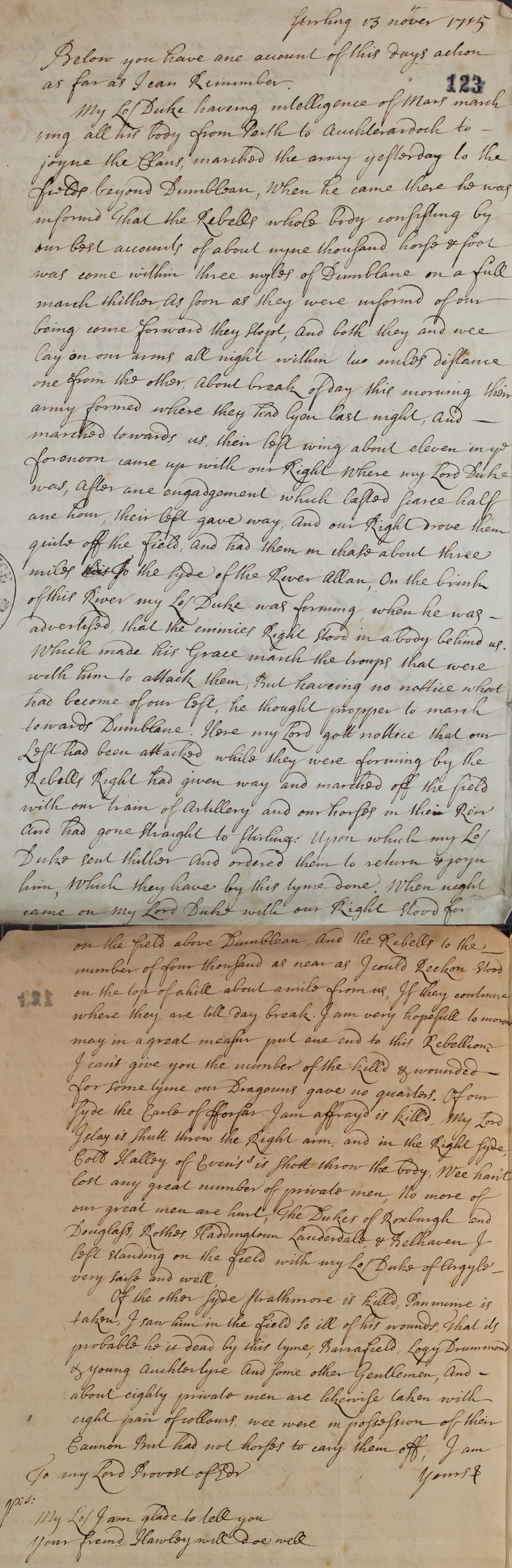
This description of the battle of Sheriffmuir suggests that the English government will be able to end the rebellion. (SP 54/10 f.47).
Transcript
Stirling 13th November 1715
Below you have an account of this days action as far as I can Remember.
My Lord Duke [Argyll] having intelligence of Mars marching all his body from Perth to Auchlerardoch to join the Clans, marched the army yesterday to the fields beyond Dumblain, when he came there he was informed that the Rebels whole body consisting by our best accounts of about nine thousand horse & foot was come within three miles of Dumblane on a full march thither, as soon as they were informed of our being come forward they stopt, and both they and we lay on our arms all night within two miles distance one from the other, about break of day this morning their army formed where they had [lain] last night, and- marched towards us, their left wing about eleven in [your]
Forenoon came up with our Right where my Lord Duke was, After one engagement which lasted scarce half one hour, their left gave way, And out Right drove them quite off the field, and had them in chase about three miles to the side of the River Allan, On the brink of this River my Lord Duke was forming when he was-advertised that the enemies Right stood in a body behind us. Which made his Grace march the troops that were with him to attack them, But having no notice what had become of our left, he thought [proper] to march towards Dumblane. Here my got notice that our Left had been attacked while they were forming by the Rebells Right had given way and marched off the field with our train of Artillery and our horses in their Rein and had gone straight to Stirling: Upon which my Lord Duke sent thither and ordered them to return & join him, which they have by this time done. When night came on my Lord Duke with our Right stood for on the field above Dumblane, and the Rebells to the number of four thousand as near as I could Reckon stood on the top of a hill about a mile from us. If they continue where they are till day break, I am very hopeful tomorrow may in a great measure put an end to this Rebellion. I can’t give you the number of the killed & wounded for some time our Dragoons gave no quarters. Of our side the Earl of Forsar I am afraid is killed, my Lord Islay shutt [shot] threw [through] the Right arm, and in the Right side, Collonel Halley of Even’s [Evans’s] shott threw the body, we [have not] lost any great number of private men, no more of our great men are hurt, The Dukes of Roxburgh and Douglass, Rothos. Haddington, Lauderdale & Belhaven I left standing on the field with my Lord Duke of Argyll very [safe] and well.
Of the other side Strathmore is killed, Panmuire is taken, I saw him in the field so ill of his wounds, that its probable he is dead by this time, Barrafield, Logy Drummound & young Auchtertyre [Amblorlise] And some other gentlemen, And about eighty private men are likewise taken with eight pair of colours, we were in possession of their cannon, but had not horses to carry them off, I am yours etc
To my Lord Provost of Edinburgh,
P.S. My Lord I am [glad] to tell you your friend Hawley [Lieutenant-Colonel] will do well.
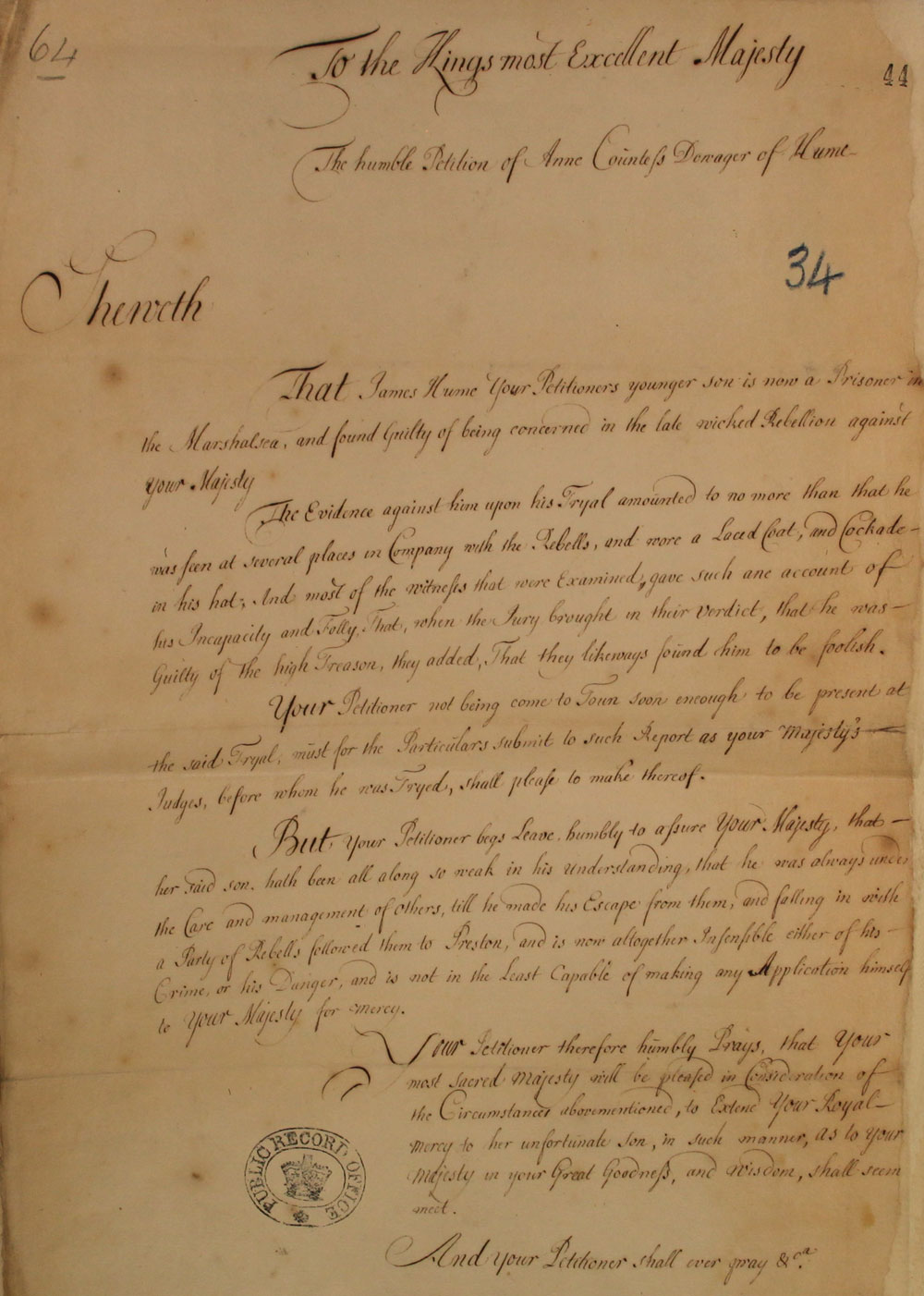
Petition from Countess Dowager of Hume to King George I for the pardon of her younger son, 1716. Lady Hume says she was unable to attend the trial of her son for his supposed involvement in the 1715 Jacobite Rebellion in Preston, Lancashire. She wants to plead for mercy on his behalf and argues that he is not responsible for his own actions and has limited understanding. (SP 35/7 f.34).
Transcript
To the Kings most Excellent Majesty
The Humble Petition of Ann Countess Dowager of Hume
Sheweth
That James Hume Your Petitioners younger son is now a Prisoner in the Marshalsea,
[prison on the south bank of The Thames in Southwark] and found Guilty of being concerned in the late wicked Rebellion against Your Majesty.
The Evidence against him upon his Tryal amounted to no more than that he was seen at several places in Company with the Rebells, and wore a Laced Coat, and Cockade [white ribbon rosette to show support for the Jacobite cause] in his hat; And most of the witness that were Examined, gave such an account of his Incapacity and Folly, That, when the Jury brought in their Verdict, that he was Guilty of High Treason, they added, That they likeways found him to be foolish.
Your Petitioner not being come to Town soon enough to be present at the said Tryal, must for the Particulars submit to such Report as your Majesty’s Judges before whom he was Tryed, shall please make thereof.
But your Petitioner begs leave humbly to assure Your Majesty, that her said son, hath been all along so weak in his understanding, that he was always under the care and management of others, till he made his Escape from them, and falling in with a Party of Rebells followed them to Preston, and is more altogether Insensible either of his Crime or his Danger, and is not in the Least Capable of making any Application himself to Your Majesty for mercy.
Your Petitioner therefore humbly Prays, that Your most sacred Majesty will be pleased in Consideration of the Circumstances above mentioned, to Extend Your Royal mercy to her unfortunate son, in such manner, As to Your Majesty in your Great Goodness, and Wisdom, shall seem meet.
And your Petitioner shall ever pray etc…
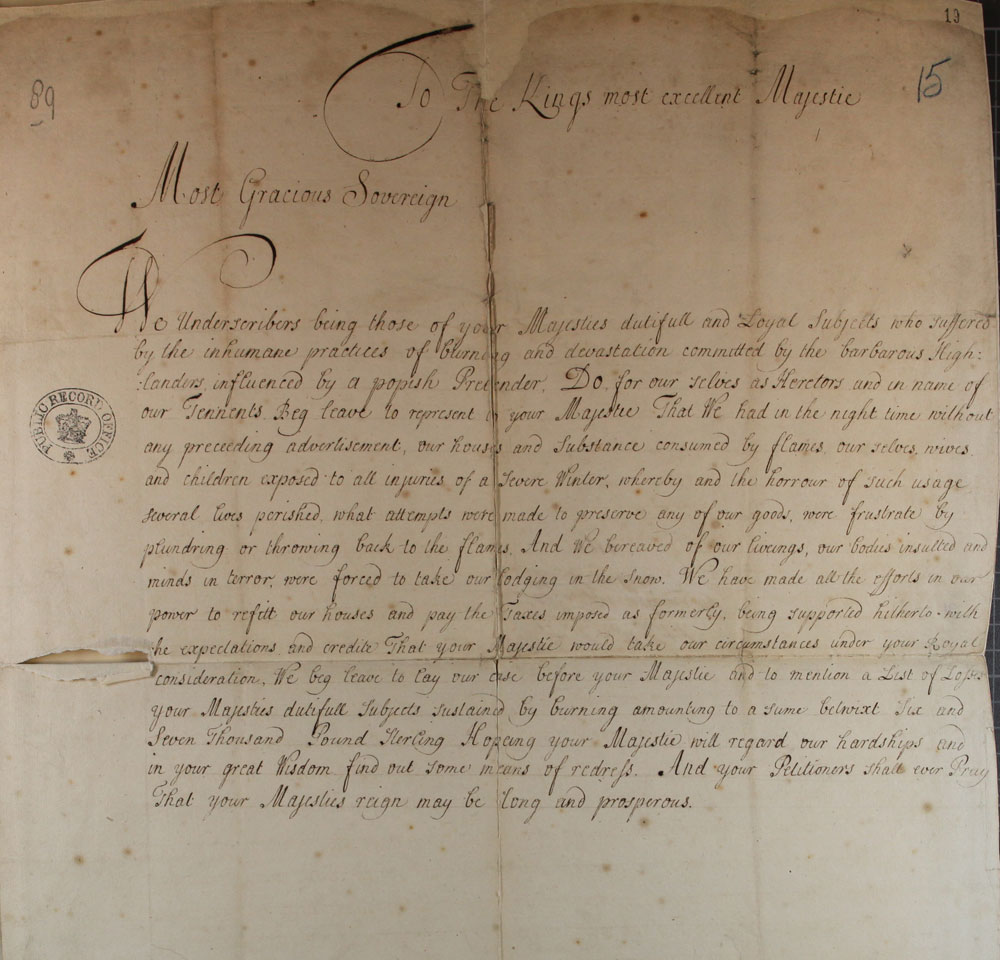
This document has 21 signatures and was written in 1716. These people are asking the King for compensation for damage caused to their land and properties which they claim was caused by Jacobite rebels setting fire to it in 1715. They have tried to rebuild and pay their taxes but hope the king will take into account their difficulties. (SP 35/7 f.15b)
Transcript
To The Kings most excellent Majestie
Most Gracious Sovereign
We Underscribers [those who have signed the petition] being those of your Majesties dutifull and Loyal Subjects who suffered by the inhumane practices of burning and devastation committed by the barbarous Highlanders influenced by a popish Pretender. Do for ourselves as Heretors [landowners] and in the name of our Tennents Beg leave to represent to your Majestie That We had in the night time without any preceeding advertisement [information] our houses and substance consumed by flames ourselves, wives, and children exposed to all injuries of a severe winter, whereby and the horrour [horror] of such usage [treatment] several lives perished [died] what attempts were made to preserve [save] any of our goods, more frustrate by plundering or throwing back to the flames. And we bereaved [lost] of our liveings [means of supporting ourselves], our bodies insulted and minds in terror were forced to take lodging in the snow. We have made all the efforts in our power to refitt our houses and pay the Taxes imposed as formerly, being supported hitherto with the expectations and credite That your Majestie would take our circumstances under your Royal consideration. We beg leave to lay our case before your Majestie and to mention a List of Losses your Majesties dutiful subjects sustained [caused] by burning amounting to a sume betwixt [between] Six and Seven Thousand Pound Sterling Hopeing your Majestie will regard our hardships and in your great Wisdom find out some means of redress. And your Petitioners shall ever Pray That your Majesties reign may be long and prosperous.
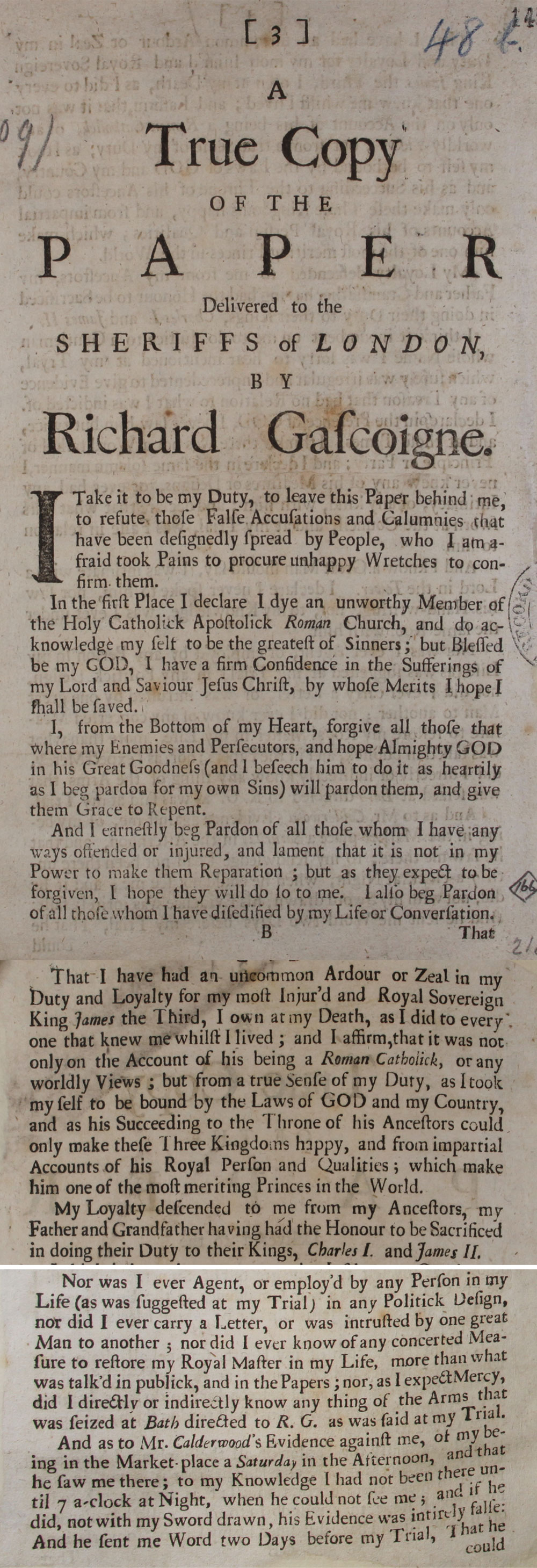
Extracts from a pamphlet dated 25 May, 1716 written by Richard Gascoigne and addressed to the sheriffs of London in which he denies being involved in a plot to put James Francis Edward Stuart (James III of Scotland) on the English throne. He says the evidence presented at his trial was false. The pamphlet was printed after the court case. (SP 35/5 f.48B).
Transcript
A True Copy OF THE PAPER
Delivered to the SHERIFFS of LONDON
BY Richard Gascoigne
I take it to be my Duty, to leave this Paper behind me, to refute [deny] those False Accusations and Calumnies [lies] that have been designedly spread [spread on purpose] by People, who I am afraid took Pains [took steps] to procure [get] unhappy Wretches to confirm them [back them up].
In the first Place I declare I dye [die] an unworthy Member of the Holy Catholick Apostolick Roman Church, and do acknowledge my self to be the greatest of Sinners; but Blessed be my GOD, I have a firm Confidence in the Sufferings of my Lord and Saviour Jesus Christ, by whose Merits [goodness] I hope I shall be saved.
I, from the Bottom of my Heart, forgive all those that [were] my Enemies and Persecutors, and hope Almighty GOD in his Great Goodness (and I beseech him to do it as heartily as I beg pardon for my own Sins) will pardon them, and give them Grace to Repent.
And I earnestly beg Pardon of all those whom I have any ways offended or injured, and lament that it is not in my Power to make them Reparation [make it up to them]: but as they expect to be forgiven, I hope they will do so to me. I also beg Pardon of all those whom I have disedified [let down] by my Life or Conversation.
That I have had an uncommon Ardour [passion] or Zeal [enthusiasm] in my Duty and Loyalty for my most Injur’d and Royal Sovereign King James the Third [Charles Francis Edward Stuart], I own at my Death, as I did to every one that knew me whilst I lived; and I affirm, that it was not only on the Account of his being a Roman Catholick, or any wordly Views; but from a true Sense of my Duty, as I took my self to be bound by the Laws of GOD and my Country, and as his Succeeding to the Throne of his Ancestors could only make these Three Kingdoms happy, and from impartial Accounts of his Royal Person and Qualities; which make him one of the most meriting [deserving] Princes in the World.
My Loyalty descended to me from my Ancestors, my Father and Grandfather having had the Honour to be Sacrificed in doing their Duty to their Kings, Charles I. and James II.
Nor was I ever Agent, or employ’d by any Person in my Life (as was suggested at my Trial) in any Politick Design [plot], nor did I ever carry a Letter, or was intrusted by one great Man to another; nor did I ever know of any concerted [planned] Measure to restore my Royal Master in my Life, more than what was talk’d in publick, and in the Papers; nor, as I expect Mercy, did I directly or indirectly know anything of the Arms that was seized at Bath directed to R.G as was said at my Trial.
And as to Mr. Calderwood’s Evidence against me, of my being in the Market-place a Saturday in the Afternoon, and that he saw me there; to my Knowledge I had not been there until 7 a-clock at Night, when he could not see me; and if he did, not with my Sword drawn, his Evidence was intirely false: And he sent me Word two Days before my Trial, That he could not [swear] anything against me whatever. And he said I was in the Council of War: I never (so far from being in it) knew the House was held in, nor did I know there was one held.
The Evidence of the Footman Walmsly was as false, he swearing me drinking of Brandy with Excise-Men Six times a Saturday, in the same Market place.
These are the two Men that swore me out of my Life; I forgive them with all my Heart, and recommend to them to Repent.
And as I have upon the Word of dying Man declar’d all these Truths, in order to caution People not to believe Reports, and to do all the Justice I am capable of doing; so now let me recommend to all People to think of their Duties to GOD and their Country, and to heal all Divisions; and exhort [call] them to think of the Means of Uniting and Reconciling all their Interests, and unite in the only Measure that can render them Happy; which that they may do, I beg of Almighty GOD to direct them, and that they may compass it.
I bless my GOD, who has given me the grace to submit patiently to all the Injuries that has been done me, as also for enabling me to resist the many Temptations I have had frequently in relation to a Gentleman, upon whose Account I presume they have taken my Life; because I would not concur to take his Life: But God forgive them; I do heartily.
And I humbly beg the Prayers of all good Christians.
[Richard] Gascoigne.
The 25th of May, 1716.
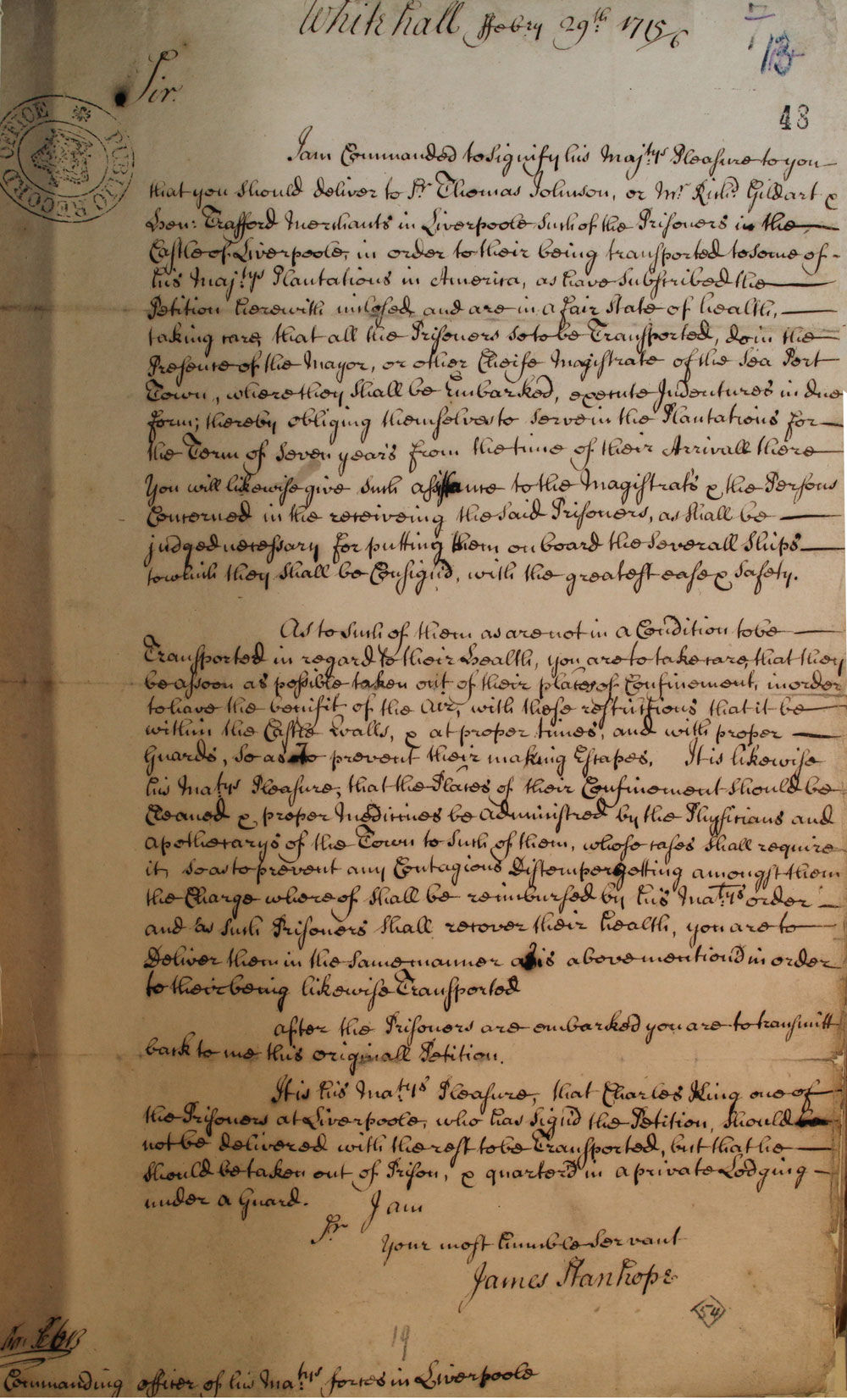
A letter written by James Stanhope at Whitehall to the Commanding Officer of his Majesty’s Forces in Liverpool. It gives orders for the transportation of Jacobite prisoners in Liverpool Castle to plantations in America and provides instructions for the care of sick prisoners, 29 February 1716 (SP 35/5/13).
Transcript
Whitehall February 29th 1715
I am commanded to signify [show] his Majesty’s pleasure to you that you should deliver to Sir Thomas Johnson, or Mr. Richard Gildart & Son: Trafford Merchants in Liverpoole such of the Prisoners in the Castle of Liverpoole , in order to their being transported to some of his Majesty’s Plantations in America, as have subscribed [signed] the Petition inclosed and are in a fair state of health- taking care that all the Prisoners so to be transported, do in the [presence] of the Mayor, or other Cheife Magistrate of the Sea Port Town, where they shall be embarked [taken on board], execute Judicature [hold trials] in due form; thereby obliging themselves to serve in the Plantations for the term of Seven years from the time of their Arrivall there. You will likewise give such assurance to the magistrates & the Persons concerned in the receiving the said prisoners, as shall be judged necessary for putting them on board the severall ships to which they shall be consign’d with the greatest case of safety.
As such of them as are not in a condition to be transported in regard to their health, you are to take care that they be as soon as possible taken out of their places of confinement in order to have the benefit of the air, with these restrictions that it be within the castle walls & at proper times, and with proper Guards, so as to prevent their making Escapes. It is likewise his Majesty’s Pleasure, that the Places of their Confinement [prison cells] should be cleaned & proper medicines be administered [given] by the Physicians [doctors]and apothecarys [chemists] of the Town to such of them, whose cases shall require it, so as to prevent any contagious Distemper [disease] getting amongst them the charge where of shall be reimbursed [paid] by his Majesty’s order and as such Prisoners shall recover their health, you are to Deliver them in the same manner as is above mentioned in order to their being likewise Transported.
After the Prisoners are embarked you are to transmit [send] back to me this originall Petition.
It is His Majesty’s Pleasure [wish], that Charles King one of the Prisoners at Liverpoole, who has sign’d the Petition, should not be delivered with the rest to be Transported, but that he should be taken out of Prison, & quartered in a private Lodging under a Guard.
I am
Sr.
Your most humble Servant,
James Stanhope
Commanding officer of his Majesty’s fortress in Liverpoole
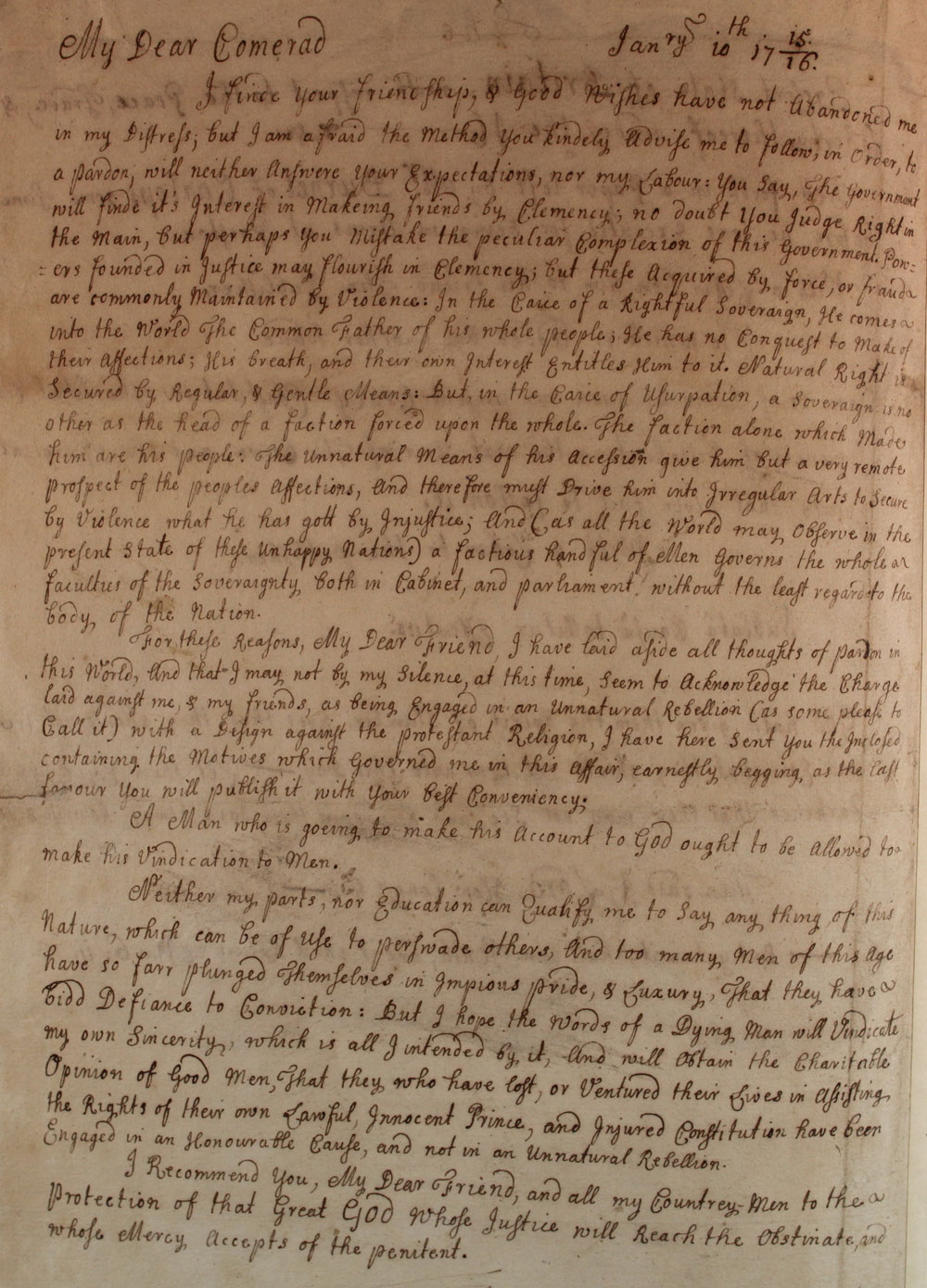
Extract from document left to a publisher by Mr Burnet of Carlops [village in Scottish borders area of Scotland] on ‘The Present State of Britain’, with respect to ‘the Peace, Trade, & Liberty’ before he was executed for having fought with the Jacobites at Preston. The author does not think he will be pardoned because the present king holds his throne illegally, so there is no chance for real justice. (SP 35/5 f3).
Transcript
My Dear Comerad January 10th 1716
I find your friendship, & good wishes have not Abandoned me in my Distress, but I am afraid the method you kindely, Advise me to follow, in Order, to a pardon, will neither Answere your Expectations, nor my, Labour: You say, The Government will finde it’s Interest in Makeing friends by Clemency [mercy]; no doubt you judge Right in the Main, but perhaps you Mistake the peculiar complexion [nature] of this Government. Powers founded in Justice may flourish in Clemency. But these Acquired by Force, or fraud are commonly Maintained by Violence: In the case of a Rightful Sovereign, He comes into the world the Common Father of his whole people, he has no conquest to Make of their Affections; his breath, and their own interest Entitles Him to it. Natural Right is secured by Regular & Gentle Means: But in the case of Usurpation [where the throne has been stolen from the rightful claimant], a sovereign is no other as the head of a faction forced upon the Whole. The faction alone which made him are his people: The Unnatural Means of his Accession give him but a very remote prospect of the peoples affections, And therefore must Drive him into Irregular Arts [unfair means] to secure by violence what he has got by Injustice, And (as all the World may observe in the present state of these unhappy Nations) a factious handful of Men [a group divided by arguments] governs the whole as faculties of the Soverainty [the king] both in Cabinet, and Parliament without the least regards to the body of the Nation [state of the country].
For these Reasons, My Dear Friend, I have laid aside all thoughts of pardon in this World. And that I may not by my silence at this time, seem to Acknowledge the Charge laid against me & my friend, as being Engaged in an Unnatural Rebellion (as some please to Call it) with a Design against the protestant Religion, I have sent you the Inclosed containing the Motives which Governed me in this affair, earnestly, begging as the last favour you will publish it with your best Conveniency [convenience]
A Man who is goeing to make his Account to God ought to be allowed to make his Vindication [defence] to men.
Neither my parts, nor Education can Qualify me to say anything of this Nature, which can be of use to persuade others, And too many men of this Age have so far plunged Themselves in Impious [ungodly] pride, & Luxury, that they have bidd Defiance to Conviction [belief]: But I hope the Words of a dying man will Vindicate [prove] my own Sincerity, which is all I intended by it, And will obtain the Charitable Opinion of Good Men, That they, who have left or ventured their Lives in assisting the Rights of their own Lawful, Innocent Prince [Charles Francis Edward Stuart], and Injured Constitution have been Engaged in an Honourable Cause, and not in an Unnatural [unlawful] Rebellion .
I recommend you, My Dear Friend, and all my Countrey-men to the Protection of that God whose Justice will Reach the Obstinate [stubborn], and whose Mercy accepts of the penitent [those who express sorrow for wrongdoing].
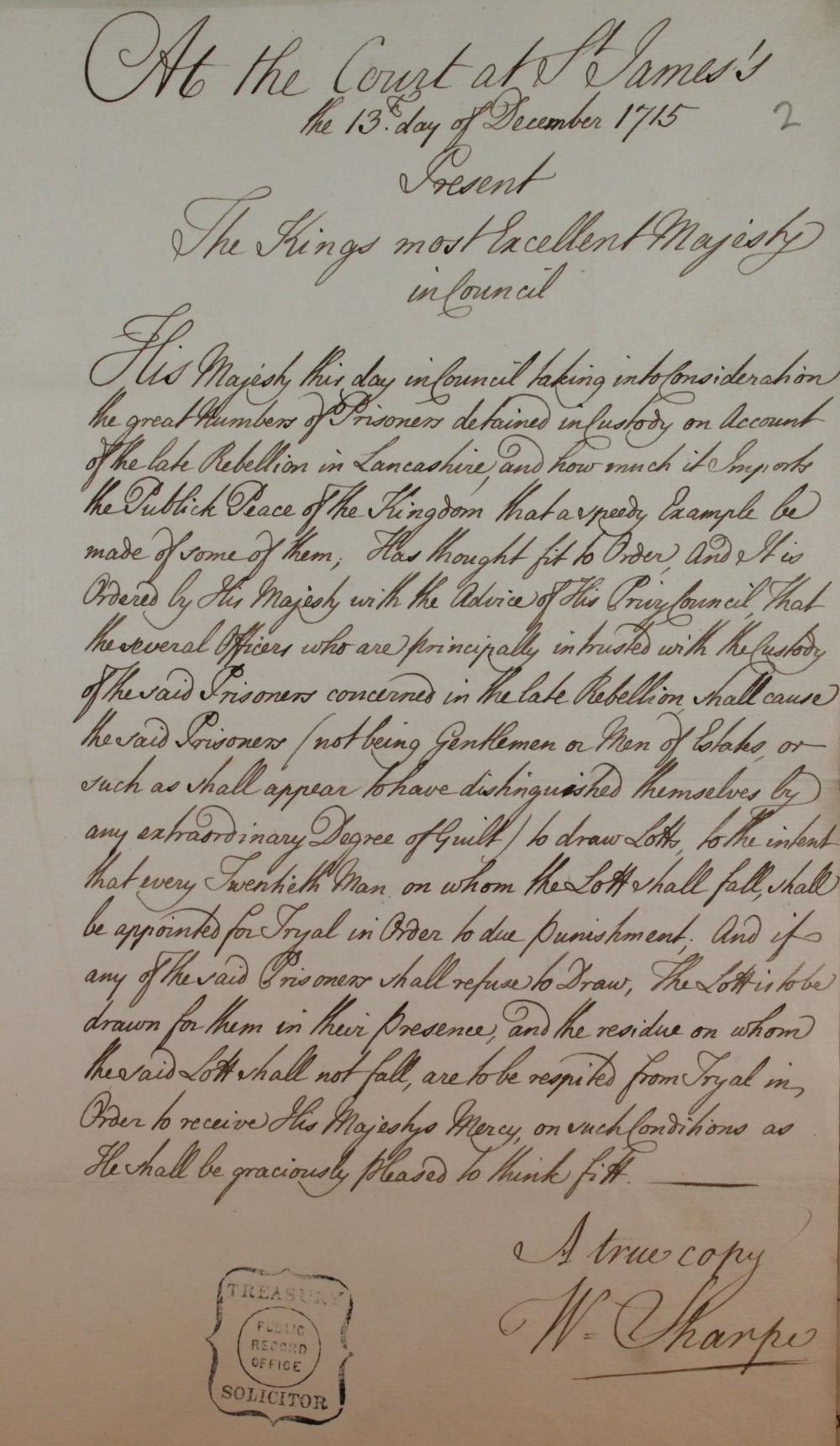
A royal command that the authorities must draw lots to decide which prisoners will face trial. This is because there were so many Jacobite prisoners taken following the rebellion in Lancashire and the government wishes to make an example of them. (TS 20/44).
Transcript
At the Court of St. James’s 13th day of December 1715
Present
The Kings most Excellent Majesty in Council
His Majesty this day in Council taking into consideration the great numbers of Prisoners detained in Custody [put in prison] on Account of the late Rebellion in Lancashire, and how much it Imports [effects] the Publick Peace of the Kingdom that a speedy Example be made of some of them, Has thought fit to Order, And It is Ordered by his Majesty with the Advice of His Privy Council that the several Officers who are principally intrusted with the custody of the said Prisoners concerned in the late Rebellion shall cause the said Prisoners (not being Gentlemen or Men of Estates or such as shall appear to have distinguished themselves by any extraordinary Degree of Guilt) to draw Lotts, to the intent that every Twentieth Man on whom the Lott shall fall, shall be appointed for Tryal [trial] in Order to due punishment; And if any of the said Prisoners shall refuse to Draw, the Lott is to be drawn for them in their presence, and the residue on whom the said Lott shall not fall, are to be respited [spared] from Tryal in, Order to receive His Majesty’s Mercy, on such conditions as He shall be graciously pleased to think fitt.
A true copy
W.Sharpe
1911 Census return (RG 14/227)