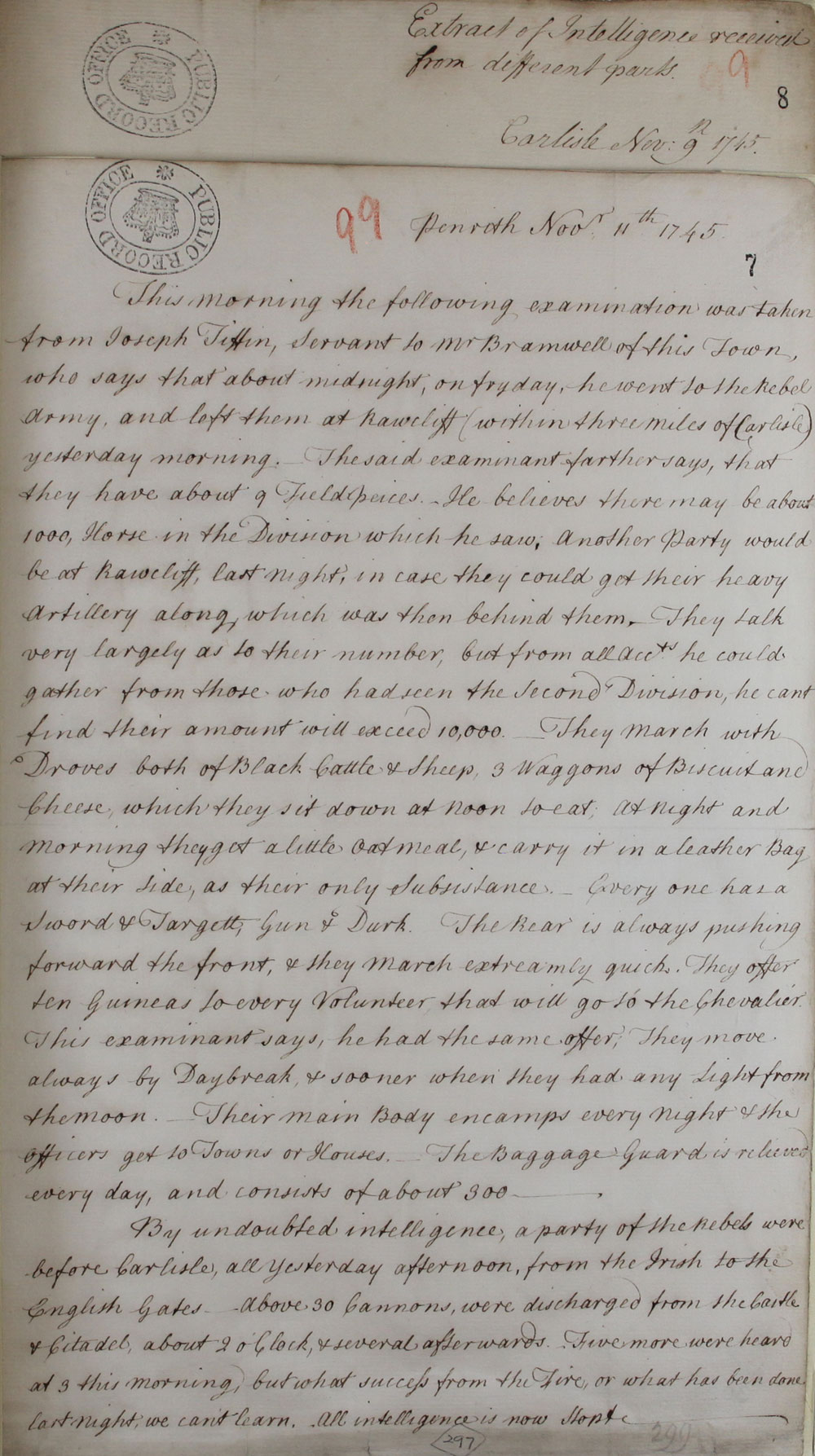
Extract of intelligence about the Jacobite army received from Penrith (SP 36/73/3/f7).
Transcript
Penrith November 11th 1745
This morning the following examination was taken from Joseph Tiffin, servant to Mr. Bramwell of this Town, who says that about midnight, on Friday, he went to the Rebel army, and left them at Rawcliff (within three miles of Carlisle) yesterday morning. The said examinant farther says, that they have about 9 Fieldpieces [a moveable gun to use to support soldiers on the front line]. He believes there may be about 1,000 Horse in the Division which he saw, Another party would be at Rawcliff, last night in case they could get their heavy artillery along, which was then behind them. They talk very largely as to their number, but from all account he could gather from those who had seen the Second Division, he cant find their amount will exceed 10,000. They march with Droves both of Black Cattle and Sheep 3 wagons of Biscuit and Cheese, which they sit down at noon to eat; At night and morning they get a little oatmeal, & carry it in a leather Bag at their side, as their only subsistence [food]. Everyone has a sword & targett [small round shield], Gun & Durk [long straight-bladed dagger]. The Rear is always pushing forward the front, & they march extreamly quick. They offer ten Guineas [twenty-one shillings] to every Volunteer that will go to the Chevalier [fight on horseback]. This examinant [witness] says, he had the same offer, they move always by Daybreak, & sooner when they had any Light from the moon. Their main Body encamps every night & the officers get to Towns or Houses. The Baggage Guard is relieved every day, and consists of about 300.
By undoubted intelligence, a party of the rebels were before Carlisle all yesterday afternoon, from the Irish to the English Gates. Above 30 cannons, were discharged [fired] from the Castle and citadel about 2 o’Clock & several afterwards. Five more were heard at 3 this morning, but what success from the Fire, or what has been done last night we cannot learn. All intelligence is now stopt.
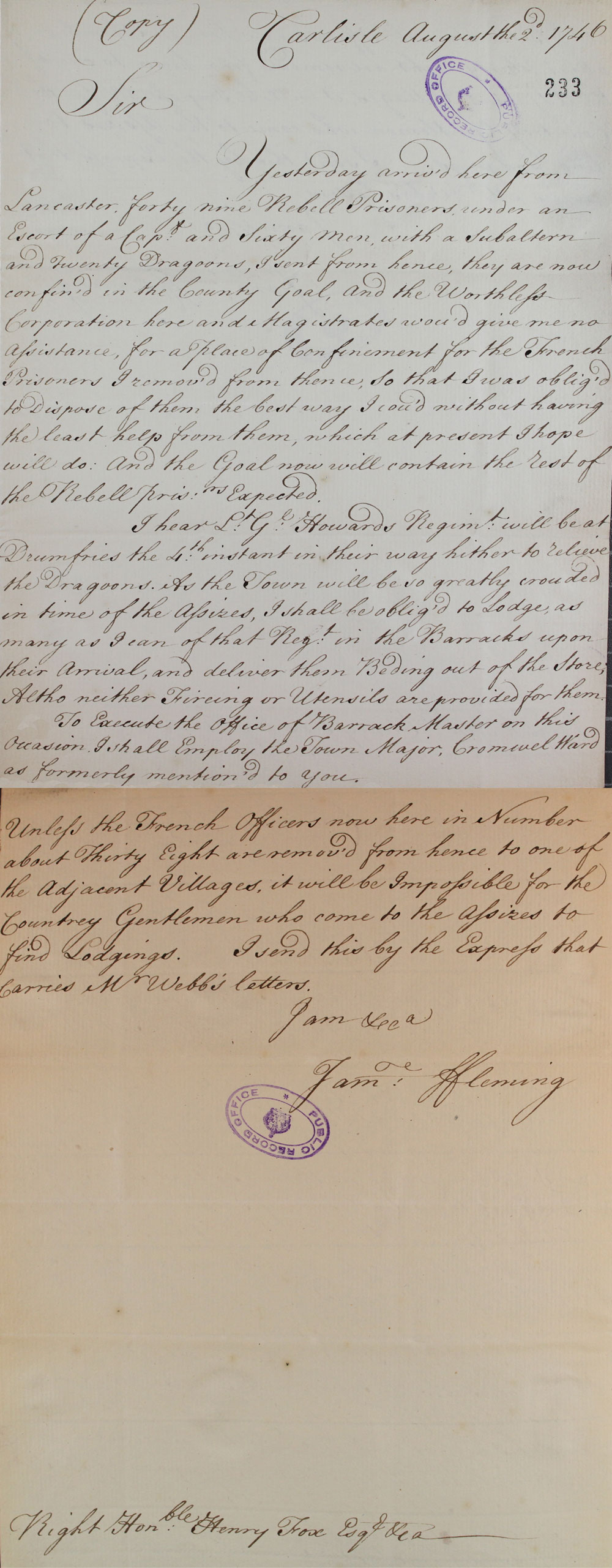
Despatch to Henry Fox, War Secretary and member of the Privy Council about the transportation of the rebel prisoners from Lancaster to Carlisle Gaol (SP 41/17/f110).
Transcript
Copy Carlisle August 2nd 1746
Sir,
Yesterday arrived here from Lancaster forty nine Rebell Prisoners under an Escort of a Captain and sixty men with a subaltern [junior ranking soldier] and twenty Dragoons [soldiers who fight on horseback], I sent from hence, they are now confined in the County Goal, and the Worthless Corporation [town council] here and Magistrates would give me no assistance, for a place of Confinement for the French Prisoners I remov’d from thence, so that I was obliged to dispose of them the best way I could without having the least help from them, which at present I hope will do: And the Goal now will contain the rest of the Rebell prisoners as Expected.
I hear Lieutenant General Howard’s Regiment will be at Drumfries the 4th instant in their way hither to relieve the Dragoons. As the Town will be so greatly crowded in the time the Assizes [regular court sessions held in the counties for the trial of civil or criminal cases], I shall be obliged to Lodge, as many as I can of that Regiment in the Barracks upon their arrival and deliver them Beding out of the store, [Although] neither Fireing [fuel] or Utensils are provided for them.
To Execute the Office of Barrack Master on this occasion I shall Employ the Town Major, Cromwell Ward as formerly mentioned to you.
Unless the French Officers now here in Number about Thirty Eight are removed from hence to one of the Adjacent Villages, it will be Impossible for the Country Gentlemen who come to the Assizes to find Lodgings. I send this by the Express that carries Mr. Webb’s letters.
I am etc.
James Fleming
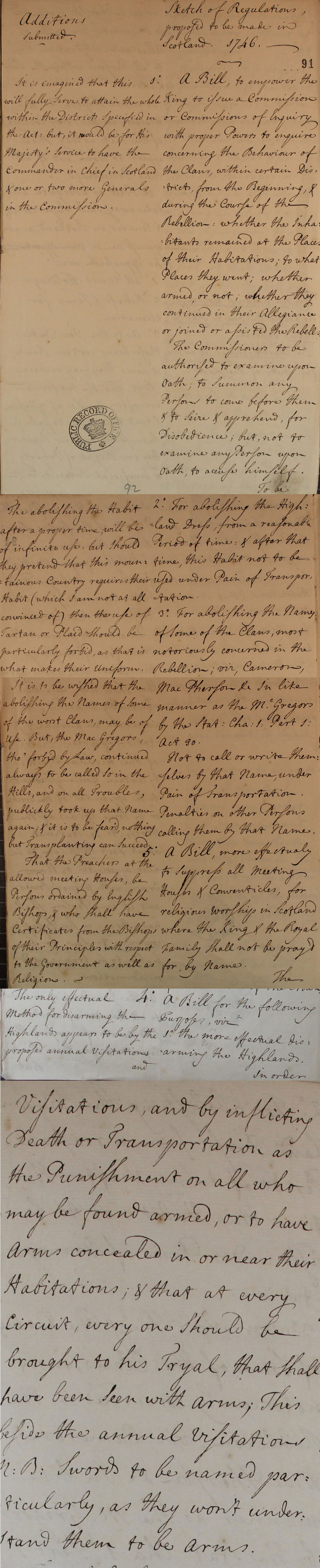
Extracts from a sketch of regulations proposed to be made in Scotland, 28 June 1746 (SP 54/32/24).
Transcript
Sketch of regulations proposed to be made in Scotland, 1746
Additions submitted
It is imagined that this will fully serve to attain the whole within the Districts specified in the Act, but it would be for His Majesty’s Service to have the Commander in Chief in Scotland and one or two more Generals in the Commission.
A Bill, to empower the King to issue a Commission or Commissions of Enquiry with proper Powers to enquire concerning the Behaviour of the Clans, within certain Districts, from the Beginning & during the Course of the Rebellion: whether the Inhabitants remained at the Places of their Habitations; to what Places they went; whether armed or not; whether they continued in their Allegiance or joined or assisted the Rebells.
The Commissioners to be authorised to examine upon Oath, to summon any Persons to come before them & to Seize & apprehend, for Disobedience; but, not to examine any Person upon Oath, to accuse himself…
The abolishing the Habit after a proper time, will be of infinite use but should they pretend that this mountainous country requires their Habit (which I am not at all convinced of) then the use of Tartan or Plaid should be particularly forbid, as it is what makes their uniform.
It is to be wished that the abolishing the Names of some of the worst clans, may be of use. But, the MacGregors, tho’ forbid by Law, continued always to be called so in the Hills, and on all Troubles, publickly took up that Name again, it is to be fear’d, nothing but Transplanting can succeed.
That the Preachers at the allowed meeting Houses, be Persons ordained by English Bishops and who shall have Certificates from the Bishops of their Principles with respect to the Government as well as Religion.
2. For the abolishing the Highland Dress, from a reasonable period of time, after that time, this Habit not to be used under pain of transportation.
3. For abolishing the Names of some of the Clans, most notoriously concerned in the Rebellion, viz, Cameron, Mac Pherson and In the like manner as the McGregors by the Statute Cha.1. Part 1: Act 30.
Not to call or write themselves by that Name, under Pain of Transportation. Penalties on other Persons calling them by that Name. A Bill more effectualy to surpress all meeting Houses & Conventicles, [a small meeting house or chapel for a religious assembly, especially of Nonconformists] for religious worship in Scotland where the King & family shall not be prayed for by Name…
The only effectual method for disarming the Highlands appears to be by the proposed annual visitations.
4. A Bill for the following purposes, viz
5. The more effectual disarming the Highlands in order…
Visitations and by inflicting Death or Transportation as the Punishment on all who may be found armed, or to have arms concealed in or near their Habitations, & that every circuit, everyone should be brought to his Tryal, that shall have been seen with arms; This beside the annual visitations.
N.B. Swords to be named particularly, as they won’t understand them to be arms…

Letter from the Earl of Ancram, William Kerr, a Scottish nobleman, to Sir Everard Fawkener, Secretary to the Duke of Cumberland (SP 54/32/24E).
Transcript
Aberdeen June 25th 1746
Sir Everard Fawkner
Yesterday I received yours with the Passports inclosed which I gave to the several people as directed and shall be sure to obey punctually the orders relating to myself and to see others do the same as far as it is in my power. I must own to you that it gives me no sort of pleasure to see good natured things done to the People of this Country, nothing will make them do their duty but starving them or in some other shape forcing them to it, I have quite lost the little humanity I had for ‘em, I mean even for those who pretend to be well affected, none of them give us the smallest assistance on the contrary I am persuaded that there is hardly one of them that would not rather conceal a Rebel than inform us of them, some examples that I have made of the houses that harbour rebels has made ’em cautious of receiving them, I must tell you what happened yesterday to a man that had been represented to me as one of the best affected man here is Burnet of Kemny [Kemnay, Aberdeenshire] I overheard him tell a gentleman That a nonjuring clergyman [clergyman who refused to take the Oaths of Allegiance and Supremacy to William and Mary and their successors after the Glorious Revolution of 1688] in his house had said that he would not administer the Sacrament to any man who would hear King George prayed for, you may believe that I immediately insisted to know his name, Mr. Burnet said that he could not betray any man that had been under his roof, I treated it I hope properly at the time, and as soon as he was gone out of the house writ him a Billet-doux [French for a sweet note, that is a love letter] which brought him to me in two hours trembling not able hardly to speak more than to beg ten thousand pardons & to tell me the rascals name & place of abode. I shall endeavour to administer a bitter cup to him the clergyman.
The officer of London’s Regiment who commands the small Garrison at Shellater had sent two soldiers with a copy of the certificates ordered by his Royal Highness to be given to rebels that surrendered to be shown to a Minister, five or six Rebel Gentleman who were lurking in that country attacked the men, fired upon them, but both made their escape, one of them was wounded. I ordered immediately the ministers to point out the houses of such as had surrendered that they might be safe, but at the same time ordered the country there about to be burnt & lay’d waste, and on Sunday the Ministers to acquaint their congregations that where ever a man belonging to His Majesty was attacked that the country should be treated in the same way. I hope that I did right. I have at this time four different Partys of Londons Regiment in request of Glenbachs, the night before last one of the partys took his own saddle horse, furniture & pistols he got off very narrowly, but we imagine that we know where he is and have surrounded the Glen, I hope that he cannot escape now. Two gentlemen, a father and son, their names Gordon of Clunie wore white cockades [rosette or knot of ribbon, usually worn on the hat as a badge.to show support for the Jacobite cause] when the rebels were here, forced their tenants to take up arms with the Rebels or to pay the levie mony, spoke treason openly etc have lived at home quietly no Gentleman of the country ever gave any information against them, at last a minister has & I hope that by this time they and their papers are in the hands of a party sent to apprehend them. Near to Angus, the Dragoons [soldiers fighting on horseback, cavalry] have seized a Mr. Mercer said to have near to three hundred pounds a year his mother where he was taken slipt ten guineas [each coin worth twenty-one shillings] into the Serjeant’s hand to let him escape, but the Serjeant had more honesty than to do it, I am told that his own confession is sufficient proof against him, I have sent to have his papers seized.
Grant the worthy sherriff of this county came to town the other day, among other things I asked him if he knew of any meeting houses, he said no, however there is one belonging to himself close to his house, I should say there was, for it is now no more. I for the first time knew by your letter of the insolent villainous behaviour of the People at Montrose, Major Chablane did not think proper to make any report to me about it. If he had I could have had patience to have delayed punishing them till now, we kept this town in very good order on the 10th and on the 11th, I made ‘em illuminate every window in great & small streets, the Troops in town, at the Fort & the Militia fired, we had bonfires and half the town Drunk.
Tomorrow the General Court Martial sits to try three mutineers of Lord Londons Regiment and two deserters from the King’s Army who listed afterwards with the Rebels, the Proceedings shall be sent to His Royal Highness. I have promised a reward of money to four young fellows who have undertaken to secure Roy Stewart, they pretend to know where he is, the Troops cannot take him the country are so watchfull in giving intelligence when we move. I am with the greatest
Regard & Esteem,
Sir, your most obedient & most humble servant,
Ancram
I shall strictly obey His Royal Highness commands & loose no time to have the recruit Horses for P.M Kerrs Regiment, I believe it will be necessary to send an officer, I beg to have orders for it, mean time the People we deal with will be doing what they can. The reinforcement that you mention come to me from London does not come farther north than Edinburgh, far enough North in all conscience.
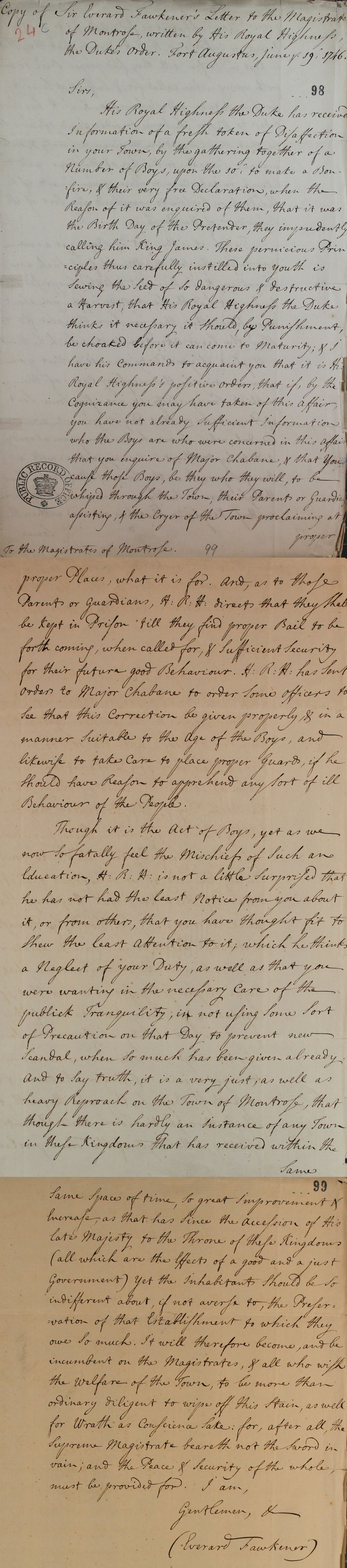
Letter from Sir Everard Fawkener, Secretary to the Duke of Cumberland, to the magistrates of Montrose, Scotland. Fort Augustus, June 19 1746, (SP 54/32/24C).
Transcript
Sirs,
His Royal Highness the Duke [Cumberland] has received information of a fresh token of Disaffection in your Town, by the gathering together of a Number of Boys, upon the said [date] to make a Bonfire, & their very free Declaration, when the reason of it was enquired of them, that it was the Birth Day of the Pretender, they impudently calling him King James. These pernicious [harmful] principles thus carefully instilled into youth is sewing the seed of so dangerous & destructive a Harvest, that his Royal Highness the Duke thinks it necessary it should, by Punishment, be choaked before it can come to Maturity, & I have his commands to acquaint you that it is His Royal Highness’s positive orders, that if, by the cognizance you may have taken of this affair, you have not already sufficient information who the boys are or who were concerned in this affair that you enquire of Major Chabane, & that you cause those boys, be they who they will, to be whiped through the Town, their Parents or Guardians assisting, & the cryer of the Town proclaiming at proper proper Places, what it is for. And, as to those Parents or Guardians, H.R.H. directs that they shall be kept in Prison till they find proper Bail to be forth coming, when called for, & sufficient Security for their future good Behaviour. H.R.H. has sent orders to Major Chabane to order some officers to see that this correction be given properly , & in a manner suitable to the age of the boys, and likewise to take care to place proper Guards, if he should have Reason to apprehend any sort of ill Behaviour of the People.
Though it is the Act of Boys, yet as we now so fatally feel the Mischiefs of such an Education, H.R.H. is not a little surprised that he has not had the least notice from you about it, or from others, that you have thought fit to shew the least attention to it, which he thinks a neglect of your duty, as well as that you were wanting in necessary care of the publick Tranquility [peace], in not using some of Precaution on that Day to prevent new scandal, when so much has been given already. And to say truth, it is a very just, as well as heavy Reproach on this town of Montrose, that though there is hardly an instance of any Town in these kingdoms that has received within the same space of time, so great improvement & increase, as that has since the accession of His Late Majesty to the Throne of these Kingdoms (all which are the effects of a good and a just Government) yet the inhabitants should be so indifferent about, if not averse [against] to, the Preservation of that Establishment [keeping the present government] to which they owe so much. It will therefore become, and be incumbent [the role of] on the magistrates, & all who wish the Welfare of the Town, to be more than ordinary diligent to wipe off this stain, as well for Wrath as Conscience sake, for after all, the Supreme Magistrate beareth not the Sword in vain, and the Peace & Security of the whole, must be provided for, I am
Gentlemen etc
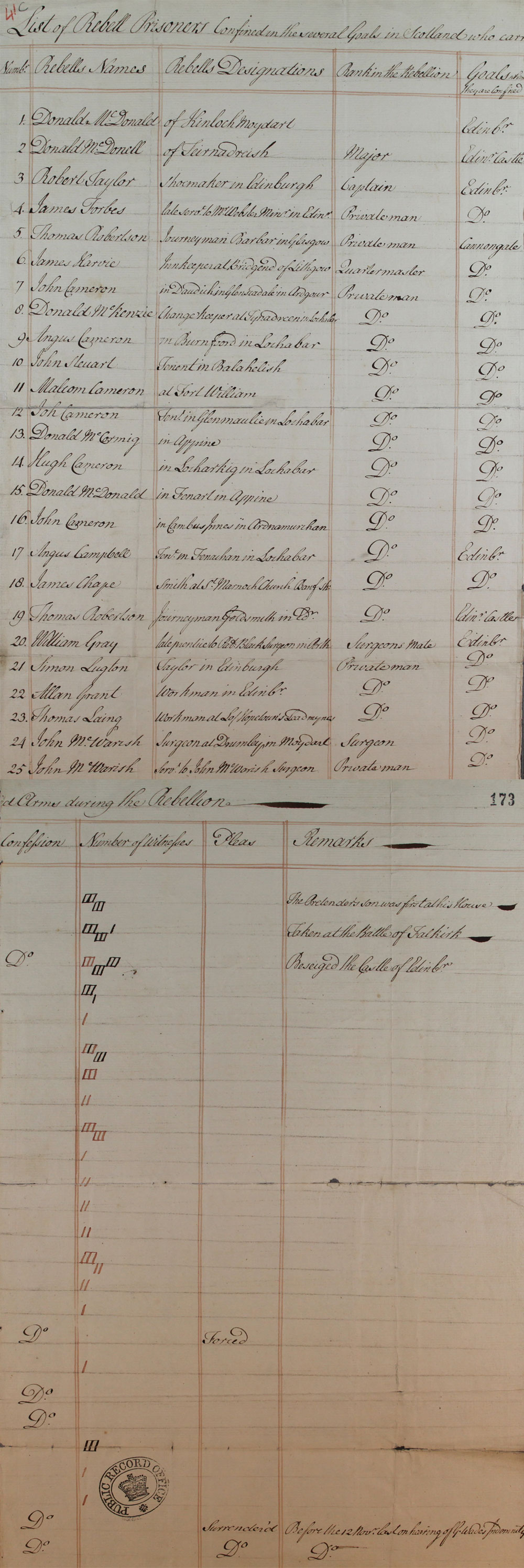
List of rebel prisoners: with their rank and the number of witnesses against them, July 17 1746 (SP 54/32/41C).
Transcript
| Rebels Names | Rebels Designations | Rank in the Rebellion |
|---|---|---|
| Donald McDonald | of Kinlochmoydart | |
| Donald McDonell | of Teirnadreish | Major |
| Robert Taylor | Shoemaker in Edinburgh | Captain |
| James Forbes | Late servant. To Mr Webster [Minister] In Edinr. | Privateman |
| Thomas Robertson | Journeyman Barbar in Glasgow | Privateman |
| James Harvic | Innkeeper at Bridgend of Lithgow | Quartermaster |
| John Cameron | in Daudich in Glenscadale in Ardgour | Privateman |
| Donald McKenzie | Change Keeper at Tynadreen in Lochaber | Do. |
| Angus Cameron | in Burnfoord in Lochabar | Do. |
| John Stewart | Tenent in Balahelish | Do. |
| Malcom Cameron | at Fort William | Do. |
| Joh Cameron | [Tenant] in Glenmaulie in Lochabar | Do. |
| Donald McCormig | in Appine | Do. |
| Hugh Cameron | in Locharkig in Lochabar | Do. |
| Donald McDonald | in Fenarl in Appine | Do. |
| John Cameron | in Cambus Innes in Ardnamunhan | Do. |
| Angus Campbell | [Tenant] in Fenachan in Lochabar | Do. |
| James Chape | Smith at S.Marnoch Church Banf. Shire | Do. |
| Thomas Robertson | Journeyman Goldsmith in Edn. | Do. |
| William Gray | Late [apprentice] to Pat Black Surgeon in Perth | Surgeons Mate |
| Simon Lugton | Taylor in Edinburgh | Privateman |
| Allan Grant | Workman in Edinbr. | Do. |
| Thomas Laing | Workman at [Lord] Hopetown's Lead mynes | Do. |
| John McWarish | Surgeon at Durnley in Moydart | Surgeon |
| John McWarish | Serv. To John McWarish Surgeon | Privateman |
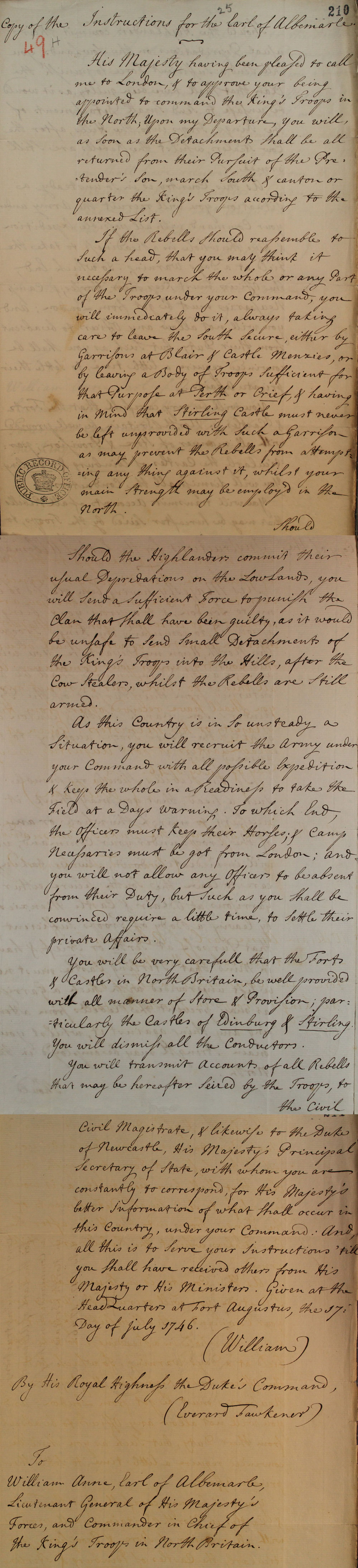
Letter from the Duke of Cumberland, the youngest son of George II to Lord Albemarle on his appointment as Commander in Chief of forces in Scotland, July 16 1746. He was nicknamed ‘Butcher’ Cumberland after his role in putting down the Jacobite Rising at Culloden. The letter gives the Earl Of Albemarle instructions for the defence of the lowlands of Scotland (SP 54/32/49H).
Transcript
Copy of the Instructions for the Earl of Albemarle
His Majesty having been pleased to call me to London, & approve your being appointed to command the King’s Troops in the North, Upon my Departure, you will, as soon as the Detachments shall be all returned from their Pursuit of the Pretender’s Son, march South & canton [divide into groups] & quarter [provide lodgings for] the King’s Troops according to the annexed [attached] list.
If the Rebells should reassemble to such a head, that you may think it is necessary to march the whole or any Part of the Troops under your command, you will immediatley do it, always taking care to leave the South secure, either by Garrisons at Blair & Castle Menzies, or by leaving a Body of Troops sufficient for that Purpose at Perth or Crief, & having in mind that Stirling Castle must never be left unprovided with such a Garrison as may prevent the Rebells from attempting anything against it, whilst your main Strength may be employed in the North Should the Highlanders commit their usual Depredations [destruction] on the Lowlands, you will send a Sufficient Force to punish the clan that shall have been guilty, as it would be unsafe to send small detachments of the King’s Troops into the Hills, after the Cow stealers, whilst the Rebells are still armed.
As this country is in So unsteady a Situation, you will recruit the Army under your Command with all possible Expedition & keep the whole in a Readiness to take the field at a Day’s warning. To which End, the officers must keep their Horses, & camp necessaries must be got from London; and you will not allow any Officers to be absent from their Duty, but such as you shall be convinced require a little time, to settle their private affairs.
You will be very carefull that the Forts & Castles in North Britain, be well provided with all manner of store & provision, particularly the Castles of Edinburgh & Stirling. You will dismiss all the Conductors [men who move guns, weapons and supplies].
You will transmit accounts of all rebells that may be hereafter seized by the Troops to the Civil Magistrate, & likewise to the Duke of Newcastle, His Majesty’s Principal Secretary of State, with whom you are constantly to correspond, for His Majesty’s better Information of what shall occur in this Country, under your Command: And all this is to serve your instructions ’till you shall have received others from His Majesty or His Ministers. Given at the HeadQuarters at Fort Augustus, the 17th Day of July 1746.
(William)
By His Royal Highness the Duke’s Command, (Everard Fawkener)
To
William Anne, Earl of Albemarle, Lieutenant General of His Majesty’s Forces, and Commander in Chief of the King’s troops in North Britain.
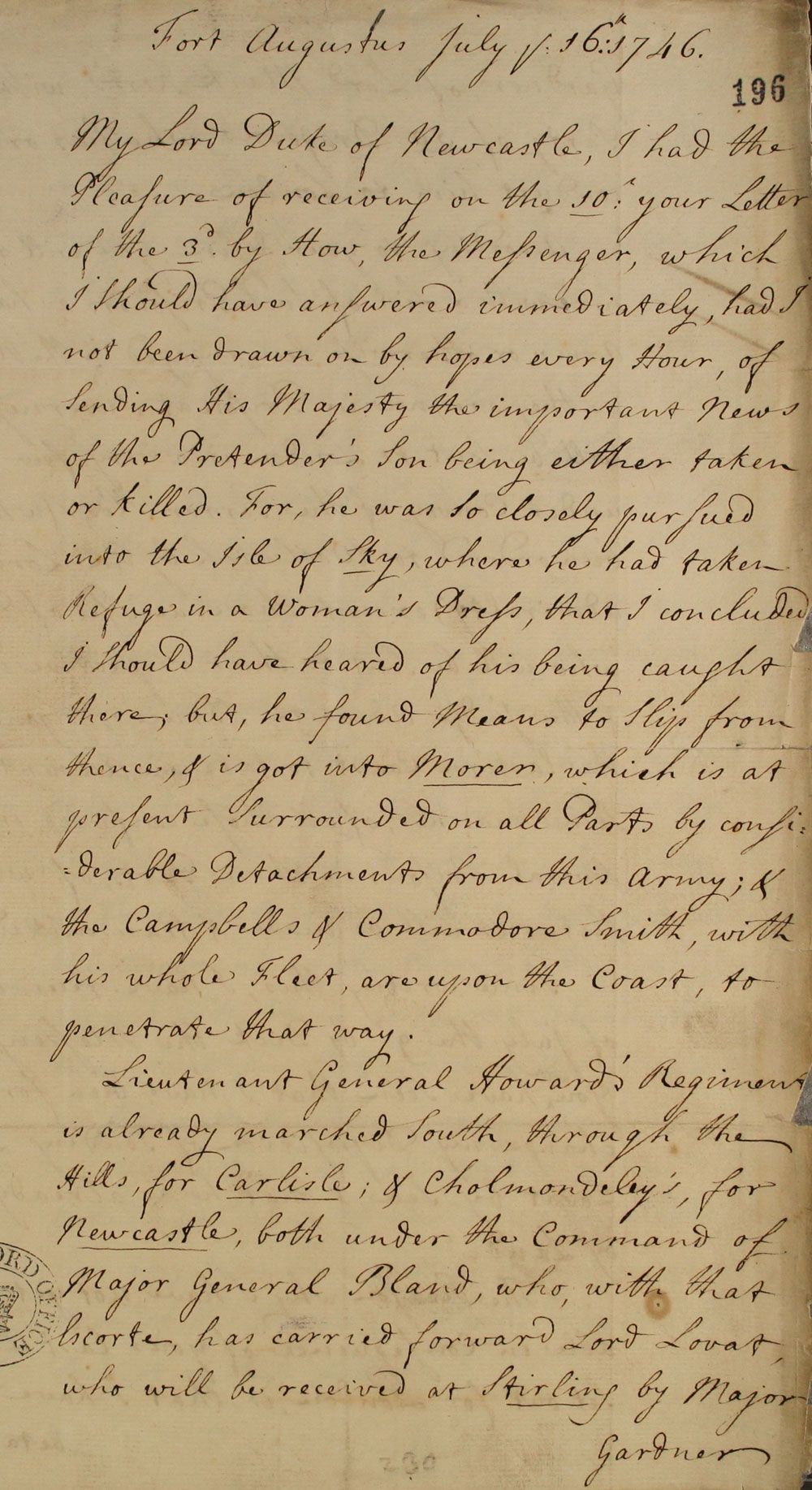
Extract of a letter from the Duke of Cumberland to Secretary Newcastle on having his return to London delayed by the pursuit of Charles Edward to Skye after Culloden, July 16 1746 (SP 54/32/49A).
Transcript
Fort Augustus July 16th: 1746
My Lord Duke of Newcastle, I had the Pleasure of receiving on the 10th your letter of the 3rd by How, the Messenger, which I should have answered immediately, had I not been drawn on by hopes every Hour of sending His Majesty the important News of the Pretenders son being either taken or killed. For, he was so closely pursed into the Island of Sky, where he had taken Refuge in a woman’s Dress, that I concluded I should have heared of his being caught there, but he found means to slip from thence, & is got into Moren, which is at present surrounded on all Parts by considerable Detachments from this army & the Campbells & Commodore Smith, with his whole Fleet, are upon the Coast, to penetrate that way.
Lieutenant General Howard’s Regiment is already marched South, through the Hills, for Carlisle; & Cholmondeley’s, for Newcastle both under the Command of Major General Bland, who with that Escorte, has carried forward Lord Lovat, who will be received at Stirling by Major Gardner.

Flora MacDonald’s statement on the escape of Charles Edward Stuart from South Uist (Outer Hebrides) to Skye, 12 July 1746. She gives details on how his escape was managed, his disguise and where he stayed. (SP 54/32 f.49E).
Transcript
Copy of the Declaration of Miss MacDonald, Apple Cross Bay, July 12th 1746
Miss Mc. Donald, Daughter in Law of Mc. Donald of Milton in Sky, [Skye] being, by General Campbell’s order, made Prisoner for assisting the eldest son [Bonnie Prince Charlie] of the Pretender in his escape from South Uist, & asked to declare the Circumstances thereof, says, That about six weeks ago, she left her Father in Law’s house at Armadach [Armadale] in Sky, & went South to see some friends.
Being asked, if she had any Invitation from those who persuaded her to do what she afterwards ingaged [engaged] in for the young Pretender or any Body else, before she left Sky; answered in the Negative, and says that at the time of her leaving Sky, she did know where the young Pretender was, but only heard He was Some where on the long Island: that she stay’d at (what they call) a Sheilling [small hut or cottage] of her brother’s, on the hills, near Ormaclait [Ormacleit] the house of Clan Ronald; and that, about the 21of June, O Neil, or as they call him Nelson, came to where she stay’d, & proposed to her, that as he heard she was going to Sky, that the young Pretender should go with her.
With her in Woman’s cloathes [clothes], as her servant which she agreed to. O Neil then went and fetched the young Pretender who was on the Hills not far off, when they settled the manner of their going.
Miss MacDonald says, that after this she went & stay’d with Lady Clan Ranold [Ronald], at her House, three days, communicated the scheme to her, & desired that she would furnish cloathes for the young Pretender, as her own would be too little. During Miss MacDonald’s stay at Ormaclait, O Neil came frequently from the young Pretender to Clan Ronald’s House to inform her where he was, what stepps had been taken for their voiage [voyage], and at the same time to hasten her to get her affairs in Readiness for going off.
Miss Mac Donald says, that the 27th past, she, Lady Clan Ronald, her eldest Daughter, & one John MacLean, who had by Lady Clan Ronald’s order, acted as Cook to the Pretender, during his stay on the Hills, went to a place called Whea where they expected to meet the young Pretender; but not finding him there, they went on to a Placed called Roychenish, where they found him, taking with them the women’s Apparel furnished by Lady Clan Ronald, he was dressed in. Here they heard of General Campbell’s being come to South Uist, & that Captain Fergussone was within a mile of them. When they got this Information, they were just going to Supper. But then went of very precipitately, & sat up all night at a Sheilling call’d Closchinisch.
Saturday, June 25th: the Cutter and Wherrier, which attended General Campbell having got from Bernera [Berneray], near the Harris, through the last side of the long island, & passing not far from them, put them again into great Fears, least anybody should land there. However, they continued there ’till about 9 at Night, when the Young Pretender, Miss Mac Donald, one MacAchran, with five men for the Boat’s crew, imbarked [embarked] & put to sea, Lady Clan Ronald having provided Provisions for the voyage.
The 29 about 11 in the Morning they got to Sky near Sir Alexander MacDonald’s House. Here Miss Mac Donald and Mac Achran landed, leaving the young Pretender in the Boat, they went to Sir Alexander Mac Donald’s House; and from thence Miss MacDonald sent for one Donald Mac Donald, who had been in the Rebellion, but had delivered up his arms some time ago. She imployed this Person to procure [get] a Boat to carry the young Pretender to Rasay, after acquainting him with their late voyage & where she had left the young Pretender . Miss Mac Donald stay’d & dined with Lady Margaret Mac Donald, but Mac Donald & Mac Achran returned to the Boat, to inform what was done.
Miss Mac Donald being asked why Rasay was pitched upon for the young Pretender to retreat to, she answered that it was in hopes of meeting Rasay himself, with whom he was to consult for his future security.
After dinner, Miss Mac Donald set out for Portree it being resolved that they should lodge there that Night; but on the Road overtook the young Pretender & Mac Anchran of Kingsbury. She told them she must call at Kingsbury’s House, & desired they would go there also. Here, Miss Mac Donald was taken sick, & therefore with the other two, was desired to stay all night, which they agreed to. She had a Room to herself; But the young Pretender & Mac Achran lay in the same Room. At this time he appeared in women’s Cloathes, his Face being partly concealed by a Hood or Cloak.
Being asked, if while they were at Kingsbury’s House, any of the Family inquired who the disguised Person was; answers, that they did not ask; but that she observed the People of the Family whispering as if they suspected him to be some Person that desired not to be known and from the Servants she found they suspected him to be Mac Leod of Bernera, who had been in Rebellion. But, being pressed to declare what she knew or believed of Kingsbury’s knowledge of his Guest, owns, that she believes, he must suspect it was the young Pretender.
The 30th of June, Miss Mac Donald set out on Horseback from Kingsbury’s House for Portree, having first desired the young Pretender might put on his own cloathes somewhere on the Road to Portree, as she had observed that the other dress rather made him more suspected. Miss got to Portree about 12: at night, where she found Donald Mac Donald, who had been sent before to procure a Boat then The young Pretender & Mac Ancran arrived about an Hour after. Here he took some Refreshment, changed a Guinea [twenty-one shillings], paid the Reckoning [bill], took his Leave of Miss Mac Donald & went out with Donald Mac Donald, but who, after seeing him to the Boat returned. She believes he went to Rasay [Raasay, an island between the Isle of Skye and the mainland of Scotland], but cannot tell what is become of him since.
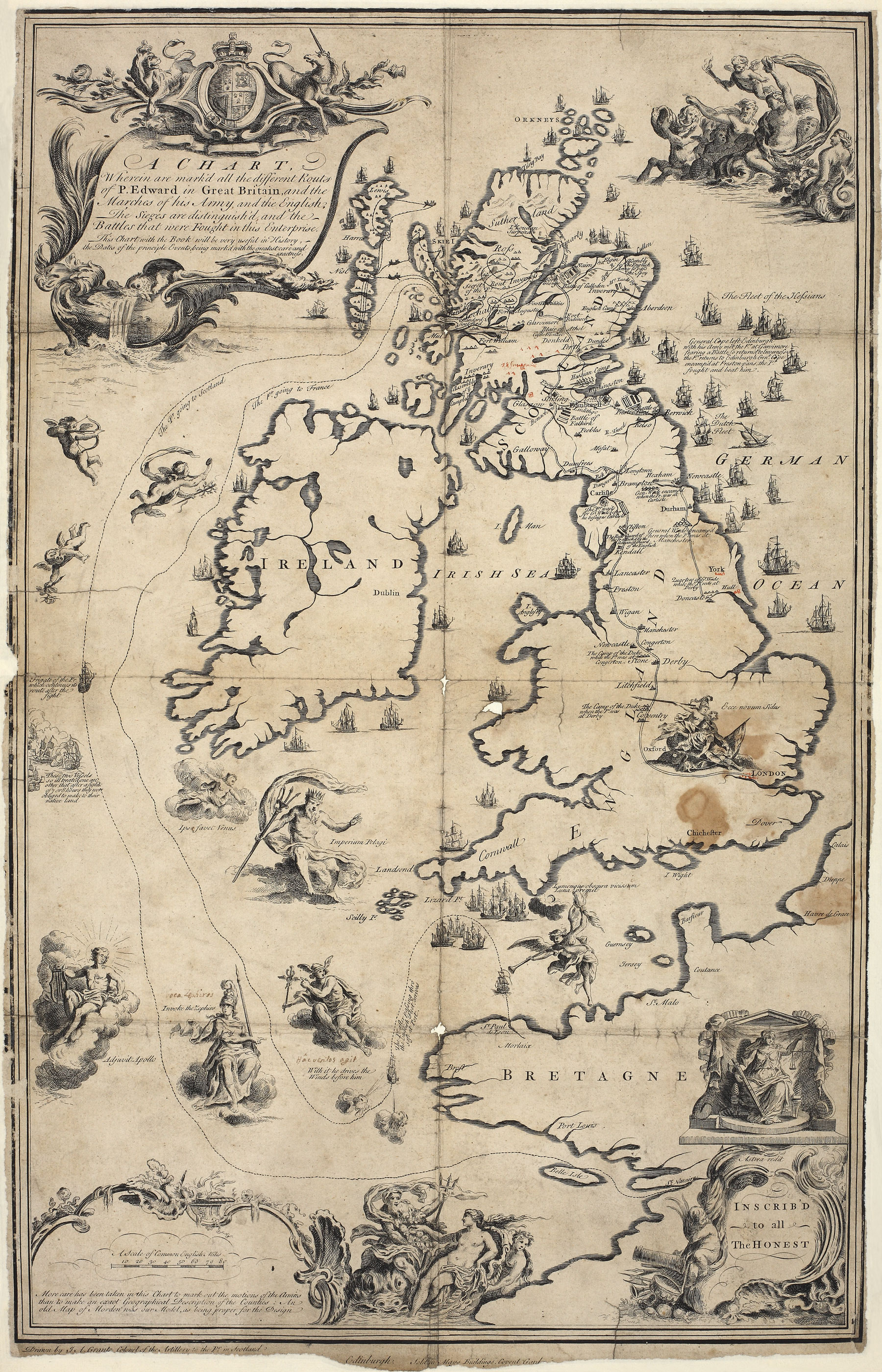
Map of Great Britain drawn by J.A. Grante, Colonel of the Artillery to Prince Charles Edward Stuart in Edinburgh. It was produced in 1749, and probably only a proof, so few copies would have been seen by the public (MPF 1/2).
Transcript
Wherein are mark’d all the different Routs of P. Edward [Prince Charles Edward Stewart] in Great Britain, and the Marches of his Army, and the English. The Sieges are distinguish’d, and the Battles that were Fought in this Enterprise [process].
This Chart with the Book will be very useful in History, the Dates of the principle Events, being marked with the greatest care and exactness.
The Fleet of the Hessians
General Cope left Edinburgh with his army met the Pr [Prince] at Garvimore fearing a Battle so return’d to Inverness the Pr. [Prince] Returns to Edinburgh [General] Cope encamp’d at Preston-pans, the Pr. [Prince] Fought and beat him.
More care has been taken in this Chart to mark out the motions of the armies than to make an exact Geographical Description of the Counties: An old Map of Morden was our Model, as being proper for the Design
INSCRIB’D – to all –The HONEST [a name that the Jacobites called themselves].