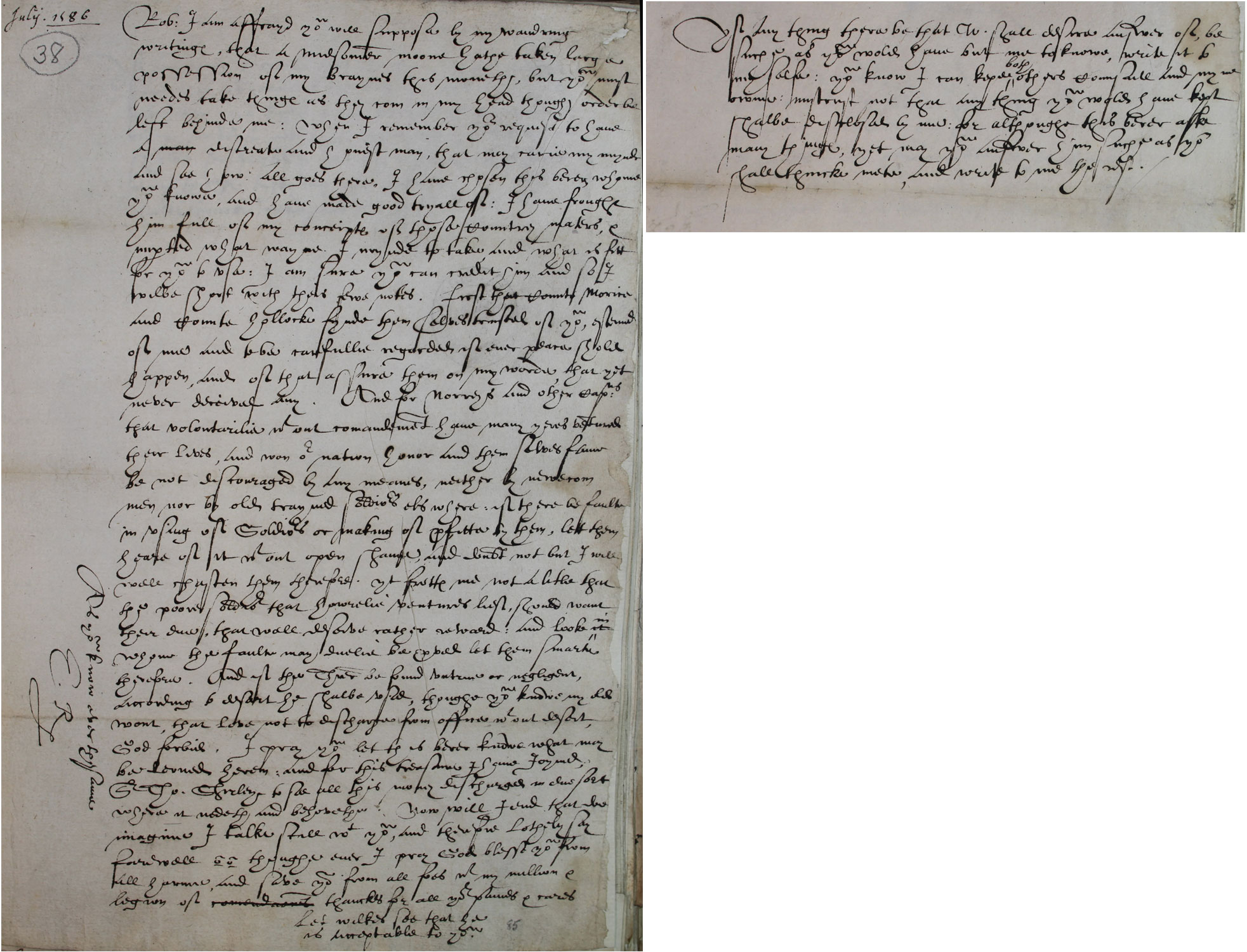
Elizabeth to Robert Dudley, Earl of Leicester, 19 July 1586 (SP 84/9 f.38)
Dudley was provided with no authority other than his military command over the English forces, and only an informal instruction to advise the Dutch on political matters. But bad weather in the North Sea severely restricted communication with England over the next two months, and as a result he felt abandoned. This may have prompted his fateful decision to accept the appointment as Governor-General of the Netherlands, and he was sworn in on 15 January 1586 [O.S.]. Elizabeth was incandescent with rage when she heard of this and demanded his immediate recall. But she could never stay angry with her favourite for long, and in July she wrote him this letter, making it clear that he had been entirely forgiven. Despite her protestations, Elizabeth was always reluctant to properly provide for her troops – an issue that sparked widespread criticism in the years to come.
Transcript
Rob: I am affrayd you will suppose by my wandring writings, that a midsomer moone hathe taken large possession of my braynes this moneth, but you must needes take thinges as they com in my head though order be left behind me. When I remember your request to have a discreate and honest man, that may carie my mynde and see how all goes there, I have chosen this berer whome you knowe, and have made good tryall of: I have froughte him full of my conceipte of those Country maters, & imparted what waye I mynde to take and what is fitt for you to use: I am sure you can credit him and so I wilbe short with thes fewe notes. First that Counte Morice and Counte Hollocke [Count Maurice and Count Hollock, commanders of the Dutch resistance against Spain] fynde them selves trusted of you, esteemd of mee and to be carefullie regarded if ever peace shold happen, and of that assure them on my worde, that yet never deceived any. And for Norrys [Sir John Norris, one of Elizabeth’s commanders in the Netherlands, and a rival of Dudley] and other captains that volontarilie without commandment have many yeres ventured their lives, and won our nation honor and themselves fame be not discouraged by any meanes, neither by newecom [new come] men nor by olde trayned soldiers elsewhere: If there be faulte in using of Soldiers or making of profitte by them, lett them heare of it without open shame, and doubt not but I will well chasten them therefore. Yt frettes me not a litle that the poore soldier that howrelie ventures life, should want ther due, that well deserve rather reward: and looke in whome the faulte may dulie be proved let them smarte therefore. And if the Treasurer be found untrue or negligent, according to desart he shalbe used, thoughe you knowe my old wont, that love not to discharge from office without desert, God forbid. I pray you let this berer knowe what may be lerned herein: and for this treasure I have joined, Sir Thomas Sherley to see all this money discharged in due sort where it nedeth and behoveth. Now will I end that do imagine I talke still with you, and therefore lothely say farewell ōō [the symbol for ‘eyes’, Elizabeth’s nickname for Dudley] thoughe ever I pray God blesse you from all harme and save you from all foes with my million and legion of thanckes for all your paines and cares. As you know, ever the same.* E.R.
[Postscript] Let Wilkes see that he is acceptable to you. Yf any thyng there be, that Wilkes shall desire answer of, be suche as you wold have but me to knowe, write it to my selfe: you know I can keep both others’ Counsaill and myne owne: mistrust not that anything you wold have kept shalbe disclosed by me: for althoughe this berer aske many thinges, yet may you answer him suche as you shall thincke mete, and write to me the rest.
* ‘Ever the same’ or ‘Semper eadem’ was Elizabeth’s motto.
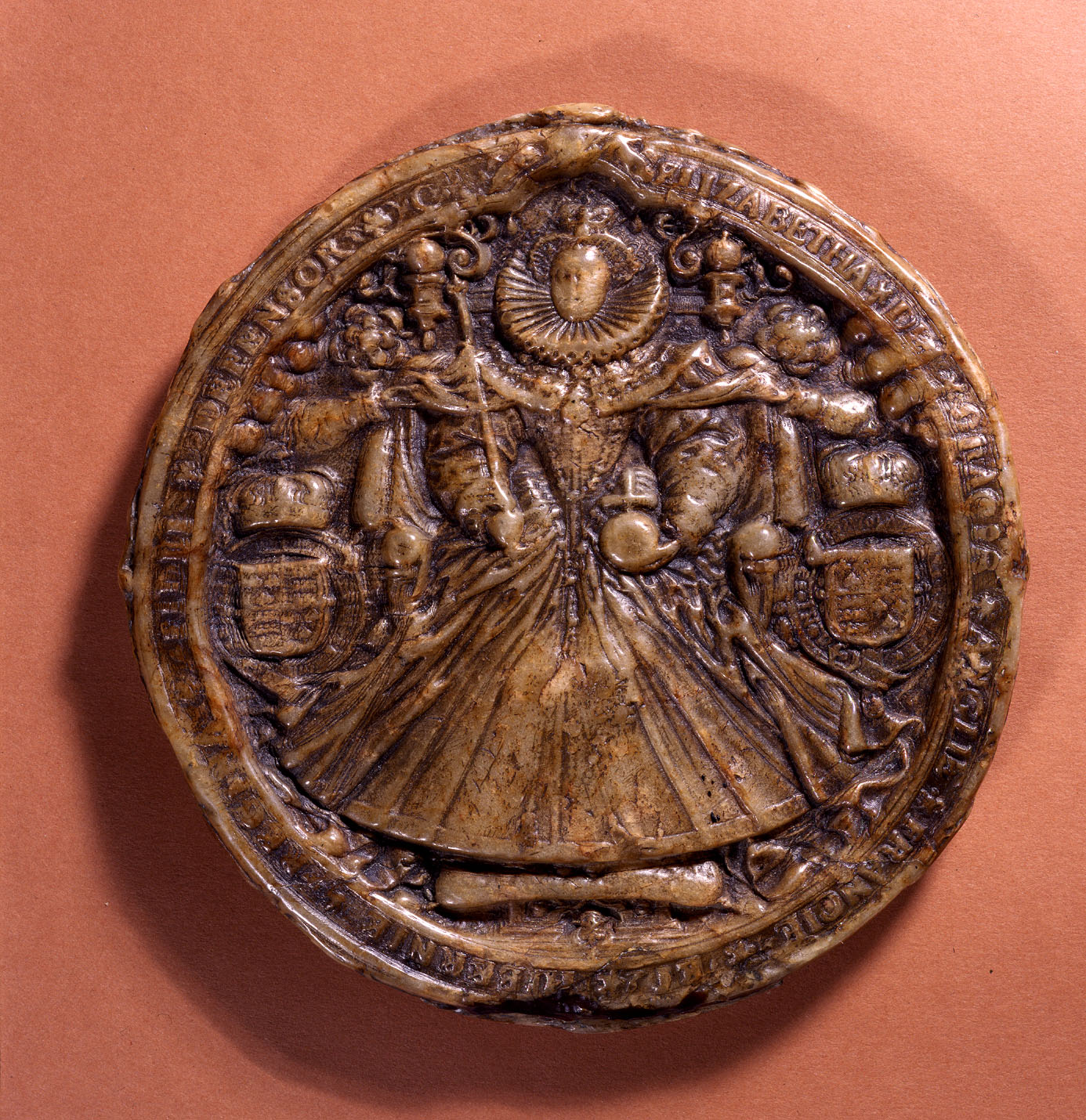
The Great Seal of Elizabeth I, 1586-1603 (SC 13/N3)
Almost all documents during the Tudor period were closed with seals, both to ensure that they would not be read before they reached the intended recipient and to identify the sender. Most seals had a picture of the owner and a motto around the edge. The same was true of a Great Seal, which belonged to the monarch and was attached to all the important transactions that he or she carried out.
The Great Seal was also an important instrument of propaganda. Of all the Tudor monrachs, Elizabeth I was the most skilled at crafting her public image. This, her second Great Seal, is laden with symbolism. The inscription reads: Elizabetha dei gracia Anglie Francie et Hibernie Regina Fidei Defensor (‘Elizabeth, by grace of God, Queen of England, France and Ireland, Defender of the Faith’). It depicts the queen in typically resplendent dress, flanked by the royal arms and Tudor roses. It was engraved by the celebrated miniaturist Nicholas Hilliard.
The image presented in this seal became the unwritten ‘official’ portrayal of the queen, and was reproduced in numerous potraits and illuminations.
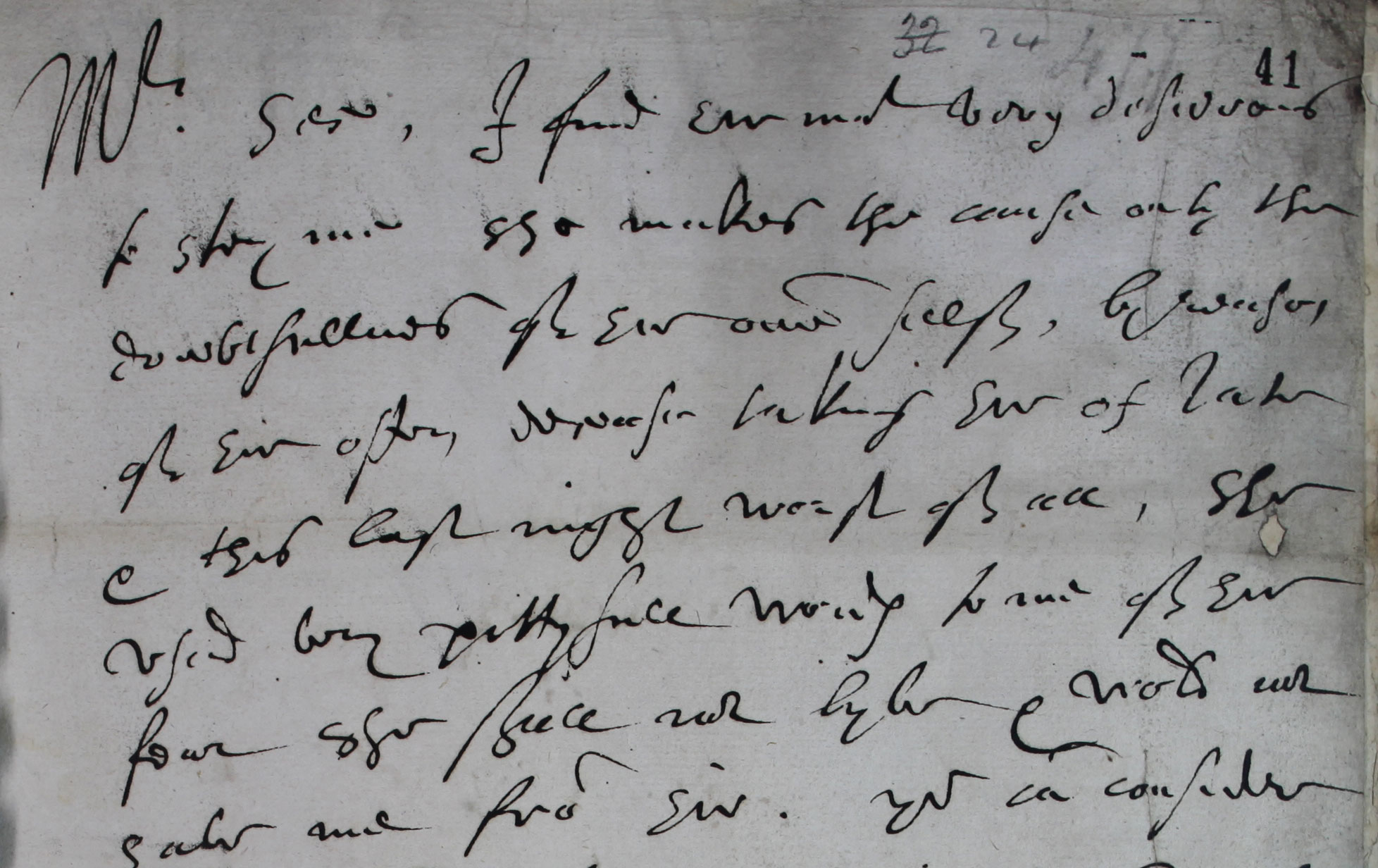
Robert Dudley, Earl of Leicester, to Sir Francis Walsingham, 28 September 1585 (SP 12/182 f.41)
On 10 August 1585, Elizabeth had forged an alliance with the United Provinces of the Netherlands – a group of seven states that had broken away from Spanish rule. The Treaty of Nonsuch pledged financial and military support for the Dutch rebels against Philip II. Although the United Provinces shared Elizabeth’s Protestant faith, the alliance was motivated more by self-interest than ideology. The Netherlands provided an ideal base from which the King of Spain could launch an invasion of England. As part of the treaty, the Dutch rebels handed over the key strategic towns of Brill and Flushing to the English queen, and in December 1585 she dispatched Robert Dudley to the latter as commander of her forces in the Netherlands. But when it came to his departure, Elizabeth suddenly lost her nerve and proved very unwilling to let him go, as Dudley confides to Sir Francis Walsingham in this letter.
Transcript (extract)
Mr. Secretary, I find hir majesty very desirous to stey me, she makes the cause only the dowtfullnes of hir owen self, by reason of hir often decease taking hir of late & this last night worst of all. She used very pittyfull words to me of hir fear she shall not lyve & wold not have me from hir. You can consider what manner of perswasion this must be to me from hir.
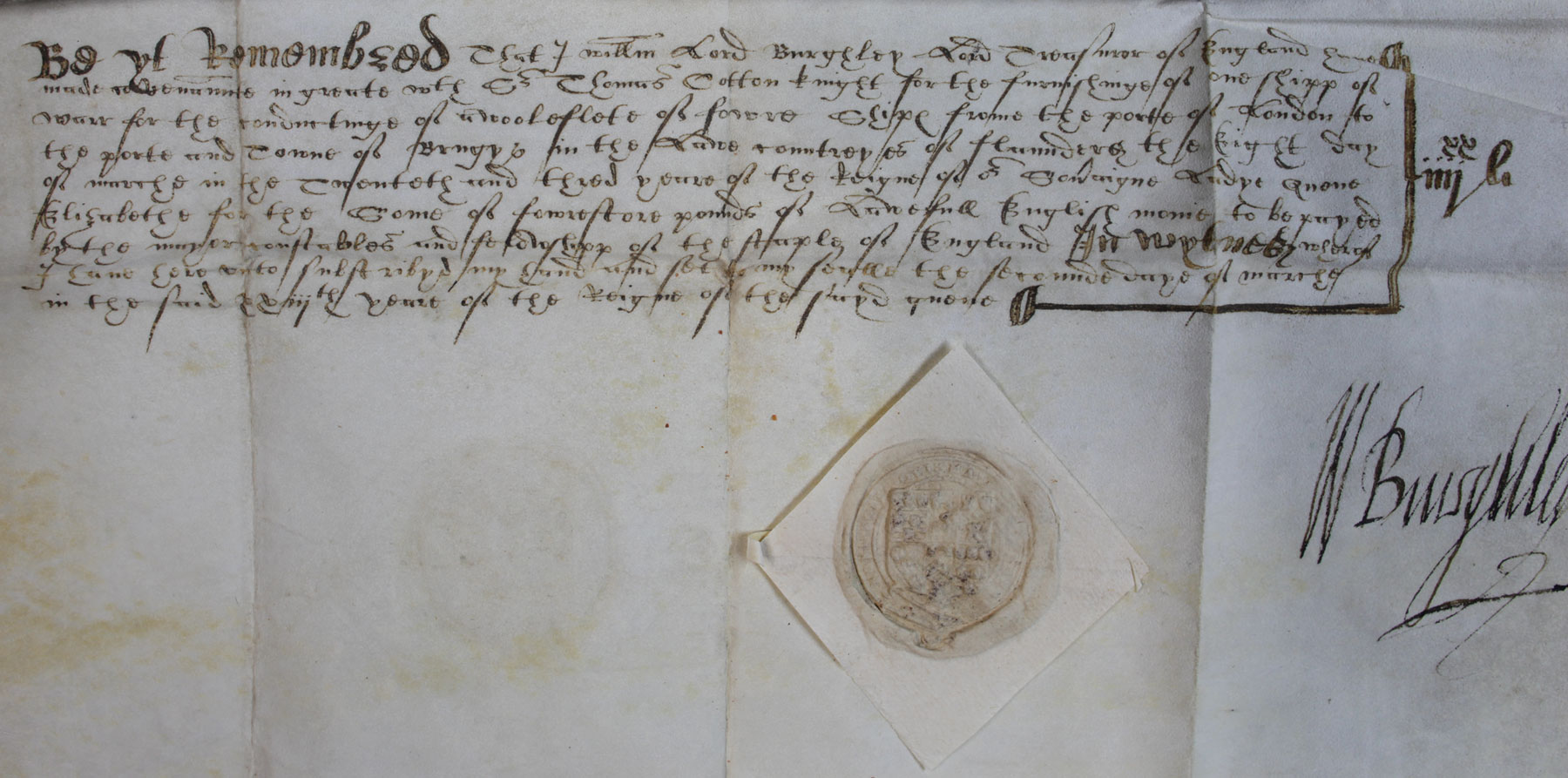
Proclamation by Lord Burghley, 2 March 1581 (E 101/668 f.48)
This proclamation by Elizabeth I’s chief minister William Cecil, Lord Burghley, assigns a warship to a wool convoy operating between London and Flanders. This protection was vital at a time of heightened international tension, when England was preparing for naval aggression by Spain. The cost of the venture was £80 (equivalent to almost £12,000 today), but given that the infrastructure of the entire wool industry depended on safe links with the continent, Burghley no doubt judged it worth the investment.
Transcript
Be yt remembred that I William Lord Burghley Lord Treasurer of England have made covenante in grant to Sir Thomas Cotton knight for the furnishing of one ship of war for the conducting of wool of late of four ships from the port of London to the porte and town of Bruges in the lowe countreyes of Flanders the eighth day of March in the twentieth and three year of the reigne of our sovereigne Ladye Quene Elizabethe for the sum of five score pounds of lawfull English monie to be payed by the mayor constables and fellowship of the staples of England. In witness whereof I have hereunto subscribed my hand and set my seale the seconde day of March in the said xxiij th yeare of the reign of the sayd Quene.
W. Burghley
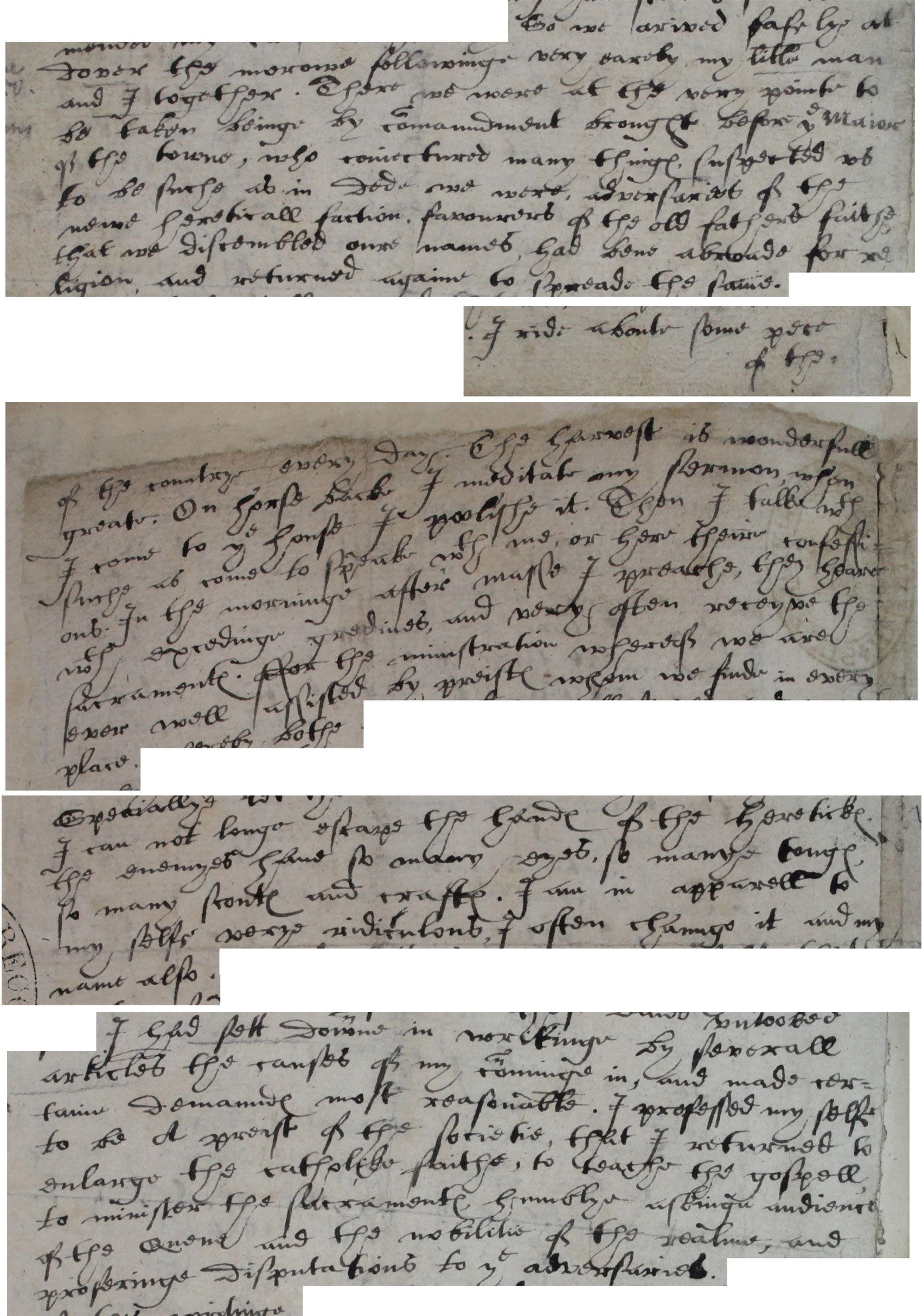
Letter from Edmund Campion to a friend (possibly Dr Allen), 1580 (SP 15/27B f117)
A substantial number of Elizabeth’s subjects still adhered to the Catholic faith. For the most part, they sustained their faith in private through spiritual reading, prayer and meditation, or the preservation of rosaries and relics. But from 1574 onwards, they had cause to hope that they might soon be able to worship more freely. From that year onwards, Elizabethan England experienced an influx of Roman Catholic missionaries from a seminary in Douai founded by William Allen, the former principal of St Mary Hall, Oxford. In June 1580, they were joined in England by the Jesuits, members of a dynamic religious order founded during the Reformation. One of the first to arrive was Edmund Campion, who had trained as a Roman Catholic priest in Dublin, Douai (in the Low Countries) and Prague. In this letter, which he may have written to his friend Allen, he describes what it was like for a Roman Catholic priest travelling in secret around England. Clearly he found many supporters, but he lived in fear of his life. The fact that this letter found its way into The National Archives suggests that the authorities were already aware of his activities. Campion was arrested at Wantage in July 1581. He was tortured, tried as a traitor and hanged.
Transcript
So we arived safelye at Dover the morowe followinge very earely my little man and I together. There we were at the very pointe to be taken beinge by comaundment brought before ye Maior of the towne, who coniectured many thinges, suspected us to be suche as in dede we were, adversaries of the
newe hereticall faction, favourers of the old fathers faithe that we discembled oure names, had bene abroade for religion, and returned againe to spreade the same…
I ride aboute some pece of the country every day. The harvest is wonderfull
greate. On Horse backe I meditate any sermons, when I come to ye house I poolishe it. Then I talke with suche as come to speake with me, or hear theire confessions. In the morninge after masse I preache, they heare with excedinge gredines, and very often receyve the sacramentes. For the ministration whereof we are ever well assisted by preistes whom we finde in every place…
I can not longe escape the handes of the heretickes the enemyes have so many eyes, so many tonges, so many scoutes. I am in apparell to my selfe verye ridiculous, I often change it and my name also…
I had sett downe in writinge by severall articles the causes of my comminge in, and made certaine demaundes most reasonable. I professed my selfe
to be A preist of the societie, that I returned to enlarge the catholike faithe, to teache the gospell, to minister the sacramentes, humblye askinge audience
of the Quene and the nobilitie of the realme, and proferinge disputations to ye adversaries.
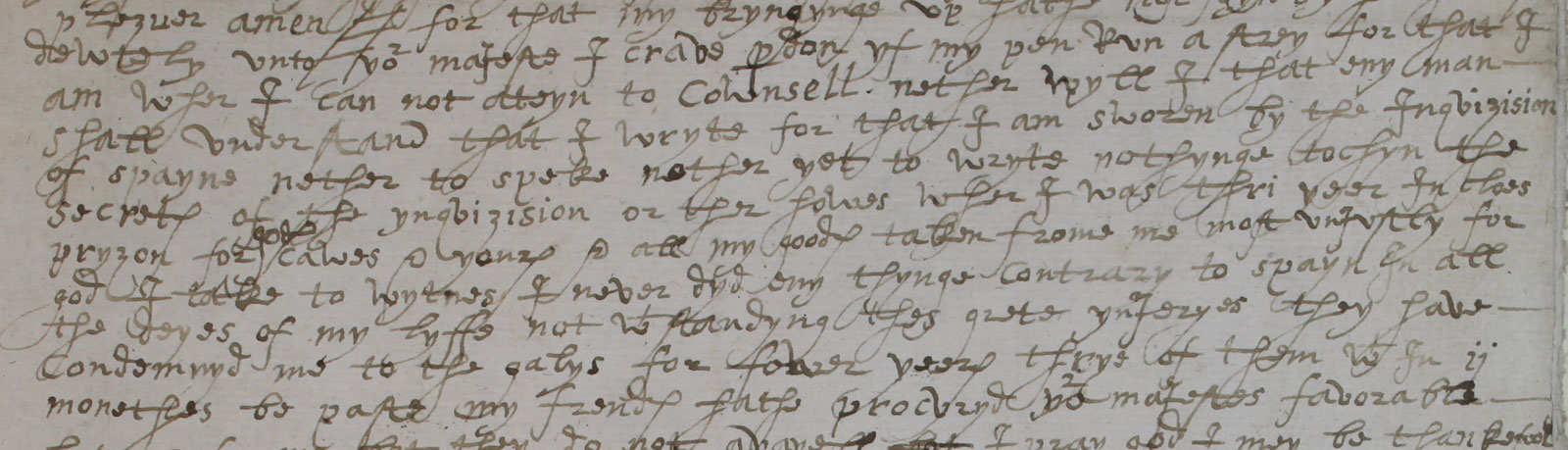
Thomas Cely to Elizabeth, 12 December 1579 (SP 94.1 f.89)
Thomas Cely, from Bristol, was one of Elizabeth’s Yeomen of the Guard and most probably also a spy for the queen. He wrote this letter from the port of Santa Maria, Andalucia, to where he had been sent by the Spanish Inquisition as a galley slave after having been put to the rack. He tells Elizabeth that he had been arrested ‘only for saying service in the churches of her Majesty’s realm and saying it in ships at sea.’ Elizabeth had already written in his favour, but Cely begs that she might do so again. Although the English queen was a religious moderate and famously declared that she had no wish to ‘make windows into men’s souls’, her reign saw the consolidation of the Protestant reforms instituted by her father’s Reformation. She was regarded as a heretic by most of Catholic Europe, and Philip II of Spain in particular, who made it his quest to conquer England and return it to papal authority.
Transcript (extract)
I am wher I can not atteyn to Cownsell, nether wyll I that eny man shall understand that I wryte for that I am sworen by the Inquizision of spayne nether yet to speke nether to wryte nothynge tochyn the secretes of the ynquizision or ther howes wher I was thri [three] yeer In cloes pryzon for godes cawes [cause] & youres & all my goodes taken frome me most unjustly for god I take to wytnes I never dyd eny thynge contrary to spayn In all the deyes of my lyffe not withstandyng thes grete injeryes [injuries] they have condemnyd me to the galys [galleys] for fower [four] yeeres the thrye [three] of them within ii monethes be paste [passed].’
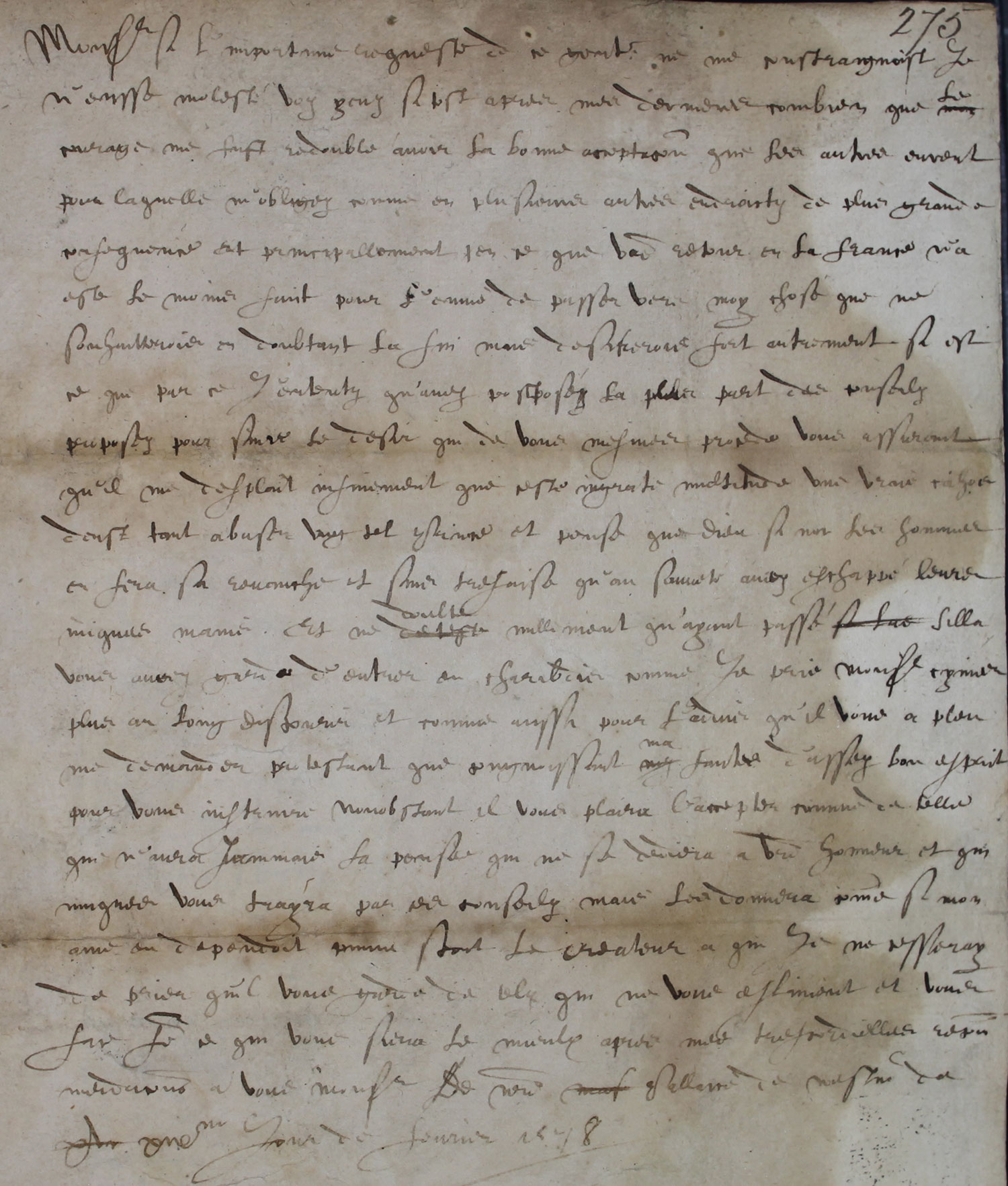
Elizabeth I to François, Duke of Alençon and Anjou, 19 February 1579 (SP 78/3 f.9)
Anjou was the last serious contender for Elizabeth’s hand in marriage. When this letter was written, Elizabeth was 45 and her suitor just 23. Despite the considerable age gap, the pair became very close – aided by the fact that the Duke was the only one of the Queen’s many suitors to court her in person. Perhaps, also, Elizabeth was aware that Anjou represented her last realistic chance of matrimony and of bearing an heir. She referred to him as her ‘frog’ and they exchanged a number of affectionate letters. Much as they wished their queen to take a husband, Elizabeth’s xenophobic subjects disapproved of Anjou and the proposed marriage caused a great deal of discontent, as is clear from this letter. Elizabeth eventually abandoned it in 1581 with apparently genuine regret.
Translation from the original French
If the urgent request of this bearer did not constrain me, I should not have annoyed your eyes with another letter so soon after my last, although my courage was doubled by the good acceptance which the others had; whereby you put me under obligation, as on other occasions of more consequence. Of which your return to France in consequence of your wish to come to me has not been the least. It was not a thing I should have wished, fearing how it might end; but my desire would be quite other if I am to understand by it that you have set aside most of the advice in order to follow the desire which proceeds from yourself. I assure you I am much displeased that that ungrateful multitude, a true mob, should so misuse such a Prince; and I think that God, if not men, will be revenged on them for it, and am glad that you have safely escaped their iniquitous hands. Nor do I doubt that having passed Scylla you will beware of entering Charybdis, as I beg M. Simier [Anjou’s envoy] to set out to you at more length, as also in respect of the advice which you have asked of me; protesting that though I recognise by lack of wit to instruct you, you may accept it as from one who will never have a thought not dedicated to your honour and will never betray you by her advice, but will give it as if my soul depended thereon.
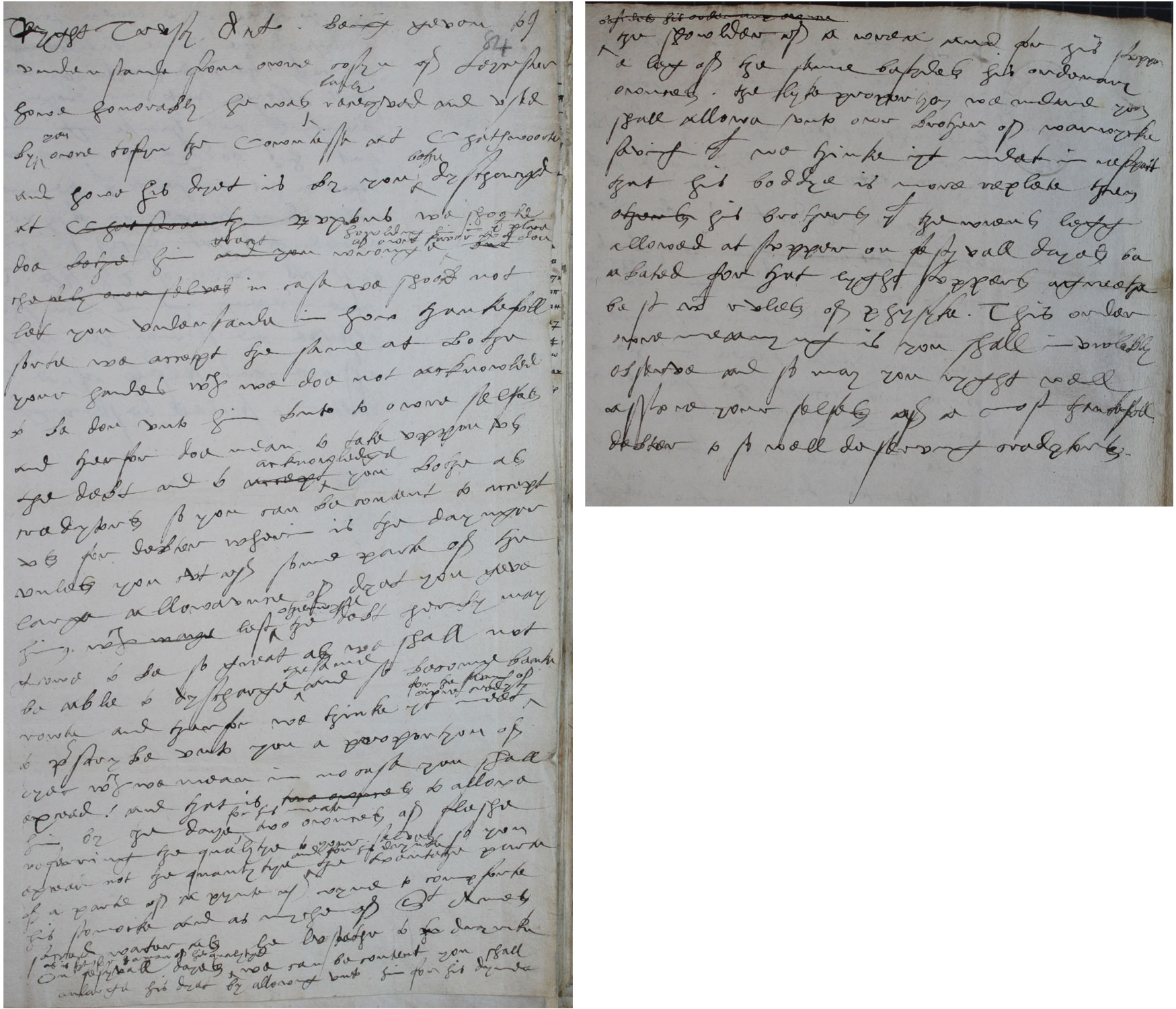
Elizabeth I to George and Elizabeth ‘Bess’ Talbot, Earl and Countess of Shrewsbury, 4 June 1577 (SP 53/10 f.84)
Elizabeth has gone down in history as the Virgin Queen. In stark contrast to her much-married father, she famously declared: ‘I will have but one mistress here, and no master.’ During the course of her long reign, she was besieged by many suitors but gave each one nothing more than ‘fair words but no promises.’ Yet it is generally accepted that there was one man who, more than any other, tempted Elizabeth to relinquish her virgin state: Robert Dudley, Earl of Leicester, to whom she had been close since childhood. Their tempestuous relationship endured for almost 50 years, and the obvious intimacy that existed between the couple prompted endless gossip. Even though she probably remained the Virgin Queen, Elizabeth loved Dudley above all others and missed him whenever he was away from court, as this letter proves. Dudley had stayed with the Earl and Countess whilst visiting Buxton baths for his health. The queen wrote them this lighthearted letter thanking them for their hospitality and prescribing an abstemious diet for her favourite.
Transcript
Right trusty etc. Being geven to understand from owre cosyn of Leycester howe honorably he was lately receyved and used by you, our cosyn the Cowntesse at Chatswoorth, and howe his dyet is by you bothe dyscharged at Buxtons we should doe him great wrong holding him in that place of our favour as we do in case we should not let you understande in how thankfull sorte we accept the same at bothe your handes which wee doe not acknowledg to be done unto him but to owre selves, and therefore doe mean to take uppon us the debt and to acknowledge you bothe as credytors so you can be content to accept us for debtor wherin is the daynger unless you cut off some part of the large allowance of dyat you geve him, lest otherwyse the debt thereby may growe to be so great as we shall not be able to dyscharge the same, and so become bankrowte [bankrupt] and therefore we thinke yt meet for the saving of owre credyt to prescribe unto you a proportyon of dyet which we mean in no case you shall exceed, and that is to allow him by the daye for his meate two ounces of fleshe, reserving the qualytye to your selves so as you excead not the quantytye, and for his drynke the twentyeth parte of a pynte of wyne to comforte his stomacke and as muche of St Anne’s sacred water [probably May dew; early morning dew gathered during May and early June was believed to have special healing powers] as he lystethe to drynke. On festyvall dayes, as is fyt for a man of his qualyty, we can be content you shall enlarge his dyat by allowing unto him for his dynner the shoulder of a wren and for his supper a leg of the same, besides his ordinary ownces. The lyke proportyon we meane you shall allowe unto our brother of Warwycke [Ambrose Dudley, Earl of Warwick, the older brother of Robert] saving that we thinke yt meet that in respectt that his boddye is more replete than his brothers that the wren’s legg allowed at supper on festyvall dayes be abated for that lyght supper agreeth best with rules of physyke. This order owre meanyng is you shall inviolably observe and so may you ryght well assure your selves of a most thankfull debtor to so well deserving a credytor.
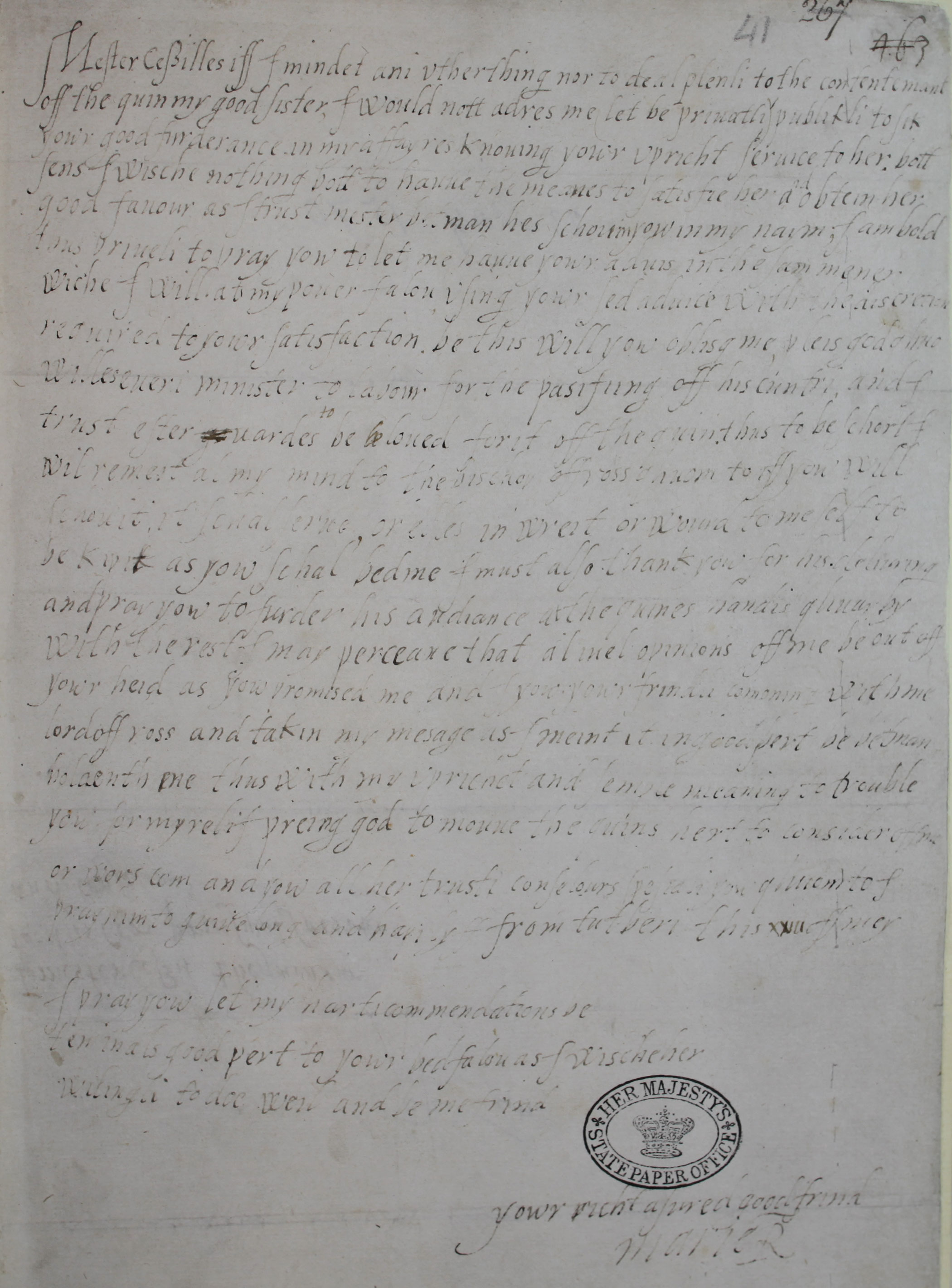
Mary, Queen of Scots to Sir William Cecil, Tutbury, 23 May 1570 (SP53/5 f.72)
Some of Mary’s letters to Cecil during her imprisonment are written in Scottish-English, like this one; others are in French. She refers to John Leslie, bishop of Ross, who was her ambassador to Elizabeth. Leslie also carried on intrigues with her supporters in Scotland and abroad. Early in 1570, he was arrested on suspicion of involvement in the Northern Rebellion, but was freed after four months for lack of evidence. Tutbury Castle was one of several locations where Mary was held prisoner. She was first taken there in February 1569 and complained of its cold, draughty and damp rooms, which she claimed aggravated her already delicate health.
Transcript
‘Mester Cessilles, iff I mindet ani uther thing nor to deal plenli to the contentemant off the quin, my good sister, I would nott adres me (let be privatli) publikli to sik yowr good furderance in my affayres, knouing yowr upricht service to her, bott sens I wische nothing bott to havve the meanes to satisfie her and obtein her good favour… I am bold thus priveli to pray yow to let me havve yowr advis in the sam mener, wiche I will at my pouer falou, using yowr sed advice with the discretion required to yowr satisfaction. Be this will yow oblisg me, pleis God, qhuo [who] willes everi minister to labour for the paisifiing of his cuntri, and I trust efteruardes to be beloved for it off the quin… I must also thank yow for his delivring and pray yow to furder his audiance at the quine’s handis, qhuarby [whereby] with the rest I may perceave that al ivel opinions off me be out off your heid, as yow promised me and I yow… preing god to move the quins hert to considere of me or wors com … I pray yow let my harti commendations be ten in als good pert to yowr bedfalou [bedfellow], as I wisch her wilingli to doe weil and be me frind.
Your richt assured good frind Marie R.
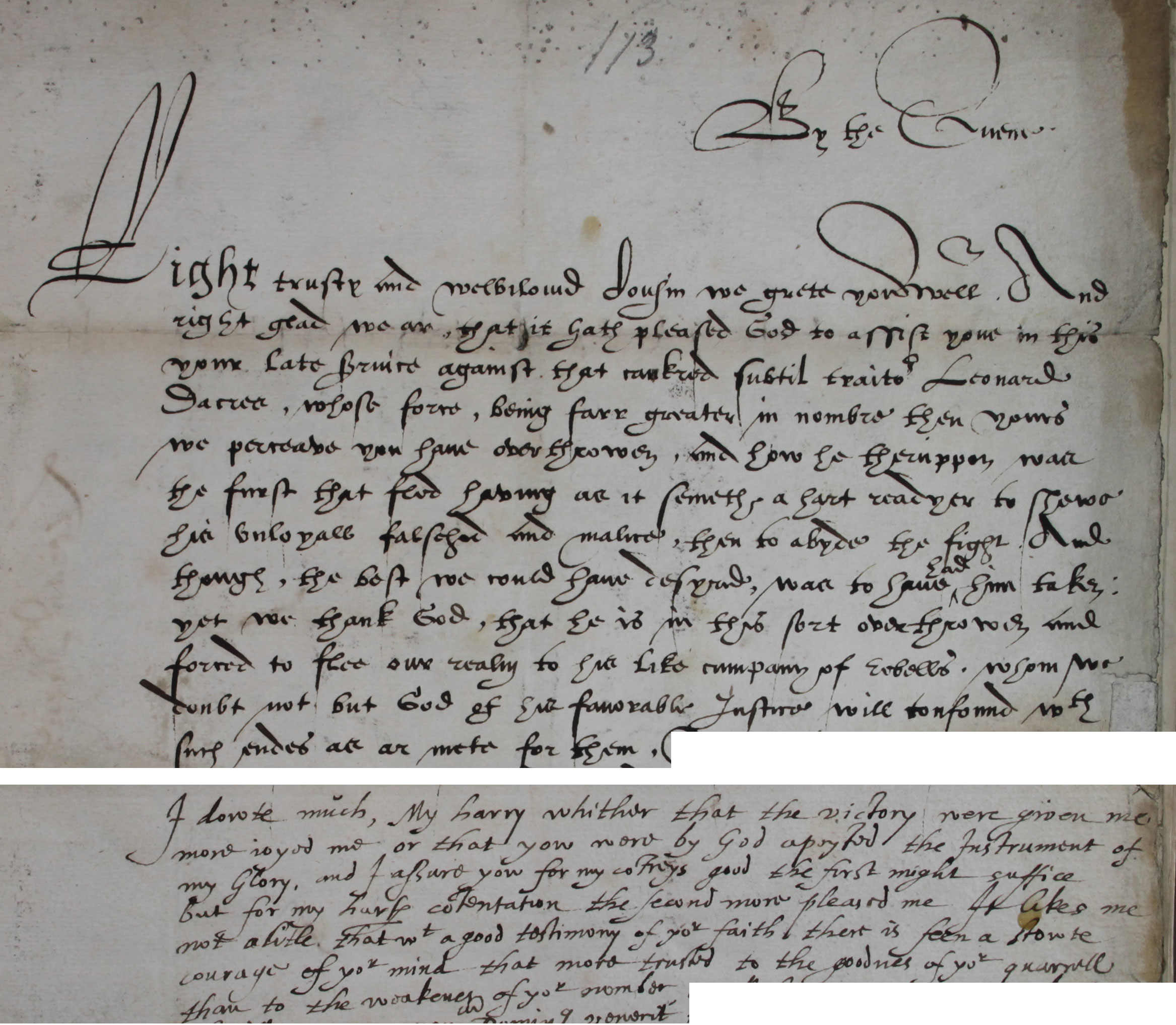
Elizabeth I to Henry Carey, Lord Hunsdon, 26 February 1570 (SP 15/17 f.263)
As a prisoner on English soil, Mary Queen of Scots was even more of a threat to Elizabeth than she had been in Scotland. Now she was tantalisingly within reach for all of the powerful Catholic nobles who wanted to oust the ‘heretical’ Elizabeth from the throne and replace her with her Scottish cousin. One of the first rebellions against Elizabeth’s regime was the Rising of the North in November 1569, led by the Earls of Northumberland and Westmorland. Although it was quickly suppressed, the investigation proved that the tendrils of revolt had spread wider than had first appeared. Another prominent nobleman, Leonard Dacre, had been deeply involved, and when Lord Hunsdon was sent to arrest him, Dacre and his followers engaged him in battle. They were defeated, and Dacre fled to Scotland. In this letter, Elizabeth thanks Hunsdon, who was her first cousin, being the son of Mary Boleyn. It was written the day after Pope Pius V issued a bull of excommunication against Elizabeth, which effectively sanctioned her assassination by those subjects who stayed loyal to the Roman Catholic faith.
Transcript (extract)
[Draft by Lord Burghley] Right trusty and welbeloved cousin we grete you well. And right glad we ar, that it hath pleased God to assist youe in your late service against that cankred subtil traitor Leonard Dacres, whose force, being farr greater in nombre then yours we perceave you have overthrowen, and how he thereuppon was ye first that fled having as it semeth a hart readyer to shewe his unloyall falshood and malice, then to abyde the fight. And though, the best we cold have desyred, was to have had hym taken: yet we thank God that he is in this sort overthrowen and forced to flee oure realme, to his lyke company of rebells, whom we doubt not but God of his favourable Justyce will confounnd with such endes as ar mete for them…
[Added by Elizabeth in her own hand] I dowte much, my Harry whither that the victory were given me more ioyed [joyed] me, or that yow were by God appoynted the Instrument of my Glory, and I assure yow for my countreys good the first might suffice but for my hartes contentation, the second more pleased me. It likes me not a litle that, with a good testimony of your faith, there is seen a stowte courage of your mind, that more trusted to the goodness of your quarrell than to the weakness of your nomber…