Elizabeth I to Lord Henry and Lady Margery Norris, 6 September 1599 (SP 12.272 f.161)
Lord and Lady Norris had suffered badly as a result of Elizabeth’s wars in Ireland. Four of their sons had already died in the queen’s service, most recently Henry and Sir Thomas. Only Sir Edward now survived, and Elizabeth recalled him from Ireland to comfort his grieving parents.
Transcript
Right trustie and wellbeloved, and right deare and wellbeloved we greet you well. The bitter accident lately befallen you, which is the cause of our writing seeing it touches you both with equall smart, And our desire that all the comfort whiche we wishe to you, may reach to each of you with like effect is the cause that we have coupled you togither in our letter. Lothe we were to have written at all, because in such accidentes (for the most part) the offering of comfort is but the presenting of freshe occasion of sorrowe. But yet being well persuaded of your constant resolution, grounded aswell on the experience of other lyke mishaps, which your yeares have seene, as also chiefly uppon your religious obedience to the work of His handes, whose strokes are unavoydable: we could not forbeare to doe our part, partly because we conceave that we shall therein propose our self for our example to you, our losse in political respect… being no less than yours in naturall consideration; And partly by giving you assurance that whatsoever from us may minister comfort by demonstrating towardes […] of you the value we made of the departed shall not faile to be employed to your best contentmentes; assuring you that this hard happe of yours shall rather serve us for matter to increase our care of you then anie waye to abate it. And because that we knowe it would be some staye to your sorrows to have him in your eyes, who is in forraine partes, we will give order that as soon as possibly he may leave his chardge in good sort, he shalbe with you to yield you all duty and service he may.
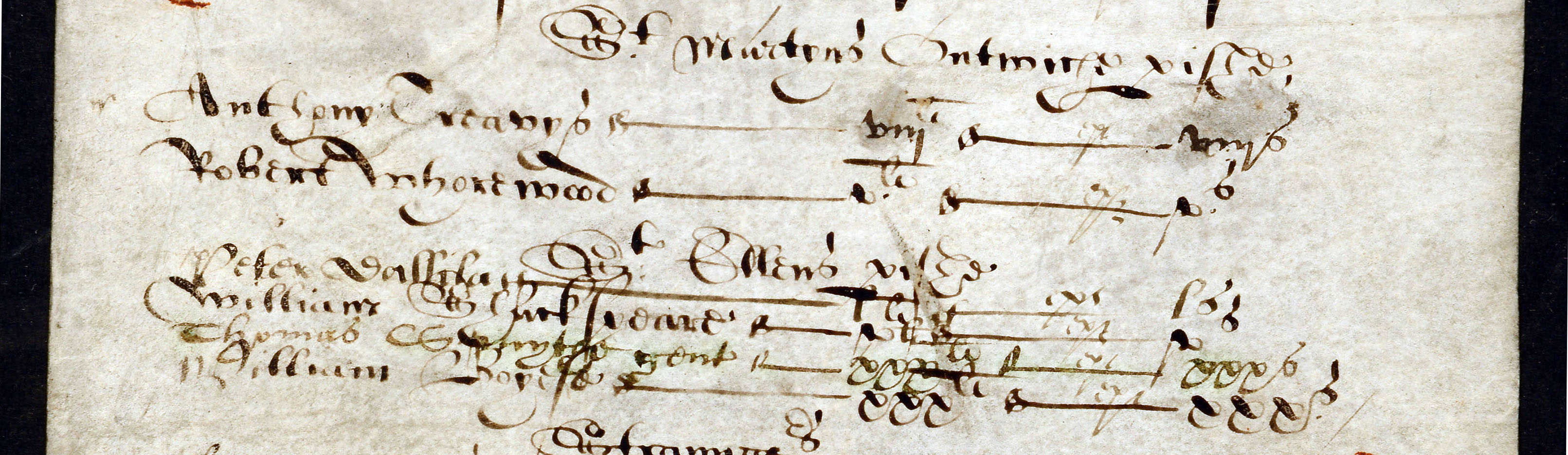
Shakespeare the tax evader: extract from a certificate by London tax commissioners, 1597 (E 179/146 f.354)
The Elizabethan age was characterised by a vibrant cultural life. The queen loved the arts in all their forms and inspired a host of poets and playwrights, many of whom performed for her at court. Foremost among them was William Shakespeare. Born in Stratford-upon-Avon in 1564, the ‘bard’ had moved to London by the early 1590s. What was probably his first play, Henry VI Part I, was performed in 1592 at the Rose Theatre in Southwark. Five years later, he and his company, the Lord Chamberlain’s Men, gave a private performance of ‘Love’s Labours Lost’ for Elizabeth I. Many more would follow. Although Shakespeare enjoyed great prosperity as a result of his plays, and their patronage by the queen, he regularly failed to pay his taxes. This entry is one of several similar ones in The National Archives.
Transcript
St Martyns Outwhiche parishe
Anthony Treavys………viii li ……viii s
Robert Whorewood…….. v li …… v s
St Ellens parishe
Peter Dallila……….. l li ……. l s
William Shackspeare…….. v li…….. v s
Thomas Smythe gent…….. xxx li …… xxx s
William Boyele……….. xxx li …… xxx s
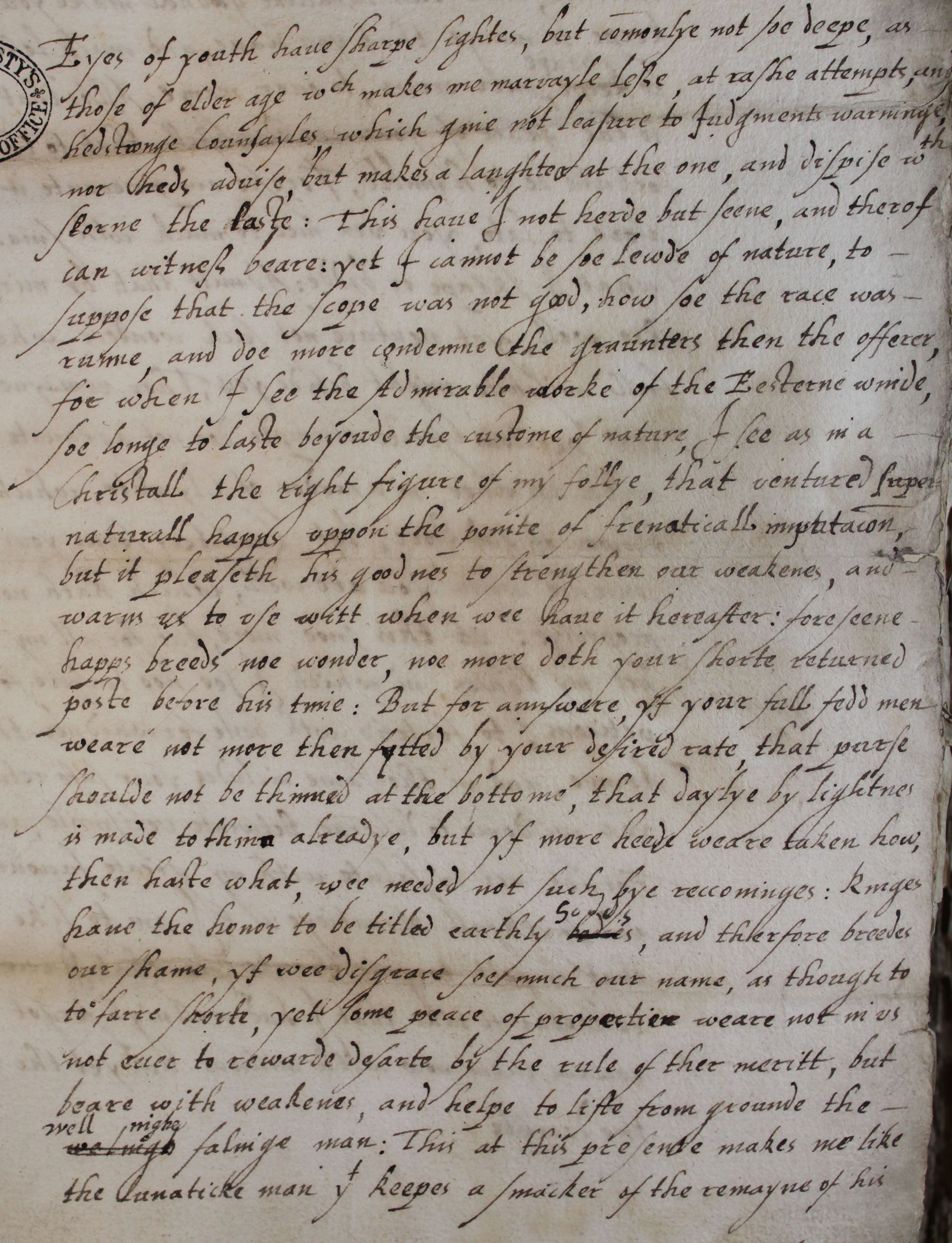
Elizabeth to Robert Devereux, Earl of Essex, July 1597 (SP 12/264 f.19)
In the summer of 1597, Essex led an expedition to the Azores, with Thomas Howard, Earl of Suffolk as Vice-Admiral and the celebrated adventurer Sir Walter Ralegh as Rear-Admiral. The purpose was to capture the gold and silver Spanish fleet of bullion returning from America at the bay of Angra in the Portuguese Azores Archipelago under King Phillipe’s rule. The English fleet was soon battered back by violent winds that inflicted considerable damage upon the ships. When she heard of this, Elizabeth wrote to advise Essex to proceed with caution. Her superior wisdom is evident in this letter to her impetuous young favourite, who was more than 30 years her junior. But Essex went on to defy his queen’s orders by pursuing the treasure fleet without first defeating the Spanish treasure fleet. His expedition, the last major naval campaign of Elizabeth’s reign, was an utter failure and he returned home in deep disgrace.
Transcript
Eyes of youth have sharpe sightes, but commonlye not soe deepe, as those of elder age which makes me marvayle lesse, at rashe attempts, and hedstronge Counsayles, which give not leasure to Judgments warning, nor hede advise, but makes a laughter at the one, and dispise with scorne the laste: This have I not herde but seene, and therof can witness beare: yet I cannot be soe lwede of nature, to suppose that the scope was not good, how soe the race was runne, and doe more condemne the graunters then the offerer, for when I see the Admirable worke of the Easterne winde, soe longe to laste beyonde the custome of nature, I see as in a Christall the right figure of my follye, that ventured supernaturall happs uppon the pointe of frenaticall imputacion, but it pleaseth his goodness to strengthen our weakenes, and warns us to use witt when wee have it hereafter: foreseen happs breeds noe wonder, noe more doth your shorte returned poste before his time: But for aunswere, yf your full fedd men weare not more then fytted by your desired rate, that parse [purse] shoulde not be thinned at the bottome, that daylye by lightnes is made to thinn alreadye, but yf more heede weare taken how, then haste what, wee needed not such bye recconinges: Kinges have the honor to be titled earthly godds, and therfore breedes our shame, yf wee disgrace soe much our name, as though to to [too too] farre shorte, yet some peace of properties weare not in us not ever to rewarde desarte by the rule of ther merit, but beare with weakenes, and helpe to life from grounde the well nighe falinge [falling] man: This at this presente makes me like the lunaticke man that keepes a smacker [ie taste] of the remayne of his frenzies freake, helpt well therto by the influence of sol in leone [‘the sun in the lion’ – ie the constellation Leo, during the hottest part of the summer], that makes me yealde for Companye to a longer proporcion, then a wiser in my place woulde ever graunte unto, with this caveate, that this lunaticke goodnes make you not boulde to keepe to manye that you have, and much lesse take in more to heape more errors, to over manye, Allsoe that you truste not to the grace of your crazed [ie cracked] vessell, that to the ocean maye fortune to be to humble, Foresee and prevente it now in tyme, afore to late, you vex mee to much with smale regarde of what I skrape or bidde. Admitt that by miracle it woulde doe well, yet venture not such wonders where such approachfull mischife might betyde you, Ther remaynes that you after your perilous firste attempte doe not agravate that danger with an other in a farder of Clymate, which muste coste blowes of good sstore, let Caracters serve your turne, and be contente when you are well, which hath not ever bene your propertye: of this noe more, but for all my moodes, I forget not my Tenses [ie times – a pun upon moods and tenses in the grammatical sense], in which I see noe leasure for ought but peticions, to fortefie with beste forwardnes the wants of this Armye, and in the same include your safe returne, and graunte you wisdom to discerne betwixte verisimile [probably], and potest fieri [it can be done], Forget not to salute with my greate favoure good Thomas and faythfull Mountjoye [Sir Thomas Baskerville and Charles Blount, Lord Mountjoy, both of whom were serving under Essex]: I am to like the common faction that forgett to give thankes for what I receaved but I was soe loathe to take that I had wellnigh forgot to thank but receave them now with millions and yet the wrest [rest] keepes the deareste.
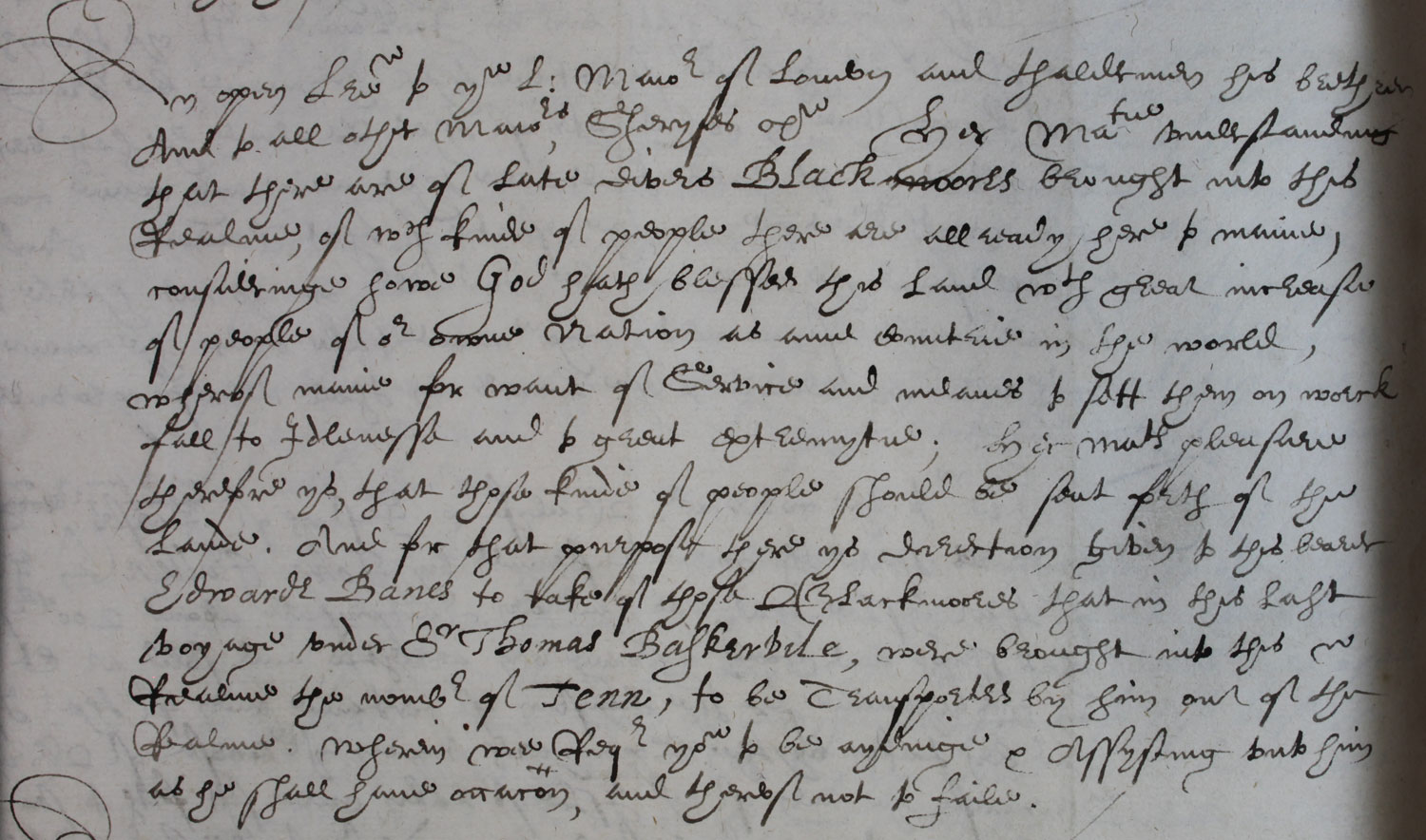
Open letter by Elizabeth I to the mayors of England, 11 July 1596 (PC 2/21 f.304)
During the Elizabethan period, the employment of Africans became increasingly common in England. They served in wealthy households as footmen or musicians, and the queen herself retained a black maidservant. But during the 1590s, Elizabeth issued a series of proclamations ordering the expulsion of black people from her realm. They were increasingly used as scapegoats by the queen and her ministers for the social ills that dogged the later years of her reign. The harvests repeatedly failed, which brought hunger and disease, and sparked a sharp rise in poverty and vagrancy. Fearing disorder and a breakdown of society, in 1597 Elizabeth passed an Act for the Relief of the Poor. This was followed by a similar act four years later which created a national poor law system for England and Wales.
Transcript
An open le[tt]re to the L[ord] Maiour of London and th’alermen his brethren, And to all other Maiours, Sheryfes, &c. Her Ma[jes]tie understanding that there are of late divers Blackmoores brought into the Realme, of which kinde of people there are all ready here to manie, consideringe howe God hath blessed this land w[i]th great increase of people of our owne Nation as anie Countrie in the world, wherof manie for want of Service and meanes to sett them on worck fall to Idlenesse and to great extremytie; Her Ma[jesty’]s pleasure therefore ys, that those kinde of people should be sent forthe of the lande. And for that purpose there ys direction given to this bearer Edwarde Banes to take of those Blackmoores that in this last voyage under Sir Thomas Baskervile, were brought into this Realme to the nomber of Tenn, to be Transported by him out of the Realme. Wherein wee Req[uire] you to be aydinge & Assysting unto him as he shall have occacion, and thereof not to faile.
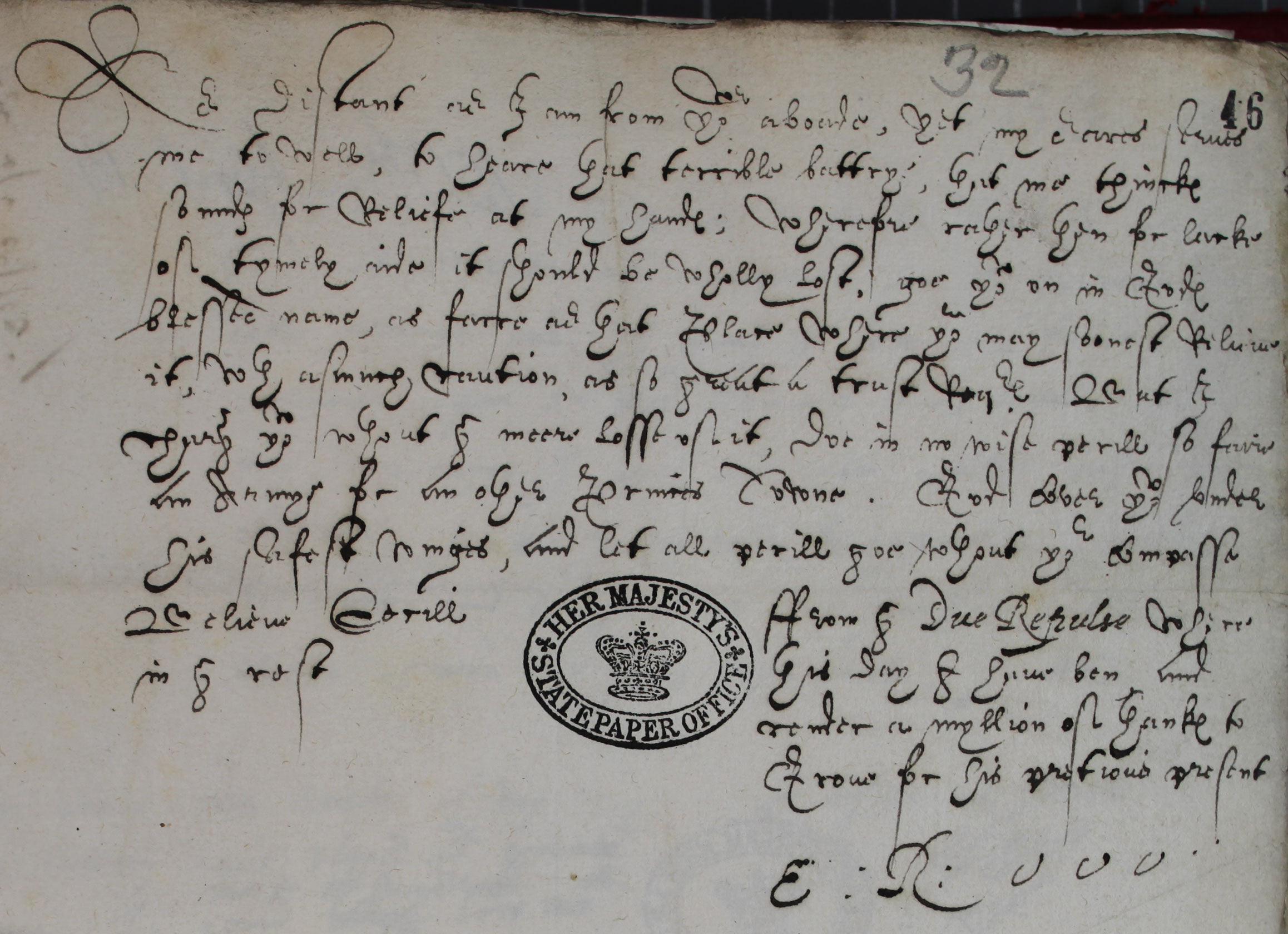
Elizabeth I to Robert Devereux, Earl of Essex, 14 April 1596 (SP 12/257 f.46)
Throughout the winter and spring of 1595-6, great preparations were being made for a combined naval and military expedition against Spain. Although the first Armada had been soundly beaten in 1588, a second was feared imminent. At the beginning of April, news reached Elizabeth that Archduke Albert of Austria, Governor-General of the Spanish Netherlands, was preparing to lay siege to Calais, which had been held by France since its loss by Elizabeth’s sister Mary in 1558. The Earl of Essex, Elizabeth’s last great favourite, and Lord Charles Howard, the Lord Admiral, hastened down to Dover to collect all available troops and ships. But the queen, ever averse to expensive foreign wars, hesitated and haggled over the terms on which her help should be given. On 14 April the noise of the cannonade was heard in London and the order to embark was given. But no sooner had the troops boarded the ships than news came that Calais had fallen.
Transcript
As distant as I am from your abowde, yet my eares serves me too well, to heare that terrible battery that methinkes sounds for relief at my handes; wherefore rather than for lacke of tymely aide it should be wholly lost, goe you on in God’s Blessed name, as farre as that place where you may soonest relieve it, with asmuch caution, as so great a trust requires. But I charge you without the mere losse of it, doe in no wise perill so faire an Armye for another Prince’s Town. God cover you under His safest winges, and let all perill goe without your Compasse. Believe Cecill in the rest.
From the Due Repulse, where this day I have ben, and render a myllion of thankes to Grove for his precious present.
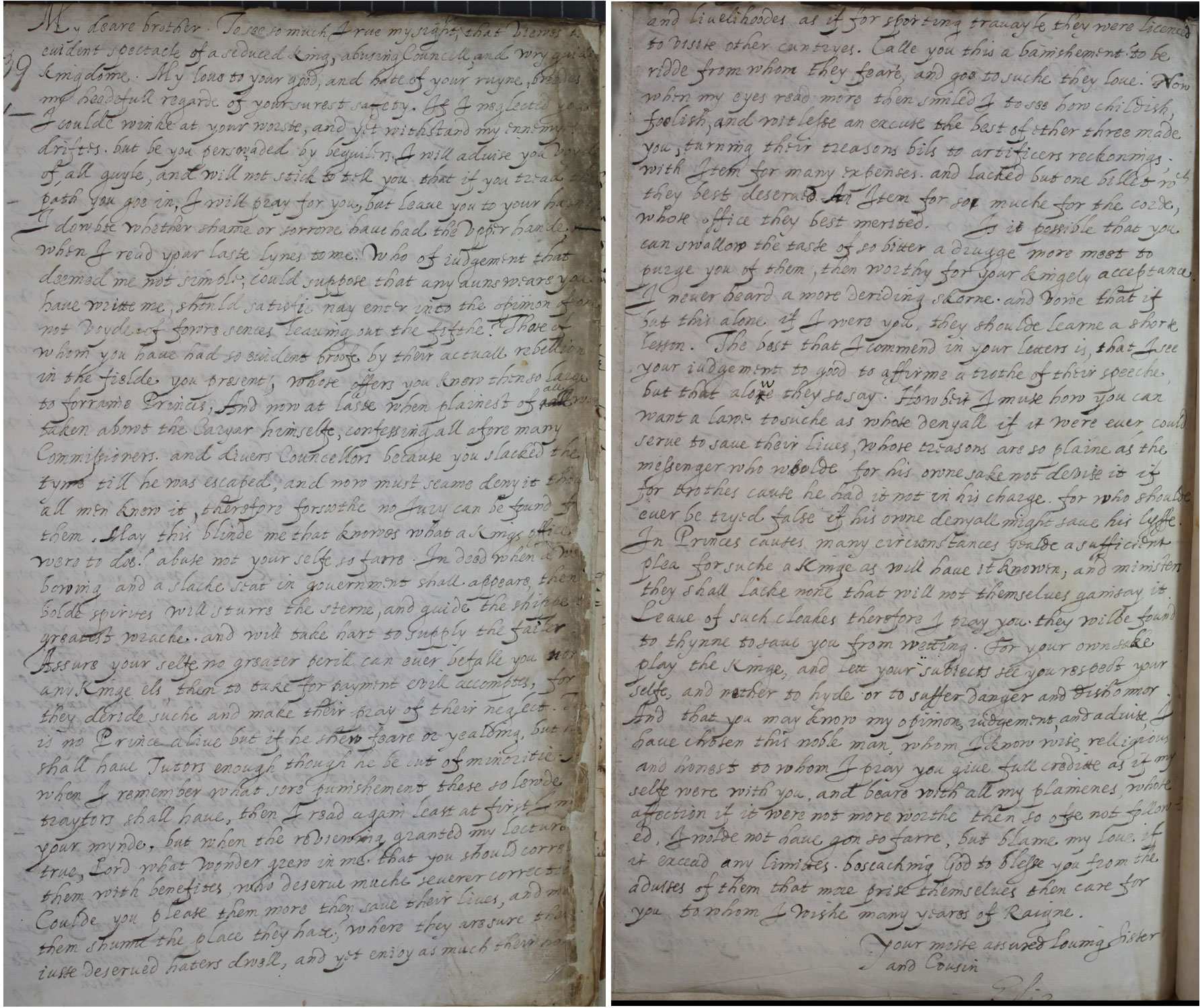
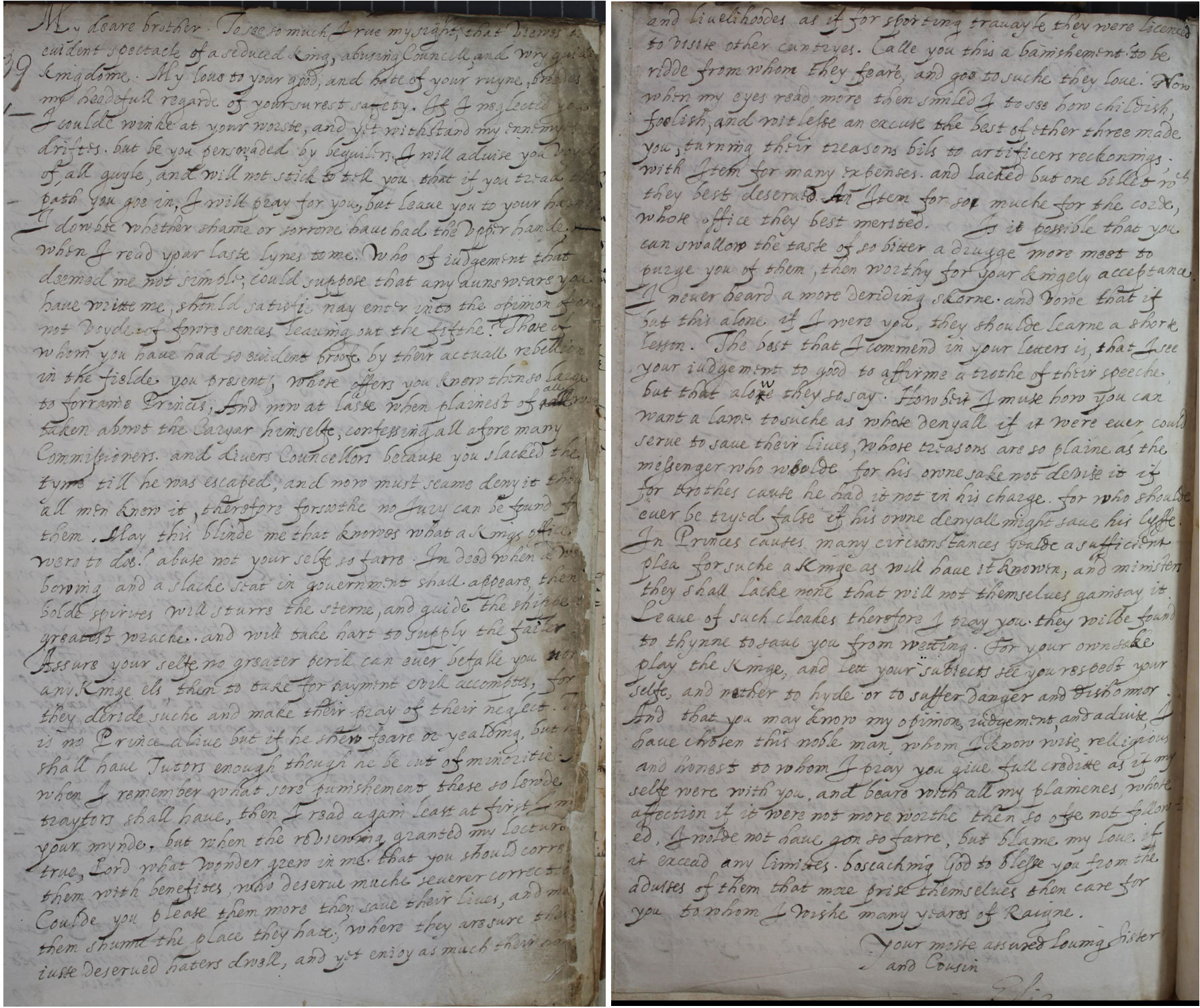
Elizabeth I to James VI of Scotland, 22 December 1593 (SP 52/51 f.75)
Edward de la Zouche, Baron Zouche of Harringsworth, was Elizabeth’s last emissary to James. He was granted an audience with the King of Scots on 15 January 1594, which is probably when this letter was delivered. In it, Elizabeth complains of James’s leniency towards the earls of Huntly, Errol and Angus, who were known to be in league with her chief enemy, Spain. The earls had also been implicated in the affair of the ‘Spanish blanks’, a Catholic plot by the Scottish Jesuits to welcome 30,000 Spanish troops from the Netherlands in Scotland, 4,000 of which were to establish Catholic control there and the rest were to advance south to England. The name of the plot derives from the fact that several of James’s Catholic earls had signed blank letters that gave carte blanche to the Spaniards.
Transcript
My deare brother. To see so much I rue my sight, that viewes the evident spectacle of a seduced king, abusing Councill, and wry guided kingdome. My love to your good, and hate of your ruyne [ruin], breedes my heedefull regarde of your surest safety. If I neglected you I coulde winke at your worste, and yet withstand my ennemyes driftes. But be you perswaded by beguilers, I will advise you voyde of all guyle [guile], and will not stick to tell you that if you tread the path you goe in, I will pray for you, but leave you to your harms. I dowbte whether shame or sorrowe have had the upper hande, when I read your laste lynes to me. Who of judgement that deemed me not simple, could suppose that any aunswears you have writte me, should satisfie nay enter into the opinion of one not voyde of sences leaving out the fifthe? Those of whom you have had so evident proofe by their actuall rebellion in the fielde you present [probably ‘preserve’], whose offers you knew then so large to forraine Princes, And now at laste when plainest of all was taken abowt the Caryer himselfe [George Ker, the messenger in the ‘Spanish blanks’ affair], confessing all afore many Commissioners and divers Councellors because you slacked the tyme till he was escaped, and now must seame deny it though all men knew it, therefore forsoothe no Jury can be found for them. May this blinde me that knowes what a Kings office were to doe? Abuse not your selfe so farre. In deed when a weake bowing and a slacke seat in government shall appeare, then bolde spirites will sturre the sterne, and guide the shippe to greatest wrecke, and will take hart to supply the failer [failure]. Assure your selfe no greater perill can ever befalle you nor any King eels, then to take for payment evill accomptes, for they deride suche and make their pray of their neglect. There is no Prince alive but if he shew feare or yealding, but he shall have Tutors enough though he be out of minoritie. And when I remember what sore punishement these so lewde traytors shall have, then I read again least at first I mistook your mynde, but when the reviewing granted my lecture true, Lord what wonder grew in me that you should correct them with benefites, who deserve muche severer correction. Coulde you please them more then save their lives, and make them shunne the place they hate? Where they are sure their juste deserved haters dwell, and yet enjoy as much their honors and livelihoodes as if for sporting travayle [travel] they were licenced to visite other cuntryes. Calle you this a banishment? To be ridde from whom they feare, and goe to suche they love. Now when my eyes read more then smiled I to see how childish, foolish, and witlesse an excuse the best other three made you, turning their treasons bils [bills] to artificers reckonings; with item for many expenses. And lacked but one billet which they best deserved – An item for so muche for the corde, whose office they best merited. Is it possible that you can swallow the taste of so bitter a drugge more meet to purge you of them; then worthy for your kingely acceptance. I never heard a more deriding skorne and vowe that if but this alone if I were you, they shoulde learne a shorte lesson. The best that I commend in your letters is, that I see your judgement to good to affirme a trothe of their speeche, but that allow they so say. Howbeit I muse how you can want a lawe to suche as whose denyall if it were ever, could serve to save their lives, whose treasons are so plaine as the messenger who woulde for his owne sake not devise it if for trothes cause he had it not in his charge. For who shoulde ever be tryed false if his owne denyall might save his lyffe. In Princes causes many circumstances yealde a sufficient plea for suche a Kinge as will have it knowen, and ministers they shall Lacke none that will not themselves gainsay it. Leave of [off] such cloakes therefore I pray you – they wilbe found to [too] thynne [thin] to save you from wetting. For your own sake play the Kinge, and let your subjects see you respect your selfe, and nether to hyde or to suffer danger and dishonnor. And that you may know my opinion, judgement, and advise, I have chosen this noble man, whom I know wise, relligious, and honest to whom I pray you give full creditte as if my selfe were with you, and beare with all my plainenes, whose affection if it were not more worthe then so ofte not followed, I wolde not have gon so farre, but blame my love if it excead any limittes. Beseaching God to blesse you from the advises of them that more prise themselves then care for you to whom I wishe many yeares of Raigne.
Your moste assured loving Sister and Cousin, Elizabeth.
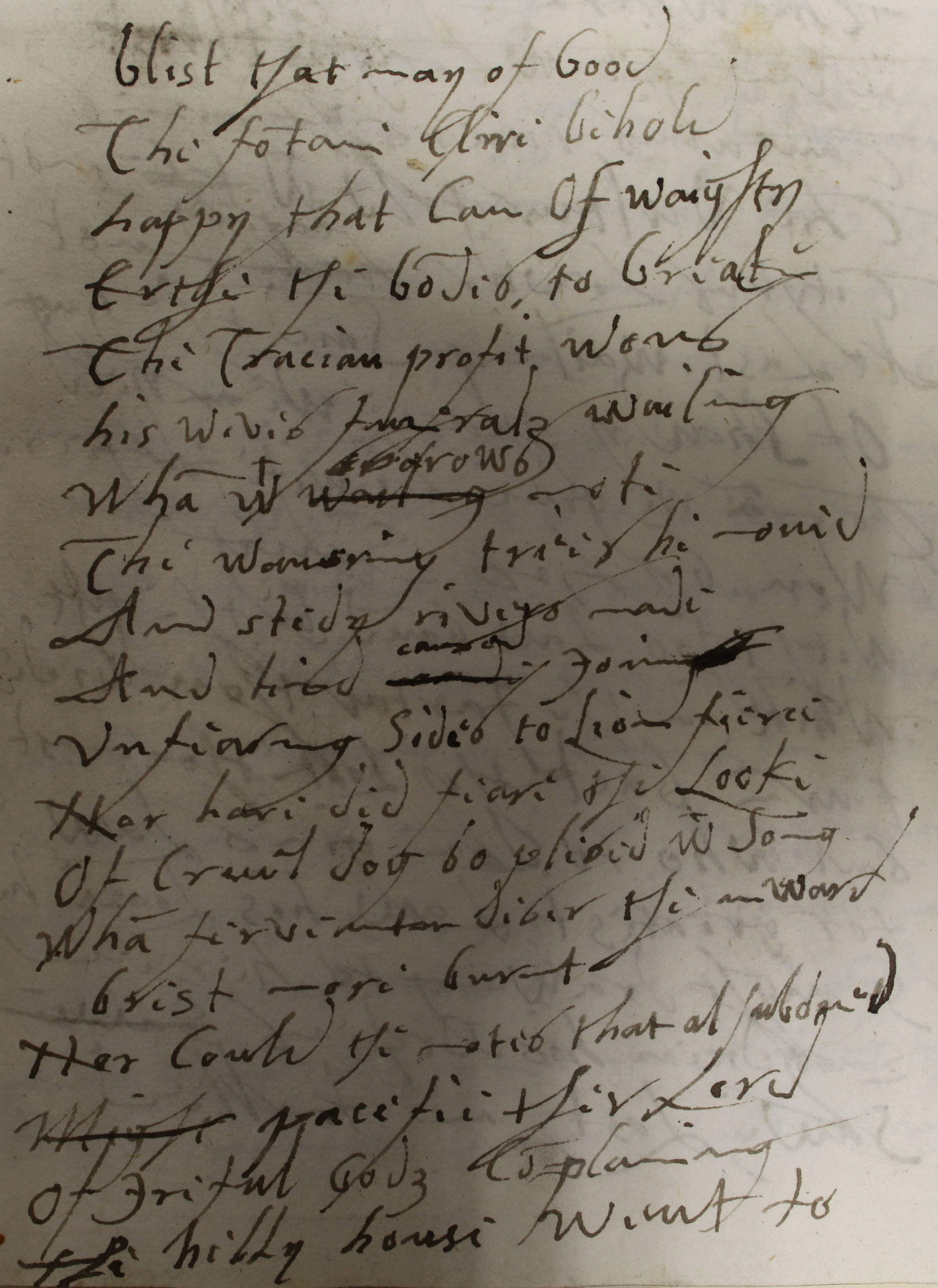
Elizabeth’s translation of Boethius’s De Consolatione Philosophie (The Consolation of Philosophy), October and November 1593 (SP 12/289 f.48)
Elizabeth had an exceptional intellect and had always loved learning for its own sake. From the age of five, she had been taught a range of languages, including Latin and Greek, and she loved to make translations of classical authors. It was clearly an abiding passion because the translation shown here was undertaken by the queen shortly after her sixtieth birthday. There is no evidence that it was intended for circulation, but rather for the pleasure that it gave her. She worked on it while staying at Windsor Castle in the autumn of 1593 and began writing it all in her own hand. After a few pages, however, she started dictating the prose sections to her secretary, Thomas Windebank, while continuing to write the verse herself. Boethius’s work had been written from prison during the closing years of the Roman Empire. It had already been ‘Englished’ by authors such as King Alfred, Geoffrey Chaucer and William Caxton. The following verse, in Elizabeth’s hand, uses the example of Orpheus to show that the light of truth may be lost by returning to darkness.
Transcript
blist that may of Good
The fontaine Clire behold
happy that Can of weighty
Erthe the bondes to breake
The Tracian profit wons
his wives funeralz wailing
Whan with sorows note
The wavering trees he moved
And stedy rivers made
And hind caused Join
Unfearing Sides to Lion fierce
Nor hare did feare the Looke
Of Cruel dog so plised with Song
Whan ferventar desir the inward
brest more burnt,
Nor Could the notes that al subdued
Pacefie ther Lord
Or Ireful Godz Complaining
The helly house went to…
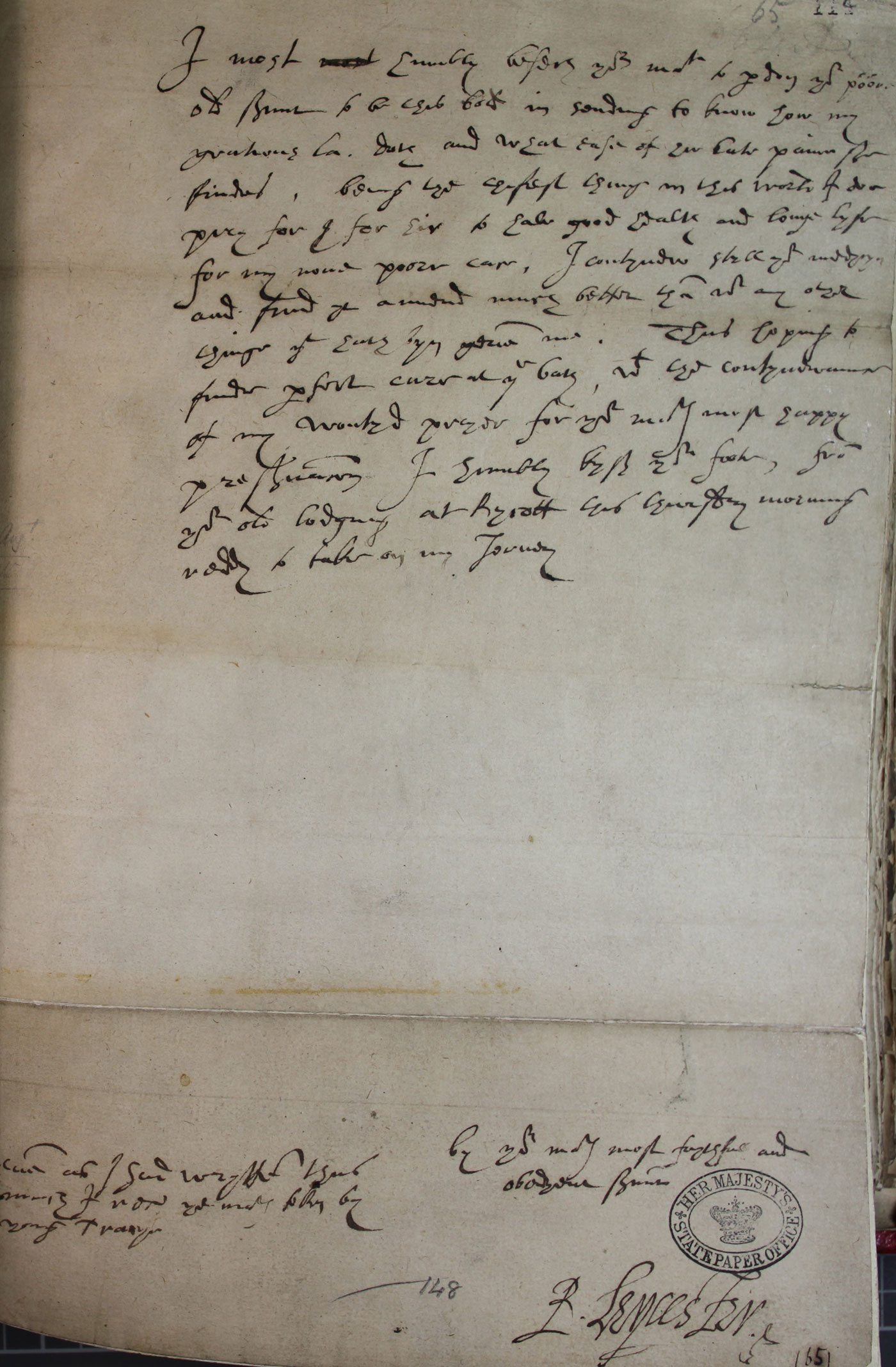
Robert Dudley, Earl of Leicester to Elizabeth, 29 August 1588 (SP 12/215 f.114)
Elizabeth’s long-standing favourite wrote this letter just a few days before his death, when he was staying at Rycote. This is the house where Elizabeth had lodged on her way to Woodstock after her imprisonment in the Tower in 1554, and she and Dudley had stayed there together in happier times as guests of Sir Henry and Lady Norris. The queen was grief-stricken at the death of her favourite on 4 September 1588. Years later, when she died, this letter was found in a casket by her bed. She had inscribed it ‘his Last lettar’.
Transcript
‘I most humbly besech your majeste to pardon your poore old servant to be this bold in sending to know how my gratious lady doth and what ease of her late paine she findes, being the chefest thinge in the world I doe prey for & for hir to have good health and longe lyfe/ for my none poore case, I contyndue still your meddycyn [medicine] and finde yt amended much better than with any other thinge that hath byn given me. Thus hoping to finde perfect cure at the bath, with the contynduance of my wontyd preyer for your majesty’s most happy preservacion. I humbly kyss your foote. From your old lodging at Rycott this Thursday morning reddy to take on my Journey.
by your most faythful and obedyent servant. R Leycester.
[postscript] Even as I had wrytten thus much I receyved your majesty’s token by young Tracye.
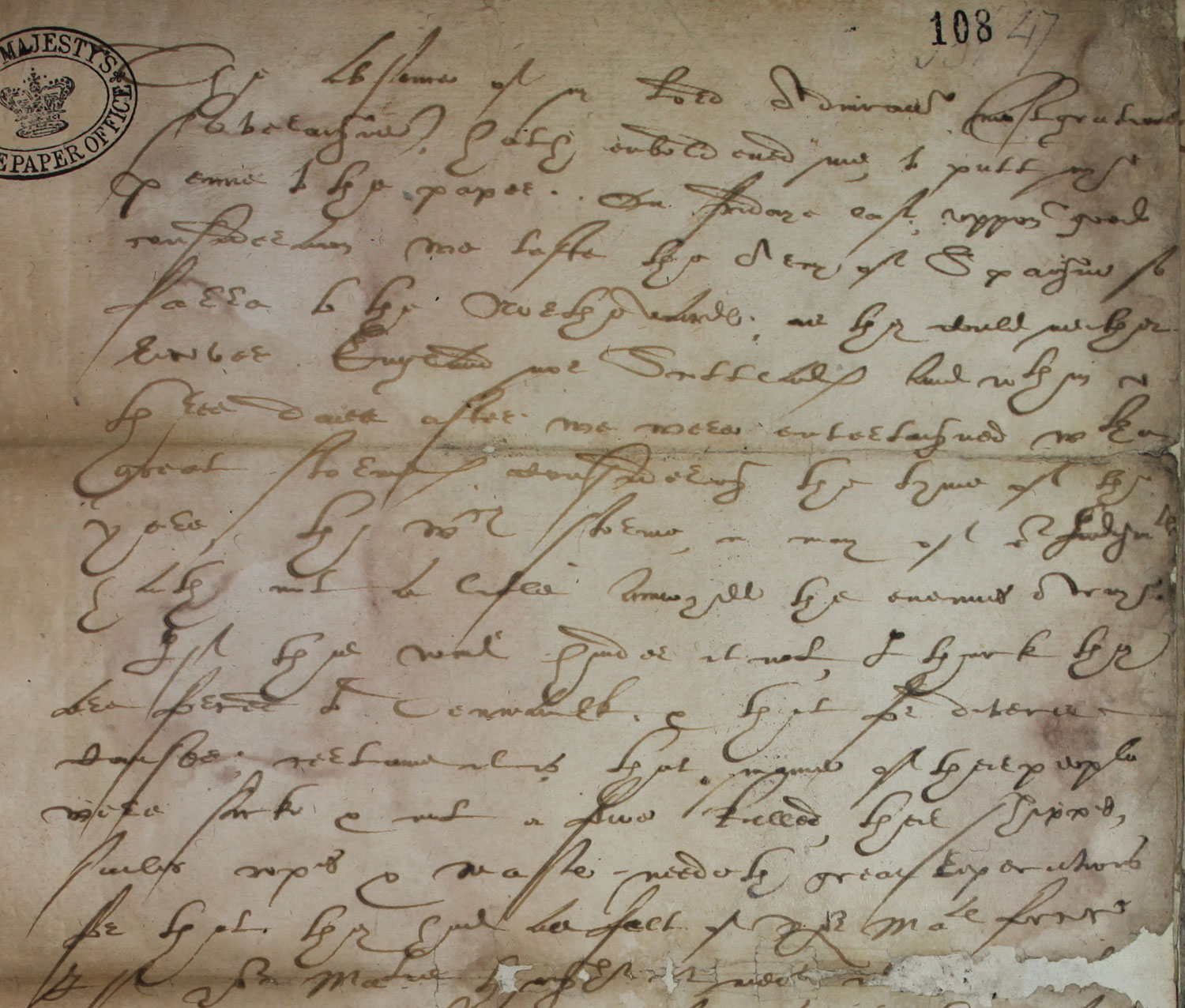
Sir Francis Drake to Elizabeth, 8 August 1588 (SP 12/214 f.108)
The queen would have rejoiced upon receiving this letter from her most celebrated naval commander, in which he announced the flight of the mighty Spanish Armada. The skill of Elizabeth’s navy, coupled with some fortuitous weather, had scattered Philip II’s ships. Many had been lost, and those that survived were blown so far northwards that they could reach neither England nor Scotland. The defeat of the Spanish Armada catapulted Elizabeth’s kingdom onto the world stage. It also secured the queen’s reputation as the iconic ‘Gloriana’ and her reign as the ‘Golden Age’. Although Drake was only second in command, he grabbed all of the glory. Even Elizabeth’s enemy Pope Sixtus V was fulsome in his praise, exclaiming: ‘Have you heard how Drake with his fleet has offered battle to the Armada? With what courage! Do you think he showed any fear? He is a great captain.’ The Spanish nicknamed him ‘El Draque’, the dragon.
Transcript (extract)
The absence of my Lord Admirall most gratious Soverayne, hath emboldened me, to putt my penne to the paper. On fridaye last, upon good consideracion we lefte the army of Spagne so farre to the northewardes, as they could neither recover England nor Scottland. And within three daies after we were entertayned with a great storme, considering the tyme of the yere, the which storme, in many of our judgmentes hath not a litle annoyedd the enemies army. If the wind hinder it not, I think they are forced to Denmark, & that for diverce causes. Certain it is that manie of their people were sick and not a fewe killed, there shippes, sailes ropes & mastes needeth great reperations for that they had all felt of your Majestie’s force…
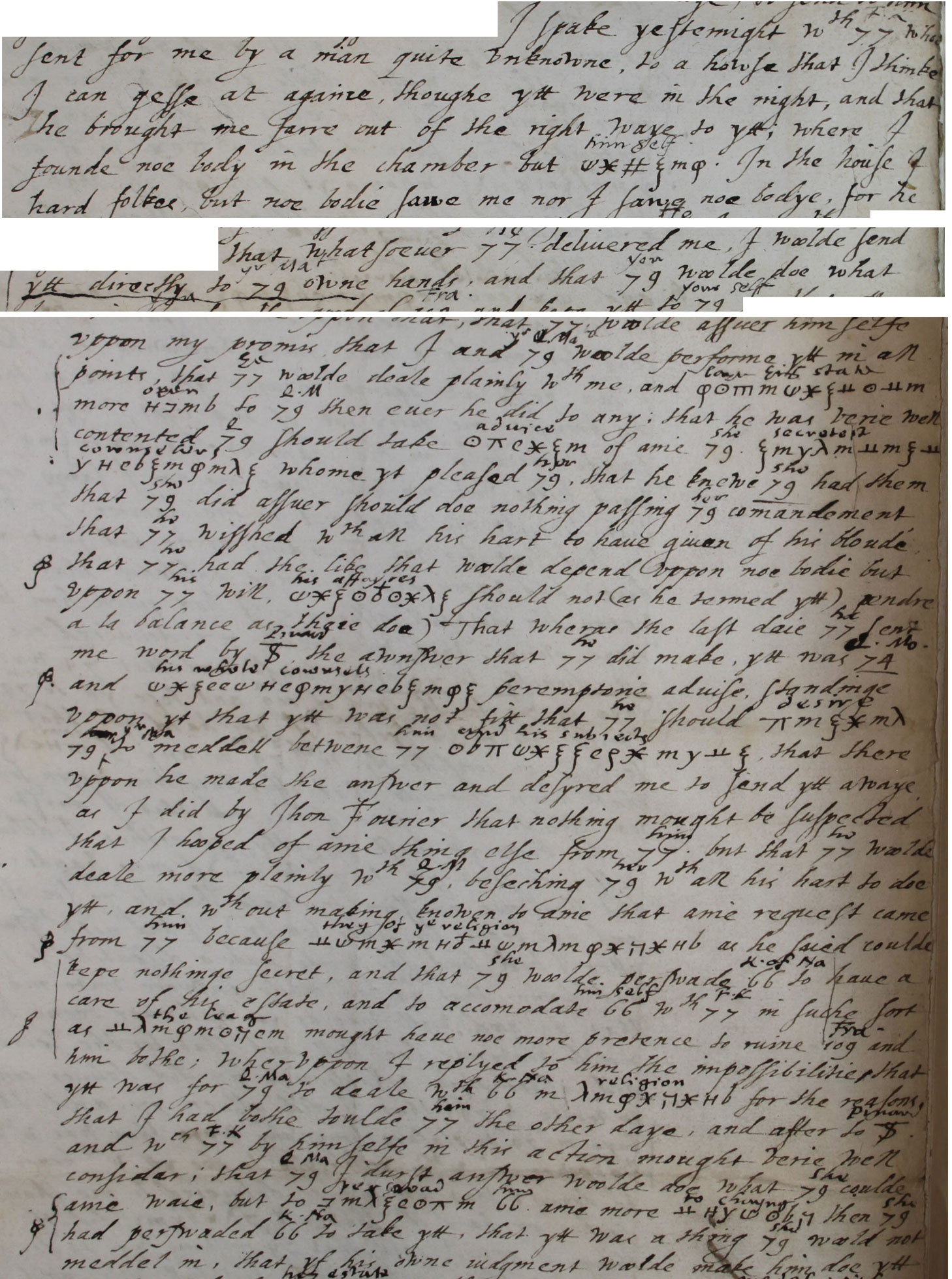
Sir Edward Stafford to Elizabeth, 25 February 1588 (SP 78/18 f.52- 52v)
Stafford was the queen’s ambassador to France. Written in the anxious months between the execution of Mary Queen of Scots and the coming of Philip II’s Armada, the letter describes a clandestine meeting with King Henry III of France. Mary Queen of Scots had spent much of her childhood in France, having been married to the Dauphin, Francis. Her execution therefore prompted outrage in that kingdom. Stafford reports that the French King wishes Elizabeth to persuade his brother-in-law and heir to the throne, Henry of Navarre (the future Henry IV) to convert to Catholicism and so disempower the hard-line Catholic League. This is Elizabethan espionage at its cloak-and-dagger best. He writes proper names in cipher, which Elizabeth’s great spymaster, Sir Francis Walsingham, has deciphered. The latter has also drawn trefoils against certain key passages that he wishes the queen to read.
Transcript
I spake yesternight with the King, who sent for me by a man quite unknown, to a house that I think I can guess at again, though it were in the night, and that he brought me far out of the right way to it; where I found nobody in the chamber but himself. In the house I heard folks, but nobody saw me nor I saw nobody, for that he brought me tarried not in the chamber. The King began with me… that whatsoever he delivered me, I would send it directly to your Majesty’s own hands, and that you would do what lay in you for the good of France, and keep it to yourself…
uppon my promis that I and your Majesty woolde performe ytt in all points, that he woolde deale plainly with me, and laye his state more open to QM then ever he did to any; that he was verie well contented Q should take advice of anie the secretest cownselors whome yt pleased her, that he knew she had them that she did assure should doe nothing passing her commandement, that he wisshed with all his hart to have given of his bloude that he had the like woolde depend uppon noe bodie but uppon his will, his affayres should not (as he termed ytt) pendre a la balance as theie doe…I hoped of anie thing else from him but that he woolde deale more pleinly with her Majestie, beseching her with all his hart to doe ytt, and without making knowen to anie that anie request came from him because they of ye religion as he saied coulde kepe nothinge secret, and that she woolde perswade the King of Navarre to have a care of his estate, and to accomodate him self with the French King in suche sort as the king mought have noe more pretence to ruine France and them bothe; wheruppon I replyed to him the impossibilitie that ytt was for the Queen’s Majestie to deale with the King of Navarre in religion…that ytt was a thing she woolde not meddel in…’