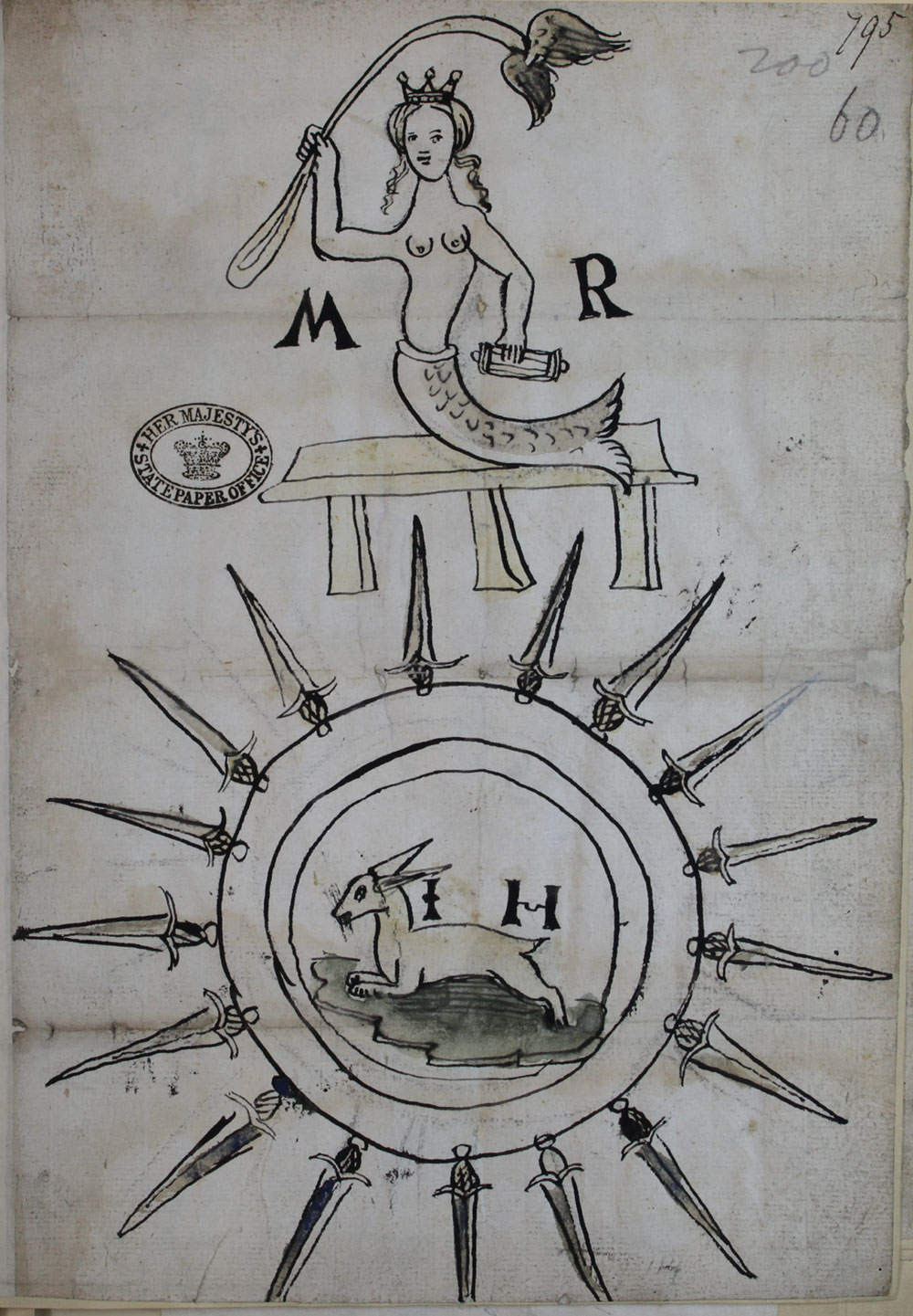
Sketch of Mary Queen of Scots, c.June 1567 (SP 52/13 f.60)
Mary paid a heavy price for her impetuous marriage to James, Earl of Bothwell. Not only did she forfeit her crown, but her reputation. In this allegorical sketch, the fallen Scottish queen is depicted as a mermaid, a symbol of prostitution. Elizabeth made the most of her rival’s disgrace and promoted herself even more vigorously as the virtuous Virgin Queen. It was a vindication of the personal sacrifices that she had made in the interests of her country.
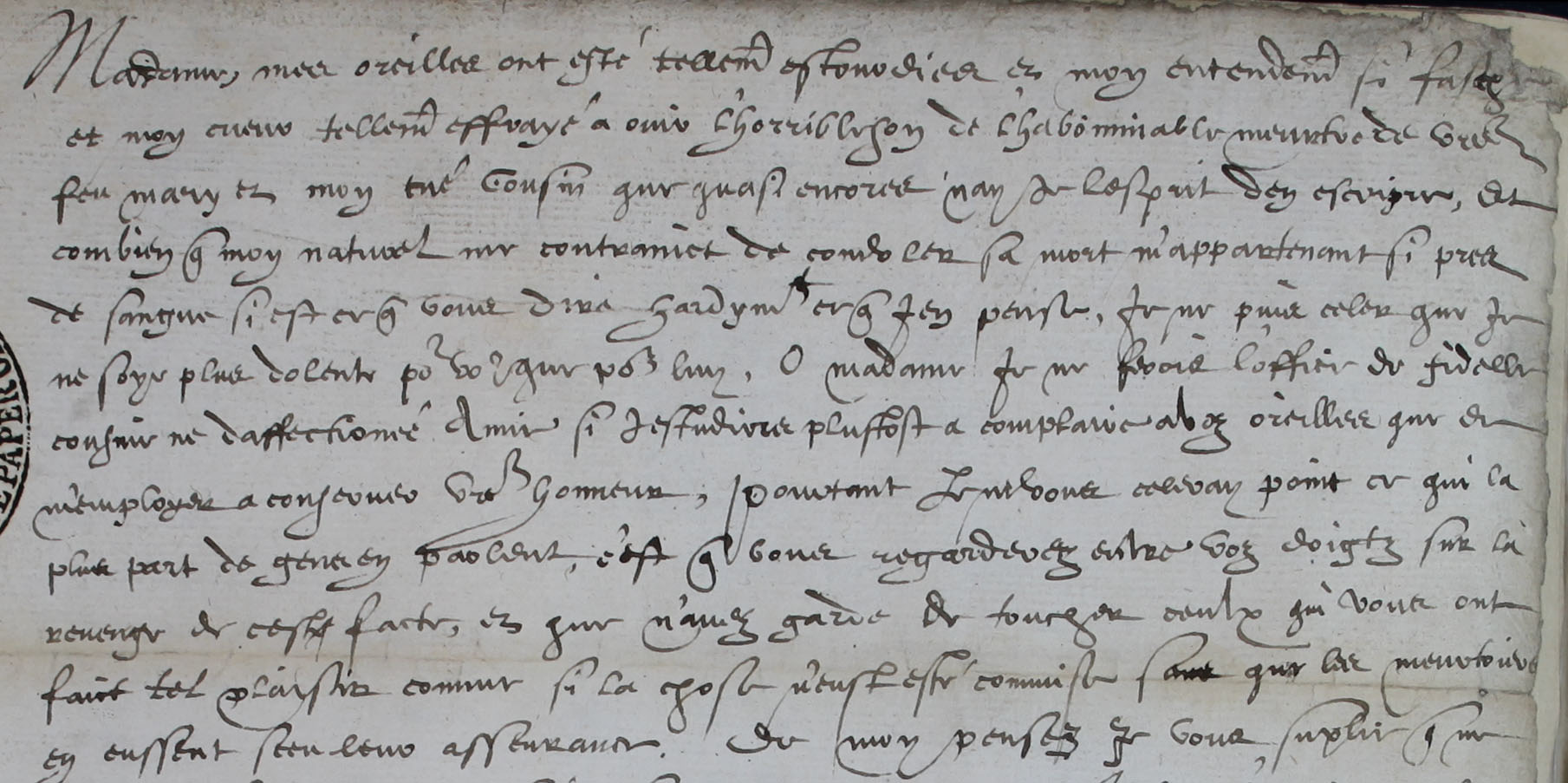
Elizabeth I to Mary Queen of Scots, 24 February 1567 (SP 52/13 f.17)
The finger of blame for Darnley’s murder soon pointed to the Earl of Bothwell and Mary herself. Bothwell had long been suspected of having designs on the throne, and his close relationship with the queen gave rise to rumours they were sexually intimate. Suspicions that Mary had colluded in her husband’s death sparked the downward spiral that led to her loss of the Scottish crown. Elizabeth was so shocked when she heard of this latest turn of events that she wrote at once to urge Mary to prove her innocence and salvage her reputation – and her throne.
Transcript
Madam,
My ears have been so astounded and my heart so frightened to hear of the horrible and abominable murder of your husband and my own cousin that I have scarcely spirit to write: yet I cannot conceal that I grieve more for you than him. I should not do the office of a faithful cousin and friend, if I did not urge you to preserve your honour, rather than look through your fingers at revenge on those who have done you that pleasure as most people say. I counsel you so to take this matter to heart, that you may show the world what a noble Princess and loyal woman you are. I write thus vehemently not that I doubt, but for affection. [Translated from the French; extract – lines 1-12]
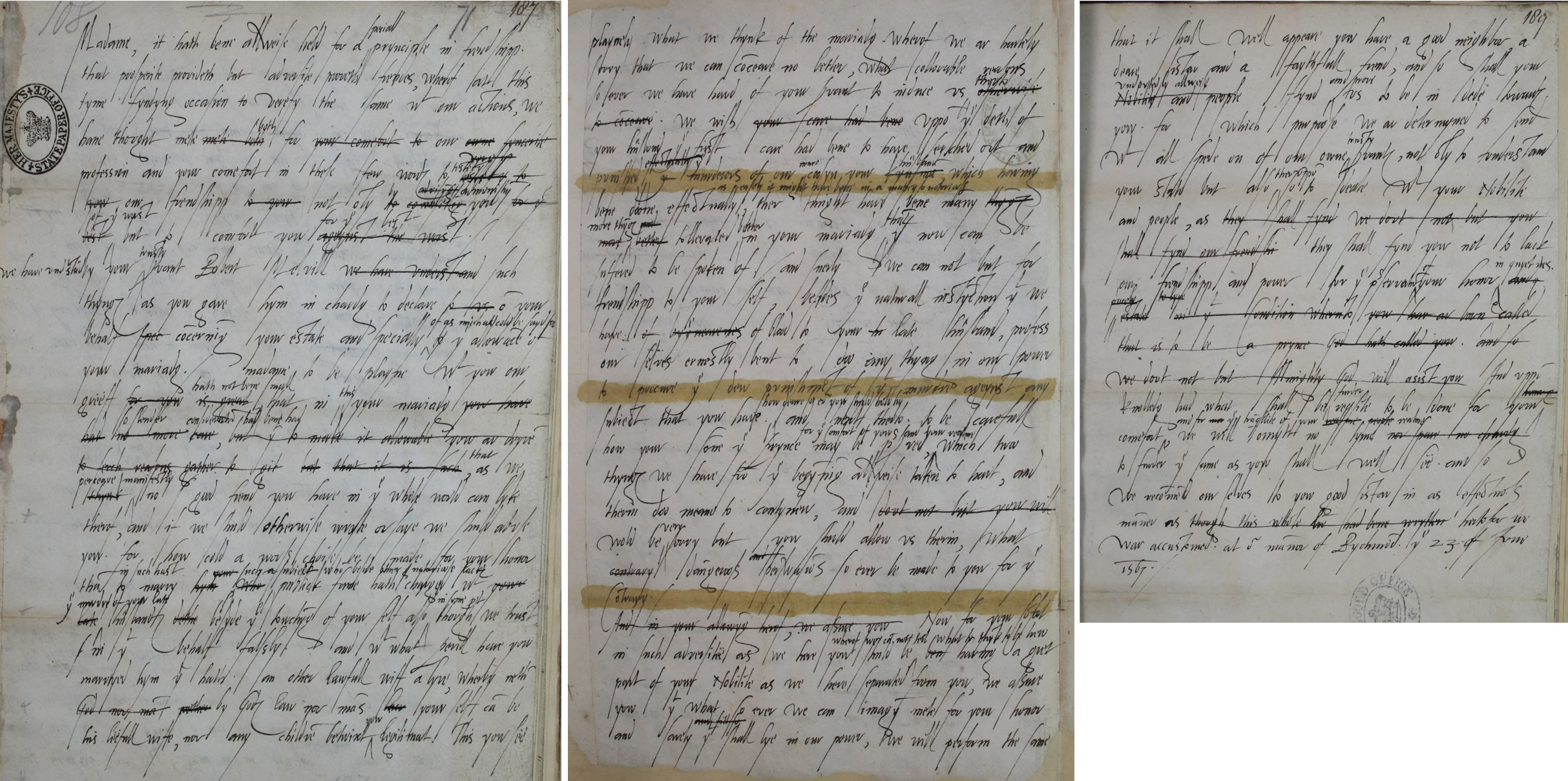
Elizabeth I to Mary, Queen of Scots, 23 June 1567 (SP 52/13 f.71)
Even though Bothwell was formally acquitted of the murder, he continued to be viewed as the chief suspect. In late April 1567, he persuaded Mary to accompany him to Dunbar, claiming that her life would be in danger if she stayed in Edinburgh. But upon arriving, Mary was taken prisoner by Bothwell. What happened next has been the subject of intense speculation ever since. It has been claimed that Bothwell raped Mary in order to force her into marriage. Other sources allege that she was complicit in the act. Either way, they were married on 15 May and Mary soon fell pregnant (she later miscarried twins). Their opposers met them at Carberry Hill on 15 June, and Bothwell fled the country. Mary was forced to surrender both the battle and her crown. Having heard all of this, Elizabeth set aside her accustomed diplomacy and wrote a furious letter full of contempt for Mary, whom she chastised for her reckless actions.
Transcript
[Draft by Lord Burghley] Madame, it hath bene allweise held for a special principle in friendship, that prosperitie provideth but adversite proveth frendes, wherof at this tyme fyndyng occasion to verify the same with our actions, we have thought mete both for our profession and your comefort in these few words, to testify our friendship not only by admonyshyng of your worst but to comfort you for your best. We have understood by your trusty servant Robert Melvill such thyngs as yow gave hym in chardg to declare on your behalf concerning your estate and specially of as much as should be sayd for ye allowance of your mariadg. Madam, to be playne with you our greef hath not bene small that in this marriadg so slender consideration hath bene had that, as we perceave manifestly no good frend you have in ye whole world can lyke thereof, and if we shuld otherwise wryte or saye we shuld abuse you. For how cold a worse choise be made for your honour than in such hast to marry such a subject who besides other notorious lackes publick fame has chargyd with the murdre of your late husband, beside ye touchyng of your self also in some part, though we trust in that behalf falsely. And with what perill have you marryed hym that hath an other lawfull wyfe a lyve, whereby neither by God’s law nor man’s your selff can be his lawfull wiff [wife], nor any children betwixt you legitimate. Thus you see playnely what we thynk of the marriadg wherof we ar hartely sorry that we can conceave no better, what collourable reasons so ever we have hard of your servant to induce us therein. We wish uppon ye deth of your husband that first care had been to have serched out and punished ye murderers of our neare coosyn, your husband, which having bene doone effectually, as easily it might have bene in a matter so notorious, ther myght have bene many more thyngs tollerated better in your mariadg than now can be suffered to be spoken of. And surely we can not but for friendshipp to your self, besides ye natural instynction that we have of blood to your late husband, profess our selves ernestly bent to doo any thyng in our power to procure ye dew punishment of that murdre agaynst any subject that you have, how deare so ever you should hold hym, and next thereto, to be carefull how your sonne ye prynce may be preserved for ye comfort of yours and your realme. Which two thynges we have from ye begyning allweise taken to hart, and therin doo meane to contynew, and wold be very sorry but you shuld allow us therin, what dangerous perswasions so ever be made to you for ye contrary. Now for your Estat in such adversitie as we here you shuld be wherof we [know?] not well what to think to be how having a great part of your Nobilitie as we here separated from yow, we assure you that what so ever we can imagyn mete for your honor and surety that shall lye in our power, we will perform the same that it shall and will appear you have a good neighbour, a deare sistar and a faythfull frend, and so shall you undoubtedly allweise fynd and prove us to be in dede towards yow. For which purpose we ar determyned to send with all spede on [one] of our owne trusty servants, not only to understand your state but also thereuppon so to deale with your Nobility and people, as they shall fynd yow not to lack our friendshipp and power for ye preservacyon of honor in quyetness. And upon knolledg had what shall be furder ryght to be done for your comfort and for ye tranquilitie of your realme we will omytt no tyme to furder ye same as yow shall and will see. And so we recommend ourselves to you good sistar in as affectionate a manner as heretofor we war accustomed. At our manor of Rychmond ye 23 of June 1567.
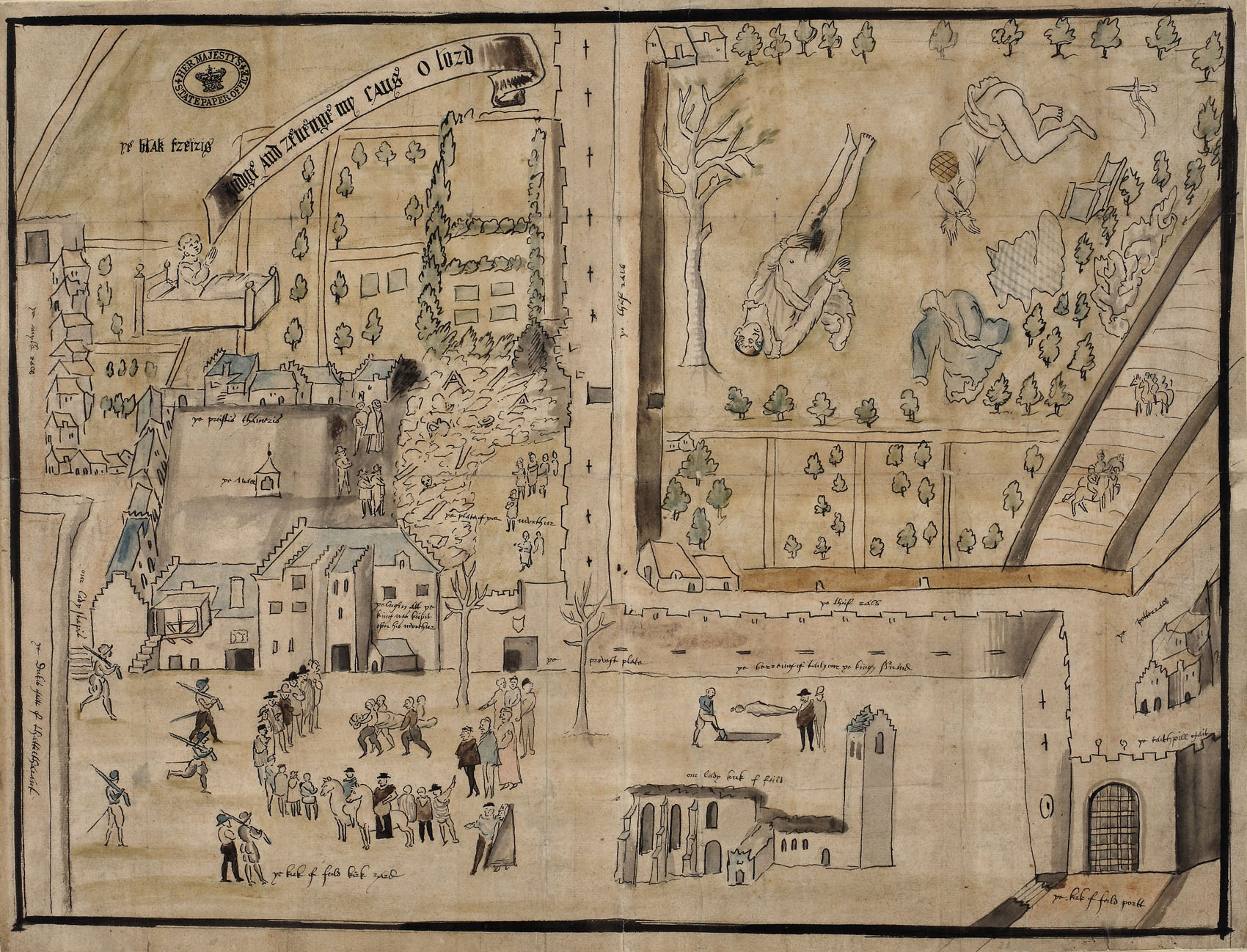
Drawing of Kirk o’Field after the murder of Henry Stuart, Lord Darnley, 1567 (MPF 1/366)
Events in Scotland were now unraveling with frightening speed. Early in the morning on 10 February 1567, Mary’s husband, Lord Darnley, was found murdered. His body and that of his valet were discovered in the orchard of Kirk o’Field in Edinburgh, where they had been staying. The house had been torn apart by two large explosions in the middle of the night. Darnley was undoubtedly the intended victim because two barrels of gunpowder had been placed in a small room underneath his sleeping quarters. Darnley was dressed only in his nightshirt, which suggests he had fled in some haste from his bedchamber. Upon further examination, the bodies had no signs of injuries that could be associated with the explosion, so the blast was not considered to have killed Darnley. It was determined that the two men were killed by strangulation, believed to have taken place after the explosion.
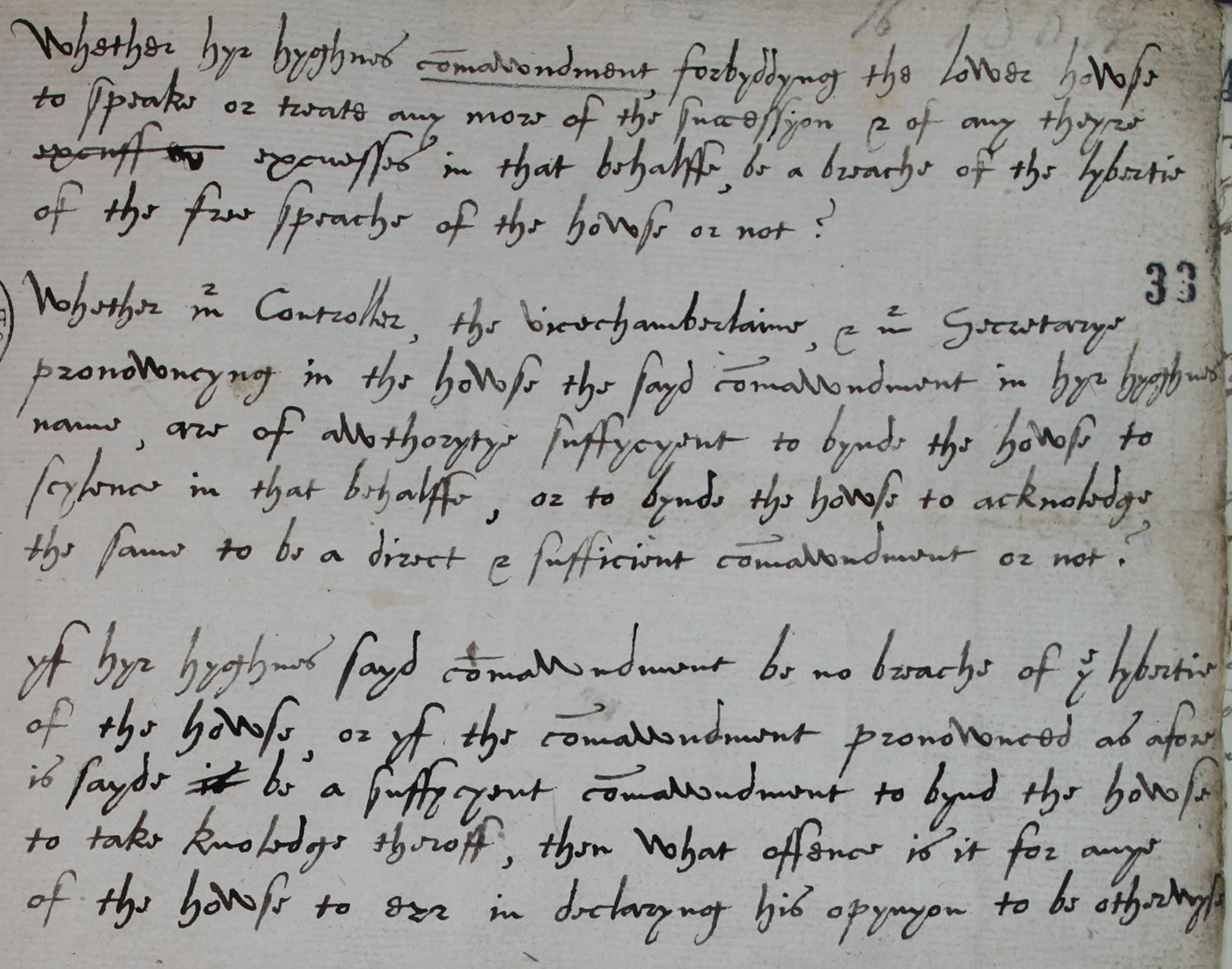
Peter Wentworth’s questions on parliamentary privilege, 11 November 1566 (SP 12/41 f.33)
The queen’s angry response to the parliamentary delegation was followed, on 9 November, by a verbal ‘gagging order’ to Parliament, forbidding them to debate matters of the succession. Their response was no less vitriolic. The issue of monarchical versus parliamentary power was one that would have explosive consequences for Elizabeth’s successors.
Transcript
Whether hyr hyghnes’ commandment, forbyddyng the Lower Howse to speake or treate any more of the succession or of any theyre escewsses in that behalffe, be a breache of the lybertie of the free speache of the howse or not?
Wheter Mr Controller, the vicechamberlaine, and Mr Secretarye pronowncyng in the Howse the sayd commandment in hyr hyghness’ name, are of awthorytye suffycyent to bynde the howse to silence in that behalffe, or to bynde the howse to acknowledge the same to be a direct and sufficient commandment or not?
Yf hr hyghness’ said commandment be no breache of ye lybertie of the howse, or yf the commandment pronownced as afore is sayde be a suffycyent commandment to bynd the howse to take knoledge theroff, then what offence is it for anye of the howse to err in declaryng his opynyon to be otherwys?
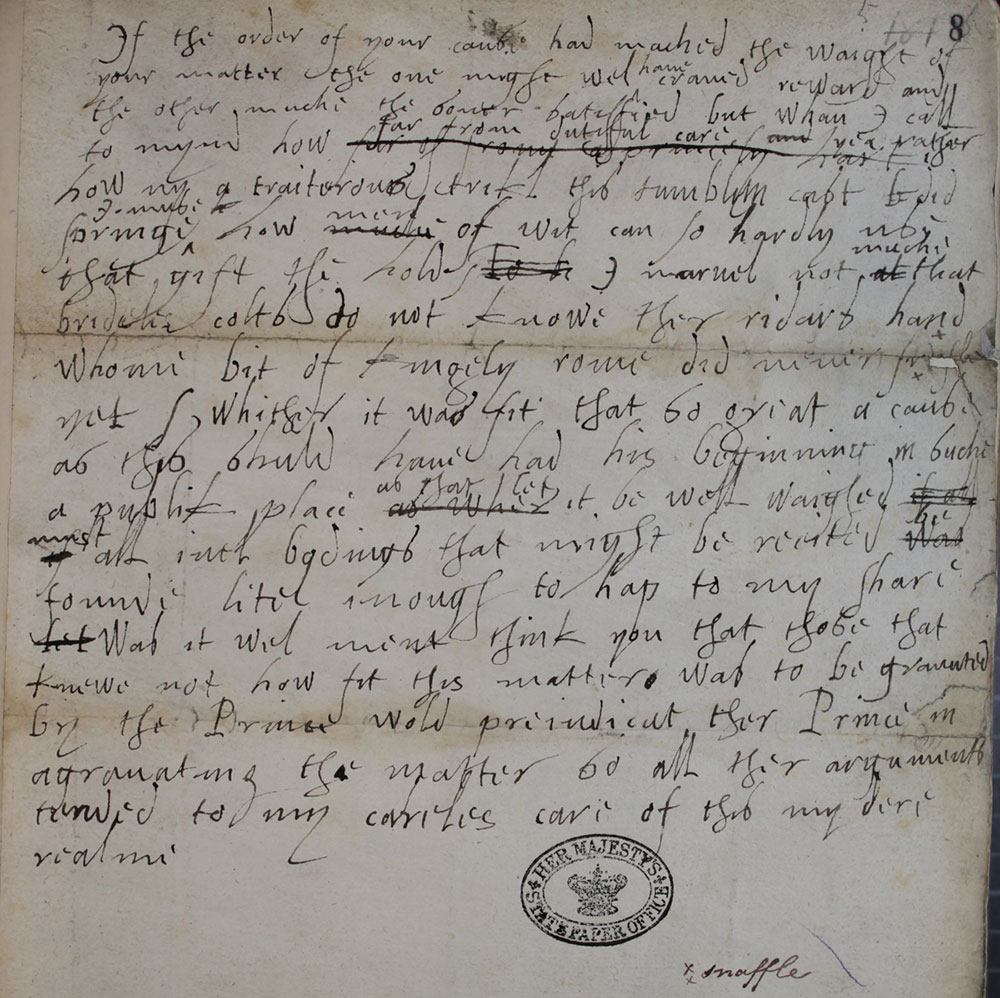
Elizabeth I’s speech to a joint delegation of Lords and Commons, 5 November 1566 (SP 12/41/5 f.8)
In November 1566, a delegation of 60 Lords and Commoners met with the queen to urge the question of her marriage and the succession. By now, eight years into her reign and aged 33, Elizabeth was under more intense pressure about this than ever before. Her response was unusually haughty and immoderate, which betrays the stress under which she was labouring. It was probably spoken impromptu and recorded after the event, then reported to the full Parliament.
Transcript
If the order of your cause had mached [matched] the waight of your matter the one might wel have craved reward and the other muche the sooner satisfyed but whan I call to mynd how far from dutyful care, yea, rather how ny [night] a traitorous trik this tumbling cast did springe I muse how men of wit can so hardly use that gift they hold. I marvel not muche that bridleless colts do not know ether ridars hand whom bit of kingly reine [or ‘reign’, a pun] did nevere snaffle yet, whither it was fit that so great a cause as this shuld have had his beginning in suche a publik place as that, let it be well waighed [weighed]. Must all evill bodings that might be recited bee founde litel inough to hap to my share. Was it wel ment think you that those that knewe not how fit this matter was to be graunted by the Prince wold prejudicat [judge in advance] ther Prince in aggravating the matter so all ther argumentes tended to my careles care of this my dere realme.
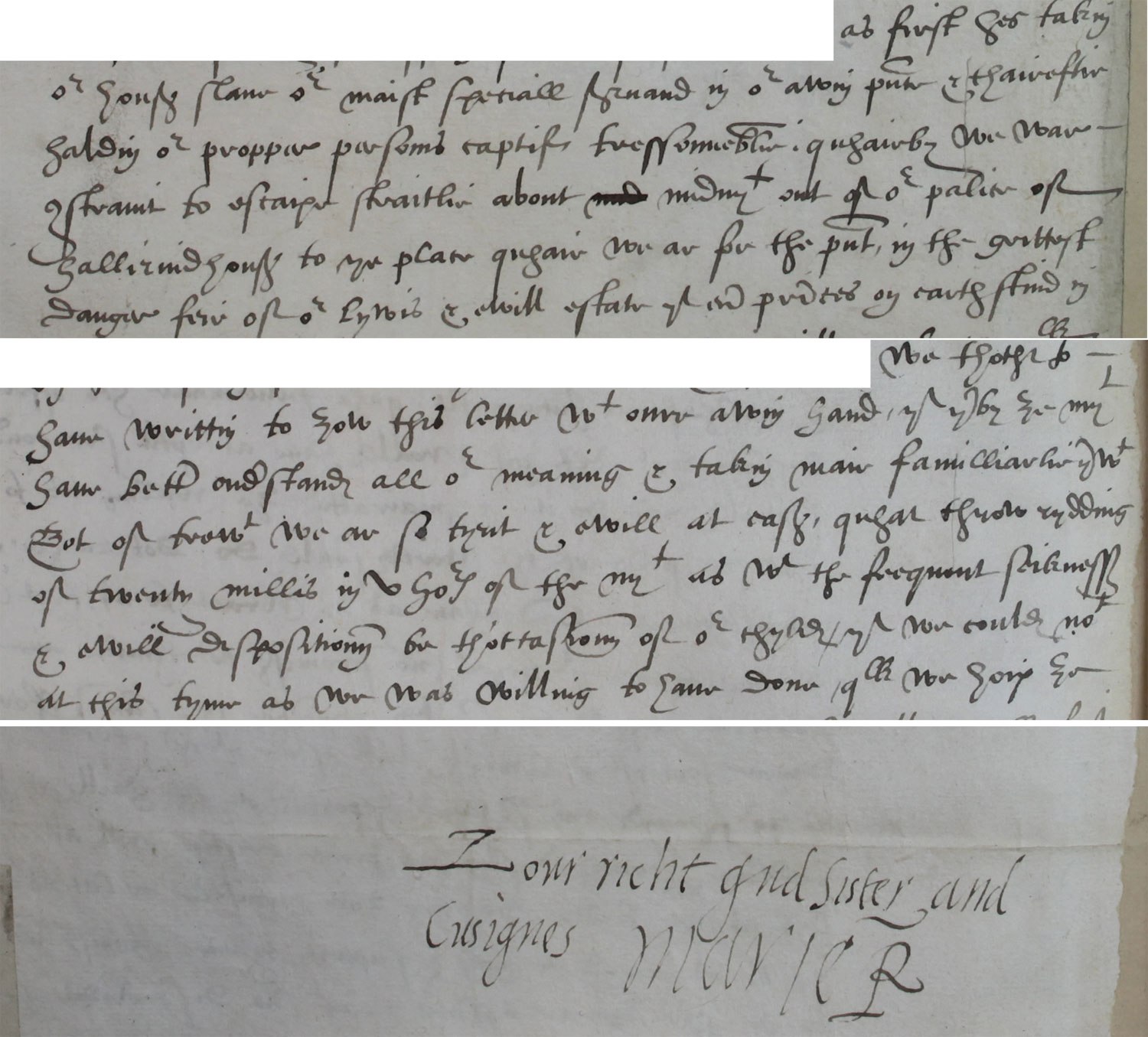
Letter dictated by Mary Queen of Scots to Elizabeth, 15 March 1566 (SP 52/12 f77v)
This letter, which is written in broad Scots, describes the murder in Mary’s presence at Holyroodhouse in Edinburgh of her Italian secretary David Rizzio. The murder had been orchestrated by her husband, Lord Darnley, and a group of Protestant Lords who were jealous of the influence that Rizzio enjoyed over the Scottish queen. It took place on the evening of 9 March 1565 when Mary had been taking supper with Rizzio in her private apartments. Her husband held her down and one of his fellow conspirators pointed a pistol at her belly while her hapless secretary was dragged out of the room, clutching at her hem and screaming for her to save him. He was then stabbed to death, in all receiving 56 wounds. After the murder, Mary was held prisoner at Holyrood but persuaded Darnley to run away with her. They reached Dunbar on 12 March, and it was from here that Mary dictated this letter, breathlessly describing the horrific episode to Elizabeth, to whom she always referred as a ‘sister queen’. Although Elizabeth replied in the same affectionate terms, she never trusted Mary and must have derived some satisfaction from hearing about the collapse of her rival’s regime.
Transcript (excerpt)
‘As first hes takin our houss slane our maist [most] speciall servand in our awin [own] presence & thaireftir haldin our propper personis captive tressonneblie, quhairby [whereby] we war constrainit to escaipe straitlie about midnyght out of our palice of halliruidhouss to the place quhair [where] we ar for the present, in the grittest danger feir of our lywis & ewill [ill] estate that evir princes on earth stuid [stood] in….
We thotht to have writtin to you this letter with oure awin [own] hand, that therby ye myght have better onestand all our meaning & takin mair [more] familliarlie therewit. Bot of trewt [truth] we ar so tyrit [tired] & ewill [ill] at eass [ease], quhat [what] throw rydding of twenty millis [miles] in v [5] horis [hours] of the nyght as wit the frequent seikness & weill dispositioun be th’occasioun of our child/that we could not at this tyme as we was willing to have done…
Your richt [right] gud sister and cusignes [cousin] Marie R.
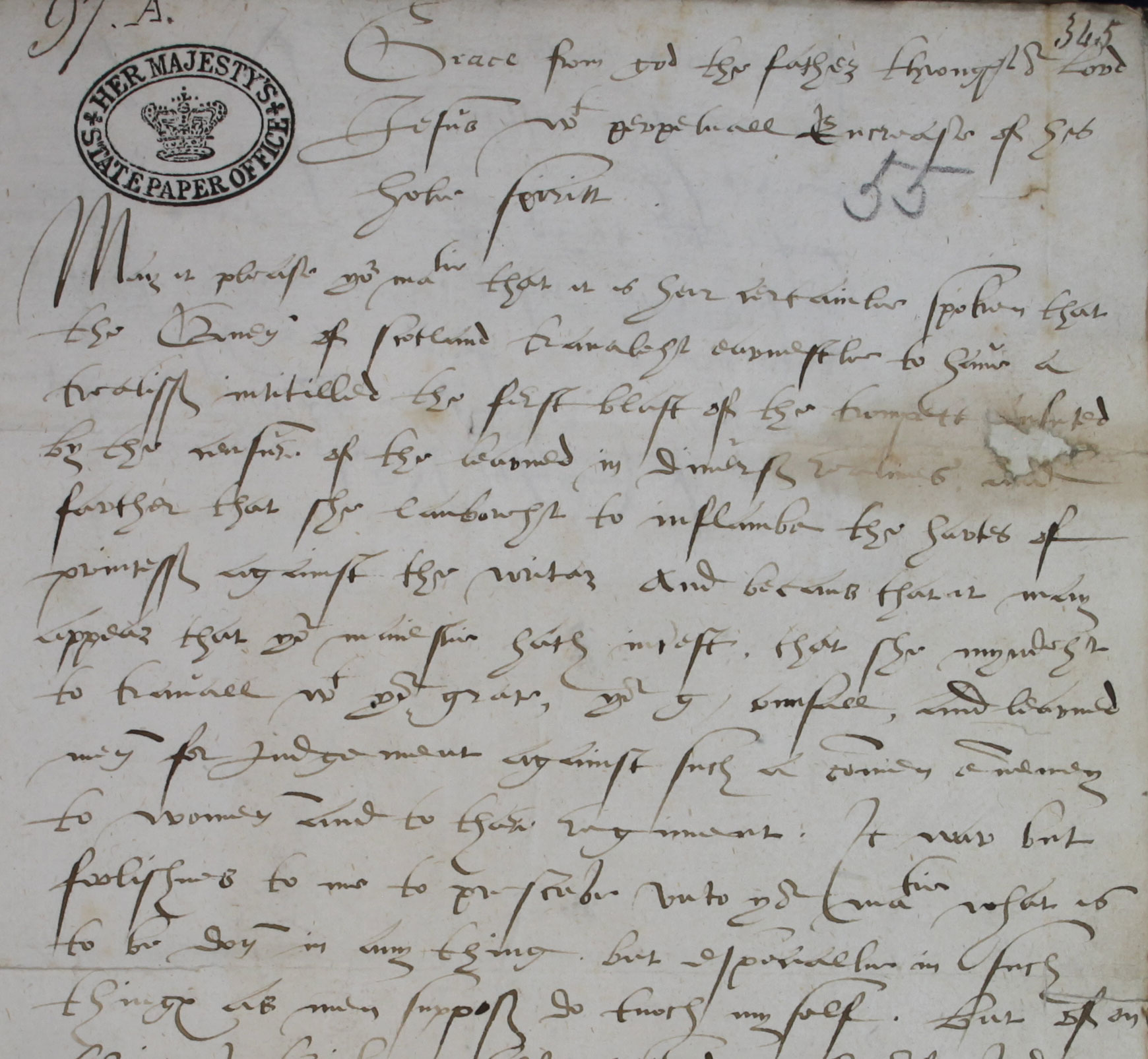
John Knox to Elizabeth, 6 August 1561 (SP 52/6 f.119)
Elizabeth despised John Knox – with good reason. The influential Scottish clergyman and reformer was scathing in his attacks on women. His famous tract The First Blast of the Trumpet against the Monstrous Regiment of Women (‘regiment’ meaning rule or regime), was published just a few months before Elizabeth became queen. In it he declared: ‘To promote a woman to bear rule, superioritie, dominion or empire above any realme, nation, or citie, is repugnant to nature.’ He slammed Elizabeth’s half-sister Mary, who was then queen, as ‘unworthy by reason of her bloody tyranny of the name of woman.’ Knox’s letter to Elizabeth was written a fortnight before Mary Stuart’s arrival in Scotland from France to begin her queenship. Although Mary and Elizabeth would become deadly rivals, they were rare examples of queens regnant in a world dominated by men. Mary shared Elizabeth’s hatred of Knox and, as his letter shows, tried to have it censured.
Transcript (excerpt)
Grace from god the father throught our Lord Jesus with perpetuall Encrease of his holie spiritt.
May it please your majestie that it is heir [here] certainlie spoken that the Quen of Scotland traveleht [travails, or is attempting] earnestlie to have a treatiss intitilled the ferst blast of the trompett [con]futed by the censure of the learned in divers realmes, and father that she lauboreht to inflambe the hartes of princess against the writer And becaus that it may appear that your majestie hath interest, that she myndeht [mindeth] to travall with your grace, your graces counsall, and learned menn for Judgement against such a common enemey to womenn and to thare regiment. It were but foolishnes to me to prescribe unto your majestie what is to be donn in any thing, but especiallie in such thinges as men suppos do tuoch [touch] my self…’
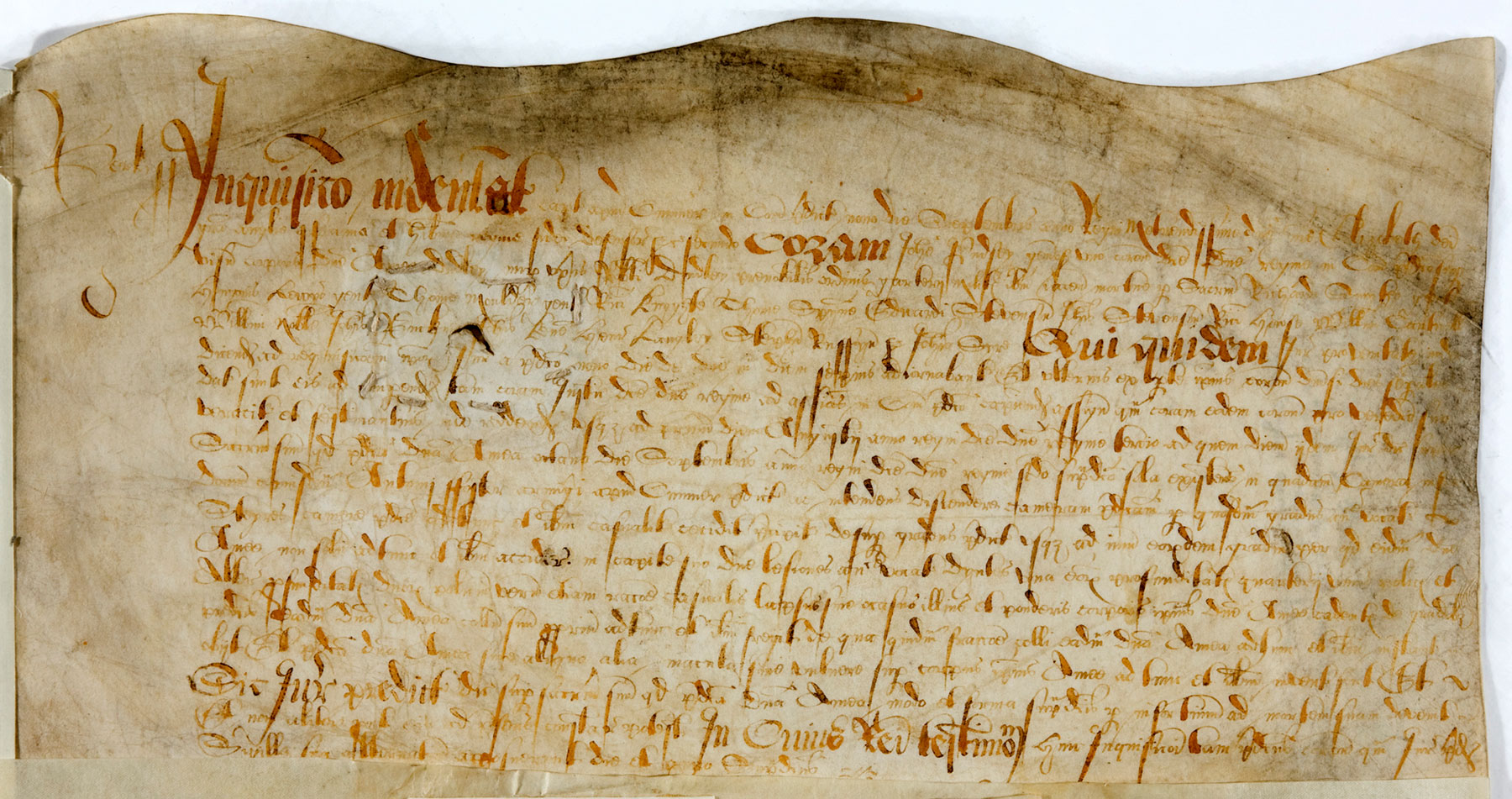
Coroner’s report into the death of Amy Robsart, August 1561 (KB 9/1073/f.80)
For all that she liked to keep foreign suitors in play, Elizabeth was already deeply in love with her Master of Horse, Robert Dudley. Ironically, though, the sudden death of Dudley’s wife in September 1560 removed any hope that the queen might have privately cherished of marrying him. Amy Robsart was found dead at the bottom of a short flight of stairs at Cumnor Place in Oxfordshire. The circumstances were suspicious. Her neck was broken and there were two small wounds to her head. On the day of her death, she had insisted that all of her servants attend the fair that was being held that day in Abingdon. When they returned, they found their mistress dead. Whether it was an accident, suicide or murder has never been resolved beyond doubt. The scandal reverberated not just around the kingdom but across the courts of Europe, so that Elizabeth was obliged to distance herself from Dudley in order to avoid being implicated any further.
Translation from the original Latin
Inquisition as indenture held at Cumnor in the aforesaid county [Oxfordshire] on 9 September in the second year of the reign of the most dread Lady Elizabeth, by the grace of God queen of England, France, and Ireland, defend of the faith, etc., before John Pudsey, gent, a coroner of the said lady queen in the aforesaid county, on inspection of the body of Lady Amy Dudley, late wife of Robert Dudley, knight of the most noble order of the garter, there lying dead: by oath of Richard Smith, gent., Humphrey Lewis, gent., Thomas Moulder, gent., Richard Knight, Thomas Spyre, Edward Stevenson, John Stevenson, Richard Hughes, William Cantrell, William Noble, John Buck, John Keene, Henry Lanlgey, Stephen Ruffyn, and John Sire: which certain jurors, sworn to tell the truth at our request, were adjourned from the aforesaid ninth day onwards day by day very often; and finally various several days were given to them by the selfsame coroner to appear both before the justices of the aforesaid lady queen at the assizes assigned to be held in the aforesaid county and before the same coroner in order there to return their verdict truthfully and speedily, until 1 August in the third year of the reign of the said lady queen; on which day the same jurors say under oath that the aforesaid Lady Amy on 8 September in the aforesaid second year of the reign of the said lady queen, being alone in a certain chamber within the home of a certain Anthony Forster, esq., in the aforesaid Cumnor, and intending to descend the aforesaid chamber by way of certain steps (in English called ‘steyres’) of the aforesaid chamber there and then accidentally fell precipitously down the aforesaid steps to the very bottom of the same steps, through which the same Lady Amy there and then sustained not only two injuries to her head (in English called ‘dyntes’) – one of which was a quarter of an inch deep and the other two inches deep – but truly also, by reason of the accidental injury or of that fall and of Lady Amy’s own body weight falling down the aforesaid stairs, the same Lady Amy there and then broke her own neck, on account of which certain fracture of the neck the same Lady Amy there and then died instantly; and the aforesaid Lady Amy was found there and then without any other mark or wound on her body; and thus the jurors say on their oath that the aforesaid Lady Amy in the manner and form aforesaid by misfortune came to her death and not otherwise, as they are able to agree at present; in testimony of which fact for this inquest both the aforesaid coroner and also the aforesaid jurors have in turn affixed their seals on the day
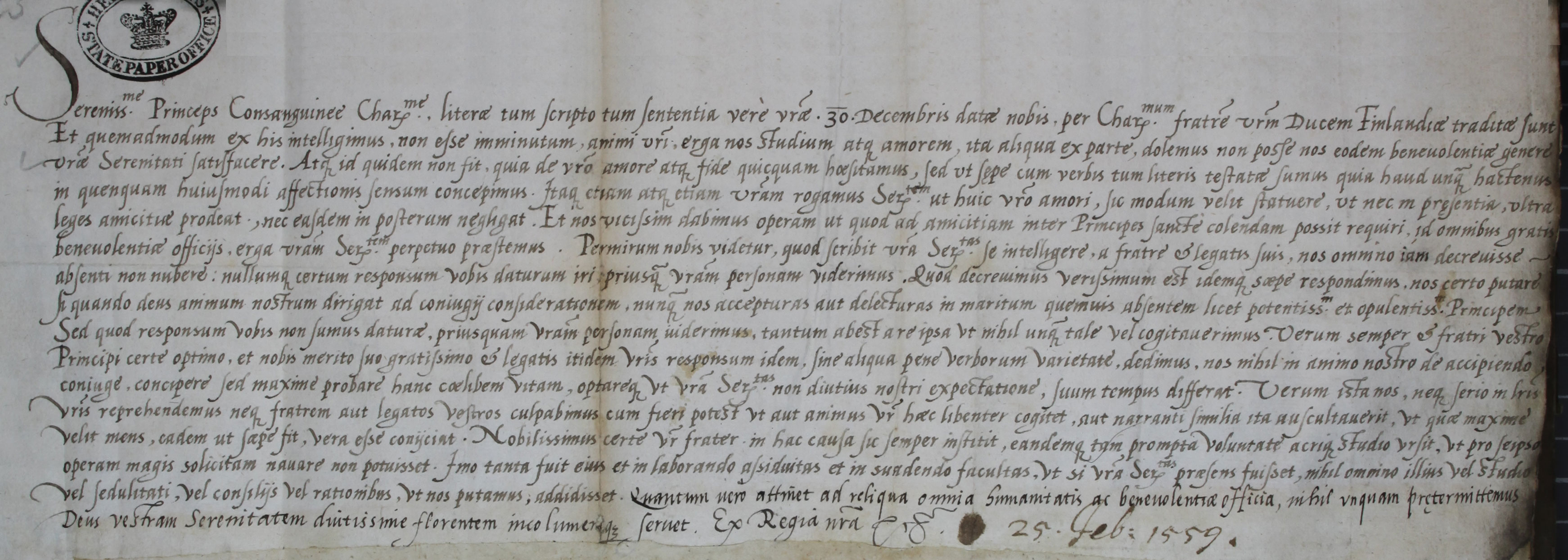
Elizabeth I to King Eric XIV of Sweden, 25 February 1560 (SP 70/11 f.74)
Although Elizabeth showed no inclination to marry, it was not long before the young queen was besieged by suitors. Among the first was the new king of Sweden, Eric XIV. Elizabeth employed what was to become a familiar tactic: she offered ‘fair words’ but no firm promises. But when Eric expressed his intention to visit her, she set aside her accustomed ambiguity. She fired off this letter, which was filled with apparent regret that she could not share his feelings, but made it clear that he should not set foot in England.
Translation from the original Latin
Most Serene Prince, our very dear Cousin,
A letter truly yours both in the writing and sentiment, was given us on 30 December by your very dear brother, the Duke of Finland. And while we perceive therefrom that the zeal and love of your mind towards us is not diminished, yet in part we are grieved that we cannot gratify your Serene Highness with the same kind of affection. And that indeed does not happen because we doubt in any way of your love and honour, but, as often we have testified both in words and in writing, that we have never yet conceived a feeling of that kind of affection towards any one. We therefore beg your Serene Highness again and again that you be pleased to set a limit to your love, that it advance not beyond the laws of friendship for the present nor disregard them in future… I have always given both to your brother, who is certainly a most excellent Prince and deservedly very dear to us, and also to your ambassador likewise, the same answer with scarcely any variation of the words, that we do not conceive in our heart to take a husband but highly commend the single life, and hope that your Serene Highness will not longer spend time in waiting for us.