











natarchives.qualtrics.com
Quiz yourself on: cartoons
How much do you know about cartoons? Test your knowledge with this quiz.
Teaching resource
There are certain things you need to watch out for when using cartoons as sources. Just like written documents, treat them with caution. This resource is intended to help students learn how to use cartoons as historical sources, including examples of useful questions to ask when using cartoons.

Engraving by George Cruikshank, 22 September 1820. Catalogue reference: TS 11/115 (60)
This resource contains a cartoon that features a racist depiction of a Japanese soldier.
This is one of 91 coloured engravings in a volume held in the records of the government’s treasury solicitor.

[Soldiers toasting] The Queen!!! The Queen!!! The Queen
[John Bull] Well done Caroline! They think to make light of you but it won't do. I'll see fair play!
[Man pulling down the King] Confound that Bull, what a row he makes.
Cartoon entitled ‘Public Opinion’ by George Cruikshank published June 1820 by John Fairburn, Broadway Ludgate Hill, London. Catalogue reference: TS 11/115/326 (28)
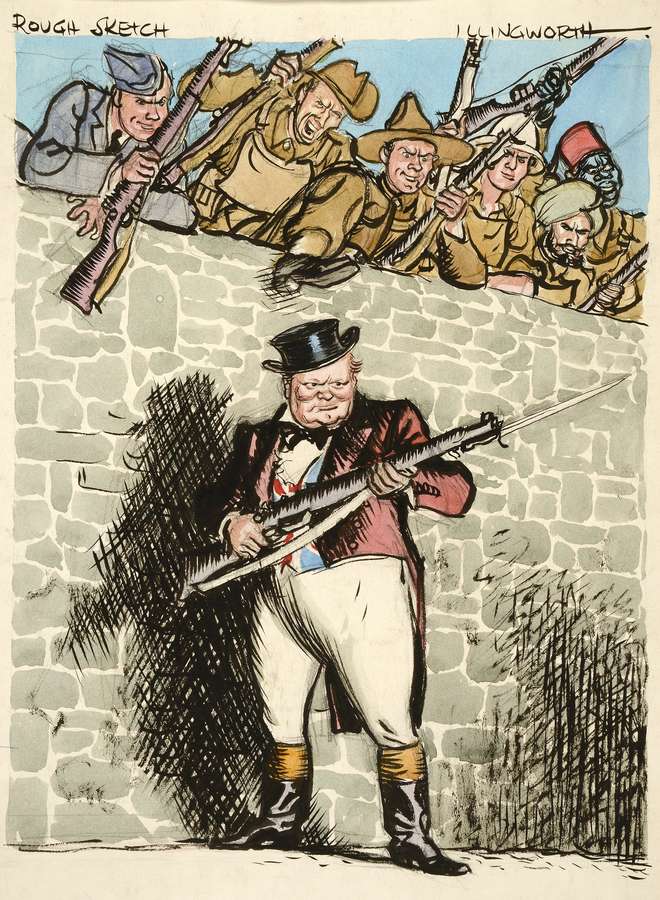
This cartoon has no caption, although the original artwork was called ‘Back to the wall’.

Cartoon by Leslie Illingworth showing Winston Churchill as John Bull, 1939–1946. Catalogue reference: INF 3/1325
Both of the below cartoons were produced by the Ministry of Information, the government department responsible for creating publicity and propaganda during the Second World War. Both show Australia (part of the former British Empire) and Britain attacking a Japanese soldier. Japan had declared war on the USA and the former British Empire on 8 December 1941. Japan attacked the United States naval base at Pearl Harbor and British forces in Malaya, Singapore, and Hong Kong.

Together for victory.
Together for Victory. Catalogue reference: INF 3/1350

Together to victory.
Together to Victory. Catalogue reference: INF 3/1350
This cartoon was drawn for the Ministry of Information in 1944 by Reginald Mount, a British cartoonist.
In the video we take you through the potential answers to useful questions to ask about a cartoon. Try answering the questions below yourself before watching the video!
 Watch What can a cartoon tell us? on YouTube
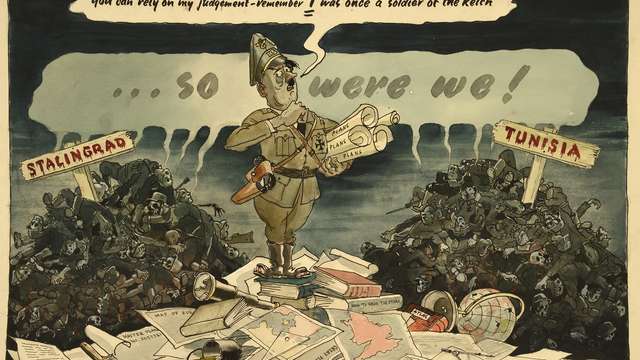
Welcome to 'what can a cartoon tell us?' Let's take a closer look at this example of a cartoon in The National Archives' collection. Our cartoon was created for the Ministry of Information in 1944 by Reginald Mount, a British cartoonist. Its catalogue reference is INF3/1321. Let's go through some useful questions to help us understand it.
What type of source is this? We can see that it is a colour cartoon with a caption - not all cartoons have one. This one says 'You can rely on my judgment - remember I was once a soldier of the Reich...so were we!'
Who produced it? The reference INF for the cartoon means that it comes from records created by the Ministry of Information. We know it was created in 1944 during the Second World War. The Ministry of information was the government department responsible for publicity and propaganda at that time.
Why was it produced? The cartoon was a form of propaganda used to convince the British public and possibly those fighting against the Allies that Hitler's war plans were a total failure. Its purpose was to convince the British and their allies of victory and the need to keep up support for the war. It is in colour, so unlikely to be produced for a newspaper - probably intended for a poster, which could have been displayed in public spaces.
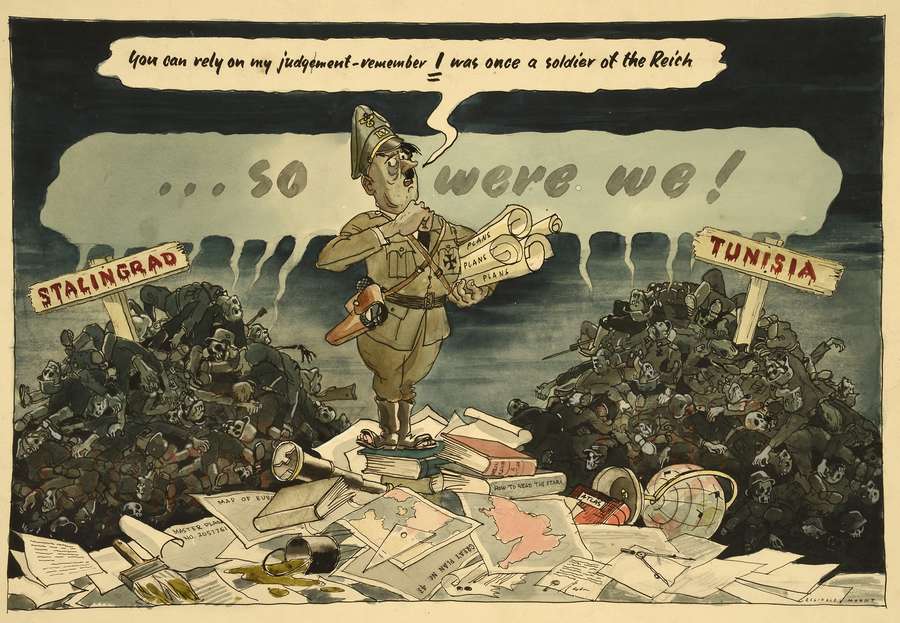
What can we infer from this cartoon? Let's take a closer look at the different elements of the cartoon to see what we can find out. The image shows Hitler standing on a pile of plans between two heaps of dead soldiers with skulls, one pile labelled Stalingrad and the other Tunisia. Adolf Hitler is instantly recognisable by his toothbrush moustache. His facial expression suggests he is afraid and exhausted. His body is small and he looks weak. His boots are worn out to reveal his toes to suggest his armies are running out of supplies and equipment. There's a broken telescope to imply that he can't see what is really happening. He is holding several rolled up plans to suggest he's indecisive or panicking. There's even a book called 'How to Read the Stars', a humorous reference to the fact that Hitler consulted astrologers .Indeed, documents at The National Archives show that British spies hired an astrologer during the Second World War to write horoscopes for him and other Nazi leaders. The abandoned paint pot is perhaps a reference to his very early career as a failed artist. The artist has composed the cartoon in this way to capture Hitler's arrogance and overconfidence; his hubris or pride before a fall. Hitler's foreign policy for German expansion and domination are suggested to be a total failure because he's standing on a heap of abandoned plans, maps or initiatives. Can you see one plan is labelled 'Master Plan 2057761' and another one 'Great Plan No. 43'. This is probably to suggest it is one of a long series of failures. The caption for the cartoon also suggests that Hitler's claim that the German military forces can rely on him as he was an experienced soldier who saw service and earned the Iron Cross in the First World War is totally misplaced. This is because the caption appears in the form of a conversation. The response to Hitler's comment is 'so were we'. This is shown in a ghostly speech bubble as the voices of the German soldiers who died on the battlefields of Stalingrad and Tunisia. This illustrates how the cartoon uses irony to express its message.
How does the cartoon relate to a historical situation? The cartoon references two different theatres of war: Stalingrad on the Eastern front and Tunisia as part of the North African campaign. It is important therefore that we have some contextual knowledge of these events to help us unlock the mess age of the cartoon. The pile of dead German soldiers and skulls is explained as follows. The Battle of Stalingrad proved to be the turning point in the Second World War. Germany had been forced to remove military forces from other areas in occupied Europe to replace German losses on the Eastern front. In the runup to this conflict in the spring of 1942 Hitler had ordered his forces to advance towards the USSR oil fields in the Caucasus region. The Soviets resisted fiercely suffering huge civilian and military casualties and by September the Germans had reached the outskirts of the city of Stalingrad on the river Volga. German forces fought their way building by building towards this river, which divides the city. They reached it in November 1942 but at a heavy cost of over 700,000 casualties. The German Army was left without supplies or reinforcements. As winter set in the Soviets began to drive them back from November 1942 to February 1943.The Germans were worn down and encircled German forces at Stalingrad surrendered at the beginning of February '43 after one of the bloodiest battles in human history had resulted in almost 2 million casualties. Through the rest of 1943 the Red Army gradually regained territory from the German invaders. Now, let's look at Tunisia, which along with Morocco and Algeria was for the most of the conflict in the hands of Vichy France. This fascist government made a pact with Nazi Germany in July 1940 after the fall of France. Germany occupied Tunisia from November 1942 to May 1943. Tunisian Jews and Muslims suffered Germany's antisemitic and racist laws. The Allies launched Operation Torch to drive out the German Nazis and Italians from French North Africa in November 1942. They formed three task forces to seize ports at Casablanca, Iran and Algiers before moving East into Tunisia. After six months of fighting the German Nazi Africa Corps and Italians surrendended to the Allied Army in Tunisia in May 1943. The German and Italian forces in North Africa sustained 40,000 casualties in Tunisia alone. 267,000 German and Italian soldiers became prisoners of war. The invasion of North Africa by the USA and Britain was the precursor of the Allied D-Day invasion of Normandy. Therefore the dreadful signs written in blood that we see in the cartoon explain the human cost of both Hitler's campaigns.
What techniques of persuasion does the cartoon use to give its message? Cartoons as sources must be read to be understood. The artist here uses arrange of techniques to express his ideas. For example, our cartoon has a very clear caption sentence, which gives the cartoon the punchline or message that Hitler with all his plans cannot win this war. The cartoon also uses labels to ensure we understand its context - in this case, German defeat at Stalingrad and in Tunisia. Let's examine how objects and figures are used in the composition of the cartoon. Hitler is shown in the centre. He's hemmed in and cannot escape the piles of bodies and plans on all sides, which represent his defeat as a leader. The cartoon also uses caricature to show Hitler. He is instantly recognisable from his moustache and pointed nose seen in numerous other cartoons. He looks foolish, as part of his appearance is exaggerated in this way. There is also evidence of symbolism within the cartoon, where an object is used to represent an idea - for example, the globe is cast aside, which suggests plans for world domination have failed. Other techniques not particularly evident in our cartoon are also used by cartoonists. Let's take a look at another example which uses the technique of analogy. Analogy means the comparison in which an idea or thing is compared to another thing and is often used to help explain a principle or idea. This cartoon from Punch Magazine in 1911 comments on British and Russian influence in Persia or Iran. Both countries are shown to embody the characteristics of different animals. Russia isa bear and Britain a lion. Persia is represented by a pet cat. At the start of the 20th century Russia and Britain had competing economic and political interests in Persia. In 1907 they signed an agreement that allowed each country to pursue its interests without competition from the other. Russia had exclusive influence in Northern Persia and Britain in southern Persia. The context of this cartoon is that Britain and Russia agreed that a Russian Force would go to the city of Tabrizin north-western Iran in June 1908 in response to a revolutionary siege. The Russians occupied the city from April 1909 until 1911. At that point the Russian government gave the Persian government an ultimatum, which was refused. The Shah or Emperor dissolved Parliament and agreed. Further conflict broke out in Tabriz and Russian troops were attacked. Further troops were sent from Russia to occupy Tabriz and two other cities. The revolutionaries of Tabriz were executed and Russian forces stayed there until 1917. The use of relative size is another cartoonist technique. This means that some figures are drawn larger or smaller than others to make a point or statement. This is shown to great effect in this cartoon from Ditty Box magazine, which was produced by the Navy during the Second World War. Here we can see the US President Franklin Roosevelt in contrast to Hitler the boxer. This juxtaposition works to stress the might and power of the United States and the weakness of Germany under the leadership of Hitler, who is claiming to be a powerful boxer in the image.
Now going back to our example are there any clues about the audience of the cartoon? The biggest clue for discovering the audience for our cartoon is that we know it was created for the Ministry of Information; therefore it was probably intended for a mass audience. As said earlier, it could have been used for public spaces like a factory canteen, town hall, a station or shop.
How reliable is our cartoon? Does it have any limitations? Certainly Hitler's territorial ambitions extended from the reoccupation of the Ruhr in 1936 and after the Munich agreement over Czechoslovakia in 1938. So reading it as a reflection of Hitler's expansionist policies as a war leader is accurate. The cartoon uses satire to ridicule his failures, which does not detract from its truth. The source is reliable in the sense it references real historical events - the losses experienced by Germany at Stalingrad and Tunisia. Obviously the cartoon is not naturalistic. Hitler is shown in caricature and there is much to infer from it as an obvious example of propaganda. It's worth knowing too that cartoons are not covered by the laws of libel. This potentially would raise the question of their reliability. Written defamation or libel is anything published or broadcast to ruin or damage the reputation of a person or business. Slander is spoken defamation. How does it relate to other sources from this period? Does it share the same attitudes or ideas? Hitler is shown as a similar stereotype figure in many wartime propaganda cartoons. The messaging for national solidarity and support of the war effort is also a constant theme in these cartoons. In terms of different types of sources, there are Foreign Office records, which include accounts of people who met Hitler and described his personality, so comparisons could also be made to our cartoon. Other sources such as War Diaries or Air Ministry and Admiralty records could give more detail on campaigns, offer other perspectives and more detailed historical context. Cabinet papers for the war years would be an excellent point of comparison too. Military maps and intelligence and security service records could be explored for yet more context. The National Archives' research guide on the Second World War is a very good place to start to find this material.
This video can also be viewed on YouTube with optional closed captions. Watch "What can a cartoon tell us?" on YouTube.

You can rely on my judgement – remember I was once a soldier of the Reich
...so were we!
Stalingrad
Tunisia
Catalogue reference: INF 3/1321
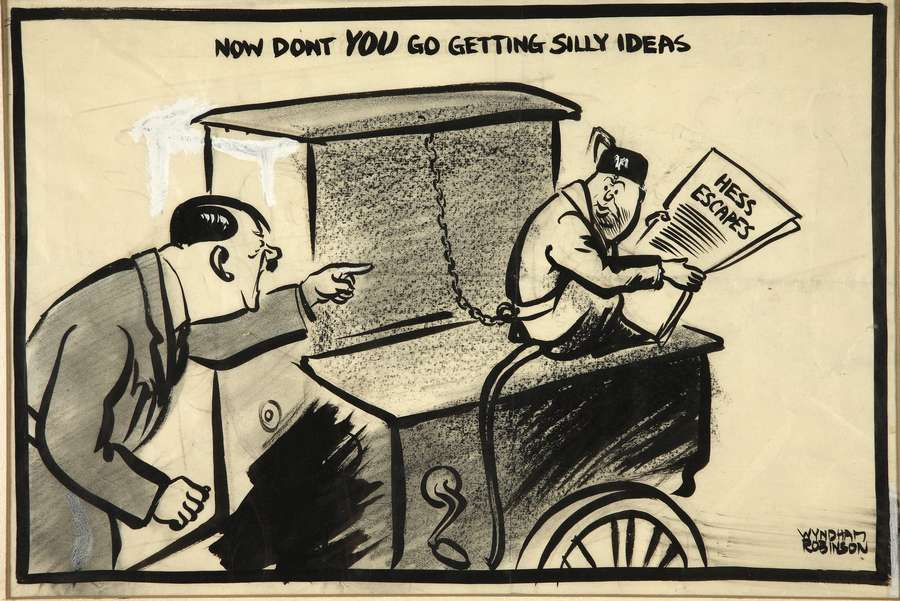
The cartoon refers to Rudolf Hess, who was Hitler’s deputy from 1933. In 1941 he secretly flew to Britain on a mission to negotiate a peace between Britain and Germany. It is also critical of the wartime relationship between Germany and Italy. The term an ‘organ grinder’s monkey’ means that a person is doing what a powerful person wants them to do and have no real power themselves. Street organ grinders historically used monkeys to perform tricks and attract interest and money.

Now don't you go getting silly ideas
[Newspaper] Hess escapes.
Cartoon for ‘Ditty Box’ magazine. Hitler appears as the organ-grinder and Mussolini the monkey, 1939–1946. Artist: Wyndham Robinson. Catalogue reference: INF 3/ 791R
President Truman signed the Economic Recovery Act of 1948. It was named the Marshall Plan, after Secretary of State George Marshall, who in 1947 proposed that the United States provide economic assistance to restore the economic infrastructure of post-war Europe.

This will help to keep you going till 1952.
Food and raw material
Marshall aid.
Thanks. I think I can produce enough to pay for all I need by then.
A political cartoon about the introduction of Marshall Aid by Clive Uptton. Catalogue reference: INF 3/1295

Putting the screw on John Bull
His foreign "friend." – All right, Lloyd George, you squeeze him dry, and I'll do the rest.
Putting the Screw on John Bull poster by G R Halkett, 1909. Catalogue reference: COPY 1/345
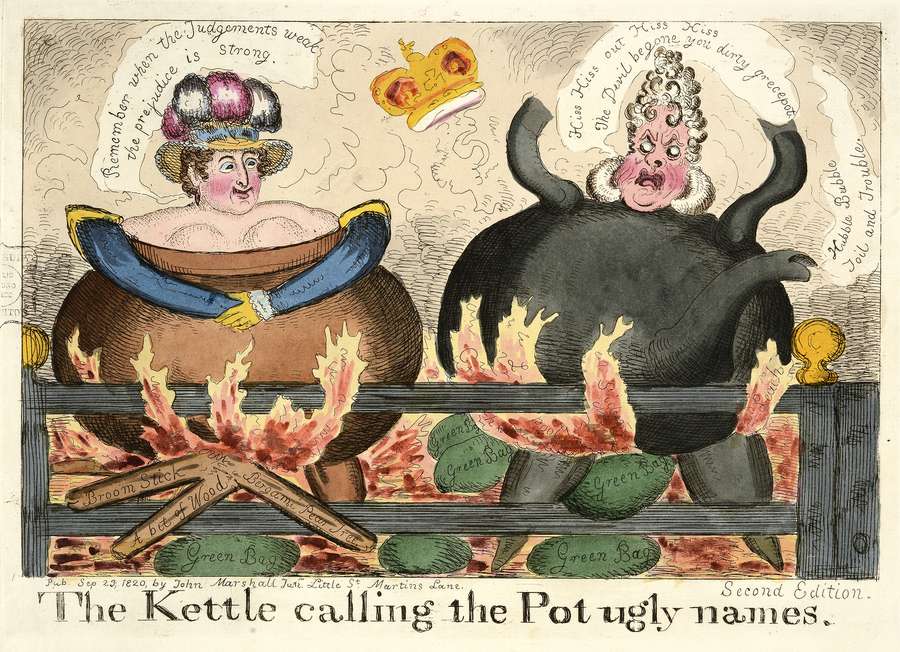
This is one of 91 coloured engravings by George Cruikshank in a volume held in the records of the government’s treasury solicitor relating to the royal divorce, 22 September 1820.
The cartoon is called ‘The kettle calling the pot ugly names’ and supported Queen Caroline over her divorce from King George IV. The expression: ‘the pot calling the kettle black’ is suggested by the cartoon which means that someone is criticizing another for the same faults they have. It refers to the build-up of soot from heating a cast iron kettle on the fire – the same soot would have formed on the pot after heat from the fire. Cruikshank’s satirical cartoon plays with this expression.
The kettle is used to represent George IV insulting his wife, Caroline of Brunswick, the ‘pot’. In 1820 a huge scandal erupted at the royal court. George IV tried to divorce his wife Caroline, because she had an affair with an Italian ex-soldier, Bartolomeo Pergami. The bags in the cartoon represent the papers sealed in green bags gathered as evidence against her. The pieces of wood being burnt in the fire say ‘Broomstick’ and a ‘A bit of wood, Bergami’s pear tree.’ The Queen is compared to a witch by the King. Cruikshank prompts the viewer to think of Shakespeare’s witches in ‘Macbeth’ as the King’s kettle says, ‘Hubble Bubble Toil and Pot.’ The cartoonist’s support for the Queen is clear when we read her speech bubble.
King George IV, and as Prince Regent, was often satirised for his extravagance and womanising by George Cruikshank.

Remember when the judgement's weak the prejudice is strong.
Hiss out. Hiss hiss. The Devil begone you dirty greasepot.
Hubble bubble toil and trouble
The kettle calling the pot ugly names.
The kettle calling the pot ugly names. Catalogue reference: TS 11/115 (60)
Political cartoons can be found in the pages of nearly every newspaper in the world. Cartoons that have a message, cartoons that make people think and cartoons that make people laugh. They can give us a unique perspective on a particular event and throw light on public attitudes and values. Therefore, to understand a cartoon, we need to know its historical context:
Students might find it useful to structure their research into a recording sheet for each cartoon.
These techniques are often used in cartoons to convey their message. Encourage your students to use these to explain how a cartoon works.
An idea or object is compared to something else used to help explain that idea.
A drawing style that makes someone look funny or foolish because some part of the person's appearance is exaggerated.
Short explanations, descriptions or titles.
To make something seem larger, more important, better, or worse than reality.
A form of humour which involves saying things that the opposite of what you mean.
Two things being seen or placed close together with contrasting effect.
Using an object or a word to represent an idea. A person, place, word, or object can have symbolic meaning.
Working with historical primary sources
natarchives.qualtrics.com
How much do you know about cartoons? Test your knowledge with this quiz.
As a style of drawing, caricature, or the exaggeration of a person’s physical features for comic effect, has been used more frequently to make a political point, leading to the development of the sort of cartoons we are now familiar with. Caricature was first was used in Italy early in the 17th century. It was introduced into England in the 18th century by those returning from the Grand Tour, an extended cultural trip around Europe for wealthy young men to finish their education.
George Townshend, later Marquis Townshend (1724–1807), was among the first to use caricature as a means of political satire in the 1760s. He produced comic portraits which were used in the London Magazine, the Political Register, and the Town and Country Magazine.
From the 18th century, the political cartoon became a recognised form of social and political commentary, taking serious issues or figures of the day and presenting them accessible way designed to affect the viewer’s opinion.
In Britain, James Gillray (1757–1815) and Thomas Rowlandson (1756–1827) made fun of political figures and issues. Unlike today’s cartoonists, Gillray was unable to publish his work in the newspapers. He displayed it in his publisher’s shop window in New Bond Street, London. Customers could buy a copy for a few shillings or even rent the pictures for a dinner-party to amuse their friends.
Another caricaturist, Thomas Rowlandson (1756–1827), did not hold back when making fun of political figures and issues either. Rowlandson created many images of life in Georgian London as a social and political observer.
George Cruikshank (1792–1878) led the next generation of British cartoonists. Cruikshank’s series of political caricatures for The Scourge (1816) established him as the leading political cartoonist of his generation, and he continued to satirize the policies of the Tories and Whigs in political cartoons until 1825. He produced a series of savagely satirical cartoons which opened the public discussion on the matter of the ‘Queen Caroline Affair’.
In the 1830s Cruikshank also produced book illustrations, notably for Charles Dickens’s Sketches by Boz (1836) and Oliver Twist (1838). In later life he embraced the cause of temperance (for moderation or abstinence in drinking) with his series The Bottle (1847) and The Drunkard’s Children (1848).
In Britain, the weekly humour and satirical magazine Punch started in 1841 and featured the work of men like John Leech (1817-1864) whose drawings were the first to be called cartoons. Prints ceased to be published as single sheets and became part of newspaper and periodical illustration.
John Tenniel (1820-1914) was another cartoonist to emerge. He was who was very influential, especially for his use of symbols such as Britannia, John Bull, Uncle Sam, the British Lion, and the Russian Bear. At the start of the twentieth century, the production of daily newspapers grew, and the political cartoon became a regular and established feature of journalism.
The two world wars and the subsequent peace treaties provided fertile ground for cartoonists such as Low, Dyson, Strube, Vicky and Illingworth. David Low’s work was highly influential, with his creation of ‘types’ which were reminiscent of Gillray and Cruikshank’s ‘John Bull.’
During wartime, the political cartoon was a powerful weapon, used to boost morale and use as propaganda. In Britain, the Ministry of Information made extensive use of them.
The use of cartoons continued to grow after the Second World war. The Times adopted a daily cartoon in 1966. In any newspaper today and you can see the latest offering from this profession. The work of Ronald Searle (1920–2011), Gerald Scarfe (1936–), and Ralph Steadman (1936–) captured some of the brutality of Gillray and Rowlandson. This continues with an anti-establishment position which can be seen in the cartoons of ‘Private Eye’ magazine (founded in 1961).
In the age of television, Peter Fluck and Roger Law, produced three-dimensional caricatures of a savagery reminiscent of Gillray for the ITV series ‘Spitting Image’ (1984–96).
Teaching resource
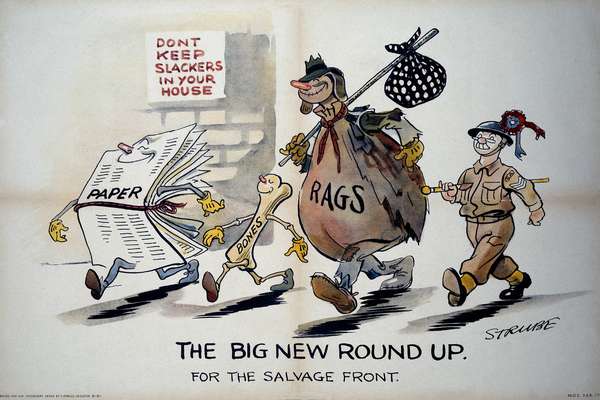
This resource includes various posters produced by the government during the Second World War with questions to help students interrogate them as sources.
Teaching resource
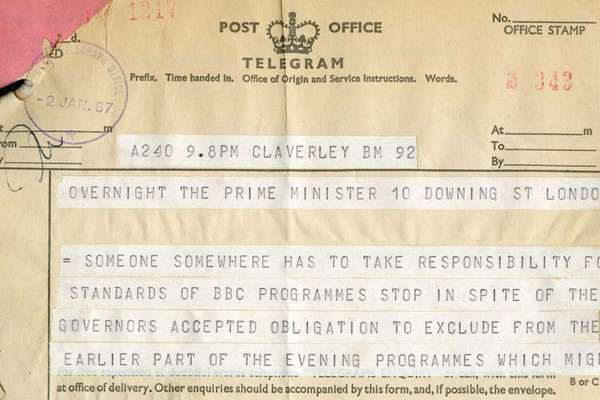
Telegrams were a form of instant communication. There are quite a lot of things you need to watch out for when using them as sources.
Teaching resource

There are quite a lot of things you need to watch out for when using photographs as sources. Just like documents they must be treated with caution.