Use Discovery to search for records held by The National Archives and around 2,500 archives and institutions across the United Kingdom as well as a much smaller number of archives around the world.
The information in Discovery is made up of record descriptions provided by or derived from the catalogues of the different archives.
Although some of The National Archives records have been digitised and can be read online, Discovery can’t search the words within them – only their description and title.
That means that if information such as somebody’s name is in the content of a record but not in its description or title, then searching for that name won’t find that record.
When you search Discovery you will get a list of records and record creators that match your search criteria. These search results will also show which archive holds the individual records.
You may have started your search on The National Archives website, but you could end up looking at descriptions of records held anywhere in the UK or even abroad. Take care to check where records are held and to contact the relevant archive if you want to find out how to see them.
Where your search results show records held by The National Archives, Discovery will show if the record is available to download (usually for a fee) or whether you need to come to Kew to view the original record or a microfilm or fiche copy.
If you are looking for manorial documents, read the section on Accessing the records of the Manorial Documents Register (MDR).
If you are looking for information about an archives service, including contact and access information you can use the Find an Archive tool which is on the Discovery home page.
See the following pages for more information about using Discovery:
Searching for records using Discovery
Understanding your search results
Sorting and filtering your search results
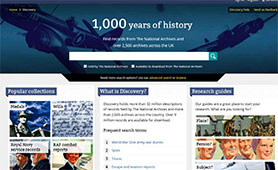
Use Discovery to access records relating to Britain and British history held at:
- The National Archives
- archives and institutions across the UK
- some archives and institutions abroad. Discovery provides contact details for these archives and institutions.
Visit Start here for advice on starting your research at The National Archives.
Or find a research guide to help you in your research.
1. Why use this guide?
This guide will help you to find records created by central government departments, and now held at The National Archives, that contain information on various kinds of residential institutions for children.
Our records are largely records of administration and policy covering institutions established since 1834 and do not routinely include records of individual children or staff.
For information on residential special schools for children with special educational needs, please see our research guide on Special services in education. See also our guides on Adoptions, and for child migration and the Children’s Overseas Reception Board 1940–1944 see our Emigration guide.
2. What kinds of records do we hold?
There are thousands of records on children’s residential care institutions at The National Archives, covering largely policy and administration. Most of the records come from three past and present government departments: the Home Office, the Ministry of Health and the Department of Health and Social Security.
Typically, when searching for records you will find the following:
On individual children’s homes and other related institutions:
- correspondence – between the government department and institution on subjects such as the institution’s management, building work, certification and finances
- inspection reports – these were routine reports assessing the institution’s accommodation, teaching, staff and environment
- investigations – carried out by government inspectors into specific incidents or complaints
On central policy and administration:
- correspondence – between the government department and charities, committees of inquiry, other government departments, foreign governments and other organisations
- statistical returns and reports compiled by civil servants on subjects which informed policy decisions
- notes and reports made by civil servants on proposed legislation
- circulars, memoranda and instructions issued to local authorities and institutions communicating policy and procedure
3. Records of individual children and staff
You are most likely to find records of individual children in care or of staff who worked in residential care institutions at the institutions themselves or in local authority archives.
The National Archives holds very few records of the people who lived and worked in children’s homes, whether the children themselves or the staff. Those that we do hold are mostly closed records, subject to the terms of the Freedom of Information Act (see section 7.3 for advice on some of the few we hold). Some members of staff might be named in inspection reports but this information was not consistently recorded.
For advice on requesting to view a closed record please see our Freedom of Information pages and to make a request please complete a Freedom of Information enquiry form.
For your own care records, use the Care Leavers’ Association website for information and guidance.
4. How to search for records: an overview
In this section you will find advice on how to conduct a search of the relevant records at The National Archives. As described at the end of the section, the Children’s Homes website is another very useful starting point, as are the other archives and organisations described in section 9.
4.1 The National Archives
Use Discovery, our catalogue, to search for document references using keywords and dates. Once you have a document reference you can view the document itself. The catalogue will indicate whether the document is available to view online or, if it isn’t online, how you can order a copy. Alternatively, in many cases you can visit us to view the original in person.
Use the following keywords as search terms, either alone or in combination (however, treat the results with caution – not all records are described in the same way):
- name of institution
- type of institution (for example, approved school)
- location (usually town, city or county)
Refine your search to one or more of the records of the three principal government departments responsible for most of these records over the years by using the advanced search in our catalogue and the following department references:
- HO – for Home Office records
- MH – for Ministry of Health records
- BN – for Department of Health and Social Security records
Further refine your search by adding keywords such as:
- policy
- inspection reports
- inquiry
- children
Suggestions of other keywords occur throughout this guide, where you will also find advice on how to target your search to specific record series covering particular time periods and types of institutions.
Why can’t you find a record?
If you cannot find what you are looking for it may be because:
- many institutions changed name over time
- many institutions changed purpose
- where provision was poor, children might be placed in the ‘wrong’ institution
- some documents may be closed where their contents name individuals
4.2 Children’s Homes website
You may also find it useful to consult the Children’s Homes website, a very useful resource where you can search for institutions by location or type and read about their history as well as view photographs of buildings and the people living in them.
5. Children’s homes 1834-1930
Charities, churches and other voluntary bodies historically provided for children who were in need of shelter and protection. With the passing of the New Poor Law in 1834, the state also began to play a role in the residential care of children who were orphaned, neglected, or impoverished.
A network of Poor Law Unions was created from 1834, to provide relief for the poor in the form of the workhouse. From the 1840s pauper children were increasingly housed in separate accommodation away from the ‘taint’ of the workhouse in a number of different types of institution. In many cases pauper children were housed in ‘voluntary homes’ of different types, their fees paid by their Poor Law Union.
5.1 Types of institutions
- Separate or District Schools (from 1849) – large institutions in rural areas, often housing hundreds of children from several urban Poor Law Unions.
- Cottage homes (from late 1870s) – groups of houses often built as self-contained miniature villages with their own chapels, schools and so on.
- Scattered homes (from 1890s) – groups of houses within the community, where the resident children attended normal elementary schools.
- Boarding-out – where other facilities were unavailable, pauper children might be ‘boarded-out’ (fostered) with local families.
- Certified schools – independently-run homes, often called voluntary homes. These ranged from small private establishments to large institutions run by national charities like Barnardo’s. From 1862 they could be licensed to receive pauper children for a fee, paid by the Poor Law Union.
- Voluntary homes – homes run by a voluntary body, or charity.
5.2 Where and how to find records: local archives
Surviving admission, discharge and other records kept by these institutions are usually deposited in the relevant county record office. You can find these records and contact details for the relevant county record office by searching for the name of the institution or Poor Law Union in our catalogue. The Workhouse website also has details for each Union.
5.3 Where and how to find records: The National Archives
To search for records at The National Archives, click on the catalogue references below to find out more about the kinds of records you can see in each record series and to search within the series itself.
Search by name of institution or location for:
- administrative records of the 14 district or separate schools in MH 27 (1848-1910) – records include staff appointments
- inspection reports in ED 132 (1904-1953) – in 1904 inspection of the educational and industrial work of separate schools was passed to the Board of Education.
Search by Poor Law Union or keywords like ‘child’ or ‘school’ for:
- information on pauper children in workhouses and reports on poor law schools attached to workhouses in MH 12 (1833-1909)
- correspondence from Assistant Poor law Commissioners and Inspectors, including reports on district schools, accommodation for pauper children, and the industrial training and education they received in MH 32 (1834-1904) – you can also search this series by name of inspector or Assistant Poor Law Commissioner
6. Children’s homes from 1930
From 1930 county and county borough councils took responsibility for the administration of children’s homes and the boarding-out (fostering) scheme, although the voluntary sector continued to provide residential homes. Institutional care remained widespread but fostering because increasingly popular, particularly after the Curtis Committee on the Care of Children recommended the use of fostering in preference to institutional care in 1946.
6.1 Where and how to find records: local archives
Surviving admission, discharge and other records kept by these institutions are usually deposited with the relevant county record office, or, for more recent records, within a council’s own archive. Search our catalogue by name of the home to identify the relevant repository.
The Care Leavers’ Association (CLA) website has information on accessing childhood care files and a list of local authority contacts.
6.2 Where and how to find records: The National Archives
Use the advanced search in our catalogue to search across HO, MH and BN using combinations of the following keywords:
- place – town, city or county
- name of institution
Alternatively, you can narrow your search by using the same keywords to search some of the key record series listed below. Click on the series references for a series-specific search (you will also find out more about the kinds of records you can see in that series).
Main policy series:
- MH 102 (1850-1971) – correspondence and policy reports from the Home Office Children’s Department
- HO 361 (1948-1980) – mainly general and policy matters and relations with local authorities
- BN 29 (1935-1992) – Home Office and DHSS Children’s Department policy files
Institutions and regions:
- HO 366 (1941-1972) – inspectors’ reports – search by local authority, name of home or keywords like ‘boarding out’
- MH 152 (1948-1995) – inspection reports and correspondence
- BN 74 (1977-1988) – policy material, inspection reports and case files for children detained in local authority community homes
- HO 361 (1948-1980) – some inspection reports of individual voluntary homes but mainly general and policy matters and relations with local authorities
- MH 102 (1850-1971) – some files on individual homes
- BN 61 (1941-1972) – review of local authority and NSPCC child care arrangements by Home Office Children’s Department inspectors – search by county
- BN 29 (1935-1992) – Home Office and Department of Health and Social Security (DHSS) Children’s Department policy files
- BN 62 (1897-1990) – files relating to inspectors’ visits
7. Correctional institutions from 1854
In 1825 the government introduced separate prison accommodation for children and adults, with the ‘Euryalus’ prison hulk for juvenile offenders and, in 1838, opened the first state prison for juvenile offenders, at Parkhurst on the Isle of Wight.
From then on a number of correctional institutions catered specifically for young offenders, many of them known as reformatories. These institutions, often set up privately by charities, churches, or philanthropic individuals, as well as by the state, could apply for government grants on condition of regular inspection. However, it was not until 1854 that the Home Office became responsible for the inspection of reformatory schools – and in 1857 for industrial schools.
Before 1854 records relating to child prisoners are found with the normal prison records.
7.1 Types of institutions
- Reformatories (1854–1933) – corrective institutions, detaining children aged 14–16, who had been convicted of a criminal offence. They were punitive and until 1899 children usually spent two weeks in prison before entering a reformatory. These institutions also provided industrial training.
- Industrial or training schools (1857–1933) – preventative, admitting children younger than 14 who were vagrant, neglected, disorderly, or at danger of being ‘corrupted’. They usually removed children from their local communities, provided moral instruction and training for a trade. There were also a number of day training schools in urban areas.
Some reformatories and industrial schools were based on ships, providing specialised training.
Later institutions which supplemented and then replaced these institutions include:
- approved schools (from 1933) – replaced reformatories and industrial schools and took children under 17
- remand homes (from 1901) – held children committed for trial or awaiting removal to an approved school
- voluntary homes – where there were no places available in remand homes, children removed from their homes by order of a juvenile court might be placed in voluntary homes
- borstals (from 1902–1983) – established to separate young offenders (aged 16 to 21) from older convicts in adult prisons
- detention centres (from 1952) – for youths aged 14 to 20 years serving short three month sentences
- secure units (from 1964) – for children aged 10 to 18 who had absconded from approved schools
- community homes with education (from 1969) – replaced approved schools
- Youth Custody Centres (from 1983) – replaced borstals
- Young Offender Institutions (from 1988) – replaced Youth Custody Centres
7.2 Where and how to find records: local archives
Surviving admission and discharge records and records of the day to day running of these institutions are usually held at the relevant county record office. Where these institutions were run by charities or religious orders, their records may be with the organisation’s archives (see section 9). Find records by searching our catalogue for the name of the institution.
Many of the children detained in these institutions were ordered there by the courts and details of their committal may survive among the Petty Session or magistrates court records at county record offices. Use our Find an archive page to search for a county record office.
7.3 Where and how to find records: The National Archives
Use the advanced search in our catalogue to search across departments HO, MH and BN using combinations of the search terms below. However, treat the results with caution – not all records are described in the same way. Search terms:
- type of institution (see 7.1)
- name of institution
- place – town, city or county
Alternatively, to narrow your search results, use the same keywords listed above to search key record series by clicking on the series references below (this will also reveal more about the kinds of records you can see in each series):
Main policy and administrative records: key series
- HO 45 and HO 144 (1839 to 1971) – policy matters in general and in relation to individual institutions
- MH 102 (1850–1971) – policy files of the Home Office Children’s Department (correspondence, reports and other papers)
- BN 29 (1935–1992) – Home Office and DHSS Children’s Department policy files (correspondence, reports and other papers)
- HO 361 (1948–1980) – general and policy matters and relations with local authorities.
- PCOM 9 (1901–1973) – correspondence and papers on the management and staffing of prisons and borstals, and the treatment of their inmate
Institutions: key series
Records of institutions include inspection reports, institution files, correspondence and inquiries and investigations into complaints or incidents.
Reformatories and Industrial schools
- HO 45 and HO 144 – includes correspondence on industrial and reformatory schools
- HO 349 (1855–1965) – contains logbooks, registers and miscellaneous records of selected reformatories and their successors
- MH 102 (1850–1971) – correspondence on remand homes, industrial and approved schools
Approved schools
- BN 62 (1897–1990) – files relating to inspectors’ visits to approved schools and remand other homes
- HO 349 (1855–1965) – contains logbooks, registers and miscellaneous records of some reformatories and their successors (ordinarily this sort of material would be found in local record offices)
- HO 360 (1946–1975) – files on individual approved schools
- MH 102 (1850–1971) – correspondence on remand homes, industrial and approved schools
Remand schools
- MH 102 (1850–1971) – correspondence on remand homes, industrial and approved schools
- BN 61 (1945–1971) – contains reports on reception, remand, and foster homes, local administration and case work and NSPCC inspectors
- BN 62 (1897–1990) – files relating to inspectors’ visits to approved schools and remand other homes
Borstals
- HO 391 (1959–1988) – management and administration of prisons, detention centres, remand centres and borstals
- PCOM 9 (1901–1973) – includes reports on conditions in borstals
Secure units
- MH 152 (1948–1995) – correspondence and inspection reports
- BN 62 (1897–1990) – files relating to inspectors’ visits
Individual cases: key series
Please note these files may be closed in line with the 100 year rule. The 100 year rule is a method for calculating the closure period for personal information about people who may still be alive. The information about them will remain closed for 100 years from their date of birth.
- HO 45 and HO 144 – includes correspondence and reports on selected cases – search by name of individual or browse results of keyword searches for type of institution, such as “approved school”, to find files on unnamed youths
- BN 28 (1939–1980) – case papers and files on the care and protection of a representative selection of individual children, some of whom were at approved schools
- HO 247 (1905–1977) – registers and sample case files on the after-care of young offenders from the Borstal Association and Central After-Care Association
8. Committees of inquiry
There have been numerous committees of inquiry into the provision of children’s care services. One of the most influential of these was the Care of Children Committee, or the ‘Curtis Committee’ which reported in 1946 and whose recommendations resulted in the Children Act 1948.
8.1 How to search for records
Use the advanced search in our catalogue to search for papers using any or all of the following:
- the name of the committee (for example, the ‘Care of Children Committee’)
- the name of the committee’s chair (for example, the ‘Curtis Committee’)
- keywords (for example ‘boarding-out’)
Key series for these records include HO 45, MH 152, MH 102 and BN 29.
For committees of inquiry investigating specific institutions or cases involving a named individual, there are two possibilities.
1. Records may survive as discrete series, for example:
- HO 350 – Inquiry into the administration of punishment at Court Lees Approved School 1967–1973. Evidence and papers of inquiry
- BN 91 – Committee of Inquiry into the Provision and Co-ordination of Services to the Family of John George Auckland (1975)
- VC 2 – Records of the Victoria Climbié Inquiry consist of the final version of a website maintained by the inquiry containing the final report, evidence key documents and background information about the inquiry (2001–2003)
2. Alternatively, papers may be found within the records of the Children’s Departments at the Home Office and DHSS. Use the advanced search option to search our catalogue by the name of the individual or institution at the centre of the investigation restricting your search to department references MH, HO and BN.
Final reports of these official committees of inquiry can be found via Proquest UK Parliamentary Papers. This is a subscription website you can access on The National Archives’ computers by visiting us at Kew. You may also be able to access it via a large reference library such as a university library.
Discussions in Parliament can be found in Hansard, which is available online on the Parliament website. Please note there are some volumes missing from the online data.
Our research guide to Hansard details different ways of accessing the reports and records of Parliamentary debates.
8.2 Complaints of abuse
There were also smaller scale investigations or inquiries by government departments into isolated complaints or incidents.
Search for these by the name of the institution and keywords such:
- complaint
- allegation
- cruelty
- abuse
To narrow your search try series HO 45, HO 144, MH 152, MH 102 or BN 29.
9. Records held elsewhere
The Care Leavers’ Association website has a useful list of contact details for local authority and other organisations that may hold further records.
Charity organisations
Many children’s homes were run by national and local charities. Some of these organisations have their own archives where records of their children’s homes may be deposited. Alternatively, search our catalogue by name of the charity for records of smaller, local charities in the relevant county record office.
Religious organisations
A number of religious groups operated children’s homes through charities, for example the Church of England’s Waifs and Strays Society, now the Children’s Society; and the Methodists’ National Children’s Home, now Action for Children. These large national charities have their own archives.
Many Roman Catholic children’s homes were run either by a diocesan branch of the Catholic Children’s Society (now the Cabrini Children’s Society), or a religious order. Where the diocesan Children’s Society or order is still active they may hold records for their homes or the records may have been deposited with the relevant Catholic diocesan archives.
Local authority records
Surviving records of a local authority’s children’s committee and children’s officer are likely to be at the relevant county record office. Use our Find an archive page to search for a county record office.
Scotland and Northern Ireland
Consult the National Records of Scotland and PRONI.
10. A brief history of institutional care for children in the UK
Provision of residential care institutions for children grew out of a mixture of private and charitable initiatives, poor law, correctional and educational institutions.
A range of institutions and different levels of local provision means that the type of care provided varied greatly. An orphaned or abandoned child in the late 19th century might have been sent to a poor law residential school, a children’s home run by a charity, he or she might have been ‘boarded-out’ (fostered) or might be sent by a magistrate to an industrial school if they were found begging or repeatedly playing truant from school.
The 19th century saw an explosion in the number of charitable children’s homes, from small homes run by a local charity or individual, to well-known national organisations like Dr Barnardo’s Homes, the National Children’s Home and the Waifs and Strays Society who had a network of national and international provision.
Various branches of government had a role in children’s institutions. The Home Office played a key role and many of the records listed in this guide were created by its Children’s Branch (and successors), set up in 1924. The Ministry of Health and Board of Education also had child care responsibilities and some homes were subject to visits from their inspectors.
From 1930 county and county borough councils took responsibility for the administration of children’s homes and the boarding-out (fostering) scheme, although the voluntary sector continued to provide residential homes. Institutional care remained widespread but fostering became increasingly popular, particularly after the Curtis Committee on the Care of Children recommended the use of fostering in preference to institutional care in 1946.
The 1948 Children’s Act brought together, under the Home Office, central government responsibility for ‘children deprived of a normal life’ in England and Wales. The Act also required each local authority to set up a Children’s Committee with a trained Children’s Officer responsible for children in their care.
In 1971 the child care responsibilities of the Home Office in England were transferred to the Department of Health and Social Security (DHSS); responsibilities in Wales were transferred to the Welsh Office. At a local level, local authority children’s departments were abolished and their functions absorbed into new social services departments.
11. Further reading
R Kershaw, and J Sacks ‘New lives for old: The story of Britain’s child migrants‘
A Land, R Lowe and N Whiteside ‘The Development of the Welfare State 1939–1951: A guide to documents in the Public Record Office‘
The website www.childrenshomes.org.uk
1. Why use this guide?
This guide provides a brief overview of records held by The National Archives that cover research, development and production of arms and other technologies by and on behalf of the British Army in the 19th and 20th centuries.
The records themselves are varied and extensive, with detailed written and visual information reflecting a broad range of topics, from reports from experimental artillery establishments to tank and small arms design. As well as successes, the records also document novel yet unsuccessful inventions.
2. Who created these records?
Although before the First World War technological development was – bar a small number of exceptions – largely the responsibility of the individual services, predominantly the Army and Navy, in 1915 the manufacture and supply of the materials of war were transferred to the newly created Ministry of Munitions.
While earlier records tend to be found within the War Office department, central direction of munitions development and production during the First World War and later periods means many also sit within other departments. The transfer of these responsibilities at different times has also meant records have been inherited and deposited by different departments, regardless of the date they were produced. As a result, you should consider broadening any search to include the series and departments given below.
3. Getting a search started and how to view documents
3.1 Speculative and basic keyword searches
This guide highlights some key series that you might like to explore. However, you may also wish to start with a more speculative keyword search of the whole of Discovery, our online catalogue. Consider the following kinds of keywords and search tips for searches:
- name of weapon/vehicle/equipment
- type of weapon/vehicle/equipment – be prepared to use broad as well as specific descriptions; some common examples include:
- ‘armoured fighting vehicles’ as well as ‘tanks’
- ‘small arms’ as well as ‘pistols’, ‘revolvers’ or ‘rifles’
- ‘artillery’ as well as ‘guns’
- very broad, general terms for military equipment and technological developments such as:
- armaments
- weapons
- explosives
- inventions
- production
- name of invention or inventor (person and company)
3.2 Advanced searches and browsing
Use the advanced search in our catalogue to restrict your keyword search by:
- department code (see below for codes)
- date (allowing you to focus your search on an event or period of interest)
The department code you use will be determined partly by the dates that you are searching within and partly on the specific subject matter. Development of weapons and other technological military advances were originally the domain of the Ordnance Office and the British Army itself. For the majority of these early records use the following department code:
- WO (War Office)
After the start of the First World War, with the development of research establishments these responsibilities fell under various bodies. Therefore, for records from 1915 onwards use the following department codes (note that these departments also contain records that predate the parent organisations):
- MUN (Ministry of Munitions)
- SUPP (Ministry of Supply)
- AVIA (Ministry of Aviation)
- DSIR (Department of Scientific and Industrial Research)
- DEFE (Ministry of Defence)
View the full list of series and records in the above departments by clicking on the department code and selecting ‘Browse by reference’ at the foot of the page.
Read Discovery search help if you need more guidance on how to search and browse Discovery, our catalogue.
3.3 Viewing the documents
None of the records referred to in this guide can be viewed online. To view them you will either need to visit The National Archives or order digital or paper copies to be sent to you. You can order copies from Discovery by clicking on the record title (you should register an account in Discovery before you request copies).
4. Development and testing of armaments and military technologies
These are records of weapons, vehicles and other military technologies proposed, in development or undergoing trials. To browse or search in a series, click on the series reference.
4.1 Records of the Boards of Ordnance
Browse within WO Division 19 for records of the Ordnance Office 1568-1983.
Browse or search within the following correspondence, reports and other papers concerning:
- early 19th century design and research in WO 44/620-640 (visit us at The National Archives building in Kew to browse the index to these records in the printed version of our catalogue)
- mid-19th to late-20th century design of armaments and munitions in SUPP 6
4.2 Records of private enterprise
Search WO 32 and WO 33 for records which show the importance of private enterprise and outside inventors to advances in military technology – these are extrememly large, broad series so browsing them, as opposed to searching them, will probably be very laborious.
Other potentially interesting avenues include the personal papers of influential individuals, such as Field Marshal Viscount Garnet Wolseley in WO 147.
4.3 Records of research and development establishments
Use the following list to determine which departments and series to search in for records of research, design or development in:
- armaments, transport equipment and other technologies – search in the sub-series within DEFE 15
- chemicals and explosives 1940-1976 – search in AVIA 37 and AVIA 67
- rocket propulsion – search in AVIA
For records of the following establishments:
- the Munitions Inventions Department of the Ministry of Munitions during the First World War – search in DSIR 37
- the Armaments Research Establishment and its antecedents dating from the turn of the 20th century through to the 1930s – a manuscript history is in DEFE 15/31
- various research and development establishments from the 19th century to the 1990s – search in WO Division 12, DEFE 15 and DSIR 37 for technical reports and memoranda
4.4 Records of experimental and testing establishments
Browse or search for reports and other records of:
- the Director of Experiments and Research at the Ministry of Supply, predominantly from the early 20th century, in SUPP 28
- artillery development and testing by the Proof and Experimental Establishments at Shoeburyness, Ty Croes, Pendine, Lavington, Cold Meece and Inchterf between 1852 and 1993 in WO 186
- equipment trials from the Director of Artillery dating predominantly from the 1930s and 1940s in WO 196
- small arms experiments and trials between 1853 and 1928 in the School of Musketry in WO 140
5. Novel inventions and armoured fighting vehicles
These are records of inventions designed to meet the specific needs of a conflict, some of which were abandoned and never produced, others which made it to the production line and were used in battle; this section also covers records of armoured fighting vehicles such as tanks.
5.1 Early records of invention
The Board of Ordnance correspondence collection in WO 44 contains details of inventions submitted to the Board by serving officers and civilians during the first half of the 19th century.
Visit us at The National Archives building in Kew to browse the index to these inventions in the printed version of our catalogue.
5.2 First World War
For novel inventions designed to tackle the challenges presented by the First World War search in:
- WO 142 (files of the Trench Warfare and Chemical Warfare Departments)
- MUN 7/273-344 (files of the Munitions Invention Department)
For documents concerning early tank development, design and performance search in:
- MUN 5/210
- CAB 17/120B
- CAB 17/167
- WO 161
- ADM (particularly in records covering the work of the ‘Landship’ Committee, such as ADM 116/1339)
For later design and production of weapons and other technological developments search in departments:
5.3 Second World War and post-war period
Search the following series for reports and correspondence concerning:
- fighting vehicles and mechanical equipment in WO 194 (Military Vehicles and Engineering Establishment records 1921-1984) and WO 362 (Inspectorate of Fighting Vehicles and Mechanical Equipment records 1960-1983)
- new vehicles and equipment in WO 341 (Royal Armoured Corps records 1947-1985)
- vehicles, equipment and armour in WO 351 (British Army of the Rhine technical reports 1950-1975)
Consult the following records for:
- Tank Board proceedings for the duration of the war in WO 185/5-8
- a report on the specialised armour used by 79th Armoured Division (Hobart’s ‘funnies’) through the latter part of the war in WO 205/1159
6. Inventors and patents
Depending on the date, financial rewards for inventors were settled by the War Office, the Ordnance Council, the Ministry of Munitions and the Ministry of Supply. Records of these awards often provide blueprints and details concerning technological advancements, as well as correspondence regarding financial awards.
Search the records below of Royal Commissions, which were set up to deal with claims. The content of these large files varies a great deal. Some of it is information about someone’s claim to have invented something and the correspondence about the case; others contain blueprints and very specific details about the invention:
- the post-First World War Tomlin Commission in T 173 – search by inventor (personal name or company name) or invention
- the post-Second World War Cohen Commission in T 166 – search by inventor only (although an index and register of claims is available to help navigate the series)
For records on patents and specifications of inventions you can search the T and TS series. Alternatively:
- for more information, see our guide on Patents of inventions or
- consult the Design Registers in BT 45 (use the subject index in BT 46/9 (1843-1883) to help identify relevant records)
7. Records of production: factories and manufacturers
These are records predominantly of the interactions between industry (state-owned and private factories), the armed forces and government departments, and include:
- technical reports
- production statistics
- contracts
- committee minutes – the records cover many and various committees which effectively undertook or oversaw the business of the ministries; examples include, in the First World War, the Munitions Works Board, the Trench Warfare Committee and the Land and Property Committee; and in the inter-war period and Second World War, the Joint Industrial Council, Flame Warfare Committee, Ordnance Board and Principal Supply Officers.
- correspondence
- entry books – these are ledgers arranged by product/contract type (for example, bits for 25 Pdr guns); they list the company manufacturing the product or undertaking the order, the items to be produced or altered, the number of items, the money paid, when the order was completed and other details.
- plans of the factories and their sites
7.1 Search terms
Use the following keywords and types of keywords in our online catalogue to search the series and departments in 7.2 for records of production:
- name or location of factory or production establishment such as ‘Woolwich’ or ‘Waltham Abbey’
- contract type or – for some records – name of producer holding the contract such as ‘armoured cars’ or ‘Birmingham Small Arms’
- statistics along with item of production – ‘small arms ammunition AND statistics’
- technical keywords concerning production materials – for example, ‘acetone’, ‘tnt’ and ‘picric acid’ not just ‘high explosives’
- ‘correspondence’, ‘minutes’, ‘board’ or ‘committee’
7.2 Relevant record series
For records of production at state as well as private contractors (for example, Birmingham Small Arms and London Small Arms), search (using the department codes in the advanced search) the following departments:
- War Office (WO)
- Ministry of Munitions (MUN)
- Ministry of Supply (SUPP)
- Ministry of Aviation (AVIA)
More specifically, search for records of the following:
- Royal Ordnance Factories 1664-1989 – including entry books, committee minutes and other records – search in SUPP Division 7
- early contracts awarded by the Ordnance Office – browse in WO 49
- contracts awarded during the First World War by the Ministry of Munitions – browse or search by company name in the MUN department code (particularly MUN 7)
- contracts awarded during the Second World War – browse or search by company name in SUPP or see the Contract Record Books in SUPP 4 (arranged by contract type)
- all types of Second World War production – browse or search the statistics sub-series within AVIA 22
Search within WO 78, WO 385 and WO 397 for maps and plans of factories and establishments.
8. Records in other archives
You can search for the records of other archives around the country, including many of the those listed here, using our catalogue.
Follow the links below for contact information and links to the websites of the following institutions, each of which contain useful records regarding army technologies:
Company records for private firms that held state contracts are often located in regional archives. For example, those of Armstrong Whitworth can be found at Tyne & Wear Archives, while those of the Birmingham Small Arms (BSA) company are now held at the Modern Records Centre at the University of Warwick Library.
For the papers of Sir Eustace Tennyson D’Eyncourt – Director of Naval Construction and central to early tank development – visit the National Maritime Museum for records DEY 41-60.
9. Further reading
These books are all available in The National Archives’ reference library. Use our library catalogue to find a recommended book list. The recommended book list might help you navigate these collections or put them in context.
The official history of the Ministry of Munitions.
Lists and Indexes Society, Volume 53 Alphabetical Guide to War Office and Other Military Records (HMSO, 1931).
Beckett, I F W The First World War: The Essential Guide to Sources in the UK National Archives (Public Record Office, 2002).
Overview of our copying service
Our record copying service provides digital or paper copies of documents from our collection.
If you are looking to obtain a digital copy of a document from our collection, you must first start by identifying the relevant record. This can be done by searching Discovery, our catalogue.
Once you have identified a document, providing the record you have chosen hasn’t already been digitised, you can request a page check from the record copying service. You can do this by clicking the ‘order a copy’ link at the bottom of the catalogue page and following the instructions.
If the record you require has already been digitised, details on how you can obtain copies can be found within the individual catalogue reference in Discovery.
Page checks
All copying requests start with a page check, costing £9.92. This charge covers:
- a member of staff reviewing the document to assess if the information can be located
- checking its suitability for copying
- providing a costed quote for the digitisation
Please note the £9.92 does not include the cost of digitising the images.
Before placing a page check, you need to have a reasonable expectation that:
- the selected document will contain the information you require
- the relevant information will be easily identifiable
If your enquiry is speculative, there is a chance your page check will be unsuccessful. If you do not have the full information required, please consider contacting either an independent researcher or our own research services to obtain the information you need.
Please be aware that once work has begun on the page check the £9.92 is non-refundable.
Making copies
If copies can be made, the price you pay for them will depend on the type and number of copies you want. View our current fees. This process can take approximately 29 working days from start to finish. Find out further information on the charging and legislation governing the copying fees.
Once an order has been completed and delivered no refunds are granted due to the non-returnable nature of digital products once they’re downloaded.
If you are interested in higher volume digitisation of whole documents, please review our digitisation services or email the Digitisation Centre to find out more.
Please note that the record copying service is not a research service. Our staff specialise in all aspects of the digitisation process but have no expert knowledge of what is contained within the documents.
Further information
- Current demand for record copying services is very high and we are working hard to ensure we maintain a high standard of service while accommodating as many orders as possible. We recognise that this may present difficulties for researchers, and we will keep this arrangement under regular review.
- Please watch our step-by-step guide to the record copying service. Some of the information in this video, such as delivery times, has been adjusted.
1. Why use this guide?
This guide provides advice on which records to consult at The National Archives for studies of the UK economy and the economic policy of central government in the 20th century. The records of numerous central government departments can provide insights into these subjects but the focus of this short guide are two of the primary decision-making bodies, the Cabinet and the Prime Minister’s Office, and the Treasury, the government’s economic and finance ministry, responsible for maintaining control over public spending.
For more detailed advice on the records of these departments, please read our guides to Treasury Board letters and papers 1557-1920, Cabinet and its committees and Prime Minister’s Office records.
2. The basics of how to locate records
You can view some of the records referred to in this guide online – they are covered in section 3. All the other records referred to remain available in their original paper form only and locating these records begins in Discovery, our catalogue. For very broad searches simply use keywords such as:
- ‘budget’, ‘spending’ ‘funding’ and an area of public spending, such as ‘housing’, ‘transport’ ‘science’ and so on
Refine search results to specific kinds of documents by adding words to your search such as:
- ‘bill’, ‘report’, ‘minutes’ or other document types
The private papers of various Chancellors of the Exchequer are available within our records. To locate these, search the catalogue using:
- “Chancellor of the Exchequer” plus “private office papers” and a date
- the name of a minister (for example, R A Butler or Lord Butler) plus “private office papers”
Alternatively, you can browse within the records of specific departments by clicking on the letter codes below for an overview of the records:
- Treasury (T) – correspondence and reports on the control of public revenue and expenditure
- Cabinet Office (CAB) – records of the supreme decision-making body in government
- Prime Minister’s Office (PREM) – includes correspondence to and from the Prime Minister’s Office, briefing papers and policy papers
- Foreign Office (FO) – correspondence, policy and negotiation with other states
For advice on searching effectively, read Discovery help.
3. Online records
3.1 Cabinet Papers
Read our research guide to Cabinet and its committees for advice on searching our catalogue for cabinet papers.
The archived Cabinet Papers site has themed pages which you can browse, some with links to downloadable documents.
3.2 UK Government Web Archive (1990 to present day)
Search the UK Government Web Archive for archived versions of over 2000 UK government websites and social media accounts. Websites for HM Treasury, Office for Budget Responsibility, and Number 10 are among those which may be useful for researching contemporary economic history.
The UK Government Web Archive includes social media, such as Twitter, and archived videos.
3.3 Parliamentary Papers (1715 to present)
Search Proquest UK Parliamentary Papers for sessional papers of the House of Commons. This is a subscription website accessible onsite at The National Archives. You may also be able to access it at large reference library such as a university library. Search by keyword, date and paper number. Discussions in Parliament can be found in Hansard, which is available online on the UK Parliament website. Please note there are some volumes missing from the online data.
Our research guide to Hansard details different ways of accessing the reports and records of Parliamentary debates.
4. Treasury records
The Treasury was reorganised in 1919, 1948, 1962 and 1975 and as a result the arrangement of Treasury records changed too. It is easier to locate Treasury records from 1920, and to a lesser extent from 1909, with keyword searches in our catalogue, as explained in section 2. Prior to these years, you will need to use Treasury registers, available at The National Archives in Kew. Consult our guide to Treasury Board letters and papers 1557-1920 for advice on how to do this.
For a sense of the topics covered by Treasury records, and how they are arranged, take a look at the list of Treasury functions for the year 1982-1983 (PDF).
To find records of a particular sector, group or division of the Treasury you can use the advanced search in our catalogue to target Treasury records using the department code T and then refining your search results using the ‘Subjects’ filter. Alternatively, you can browse the Treasury material by hierarchy to identify the records grouped by its different areas of responsibity.
The following Treasury record series may prove particularly useful for some areas of research:
- T 171 – Budget and Finance Bill Papers (1859-1980). This series records the Chancellor’s meetings with advisers and includes papers relating to debates in Parliament and the Chancellor’s budget speeches. Budget papers post-1980 can be found in the series T 366.
- a collection of papers from Lord John Maynard Keynes’ private office in T 247
- T 267 – Treasury Historical Memoranda (1957-1976). This series contains memoranda on recurring issues or episodes of long-term significance. For example there are papers on negotiations with the European Economic Community (1961-1963) in T 267/14.
- T 639 – Private Office of the Chancellor of the Exchequer: Geoffrey Howe’s records (1979-1983). This series contains high level policy work and correspondence at a ministerial level. For example, files concerning budget preparations, economic strategy and European and international issues are included.
- T 640 – HM Treasury: Chancellor of the Exchequer: Private Office Papers [Nigel Lawson]: Private Office files (PO-CH/NL prefix) 1979-1990
5. Some useful Cabinet record series
For more detailed advice on the records of Cabinet, read our guide to Cabinet and its committees. The following record series may prove particularly useful for research into economic policy:
- minutes and papers of the Economic Policy Committee and various other committees and sub-committees on economic policy in CAB 72)
- CAB 147 – consisting primarily of economic advice and briefings provided by Dr Thomas (later Lord) Balogh to the Prime Minister and other ministers
- CAB 134 – Miscellaneous Committees: Minutes and Papers (General Series) (1945-1987). This series contains records of standing Cabinet committees including the Economic Policy Committee. See section 12 of our guide Cabinet and its committees for more information
6. Records in other archives
6.1 The Bank of England Archive
Visit the Bank of England Archive website for information on their holdings and how to view material.
6.2 Records held locally
The National Archives’ catalogue has details of collections held by over 2,500 archives across the UK. Search our catalogue with the names of politicians to find out where their papers are held. You may need to refine your results using the filters.
7. Further reading
Use our library catalogue to find a recommended book list. The books are all available in The National Archives’ reference library. You may also be able to find them in a local library. You can buy from a wide range of history titles in our bookshop.
You can also listen to the podcast on 20th-century Treasury records.
1. Why use this guide?
This guide will help you to identify records documenting the Nazi regime in Germany held at The National Archives. These are largely British records, though they do include some captured German records. They contain details of Nazi persecution and policy, including records created during and following the liberation of the concentration camps.
None of these records are available to view online so to see them you will either have to visit us in Kew or, if you can locate document references using our online catalogue, order copies.
2. An introduction to what we hold
The records we hold documenting Nazi persecution, including of the Holocaust, are, like everything held at The National Archives, records collected and created by central departments of the UK Government, including the War Office, Foreign Office, Cabinet Office and so on.
Of course, these records date from before and after the Second World War as well as from the war itself. The UK had an embassy in Nazi Germany right up until the declaration of war and there is much correspondence shared between the British diplomatic mission in Germany and the Foreign Office now preserved in the archives.
Some of the records contain sensitive and potentially upsetting details and because of this, as well as for data protection reasons, some are closed for up to 100 years. These records can only be opened and seen via a successful Freedom of Information request.
Given the scale of Nazi persecution across Europe, some of the records are in other languages.
3. How to search for records
The simplest way to get started is to try a keyword search of our online catalogue. Every record we hold is represented in our catalogue by a title, a date or date range, a reference and a brief description. When you use our catalogue to search for records you are searching across these titles and descriptions, rather than the contents of the records themselves. By clicking on any item in catalogue search results you can see what the options are for viewing that record.
The terms ‘Holocaust’ or ‘Final Solution’ aren’t very useful when conducting searches as they were rarely used at the time the records were created. You should, instead, try words or combinations of words like:
- Nazi persecution
- Nazi and/or German atrocities
- Nazi activities
- National Socialism
- concentration camp, or the name of a specific concentration camp
- war crimes
- expulsion AND Germany
- resettlement AND Germany
- deportation AND Germany
- names of Nazi leaders including ‘Hitler’ or ‘Himmler’
It is possible in some cases to search for records of Nazi treatment and policy towards specific religious, ethnic and other social groups where these are named in the catalogue descriptions. For example, you can combine some of the keywords above with ‘Jewish’ or ‘Jews’.
Sometimes it helps to narrow your search to specific record departments by using the advanced search of our catalogue and one or more department codes. Record departments correspond to the central government departments which originally collected and created the records or, in some cases, the predecessor or successor departments. Some departments, naturally, were more involved in the creation of records documenting Nazi persecution than others. Among those that produced the largest number of records on Nazi atrocities and other elements of the Nazi regime, and therefore particularly worth targeting when searching, are:
- The Foreign Office – department code FO. Foreign Office correspondence includes many reports of the persecutions and atrocities which occurred in many countries before, during and after the Second World War. See our guide on Foreign Office records for a more detailed explanation of how to search.
- The War Office – department code WO. These are largely records created by the British Army and military staff, ranging from War Office meetings and reports created by administrators and politicians in London to records from the field written by Army officers.
- German Foreign Ministry papers – department code GFM. German Foreign Ministry papers were captured at the end of the Second World War. They contain information about German policy between 1867 and 1945. They are written in German and there are no translations.
- Cabinet Papers – department code CAB. Recording British government strategy and decision-making at the highest level. See our guide to records of the Cabinet and its committees for detailed search advice.
- Prime Minister’s Office – department code PREM. The records of the Prime Minister’s Office include official correspondence of the Prime Minister and much on Second World War policy and operations.
4. Records of persecuted individuals and holocaust victims
In general, you are more likely to track down a record of an individual who was imprisoned in a Nazi labour or concentration camp among the records of other archives and organisations, covered later in this guide. Furthermore, of the records of individuals held at The National Archives, it is often not possible to use our catalogue to search for them by name.
4.1 Records of compensation claimed by and paid to victims of Nazi persecution
Foreign Office records in record series FO 950 include both administration files and individual claims for compensation made by British victims of Nazi persecution under the Anglo-German Agreement of 1964.
These files include both those who received compensation and those who were refused compensation under this scheme.
These records vary in detail but can include:
- an application form
- supplementary letters of personal experiences of Nazi persecution which vary in length
- medical assessments
- letters of acceptance or rejection of the claim
- responses of the individual of the rejection/acceptance
Use the FO 950 series search, using keywords such as ‘Nazi persecution’. Names are included in some catalogue descriptions so it is worth trying a search by name. However, some records are closed and the claimants’ names have been withheld under the Data Protection Act.
You can request the opening of closed records in FO 950 under the Freedom of Information Act 2000 by filling out our Freedom of Information enquiry form or by writing to our Records Enquiry Service at The National Archives, Kew, Richmond, Surrey TW9 4DU. In your request please specify the series reference FO 950 and the full names of the claimants you are researching.
4.2 Records held by other archives and organisations
See section 9 below for better places to go to trace records of individuals.
5. Records of Nazi policy and of Nazi occupied territories
For records of the treatment of minority groups by Nazi governments and civilians, including anti-Jewish legislation and civil disorder, the best place to start is Foreign Office correspondence. These records also indicate the extent of the British government’s knowledge of Nazi atrocities, including concentration camps, and how it planned to respond. See our guide on Foreign Office records for a more detailed explanation of how to search.
German Foreign Ministry papers, captured at the end of the Second World War, contain information about German policy between 1867 and 1945, including racism and persecution by the Nazis. The key records series for information on the persecution of minority groups is GFM 33.
You can carry out an advanced search of our catalogue using either English or German keywords, including those suggested in section 3; but bear in mind that the majority of these records are in German. See our guide on German Foreign Ministry and Italian documents 1867-1945 captured by the British for further information.
6. Records of the liberation of the camps
British forces liberated concentration camps in northern Germany, including the camp at Bergen-Belsen but also Neuengamme. It is these camps for which the largest number of records exist at The National Archives. Search the catalogue using ‘concentration camp’ or the name of a specific camp.
Details of the discovery of concentration and labour camps by the British Army are often contained in war diaries, among War Office records.
Search for war diaries in our catalogue by unit name(s) and headquarters rather than by place. See our research guide on British Army Operations in the Second World War for more information on how to search these operational records.
Control Commission records in FO 1060, documenting British-occupied post-war Germany include details of concentration camps as well as the handling of former inmates, refugees and displaced persons.
7. Records of Allied occupied Germany
The Foreign Office inherited the records of a number of the organisations through which the Allies administered what are now Germany and Austria after the Second World War. These were:
- The Control Offices, based in London
- The Control Commissions, based in Germany and Austria
- The Civil High Commission, which instigated de facto self-government in West Germany from 1948 until 1955 (when normal diplomatic relations were resumed)
For the greatest concentration of material on the policy and administration of the Control Commission in the British-occupied zone of post-war Germany target Control Commission records.
7.1 What kinds of records are held at The National Archives?
The surviving records of the Control Commission for Germany (British Element) are held at The National Archives but are incomplete as only a small percentage of the files were selected for permanent preservation. The overwhelming majority of these are administrative in nature and rarely contain personal details.
In addition to the above, there are numerous files and material on denazification generally including:
- policy and applications
- some name lists
7.2 How to search for records
For a breakdown of the record series relating to the Allied Administration, see the FO Division 14 page.
The file descriptions used by the Control Commission were very broad and this is reflected in the record descriptions in our catalogue. A keyword search of our catalogue is therefore of limited value but it may be worth completing the following fields in the advanced search with the terms provided:
- All of these words: a keyword relevant to your search e.g. censorship
- Exact word or phrase: Control Commission for Germany
- Within references: FO
- Date: 1945 to 1950
You should also consult Akten der Britischen Militärregierung in Deutschland: Sachinventar 1945-1955 (11 Volumes, published by KG Saur 1993). These volumes, available from The National Archives library, provide brief details (in English and occasionally German) of the Control Commission documents for Germany (the “G documents”) as well as the associated National Archives references.
Search within the indexes for relevant keywords. Useful keywords include:
- displaced person
- refugee
- Jewish communities
- Jews
- nationality
In addition, the records of the Allied Kommandatura, the four power body that administered Berlin until the end of the Cold War, are in FO 1112.
8. Records of war crime trials
Records of war crimes and war crimes trials, particularly those held in the British occupied zone of Germany from 1945 onwards, are held primarily in Foreign Office and War Office departments. These records cover investigations into individuals accused of war crimes and details of their prosecution. They include:
- minutes
- proceedings
- outcomes of the trials
- statements made by witnesses and the accused
They contain descriptions and photographs of a particularly sensitive nature which you might find upsetting.
See our research guide on War Crimes 1939-1945 for further information.
9. Records of interviews from the UK Holocaust Memorial Foundation
In 2015, an independent, cross-party Commission found there was an urgent need to record some of the last remaining voices of British Holocaust survivors and liberators, while there was still an opportunity to do so. Between 2015 and 2016, the UK Holocaust Memorial Foundation (UKHMF) took forward this recommendation and recorded 112 audio-visual interviews with 113 people.
The interviews recorded by UKHMF cover a wide range of experiences linked to Nazi persecution and the Holocaust, and include the perspectives of camp survivors, children in hiding, refugees who escaped to the United Kingdom and Kindertransport children. The collection also includes the voices of British soldiers and medical staff involved in the liberation and relief of the Bergen-Belsen concentration camp.
Since December 2024, edited educational copies of these testimonies have been made publicly available through the Holocaust Testimony UK website. The testimonies now transferred into The National Archives’ collection are the original master footage files.
The records are available to search and browse in CLG 126.
The records on this series include the original videos of interview testimonies (in mp4 format) and the written transcripts of the interview testimonies.
If you wish to license the material please see details on our website UK Holocaust Memorial Foundation (UKHMF) testimonies and transcripts licensing arrangements
10. Records in other archives
Many other archives and libraries have large collections of written and visual material relating to the Holocaust and Nazi persecution. Some of these are:
- The Wiener Library for the Study of Holocaust and Genocide
- Imperial War Museum
- United States Holocaust Memorial Museum
- Yad Vashem
- Simon Wiesenthal Center Library and Archives
- German local archives
11. Further reading
Many books have been published about Nazi persecution and the Holocaust. Use our library catalogue to find a recommended list of books which are available to read in our reference library; you may also be able to find them in a local library. You can buy a wide range of history titles in our bookshop.
We have published several blogs on The National Archives website on this subject:
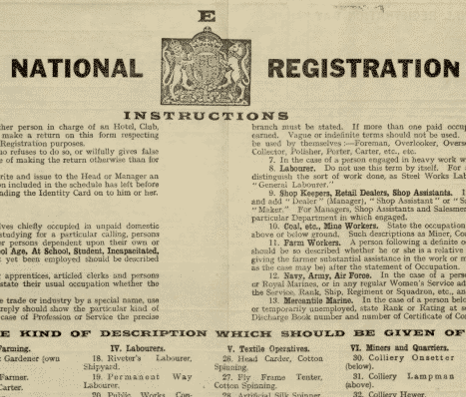
1. What are these records?
The 1939 Register provides a snapshot of the civilian population of England and Wales just after the outbreak of the Second World War.
As the 1931 census for England and Wales was destroyed by fire during the Second World War and no census was taken in 1941, the Register provides the most complete survey of the population of England and Wales between 1921 and 1951, making it an invaluable resource for family, social and local historians.
The Register is available to search and view on our partner sites Findmypast.co.uk (£) and Ancestry.co.uk (£). For more details see section 5.
You can learn more about the 1939 Register by watching our webinar on Using the 1939 Register.
2. When and why the Register was compiled
The 1939 Register was taken on 29 September 1939. The information was used to produce identity cards and, once rationing was introduced in January 1940, to issue ration books. Information in the Register was also used to administer conscription and the direction of labour, and to monitor and control the movement of the population caused by military mobilisation and mass evacuation.
3. What and who the Register records
The 1939 Register was designed to capture the details of every member of the civilian population on a specific date – military personnel were not recorded (see below for more information on who was and wasn’t recorded). It contains details of around 40 million people, recorded in more than 65,000 volumes (transcript books).
While the 1939 Register is not a census, it is arranged along similar lines and includes similar, if less detailed, information. It does, however, show exact dates of birth where census returns simply give a person’s age.
3.1 The civilian population
These records do include the civilian populations of:
- England
- Wales
These records do not include the civilian populations of:
- the Channel Islands
- the Isle of Man
- Scotland (for information relating to records of individuals in Scotland at the time of the 1939 Register please contact National Records of Scotland)
- Northern Ireland (for information relating to records of individuals in Northern Ireland at the time of 1939 Register please contact Public Record Office of Northern Ireland)
3.2 Exceptions and anomalies among armed forces personnel
Registration of members of the armed forces was dealt with by the military authorities, so the 1939 Register does not include service personnel in military, naval and air force establishments. Nor does it include members of the armed forces billeted in private homes, including their own homes. However, since conscription did not begin in earnest until January 1940, most people who subsequently served in the armed forces during the Second World War were still civilians in September 1939.
The records do include
- members of the armed forces on leave
- civilians on military bases
3.3 The information recorded for each individual
For each individual the following details are included:
- address
- schedule number
- sub number
- surname
- first name(s)
- role (for institutions only – Officer, Visitor, Servant, Patient, Inmate)
- gender
- date of birth
- marital status
- occupation
4. How the Register was compiled and arranged
Information is arranged by:
- enumeration district – each enumeration district has a unique four- or five-letter code, and large enumeration districts may comprise more than one book
- household or institution – each household or institution is represented by a schedule number. A large institution such as a hospital may be an enumeration district in its own right
- national registration number – each person is represented by a sub-number within the household or institution
When preparing the Register, the General Register Office used the plans already in place for what would have been the 1941 Census. It was based on registration districts and sub-districts, and was administered by Superintendent Registrars and Registrars of Births and Deaths.
The enumeration districts used for the Register were based broadly on those used for the 1931 Census, adjusted to account for the population movements since 1931. They were sub-divided into smaller units for National Registration purposes. The general rule was that an enumeration district should contain no more than 300 households, not counting institutions.
The final arrangement of the Register was not by registration district, as in a census, but according to the boundaries of local government units. These were the bodies responsible for the Local National Registration Offices and Food Offices, who maintained and updated information in the Register. These were County Boroughs, Municipal Boroughs, Urban Districts and Rural Districts, except in London which was made up of Metropolitan Boroughs and the Cities of London and Westminster. For more information about enumeration districts and area codes, please read understanding the 1939 registration districts.
5. How to access and search the Register
It is only digital copies of the 1939 Register that are available to the public. The original register books are not held at The National Archives and have been retained by the Health and Social Care Information Centre, now called NHS Digital. Short descriptions of the records are available to view in our catalogue, in record series RG 101.
You can search for and view open records on our partner site Findmypast.co.uk (£). A version of the 1939 Register is also available at Ancestry.co.uk (£), and transcriptions without images are on MyHeritage.com (£). It is free to search for these records, but there is a charge to view full transcriptions and download images of documents. Please note that you can view these records online free of charge in the reading rooms at The National Archives in Kew.
Broadly speaking, there are two ways to search the records on Findmypast.co.uk:
5.1 Using the Advanced search
Use the Advanced search to search by name, date of birth, gender, occupation and marital status. You can also include the name of another person expected to be in the same household. There is also an exact reference search and several ‘place’ fields, as well as a separate tab for an address search.
5.2 Using the 1939 Register Browse
Use the 1939 Register Browse to browse the records by
- place (‘Borough/District’)
- document reference (‘Piece Number’), for example RG 101/1234a
- enumeration district code (‘ED Letter Code’) such as DVIA
- numbers from National Registration Identity Cards or ration books, or from pre-1991 NHS Medical Cards – some of these forms of identification included the enumeration district code (‘ED Letter Code’), a four- or five-letter code followed by two numbers (these two numbers are the schedule number and the sub-number)
You can learn more about the 1939 Register by watching our webinar on Using the 1939 Register.
6. Why can’t I find the person I am looking for?
6.1. They were born less than 100 years ago
The record of anyone born less than 100 years ago is closed unless they are known to have died. For more information see section 9.
If someone was born less than 100 years ago, and has died, their record may still be closed if their death was not notified and recorded in the register. Deaths that occurred outside the United Kingdom are unlikely to have been notified. These include the majority of Second World War deaths.
6.2. They were not in England or Wales on 29 September 1939
People who were born after 29 September 1939, or who arrived in the country after that date, are listed in separate registers not yet publicly available.
6.3. They were not included in the original Register, or appear under a different name
Despite the best efforts of the registration authorities, a small number of people were missed out, and had to be registered later. A few deliberately failed to register, possibly because they thought they could avoid being conscripted.
A very few enumeration district books (Transcript Books) are known to be missing from the 1939 Register. The people in those districts would have been registered and received their identity cards and ration books, but unfortunately the books themselves are not included in the register that has been released because they arrived too late at the Central National Registration Office.
6.4. Names may not appear as you expect them
Try different spellings, or use a wild card. The names in the Register were copied by the enumerator from the household schedules, hand-written by the householders. The Register was subsequently in constant use for more than 50 years so some entries will have become hard to read through frequent handling. Middle initials are generally included, but middle names rarely appear in full.
6.5. Incomplete, inaccurate or too much information
The information in a huge database such as this will inevitably contain some errors, either in the original information supplied, or in the course of copying and indexing. You should be flexible and imaginative when searching and try any combination of the following:
- Search with just one or two search terms (such as name and date of birth), resisting the temptation to fill in all the search boxes you can
- Search with just a surname
- Search by address
- Try multiple searches for the same person, varying the information you search with each time
See Findmypast’s Frequently asked questions for more guidance on searching.
6.6. They were living apart from their families
By 29 September 1939 there had already been mass evacuations of the population so many people may be listed in an entirely different location to the rest of their family. Many seasonal workers, such as hop-pickers, were still in the countryside when the Register was taken, and not at their normal home addresses in urban areas.
If you can’t find an individual in the place you thought they lived or where their family lived, try searching in ‘reception areas’; these are the rural counties where evacuees were sent.
The whole of the following counties and areas were designated Reception Areas:
- Bedfordshire
- Berkshire
- Buckinghamshire
- Cambridgeshire
- Cumberland
- Dorset
- Herefordshire
- Huntingdonshire
- Northamptonshire
- Oxfordshire
- Rutland
- Shropshire
- Suffolk
- Sussex
- Westmorland
- Wiltshire
- the Isle of Wight
- the Isle of Ely
- the Soke of Peterborough
- the Holland and Kesteven divisions of Lincolnshire
6.7. Change of street name
If you are searching for a particular street and are unable to find it, remember that street names may have changed, or that the street may have been built after 1939.
Small villages and hamlets can be very difficult to find because house or street addresses may not include the name of the hamlet or village. This will depend on how each enumerator chose to record this information in the limited space allowed for it in the register books.
Village and hamlet names, along with the Registration District and Sub-district number and other detailed place information, were recorded in the description pages at the start of each Enumeration Book. These were the equivalent of the Enumerators’ Summary Books that accompany the 1911 Census. Unfortunately, these books have not survived, so there is no simple way to identify the area covered by every enumeration district.
7. Why do some entries show the married names of women who did not marry until long after 1939?
The Register was continually updated while National Registration was in force, when it was a legal requirement to notify the registration authorities of any change of name or address. This ended in 1952, but since 1948 the Register had also been used by the National Health Service, who continued updating the records until 1991, when paper-based record keeping was discontinued.
Changes of name for any reason were recorded; in practice this was mostly when women changed their surnames on marriage or re-marriage, but also includes changes of name for any other reason, such as by deed poll.
The majority of these name changes appear in the indexes so you can search for a person using either their name in 1939 or any subsequent name.
8. What does it mean when an entry is crossed out and marked ‘See page…?’
These refer to ‘continuation entries’ where the line in the ‘postings’ column (see section 9.4) against a person’s name was full up, and a new line had to be created for any new entries.
The new line was added at the back of the enumeration book or sometimes at the back of the next book in large enumeration districts that comprised two or more books. You can browse to the page containing the continuation entry if it is in the same book; if it is in the next book you can use the browse function described in section 5.2 to go there, and then browse to the right page. However, this is very unlikely to contain any additional information.
9. Living individuals and closed records
Some online search results of the Register will have a number of blanked out lines, indicating that the record is closed because the individual may still be alive.
9.1 Why records are closed: the 100 year rule
In February 2004 the Lord Chancellor’s Advisory Council on National Records and Archives considered and accepted a proposal for the use of a standard closure period, and that a lifetime of 100 years should be assumed.
Individuals’ records remain closed for 100 years from their date of birth or until proof of death. Information relating to living individuals is withheld under sections 40(2) and 40(3)(a)(i) of the Freedom of Information Act 2000.
9.2 Some records of people born less than 100 years ago are open
From 1948 the Register was also used as the National Health Service (NHS) Register, and was updated until 1991, when the paper-based system was discontinued. This included notification of deaths, so the records of people born less than 100 years ago, but whose death was reported to either the National Registration authorities or to the NHS, will be open (see also section 8).
Findmypast have checked the names and dates of birth in the 1939 Register against the General Register Office indexes of deaths in England and Wales and opened many records where exact matches are found. Furthermore, the records of individuals born 100 years ago (according to the date of birth shown in the Register) are opened at Findmypast.co.uk on a regular basis.
The version of the 1939 Register on Ancestry.co.uk is updated less frequently. Ancestry open previously closed records once a year, on average, and there is sometimes more than a year’s lag between the notification of a death and the opening of a record on their website.
For advice on requesting the opening of a record for an individual you know to be deceased, please see section 10.
9.3 How to close an open record of a living individual
If you see a record that is open, but which you believe should be closed because the person is still alive, you can ask for the record to be closed using the ‘close an open record’ button on the respective transcription page on Findmypast. If you do not have access to Findmypast, you can make a request direct to The National Archives using our Your views form.
9.4 The ‘postings’ column
Each entry in the Register extended across a double page spread. However, the accessioned digital record does not include the ‘postings’ column on the right hand page which contains various codes used for National Registration and National Health Service purposes. The National Archives does not have access to this column and the information it contains.
10. How can I open a record of an individual I know to be deceased?
To open a record it must first be located and checked. Who does the checking and whether there is a charge will depend on whether or not you subscribe to Findmypast.co.uk or Ancestry.co.uk.
Findmypast.co.uk subscribers
If you are a Findmypast.co.uk subscriber and you have located a closed record, you can request a check of the record free of charge and if successful, the record will be made available via the online service. Please note, Findmypast will not search for records on your behalf – to request a check of a closed record you must locate the record yourself first. To have a record checked you will be required to provide proof of death, most commonly a death certificate. If you have proof of death but cannot identify a specific record, you can request a search of the 1939 Register for a fee using The National Archives Freedom of Information (FOI) request form.
Ancestry.co.uk subscribers
If you are an Ancestry.co.uk subscriber and you have located a closed record, you should use The National Archives Freedom of Information (FOI) request form to request a search of closed records from the 1939 Register. If the record can be opened, we will send you a full transcription of the information held in the record. The transcription is likely to include the following details: schedule number, sub-schedule number, name, address, date of birth, gender, marital status and occupation. The opened record will be available to view on Ancestry.co.uk between 12 and 18 months after the notification of a successful request. Please note there is a fixed charge for this service.
Non-subscribers
If you do not subscribe to Findmypast.co.uk nor to Ancestry.co.uk you should use The National Archives Freedom of Information (FOI) request form to request a search of closed records from the 1939 Register. If the record can be opened, we will send you a full transcription of the information held in the record. The transcription is likely to include the following details: schedule number, sub-schedule number, name, address, date of birth, gender, marital status and occupation. The opened record will be available to view on Findmypast.co.uk ten to twenty working days after the notification of a successful request and on Ancestry.co.uk between 12 and 18 months after the notification. Please note there is a fixed charge for this service.
11. How can I see my own record?
An individual is entitled to submit a Data Subject Access Request to obtain their own record information within the 1939 Register. You can use this form if you are searching for information about yourself in the 1939 Register. You can also use this form if you are acting on behalf of someone who was in the Register and has authorised you to request information on their behalf.
These requests fall under the Data Protection Act 2018 and the General Data Protection Regulation. Please note that the information will only be disclosed to you, and the record itself will remain closed.
12. The NHS Central Register
The records of the 1939 Register were subsequently used by the National Health Service at its inception in 1948 and became the NHS Central Register, transferred to the Health and Social Care Information Centre (HSCIC) in 2007, and now called NHS Digital.
The records remained with the NHS up until 1991 – therefore most changes of name between 1939 and 1991 are listed in the records. Although all changes of name or address should have been notified, this did not always happen, and it was no longer a legal requirement after the National Registration Act was repealed in 1952. Changes of address were recorded only at the local level, and so do not appear in the 1939 Register.

How do I view these records?
Search and download these records on:

More about these records
You can search and download birth, marriage and death records from nonconformist, non-parish and overseas sources 1567-1969.
These are selected digitised records from a variety of record collections held at The National Archives:
- registers of births, baptisms, deaths, burials and marriages in RG 4
- birth certificates from the Presbyterian, Independent and Baptist Registry and from the Wesleyan Methodist Metropolitan registry from 1742-1840 in RG 5
- Society of Friends’ (Quakers) registers, notes and certificates of births, marriages and burials from 1578-1841 in RG 6
- registers and notebooks of clandestine marriages and baptisms in the Fleet Prison, King’s Bench Prison, the Mint and the May Fair Chapel from 1667-c1777 in RG 7
- registers of births, marriages and deaths surrendered to the Non Parochial Registers Commission of 1857 in RG 8
- overseas births, baptisms, marriages, deaths and burials abroad and on British & foreign ships, of British subjects, nationals of the colonies, the commonwealth and countries under British jurisdiction in RG 32
- overseas birth, marriage, death and burial of British subjects including those on board ships in RG 33
- overseas Foreign Marriage Returns from 1861-1921 in RG 34
- miscellaneous Foreign Death Returns from 1791-1921 in RG 35
- registers in the protectorates etc of Africa and Asia from 1895-1965 in RG 36
- registers of births, deaths and marriages of passengers at sea from the Registry of Shipping and Seamen from 1854-1908 in BT158
- registers of deaths at sea of British nationals from the Registry of Shipping and Seamen from 1875-1888 in BT159
- registers of births at sea of British nationals from the Registry of Shipping and Seamen from 1875-1891 in BT160
For more information on what these records contain see thegenealogist.co.uk/non-conformist-records/
Basic principles
Big number followed by small number: ADD
Small number followed by bigger number: SUBTRACT small from big
Number followed by number of equal value: ADD
Small number with large number above: MULTIPLY
Examples
- I or j = 1
- II or ij = 2 (1+1)
- III or iij = 3 (1+1+1)
- IIII or iiij or IV = 4 (1+1+1+1) or (5-1)
- V =5
- VI or vj =6
- VII or vij = 7 (5+1+1)
- VIII or viij = 8 (5+1+1+1)
- IX or Viiij = 9 (10-1) or (5+1+1+1+1)
- X = 10
- XI or xj = 11 (10+1)
- XIX = 19 (10+(10-1))
- XX = 20 (10+10)
- XXX = 30 (10+10+10)
- XXXX or XL = 40 (10+10+10+10) or (50-10)
- L = 50
- LX = 60 (50+10)
- LXX = 70 (50+10+10)
- LXXX or iiijxx = 80 (50+10+10+10) or (4×20)
- LXXXX or XC = 90 (50+10+10+10+10) or (100-10)
- XCIX or iiijxxxix = 99 ((100-10)+(10-1)) or ((4×20)+10+(10-1))
- C = 100
- CI or cj = 101 (100+1)
- CC = 200 (100+100)
- CCC = 300 (100+100+100)
- CCCC or iiijc = 400 (100+100+100+100) or (4×100)
- D = 500
- DC = 600 (500+100)
- M = 1000
- MDCCCCLXXXV or MCMLXXXV = 1985 (1000+500+100+100+100+100+50+10+10+10+5) or (1000+(1000-100)+50+10+10+10+5)
But
- Ml = 1000 (mille)
- MM or MlMl = 2000 (1000+1000) (mille+mille)