The primary record series for First World War air operations is AIR 1. This record series contains an extremely wide variety of documents, not all of them relating to operations. Among the hundreds of subseries which make up AIR 1 are the papers of military officers; RFC squadron, wing, brigade and headquarters records; some of the early RAF squadron and wing records; papers of the Australian Flying Corps and the South African Aviation Corps.
1. Why use this guide?
This is a guide to finding records of manors held by The National Archives. Manorial records are a vital source for local, social, family and economic history. These records can reveal historical information about local areas in England and Wales, predominantly before the 1920s, including details of:
- the community living on the manor and its social structure, including the division of households
- local agriculture
- the tenure and transfer of property among tenants
- disagreements between tenants
- markets and trade more generally
- industrial developments
Records from a single manor can be scattered across a number of archives and institutions, held in both public and private hands and sometimes both. At The National Archives, manorial records, as with all of our records, are among the records accumulated by government departments and courts, though some have been regrouped into new series since their arrival in our repositories
This guide will help you to understand the records we hold and how to search for them.
Until 1733, manorial records are likely to be in Latin and, both before and after that date, in handwriting that can be difficult to read. In general, the manorial records held by The National Archives cannot be viewed online, though a small number are held in our online image library.
2. What is a manor?
The manor was a landed estate originating in the Middle Ages. It was administered by and for their lords, with dependent tenants living on the land, and its business was carried out in the manor court before the steward. Manors varied in size, from a few acres within a single parish to manors covering several whole parishes, and even parcels of land scattered across several parishes but not adjacent to one another. They were, however, administered by their lords as a single unit.
To see examples of manorial records, with transcriptions in English, and further information on life on a manor, visit the Conisbrough Court Rolls website and Cumbrian Manorial Records. https://www.lancaster.ac.uk/fass/projects/manorialrecords/gallery/index.htm
3. Manorial records and starting a search
Manorial records for any given manor may be held in several different locations. They may be in private collections, local archives and record offices or national record repositories including The National Archives. The National Archives only holds manorial documents that at one time or another had been in Crown hands, were acquired from duchies or had passed through a central court or government department, such as Chancery or the Office of Land Revenue Records and Enrolments.
If you are looking for the ownership and location of manorial documents for any of the historic counties in England and Wales, the best place to begin a search is in the Manorial Documents Register (MDR). You can search by the name of a parish, manor, county, document type and /or by date.
The online MDR provides a bespoke search of The National Archives catalogue. Our catalogue holds descriptions of our own records and those of more than 2,500 other archives across the country. When viewing catalogue search results, keep your eye on the ‘Held by’ line which will indicate whether the record is held here or at another archive. If you find a manorial record held here, your search may return a National Archives’ catalogue reference and/or a Manorial Documents Register reference. Only the former is orderable (that is, can be used to order the document itself) so MDR references need to be converted into orderable references but there is no formula for doing this and much depends on a familiarity with our catalogue references. For more help with this and detailed advice on using the online MDR please read our guide to Accessing the records of the Manorial Documents Register.
You can also try an ordinary catalogue search. There is more detailed advice for searching specific areas of our own collections, using ordinary catalogue searches, in the following sections of this guide.
The manorial system never covered the whole country and so there are no manorial records for some areas. Where they do exist, the survival rate and comprehensiveness of records varies.
4. Manorial court rolls, c1200-1954
Manorial court rolls are the records of manorial courts dealing with matters over which the lord of the manor had jurisdiction. They are held at local archives around the country as well as at The National Archives and should not be confused with the records of the central law courts at Westminster.
Court rolls record the proceedings of public, franchise, manorial and other local courts. The principal courts were the court baron and court leet.
The court baron was the court of the chief tenants of the manor. It was responsible for the internal regulation of the local affairs within the manor. The court was attended by all those free tenants whose attendance at court was a condition of their tenure, and by customary tenants. Customary tenants, the most significant of which were copyholders, held land by an agreement made at the manor court which was entered on its roll, a ‘copy’ of which was regarded as proof of title.
A court leet exercised the peace-keeping jurisdiction of the sheriff’s twice-yearly tour of the hundred courts and dealt with minor criminal offences.
4.1 What information do manorial court rolls provide?
Manorial court rolls contain a wealth of information, often about ordinary people, at the base of the economic pyramid, and covering local issues, including:
- cases of transferring property rights, notably copyhold tenure
- occupation of land at a given time
- the enforcement of law and order, including cases of minor disputes and debts, theft or petty assault
- the regulation of agricultural affairs such as the allocation of strips of land
- the enforcement of bye-laws about common land, ditches and crops
- the enforcement of labour services
- the election of local officials
- the obstruction of highways and watercourses
- the name of the lord of the manor
The variety of business conducted in manor courts declined in the 18th century and they became primarily concerned with the surrender of and admittance to copyhold land.
4.2 How to search for manorial court rolls held at The National Archives
The series references below are for record series which consist almost entirely of manorial court rolls. Click on the series references to search the respective series by year or year range and by name of county or other place names:
Other record series that have been identified as holding manorial court rolls, and which you can search by place name and “manor”, restricting by date range where necessary, include series ADM 74, C 116, C 171, CRES 5, CRES 34, CRES 35, DURH 3, E 315, F 14, J 90, LR 3, LR 11, MAF 5, PRO 30/26, SC 12, TS 19 and WARD 2.
4.3 Pre-1700 court rolls
There are additional finding aids held at our building in Kew for pre-1700 court rolls, though generally speaking the online Manorial Documents Register should be the first place you conduct a search:
- The List and Index of Court Rolls Preserved in the Public Record Office (Lists and Indexes VI, Kraus Reprint, 1963). Use the place index in this publication to locate the area you are researching.
- For records in SC 2 search under ‘General series’
- For records in DL 30 search under ‘Duchy of Lancaster’
- Use the printed but unpublished Union place name index to Court Rolls, which is on open access at The National Archives for finding other court rolls at The National Archives.
- M Ellis, Using Manorial Records (PRO, 1994). Contains guidance on locating document references for manorial records.
4.4 What format do the court rolls follow?
The heading of a court roll usually gives the type of court, the day of the week and date expressed with reference to a saint’s day, the regnal year and possibly the name of the official presiding over the court.
There is no set pattern for the recording of the business of the court. However, essoins (excuses) will typically be listed first, followed by the names of the jury, and then presentments (lists of matters to be dealt with by the court).
During the medieval period the proceedings were generally written on parchment rolls. It became increasingly common from the 16th century onwards for court rolls to be written in book form.
Very often a court roll or book will include the proceedings of more than one manor.
5. Manorial accounts, c1200-1851
Accounts of income and expenditure by the steward, bailiff or other manorial officials are known as ‘minister’s accounts’, also referred to as manorial accounts.
The main series of records containing manorial accounts at The National Archives are:
- SC 6 and DL 29
- E 372, E 364, or E 199 may contain accounts for manors temporarily held by the Crown
- LR 6–LR 7 and LR 12 may also contain accounts from Crown manors
The following publications, held in the library and reading rooms at our building in Kew, may help you to locate records:
- List of Original Ministers’ Accounts held in the Public Record Office (Lists and Indexes V, VIII, and XXXIV, Kraus Reprint, 1963) for topographically arranged lists. There is a Supplementary Series II (Kraus Reprint, 1967) to locate records in series SC 6 and DL 29.
- List of the Lands of Dissolved Religious Houses (Lists and Indexes Supplementary Series No. III, vols. 1 to 7, Kraus Reprint 1967). An index to accounts of royal officials who took control of the possessions of the dissolved monasteries in the 16th century.
- M Ellis, Using Manorial Records (PRO, 1994).
6. Surveys, extents and maps, c1200-1851
Among the most detailed records of manors are the manor ‘extents’, documents compiled whenever a manor changed hands. These include details of the tenants themselves, their holdings and can even include their names, as well as the value of rents and the services and goods produced on the manor. Other kinds of surveys exist for manors and there are numerous maps of manors within our collection too, though few manorial or estate maps survive for the period before 1600.
Search with the name of a manor (including the word ‘manor’ itself) and the following words to uncover some of the available records:
- extent
- survey
- map
- rental
- terrier
Clink on the links below to narrow your search by series, searching with the terms indicated:
- SC 11 and SC 12 – various manorial surveys, mostly pre-1685 but up until 1800s – search by placename (manor, village, parish) or county
- DL 29 and DL 42, DL 43 and DL 44 – records of the Duchy of Lancaster some of which include details of estates on land held by the Duchy – search by placename (manor, village, parish) or county
- E 36, E 142, E 164, E 315, E 317 – records of the Exchequer and related bodies including, in series E 317, parliamentary surveys of crown manors taken after 1649 which lists the names of tenants – search by county (often in an abbreviated form, such as Berks, Hants or Lincs) or by individual
- LR 2 – within this series are audits of the revenue generated on Crown lands – search by county (often in an abbreviated form, such as Berks, Hants or Lincs)
In addition to the kinds of catalogue searches suggested above, you can search for documents at our building in Kew using the List of Rentals and Surveys and other analogous documents preserved in the Public Record Office (Lists and Indexes XXV and Supplementary Series IV Kraus Reprints, 1963 and 1968). It provides full document references for records in the series listed above.
You may also find extents of manors amongst the records of Inquisitions Post Mortem, which were local inquiries into valuable properties, conducted to establish any income and rights that might be owed to the Crown and to establish who the heir should be. Read our guide to the records of inquisitions post mortem for more advice.
7. Manorial lordships and titles
The law of property acts did not abolish manorial lordships and manorial lordships may be bought and sold, but a new lord is not automatically entitled to documents relating to the manor, unless these have been specifically conveyed to him. The case Beaumont v Jeffery (1925) established that the lord of a manor could sell the lordship while retaining ownership of any documents in his possession relating to the manor. Conversely, it was also established that manorial documents could be disposed of by the lord while the lordship itself could be retained. A new lord is not entitled, as of right, to obtain copies of documents relating to the manor to which he has acquired the title, although these may be purchased at the discretion of the owners or custodians, normally an archive repository. A manorial lord is entitled to those documents created in the period during which he is the lord.
7.1 Manorial lordships and registration
The MDR is not a register of title to lordships and we do not collect or record information relating to the owners of manorial titles or manorial rights and information concerning the conveyance of a title will not be recorded in the MDR. The MDR need only be informed of a transfer of a manorial title should the conveyance include a manorial document or documents, as defined by the Manorial Documents Rules. No register of manorial lordships is maintained and therefore there is no obligation for owners to register a manorial title.
7.2 The Land Registry and manorial lordships
A voluntary registration of a manorial title with the Land Registry was, until recently, possible. The Land Registry keeps an index of registered lordship titles and a guide to this index (Practice Guide 13), explaining the procedures for searching the index, can be downloaded from the Land Registry website.
Basic background information about manorial titles and rights can be found in another Land Registry guide (Practice Guide 22), also available to download from the Land Registry website.
7.3 Tracing of manorial titles
Since the MDR is not a register of title you cannot use it alone to establish the ownership of a manorial lordship. You can of course use it to locate documents which may themselves, once consulted, help you to trace the descent of a lordship.
Although unlikely to provide current information, there are other sources which may help, such as the published volumes of the Victoria History of the Counties of England, the topographical volumes of which contain detailed manorial histories, and Kelly’s Directories, both of which should be available in any good reference library. In addition, as a result of the Law of Property (Amendment) Act 1924 the Manorial Documents Committee was supplied by the Ministry of Agriculture and the Board of Inland Revenue with a considerable amount of detail relating to the existence of manors and the ownership of manors. These lists of manors and owners of titles, which do not go much beyond the 1920s, are held here under the reference HMC 5/6-8. They are available for public inspection at The National Archives.
8. Further reading
Websites
Search the British History Online website. This is a digital library created by the Institute of Historical Research and the History of Parliament Trust containing core printed primary and secondary sources for the medieval and modern history of the British Isles.
Look at the Lancaster University and Nottingham University guides to using manorial records.
Books
Until 1733, the records are likely to be in Latin with difficult handwriting, so first time users should begin by consulting one of the guides listed below.
Some or all of the publications below may be available to buy from The National Archives’ bookshop. Alternatively, search The National Archives’ library catalogue to see what is available to consult at Kew.
Read Using Manorial Records by Mary Ellis (Public Record Office, 1994)
Dorset Manorial Documents: A Guide for Local and Family Historians by Mark Forrest (Dorset Record Society, 2011)
Mark Forrest with Helen Watt, Manors and Manorial Documents after 1500 (British Association for Local History, 2022)
PDA Harvey, Manorial Records (British Records Association, Archives and the User No 5, 1984) Should be available soon as an ebook
M Bailey, ‘The English Manor c.1200-c.1500’ (Manchester University Press, 2002)
‘Manorial Records in Cumbria and Lancashire: A User’s Guide’ by Angus Winchester, et al (Lancaster University, 2013)
RE Latham, ‘Hints on Interpreting the Public Records, IV, Ministers’ Accounts’, The Amateur Historian, Vol 1, No 4 (1953)
Peter B Park, My ancestors were manorial tenants (Society of Genealogists, 1990)
D Stuart, Manorial Records, an introduction to their transcription and translation (Phillimore, 1992)
E Gooder, Latin for Local History (Longmans, 1982)
This guide will help you to locate records of UK Parliament.
The National Archives is the place of deposit for records created by UK central government departments and law courts.
Records created by Parliament, including those of the House of Commons and House of Lords, are now held by The National Archives. All records previously available through Parliament’s online catalogue can now be searched on The National Archives’ catalogue. For information on accessing Parliament’s Archive Collections, please visit our webpage.
Types of Parliament records
Documents created by Parliament encompass a wide range of document types, including:
- Accounts of debates (including Hansard and Journals) in the House of Commons and House of Lords
- Command Papers (documents that set out major government initiatives, the content of which will be of interest to Parliament)
- Act Papers (a document that is required by law to be presented to Parliament)
- Records produced by Parliamentary committees (which consider policy issues, scrutinise government work, expenditure, and examine proposals for legislation)
- Deposited papers (documents that are made available to Parliament, usually by a government minister in response to a request for information by an MP or member of the Lords)
The National Archives now holds the records that contributed to the creation of Command Papers, Deposited Papers and other parliamentary records, as well as the final published versions produced by Parliament. Almost all the original records of the House of Commons were lost in the fire that destroyed the building in 1834.
Records of Parliament also include records of legislation. Legislation is a law or set of laws passed by Parliament. These include:
- Acts of Parliament – Laws approved by both the House of Commons and the House of Lords and have received Royal Assent.
- Public Acts – Laws that apply nationally. These are the most common type of act and include major constitutional, criminal, financial and social legislation that affects the public.
- Private Acts – Laws that apply to specific individuals, organisations or local areas. They were often used for matters such as estate management, divorce, enclosure, naturalisation, or the creation of local authorities and companies. Private Acts were not always printed or published.
- Local and Personal Acts – A category of Private Acts from the 19th century onward which deal with local infrastructure or specific bodies, such as railways, canals, utilities and local government powers.
- Statutory instruments – a form of delegated legislation that allow the government to amend or update existing laws without passing a new Act.
Original Acts of Parliament before 1497 are held at The National Archives. From 1497 onwards, they form part of the Parliamentary Archives collection, which has relocated to The National Archives. All current legislation is published online at legislation.gov.uk.
Online records
Parliamentary Papers
House of Commons Papers (1715-2015) and House of Lords Papers (1714-1911) are digitised and available via Proquest UK Parliamentary Papers, a subscription service available via university libraries and large reference libraries, including onsite at The National Archives.
Public Petitions to Parliament (1833-1918), also available via Proquest and accessible onsite at The National Archives, offers an insight to contemporary public opinion and the priorities of both the populace and Parliament.
Select Committee Reports (1997 to present) are available via the Parliament website. Command Papers and other Government papers (2005 to present) can be found via the Government website.
Most Deposited Papers are only available via the House of Commons or House of Lords enquiry services. The Deposited Paper database on the Parliament website is a catalogue of Deposited Papers from 1987 to date, with the papers available digitally from November 2007 onwards. Before that the papers are only available in hard copy.
Printed sets of Parliamentary Papers may also be accessible in large reference libraries such as university libraries.
Hansard (reports of Parliamentary debates)
Hansard is an “edited verbatim” report of what is said in the House of Commons and House of Lords Chamber, Westminster Hall, and Grand Committee. The speeches are recorded and then edited but care is taken to always ensure that this does not take away from the meaning of what was said. Written statements are also included.
Hansard can be freely accessed and searched online via:
- Historic Hansard (1803-2005)
- Hansard (1803 to present day)
A small number of Hansard volumes are missing from the websites. Lists of volumes which are missing or partially missing are available on Parliament’s website. To access these, you need to find printed editions of Hansard, which will be accessible in large reference libraries such as university libraries.
Our research guide to Hansard details different ways of accessing the reports and records of Parliamentary debates.
Before 1803 parliamentary debates were unofficial. The most complete collection of these is Cobbett’s Parliamentary History of England, 1066-1803 via Digital Bodleian.
Acts of Parliament and legislation
Access to the following legislation is available via legislation.gov.uk.
- All primary legislation (Acts of Parliament) from 1988 to present day
- Most pre-1988 legislation that is still in force, as well as most published local, private and personal Acts
- All secondary legislation (Statutory Instruments) from 1987
The National Archives also holds printed versions of published legislation, accessible via our reference library. This includes Statutes of the Realm and Local Acts of Parliament. Enrolled, or finalised, copies of all Public Acts (and some Private Acts) are also available in Chancery’s Parliament rolls (see the relevant section below for more information).
Printed legislation may also be accessible in large reference libraries such as university libraries. Digitised copies may also be found via other websites such as The Statutes Project.
You can also search the VLex Justis Publishing website (institutional subscription required; free access on site at The National Archives) for General Acts of Parliament from 1235, Local Acts of Parliament from 1797 and statutory instruments from 1949.
Journals
The Journals are the formal daily minutes of the House of Commons and House of Lords. They record what was done rather than what was said.
House of Commons Journals from 1835-2015 are available online via Parliament’s website. Some Commons Journals pre 1835 are available online via British History Online.
House of Lords Journals 1997-2017 are also available via Parliament’s website. Limited Lords Journals can be found online via British History Online.
The National Archives holds manuscript and print Journals for both the House of Commons and the House of Lords, as well as associated calendars and indexes. Printed Journals may also be accessible in other large reference libraries such as university libraries.
House of Lords Judgments
The House of Lords was the highest court in the UK until 2009. All Lords judgments from 14 November 1996 to 30 July 2009 are available online via the Parliament website.
Selected Lords judgments between 1709 and 2009 are also available via the BAILII (British and Irish Legal Information Institute) website.
Printed Lords judgments may also be accessible in large reference libraries such as university libraries and law libraries. Digitised copies may also be found in legal subscription databases accessible via law libraries, such as Westlaw and Lexis.
Parliament Rolls, 1275-1504
The rolls of Parliament were the official records of the meetings of Parliament, containing the principal decisions taken and acts passed, along with procedural material, compiled by the clerk of the Parliaments after the end of the assembly.
Search for transcriptions and translations of medieval Parliament Rolls, from 1275 to 1504, on the British History Online website (institutional subscription required; free access on site at The National Archives).
Records available only at The National Archives in Kew
To access these records you will either need to visit us, pay for research (£) or, where you can identify a specific record reference, order a copy (£).
Beaverbrook Library Collections
This collection comprises Lord Beaverbrook’s papers along with archives he accumulated, including the Bonar Law and Lloyd George papers. For detailed guidance on searching within these collections, please refer to our research guides on:
Parliament Rolls, 1289-2010
Transcriptions and translations of medieval Parliament Rolls, from 1275 to 1504, have been published on the British History Online website, as described in the section above. The original rolls are still available to view in our reading rooms at Kew, as are another 500 years of rolls, unavailable online, up to 2010.
Browse our catalogue for Parliament Rolls between 1289 and 1322 in SC 9, and search by year in C 65 for rolls between 1327 and 2010. Most of the medieval and early modern rolls are in Latin, Anglo-Norman or Medieval French.
Other resources
Newspaper accounts of Parliamentary debates
National and local newspapers frequently reported on proceedings in Parliament. You can find guidance on accessing these publications in our Newspapers research guide.
The history of Parliament
Consult the History of Parliament website for a comprehensive account of parliamentary politics and biographies of members from both houses in England, then Britain, from their origins in the 13th century.
Books
Find bound volumes of legislation at the British Library.
Consult The House of Commons series (History of Parliament Trust, 1964 onwards).
Read A Short Guide to the Records of Parliament by Maurice Bond (House of Lords Records Office, 1980).
This is a brief guide to researching records of disability. For the purpose of this guide, disability is taken to include all types of sensory or physical impairment, including chronic health conditions and the long-term effects of war wounds. Deafness and blindness are also covered as these have historically been treated as disabilities.
Most of the records in our collection do not refer to disabled individuals but detail government policy and services.
What would it be useful to know before I start?
Research requires an awareness of the history of disability and how attitudes and terminology have changed over time.
Try to find out:
- the type of disability and how it was referred to in the past
- the dates and places associated with your research
- how and why the state was involved
Certain disabilities, such as those caused by inadequate medical treatment, are uncommon in Britain today but affected large numbers of people in the past.
Be aware that many terms used in historical records are now considered offensive.
Online records
Census records 1851–1921
Search and view census records from 1851 to 1921 through Ancestry (£) or free of charge at The National Archives building in Kew. From 1851, the information recorded for each individual on the census included a record of certain disabilities. Enter the following terms in the ‘Keyword’ search box to find these records:
- deaf
- dumb
- blind
- lunatic
- imbecile
- idiot
- asylum
- inmate
- patient
Cabinet Papers
Read our research guide to Cabinet and its committees for advice on searching our catalogue for cabinet papers.
The archived Cabinet Papers site has themed pages which you can browse, some with links to downloadable documents. Learn how legislation and services for the physically disabled evolved in the post-war period.
Parliamentary records
Discussions in Parliament on disability from 1803 can be found in Hansard, which is available online on the Parliament website. Please note Hansard is a selective record until 1909, and there are some volumes missing from the online data.
Our research guide to Hansard details different ways of accessing the reports and records of Parliamentary debates.
Reports, bills, and other records relating to disability may be found in published Parliamentary papers. You can access these online via Proquest UK Parliamentary Papers. This is a subscription website you can access on The National Archives’ computers by visiting us at Kew. You may also be able to access it via a large reference library such as a university library.
Records available only at The National Archives in Kew
To access these records you will either need to visit us, pay for research (£) or, where you can identify a specific record reference, order a copy (£).
Some of the broad range of records of disability at The National Archives are listed below. Find others by searching Discovery (£), our catalogue. Use a wide variety of search terms, including combinations of words, historical terms, place names and institutions. Sometimes search terms only broadly connected to the subject matter can be the key to uncovering files. For example:
- Search for early records on the Paralympics using ‘Stoke Mandeville’
- Search for records of disability caused by industrial accidents with combinations such as mine AND rehab* or coal AND paraplegia
- Search for research carried out on debilitating illnesses using terms such as rickets or occupational injuries using terms such as ‘beat elbow’
Records of the Disabled Persons Employment Corporation and Remploy Ltd 1945–2001
Search our catalogue by keyword or browse the BM department for records of the Disabled Persons Employment Corporation and the non-profit company Remploy Ltd, set up under the provisions of the Disabled Persons (Employment) Act 1944. Search for related records in LAB 9, LAB 16 and LAB 20. The following search terms will prove useful:
- Cripplecraft
- Chailey Heritage
War pensions from First World War
Use our catalogue to search PIN 26 by nature of injury (for example, amputation or deafness) or by injured body part (for example, head or hip) for details of individuals awarded war disability pensions following the First World War. See the PIN 26 series arrangement for abbreviations used to describe some of these records. For more information see our guide to Disability and dependents’ pensions in the First World War.
Ministry of Labour files 1918–1980
Use our catalogue to search or browse the Ministry of Labour’s files on disabled persons (1919–1978) in LAB 20 and training schemes for the rehabilitation of the disabled (1922–1980) in LAB 18.
Charities for the disabled
Click on the series reference to search by charity name for charities which relate to disabilities in the Charity Commission files in CHAR 7 (1750–2002) and the files relating to public health services in MH 55 (1853–1970). Some charities have changed their names since the files were created and you will need to search by the old name.
Government Acts
Search our catalogue by the title of individual government acts relevant to disability issues in MH 55, T 161 and AST amongst others. One of the first pieces of legislation passed specifically for a disability was the Blind Persons Act of 1920. For a useful timeline, see the English Heritage website.
Public Acts of Parliament are all online on legislation.gov.uk from 1988 to present. Before that they are not all available online. For more information see our research guide on Original Acts of Parliament and Royal Assent.
Development of assistive technology
Use the advanced search in our catalogue to search by name of product (for example, ‘hearing aid’, ‘invalid chair’ or ‘artificial limb’) for records of designs, copyright and funding of assistive technology in the following record series and departments:
- COPY 1
- BM 12 for patents registered by Remploy between 1950 and 1996
- BT 45 (and registers in BT 46) for representations of designs registered under the Utility Designs Act 1843 – see our guide to registered designs for more information on how to search these records
- MH for Ministry of Health records
- FD for Medical Research Council records
- BN for Department of Health and Social Security records
Ships’ medical journals 1785–1963
Use the search box contained within to search ADM 101 for surgeons’ journals, a very small number of which are available online. These journals were kept on board ships to track the health of the ship’s company. Among accounts of the medical or surgical treatments carried out on board, they also include details of long-term disabilities and some sketches. Search using historical terms (see the glossary link below).
Records in other archives and organisations
Wellcome Library
Consult the wide variety of documents on disability in the Archives and Manuscripts Collection at the Wellcome Library, from the papers of societies and associations to studies of specific disabilities.
Royal College of Surgeons
Explore the Royal College of Surgeons archives for collections which include the personal papers and case notes of surgeons, a small number of hospital records, correspondence and diaries.
Records held elsewhere
The National Archives’ catalogue contains collections and contact details of local archives around the UK and beyond. To locate these records, search our catalogue with keywords and refine your results to ‘Other archives’ using the filters.
Other resources
Oral histories
Search the British Library’s collection of oral histories of personal and mental health and disability, for insight into the lives of people living with disabilities and their experiences of different levels of support and service provision over the 20th century.
Podcasts
Listen to The National Archives podcasts on disability and war in the 20th century, the Paralympics and mental health in the 19th century.
Books
Read the books on our disability book list, all of which are available in The National Archives library.
Timeline
Trace the timeline of disability on the English Heritage website, providing a brief overview of the main legislative and historical events affecting disabled people between the 1100s and the present day.
Glossary
Use the disability history glossary on the English Heritage website for useful search terms.
1. Why use this guide?
In popular culture, famous outlaws such as Robin Hood often have a romantic and heroic reputation. While some medieval and early modern criminals did live as fugitives without regard for the law or the people under its protection, the reality of outlaws and outlawry was generally much more mundane. Anyone who was caught up in the process of the law could be declared an outlaw if they persistently failed to obey the rules and orders of courts of law or legal officials like justices and sheriffs.
This is a guide to the legal and administrative records that were created when and after a person was declared an outlaw. These records and those linked to them can be helpful in identifying people, their relationships and networks in the past.
2. What was an outlaw?
An outlaw was a man who was put outside the protection of the law by an official order. Only men aged over 14 could be outlawed. Women were said to be ‘waived’ rather than outlawed although the outcome was the same. Outlawry normally occurred because of a criminal or civil action, although the process sometimes began with a petition in parliament.
Criminal outlawries arose from indictments for treason, rebellion, conspiracy, or other serious felonies.
Civil outlawries usually resulted from defaults in cases of debt.
3. When, why and how records were created
Official declarations of outlawry were issued by courts of law. The consequences of being declared an outlaw, which included the seizure of goods and lands, were also dealt with by the courts. Each formal stage in the process was recorded (see section 4-6 for advice on how to find the records)3.1 Declarations of outlawry
3.1 Declarations of outlawry…
…in the early medieval period
During the early medieval period, most outlawries were for criminal acts. A suitor would make a public accusation called an appeal in the county court, which was run by the sheriff. These appeals, along with royal writs ordering the appearance of the defendant, were recorded by the coroner on his rolls.
…in the late medieval period
By the late medieval period, the process of outlawry had expanded to include both civil and criminal actions. Outlawries were still proclaimed in the sheriff’s county court, but the process of outlawry by appeal had been largely replaced by one based on exigent writs issued by the central courts, either at Westminster or when the senior justices travelled around the country hearing cases on circuit. These writs commanded the sheriff to ensure the appearance in court of a defendant who had previously failed to turn up voluntarily or had not been apprehended. Few records of sheriffs’ courts have survived, but there are some examples in series SC 2.
The legal procedure which led to the declaration of outlawry took the following form:
- Writs of capias. If a defendant failed to appear in court, it was the sheriff’s duty to find and arrest him. The court authorised this by issuing writs of capias. Three successive writs were issued in civil and minor criminal issues; one or two for more serious offences of treason, rebellion or homicide.
- Writs of exigent. If the sheriff still failed to find the defendant, the next step was to issue a writ of exigent. This declared that the defendant could not be found, did not have any goods in that county, and because of that, could not be ‘attached’ (securities taken for his appearance) or ‘distrained’ (goods seized to enforce his appearance). It directed the sheriff to make a proclamation at five successive sittings of the county courts (in the case of the City of London, at the Hustings), ordering the defendant’s appearance upon pain of outlawry.
- The declaration of outlawry. If the defendant had still failed to appear by the sheriff’s fifth proclamation, he was then declared an outlaw.
3.2 The seizure of goods and land
In instances of treason, rebellion or homicide, the lands and possessions of the individual would normally have been seized by the crown by the time a second writ of capias was issued. In other cases, a new writ of capias utlagatum could be obtained from the courts of King’s Bench and Common Pleas, ordering the sheriff to apprehend the outlaw for not appearing, to keep him in custody until the day ordered for his appearance, and then produce him in court. A special writ of capias utlagatum could also command the sheriff to seize possessions. County officials called escheators then managed those lands and goods for the crown until they were regranted or returned if the outlawry was reversed.
Many debt-related actions did not reach the stage of outlawry. A writ was obtained from Chancery ordering the sheriff to make an inquisition into the possessions of a defaulting debtor. Having returned this list of goods, known as an ‘extent’, a further writ was issued allowing the creditor to recover the sum owed. If a case did result in outlawry, an inquisition was officially appointed to discover what lands and goods the outlaw possessed.
3.3 Pardons and the reversing of outlawry
To reverse an outlawry the defendant had to appear in person before the court. It was possible to reverse the outlawry by pleading that an error in the way that the case was handled had been made in either the Court of Common Pleas or King’s Bench. A case could also be transferred from Common Pleas to King’s Bench.
Another way to reverse an outlawry was by pleading a pardon.
To plead his pardon, the defendant first had to surrender himself to the Fleet Prison in the City of London or the Marshalsea, the prison of the King’s Bench court, over the river in Southwark. Having obtained his pardon before surrendering, he would then present this to the court when he appeared in person.
3.4 Other records
References to outlawry and outlaws are found in many other collections, such as Ancient Correspondence or State Papers. Records of outlaws and felons who sought sanctuary or abjured the realm (renounced their status as English subjects), are usually found elsewhere – although mention is sometimes made in criminal indictments arising in the counties from justices on circuit or from the Quarter Sessions, held by justices of the Peace from the mid-fourteenth century (KB 9, KB 10, KB 11) and returned to the King’s Bench court.
4. How to search for declarations of outlawry
Among the records covered in this section are those of the Court of King’s Bench, the most senior criminal court in England. In the records of the court, outlawries resulting from cases between individuals are known as ‘suit of party’ and those arising from criminal cases are known as ‘suit of the crown’.
4.1 Civil outlawries
Outlawries resulting from civil cases can be traced in the texts of other documents and records of proceedings. The best places to look are the plea rolls of the Court of Common Pleas, or the sections of civil cases found in the first part of each plea roll created by the Court of King’s Bench.
If the individual might have been pardoned, searching for the writ of certiorari could speed up your research time, since the information on the plea rolls could be bypassed. Before 1331 this writ was sent to the sheriff. After that date, it was delivered to the judges of Common Pleas or King’s Bench ordering them to produce the documents of the case and its process through the court, together with the proof of the outlaw’s surrender to them and his imprisonment in the Fleet Prison or Marshalsea. Many of the writs were copied onto the plea rolls as part of the record of how cases progressed.
- C 88 (1277-1628) – writs certiorari super recordum et processum utlagarie, returned to Chancery as the first step to obtaining a pardon for outlawry. Files arranged by groups of regnal years without any other description in the online catalogue.
- CP 40 (1273-1874) – plea rolls of the Court of Common Pleas. Rolls arranged by regnal year and law term. CP 60 docket rolls offer summary information on cases after 1509.
- KB 27 (1273-1702) – coram rege rolls. Plea rolls of the Court of King’s Bench, civil pleas section, and KB 122 for complete rolls of civil cases after 1702.
4.2 Criminal outlawries
Criminal outlawries are held in the series listed below. In the KB 26 and KB 27 series, outlaws at ‘suit of party’ are located in the section of civil pleas. Those outlawed at the ‘suit of the crown’ are on the crown or ‘Rex’ section.
- JUST 2 (1228-1426) – rolls of pleas before coroners, with some other crown plea records for counties, towns, and liberties. Also includes lists of outlawries and returned exigent writs.
- JUST 1 (1198-1528) – rolls of pleas before judges travelling on circuit to the counties. Search by county and date only (catalogue descriptions contain no further details). Many transcripts have been printed and published by legal and local history societies.
- KB 26 (1194-1272) – early plea rolls from various courts, formerly curia regis rolls. Most rolls to 1249 are transcribed in printed volumes. Search the catalogue by county, type of court and date only.
- KB 27 (1273-1702) – coram rege rolls. Plea rolls of the Court of King’s Bench; criminal pleas on the Rex section. One roll for each of the four law terms in each regnal year. KB 29 can be used as an index to and summary of cases across the whole regnal year.
- KB 29 (1329-1843) – controlment rolls. Memoranda rolls of the clerk of the crown recording progress of cases on the Rex side of King’s Bench. Search by regnal year only (catalogue descriptions contain no further details). There is one roll per regnal
- SC 2 (c.1200-c.1900) – Special Collections: Court Rolls. Searching on ‘county court’ will separate sheriffs’ courts from the manorial courts that make up most of this series.
Annual rolls called controlment rolls recorded ‘suit of party’ and ‘suit of the crown’ cases but by the 15th century were used mainly to record those outlawed at ‘suit of party’. They begin with writs of inquiry into the goods and movable property (chattels) of persons recently outlawed. Four specific rolls in KB 29 list outlaws at ‘suit of the crown’:
- KB 29/91 for the reign of Henry VI
- KB 29/113 for the reign of Edward IV
- KB 29/139 for the reign of Henry VII
- KB 29/220 for the reign of Elizabeth I
There are also outlawry rolls for the reigns of Henry IV and Henry V in E 389. These contain the names of outlaws sent into the Exchequer from the courts of Common Pleas and King’s Bench. The latter include outlaws at ‘suit of party’ and ‘suit of crown’.
5. How to search for records of the seizure of goods and land
Writs ordering the sheriff to make an inquisition into the possessions of a defaulting debtor are in Chancery records:
- C 131 (1316-c1660) – Extents for debts, series I. Incudes sheriffs’ valuations of lands and goods seized from debtors. Search by name of debtor, creditor, date or placename.
- C 239 (1529-1648) – Extents for debts, series II. Mainly writs for the recovery of private debts. Search by regnal year.
Some inquisitions into the lands, goods, and movable possessions (chattels) the outlaw held are found in:
- C 145 (1218-1485) – Files arranged chronologically, but no searchable descriptions in the catalogue. All items are summarised in published Calendars of Inquisitions Miscellaneous.
- E 199 (1216-1837) – King’s Remembrancer, sheriffs’ accounts. Includes records of seized outlaws’ lands and goods. Search by county and regnal year.
- E 379 (1422-c1660) – King’s Remembrancer, sheriffs’ accounts of seizures. Search by county and regnal year.
In the 17th century, seized land and goods are recorded in outlawry books:
- E 172 (1606-1842) – King’s Remembrancer, outlawries. Transcripts of writs and extents of the lands and goods of outlaws. Use E 173 to locate records.
- E 173 (1606-1842) – King’s Remembrancer, outlawry books. Registers of writs and notes on seizures of outlaws’ lands and goods. From 1776 they fully list those lands and goods. There are just 5 pieces in this series and they can be used as an index to E 172.
The results of inquisitions were returned to the Exchequer and these are recorded in:
- E 143 (1216-1830) – King’s Remembrancer, extents and inquisitions. Includes the results of inquests into forfeited land. Chronological arrangement with very little descriptive detail on contents.
- E 159 and E 368 (1218-1994) – King’s Remembrancer and Lord Treasurer’s Remembrancer, memoranda rolls. Each roll covers one regnal year. Look for the recorda section for each of the four terms on these rolls for the results of inquisitions. Some original indexes from 1543 are in the IND 1 series.
Some records of forfeited lands are in:
- E 357 (1323-1625) – Escheators’ account rolls. Records of lands which were forfeited to the crown and then accounted for by escheators in each county. Search by county name and ranges of regnal years. Multiple counties listed as ‘various counties’.
- E 142 (1211-1438) – Surveys, inquests, and valuations of forfeited lands. Includes documents relating to the Knights’ Templar and the ‘contrariants’, rebels against Edward II in 1320s.
Some isolated accounts of forfeited goods and lands of outlaws have also survived amongst King’s Remembrancer records in:
- E 101 (1154-c.1830) – accounts various. Some accounts of outlaws’ goods and of land temporarily in the king’s hands.
- E 364 (1219-1661) – enrolled foreign accounts. Some accounts of possession in the king’s hands were accounted here by county sheriffs.
- SC 6 (1216-1799) – ministers’ and receivers’ accounts. Search with ‘outlaw’ for accounts of possessions of attainted and outlawed people.
6. How to find records of pardons and the reversing of outlawry
Pardons for civil and criminal outlawries were often enrolled on the patent rolls as additional proof that a pardon had been issued. These records usually present names, places of residence, and occupation of the parties to the cases that resulted in outlawry, as well as the value of any debt. They are in C 66 and summarised in the relevant published Calendar of Patent Rolls.
In the Court of King’s Bench, pardons were usually entered on the crown or Rex side of the coram rege rolls. The outlaw’s goods should then have been restored to him, with notification being sent to the Exchequer.
- KB 27 (1273-) – coram rege rolls
Records relating to the restoration of lands and possessions are in the recorda section of the memoranda rolls. If an outlaw had been guilty of a serious felony or treason, a reversal could be obtained by petitioning parliament.
- E 159 – search these memoranda rolls by regnal year, term, and locate the recorda
- E 368 – search these memoranda rolls by regnal year, term, and locate the recorda
- C 65 – search these Parliament rolls for petitions to Parliament by date. Very little indexing after 1509. For the medieval period, the Parliament Rolls of Medieval England and Rotuli Parliamentorum publications provide full transcripts of the rolls before that date. See the research guide to Parliament for more details.
7. How to find records of outlawry from the Palatine jurisdictions: Chester, Durham and Lancaster
A person outlawed in one of the three Palatinates, where the crown’s administrative and legal power was delegated regionally, will be found amongst records of those jurisdictions:
Cheshire
For outlawries in the Palatine of Cheshire look in:
- the Eyre Rolls in CHES 17
- the Outlawry Rolls in CHES 27
- the Chester County Court and Great Sessions Plea Rolls in CHES 29
- the Flint Justices’ Sessions Plea Rolls in CHES 30
Lancaster
For outlawries for the Palatine of Lancaster, look in:
Durham
Evidence of outlawries in Durham is in the Plea and Gaol Delivery Rolls in DURH 13.
8. How to find records of outlawry from the Cinque Ports in Kent and Sussex
Records of outlaws from the Cinque Ports are held at the Centre for Kentish Studies, East Sussex Record Office, and the British Library, among the records of the individual ports themselves. Names are often recorded in the Chamberlain’s Accounts where they have survived.
9. Further reading
WS Holdsworth, A History of English Law (3rd edition, 9 volumes, 1922 et seq)
J Bellamy, Crime and Public Order in England in the Later Middle Ages (1973)
M Blatcher, The Court of King’s Bench, 1450-1550 (1978)
M Carlin, London and Southwark Inventories 1316-1650 (1997)
M Hastings, The Court of Common Pleas in the Fifteenth Century (1947)
RF Hunnisett, The Medieval Coroner (1961)
ND Hurnard, The King’s Pardon for Homicide before AD 1307 (1969)
RC Palmer, The County Courts of Medieval England, 1150-1350 (1982)
RB Pugh, Imprisonment in Medieval England (1968)
E Tomlins, The Law Dictionary (2 volumes, 1820)
1. Why use this guide?
This guide shows you how to find records held at The National Archives relating to the British Empire from 1782 and outlines ways of researching a particular topic. From the 16th century onwards, the British government amassed a wealth of documentation on its empire. The collection is therefore an unrivalled resource on the history of the British Empire and its former colonies.
The guide will show you how to navigate our online catalogue to the relevant document series. It will show how to use finding aids, like indexes and registers, to locate documents where the information on the online catalogue is insufficient.
For advice on records of the earliest English colonies, established in the Americas and West Indies from the late 16th century, see our guide to American and West Indian colonies before 1782 and its supplementary guide to using the Calendar of State Papers Colonial 1573-1739.
2. What we hold and what we don’t hold
We hold the records of central government departments which were responsible for administering the colonies (for example Colonial Office, Dominions Office, Foreign and Commonwealth Office) and other departments which were involved in colonial affairs.
However, we do not hold the records of the India Office, which was responsible for the administration of British India to independence in 1947, as well as Burma and some Middle Eastern territories during the colonial period. These are held by the British Library.
In general, we do not hold the internal administrative records of former colonies, such as registries of births, marriages and deaths or land ownership, or census records, which would have remained in place at independence.
Some internal records were transferred from the former colonies, they can be found in the Migrated Archive. See section 8 for more details.
We do hold copies of some documents publicly issued or published by colonial governments, for example, sessional papers, acts, government gazettes and blue books of statistics. These are usually found in their own series, see section 4 below, but may occasionally occur as enclosures in Governor’s despatches.
Use the table below for further details and to identify the best place to start your research. Within these departmental divisions, the majority of the records are organised into catalogue series by individual colony, such as Barbados, Cape of Good Hope and so forth.
| Government department | Catalogue reference | Years covered |
|---|---|---|
| Colonial Office: established in 1854, but the CO series include records of its predecessors from the 16th century onwards | CO | 1570-1990 |
| Dominions Office: established in 1925. Had responsibility for semi-autonomous territories (such as Canada, Australia and South Africa) and some anomalous territories (such as the ‘High Commission territories’ of Botswana, Lesotho and Swaziland) | DO | 1843-1990* |
| Commonwealth Relations Office: established 1947 and incorporating the responsibilities of the former Dominions, India and Burma Offices | DO | 1843-1990* |
| Commonwealth Office: established in 1966, combining the Colonial Office and the Commonwealth Relations Office | CO, DO and FCO | |
| Foreign and Commonwealth Office: established in 1968. See the research guide to Foreign and Commonwealth records from 1782 for more details. |
* Contains records from various High Commissioners and Acts, Sessional Papers, Government Gazettes, Confidential Print and other papers from the dominions prior to 1925.
3. Online records
For most topics on imperial and colonial history, you will need to come to our reading rooms to view original documents. However, there are significant collections available online:
- For online collections and finding aids for the period before 1782, see our guide to American and West Indian colonies before 1782.
- View Colonial Office (and Foreign Office and Cabinet Office) records showcasing the story of the rich and complex history of the countries located in the Arabian Gulf on the Arabian Gulf Digital Archive. This online archive, a joint project between the National Archives of the United Arab Emirates and The National Archives of the United Kingdom, contains material dating from 1820 to 2004. You can search and download records from the website using OCR keywords, date ranges and document references. The archive is available in both English and Arabic versions.
- Read our research guide to Cabinet and its committees for advice on searching our catalogue for cabinet papers.
- The archived Cabinet Papers site has themed pages which you can browse, some with links to downloadable documents.
- Foreign Office records on the Adam Matthew website, including Empire Online, Apartheid South Africa 1948-1980, Colonial America and others. These services are available by subscription only, but can be consulted free of charge in our reading rooms.
- A few Colonial Office series can be downloaded free from out website as digital microfilm records.
- A number of series of records relating to Australia copied by the Australian Joint Copying Project can be searched through the Trove online records portal.
- There is a wealth of material relating to colonies and dependences in published Parliamentary papers, including reports, returns, accounts and correspondence. You can access these online via Proquest UK Parliamentary Papers. This is a subscription website you can access on The National Archives’ computers by visiting us at Kew. You may also be able to access it via a large reference library such as a university library.
4. Key Colonial Office and Dominions Office record types
The records of the Colonial Office (CO) and Dominions Office (DO) are the primary sources of information on the colonial period. These departments changed names and responsibilities over time but other departments, such as Overseas Development (OD), may also contain useful material for the 20th century.
Most of the records are grouped in series according to the following categories.
Original Correspondence
This is the correspondence received by the Colonial Office and Dominions Offices from colonial governors, other government departments, external organisations and individuals. Correspondence is often accompanied by draft replies and comments by Colonial Office officials.
The topics covered may concern any aspect of colonial administration, including:
- internal politics
- constitutional development
- trade
- production and economics
- public policy
- infrastructure and environment
- relations with indigenous people
- war and conflict
Each colony has a separate original correspondence series, but when items of correspondence were of a general nature and did not relate to a particular colony, they were placed in the general correspondence series, now held in CO 323. The documents can be about any aspect of colonial administration. From 1907, you can use keywords to search file titles on our catalogue, but for the earlier period you would need to use Colonial Office registers of correspondence to locate items (see section 6 below).
Other documents concern regions and have been placed in regional series. For example, correspondence on West Africa is in series CO 554.
Some confidential documents were placed in a general confidential correspondence series CO 537.
Sometimes a set of closely connected records, such as those arising out of Royal Commission, have been placed in a separate series.
Confidential Print
Important correspondence on a particular topic was sometimes collated and printed for circulation within government as ‘confidential print’. Should it be available on your subject, consulting confidential print is a good way to gain an overview of Colonial Office correspondence before accessing the original correspondence series. There is a separate series for each region:
- Africa: CO 879
- North America: CO 880
- Australia, New Zealand and Western Pacific: CO 881
- Eastern: CO 882
- Mediterranean: CO 883
- West Indies: CO 884
- Miscellaneous (on colonies generally): CO 885
- Dominions: CO 886
- Ireland: CO 903
- Western Pacific: CO 934
- Middle East: CO 935
Entry books
Colonial Office clerks recorded details of the correspondence that they sent out in ‘entry books’. Sometimes they record only brief details of date, sender and subject, but sometimes there are brief summaries or even full copies of the correspondence sent.
Sessional papers
These are documents issued and usually published by colonial governments and parliaments (executive and legislative councils and assemblies). They are usually printed documents and include a record of the meetings of councils and assemblies, but also many of the papers which they considered, for example:
- annual reports of government departments
- budgets
- reports of commissions of enquiry and select committees
- government-commissioned research and policy papers
Many of the older colonies have elaborate sets of sessional papers, while those of colonies acquired since the late 19th century tend to be limited to departmental annual reports. They may prove invaluable sources on such topics as public policy, relations with indigenous people, social and economic change, local politics, environment, medicine and so forth.
Acts
Full text copies of acts or statutes passed in colonies.
Government Gazettes
The official newspapers of colonial governments, in which they published details of legislation, government notices, business and news. They vary greatly in coverage and detail, but may contain information on government licences issued, list of bankrupts, sales of government land and the like.
Statistical Blue Books
These contain statistical information on society and economy that colonial governments returned annually to the Colonial Office. The compilation of statistical blue books began in the early 19th century and coverage includes, among others things, lists of government employees and the military, tax and revenue, expenditure, budgets, education, prisons, shipping and import and export figures. The blue books were not standardised and there is a lot of variation between colonies.
5. Research strategies – how to find records on a topic
5.1 Searching by series and record type
Begin by deciding which types of records (as described in section 4) are likely to contain useful documents. This will depend on the topic and the date range in which you are interested. Are you interested in a single former colony, or a wider-ranging thematic topic?
For example, if you are interested in researching the history of public health in Gold Coast (Ghana), you might look in the correspondence to find letters and reports which were sent to the Colonial Office and in the entry books for responses. You might also find reports of the Gold Coast Public Health Department in sessional papers and legislation on public health in Acts and Government Gazettes. Statistical material on the occurrence of disease, hospital admissions and so forth may occur in the Blue Books.
Use our catalogue to search by name of the colony and the record type.
Keep in mind that many colonies have histories of amalgamation and unification and that records series tend to follow these. For example, the original correspondence series for New South Wales ends in 1900 and continues in the series for the Federation of Australia.
5.2 The arrangement of the original correspondence records
Before 1926, the documents were usually bound into volumes in date order, regardless of subject matter. A volume is identified only by colony, year or date range and a brief title, such as ‘despatches’, ‘appendices’, ‘papers’, ‘government gazettes’ and so forth. There are some exceptions. When there were many items of correspondence on a single subject, these were sometimes bound into ‘case volumes’.
The practice changed in 1926, when the correspondence was filed according to its subject. Staff at the Dominions Office delayed this change until 1929.
5.3 Keyword searching in our online catalogue for records before 1926
Unfortunately, for most documents there is no useful descriptive detail, other than a brief or miscellaneous title and date range, on the online catalogue, which means that subject keyword searching of the catalogue is generally not an effective way of finding them. Further, documents on a particular colony or topic occur in different parts of the collection. Generally, for this period, you will need to use registers of correspondence to locate items on your subject (see section 6). There are some exceptions.
When there were many items of correspondence on a single subject, these were sometimes bound into “case volumes” and the title of the volume does appear on the catalogue. Please note, however, that the case volumes consist only of unregistered correspondence, such as internal memos, whilst registered correspondence on the same topic remains in the regular correspondence volumes for which you will need the aforementioned registers. In some areas (notably some of the Caribbean colonies) cataloguers have worked through the documents and included fuller details in the online catalogue description.
5.4 Keyword searching in our online catalogue for records from 1926
From 1926 the files have descriptive titles, which appear on the catalogue. You can therefore use topic keyword searches to find Colonial Office correspondence files from 1926 as an effective means of locating documents. During this period the Colonial Office and its successors established various sub-departments, which have series of correspondence separate from those reserved for specific colonies (for example, the Economic General Department at CO 852) .
Keywords will usually produce reliable results only in the following cases:
- Colonial Office correspondence from 1926
- Part of the 19th century correspondence for some Caribbean series, such as Jamaica (CO 137) and Barbados (CO 28)
- Dominions Office correspondence from 1929
- Confidential print
It might be worth an initial search of the catalogue, using the advanced search, with date range, using the name of the colony and additional keywords to see if anything is immediately revealed. However, this is unlikely to reveal all the relevant material which might be available.
6. How to find original correspondence by using indexes and registers of correspondence
6.1 Finding original correspondence before 1926
Before 1926, the online catalogue does not generally describe individual items. If you are interested in a relatively brief period of time you might want to order the volumes of correspondence and look through them.
If you are tracing a topic over time, it will probably be better to use the indexes and registers, which Colonial Office staff used to record the correspondence, to identify relevant material.
To find out how to use the indexes and registers, see our research guides:
Colonies and dependencies 1815-1870: using Colonial Office indexes to locate correspondence
Colonies and dependencies 1820-1850: using Colonial Office registers to locate correspondence
Colonies and dependencies 1850-1926: using Colonial Office registers to locate correspondence
6.2 Finding original correspondence from 1926
The Colonial Office correspondence series continue after 1926, while the Dominions Office correspondence is all placed in series DO 35.
As the titles of Colonial Office correspondence files from 1926 (and Dominions Office from 1929) appear on the online catalogue, there is generally no need to use the registers from these dates. Use the advanced search option to find relevant records and series, searching by keywords (name of colony plus any other keyword or ‘correspondence’), department reference (CO and/or DO) and date.
However, the Colonial Office registers continue through to 1951 and those of the Dominions Office continue into the 1940s in series DO 3. They may be useful as they give a summary of ALL correspondence, which includes documents that were ‘destroyed under statute’ and no longer exist.
To find registers, use the advanced search option, search for a colony and ‘register of correspondence’ within reference CO or DO, as applicable.
The register you get will be arranged in file number order, with a file per page and the file number stamped near the top right hand corner of each page; individual papers are then listed on that page.
7. How to find court records
In general, the majority of court records have remained in the country itself. Use our Find an archive tool to search for an archive by country name, though the number of overseas archives listed in our catalogue is very limited and you may be better off with an internet search.
The National Archives holds few records of court cases held in ex-British colonies. These records usually appear in correspondence where the details of court cases are discussed (for advice on how to find original correspondence see section 6). Details about the setting up of colonial courts and their administration can also be found in our collection.
You can try searching for records in our catalogue using keywords, dates and sometimes names.
Use the advanced search option in our catalogue.
Search using department code CO and/or DO as a reference.
Search using the following keywords:
- Colony/territory name
- The accused’s name
- A keyword, such as ‘court,’ ‘trial,’ or ‘case’
You can also restrict your search to a date range.
For court records on colonies held by other government departments see section 11.
8. How to find other types of records
For each colony there are separate catalogue series for sessional papers, entry books, acts, government gazettes and miscellanea (blue books of statistics).
For these records you can only search by place and year or year range.
Use the advanced search option in our catalogue. Search using:
- name of colony/territory
- type of record – for example, ‘government gazette’ or ‘sessional papers’
Search within department code CO and/or DO.
You can restrict your search to a date range.
9. Records of former colonial governments – ‘the Migrated Archive’
In general, The National Archives does not hold the records of the colonial governments of the former colonies. However, before independence some files were sent from many of the former colonies to the Foreign and Commonwealth Office. These files are now in catalogue series FCO 141, the Records of Former Colonial Administrations: Migrated Archives.
The files cover a wide range of subject matter and material which complements records already held by The National Archives. The title of each file on the online catalogue begins with the name of the former colony from which it originated. You can therefore search the series by using the name of the colony and any relevant keywords. The files were made available in eight tranches, and this archived webpage contains links to guides to the records for each one, as well as to related podcasts and to the Cary Review. The finding aids provide an overview of topics and key files, but they are not full lists of the files included in the tranches and should therefore be used in conjunction with catalogue searches. More details of the coverage of the series is included in the catalogue description at FCO 141.
10. Maps, plans and photographs
The records contain many maps, plans and photographs, which may be contained within correspondence files, sessional papers and blue books. However, there are also some specific collections.
Maps and plans (1595-1927)
Search our catalogue for Colonial Office Maps and Plans in CO 700 by name of country.
Photographs (1815-1986)
Search our catalogue for the Colonial Office Photographic Collection in CO 1069 by name of country.
To access these records you will either need to visit us, pay for research (£) or, where you can identify a specific record reference, order a copy (£).
See our research guides to Maps and plans of lands abroad and Photographs for more details and advice on how to search.
11. Records on colonies from other government departments and Parliament
Documents about colonies and dependencies may be found in the records of other government departments, including (among others):
CAB – Cabinet Office and PREM – Prime Minister’s Office records may contain higher level material on colonies. Further information is available in our research guide on the Cabinet.
WO – War Office and ADM – Admiralty: these departmens were often involved in colonial matters and conflicts. See our guides to British Army operations up to 1913 and Naval correspondence using the ADM 12 indexes and digests.
FO and FCO – Foreign Office and Foreign and Commonwealth Office: These series include correspondence with other imperial powers concerning colonies. Further information is available in our research guide on Foreign Office and Foreign and Commonwealth Office records from 1782.
T – Treasury, including T70 records of the Royal African Company and T 71 Registry of Colonial Slaves and Slave Compensation Commission.
OD – records of overseas development bodies contain information on development and technical matters in the period after 1939.
AY – records of research institutes and councils, some of which concerned colonies.
PCAP – records of the Judicial Committee of the Privy Council, which is the court of final appeal for the UK overseas territories and Crown Dependencies. Series PCAP 6 contains the printed papers to appeals made to the court from colonies.
HCA – records of the High Court of Admiralty and colonial Vice-Admiralty courts. Prize Court, Prize Papers (HCA 32) and Supreme Court of Judicature, Admiralty Miscellanea (HCA 30) are available online at Prize Papers Portal.
Parliament’s Archive Collections include much unpublished material relating to colonies and dependences in the Main Papers. Search the catalogue for the name of the country. The original Acts of independence for former colonial countries printed on vellum can be found by searching for the name of the Act. For more information see our research guide on Original Acts of Parliament and Royal Assent.
Records about Parliament’s relationship with colonial parliaments and their officials can be found in House of Commons Overseas Office records, House of Lords Overseas Office records, papers of the Association of Secretaries General of Parliaments, the Society of Clerks at the Table, and the Commonwealth Parliamentary Association archives.
12. Records in other institutions
For advice on significant collections on the British Empire and Commonwealth held elsewhere, see our research guide to Empire and Commonwealth records held by other archives.
13. Further reading
The following recommended publications are available in The National Archives’ Library.
13.1 Calendars and transcripts of original records
- Calendars of State Papers Colonial 1574-1739 (HMSO, 1860-1994, 45 volumes). Volumes up to 1700 use old document references. These can be converted to modern references using the Key to Colonial Office Records in the reading rooms in The National Archives, or List and Index Society Volume (forthcoming)
- K G Davies, Documents of the American Revolution, 1770-1873 (Irish University Press, 1972-81, 21 volumes)
- Journals of the Commissioners of Trade and Plantations 1704-1782 (HMSO 1920-28, 9 volumes)
- W L Grant, J Munro, Acts of the Privy Council of England, Colonial Series (HMSO 1908-1912, 6 volumes)
13.2 Selected records guides
- Mandy Banton, Administering the Empire 1801-1968: a guide to the records of the Colonial Office in the National Archives of the UK (Institute of Historical Research, 2nd edn, London, 2015) – the best overall introduction to the records of the Colonial Office held at The National Archives. This book is also available as a free Open Access digital download from the University of London Press.
Use our library catalogue to find a recommended book list. The books are all available in The National Archives’ reference library. You may also be able to find them in a local library. You can buy from a wide range of history titles in our bookshop.
1. Why use this guide?
Use this guide for advice on locating records at The National Archives of Royal Air Force (RAF) operations. These records cover operations that have taken place since the RAF’s formation in 1918. The guide also covers airborne operations that took place prior to 1918, carried out by the Royal Flying Corps and the Royal Naval Air Service. Our most recent operational records are around 30 years old.
This is not a guide to personnel records, though some of the records covered do shed light on the service of RAF airmen and officers. If you are looking for the service records of specific individuals, you should consult our guides to Royal Flying Corps airmen or officers, Royal Naval Air Service ratings or officers, Royal Air Force personnel or Women’s Royal Air Force personnel.
For guidance on records of aircraft production, see our Research and development in the Royal Air Force guide. For advice on searching for photographs of Royal Air Force operations, installations and aircraft consult our Photographs guide and Roy Conyers Nesbit’s The RAF in Camera 1939-1945, which includes advice on records held at the Public Record Office, which became The National Archives.
2. The Royal Air Force, its predecessors, administration and structure
The Royal Air Force (RAF) was not created until the last year of the First World War. It was formed on 1 April 1918 with the merger of the Royal Flying Corps (RFC), which had been the airborne operations branch of the British Army, and the Royal Naval Air Service, the air arm of the Royal Navy. In April 1918 the RFC and RNAS ceased to exist.
The RAF was administered by the Air Ministry from 1918 to 1964, and then by the Ministry of Defence. Prior to the formation of the RAF and the Air Ministry in 1918, military aviation had been organised haphazardly, falling under the jurisdiction of a series of short-lived bodies:
- The Air Committee, from April 1912
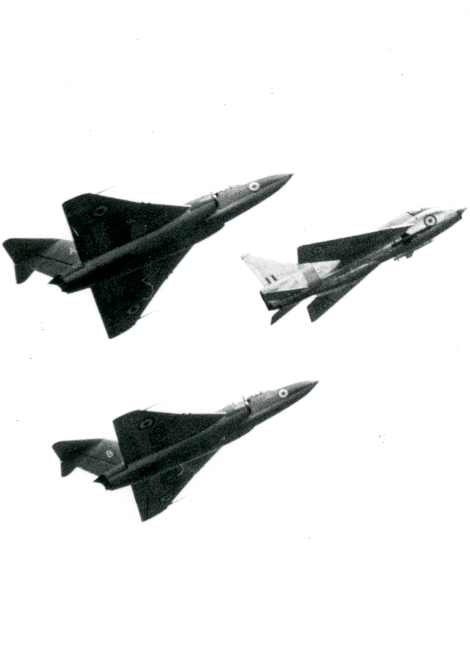
- The Joint War Air Committee, from February 1916
- The Air Board, from May 1916
2.2 Command structure of the RAF
The command structure of the RAF has varied since its creation, sometimes changing and often becoming more complicated during prolonged conflict. The basic structure is based on the following hierarchy, in ascending order from the smallest unit:
- Squadrons
- Wings
- Stations
- Groups
- Commands (Second World War)
- Headquarters
As with all branches of the military, the chain of command extended up, ultimately, to the Cabinet and, at times of war, War Cabinets.
2.3 Command structure of the RFC
The RFC, a branch of the British Army, was structured along different lines to the RAF. The hierarchy, in ascending order, was as follows:
- Squadrons
- Wings
- Brigades
- Stations
- Divisions
3. An introduction to the records and to locating them
The records of The National Archives are divided into departments, each known by a letter code. The records of the RAF are held in the AIR department. You can find related records in WO, ADM, DEFE and CAB.
Most of the records covered in this guide are not available online so to see them you will either need to visit us in Kew, where you can look at records for free, or order copies of documents to be sent to you for a fee. There are some records available to download online – details are in section 8.1.
3.1 Determining your search parameters
Almost all searches for records at The National Archives begin in our catalogue. Using the catalogue, you can search across our entire collection, across a whole department or within a specific record series.
To search our entire collection use our catalogue homepage from where you can use keywords to search for records, unrestricted by dates or departments. To search all AIR files, or the files of any other department, use the advanced search to specify the department code in the ‘references’ boxes. To search any of the record series listed in this guide, click on the series reference to be directed to the search page for that series – from there you can search by keywords and dates or browse through the whole series.
3.2 Choosing keywords
To search for records in any of these ways you will need to experiment with keywords. Your goal is to find keywords which appear in the catalogue description of the documents you seek. For RAF operations records, among the most fruitful sets of keywords are unit numbers, especially squadron numbers. When searching with unit numbers, avoid ordinal numbers (1st, 2nd, 3rd and so on). For example, search for 32 Squadron, not 32nd Squadron; for 4 Brigade, not 4th Brigade and so on.
For First World War records it may help to specify that you are interested only in squadron or other unit records of either the RAF, the RFC or the RNAS. You can try ‘Royal Air Force’, ‘Royal Flying Corps’ and ‘Royal Naval Air Service’ as search terms but it is more common for their abbreviations to be used. Try the following variations:
- RAF or R.A.F
- RFC or R.F.C.
- RNAS or R.N.A.S.
To identify some squadron records search only with the number, omitting RAF, RFC and RNAS (and their variations) altogether.
Other keywords worth trying include:
- ‘operation’
- the name of an operation, such as ‘Operation Neptune’
- ‘mission’
- the location of operations, such as ‘Greece’, ‘Atlantic’ or ‘North Africa’
4. Tracing the life of a unit: Operations Record Books
For close-up detail of operations the records to start with are usually the Operations Record Books (ORBs). ORBs were kept at almost every level of the air force pyramid, from squadrons to commands. They are records of daily events kept by the units themselves and, for records of RAF squadrons as well as other units, likely to be the most revealing documents available. However, the accuracy and detail entered within each book depends on the compiler and unit.
They comprise:
- ‘summary of events’ forms (Form 540)
- ‘detail of work carried out’ forms (Form 541)
- appendices where applicable (which may include operational orders, miscellaneous reports and telegraphed messages)
Click on the record series references in the table below to search for the ORBs of a unit by name or number:
| Operations Record Books of… | Record series |
|---|---|
| Commands | AIR 24 |
| Groups | AIR 25 |
| Wings | AIR 26 |
| Squadrons | AIR 27 |
| Stations | AIR 28 |
| Miscellaneous units | AIR 29 |
| Directorate of plans, 1939-1942 | AIR 9/445-454 |
These series also include the ORBs of allied and dominion air forces serving under British command.
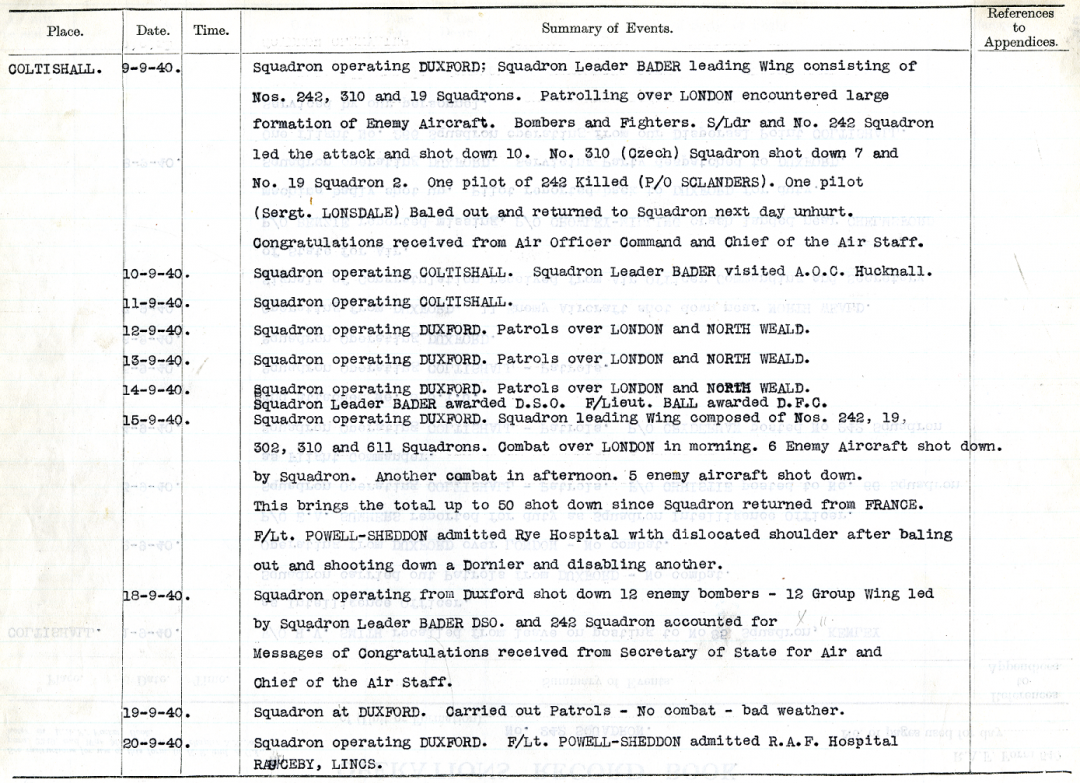
Operations Record Book for 242 Squadron, led by Douglas Bader, September 1940 (catalogue reference AIR 27/1471)
In the absence of a service record, or perhaps to supplement one, ORBs can prove very revealing. They sometimes include nominal rolls, lists of officers and details of promotions, transfers or awards.
5. Crashes, casualties and combat reports
Some of the First World War, Second World War and interwar record series listed in subsequent sections of this guide contain details of crashes and casualties.
Use the advanced search of our catalogue to search the entire AIR department using keywords such as ‘crash’, ‘crash report’ or ‘accident report’ and a year or year range. Alternatively, and to target your search to specific record series, try the following:
- combat reports for the Second World War in AIR 50
- combat reports for First World War in AIR 1 – search with the number of the squadron and the keywords ‘combat report’
- operations record books in AIR 27 for crashes during operations – details may be very brief, such as ‘the aircraft failed to return’
- operations record books in AIR 28 for crashes recorded by RAF stations
- accident reports in AVIA 5 which covers some military crashes as well as civil aviation crashes – search by aircraft and/or location of crash
- enquiries into casualties suffered during air operations and aircraft accidents, 1939-1945 in AIR 81
- courts of inquiry records in the AIR department (only a few of these survive at The National Archives) – use the advanced search to search AIR using ‘court of inquiry’ as your search term
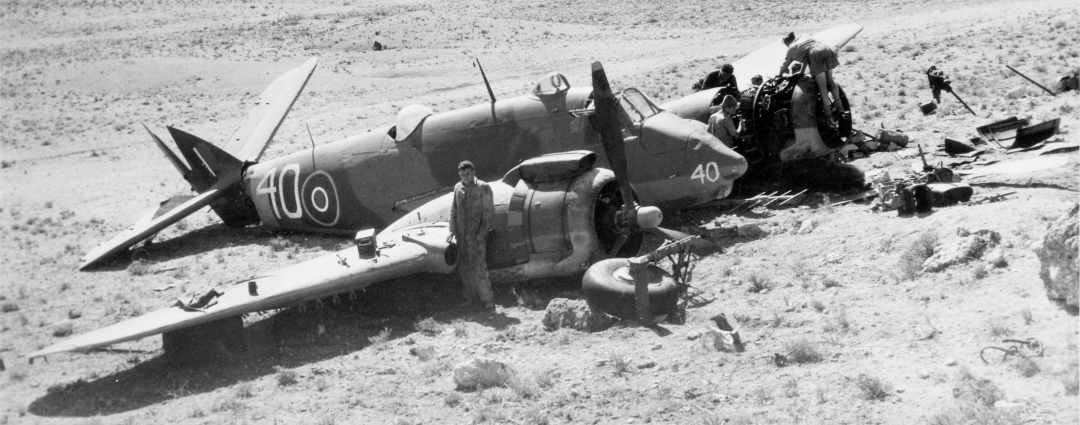
A crashed Beaufighter at Nicosia, October 1944. This photograph is from the Operations Record Book of the RAF station at Nicosia (catalogue reference AIR 28/588). You can order a high-resolution copy of this photograph from our Image Library.
You can also consult accident record cards, available in other archives (see section 12).
6. First World War, 1914-1918
See section 4 for advice on locating Operations Record Books, though there are far fewer for the First World War than for later conflicts.
6.1 Air Ministry records
Search AIR 1 using keywords which can include the squadron, brigade or wing number, the name of an officer, the base of operations (for example, Egypt, Salonica or Palestine) and entering 1914-1918 in the date range fields.
Additional Air Ministry operational records are in the following series – click on the reference to search the respective series:
- AIR 2 – Air Ministry correspondence
- AIR 3 – includes some airship log books
- AIR 27 – operations records books for squadrons primarily after the First World War but there are a few early squadron records from 1911 to 1918
6.2 War Office and Admiralty records
As the British Army was administered by the War Office and the Royal Navy by the Admiralty, RFC and RNAS records are found among the records of those departments. War Office records at The National Archives are in WO and Admiralty records in ADM.
General reports for the RFC are in series WO 158.
RNAS operational records are in series ADM 137. Use the Admiralty index and digests in ADM 12 to identify potential references in ADM 137. Read our guide on How to find naval correspondence using the ADM 12 indexes and digests for more information.
7. Between the Wars, 1919-1939
From 1919 to 1939 the RAF was involved in a number of campaigns in the Middle East and India. See section 4 for advice on locating Operations Record Books, vital documents when piecing together the story of a mission or of larger operations.
Search among the following records for further details of operations:
- Reports on operations in AIR 1 – search by location
- Reports on operations in AIR 5 – search using the word ‘operations’ and a geographical location, such as Iraq, Mesopotamia or Nuba Mountains
- Chief of Air Staff records in AIR 8
- Directorate of Operations and Intelligence and Directorate of Plans records in AIR 9
- Air Publications in AIR 10
- Unregistered papers in AIR 20
- Overseas Commands in AIR 23
- Squadron record books in AIR 27
- Directorate of Intelligence and other intelligence papers in AIR 40
For more series covering this period see the Second World War section below – many of the record series covering the war include interwar records.
8. Second World War, 1939-1945
For an overview of Second World War operations try the periodical returns and summaries in AIR 22. They include weekly intelligence reports, losses sustained and allied and enemy activities as well as statistical material.
See section 4 for advice on locating Operations Record Books, vital documents when piecing together the story of a mission or of larger operations.
8.1 Squadron records and combat reports
These records are available online for the Second World War.
Go to our research guides on Royal Air Force operations record books 1911-1963 and Royal Air Force combat reports 1939-1945 to search for records by squadron number and download records from our website.
8.2 Bombing missions in Europe
These are primarily the records of Bomber Command.
The following are particularly useful:
- intelligence reports in AIR 40 and files AIR 24/214 to 325
- night and day reports in series AIR 14 – these include details of all operations carried out by Bomber Command and feature some reconnaissance photographs
- photographs documenting bombing missions in Europe in HO 191/113-121 and in series AIR 23
8.3 Fleet Air Arm and naval aviation
Consult the following:
- squadron diaries, with day-by-day accounts of activities, in ADM 207
- combat reports in AIR 50 (available to download)
- operations record books in AIR 27 (available to download) – most of them are in a single file, AIR 27/2387, covering April 1933 to September 1943
- Coastal Command records in AIR 15 for operations over the Atlantic
Other Fleet Air Arm records are held in ADM series (Admiralty records). Search in:
- ADM 1 – try searching for ‘Code 90’
- ADM 116 – search for ‘Fleet Air Arm’
- ADM 199 – search for ‘Fleet Air Arm’ or ‘Naval Air Squadrons’
8.4 Expeditionary forces
There are whole record series for the records of the air components of British expeditionary forces. They are:
- British air forces in France, 1939-1940 are in AIR 35
- Air component North West Expeditionary Force (Norway, 1940) in AIR 36
- The British air element in the Allied Expeditionary Force (North-West Europe, 1944-1945) in AIR 37
- Planning papers for the invasion of North Africa in 1942 (Operation Torch) are in series AIR 47
8.5 Commands
The records of RAF commands contain a wide variety of information and extend beyond operational matters. They include details on the planning and conduct of operations, orders and directives, reports of various kinds, orders of battle, diagrams and, in some cases, particularly for Bomber Command, photographs.
Click on the series references below to search the series by keyword or to browse the series. As descriptions for each file are short you may find you will need to browse rather than search to uncover anything.
| Records of… | Series reference |
|---|---|
| Balloon Command | AIR 13 |
| Bomber Command | AIR 14 |
| Coastal Command | AIR 15 |
| Fighter Command | AIR 16 |
| Maintenance Command | AIR 17 |
| Overseas commands | AIR 23 |
| Training Command | AIR 32 |
| Ferry and transport commands | AIR 38 |
| Army co-operation command | AIR 39 |
8.6 The Army Air Corps and British Army airborne operations
The Army Air Corps (AAC) is the combat aviation arm of the British Army. It was formed in 1942. The AAC included the Glider Pilot Regiment.
Search for records in the following:
- operations records books in AIR 27 for records of the AAC air observation post (AOP) squadrons
- operations record books in AIR 29 for glider units
- British Army unit war diaries for unit diaries of glider pilots’ regiments and squadrons and other AAC units
- Directorate of Air records in WO 233 for details of British Army airborne operations
8.7 Air policy and planning
Files relating to policy, including some concerned with operations are in the:
| Description | Catalogue reference |
|---|---|
| Correspondence | AIR 2 |
| Chief of air staff | AIR 8 |
| Directorate of plans | AIR 9 |
| Private office papers | AIR 19 |
| Unregistered papers | AIR 20 |
| Directorate of intelligence and other intelligence papers | AIR 40 |
The combined operational planning committee was responsible for the plans for strategic daylight operations by British and United States bomber and fighter forces. Records of the combined operational planning committee, from June 1943 to June 1945 are in AIR 42.
As with all branches of the military, the chain of command extended up to the Cabinet and, at times of war, the War Cabinet records.
This includes:
- combined chiefs of staff committee and sub-committees in series CAB 88
- daily situation reports for the war Cabinet and the daily summaries of information prepared in the central war room in series CAB 100
- cabinet telegrams to overseas commands in war Cabinet in series CAB 105
- details about personal intervention of the Prime Minister of the day in operational matters in series CAB 120 and series PREM 3
You can search memoranda about the high command in series CAB 65-68, in our catalogue. Some records of the Cabinet committees concerned with defence in series CAB 69, CAB 83 and CAB 85 can be browsed on digital microfilm. Other related records are in series CAB 70 and CAB 78.
8.8 Narratives and histories
Narratives written by members of the branch during and after the war are in series AIR 41. Material omitted in the published versions may be found in series CAB 101.
9. Post Second World War operations
See section 4 for advice on locating Operations Record Books, vital documents when piecing together the story of a mission or of larger operations.
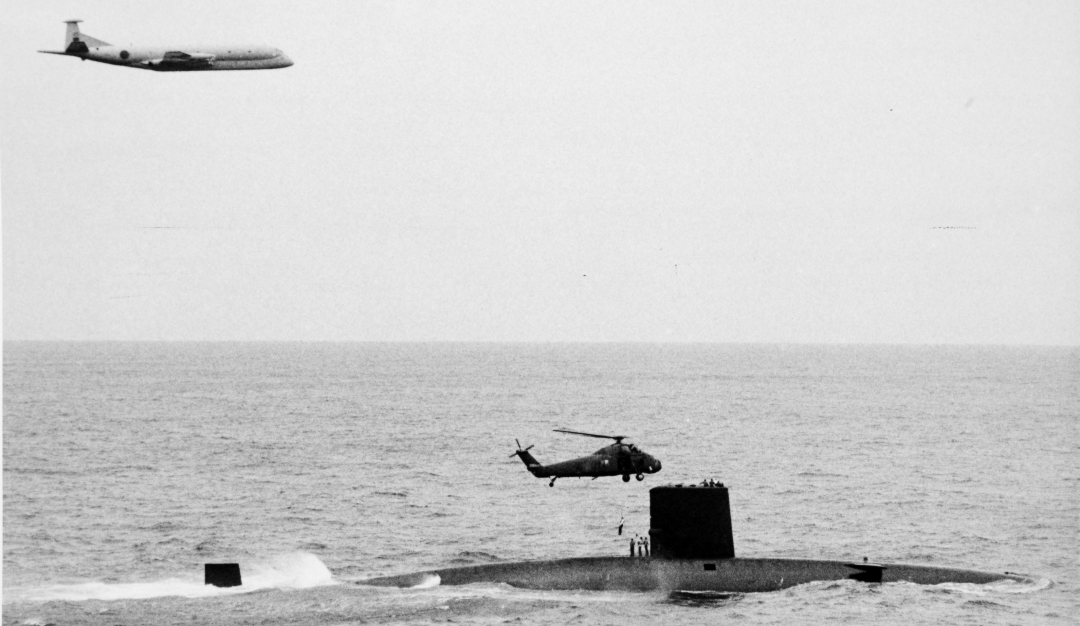
A photo from the Operations Record Book of 42 Squadron, taken during the Falklands Conflict, 1982 (catalogue reference AIR 27/3575/38). You can order a high-resolution copy of this photograph from our Image Library.
The following sources may also prove useful:
- Records of the British Air Forces of Occupation in Germany after 1945 and the British element of the Air Division Allied Commission in Austria are in series AIR 55
- War diaries and operations record books of the Army Air Corps from 1957 to 1977 are in series WO 295
- Air Ministry registered files in AIR 2 cover operations up until the late 1980s
- Department of the Chief of the Air Staff records in AIR 8 include details of operations as recent as 1989
- Air Historical Branch: Unregistered Papers in AIR 20
- RAF Strike Command reports, files, memos and operation orders in DEFE 58
10. Other air forces, 1914-1947
There are some records both of the air forces of British allies and more so of British colonial and dominion air forces at The National Archives. These include:
- South African Aviation Corps
- Australian Flying Corps
- Royal Australian Air Force
- Royal New Zealand Air Force
- Royal Canadian Air Force
- United States Army Air Force
To locate records, start by trying a search in our catalogue using the names of any of the above air forces. For the period before 1939 target series AIR 1, AIR 2 and
AIR 5. For 1939 onwards see, in particular, series AIR 2, AIR 20 and AIR 40.
There are more records in other record series. They include:
- Operations record books for the South African Air Force in AIR 54 – these contain details of various operational units serving in Africa, the Middle East and the Mediterranean.
- A selection of South African Air Force aircrew flying log books in AIR 4.
- Second World War missions undertaken by the United States Army Air Force operating from bases in the United Kingdom in AIR 40/394-1133.
- Reports of the United States Strategic Bombing Survey in AIR 48. Some intercepted German cipher messages appear in HW 1 and HW 5.
11. RAF stations and airfields
Our records of military airfields include maps, photographs and text descriptions. Some records cover airfield construction, others present a snapshot of stations at a moment in time. You can search our catalogue for document references using ‘airfield’, ‘station’ or the name of a specific airfield or station as your keywords. To target your search more precisely, try searches in:
- AIR 2 (for 1912 to 1991)
- AIR 10 (for 1913 to 1987)
- WO 227 (1939-1985) – covers the construction of airfields by Royal Engineers
- WORK 44. for detailed plans of RAF Spittlegate, Grantham, the Central Flying School, Upavon, and drawings of aircraft sheds and workshops
There is additional material for the two world wars:
11.1 First World War
There are six volumes of quarterly surveys, all from 1918, of RAF establishments around the UK. They are in AIR 1/452/15/312/26.
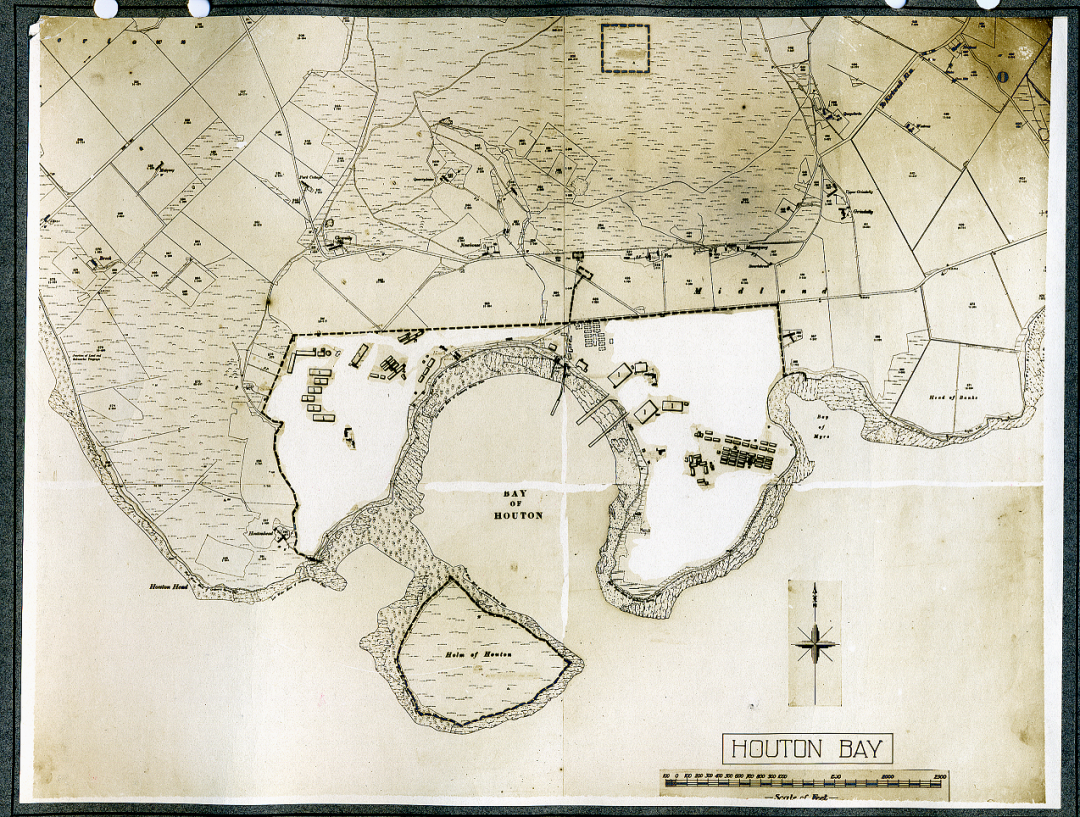
Houton Bay Seaplane Station, September 1918 (catalogue reference AIR 1/452/15/312/26Volume1). You can buy a high-resolution copy of this image from our Image Library.
11.2 Second World War
- RAF airfields and flying boat bases in the UK, Iceland, Malta and Gibraltar in AIR 10/4038 and AIR 10/4039
- Site plans of airfields in UK with photographs, 1935-1945, in AIR 20/7585 and AIR 20/7586
12. Records in other archives
12.1 Air Historical Branch (Ministry of Defence)
Contact the Ministry of Defence’s Air Historical Branch for:
- Accident Record Cards (Air Ministry Form 1180) which recorded non-operational crashes dating mostly from 1929 onwards
- casualty files
- other aircraft records
12.2 Royal Air Force Museum
The Royal Air Force Museum holds:
- aircrew logbooks
- Air Ministry bulletins and air publications (AP)
- Aircraft Movement Cards (Air Ministry Form 78)
- Accident Record Cards (Air Ministry Form 1180) – microfilm copies only
- other aircraft records
12.3 Fleet Air Arm Museum
The records held at the Fleet Air Arm Museum’s Archive & Research Centre include:
- photographs
- personnel records (but not official service records)
12.4 International Bomber Command Centre
The IBCC losses database records 67,500 RAF Bomber Command deaths, details include:
- Squadron and aircraft number
- other crew
- memorial location
- links to ORBs and AIR 81 investigation files
13. Further reading
All of the publications below are available at The National Archives’ library in Kew. Some of these publications may be available to buy from The National Archives’ shop.
J D Cantwell, The Second World War: A Guide to Documents in the Public Record Office, (HMSO, 1972) (describes documents held at The National Archives, previously known as the Public Record Office)
Roy Conyers Nesbit, The RAF in Camera 1939-1945: Archive Photographs from the Public Record Office and the Ministry of Defence (Public Record Office, 1997)
The Historical Section of the Committee of Imperial Defence published a number of Histories of the Great War Based on Official Documents (various publishers but mostly HMSO, 1921-1987)
W Raleigh and H A Jones, The War in the Air: Being the Story of the Part Played in the Great War by the Royal Air Force (6 vols) (HMSO, 1922-1935)
Denis Richards and Hilary Aidan St George Saunders, The Royal Air Force at War, 1939-1945 (3 vols) (HMSO, 1993)
William Spencer, Air Force Records: A Guide for Family Historians (2nd Ed), The National Archives, 2008 (includes a chapter on operations records)
Phil Tomaselli, Tracing your Air Force Ancestors (Pen & Sword, 2007)
This guide will help you find and interpret records of Merchant Navy officers’ from 1845 to 1965. For service before 1845, when registers of Merchant Navy officers were not kept, you must look for records kept for other purposes (such as crew lists, agreements and log books) but which may include incidental mention of officers. You might also find information about an officer by searching the records of ordinary merchant seamen.
You may also like to read our guide on Merchant seamen’s medals and honours.
What does it help to know before I start?
Officer ranks
In the merchant navy the term ‘officer’ can refer to a master, mate, engineer, fishing boat skipper, second hand or cook.
Ships’ numbers
It may help to know the number of a ship as ships are sometimes referred to in the records by their number rather then their name. You can search for ships’ official numbers through the Crew List Index Project.
Dates of departure and arrival for voyages
Find out dates of departure and arrival by consulting:
- the crew lists in BT 98
- the Lloyd Lists which are available at the Guildhall Library or the National Maritime Museum
Online records
Alphabetical register of masters, 1845-1854
Search the alphabetical register (BT 115) on Findmypast (£) which was compiled from crew lists.
The registers follow a similar format to Registers of Seamen Tickets in BT 113.
Certificate applications by masters, mates, engineers and fishing officers, 1850-1927
Search for the National Maritime Museum’s records of master and mate certificates (1850-1927) on Ancestry.co.uk (£).
Announcements of examination passes
Search The Gazette for lists of masters and mates who passed officer examinations.
Second World War Medals, 1939-1945
Search and download (£) records of World War Two Medals issued to Merchant Seamen (BT 395).
Records available only at The National Archives in Kew
To access the records in this section you will either need to visit us or, where you can identify a specific document reference, order a copy (£).
Merchant Navy gallantry awards for the Second World War, 1939-1947
Search Discovery, our catalogue, by name of person or ship in T 335 to find what the award was, the person’s rank at the time, and the ship they were serving on.
Narrow your search by using double quotation marks to find a ship’s or person’s full name, such as “Sydney Star” or “John Williams”.
Registers of merchant seamen after 1913 (for records of voyages)
Consult our guide to records of merchant seamen serving after 1917 for advice on searching within registers of seamen and seamen’s pouches to establish voyage details which you may be able to apply to the service of officers.
Voluntary examination passes, 1845-1850
From 1845 onwards a system of examinations was introduced for masters and mates. At first it was voluntary and applied only to foreign-going vessels.
Records of masters and mates passing the voluntary examination are in series BT 143 (which includes a name index) and in BT 6/218-219.
Details of masters and mates who have voluntarily passed an examination appear in the Lloyd’s Register of Shipping (copies of which are available at The National Archives). The details are in an appendix entitled ‘An Alphabetical List of all the Masters and Mates in the Merchant Service…’.
Registers of certificates of competency and certificates of service (including records of voyages), 1845-1921
From 1850 onwards, an officer was only officially qualified or ‘certified’ as an officer if he had been awarded a Certificate of Competency (by passing an exam) or a Certificate of Service (for long service). A certificate came with a number (and new numbers were assigned if a replacement certificate was issued following the loss of the original).
Registers were created to record the awarding of these certificates to officers and what they had done to qualify for them. For each officer registers provide:
- name of officer
- date and place of certification
- place and year of birth
- certificate number and grade
- record of voyages (certificates up to 1888 only) – dates are for when the records were filed and are not arrival dates – sometimes records were filed after a series of voyages
- date of death (certificates after 1888 only – and only sometimes)
Look for a certificate entry in the registers of certificates (they are arranged by certificate number) listed below. Use the name indexes (indicated below in brackets) to locate a certificate number. In the indexes, names beginning with Mc or Mac are usually found under the letter following that prefix. For example, MacDonald will not appear under the letter ‘M’ but under ‘D’.
Masters and Mates
Consult BT 122-126 and BT 128 (index in BT 127). Once you have obtained a certificate number from the index in BT 127, consult the table below for the respective record series reference:
| Certificate No | Certificate type | Rank | Trade | Series starts | Series Reference |
|---|---|---|---|---|---|
| 1-34,999 | Competency | Master or Mate | Foreign | 1 Jan 1851 | BT 122 |
| 35,000-54,999 | Service | Master | Foreign | Dec 1850 | BT 124 |
| 55,000-69,999 | Service | Mate | Foreign | Dec 1850 | BT 124 |
| 70,000-78,999 | Service | Master | Foreign | April 1851 | BT 124 |
| 79,000-80,999 | Service | Mate | Foreign | May 1852 | BT 124 |
| 81,000-99,999 | Competency | Master or Mate | Foreign | Oct 1868 | BT 122 |
| 100,000-119,000 | Competency | Master or Mate | Home | March 1855 | BT 125 |
| 120,000-134,999 | Service | Master | Home | April 1855 | BT 126 |
| 135,000-150,000 | Service | Mate | Home | April 1855 | BT 126 |
| 01-0500 | Yacht Master | No records survive | |||
| 0501-045,000 | Competency | Master or Mate | Foreign | July 1875 | BT 122 |
| 001-0021,000 | Master or Mate | Foreign, steam | April 1881 | BT 123 | |
| 21,001 – | Master or Mate | Foreign, steam | May 1927 | – | |
| * Most of these series are continued in BT 352. |
Certificate numbers with a letter(s) prefix – NWS – were issued in the colonies. Consult series BT 128 for details.
Engineers
Consult BT 139 for certificates of competency from 1861-1921, BT 142 for certificates of service from 1862-1921 and BT 140 for certificates of service of engineers examined in the colonies from 1870-1921 (index in BT 141).
The certificate number obtained from the index indicates:
| Certificate number | Certificate type | Rank | Series begins |
|---|---|---|---|
| 1-400 | Service | 1st class Engineer | 1862 |
| 401-3,000 | Service | 2nd class Engineer | 1862 |
| 3,001-5,000 | Service | 1st class Engineer | |
| 5,001-5,999 | Service | 2nd class Engineer | March 1930 |
| 6,000 upwards | Competency | Engineer | 1862 |
Certificate numbers with a letter(s) prefix – NWS – were issued in the colonies. Consult series BT 140 for details.
Fishing officers
For skippers and mates of fishing boats, registers of certificates of competency are in BT 129 and registers of certificates of service are in BT 130 (index in BT 138).
Numbers were allocated to the certificate of service in BT 130 are as follows:
| Certificate number | Certificate type | Series begins |
|---|---|---|
| 01-03000 | Skippers, English | December 1883 |
| 03001-04888 | Second Hands, English | December 1883 |
| 05001-05765 | Skippers, English | January 1884 |
| 05800-05999 | Skippers, Scottish | May 1907 |
| 06000-07561 | Second Hands, English | July 1887 |
| 07600-07881 | Second Hands, Scottish | May 1907 |
| 08000-08180 | Skippers, Scottish | May 1907 |
Cooks
We hold indexes to registers of certificates of competence and service for cooks, 1913-1956 in BT 319. The National Maritime Museum holds the registers (see below).
Voyages
Voyages in the registers were usually recorded either as:
Home trade voyages (‘repeated’ or ‘reported’ voyages)
These entries do not simply record a single voyage, but a half year (January to June or July to December) during which the seaman was engaged on a particular ship. During that period the ship may have been on several voyages, and he may have been engaged for some or all of the period.
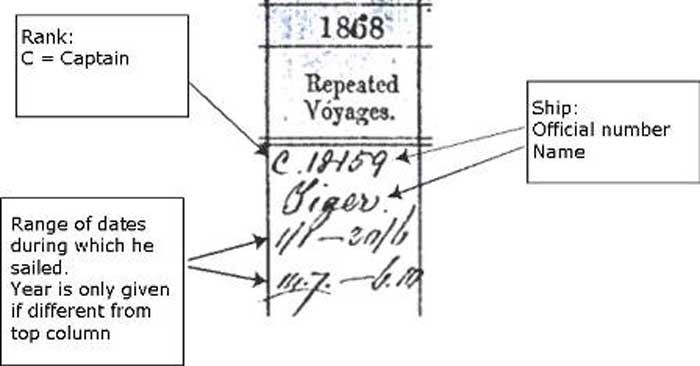
A register entry for home trade voyages, from BT 126.
Foreign trade voyages
These entries record a single voyage during which the seaman was engaged on a particular ship.
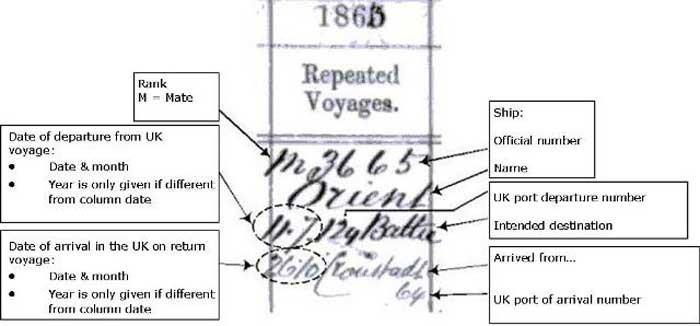
A register entry for a foreign trade voyage, from BT 124.
Use our guide Abbreviations in merchant seamen’s records to interpret the records.
Lloyd’s Captains’ Registers, 1851-1947
The Lloyd Captains’ Registers were compiled from the records of certificates issued to foreign-going masters. They cover masters with foreign trade certificates sailing either as masters or mates.
An incomplete set of captains’ registers is available on microfilm in The National Archives reading rooms. They contain the following information:
- name
- place and year of birth
- date, number and place of issue of the master’s certificate obtained
- any other special qualification, including the ‘steam’ certificate from 1874
- name and number (taken from the Mercantile Navy Lists) of each ship (date of engagement and discharge as master or mate and the destination of each voyage)
- any casualties endured
- any special awards (for example, war service)
- pasted-in summaries of the qualifications and service from 1851 of masters who were still active in 1869
Combined indexes to certificates of competency, 1910-1969
Search BT 352, a combined index to masters, mates, engineers and fishing officers certificates of competency covering home and foreign trade.
Each card provides:
- name
- certificate number
- date of passing examination
- date and place of birth
- port of examination
The cards are of different colours depending on the type of qualification:
- white cards are for masters and mates
- pink cards are for engineers
- green for skippers and mates of fishing boats
Chronological registers of the issue of certificates, 1913-1984
Consult registers and renewals of certificates of competency of masters and mates in BT 317; masters, mates and engineers in BT 318; just engineers in BT 320 (1913-1935) (in process of transfer from National Maritime Museum under references RSS/ENG/5-6); and fishing officers in BT 396.
The entries are arranged in date order and provide:
- date received
- first and last name
- examination date
- certificate number
- grade
- port sent to
- port of examination
Records in other archives and organisations
Registers of certificates of competency and service, 1850-1927
Apply for a copy of a certificate from the National Maritime Museum’s Caird Library – you will need the certificate number.
Registers of certificates for engineers
As well as the registers of certificates of competency for engineers at The National Archives (in series BT 139, see above), the National Maritime Museum holds registers for the following years and certificate numbers:
- RSS/ENG/1 1902-1905 39000-43999
- RSS/ENG/2 1905-1909 44000-48999
- RSS/ENG/3 1909-1913 49000-53999
- RSS/ENG/4 1913-1918 54000-58999
Registers of certificates for cooks, 1915-1958
The National Maritime Museum holds the registers, bearing numbers 5001-41021 (reference RSS/CO/1-6).
Agreements and crew lists, 1861-1994
Look at the websites of other archives and organisations which hold agreements and crew lists, including the Maritime History Archive in Newfoundland, the National Maritime Museum, the National Records of Scotland, the National Archives of Ireland, and local archives.
Application for certificates made in the colonies
Contact the appropriate state or national archive.
Other resources
Websites
Visit the Crew List Index Project (CLIP) website, which has information about merchant seamen on British registered ships from 1861 to 1913.
Search indexes to crew lists from 1861 to 1913 by name on findmypast (£).
Books
Visit The National Archives’ bookshop for a range of publications on the Merchant Navy. Alternatively, search The National Archives’ Library to see what is available to consult at Kew.
Consult copies of the Mercantile Navy List for 1860 to 1864 in The National Archives reading rooms for alphabetical lists of masters and mates (with certificate numbers) as well as one-line obituaries for deceased seamen.
Read My Ancestor was a Merchant Seaman by Christopher and Michael Watts (Society of Genealogists, 2002) – this title is also available in our shop.
1. Why use this guide?
Use this guide to understand the types of records held at The National Archives relating to the American Revolution and how to search for them. These records were originally created by British government departments, including the Colonial Office, War Office, Admiralty and Treasury and as such, these records primary cover the British perspective.
If you are researching the American perspective, including the military service of rebel (or “Patriot”) troops during the Revolutionary War, you should consult resources held in other archives (see section 10).
The records discussed here cover:
- the final period of the British administration of America (1770-1773)
- the American Revolutionary War, also known as the American War of Independence (1775-1783)
- the British government’s relationship with the independent United States of America (1783 onwards)
Unless documents have been digitised you will need to visit The National Archives at Kew to see the content.
2. How to search for records
Every record we hold is represented in our online catalogue by a title, a reference and a brief description. When you use our catalogue to search for records you are actually searching across these titles and descriptions, rather than the contents of the records themselves. By clicking on any item in catalogue search results you can see what the options are for viewing that record. Search the descriptions of our documents in Discovery, our catalogue using keywords such as:
- American Revolution
- names of battles
- place names
Most American Revolution records are in Colonial Office files. Use the catalogue’s advanced search to target departments (e.g. Colonial Office) by entering department codes in the reference boxes. Common codes include:
- CO (Colonial Office records)
- WO (War Office records)
- ADM (Admiralty records)
- T (Treasury records)
- YHL (House of Lords records)
3. Key records and series
3.1 General
Click on the links below to search within specific record series known to contain material relating to the American Revolution. For records covering:
- The colonial history of the English/British in America from 1574-1739 go to State Papers Online (institutional subscription required).
- British Army Headquarters in America from 1775 to 1783 are held in PRO 30/55. Comprising the papers of Sir Guy Carleton, they represent the official notes of General Thomas Gage, Sir William Howe, Sir Henry Clinton, and Carleton as successive commanders in chief. Dispatches to Lord Cornwallis, one of the leading British general officers, are held in PRO 30/11.
- The period up to the end of the American War of Independence in 1783, search in Colonial Office correspondence in CO 5. These records can be searched by keyword at Adam Matthew’s Colonial America, a subscription service available at universities and major reference libraries, including on site at The National Archives.
- The period following the end of the war, search Foreign Office correspondence in FO 4 and FO 5.
- The American Revolution itself from a military perspective search in British Army correspondence and papers in WO 1 to WO 5. For more detailed descriptions of these records than those in our catalogue, consult the “Alphabetical Guide to War Office and other Military Records”, available in The National Archives’ library.
- The records of the House of Lords, search in the Main Papers YHL/PO/JO/10. Some can be identified by searching for the exact phrase “American Papers”. These include a contemporary manuscript copy of the US Declaration of Independence, laid before the House of Lords and digitised under reference YHL/PO/JO/10/7/542A.
- A collection ‘American Papers in the House of Lords Record Office’ was published in a microfilm edition in 1983 with an accompanying guide, and is now digitised and available via a subscription service, British Online Archives.
4. British soldiers and military records
For brief details of individuals who served with the British Army in North America search by regiment name in muster rolls and paylists in WO 10, WO 12 and WO 13.
British Army correspondence and papers can be found in WO 1 to WO 5.
For Royal Navy operations, ships’ logs and journals please see our guide to Royal Navy operation and correspondence 1660-1914.
5. Maps and plans
We hold a significant number of maps relating to the American Revolution and to America as a colony. Search our catalogue using the search terms suggested in section two alongside the word ‘maps’. Many of these are in the colonial papers’ map series in CO 700. For more help finding maps, consult our guide to finding overseas maps and plans and the publication Maps and Plans in the Public Record Office, America and West Indies, available in The National Archives’ library.
6. Private papers of politicians and military officials
The following collections of private papers contain material related to the American Revolution:
- Chatham Papers (Pitt the Elder and Pitt the Younger) in PRO 30/8
- Carleton Papers (British Army headquarters in America, 1775-1783) in PRO 30/55
- Cornwallis Papers (Charles Cornwallis) in PRO 30/11 – transcriptions are in Ross’s Correspondence of Charles, First Marquis Cornwallis, available in The National Archives’ library
7. Loyalist compensation claims
Records of the Claims Commission in AO 12 and AO 13 and the Treasury in T 50, T 77 and T 79 contain details of the compensation claims of Loyalists who had suffered hardship as a result of their loyalty to the Crown during the war.
Some records of the Claims Commission in AO 12 and AO 13 can be searched and downloaded from Ancestry (£).
You can find indexes to claimants’ names in the List of Records of the Treasury, Paymaster-General’s Office, Exchequer and Audit Department and Board of Trade and other useful material in A Bibliography of Loyalist source material in the United States, Canada and Great Britain. Both items are available in The National Archives’ library.
8. Black Loyalists
All thirteen British American colonies were involved in the transatlantic slave trade to varying degrees. All trade with the rebel colonies was later banned under the Prohibitory Act of 1775. For an overview of relevant records, consult our research guide to slavery and the British transatlantic slave trade.
During the American Revolution, many enslaved people of African descent fled to British forces in pursuit of freedom. Freedom was offered under limited terms by the Dunmore Proclamation (1775) and the Philipsburg Proclamation (1779), which invited anyone enslaved by rebels to escape and join the British side, first in Virginia and then across the Thirteen Colonies.
Records relating to Black Loyalists are dispersed across several series, including Colonial Office correspondence in CO 5, the Carleton papers in PRO 30/55, and the Loyalist Claims Commission papers in AO 12 and AO 13.
A key source is the ‘Book of Negroes‘, held in PRO 30/55/100. For records relating to Black Loyalists in Nova Scotia after the war, see CO 217. Additional correspondence relating to Nova Scotia can be found in CO 267–CO 270.
9. Indigenous nations
Records relating to diplomacy between Britain and Indigenous nations are primarily found in Colonial Office correspondence in CO 5, with additional material in the Carleton papers PRO 30/55.
Relevant correspondence by the ‘Superintendents of Indian Affairs’, acting on behalf of the Crown, is in CO 5/65 and CO 5/82 (1760–1784). Records in CO 5 can be searched by keyword at Adam Matthew’s Colonial America, a subscription service available at universities and major reference libraries, including on site at The National Archives.
10. Records in other archives
Many resources concerning the American Revolution can be found in North American state archives and historical societies:
- Microfilms and transcripts of documents relating to the American Revolution can be found at the Library of Congress
- A name index of Hessian troops who served in the American Revolution, produced by The Marburg School of Archives in Germany is available in The National Archives’ Library
- Muster rolls of Loyalist regiments (provincial troops) 1777-1783 are held at the Library and Archives Canada
- Records relating to military service of rebel (or “Patriot” troops during the American Revolution are available in the U.S. National Archives and Records Administration
- Records relating to Black Loyalists in Sierra Leone, after the American Revolution are held at the British Library
- Private papers belonging to some British military officers, including Henry Clinton and Thomas Gage, are available in the University of Michigan Library
11. Further reading
Use our library catalogue to find recommended books which may provide all the information you need without needed to consult original records. Follow the link to consult our American Revolution recommended book list. The books are all available in The National Archives’ reference library. You may also be able to find them in a local library. You can buy from a wide range of history titles in our bookshop.
British History online contains a selection of secondary sources.
1. Why use this guide?
This is a guide to records relating to oaths of loyalty to the Crown and Church of England in the seventeenth and eighteenth centuries. Between the 16th and 19th centuries various groups of people, from members of Parliament and the House of Lords, justices of the peace and church ministers to merchants, lawyers and members of the royal household, were required to swear oaths of loyalty to the Crown and the Church of England.
These contain the names of:
- MPs and Peers
- local government office holders
- the clergy
- individuals belonging to various occupational and religious groups
They illustrate the cultural, religious and political diversity of Britain in the early modern period.
None can be said to include a majority of the population except perhaps the Protestation Returns, where all adult men were asked to swear an oath of allegiance to the Protestant religion (see section 8).
It cannot be assumed that all who were intended to subscribe did so.
Most surviving oath rolls date from after 1673, although the records C 215/6 and C 202/44/5 document the names of officers and men in the Royal Navy, arranged by ship, who took the oaths of allegiance and supremacy in 1660-1661.
2. The Solemn Association
The most comprehensive of these oaths was the ‘Solemn Association’ for the defence of the king and in support of the succession.
In 1696, following an attempt on the life of William III, Parliament passed ‘An Act for the Better Security of His Majesties’ Royal Person and Government’ (7&8 Will III c 26, 27; see The Statutes of the Realm, 1695-1701, pp 114-117).
2.1 What kinds of people do the records capture?
Under the terms of the act, it became compulsory for all office holders under the Crown, military and civil, to swear the oath in one of the courts of law.
These records demonstrate that it was not only office holders who swore the oath. They also include:
- the clergy
- the gentry
- freemen of city livery companies
- nonconformists
In some counties, most adult males of status in the local community appear to have done so, and the names of women feature in many of the rolls.
The names of those who refused to swear the oath were often included.
2.2 How do I search these records?
Use the advanced search option in Discovery, our catalogue to search by county (in England and Wales), by occupation group (for example, ‘weavers’ or ‘tinners’) or by diocese (for example, ‘St Asaph’) within:
Alternatively, you may wish to browse the records in our catalogue using the links provided above. This can prove very effective, particularly given the diversity of the Association Oath rolls.
Many of the records contain original signatures, but they also include marks and listings made by clerks.
3. Oaths taken abroad
The so-called ‘Foreign Plantations’ which you can browse within C 213/459-473 cover sworn oaths from:
- Channel Islands (Jersey and Guernsey)
- Colonies (namely Barbados, St James City in Virginia, New York, Bermuda, and the Leeward Islands)
- merchant groups in Holland, Malaga and Geneva
4. The Test and Corporation Acts
The Corporation Act of 1661 prohibited anyone who would neither swear the oaths of allegiance and supremacy nor take the sacrament of Holy Communion at a Church of England service from being elected to a post governing a city or corporation.
This act effectively excluded Roman Catholics and the more zealous protestant nonconformists from holding official positions.
From 1672 the Test Act required all post-holders, in civil or military positions, or those who held positions of trust under the sovereign, to submit a sacrament certificate confirming they had taken Holy Communion according to Anglican rites.
Between 1689 and 1702, the requirement to take the oaths was extended to beneficed clergy, members of the universities, lawyers, schoolteachers and preachers.
In 1828 the Test Act was abolished and replaced with a declaration (under the Sacramental Test Act of the same year) that the office holder, in exercising their authority and powers, would neither injure nor weaken the Church of England.
Rolls of oaths sworn under the Test Act and the subsequent declarations can be browsed by date within C 214.
5. Oaths to uphold the succession
The Security of Succession Act of 1702 introduced the oath abjuration, which demanded officials swear an oath of loyalty to the protestant succession and deny the son of the Catholic James II, deposed in 1688, his claim to the English throne.
These oaths were taken in court, either at one of the central law courts of Chancery or King’s Bench (or Common Pleas or Exchequer after 1702) or in the local Courts of Quarter Sessions .
For more information on records created or inherited by the Courts of Quarter Sessions please see the section of this guide entitled Record held elsewhere.
Oaths of allegiance, test and abjuration sworn and enrolled in Chancery are in the record series:
The names of those who took these oaths in the years 1673 to 1709 are in C 220/9.
For oaths sworn in King’s Bench, Exchequer and Common Pleas browse:
These records are arranged either chronologically or by type of oath, and they include no indexes of names.
Browse E 169, mentioned above, which includes:
- oaths sworn by Roman Catholics
- some post-1723 Quaker affirmations
Quakers, theologically opposed to the swearing of oaths, were legally permitted after 1723 to take a special affirmation of loyalty. Following the Catholic Relief Act of 1778, Roman Catholics were allowed to take the oath of allegiance.
In addition, browse KB 18 for a list of Roman Catholics in Lancashire who had been summoned in around 1723 to take the oath of allegiance but had failed to appear.
6. Oaths taken by lawyers and judges
Oaths taken by lawyers wishing to practise in a particular court can be found with the records of that court.
For Chancery, browse:
For Common Pleas, browse:
Exchequer, browse:
King’s Bench, browse:
Palatinates of Chester, Durham and Lancaster, browse:
After 1791 Roman Catholics were allowed to practise as lawyers after making a declaration and oath, and their names are normally enrolled separately.
The Promissory Oaths Act 1868 substituted new forms of oath or affirmation. Barristers’ Rolls, a register of members of the Bar and signed by barristers wishing to practise in the courts, are in:
For judicial oaths sworn by High Court judges, recorders and magistrates from 1910, which are also indexed by name:
Rolls containing the names of the officers of state who swore oaths before the clerk of the Crown, from 1639, are in:
7. Sacrament certificates
Sacrament certificates document where and when Holy Communion was taken along with the names clergymen, churchwardens and witnesses.
Those submitted to Chancery, King’s Bench and Exchequer can be browsed in:
The sacrament certificates in Chancery and King’s Bench are arranged chronologically, while in Exchequer they are arranged chronologically within parishes.
Most of these certificates relate to individuals who lived within a thirty mile radius of London and Westminster, which means the counties of Hertfordshire, Kent, Middlesex and Surrey are well represented.
Those submitted to the Chester Palatinate Court are in:
Between 1708 and 1711, foreign protestants could become naturalised by taking the oaths of allegiance and supremacy in court and producing a sacrament certificate.
Consult the enrolled records in:
These records, together with others from the Middlesex Court of Quarter Sessions are indexed by name in Publications of the Huguenot Society of London, volumes XXVII (1923) and XXXV (1932).
8. Protestation Returns, 1642
The Protestation Returns are the closest record we have to a census from 1642, and survive for about one third of English counties. By order of the House of Commons, all adult men were asked to swear an oath of allegiance to the Protestant religion. Their names were duly inscribed in a list in each parish, and the list sent back to Parliament. In a few areas such as Cornwall, people wrote their own names, but usually a local official wrote out all the names. Occasionally other information such as names of recusants (those who refused to attend Church of England services), churchwardens, local government officials, women, or those unable to take the oath due to age or infirmity. Sometimes job titles are given.
The Protestation Returns are held in the House of Lords Main Papers, YHL/PO/JO/10. The Returns are organised by country, then town or parish. To find them, search under reference YHL/PO/JO/10 using keyword “protestation returns” combined with parish or county name in advanced search. All Returns have been digitised, and images can be found in the catalogue by selecting ‘Available for download only’ under Held by.
9. Test Rolls
Test Rolls are oaths of allegiance to the Crown taken by Peers and MPs on first entering Parliament. Each roll contains a preamble, the form or forms of declaration, and the signatures of the Peers or MPs who took the oaths. Some are in the form of rolls, other are in book format. House of Commons test rolls before 1835 were destroyed by the fire which burned down the Houses of Parliament in 1834.
- Test Rolls of the House of Lords, 1675 onwards YHL/PO/JO/8
- Test Rolls of the House of Commons, 1835 onwards YHC/CL/JO/17
10. Records held elsewhere
Search our catalogue for records held locally and refine your results using the filters.
Where they survive, records of the Court of Quarter Sessions are held by county record offices and may include both oath rolls and sacrament certificates.
11. Further reading
Some of the publications below may be available to buy from The National Archives’ shop. Alternatively, click on the links to view the books in The National Archives’ library catalogue and see what is available to consult at our building in Kew.
W Gandy, A guide to some original manuscript sources of British and colonial and family history: the Association oath rolls of 1696 (1921)
W Gandy, The Association oath rolls of the British plantations AD 1696: being a contribution to political history (1921)
W Gandy, Lancashire Association oath rolls AD 1696 (1921)
J Gibson, The hearth tax, other later Stuart tax lists and Association Oath rolls (Federation of Family Historians, 1996)
J Gibson and A Dell, The Protestation Returns, 1641-1642, and Other Contemporary Listings (Federation of Family History Societies, 1995).
Parliamentary Archives blog, The Protestation Returns, Lancashire and Recusants (2022).
J Gibson, Politics and loyalty in post-revolution Oxfordshire: The ‘1690’ county parliamentary poll: an edited transcript; the Association Oath rolls, 1695-6: analysis (Oxford: Oxfordshire Family History Society, 2011)
D Torrance, Oaths of Allegiance (House of Commons Library Research Briefing, 2025)
1.Why use this guide?
The National Archives holds no service records of nurses who served with the Royal Air Force Nursing Service (RAFNS).
While some early recruits are named in documents related to the service’s establishment, most service records are held by the Ministry of Defence and the British Red Cross. See Section 3 for further details.
2. Before you start
The Royal Air Force Nursing Service (RAFNS) was established in 1918 and became Princess Mary’s Royal Air Force Nursing Service (PMRAFNS) in 1923.
The RAFNS was confirmed as a permanent, independent service in 1921. It remained a women-only service until 1980.
Matrons, sisters, and staff nurses held honorary military ranks without command.
3. Online records
3.1 Campaign Medals and Awards
- Royal Red Cross Recipients,1883–1994
Search and download entries from the registers of recipients of the Royal Red Cross at Findmypast.co.uk (charges apply). Covers around 9,000 awards for exceptional nursing service. Includes service number, role, and date published in the London Gazette.
- First World War Medal Index Cards, 1914-1920
Search by name or regimental (service) number for First World War army medal index cards (WO 372) on our website (charges apply). Use keywords like Nurse, Voluntary Aid Detachment, or Queen Alexandra’s with a surname.
- Campaign Medal Rolls, 1793–1949
For records of medals awarded for service before 1914, search by name on the Ancestry (charges apply) website. Lists names but includes limited personal details. Knowing the campaign and nursing service helps.
4. Accessing original records
Our online catalogue and advanced search page display records using a title, reference number, and brief description. When you search using keywords, you’re searching these descriptions—not the full content of the records. For help using our catalogue, watch our short video guide.
Many records are not keyword searchable, so you may need to consult the original documents. You’re welcome to visit us in person to continue your research—access to our records is free of charge. Before visiting, please check our website for opening hours and ID requirements. If you can’t visit, or would like someone to carry out research on your behalf, you can pay for research.
When you click on a search result, you’ll see whether the record is available online or if you need to view it onsite. You can also request copies directly from the catalogue description page. If a record is held by another archive, you’ll need to contact them directly to find out how to access it.
5. Service records, 1918-present
Visit the GOV.UK website for information about how to request a summary of a service record from the Ministry of Defence. These are not available to members of the public, though next of kin may request access to them.
6. Policy and administrative history
To explore the policy and administrative history of British Army nursing, click on any of the reference codes below to request access to documents using our online catalogue. These records are not available online, so once you’ve found something relevant, you’ll need to visit us in person to view it.
- AIR 2 – Air Ministry and Ministry of Defence: Registered Files, 1887-1995. It covers rules and regulations, conditions of service for nurses, financial matters and so on.
- AIR 2/93/C66031 – includes records relating to the establishment of the RAF Nursing Service, 1918-1921.
- AIR 2/155/350196/20 – holds records relating to the future of the service after the First World War, 1920-1921.
7. Websites
- Royal Air Force Museum. Explore the official website for the Royal Air Force Museum.
8. Further reading
Welch, Samuel Cuthbert Rexford, The Royal Air Force medical services. London: 1954-1958.