1. Why use this guide?
This guide will help you find and interpret government financial records known as pipe rolls from the medieval period held at The National Archives.
Pipe rolls give us the most accurate picture available for this period of the financial resources of English royal government, revealing:
- payments made to the Crown
- debts owed to the Crown
- Crown expenditure
They reveal more than just financial information and can also tell us, amongst other things:
- who the occupants of royal lands and castles were
- the identity of royal judges and other officials, including relatively low ranking local government officials
- how different aspects of the judicial system in medieval England worked (through the recording of judicial fines)
They did not, however, record all types of royal income or expenditure and should not be considered a complete record of government and royal finances.
2. What are pipe rolls and what kind of information do they contain?
Pipe rolls are the annual financial records of the Crown. More precisely, they are the written record, maintained by the Exchequer, of the audit process of the monarchy’s accounts for one financial year.
The earliest surviving pipe roll covers the 1129-1130 financial year.
They are some of the earliest financial records available from the medieval period and one of the richest sources of governmental history from that era. A nearly continuous series runs from 1155 until 1832, the earliest series of English royal records; only four are missing.
Payments made to the Crown recorded in the pipe rolls include:
- debts owed
- offerings for the king’s favour
- land rents
- financial penalties imposed by the king’s justices in eyre courts or assize courts
- feudal taxes
- money from vacant Church land
Crown expenditure recorded in the pipe rolls includes:
- grants of alms and statutory payments to individuals
- money spent on royal manors and houses
- wages for royal servants and royal gifts
3. How to find and view pipe rolls
3.1 The original records
To view pipe rolls at The National Archives you must first use Discovery, our catalogue, to find document references within one of the two record series listed below. Originally, two copies of each account were made and these separate copies are kept in separate record series.
Click on the following series references to search for records within each respective series using keywords and dates.
- E 372 for the pipe rolls themselves
- E 352 for the Chancellor’s rolls; these are largely duplicates of the pipe rolls but often contain minor variants and occasionally more substantial differences
Once you have a document reference you can view the roll either by visiting The National Archives at Kew or paying for copies to be sent to you. Alternatively, you can pay for research.
See section 6 for guidance on finding related records.
3.2 Printed and published transcriptions
Search our library catalogue using the search term ‘pipe roll’ for printed transcriptions of rolls up until 1224, published predominantly by the Pipe Roll Society.
Consult The Pipe Roll Society website for a similar list of the rolls that it has so far published and information on recent and forthcoming publications. The Pipe Roll Society is dedicated to publishing editions of the pipe rolls and other related medieval documents.
A few calendars of other pipe roll material have been published by county record societies.
4. Understanding the rolls: composition and materials
Each pipe roll was made up of a number of rotuli. A rotulus, the Latin word for ‘roll’, was composed of two membranes of sheepskin parchment, stitched together in the middle, and with both sides used for writing. The front was known as the ‘face’, and the back as the ‘dorse’.
The rotuli were sewn head to head ‘Exchequer style’, rolled up together to look like a section of drainage pipe, and stored, usually covered with waxed parchment for protection. It was probably this resemblance to a pipe that gave the documents their common name; before the 13th century, and officially until at least the early 18th century, the roll for the year was known as ‘the Great Roll’, or the ‘roll of the year’.
Chancery rolls, which began in 1199, were composed of membranes sewn head to foot ‘Chancery style’: they lacked the sewing ridge at the centre of an Exchequer style roll, and thus were rolled into a much smaller roll.
5. Understanding the rolls: timing and language
The financial year ran from Michaelmas (29 September) to the next Michaelmas. In the very early years the Exchequer’s terms were usually quite short, but by about 1220 the audit process usually began on the day following the closure of one financial year, and lasted between eight and ten months.
Apart from a brief period in the 1650s, when English was used, the rolls were written in abbreviated Latin until 1733, when they changed permanently to English. They were written in what was originally a clear Exchequer hand, which later became stylised and more difficult to read. In the period before 1300, and for some time afterwards, they are quite easy to read. See our online tutorial for help with reading Latin and old handwriting.
Read the Introduction to the study of the Pipe Rolls which includes an extensive glossary and list of abbreviations used in the rolls.
6. Understanding the rolls: arrangement and content
Each pipe roll is usually divided into separate accounts for all the English counties plus one for Wales, though sometimes two counties are combined or a county is missing. As the years progressed an increasing number of miscellaneous accounts were added at the end.
On each rotulus, at the foot of its dorse, there is a note of the contents, known as a docket. These dockets can be checked without unrolling the roll very far, and can be particularly useful where, as is often the case, an account is continued on another rotulus.
Within each county account are a number of sections, some with headings. However, pipe rolls differ in their arrangement from roll to roll and while some follow the straightforward pattern described below, in others the categories get jumbled and it is not always easy to identify what is being recorded.
6.1 First section: the county farm
A county account begins with the record of a fixed annual sum known as the county ‘farm’ (from the Latin ‘firma’ for ‘fixed’). This was a sum, presented by the sheriff to the Exchequer for auditing, based largely around income from lands held by the Crown (sometimes referred to as land retained as demesne).
Over the years, royal land grants, recorded in the pipe roll as ‘terre date‘ entries, reduced the base from which the sheriff could draw revenue. As well as ‘terre date’ deductions from the county farm, standard grants such as alms to religious houses and statutory payments to individuals were also recorded in this first section.
This section of the pipe roll can also provide information on local government, especially useful before the Chancery rolls begin at the end of the 12th century. The kind of information recorded can include local expenditure on:
- the building and repair of royal castles and houses
- the supply of munitions
- the building and maintenance of local infrastructure such as bridges and docks
These were payments authorised by writ to be paid from local funds, and the sum deducted from the county farm payment.
The farms sections were removed from the pipe roll in 1284, as by this time most of the Crown lands had been granted away and the farms section therefore remained unaltered from year to year. They were instead recorded in the ‘rotulus de corporibus comitatibus’ (E 372/129), to which a cross-reference was made in each county account, although they were temporarily restored to the individual county accounts between 1299 and 1312.
6.2 Second section: debts from previous years
After the farm, the county account continues with debts carried over from previous years, sometimes using headings found on previous rolls, often in abbreviated form. These may appear as De Oblatis (see section 6.5).
6.3 Judicial section
There is often a section headed De Amerciamentis, under which is listed income from:
- common law eyres (also known as general eyres)
- forest eyres
The names of the leading justices are often provided in this section and it provides an important source of information for legal historians, especially where specifically legal sources are lacking.
The earlier rolls give lists of names of those on whom financial penalties were imposed in the eyres, identifiable through the indexes in the Pipe Roll Society publications detailed in section 3.2. Not all the names are included, because even before 1200 most of them were accounted for in subsidiary rolls to save space in the account, but fuller lists are sometimes available from receipt rolls in E 401, where they have survived. In the 1270s long-standing debts of this type began to be removed from the rolls, a process carried out even more systematically in the reign of Edward II.
Use the search box in E 401 to search by year or date.
6.4 Taxation sections
There are often sections for the following:
- scutage, a tax levied in lieu of military service; scutage accounts often list those exempted from paying scutage, and the number of knight’s fees for which they were liable, which can provide information on land-holding in the counties
- tallage, a tax on boroughs, towns and royal manors; tallage accounts give the names of the more important inhabitants of towns liable for the tax
6.5 Nova Oblata and De Oblatis
Nova Oblata were payments made to the crown in exchange for favours; they are usually at the end of each county account, and are the most recent entries on the roll, often being added after the financial year had ended. The details were taken from the ‘originalia rolls’, created in Chancery using information first recorded in the fine rolls and passed to the Exchequer.
When Nova Oblata were transferred to subsequent rolls and were over a year old they often appeared as De Oblatis.
Click on the following series references to search by date only to find:
Use the online Henry III Fine Rolls Project to view, free of charge, images and English translations of fine rolls covering the period 1216-1272 (the originals are in C 60/8-69).
6.6 Miscellaneous accounts
Miscellaneous ‘foreign’ accounts, so-called because they were outside the county accounts, were commonly enrolled in the main body of the pipe roll from the early 13th century onwards. They appear after the county accounts.
They covered:
- lands temporarily in the custody of the crown
- vacancies in bishoprics
- wardrobe accounts
- accounts of royal building projects
They can provide information about a variety of subjects, including prices, estate management and building works. Their numbers increased to such an extent after 1300 that they were eventually removed from the pipe rolls and kept as a separate series of rolls of foreign accounts.
Search by date only for these foreign accounts rolls in E 364 using the search box within the series.
You may also wish to consult the Introduction to the study of the Pipe Rolls which provides a comprehensive account of how the rolls were created and how to use them.
7. Further reading and other resources
Books
The Introduction to the study of the Pipe Rolls (Pipe Roll Society, volume III, 1884)
Websites
The GenGuide website, a resource for genealogists, has a section on Pipe Rolls.
The Pipe Roll Society website provides an image of a pipe roll and some brief information on pipe rolls in general.
The Anglo-American Legal Tradition website provides images of some medieval pipe rolls. It does not provide transcriptions or translations.
1. Why use this guide?
This research guide is intended as an introduction to the key records relating to the history the British Empire and Commonwealth held at The National Archives and at other archives in the UK.
If you are interested solely in documents held by The National Archives please also see our guide to records of Colonies and dependencies from 1782.
2. How to search for records
Search Discovery, our catalogue, to find records from over 2,500 archives across the UK, as well as from The National Archives itself. Your search results will include details of which archives currently hold the records.
Click on the title of a result for the contact details of the archive which holds the record – you will need to contact this archive for further information about the collection or the record itself.
Where the keywords you searched for appear in the description of a record, the search results are displayed under the ‘Records’ tab.
Where the keywords you searched for appear in the name of the institution or person that originally created the record (often not the same as the institution or person that currently holds the record), the search results are displayed under the ‘Record creators’ tab. For further tips on searching, see our Discovery help pages.
If you are looking for the records of a particular state-funded school you should, in the first instance, contact the nearest local archive. Use the Find an archive tool to find contact details for county and other local archives.
3. Records held at The National Archives
The National Archives is probably the single richest source of records for the study of Imperial and Commonwealth history. As well as official records of the Colonial and Dominions Offices, The National Archives holds many personal and semi-official papers of British ministers and officials relating to former British colonies; including the papers of General Sir Redevers Buller (WO 132), Viscount Cardwell, 4th Earl of Carnarvon (PRO 30/30), Earl Kitchener of Khartoum (PRO 30/57) and Viscount Milner (PRO 30/30). You can search for records using Discovery our catalogue and selecting the ‘held by The National Archives’ option.
The National Archives also has written many research guides describing sources for imperial and commonwealth history including guides on the Colonial Office, Foreign Office, and Dominions Office as well as a guide called Colonies and dependencies: further research.
4. Records recently collected by other archives
Many archives regularly take in new records to add to their collections – this process is known as accessioning. Every year, The National Archives collects information about new accessions from 250 archives across Britain and Ireland. This is known as the annual Accessions to Repositories’ survey.
This information is added to Discovery, our catalogue. It is also edited and used to produce thematic digests, including one relating to education history. The digests are made available through this website and distributed for publication in a number of learned journals and newsletters. Further information is available at Accessions to Repositories.
5. Major collections
The following is a list of repositories and institutions that hold major collections relating to Imperial and Commonwealth history.
University of Birmingham: Cadbury Research Library: Special Collections
Holds the Church Missionary Society Archive as well as the personal papers of numerous individual missionaries.
–
Borthwick Institute of Historical Research
Holds extensive primary source materials on southern Africa with a strong emphasis on Rhodesia and parts of South Africa in the post Second World War period, including papers of Joost De Blank, Sir Patrick Duncan, the Rev WD Grenfell, Dame Naomi Mitchison, Sir TIF Wilson and Sir Roy Welensky. See Tom Lodge, AV Akeroyd and CP Lunt Guide to the Southern Africa Archives in the University of York (1979).
British Library, Manuscript Collections
As one of the major national repositories for the United Kingdom the British Library holds papers of many eminent persons who served as colonial administrators. Some 53 such individuals are listed in the Commission’s guide to the Private Papers of British Colonial Governors 1782-1900, (HMSO 1986) and many others can be found in The British Library, Catalogue of Additions to Manuscripts (1986).
British Library, Asia, Pacific and Africa Collections
The single most important repository in the UK for records documenting the British presence in the sub-continent. Holdings include official records of the East India Company, Board of Control and India Office, taking in records of British administration in the Persian Gulf, East Africa and South Asia at different periods. Also holds extensive collections of personal papers of individuals who served in the area, notable examples being the Viceregal papers of Chelmsford, Curzon, Dufferin, Lansdowne, Mountbatten, Northbrook and Wavell. See Select List of the Private Collections in the European MSS (1985) and DM Blake, Catalogue of the European Manuscripts in the Oriental and India Office Collections in the British Library (1998).
Cambridge University: Centre of South Asian Studies
Holds records relating to the British presence in India, Pakistan, Ceylon, Burma, Nepal and Afghanistan, with a strong emphasis on the papers of civil servants and others who worked in government administration for the period 1760-1947. See Mary Thatcher Cambridge South Asian Archive (1973) and L Carter and D Bateson Principal Collections of Papers in the Cambridge South Asian Archive (3rd ed, 1995).
Cambridge University Library: Royal Commonwealth Society Library
Holds records of colonial officials and others including Lt-General Sir George Arthur, Sir John Glover and Frederick Grant Banks as well as a large collection of travel journals, diaries and papers. Records of organisations such as the Imperial Federation League, the Royal Colonial Institute and the Commonwealth Producers Organisation are also held. See DH Simpson Manuscript Catalogue of the Royal Commonwealth Society (1975)
Durham University Library, Special Collections
Holds papers of former officials, soldiers, missionaries and businessmen who served or lived in the Sudan 1899-1956. See Summary Guide to the Sudan Archive (nd).
London University: Institute of Commonwealth Studies
Holds major collections of primary sources relating to countries in the Commonwealth with a particular emphasis on southern Africa and the West Indies. Among the personal papers held are those of CLR James, Simon Taylor and Richard Hart, Richard Jebb, Sir William Ivor Jennings, Mary Benson and John Patrick Cope. Organisational holdings include records of the African National Congress, South African Congress of Democrats and the West India Committee.
London University: School of Oriental and African Studies (SOAS)
An extensive collection of oriental and African MSS and related European MSS, including private papers of overseas administrators, businessman, scholars, teachers, missionaries and travellers. The School also holds many business records including the British India Steam Navigation Co Ltd, Guthrie and Co Ltd, India merchants, London and John Swire and Sons, oriental merchants and ship owners. The School is one of the main repositories for overseas mission records including the London Mission Society, the Methodist Missionary Society, the China Inland Mission, the United Society for Christian Literature and others; other organisational records include Liberation, formerly the Movement for Colonial Freedom and the China Association. See Guide to the Archives and Manuscript Collections (1987).
Musee Royale de L’Afrique Centrale
Holds, in addition to records relating to the Congo, papers of Sir Francis Walter De Winton and Sir Henry Morton Stanley.
Holds papers of British colonial officials who served in Canada including Major-General Sir Isaac Brock, Lt-General Sir Archibald Campbell, General Sir William MacBean George Colebrooke, Admiral Sir Thomas Duckworth, John George Lambton, 1st Earl of Durham and the Legge family, Earls of Dartmouth. See Union List of Manuscripts in Canadian Repositories, revised edition (1975).
Holds papers of persons who served in the colonial administration including Henry Dundas, 1st Viscount Melville, George William Hope, Lt-General Sir James Leith, Henry Brougham Loch, 1st Baron Loch and General George Ramsay, 9th Earl of Dalhousie.
Holds a collection of non-official historical manuscripts comprised of private papers of former colonial officials including Albert Henry George Grey, 4th Earl Grey, Sir Leander Starr Jameson, Sir Harry Hamilton Johnson, Sir William Henry Milton, General Sir George Thomas Napier and Colonel Francis William Rhodes; also, business records including the Anglo-African Trading Co and records of missions and other organisations. See TW Baxter and EE Burke Guide to the Historical Manuscripts in the National Archives of Rhodesia (1970).
Holds private papers of officials including the Governor-Generals John Lawrence Baird, 1st Viscount Stonehaven, Thomas Denman, 3rd Baron Denman, Ronald Crauford Munro-Ferguson, Viscount Novar and Hallam Tennyson, 2nd Baron Tennyson.
National Library of Scotland, Manuscripts Collections
Holds records of eminent individuals who served in the colonial administration including Admiral of the Fleet Sir Alexander Forrester Inglis Cochrane, Henry Dundas, 1st Viscount Melville, Admiral Sir Charles Elliot, Hugh Elliot, Gilbert John Elliot-Murray-Kynynmound, 4th Earl of Minto and General Sir Thomas Hislop.
Oxford University: Bodleian Library of Commonwealth and African Studies
Holds manuscript collections relating mainly to Africa, including papers of colonial officials and other persons including Cecil John Rhodes, General Sir Richard Bourke and Lord Lugard, and papers of former British colonial officials and development administrators collected under the Oxford Colonial Records Project and the Oxford Development Records Project. Rhodes House Library also holds organisational records including the Fabian Colonial Bureau, the London Group on African Affairs and the Africa Bureau. See LB Frewer Manuscript Collections of Africana in Rhodes House Library, Oxford (1968) and Manuscript Collections (excluding Africana)(1970-1978).
Oxford University: St Antony’s College: Middle East Centre Archive
Holds the papers of over two hundred individuals who either served or had interests in the Middle East, with particular emphasis on Palestine during the period of the British Mandate and Saudi Arabia and the Gulf States since the First World War. Among individuals of note are Harold Richard Patrick Dickson, Cecil John Edmonds, Harry St John Philby and Major-General Sir Edward Louis Spears.
Rhodes University Cory Library for Historical Research
Holds collections that are particularly rich in the personal papers of Presbyterian and Methodist missionaries, soldiers and colonial officials.
Holds records of overseas expeditions and private papers, diaries and travel journals of British explorers in territories which subsequently became colonies. See The RGS Archives. A Handlist, compiled by Christine Kelly. (Reprinted from the Geographical Journal vols 141-3 and a supplement 1988 vol 154).
State Library of New South Wales, Mitchell Library
Holds papers of officials in the colonial administration, including Vice-Admiral William Bligh, General Sir Richard Bourke, Sir Evan Nepean and Sir Alfred Stephen.
6. Other useful resources
The Archives Hub provides descriptions of collections held at archives in UK universities and colleges. At present the descriptions are primarily of the broad themes and subject matters of the collections, although where possible they are linked to more detailed descriptions of the records that make up each collection.
Archives in London and the M25 area (AIM25)
AIM25 provides online descriptions of collections held at the archives of over 50 higher education institutions and other academic and cultural organizations within the greater London area.
Research resources relating to Caribbean Studies and the history of Black and Asian peoples in the UK.
The database contains a sample of records held across the UK relating to Caribbean Studies and immigration to Britain.
The Mundus Gateway is a web-based guide to more than 400 collections of overseas missionary materials held in the United Kingdom. These materials, comprising the archives of British missionary societies, collections of personal papers, printed matter, photographs, other visual materials and artefacts, are held in a large number of libraries, record offices and other institutions in England, Northern Ireland, Scotland and Wales.
Scottish Archive Network (SCAN)
The project aims to revolutionise access to Scotland’s archives by providing a single electronic catalogue to the holdings of more than 50 Scottish archives.
7. Further reading
Some of the publications below may be available to buy from The National Archives’ shop. Alternatively, search The National Archives’ library catalogue to see what is available to consult at Kew.
General
A L P Burdett, Summary Guide to Archive and Manuscript Collections relevant to the Former British Colonial Territories in the United Kingdom (Commonwealth Archivists Association)1988)
L H Gipson, Guide to Manuscripts relating to the History of the British Empire 1748-1776 (1970)
A R Hewitt, Guide to Resources for Commonwealth Studies in London, Oxford and Cambridge (1957)
HMC Private Papers of British Colonial Governors 1782-1900 (1986)
HMC Private Papers of British Diplomats 1782-1900 (1984)
C A Jones, Britain and the Dominions. A Guide to the Business and related records in the UK concerning Australia, Canada, New Zealand and South Africa (1978)
R B Pugh, Records of the Colonial and Dominions Offices (1964)
R Seton and E Naish, Preliminary Guide to the Archives of British Missionary Societies (Workshop on Missionary Archives at SOAS, 8-9/7/1992)
D H Simpson, Manuscript Catalogue of the Royal Commonwealth Society (1975)
Anne Thurston, Records of the Colonial Office, Dominions Office, Commonwealth Relations Office and Commonwealth Office (1995)
Anne Thurston, Sources for Colonial Studies in the Public Record Office Vol. 1. Records of the Colonial Office, Dominions Office, Commonwealth Relations Office and Commonwealth Office (1995)
Geoffrey Yeo, The British Overseas: A Guide to Records of their Births, Baptisms, Marriages, Deaths and Burials Available in the UK (1984)
Africa
R W Baldock, Survey of Southern African Manuscripts in the United Kingdom (1976)
T W Baxter and E E Burke, Guide to the Historical Manuscripts in the National Archives of Rhodesia (1970)
C Cook, The Making of Modern Africa. A Guide to Archives (1995)
Durham University Library, Summary Guide to the Sudan Archive (nd)
Tom Lodge, A V Akeroyd and C P Lunt, Guide to the Southern Africa Archives in the University of York (1979)
N Matthews, Materials for West African History in the Archives of the United Kingdom (1973)
N Matthews and M D Wainwright, Guide to Manuscripts and Documents in the British Isles relating to Africa (1971)
N Matthews and M D Wainwright, Guide to Manuscripts and Documents in the British Isles relating to the Middle East and North Africa (1980)
J D Pearson, Guide to Manuscripts and Documents in the British Isles relating to Africa, 2 vols (1993-94)
Anne Thurston, Guide to Archives and Manuscripts relating to Kenya and East Africa in the UK, 2 vols (1991)
The Americas and West Indies
C M Andrews, Guide to the Materials for American History to 1783 in the Public Record Office, 2 vols ((Kraus reprint)1965)
C M Andrews, Guide to the Manuscript Materials for the History of the US to 1783, in the British Museum, in minor London Archives, and in the Libraries of Oxford and Cambridge ((Kraus reprint)1965)
E C Baker, Guide to Records in the Leeward Islands (1965)
E C Baker, Guide to Records in the Windward Islands (1968)
H C Bell et al, Guide to British West Indian Archive Materials, in London and in the Islands, for the History of the United States (1926)
V Bloomfield, Resources for Canadian Studies in Britain, with some reference to related collections in Europe (2nd ed, 1983)
B R Crick, M Alman and J W Raimo, Guide to Manuscripts relating to America in Great Britain and Ireland (1979)
Guy Grannum, Tracing Your West Indian Ancestors (PRO Readers’ Guide No 11, 1995)
J S Handler, Guide to Source Materials for the Study of Barbados History 1627-1834 (1974)
C O Paullin and F L Paxson, Guide to the Materials in London Archives for the History of the US since 1783 ((Kraus reprint) 1965)
K E Ingram, Sources of Jamaican History, 1655-1838, 2 vols (1976)
L J Ragatz, Guide to the Official Correspondence of the Governors of the British West India Colonies with the Secretary of State 1763-1833 (1923)
L J Ragatz, Guide for the Study of British Caribbean History 1763-1834 (1932)
Peter Walne, Guide to Manuscript Sources for the History of Latin America and the Caribbean in the British Isles (1973)
B G Wilson and A Burdett, Manuscripts and Government Records in the United Kingdom and Ireland relating to Canada (1992)
Australasia
V Bloomfield, Resources for Australian and New Zealand Studies. A Guide to Library Holdings in the United Kingdom (1986)
Guide to Collections of Manuscripts relating to Australia, 3 vols (1965)
P Mander-Jones, Manuscripts in the British Isles relating to Australia, New Zealand and the Pacific (1972)
Middle East
P Jones, Britain and Palestine, 1914-1948: Archival Sources for the History of the British Mandate (1979)
N Matthews and M D Wainwright, Guide to Manuscripts and Documents in the British Isles relating to the Middle East and North Africa (1980)
South Asia and South-East Asia
Brigid Allen, India Office Records: Diaries Held by the European Manuscripts Section (1981)
D M Blake, Catalogue of the European Manuscripts in the Oriental and India Office Collections in the British Library (1998)
L Carter and D Bateson, Principal Collections of Papers in the Cambridge South Asian Archive (3rd ed, 1995)
India Office Library and Records: Select List of the Private Collections in the European MSS (1985)
N Matthews and M D Wainwright, Guide to Manuscripts and Documents in the British Isles relating to the Far East (1977)
J D Pearson, Guide to Manuscripts and Documents in the British Isles relating to South and South-East Asia, 2 vols (1989-90)
R K Renford, Archival and Library Sources for the study of the activities of the non-official British Community in India – a brief survey ((SOAS) 1976)
G P S H de Silva, Survey of Archives and Manuscripts relating to Sri Lanka and located in major London Repositories ((UNESCO) 1981)
Mary Thatcher, Cambridge South Asian Archive: Records of the British Period in South Asia (1973)
Pitt Kuan Wah, Guide to the Public & Private Records Relating to Singapore in Nine Major Repositories in the UK (unpublished dissertation, microfiche copy available in the Open Reading Room, at The National Archives, Pamphlet 959.67 WAH)
This guide provides a brief overview of Anglo-Boer War records held at The National Archives. The guidance refers mainly to the Second Boer War, 1899-1902, better known as the South African War, but much of the guidance could also be applied to records of the First Boer War, 1880-1881. The advice here could also help you with research into other colonial conflicts of the late 19th century.
These are the records of central government, including all branches of the military. You’ll get a sense of the sort of records we hold and links to guides with more details and advice on how to find the records in our collection, including whether records are available online.
How the records are arranged
The original records are arranged at The National Archives by the government departments that created them. Each department’s collection of records is identified by a department code. Three of the most significant for Boer War research are:
- The War Office, which administered the British Army – department code WO
- The Colonial Office, administration of British colonies – department code CO
- The Dominions Office, relations with British dominions – department code DO
Numerous other government departments may have transferred related records to The National Archives. You will find details for many of them in the guides which we provide links to below.
How to search for records
Before you begin a search you should see if there is a guide to the specific type of records you are looking for – this guide is designed to help you to do that. Each guide listed below contains the links and advice you will need to search a specific set of records.
Each guide will indicate whether records have been made available online (charges usually apply). The online copies are accessed either directly from our website or from the websites of our licensed partners, including Ancestry and Findmypast.
Some records have no online version and to see these you will need to consult them at our building in Kew or pay for copies to be made and sent to you. The search for records held at Kew begins by using keywords and dates to search our online catalogue. The catalogue contains short descriptions of the records and a document reference for each – you will need the document reference to see the record itself or to request copies. Successful keyword searching may mean trying a number of different search terms. You should note that the terms ‘South African War’, ‘Boer War’ or ‘Anglo-Boer War’ are all used in the catalogue, and the different search terms will return different sets of results.
For more guidance on searching or browsing our catalogue, visit our Discovery help pages.
Records of individuals
British Army personnel
Read our guides to British army soldiers and officers up to 1913 for information on finding records of regular army officers and men who fought in South Africa.
For guidance on finding records of the Imperial Yeomanry and African forces see our guides to Second Boer War personnel records and to Soldiers in African forces under British control.
Royal Navy and Merchant Navy
Although no naval engagements were fought at sea, detachments of Royal Marines and Royal Navy ratings and officers fought on land alongside soldiers.
Medal rolls for the Queen’s and King’s South Africa medals can be downloaded from Discovery at ADM 171/53 and ADM 171/54 or searched by name on Ancestry (£).
The rolls also include the Sea Transport Medal at ADM 171/52 for merchant seamen on ships transporting troops. The merchant navy did not keep records of individual seamen at this time, see our guide to crew lists and agreements for more information.
A number of guides can help you to find more information on officers and men serving in the Royal Navy
- Royal Navy ratings’ service records 1853-1928
- Royal Navy officers’ service records 1756-1931
- Royal Navy Commissioned and warrant officers
Royal Marines
For guidance on finding records of men serving in the Royal Marines read our guide to Royal Marines other ranks.
For officers’ records refer to Royal Marines officers.
Prisoners of war
Our guide to Prisoners of war in British hands has a section on the Boer War.
Lists of prisoners transported overseas can be found in the Admiralty, Transport Department series MT 23, along with other correspondence relating to prisoners and their transport.
Operational records
For advice on finding records of the conduct of the war, consult our guide to British army operations up to 1913, which includes a section on the private papers of prominent army officers involved in commanding British forces during the war, Another collection of Lord Roberts’ papers can be found in WO 105.
The main War Office series relating to the war is . Records can also be found by keyword search in WO 32, War Office, registered files.
Our guides to Maps and plans, Overseas maps and plans and to Sea charts give advice on finding charts and maps in Colonial Office, War Office and Admiralty records.
Our guides to Royal Navy operations and correspondence 1660-1914 and to Royal Navy ships’ voyages in log books give some advice which may be useful in finding Admiralty records. Many papers have been collected into cases in the series ADM 116. Correspondence of the Africa Station is in ADM 123.
Government policy and strategy, international relations and the aftermath of the war
Our guide to Foreign Office general correspondence 1891-1905 gives guidance on searching for international reactions to the war. Records can be found by keyword searches, the names Transvaal, South African Republic, Orange Free State and Orange River Colony all appear in our catalogue. Guidance on finding treaties can be found here.
For guidance on finding records of British colonial administrations affected by the war use our guide to records of colonies and dependencies from 1782 and for advice on records held in other archives see our guide to empire and commonwealth records held by other archives.
Correspondence of the High Commission for South Africa is in series CO 417 and includes correspondence received from the British South Africa Company.
Government Gazettes of the British South Africa company are in CO 455, Ordinances passed by them are in series CO 3.
Browse Discovery for records of the Cabinet Office for the period around and during the Second Boer War for documents concerning decisions and discussions before, during, and after the war in record series CAB 37.
Records in other archives and organisations
Records held elsewhere
The City of London Yeomanry, also known as the City Imperial Volunteers, was raised at the same time as the Imperial Yeomanry. No attestation papers have survived, but you can find some records at the Guildhall Library.
The Women’s Library at London School of Economics has a collection of the papers of Millicent Garrett Fawcett relating to the Boer and First World Wars including photographs of concentration camps.
Other resources
Books
Read ‘Army Records‘ by William Spencer (The National Archives, 2008).
Websites
Search The Times Archive and the Guardian and Observer Digital Archive to view articles (£) about the Boer War.
Consult Boer War source notes on Your Archives for more information on records held at The National Archives.
1. Why use this guide?
This guide helps you find records about nurses who worked in the British Army, including information about their service, medals, and how the nursing service was run.
Service records for nurses who served after the First World War are currently being transferred from the Ministry of Defence (MOD) to The National Archives. See section 6 for more information.
If the person you’re researching served in a Voluntary Aid Detachment (VAD) during the First or Second World War, you should contact the British Red Cross Museum and Archives. See section 3.2 for registers of Royal Red Cross recipients.
2. Before you start
Before the 1850s, medical care in the British Army was managed by individual regiments and carried out by male nurses. Detailed records from this time are rare.
In 1881, the Army Nursing Service (ANS) was created. It became the Queen Alexandra’s Imperial Military Nursing Service (QAIMNS) in 1902, and later the Queen Alexandra’s Royal Army Nursing Corps (QARANC) in 1949.
The Territorial Force Nursing Service (TFNS) was set up in 1908 to support the Territorial Army. It was renamed the Territorial Army Nursing Service (TANS) in 1922. Nurses in TFNS and TANS served both in the UK and overseas during the First World War.
Even after QAIMNS was formed, some records may still refer to the earlier ANS. The sections below explain what nursing records are available in our catalogue.
3. Online records
3.1 Nursing Service Records,1902–1939
You can search and download service records from our website (charges apply). They include service records for nurses in WO 399 which include:
- Queen Alexandra’s Imperial Military Nursing Service (QAIMNS)
- QAIMNS (Reserve)
- Territorial Force Nursing Service (TFNS)
3.2 British Army Casualty Lists 1939-1945,
Search the daily British Army casualty lists (WO 417) on Findmypast.co.uk (). Records include daily lists showing rank, service number, and casualty type (e.g. wounded, missing, prisoner of war).
3.3 Campaign Medals and Awards
- First World War Medal Index Cards, 1914-1920
Search by name or regimental (service) number for the index cards to First World War campaign medal rolls (WO 372) on our website (charges apply). Use keywords like Nurse, Voluntary Aid Detachment, or Queen Alexandra’s with a surname.
- Second World War Medal Cards
World War Two army medal cards are available to search and download through Forces War Records (charges apply).
- Campaign Medal Rolls, 1793–1949
For records of medals awarded for service before 1914, search by name at Ancestry (charges apply) website. Lists names but includes limited personal details. Knowing the campaign and nursing service helps.
- Royal Red Cross Recipients,1883–1994
Search and download entries from the registers of recipients of the Royal Red Cross (WO 145/1-3) at Findmypast.co.uk (charges apply). Covers around 9,000 awards for exceptional nursing service. Includes service number, role, and date published in the London Gazette.
4. Accessing original records
Our online catalogue and advanced search page display records using a title, reference number, and brief description. When you search using keywords, you’re searching these descriptions—not the full content of the records. For help using our catalogue, watch our short video guide.
Many records are not keyword searchable, so you may need to consult the original documents. You’re welcome to visit us in person to continue your research—access to our records is free of charge. Before visiting, please check our website for opening hours and ID requirements. If you can’t visit, or would like someone to carry out research on your behalf, you can pay for research.
When you click on a search result, you’ll see whether the record is available online or if you need to view it onsite. You can also request copies directly from the catalogue description page. If a record is held by another archive, you’ll need to contact them directly to find out how to access it.
5. Service, pension and administrative records, 1820-1926
Click on any of the reference codes below to open that series in our online catalogue. These records are not available online, so once you’ve found something relevant, you’ll need to visit us in person to view it. See section 4 for more information.
Service, pension, casualty, and administrative records for British Army nurses (including Crimean war service), 1820-1907
| Date Range | Description | Catalogue Reference |
| c.1820–c.1890 | Royal Hospital Chelsea pension registers; nurses are listed with officers. Information includes name, age on retirement, place of work, length of service, date of death (if applicable), and pension details. | WO 23/93–95 |
| c.1820–c.1890 | Medical Staff Corps casualty returns. Mainly records of soldiers and orderlies, but includes some entries for nurses. Details include date and cause of death. | WO 25/3462 |
| c.1851–c.1856 | Letters of recommendation for nurses applying to go to the Crimea (arranged alphabetically in bundles). | WO 25/264 |
| 1853–1857 | Correspondence and memoranda to, from, and about nurses in the Crimea. | WO 43/963 |
| 1855–1858 | Lists of ladies, nurses, and orderlies embarked for England from the Crimea. | WO 43/991 |
| 1869–1891 | National Aid Society and Army Nursing Service records. Includes name and seniority rolls and service records. The original documents contain a name and place index. Information includes date and sometimes place of birth, dates and places of service, awards and decorations, pension awards, resignation dates, and sometimes date of death. | WO 25/3955 |
| c.1857–1907 | Royal Hospital Chelsea registers; no index, but arranged in rough date order. Includes name, date of appointment and resignation/retirement, age on appointment; later entries include date of birth. | WO 23/181 |
Pension and casualty records, along with recommendations for British Army nurse appointments, 1903–1926
| Date Range | Branch or Unit | Type of Record | Content of Record | Catalogue Reference |
| 1914–1918 | QAIMNS | Disability pensions | Name, sometimes address, sometimes age, dates of pension commencement and ceasing, pension rate | PMG 42/1–12 |
| 1909–1928 | QAIMNS | Pensions | Name, address, rank (nurse, sister, or matron), pension details, date of death (if applicable) | PMG 34/1–5 |
| 1914–1918 | Women’s services, including nurses and VADs | Selection of medical sheets | Name, age, rank, and treatment | MH 106/2207–2211 |
| 1914–1919 | No 34 Casualty Clearing Station, 2nd and 19th General Hospitals, 4th Stationary Hospital, Queen Alexandra’s Military Hospital at Millbank, and Catterick Military Hospital | Hospital admission and discharge registers | Name, age, rank, years of service, disease contracted/injury sustained, dates of admission and discharge | MH 106 |
| 1903–1926 | Queen Alexandra’s Imperial Military Nursing Service | Recommendations for appointment of staff nurses | Name, date of birth, occupation of father, whether single or widow, where educated, in which hospital trained (with dates), places and dates of nursing experience, matron’s reference, appointment given | WO 25/3956 |
6. Service records, 1939-1963
Service records for British Army nurses who served after the First World War are currently being transferred from the Ministry of Defence (MOD) to The National Archives. To request access, just follow the steps in our guide.
Records for nurses who served in the Queen Alexandra’s Royal Army Nursing Corps (QARANC) between 1939 and 1945 are now held at The National Archives.
6.1 Women’s Services in East Africa
Search selected service records of nurses and other ranks who served in East Africa during and after the Second World War (in WO 427).
Includes personnel from:
- Queen Alexandra’s Imperial Military Nursing Service (QAIMNS)
- East African Military Nursing Service (EAMNS)
- First Aid Nursing Yeomanry (FANY)
Search by surname, service number, or date of birth.
7. Policy and administrative history
To explore the policy and administrative history of British Army nursing, click on any of the reference codes below to open that series in our online catalogue. These records are not available online, so once you’ve found something relevant, you’ll need to visit us in person to view it. See section 3 for information about accessing original records.
The principal record series codes for these documents are WO 32 and WO 33, though you will also find nursing policy and administration records in WO 30, WO 222 and WO 243.
- WO 30 – War Office: Miscellaneous Papers, 1684–1951
- WO 32 – War Office and successors: Registered Files (General Series), 1845–1999
- WO 33 – War Office: Reports and Memoranda, 1853–1969
- WO 222 – War Office: Medical Historians’ Papers, 1914–1949
- WO 243 – War Office: Advisory Board for Army Medical Services, 1898-1914
There are several ways to perform a search:
- Use the search box in WO 32 and enter either ‘Code 2’ (nursing services), ‘Code 182’ (medical) or ‘Code 68’ (women’s services) as your search term
- Use advanced search in Discovery, our catalogue, and enter ‘nursing’ as your search term, restricting your enquiry to search within any or all of record series references WO 30, WO 32, WO 33, WO 222 or WO 243
- Use the table below to locate specific document references (these are references that cannot be found using either of the methods above)
8. Websites
Explore the official website for historical information on British Army nurses before the First World War.
Browse a curated selection of transcriptions of British military nurses’ records and related insights.
9. Further reading
Yvonne McEwen, In the company of nurses: The history of the British Army Nursing Service in the Great War. Edinburgh University Press, 2014.
Piggott, Juliet, Queen Alexandra’s Royal Army Nursing Corps. London. Leo Cooper, 1990.
Hallett, Christine E, First World War nursing: new perspectives. Abingdon: Routledge, 2013.
This guide provides an overview of medieval political records held at The National Archives, dating from the 12th to the start of the 16th century.
The advice here will help you to get your research into English medieval political structures, affairs and government started, with links to our more specialist guides to help you take your next steps and locate specific records. For political relations with other countries, see our guide to foreign affairs before 1509.
Medieval documents are usually written in Latin or French, often heavily abbreviated.
Central government in the medieval era
Throughout the Middle Ages political authority was vested in the monarch. He exercised power, dispensed patronage, raised armies and conducted diplomacy through a structured network of administrative institutions. ‘Policy’ was determined by the king and a council of advisers drawn from the elite of society.
There were two great offices of state in medieval English government, the Chancery and the Exchequer, whose roles became more defined after the Norman Conquest in 1066. Both offices, and their officials, acted directly on behalf of the crown. Broadly speaking, the Chancery was the crown’s writing office, and the Exchequer managed its finances. However, both departments accumulated other functions (including acting as law courts) throughout their long histories, and their roles and functions often overlapped.
Chancery
The Chancery was responsible for ensuring that official instructions were carried out and recorded. The Chancellor was the king’s principal administrative officer and the custodian of the great seal, used to authenticate the king’s written instructions, official letters, and grants. Chancery also operated an equity court where decisions were based on evidence and conscience.
The Exchequer
The Exchequer was the main financial department of royal government. It had two primary functions – to receive and issue money on the king’s behalf and to audit the accounts of royal officials. It also operated a court where disputes largely over personal debts involving the crown were tried. The principal Exchequer officials were the treasurer, chamberlains and barons, who oversaw daily business and the annual audits.
How to start a search for records
In general, locating individual medieval records in our collections is more difficult than finding modern records. While searches for modern records usually begin in our online catalogue, the listings for medieval records in the catalogue are less comprehensive and more often a catalogue search will come up short. Furthermore, the vast majority of medieval records are not available to view online.To find individual items within medieval records you are likely to need to use printed calendars and other finding aids held in our reading rooms in Kew or other reference libraries. This research is therefore likely to require a visit to our building, or to a reference library, or you may be able to find the calendars of some of the key record series online (many of which are now out of copyright and can be found freely available).
These calendars provide summarised, indexed translations of the records in each series. For orders given by government and grants made in public or private by the king and his ministers, and for offerings made to the king for these grants, see the following calendars, all available at our building in Kew:
- Calendar of Patent Rolls (HMSO, 1891-1986)
- Calendar of Close Rolls (HMSO, 1900-1963)
- Calendar of Charter Rolls
- Calendar of Fine Rolls (various). There is an online calendar of the fine rolls of Henry III available here.
For published, indexed transcripts in abbreviated Latin of the annual central rolls of audited accounts in the Exchequer (between 1130 and 1226) see the publications of the Pipe Roll Society.
Sometimes the printed lists, calendars and other indexes contain transcripts and translations of the records and may provide all the information that you need, without having to consult the original document itself.
If you do decide to consult original documents, you will need to find a document reference for each one. Document references are usually broken down into three parts: department, series and piece. For more on this see the Discovery Help Glossary. For medieval records the department code is most likely to either be C (for Chancery), E (for Exchequer) or SC (for Special Collections). The Chancery and Exchequer departments are split into hundreds of series and this guide will highlight some of the most useful for research into medieval politics.
How to view records
Only a very small proportion of medieval documents are viewable online and we flag these in the subsequent sections of this guide.
For all other records you will either need to consult them at our building in Kew or pay for copies to be made and emailed to you, in both instances using document references to place your request.
Many medieval documents are preserved in rolls, made of sheets of parchment sewn at the top and bottom, one for each type of document issued.
Records of Chancery
Records of the Chancery are identified by the department code C. Chancery had its origins as the secretariat, or writing-office, of the emerging English state, and after the Norman Conquest it developed rapidly into the principal non-financial department of state.
Although Chancery’s functions, throughout its history, derived logically from this origin as the king’s formal writing-office, they developed into several separate categories which went far beyond those origins. Read the department description of Chancery in our catalogue for more historical background.
Enrolments of letters under the great seal
The two primary functions of the medieval Chancery were the writing and enrolment of letters sent in the King’s name to various people around the country, and as a court of law.
The main series of Chancery enrolments were:
- the Charter Rolls (C 53, ended in 1516)
- the Patent Rolls (C 66)
- the Close Rolls (C 54)
- the Fine Rolls (C 60, ended in 1648)
See our guide to Royal grants in letters patent and charters from 1199 for more information about the writing office. If you are interested in the Chancery’s role as a central law court, see our guide to Chancery equity suits before 1558.
Royal letters, writs, and grants were sent to a wide variety of individuals such as lords of manors, individuals who received gifts from the king, and royal officials. Most of these original letters were kept by their recipients, and many no longer survive. From 1199, however, Chancery enrolments were introduced – a system of creating registers of important official documents, where the content of these documents was copied onto extensive series of rolls, stored as an official crown copy. Chancery rolls were arranged by type of document or the subject they related to. Read the catalogue description of the Chancery’s enrolment division to get a better sense of the material covered by the 28 series of rolls that were produced, and where you can find documents.
Watch our Spotlight On Chancery video for a brief introduction to the records.
Parliament Rolls
Among the Chancery Rolls, a series of particular importance for this research is C 65, Parliament Rolls.
The rolls of parliament were the official records of the meetings of parliament, containing the principal decisions taken and acts passed, along with procedural material, compiled by the clerk of the Parliaments after the end of the assembly. They are not transcripts of what was said in parliament. They differ from the majority of Chancery rolls in being the official records produced by parliament, rather than enrolled copies of documents sent out of Chancery.
Search for transcriptions and translations of medieval Parliament Rolls, from 1275 to 1504, on the British History Online website alongside introductions to each parliament (institutional subscription required; free access on site at The National Archives in Kew). The original rolls are held at The National Archives, primarily in both C 65 and SC 9.
Records of the Exchequer
Records of the Exchequer, the main financial department of the medieval English state, contain insights into most aspects of royal finance and of the income and expenditure of many royal officials. Exchequer records include political and diplomatic material too. They are all identified by the department code E.
Exchequer accounts contain an incalculable array of material relating to political and material culture, landscape and economy, taxation, warfare and society.
Read the catalogue description of the Exchequer department for a broad summary of the material it holds and how it is organised. By browsing the Exchequer divisions within the catalogue you can get a better sense of the material. The most famous set of Exchequer records is Domesday Book, a detailed survey and valuation of landed property in England at the end of the 11th century. See our guide to the Domesday Book for in-depth advice.
Below we highlight some of the key Exchequer series for research into medieval political structures and government. Key among them are enrolments (information recorded on rolls of parchment). These are large, unwieldy documents containing thousands of payments, debts and other financial instructions and disputes.
If you are interested in the Exchequer’s role as a law court, see our guide to the Court of Exchequer.
Pipe Rolls
The records of the annual audit in the Exchequer are the Pipe Rolls (series E 372). They are the earliest continuous series of medieval records of any kind, surviving in almost unbroken sequence from 1130. These rolls give us the most accurate picture available for this period of the financial resources of English royal government, revealing payments made and debts owed to the Crown as well as Crown expenditure, details of royal officials and the judiciary and how aspects of the judicial system worked in medieval England
See our guide to pipe rolls for in-depth advice and information on finding aids and publications.
Memoranda Rolls
Pipe Rolls did not, however, record all types of royal income or expenditure and should not be considered a complete record of government and royal finances. Records of Exchequer business can be found in the so-called ‘memoranda rolls’. Amongst other things, these record, in increasing volume by the end of the 13th century:
- notes about the arrival of officials
- copies of writs emanating from the exchequer
- enrolment of private deeds
- acknowledgements of debt
- returns of documents from external institutions and officials to help process accounts
- notes on the status of accounts as they are processed
They were compiled for two ‘remembrancers’, those officials responsible for capturing daily business, one for the King and one for the Treasurer. They therefore survive in two parallel series:
The memoranda rolls are almost entirely unpublished but you can access digital images through the Anglo-American Legal History website and we hold indexes to both series at our reading rooms in Kew.
Particulars of Account
Enrolled accounts essentially contain fair-copy, abridged summaries of the accounts submitted by a vast range of royal officials. As evidence of audit they survive in greater number and frequency than the documents submitted by accountants. These are known as ‘particulars of account’ and can consist of draft accounts, royal writs mandating actions, and receipts.
They were submitted by numerous different officials, dealing with such diverse business as military and naval array and ordnance, immigration, the Irish Exchequer, the Jewish community, mines and the Wardrobe and Household (an independent department responsible to the Exchequer which dealt with provisioning and those closest to the royal family). In the 19th century many accounts were brought together in an artificial series, E 101. For more in-depth advice and information on finding aids and publications, see the following research guides:
Other useful records
In the 19th century, officials of the Public Record Office (the predecessor of The National Archives) created a separate series of documents known as Special Collections, identified by department code SC. The records in this department were collected from across the Public Record Office for their historical importance. Many of these records have lost their original context but they can still be very useful for illuminating personal, political and official relationships. Unlike many medieval records, the two Special Collections series we describe below are keyword searchable in our catalogue.
SC 1 Letters
SC 1 is an artificial collection of correspondence. The records are enormously diverse in format, purpose and content, covering the wide range of secular and ecclesiastical subjects which were of direct or indirect interest to the royal government.
Use the search box in the series description of SC 1 to search for correspondence by name, place and date in our catalogue.
SC 8 Petitions
SC 8 is a series of petitions from the king’s subjects asking for resolution of their problems. Many of the petitions in SC 8 were submitted to parliament.
Use the search box in the series description for SC 8 to search for records by place, person or subject and date. The series description also contains a list of related records series.
Records of law courts
The records of the Court of King’s Bench, the most senior criminal court in England, and records of the general eyres, the itinerant (travelling) law courts, contain much information on individuals, their relationships, and the powers of local lords and officials. These records are difficult to access as they have not been calendared or catalogued in detail. For information on how to find and use these records, see our guides to Court of King’s Bench records and general eyres.
1. Why use this guide?
This is a guide to records of lunatic asylums, their inmates and other records relating to mental health, primarily from the 19th century, held at The National Archives. Lunatic asylums were first established in Britain in the mid-19th century.
Records of lunatic asylums are not held in any one place and often not all their records have survived. Many records of asylums, prisons and houses of correction are kept in local archives and especially those of the patients and inmates. However, most patient files have been destroyed.
The records held by The National Archives relate mainly to the administration of the institutions, though some of these records may include the names of inmates. We also hold some records relating to the administration of the estates of people deemed incapable of managing their own affairs (see section 9).
2. Terminology
In this guide we have used the terms used to refer to people with mental health problems that you will find in the records themselves. These terms reflect the attitudes and language of the historical period in which the records were created and some would now be considered derogatory or offensive.
‘Lunatic’ was used to describe a person who was ‘sometimes of good and sound memory and understanding and sometimes not’.
‘Idiot’ described ‘natural fools from birth’.
3. Mental health and the State
Until the 19th century the custody of ‘idiots’ and ‘lunatics’, as well as the ownership of their land and property, fell to the Crown. Before the establishment of lunatic asylums in the mid-19th century, pauper lunatics were dealt with locally under poor law, vagrancy law or criminal law. They were therefore likely to end up in workhouses, houses of correction or prisons.
Wealthier people had to make private arrangements for the care of family members with a mental illness. Private ‘madhouses’ were licensed by the justices of the peace, and were examined by several series of government commissioners.
The County Asylums Act of 1808 encouraged justices of the peace to build county lunatic asylums to house any pauper lunatics in their county. However, the response was slow and many patients continued to end up in prisons and workhouses.
Under the Lunacy Act 1845 and the County Asylums Act of the same year, county lunatic asylums became compulsory and the Lunacy Commission was established to take responsibility, among other things, to regulate them.
The 1890 Lunacy Act gave asylums a wider role, and wealthier patients began to be admitted.
4. Online records of patients and inmates
4.1 Patients’ admission registers (1846-1912)
Search asylum and psychiatric hospital admission registers by name at Ancestry.co.uk (£). These are records that were maintained by the Lunacy Commission and Board of Control (MH 94/1-47).
4.2 Criminal lunacy warrant and entry books (1882-1898)
Search the criminal lunacy warrant and entry books by name at Ancestry.co.uk (£). These cover criminals who were confined at asylums after being certified at court, or after imprisonment, as being insane (HO 145/1-9).
4.3 Criminal lunatic asylum registers (1800-1843)
Search criminal lunatic asylum registers by name at Ancestry.co.uk (£). These include Bethlem Hospital registers 1823-1843 and registers from county and metropolitan lunatic asylums 1800-1839 (HO 20).
4.4 Correspondence with Poor Law Unions and other local authorities (1834-1900)
Search by county and poor law union within the returns of insane inmates in workhouses and asylums from 1834 to 1909 in MH 12. The records provide:
- name
- age
- type of disability
- whether considered dangerous
Not all of the records in MH 12 have been digitised – see the MH 12 series description.
5. Other records of patients and inmates
A very few patient records survive in MH 85, MH 86 and MH 51/27-77. Some of the files are closed for 75 years, although under the Freedom of Information Act 2001, a request can be made via email, or in writing, for a review of closed files – see our Freedom of Information pages for more information.
See section 9 for court records regarding lunatics and idiots.
5.1 Patients’ admission registers (1846-1960)
Search, by date, MH 94 for admission registers of asylums and psychiatric hospitals. This series also contains diaries which contain further details on patients.
Please note, some of the early admission registers are available online – please see above.
The registers to the patient files survive in MH 94 for various categories of inmates from 1846 to 1960. The registers give name and sex, name of the institution, and dates of admission, discharge or death. A union card index to all patients admitted (possibly from as early as 1774) was destroyed in 1961: apparently it covered over 2.5 million names.
5.2 Records of Broadmoor and Bethlem (c1820-1941)
Search our catalogue, in record series HO 8 (1862-1875), HO 20 (1820-1843), HO 144 (1869-1941) and HO 145 (1882-1921) for records of criminals who were confined at Broadmoor and Bethlem (Bethlehem) asylums after being certified at court, or after imprisonment, as being insane.
Records in HO 145 and HO 20 are available online (see section 4.2 and 4.3).
5.3 Quarterly returns of criminal lunatic asylums (1862-1876)
Search our catalogue, in record series HO 8, by name of asylum and year for quarterly returns of criminal lunatic asylums.
5.4 Correspondence with Poor Law Unions and other local authorities (1834-1900)
Unfortunately, they are arranged by county and poor law union, and there are subject indexes only (MH 15). Correspondence with asylum districts in MH 17 may be worth looking at.
There are also returns of insane prisoners in prisons and houses of correction, submitted in March 1858, in MH 51/90-207.
6. Records of the Ministry of Health and related organisations (1798-2001)
Search our catalogue for records of the Ministry of Health and related organisations from 1798 to 2001 (record series MH and KB) using keywords such as ‘madhouse’, ‘lunatic asylum’, insane’, ‘pauper lunatic’ and ‘mental’; or for the 19th century, terms like ‘imbecile’, ‘idiot’, ‘idiotic’, ‘lunatic’, ‘weak’, ‘weak minded’, ‘mental defective’, or ‘criminal lunatic’.
In a few cases names are mentioned in the online records, so it is also worth trying a search by last name within record series MH.
7. Records of private and county lunatic asylums
Records of private and county lunatic asylums are generally held locally, though there are some records here.
7.1 Private asylums
Among the records held at The National Archives on private asylums, you are most likely to find correspondence sent to and from government departments, or reports or minutes of commissioners.
However, you may also find the odd document containing details of patients. For example, MH 51/745 is a list of patients names, ages illnesses and causes of death from Haydock Lodge. MH 51/735 is a register of admissions to private asylums outside London, for 1798-1812 – it includes the names of 1,788 patients, and is indexed by both names of inmates (at the front) and keepers of licensed houses (at the back).
7.2 County lunatic asylums
Records of the county asylums are likely to be kept locally. See section 10 for advice on using our catalogue to search for records held locally.
8. Naval asylums and lunatics
There are several musters of lunatics who were patients at the following institutions:
- Hoxton House, 1755-1818 in ADM 102/415-420
- Royal Hospital Haslar, 1818-1854 in ADM 102/356-373
The Royal Naval Hospital in Yarmouth was also a major hospital for naval lunatics and searches with the hospital name in our catalogue will return document references for various records.
Reports on the treatment of naval lunatics, 1812-1832, are in ADM 105/28. The musters of sea-going hospital ships can be found with the other musters in ADM 36 and ADM 37.
9. Chancery records: determining lunacy and administering the property of lunatics and idiots
While pauper lunatics were dealt with locally, the ‘care’ of idiots and lunatics who owned significant amounts of property was administered by the Crown, which also took charge of their property and possessions. The responsibility for this fell to the Lord Chancellor (although the Court of Wards took this over from 1540 to 1646), and those concerned were subsequently sometimes known as ‘Chancery lunatics’. The king was entitled to administer the lands of an idiot until he or she died, but of the lunatic only during periods of insanity. However, such land and possessions were not generally held directly in Crown hands, but granted to ‘committees’ for the term of the lunacy or idiocy. Committees were made up of those to whose care the lunatic or their estate was committed – possibly the next of kin.
By declaring a person of ‘unsound mind’ a Chancery inquisition removed his or her power of independent legal action in the administration of the lunatic’s estate, an issue often of vital importance to the next of kin. The role of Chancery had nothing to do with committal to an asylum, which was a separate medical procedure (the only requirement for committal to an asylum was for two doctors to issue a certificate). In many cases the alleged lunatic was already in an asylum when the inquisition took place.
Lunatics and idiots were brought to the Chancellor’s attention by relatives, solicitors, or anyone else that might have an interest in their estate, including anyone acting as the executors of a will, or trustees, where one of the beneficiaries was a supposed lunatic. The Lunacy Commissioners might also be involved, fearing that the money of an asylum inmate was being misappropriated. Creditors of the alleged lunatic might also alert the Chancellor, as they could claim payment from the Master in Lunacy once their debtor had been declared of unsound mind.
The following Chancery records are concerned with attempts to establish whether or not a person was of sound mind for the purposes of administering or disposing of their property are recorded. Many of these records are not searchable, other than by date, in our online catalogue – to make any progress with this area of research you will need to visit us at our building in Kew where you can use paper indexes and view the original records themselves.
9.1 Commissions and inquisitions to determine lunacy (mostly 1627-1932)
All petitioners had to support their request for a commission of inquiry with at least two sworn affidavits supporting their opinion of the state of mind of the supposed lunatic. The Lord Chancellor had to establish whether or not a person was of sound mind. He did this by ordering commissioners to hold an inquisition. If the person was deemed not to be of sound mind, the Chancellor committed the custody of the lunatic and his estate to suitable people (called ‘committees’). He then had to examine the accounts of the committees.
The above-mentioned affidavits do not generally survive, but the gist is given in the abstracts of the petitions in C 211, covering 1627-1932. Use the search box below to search record series C 211 for commissions and inquisitions of lunacy. These records are name searchable from 1853 onwards.
Please note, this is a search across all names that appear in each catalogue description. Search results will include any instance of the name you search for, whether that person was the petitioner, the supposed lunatic or anyone else. Commissions and inquisitions are in Latin until the interregnum, and between 1660 and 1733. For the interregnum and from 1733 they are in English.
Search in PL 5 for records from Lancashire. About 1,000 affidavits supporting petitions for a lunacy commission are in C 217/55, dating from 1719 to 1733. They are not yet listed individually or indexed.
There are few lunacy commissions for England in the 20th century. The later records, however, include copies of inquisitions taken in Ireland, and in some British colonies. The latter are concerned with the mental health of the person, and with getting them transported back to Britain.
Other inquisitions of lunacy:
9.2 Disputed inquisitions
Disputes (‘traverses’) on the validity of an inquisition are in the records of the common law (‘plea’) side of Chancery.
- Pleadings for Edward I-James I are well-listed, in C 43 and C 44
- Pleadings for Elizabeth I to Victoria are in C 206
- Remembrance rolls are in C 221 and C 222
- Writs are in C 245
9.3 The Clerk of the Custodies and related records
Information on the estates and possessions of a lunatic was sent to the Clerk of the Custodies, who granted out the custody of the estates of lunatics and idiots, and the care of the people themselves, by the issue of letters patent to the committees. These were not generally enrolled on the patent rolls, but in a separate series of rolls, which unfortunately appear to have been destroyed in the later 19th century. However, there is a register of bonds by committees, 1817-1904, in J 103. From 1900, registers of bonds given as security by the committees are in J 92. Some bonds given by committees from the eighteenth to twentieth centuries are in J 117.
9.4 Committees’ accounts
Accounts were supposed to be submitted annually by the committee to the Chancery Master. These are easy to find (if they survive) by checking the indexes – in IND 1 – to C 101, the Chancery Masters’ accounts.
9.5 Chancery Masters’ reports and exhibits
The Chancery Masters’ reports and exhibits can be informative, although there is no guarantee of finding anything. You can pick out lunatics from Chancery litigation because they are described as ‘In re Smith, a lunatic’.
- Reports are in C 38. Indexes are in IND 1. Use the printed version of C 38, available in the reading rooms, to identify indexes.
- Some exhibits from cases relating to lunatics are in C 103-115. An index is filed with the printed version of C 103 list, available in the reading rooms.
- Later exhibits are in J 90. These are kept off-site and need to be ordered three working days in advance.
9.6 Decrees and orders
Decrees and orders relating to lunatics are in C 33 and J 79 (records from this latter series need to be ordered three days in advance).
9.7 Visitors reports
Official visitors’ reports on Chancery lunatics, from 1879 (with a 75 year closure) are in LCO 10. They provide
- name
- address
- age
- income
- allowance
10. Records of lunatic asylums held locally
Search archived data from the Hospital Records Database. The data has not been updated since the 1990s and information on location of records may not be current.
To find other records held locally, search our catalogue and refine your results using the catalogue filters. You can find contact details for local archives using Find an archive.
11. Parliamentary records
There are local Acts of Parliament setting up and governing individual asylums. Search the catalogue for the name of the asylum. For more information see our research guide on Original Acts of Parliament and Royal Assent.
There are also many reports, returns, correspondence and other records relating to individual asylums in published Parliamentary Papers. You can access these online via Proquest UK Parliamentary Papers. This is a subscription website you can access on The National Archives’ computers by visiting us at Kew. You may also be able to access it via a large reference library such as a university library.
Discussions in Parliament can be found in Hansard, which is available online on the Parliament website. Please note there are some volumes missing from the online data.
Our research guide to Hansard details different ways of accessing the reports and records of Parliamentary debates.
12. Further reading
All of the publications below are available in The National Archives’ library at Kew.
Gibson and Youngs, Poor Law Union Records 4: Gazetteer of England and Wales (The Family History Partnership, 1993)
Jones, Kathleen, Law and conscience, 1744-1845: the social history of the care of the insane (Routledge & Kegan Paul, 1955)
Lappin, James Harold, Central Government and the supervision of the treatment of lunatics 1800-1913: a guide to sources in the Public Record Office (thesis, available in The National Archives library and the Wellcome Trust)
Llywelyn Parry-Jones, William, The trade in lunacy: a study of private madhouses in England in the eighteenth and nineteenth century (Routledge, 1972)
1. Why use this guide?
This guide will help you to find records at The National Archives of air raids during the Second World War. These records include details of:
- type and number of bombs dropped
- location of bombs dropped
- casualty statistics
- damage caused to domestic and commercial buildings, sometimes with photographs
- damage to public utilities and services, such as railways and shipyards
Information relates mostly to London, but also covers the rest of England, Wales, Scotland and Northern Ireland.
The records do not include information about bombing raids made by the RAF and other air services on enemy territory.
2. What was the Bomb Census?
In September 1940, the government started to collect information relating to damage sustained during bombing raids. This was known as the ‘Bomb Census’. Initially, only information relating to London, Birmingham and Liverpool was collated, but by September 1941 the Bomb Census had been extended to cover the rest of the UK.
Its purpose was to provide the government with a complete picture of air raids taking place to assess raid patterns, types of weapon used and the damage caused, in particular to strategic services, such as railways, shipyards, factories and public utilities.
Information was gathered locally by police, air raid wardens and military personnel. They noted where, when and what types of bombs had fallen during an air raid and passed this on to the Ministry of Home Security Bomb Census Organisation where regional technical officers plotted the positions of the bombs onto maps.
These bomb plots, along with the information gathered locally, were passed to the Ministry of Home Security Research and Experiments Branch.
The information was digested, summarised and sometimes collated with intelligence from other sources. The reports were distributed to the Cabinet, Air Ministry, local authorities and to government departments with responsibility for civil defence.
The Ministry of Home Security divided the UK into 12 civil defence regions and information about bomb damage was coordinated through these regions. London (region 5) was sub-divided into groups and further divided by borough. Appendix 1 maps out the civil defence regions and sub-groups, listed below:
- Northern (HQ Newcastle-upon-Tyne)
- North Eastern (HQ Leeds)
- North Midland (HQ Nottingham)
- Eastern (HQ Cambridge)
- London
- Southern (HQ Reading)
- South Western (HQ Bristol)
- Wales (HQ Cardiff)
- Midland (HQ Birmingham)
- North Western (HQ Manchester)
- Scotland (HQ Edinburgh)
- South Eastern (HQ Tunbridge Wells)
Northern Ireland seems to have been outside the regional structure but The National Archives does hold a small number of records relating to bomb damage in Northern Ireland.
HO 193/90 and chapter 7 of HO 191/203 include some information on the historical background to the Bomb Census survey.
3. Key records of the Bomb Census
There are three main types of records that made up the Bomb Census:
3.1 Bomb Census reports
Of particular significance among the records are the Bomb Census reports. These were mostly made up of forms called BC4s and were completed by the Research and Experiments Branch of the Ministry of Home Security.
BC4 forms contain the following information:
- date and time that the bomb fell
- type and size of bomb
- whether the bomb exploded
- brief description of damage caused, including the size of crater
- information on air raid warnings
- casualty statistics
- map sheet reference
Casualties are categorised as killed (K); seriously injured (S/I); or lightly injured (L/I) but do not give their names (see section 6 for advice on searching for casualties by name).
The BC4 form is often accompanied by a tracing of a map showing features such as the road layout, and the point of impact of the bomb.
The bombs in each raid are numbered in sequence on the BC4 form.
3.2 Bomb Census maps
The National Archives has maps and tracings for all of the London civil defence region, but far fewer for provincial towns and cities.
There are a variety of maps showing different analyses of the bomb fall.
Information is sometimes plotted directly onto an Ordnance Survey map and sometimes on tracings which overlay the maps.
Incendiary bombs are shown as a hatched area as they were impossible to count. Other bombs can be marked as small black dots or coloured circles denoting the day of the week the bomb fell.
On most maps the bombs are numbered to show the sequence in which they fell. The bomb number, date and time of the bomb is marked in the margin.
Accumulative maps show bombs dropped over periods varying between one night and a month.
3.3 Air raid damage files
Some air raid incidents were followed up with a more detailed investigation. There are over 1,000 files containing reports on specific towns or London boroughs which typically contain:
- copies of form BC4
- detailed technical report on the effects of the bomb and the extent of damage caused
- analysis of the size and type of bomb
- plans of buildings showing damage
- photographs
Some files provide a general analysis of bomb damage and its effects on industry, transport and public utilities, and some transcripts of interrogation of enemy personnel.
4. How to search for Bomb Census records
A search for documents at The National Archives begins in our online catalogue.
Every document we hold is listed in our catalogue by a unique reference (a code made up of letters and numbers). You will need to identify the unique reference to be able to see the record.
All document references begin with a department letter code. The records of the Ministry of Home Security Bomb Census Organisation, which administered the Bomb Census, fall under the umbrella of the Home Office, the department code for which is HO. Each department is then made up of multiple record series.
The following sections of this guide explain the key record series within the HO department that contain the Bomb Census. Searching within these record series will help you to target your catalogue searches more precisely to locate a full document reference.
Records of the Bomb Census are not viewable online so to see them you will have to either visit us in Kew or order copies.
4.1 Bomb Census reports
Bomb Census reports are in the record series HO 198.
These are organised according to the type of bomb that fell, as follows:
- bombs dropped from piloted aircraft: HO 198/1-73
- V1 flying bombs: HO 198/74-102
- V2 long range rockets: HO 198/103-109
Then arranged by civil defence region and then by date of the air raid.
Bombs dropped from piloted aircraft in London (region 5) are further divided into groups. Knowing this sub-group will help to narrow your search down (see Appendix 1).
V1 flying bombs and V2 long range rockets are not split into the sub-groups. If you know the date a bomb fell, this will help to narrow the results down.
If you do not know what type of bomb was dropped or a specific date, you may need to search in multiple documents.
4.2 Bomb Census maps
Bomb Census maps are in the record series HO 193.
These are also organised by the different types of bombs that were dropped and by date. Bombs dropped from piloted aircraft are divided into London raids and provincial raids:
- piloted aircraft in London raids: HO 193/1-11, HO 193/15-40and HO 193/84-87
- piloted aircraft in provincial raids: HO 193/55-67 and HO 193/73-81
- V1 flying bombs: HO 193/48-50
- V1 tracings to use with maps: HO 193/69-71
- V2 long range rocket maps: HO 193/48-50
- V2 tracings to use with maps: HO 193/72
For provincial towns and cities, the online catalogue mostly only lists the first and last place included. See Appendix 2 for the expanded list.
Alternatively, if you have a map sheet reference from a BC4 form, you can consult the printed catalogue, available in the reading rooms at The National Archives, which lists the relevant document per map sheet reference.
If a map sheet reference is not known, the printed catalogue also includes a map of Britain covered by grids which you can use to identify a numbered square. The numbered square, for example 56/20, is the basis of the map sheet reference.
If you do not know what type of bomb was dropped or a specific date, you may need to search across multiple maps and tracings.
4.3 Air raid damage files
Air raid damage files are in the record series HO 192.
Click on the following links relating to a specific civil defence region to browse the descriptions of the air raid damage files by place name or topic of the file:
- Northern HO 192/75-128
- North Eastern HO 192/129-163
- North Midland HO 192/164-199
- Eastern HO 192/200-327
- London HO 192/328-809
- Southern HO 192/810-861
- South Western HO 192/862-923
- Wales HO 192/924-931
- Midland HO 192/932-946
- North Western HO 192/947-956
- Scotland HO 192/957-961
- South Eastern HO 192/962-1094
For Northern Ireland, search our catalogue as described below.
4.4 Search for records using keywords
You can also search the catalogue using keywords and dates.
You can search any of the three key record series individually from the HO 198, HO 193 or HO 192 homepages. Alternatively, use the advanced search option to search across all three at the same time, placing HO 198, HO 193 and HO 192 in the reference boxes.
Use the following as keywords to search with:
- the name of a town
- a London borough
- a civil defence region or group number
- map sheet number
- a keyword such as ‘factory’, ‘shipyard’ or ‘airfield’
5. Other records of air raid attacks and damage
See the following record types, produced by branches of central government, for a broader picture of the effects of and responses to air raids.
5.1 Records of the Key Points Intelligence Directorate
‘Key points’ was the name used to refer to strategic targets such as factories, public utilities, service establishments and buildings of national importance.
The Key Points Intelligence Directorate of the Ministry of Home Security compiled and distributed information about attacks on these key points and produced reports on the damage sustained. These files include:
- general assessments and reviews of defence measures
- weekly reports summarising the damage to and effect on production
- daily damage reports giving the same information in tabular format
Search by year and month for reports in HO 201 or browse the 43 records in the series. Map tracings of air raid damage to key points are in HO 315 and are also only searchable by year and month.
5.2 Home Security War Room reports
These reports were made by the Home Security War Room and regional war rooms for the use of the Ministry of Home Security and other departments. They contain daily and weekly assessments of raids and damage. Arranged into ten records in the series HO 202, they are searchable only by report number range or date, so it’s easier to browse the series to locate one.
5.3 Home Security daily intelligence reports
These are reports received in the Home Security War Room summarising air raid damage and other information of importance to civil defence, collated for the benefit of the Minister, the Cabinet and other senior officials. Arranged into sixteen records in the series HO 203, they are searchable only by report number range or date, so it’s easier to browse the series to locate one.
6. Searching for casualties by name
Try searching on the Commonwealth War Graves Commission website to trace a record by name of someone killed by a bomb. Try variations of a name if your first search does not yield results. For example, Bert may be listed as Albert, Bill as William, and so on.
Alternatively, you can consult the printed volumes of the Civilian War Dead 1939-1945 register, published by the Imperial War Graves Commission (now the Commonwealth War Graves Commission). A copy is available at the library of The National Archives. There are eight volumes arranged by county and borough and include the full name of the casualty, their age, names of parents and/or spouse and when and where they were injured and died. Sometimes the injury occurred at a domestic address, but the casualty died later in a hospital in a different borough.
It may, alternatively, be worth searching online for ‘civilian war dead’ by county or London borough.
7. National Fire Service and Air Raid Precautions
For the first two years of the war, fires were dealt with by locally run Auxiliary Fire Services, staffed by men who were unable to serve in the armed forces. In 1941 these were replaced with the National Fire Service (NFS). Personnel records for the NFS and ARP have not survived but you can search our catalogue for surviving policy files and other records relating to central government oversight of the two services.
Air Raid Precautions (ARP) was established well before the war, but the number of wardens and their responsibilities increased from 1939 onwards. ARP wardens had various responsibilities including
- making sure no lights were visible during the ‘blackout’
- issuing gas masks and air raid shelters
- searching for survivors after bombing raids
- recording information about size and location of bombs and related damage
Bomb disposal crews were drawn from the Army (Royal Engineers) or the Royal Navy.
8. Records in other archives and online sources
Some county and local archives hold records created locally relating to the area, such as incident maps and registers or ARP wardens’ logs. There are also some useful online sources relating to Second World War bombing.
8.1 Online sources
Bomb Sight – includes digitised images of selected Bomb Census maps from HO 193
The West End at War – based mainly on sources from Westminster City Archives
Bath Blitz Memorial Project – an historical record of the bombing of Bath during the Second World War
8.2 County, metropolitan and local archives
To find records held in local archives, search our catalogue and restrict your search results to ‘Other archives only’ using the ‘Held by’ filter. Alternatively, find contact details for archives elsewhere using our Find an archive tool.
8.3 The London Archives
The London Archives holds the London County Council bomb damage maps and other records relating to bombing incidents in London.
8.4 Imperial War Museum
The Imperial War Museum has many personal reminiscences, both written and oral, from civilians and civil defence workers as well as photographs of air raid damage.
9. Further reading
You can search The National Archives’ library catalogue to see what is available to consult at Kew. Alternatively, visit The National Archives’ shop for a range of publications about bombing in the Second World War. Useful publications include:
Basil Collier, The defence of the United Kingdom (HMSO 1957)
Norman Longmate, The Doodlebugs: the Story of the Flying-Bombs (Hutchinson 1981)
Norman Longmate, Hitler’s Rockets: the Story of the V-2s (Hutchinson 1985)
Terence Henry O’Brien, Civil defence (HMSO 1955)
Bob Ogley, Doodlebugs and Rockets: the Battle of the Flying Bombs (Froglets 1992) – focuses on the V weapons that fell on South East London
Ann Saunders (ed), The London County Council Bomb Damage Maps 1939-1945 (London Topographical Society 2005) – includes a very useful introduction by Robin Woolven
Peter Doyle, ARP and Civil Defence in the Second World War (Shire 2010)
Appendix 1: Civil defence regions
Use the below map to determine the relevant civil defence region:
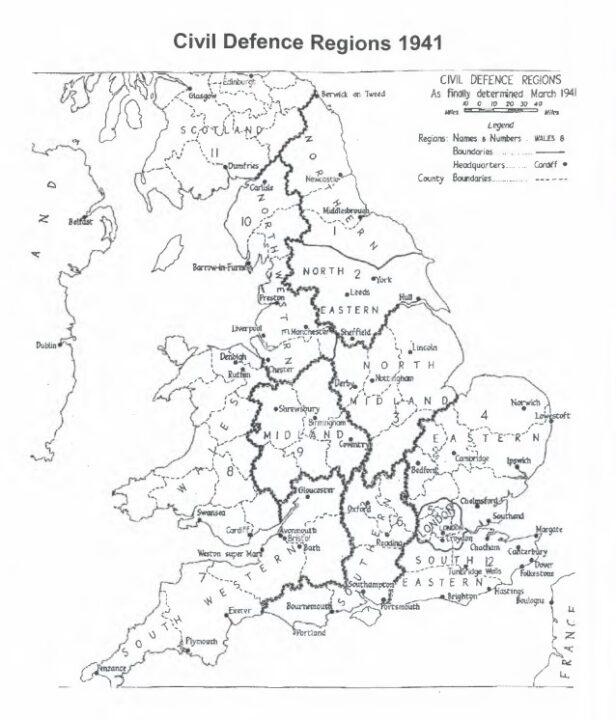
If you are looking for records in London (region 5), use the map below and table to determine the relevant sub-group:
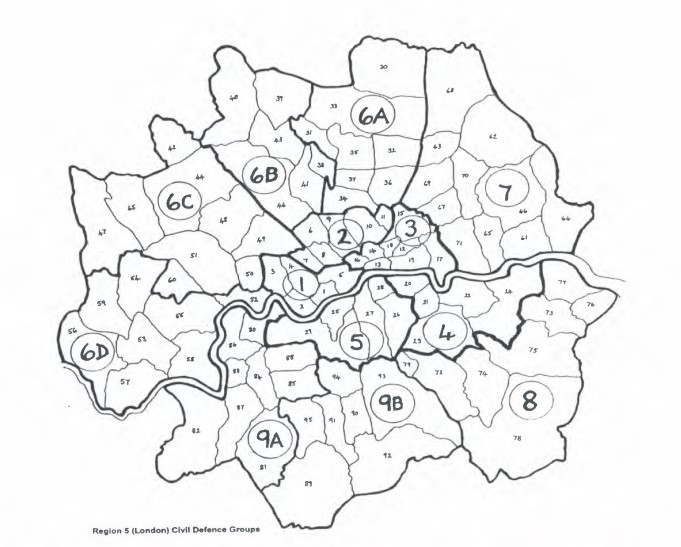
Group 1
|
Group 6A
|
Group 7
|
Group 2
|
Group 6B
|
Group 8
|
Group 3
|
Group 6C
|
Group 9A
|
Group 4
|
Group 6D
|
Group 9B
|
Group 5
|
Appendix 2: Provincial regions
If you are searching for the map of a provincial town or city, use the below list to determine the relevant reference:
| HO 193/55 | Aberdeen, Alburgh, Aldershot, Altrincham, Aston-under-Lyne, Barrow in Furness, Bath, Billingham |
| HO 193/56 | Birmingham |
| HO 193/57 | Birmingham |
| HO 193/58 | Bodmin, Bolton, Bournemouth, Bradford, Bridlington, Brighton, Bristol, Brixham, Bury, Burslam, Cambridge, Canterbury, Cardiff, Chatham & Gillingham, Chelmsford, Chester, Chichester, Colchester |
| HO 193/59 | Coventry, Cowes, Cromer, Dartmouth, Derby, Doncaster, Dover, Dundee, Eastbourne, Edinburgh, Ellesmere Port, Exeter, Exmouth |
| HO 193/60 | Falmouth, Felixstowe, Folkstone, Fraserburgh, Gateshead, Goole, Grantham, Gravesend, Great Yarmouth, Grimsby, Guildford, Hartlepool (West), Harwich, Hastings, Ipswich, Jarrow, Kings Lynn, Leamington Spa, Lincoln, Lowestoft, Luton |
| HO 193/61 | Maidstone, Margate, Middlesbrough, Newcastle-on-Tyne, Newport, Norwich, Nottingham, Nuneaton, Oldham, Penzance, Peterborough, Plymouth, Poole, Portland, Portsmouth |
| HO 193/62 | Ramsgate, Rochdale, Rochester, Rotherham, Salisbury, Scarborough, Scunthorpe, Sheffield, Slough, Southampton, Southend |
| HO 193/63 | South Shields, Southwold, Stockton-on-Tees, Stoke-on-Trent, Sutherland, Swanage, Swansea, Swindon, Teignmouth, Thornaby, Tilbury, Torquay, Truro, Wallsend, Walsall, Watford, Weston Super Mare, Widnes, Winchester, Wolverhampton, Yeovil |
| HO 193/64 | York, Yeovil (East Riding) |
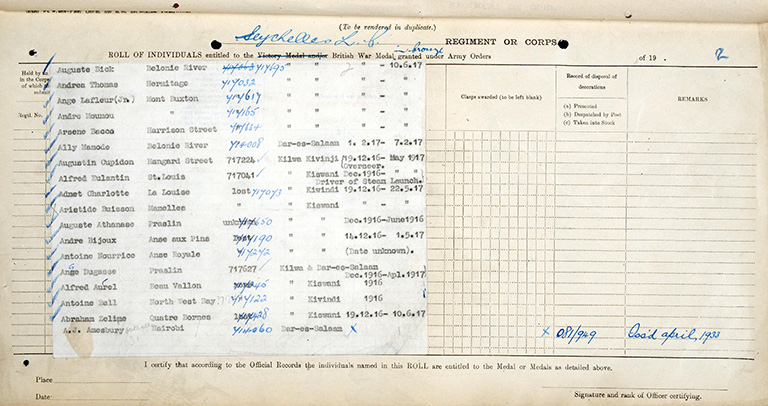
What are these records?
These records are index cards created by the Army Medal Office towards the end of the First World War. They record the medals that men and women who served in the First World War were entitled to claim.
There are over 5 million cards, held in series WO 372. Most of the cards are for soldiers in the British Army. The collection also includes:
- some British Army officers (officers had to apply for their campaign medals and may not have)
- Indian Army personnel
- British Army nurses
- Royal Flying Corps personnel
- Royal Naval Division personnel
- some civilians
Most of the cards contain information about campaign medals, which were generally awarded to all those who served overseas. However, some of the cards record entitlement to gallantry and long service awards.
It is Ministry of Defence policy to not issue medal replacements for service before 1920, irrespective of entitlement. You may be able to obtain duplicate medals from a coin or medal dealer. Alternatively, replica medals can be purchased from The National Archives bookshop.
How do I search the records?
You can search for an individual medal index card using the form below. You do not need to fill out every field to search these records; using only the last name and regiment number often works. Your search results will be displayed in Discovery, our catalogue. From search results you can select an individual record (by clicking on the title) and download it (£).
Your download will actually contain the images of six medal cards (with the exception of the Indian Army medal cards, which download individually), usually for six different individuals with similar or even identical names. Given this, if you are looking for the medal cards of two different people with the same surname it may only be necessary to download one image. In your search results, look for the Reference code. If the reference is the same for two separate individuals, you will only need to download one image for both cards.
Please note you can also search for, download and view these records on Ancestry.co.uk (£) and Findmypast.co.uk (£).
What information do the records contain?
It’s important to note that the cards do not contain much personal information. You may be able to find out more from the person’s service record, if it survives.
Campaign medal index cards
For each person the cards record:
- name
- rank(s)
- unit(s)
- regimental number
- medal entitlement
- often a roll reference that refers to a medal roll entry in series WO 329 which may reveal the specific battalion, brigade or battery in which the individual served
- often the first theatre of war in which they served and when they entered that theatre (if this part of the card is blank it usually means that the individual went to France in 1916 or later)
The card may mention the theatre of war entered, such as (1) France, but occasionally they only give the code number, or nothing if the date of entry is after 1916.
- Western Europe
- Balkans
- Egyptian
- African
- Asiatic
- Australasian
A complete list of the codes used on the medal index cards can be found on the LongLongTrail
Where additional remarks are recorded on a card, you may find information on:
- date of death
- date of discharge
- other remarks concerning the career or fate of the person
The original medal issue and medal receipt may also be noted. However, most of the cards record medal entitlement rather than the awarding of medals. If you want to check whether a person received a medal, you can consult the medal rolls (WO 329) which should be annotated with pencil ticks. These campaign medal rolls are available online via Ancestry £. There is a separate search for campaign medal rolls for the Silver War Badge.
Occasionally, the medal card will confirm that the individual did not receive any medals, including many soldiers who went to France after 11 November 1918. They thought they were entitled and applied, but had their application refused.
Others failed to meet the required criteria for certain awards, had not served abroad, or forfeited their campaign medals due to a disciplinary infringement.
1914 Star
 The 1914 Star was instituted in 1917 for service ashore in France and Flanders between 5 August and 22 November 1914. In 1919 a clasp bearing the above dates was authorised and given to personnel who had actually been under fire between the prescribed dates.
1914/15 Star
 Authorised in 1918, the 1914/15 Star was awarded to personnel who saw service in France and Flanders from 23 November 1914 to 31 December 1915, and to personnel who saw service in any other operational theatre from 5 August 1914 to 31 December 1915.
British War Medal
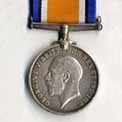 The British War Medal 1914-1920, authorised in 1919, was awarded to eligible service personnel and civilians. Qualifications for the award varied slightly according to service. The basic requirement for army personnel and civilians was that they either entered a theatre of war, or rendered approved service overseas between 5 August 1914 and 11 November 1918. Service in Russia in 1919 and 1920 also qualified for the award.
Victory Medal
 The Victory Medal 1914-1919 was also authorised in 1919 and was awarded to all eligible personnel who served on the establishment of a unit in an operational theatre.
Territorial Force Medal
 The Territorial Force War Medal 1914-1919 was awarded to members of the Territorial Force only. To qualify, the recipient had to have been a member of the Territorial Force on or prior to 30 September 1914, and to have served in an operational theatre outside of the United Kingdom between 5 August 1914 and 11 November 1918.
Silver War Badge
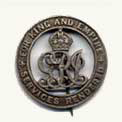 The Silver War Badge, sometimes erroneously called the Silver Wound Badge, was authorised in September 1916 and takes the form of a circular badge with the legend ‘For King and Empire-Services Rendered’ surrounding the George V cypher. The badge was awarded to all of those military personnel who were discharged as a result of sickness or wounds contracted or received during the war, either at home or overseas.
Gallantry award medal index cards
The gallantry award medal index cards are all in WO 372/23 or WO 372/24. They cover awards granted between about 1909 and 1931.
Each card provides:
- first initial and surname (the full first name is usually not given)
- rank(s)
- unit(s)
- regimental number
- medal entitlement
- date and page number of the London Gazette where the award was announced – search for this on The Gazette website
- Army Order number – Army Orders are preserved at The National Archives in the series WO 123
Most of the DCM, MM and MSM card indexes note in which operational theatre the award was won.
The card will not give the reasons for the award, but you might find a citation in the Gazette.
Some of the award dates are given as a numerical code – use the table below to interpret the codes.
Gazettes codes table
| Gazette code number | Date(s) |
|---|---|
| 59 | 11 February or 13 March 1919 |
| 60 | 18 or 24 or 30 January or 22 February 1919 |
| 61 | 29 March 1919 |
| 62 | 14 May 1919 |
| 63 | 17 June 1919 |
| 64 | 3 July 1919 |
| 65 | 23 July 1919 |
| 66 | 20 August 1919 |
| 67 | 20 August 1919 |
| 68 | 22 September 1919 |
| 69 | 16 October 1919 |
| Peace Gazette | 3 June 1919 |
| Prisoner of War | 30 January or 19 June 1920 |
Types of gallantry award
There were various gallantry awards, with different qualifications for each type:
Distinguished Conduct Medal
The Distinguished Conduct Medal (DCM), second only to the Victoria Cross, was awarded to all other ranks for exceptional bravery.
Military Medal
 The Military Medal (MM) was awarded to warrant officers, non-commissioned officers and other ranks for gallantry in action against the enemy. It ranked below the Distinguished Conduct Medal.
Meritorious Service Medal
The Meritorious Service Medal (MSM) could be awarded for services in connection with the war or for gallantry but not in face of the enemy.
Mention in Despatches
 Commanders-in-Chief in the field submitted periodical lists of officers and soldiers who were ‘mentioned in despatches’. Award of a Mention ranked below MC or MM and could be for gallantry in action or for a wide range of services on and off the battlefield.
Types of long service medals
The Territorial Force Efficiency Medal (TFEM)
The Territorial Force Efficiency Medal (TFEM) was instituted in 1908 as a long service award for other ranks in the Territorial Force. Qualification for the award was 12 years’ service, with war service counting double.
Territorial Efficiency Medal (TEM)
The TFEM was renamed the Territorial Efficiency Medal in 1921 when the TF became the Territorial Army. The name and design of the award was changed again in 1930, becoming the Efficiency Medal (Territorial), sometimes noted as EM(T).
What do the records look like?
The medal index cards are displayed in sets of six (with the exception of the Indian Army medal cards, which download individually), usually for six different individuals with similar or even identical names.
Several different designs of medal cards were used but the most common type was the following:
Design 1
The left hand side of the card contains a printed list of the campaign medals. A note in the ‘roll’ and ‘page’ column meant the soldier was awarded that medal. You may also see ‘do’, which meant ‘ditto’.
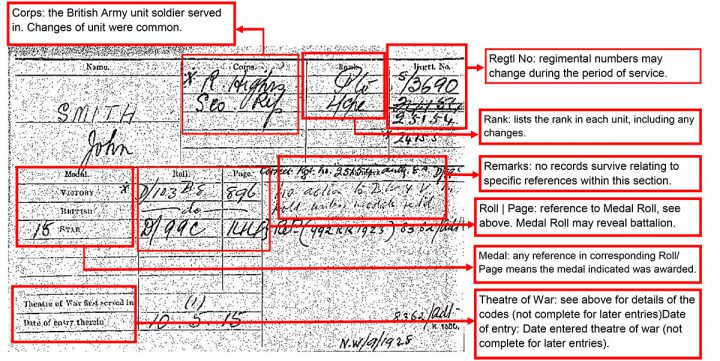
Example of the most common type of design for a medal index card (catalogue ref: WO 372/18)
Design 2
The essential difference with this design is that the medal entitlement is at the top right hand corner and the entire lower half of the card is left free for any remarks.
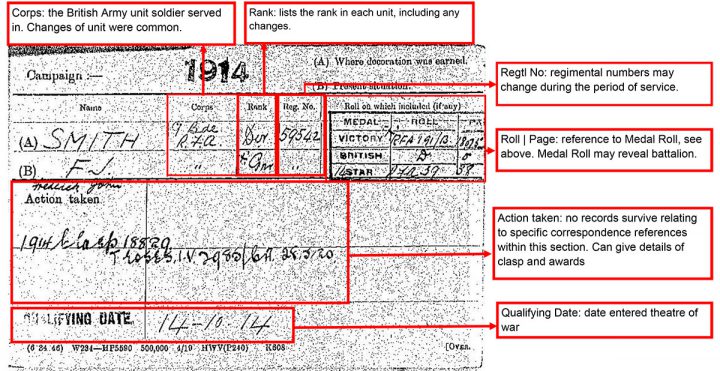
Example of the less common design of medal index card (catalogue ref: WO 372/18/154847)
Design 3: the Silver War Badge
This type of card was used for individuals who received the Silver War Badge only. The card contains information about an individual and often gives the date of enlistment, date of discharge and reason for discharge.
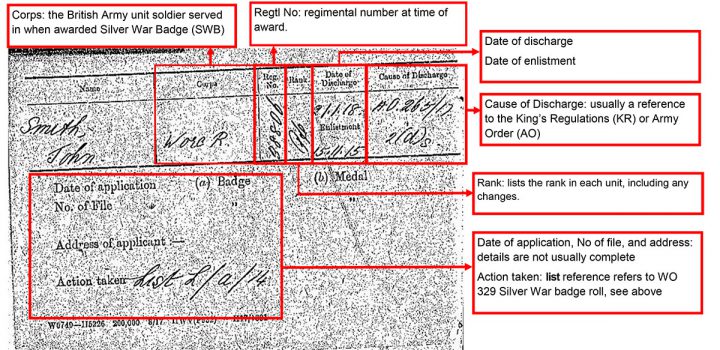
Example of a medal index card for the Silver War badge (catalogue ref: WO 372/18/154847)
Abbreviations
Medal cards often contain abbreviations and alphanumeric codes and we have listed some common ones below. The codes for those who saw their first operational service from 1 January 1916 onwards differ slightly from those who saw operational service before 1916.
For a more detailed list of abbreviations for rank and unit, you might find it useful to refer to the PDFs below or alternatively The Collector and Researcher’s Guide to the Great War by Howard Williamson.
Abbreviations table
| Up to 31 December 1915 | From 1 January 1916 |
|---|---|
| 1 | 1 Western Europe |
| a France and Belgium | |
| b Italy | |
| 2 | 2 Balkans |
| a Greek Macedonia, Serbia, Bulgaria and European Turkey | |
| b Gallipoli (Dardanelles) | |
| 3 Russia (4-5 August 1914 to 1-2 July 1920) | |
| 3 | 4 Egypt |
| a 4-5 November 1914 to 18-19 March 1916 | |
| b 18-19 March 1916 to 31 October – 1 November 1918 | |
| 4 | 5 Africa |
| a East Africa, Nyasaland and Northern Rhodesia | |
| b South West Africa | |
| c Cameroon | |
| d Nigeria | |
| e Togoland | |
| 5 | 6 Asia |
| a Hedjaz | |
| b Mesopotamia | |
| c Persia | |
| d Trans Caspia | |
| e South West Arabia | |
| f Aden | |
| g Frontier regions of India | |
| h Tsingtau | |
| 6 | 7 Australasia |
| a New Britain | |
| b New Ireland | |
| c Kaiser Wilhelmland | |
| d Admiralty Islands | |
| e Nauru | |
| f German Samoa |
Other abbreviations table
| Abbreviation | Meaning |
|---|---|
| ARZ | Class Z Army Reserve. In December 1918 soldiers being demobilised were first posted to Class Z. They could return to civilian life but knew they were obliged to return if necessary. The Z Reserve was abolished on 31 March 1920 |
| Cl | An individual had been sent a dated clasp. This clasp would go on the ribbon of the 1914 Star, or a silver rosette would go on the ribbon when only medal ribbons were being worn |
| Comm | Commissioned |
| EMB or Emblems | An individual had been ‘Mentioned in Despatches’ (MID) and at least two ‘oak leaf’ MID emblems had been sent to the recipient |
| KiA or Killed | If a soldier died in action, it is often marked on the card. Sometimes it will just say ‘Dead’ but occasionally it will not be noted at all |
| KR 392 | King’s Regulation 392 which covered causes of early discharge whether through ill health, misconduct or other reasons |
| Rep | Replaced. This is an unusual comment implying that the index card was replaced at some point |
| Retd or Rtd (sometimes ‘Retd undisposed of’) | Returned. If there was an error in the inscription, the medals would have to be returned to the Medals Office. Another reason for return was if the individual had moved house and the parcel was not deliverable |
| TE or T/E or T of E | Time Expired. This is when the soldier had reached the end of his agreed period of military service. It applies only to pre-war soldiers of the regular army or Territorial Force. These men were allowed to go home but from 1916 many TE men returned to active service as conscripted soldiers. |
Rank abbreviations used in the medal index cards (PDF, 0.62MB)
Unit abbreviations used in the medal index cards (PDF, 1.06MB)
Why can’t I find what I’m looking for?
Occasionally there is no regimental number recorded on the card, which may be the case if the person was an officer. In this case try searching by name and regiment only.
If members of the Royal Flying Corps did not see service overseas until 1916 or later, you will not find a medal card here. The Air Ministry maintained these medal records and they have not been transferred to The National Archives.
You may need to change the spelling of the words you are searching with; this is most commonly the case when searching for a sergeant, which was more commonly spelt as ‘serjeant’ at the time the cards were produced.
Officers had to apply for their campaign medal, so if they did not apply, there will not be a medal card.
This is a guide to finding records of merchant seamen who served during the First World War. It is very difficult to find information about an individual merchant seaman during the war as the registers that were kept to record service have not survived.
Some merchant seamen may have seen service with the Royal Naval Reserve, refer to our research guide for advice on searching for records.
What do I need to know before I start?
The missing registers
The Merchant Navy began to register its seamen again, after decades of not doing so, in 1913. Names and other details were entered into the Central Indexed Register, also known as the Fourth Register of Seamen. However, the entries for 1913 to 1917 and all but the last two months of 1918 were destroyed, so for the war years you are left with medal records and the agreements and crew lists – unless your seaman was an apprentice or died in service in which case there may be a separate record.
How to trace a ship
Sometimes the only way to track down a record of a seaman is to trace the records of the ships he served on. You can use the CLIP (Crew List Index Project) website to trace a ship by the:
- ship’s name
- ship’s port of registration
- ship’s official number
How to interpret abbreviations in the records
See our guide to Abbreviations in merchant seamen records for further help interpreting information in these records.
Online records
First World War medals
Search and download cards recording the award of campaign medals to merchant seamen in the First World War (BT 351/1/1, BT 351/1/2 and MT 9/1404) (£). These cards record the award of the British War Medal, Mercantile Marine Medal and Silver War Badge.
First World War Roll of Honour
Search by name the Shipping and Seamen First World War Roll of Honour (BT 339) on Ancestry (£). The Roll of Honour lists merchant seamen who died in service during the war or who were declared ‘missing, presumed dead’. The information in these records usually includes:
- rank or rating
- name of ship
- date of death or presumed death
Records available only at The National Archives in Kew
To access these records you will either need to visit us, pay for research (£) or, where you can identify a specific record reference, order a copy £).
Agreements and crew lists, 1861-1994
The National Archives holds a 10% sample of agreements and crew lists for 1861 to 1938 (see below for other archives that hold agreements and crew lists).
Use the box below to search the agreements and crew lists in BT 99 by ship’s official number for the period 1861 to 1934. You can search for a ship’s official number at the Crew List Index Project website (CLIP) or the Miramar Ship Index (£).
1915 crew lists
If you are looking for a seaman who served in 1915 you are able to search the 1915 crew lists by seaman’s name. Further details are available on the National Maritime Museum’s 1915 project page. Please note, your search results will include records held at the National Maritime Museum – please check the ‘held by’ information on your search results.
For more information read Merchant Navy ships’ records: crew lists, musters and log books.
Merchant Navy apprentices, 1824-1953
Browse the indexes of apprentices registered in the merchant navy in BT 150. BT 150/54 covers 1911-1917, and BT 150/55 covers the period 1918-1928.
These are indexes to the apprentices’ indentures in BT 151 and BT 152. Browse BT 151 and BT 152 by date and by port. Please note only a sample survive (a two month sample for every five years).
Records in other archives and organisations
Agreements and crew lists, 1861-1994
Most agreements and crew lists for this period are held in repositories other than The National Archives. Search at the following:
- Maritime History Archive in Newfoundland holds approximately 70% of the crew lists and agreements for the years 1861-1938 and 1951-1976. You can search these by ship’s official number.
- National Maritime Museum in London holds 10% of agreements and crew lists for the periods 1861-1938 and 1951-1976. In general, the records held are for years ending with five (1865, 1875, and so on) however they do hold some other years too. Contact them directly to find out more.
- National Records of Scotland
- National Archives of Ireland
Other resources
Books
Christopher and Michael Watts, My Ancestor was a Merchant Seaman (Society of Genealogists, 2002)
Search The National Archives’ shop and the The National Archives’ library catalogue for other publications.
1. Why use this guide?
Use this guide for advice on how to find records of airmen and officers of the Royal Air Force (RAF). These are predominantly records of service prior to 1939.
RAF service records created since the beginning of the Second World War are currently being transferred from the Ministry of Defence. Refer to section 3.2 below.
If you are looking for the service record of an airwoman you should start by consulting our guide to records of Women’s Royal Air Force personnel.
2. RAF, RFC or RNAS?
The Royal Air Force was formed on 1 April 1918 when the RFC and the RNAS were amalgamated. Officers and men of both services who continued service after this date transferred into the newly formed RAF and were joined by new entrants. From this date onwards the RFC and RNAS ceased to exist.
Someone who served in the Royal Flying Corps (RFC) or Royal Naval Air Service (RNAS) as well as the RAF may have service records in more than one place and you may need to consult our guides to RFC officers, RFC airmen, RNAS officers and RNAS ratings for more detail.
3. Service records
3.1 Airmen (not officers) 1912-1939
Search for a Royal Air Force airmans’ service records (AIR 79) on findmypast (£). These are records of airmen with service numbers from 1 to 562875. Some files may contain information from the Second World War.
The records in AIR 79 usually contain the following information:
- date and place of birth
- physical description
- religious denomination
- next of kin
- spouse and children
- date of joining
- promotions
- units served in
- award of medals
- date of discharge
RAF service numbers between 313001 and 316000 indicate that the airmen previously served with the Royal Navy and then subsequently the Royal Naval Air Service, before transferring to the RAF. If the airman’s service number falls within this range there may be further records of his military service in Royal Naval Air Service records or Royal Navy records.
3.2 Airmen (not officers) after 1939
Records of RAF airmen who served after 1939, and of men whose service numbers were above 562875, and who completed their service before 1963 have recently been transferred from the Ministry of Defence. These records are in the process of being catalogued and being made available on Discovery.
Records which have been catalogued can be found by searching within the series AIR 85 by surname and year of birth (and by service number if the record relates to someone with a date of birth over 115 years ago).
For records that cannot yet be found through our catalogue, or for records that are currently closed, you can request to access them by using our Request a military service record service.
3.3 Officers 1918-1922
Search the Royal Air Force officers’ service records 1918-1919 (£) online for officers who served in the Royal Air Force during the First World War (AIR 76). By the end of 1919, 26,000 of the 27,000 serving RAF officers had been discharged, and it is largely their service details which are held in this series.
3.4 Officers after 1922
Records of RAF Officers who served after 1939 and who completed their service before 1963 have recently been transferred from the Ministry of Defence. These records are in the process of being catalogued and being made available on Discovery.
Records which have been catalogued can be found by searching within the series AIR 84 by surname and year of birth.
It may also be possible to search with a service or registered number, if this is known.
Many catalogue entries in AIR 84 do not include the service number but instead display a ‘registered number’. This number usually consists of a letter followed by six digits and then a slash followed by two further digits (e.g. A123456/40).
The final two digits refer to the date on which someone received their commission. For example, /40 means that someone was awarded a commission in 1940. It is possible to use this information to search in the Royal Air Force Lists and for a service number to be located. If, for example, you know that someone was awarded their commission in 1940, you would need to look up a List from after this date. It may also be possible to find an individual’s service number by consulting the London Gazette.
For records that cannot yet be found through our catalogue, or for records that are currently closed, you can request to access them by using our Request a military service record service.
Records of RAF officers who served after 1963 are still with the Ministry of Defence. Look on the GOV.UK website to find out how to obtain service records.
4. Operations Record Books and Combat Reports
In the absence of a service record, or perhaps to supplement one, Operations Record Books (ORBs) can prove very revealing. These daily records of the life of a squadron, and of other units within the RAF structure, can provide insights into what an airman or officer did during their time at war. Sometimes individuals are mentioned by name, though often it is just the activities of the unit as a whole which are recorded. ORBs can also include:
- nominal rolls
- lists of officers
- details of promotions, transfers or awards
Along with combat reports, operations record books can help to tell a serviceman’s story.
You need to know which squadron a serviceman or woman served with to locate these records. Consult our Royal Air Force operations guide for detailed advice.
5. RAF personnel missing in combat
Search for missing RAF personnel in AIR 81. Search these records by:
- surname of missing airman
- place/location of the incident in which air crew went missing
- date of the incident
- type of aircraft from which air crew went missing (for example, Blenheim)
These files may contain missing person and casualty action sheets, death certificates, personal letters and correspondence, exhumation reports, investigation reports, questionnaires by repatriated personnel and personal effects of POWs.
Please note that this series is still accruing and currently only goes up to June 1943.
6. Medal records 1914-1922
6.1 Campaign medals
If an individual in the RAF qualified for medal(s) after 1 April 1918, the only place you will find details about his medal entitlement will be on his service record.
6.2 Gallantry medals
For information on gallantry medals awarded to RAF personnel, read our British military gallantry medals guide.
7. Lists of RAF servicemen
7.1 Muster list from 1918
Consult the only complete muster roll of the RAF, compiled on its formation on 1 April 1918, on Findmypast.co.uk. The original documents are in AIR 1/819/204/4/1316 and also AIR 10/232-237.
7.2 Rolls of Honour: First World War
Browse the first series of Air Historical Branch (AHB) records in series AIR 1 for nominal rolls of individual units for the First World War.
Indexes and keys to AIR 1 are available with the printed version of our catalogue at The National Archives at Kew. The second series of AHB records, in AIR 5, contains little on individuals.
Look at AIR 2/219, the Roll of Honour for men from the USA and Dominions who served with the British Air Forces in the First World War.
7.3 Rolls of Honour: Second World War
Look at AIR 14/2091, the Roll of Honour for No. 5 Group in Bomber Command. This is the only known Second World War nominal roll for the RAF in The National Archives.
8. Records specific to officers
RAF officer ranks include:
- Flying Officer
- Flight Lieutenant
- Squadron Leader
- Wing Commander
- Group Captain
Records of officers are usually held in separate sets of files to those of ordinary airmen. Some records were created only for officers, including records of commissions. The following record types may prove useful when tracing the career of an officer:
8.1 The Air Force List
You can trace the commissions and promotions of an RAF officer’s career from March 1919 in the Air Force List, available at The National Archives at Kew and other specialist libraries and archives (see section 11). Up until 1938 the lists also provide details of where in the world an officer was posted.
From 1939 there is also the Confidential Air Force List, similar to the standard Air Force List but often with slightly more detail on the specifics of an officer’s duties. Search it in the following sets of documents:
- for April 1939 to 1945 in AIR 10/3814-3840
- for 1946 to 1950 in AIR 10/5237-5256
- for 1951 to 1953 in AIR 10/5413-5421
- for 1954 in AIR 10/5581-5582
8.2 Officers’ pension records 1916-1920
Look in PMG 42/13-16 to find payments made to invalided RAF officers from 1917 to 1920.
Browse by reference through PMG 44 to find records of pensions paid to relatives of deceased RAF officers from 1916 to 1920.
Look in PMG 43 for supplementary payments to RAF officers and their dependents from 1916 to 1920.
8.3 Air Historical Branch papers
For additional material on awards and promotions, as well as officers’ correspondence, browse or search the Air Historical Branch (AHB) papers in AIR 1. Indexes and keys to AIR 1 are available with the printed version of our catalogue at The National Archives at Kew.
9. Courts martial 1918-1986
Browse AIR 21 for courts martial records from 1918 to 1965. These give:
- name of prisoner
- rank of prisoner
- place of trial
- nature of charge and sentence
Click on AIR 18 and use the search box to search by surname to find the proceedings of district, general and field courts martial of officers and men from 1941 to 1986.
Look in series AIR 2 and AIR 20 for records of courts martial policy.
10. Prisoner of war records
Air Ministry (AIR) records do not generally contain detailed information on prisoners of war. You can, however, consult:
- a list of all aircrew known to have been held prisoner by Germany in AIR 20/2336
- escape reports and related files in AIR 40
- prisoner of war and internees’ files in FO 916
See also our guides to British prisoners of war c1790-1919 and British prisoners of the Second World War and the Korean War.
11. Records in other archives
For more information about the RAF, you may wish to:
- visit the RAF Museum website
- visit the RAF website to read about the histories of RAF squadrons
- consult the Air Force Lists (see section 8.1) at the British Library, the Society of Genealogists and some local archives
12. Further reading
Visit The National Archives’ bookshop for a range of publications on Royal Air Force personnel and the associated records. Alternatively, search The National Archives’ library catalogue to see what is available to consult at Kew. The following publications are recommended:
William Spencer, Air Force records for family historians (The National Archives, 2008)
Ian Tavendar, The Distinguished Flying Medal register for the Second World War: With Official Recommendation details (Savannah Publications, 2000)
Michael Maton, Honour the Air Forces: Honours and awards to the RAF and Dominion Air Forces during the Second World War (Token Publishing Limited, 2004)
Find details of men who joined the RFC between its formation in 1912 and August 1914 (numbers 1-1400) by reading Jack V Webb and Ian McInnes, A Contemptible Little Flying Corps (London Stamp Exchange, 1991)
Nick Carter and Carol Carter, The Distinguished Flying Cross and how it was won 1918-1995 (Savannah Publications, 1998)
Phil Tomaselli, Tracing your Air Force Ancestors (Pen & Sword, 2007)