1. Why use this guide?
Use this guide for advice on where and how to search for records created by Crown courts in England and Wales.
Since 1972, when Crown courts were established, they have been the courts where all serious offences, including robbery, rape and murder, are tried. The records they have created are usually held in one of three places:
- At the Crown court itself (for trials heard in the last six years or so)
- With HM Courts and Tribunals Service
- At The National Archives (usually for trials at least 20 years old)
For more detailed advice on records of the Central Criminal Court (the Crown Court in the City of London) see our guide to Criminal court cases: Old Bailey (Central Criminal Court). For advice on finding records from other types of criminal courts see our overview guide.
2. What are Crown courts?
Following a Royal Commission, the Courts Act 1971 established a restructuring of the criminal justice system. Assize courts and quarter sessions courts were replaced by Crown courts, which began life at the start of 1972. Liverpool and Manchester Crown courts had already been established in 1956.
Crown courts hear serious criminal cases such as:
- robbery
- burglary
- grievous bodily harm
- kidnapping
- rape
- murder
- manslaughter
- treason
- riot
A judge has overall responsibility for the court with a jury of twelve people providing the verdict.
Crown courts also deal with:
- appeals against a magistrates’ court conviction or sentence
- cases passed from a magistrates’ court for trial or sentencing

York Crown Court (source: Andy Farrington via Wikimedia Commons)
There are approximately 80 Crown courts around England and Wales and they include the Central Criminal Court in the City of London, popularly known as the Old Bailey.
3. Record types, the information they contain and what gets kept
Whilst the records are still held at the courts themselves (for the six to seven years after the trial) almost everything is retained. Once records are removed from the courts, some are destroyed. Not all records created by the courts are kept for permanent preservation. For most cases indictments are permanently retained but only a small sample of case files are kept.
3.1 Indictments
The indictment contains key information about the progress of the trial, outcome and appeal (if there is an appeal). The indictment is formally annotated during the trial thereby providing a concise account of the events and decisions that occurred.
Information contained on the indictment includes:
- defendant’s name, sex and date of birth
- whether bail or custody was granted
- date committed for trial, conviction and sentence date
- trial dates (from/to) added upon completion of the trial
- the identity of the firm of shorthand writers
- judge’s name
- defence counsel names of barristers and solicitors
- prosecution counsel names of barristers and solicitors
- offences charged to the defendant listed as separate ‘counts’
- defendant’s plea to the charges
- jury’s verdict
- sentence or order
- appeal details – date of appeal and whether grounds for appeal granted or refused
A copy indictment is usually attached to the indictment and includes a list of witnesses called to trial, along with repeating much of the information contained within the initial indictment.
3.2 Case files
Information contained within a case file varies from one file to another but can include:
- committal proceedings (records created at magistrates courts to determine whether a case should be heard by a Crown court)
- court logs (recording brief case histories, such as dates of hearings)
- police statements
- copy indictment (a duplicate of the indictment file itself)
- evidence for the prosecution
- list of witnesses with their statements and depositions
- list of exhibits produced in court
- photographs of the crime scene
- sentence
- detail of appeal if there was one
- a case file number (which you can help you to find an indictment). This is usually a six-digit number, such as ‘721717’ or ‘91/0108’. The first two numbers indicate the year and the other numbers denote the case number heard by the Crown court that year. In our first example, the case number indicates that the case dates from 1972 and was the 1717th case heard that year.
Crown court files have been selected for permanent preservation partly to represent the wide variety of cases heard by the courts but not all individual case files are kept permanently. Those that are kept tend to be files that record more serious crimes, cases that attracted public interest, or were of significance (either legally or historically), or where the accused was eminent or infamous or if the case generated widespread public concern.
3.3 Transcripts
Court stenographers recorded the proceedings in short hand known as computer aided transcription notes. These are filed separately from the case file and not kept permanently. However, if the defendant lodged an appeal within five years of the conviction then long hand notes were recreated from the original computer aided transcription notes for the appeal and may be found on the criminal appeal case file (see our guide to criminal appeal cases).
4. How to search for records
Before you start a search, bear in mind that The National Archives holds only samples of surviving Crown court case files and that many Crown courts have not yet sent any indictment files at all to The National Archives. Many records remain in the custody of HM Courts and Tribunal Service. For information about these records contact the Ministry of Justice. Consult the HM Courts and Tribunals Service website for contact details of individual Crown courts.
To understand how files are selected for preservation at The National Archives see our Operational Selection Policy for Crown Courts.
Some of the records that we do hold are not accessible to the public as the information within them is sensitive. You can request that a closed file be opened by submitting a Freedom of Information request.
To get an idea of what you might find in Crown court records, see section 3 above.
Stage 1 of a search: case files
Start by looking for case files as they unlock information that will make a search for indictments easier.
Search for case files in one of the two following ways:
Method 1: If you know the Crown court where the case was heard, locate its name in the table in section 5 of this guide and click on the links for case files – this will take you to a catalogue description page for all the case files held for that court at The National Archives. Use the ‘Keyword search’ box to search by name of defendant or the charge.
Method 2: If you do not know the Crown court where the case was heard, try using our advanced search, placing a J in the reference fields and searching with the defendant’s name and/or the charge. The results for this kind of search are likely to be more jumbled than those for Method 1 as they will include results from a variety of other courts.
Sometimes the name of the defendant is not listed in our catalogue, either because the defendant was under age or because it could give away the identity of the victim. To account for this, you should search with the phrase ‘name withheld.’
The naming of a defendant within our catalogue does not imply guilt.
Stage 2 of a search: indictments
To search for an indictment you will need a case number.
If you don’t already have a case number, contact HM Courts and Tribunal Service who can provide you with a case number for some Crown court cases (The National Archives has indexes to cases, and therefore case numbers, only for the Central Criminal Court – the Old Bailey – and only up to 1980).
With a case number you can search for the indictment, in one of the two following ways:
Method 1: Try this method first.
- Locate the name of the court in the table in section 5
- Click on the series code for that court’s indictments
- Click on ‘browse from here by reference’, as shown here:

- Look for the case number in the ranges of case numbers displayed in the right-hand panel
- Order the record to locate the precise case number you are looking for
Method 2: If you have not found the court listed in section 5 or the indictment is not among those listed for that court, try using our advanced search, placing a J in the reference fields and searching with the name of the court, the word indictments and the year, or a range of years. Some series contain indictments for more than one court.
5. Key to records of Crown court cases
Different Crown courts transfer documents at different rates so some of the record series below are less complete than others. Many Crown courts have not yet sent any indictment files to The National Archives and their records remain in the custody of HM Courts and Tribunal Service.
For various reasons, records of a Crown Court may sometimes be found among the records of a different court, where we know this to be the case we have cross referenced in the table below.
Click on the links below to view the record series description – the ‘Access conditions’ will indicate whether or not files have been transferred from the Crown Court to The National Archives.
| Crown Court | Record series in which case files may be held | Record series in which indictments may be held | Other records for this court |
|---|---|---|---|
| England | |||
| Acton | J 238 | J 239 | |
| Aylesbury | J 240 | J 241 | |
| Basildon | J 345 | J 351 | |
| Beverley | J 224 see J 220 Kingston upon Hull for 1972-74 | J 221 Kingston upon Hull and Beverley | |
| Birmingham | J 190 | J 191 | |
| Blackfriars (also Knightsbridge) | J 216 | J 217 | |
| Bodmin | J 305 | J 306 | |
| Bolton | J 208 | J 209 | |
| Bournemouth (including Dorchester) | J 307 | J 308 | |
| Bradford | J 226 | J 227 | |
| Bristol | J 309 | J 310 | |
| Burnley | J 236 | J 237 | |
| Cambridge | J 242 | J 243 | |
| Canterbury | J 244 | J 245 also J 207, Maidstone | |
| Carlisle (including Kendal) | J 289 | J 290 | |
| Central Criminal Court | J 267 | J 268, J 336 index | J 164 Papers of Sir James Miskin |
| Chelmsford and Southend-on-sea | J 265 | J 266 | |
| Chester (Wales and Chester Circuit) | J 301 | J 302 | |
| Chichester | J 246 | J 247 | |
| Coventry | J 192 | J 193 | |
| Croydon and Inner London Crown Court | J 248 | J 249 | |
| Derby | J 194 | J 195 | |
| Doncaster | J 228 | J 229 | |
| (Weymouth and) Dorchester (see Bournemouth) | J 307 | J 308 | |
| Dudley | J 254 | J 175, Wolverhampton and Dudley | |
| Durham | J 230 | J 231 | |
| Exeter | J 311 | J 312 | |
| Gloucester | J 313 | J 314 | |
| Grimsby | J 259 | J 260 | Indictments 740101-740283, dated 1974, are in J 235/30-33 |
| Guildford | J 250 | J 251 | |
| Harrow | J 263 | J 264 | |
| Inner London Crown Court See also Croydon) | J 269 | J 270 | |
| Ipswich and Bury St Edmunds | J 261 | J 262 | |
| Isleworth | J 252 | J 253 | |
| Kingston-upon-Hull and Beverley | J 220 | J 221 | |
| Kingston-upon-Thames | J 279 | J 280 | |
| Knightsbridge (including Blackfriars) | J 216 | J 217 | |
| Knutsford (Wales and Chester Circuit) | None | J 302 | |
| Leeds | J 291 | J 292 | |
| Leicester | J 196 | J 197 | |
| Lewes | J 277 | J 278 | |
| Lincoln and Grimsby | J 234 | J 235 (Contains some indictments from Grimsby Crown Court for 1974) | |
| Liverpool, Birkenhead and Wirral | J 222 | J 223 | J 108 Stopping up orders etc. |
| Luton | J 218 | J 219 | |
| Maidstone, Canterbury, Margate and Gravesend | J 206 | J 207 | |
| Manchester and Minshull Street, Manchester (including Bolton to 1982) | J 287 | J 288 | J 109 Stopping up orders etc. |
| Middlesex Guildhall | J 275 | J 276 | |
| Newcastle upon Tyne | J 212 | J 213 | |
| Newport (Isle of Wight) | J 315 | J 316 | |
| Northampton | J 257 | J 258 | |
| Norwich | J 273 | J 274 | |
| Nottingham | J 188 | J 189 | |
| Oxford | J 186 | J 187 | |
| Peterborough and Huntingdon | J 184 | J 185 | |
| Plymouth | J 319 | J 320 | |
| Portsmouth | J 317 | J 318 | |
| Preston (including Barro and Lancaster) | J 285 | J 286 | |
| Reading | J 202 | J 203 | |
| Salisbury | J 329 | J 330 | |
| Sheffield | J 214 | J 215 | |
| Shrewsbury | J 182 | J 183 | |
| Snaresbrook and Woodford | J 200 | J 201 | |
| Southampton | J 327 | J 328 | |
| Southwark | J 204 | J 205 | |
| St Albans and Bedford | J 271 | J 272 | |
| Stafford | J 180 | J 181 | |
| Stoke-on-Trent | J 178 | J 179 | |
| Swindon (including Devizes) | J 325 | J 326 | |
| Taunton (including Barnstaple) | J 323 | J 324 | |
| Teesside | J 283 | J 284 | |
| Truro | J 321 | J 322 | |
| Wakefield and Huddersfield | J 281 | J 282 | |
| Warrington | J 333 | J 334 | |
| Warwick | J 176 | J 177 | |
| Weymouth and Dorchester | J 295 | J 296 | |
| Winchester | J 297 | J 298 | |
| Wolverhampton, Dudley, Walsall, Warley and West Bromwich | J 173 | J 175 | |
| Wood Green | J 198 | J 199 | |
| Woolwich | J 210 | J 211 | |
| Worcester and Hereford | J 255 | J 256 | |
| York | J 232 | J 233 | |
| Wales | |||
| Cardiff | J 299 | J 300 | |
| Merthyr Tydfil | J 303 | J 304 | |
| Newport (Gwent) | J 293 | J 294 | |
| Swansea, Carmarthen and Haverfordwest | J 331 | J 332 |
Wales and Chester Circuit
Crown Courts in North Wales were part of the Wales and Chester Circuit, which included the courts at Caernarfon, Dolgellau, Knutsford (Cheshire), Mold and Welshpool.
Indictments can be found in J 302. Some case files are in J 301.
| Court | Case files | Indictments | |
| Caernarfon | J 301 | J 302 | |
| Dolgellau | J 302 | ||
| Knutsford (Cheshire) | J 302 | ||
| Mold | J 301 | J 302 | |
| Welshpool | J 302 |
6. Director of Public Prosecutions files
The Office of Director of Public Prosecutions (DPP) was created in 1879 with powers to institute and conduct criminal proceedings in any of the senior criminal courts – assizes, King’s/Queen’s Bench or Central Criminal Court, and, more recently, Crown Court.
Search or browse case files of the Director of Public Prosecutions in DPP 2 1931-2016. File descriptions include the name of the defendant (recent records are closed).
7. Further reading
The following recommended publications are available in the The National Archives’ Library:
Richard Beeching, Royal Commission on Assizes and Quarter Sessions 1966-69: Report (London, 1969)
Michael Zander, Cases and materials on the English legal system (London, 10th edition, 2007)

What are these records?
These records are the original wills of warrant officers and ratings as well as Royal Marines other ranks. You can search and download the wills in series ADM 48 of around 20,000 men who joined the Royal Navy between 1786 and 1882.
Accident, disease and war were risks for seamen and many of them made wills to provide for their families in the event of death. As far back as 1698 the Admiralty had to deal with people impersonating deceased seamen or their executors, creditors or next of kin.
These forms were accepted as valid by the Admiralty and they were deposited in the Navy Office, with orders to issue cheques to the executors.
What information do the records contain?
As a rule each man’s will begins with the printed words ‘In the Name of God, Amen’.
The wills usually provide the following information:
- the man’s name
- the date the will was made
- the man’s rank
- the last ship he served on
- details of his effects
- the name (and sometimes the address) of the person who was to receive the effects in the event of his death (usually his next of kin)
As well as being signed and dated by the testator, wills were usually signed by the master and captain of the ship that the seaman or warrant officer was serving on when the will was made.
These wills also hold details such as the name, address and occupation of the executor.
How do I search the records?
You can search the records in our catalogue (£), by using the search box below.
This is a keyword search so your results will show all instances of the term(s) you searched for within our catalogue descriptions for these records.
- Use AND to find more than one term in a description
- Use “double quotation marks” to find exact phrases
What do the records look like?
The wills are usually a printed form with details filled in by hand, although some have been written out in full. There might also be correspondence, such as the ‘Application of the Executor/Executrix’ and notes.
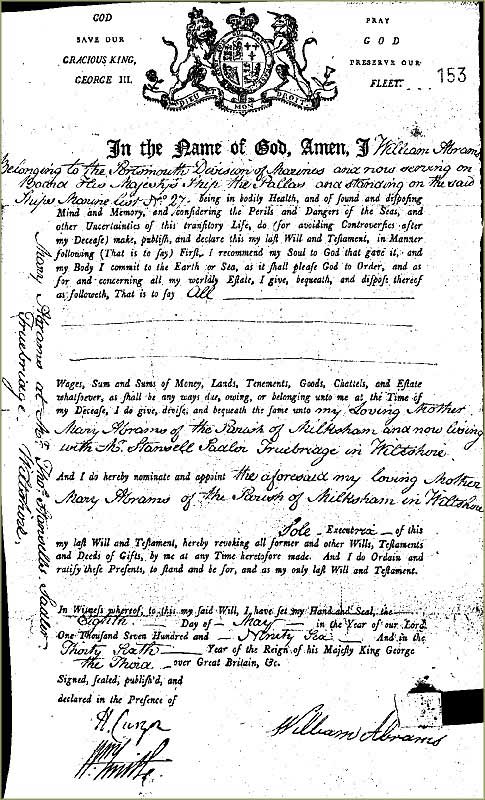
Will of William Abrams, 1796 (ADM 48/1)
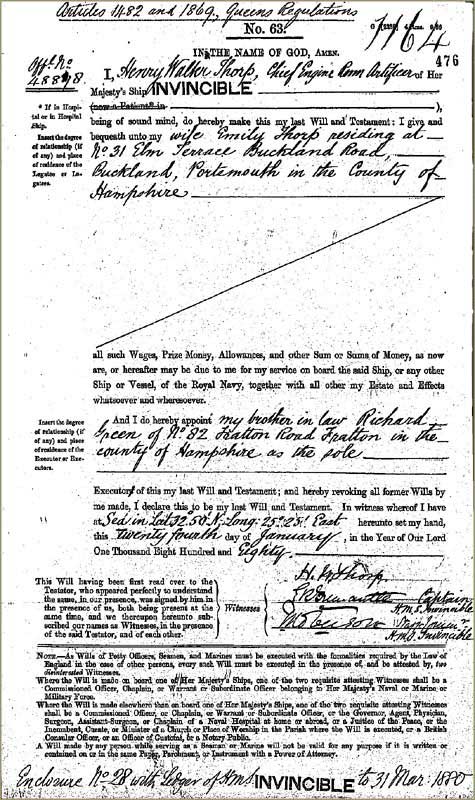
Will of Henry Walker Thorp, 1880 (ADM 48/107)
Why can’t I find what I’m looking for?
Some of the information you are looking for may be recorded in other places. For example:
- in the Prerogative Court of Canterbury wills 1384-1858
- in registers of probates and administrations 1836-1915, in the series PMG 50
- in officers’ effects papers in ADM 45
- in seamen’s effects papers in ADM 44
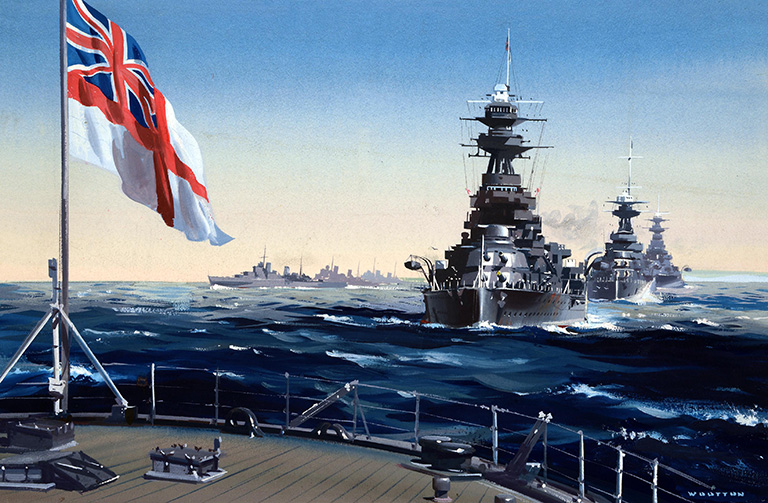
This guide provides advice on searching for records of Royal Naval Reserve personnel. The Royal Naval Reserve (RNR) was established in 1859 and was made up of experienced officers and seamen from merchant ships.
Service records for Royal Naval Reserve officers after 1920, and for ratings after 1955, are held by the Ministry of Defence. Only the subject of the record, or next of kin, may request access to them.
What do I need to know before I start?
If you are looking for the records of someone who served in the First World War it may be worth searching in the records of the Royal Naval Division. From 1914-1916 a number of Royal Naval Reserve officers and ratings served ashore in Flanders as infantry and formed the Royal Naval Division. In 1916 the Division was transferred to the army as the 63rd (Royal Naval) Division.
In general, and for any period, it will help if you can find out the following so that you can establish which sets of records to focus your search on:
- the rank of the person
- their service number
- the range of years during which they served
Online records
Ratings’ service records (1860-1955)
A rating is the most junior class of seaman in the Royal Navy.
Search and download (£) surviving ratings’ service records for 1908-1955 (BT 377/7) and a representative sample for 1860-1908 (BT 164) from Discovery, our catalogue. Only a small sample of service records for Royal Naval Reserve ratings survive for the period 1864 to 1908.
Royal Navy officers’ service record cards and files (c1840-c1920)
Download (£) selected RNR officers’ service records (ADM 340) from our catalogue.
Medal rolls (1914-1918)
Search by name for information about the award of honours, campaign medals and RNR long service medals in the Royal Navy medal roll (ADM 171) using Ancestry.co.uk (£). These rolls do not usually contain biographical information.
Digital microfilm copies of these records are also available to download and browse from our website free of charge. See ADM 171/70-72, ADM 171/77, ADM 171/92-3 and ADM 171/120-124.
Merchant seamen’s campaign medal records (1914-1918)
Some Royal Naval Reservists may also have been eligible for the Mercantile Marine Medal. Download (£) from our catalogue records within merchant seamen’s medal records (BT 351/1/1-2).
Officer medals (1939-1945)
Browse papers on awards to RNR officers during the Second World War in BT 164/23.
Records available only at The National Archives in Kew
To access these records you will either need to visit us, pay for research (£) or, where you can identify a specific record reference, order a copy (£).
Indexes to ratings’ service records (1908-1955)
Look in BT 377 for alphabetical name indexes to the service records which are arranged by service number. Some names appear only in indexes and not in records.
Miscellaneous information sources on ratings
Look at ADM 23/170 for information on Admiralty pensions granted to RNR ratings. Service records of Merchant seaman for the war period and Second World War naval operations records may also be useful.
Records in other archives and organisations
Officers’ service records (1921-present)
Consult the GOV.UK website to establish how to request a summary of an officers service record from the Ministry of Defence.
Records at the Fleet Air Arm Museum
Contact the Fleet Air Arm Museum about access to original Royal Naval Reserve ratings service records from 1909 to 1955, and officer record cards including: Executive (X), Engineers (E), Cadets and Warrant Officer Telegraphic.
The museum also holds crew books for Royal Fleet Auxiliary (RFA) and Mercantile Fleet Auxiliary. These contain alphabetical indexes of ships, crew lists, rates of pay, and next of kin.
Other resources
Books
Consult the published Navy Lists to follow a Royal Naval Reserve officer’s career. RNR officers have been included since 1862. Confidential Navy Lists (ADM 177) contain information omitted during the world wars.
For RNR officers the Navy List gives name, rank, date of commission and seniority. It should also indicate names of ships served on.
Use our library catalogue to find a recommended book list.
The books are all available in The National Archives’ reference library. You may also be able to find them in a local library. You can buy from a wide range of history titles in our bookshop.
Use this guide if you are researching records of Royal Naval Reserve personnel.
Service records for Royal Naval Reserve officers after 1920, and for ratings after 1955, are held by the Ministry of Defence. Only the subject of the record, or next of kin, may request access to them.
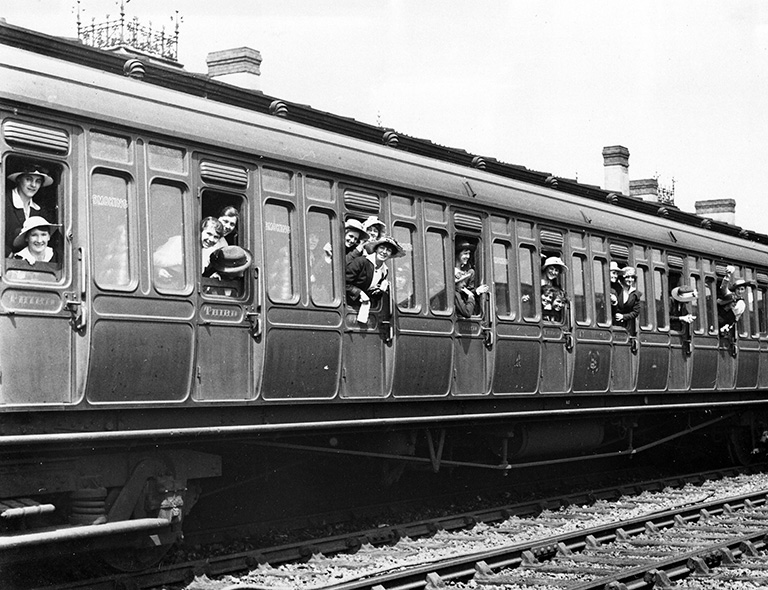
What are these records?
These are the service records of more than 7,000 women who joined the Women’s Army Auxiliary Corps (WAAC) between 1917 and 1920. These records are held in series WO 398.
The WAAC became the QMAAC in April 1918 and was disbanded in September 1921. When the Royal Air Force (RAF) was created in 1918 a number of WAAC volunteers entered the Women’s Royal Air Force (WRAF).
How do I search the records?
You can search and download the records in Discovery (£) by filling in the form below.
You don’t need to complete every field to find a record.
What information do the records contain?
These records contain a variety of material on a number of different forms.
Enrolment forms include:
- name
- age
- address
- parents’ nationality
- marital status
Statements of service include:
- rank – known as grade
- location
- promotions
- name and address of next-of-kin
Other documents in a woman’s file could include:
- identification certificates
- references from employers
- application forms
- casualty forms
- clothing history sheets (with details about the uniform issued to each woman)
What do the records look like?
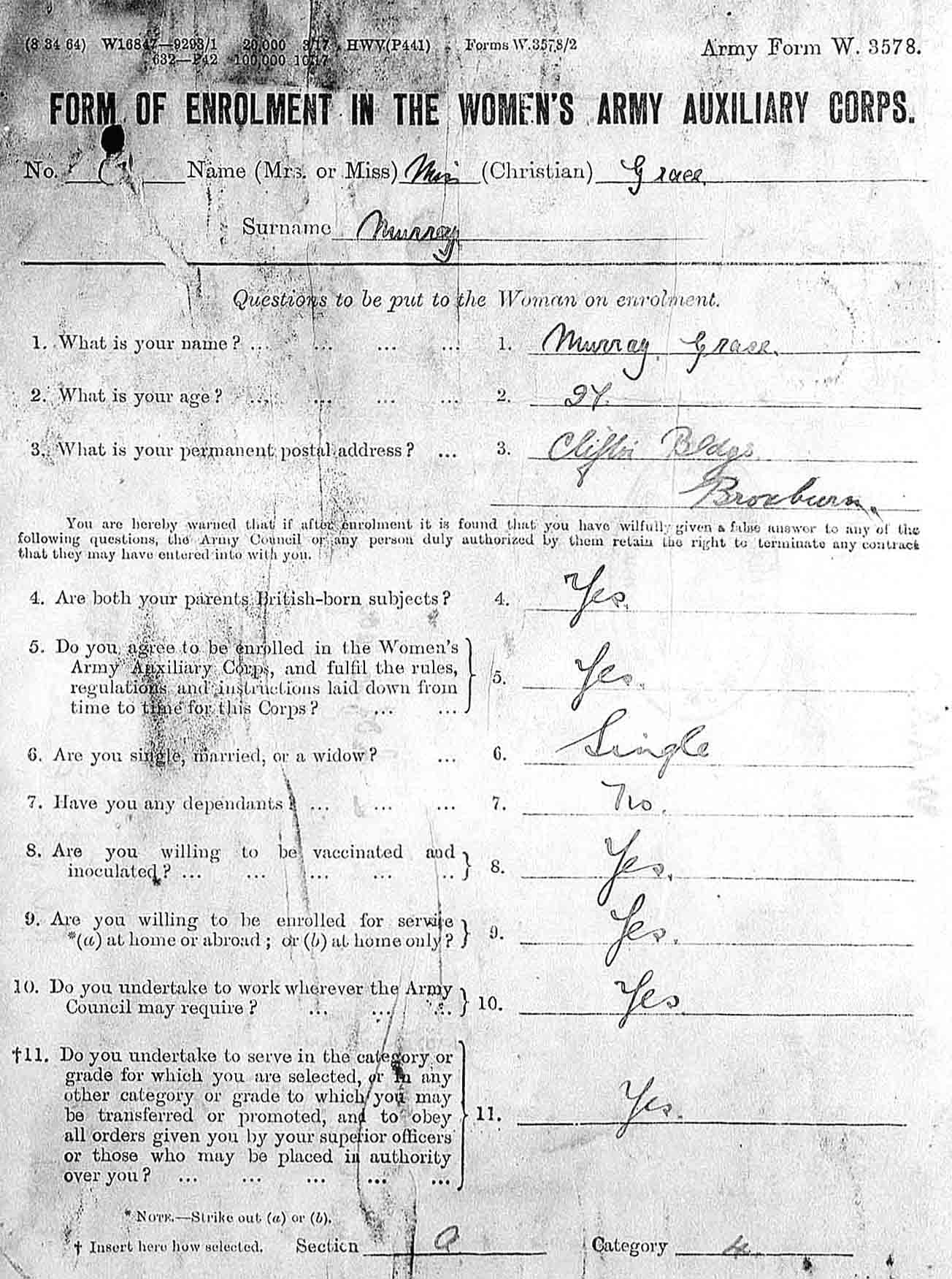
Enrolment form from WO 398/163
The original records suffered substantial fire, water and mould damage and this left some text in poor contrast. The microfilms were of the highest quality obtainable and during filming, every effort was made to maximise image retention. Click on the image on the right to view a sample document.
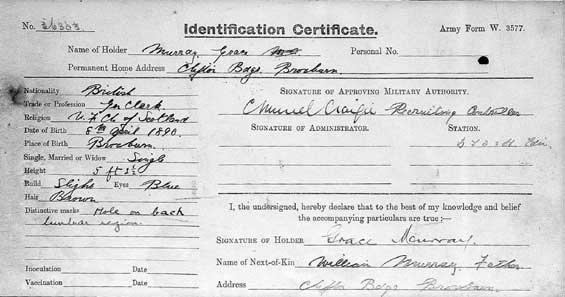
Identification certificate WO 392/163
Some of the records are on pre-printed forms, for example the application and enrolment forms or the certificate of identity, but you might also find handwritten letters such as pay enquiries. Click on the image on the right to view a sample document.
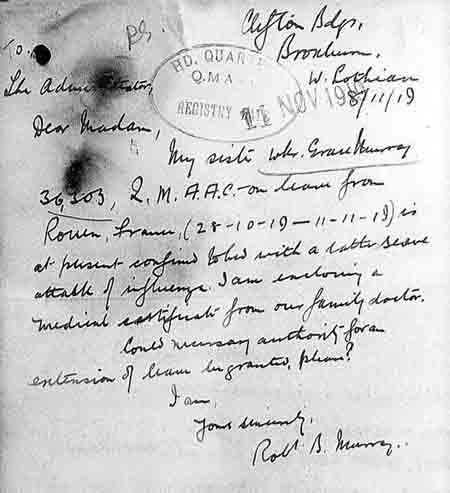
Correspondence from WO 398/16
Applicants had to appear before a selection board and they needed to provide two references. They would also have to pass a medical examination before they could be accepted. Click on the image on the right to view a sample document.
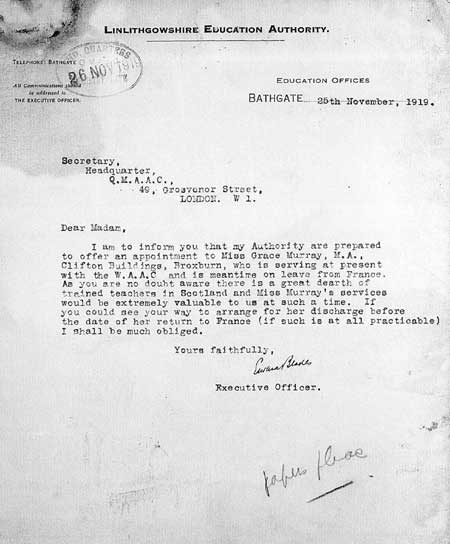
Correspondence WO 398/163
These are taken from the file of Grace Murray, a teacher who applied for a post in the WAAC. Although she served in France, she had a severe attack of influenza and had to return to Scotland. Click on the image on the right to view a sample document.
Why can’t I find what I’m looking for?
Many records suffered severe damage as a result of a German air raid in September 1940. About 57,000 women served in the WAAC, but only 7,000 records survive. Therefore it is possible that the records you are searching for do not exist.
The National Archives does not hold wills or administrations proved in England and Wales (or any other part of the UK) after 1858 but this guide provides advice on where they are held and how you can search for them.
For further information on how to find wills proved after 1858 in England and Wales, read Find a will or probate document on the GOV.UK website.
For wills proved in Scotland up to 1925 go to Scotland’s People and from 1925 onwards go to the National Records of Scotland.
For Northern Ireland wills, go to the Public Record Office of Northern Ireland (PRONI), and for the Republic of Ireland go to the National Archives of Ireland.
What do I need to know before I start?
The Principal Probate Registry was established on 12 January 1858 and keeps a copy of every will proved in England or Wales after 1858, as well as copies of letters of administration.
An application for administration could be made when a person died without leaving a will.
Online records
Index to wills and administrations (1996 to present)
Search by surname the Probate service’s index to wills and administrations (£). This covers England and Wales only.
Index to wills and administrations (1858–1995)
Search by surname the Probate service’s index to wills and administrations. This covers England and Wales only. It also includes links to relevant pages of the National Probate Calendar.
Index to soldiers’ wills (1850–1986)
Search for the will of a soldier (£) who died while serving in the British armed forces between 1850 and 1986.
National Probate Calendar (1858–1966)
The National Probate Calendar for 1858 to 1966 is available on Ancestry.co.uk (£).
As well as the full name, address and occupation of the deceased, the National Probate Calendar may also contain:
- full names of executors, administrators and relationships to the deceased
- the date and place of the death
- the date and place of the probate or administration grant
- value of the estate
Records available only at The National Archives in Kew
Selected disputed wills (1858–1960)
You can search our catalogue by name in J 90 and J 121 for 7% sample of papers relating to cases of disputed probate (1858–1960).
These are listed by the full name of the testator whose will was being disputed, and the name of the suit (for example, Testator: Finlay, Anne Case: Raynor v Bevan).
Records in other archives and organisations
The National Probate Calendar (from 1858)
Partial indexes are available to consult at:
Other resources
Books
Visit The National Archives’ bookshop for a range of publications about wills and death records. Alternatively, look in The National Archives’ library catalogue to see what is available to consult at Kew.
Karen Grannum and Nigel Taylor, ‘Wills and probate records: A guide for family historians’, 2nd edition (The National Archives, 2009)
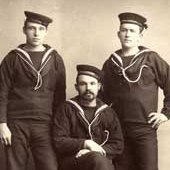
What are these records?
Available here are over 700,000 Royal Navy service records for ratings who entered the service between 1853 and 1928. Some of the records cover periods of service up to at least 1950.
The original records are in four series at The National Archives:
Please note, a rating must have enlisted before 1929 in order to have a record within these series.
How do I search the records?
You can search and download the records in Discovery (£) by filling in the form below. You may find more than one record for an individual is their service spans a number of the series above.
You don’t need to complete every field to find a record.
Bear in mind:
- the date of birth was not always recorded, so try leaving this out if you don’t get any results
- a small number of records are not searchable by name. For more information see ‘Why can’t I find what I’m looking for?’ below
- some official service numbers contain letters and numbers – when searching it is easier to enter the number only
Where there is no date of the birth in the original document, the record description will give the date range for this collection.
You may find more than one search result for an individual. Depending on how long they served, you many find records in the following combinations of series:
- ADM 139 and ADM 188
- ADM 188 and ADM 363
- ADM 362 and ADM 363
Some may have two records of service within series ADM 188. If there are two records within ADM 188 we have linked these together, so both are attached to the same download.
In ADM 188 records you can find the continuous service (CS) number in the ‘date and period of CS engagement’ box, usually in the top left hand corner. This indicates they will also have a record in ADM 139.
What information do the records contain?
The information in these records can include:
- year of birth (you might also find the day and month)
- town and country of birth
- names of ships served on, with dates of joining and discharge from each ship
- period of time actually served
- any engagements not completed and the reason for this
- service numbers – known as continuous service (CS) numbers up to 1872, and official numbers (ON) from 1873 onwards
From 1892 you can find greater detail in the records, including:
- occupation
- good conduct badges issued (if any)
- notes made about character and ability
- physical appearance, such as hair and eye colour, height and tattoos
- wounds suffered (if any)
- date of death (if occurred in service)
- you may also find a cross reference to the ‘new register’. This will be to one of the Continuation books in ADM 188/83-90
The continuous service engagement books, from series ADM 139, may also reveal:
- details of any service in the merchant navy
- official numbers (which can be traced to records of service in the later registers of seamen’s services)
What else can I learn from the record?
A record may indicate that the rating was promoted to warrant officer (for example, gunner, boatswain, carpenter or artificer engineer). You can find warrant officers’ service records in ADM 196.
If an ADM 363 record shows that the rating re-entered at a date after 1928, with a new official number, then you may find their record is still held by the Ministry of Defence.
If the service numbers is prefixed with the letter ‘F’ this means the rating served in the Royal Naval Air Service (RNAS) during the First World War or with The Fleet Air Arm after 1920.
If you find a Y-prefixed official number, the rating may have volunteered for service in the Royal Navy but was allocated a Royal Naval Volunteer Reserve without necessarily being called up.
From January 1894 service numbers were assigned according to a rating’s branch of service. Consult the table below to find which sets of service numbers were assigned to the respective branches of service:
| Service numbers issued 1894-1907 | Service numbers issued 1908-1923 | Branch of service numbers assigned to |
|---|---|---|
| 178001-240500 | J 1 – J 110000 | Seamen and Communications ratings |
| 268001-273000 | M 1 – M 38000 | Engine Room Artificers |
| 276001-313000 | K 1 – K 63500 | Stokers |
| 340001-348000 | M 1 – M 38000 | Artisans and Miscellaneous |
| 350001-352000 | M 1 – M 38000 | Sick Berth Staff and Ship’s Police |
| 353001-366450 | L 1 – L 15000 | Officer’s stewards, Officer’s cooks and Boy servants |
What do the records look like?
The early two examples here are from the record of George Smith, who first served on HMS Victory.
The form in the first image shows that he volunteered on 10 June 1853 and gives his birth date as 1 December 1838, along with a description of his appearance.
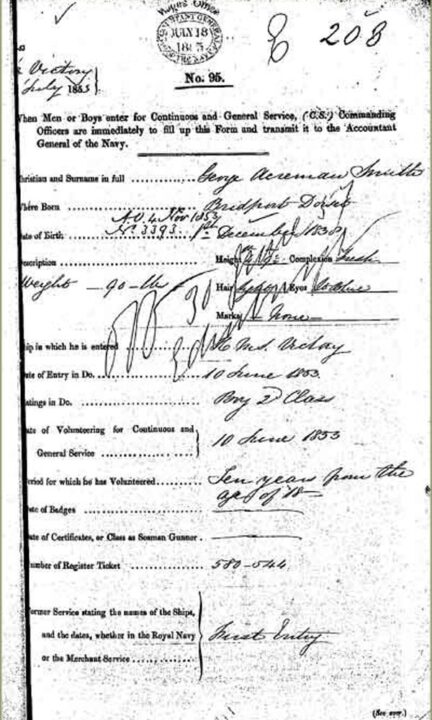
Royal Navy service record of George Smith
The second image shows the separate forms that were signed by boys, agreeing to serve ten years once they turn 18, and by men, agreeing to serve a fixed number of years.
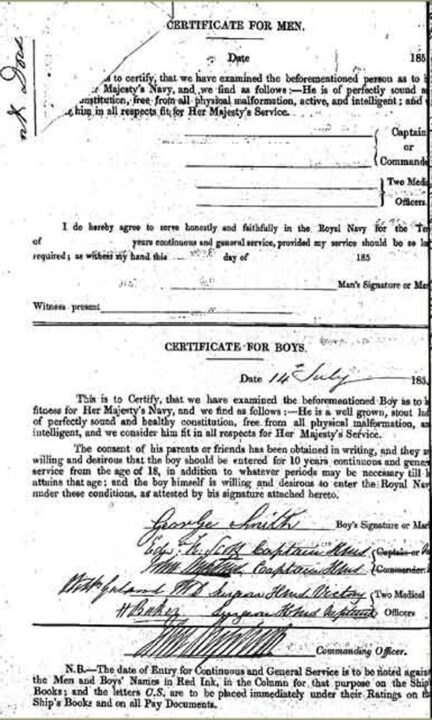
Certificate for boys
The third image is a later example. It’s a pre-printed form, with the details listed in headed columns.
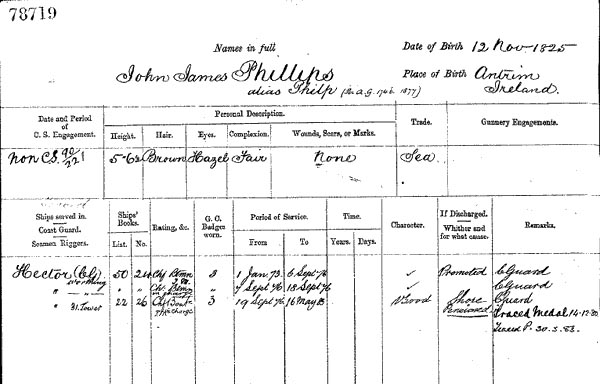
Pre-printed form
This final image is an example of the later records in ADM 363. This image shows the first page only.
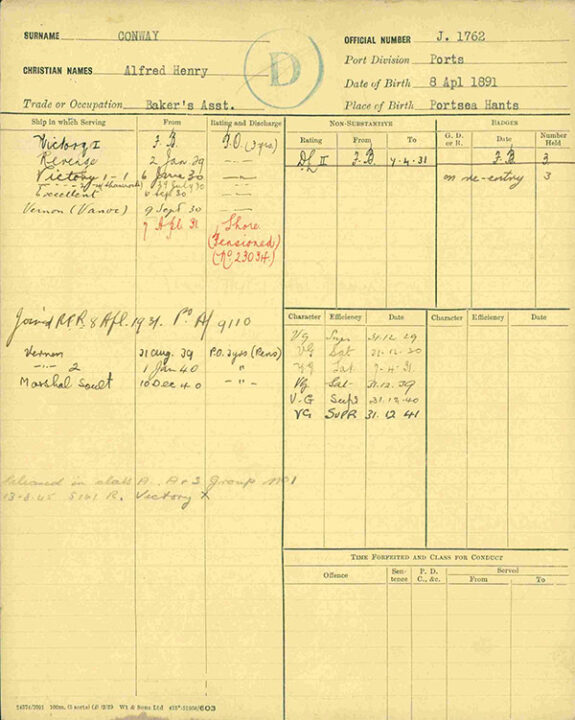
First page of a service record for Alfred Henry Conway (ADM 363/1/1)
Why can’t I find what I’m looking for?
If you are looking for records of ratings who served with armoured cars in Russia, 1915-1917; these are in ADM 116/1717. They are original documents and must be viewed at The National Archives at Kew.
The record may be amongst the ADM 188 pieces which are not searchable by name. These are the service records for ratings issued with CS numbers 1–40,000. You can find them within the following pieces:
ADM 188/1: 1–10000, including A and B suffix
ADM 188/2: 10001–20000, including A and B suffix
ADM 188/3: 20001–30000, including A and B suffix
ADM 188/4: 30001–40000, including A and B suffix
You can download these free of charge, but you will need to scroll through them to find an individual entry.
Try searching the Royal Navy First World War Lives at Sea database by name, service number and numerous other criteria. As of June 2021, the database contains 32,000 records and is continually being updated. Once completed (scheduled for November 2022), it will contain information relating to all the Royal Navy officers and ratings that served in the First World War. The database is being compiled largely from records held at The National Archives and there is no charge for access. It is a joint project between The National Archives, The National Maritime Museum and the Crew List Index Project with the help of a global team of volunteers.
If the rating joined in 1929 or after, their service record will still be with the Ministry of Defence. Visit the GOV.UK website for information about how to request a summary of a service record.
1. Why use this guide?
Port books record customs duties paid on goods imported and exported through English and Welsh ports. The books were kept by local customs officials at ports all around England and Wales between 1565 and 1799.
Use this guide to find out more about port books and how to locate books for individual ports among the collection held at The National Archives. You can use port books to find information on:
- the development of trade between the 16th and 18th centuries in England and Wales
- ships and their masters
- merchants and the goods they traded
Occasionally you can also find information on some or all passengers on a ship.
2. About port books
Although there are some 20,000 port books among our records, many did not survive and there is no guarantee you will find a port book for a particular date and port. Furthermore, most ports had stopped using port books by 1750 so their number drops off significantly after this date. For example, there are no London port books for 1697-1799. Of those that do survive, for any port, many are in a poor state of preservation.
Before 1600 many entries in port books are in Latin – by 1660 most are in English.
2.1 Who recorded entries in port books?
There were several different types of local customs officials who made entries in port books:
- the Collector or ‘Customer’ – recorded all goods exported or imported and all moneys received, for which he issued a cocket (receipt)
- the Controller – made a similar record but did not receive the payments
- the Searcher – appointed to prevent fraud, he examined the goods and created a warrant to show he had done so
- the Surveyor – appointed to check the work of the Searcher (this second check was introduced in the 17th century)
Exchequer officials checked warrants, cockets and the other records created for each entry to make sure everything checked out.
2.2 What was recorded?
Entries in port books can include:
- the name of the ship and its tonnage
- the name of the master of the ship
- whether the ship was British built (18th century books only)
- the ship’s destination or port to which it was sailing next (false information was sometimes supplied, for instance if a merchant was infringing the rights of a monopoly trading company)
- the ship’s port of registry and its port of departure
- the names of the merchants (sometimes giving the merchant’s mark) and whether they were aliens (aliens paid 25% higher duty)
- date on which duty was paid (not the date of arrival or unloading)
- a description of the goods
- the amount of duties paid (based on the official valuation as laid down in the Book of Rates)
There are distinctions, however, between entries for overseas trade and entries for coastal (domestic) trade.
For overseas trade, they record:
- imports and exports
- the issue of cockets (receipts) for payment of duty
For coastal trade, they record (at the port of unloading)
- exports only
- the issue of the certificate declaring that the cargo was not subject to duty, as it was not overseas trade
2.3 What do port books tell us about trade?
Smuggling, evasion and fraud mean that port books do not provide a full picture of trading activity. However, they are still a vital source of evidence for studies of the development of trade, especially in the 16th and 17th centuries. They are particularly valuable for those periods when the customs were farmed out (1572-1588 and 1585-1590 for certain ports and generally after 1605).
When customs were farmed out, general accounts of the farm syndicates appear in the ‘declared accounts’ in E 351 and AO 1, but be aware that the summary totals for each port were not recorded on the ‘enrolled accounts’ in E 356.
3. How to search for individual port books
Port books at The National Archives are held among the records of the Exchequer, in record series E 190. You can search for individual books, each of which has a unique document reference, in our catalogue. You will need the document reference to see the record itself. The records are not available to view online so to see them you will have to either visit us in Kew or, if you can locate document references, order copies.
Begin by going to the E 190 catalogue description from where you can search the series using dates and keywords. Use the following types of keywords:
- name of port
- creator of the book (controller, collector or searcher)
- type of trade (overseas or coastal, import or export)
Ports were grouped together under ‘head ports’. Examples of head ports include Chester, Newcastle and Southampton and groups of so-called ‘lesser ports’, also referred to as ‘lesser harbours’, ‘creeks’ or ‘havens’, are found within the port books for these head ports. Among the ports grouped under Chester, for example, are Liverpool, Carnarvon, Conway and several others. There is an ‘Index of creeks and lesser harbours’ in the printed version of the E 190 catalogue listings (pages 564-566 of E 190 Vol 1), held in the Map and Large Document Room at The National Archives in Kew. However, the online catalogue listings should include the names of lesser ports as well as the head ports.
Some port books are held in local archives. Search for “port books” in our catalogue (which includes listings for other archives around the country), filtering search results to ‘Other archives’ or find contact details for archives elsewhere using our Find an archive tool.
A number of port books have been transcribed and published. It may prove much easier to seek out published port books before searching for the original records at The National Archives in Kew or elsewhere. E L C Mullins’ Texts and calendars, ‘Royal Historical Society’ (1983), held in the Map and Large Document Room at The National Archives in Kew, contains some listings for published or printed port books. Alternatively, local history societies may be a good place to enquire (you can find a directory of local history societies on the British Association for Local History website).
4. Understanding and interpreting entries in the books
Information in the port books can be difficult to read and interpret. Before 1600 many entries in port books are in Latin though by 1660 most are in English.
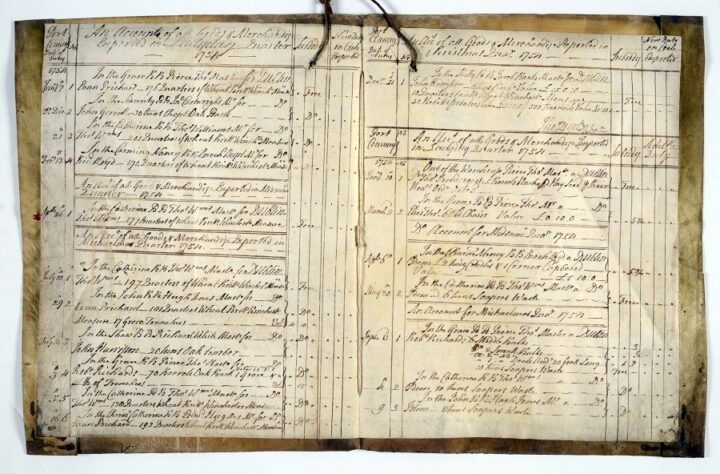
A page from a searcher’s port book for Conway, whose head port was Chester, from 1754 (document reference E 190/1427/1).
4.1 Tips and pitfalls
When examining port books it is worth bearing the following in mind:
- there might be more than one ship with the same name so even if other details from the port books match up, you can’t be sure it is the same ship
- the names of foreign masters or merchants, given verbally, might be written down wrongly or anglicised
- merchants and masters are sometimes described as native (‘indigenus’, often abbreviated to ‘Ind’) or alien (‘alienigena’ often abbreviated to ‘Al’)
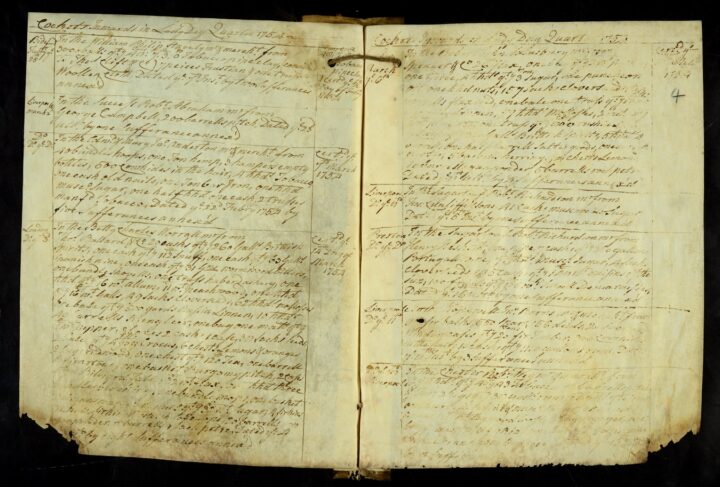
A page of from a controller’s port book for Chester from 1754 (document reference E 190/1427/7).
4.2 Useful published sources for interpreting port books
The following books, all available from The National Archives library, may help you to identify unfamiliar descriptions of goods and quantities occurring in the port books:
- R E Zupko, A Dictionary of English Weights and Measures (1968)
- S W Beck, The Draper’s Dictionary: A Manual of Textile Fabrics, Their History and Applications (1886)
- N S Gras, The Early English Customs System (1918) which includes the 1507 Book of Rates, listing commodities and duties payable
- A Millard, Analyses of Port Books Recording Merchandises Imported in the Port of London by English and Alien and Denizen Merchants for Certain Years Between 1588 and 1640
(1960) - T S Willan (ed), A Tudor Book of Rates (1962)
- H Crouch, A Complete View of the British Customs (1755) which lists rates of duty from 1660 onwards
5. Passengers in port books
Names of passengers do not normally appear in port books but there are some exceptions to this:
- Before 1678 some passenger names are in the ‘Licences to pass beyond the seas’ which you can browse in E 157.
- If people had to pay duty on goods they were shipping, their names are sometimes in the port books. This applied to emigrants such as those travelling to America – you can find names in Peter Coldham’s Complete book of emigrants series.
- Traders are sometimes listed in port books. For instance a Weymouth port book (E 190/875/8) names 26 ‘planters’, sailing to New England in 1633, with a note that they had been allowed to export ‘diverse sorts of household stuff, apparell & other provisions’ to the value of £960 6s 8d, free of duty.
There is an index of Ships, Merchants and Passengers to the American Colonies, 1618-1668 which includes names taken from port books (mainly those of London and Bristol).
6. Related records
To study customs records from before and after the time span of the port books (1565-1799) you will need to consult records from other departments and series. Port books effectively became redundant after 1750, by which time most ports had ceased sending them in.
6.1 Particulars of customs accounts, c1272-c1830
Particulars of customs accounts in E 122 contain details of duties paid at particular ports and subsidiary accounting documents (including cockets).
Search E 122 using the name of the port. Records include names of customs officials, merchants and details of goods. They are dated by regnal year.
6.2 Registers of imports and exports from 1696
The Board of Customs introduced registers of imports and exports in 1696. These registers are in CUST 2-17 and CUST 22-37 but can only be searched in our online catalogue by year.
6.3 Mainland English, Scottish and Irish outport records, 1660-1988
These records make up a division within the CUST department and consist of 46 series of records of the daily work and business conducted at each port, but not duties paid on goods (each series covers between one and five ports). The records are mostly correspondence and letter books. Outports were any ports, other than the Port of London, where goods from foreign ships were traded and where the duties paid on the goods were received by a collector to be remitted to the Receiver General’s Office in London.
They are more fully described in Carson’s ‘Customs records as a source for historical research’ (see further reading below).
7. Further reading
Some of the publications below may be available to buy from The National Archives’ bookshop. Alternatively, search The National Archives’ library catalogue to see what is available to consult at Kew.
Books
- T S Willan, The English coasting trade 1600-1750 (Manchester 1938)
- N J Williams, The maritime trade of the East Anglian ports 1550-1590 (Oxford, 1988)
- R W K Hinton, The port books of Boston 1601-1640, Lincoln Record Society, vol L (1956), useful for understanding how the port books were compiled
Leaflet
- D M Woodward, ‘Port books’, Short guides to records No 22 (Historical Association, reprinted 1994)
Journals
- E Carson, ‘Customs records as a source for historical research’, Archives, vol XIII (1977-1978)
- R C Jarvis, ‘Sources for the history of ports’, Journal of transport history, vol III (1957-1958)
- R C Jarvis, ‘The archival history of the customs records’, Journal of the Society of Archivists, vol I (1955-1959)
- N J Williams, ‘The London port books’ in Transactions of the London & Middlesex Archaeological Society, vol XVIII (1956)
These are the service records of over 5,000 women who served in the Women’s Royal Naval Service (WRNS) between 1917 and 1919. The original records are grouped in series ADM 318 for officers and ADM 336 for ratings or other ranks.
The WRNS was formed to carry out shore-based duties and allow sailors to go to sea. Recruitment posters encouraged women to ‘Free a man for sea service’. The Admiralty aimed to recruit 3,000 women but eventually over 5,000 women joined. Katharine Furse, formerly Commandant of the British Red Cross Voluntary Aid Detachments, was appointed Director in November 1917.
How do I search the records?
You can search and download the records in Discovery (£) by filling in the form below.
You don’t need to complete every field to find a record.
What information do the records contain?
Ratings’ service records
Each rating’s record consists of a form listing details such as:
- full name
- date of enrolment
- age at enrolment
- character
- ‘mobile’ (willing to work away from their home area) or ‘immobile’
- period of service
- where she served
- name and address of next-of-kin
- whether discharged from service
Immobile ratings are found most often in London or at naval bases such as Portsmouth.
Officers’ service records
The officers’ files hold official forms, dossiers and letters concerning appointments and promotions.
In some cases a file might also include an identification certificate giving details about:
- date and place of birth
- marital status
- trade or profession
- religion
- physical description
- name of next-of-kin
What do the records look like?
Example of a rating’s service record
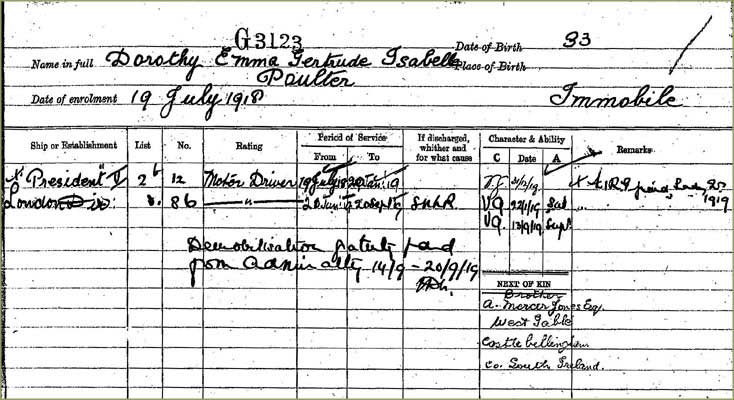
The service record of Dorothy Poulter shows that she enrolled as a motor driver on 18 July 1918. View an extract below.
Her character and ability were assessed as ‘V.G.’ (or very good).
The record also shows that she was paid a demobilisation gratuity in September 1919. The abbreviation ‘SNLR’ appears in the ‘discharge’ column. This abbreviation occurs frequently in these records and it means ‘services no longer required’.
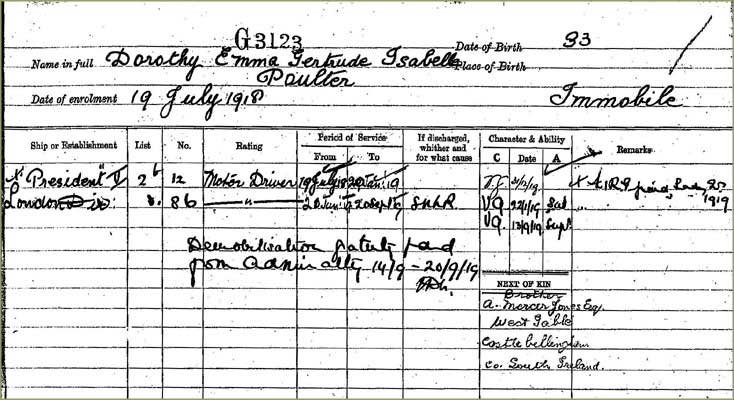
Service record of Dorothy Poulter ADM 336/26
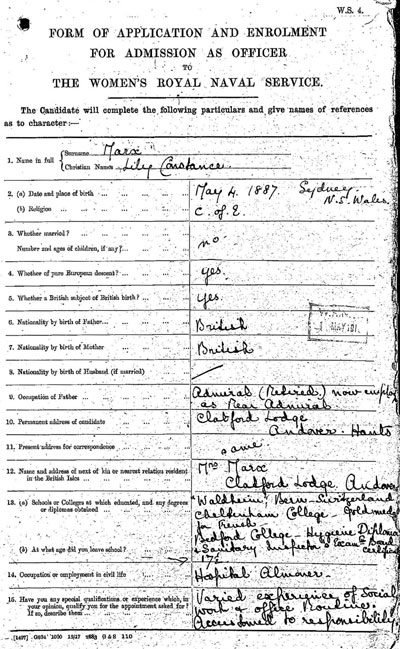
Service record of Lily Marx ADM 318/189
Examples of an officer’s service record
Click on the thumbnail, right, to view extracts taken from the service record of Lily Marx.
The first image, her application form, shows that she was born in Australia, was of British nationality and had been educated in Switzerland. She had also attended Cheltenham College and Bedford College.
The second image is from a 1919 report which reviews her performance. In this report, the divisional director considered her to be ‘an extremely good officer all round’ and deemed her suitable for promotion.
Why can’t I find what I’m looking for?
Officers who resigned in 1918 for personal reasons are not included in these records. Look at the series ADM 321 instead, which contains two registers of appointments, promotions and resignations of WRNS officers from 1917 to 1919.

What are these records?
These records, in series ADM 340, consist of over 5,000 officers’ service records for men and women serving in the Royal Navy, Royal Naval Reserve, Royal Naval Volunteer Reserve and Women’s Royal Naval Service.
Some contain information dating back as far as c.1880 (and possibly earlier still in a few cases), while others detail service through both World Wars and into the 1950s.
At present only the cards are available to download (pieces 1-150).
How do I search the records?
You can search and download the records in Discovery (£) by filling in the form below.
You don’t need to complete every field to find a record.
What information do the records contain?
The information in these records can include:
- name
- date of birth
- place of birth
- rank
- date of seniority and promotions attained
- training undertaken
- names of ships served on, with dates of joining and discharge from each ship
- period of time served
- home address
In some instances an officer may have more than one card.
What do the records look like?
Cards
The image you receive will contain both the front and reverse of the card.
The top of the card contains an officer’s name, date of birth, place of birth, previous service, rank and date of seniority. The lower section of the card records any obligatory training undertaken and a list of ships the officer served on.
The reverse of the card contains a list of ships served on, retainer pay and any voluntary training undertaken.
To get an idea of what the cards look like, see the record of William Holmes Hossack (PDF, 0.59MB).
Why can’t I find what I’m looking for?
If you cannot find a record for an officer it may be because:
- the officer died before records were systematically kept
- the officer’s record you are searching for is held in files that have not yet been digitised
- you should be searching for a rating, rather than an officer
Try searching the Royal Navy First World War Lives at Sea database by name, service number and numerous other criteria. As of June 2021, the database contains 32,000 records and is continually being updated. Once completed (scheduled for November 2022), it will contain information relating to all the Royal Navy officers and ratings that served in the First World War. The database is being compiled largely from records held at The National Archives and there is no charge for access. It is a joint project between The National Archives, The National Maritime Museum and the Crew List Index Project with the help of a global team of volunteers.
You can also try the following record series as alternative sources of information:
- Royal Navy ratings’ service records in series ADM 139 and ADM 188
- Royal Navy officers’ service records in series ADM 196
- Royal Naval Reserve officer service records in series ADM 240
You can also consult The Navy Lists, which are available to view at The National Archives. The Navy List gives name, rank, date of commission and seniority. It should also indicate names of ships served on.
1. Why use this guide?
Use this guide for advice on how to find records at The National Archives, and to a lesser extent in other archives, of Royal Navy shipwrecks. The records covered include those that document the complete loss of ships through sinking as well as those lost to damage, whether as part of a military conflict, a result of natural disaster or any other accident. Some of the records will allow you simply to establish that a ship sunk or was wrecked, others can provide more detail, such as the circumstances of the disaster or incident and the number on board who died, if any.
You can also consult our guide to births, marriages and deaths at sea.
2. How to conduct a search at The National Archives
A search in The National Archives’ records will almost certainly require a visit to our reading rooms in Kew where you can consult library books and original documents. Most of the records we hold for lost ships are not available to download or view online but you can, however, make a start online by searching our catalogue (see Step 2, below).
We recommend you follow these steps, in the order shown, when searching for records of the loss or damage to a specific ship:
Step 1: Consult the Royal Navy Lost List and/or lists in published books
The Royal Navy Loss List is a searchable database on the Maritime Archaeology Sea Trust website. It covers all vessels recorded as sunk or destroyed in service from 1512-2004 but does not include vessels captured by the enemy or that suffered loss of life but which did not sink. The purpose of the list was to record losses which are likely to have resulted in material remains on the sea floor.
There are a number of alternative lists in printed publications, many available at The National Archives library, and they are likely to be the easiest way of establishing the date and circumstances of the loss, if they are known, and will equip you with vital facts in your search for primary sources – or may remove the need to consult original documents altogether.
The following books are available at our library in Kew, as are those listed for the First and Second World Wars in the subsequent sections of this guide. They are the best place to start on a visit to our reading rooms.
- Larn, R and Larn, B, Shipwreck Index of the British Isles (Lloyd’s Register of Shipping, 1995-2002). These six volumes are the most comprehensive listing of wrecks in UK coastal areas up to the end of the 20th century. Organised by county and date, with a ship name index, among the details provided with each listing are the name of the captain, the number of crew on board and lost, if any, and the origin and intended destination of the voyage.
- Gosset, W P, The Lost Ships of the Royal Navy, 1793-1900 (Mansell Publishing, 1986). Contains a ship name index and a geographical index listing ships lost by region.
- Hepper, D J, British Warship Losses in the Age of Sail, 1650-1859 (Jean Boudriot Publications, 1994). Chronological list with details of the circumstances of the loss.
- Hocking, C, Dictionary of Disasters at Sea during the Age of Steam, 1824-1962 (Lloyd’s Register of Shipping, 1969). Two volumes listing ships in alphabetical order with a short description of the disaster and the date, among other details. Includes Royal Navy and merchant ships.
- Hooke, N, Modern Shipping Disasters, 1963-1987 (Lloyds of London Press, 1989). A sequel to Hocking’s Dictionary of Disasters at Sea, presented in the same format.
- Marx, R, Shipwrecks of the Western Hemisphere, 1492-1825, (David Mckay Co, 1975). Covering shipwrecks in the Caribbean and all over the Americas, several thousand losses are listed in date order and briefly described. The book covers ships of all types and includes a ship name index.
- Grocott, T, Shipwrecks of the Revolutionary and Napoleonic Eras (Caxton, 2002). Contemporary newspaper accounts of both merchant and military ships wrecked. Organised by date but with a ship name index.
Step 2: Search the catalogue with ship’s name and one other search term
Though the records of ships losses are not always identified by the ships’ names in our online catalogue, it is worth trying to locate those that are at an early stage of your search.
Search our catalogue using the name of the ship (omitting HMS as it is not always used in catalogue descriptions) plus one of the following words:
- sunk
- sinking
- loss
- wreck/wrecked
- torpedo/torpedoing/torpedoed
- damage
- attack
To target the records of the Admiralty, the body that administered the Royal Navy, use the advanced search of our catalogue and use the references fields to restrict your search to reference ADM.
Step 3: Consult the ship’s log, if it survives
We hold large numbers of Royal Navy ships’ logs from the 1660s onwards, though not all survive. The log book may give the position of the sinking, though the ship may have been wrecked because its officers did not know where they were. However, logbooks were often lost with the ship and in these instances you should turn to the logs of any other ships which sailed in company with the lost ship.
To search for logs, which are arranged alphabetically by ships’ names, click on the following series links and search by ship’s name or, for Masters’ logs, by the name of the officer who wrote the log:
- Captains’ logs, 1669-1853, in ADM 51
- Masters’ logs, 1672-1840, in ADM 52
- Log books maintained by the Officer of the Watch, 1799-2007, in ADM 53
- Supplementary ships’ logs, 1808-1871, in ADM 54
Step 4: Search for a courts martial record, if there was an inquiry
The loss of Royal Navy ships usually resulted in an inquiry, with the captain or surviving officers sometimes court martialled, though this was far less likely if the ship was lost to enemy action or if none of the officers survived.
These records can be the most detailed narratives of a loss available, although, as the court’s purpose was to establish the circumstances of the loss and to apportion any blame, it did not necessarily take an interest in the exact position of the wreck.
Click on the following series links to search each series by year and by words such as ‘loss’, ‘sinking’ or ‘grounding’ plus the name of a ship for:
- 1892-1951 in ADM 178
- 1890-1965 in ADM 156
- 1660-1976 in ADM 1 (most are indexed in The Lost Ships of the Royal Navy, 1793-1900) – to search in this series you will need to include ‘courts martial’ as one of your search terms
Step 5: Search through Admiralty and Navy Board correspondence and case files
There are many records which were not created specifically to record losses but which do, nonetheless, either formally record losses or contain incidental references to them. Using these records for details of a wreck is bound to be quite time consuming and should be considered a last resort if you have followed the steps above and still need information. The principal records to search through are:
- Reports from flag officers and captains on the loss of ships under their command from about 1698 onward in ADM 1. See our guidance on How to use ADM 12 to locate items in ADM 1.
- Case files created by the Admiralty Record Office, 1852-1965, in ADM 116.
- Letters sent to the Navy Board, or by that board to the Admiralty in ADM 106, which occasionally deal with wrecks, particularly those which occurred in the vicinity of dockyard ports or where salvage was attempted. We also hold digests, summarising contents of each letter or paper, for 1822 to 1832 in ADM 106/2153 to 2177.
- The Admiralty Digest in ADM 12, which provides a name and subject index from 1793 onward. See our guidance on How to use ADM 12 to get the most from this series and the various series that it indexes.
3. Additional records and publications of First World War losses
You can find records of First World War losses by following the steps in section 2 but in this section we present publications and records focussed specifically on the war.
Books
The following publication is available at our library in Kew and is the best place to start when conducting a search at The National Archives:
- HMSO, British Vessels Lost at Sea 1914-1918 and 1939-1945 (Patrick Stephens, 1988)
Lists
A card index of ships lost between 1914 and 1919 in ADM 242/6.
Narrative accounts
Search with a ship’s name and the word ‘loss’, ‘torpedoing’ ‘sinking’ (or any of the other keywords suggested at Step 2 in section 2 of this guide) to search the records used to compile the Official History of the First World War held in ADM 137. The series includes hundreds of reports on the losses of individual ships, found between ADM 137/3089 and ADM 137/3832.
4. Additional records and publications of Second World War losses
You can find records of Second World War losses by following the steps in section 2 but in this section we present publications and records focussed specifically on the war.
Books
The following books are available at our library in Kew and are the best place to start when conducting a search at The National Archives:
- HMSO, British Vessels Lost at Sea 1914-1918 and 1939-1945 (Patrick Stephens, 1988)
- Brown, D, Warship Losses of World War Two (Arms & Armour Press, 1990)
- Lenton, H T & Colledge, J J, Warships of World War Two (Ian Allan Publishing, 1973)
- Morgan, D & Taylor, B, U-Boat Attack Logs: A Complete Record of the Warship Sinkings From Original Sources 1939-1945 (Seaforth Publishing, 2012)
- Rohwer, J, Axis Submarine Successes 1939-1945 (Patrick Stephens Ltd, 1993)
Lists
Search the lists of Royal Navy ships lost in the war held in ADM 213/578.
Narrative accounts
The records used to compile the Official History of the Second World War are held in ADM 199 and include reports of ships lost during the war. Search the series with a ship’s name and the terms ‘loss’, ‘ships lost’, ‘torpedoing’ ‘sinking’ or any of the other keywords suggested at Step 2 in section 2 of this guide.
5. Beyond The National Archives: where else to look for information and records
Newspaper reports
The most comprehensive source for archived newspapers is the British Newspaper Archive. Local libraries may provide access to online versions of national newspapers, including The Times Archive, also available online in our reading rooms.
As well as the British Newspaper Archive, the British Library holds the largest readily accessible collection of printed Admiralty charts in its Map Library. Sea charts may be useful in establishing the location of a wreck, but usually not in identifying it. See our guide to sea charts for more information.
UK Parliamentary Papers
The Admiralty Register of Wrecks is found in Proquest UK Parliamentary Papers. This is a subscription website you can access on The National Archives’ computers by visiting us at Kew. You may also be able to access it via a large reference library such as a university library.
UK Hydrographic Office
A comprehensive database of wrecks containing over 60,000 records, of which approximately 20,000 are for named vessels, is maintained by the UK Hydrographic Office. Though focussed mainly on UK territorial waters the database includes information on a small number of wrecks in other areas. The same office holds an extensive collection of British Admiralty Charts and other hydrographic charts.
6. Further reading
Huntress, K, Checklist of Narratives of Shipwrecks & Disasters at Sea to 1860 (Iowa State University Press, 1979) – a guide to contemporary accounts of losses
Pickford, N, The Atlas of Shipwreck & Treasure (London, Dorling Kindersley, 1994)
Rohwer, J, Allied Submarine Attacks of World War Two: European Theatre of Operations 1939-45 (Greenhill, 1997)