1. Why use this guide?
The National Archives holds the records of the United Kingdom’s central government departments, including those responsible for labour and employment matters. The records cover a wide range of topics including labour disputes, regulations, health and safety, training and trade unions. This guide provides advice on where and how you might find related records beyond The National Archives.
Though we have not published a guide covering The National Archives labour and employment records, we do provide guidance on the records of specific industries, such as mining and the railways.
2. How to search for records
The majority of historical business and trade records in the UK are held by local county record offices. Use our Find an archive tool to find contact details of archives/repositories across the UK.
Alternatively, search Discovery our catalogue to find records from The National Archives and over 2,500 archives across the UK. Your search results will display details from a range of archives and you can then refine your results. Where the keywords you searched for appear in the description of a record, the search results are displayed under the ‘Records’ tab. Use the ‘held by’ filter to distinguish between records held at The National Archives and those found at other archives.
Where the keywords you searched for appear in the name of the institution or person that originally created the record (often not the same as the institution or person that currently holds the record), the search results are displayed under the ‘Record creators’ tab.
For further tips on searching see our catalogue help pages.
3. New accessions: records recently collected by other archives
Many archives regularly take in new records to add to their collections – this process is known as accessioning. Every year, The National Archives collects information about new accessions from 250 archives across Britain and Ireland. This is known as the annual Accessions to Repositories survey.
This information is added to Discovery, our catalogue. It is also edited and used to produce a number of thematic digests, including one relating to labour history. The digests are made available online and distributed for publication in a number of learned journals and newsletters. Further information about accessions is available on our website.
4. Major collections
The following list includes some of the repositories and institutions that hold important archival collections relating to the history of the labour movement.
4.1 General repositories
Parliamentary Archives
Holds records of both Houses of Parliament.
National Library of Scotland, Manuscripts Division
Has extensive collections of records of Scottish trades unions.
4.2 Specialist repositories
Bishopsgate Institute
Holds papers of George Howell and Charles Bradlaugh, together with extensive printed materials relating to the history of labour and political radicalism in the 19th century.
London School of Economics Library, Archives Division
Has collections relating particularly to Fabian and Labour Party thinkers, including Hugh Dalton, George Lansbury, RH Tawney, Graham Wallas and Sidney and Beatrice Webb.
National Co-operative Archive
The central record repository in the UK for records of the Co-operative movement, the archive also holds papers of prominent individuals such as Robert Owen, GJ Holyoake and Edward Greening, and extensive printed collections.
Hull History Centre (Hull University Archives)
The labour archive includes papers of prominent left-wing individuals and several national organisations: the Co-operative Women’s Guild and International Women’s Co-operative Guild, the National Council for Civil Liberties, the Socialist Medical Association and the Union of Democratic Control.
Labour History Archive and Study Centre
One of the most important record repositories in the UK for the study of labour history, the centre holds the archives of the Labour Party and the Communist Party, and personal papers of nationally important figures in the labour movement. There are also materials relating to Chartism and the Labour and Socialist International.
Trades Union Congress Library Collections
One of the major research libraries in Britain for the study of all aspects of trades unions and collective bargaining. The collections are largely printed, but the archival holdings include personal papers of several prominent trades unionists, records of a number of individual unions, the Workers Educational Union, and the London Trades Council.
Swansea University Archives
Holds the South Wales Coalfield Collection (SWCC) which was established in 1969 as an attempt to preserve the documentary records of the mining community of South Wales. The majority of records relate to the South Wales Miners’ Federation, later the NUM (South Wales Area) and its individual lodges. The archive also contains records from miners’ institutes, co-operative societies and individuals connected with the mining community. There are also some colliery records and documents relating to political parties.
Warwick University: Modern Records Centre
Holds records of the Trades Union Congress, numerous national trade union collections and papers of leading trade unionists. Also has collections relating to the Communist Party and Marxist left. See its published guides (1977, 1981, 1986, 1992) and the Summary Guide on its website.
Working Class Movement Library
Holds records particularly of trades unions and shop stewards in the North West of England and in the engineering industry; also extensive printed collections.
5. Useful resources
In many cases the records of trades unions branches and organisations connected with the labour movement are held at the appropriate local record office; contact details can be found via the Find an archive tool.
For advice about oral history and information about existing oral history resources, you should first approach the Curator of Oral History at the British Library Sound Archive, 96 Euston Road, London NW1 2DB
Archives Hub
The Archives Hub provides descriptions of collections held at archives in UK universities and colleges. At present the descriptions are primarily of the broad themes and subject matters of the collections, although where possible they are linked to more detailed descriptions of the records that make up each collection.
Archives in London and the M25 area (AIM25) – AIM25 provides online descriptions of collections held at the archives of over fifty higher education institutions and other academic and cultural organizations within the greater London area.
South Wales Coalfield Collection – The South Wales Coalfield Collection (SWCC) gives an insight into the experience of the South Wales Valleys during a period of industrial turmoil both from an institutional and personal perspective. It contains records of trade unions (notably the South Wales Miners’ Federation, later the National Union of Mineworkers (South Wales Area) and the Iron and Steel Trades Confederation, South Wales Division), miners’ institutes, co-operative societies, and individuals connected with the mining community.
Scottish Archive Network (SCAN) – The Scottish Archive Network allows online searching of over 20,000 collections in 52 Scottish repositories.
6. Further reading
J Bellamy and J Saville (eds), Dictionary of Labour Biography, 9 vols (Macmillan, 1972-1993)
C Cook (ed), Sources in British Political History 1900-1951, 6 vols (Macmillan, 1975-1985)
C Cook (ed), The Longman guide to Sources in Contemporary British History, 2 vols (Longman, 1994)
JFC Harrison and D Thompson, Bibliography of the Chartist Movement, 1837-1976 (Harvester Press, 1978)
C Hazlehurst, S Whitehead and C Woodland, Guide to the Papers of British Cabinet Ministers 1900-1964 (Cambridge University Press, 1996)
Labour History Review (formerly the Bulletin of the Society for the Study of Labour History)
Since 1974 the second issue each year has included a list of archives deposited in record offices and libraries during the previous year. (Since 1991, this list has been provided by the HMC, and since 1994 it has been made available on our website.) The Review also publishes an annual bibliography and list of theses and occasionally more specialised surveys.
I MacDougall, Catalogue of Some Labour Records in Scotland and Some Scots Records Outside Scotland (Scottish Labour History Society, 1978)
A Marsh and V Ryan, Historical Directory of Trade Unions, 3 vols (Gower, 1980-1994)
John Saville, The Labour Archive at the University of Hull (Brynmor Jones Library, University of Hull, 1989)
This is a brief guide to researching records of landed estates. The National Archives is not the best place to start your research as landed estate records are kept in a variety of archives.
Start by searching Discovery by family name and then click on the record creators tab – this will tell you which archives hold the information you are seeking. This guide will help you to find other helpful sources of information.
What do I need to know before I start?
Try to find out:
- the name of the landed estate or seat
- names of families that have owned the landed estate
- which county the landed estate is in
Until the 19th century, much of the land and property of Britain was vested in the hands of a few hundred or so elite landed families. These British landowners could potentially hold property stretching from Cornwall to the Highlands of Scotland, and would pass that property from generation to generation. As a result, family and estate collections are almost unparalleled in terms of their range and continuity.
The archives created and gathered together by landowners usually contain records relating to many aspects of local life. Often, these records are held in local archives, but some families still keep their papers in an estate office or at home.
Very often landowners were connected with early industrial enterprises because of the natural resources found on their estates, such as coal and other valuable minerals underground.
Not all estates were confined to the countryside. The records of estates with property in towns show the development of building and housing.
Estate archives can include deeds, leases, rentals, surveys, accounts, maps, architectural drawings, correspondence, household records, wages books other working papers that can help to build up a picture of the people living and working on the estate.
Online records
Sutherland Collection papers
Browse the Sutherland Collection papers covering areas in Staffordshire and Stoke-on-Trent. This collection shows the kind of records that can be found for landed estates.
Records available only at The National Archives in Kew
To access these records you will either need to visit us, pay for research (£) or, where you can identify a specific record reference, order a copy (£).
Estate papers (formerly in private hands)
Search Discovery, our catalogue, in the records of the Public Record Office (PRO), Chancery (C), Special Collections (SC), Land Revenue Records Office (LRRO), Duchy of Lancaster (DL), State Papers (SP) and Crown Estates (CRES) for estate papers, some of which were formerly in private hands, by name of the estate, seat or family you are interested in.
Records in other archives and organisations
Family and estate index
Search our catalogue by family name and click on the record creators tab within your search results. This will tell you which archives hold the records of a particular landed estate.
Nottinghamshire landed estate records (12th–20th century)
Browse the Nottingham University Collections website. The collections represent some of the most important Nottinghamshire landowning families.
East Riding of Yorkshire landed estate records
Browse the University of Hull Archives website for information about the family and estate collections in its care. The collections provide valuable material on the history of Yorkshire with some of the manorial records dating back to 1317.
Other resources
Websites
Download the Public Record Office of Northern Ireland’s Landed Estates Research Guide for information on landed estates in Northern Ireland.
The National Records of Scotland has information on landed estates in Scotland.
Books
Search The National Archives’ shop to see whether any of the publications below may be available to buy. Alternatively, look in The National Archives’ Library to see what is available to consult at Kew.
Principal family and estate collections: Family names: Volume I A-K and Volume II L-W (Royal Commission on Historical Manuscripts, 1996 and 1999)

What are these records?
These are muster rolls of ships which were led by Captain (later Vice-Admiral) Richard Strachan, and sent to capture French ships in the Bay of Biscay on November 1805.
At the time Royal Navy sailors received bonuses for capturing enemy vessels. They were rewarded for each ship captured and returned to the UK, and given a further bonus for men captured.
The collection includes muster rolls and other documentation seized at the time from the following ships:
- Scipion (HCA 32/1171)
- Mont-Blanc (HCA 32/1096)
- Duguay-Trouin (HCA 32/999)
- Formidable (HCA 32/1026)
These were the only enemy ships involved in the Battle of Trafalgar to be taken to the UK.
How do I search the records?
You can search and download the records in Discovery. (£)
Use the form below. You don’t need to complete every field to find a record.
What information do the records contain?
The muster rolls include details of the sailors, soldiers and passengers of each vessel.
The details recorded for each individual vary from book to book.
Most entries include:
- name
- rating (rank)
- place of birth
- nationality
- monthly salary
- embarkation/disembarkation dates
- offences committed and punishments inflicted
- promotions and demotions
- transfer of personnel between vessels
You might also find details of:
- desertions
- unusual events, such as attendance at Napoleon’s coronation
- lists of army units aboard (for example the 67th Infantry aboard Scipion)
What do the records look like?
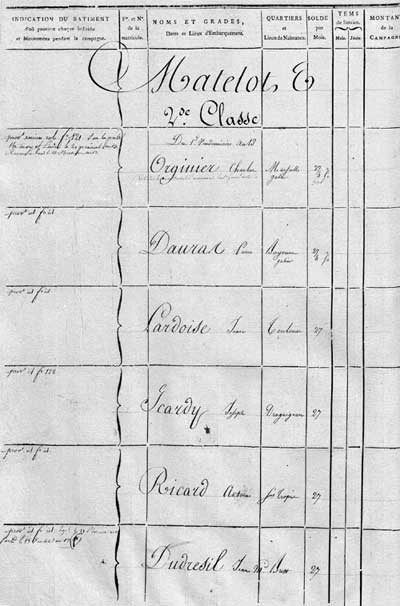
Mont Blanc muster roll
An example from the Mont-Blanc muster roll is shown on the right.
Although involvement in the battle had been minimal, deaths, injuries and sickness are recorded in these documents, including the names of those who were killed at Trafalgar.
The records reveal that there were a number of nationalities aboard the French ships at their time of capture.
Although involvement in the battle had been minimal, deaths, injuries and sickness are recorded in these documents, including the names of those who were killed at Trafalgar.
The records reveal that there were a number of nationalities aboard the French ships at their time of capture.
Eyewitness Account – the helmsman’s log
One of the documents seized from the Mont-Blanc was a helmsman’s log which covers the period of 16 September 1805 to 4 November 1805.
The helmsman’s log was recorded at four to six hourly intervals as the fighting was taking place and this is the first time there has been access to an eyewitness account from behind the French line.
The record also provides an account of the French response to Strachan’s actions and subsequent capture.
You can also download the helmsman’s log in full (in French) or read a transcript of key entries (in French) or an English translation below.
Helmsman’s Log transcript in English (PDF, 0.06MB)
Helmsman’s Log transcript in French (PDF, 0.07MB)
Calendar conversions for French muster rolls
The records can include French Revolutionary Calendar dates. Consult the table below to convert the calendar dates.
| French revolutionary calendar | Converted date |
|---|---|
| 12 Brumaire 14 | 3 November 1805 |
| 11 Brumaire 14 | 2 November 1805 |
| 10 Brumaire 14 | 1 November 1805 |
| 9 Brumaire 14 | 31 October 1805 |
| 8 Brumaire 14 | 30 October 1805 |
| 7 Brumaire 14 | 29 October 1805 |
| 6 Brumaire 14 | 28 October 1805 |
| 5 Brumaire 14 | 27 October 1805 |
| 4 Brumaire 14 | 26 October 1805 |
| 3 Brumaire 14 | 25 October 1805 |
| 2 Brumaire 14 | 24 October 1805 |
| 1 Brumaire 14 | 23 October 1805 |
| 30 Vendemiare 14 | 22 October 1805 |
| 29 Vendemiare 14 | 21 October 1805 |
| 28 Vendemiare 14 | 20 October 1805 |
| 27 Vendemiare 14 | 19 October 1805 |
| 26 Vendemiare 14 | 18 October 1805 |
| 25 Vendemiare 14 | 17 October 1805 |
| 24 Vendemiare 14 | 16 October 1805 |
| 23 Vendemiare 14 | 15 October 1805 |
| 22 Vendemiare 14 | 14 October 1805 |
| 21 Vendemiare 14 | 13 October 1805 |
| 20 Vendemiare 14 | 12 October 1805 |
| 19 Vendemiare 14 | 11 October 1805 |
| 18 Vendemiare 14 | 10 October 1805 |
| 17 Vendemiare 14 | 9 October 1805 |
| 16 Vendemiare 14 | 8 October 1805 |
| 15 Vendemiare 14 | 7 October 1805 |
| 14 Vendemiare 14 | 6 October 1805 |
| 13 Vendemiare 14 | 5 October 1805 |
| 12 Vendemiare 14 | 4 October 1805 |
| 11 Vendemiare 14 | 3 October 1805 |
| 10 Vendemiare 14 | 2 October 1805 |
| 9 Vendemiare 14 | 1 October 1805 |
| 8 Vendemiare 14 | 30 September 1805 |
| 7 Vendemiare 14 | 29 September 1805 |
| 6 Vendemiare 14 | 28 September 1805 |
| 5 Vendemiare 14 | 27 September 1805 |
| 4 Vendemiare 14 | 26 September 1805 |
| 3 Vendemiare 14 | 25 September 1805 |
| 2 Vendemiare 14 | 24 September 1805 |
| 1 Vendemiare 14 | 23 September 1805 |
| 5 Sans-culottide 13 | 22 September 1805 |
| 4 Sans-culottide 13 | 21 September 1805 |
| 3 Sans-culottide 13 | 20 September 1805 |
| 2 Sans-culottide 13 | 19 September 1805 |
| 1 Sans-culottide 13 | 18 September 1805 |
| 30 Fructidor 13 | 17 September 1805 |
| 29 Fructidor 13 | 16 September 1805 |
| 28 Fructidor 13 | 15 September 1805 |
| 27 Fructidor 13 | 14 September 1805 |
| 26 Fructidor 13 | 13 September 1805 |
| 25 Fructidor 13 | 12 September 1805 |
| 24 Fructidor 13 | 11 September 1805 |
| 23 Fructidor 13 | 10 September 1805 |
| 22 Fructidor 13 | 9 September 1805 |
| 21 Fructidor 13 | 8 September 1805 |
| 20 Fructidor 13 | 7 September 1805 |
| 19 Fructidor 13 | 6 September 1805 |
| 18 Fructidor 13 | 5 September 1805 |
| 17 Fructidor 13 | 4 September 1805 |
| 16 Fructidor 13 | 3 September 1805 |
| 15 Fructidor 13 | 2 September 1805 |
| 14 Fructidor 13 | 1 September 1805 |
| 13 Fructidor 13 | 31 August 1805 |
| 12 Fructidor 13 | 30 August 1805 |
| 11 Fructidor 13 | 29 August 1805 |
| 10 Fructidor 13 | 28 August 1805 |
| 9 Fructidor 13 | 27 August 1805 |
| 8 Fructidor 13 | 26 August 1805 |
| 7 Fructidor 13 | 25 August 1805 |
| 6 Fructidor 13 | 24 August 1805 |
| 5 Fructidor 13 | 23 August 1805 |
| 4 Fructidor 13 | 22 August 1805 |
| 3 Fructidor 13 | 21 August 1805 |
| 2 Fructidor 13 | 20 August 1805 |
| 1 Fructidor 13 | 19 August 1805 |


What are these records?
These are records which show the systematic looting of works of art and cultural property throughout Europe by Nazi Germany between 1933 and 1945. They have been identified, described and introduced by the Commission for Looted Art in Europe in partnership with The National Archives.
The records also show British and Allied efforts to prevent the looting and to retrieve and return the property to its rightful owners both during and after the Second World War.
The selected records are drawn from 900 files at The National Archives, from a variety of government departments and officials, spanning the period from 1939 to 1961.
The Introduction provides an overview and a description of the topics covered by the records. These include wartime and post-war policies on restitution and specific cases of looted property.
We have digitised these records as part of the International Research Portal for Records Related to Nazi-Era Cultural Property. You can use the portal to navigate to the websites of the institutions that are participating in the project.
Special thanks go to the Commission’s team of historians including Diane Boucher, Bianca Gaudenzi, Mary-Ann Middelkoop, Toby Simpson and Hester Vaizey.
What information do the records contain?
The documents provide detailed information on
- the processes of Nazi looting
- disposal of the seized works of art by the Nazis
- whether the art was recovered and where it was returned after the end of the war
The works of art and cultural property were taken from both private and public collections, and included a broad range of objects:
- paintings and drawings
- books and libraries
- antiquities
- archives and historic documents
- furniture
- precious works of gold and silver
- religious artefacts
- sculpture and statuary
The records can also shed light on the development and implementation of Allied restitution policies and practices including:
- the issuing of the 1943 Inter-Allied Declaration against Acts of Dispossession committed in Territories under Enemy Occupation and Control
- the creation of restitution commissions
- the negotiation of policies to document and remedy Nazi looting
This is an ongoing process today.
How do I search the records?
You can search and download the records in Discovery (£) by using the search box below.
You can refine your results by using the filters on the left-hand side of the search results page but if you wish to change your search term you should use the search box below.
Read our guide to useful search terms for finding records relating to Nazi-era cultural property by clicking on the link below.
Guide to useful search terms (PDF, 0.04MB)
What do the records look like?
The files are made up from a wide range of material such as:
- correspondence
- telegrams
- written records of conversations
- field reports
- minutes and agendas of meetings
- press articles
- texts of Parliamentary questions
- investigations of monuments and historic buildings
- forms for the restitution of claimed property
- inventories of looted works of art
Photographs of looted artworks can also occasionally be found.
Many of the records contain acronyms. See our guide (below) for definitions of some of the acronyms found in the records.
Guide to useful acronyms (PDF, 0.06MB)
1. Why use this guide?
This is a guide to records held at The National Archives which document land requisitioned for war by the British Government and armed forces during the 20th century.
Widespread requisitioning took place during the First and Second World Wars, both for military use and for civilian functions related to the war effort.
2. The kinds of records we hold and how to start a search
There is no single record source or comprehensive list of the land and properties that were requisitioned during conflict. Records of this nature were created by a range of different government departments, reflecting the interest many of them had in the requisitioning of land and property and in subsequent compensation payments. Many of the surviving records relate to:
- applications for compensation
- assessments of the value of requisitioned property
Search our catalogue using terms like ‘requisition’, ‘compensation’ or ‘acquisition’, together with an appropriate date range. This should produce references for a range of records in addition to those listed in this guide. For more guidance on how to use our catalogue, see Discovery help.
3. First World War
War Office files on the Defence of the Realm (Acquisition of Land) Act 1916 are in WO 32/2655-2663.
The records of the Acquisition and Valuation of Land Committee (1917-1919) are in series LCO 3. They include agendas, minutes and circulated papers of both the main committee and sub-committees considering compensation, mines and transfers of lands.
Records of the Land Values Reference Committee include the register of references to arbitration of cases under the Defence of the Realm (Acquisition of Land) Act 1916 and the Acquisition of Land (Assessment of Compensation) Act 1919 fills eighteen volumes in LT 5/21-36, LT 5/46-7, covering the period 1919 to 1947.
Numerous Treasury files discuss policy and practice, including:
- Acquisition and Valuation of Land Committee: T 1/12308 (paper 15534); T 1/12338 (paper 25275); T 1/12446 (paper 3117)
- Compensation claims, 1920-1921: T 161/81/2 (file S.6363)
- Work of the official arbitrator in disputed cases, 1929-1930: T 163/41/10
Post-war files of applications, orders, etc., made to the Railway and Canal Commission under the Defence of the Realm (Acquisition of Land) Acts 1916 and 1920 are in series J 75.
Ministry of Reconstruction files on the post-war disposal of War Office land, buildings and other property are in series RECO 1.
4. Second World War
Perhaps the most informative series of records about individual cases is series WORK 50, the Government Property Registers.
These include WORK 50/23-29 which covers requisition, compensation and settlement registers relating to property taken over by the state during the Second World War in:
- Berkshire
- Buckinghamshire
- Hampshire
- Isle of Wight
- Hertfordshire
- Oxfordshire
- Surrey
Similar registers relating to other counties do not survive.
The registers give:
- addresses of requisitioned premises
- names and addresses of claimants (usually owners)
- agents/solicitors
- the government department that used the premises
- dates of requisition, derequisition and claims for compensation
- amounts claimed and agreed
The list below sets out some of the other major sources among the records.
4.1 Military requisitions
Air Ministry files about requisitioning, derequisitioning and compensation are in AIR 2/16897-16912.
HLG 102 includes post-war files about compensation for and disposal of requisitioned land. HLG 102/291 is about claims for increased compensation under the Requisitioned Land and War Works Act 1945 as opposed to the Compensation (Defence) Act 1939.
A register of cases heard before the General Claims Tribunal set up under the Compensation (Defence) Act 1939 and subsequent Acts is in LT 7. A small selection of case files is in LT 6. Both these series include material relating to requisitioning and damage by civil as well as military departments.
MAF 48 contains a number of files about the requisitioning of agricultural or common land, and about compensation for wartime allotments.
The records of the National Farm Survey contain references to the requisitioning of land for military purposes. For more information about these records, see the research guide, National farm surveys of England and Wales, 1940-1943.
Ministry of Agriculture, Fisheries and Food Divisional Office records in MAF 145-149, MAF 157-182 include numerous files about the requisitioning and derequisitioning of land.
Records of the War Works Commission which was established under the Requisitioned Land and War Works Act 1948 are in T 180. They include a number of individual case files.
Files of the Treasury Land and Buildings Division in T 226 cover such subjects as compensation for compulsory acquisition, and the Requisitioned Land and War Works Acts 1945 and 1948.
Registered files of the Treasury Solicitor in TS 46 relate to case work undertaken on behalf of the War Office. The files relate to transactions, claims and advice across a broad range of topics including matters arising from wartime requisition of land, buildings and horses for defence purposes, and arbitration in disputed valuations.
Post-war claims for damage to property arising from derequisitioning are also included in the series.
A substantial number of files, some as recent as the 1970s, relating to the derequisitioning of buildings and lands and to compensation paid by the War Office, are in WO 32 (see especially code 5A).
4.2 Agricultural requisitions
MAF 142 contains files about the outworking of the Agriculture Act 1947, especially section 85 which relates to the serving of notices and certificates for the acquisition of requisitioned land (for example, MAF 142/111 and MAF 142/402).
MAF 143 includes a number of post-war files about land requisitioned by County War Agricultural Executive Committees. MAF 143/49 contains a schedule of requisitioned common land. MAF 285 contains records concerned with the disposal of requisitioned land under Part V of the Agriculture Act 1947, and includes material relating to methods of disposal of individual pieces of land and buildings and the Land Settlement Association, which managed small holdings on behalf of the Minister of Agriculture and Fisheries and the Minister of Agriculture, Fisheries and Food.
5.3 Extinguishing of public rights of way
Many rights of way were closed on requisitioned lands. See the records listed in section 6 of our Public rights of way guide.
5. After the Second World War
Detailed statistics of land held by the War Office until 1965 are in WO 32/16666.
A number of other government departments have acquired land since 1945. A catalogue search using the keywords ‘requisitioned land’ and an appropriate date range will indicate the wide range of material in our collection.
During the 1950s, and in particular after the Crichel Down inquiry of 1954, it was government policy that:
- land held by the Ministry should be sold
- forestry land should be transferred to the Forestry Commission
Crichel Down was not strictly a case of requisitioning (the site was purchased by the Air Ministry in 1940), but the public interest aroused by its post-war disposal resulted in the setting up of a public inquiry. The records of the inquiry itself are in MAF 236.
Other series containing relevant records include:
- Air Ministry and Ministry of Defence registered files in AIR 2
- Air Ministry and Ministry of Defence private office papers in AIR 19
- registered files on estates remaining in crown possession after 1940 in CRES 35
- Crichel Down Inquiry files in CRES 44
- South Western regional office registered files in MAF 109
- registered Files, Land Acquisition by Other Government Departments in MAF 140
- registered files: Agricultural Land Management in MAF 142
- registered files: Establishments in MAF 227
- registered files: Agricultural Land Commission in MAF 245
6. The legislative framework for requisitioning
6.1 First World War
Although there had been a number of statutes governing the purchase and/or leasing of lands for military purposes (of which the principal still in force in 1914 were the Defence Act 1842 and the Military Lands Act 1892), the first large-scale requisitioning of land for government purposes took place during the First World War.
Successive Defence of the Realm Acts from 1914 onward gave the government wide-ranging coercive powers during wartime, and the Defence of the Realm (Acquisition of Land) Act 1916 provided specifically for the requisitioning of land.
Land was requisitioned for airfields, allotments, and accommodation for government departments. The Office of Works carried out land acquisition for other government departments, as well as the construction and conversion of buildings for wartime purposes.
The Defence of the Realm (Acquisition of Land) Act of 1916 established that questions about compensation or the purchase price of land would be settled by a panel appointed by the Railway and Canal Commission. This became known as the Land Values Reference Committee.
The Acquisition of Land (Assessment of Compensation) Act of 1919 provided a means for resolving disputes over payments to owners after the war.
6.2 Second World War
The Ministry of Works set up a central register of accommodation in 1938. This was used during and after the Second World War for the requisitioning of land and buildings for:
- the armed services
- accommodation of civil servants
Land was requisitioned under the Defence (General) Regulations 1939, according to the Emergency Powers (Defence) Act 1939. The need for compensation was recognised from the outset, and assessed under the Compensation (Defence) Act 1939.
The Second World War saw the enactment of a number of other statutes granting various powers to acquire land for government use or for the support of the war effort. Among these were:
- Agriculture (Miscellaneous War Provisions) Acts, 1940 and 1941
- Landlord and Tenant (Requisitioned Land) Acts 1942 and 1944
- Requisitioned Land and War Works Act 1944
- Town and Country Planning Act 1944
14.5 million acres of land, 25 million square feet of industrial and storage premises and 113,350 non-industrial premises were requisitioned during the Second World War. The War Office alone requisitioned 580,847 acres between 1939 and 1946. (WO 32/16666, paper no 41A.) Land and buildings were requisitioned for a very wide range of uses, including:
- battle training areas
- airfields (both civil and military)
- mines
- accommodation
- railways
- oil pipelines
- underground shelters
- fire services
- factories
- schools
- hospitals
The requisitioning of land for military use often seemed to conflict with the need to increase increasing food production. Much agricultural land was requisitioned, and while it was decided in principle that where an entire farm was given over to the military it should be excluded from the National Farm Surveys, the survey records do contain incidental information about requisitioning (see below).
In 1939, the Minister of Agriculture and Fisheries was empowered to create County War Agricultural Executive Committees throughout the country. These committees were empowered to control and direct agricultural production in wartime and, to that end, to take possession of land and to requisition, inspect and enter property. Their records are in MAF 80 and often contain information about the effect of military requisitioning.
After the war, a number of provisions deriving from the requisitioning of land were made:
- Requisitioned Land and War Works Acts 1945 and 1948
- Town and Country Planning Act 1947
- Agriculture Act 1947
- Requisitioned Land and War Works (Compensation) Act: the Government Oil Pipe-Lines Regulations, 1948
- Town and Country Planning Acts 1944 and 1948 (Registration of Orders and list of Buildings) Rules 1948
- Land Powers (Defence) Act (Registration of Way-Leave Orders etc) Rules, 1958
Towards the end of the war and afterwards, the Ministry of Works dealt with the derequisitioning of property taken over for government use, as well as with compensation claims relating to requisitioned property, the disposal of surplus buildings and stores, the removal of temporary defence works on private land and the restoration of the land.
Requisitioned land on which development of permanent value had taken place was formally acquired, as were cross-country oil pipelines.
After the war it was decided that some of the land requisitioned to increase food production should be retained for agricultural purposes, and under Part V of the Agriculture Act 1947 the Minister of Agriculture acquired powers to compel purchase of any requisitioned land not sold voluntarily, in order to maintain its full and efficient use for agriculture. Such land was then managed by the Agricultural Land Commission, set up under the Act.
7. Further reading
Some of the publications below may be available to buy from our bookshop. Alternatively, search our library catalogue to see which are available to consult in our reading rooms.
Successive editions of the Manual of Emergency Legislation (published by HMSO) are useful compendia of relevant statutes effective in the First World War. A set covering the years 1914 to 1919 is in The National Archives’ Library.
An interesting case study is Patrick Wright, The Village that Died for England: The Strange Story of Tyneham (London, revised edition 2002) in The National Archives’ Library (942 Dorset).Guide reference: Domestic Records Information 128.
Gerry Rubin, Private Property, Government Requisition and the Constitution in 1914-1927. (London, 1994) available in The National Archives’ Library.
S M Krusin and P H Thorold Rogers, The Solicitors’ Handbook of War Legislation (London, 1940), is a useful compendium of relevant statutes effective in the Second World War, also in The National Archives’ Library.
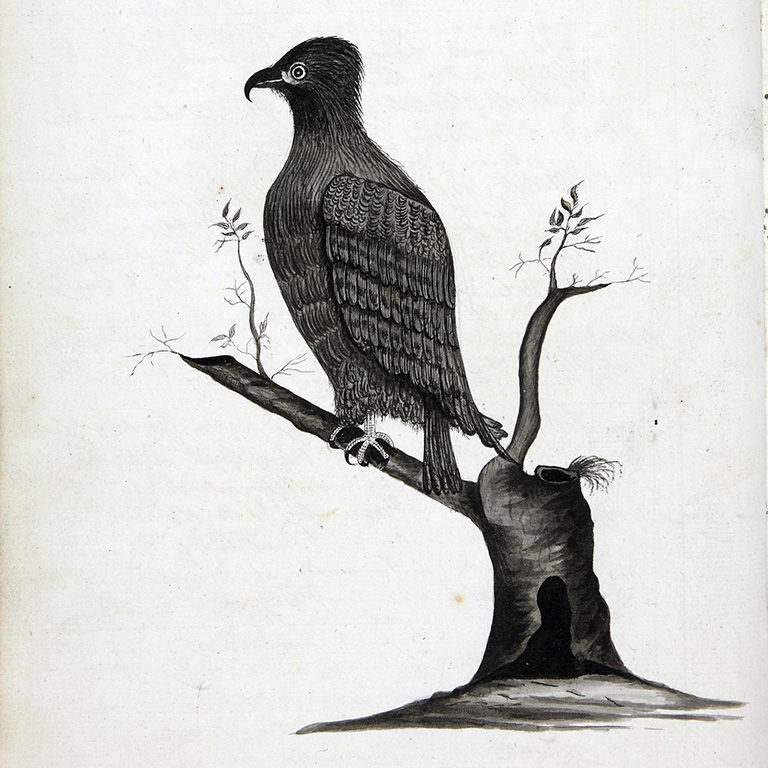
What are these records
These records consist of 164 volumes of log books of the Royal Navy’s voyages of scientific discovery in series ADM 55. The records were made between 1757 and 1861, with one exception made in 1904.
Many famous officers kept logs held in this collection, including James Cook, William Bligh and Matthew Flinders.
The main areas covered in the logs are the Pacific, the Arctic, the Antarctic, Australia, the Americas and the west coast of Africa, although China, St Helena and other places are also included.
Amongst this collection of Royal Naval ships’ logs, there are a several logs which were kept by merchant ships.
What information do the records contain?
These logs and journals are a first-hand account of the day-to-day activities of the exploration party, giving a picture of life aboard ship.
They include details such as:
- scientific information gathered during the voyage
- detailed daily accounts of the weather
- meteorological observations
How do I search the records?
You can search and download the records in Discovery (£) by filling in the form below.
Please note, your results will show all instances of the term(s) you searched for within the record descriptions, as this is currently a keyword search. Examples of keywords you might want to use are the ship’s name or the name of the logbook keeper.
What do the records look like?
To get an idea of what the logs look like, you may wish to view the log of the ship Felix which details her voyage to the North Pole from 1850 to 1851.
Felix log (PDF, 25.27MB)
1. Why use this guide?
This guide briefly describes:
- how to search for records
- the principal relevant repositories with strong collections relating to architectural history
- general works of reference
2. How to search for records
2.1 Using Discovery, our catalogue
Search Discovery our catalogue to find records from The National Archives and over 2,500 archives across the UK.
Your search results will display details from a range of archives and you can then refine your results.
Where the keywords you searched for appear in the description of a record, the search results are displayed under the ‘Records’ tab.
Where the keywords you searched with appear in the name of the institution or person that originally created the record (often not the same as the institution or person that currently holds the record), the search results are displayed under the ‘Record creators’ tab.
For further tips on searching see our catalogue help pages.
2.2 Printed index of papers relating to art and architecture
As well searching our catalogue, there are four typescript indexes to art (and architecture) papers mentioned in catalogues and reports received from repositories in the years 1969-1972. These are bound together and available in the reading rooms, Kew. They are useful in that they refer to individual items, whereas the computerised indexes only notice groups of papers.
3. Accessions to repositories
Each year The National Archives contacts approximately 250 of the principal record repositories in the British Isles in order to discover which major and unusual accessions have been received. This information is added to Discovery, our catalogue. It is also edited and used to produce thematic digests, including one relating to architecture. We make the digests available through this website and distribute them for publication in a number of learned journals and newsletters.
4. Artists Papers Register
The Artists Papers Register contains many references to architects’ papers in repositories around the country. Although information about architects’ papers was not specifically sought by the project officers, a number of details about plans etc were drawn from the NRA and supplemented with information on collections at local level. Users seeking information about architects and architectural history should consult it in addition to the NRA.
5. Relevant repositories
The following provides details of repositories and institutions that hold major collections relating to architectural history.
Lambeth Palace Library, London SE1 7JU
Holds 15,000 files and minute books of the Incorporated Church Building Society (ICBS), established in 1818. Its records consist of plans, drawings, correspondence and photographs from 1818 until 1967. A database index to the collection allows searches to be made under the names of architects, churches, counties and dioceses.
Holds England’s national collection of photographs, drawings and written records of historic buildings and archaeological sites including records produced as a result of survey work undertaken by the former Royal Commission on the Historical Monuments of England, aerial photographs covering the whole of England, deposited collections, early Ordnance Survey maps and statutory lists of listed buildings. The main finding aids are the Listed Building System (LBS), a database containing details of all listed buildings in England, and MONARCH, the main database of information.
National Monuments Record of Scotland, Royal Commission on the Ancient and Historical Monuments of Scotland, John Sinclair House, 16 Bernard, Edinburgh EH8 9NX
Maintained by the Royal Commission on the Ancient and Historical Monuments of Scotland, which was established in 1908 to make an inventory of the surviving built heritage of Scotland. Performs similar functions to the English NMR. The principal finding aid to the NMRS is CANMORE, which can be searched online.
National Monuments Record of Wales, Crown Building, Plas Crug, Aberystwyth SY23 1NJ
Maintained by the Royal Commission on the Ancient and Historical Monuments of Wales, which was established in 1908 to make an inventory of the ancient and historical monuments of Wales and Monmouthshire. Performs similar functions to the English NMR.
The National Archives, Kew, Richmond, Surrey TW9 4DU
Records of successive works departments are held at The National Archives under the series WORK. Also held here are the records of the architects departments of many government bodies, such as the Education Department, Local Government Board and the Poor Law Commission.
Maps, plans and architectural drawings are scattered throughout many different series of records; see Maps and Plans in The National Archives 1. British Isles c1410-1860 (HMSO 1967).
V&A + RIBA Architecture Partnership
Two major national and international resources based in London have entered into a joint initiative: the V&A + RIBA Architecture Partnership brings together in a single location the drawings and archives collections of the Royal Institute of British Architects and the architectural drawings and photographs in the collections of the Victoria and Albert (V&A) Museum. From November 2004 these collections have been accessible through the appropriate study rooms in the Henry Cole Wing of the V&A. The collections contain material likely to be of interest to researchers studying particular buildings or architects, whether in the public or private sector, from the Renaissance to the present day. Access is free, but you must make an appointment.
The location and postal address are:
V&A South Kensington
Cromwell Road
London SW7 2RL
For further information about the RIBA’s drawings and archives collections and the RIBA Study Room, visit the RIBA Library and Collections page .
For further information about the V&A’s collections of architectural drawings and photographs and the Prints and Drawings Study Room, see the V&A study rooms page.
RIBA’s library and photographic collections are at RIBA headquarters. You can access the Library catalogue online.
RIBA British Architectural Library
Royal Institute of British Architects
66 Portland Place
London W1B 1AD
United Kingdom
Main Switchboard
Tel: +44 (0) 20 7580 5533
Fax: +44 (0) 20 7255 1541
Public Information Line – Mon-Fri: 10:00-17:00 (GMT)
Tel: +44 (0) 906 302 0400
(Information line calls charged at 50p per minute in the UK. These lines cannot be accessed from outside the UK)
Library Information (24-hour recorded):
Tel: + 44 (0) 20 7307 3707
(administrations, loans, photographs, manuscripts)
Sir John Soane’s Museum, 13 Lincolns Inn Fields, London WC2A 3BP
Holds Sir John Soane’s personal correspondence, and journals, account books and other papers connected with his professional practice. Also holds the manuscript Book of Architecture of John Thorpe.
6. Local record offices
Nearly all local repositories hold a wide range of estate, inclosure, tithe and Ordnance Survey maps for the area they cover, many of which may help in tracing the development of an estate, or the changing block plan of a building.
Licences, or faculties, for alterations to churches, which can include plans, may be among parish or diocesan collections; and plans for 19th century buildings will be among planning applications included in the records of district councils.
Records concerning specialist buildings such as schools, workhouses, prisons and non-conformist churches may be among locally held collections. Building accounts and plans can often be found in collections of family and estate papers.
In addition, these repositories usually have a good collection of prints, drawings, photographs and sale particulars, as well as the standard sources such as census and land tax returns. Contact details for local repositories can be found using the Find an archive tool.
7. Useful links
The Archives Hub provides a single point of access to descriptions of archives held in UK universities and colleges. At present these are primarily at collection-level, although where possible they are linked to complete catalogue descriptions.
Archives in London and the M25 area (AIM25) is a major project to provide electronic access to collection level descriptions of the archives of over 50 higher education institutions and learned societies within the greater London area.
The Scottish Archive Network the project aims to revolutionise access to Scotland’s archives by providing a single electronic catalogue to the holdings of more than 50 Scottish archives.
8. Further reading
Rebecca M Bailey, Scottish architects’ papers: a source book (1996)
H M Colvin, A biographical dictionary of British architects 1600-1840 (third edition, 1995)
H M Colvin (ed), The history of the King’s works (1973-)
H M Colvin, English architectural history: A guide to sources (second edition, 1976)
Roger Dixon and Stefan Muthesius, Victorian architecture (1978)
Alison Felstead, Jonathan Franklin, Leslie Pinfield, Directory of British architects 1834-1900 (1993)
A Stuart Gray, Edwardian architecture: A biographical dictionary (1985)
John Harvey, English mediaeval architects: A biographical dictionary down to 1550 (1987)
John H Harvey, Sources for the history of houses (British Records Association, Archives and the User Number 3, 1974)
Rolf Loeber, A biographical dictionary of architects in Ireland 1600-1720 (1981)
Nikolaus B Pevsner (et al), The buildings of England, Ireland, Scotland and Wales (1951-)
1. Why use this guide?
This guide will tell you how to find records of Indian indentured labourers at The National Archives.
Please note that the terms used in historical records reflect attitudes and language at the time and may now be considered derogatory or offensive.
This guide does not cover Chinese indentured labourers. If you want to find Foreign Office correspondence relating to Chinese indentured labourers, search Discovery, our catalogue using the keywords ‘Chinese’ and ‘coolies’.
2. Who were the Indian indentured labourers?
Under colonial rule, India’s population provided the British Empire with a ready source of cheap and mobile labourers.
Many Indians agreed to become indentured labourers to escape the widespread poverty and famine in the 19th century. Some travelled alone; others brought their families to settle in the colonies they worked in.
The demand for Indian indentured labourers increased dramatically after the abolition of slavery in 1834. They were sent, sometimes in large numbers, to plantation colonies producing high value crops such as sugar in Africa and the Caribbean.
3. How do I search for records at The National Archives?
The best way to start is to search our catalogue using keywords. Try using the keyword ‘Indian’ plus terms such as:
- coolie
- labour, labourer
- place name, (for example Mauritius, Jamaica, Calcutta)
- emigrant, emigration
- immigrant, immigration
You can refine your search by the Colonial Office department (CO), which contains many relevant records.
It is not possible to search for a particular labourer’s name in our catalogue. Some records may contain names, but these have not been entered into the online descriptions.
Many of the records contain only the first names of the labourers, not their last names.
Most of the records have not been digitised, so you may need to consult original documents.
4. What kind of records does The National Archives hold?
The records at The National Archives are mainly concerned with how governments generally administered different indentured labour systems. They contain very little personal information about the labourers themselves.
The largest sources of records about Indian indentured labourers are:
- Colonial Office correspondence
- Foreign Office correspondence
Whilst these papers may contain sample records on how the labourers were contracted, transported, and employed, they do not hold information on how local administrations managed labourers on a day-to-day basis.
The archives of former colonies may hold records relating to the local management of Indian indentured labourers. Try contacting them directly for information about surviving records.
5. Key records at The National Archives
5.1 Births, marriages and deaths at sea (1891-1972)
As Indian indentured labourers were British colonial citizens, the Registrar General of Shipping and Seamen recorded their births, marriages and deaths.
Search and download these registers in BT 334 from findmypast.co.uk (£).
If an indentured labourer gave birth to a child on board a ship, the records give the child’s name, but the parent is simply listed as ‘coolie’.
5.2 Colonial Office original correspondence
Use the original correspondence for the relevant colony to find details of the indentured labour system. The correspondence consists of letters coming into London from the colonies. For example:
- Mauritius in CO 167
- British Guiana in CO 111
- West Indies in CO 318
- Trinidad in CO 295
- Jamaica in CO 137
- Ceylon in CO 54
- Fiji in CO 83
- Cape Colony (in South Africa) in CO 48, Natal in CO 179
- St Christopher (St Kitts) in CO 239
- Windward Islands in CO 321
- Grenada in CO 101
- Kenya in CO 533 – see also FO 107 for the period before 1906
- Uganda in CO 536
You’ll need to use entry books or registers to find particular items within these collections of original correspondence.
To find the entry books or registers for a collection of correspondence, refer to the full series description in our catalogue: for instance, the description for CO 167 (Mauritius original correspondence) says that the registers are in CO 326 and CO 356.
5.3 Records of the colonial emigration departments
Use the Land Board and Emigration Department’s correspondence in CO 384 for information about indentured labour practices and systems.
Browse the Land and Emigration Commission correspondence in CO 386 for information on Indian indentured migration to the West Indies.
Use the Colonial Office General Department’s original correspondence on immigration in CO 571 for information about the entry of Indian indentured labourers into Mauritius and the West Indies.
The types of records you may find include:
- medical reports, which sometimes give details of the births and deaths of Indians on the ships
- population analysis, statistical returns and mortality rates
- lists of ships, receipts and information about expenditure
- policy papers and reports on criminal cases involving indentured labourers
5.4 Foreign Office records
Many Indian indentured labourers were sent to work for the colonies of foreign countries, such as the Netherlands, Spain, Portugal and France.
You can find some records relating to this by searching for keywords in our catalogue within the Foreign Office (FO) department.
6. Parliamentary records
Search Proquest UK Parliamentary Papers to find papers relating to the British Parliament’s legislation of the Indian indentured labour system. This is a subscription website you can access at the National Archives. You may also be able to access it via a large reference library such as a university library.
Discussions in Parliament can be found in Hansard, which is available online on the Parliament website. Please note there are some volumes missing from the online data.
Our research guide to Hansard details different ways of accessing the reports and records of Parliamentary debates.
7. More about the history of indentured labourers
The term ‘coolie’ is of disputed origins: some believe it derives from an aboriginal tribe in the Gujarat region of India, and others believe it comes from the Tamil word ‘kuli’, meaning ‘payment for occasional menial work’ (Oxford English Dictionary).
The labourers were mostly young, active, able-bodied people used to demanding labour, but they were often ignorant of the places they agreed to go to or the challenges they were going to face.
Before 1840 a large proportion of the labourers were so-called ‘Hill coolies’, aboriginal people from the plains of the Ganges. Later many others signed indentured labour contracts, including Hindus, Brahmins, high castes, agriculturists, artisans, Mussulmans, low castes (untouchables) and Christians.
Over 41,000 Bengali labourers were sent to Mauritius in 1834, but the Indian government banned ‘coolie’ shipments in 1838 because there were reports of repression and abuse.
In 1842 the British Prime Minister Robert Peel directed the Indian government to re-open these lines of emigration under proper safeguards. A Protector of Emigrants was appointed to ensure that the labourers had adequate space, food, water and ventilation on the journey.
Emigration to Jamaica, British Guiana and Trinidad was legalised in 1844. Emigration to Grenada and St Lucia was legalised in 1856 and 1858 respectively.
The last indentured labourers went to the West Indies in 1916. Repatriation continued for many years after the time limit. The last ship carrying returning emigrants left the West Indies for India in 1954.
8. Further reading
Read historical newspapers such as The Times, Asiatic Journal of Calcutta and The British Emancipator.
Use our library catalogue to find a recommended book list. The books are all available in The National Archives’ reference library, or you may be able to find them in a local library.
Contact the British Library. The Asia, Pacific and Africa collections contain many records about Indian indentured labour under colonial administration.
Use the library of the School of Oriental and African Studies, which is a major source for academic studies into Indian indentured labour systems.
Also try searching our bookshop for a wide range of history titles.
This guide provides advice on how to search for a will in England and Wales proved before 1858. The Principal Probate Registry was established on 12 January 1858 and for wills proved from this date onwards go to the Probate Service.
This is not an exhaustive guide to finding wills and the focus is on what you can find at The National Archives. However, there is some advice on wills held elsewhere. There is also advice on searching for letters of administration, issued in lieu of a will.
Getting started
Before starting a search, consider the following:
- Not everyone left a will and not all wills needed to be proved by a court. People leaving small amounts of goods could leave instructions with their family or friends.
- For the instructions in a will to be carried out by the executors, who would distribute the estate of the testator, the will had to have been proved in a probate court, almost all of which were church courts.
- Where there was no valid will, a probate court could issue letters of administration, appointing people to distribute the estate according to fixed rules of inheritance.
- Wives needed their husband’s permission to make a will, and most female testators were spinsters or widows.
- Many people left estates which were liable for death duties and these produced separate sets of records – read our guide to death duty records for more information
The National Archives holds wills proved in the highest and busiest probate court, the Prerogative Court of Canterbury (PCC) in London. By the late 1850s it was proving about 40% of all wills. The records of this court are the best place to start looking for a will (over one million PCC wills are available online). However, before 1858 there were more than 200 other church courts across the country that dealt with probate, each of which kept separate records and registers of wills – there was no central index and this remains the case. For most wills proved elsewhere you will need to search in other archives. The probate court system is shown here from the top down:
- The Prerogative Court of Canterbury
- The Prerogative Court of York
- Bishops’ diocesan courts
- Archdeacons’ courts
- Other courts, known as ‘peculiars’, administered by the deans and chapters of cathedrals
When looking for someone’s will or administration you will need to determine which court dealt with it. Where a will was proved usually depends on:
- where the person died
- the value of the assets
- how these assets were distributed geographically
Typically:
- If the testator had personal property in only one archdeaconry or local peculiar jurisdiction then the will was proved or administration granted in the archdeaconry or peculiar court
- If the testator had personal property in more than one archdeaconry located in the same diocese then the will was proved or administration granted in the bishop’s consistory or commissary court
- If the testator had personal property worth more than £5 in more than one diocese either within the province of Canterbury or within that of York then the will was proved or administration granted in the relevant Prerogative Court
- If the testator had personal property worth more than £5 in both provinces of Canterbury and York, then two grants of probate or administration were required
You can use the English jurisdictions 1851 map to identify the jurisdiction of each diocese and therefore the respective probate court.
Prerogative Court of Canterbury records online
Registered copies of wills proved in the Prerogative Court of Canterbury, 1384–1858
Wills proved in the Prerogative Court of Canterbury (PCC) mainly relate to testators resident in the south of England but there are wills from people in all parts of England and Wales. Although on the whole the PCC was used by the relatively wealthy, as time went on many less prosperous people used this court, as well as people who feared to die abroad – sailors and soldiers are well represented.
Search online by name and year (the date you are searching for is the date of probate – the will itself may date from years before) plus occupation, place or county for Prerogative Court of Canterbury wills, 1384–1858 which you can download from our website (£). These records, that number over one million in total, are from series PROB 11.
Prerogative Court of Canterbury wills proved during the Civil War, 1643–1646
From 1643 to 1646 some Prerogative Court of Canterbury wills were proved in Oxford rather than London.
Search and download PCC wills proved in Oxford (PROB 10/639 – PROB 10/642) free of charge from our catalogue. These records are on digital microfilm and there are therefore multiple wills on a single download. You will need to scroll through the digital microfilm to locate a single will.
Wills of famous people proved in the Prerogative Court of Canterbury, 1552-1854
There are online copies of the wills of 102 famous people from the 16th to the 19th centuries, including William Shakespeare, Admiral Lord Nelson and Jane Austen. For more information and to search these records see our guide to famous wills 1552-1854.
Prerogative Court of Canterbury records available only at The National Archives in Kew
Many of our records are not available online. To access these records you will either need to visit us and view the records at our site in Kew for free, pay for research (£) or, where you can identify a specific document reference, order a copy (£).
Original Prerogative Court of Canterbury wills, 1484-1858
Original wills, as opposed to the registered copies held in PROB 11 (see online records section above), are what the executor brought to the court to have proved. They are either the will as drawn up and signed by the testator or a copy that was made before the notary of the court. Though they contain the same details as the registered copies, they can be easier to read.
Search for these original wills in PROB 10 by year/month of probate and (from around 1577) by the initial letter of the testator’s surname. Individual pieces cover ranges of months/years and ranges of surnames so their catalogue descriptions reflect this. For example, PROB 10/211 covers wills proved between June and August 1602 in surname ranges R-Y for June and A-W for July and August. Given these irregularities, it can be easier to browse through the series.
Administrations granted by the Prerogative Court of Canterbury, 1559-1858
An application for administration would be made when a person died without leaving a will. Administrations ‘with will annexed’ were made if the original executors of a will died or refused to act.
The grants of administration are not very informative. They are registered in the Administration Act Books of the Prerogative Court of Canterbury in PROB 6. These are the PCC’s own records of the letters of administration issued under the seal of the court.
To search for an administration, you must first consult an index to obtain a year and a folio number, and for later years, a county. There are several indexes, all available and held together in the Open Reading Room, and the one you use is determined by the year in question:
- 1559-1660: Published indexes
- 1661-1662: Copies of the original indexes (from PROB 12); 1661 partly indexed by a typescript index (the corresponding administration books in PROB 6 have not survived for 1661-1662 so the indexes are the only source of information)
- 1663-1664: Typescript index
- 1665-1700: Copies of the original indexes (from PROB 12)
- 1701-1800: Typescript index
- 1801-1858: Copies of the original indexes (from PROB 12)
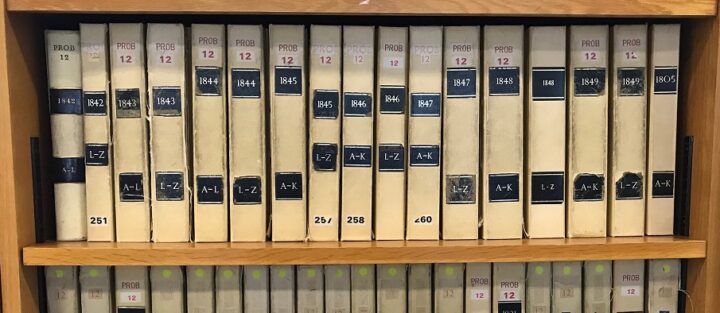
Copies of the PROB 12 indexes on the shelves in the Open Reading Rooms at The National Archives in Kew. These are copies of the original indexes used by the court to locate individual administration act books and wills.
Original Prerogative Court of Canterbury inventories, 1417-1858
Up to 1782 every executor or administrator was required to send the court registry an inventory of the deceased’s goods. Inventories itemised the estate held by the deceased, and can (but do not always) include details of:
- all the deceased’s goods and assets, including values
- the contents of a deceased person’s home room by room
- a deceased trader’s stock
- the crops, livestock, and agricultural equipment owned by deceased farmers
- debts owed and owing
Not all inventories survive, but there are over 60,000 held across a number of series. Click on the series links below to search the respective series by name of testator or intestate and/or by place name (counties are sometimes expressed in abbreviated form so try, for example, Staffs or Stafford as well as Staffordshire) plus the word ‘inventory’, to locate inventories from the following year ranges:
- pre-1660 in PROB 2
- 1661-1732 in PROB 3, PROB 4 and PROB 5 (there are a small number of inventories outside this year range in PROB 5)
- 1658-1723 in PROB 32
- 1722-1858 in PROB 31
Alternative searches could be by occupation or ‘at sea’.
Original Prerogative Court of Canterbury indexes, 1383–1858
Though largely replaced by the online indexes which allow you to search PROB 11 (see online records, above), the original indexes, also referred to as calendars, to wills and administrations used by the clerks of the Prerogative Court of Canterbury are still available to view. Each index lists the names of the testators and intestates of whose estates grants of probate and administration were made in that year. They are held in series PROB 12 and modern copies of these indexes are available in the open reading rooms at Kew, as described and illustrated above in reference to administrations (they are indexes to both administrations and wills).
Though limited in detail, the original indexes do sometimes provide useful alternatives to the online indexes because:
- names are sometimes spelt slightly differently
- the online indexes use the domicile of the testator at the time the will was written; the original indexes use the domicile of the testator at the time of death
In addition they can provide:
- limited information about testators’ and intestates’ places of residence. In the case of the English and Welsh testators’ and intestates’ the county of residence is usually given, generally in abbreviated form, for example Ches for Cheshire (or county of Chester). Southampton (variously abbreviated to South, Southt, Southton) denotes the county of Hampshire and not just the town of Southampton.
- names of towns or cities, other than county towns. This information is only occasionally included. The most common examples (with abbreviations in brackets) are Bath, Bristol (Brist.), Coventry (Cov.), Exeter (Exon.), Norwich (Norw.), and Salisbury (Saru.).
- occupations for certain people such as clerics holding high office and members of the nobility and doctors and physicians. Data about occupation and status is not given for the majority of testators and intestates.
Beyond the Prerogative Court of Canterbury: some online sources for other probate court records
Wills and administrations from courts other than the Prerogative Court of Canterbury are generally held at local archives. Some of these are available online.
Indexes to wills proved in other probate courts
For online indexes to wills proved by English and Welsh courts other than the Prerogative Court of Canterbury, go to Ancestry.co.uk (charges apply) or Findmypast.co.uk (charges apply). Among the online indexes on these websites are indexes to:
- wills proved in the Prerogative Court of York
- wills proved at local courts all over England and Wales
Bank of England will extracts, 1717-1845
The Bank of England kept extracts of wills of persons who died with monies in public funds in England or who were stockholders who went bankrupt.
Search registers of will extracts once held by the Bank of England at Findmypast (charges apply). They include extracts from wills proved in the lower courts as well as those proved in the Prerogative Court of Canterbury.
Welsh wills, pre-1858
For Welsh wills, search wills proved in the Welsh church courts at the National Library of Wales (free to view online). These include other types of probate records, such as inventories. However, if someone held land in more than one diocese in Wales, the will was proved in the Prerogative Court of Canterbury.
Beyond the Prerogative Court of Canterbury: other sources for probate court records
Records of the Prerogative Court of York
The records of the Prerogative Court of York are held by the Borthwick Institute for Archives at the University of York.
Records of other local church courts
Most of these are held at county record offices, some of which publish indexes and images of wills on their own websites. To search for these try one or more of the following:
- Consult the archived Online Probate Indexes (not updated since 2012) published on the now inactive Your Archives website
- Consult online probate indexes published by the British Record Society
- Search our catalogue, using the ‘held by’ filters to search in ‘Other archives’ and searching with the name of a county and the word ‘probate’
- Search online for local country record office websites
Indexes to vacancy wills, 1383-1558
Vacancy wills were proved by the Dean and Chapter of Canterbury when the Archbishop’s seat was vacant. The Canterbury Cathedral Archives hold indexes to these vacancy wills from 1383 to 1558, compiled by the British Record Society.
Printed resources
If you know the county or parish, the following resources may help to locate the records:
- Phillimore Atlas and Index of Parish Registers– for maps of the areas covered by each church court and details of their surviving records.
- Tracing your ancestors in The National Archives – for a table of records by county. Copies are available at the enquiry desks in the open reading rooms at Kew.
- Probate jurisdictions: Where to look for wills by Jeremy Gibson.
- A list of wills, administrations, etc in the Public Record Office, London, England: 12th-19th century.
- American wills and administrations in the Prerogative Court of Canterbury, 1610 to 1857 by P W Coldham.
- Wills and their whereabouts by Anthony J Camp
Further reading
Visit The National Archives’ shop for a range of publications about wills and death records. Alternatively, look in The National Archives’ library catalogue to see what is available to consult at Kew.
Karen Grannum and Nigel Taylor, ‘Wills and probate records: A guide for family historians’, 2nd edition (The National Archives, 2009)
1. Why use this guide?
Use this guide if you are looking for original sources on the Easter Rising held at The National Archives.
On Easter Monday, 24 April 1916, members of the Irish Volunteers and the Citizen’s Army occupied buildings in Dublin and proclaimed an Irish Republic.
The records at The National Archives have detailed information on the political and military activities as well as the events leading up to and following the Easter Rising.
They contain detailed information on some key figures of the Rising.
2. General search tips
Look for mentions in this guide of:
- department references such as WO (War Office) or CO (Colonial Office)
- record series references such as WO 35 or CO 903
These will help you to focus your search for relevant records using the advanced search option in our catalogue.
Search for relevant records in our catalogue using keywords or a combination of keywords such as:
- Irish AND rebellion
- Ireland AND rebellion
- Easter AND Rising
- Disturbances AND Ireland
- Prisoners AND Irish
- Irish AND nationalist
The names of many of the people involved in the Rising are well known and you can search many records by name. For example, using “Constance Markievicz” as a search term will search across all record series.
For general tips on searching the catalogue, use the Discovery help page.
Discovery, our catalogue, contains descriptions of our records and of records held at over 2,500 other archives (mostly within the UK).
To find out how to view records held at other archives please contact the relevant archive directly.
3. Key records
A number of pieces in several key record series on the Easter Rising are available online (see 4.1) but other pieces within the same series are not (see 4.2). One of these series, WO 35, is particularly rich in details of individuals – for a summary of what the entire series contains see the WO 35 series description. More details on many of these records appear throughout this guide.
3.1 Online records
Click on the links in the table to search for records available online on the websites of our commercial partners – the document references for the original records, held at The National Archives, are shown in the right-hand column but are not needed for an online search.
| Description of records | Document references |
|---|---|
| Easter Rising and Ireland under martial law 1916–1921 at findmypast.co.uk (£) – these are records selected for digitisation because they contain details of individuals (includes records of people detained, interned and court-martialled) | WO 35/57-58, 69-86, 94-95, 121-137, 140-142, 144-160, 208 and 214 |
| Intelligence profiles of Sinn Fein activists 1914–1922 at ancestry.co.uk (free) – see section 5 for more details | WO 35/206-207; CO 904/193-216 |
| Courts martial records, Ireland 1916–1922 at ancestry.co.uk (free) – see section 6 for more details | WO 35/68, 96-119, 143; WO 71/344-386; CO 903/19 |
| The Key despatch from the commander in Chief, Home Forces at gazette.co.uk (free) | n/a |
3.2 Other key records
Many key records cannot be viewed or downloaded online. To view these records, you will need to either visit The National Archives at Kew or pay for copies to be sent to you. Alternatively, you can pay for research. You can view a breakdown of any record series by clicking on the link and scrolling down through the series description to ‘Browse by Reference’.
| Description of records | Document references |
|---|---|
| The maintenance of law and order in Ireland by the military authorities 1916–1922 | WO 35 |
| Commander in Chief reports and other reports about the rebellion | WO 32 |
| War Office and Commander-in-Chief’s reports on the Rising | WO 32/4307, WO 32/9523, WO 32/9568, WO32/9574 and WO 32/9575 |
| Records of the British administration in Ireland prior to 1922 | CO 904 |
| Reports of political activities in Ireland during the period 1885–1919 | CO 903 |
| War Office Registered Papers (Special Series) | WO 141/4-9 and WO141/15-28 |
| Reports and correspondence on United States’ opinion and reaction to the Rising and the executions | FO 371 |
4. Intelligence reports and inquiries
The records in CO 904, known as the Dublin Castle Records, are a major source of information for the Easter Rising. In particular, the following may be of interest:
- CO 904/23, part 2 – detailed analysis of the numbers and arms of the Irish Volunteers and part 3 -reports from British agents ‘Chalk’ and ‘Granite’ who were placed within the Irish Volunteers
- CO 904/193-216 – intelligence profiles of leading nationalists, including figures like Eammon De Valera, later President of Ireland. These date mainly from 1917 but include people who were involved prior to 1917. You can search by name and download intelligence profiles which cover these records at ancestry.co.uk (£)
- CO 903/19 – records of Dublin Castle: Judicial Division – reports of political activities in Ireland during the period 1885-1919. They provide information on the internal proceedings of the Irish Republican organisations in the Colonial Office. You can search these records by name and download at ancestry.co.uk (£)
Records from the Royal Commission enquiring into the events of the Easter Rising are in HO 45/10810/312350 and PRO 30/67/31.
You can also search our catalogue using keywords for intelligence reports and inquiries within HO 45 and HO 144.
5. Courts martial and prisoners
5.1 Courts martial records
The following records relate to courts martial following the Easter Rising.
- CO 903/19 – intelligence records listing 171 people tried by courts martial. You can search these records by name and download at ancestry.co.uk (£)
- WO 71/344-358 – records of those men executed between 3 and 12 May 1916 including evidence against the defendants, their statements and proclamations. They include case papers in the Proceedings against Clarke, Pearse, Connolly and the other executed leaders of the 1916 Dublin Rising from the War Office and Judge Advocate General’s Office. Search these records by name and download at ancestry.co.uk (£)
- WO 35/67 – reports and inquiries into the execution of prisoners
- WO 35/94-119 – lists of civilians prosecuted, arranged by case number. WO 35/68, WO 35/96-119 and WO 35/143 contains records of individual files on the prosecution of civilians (Irish Republicans) from the War Office: Army of Ireland. You can search these records by name and download at ancestry.co.uk (£). Otherwise use the index in WO 35/120 to identify the relevant case number first if the records aren’t online
- WO 35/97 – reports of prosecutions of civilians. Search WO 35/97 by name in the advanced search option of our catalogue
- WO 35/132 – a register of cases tried by courts martial
5.2 Prisoners
HO 45 and HO 144 contain records relating to nationalist prisoners, mainly in gaols in England. You can search our catalogue using terms such as ‘Irish AND nationalist’ or ‘Irish AND prisoners’ within HO 45 and HO 144 and includes files such as:
- HO 144/10309 which contains details of Edward de Valera convicted at Court Martial, Dublin, on 8 May 1916 for armed rebellion and war against H.M. the King and sentenced to death (commuted)
- HO 144/1580/316818 which contains information on the activities of Countess Markievicz (case papers of her court martial trial)
You can also find records of remittances and commutations of sentences in PCOM 6/39. It includes the 80 or so commutations of death sentences of Easter rising prisoners.
6. Policy and political reactions
For The Third Home Rule Bill and Act 1914, and the Suspensory Act 1914, and the Government of Ireland Amendment Act (1916), see Proquest UK Parliamentary Papers. This is a subscription website you can access at The National Archives. You may also be able to access it from a large reference library such as a university library.
Public Acts of Parliament may be found on legislation.gov.uk but they are not all available online. For more information see our research guide on Original Acts of Parliament.
Discussions in Parliament can be found in Hansard, which is available online on the Parliament website. Please note there are some volumes missing from the online data in this period, particularly around 1917.
Our research guide to Hansard details different ways of accessing the reports and records of Parliamentary debates.
Key records include:
- CAB 1/21/1
plea for conciliatory attitude towards Ireland Dec 1916 - CAB 37/147 -159 – photocopies of Cabinet Papers relating to Ireland in 1916
- CAB 41/37/17 – spread of the rebellious movement throughout Ireland
- HO 45/10810/312350 – report of Royal Commission on Irish Rebellion
- MEPO 2/10674 – news cuttings giving reactions to the Rising
- YLG – The political papers of David Lloyd George
- PRO 30/67/31 – Midleton Papers Unionist reaction to the Rising
- PRO 30/89/1–2 – WE Wylie Papers which contain written and printed notes of proceedings during and after Rising
- PRO 30/89/16 – WE Wylie Papers: Easter 1916 which contain photographs of Dublin during and after the rising; copy of the stamp of the Republic (Wylie was involved in the suppression of the rebellion and was one of the key prosecutors at the Courts martial trials)
You can also use the search boxes contained in the following record series to identify relevant Cabinet papers :
- CAB 16 – Committee of Imperial Defence, Ad Hoc Sub-committees
- CAB 21 – registered files (viewable online)
- CAB 23 – War Cabinet and Cabinet minutes (viewable online)
- CAB 24 – War Cabinet and Cabinet: Memoranda (viewable online)
- CAB 27 – War Cabinet and Cabinet: Miscellaneous Committees
When you search our catalogue, try using the keyword ‘Ireland’ and restrict your search to the dates 1916–1922.
Read our research guide to Cabinet and its committees for advice on searching our catalogue for cabinet papers.
Also use the advanced search option to search by date within ZHC 2 for parliamentary debates (Hansard) which contains debates of the British Parliament in relation to Ireland. To do this, enter an asterisk [*] as your keyword, date(s) in the date range field, and enter ZHC 2 with the reference field.
Alternatively you can search for copies of the Hansard online.
7. Records held elsewhere
To find records held elsewhere, search our catalogue and refine your results using the filters.
The following collections may be of interest:
- Asquith Papers – The Bodleian Library, Oxford University. Also Papers of four of the last six Chief Secretaries and also some of Lords Lieutenant of Ireland
- Various collections including links to online records of veterans interviews – National Archives of Ireland
- Churchill Papers – Cambridge University: Churchill Archives Centre
- Dillon Papers – Trinity College Dublin
- Sir John Maxwell Papers – Princeton University Library
- Redmond Papers – National Library of Ireland
- Ulster Unionist Council Papers (D1327) – Public Record Office of Northern Ireland
- Military Bureau Collection including the Michael Collins Papers – Military Archives, Dublin
- Political and Military Collection – The Linen Hall Library
8. Further reading
Some of the publications below may be available to buy from The National Archives’ shop. Alternatively, click on the links to view the books in The National Archives’ library catalogue and see what is available to consult at our building in Kew.
Michael Foy and Brian Barton, Easter Rising 1916 (Stroud: Sutton, 2000)
Brian Barton, From behind a closed door: secret court martial records of the Easter rising (Blackstaff Press, 2002)
Sean O’Mahony, Frongoch, University of Revolution (FDR Teoranta, 1987)
Michael Hopkinson, The Irish War of Independence (Gill & Macmillan, 2002)
Fearghal McGarry, The Rising (Centenary Edition): Ireland: Easter 1916, (OUP 2016)
The Easter Rising 1916 Web Archive
Lorcan Collins, 1916: The Rising Handbook (O’Brien, 2016)