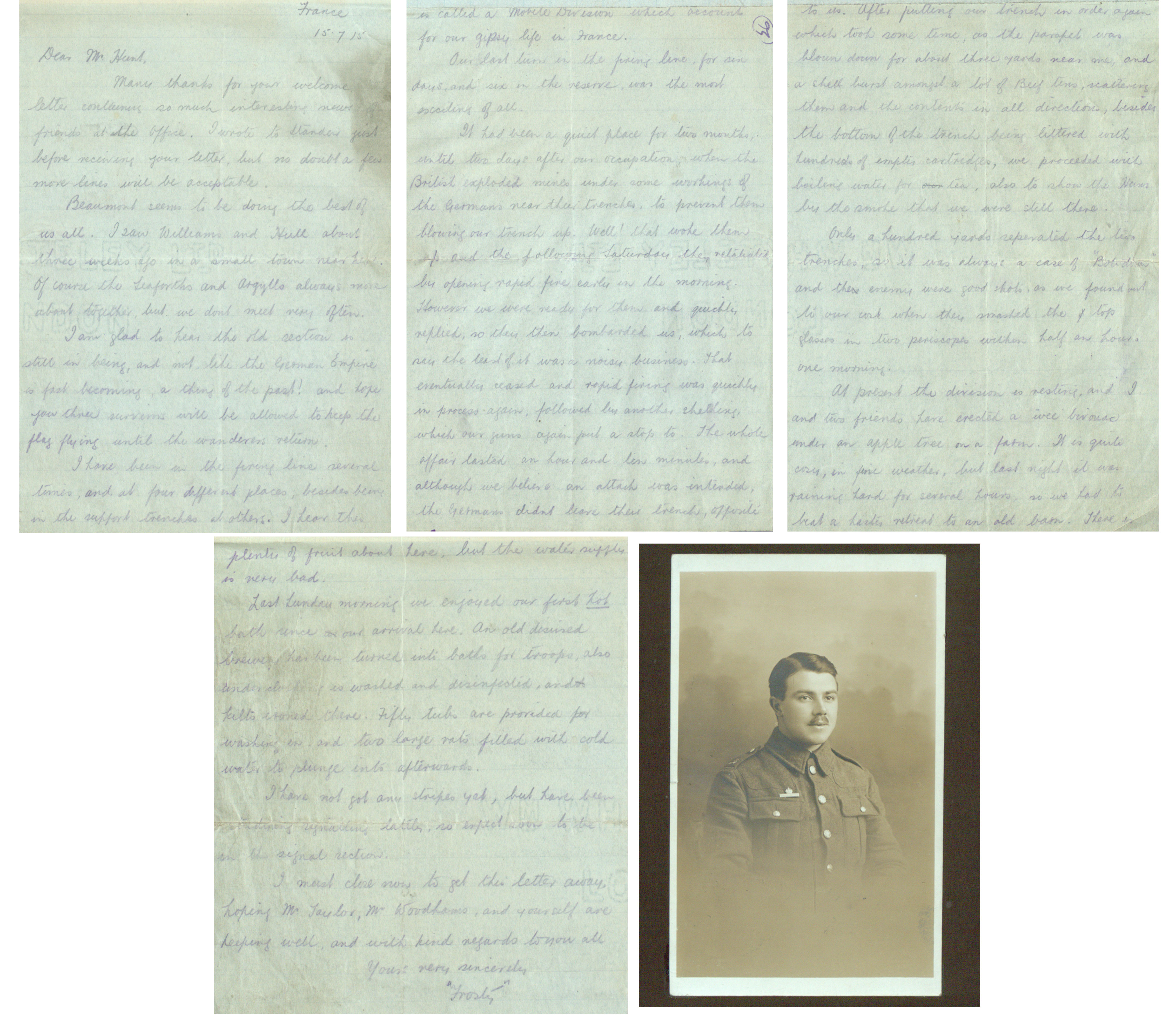
This is one of many letters sent by staff of the Great Western Railway Audit office at Paddington who had enlisted to fight in the First World War. (RAIL 253/516)
R.C.S. Frost, 15 July 1915, France. Born: 30 January 1888, Regiment: 8th Argyll and Sutherland Highlanders; Duke of Cornwall’s Light Infantry, Regiment number: 1998; 300470, Rank: Private; Second Lieutenant, Died: 1962
Transcript
Dear Mr Hunt
Many thanks for your welcome letter volunteering so much interesting news of friends at the office. I wrote to Standew just before receiving your letter, but no doubt a few more lines will be acceptable.
Beaumont seems to be doing the best of us all. I saw Williams and Hull about three weeks ago in a small town near here. Of course the Seaforths and Argylls (regiments) always move about together, but we don’t meet very often. I am glad to hear the old section is still in being, and not like the German Empire is fast becoming a thing of the past! And hope your three survivors will be allowed to keep the flag flying until the wanderers return.
I have been in the firing line several times, and at four different places, besides being in the support trenches at others. I hear this is called a mobile division which accounts for our gipsy life in France.
Our last turn in the firing line, for six days and six in the reserve was the most exciting of all.
It has been a quiet place for two months, until two days after our occupation, when the British exploded mines under some workings of the Germans near their trenches, to prevent them blowing our trench up. Well! That woke them up and the following Saturday they retaliated by opening rapid fire early in the morning.
However we were ready for them and quickly replied, so they then bombarded us, which to say the least of it was a noisy business. That eventually ceased and rapid firing was quickly in process again, followed by another shelling, which our guns again put a stop to. The whole affair lasted an hour and ten minutes, and although we believe an attack was intended, the Germans didn’t leave their trench, opposite to us. After putting our trench in order again which took some time, as the parapet was blown down for about three yards near me, and a shell burst amongst a lot of beef tins, scattering them and the contents in all directions, besides the bottom of the trench being littered with hundreds of empty cartridges, we proceeded with boiling water for tea, also to show the Huns by the smoke that we were still there. Only a hundred yards separated the two trenches, so it was always a case of “bob down” and the enemy were good shots, as we found out to our cost when they smashed the top glasses in two periscopes within half an hour one morning.
At present the division is resting, and I and two friends have erected a wee bivouac under an apple tree on a farm. It is quite cosy, in fine weather, but last night it was raining hard for several hours, so we had to beat a hasty retreat to an old barn. There is plenty of fruit about here, but the water supply is very bad.
Last Sunday morning we enjoyed our first hot bath since our arrival here. An old disused brewery has been turned into baths for troops, also under clothing is washed and disinfected, and kilts ironed there. Fifty tubs are provided for washing in and two large vats filled with cold water to plunge into afterwards.
I have not got any stripes yet, but have been studying signalling lately, so expect soon to be in the signal section.
I must close now to get this letter away, hoping Mr Taylor, Mr Woodhams, and yourself are keeping well, and with kind regards to you all.
Yours very sincerely,
‘Frosty’

This is one of many letters sent by staff of the Great Western Railway Audit office at Paddington who had enlisted to fight in the First World War. (RAIL 253/516)
Albert Edwin Rippington, undated, England. Born: 21 November 1893, Regiment: 5th London Rifle Brigade, discharged due to injury November 1917, Died: 1982
Transcript
Dear Ernie,
Thanks very much for your letter and kind wishes. My wounds are getting on all right and they have discovered eleven in all. It is hard not to be able to get up, but I suppose a month will soon be slip by. My people came to see me yesterday and the day before.
You ought to see my face. They cannot shave me because I have scraps of shell sticking in, and as I had not had a shave for about a week before I was wounded, I look a pretty picture.
Well old chap, I am glad I am wounded to get out of that hell, and if you ever meet a chap that says he wants to go back call him a liar.
If you could manage to come down at any time I should be delighted. I have not received any letter from Dalton but perhaps will get it later. That will be the time old chap when I look into the office on my way home. We’ll manage to get a drink then. Well I must close now and I expect you will have quite enough trouble to read what I have written already. Hoping to be with you all,
Your old pal, Rip.
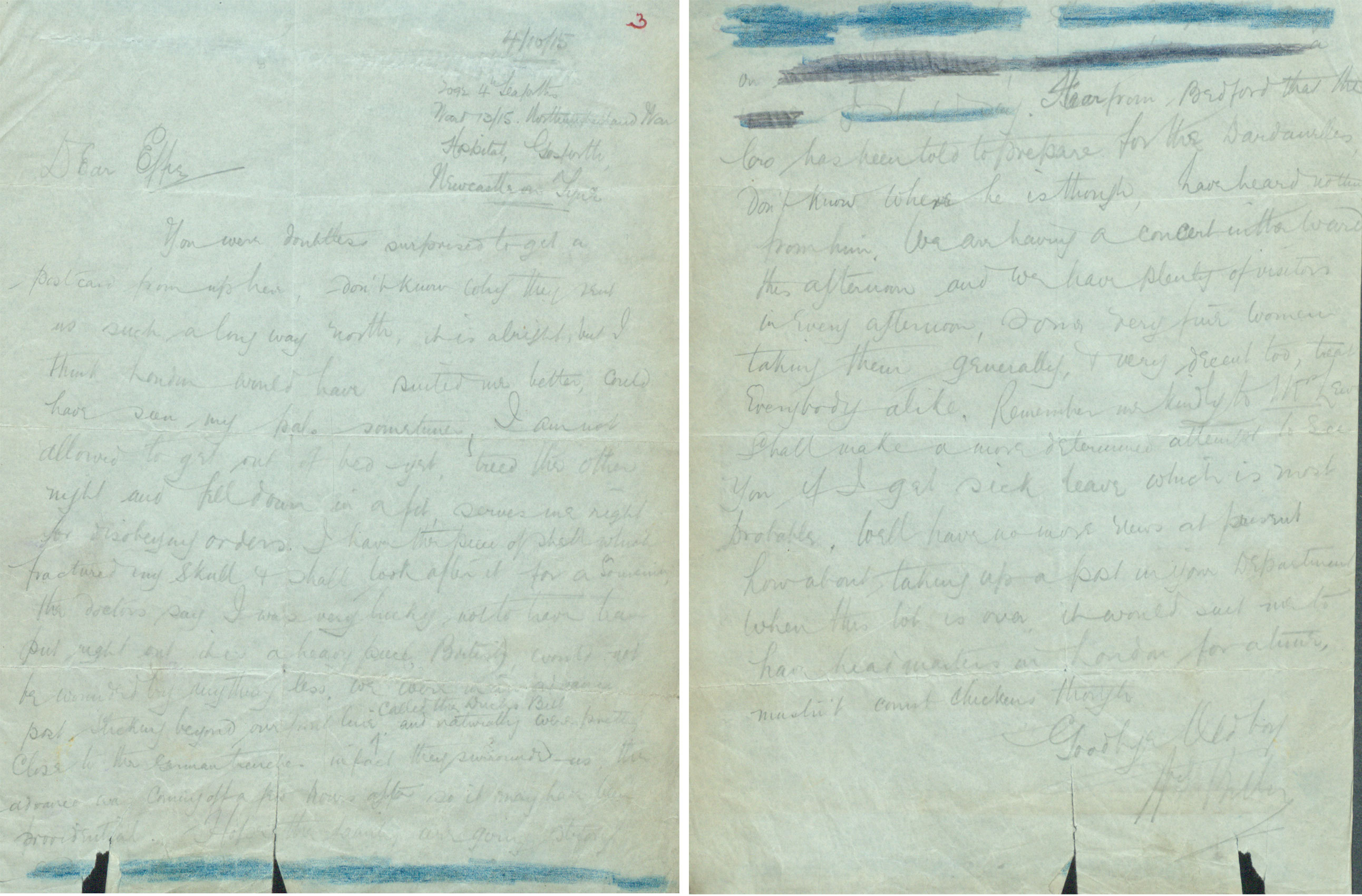
This is one of many letters sent by staff of the Great Western Railway Audit office at Paddington who had enlisted to fight in the First World War. (RAIL 253/516)
William Albert Hastings, 4 October 1915, Northumberland War Hospital, Newcastle. Born: 17 March 1888, Regiment: 4th Seaforth Highlanders, Regiment number: 2092, Rank: Sergeant, Died: 1937
Transcript
Dear Effie,
You were doubtless surprised to get a postcard from up here, don’t know why they sent us such a long way north, it is alright but I think London would have suited me better, could have seen my pals sometimes. I am not allowed to get out of bed yet, tried the other night and fell down in a fit serves me right for disobeying orders. I have the piece of shell which fractured my skull and shall look after it for a souvenir. The doctors say I was very lucky not to have been put right out. It was a heavy piece (British) would not have been wounded by anything less. We were in an advanced post sticking beyond our front line called the “Duck’s Bill” and naturally pretty close to the German trenches. In fact they surrounded us… [Lines censored]
I hear from Bedford that the company has been told to prepare for the Dardanelles. I don’t know where he is though, have heard nothing from him. We are having a concert with our ward this afternoon and we have plenty of visitors in every afternoon, some very fair women taking them generally, and very decent too, treat everybody alike. Remember me kindly to Mrs Lewis. I shall make a more determined attempt to see you if I get a sick leave which is most probable. Well, have no more news at present. How about taking up a post in your department when this lot is over, it would suit me to have headquarters in London for a time, mustn’t count chickens though. Goodbye Old boy,
regards,
Billy

This is one of many letters sent by staff of the Great Western Railway (GWR) Audit office at Paddington who had enlisted to fight in the First World War. This letter was typed out and circulated in the Audit office. (RAIL 253/516)
Charles Douglas Mayo, 22 October 1915, Courtrai, Belgium. Born: 30 June 1893, Regiment: Artists’ Rifles; 2nd Royal Scots Regiment, Rank: Lieutenant; 2nd Lieutenant, Retired: Resigned 17 February 1919, but seems to have re-joined GWR on 17 November 1924 and subsequently retired on 16 April 1955
Transcript
Dear Father,
I do hope you and mother have not been worrying much about me as I am getting on all right. My wound is well now and the broken bone is my only trouble- the two ends took the wrong turning first time so a couple of days ago they put them on the right road again. I ought not to be left with a short leg as there is about 40lb weight on the end of it, in fact I should not be surprised if it finishes off ahead of the other. One good thing is I get very little pain except when I am moved.
Did you get my postcard? I haven’t had an answer yet but expect letters take a long while. I believe I asked you to send me some fruit but as things take such a long while to get here I am afraid it would be bad, besides they take French money here, and as I drew £5 from the Field Cashier only a few days before I was wounded I am quite well off and the orderly will buy fruit for me in the town.
I expect you are surprised to get a letter when I said on the post card that I should only be allowed to write once from this hospital, but a fresh order has come out and one letter a month is allowed.
Well, I have written quite enough about myself I think. I am longing to get a letter from you and mother, it seems ages since I heard from you. Have you taken a house in Uxbridge yet or are you waiting until Auntie and Uncle move there. I do hope you are getting a little more used to the lonely house. Please remember me to everybody and give my love to all relations next time you write and tell them I should like to hear from them if they would write although I shan’t be able to answer their letters. Have you heard how Frank is getting on, I meant to write him but put it off too long.
I expect my kit has been sent home, hasn’t it? I am afraid your field glasses are lost as I left my equipment in the wood when I was hit. I am awfully sorry if they are but perhaps one of the men picked them up. I arrived here with only one boot and only one puttee, so will you send me a pair of puttees and a tie out of my kit. I shall be supplied with boots when I leave here, which won’t be for a while I expect. One thing I shall be very glad to get will be some books.
We are very well treated here, and the Belgian sisters from the convent are very good and often bring us grapes or apples.
I didn’t get a very long run for my money, did I? It is rotten being out of the show, not that I wanted the war to last long, far from it, but while it was on I liked to have a finger in the pie, but it is no good grumbling and the best thing to do is to hope it will soon be over so that I can soon be home with you both again. Please give my kind regards to Kate. Very best, love to you both. Cheer up and don’t worry about me.
Your loving son, (2nd Lieutenant Mayo)
Charlie.
P.S. I hope you can read this, it is awkward writing lying down.
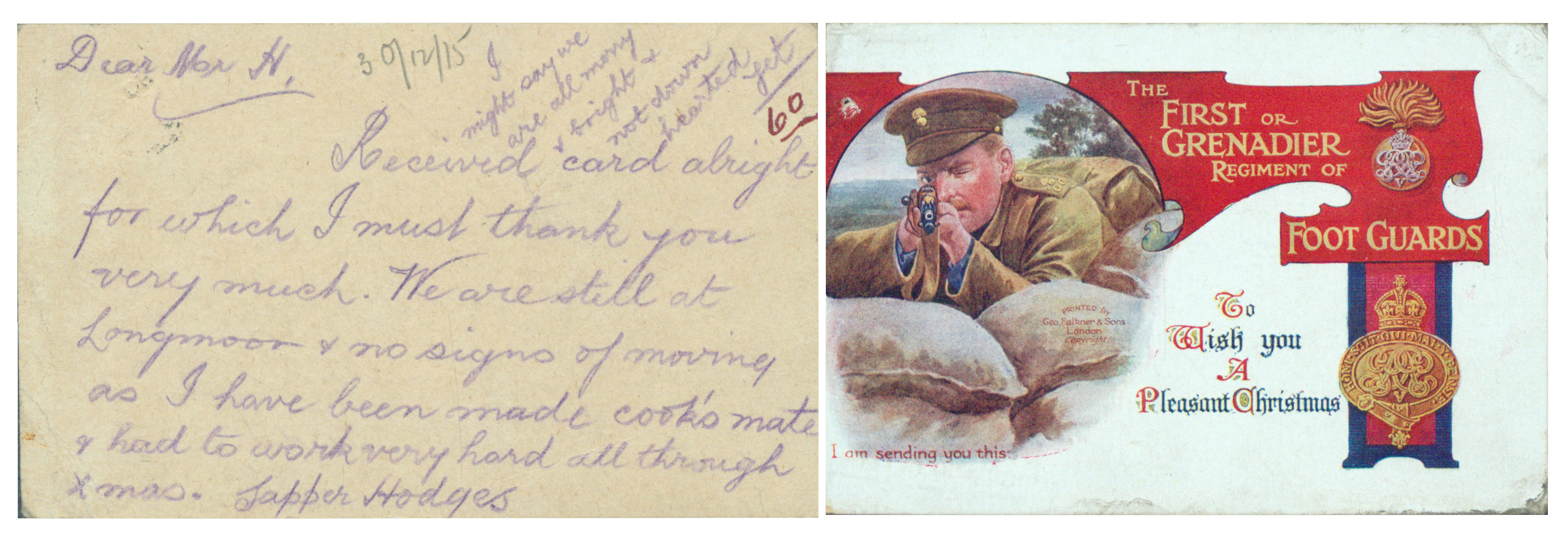
This is one of many letters sent by staff of the Great Western Railway Audit office at Paddington who had enlisted to fight in the First World War. (RAIL 253/516)
Sidney Broad Hodges, 30 December 1915, Longmoor, England. Born: 7 January 1884, Regiment: Royal Engineers, Railway Troop, Regiment number: 138032, Rank: Sapper, Died: 1956
Transcript
I might say we are all merry and bright and not down hearted yet.
Dear Mr Hunt,
Received card alright for which I must thank you very much. We are still at Longmoor and no signs of moving as I have been made cook’s mate and had to work very hard all through Xmas.
Sapper Hodges
Front of postcard:
I am sending you this
THE FIRST OR GRENADIER REGIMENT OF
FOOT GUARDS
To
Wish you
A
Pleasant Christmas

This is one of many letters sent by staff of the Great Western Railway (GWR) Audit office at Paddington who had enlisted to fight in the First World War. (RAIL 253/516)
Nicholas Boyce, 9 November 1915, Longmoor Camp, England. Born: 21 October 1879, Joined GWR: 10 February 1896, Regiment: Railway Troop, Royal Engineers, Regiment number: 138015, Rank: Sapper, Retired: October 1939
Transcript
Dear Lack,
Many thanks for the photographs received. We all think they are good and on Saturday the six of us had out photo taken here in a similar position– in khaki. The two pictures together should make a lasting memento.
We have had little spare time since we have been training here. Having been through company drill mixed with route marches, physical drill, semaphore, knot tying and frog, long jumping etc. Some of our men were able to go to town on Saturday… but I myself with a few others have been under orders for overseas service now waiting to proceed, so popping up town seems out of the question for us. We are numbered in alphabetical order, and in the order we are sent out. We are now fully equipped. I enclose … postage for the photographs. If you are printing any more you might save me one as I am afraid I have spoilt mine, it got bent in my overcoat pocket on Saturday. Please remember me to all at the office…
N. Boyce
Photo captions:
Before joining H. M. Forces
(Left to Right)
A.E. Kirk, Boyee N. Hodges S.B. Bright E. Robertson D.J. Russell M.A.
After

This is one of many letters sent by staff of the Great Western Railway (GWR) Audit office at Paddington who had enlisted to fight in the First World War. (RAIL 253/516)
Ernest William Bratchell, undated, France. Born: 28 July 1893, Joined GWR: 3 February 1908, Regiment: 1/3 (City of London) Battalion (Royal Fusiliers), Regiment number: 2176, Rank: Private, Died: 1969
Transcript
Dear Burgie,
Was very glad indeed to get your letters although, your news in regard to Joe [Chamberlain] comes as a shock. It was the first I had heard of him since he arrived in France in spite of the fact his regiment being quite close. Am afraid the 9th and few days following were rotten days for a good many battalions, our lot as much as any. We have been “in” since the 8th and have had a fairly trying time we were reinforced during this week, not before time as we were down to our last two hundred. Can’t tell how sorry I am to hear about Joe as you say he was “one of the best”. I hope you chaps have not been annoyed at my not answering your very welcome letters. I don’t pride myself much on writing good yarns though and opportunities are also hard to find. As you know I had a bit of a knock at Neuve Chappell but have quite got over that and am now in the best of health and spirits. I came across Len Phillips and Peter Hawes in different drafts of the London Scottish while down at Rouen both of them have now had some experience on the job I expect. Thank Mr Drewe very much for making inquiries, tell him I occasionally wish heartily to be on the old job again the quiet life will do for me after this. No I did not get Dick’s magazine or letter expect it went astray while I was in hospital. Thank him very much for sending them will you. Had a game of football about two weeks ago with R.G.A.* Battery, the pitch being a serious drawback. I think it was a cabbage patch. Still we managed to get a good game in and most important of all, won. The weather here has on the whole been very good just lately only getting an occasional day’s rain. Last night we had a sharp thunderstorm, a new experience it had at least the effect of shutting all the other disturbances of our rest up so we did not grouse. Much obliged for all the information re the other fellows. Am glad most of them are getting on so well. Peacock seems to have come out top dog. The job alone from other examples seems to be a paying one, leaving out the holiday in Scotland. Well must close my epistle. Please remember me to Dick, Mr Horsley, Ransley and Drewe, Fox. Hoping both they, and yourself are, like myself O.K. [Line censored]. From yours faithfully,
E.W. Bratchell

This is one of many letters sent by staff of the Great Western Railway Audit office at Paddington who had enlisted to fight in the First World War. (RAIL 253/516)
R.C.S. Frost, 6 July 1915, France. Born: 30 January 1888, Regiment: 8th Argyll and Sutherland Highlanders; Duke of Cornwall’s Light Infantry, Regiment number: 1998; 300470, Rank: Private; Second Lieutenant, Died: 1962
Transcript (extracts)
… This trench of ours is a model in its own way, being fairly safe, and connected by good communication trenches. The Commanding Officer’s house of white sandbags is fitted with window, curtains, and window box with pansies in it. It is furnished with table and chairs also a large mirror. Of course this is quite a ‘one occasion’ affair and don’t imagine we are here town planning with model dwellings etc! But it will show you how soldiers can adapt themselves to circumstances. At the back of our trench is ripening corn and plenty of wildflowers in bloom.
We have also canaries in cages in the trench! But these are used by the miners for testing the air in the mines after the explosion, to see if it was possible to finish off their job. [Censored line] captured from the Germans a short time ago and during the stay we were kept busy with sandbags etc. and at night of course had to especially watch the enemy.
When in the reserve or support trenches fatigue work has to be done every night, such as carrying food, ammunition, material for the engineers etc. to the firing line, so you can guess it is nothing but continual ‘bob’ work (odd jobs).

This is one of many letters sent by staff of the Great Western Railway Audit office at Paddington who had enlisted to fight in the First World War. This letter was typed out so that it could be circulated in the office where Effie (F.E. Lewis) worked. (RAIL 253/516)
William Albert Hastings, 11 July 1915, France. Born: 17 March 1888, Regiment: 4th Seaforth Highlanders, Regiment number: 2092, Rank: Sergeant, Died: 1937
Transcript
Dear Effie,
Very pleased to receive your letter, like yourself I find my correspondence voluminous for me at times, especially since I have taken on the duties of Platoon Sergeant which takes up more time than one realises at first. We are still in the trenches and have been in action twenty four days consecutively and I don’t know long we shall keep it up. Had a dirty time yesterday morning dodging damned great bombs the blighters were presenting to us without exaggeration they were eighteen inches to a two feet long and made a hole about ten feet deep and fifteen feet diameter at least we did not wait to see them burst. They can be seen descending through the air and then a scoot is made to get as far as possible round the corner, the iron and dirt seem to be falling for a minute afterwards, they are disturbing. Dicky Gilson has not been with us the last twenty four days, he broke his glasses and would not buy new ones (went to the doctor and all that and worked the oracle and was left behind with the Transport, don’t know whether he worked the ticket properly and got a safer job farther back, should not blame him if he has, his nerves have been in a shocking state, he’d brood a lot as you know that is absolutely fatal when you have a dirty job on like this. I have not seen either Frost or Kemball out here, do not seem to meet anybody fresh as we are always in the same district and relieve the same crowds generally.
Our pals the French in my opinion scrap jolly well except in the isolated instances which are given undue prominence by our chaps by prejudice probably. The casualties have certainly been enormous but a lot of them are a week old and one cannot form any opinion of what is going on by the lists, and I should not be allowed to say what I thought of our doings lately. Cronin is still with the 5th Bedfordshires and not out yet, I think not likely to be in all probability. Only wish we could repeat our swimming performance off Penarth ‘specially the Wednesday evening ones. Have heard rumours of leave being given shortly but do not rely much on it, have been offered a Commission in this Battalion and I may take it up if my papers go through satisfactorily.
Kindest regards and wishes to Mrs Lewis,
Your old Pal,
Billy

This is one of many letters sent by staff of the Great Western Railway Audit office at Paddington who had enlisted to fight in the First World War. This letter was typed out and circulated in the Audit office. (RAIL 253/516)
Thomas Harold Watts, 18 June 1915, Dardanelles. Born: 28 August 1884, Regiment: Drakes Battalion, Royal Naval Volunteer Reserve, Died: 11 September 1953
Transcript
Dear Arthur,
I expect you are wondering why I have not written, but it is an awful effort to get all correspondence off, and be on active service at the same time. I can’t say that I am enjoying myself out here. It’s awfully hot, and we are eaten up by millions of flies. Life in the trenches is not a picnic either we have about four or five days out of them and eight or nine in them. When we are out supposed to be resting, we have to go on working parties, digging etc., then wherever we are, we are always under shell fire, so it’s not much rest after all. The last shell we had in camp, there was four killed and seventeen wounded.
We have been under fire for three months now, and we should like a rest as the strain is tremendous on one’s nerves. I don’t think the troops in France get it quite as bad. Then again, the only comforts we have are sent from home, as the country here is quite barren, and we cannot buy anything in shops, I would give a quid for a pint of beer down the club. Our food consists of half a loaf of bread per day, bacon and tea for breakfast, Bully beef and biscuits for dinner and Jam for tea and cheese. Lime juice is served out about four times per week, that is a drop is put into a dixie of water and a cup full served out per man, and rum is served out twice a week (sometimes) that is about four table spoonful each.
We live in a trench and it is a mercy it don’t rain otherwise we’d be washed away. The fighting just lately has been terrible. Our shells knock the enemy all ways and the sight in the trenches that we take is awful. We wear our respirators because of the awful smell of the dead. I’ll never get the sight out of my eyes, and it will be an everlasting nightmare. If I am spared to come home, I’ll be able to tell you all about it, but I cannot possibly write as words fail me. I can’t describe things.
Wouldn’t it be nice to be at Walmer again and you come down and see me again, I did enjoy that time, and also seeing Billy Dawson and Richardson. There seem to be a lot of French troops out here, but there seems to be no relief for us. Nobody loves us now Churchill has gone, we are nobody’s pets. It’s the army first here, except when there is work to be done, and then the Naval Division have to do it. You know both my brothers have commissions in the 4th Bedfordshires and are at Dovercourt. My wife tells me she has sent me three boxes of stuff, I received one box, and I fear that one transport has been floundered [sunk] and another has been torpedoed, so I expect that is where my other two boxes are. It’s awfully disappointing because I do look forward so to a bit of chocolate and a few biscuits from home. We get cigarettes and baccy served out to us, but it is too hot to smoke much, so that I don’t miss that so much. I get a bath in a biscuit tin when I can, but when in the trenches I have to go all the time without a wash, so you can tell I am used to being dirty.
How are they all down the club, and is Emmie still there, and is she better or not? Is Paice going to Looe this year? And where are you spending your holidays? Lord how I’d like a holiday, I am so tired and would give anything to get away from this continual banging.
Please remember me to all fellows who are left in the office. Mr Miller and Goff & Hills and George Williams, and all the boys generally. I can’t write to all separately, also for details of my experiences you must wait until I get back, if ever I do, of which sometimes I despair.
The papers tell you pretty full accounts, although they are rather anticipating events as to our advancing. Now I must close old chap, and thank you very much for all your kindness. Wishing you all the best
Yours very sincerely,
Harold Watts.
Photo caption: Excavating new dug-outs at the Dardanelles.