
This is one of many letters sent by staff of the Great Western Railway Audit office at Paddington who had enlisted to fight in the First World War. Image shows part of letter. (RAIL 253/516)
Gilbert Williams, 16 November 1915, France. Born: 18 April 1894, Regiment: 1/6 Seaforth Highlanders, Regiment number: 2175, Rank: Private, Died: 1967
Note: Williams also fought in the Second World War, returning from war on 15 November 1948
Transcript
Dear Mr Hunt,
Please accept yourself and convey to the other gentlemen my best thanks for the State Express cigarettes. They are fine. Oh what a picnic it is in the trenches just now. We have been in the trenches 10 days up to now, and except for the last two days it has been raining almost steadily. The result is mud, mud and yet more mud, knee deep in places. But luckily we have long top boots from trench wear, so that the mud does not worry as much, except that is making our feet as cold as ice… We have been issued with fur jackets so we can keep our bodies warm.
Just now the whole countryside is covered with snow and moving objects are distinguishable a long distance off. For instance this morning when I was on duty with the gun I could see the Germans walking down a road away behind their lines. I had several bursts at them with the gun but they were out of range. Made me damned mad I can tell you seeing the blighters and then not being able to lay them out.
You can’t realise the power one seems to possess when handling a Maxim. Personally I feel as if I could lay out the whole German army. We fire about a couple of thousand rounds every night into Fritz’s trenches just to keep them quiet. They (the Germans) have been trying to find the gun, both with their Maxims and with shells, but up to now, they’ve not succeed. Kind regards to everybody. Yours very sincerely,
Gilbert Williams.
Photo caption: Private G. Williams
6th Seaforth Highlanders.
Now serving in Flanders.

This is one of many letters sent by staff of the Great Western Railway Audit office at Paddington who had enlisted to fight in the First World War. Image shows part of letter (RAIL 253/516)
Edward Henry Cecil Stewart, undated, France. Born: 13 November 1891, Regiment: 1/5 Grenadier Company, London Rifle Brigade, Regiment number: 1167; 300717, Rank: Private, Died: 1 July 1916
Transcript
Extract
… As long as you kept your head down you were comparatively safe, so as it went on, this was where I had my first escape. I was on sentry duty for a couple of hours, from 1am to 3am and was instructed to keep a sharp look out. I did not care for the idea of keeping my head above the trench and looking for beastly Germans, however it had to be done, it was quite uncanny to watch the enemy trench which appeared somewhat like a black wave and only sixty yards in front, then you would suddenly see the flash of their rifles and machine guns immediately after would come the report and nasty thuds on the sandbags which you might be resting against. I fired about five shots at their flashes (the only target to aim at) then another two shells which lodged in the parapet either side of my head leaving about 2 to 3 inches between me and certain death. I thought that near enough but it turned out that it was to have something nearer than that. Our casualties here amounted on the average, to about two per day killed, of course, we thought it terrible at the time at least I did.
Early April saw us relieved by another division and we were sent a few miles back for a well-earned rest, which consisted of physical drill and a run before breakfast. The remainder of the morning being spent in platoon drill musketry drills. After dinner we put the “cap on” our rest (why so called I do not know) by having a route march for two hours. We spent a few days like this and were dispatched with all possible speed to Ypres, here we went in to support the Canadians and spent a most unpleasant eight days, during which time we lost several hundred men, nearly all my friends who came out in the same draft and were killed or wounded, we had to retire, the best part being that the Germans did not find this out until two days after when we were more or less safely bivouacking in a very pretty wood. We stayed here for about a week; then we got to work again, digging reserve trenches just behind the front line, building up parapets which had been demolished by the enemy’s high explosive shells and such like, working all night and getting what sleep we could in the daytime. One morning we were awakened by the most awful din, it seemed as though hell had broken loose, shells were falling like summer rain. And people have often told me in the course of conversation it was raining shells and I admit I took it with a grain of salt, could not be possible I thought, but such I was surprised to find was possible and actually taking place there about 3.30am. This bombardment started and about half an hour later, I, with three others, were ordered to start reinforcing. We went up in fours, it being considered safer that way, half a mile over open ground we had to do, this being swept continually with shells, to give you a slight idea I can say the previous night, just in front of our reserve trenches was a beautifully green field, and the next morning it was as much as one could do to see any grass at all, simply one mass of craters, varying in diameter from ten to twelve paces.
I had gone about half the required distance when a shell fell only a yard from where I was, the force of the concussion [explosion] pitched me several yards to my left and I came down rather heavily, however I reached the first line without any further mishap, where we had to stay until midnight when we had to be relieved again owing to not having enough me to hold the trench. Our honours were one V.C. (Victoria Cross), two D.S.O. (Distinguished Service Orders), one Military Cross and one or two D.C.M. (Distinguished Conduct Medals).
The next day I paraded sick, my back paining me so much that I could not stand straight for a week after. I am now back with the regiment who are on the line of communications. We are having leave shortly and if possible will pay a visit to the Audit office. Have you any news of Chichester?
Yours truly,
(Rifleman) E.H.C. Stewart

This is one of many letters sent by staff of the Great Western Railway Audit office at Paddington who had enlisted to fight in the First World War. (RAIL 253/516)
Richard Gilson, 12 May 1915, France. Born: 20 September 1887, Regiment: 4th Seaforth Highlanders, Regiment number: 2076; 200415, Rank: Acting Colour Sergeant, Died: 1961
Transcript
My dear Mother,
Have just come through a particularly nasty period. We went into the trenches on Wednesday night and on Sunday morning at 5am our Artillery commenced bombarding the German trenches and after 20 minutes had elapsed we went over the parapet. My goodness what a reception the Huns had in store for us, they simply swept the ground with machine gun fire and shrapnel. Poor old ‘C’ coy. caught it hot and Neuve Chapelle seemed to be a fleabite compared with this. It was found impossible to make any advance in our quarter, so I dug myself in and awaited events. It was horrible suspense, as I seemed to be the only man untouched, all around me, and being personally acquainted with each man made matters worse, in fact, it’s all wrong to call them men, as they were mostly mere boys.
About early afternoon I was hailed from the trench as to whether it was possible for me to get back. I replied in the affirmative and decided to run the risk of getting potted on the way. So I commenced crawling on my stomach until about a few yards from the parapet, then made a spring and rushed headlong over the top, nearly spoiling the features of a few who happened to be in the trench and were not expecting me. We were relieved that afternoon, but some of the fellows did not get in until nightfall and these experienced another bombardment… Billy Hastings is quite fit and the only pal left. We have been resting since and getting information about the (illegible) but by all reports we shall be up again soon. No rest for the wicked it is said, and if true we must surely be a bad lot.
What a terrible thing about the Lusitania, and with so many Americans aboard. Should imagine there will be more trouble. Have received box and letter dated 6th and am most thankful for everything you are all doing for me. (censored.)
As regards the pads, (masks of cotton pads which served as gas masks), all we were served out with were made ‘on the spot’ and consisted of a piece of gauze and tape and were steeped in a solution of bicarbonate of soda, prior to this charge. I lost all my belongings except the Gillette (razor) so should be glad of a few toilet requisites when next you are sending a parcel. Do not trouble about towel and perhaps Frank would get me a shaving brush. Must now close. Much love to all. From your affectionate son,
Dick

This is one of many letters sent by staff of the Great Western Railway Audit office at Paddington who had enlisted to fight in the First World War. Image shows part of letter. (RAIL 253/516)
George Shipley, 8 November 1915, Gallipoli, Turkey. Born: 18 August 1878, Regiment: 10 Middlesex Regiment, Regiment number: 2594, Rank: Company Sergeant Major, Died: 2 December 1915
Transcript
Dear Nic (Boyce),
Thanks very much for your interesting letter… I wondered when I would hear from someone at the office. Also many thanks for your good wishes and congratulations on my marriage which I have conveyed to my wife. I am sure she will thank you all very much.
Well to tell you a little about our experiences, we started off mysteriously one Sunday from Devonport on the captured German liner Derflinger, not a bad boat. The Warrant Officers had 2nd class quarters it was all right. Food was very fair. Submarine pickets* every night for one of the four companies, lights out… at seven or half past. Stole by Gibraltar at night in a fog expecting it to be torpedoed. We did reach Malta in due course after skirting north African coast, spent a day there, went ashore, had a few drinks which we needed being very hot and then on to Alexandria for three days, ashore every night, not a bad place, of course the lower men didn’t go, except for a route march on the Saturday. Our movements were kept very secret and we couldn’t find out what was to be done with our division, we then pushed to Port Said and had a day there. All of a sudden, we received orders to sail and soon found we were off to Gallipoli as we were passing through the Aegean sea, which is as you know full of pretty islands. Some hours before reaching Lemnos, the naval guns could be heard booming and we ran into the magnificent harbour there full of shipping and life. After a day there, we pushed on to Imbros 4½ miles from Sulva Bay during the afternoon they treated us to a naval shelling of Achi Baba, which is really the other side of the peninsula, but they shoot over the hills and mountains here. It was a fine sight and many of our chaps went sick at once. At night (Sunday 9/8/15) our good ship made for Anafarta Bay where a new landing had been effected two days before. 900 rounds, four days’ rations each, as much as a man is expected to carry and they dumped us over the side in lighters [a type of flat-bottomed barge] at 7am, a short journey through the boom defences and we were ashore waiting for something to turn up.
Bivouacked on the beach and were put on unloading lighters till about 10 when the Turks spotted us and started shelling, two men killed and four wounded to start with and we lost a few more, wounded during the day although naturally we took what cover we could. I had one or two near me whilst getting a timber out of the hold of a lighter but managed to dodge them all right. At night my company received orders to take picks and shovels up into the firing line which was about five miles away half way up Chocolate Hill… Well Nic the 10th were soon in the thick of it as we advanced across the salt lake in extended order.
Rifle fire now we had to dodge and many of our chaps got hit rather seriously I have since found out. I was glad of a rest at the foot of the hill but had to push on again and deliver the goods, after feeling about in the dark for some time our guide led us in single file up behind the firing line, where we laid down, bullets were whistling round but we managed to escape them… The enemy were yelling for all they were worth and I was glad when our captain ordered us down again to the beach. This took us some hours and when we reached the place, the other three had gone up to reinforce the firing line, so up we went again the next day about 6pm, nearly all things are done here in the dark as we are in view all the time. We again advanced across the take from Lala Baba, my heels were nearly raw through new boots and I eventually had to rest for a fortnight later on. Well on our right was a hill burning furiously with many a chap caught in the flames and so perishing (not our regiment).
We finished on rather a feathered bed and did not find the other Company ‘til next day, it was a night, we were all parched with the heat, and no water. Dried up and had to dig ourselves in, it’s no light job this hiding being… like an ostrich, ‘til you make a hole large enough to get into and make yourself head cover.
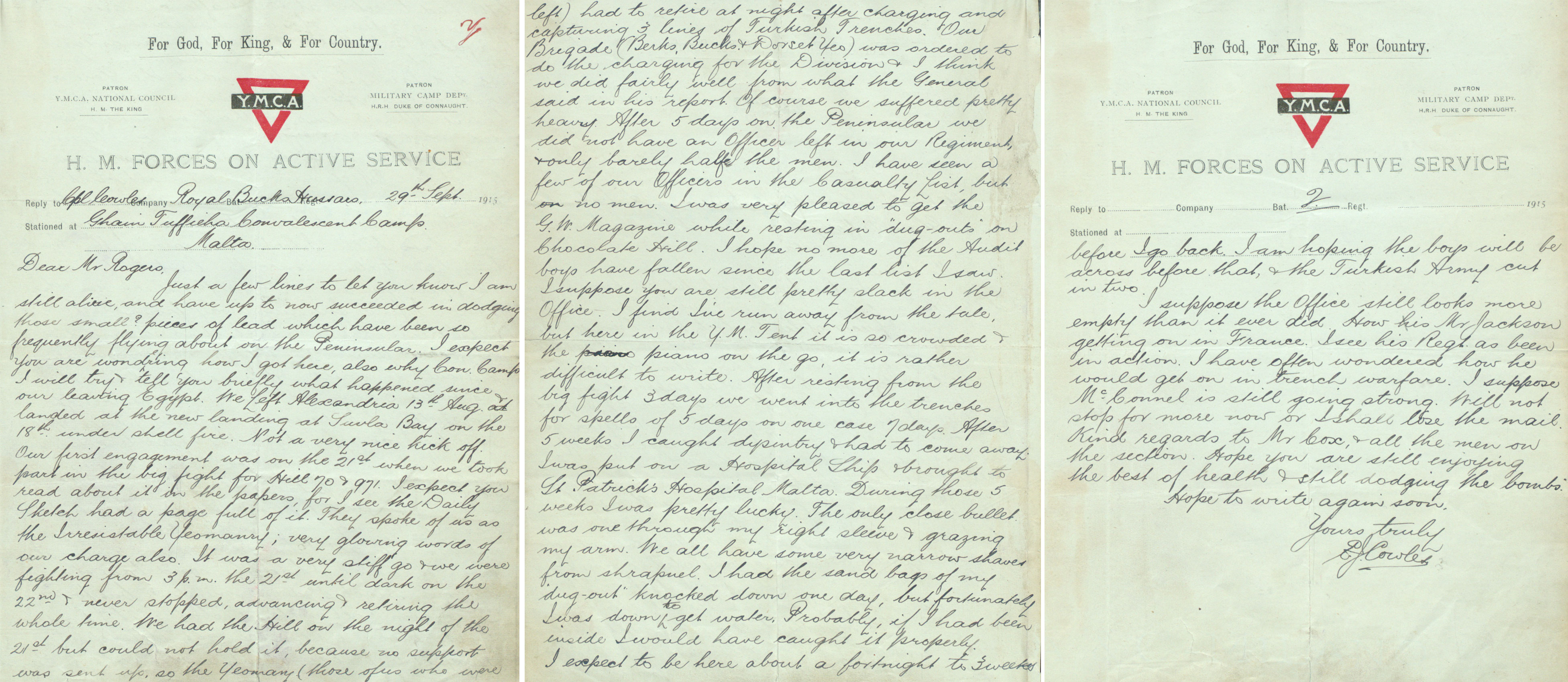
This is one of many letters sent by staff of the Great Western Railway (GWR) Audit office at Paddington who had enlisted to fight in the First World War. (RAIL 253/516)
Ernest John Cowles, 29 September 1915, Malta. Born: 8 August 1893, Joined GWR: 29 June 1903, Regiment: Royal Buckinghamshire Hussars; Royal Army Medical Corps, Regiment number: 713; 434085, Rank: Corporal, Died: 1967
Transcript
Dear Mr Rogers,
Just a few lines to let you know I am still alive and have up to now succeeded in dodging those small pieces of lead which have been so frequently flying about the Peninsular [Dardanelles]. I expect you are wondering how I got here, also why Con. [convalescent] Camp. I will try and tell you briefly what happened since our leaving Egypt. We left Alexandria 13th August and landed at the new landing at Sulva Bay on the 18th under shell fire. Not a very nice kick off. Our first engagement was on the 21st when we took part in the big fight for Hill 70 and 971. I expect you read about it in the papers, for I see the Daily Sketch had a page full of it. They spoke of us as the Irresistable Yeomanry; very glowing words of our charge also. It was a very stiff go and we were fighting from 3pm the 21st until dark on the 22nd and never stopped advancing and retiring the whole time. We had the Hill on the night of the 21st but could not hold it, because no support was sent up, so the Yeomanry (those of us who were left) had to retire at night after charging and capturing three lines of Turkish trenches. Our Brigade (Berkshire, Buckinghamshire and Dorset Yeomanry) was ordered to do the charging for the Division and I think we did fairly well from what the General said in his report. Of course we suffered pretty heavy. After five days on the Peninsular we did not have an Officer left in our regiment, and only barely half the men. I have seen a few of our Officers in the casualty list, but no men. I was very pleased to get the GRW Magazine while resting in dugouts on Chocolate Hill. I hope no more of the Audit boys have fallen since the last I saw. I suppose you are still pretty slack in the office. I find I’ve run away from the tale, but here in the Y.M.C.A. tent it is so crowded and the piano on the go, it is rather difficult to write. After resting from the big fight three days we went into the trenches for spells of five days, on one case seven days. After five weeks I caught dysentery and had to come away. I was put on a hospital ship and brought to St. Patrick’s Hospital, Malta. During those five weeks I was pretty lucky. The only close bullet was one through my right sleeve and grazing my arm. We all have some very narrow shaves from shrapnel. I had the sandbags of my dugout knocked down one day, but fortunately I was down to get water. Probably, if I had been inside I would have caught it properly. I expect to be here about a fortnight to three weeks before I go back. I am hoping the boys will be across before that, and the Turkish army cut in two.
I suppose the office still looks more empty than it ever did. How is Mr Jackson getting on in France? I see his regiment has been in action. I have often wondered how he would get on in trench warfare. I suppose McConnel is still going strong. Will not stop for more now as I shall lose the mail. Kind regards to Mr Cox and all the men on the section. Hope you are still enjoying the best of health and still dodging the bombs. Hope to write again soon. Yours truly,
E.J. Cowles.

This is one of many letters sent by staff of the Great Western Railway Audit office at Paddington who had enlisted to fight in the First World War. (RAIL 253/516)
Thomas Harold Watts, 23 November 1915, Dardanelles, Turkey. Born: 28 August 1884, Regiment: Drakes Battalion, Royal Naval Volunteer Reserve, Died: 1953
Transcript
Dear Arthur,
I really must make this effort to write to you and let you know how I am progressing. Well so far as a little internal trouble I’m keeping fairly fit now that the cold weather has started, and on my present job I can doctor myself, I am prepared to stick this campaign until further orders.
We are now in our winter quarters and a very nice place it is. Right on the edge of the cliffs, with a beautiful sea below, it reminds me very much of Cornwall. Then just across is the island of Imbros, and the sunlight on those mountains is sometimes marvellous. On a quiet, warm day, with the birds singing, one wonders if there is a war on, but the blooming shells soon drive that idea away. It’s jolly cold now though, but we have been served out with nice thick underclothes, and waterproofs, and top boots and except for always living in the ground, our comforts have been looked after as far as possible. Our food is as good as anyone could want, also I’m now used to a lot that before I’d turn my nose up at, and so long as the ships can land the goods I don’t think we shall be so badly off.
Mind it does blow, and the sea gets awfully rough and then no ships can come near us. We have the sea on three sides and the Turks on the fourth, so we are truly between the devil and the deep sea. The Turks still find some ammunition from somewhere whether our guns and the warships knock the very dickens out of them. It’s very exciting to watch a battle especially now it’s on our side the guns are not like at Antwerp where we were the ones potted. Now I am too sleepy to continue and as the firing has quieted down I’m going to sleep and continue tomorrow.
5/12/15. I’ve not had a chance to finish this letter before, so here goes. We’ve had snow and rain and thunder and such lightening, and Lord it has been cold, everything frozen and even the water in my water bottle. But today has been beautifully mild and calm, almost like summer again. I have just received a packet of letters from my wife, written at different times since May, so am still in hopes that there may be some more back dates knocking around the world for me. We had three men killed last night in a little spasm, and today our guns and the Turks have been flinging dirt at each other. We used to duck once upon a time, as the shells came over, but now everyone seems curious to see what sort of a burst it will be and how much dust is knocked up, and heaps have cameras taking photos.
Enclosed is a bit of heather which grows in great profusion all over the peninsular. And the troops use in the trenches to boil their dixies on. And now about the office. Do you know but, it’s quite an effort to remember the routine now…
I suppose Mr Millow is still with you and is there any chance of H.R.H. Goff joining say as a S.C. (probably Senior Clerk)? There is now a singing in the air and bang just as I write they’ve dropped one over to us. Sometimes a shell bursts, and when we are working at something we don’t even know it’s come along. It’s funny what you can get used. But to get back to the office. I expect you have heaps of ladies there now, lord I haven’t seen a woman since April. What do they look like? I expect they scent out the office, and how careful you all must be not to swear. We often laugh here at the thought that if ever we do return to civil life again, we’ll be digging a little hole in the garden to live in and stirring up our tea with a bit of stick or our finger and just spit on the floor when smoking and if a little tickling in our shirt, just hopping it off in the street.
I am out of paper (he is writing this on envelope), but it don’t matter. How are the lambs going? Here’s one that’s doing a little doing a little bleat far from home. I’d like to come you know, and have a rub at a bed and a roof, also a drop of beer perchance. Living in a hole for seven months now and the blue sky above gets a bit monotonous at times especially when the dirt will persist in falling on your face when you are trying to sleep and when it rains you’re up to your knees in no time, and that’s always at night. We had rum served out tonight and do you know, I can’t bear the stuff, just pause and think by the wayside, I can’t drink rum, in fact I hate it. How we do change by time. Now how is everyone down the club? Remember me to Emmie and Mrs Fellows and May. I understand that Mr Welsh and Mr Davies have been awfully kind to my wife, and I reckon its jolly good of them. This war seems to have found me so many kind friends, I don’t know what I’ll do to repay them all if I live through this…
What has become of Beaumont and Jackson, and is my pal Jimmy Edwards still alive,… Bert I’d like to send you a Turkish shell but the post office won’t accept them for transit, anyhow perhaps I’ll bring home a nose fuse for a paper weight. Do you know back in the summer I had a shell drop just off the seat of my trousers and it did not explode. Kaw! It was a bit of luck, I didn’t stop to pick him up though, in case he changed his mind later. Well now I’ve tried to remember everyone, but do you give heartiest good wishes to the office for a Merry Xmas and a victorious New Year and trusting you’ll all be safe from Zeppelins. Yours very sincerely,
T. Harold Watts
Photo caption: The Mule Trench.

This is one of many letters sent by staff of the Great Western Railway (GWR) Audit office at Paddington who had enlisted to fight in the First World War. (RAIL 253/516)
Montague Percy Pond, 31 July 1915, France. Born: 13 September 1888, Joined GWR: 19 May 1904, Regiment: Railway Troop, Royal Engineers, Regiment number: 87749, Rank: Sapper, Died: Killed in action on 6 May 1917
Transcript
Dear Mr Hunt
Many thanks for your long and interesting letter which I was very pleased to receive. I am sorry I have been unable to answer it before but I have been constantly moving about from one place to another lately, and have had no opportunity of writing letters. Well I am very pleased to say I am feeling very fit and well, and quite enjoying the life. When writing to you last, I was attached to the 4th Division and was stationed at a small village where we were living in tents. We were stationed there about six weeks. Just over a week ago I was transferred to another place about eighty miles from the other one. I travelled by motor lorry with the Supply column and it took us all day from 7.30am till about 9 o’clock in the evening to do the journey. It was a glorious trip, the scenery being very fine. Almost as good as our office outing, only not quite such comfortable travelling. We put up for the night in a small village, sleeping in the lorry with some empty petrol cans for a bed. Next morning I was taken to the railhead where I was stationed until yesterday being only in that place just a week. While there we were all still sleeping in tents, but I was fortunate enough to have my meals with the Post Office Staff so have had a rest from being my own cook. Yesterday afternoon, just as I was going for my tea, I was sent for and told to pack up my things and catch a train to another railhead as I had to take charge as the A.M.F.O* for three Divisions there. As there is usually a man attached to each division, this was rather a large order. I only had about twenty miles or so to go, but it took from 5 o’clock till after 9pm to get there. These French trains are very rapid.
I am now attached to the 51st (Highland) Division, the same division as Williams, a number of his lot were here today, but he was not with them. We shall probably only be here for a few days and will then move to another village further on. I was very surprised to hear of Mr Pritchard’s death. I also heard that Mr Crossley is also dead. We are having glorious weather here at present and very hot at times. Glad to hear you are having a soft time on the old section.
I was very pleased to hear about the collection of letters and photos from the troops that you are sending round the office and will certainly send you a photo later on. I have has some taken but have not received them yet. Have you heard from Ferdie or Gray at all? We all had our photos taken at Longmoor before we came out here a group of six. Unfortunately, I only had a few copies and they have all been sent away. Ferdie and Gray are still at the Base, I believe, but Arthur Smith is at one of the railheads somewhere. Well I don’t think I can tell you any more news at present. Will write again later and send photo.
Kindest regards to all.
Yours sincerely,
M.P. Pond

This is one of many letters sent by staff of the Great Western Railway Audit office at Paddington who had enlisted to fight in the First World War. (RAIL 253/516)
Harry Beaumont, May 1915, Rawalpindi, India. Born: 17 October 1873, Regiment: 1/6 East Surrey Regiment, Regiment number: 2297, Rank: Quarter Master Sergeant, Died: 1952
Note: Beaumont was a member of volunteer army as a young man. He was a life governor of Richmond Hospital, London and held an MBE (Military Division)
Transcript
Dear Bertie,
Just a few lines to let you know how I am getting on. Am having the time of my life out here.
No doubt you have seen the several letters I have written to the office during the past few months, so will not go into further details, except to say that I have been exceedingly fortunate in seeing so much of India in a short time. I shall never forget my trip through the Khyber Pass which has since been the scene of hard fighting, one consequence of which we were hurriedly moved from Fyzabad to Rawalpindi in readiness to reinforce.
You would scarcely credit the feeling of disappointment that exists among the few British regular regiments left in India, over not being ordered to France to take their share in the war. The same feeling also exists in the Territorials… A dragoon then left a few weeks ago to replace heavy casualties among the Norfolk regiment at the Gulf.
As the hot weather commenced the latter part of April, and as many British troops as possible are always sent to the hills (being almost unbearable on the plains), we are fortunate enough to go, and had a three days’ march and climb to this place 8,000 feet up. Well I never in any wild stretch of imagination ever dreamed that I should be soldiering in the Himalayan mountains.
Kuldana, although 8,000 feet up is on the lower Himalaya, and from my bungalow, which is situated on the edge of a steep precipice, I can see lovely views which words fail to describe, a perfect mixture of Devonshire, Scotch and Alpine scenery. Although seemingly only a few miles off, the higher snow clad ranges in full view are from 100 to 150 miles away. I have about 1½ miles trek to our Sergeant’s mess, through beautiful scenery, lovely wild rose bushes climbing up giant pink trees, smothering them in roses, maiden hair fern and all kinds of pretty flowers in the woods. The climate is perfect, lovely English summer weather, with delightful mountain breezes. The heat in India has not distressed me in the least, not even on long arduous marches. I am feeling splendidly fit and well, and trust I shall continue so. We have no end of gaiety; all the married families of the Yorkshire regiment are living in our barracks under our charge, (as their regiments had to remain behind at Pindi, and are being bitten to death almost with mosquitoes.) So we have Cinderella dances about three times a week, whist drives, racquet and tennis parties and have most enjoyable times.
I wish May and Eileen could take an aeroplane trip of a few hours and get to me, it would be ripping for them. I should be glad to hear that you had called to see them on your promised visit of months ago when I was home, they would be awfully glad to see you both. Do drop them a card old boy. Fancy it is 10 months ago today since I left to go to camp, what a lot has transpired since then. I was in the 8th Middlesex 12 months ago, and I see they have lost heavily in France, funny I should have left them, and joined the 6th East Surrey and to pass them at Gibraltar (where they were first) on my way to India.
On the whole I am enjoying life in India immensely; I am acting Company Sergeant Major now, and expect to be promoted to the rank shortly. We are all ‘Tommies’ now. Trusting you are both fit and well. Remember me to Stacey. Yours sincerely,
H. Beaumont
Photo caption: Sergeant Beaumont.

This is one of many letters sent by staff of the Great Western Railway Audit office at Paddington who had enlisted to fight in the First World War. Image shows part of letter. (RAIL 253/516)
James Walter Hyam, undated, England. Born: 24 July 1891, Regiment: 11 Hussars, C. Squadron; Royal Field Artillery; Royal Garrison Artillery, Regiment number: 223725; 184963, Rank: Gunner, Died: 1951
Transcript (extracts)
Dear Bertie,
Many thanks for letters and fags both were very acceptable as you can imagine for it bucks one up to hear from old associates. I also had a letter from “Tinker” Taylor who told me Gwen has left the Great Western Railway Company. I will write to Ferdi [Ferdinand] and ask Frosty if you give me his address. I can imagine how lovely and empty the old room looks, fancy more flappers eh, quite a selection as you say. I will just give you an idea of our work here day by day. Reveille 6.00am, stables at 6.30-7.30, breakfast till 9. Then exercise ride one and lead two or three [horses] for one and a half hours, then groom them until 12.15, then we water and feed and go to dinner till 2.30 then sweep up … [Letter damaged]
Bed [horses] down at 4pm then water and feed at 4.15 to 4.30 and hay up at 5pm, only we take it in turns to do that and we have stables like this. [Fatty has drawn a rough sketch of the stables which house the horses].
We have six and seven a side which leaves us four horses each. Of course, sandwiched between this is probably a visit to Avonmouth Docks to fetch horses or take ours to the station for we only keep them for a week at the time just to knock the mud off and feed them up so as they get their shore legs and look a bit shipshape again. We have about 10,000 a week come in of horses and mules and some of them are fair devils, so wild and timid.
I may come and see you probably Saturday if I get the weekend off…
Fatty
Photo caption: Late Audit old sport. Trooper J. H. Hyam more generally known as “Fatty” (Front row third from left)
11th Hussars (Remount Football Team)
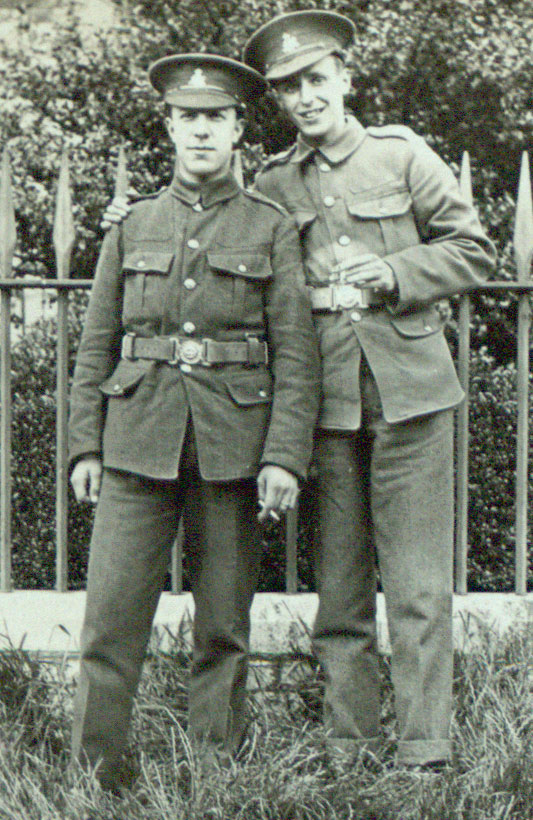 How did these men experience the conflict? (1915)
‘Well old chap, I am glad I am wounded to get out of that hell, and if you ever meet a chap that says he wants to go back call him a liar’
These few words written by Albert Edwin Rippington, from a hospital in England, come from this collection of letters from staff at the Audit office for the Great Western Railway (GWR) based at Paddington, London, who had enlisted to fight in the First World War.
What makes this collection of soldiers’ letters so different from all others is the fact that it reveals the stories of a particular group of men who varied in class and education, who were writing back to their colleagues and bosses in the office while on active service during in the First World War. Many men enlisted from the GWR to fight, but these letters come exclusively from those worked at its Audit office. Staff at Paddington covered a range of different roles in insurance, accounting or ticketing for the Great Western Railway.
The letters (catalogue reference RAIL 253/516) belong to the RAIL series (which includes the records of the railway companies) at The National Archives. They are arranged in 12 carefully bound folders, rather like a series of scrapbooks. Starting from August 1915, each part represented what was known as the office newsletter, a collection of letters, photographs postcards, field cards and contemporary newspaper cuttings from those who had gone to fight.
Every newsletter opened with a news section listing those who had written and sent photos to the office and those who recently left to company to serve at the front. The totals of all men in khaki from the Audit office were given too. The news section also provided information about those who had died, been injured, visited the office on leave or been promoted.
The newsletters were circulated within the office departments and read by men when they came home on leave. Friends or relatives who had been sent their own letters or photographs often lent them or typed them out to be circulated as part of the regular Audit office newsletter.
The Audit office raised enough money through collections and the sale of Christmas cards, to create a temporary roll of honour for the office at Paddington to commemorate those who had fallen in battle by August 1915. Photographs of the Roll of Honour were sent out to several employees as their correspondence reveals.
After the war had ended and troops had returned, the GWR was able to quantify the contribution that it had made to the cause. The contribution made by the Audit office was high: 55.5% of male staff enlisted, whereas the average rate of enlistment across the GWR was 32.6%. This amounted to 184 men, 17 of whom lost their lives.
On 11 November 1922, The Great Western Railway War Memorial, dedicated to all 2,524 staff who had died in battle was unveiled on platform 1, Paddington station.