
Report from the World Jewish Congress on the annihilation of Jews in Europe (catalogue reference: FO 371/30923)
Transcript
WORLD JEWISH CONGRESS December 1st, 1942.
(BRITISH SECTION).
————
ANNIHILATION OF EUROPEAN JEWRY.
HITLER’S POLICY OF TOTAL DESTRUCTION.
The Jews of Europe are being exterminated by the Nazis. It is not merely that atrocities are being committed against the Jews. They are being quite literally slaughtered in masses, in pursuance of a systematic plan and in accordance with a deliberate policy.
This is Hitler’s ‘final solution of the Jewish problem of Europe’. He has openly proclaimed his design. He is now executing his policy with a diabolical fiendishness unknown in the whole history of human savagery.
2,000,000 is the barest minimum number of Jews murdered, tortured and deliberately starved to death in Eastern Europe. The number is probably much greater.
It is now clear that the mass deportation of Jews from France, Belgium, Holland and other Western European countries, has been for the purpose of concentrating all the Jews of Nazi occupied Europe chiefly in Poland for the purpose of facilitating their mass massacre.
On the 27th November 1942, it was stated at the Polish National Council in London that at the beginning of last September about 1 ½ million Jews have been murdered in an organised way. About half a million were deported to the U.S.S.R. in 1940, and of the rest of the peace-time Jewish population of Poland, several hundred thousand Jews have died of starvation, disease and frightful living conditions imposed by the Nazis.
Several hundred thousand Jews have been murdered in the Nazi occupied areas of the U.S.S.R. and in the Ukraine.
Almost the entire Jewish population of the Baltic States have been exterminated.
Hundreds of thousands of Jews of Roumania have been deported to Transdniestria and there massacred.
In addition, scores of thousands of German, French, Belgian, Dutch, Czechoslovak and Yugoslav Jews have been deported to Poland and the occupied areas of the U.S.S.R. for mass slaughter.
Many transports of Jewish deportees from Western Europe do not reach their destination. The victims, crammed into closed cattle-trucks, either die of suffocation or disease on the way or are done to death by their captors.
It is known that at the beginning of last August train-loads of Jewish deportees reached Germany from Belgium, Holland and France. The compartments were filled with dead and living Jews crowded together.
POLAND HAS BECOME THE NAZI SLAUGHTER-HOUSE FOR THE JEWS OF EUROPE:
Massacres of Jews have been going on from the first say of the German occupation. The holocaust took on a formal design, under an explicit policy, in March 1942. Himmler then gave orders for the extermination of 50% of the Jewish population of the so-called Government-General. The extermination was to be completed by the end of 1942.
Not satisfied with the speed and extent of the mass massacres, Himmler, in July last, decreed the total destruction of all the Jews concentrated in Poland.
It is from approximately this date that the large-scale deportations of Jews from Western Europe began. The massacres started on July 21st 1942, when German Police cars invaded the Ghettoes, shooting the inhabitants indiscriminately and at sight. On that date all the Jewish members of the Jewish Council of Warsaw were arrested on bloc as hostages.
On July 22nd 1942, the Nazis ordered the deportation to Eastern Poland and the Ukraine of all Jews irrespective of the age and sex. The daily quota of deportees was fixed at 6,000. Later this quota was increased to 10,000. Victims were dragged from their homes or seized in the streets in organised manhunts.
Jews were congregated in the squares. Old people and invalids were driven to cemeteries and shot in droves. Others were loaded into trucks, 150 persons being crowded into the space normally holding a maximum of 40. The trucks were then driven off. Hundreds died of suffocation.
This process is now going on continuously. The floors of the trucks are covered with a thick layer of lime and chlorine sprinkled with water. The doors are locked. Often the trains remain on a siding for a day or two or longer. The fumes of lime and chlorine, the lack of air, water and food, cause hundreds of deaths, with the result that dead and living remain packed side by side.
On arrival at their destination, 50% of the deportees were found dead. The remainder were taken to the special camps of Treblinka, Belzec and Selibor, where they were shot. Neither children nor babies were spared. By the end of September 1942, 250,000 Jews had been thus exterminated.
The deportations are described by the Nazis as “the re-settlement of the Jews”. The “re-settlement” is a final one in the sense that few, if any, of the “re-settled” Jews remain alive.
THE WARSAW GHETTO:
In March 1942, according to official German statistics, there were 433,000 Jews packed into the Ghetto – the area walled off by the Nazis which formerly contained about 200,000 Jews.
According to ‘Arbeitsamt’ – the official Nazi Labour journal – only 40,000 Jews are to be left in the Warsaw Ghetto. These are the highly-skilled workers who the Nazis require for their war industry.
For September 1942, the Nazis distributed 120,000 ration cards for the Warsaw Ghetto. In October, the number issued was only 40,000.
The same process of elimination and massacre is going on in all the other Ghettoes of Poland. The reports state that the Ghetto of Lodz which formerly contained about 250,000 Jews has been entirely cleared of Jews.
NAZI METHODS OF EXTERMINATION:
Besides the Firing Squads, the Nazis are now facilitating mass executions by the use of electrocution and lethal gas chambers in which Jews are crowded and ‘eliminated’.
An electrocution station has been installed at the Belzec Camp. Transports of deportees are de-trained near the execution place, sheds with a metal plated floor. The sheds are then locked and an electrical current passed through the metal plates. Death is almost instantaneous.
A large digging machine for mass graves has been recently installed at Treblinka.
In Chelm, 10,000 Jews have been gassed recently.
The Germans have organised special Extermination Squads – Vernichtungskolonne – whose task is to round up and kill Jews on sight. The Squads fire indiscriminately into windows of Jewish houses.
————
The above summary takes no account of suicides, the insanities of mothers whose children are seized or murdered, and the innumerable outrages and atrocities resulting in the deaths of many thousands of Jewish men and women.
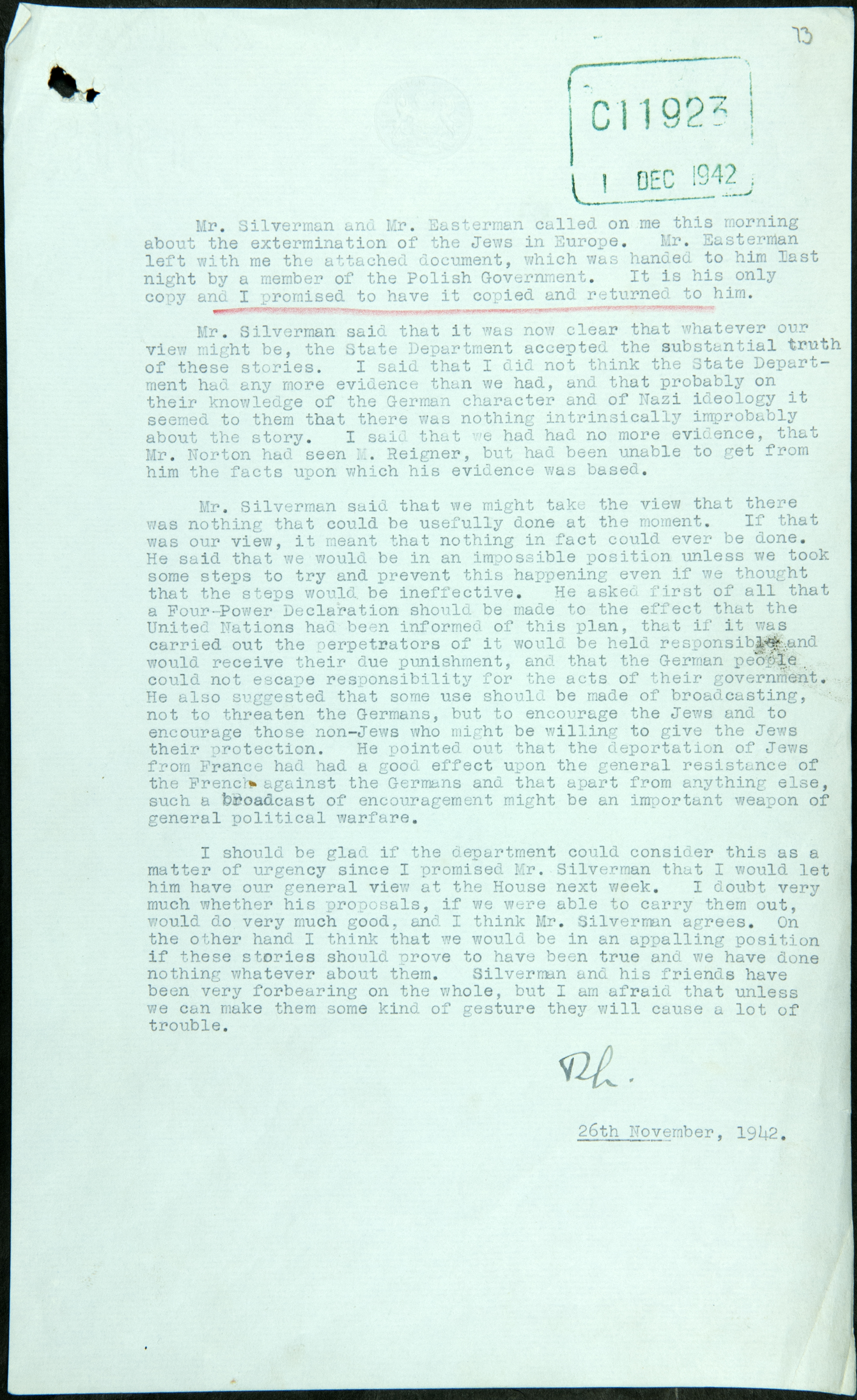
Request for action in response to the rumours of the plan against Jews in German territories (catalogue reference: FO 371/30923)
Transcript
Mr. Silverman and Mr. Easterman called on me this morning about the extermination of the Jews in Europe. Mr. Easterman left with me the attached document, which was handed to him last night by a member of the Polish Government. It is his only copy and I promised to have it copied and returned to him.
Mr. Silverman said that it was now clear that whatever our view might be, the State Department accepted the substantial truth of these stories. I said that I did not think the State Department had any more evidence than we had, and that probably on their knowledge of the German character and of Nazi ideology it seemed to them that there was nothing intrinsically improbably [sic] about the story. I said that we had had no more evidence, that Mr. Norton had seen M. Reigner, but had been unable to get from him the facts upon which his evidence was based.
Mr. Silverman said that we might take the view that there was nothing that could be usefully done at the moment. If that was our view, it meant that nothing in fact could ever be done. He said that we would be in an impossible position unless we took some steps to try and prevent this happening even if we thought that the steps would be ineffective. He asked first of all that a Four-Power Declaration should be made to the effect that the United Nations had been informed of this plan, that if it was carried out the perpetrators of it would be held responsible and would receive their due punishment, and that the German people could not escape responsibility for the acts of their government. He also suggested that some use should be made of broadcasting, not to threaten the Germans, but to encourage the Jews and to encourage those non-Jews who might be willing to give the Jews their protection. He pointed out that the deportation of Jews from France had had a good effect upon the general resistance of the French against the Germans and that apart from anything else, such a broadcast of encouragement might be an important weapon of general political warfare.
I should be glad if the department could consider this as a matter of urgency since I promised Mr. Silverman that I would let him have our general view at the House next week. I doubt very much whether his proposals, if we were able to carry them out, would do very much good, and I think Mr. Silverman agrees. On the other hand I think that we would be in an appaling position if these stories should prove to have been true and we have done nothing about them. Silverman and his friends have been very forbearing on the whole, but I am afraid that unless we can make them some kind of gesture they will cause a lot of trouble.
26th November, 1942
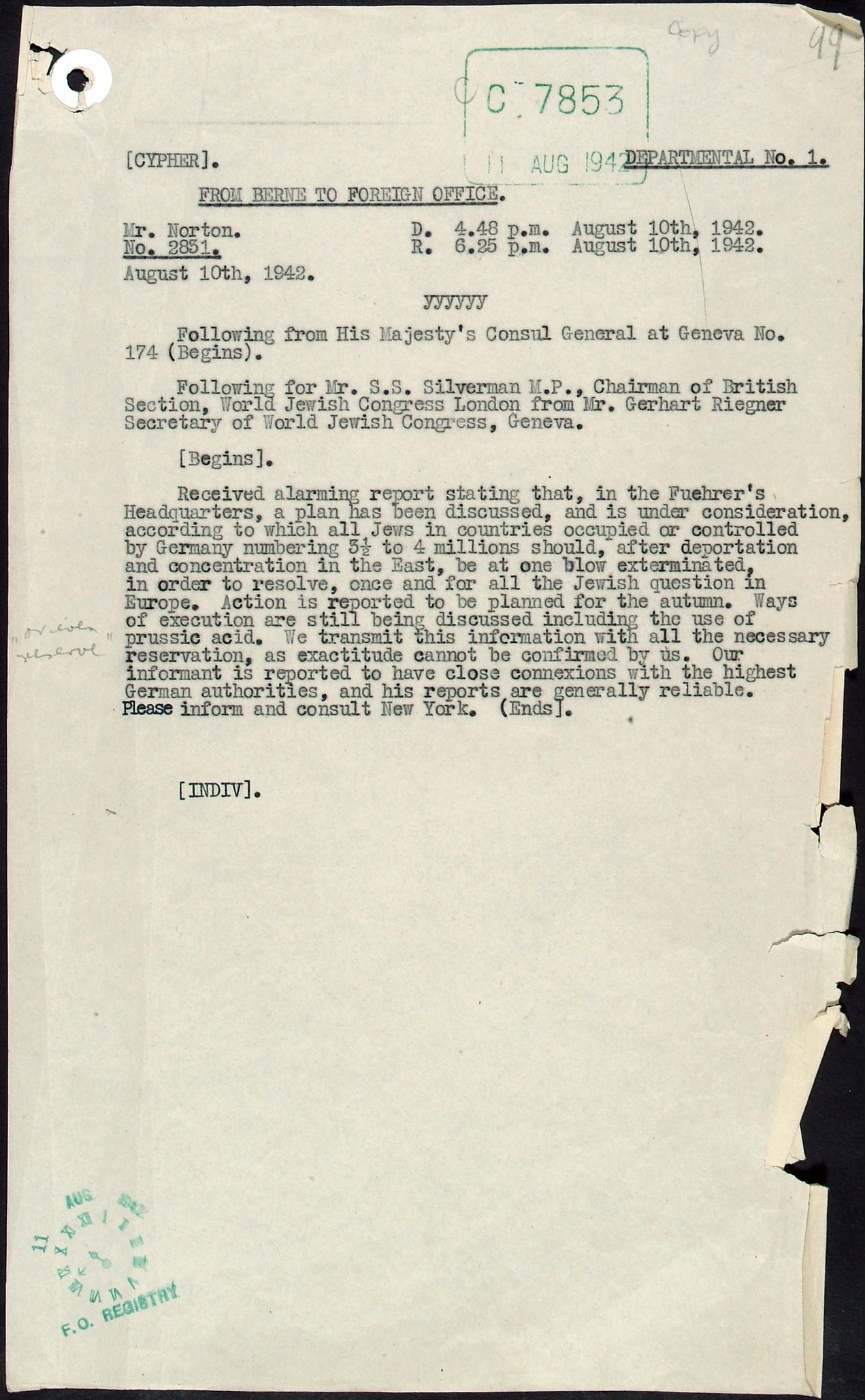
Telegram from Mr Gerhart Riegner to Mr S. S. Silverman, both of the World Jewish Congress, regarding rumours of the extermination of Jews in Concentration Camps (catalogue reference: FO 371/30917)
Transcript
[CYPHER]. DEPARTMENTAL No. 1.
FROM BERNE TO FOREIGN OFFICE.
Mr. Norton. D. 4.48 p.m. August 10th, 1942.
No. 2831. R. 6.25 p.m. August 10th, 1942.
August 10th, 1942.
yyyyyy
Following from His Majesty’s Consul General at Geneva No. 174 (Begins).
Following for Mr. S.S.Silverman M.P., Chairman of British Section, World Jewish Congress London from Mr. Gerhart Riegner Secretary of World Jewish Congress, Geneva.
[Begins].
Received alarming report stating that, in the Fuehrer’s Headquarters, a plan has been discussed, and is under consideration, according to which all Jews in countries occupied or controlled by Germany numbering 3 1/2 to 4 millions should, after deportation and concentration in the East, be at one blow exterminated, in order to resolve, once and for all the Jewish question in Europe. Action is reported to be planned for the autumn. Ways of execution are still being discussed including the use of prussic acid. We transmit this information with all the necessary reservation, as exactitude cannot be confirmed by us. Our informant is reported to have close connexions with the highest German authorities, and his reports are generally reliable.
Please inform and consult New York. (Ends].
[INDIV].

Telegram from Sir G. Ogilvie Forbes regarding the damage dealt to Jewish properties during ‘Kristallnacht’ on 10 November 1938 (catalogue reference: FO 371/21636)
Transcript
From GERMANY.
Telegram (en clair) from Sir G. Ogilvie Forbes (Berlin),
D. BY TELEPHONE. 10th November, 1938.
R 5.5p.m. 10th November, 1938
No.663.
IMPORTANT
My telegram No. 661.
I have just returned from a tour of Friedrichstrasse and city districts where Jewish shops are being smashed and looted by youths in plain clothes, followed by large and smiling crowds including soldiers and others in party uniforms. Police were taking no notice.
Only exception was the premises of Messrs. Israel, a big department store partly British-owned which was guarded by police with fire brigade standing by. His Majesty’s Consul-General who visited these premises informs me that enormous damage has been done to stock and fittings. According to Mr. Israel store was attacked early this afternoon by a crowd which included S.S. men in uniform. Business offices owned by Jews are also being entered and smashed up apparently with impunity. Similar attacks on Jewish property are said to be taking place all over Germany.
His Majesty’s Consul Dresden reports that a British Jew from Leipzig has asked for asylum in the Consulate as Jews in Leipzig are being beaten up. I have taken immediate steps with the Under Secretary of State for the safeguarding of British subjects.
Chief Rabbi of Berlin has been arrested and seven synagogues have been burnt.
The facts that these attacks began only after midnight last night and that Jewish shops and offices have been systematically signalled out indicate that this action was deliberately planned.
 Key documents from The National Archives
In unleashing the Second World War, the Nazi regime was responsible for the deaths of around 50 million people, including civilians and soldiers. The Nazis and their allies committed genocide against Europe’s Roma, murdered millions of Catholic Poles and Soviet Prisoners of War, and caused death and destruction throughout occupied Europe. The genocide of the Jews that has come to be known as the Holocaust was both intertwined with and separate from these other killings.
For the Nazis, murdering the Jews was part of a vast scheme for the racial reorganisation of Europe, which would create a pan-European Germanic empire with ‘Nordics’ at the top of the hierarchy, Slavs at the bottom, and Jews eliminated. At the same time, the Nazi obsession with the Jews was different from the way it regarded other ‘races’: Jews were both hated and feared and – at least at the level of the Nazi leadership – were regarded as the masterminds behind a vast world conspiracy that aimed to destroy the ‘Aryan race’.
Many of the regimes that allied themselves with Nazi Germany – especially Croatia, Romania, Slovakia, Vichy France and Hungary – found that the Nazis’ anti-Jewish obsession chimed with their own aspirations for creating ethnically homogeneous nation states. Even if they were not as driven by antisemitism as the Nazis, such regimes made use of the atmosphere created and licence granted by the Nazis to fulfill their own ambitions. As a result, as it played out across Europe, the Holocaust was so far-reaching because of the role played by collaborators, from states to institutions such as auxiliary police battalions, to individuals.
As the documents in this important collection show, the murder of the Jews was a complex series of interrelated events. There was not one single, unidirectional policy that saw Jews everywhere in Nazi-occupied Europe ghettoised and then deported to death camps. Rather, the experiences of different Jewish communities were very different, depending on what sort of occupation regime they lived under, the attitude of local administrations, the extent of SS penetration in the area, military circumstances, the Germans’ need for labour – especially towards the end of the war – and other factors such as possibilities for escape, hiding or resistance. What we call ‘the Holocaust’ was a continent-wide crime: a series of vastly different experiences for all involved, united by the fact that everywhere the Nazis aimed to kill Jews as and when they could.
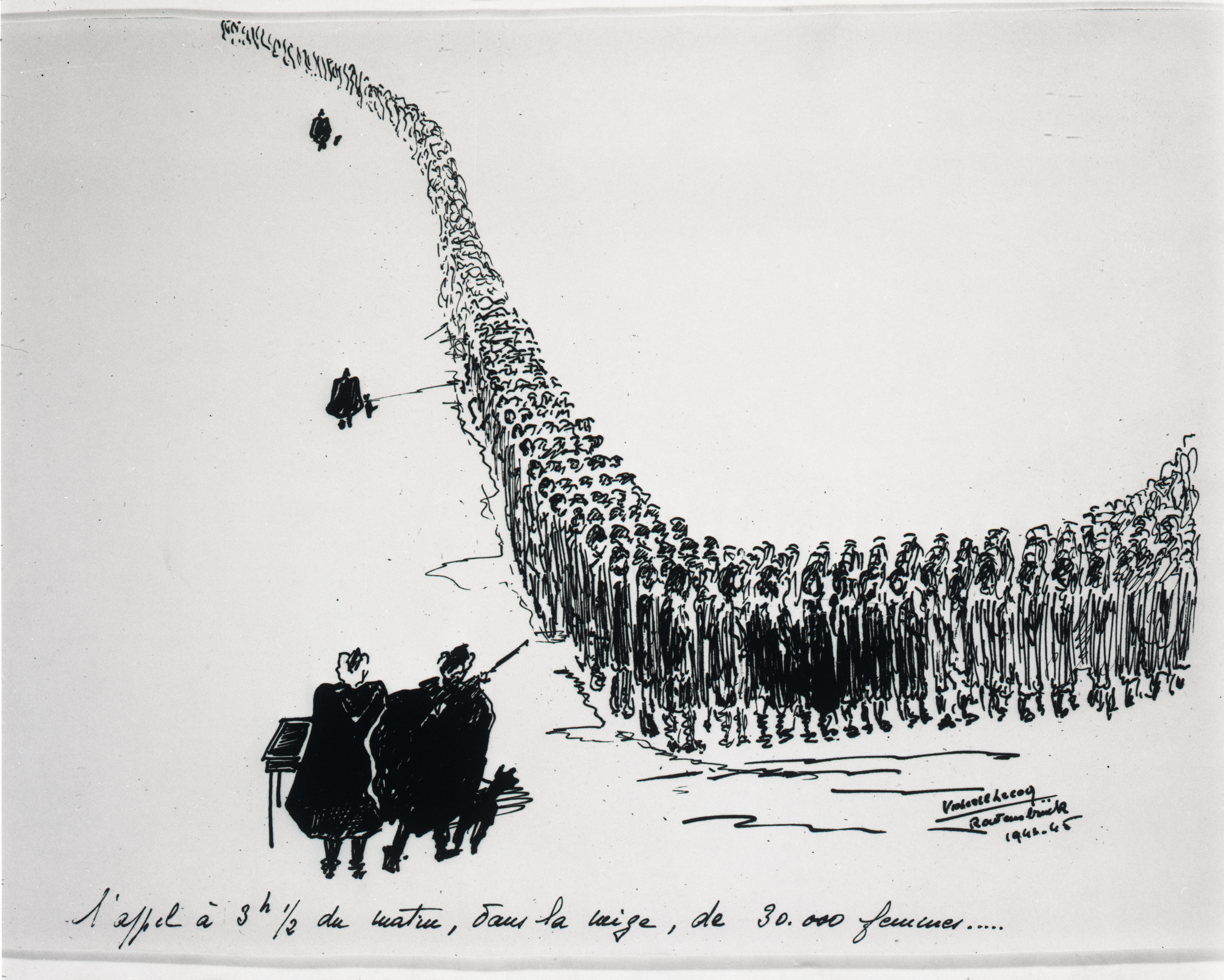
The complexity of the Holocaust means that documents such as the Riegner telegram or the Lichtheim telegram are all the more remarkable, since they show that some concerned contemporaries were trying to make sense of what the Nazis were doing to Europe’s Jews. Plans of the Auschwitz and Treblinka camps, reports from the Warsaw ghetto and from Polish representatives in London, all show that knowledge of the murders was circulating. Nevertheless, it was only in July 1944, when most of the Jews of Hungary (the last remaining large Jewish population group in Europe outside of Russia) had already been murdered, that Churchill could write that ‘we are in the presence of one of the greatest and most horrible crimes ever committed.’ In other words, how to interpret the documents remains a matter of historical debate: do they show that the Allies understood that the Nazis intended to wipe out the Jews and that therefore they should have done more to save them? Or should they not be read in isolation but placed in the broader context of wartime issues, which might reveal that they were received and understood piecemeal, so that no real comprehension of the extent of Nazi plans prevailed? In the presence of images such as Violette Le Coq’s drawings of Ravensbrück (in The National Archives because they were used as evidence at the 1946 Ravensbrück trial), such questions might seem irrelevant. But beyond the fact that the Nazis killed six million Jews, more or less destroying an ancient civilisation, only questions such as these, which rely on documents such as those held at The National Archives to establish interpretations and meanings, can help us in some measure to grapple with the enormity of the Nazis’ crimes.
Dan Stone
Professor of Modern History
Royal Holloway, University of London
What to expect in the onsite workshop:
In the onsite workshop students will examine original documents to explore different methods enslaved people used to resist the system of slavery. These range from day to day acts of resistance like working deliberately slowly to full-scale armed revolts. This workshop contains documents that explore the brutality of British rule in the Caribbean such as punishment lists and laws restricting cultural and religious practices of enslaved people.
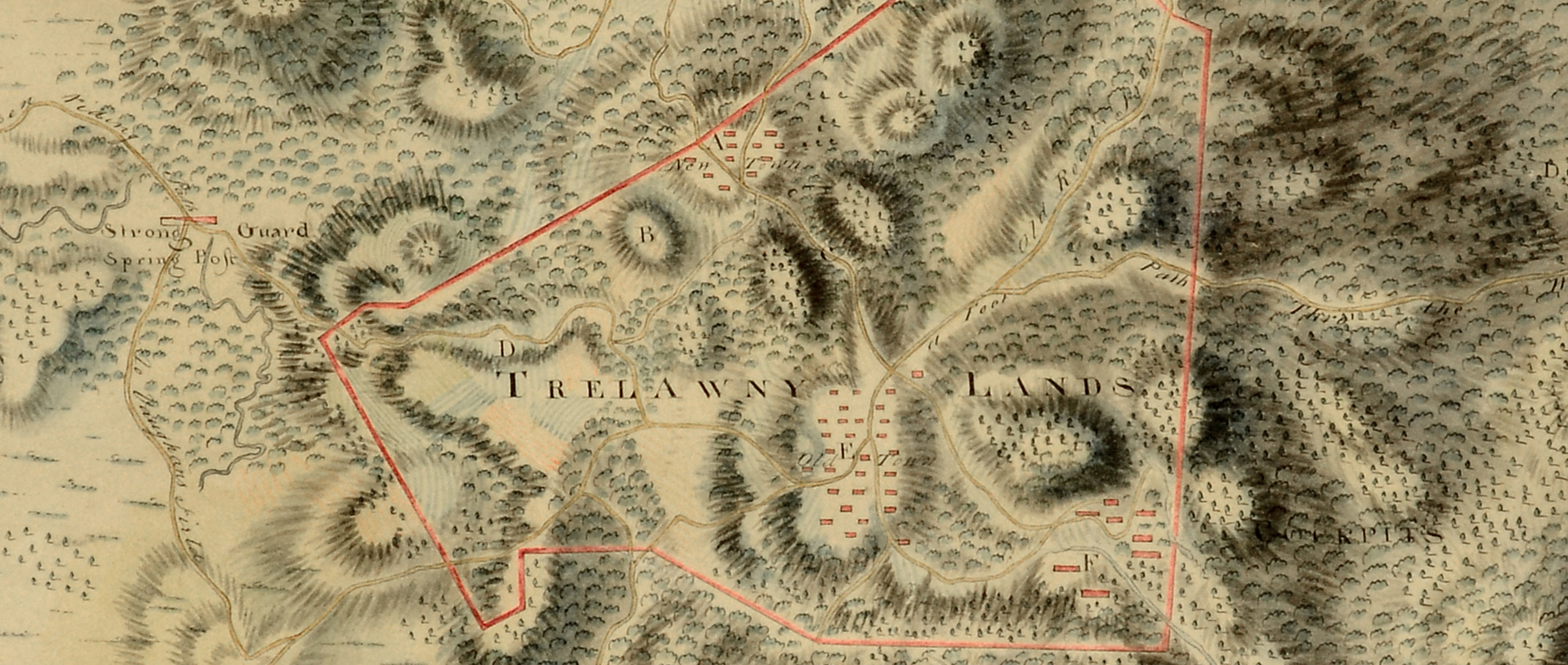
The two-hour workshop is led by an experienced history educator in an inspiring learning space at The National Archives in Kew. Students handle a range of original documents including newspapers, letters and a fascinating map showing the area the Maroons, formally enslaved people in Jamaica settled.
*Note both onsite and online sessions are designed for students who have studied Transatlantic slavery, it is not an introduction to this subject.
What to expect in the online workshop:
In the online workshop in your classroom students will examine documents to explore different methods enslaved people used to resist the system of slavery. These range from day to day acts of resistance like working deliberately slowly to full-scale armed revolts.
The one-hour online session in your classroom is led by an experienced history educator, you only need a microphone, large screen and webcam to take part. Interactive activities encourage students to discuss their ideas and work in groups using high-quality materials provided in advance by the Education team.
*Note we will adapt the timing of the workshop to fit with your lesson times.
How did enslaved people resist?All activities must be booked in advance.
Tel: +44 (0)20 8392 5365
Fax: +44 (0)20 8487 9202
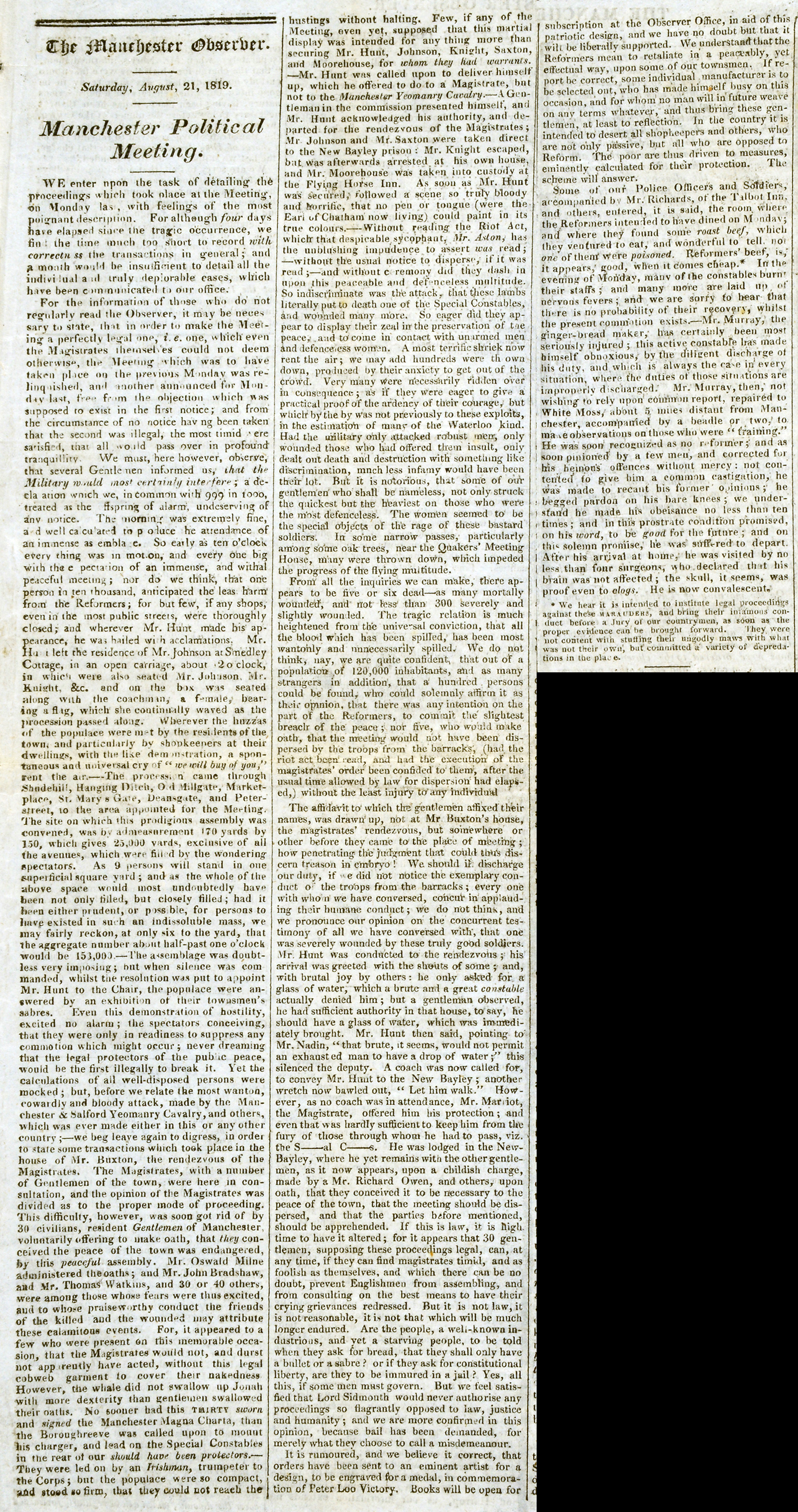
Manchester Observer, 21 August 1819. This was Manchester’s radical newspaper which helped to organise the meeting. (Catalogue reference HO 42/192 f.5)
Transcript
Manchester Political Meeting
We enter upon the task of detailing the proceedings which took place at the Meeting on Monday last, with feelings of the most pregnant description. For although four days have elapsed since the tragic occurrence, we find the time much too short to record with correctness the transactions in general; and a month would be insufficient to detail all the individual and truly deplorable cases, which have been communicated to our office.
For the information of those who do not already read the Observer, it may be necessary to state, that in order to make the Meeting a perfectly legal one, i.e. one, which even Magistrates themselves could not deem otherwise, the Meeting which was to have taken place on the previous Monday was relinquished, and another announced for Monday last, free from the objection which was supposed to exist in the first notice; and from the circumstance of no notice having been taken that the second was illegal, the most timid were satisfied that all would pass over in profound tranquillity. We must, here however, observe, that several Gentlemen informed us, that the military would most certainly interfere; a declaration which we, in common with 999 in 1000, treated as the offspring of alarm, undeserving of notice. The morning was extremely fine, well calculated to produce the attendance of an immense assemblage. So early as ten o’clock everything was in motion, and every one big with the expectation of an immense, and withal peaceful meeting; nor do we think, that one in ten thousand, anticipated the least harm from the Reformers; for but few if any shops, even in the most public streets, were thoroughly closed, and wherever Mr. Hunt made his appearance he was hailed with acclamations. Mr. Hunt left the residence of Mr. Johnson at Smedley Cottage, in an open carriage, about 2 o’clock, in which were also seated Mr. Johnson. Mr Knight &c. and on the box was seated along with the coachman, a female, bearing a flag, which she continually waved as the procession passed along. Wherever the huzzas of the populace were met by the residents of the town and particularly by shopkeepers at their dwellings, with the like demonstration, a spontaneous and universal cry of “we will buy of you”, rent the air. The procession came through Shudehill, Hanging Ditch, Old Millgate, Market-place, St. Mary’s Gate, Deansgate, and Peter-street, to the area appointed for the Meeting. The site on which this prodigious assembly was convened, was by admeasurement 170 yards by 150, which gives 25,000 yards, exclusive of all the avenues, which were filled by the wondering spectators. As 9 persons will stand in one hypothetical square yard; and as the whole of the above space would most undoubtedly have been not only filled, but closely filled; had it been either prudent, or possible, for persons to have existed in such an indissoluble mass, we may fairly reckon, at only six to the yard, that the aggregate number at half-past one o’clock would be 153,000. The assemblage was doubtless very imposing; but when silence was commanded, whilst the resolution was put to appoint Mr Hunt to the Chair, the populace were answered by an exhibition of their townsmen’s sabres. Even this demonstration of hostility, excited no alarm; the spectators conceiving, that they were only in readiness to suppress any commotion which might occur; never dreaming that the legal protectors of the public peace, would be the first illegally to break it. Yet the calculations of all well-disposed persons were checked; but, before we relate the most wanton, cowardly, and bloody attack, made by the Manchester & Salford Yeomanry Cavalry, and others, which was ever made in either this or any other country; we beg leave again to digress, in order to relate some transactions which took place in the house of Mr Buxton, the rendezvous of the magistrates. The Magistrates, with a number of Gentlemen of the town, were here in consultation, and the opinion of the magistrates was divided as to the proper mode of proceeding. This difficulty, however, was soon got rid of by 30 civilians, resident Gentlemen of Manchester, voluntarily offering to make oath, that they conceived the peace of the town was endangered, by this peaceful assembly. Mr Oswald Milne administered the oaths; and Mr John Bradshaw, and Mr. Thomas Watkins, and 30 or 40 others, were among those whose fears were thus excited, and to whose praiseworthy conduct the friends of the killed and the wounded may attribute these calamitous events. For, it appeared to a few who were present on this memorable occasion, that the Magistrates would not, and durst not, apparently have acted without this legal cobweb garment to cover their nakedness. However the whale did not swallow up Jonah with more dexterity than gentlemen swallowed their oaths. No sooner had this thirty sworn and signed the Manchester Magna Charta, than the Boroughreeve was called upon to mount his charger, and lead on the Special Constables in the rear of our should have been protectors. They were led on by an Irishman, trumpeter to the Corps; but the populace were so compact, and stood so firm, that they could not reach the hustings without halting. Few, if any of the Meeting, even yet, supposed that this martial display was intended for any thing more than scaring Mr. Hunt, Johnson, Knight, Saxton, and Moorehouse, for whom they had warrants. Mr. Hunt was called upon to deliver himself up, which he offered to do to a Magistrate, but not to the Manchester Yeomanry Cavalry.—A Gentleman in the commission presented himself, and Mr. Hunt acknowledged his authority, and departed for the rendezvous of the Magistrates; Mr. Johnson and Mr. Saxton were taken direct to the New Bayley prison: Mr. Knight escaped, but was afterwards arrested at his own house, and Mr. Moorehouse was taken into custody as the Flying Horse Inn. As soon as Mr. Hunt was secured, followed a scene so truly bloody and horrific, that no pen or tongue (were the Earl of Chatham now living) could paint in its true colours. Without reading the Riot Act, which that despicable sycophant, Mr. Aston, has the unblushing impudence to assert was read; without the usual notice to disperse, if it was read; and without ceremony did they dash in upon this peaceable and defenceless multitude. So indiscriminate was the attack, that these lambs literally put to death one of the Special Constables, and wounded many more. So eager did they appear to display their zeal in the preservation of the peace, and to come in contact with unarmed men and defenceless women. A most terrific shriek now rent the air; we many add hundreds were thrown down, produced by their anxiety to get out of the crowd. Very many were necessarily ridden over in consequence; as if they were eager to give a practical proof of the ardency of their courage, but which by the by was not previously to these exploits, in the estimation of many of the Waterloo kind. Had the military only attacked robust men, only wounded those who had offered them insult, only dealt out death and destruction with something like discrimination, much less infamy would have been their lot. But it is notorious, that some of our gentlemen who shall be nameless not only struck the quickest but the heaviest on those who were the most defenceless. The women seemed to be the special objects of the rage of these bastard soldiers. In some narrow passes, particularly among some oak trees, near the Quakers’ Meeting House, many were thrown down, which impeded the progress of the flying multitude.
From all the inquiries we can make, there appears to be five or six dead—as many mortally wounded, and not less than 300 severely and slightly wounded. The tragic relation is much heightened from the universal conviction, that all the blood which has been spilled, has been most wantonly and unnecessarily spilled. We do not think, nay, we are quite confident, that out of a population of 120,000 inhabitants, and as many strangers, in addition, that a hundred persons could be found, who could solemnly affirm it as their opinion, that there was any intention on the part of the Reformers, to commit the slightest breach of the peace; nor five, who would make oath, that the meeting would not have been dispersed by the troops from the barracks, (had the riot act been read, and had the execution of the magistrates’ order been confided to them, after the usual time allowed by law for dispersion had elapsed,) without the least injury to any individual.
The affidavit to which the gentlemen affixed their names, was drawn up, not at Mr Buxton’s house, the magistrates’ rendezvous, but somewhere or other before they came to the place of meeting; how penetrating the judgement that could thus discern treason in embryo! We should ill discharge our duty, if we did not notice the exemplary conduct of the troops from the barracks; every one with whom we have conversed, concur in applauding their humane conduct; we do not think, and we pronounce our opinion on the concurrent testimony of all we have conversed with, that one was severely wounded by these truly good soldiers. Mr Hunt was conducted to the rendezvous; his arrival was greeted with the shouts of some, and with brutal joy by others; he only asked for a glass of water, which a brute and a great constable actually denied him; but a gentleman observed, he had sufficient authority in that house, to say, he should have a glass of water; which was immediately brought. Mr Hunt then said, pointing to Mr Nadin, ‘that brute, it seems, would not permit an exhausted man to have a drop of water;’ this silenced the deputy. A coach was now called for, to convey Mr Hunt to the New Bayley; another wretch now bawled out, ‘Let him walk.’ However, as no coach was in attendance, Mr Marriot, the Magistrate, offered him his protection; and even that was hardly sufficient to keep him from the fury of those through whom he passed, viz, the S—l C—s. He was lodged in the New Bayley, where he yet remains with the other gentlemen, as it now appears, upon a childish charge, made by a Mr Richard Owen, and others, upon oath, that they conceived it to be necessary to the peace of the town, that the meeting should be dispersed, and that the parties before mentioned, should be apprehended. If this is law, it is high time to have it altered; for it appears that 30 gentlemen, supposing these proceedings legal, can, at any time, if they find the magistrates timid, and as foolish as themselves, and which there can be no doubt, prevent Englishmen from assembling, and consulting on the best means to have their crying grievances redressed. But it is not law, it is not reasonable, it is not that which will be much longer endured. Are the people, a well-known industrious, and yet a starving people, to be told when they ask for bread, that they shall only have a bullet or a sabre? or if they ask for constitutional liberty, are they to be immured in a gaol? Yes, all this, if some men must govern. But we feel satisfied that Lord Sidmouth would never authorise any proceedings so flagrantly opposed to law, justice, and humanity; and we are more confirmed in this opinion, because bail has been demanded, for merely what they choose to call a misdemeanour.
It is rumoured, and we believe it correct, that orders have been sent to an eminent artist, for a design, to be engraved for a medal, in commemoration of Peter Loo Victory. Books will be opened for subscription at the Observer Office, in aid of this patriotic design, and we have no doubt but that it will be liberally supported. We understand that the Reformers mean to retaliate in a peaceably, yet effectual way, upon some of our townsmen. If reports be correct, some individual manufacturer is to be selected out, who has made himself busy on this occasion, and for whom no man will in future weave on any terms whatever, and thus bring these gentlemen, at least to reflection. In the country it is intended to desert all shopkeepers and others, who are not only passive, but all who are opposed to Reform. The poor are thus driven to measures, eminently calculated for their protection. The scheme will answer.
Some of our Police Officers and Soldiers, accompanied by Mr. Richards, of the Talbot Inn, and others, entered, it is said, the room where the Reformers intended to have dined on Monday; and where they found some roast beef, which they ventured to eat, and wonderful to tell not one of them were poisoned. Reformers’ beef, is, it appears, good, when it comes cheap.* In the evening of Monday, many of the constables burnt their staffs; and many more are laid up of nervous fevers; and we are sorry to hear that there is no probability of their recovery, whilst the present commotion exists.—Mr. Murray, the ginger-bread maker, has certainly been most seriously injured; this active constable has made himself obnoxious, by the diligent discharge of his duty, and which is always the case in every situation, where the duties of those situations are improperly discharged. Mr. Murray, then, not wishing to rely upon common report, repaired to White Moss, about 5 miles distant from Manchester, accompanied by a beadle or two, to make observations on those who were ‘training.’ He was soon recognized as no reformer; and as soon pinioned by a few men and corrected for his heinous offences without mercy; not contented to give him a common castigation, he was made to recant his former opinions; he begged pardon on his bare knees; we understand he made his obeisance no less than ten times; and in this prostrate condition promised, on his word, to be good for the future; and on this solemn promise, he was suffered to depart. After his arrival at home, he was visited by no less than four surgeons, who declared that his brain was not affected; the skull, it seems, was proof even to clogs. He is now convalescent.
* We hear it is intended to institute legal proceedings against these MARAUDERS, and bring their infamous conduct before a jury of our countrymen as soon as the proper evidence can be brought forward. They were not content with stoning their ungodly maws with what was not their own, but committed a variety of depredations in the place.
___________________________________________________
 How close was Britain to revolution?
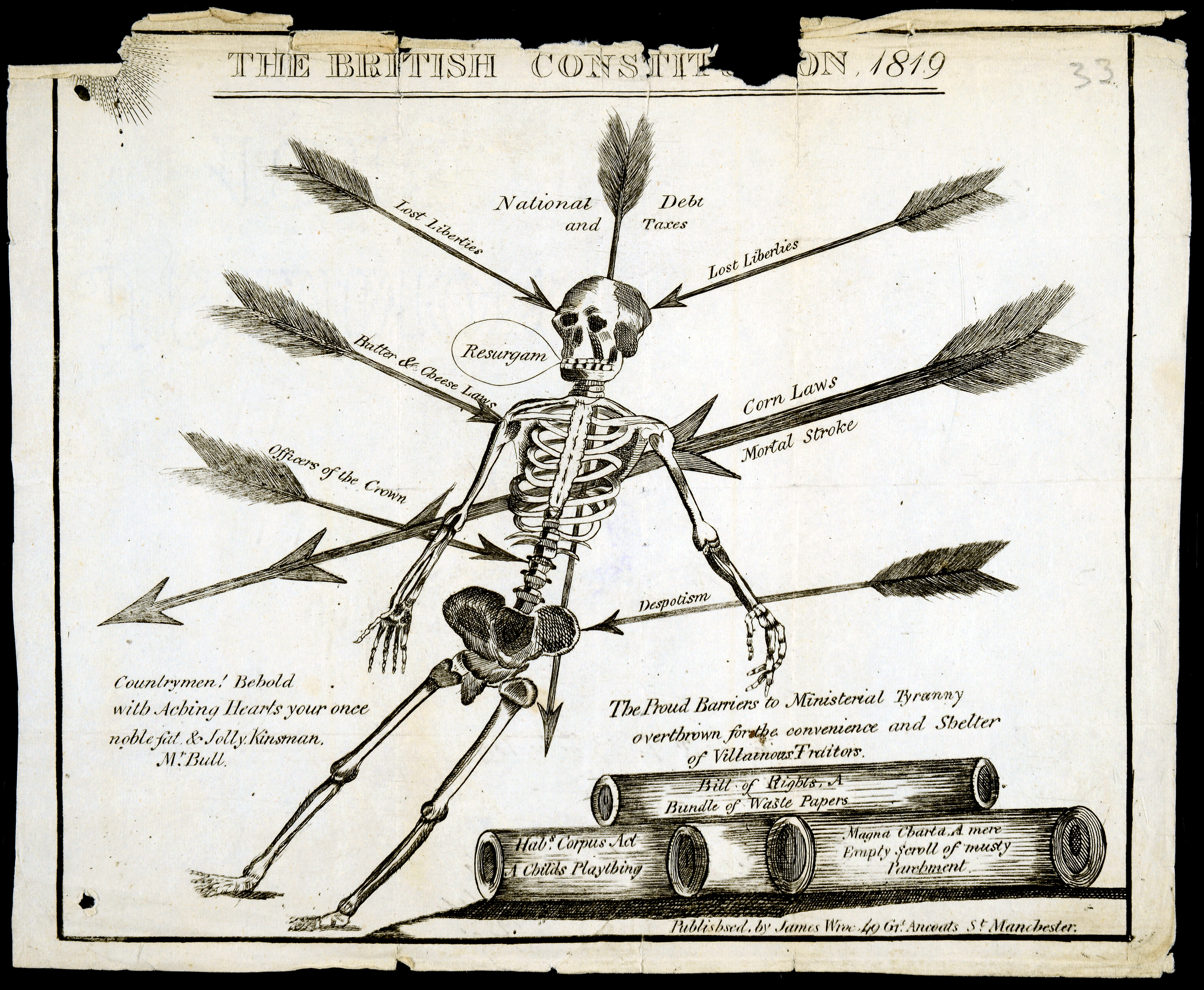
After the failure of rebellion in 1817, economic conditions improved rapidly in 1818. A wave of strikes for higher wages helped to reverse some of the losses of 1816-1817, particularly in the cotton industry. Workers briefly organised a ‘philanthropic union’, an early attempt at a national union of all trades which could support each other in disputes. However, 1819 saw other slumps with widespread wage cuts and unemployment, prompting a second wave of protest for parliamentary reform. This time the radical reformers took care to avoid the failed plots and rebellions of 1817, aiming instead to rally such overwhelming numbers of protestors that the government would be forced to back down.
The climax of the national series of mass meetings was a rally of 60,000 people at St Peter’s Fields, Manchester, on 16 August 1819, addressed by the orator Henry Hunt. Hunt called for a peaceful show of strength from across the region: for several weeks beforehand the reformers for miles around practised marching in military formation, drilled by old soldiers, to ensure order on the day. But the local magistrates believed the reformers were preparing for armed rebellion; they declared the meeting illegal and warned people to stay indoors. Several months before, the Home Office had secretly told them: ‘your Country will not be tranquillized, until Blood shall have been shed either by the Law or the sword.’
The meeting rallied peacefully with flags, banners, and music, watched by reporters from the national press. As it began the magistrates, fearful of what would happen next, sent in the Manchester Yeomanry (a local volunteer cavalry) to arrest Hunt; they then ordered the regular Hussars to clear the field. The senior magistrate, the Reverend William Hay, fired off a report to London the same evening claiming that rebellion had been averted and injuries had been few; however, cavalrymen such as Major Dyneley wrote enthusiastically of winning ‘the battle of Manchester’ against the ‘enemy’ reformers. Reports in the press, including both the radical ‘Manchester Observer’ and ‘The Times’ of London, told of many deaths and hundreds of casualties, many of them inflicted face-to-face by cavalry sabres, although the authorities tried to discredit individual cases.
The news of Peterloo spread far and wide, with fairground booths as far away as Devon displaying detailed hand-coloured prints of the scene. There were protest meetings, which led to further arrests, and for a time rebellion appeared to threaten. In the spring of 1820 there was serious unrest in Yorkshire and armed rebellions in Ireland and Scotland; in Glasgow, a provisional government was optimistically proclaimed.
In January 1820, some of the London ultra-radicals plotted to assassinate the Cabinet in the dramatic ‘Cato Street conspiracy’; however, the whole thing was a trap laid by government. The plotters’ every move was watched by informers – yielding some gripping details about London’s tiny but committed revolutionary underground – but they were arrested and executed. 1820 also saw a popular movement which was more difficult to suppress: a campaign in support of Queen Caroline, the estranged wife of the new monarch George IV, who was trying to divorce her. Reformers compared her treatment with that of the female reformers cut down at Peterloo: ‘The same power which scourged us, is oppressing you’ declared radicals from Lancashire. Support for the Queen spread among troops, and there were signs of mutiny among the guards. The radical printer William Benbow excitedly posted bills urging them to imitate the Italian soldiers who had supported a revolution in Naples.
In the end, the forces of the state proved stronger than those of reform. However, at the next crisis in 1832, the government was forced to back down, unwilling to use military force against reformers for a second time.
Dr Robert Poole
University of Central Lancashire [UCLAN], author of ‘Return to Peterloo’
 Were the troubles facing England in the 1370s and 1380s due to Richard II’s age and inexperience?
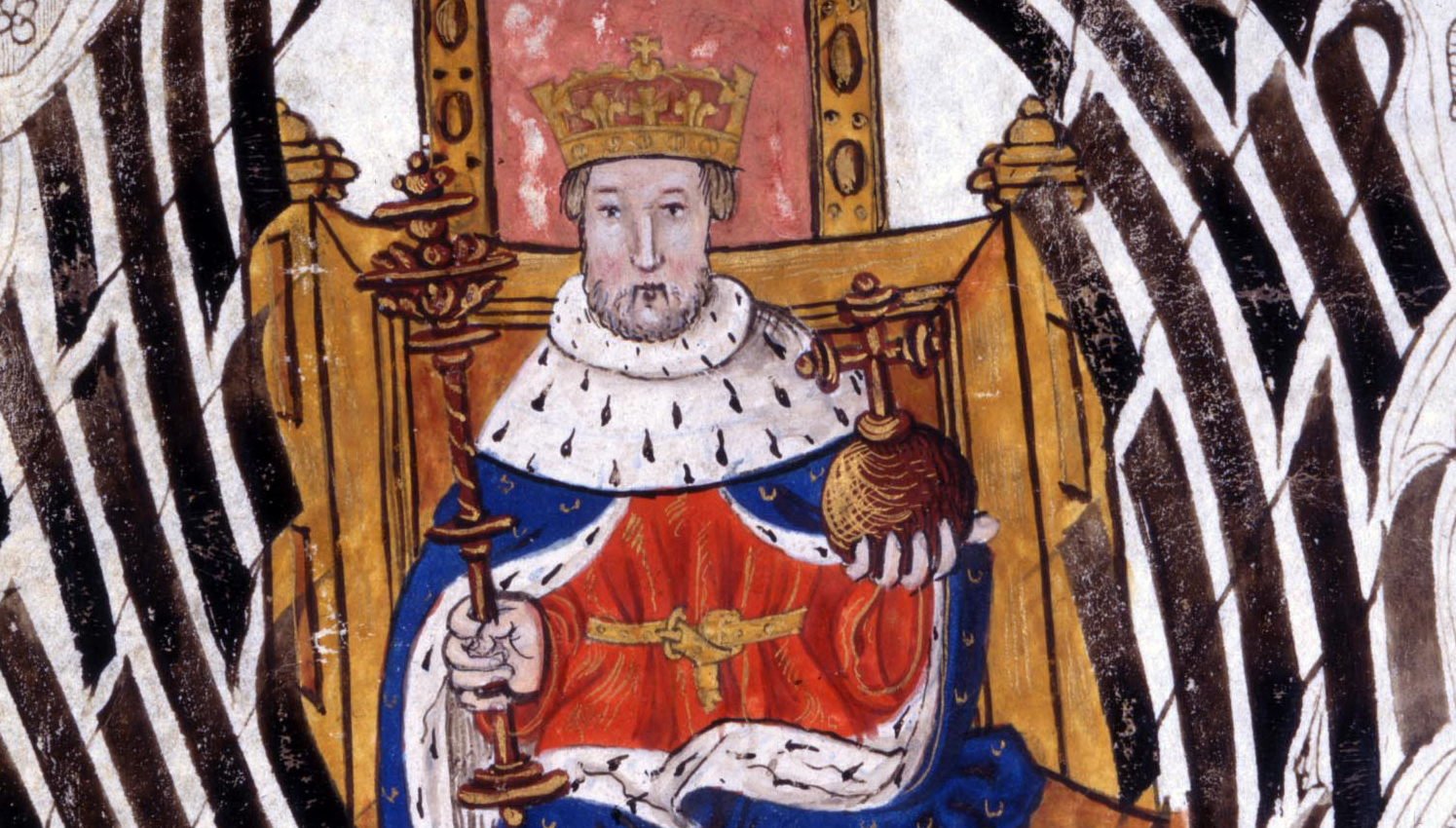
When Richard II came to the English throne in 1377 he was only ten years old. For the foreseeable future, important political decisions would have to be made for him by the most powerful and experienced people in the kingdom. This included the organisation of his coronation, which was overseen by his uncle – John of Gaunt, Duke of Lancaster.
Richard II’s coronation took place at a time of great uncertainty and bloodshed. England had been at war with France intermittently since 1337 in the Hundred Years War. In June and July 1377 a French fleet attacked English ports all along the English Channel. Since the king could not be expected at such a young age to take leadership of the kingdom, the commons in Parliament requested that a special council be appointed to make key decisions and provide the king’s government with advice. The appointment of this ‘continual council’, along with a description of its responsibilities and powers, is recorded in documents here, as well as the decision taken by the continual council to improve England’s naval power by initiating a shipbuilding programme.
Despite these arrangements, the war with France continued to go badly. In the summer of 1381, peasants and craftsmen across the country rebelled against the government in the Peasants’ Revolt. The event was triggered by the high level of taxation needed to fund the war, and over the next few years the commons in Parliament put pressure on government to reduce its expenses. However, there was no easy solution to the conflict with France and the commons looked for other ways of saving money. Even before the Peasants’ Revolt they had sought to reduce government expenses. In 1379 the commons appointed a commission to investigate the financial health of the kingdom and how to reduce the cost of the royal household – in other words, the king’s personal expenses. This raises an important question: would Parliament have targeted the king’s personal expenditure if he had been older and exercised more direct control over the country? By 1384, Richard II wanted make his own decisions. For example, he granted his servant, Simon Burley, his under-chamberlain, a reward for the service he ‘did for us in our tender age’. At the age of 17, Richard II tried to exercise power and authority independently. The grant showed him rewarding those he felt close to, a tendency that became problematic during the next decade of his reign. The king began to lavishly reward his friends against the wishes of the broader political community.
A key theme of medieval kingship was ‘largesse’, a form of generosity. An effective king was expected to reward good service by showing generosity to his loyal subjects, typically by granting them land and titles. However, many people – especially members of the nobility – felt that Richard II was too generous to those who didn’t deserve it: people like his friend Robert de Vere, to whom he granted the whole of Ireland in 1385.
By 1386, a group of lords, known as the ‘Lords Appellant’, grew disillusioned with Richard II’s promotion of his favourites. They rebelled against the king, took him captive, and called a parliament known as the ‘Merciless Parliament’ to legitimise their rebellion and destroy many of the king’s friends, including Robert de Vere.
The Lords Appellant used Parliament as a weapon against their enemies, and brought the ‘traitors’ to trial before Parliament. They took care to justify the legality of their use of Parliament as a court of law by asserting that it was the only venue suitable to judge the ‘high crimes’ committed by their enemies. This justification was designed to mask the fact that the Lords Appellant were in rebellion against the king. Also, by bringing their enemies to trial in Parliament, the Lords Appellant were able to build consensus within the political community against the king and his friends.
 How did state and people respond to religious change?
by Dr Natalie Mears, University of Durham
The Reformation was one of the most transformative events in the history of the British Isles. Not only did it profoundly (although ultimately slowly and haphazardly) change people’s religious beliefs, but it also ushered in important political, constitutional, social and cultural change. Moreover, it played a fundamental role in the establishment of national identity. It defined England (Wales and Ireland were ignored; Scotland was a separate power) as a new Israel. That is to say, an island bastion of the true (i.e. protestant) faith, especially favoured by God and physically separated from largely Roman Catholic (and hence corrupt and tyrannical) continental Europe. Indeed, our understanding of the Reformation – and, therefore, the histories written of it – has been shaped precisely by these factors ever since John Foxe’s ‘Actes and monumentes’ (commonly known as the ‘Book of Martyrs’).
Was this all because Henry VIII fell in love with Anne Boleyn? Certainly, the combination of Henry’s need for a male heir to rule over a patriarchal society, his infatuation for Anne, and her determination not to be just the king’s mistress were all significant triggers. But it seems likely that home-grown evangelicalism (in England’s case, left over from the Lollard movement) and the dissemination of reforming ideas from abroad would, sooner or later, have effected some sort of ‘Reformation’, as it did in other continental countries.
It would be a mistake, however, to think that the Reformation in England, Wales and Ireland was a forgone conclusion. The Henrician Reformation was notoriously haphazard, not least because Henry himself – despite pushing from Anne, Thomas Cranmer and Thomas Cromwell – was never really convinced by evangelicalism. His realms could have remained jurisdictionally ‘semi-detached’ from the Papacy (he was too fond of the supremacy to give it up) while remaining religiously close to Rome. Similarly, had Edward VI not died unexpectedly in 1553 – he was not the sickly boy of legend, but relatively robust one with a liking (if not the skill) for jousting as well as an impressive hat collection – the Tudor Reformation may have been distinctly less idiosyncratic and more in line with continental beliefs and practice, than it ultimately was. And, as Christopher Haigh and Eamon Duffy have shown that the Tudors’ dominions remained largely Catholic until at least 1580, if Mary had lived or produced an heir then the Reformation could have fizzled out altogether.
Ultimately, what these documents show is that we need to pay as much, if not more, attention to how people articulated their ideas and beliefs, as to what they articulated: the language they used, the ritual actions they employed, the way they defined themselves and others, and how their perceptions shaped the way they acted. The Reformation may have ‘begun’ with Henry VIII’s beliefs about his marriage and the succession and his emotions regarding Anne Boleyn, but its real story lies in the beliefs, actions, perceptions, and prejudices of his subjects.
Reading list
This is a full, but by no mean comprehensive, reading list for the Reformation, covering England, Wales and Ireland. The material is mixed: some of the items are books, but many are journal articles which you will primarily find in, or via, a university library.
Reading list on the English Reformation c1527-1590, (PDF, 0.07MB)