


























Teaching resource
Belfast (Good Friday) Agreement 1998 Themed Collection Part 2
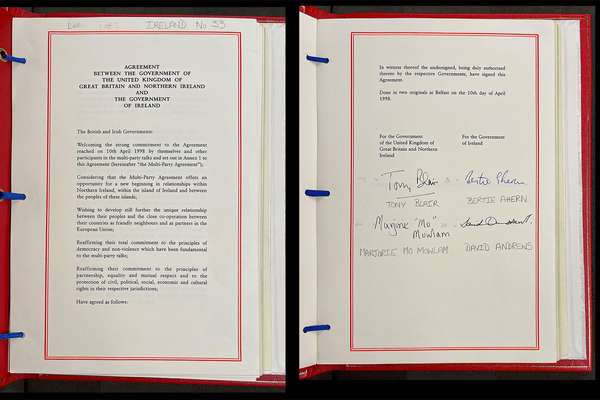
This resource includes all the original documents used to create our resources about the signing of the Belfast (Good Friday) Agreement.
Teaching resource
This themed collection includes all the original documents used to create The National Archives' resources about the signing of the Belfast (Good Friday) Agreement. Teachers and students can use these sources to find their own themes and conduct independent research.

Woman reads her copy of the Good Friday Agreement 1998.
Reuters/Crispin Rodwell
Explore these sources alongside those found in part 2 of this resource.

From: Graham Archer. Republic of Ireland Department
Date: 9 December 1992
CC: Mr Thomas, Mr Bell, Mr Brooker
Mr D A Cooke
TPU, NIO – B
Brief for Prime Ministers telephone conversation with President Elect Clinton
1. We have been asked for a note by tomorrow morning to include in a short brief.
2. Are you content with the following:
Northern Ireland
President-elect Clinton’s closest foreign policy advisers have told our Ambassador
that we should not take too seriously statements made by him to Irish-American
audiences during the election campaign. These included comment that a US envoy
could be a catalyst for peace, on possible support for the MacBride principles that
impose conditions on investment in Northern Ireland, a visa for Gerry Adams, and
the “wanton use of lethal force.”
We see no need for the Prime Minister to enter into any detail on Northern Ireland
with Governor Clinton. But the Prime Minister may wish to play up our concern in a
low key on the following lines:-
– We hope to restart the Northern Ireland Talks process shortly;
– We place great importance on this process. It needs careful handling and we shall
need continuing American support for it. I look forward to having a fuller word about
this when we meet.
G R Archer
Memo from Graham Archer a British official in the Foreign Office, Republic of Ireland Department, to D.A. Cooke, an official in the Northern Ireland Office. Catalogue reference: FCO 87/3596

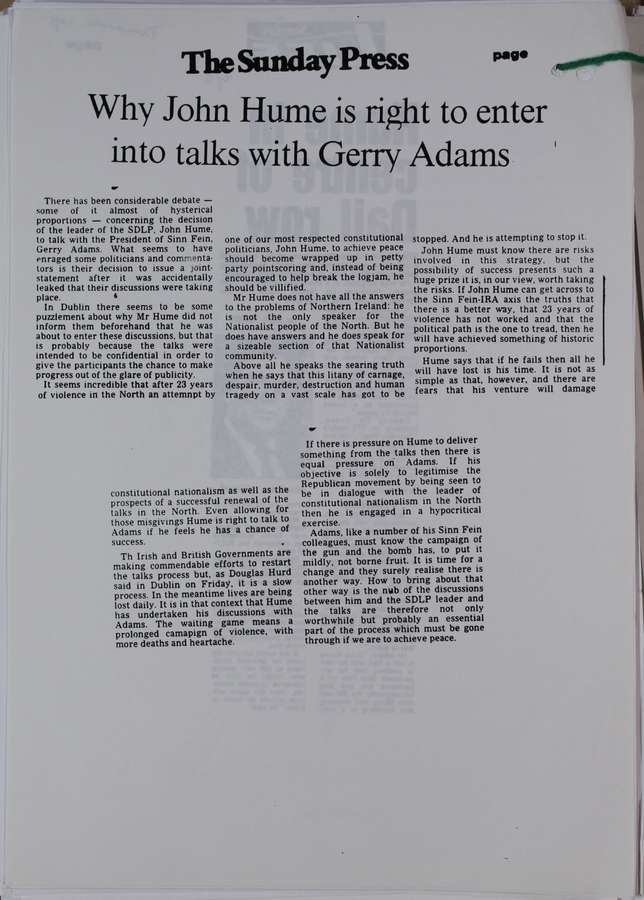
Why John Hume is right to enter into talks with Gerry Adams
There has been considerable debate – some of it almost of hysterical proportions – concerning the decision of the leader of the SDLP, John Hume, to talk with the President of Sinn Fein. Gerry Adams. What seems to have enraged some politicians and commentators is their decision to issue a joint- statement after it was accidentally leaked that their discussions were taking place.
In Dublin there seems to be some puzzlement about why Mr Hume did not inform them beforehand that he was out to enter these discussions, but that probably because the talks were tended to be confidential in order to give the participants the chance to make progress out of the glare of publicity. It seems incredible that after 23 years violence in the North an attempt by one of our most respected constitutional politicians, John Hume, to achieve peace should become wrapped up in petty party point scoring and, instead of being encouraged to help break the logjam, he should be vilified.
Mr Hume does not have all the answers to the problems of Northern Ireland: he is not the only speaker for the Nationalist people of the North. But he does have answers and he does speak for sizeable section of that Nationalist community. Above all he speaks the searing truth when he says that this litany of carnage, despair, murder, destruction and human tragedy on a vast scale has got to be stopped. And he is attempting to stop it. John Hume must know there are risks involved in this strategy, but the possibility of success presents such a huge prize it is, in our view, worth taking the risks. If John Hume can get across to the Sinn Fein-IRA axis the truths that here is a better way, that 23 years of violence has not worked and that the political path is the one to tread, then he will have achieved something of historic proportions.
Hume says that if he fails then all he will have lost is his time. It is not as simple as that, however, and there are fears that his venture will damage constitutional nationalism as well as the prospects of a successful renewal of the talks in the North. Even allowing for those misgivings Hume is right to talk to Adams if he feels he has a chance of success.
The Irish and British Governments are making commendable efforts to restart the talks process but, as Douglas Hurd said in Dublin on Friday, it is a slow process. In the meantime lives are being lost daily. It is in that context that Hume has undertaken his discussions with Adams. The waiting game means a prolonged campaign of violence, with more deaths and heartache.
If there is pressure on Hume to deliver something from the talks then there is equal pressure on Adams. If his objective is solely to legitimise the Republican movement by being seen to be in dialogue with the leader of constitutional nationalism in the North then he is engaged in a hypocritical exercise. Adams, like a number of his Sinn Fein colleagues, must know the campaign of the gun and the bomb has, to put it mildly, not borne fruit. It is time for a change and they surely realise there is another way. How to bring about that other way is the nub of the discussions between him and the SDLP leader and he talks are therefore not only worthwhile but probably an essential art of the process which must be gone through if we are to achieve peace.
Newspaper cutting from The Sunday Press, May 1993. Catalogue reference: CJ 4/11527

3.0 ORIGIN AND DEVELOPMENT OF PEACE TRAIN ORGANISATION
The Peace Train Organisation came into being in 1989. The original idea is attributed to Pronsais De Rossa, a Workers Party T.D. in Dail Eireann, who together with other interested individuals decided to form a pressure group to oppose the ongoing bombing campaign against the Dublin /Belfast rail link. The idea was taken up by like minded individuals in Northern Ireland, initially by Chris and Michael McGimpsey, who formed a Northern contingent to co-operate with the group in Dublin. Eventually support committees were established in both London and Glasgow.
10.0 RECOMMENDATIONS
A report on the Peace Train Organisation (PTO) produced in May 1993. The report was commissioned by the Central Community Relations Unit, part of the Northern Ireland Civil Service. Public Record Office of Northern Ireland: CENT-1-20-33A_1993-nd

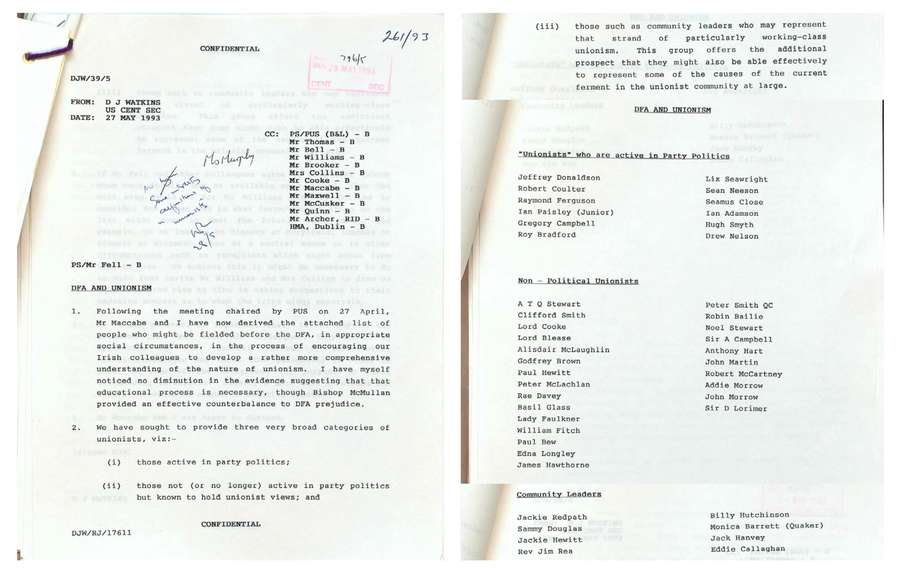
CONFIDENTIAL
DJW/39/5 FROM: DJ WATKINS US CENT SEC
DATE: 27 MAY 1993
CC: PS/PUS (B&L) – B Mr Thomas – B Mr Bell – B Mr Williams – B Mr Brooker – B Mrs Collins – B Mr Cooke – B Mr Maccabe – B Mr Maxwell – B Mr Mccusker – B Mr Quinn – B Mr Archer, RID – B HMA, Dublin – B
PS/Mr Fell – B
DFA AND UNIONISM
1. Following the meeting chaired by PUS on 27 April, Mr Maccabe and I have now derived the attached list of people who might be fielded before the DFA, in appropriate social circumstances, in the process of encouraging our Irish colleagues to develop a rather more comprehensive understanding of the nature of unionism. I have myself noticed no diminution in the evidence suggesting that that educational process is necessary, though Bishop McMullan provided an effective counterbalance to DFA prejudice.
2. We have sought to provide three very broad categories of unionists, viz:-
(i) those active in party politics;
(ii) those not (or no longer) active in party politics but known to hold unionist views; and
(iii) those such as community leaders who may represent that strand of particularly working-class unionism. This group offers the additional prospect that they might also be able effectively to represent some of the causes of the current ferment in the unionist community at large.
DFA AND UNIONISM
“Unionists” who are active in Party Politics
Jeffrey Donaldson. Robert Coulter. Raymond Ferguson. Ian Paisley (Junior). Gregory Campbell. Roy Bradford. Liz Seawright. Sean Neeson. Seamus Close. Ian Adamson. Hugh Smyth. Drew Nelson
Non – Political Unionists
AT Q Stewart. Clifford Smith. Lord Cooke. Lord Blease. Alisdair McLaughlin. Godfrey Brown. Paul Hewitt. Peter McLachlan. Rae Davey. Basil Glass. Lady Faulkner. William Fitch. Paul Bew. EdnaLongley. James Hawthorne. Peter Smith QC. Robin Bailie. Noel Stewart. Sir A Campbell. Anthony Hart. John Martin. Robert McCartney. Addie Morrow. John Morrow. Sir D Lorimer.
Community Leaders
Jackie Redpath. Billy Hutchinson. Sammy Douglas. Monica Barrett (Quaker). Jackie Hewitt. Jack Hanvey. Rev Jim Rea. Eddie Callaghan.
An internal memorandum produced by an official in the Northern Ireland Civil Service in May 1993. It is reporting on a plan to arrange a meeting between representatives of Unionism in Northern Ireland and the Irish Government’s Department of Foreign Affairs (DFA). Public Record Office of Northern Ireland: CENT/1/20/33A_1993-05-27

10 Downing Street
London SW1A 2AA
The Prime Minister
25 November 1993
Strictly Confidential
Dear Albert
It was good to talk to you last Saturday. I am sorry to have intruded on your weekend off. I hope that you and Kathleen were able to get some relaxation during your trip. If I may say so, I thought your interview with David Frost went very well.
Making no bones about it, we have had an extremely difficult and depressing week. I need not labour the reasons why. I had allowed myself to feel a little optimistic after my meeting with Robin Eames on 18 November. But I am afraid that the following day’s leak and the Hume/Adams statement on Saturday last have had precisely the effect I feared when we spoke on the phone.
I have spent all week trying to repair the damage through a series of meetings and public statements. I fear that I have had only limited success. In the current political atmosphere, there is clearly no hope of securing even tacit acceptance by the Unionist mainstream of a Joint Declaration on the lines of your draft. The text would be seen as deriving from Hume/Adams, and thus would assumed to be the product of negotiation with Sinn Fein. This is an impression which successive statements from Hume and Adams have done nothing to dispel. As we have agreed all along, association with Hume/Adams is the kiss of death for any text intended to secure acceptance on both sides of the Community.
A letter from the UK Prime Minister to the Taoiseach November 1993, Catalogue reference: CJ 4/10560

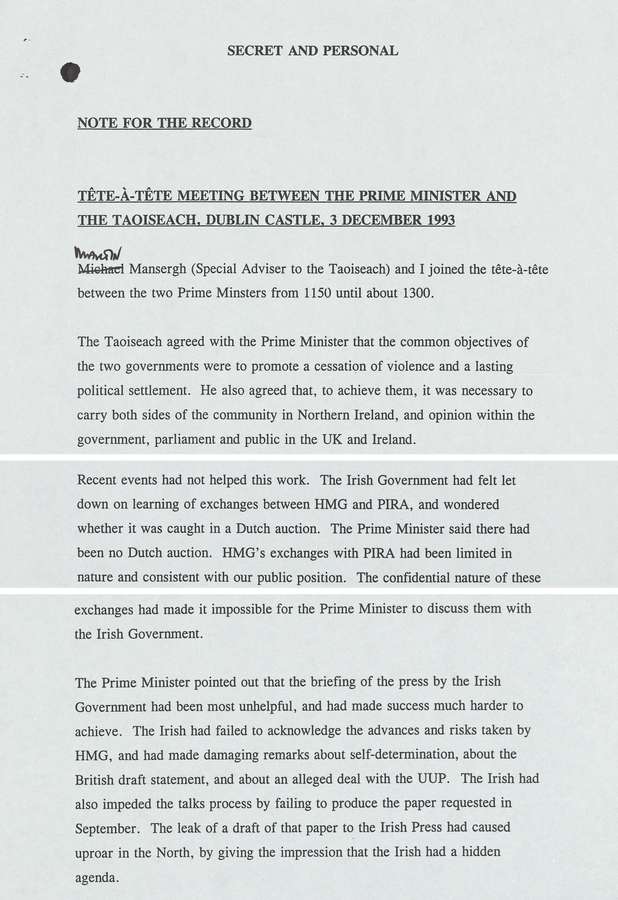
SECRET AND PERSONAL
NOTE FOR THE RECORD
TÊTE-À-TÊTE MEETING BETWEEN THE PRIME MINISTER AND
THE TAOISEACH, DUBLIN CASTLE, 3 DECEMBER 1993
Martin Mansergh (Special Adviser to the Taoiseach) and I joined the tête-à-tête between the two Prime Minsters [sic] from 1150 until about 1300.
The Taoiseach agreed with the Prime Minister that the common objectives of the two governments were to promote a cessation of violence and a lasting political settlement. He also agreed that, to achieve them, it was necessary to carry both sides of the community in Northern Ireland, and opinion within the government, parliament and public in the UK and Ireland.
The Prime Minister and the Taoiseach had been working towards these objectives since their first meeting in Downing Street soon after the Taoiseach took office – and long before people had heard of the Hume/Adams dialogue. Since June 1993, they had been working on a draft Joint Declaration originally put forward by the Taoiseach, but since amended towards a more balanced document.
Recent events had not helped this work. The Irish Government had felt let down on learning of exchanges between HMG and PIRA, and wondered whether it was caught in a Dutch auction. The Prime Minister said there had been no Dutch auction. HMG’s exchanges with PIRA had been limited in nature and consistent with our public position. The confidential nature of these exchanges had made it impossible for the Prime Minister to discuss them with the Irish Government.
The Prime Minister pointed out that the briefing of the press by the Irish Government had been most unhelpful, and had made success much harder to achieve. The Irish had failed to acknowledge the advances and risks taken by HMG, and had made damaging remarks about self-determination, about the British draft statement, and about an alleged deal with the UUP. The Irish had also impeded the talks process by failing to produce the paper requested in September. The leak of a draft of that paper to the Irish Press had caused uproar in the North, by giving the impression that the Irish had a hidden agenda.
Record of a meeting between the UK Prime Minister and the Irish Taoiseach December 1993. Catalogue reference: CJ 4/1056

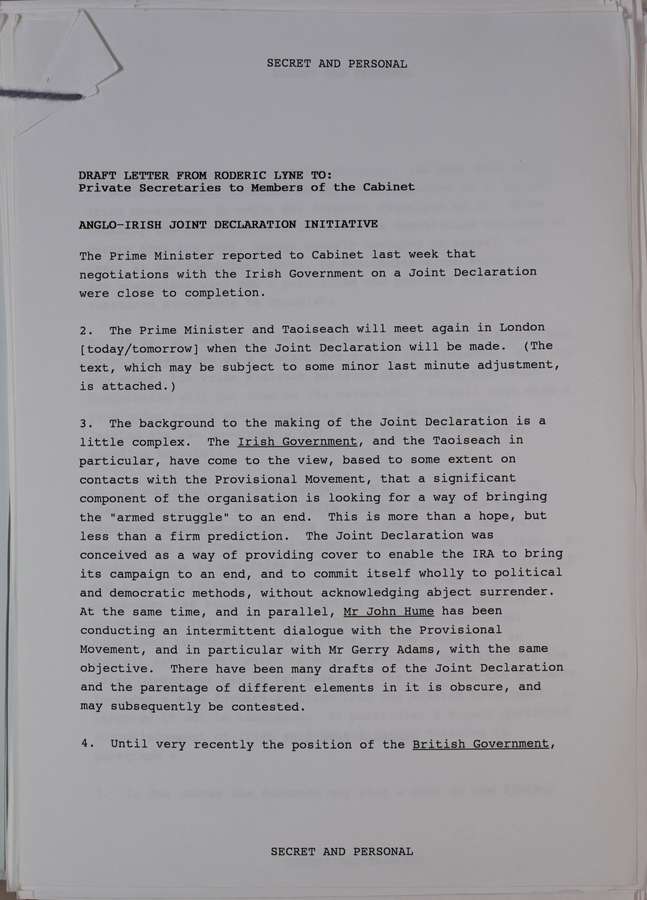
SECRET AND PERSONAL
DRAFT LETTER FROM RODERIC LYNE TO:
Private Secretaries to Members of the Cabinet
ANGLO-IRISH JOINT DECLARATION INITIATIVE
The Prime Minister reported to Cabinet last week that negotiations with the Irish Government on a Joint Declaration were close to completion.
2. The Prime Minister and Taoiseach will meet again in London [today/tomorrow] when the Joint Declaration will be made. (The text, which may be subject to some minor last minute adjustment, is attached.
3. The background to the making of the Joint Declaration is a little complex. The Irish Government, and the Taoiseach in particular, have come to the view, based to some extent on contacts with the Provisional Movement, that a significant component of the organisation is looking for a way of bringing the “armed struggle” to an end. This is more than a hope, but less than a firm prediction. The Joint Declaration was conceived as a way of providing cover to enable the IRA to bring its campaign to an end, and to commit itself wholly to political and democratic methods, without acknowledging abject surrender. At the same time, and in parallel, Mr John Hume has been conducting an intermittent dialogue with the Provisional Movement, and in particular with Mr Gerry Adams, with the same objective. There have been many drafts of the Joint Declaration and the parentage of different elements in it is obscure, and may subsequently be contested.
4. Until very recently the position of the British Government, […]
Briefing notes sent to senior civil servants explaining the proposed Downing Street Declaration December 1993. Catalogue reference: CJ 4/10562

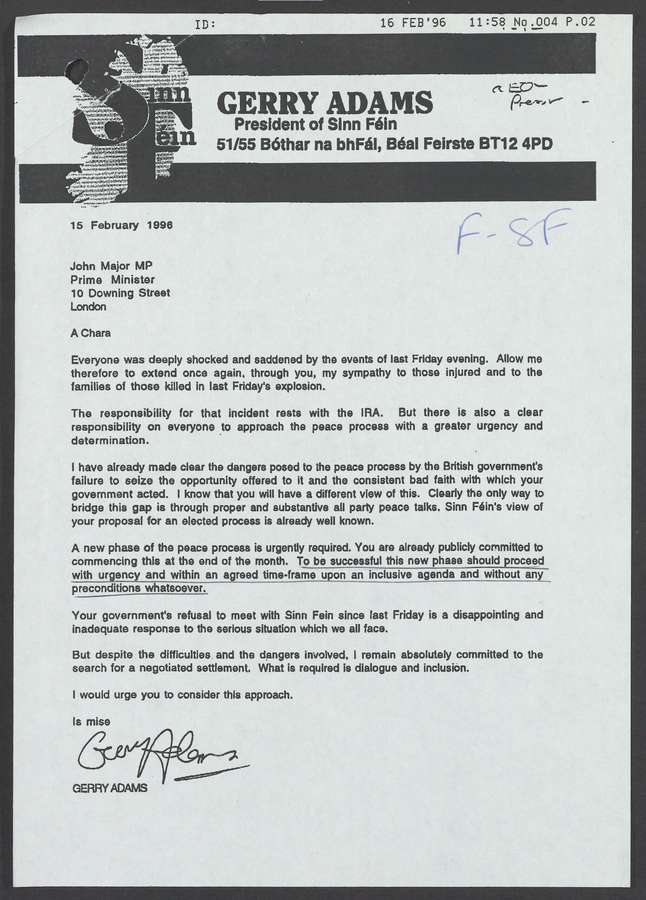
GERRY ADAMS
President of Sinn Féin
51/55 Bóthar na bhFál, Béal Feirste BT12 4PD
15 February 1996
John Major MP
Prime Minister
10 Downing Street
London
A Chara
Everyone was deeply shocked and saddened by the events of last Friday evening. Allow me therefore to extend once again, through you, my sympathy to those injured and to the families of those killed in last Friday’s explosion.
The responsibility for that incident rests with the IRA. But there is also a clear responsibility on everyone to approach the peace process with a greater urgency and determination.
I have already made clear the dangers posed to the peace process by the British government’s failure to seize the opportunity offered to it and the consistent bad faith with which your government acted. I know that you will have a different view of this. Clearly the only way to bridge this gap is through proper and substantive all party peace talks. Sinn Féin’s view of your proposal for an elected process is already well known.
A new phase of the peace process is urgently required. You are already publicly committed to commencing this at the end of the month. To be successful this new phase should proceed with urgency and within an agreed time-frame upon an inclusive agenda and without any preconditions whatsoever.
Your government’s refusal to meet with Sinn Fein since last Friday is a disappointing and inadequate response to the serious situation which we all face.
But despite the difficulties and the danger involved, I remain absolutely committed to the search for a negotiated settlement. What is required is dialogue and inclusion.
I would urge you to consider this approach.
Is mise
GERRY ADAMS
A letter from Gerry Adams, the leader of Sinn Féin, to John Major, the UK Prime Minister, 15 February 1996. Catalogue reference: CJ 4/12375

Sinn Féin Ard Oifig
6 June 1996
Sir Patrick Mayhew
Secretary of State
Northern Ireland Office
Whitehall
London
I understand from the media that invitations have been sent to party leaders to nominate their negotiating teams. Sinn Fein have not received such an invitation. I want to protest in the strongest possible terms at your discriminatory approach. Those who vote for our party gave us a negotiating mandate which you should respect and accept. I am therefore sending you the names of our negotiating team.
GERRY ADAMS
MARTIN McGUINNESS
GERRY KELLY
LUCILITA BHREATNACH
PAT DOHERTY
ANNE (DODIE) McGUINNESS
Martin McGuinness is our chief negotiator and in my absence he will lead the Sinn Fein negotiating panel. Note also that Siobhan OHanlon has been appointed by us to head up our secretariat and she can be contacted in the usual manner.
Is mise
GERRY ADAMS
A letter from Gerry Adams, the leader of Sinn Féin, to Sir Patrick Mayhew, the Secretary of State for Northern Ireland (a UK government minister), 6 June, 1996. Catalogue reference: CJ 4/12383

CONFIDENTIAL
RECORD OF PLENARY SESSION, CASTLE BUILDINGS, 12 JUNE
Independent Chairman (after adjournment)
Senator Mitchell
General de Chastelain
Mr Holkeri
British government team
Secretary of State
Michael Ancram
Sir David Fell
Irish government team
Tanaíste
Mrs Owen
Mr de Rossa
Alliance Party
Dr Alderdice
Mr Close
Mr Neeson
Labour
Malachi Curran
NI Women’s Coalition
Ms Sagar
Ms McWilliams
PUP
Mr Smyth
Mr Ervine
SDLP
Mr Hume
Mr Mallon
Mr. McGrady
UDP
Mr McMichael
Mr White
UDUP (for part of meeting)
Dr Paisley
Mr Robinson
Rev McCrea
UK Unionist (for part of meeting)
Mr McCartney
Dr O’Brien
Mr Wilson
UUP
Mr Trimble
Mr Taylor
Mr Empey
1. The meeting began at 12.20 am.
5. When other delegates had arrived, the Secretary of State opened the meeting. The day had seen a long and useful period of deliberation, which had led the two Governments to put forward a paper which they believed offered a way forward (A possible approach to resolving procedural difficulties, 00.01am draft, annexed at A). On the basis of this, in particular paragraph 4.1, he invited Senator Mitchell to take over, following a five minute adjournment. Dr Paisley shouted ‘No, no, no’; and the rest of his delegation, and the UKUP’s, left, with disparaging comments about ‘British democracy’; Mr Wilson (UKUP) moved to take over one of the Independent Chairmen’s chairs.
6. As proceedings were about to resume after the adjournment, Dr Paisley addressed Senator Mitchell. He said he did not accept him in the chair; his name had not been put to the meeting, and he objected in the strongest manner to the intrusion. He repeated his points about undertakings that proposals put forward would have to be to the satisfaction of participants, undertakings which had not been met. The Secretary of State had not given an opportunity to discuss it. His lackey had seen to it that he had not visited the DUP room. (I was the lackey who had visited delegations to tell them a paper, then a meeting, were imminent, if that is what was referred to: there was no-one in the DUP office, and Dr Paisley was already in the Private Office).
7. Dr Paisley then left the room, shouting that he did not wish to sit with a member of the Irish Government who threatened that there would be bodies in the street, a remark ascribed to the ‘man with the beard’ [presumably Mr de Rossa. It had been reported around the building that he had made such a prediction, in the event that Senator Mitchell was not appointed and the process broke down].
Extracts from a Northern Ireland Office (UK government department) record of a morning session during the peace talks on 12 June 1996 in Stormont, Belfast. The notes were recorded by a UK government official. Catalogue reference: CJ 4/12228

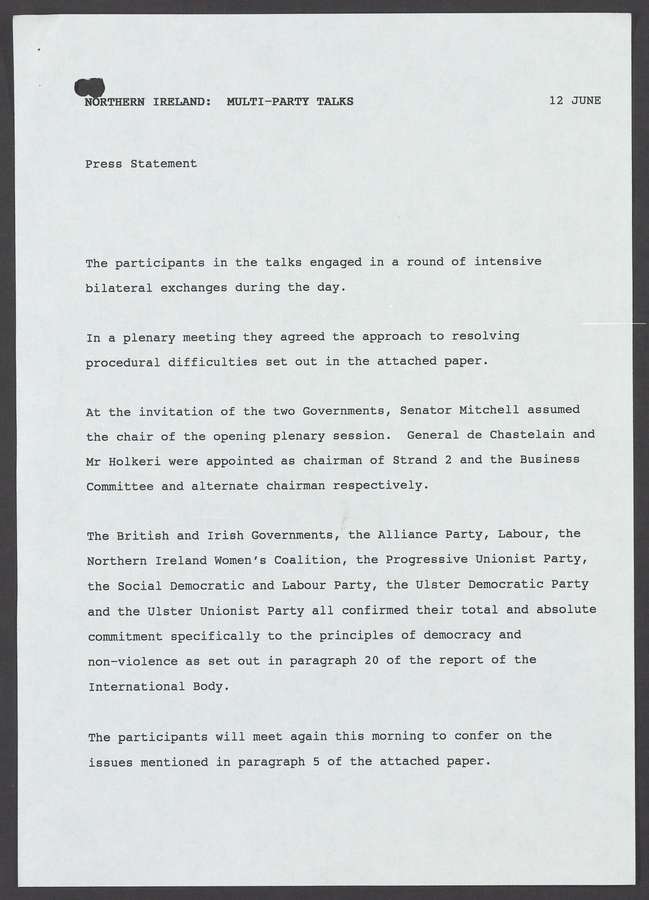
NORTHERN IRELAND: MULTI-PARTY TALKS
12 June
Press Statement
The participants in the talks engaged in a round of intensive bilateral exchanges during the day.
In a plenary meeting they agreed the approach resolving procedural difficulties set out in the attached paper.
At the invitation of the two Governments, Senator Mitchell assumed the chair of the opening plenary session. General de Chastelain and Mr Holkeri were appointed as chairman of Strand 2 and the Business Committee and alternate chairman respectively.
The British and Irish Governments, the Alliance Party, Labour, the Northern Ireland Women’s Coalition, the Progressive Unionist Party, the Social Democratic and Labour Party, the Ulster Democratic Party and the Ulster Unionist Party all confirmed their total and absolute commitment specifically to the principles of democracy and non-violence as set out in paragraph 20 of the report of the International Body.
The participants will meet again this morning to confer on the issues mentioned in paragraph 5 of the attached paper.
A copy of a press release concerning the peace talks so far. It was tabled by Senator Mitchell at the end of the meeting and there were no objections from those present, 12 June 1996. Catalogue reference: CJ 4/12228

10 Downing Street
London
SW1A 2AA
The Prime Minister
12 June 1996
Dear David,
Just a quick note to say how pleased I am that a way forward was finally found yesterday, and that we now have a basis for the talks to proceed. I know you worked hard to achieve this and am grateful for your efforts.
I hope we can move forward from here successfully, although I have no illusions about how difficult the process is likely to be. If you need to be in touch at any stage, I am always available as you know.
Yours Sincerely,
John M
David Trimble Esq MP
Letter from UK Prime Minister John Major to David Trimble, leader of the Ulster Unionist Party, June 1996. Catalogue reference: CJ4/12228

10 DOWNING STREET
LONDON SWIA 1AA
THE PRIME MINISTER
27 September 1996
Thank you for your letter of 8 August and the text which you faxed on 6 September.
The IRA’s position, as you describe it, is that if we are ready to make this statement, and the IRA knew when we were going to make it, they would respond shortly afterwards, at a time specified in advance, with an unequivocal restoration of the August 1994 “total cessation”.
When I wrote to you on 24 July. I said that the IRA should restore their ceasefire without any further prevarication. But, in response to the suggestion that reassurances from the British Government on certain issues in line with its established public policy would help to bring this about, l set out words which could be used.
Now they have returned with one significant issue – the timeframe – which is simply not under our control, and an altogether longer text covering a host of other issues. Meanwhile, continued preparation for further IRA attacks goes on, as the arrests and arms finds on Monday demonstrated all too clearly. Intimidation and so-called punishment attacks also continue to increase in
2
number and brutality. As I have already said publicly, Sinn Fein’s talk of peace can have little credibility against this background.
It remains the case that the IRA should restore their ceasefire without further ado and without the need for further statements. The Government is certainly not in the business of negotiating a restoration of the IRA ceasefire, nor in giving secret assurances to bring it about. Sinn Fein must understand that we mean in private what we say in public.
Nevertheless, if there is genuine doubt or uncertainty over the Government’s policy, I am happy to look at that. Because I am in no doubt of the benefits, for the people of Northern Ireland and the negotiations, of a genuine and unequivocal restoration of the IRA ceasefire, we will repeat and reaffirm our approach on the key issues. The attached text has been prepared for this purpose, and will be published in the near future.
Yours sincerely
John M
A letter from the UK Prime Minister John Major to the SDLP leader John Hume, September 1996. National Archives of Ireland, TAOIS-2021-98-18 1996-09-27
National Archives of Ireland

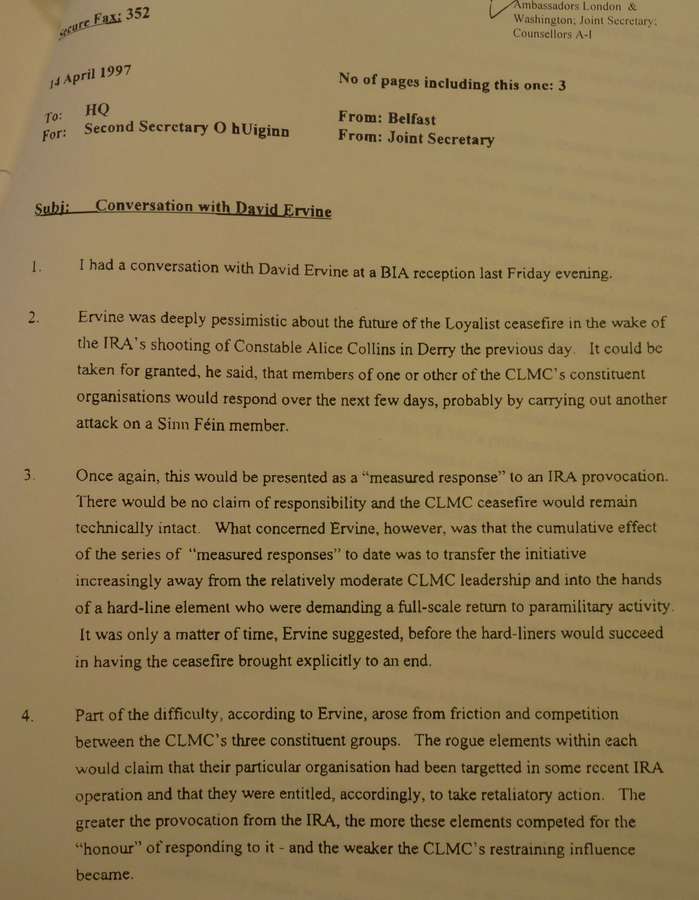
14 April 1997
No of pages including this one 3
To: HQ
For: Second Secretary O hUiginn
From: Belfast
From: Joint Secretary
Subj:
Conversation with David Ervine
Extract from a report written 14 April 1997 by an official to Seán Ó hUiginn, the Joint Secretary of the Anglo-Irish Secretariat in Belfast. It describes a conversation with David Ervine, a former Loyalist paramilitary and member of the Progressive Unionist Party. National Archives Ireland, DFA_2021_53_15 p1 and p2
National Archives Ireland

10 DOWNING STREET
LONDON SWIA 2AA
From the Private Secretary
7 May 1997
Dear Ken
CALL BY THE UUP, 7 MAY
The Prime Minister decided that, before he saw the Taoiseach, he would like to touch base in person with David Trimble. Trimble therefore called on the Prime Minister in the House of Commons for 10 minutes this afternoon, accompanied by Geoffrey Donaldson. Jonathan Powell and I were there on our side.
Trimble began by thanking the Prime Minister for seeing him. This would be an important signal to the Unionist community. The Prime Minister said that in the ideal world he would not have been seeing the Taoiseach so soon, but he was in town anyway and a meeting could hardly be avoided. Trimble accepted this. But the Irish were busy trying to make something of the meeting and giving the impression that things were being done behind the backs of others.
The Prime Minister said that his aim was to sort out the Northern Ireland problem. He had no predilection whatsoever for a united Ireland, and he would want to find the right way of making this clear in due course. Trimble welcomed this. There was considerable nervousness on doorsteps in Belfast about the views of the new government.
Part of a record of a meeting on 7 May 1997 between the UK Prime Minister Tony Blair and David Trimble, leader of the Ulster Unionist Party (UUP) and Jeffrey Donaldson, of the Ulster Unionist Party (UUP). Catalogue reference: PREM 49/108

10 DOWNING STREET
LONDON SWIA 2AA
From the Private Secretary
12 May 1997
Dear Ken
CALL BY THE UUP, 12 MAY
David Trimble and John D Taylor called on the Prime Minister this afternoon for about 45 minutes. Dr. Mowlam, Jonathan Stephens, Jonathan Powell and I were present on our side. The Prime Minister began by asking for Trimble’s assessment of the situation.
Trimble said that he was particularly worried about the Loyalist ceasefire. The situation on the ground was worse than it had been for many years, with considerable tension in urban areas. Recent spontaneous attacks on individuals of one community or the other were the most obvious signs of this. The continuing IRA violence was a major factor, compounded by worry about what might happen in the marching season and, to a lesser degree, nervousness about a Labour government. Feelings in the Protestant community were not helped by public suggestions by Dr. Mowlam that the RUC could be radically reformed.
2
The Prime Minister looked forward to the eventual solution. This would presumably involve a devolved assembly commanding confidence from both Unionists and Nationalists, and proper cross border arrangements. Both the UUP and SDLP appeared to envisage something like this. Taylor agreed but pointed out that there was a big difference between practical cross border cooperation e.g. the Foyle Fisheries Commission, and the kind of all Ireland bodies with executive powers demanded by the Irish government. If discussion could move away from the latter proposal, the package could be sold to Unionists. Meanwhile the current talks process was stuck. If the governments continued to wait for the IRA to make up their mind, and the argument about decommissioning continued, there would never be progress.
The Prime Minister suggested that it would be better if Sinn Fein were in the talks. Taylor disagreed. It was better for them to be out. They were not in practice in a position to go back to full scale violence because people would not accept it. Trimble agreed. The republicans were in a difficult position. They were not ready to turn their backs on violence definitively and found the choice of going wholly political unpalatable. There was a lot to be said for keeping them in their present awkward position. In theory it would be good to get Sinn Fein in, but only if they had genuinely given up violence. Otherwise the pressure on them should be maintained until the movement split. That would be inevitable because the Slab Murphys of this world would never give up violence.
Taylor drew attention to the problem for the UUP if violence got worse, and the Loyalists had to be thrown out of the talks. The UUP needed the Loyalists in order to meet the rules of sufficient consensus. Otherwise they could be out-voted by Paisley and McCartney. So it was extremely important to keep the Loyalists in if possible. Trimble emphasised the same point.
3
Discussion moved to Irish elections and the prospect of Ahern as Taoiseach. Taylor suggested that, judging from his most recent comments, Ahern would be happy to see Sinn Fein in talks even without a ceasefire. Trimble said that he did not think Ahern would adopt this policy. He was very ignorant about Northern Ireland. But he had just had a reasonably good private meeting with Ahern – which Ahern had kept secret, unlike Trimble’s experience with Bruton. However, Ahern would be subject to the influence of Martin Mansergh and others.
Part of a record of a meeting on 12 May 1997 between the UK Prime Minister Tony Blair and David Trimble, leader of the Ulster Unionist Party (UUP) and John Taylor, the Deputy Leader of the UUP, Catalogue reference: PREM 49/108

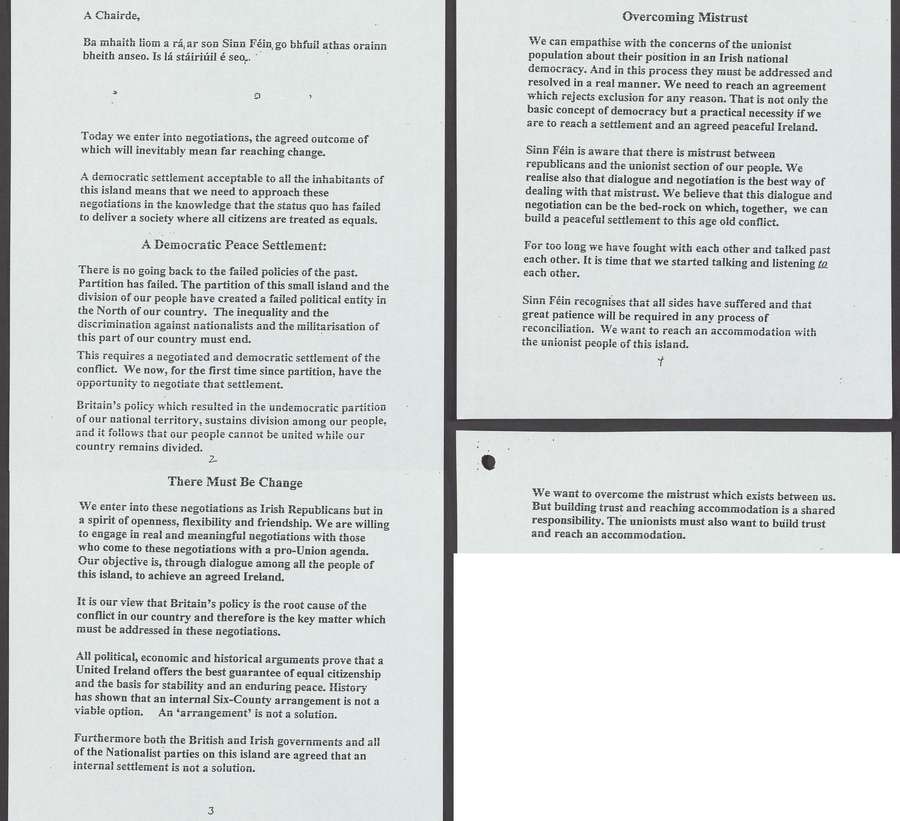
A Chairde,
Ba mhaith liom a rá ar son Sinn Féin, go bhfuil athas orainn bheith anseo. Is lá stáiriúil é seo.
Today we enter into negotiations, the agreed outcome of which will inevitably mean far reaching change.
A democratic settlement acceptable to all the inhabitants of this island means that we need to approach these negotiations in the knowledge that the status quo has failed to deliver a society where all citizens are treated as equals.
A Democratic Peace Settlement:
There is no going back to the failed policies of the past. Partition has failed. The partition of this small island and the division of our people have created a failed political entity in the North of our country. The inequality and the discrimination against nationalists and the militarisation of this part of our country must end.
This requires a negotiated and democratic settlement of the conflict. We now, for the first time since partition, have the opportunity to negotiate that settlement.
Britain’s policy which resulted in the undemocratic partition of our national territory, sustains division among our people, and it follows that our people cannot be united while our country remains divided.
There Must Be Change
We enter into these negotiations as Irish Republicans but in a spirit of openness, flexibility and friendship. We are willing to engage in real and meaningful negotiations with those who come to these negotiations with a pro-Union agenda. Our objective is, through dialogue among all the people of this island, to achieve an agreed Ireland.
It is our view that Britain’s policy is the root cause of conflict in our country and therefore is the key matter which must be addressed in these negotiations.
All political, economic and historical arguments prove that a United Ireland offers the best guarantee of equal citizenship and the basis for stability and an enduring peace. History has shown that an internal Six-County arrangement is not a viable option. An ‘arrangement’ is not a solution.
Overcoming Mistrust
We can empathise with the concerns of the unionist population about their position in an Irish national democracy. And in this process they must be addressed and resolved in a real manner. We need to reach an agreement which rejects exclusion for any reason. That is not only the basic concept of democracy but a practical necessity if we are to reach a settlement and an agreed peaceful Ireland.
Sinn Féin is aware that there is mistrust between republicans and the unionist section of our people. We realise also that dialogue and negotiation is the best way of dealing with that mistrust. We believe that this dialogue and negotiation can be the bed-rock on which, together, we can build a peaceful settlement to the age old conflict.
For too long we have fought with each other and talked past each other. It is time that we started talking to each other.
Sinn Féin recognises that all sides have suffered and that great patience will be required in any process of reconciliation. We want to reach an accommodation with the unionist people of this island.
We want to overcome the mistrust which exists between us. But building trust and reaching accommodation is a shared responsibility. The unionists must also want to build trust and reach an accommodation.
Extracts from an opening statement by Martin McGuinness, Sinn Féin’s Vice President and chief negotiator at the peace talks in Stormont, Belfast, 7 October 1997. The title of the statement was ‘A New Beginning’. Catalogue reference: PREM 49/403

Ulster Unionist Party (UUP)
Statement
by the
Ulster Unionist Party
Launch of Strand 1 Talks
7 October 1997
The Ulster Unionist Party is participating in these talks because the best way to defend and promote the cause of the Union is not by abstention, but by fighting for our cause from within the talks process. Too often, we have seen the wishes of the greater number of people of Northern Ireland ignored and the imposition of so-called solutions, such as the Anglo-Irish agreement, forced upon them. These talks require the principle of consent to be accepted by the participants and the reality that the Union will continue for as long as that is the wish of the greater number of the people in Northern Ireland. By attending these talks the Ulster Unionist Party is determined to challenge the sincerity of Sinn Fein/IRA’s declared commitment to peace and to the democratic process. We view consent and actual disarmament as a test of Sinn Fein’s commitment to exclusively peaceful means as required by the Mitchell Principles. Terrorists must not be allowed to use, or threaten to use, their weaponry in order to extract concessions at the table of democracy. If Sinn Fein/IRA is truly committed to democratic and exclusively peaceful means of achieving political accommodation within Northern Ireland, it no longer needs to retain its murderous arsenal.
The Ulster Unionist Party and its supporters oppose a United Ireland because we are British. We actively espouse the United Kingdom and the Union that exists between the people of England, Scotland and Wales and Northern Ireland. We believe that the United Kingdom, by adding up those four parts, equals more than the sum of those four parts, and it reflects the interaction which has existed in the British Isles throughout history. The Union with Great Britain is a Union in the hearts and minds of the Unionist people. The feeling of Britishness is not a device or artifice which has been imposed on an unsuspecting people by successive British governments. Britishness is at the heart of the Unionist philosophy, the feeling of belonging; the feeling of sharing with our fellow-citizens in Great Britain in great national events; of being part of something larger than simply the six counties in the north-eastern corner of this island It is a shared psychological bond; a shared emotional bond, common bonds of history and of shared adversities, shared triumphs and shared sacrifices.
Since 1177, when the Normans came to Ulster, eastern Ulster has been loyal to the crown of, firstly England, and then, Great Britain. But, our Britishness is more than loyalty to the Crown. It is a sense of communion with the rest of the peoples of the United Kingdom built up over centuries. Northern Ireland itself has been a part of the United Kingdom from before the time when Nelson defeated the French at Trafalgar and before Wellington defeated Napoleon at Waterloo. Our ancestors shared in the project of the Empire; sacrificed themselves for King and Country on the battlefields of Europe, whilst Republicans rose in revolt in Ireland; and stood alone with Britain during the Second World War, while our southern neighbour remained aloof from the battle to preserve European civilisation. Indeed, as Winston Churchill said,
But for the loyalty of Northern Ireland…the light which now shines so brightly throughout the World, would have been quenched ‘
In short, our sense of Britishness was forged in sweat and blood.
[Footer of the paper reads:]
3 glengall street
Belfast 12
tel 01232 324601
fax 01232 246738
building your future within the union
Extracts from an opening statement by Ulster Unionist Party (UUP), which was led by David Trimble, at the peace talks in Stormont, Belfast, on 7 October 1997. [Trimble was not present] Catalogue reference: PREM 49/403

P28
Sinn Fein enters these negotiations as an Irish republican party seeking to promote the broad nationalist objective of an end to British rule in Ireland.
It is our firm view that this Strand, which deals with north-south relations, is a critical area of negotiation because the resolution of this conflict will only be found in an all-Ireland context.
British policy at present upholds the union. It enforces the partition of Ireland. Democratic opinion in Ireland and in Britain must seek to change this policy to one of ending the union.
The issue of sovereignty, the claim of the British government to sovereignty in a part of Ireland, is a key matter which we will raise in the negotiations. Our objective is to achieve through dialogue among the Irish people an agreed Ireland. The political and historical evidence shows that political independence, a united Ireland, offers the best guarantee of equality and the most durable basis for peace and stability. An internal Six-County arrangement cannot work.
Equality
There are many issues which fuel the conflict. For example there needs to be equality of treatment in terms of employment, economic development and the Irish language and culture, as well as on the difficult issue of cultural symbols, of flags and emblems. In other words there needs to be equality in all sectors of society – in social, economic, cultural, education, justice, democratic and national rights issues.
P29
These issues do not require negotiation. They are issues of basic civil and human rights. The British government should act on these issues immediately by outlining a programmatic approach which delivers real change, which makes equality a reality and which builds confidence in the wider peace process. The immediate responsibility for equality rests with the British government and there should be no artificial distinctions, no arbitrary barriers placed in the way of these rights.
But the Irish government and Irish nationalists also have a responsibility; a responsibility to ensure that the concerns and fears of the unionist population are addressed and resolved through negotiation. A process of national reconciliation must secure the political, religious and democratic rights of the northern unionist population. That is not only the democratic norm but a practical necessity if we are to advance the cause of peace in Ireland.
Bridging the Gap of Distrust
I welcome the contribution of Senator Mitchell and his colleagues to the negotiating process. Sinn Fein has long argued for an international dimension to the search for peace in Ireland. The international dimension is one which can play a crucial part in maintaining the momentum and dynamic through the negotiations. There is a huge gap of distrust between nationalists and unionists. It must be bridged. We need to secure an accommodation, based on equality. Building peace is a collective responsibility. In setting out the
P30
republican position I also want to stress our willingness to listen to other positions and to see and to uphold the dignity of all sections of our people.
The British government also has a crucial and constructive role to play in persuading unionists to reach a democratic agreement on the issue of Irish national reunification with the rest of the people of this island and to encourage, facilitate and enable such agreement.
Extracts from the opening remarks of Sinn Féin leader Gerry Adams to the first meeting of Northern Ireland parties and the UK and Irish governments in October 1997. National Archives of Ireland, TAOIS-2021-99-23 1997-10-07b
National Archives of Ireland

From the Private Secretary
14 October 1997
Dear Ken
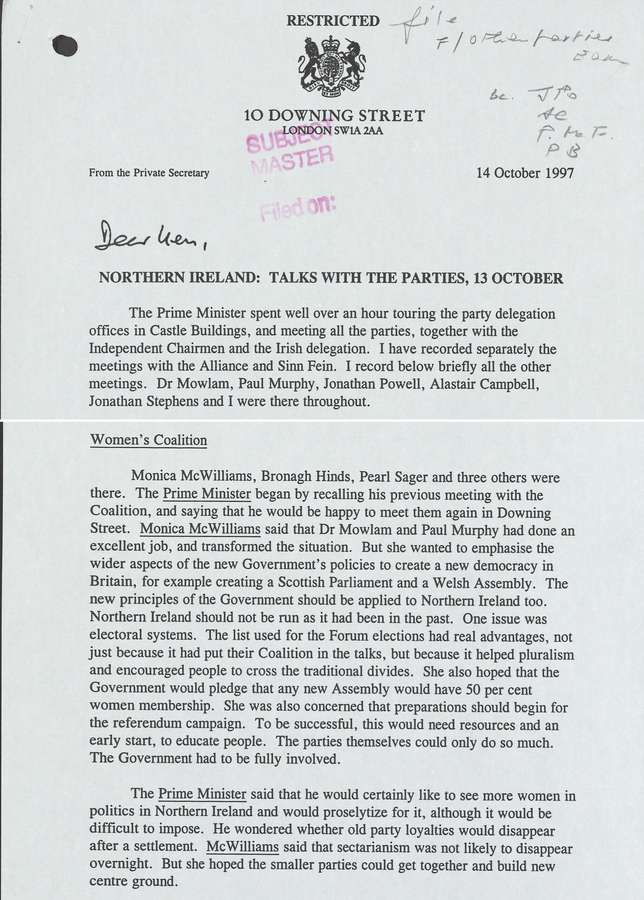
NORTHERN IRELAND: TALKS WITH THE PARTIES, 13 OCTOBER
The Prime Minister spent well over an hour touring the party delegation offices in Castle Buildings, and meeting all the parties, together with the Independent Chairmen and the Irish delegation. I have recorded separately the meetings with the Alliance and Sinn Fein. I record below briefly all the other meetings. Dr Mowlam, Paul Murphy, Jonathan Powell, Alastair Campbell, Jonathan Stephens and I were there throughout.
Women’s Coalition
Monica McWilliams, Bronagh Hinds, Pearl Sager and three others were there. The Prime Minister began by recalling his previous meeting with the Coalition, and saying that he would be happy to meet them again in Downing Street. Monica McWilliams said that Dr Mowlam and Paul Murphy had done an excellent job, and transformed the situation. But she wanted to emphasise the wider aspects of the new Government’s policies to create a new democracy in Britain, for example creating a Scottish Parliament and a Welsh Assembly. The new principles of the Government should be applied to Northern Ireland too. Northern Ireland should not be run as it had been in the past. One issue was electoral systems. The list used for the Forum elections had real advantages, not just because it had put their Coalition in the talks, but because it helped pluralism and encouraged people to cross the traditional divides. She also hoped that the Government would pledge that any new Assembly would have 50 per cent women membership. She was also concerned that preparations should begin for the referendum campaign. To be successful, this would need resources and an early start, to educate people. The parties themselves could only do so much. The Government had to be fully involved.
The Prime Minister said that he would certainly like to see more women in politics in Northern Ireland and would proselytize for it, although it would be difficult to impose. He wondered whether old party loyalties would disappear after a settlement. McWilliams said that sectarianism was not likely to disappear overnight. But she hoped the smaller parties could get together and build new centre ground.
Extract from a report summarising talks between the UK government and various political parties and community groups in Northern Ireland, 14 October 1997. Catalogue reference: PREM 49/119
This themed collection includes all the original documents used in The National Archives' resources on the Belfast (Good Friday) Agreement which ended the conflict in Northern Ireland.
This themed collection allows teachers to create their own differentiated resources.
Students can also be encouraged to do their own research within an archival collection for their own individual projects and enquiries. Using the themed collection, students could ‘curate’ their own ‘exhibition’ of the most significant sources on the topic.
Students could also use the documents to substantiate or dispute points made in the introduction to the collection. The collection allows students to work independently with a group of sources or source type, ranging from documents from the Prime Minister’s Office, Secretary of State or Northern Ireland, press releases, newspapers and so on.
Working with original documents should offer students a chance to develop their powers of evaluation and analysis and support their course work. Please note, the transcripts of the resources retain any typographical errors included in the original documents.
Possible questions/themes to explore using the documents collection:
Challenges for Britain, Europe, and the wider world, 1901 to the present day
Challenges for Britain, Europe, and the wider world, 1901 to the present day
Once students are familiar with the collection it would be worth discussing as a group:
The Belfast (Good Friday) Agreement (BGFA) of 10 April 1998, is the most significant attempt, since partition in Ireland, to address division in Northern Ireland.
It was the third agreement between the United Kingdom and Ireland (following the Sunningdale Agreement of 1973 and the Anglo-Irish Agreement of 1985) focused on securing a solution to divisions and an end to the campaign of violence in Northern Ireland and, at times, across the two countries, particularly since 1969, although there had been occasional violent campaigns since the Fenian bombing campaign in the UK in the nineteenth century. The violence in Northern Ireland had endured for centuries involving the native Irish and descendants of British colonists who had arrived with the Plantation in the seventeenth century, thus as long in Ireland as Europeans in North America.
The Sunningdale Agreement of 1973 was negotiated between the UK and Irish governments as well as the then government in Northern Ireland and the main opposition party. It failed to secure broad support from the unionist community and collapsed the following year in 1974.
The Anglo-Irish Agreement of 1985 was between the two governments alone. It endured until the Belfast Good Friday Agreement in 1998 and secured the right of the Irish government to have an input on issues in Northern Ireland, a right underpinned by international law through the registration of the Agreement with the United Nations.
The BGFA differed in a number of important respects from the earlier agreements, not least its far-reaching nature, seeking to address all the dimensions of division.
Firstly, in terms of inclusion, it was close to comprehensive. The two governments, as well as all political parties bar one, the Democratic Unionist Party, were involved. That inclusivity meant that, for the first time, subject to strict conditions on non-violence and eventually on putting all weapons beyond use, representatives of paramilitary groups, which had been engaged in violent campaigns, were involved in the negotiations.
The second way in which the BGFA differed from earlier agreements was in external arbitration, the appointment of an experienced outsider, United States Senator George Mitchell, as the Chair of the talks. His presence, as a respected outsider with no prior engagement on Ireland, together with his wide experience as a senior member of the US Senate (Majority Leader 1989-1995), helped keep the focus on the issues.
The BGFA, as mentioned, embraced a wide agenda, dealing with issues like sovereignty, discrimination, the disbandment and disarmament of paramilitary groups, reform of justice and policing, self-government in the province, the release of prisoners. It established two institutions in Northern Ireland – the Assembly and the Executive – and three North-South institutions – North-South Ministerial Council, the North-South Inter-Parliamentary Association and the North-South Consultative Forum. Three institutions were set up to facilitate interaction between the UK and Irish governments – British–Irish Intergovernmental Conference, the British–Irish Council and the British–Irish Interparliamentary Body.
Thus, by creating this broad system of interaction, the Agreement provided institutional mechanisms for cooperation on a broad level and for dealing with divisive issues as they arise.
Importantly, the BGFA addressed the consent principle in a fundamental way.
Through two referendums on the 22 May, 1998, held simultaneously in both Ireland and Northern Ireland – thus, island-wide – it secured agreement to there being no change in the sovereign status of Northern Ireland until and unless a majority there so voted. But, equally and no less importantly, by gaining a significant majority for the Agreement in Northern Ireland (70%), implicitly it secured, for the first time since partition, the consent of a significant nationalist minority to being part of Northern Ireland. Moreover, because of the island-wide referendums, the BGFA has a huge majority mandate of support from the people of Ireland.
This project, From Conflict to Peace, aims to acquaint students at secondary school level (GCSE and A level) with the BGFA, to demonstrate the enormous benefits of the Agreement to society in Northern Ireland and to sensitise them to the fact that their generation is one of the first to go through school and live in peace, with no intrusive security industry impinging on their daily lives, and, importantly, without ever hearing the sound of a gunshot or an explosion.
Moreover, the Agreement has created the drivers which offer the prospect over time of a blurring of communal and traditional identity and a greater degree of finding common social cause across communities. Equally, the Agreement’s emphasis on parity of esteem and fair employment, as well as its reforms in law enforcement, removes the impulse to see challenges in communal, sectarian terms and shifts the focus to the same drivers as in a settled, unified community.
Obviously, there is no guarantee that the BGFA will hold and not be threatened by the actions of the minority still committed to violence. Yet, as demonstrated by this project, there is a dramatic and popular contrast in society post-BGFA and the divided society which preceded it.
The historically strong popular mandate given to the Agreement in 1998 needs bolstering, not least through projects like From Conflict to Peace which remind the generations which follow of the division which went before and of the huge benefits of an Agreement involving all the main elements of society. The current generation of young people have the opportunity to bed down the Agreement further and continue the process of helping social division to wither.
Background information written by Frank Sheridan, a retired Irish Government Diplomat who participated in the Peace Process.
Teaching resource
This resource includes all the original documents used to create our resources about the signing of the Belfast (Good Friday) Agreement.
Teaching resource
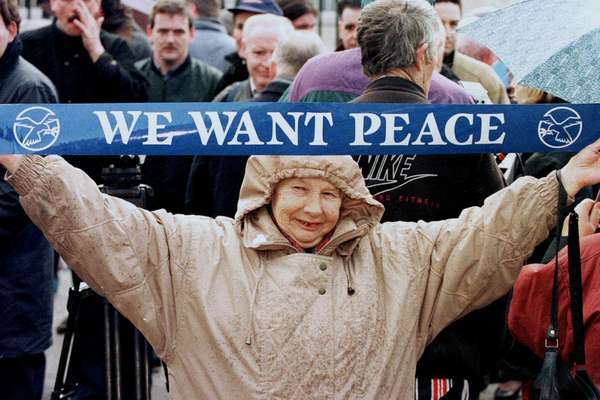
This resource looks at two documents in depth that trace the final 72 hours leading up to the Belfast (Good Friday) Agreement.
Teaching resource

This lesson for key stage 5 students investigates what was the most important factor which led to the achievement of the Belfast (Good Friday) Agreement.
Teaching resource

This lesson, aimed at key stage 3 students introduces students to two of the key moments on the road towards the Belfast (Good Friday) Agreement.
Teaching resource

This resource for key stage 4 students looks at the significance of The Belfast (Good Friday) Agreement and looks at how historians use sources.
Teaching resource
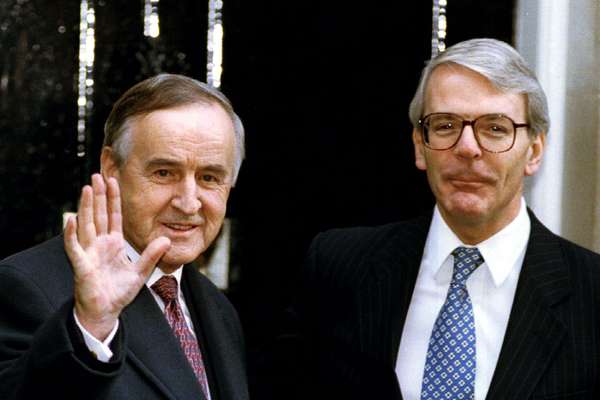
This resource, designed for key stage 4, looks at the significance of the Downing Street Declaration and how historians use sources.