












Teaching resource
The road to the Belfast (Good Friday) Agreement

This lesson, aimed at key stage 3 students introduces students to two of the key moments on the road towards the Belfast (Good Friday) Agreement.
Teaching resource
This resource looks at two documents in depth that trace the final 72 hours leading up to the Belfast (Good Friday) Agreement. It includes a series of detailed activities to conduct with your students plus discussion questions and useful contextual information.

A woman holds up her message during a trade union peace rally at the front of Belfast City Hall.
Reuters/Stringer

Comments from Jeffrey Donaldson (UUP) and David Adams (UDP)
UTV Live at Six – 7 April 1998
Interviewer: Mr Donaldson what is the main problem for your party?
Mr Donaldson: We are not going to sign up for some sort of charter for a United Ireland. What we require, especially from the Irish Government, is some movement. Last week, the Irish Prime Minister said he would not compromise and the result has been the kind of proposals in this document which cannot form the basis of an agreement acceptable to Unionists. We are now prepared to negotiate in good faith and if they don’t, then we are not going to get agreement.
Interviewer: David Adams, is your party unhappy?
Mr Adams: Well, we are unhappy with the document as it sits and Jeffrey is quite right to say that it doesn’t form the basis of an agreement that Unionism could buy into and we, as Unionist parties, will refuse to give our acquiescence to anything which the Unionist population could not be happy with.
Interviewer: Could you walk away from it this week?
Mr Adams: We, at this stage, have no desire or inclination whatsoever to walk away from the negotiations. Jeffrey is quite right when he says what has to happen now is people have to plug in to “planet reality” and try to understand the position that we are in and create a real agreement that Unionism could happily buy into.
Interviewer: Jeffrey Donaldson, what does the Prime Minister have to do?
Mr Donaldson: I think the prime Minister and for that matter the Irish Government, have take a long look at these proposals. There has got to be fundamental changes if we are going to get agreement, if there is to be an agreement to which Unionists can put their hand to we must see fundamental changes to be made to the kind of ideas that are being put forward. Otherwise, unfortunately, if people are not prepared to compromise, we are not going to get agreement.
A transcript of an interview from a TV news programme in Northern Ireland, Live at Six. Catalogue reference (National Archives of Ireland): DFA_2021_53_15 p1 and p2
National Archives of Ireland
This report, written on 13 April, lays out the account of John Holmes of the final days of negotiation before the Agreement was signed on 10 April.

Tuesday 7 April
The situation looked bleak as we arrived in Belfast late on Tuesday afternoon. The decision by Mitchell to insist on including in the text put on the table late on Monday night two long unagreed annexes of issues for North-South co-operation had pushed the Unionists over the edge. They also found the sections on rights, policing, prisoners etc, which they had not seen before, too green for their taste. We therefore invited Trimble to Hillsborough immediately after our arrival, to allow him to explain at length his objections to the text. With the important exceptions of the North-South section and decommissioning, these objections did not seem insuperable. As important, he still seemed interested in a deal.
In the light of all this we worked overnight on proposed amendments to put to the Irish the following morning.
Extract from a report written by John Holmes, who was Principal Private Secretary (a senior official) to the British Prime Minister, Tony Blair. Catalogue reference: PREM 49/412

Wednesday 8 April
The Prime Minister spoke to Trimble first thing to reassure him that we would be pressing Ahern for radical change. When Ahern arrived from Dublin for breakfast (before returning to Dublin for his mother’s funeral), the Prime Minister stressed that there would have to be radical change, particularly to the North-South Annexes, if there was to be a real hope of a deal. Ahern made clear in response that he and his team were ready to have a crack at amending the paper, in particular the North-South part. But he also stressed his own difficulties, and his fear that if one Unionist set of demands was met, another one would quickly appear.
Subsequent negotiation on the North-South text between Gallagher, Teahon, myself and Bill Jeffrey, while the Prime Minister went to Castle Buildings to meet other parties, showed that the Irish had indeed been shaken by the Unionist and other reaction and were ready to make significant changes. The infamous Annexes were deleted, and the text moved a considerable way towards Unionist concerns. The process therefore looked as if it might get back on track, although there was great concern on the nationalist side that the Unionists were refusing to engage on Strand 1 until their Strand 2 (North/South) concerns were sorted out.
Extract from a report written by John Holmes to Tony Blair. Catalogue reference: PREM 49/412

This was followed by a difficult meeting with the UUP team. Empey was particularly insistent that, unless the Irish were prepared to consider radical change, not only in strand 2, the process was going nowhere. Unionist annoyance with hardline Irish public statements in previous days was very clear. The Prime Minister underlined the need to meet the Irish fear that there would never be any North-South implementation bodies because of Unionist sabotage. Trimble suggested (for the first but not last time) that the Irish actually wanted to damage the UUP politically, but that the UUP were nevertheless ready to talk to the Irish if they were ready to make serious change. Maginnis stressed UUP difficulties over policing, decommissioning and security. It was left that we would talk to the Irish again about the text. (By prior agreement with the Irish, we did not give the UUP the new Strand 2 text at this stage for fear of simply triggering further Unionist demands).

A frustrating period followed, with no real negotiation underway on the key fronts. Ahern did not get back from Dublin until the early evening. Until he had approved the Strand 2 text negotiated earlier, so that we could prove to the Unionists that the Irish really were up for serious change, the process was effectively stuck. When he eventually did arrive for a bilateral with the Prime Minister, the initial atmosphere was chilly, because the Irish mistakenly thought we had been trying to negotiate with Mitchell behind their back over policing and decommissioning. Apologies from the Prime Minister quickly restored relations, and Ahern confirmed he was ready to sign up to the paper on Strand 2, contingent on the Unionists being ready to do a reasonable deal on other issues, notably Strand 1.

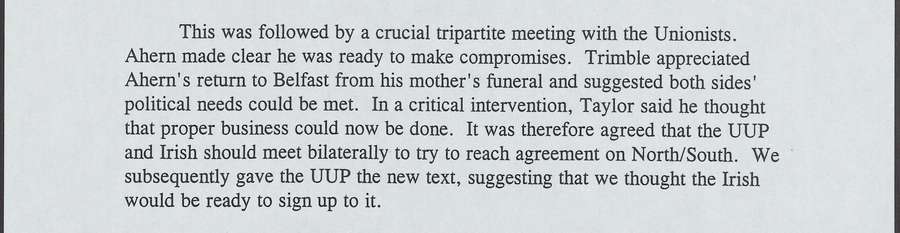
This was followed by a crucial tripartite meeting with the Unionists. Ahern made clear he was ready to make compromises. Trimble appreciated Ahern’s return to Belfast from his mother’s funeral and suggested both sides’ political needs could be met. In a critical intervention, Taylor said he thought that proper business could now be done. It was therefore agreed that the UUP and Irish should meet bilaterally to try to reach agreement on North/South. We subsequently gave the UUP the new text, suggesting that we thought the Irish would be ready to sign up to it.

The UUP and Irish eventually met late that evening, for a long and evidently tense discussion. It did not focus on the new text, as we had hoped, but on the difficult issues, in particular the Irish need for guarantees about the establishment of North-South implementation bodies and preference for Westminster legislation, and the UUP reluctance to contemplate anything “pre-cooked”, before the Assembly could take a view. It was agreed that both sides would go away overnight to draft words to reflect their respective ideas. Some of the Irish side seemed encouraged by the meeting, but Ahern himself commented that it had finished just in time, before blows were exchanged. Andrews and Liz O’Donnell in particular had clearly taken a negative line – a problem which was to plague us further in the next 24 hours.
The Prime Minister was furious that the Irish and UUP had not been prepared to stay up all night to sort out the problems and agree a text. He feared that the delay would make things worse — a fear which proved amply justified the following morning. But Ahern was clearly too tired for an all-night session to be possible.

The end of the evening was marked by Gerry Adams wandering in to see the Prime Minister on his own. He was friendly and philosophical, as always, but his underlying message was worrying: Sinn Fein wanted to sign up to a deal, but we had to give them a deal they could sign up to — and this had to involve more than just prisoner release. The Prime Minister took the opportunity to ask Hume and Mallon immediately afterwards whether he thought Sinn Fein would sign up. They thought Adams genuinely wanted to. But this question was to be a constant preoccupation for the next 36 hours.
We eventually returned to Hillsborough after midnight, frustrated that so little progress had been made during the day. We had arranged to meet Ahern again for breakfast the following morning.

Thursday 9 April
At breakfast with Ahern, the Irish went through the North-South problems again. They were angry that, having made concessions in negotiation with us the previous day, these had been set aside by the Unionists. Not for the first time, the Taoiseach revealed his extreme suspicion of Unionist intentions, based on nationalist experience of many years. He recalled Unionist failure to deliver on the North-South front in both 1921 and 1973. He was worried at the idea that he could change Articles 2 and 3, and then get nothing for it. There was consequently great stress on the Irish side on the need for Westminster legislation to ensure that the North-South bodies would definitely be established. The Irish also showed further concern about Sinn Fein’s position.
Extract from a report written by John Holmes to Tony Blair. Catalogue reference: PREM 49/412

The Prime Minister put the Unionist North-South proposal to Ahern, and pushed him hard. Ahern accepted that the basis of a deal was there, but repeated that Westminster legislation had to be part of this, even if the Assembly helped to draft the legislation. The Prime Minister saw no reason why we should not reintroduce the previous reference to the two governments making all necessary legislative and other preparations. After Teahon and Gallagher had studied the Unionist text in more detail, and suggested some more changes, the Irish reluctantly agreed to it, together (apparently) with the list of proposed subjects for co-operation / implementation bodies.
The Prime Minister then put the proposed Irish amendments to Trimble, who accepted the essential ones. So a deal appeared to have been struck on Strand 2, and a breakthrough achieved. Strand 1 negotiation could start in earnest, together with efforts to resolve the remaining textual problems over rights, policing, decommissioning, etc.
However problems soon appeared. Word began to reach us of serious difficulties about the new text in the Irish camp, fuelled by Andrews, O’Donnell and Mansergh, and unhappiness on the part of Sinn Fein and the SDLP. The Prime Minister explained at length to both parties why the new text was satisfactory from their point of view. The SDLP seemed reasonably convinced. Sinn Fein were not.

After a long period of silence from the Irish, during which the Prime Minister tried in vain to contact the Taoiseach,
It was a disaster — the Irish had altered the balance fundamentally, reintroducing the necessity for Westminster legislation throughout the text and putting all the responsibility in the hands of the two governments. There was fury on our side that the deal had so quickly fallen apart. The Prime Minister quickly told Ahern that the text could not be seriously reopened, but he was ready to see whether the UUP might accept one or two amendments. A difficult negotiation between me and Teahon/Gallagher followed. I agreed to try on the Prime Minister and, if he agreed, the UUP, half a dozen small but significant textual changes.

The Prime Minister met Trimble and Taylor, and put the Irish changes to them. Since they did not fundamentally alter the balance of the text, they accepted four of the six amendments, to our relief. The Irish were in turn satisfied. So the deal seemed to be back on, and attention could switch back to the wider problem of whether Sinn Fein would sign up to a deal, not least since Ahern had made increasingly clear that a deal would be almost impossible for the Irish if they did not. Ahern had already spent hours with Adams trying to persuade him that the deal was worth accepting, and listening to Sinn Fein demands for improvements, particularly on policing, security, the Irish language and prisoners (whom they insisted all had to be out in a year). Dr Mowlam had also been engaged in tough negotiations over the latter point for two days, with us deliberately refusing to reveal our hand. Sinn Fein’s public line had meanwhile turned very negative and it looked as if they were preparing to disassociate themselves from any agreement.

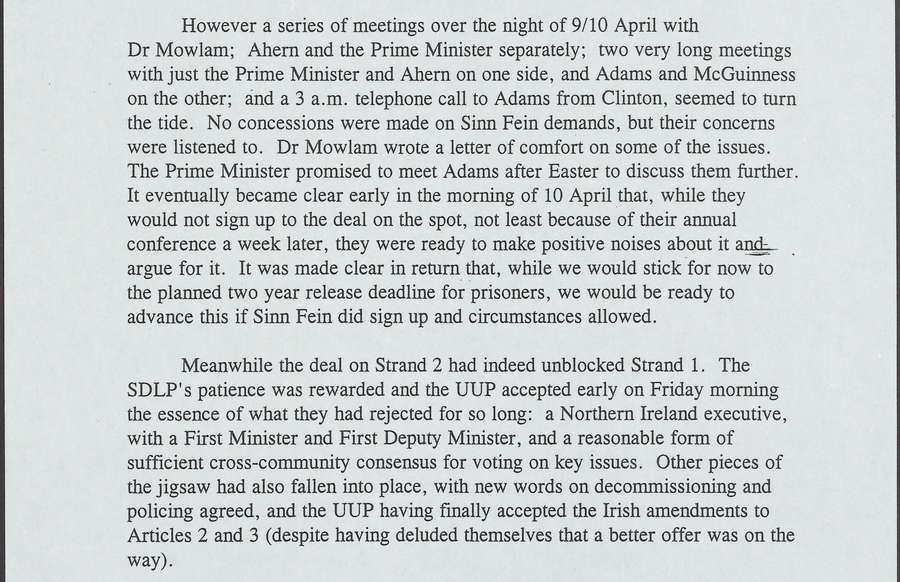
However a series of meetings over the night of 9/10 April with Dr Mowlam; Ahern and the Prime Minister separately; two very long meetings with just the Prime Minister and Ahern on one side, and Adams and McGuinness on the other; and a 3 a.m. telephone call to Adams from Clinton, seemed to turn the tide. No concessions were made on Sinn Fein demands, but their concerns were listened to. Dr Mowlam wrote a letter of comfort on some of the issues. The Prime Minister promised to meet Adams after Easter to discuss them further. It eventually became clear early in the morning of 10 April that, while they would not sign up to the deal on the spot, not least because of their annual conference a week later, they were ready to make positive noises about it and argue for it. It was made clear in return that, while we would stick for now to the planned two year release deadline for prisoners, we would be ready to advance this if Sinn Fein did sign up and circumstances allowed.
Meanwhile the deal on Strand 2 had indeed unblocked Strand 1. The SDLP’s patience was rewarded and the UUP accepted early on Friday morning the essence of what they had rejected for so long: a Northern Ireland executive, with a First Minister and First Deputy Minister, and a reasonable form of sufficient cross-community consensus for voting on key issues. Other pieces of the jigsaw had also fallen into place, with new words on decommissioning and policing agreed, and the UUP having finally accepted the Irish amendments to Articles 2 and 3 (despite having deluded themselves that a better offer was on the way).

Friday 10 April
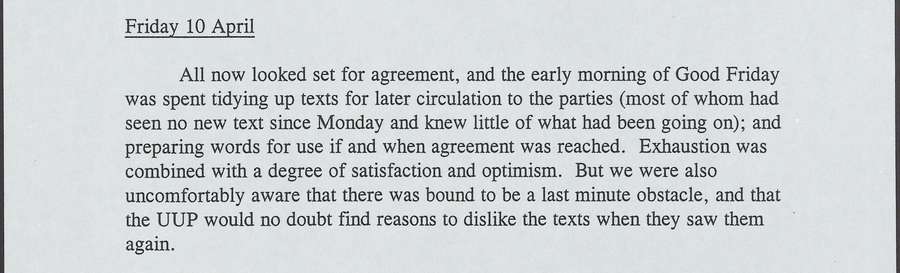
All now looked set for agreement, and the early morning of Good Friday was spent tidying up texts for later circulation to the parties (most of whom had seen no new text since Monday and knew little of what had been going on); and preparing words for use if and when agreement was reached. Exhaustion was combined with a degree of satisfaction and optimism. But we were also uncomfortably aware that there was bound to be a last minute obstacle, and that the UUP would no doubt find reasons to dislike the texts when they saw them again.
Extract from a report written by John Holmes to Tony Blair. Catalogue reference: PREM 49/412

Before they could even be circulated, a mini-crisis arose over the Annex listing the areas where separate or joint North-South implementation bodies would be set up. The Irish had been unhappy with the number of areas on this list (12), together with the fact that few of them were what they wanted. They had pressed throughout for an Irish Language Promotion Body and a Trade Promotion and Indigenous Company Development Body. The UUP had resisted both fiercely, one on political grounds and the other because of competition worries.
The Irish claimed to have persuaded the UUP at some time during the night to accept both
We stupidly took their word for it. When the UUP saw the new list, they blew a fuse, accused the Irish of duplicity and refused to accept any more than the original list. The Irish in turn dug in their heels, and a lengthy impasse followed, with Mitchell unable to circulate a new text and getting increasingly angry. We were also tearing our hair out.

Eventually, the Prime Minister brought Ahern and Trimble together again. Trimble had been given fierce instructions by his colleagues not to accept another body, or not to bother coming back. He was adamant. Ahern pressed but in was persuaded to propose again vain. Eventually Trimble, was persuaded to propose again a pretty meaningless health body. We sold this to an unhappy Ahern on the basis of an additional reference in the text to other bodies being considered, and an exchange of letters with Trimble where Ahern set out four Irish requests again, and Trimble agreed to consider them later.
This fudge allowed the text to be circulated around midday. We sat back and waited for the next problems. They were not long in arriving but were worse than we had anticipated. First the UUP insisted that the Anglo-Irish Secretariat at Maryfield be closed by the end of the year. But the Irish were resistant to further concessions to the UUP. Then the Unionists wanted to change the wording on decommissioning. We told them it was impossible.
But it quickly became clear that Trimble’s troops were in general revolt, particularly his young staffers, but also major figures like Donaldson. Faced with the prospect of selling to their community a deal involving Sinn Fein at the Assembly and Government table with no guarantee of decommissioning, with all prisoners out in two years, at least severe doubts about the future of the RUC, a new relationship with Dublin, and a nationalist hold on major Assembly decisions, they were losing their nerve. The precise cause varied over the hours. First, it was prisoners. We provided written comfort on how the scheme would work. Then it was policing. Then it was decommissioning.

The Prime Minister spoke to Trimble several times on the phone. He wrote to Trimble unilaterally agreeing that Maryfield would close by the end of the year. We enlisted David Montgomery. We deployed the big picture arguments we could. But Trimble still seemed to be losing the argument (and to share most of his colleagues’ reservation). It began to look hopeless, and despair took hold.

Trimble eventually brought Taylor, Empey, Maginnis and Donaldson up to see the Prime Minister. All effectively said the text was unacceptable and unsaleable to Unionists. The Prime Minister let his despair show, but said he was ready to help if he could, but not by reopening the text itself. The delegation made clear that the single biggest issue was the prospect of sitting round the Cabinet table with Sinn Fein when there had been no decommissioning. The Prime Minister promised to consider this.
When they had left, we concocted a letter to Trimble making clear that, if after 6 months of the Assembly the present rules to promote non-violent methods had proved ineffective, we would support changing the rules to give them teeth. We sent this off without much hope, and meanwhile enlisted Clinton’s help through a direct phone call to Trimble. The cause still looked all but hopeless, although Trimble had said one or two things which suggested he was determined to make his colleagues swallow the agreement. Meanwhile the other delegations were getting restive and suspicious that Mitchell had still not been able to call the expected plenary to ratify agreement; and the press outside, who had thought it was all over bar the shouting, were just beginning to get wind that we might be in serious trouble.

Suddenly, at about 1630, the picture changed again. Rumours reached us that, following the Prime Minister’s letter, and Clinton’s call, Trimble had taken renewed heart and called a vote, which he had narrowly won. This seemed too good to be true, but Trimble quickly rang to confirm that the way was now clear for the plenary to be held, and Mitchell arranged it for 1700.

The plenary itself was relatively devoid of drama. No-one pressed any amendments, though Adams insisted that a paper on Sinn Fein “Issues of Concern” be entered into the record. The vote was swift. All said yes except Adams, who said he was “very positive” about the text but would have to consult his Annual Conference first. Trimble said he would have to consult his Executive Committee and full Executive Council, but was voting yes anyway. And that was it. There was no applause when sufficient consensus was achieved – just a stunned silence.

After votes of thanks from all parties to Mitchell and his co-chairmen, the Prime Minister and Ahern rushed out to make their planned statements to the waiting media, while Mitchell held a ceremonial closing meeting to allow all the participants to say their piece. Immediately after the press conference, we left for London completely drained by the roller-coaster nightmare of the previous three days and scarcely able to believe what had happened.
The two documents selected within this package (one from The National Archives of Ireland and one from The National Archives in Kew) reveal the doubts about whether a peace agreement for Northern Ireland could be reached just days before it was finally signed by all parties. The documents also cover all the twists and turns of the final 72 hours of negotiation.
It is expected that students will already have completed The Road to the Belfast (Good Friday) Agreement lesson, although this is not essential. This lesson provides a contrast to that lesson: whereas the previous lesson focused more on the barriers to peace, this centres more on how agreement was reached.
In the main activity, students are encouraged to analyse extracts from a long document, a report on the final 72 hours written by John Holmes, Principal Private Secretary (PPS) to Tony Blair.
Students need to look for:
Students can chart the progress of the negotiations by plotting the 20 points on a graph to represent them in a visual form, with time on the x axis and likelihood of the agreement being achieved on the y axis. Teachers may wish to remove extracts in order to cut down the number students need to examine.
By the end of the session, students will:
Hand out the starter document. It is important that if you give students the full version that you cover the date!
This is an extract on from the transcript of an interview on 7 April 1998 on UTV’s Live at Six with Jeffrey Donaldson of the Ulster Unionist Party (UUP) and David Adams of the Ulster Democratic Party (UDP) in which both, Donaldson particularly, express dissatisfaction with the proposals for an agreement, with Donaldson describing them as ‘some sort of charter for a United Ireland’.
Some questions may assist students in analysing the document (alongside a reminder of the date on which the Belfast (Good Friday) Agreement was signed):
Students need to choose the date they think the document is from:
Teachers should then reveal the actual date, just three days before the Agreement was signed, and invite answers to the question: what might this suggest about the final days of negotiation leading up to the Agreement?
Teachers can then introduce the focus of the lesson. The timeline in the Background section below provides some information on some of the key events which had occurred between October 1997 and the beginning of April 1998.
The main focus of the lesson are the extracts from a report written by John Holmes, who was Principal Private Secretary (a senior official) to the UK Prime Minister, Tony Blair.
The report, written on 13 April, lays out his account of the final days of negotiation before the Agreement was signed on 10 April.
Students should look at each extract from the document. They should be encouraged to look for:
This should be done before plotting the document on their graph.
For each document, there are some brief notes, which may assist in students’ understanding and analysis (note that these are not repeated with each subsequent extract, e.g. ‘Taoiseach’ is only explained the first time the word appears). Nevertheless, there are undoubtedly technicalities to the negotiations which students will find challenging. They should be encouraged to focus on the tone and pace of the negotiations and the relationships between the key players, rather than getting too bogged down in the substance of the negotiations themselves.
stated that the whole island of Ireland was Irish national territory, thereby claiming Northern Ireland to be part of a united Ireland.
a unionist political party
a republican paramilitary group. Sometimes called the Provisional IRA (PIRA) or the Provisionals.
militant Unionists often associated with violent paramilitary groups such as the UVF and UFF
a prison in Northern Ireland used to house republican and loyalist paramilitary prisoners.
Secretary of State for Northern Ireland, a member of the UK government, who led the government of Northern Ireland before the Belfast (Good Friday) Agreement.
supporter of Northern Ireland leaving the United Kingdom and joining a united Ireland
an armed group that used violence to try and achieve its goal. There were paramilitary groups on both sides of the conflict such as the loyalist UVF and the republican IRA.
militant Nationalists often associated with violent paramilitary groups such as the IRA
an American politician who chaired the app-party talks that led to the Belfast (Good Friday) Agreement
a nationalist political party
a republican political party linked to the IRA
supporter of Northern Ireland remaining in the United Kingdom and opposing a united Ireland
a loyalist paramilitary organisation
a loyalist political party linked to the UDA
a loyalist paramilitary organisation
a unionist political party
Challenges for Britain, Europe and the wider world, 1901 to the present day
There are two suggested discussion activities, although either could easily be turned into written exercises:
A new round of talks opened in Stormont, Belfast. The DUP were not present.
The UUP walked out of the talks at the refusal of the Irish government to change Articles 2 & 3 of the Irish Constitution, which extended a claim to Northern Ireland.
Some Republicans, unhappy with Sinn Féin’s involvement in the peace process, set up splinter groups, the Continuity IRA and the Real IRA.
First talks between a UK PM and leaders of Sinn Féin in 76 years.
Crisis hit when prisoners from Loyalist paramilitaries being held in the Maze prison voted to withdraw their support for the peace process.
Mo Mowlam went into the Maze Prison to meet with the Loyalist paramilitary prisoners. Her visit was harshly criticised. However, the prisoners’ support for the peace process was regained.
The UDP are expelled from peace talks after the UFF (who were associated with the UDP) were found to have been involved in the killing of three Catholics.
Sinn Féin are excluded from peace talks for 17 days because of allegations that the IRA were involved in two killings in Belfast.
After almost two years of talks, Senator George Mitchell (Chairman), set a deadline of 9 April for an agreement to be reached.
Late in the evening, Chairman George Mitchell presented a draft settlement paper to the parties involved.
From October to December 1997 there were six murders by paramilitary groups
From January to March 1998 there was a series of bombings by Loyalist and Republican splinter groups who rejected the peace process.
From January to April 1998 there were 18 murders by paramilitary groups.
Teaching resource
This lesson, aimed at key stage 3 students introduces students to two of the key moments on the road towards the Belfast (Good Friday) Agreement.
Teaching resource

This lesson for key stage 5 students investigates what was the most important factor which led to the achievement of the Belfast (Good Friday) Agreement.
Teaching resource

This resource for key stage 4 students looks at the significance of The Belfast (Good Friday) Agreement and looks at how historians use sources.
Teaching resource
This resource, designed for key stage 4, looks at the significance of the Downing Street Declaration and how historians use sources.