Teaching resource
Downing Street Declaration
This resource, designed for key stage 4, looks at the significance of the Downing Street Declaration and gives students an insight into how historians use sources.
- Age range
- Key stage 4 (Ages 14–16)

About this image
Irish Prime Minister Albert Reynolds (left) being greeted by the UK Prime Minister John Major (right) outside 10 Downing Street in central London December 15, 1993 after signing the Downing Street Declaration.
Dylan Martinez / Reuters
About this resource
Time period
- Post-War and modern
Themes
- Power, politics and reform
- Significant people, places and events
Investigate the sources
-
Source 1: Newspaper cutting
John Hume was the leader of the Social Democratic Labour Party (SDLP), the largest Nationalist party in Northern Ireland at the time. Gerry Adams was the leader of Sinn Féin, which was generally seen as the political wing of the IRA although Gerry Adams always officially denied that there was a link between the two organisations. They began a series of meetings in 1992 to discuss the conditions which would be necessary to end the conflict in Northern Ireland. In April 1994 these ‘secret’ talks were discovered and widely reported in the newspapers and as a result Hume and Adams made a public statement about their talks in April 1993. They then continued to meet and made further public statements in September and November 1993, setting out their views on how government and politics in Northern Ireland should develop.
-
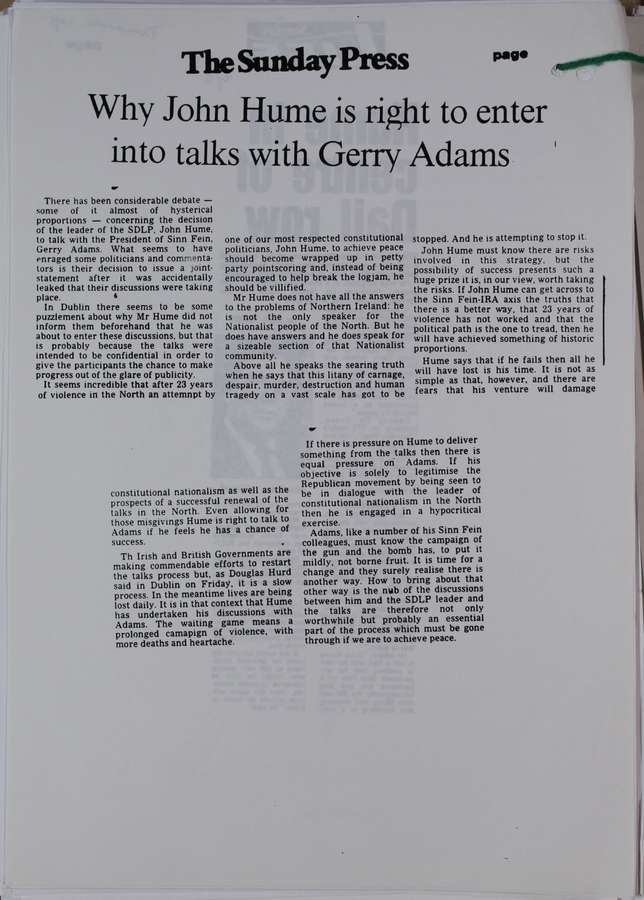
Why John Hume is right to enter into talks with Gerry Adams
There has been considerable debate – some of it almost of hysterical proportions – concerning the decision of the leader of the SDLP, John Hume, to talk with the President of Sinn Fein. Gerry Adams. What seems to have enraged some politicians and commentators is their decision to issue a joint- statement after it was accidentally leaked that their discussions were taking place.
In Dublin there seems to be some puzzlement about why Mr Hume did not inform them beforehand that he was out to enter these discussions, but that probably because the talks were tended to be confidential in order to give the participants the chance to make progress out of the glare of publicity. It seems incredible that after 23 years violence in the North an attempt by one of our most respected constitutional politicians, John Hume, to achieve peace should become wrapped up in petty party point scoring and, instead of being encouraged to help break the logjam, he should be vilified.
Mr Hume does not have all the answers to the problems of Northern Ireland: he is not the only speaker for the Nationalist people of the North. But he does have answers and he does speak for sizeable section of that Nationalist community. Above all he speaks the searing truth when he says that this litany of carnage, despair, murder, destruction and human tragedy on a vast scale has got to be stopped. And he is attempting to stop it. John Hume must know there are risks involved in this strategy, but the possibility of success presents such a huge prize it is, in our view, worth taking the risks. If John Hume can get across to the Sinn Fein-IRA axis the truths that here is a better way, that 23 years of violence has not worked and that the political path is the one to tread, then he will have achieved something of historic proportions.
Hume says that if he fails then all he will have lost is his time. It is not as simple as that, however, and there are fears that his venture will damage constitutional nationalism as well as the prospects of a successful renewal of the talks in the North. Even allowing for those misgivings Hume is right to talk to Adams if he feels he has a chance of success.
The Irish and British Governments are making commendable efforts to restart the talks process but, as Douglas Hurd said in Dublin on Friday, it is a slow process. In the meantime lives are being lost daily. It is in that context that Hume has undertaken his discussions with Adams. The waiting game means a prolonged campaign of violence, with more deaths and heartache.
If there is pressure on Hume to deliver something from the talks then there is equal pressure on Adams. If his objective is solely to legitimise the Republican movement by being seen to be in dialogue with the leader of constitutional nationalism in the North then he is engaged in a hypocritical exercise. Adams, like a number of his Sinn Fein colleagues, must know the campaign of the gun and the bomb has, to put it mildly, not borne fruit. It is time for a change and they surely realise there is another way. How to bring about that other way is the nub of the discussions between him and the SDLP leader and he talks are therefore not only worthwhile but probably an essential art of the process which must be gone through if we are to achieve peace.
A newspaper cutting contained in a UK government file. The article was published in May 1993 in The Sunday News, a newspaper in the Irish Republic. Catalogue reference: CJ4/11527
Content
- What have Hume and Adams been doing?
- What is the view of the author of the article about these actions?
- Is there any evidence that there have been reactions from other groups?
Inferences from the content
- What can historians infer about public opinion and politicians in Ireland at this time?
- What can historians infer about the impact of the Hume Adams talks?
Inferences from the context
- Is it significant that a copy of this article was made and was kept in a UK government file?
-
-
Source 2: Report on the Peace Train Organisation
This report was commissioned by the Central Community Relations Unit (CCRU). The Central Community Relations Unit was established in 1987 to advise the Secretary of State on all aspects of the relationship between the different parts of the Northern Ireland community. The Unit is part of the Northern Ireland Civil Service. The Unit’s role is to make policies on issues of equality and improve community relations. The purpose of this report was to decide whether the Northern Ireland civil service should continue to provide financial support to the Peace Train Organisation (PTO).
-

3.0 ORIGIN AND DEVELOPMENT OF PEACE TRAIN ORGANISATION
The Peace Train Organisation came into being in 1989. The original idea is attributed to Pronsais De Rossa, a Workers Party T.D. in Dail Eireann, who together with other interested individuals decided to form a pressure group to oppose the ongoing bombing campaign against the Dublin /Belfast rail link. The idea was taken up by like minded individuals in Northern Ireland, initially by Chris and Michael McGimpsey, who formed a Northern contingent to co-operate with the group in Dublin. Eventually support committees were established in both London and Glasgow.
10.0 RECOMMENDATIONS
- CCRU should extend funding for a further year, rather than for three years, to allow time for the Peace Train to demonstrate that they have put into effect a clear development strategy. Such a strategy is not yet evident but there are clear signs that the need for it has been recognised and that attempts are under way to formulate one. 2. CCRU should reinforce to PTO as a condition of any further funding the types of output it considers appropriate for projects which it funds. 3. CCRU should give considered assessment to the value which it would place on any initiative which brings politicians from across the political divide in Northern Ireland to work together for a common purpose. This does not have a high correlation with CCRU objectives as specified and may be within the remit of another agency. Peace train should be encouraged to give precedence to an initiative highlighting Loyalist paramilitary violence . To date its campaign has been almost exclusively directed at republican violence. Such a display would almost certainly make it clear that the organisation was unequivocal in its operation and this would be likely to broaden it’s appeal and acceptability.
A report on the Peace Train Organisation (PTO) produced in May 1993. The report was commissioned by the Central Community Relations Unit, part of the Northern Ireland Civil Service. Public Record Office of Northern Ireland: CENT-1-20-33A 1993-nd
Content
- When was the Peace Train Organisation created?
- Who belonged to the group?
- What were its aims?
- What recommendations did the CCRU make?
Inferences from the content
- What can historians infer about the impact of the PTO?
- What can historians infer about the views and attitudes of the members of the PTO?
Inferences from the context
- Is it significant that government officials were providing financial support to the PTO?
- What can historians infer about attitudes within Ireland and Northern Ireland towards the conflict at this time?
-
-
Source 3: Internal Memo
When Northern Ireland was created in 1921 there was a great deal of hostility and bitterness in the rest of Ireland. Many Irish politicians and officials felt that Ireland should be united, and that Northern Ireland should not exist. By the 1990s this hostility towards Northern Ireland was greatly reduced. However, there was a problem that many in the Irish Government were unsympathetic towards Northern Ireland’s Unionist community. It was felt that many in Irish public life and its institutions regarded Unionists with suspicion, and thought they were simply pawns of the British government.
-
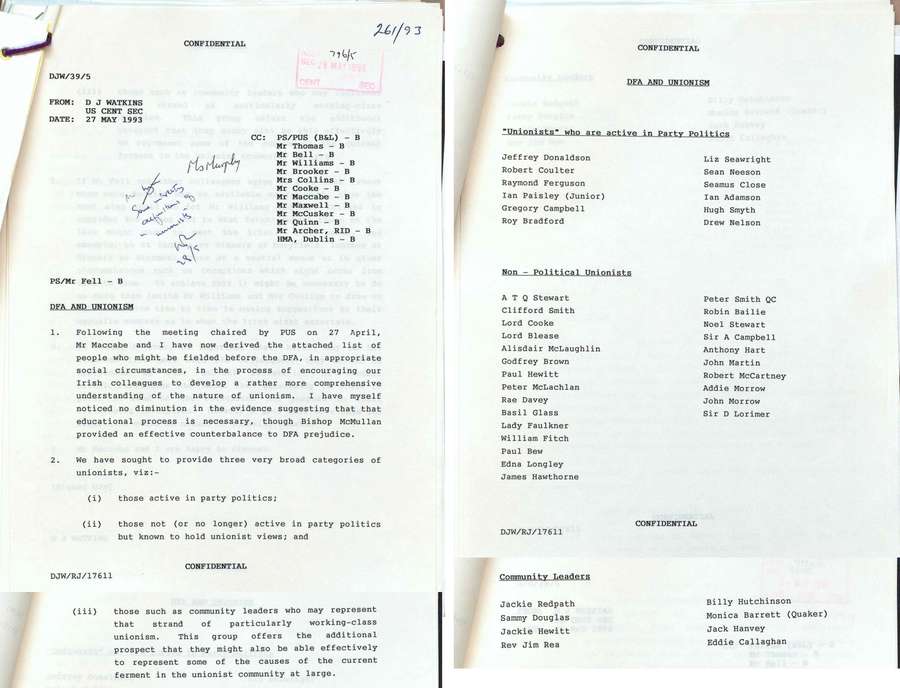
CONFIDENTIAL
DJW/39/5 FROM: DJ WATKINS US CENT SEC
DATE: 27 MAY 1993
CC: PS/PUS (B&L) – B Mr Thomas – B Mr Bell – B Mr Williams – B Mr Brooker – B Mrs Collins – B Mr Cooke – B Mr Maccabe – B Mr Maxwell – B Mr Mccusker – B Mr Quinn – B Mr Archer, RID – B HMA, Dublin – B
PS/Mr Fell – B
DFA AND UNIONISM
- Following the meeting chaired by PUS on 27 April, Mr Maccabe and I have now derived the attached list of people who might be fielded before the DFA, in appropriate social circumstances, in the process of encouraging our Irish colleagues to develop a rather more comprehensive understanding of the nature of unionism. I have myself noticed no diminution in the evidence suggesting that that educational process is necessary, though Bishop McMullan provided an effective counterbalance to DFA prejudice.
- We have sought to provide three very broad categories of unionists, viz:-
(i) those active in party politics;
(ii) those not (or no longer) active in party politics but known to hold unionist views; and
(iii) those such as community leaders who may represent that strand of particularly working-class unionism. This group offers the additional prospect that they might also be able effectively to represent some of the causes of the current ferment in the unionist community at large.
DFA AND UNIONISM
“Unionists” who are active in Party Politics
Jeffrey Donaldson
Robert Coulter
Raymond Ferguson
Ian Paisley (Junior)
Gregory Campbell
Roy Bradford
Liz Seawright
Sean Neeson
Seamus Close
Ian Adamson
Hugh Smyth
Drew Nelson
Non – Political Unionists
AT Q Stewart
Clifford Smith
Lord Cooke
Lord Blease
Alisdair McLaughlin
Godfrey Brown
Paul Hewitt
Peter McLachlan
Rae Davey
Basil Glass
Lady Faulkner
William Fitch
Paul Bew
Edna Longley
James Hawthorne
Peter Smith QC
Robin Bailie
Noel Stewart
Sir A Campbell
Anthony Hart
John Martin
Robert McCartney
Addie Morrow
John Morrow
Sir D Lorimer
An internal memorandum produced by an official in the Northern Ireland Civil Service in May 1993. It is reporting on a plan to arrange a meeting between representatives of Unionism in Northern Ireland and the Irish Government’s Department of Foreign Affairs (DFA). Public Record Office of Northern Ireland: CENT/1/20/33A 1993-05-27
Content
- What event is this document trying to organise?
- What types of people do the officials plan to invite?
Inferences from the content
- Is this source more useful as evidence about the Irish DFA officials or about the British official writing it?
- What can historians infer about the relationship between the Northern Ireland Civil Service and the Irish DFA?
Inferences from the context
- Explain why it is significant that this meeting was being organised.
- Explain why it is useful to see who got a copy of this document.
-
-
Source 4: Letter from the Prime Minister to the Taoiseach
Throughout 1993 the British and Irish governments were talking regularly about Northern Ireland. The governments were also talking to political parties, both Unionist and Nationalist, in Northern Ireland. The British were also talking to representatives of the Provisional Irish Republican Army (PIRA). In the week before this letter a number of events caused problems for Prime Minister John Major. He had spoken to Robin Eames, the most senior figure in the Church of Ireland. That was a positive step, but from this point on things went very wrong. On 15 November a Northern Ireland newspaper reported that the British had been holding talks with the PIRA. On 19 November a newspaper in the Republic published a document drawn up by the Republic’s Department of Foreign Affairs setting out plans for the future of Northern Ireland. On 20 November John Hume and Gerry Adams issued a third joint statement. On 24 November British police intercepted a large shipment of arms which was meant for the Loyalist paramilitary group the Ulster Volunteer Force (UVF).
-

10 Downing Street
London SW1A 2AA
The Prime Minister
25 November 1993
Strictly Confidential
Dear Albert
It was good to talk to you last Saturday. I am sorry to have intruded on your weekend off. I hope that you and Kathleen were able to get some relaxation during your trip. If I may say so, I thought your interview with David Frost went very well.
Making no bones about it, we have had an extremely difficult and depressing week. I need not labour the reasons why. I had allowed myself to feel a little optimistic after my meeting with Robin Eames on 18 November. But I am afraid that the following day’s leak and the Hume/Adams statement on Saturday last have had precisely the effect I feared when we spoke on the phone.
I have spent all week trying to repair the damage through a series of meetings and public statements. I fear that I have had only limited success. In the current political atmosphere, there is clearly no hope of securing even tacit acceptance by the Unionist mainstream of a Joint Declaration on the lines of your draft. The text would be seen as deriving from Hume/Adams, and thus would assumed to be the product of negotiation with Sinn Fein. This is an impression which successive statements from Hume and Adams have done nothing to dispel. As we have agreed all along, association with Hume/Adams is the kiss of death for any text intended to secure acceptance on both sides of the Community.
A letter from the British Prime Minister to the Taoiseach November 1993. Catalogue reference: CJ 4/10560
Content
- What events have worried the Prime Minister?
- What has the Prime Minister tried to do and how successful has he been?
- Which group is the Prime Minister most concerned about?
Inferences from the content
- How would you describe the Prime Minister’s attitude towards Hume and Adams?
- What can a historian infer from this document about attitudes in Northern Ireland at this time?
Inferences from the context
- What can a historian infer from this letter about the relationship between Major and Albert Reynolds?
-
-
Source 5: Record of a Meeting
This meeting took place a short time before the Downing Street Declaration was issued. There was constant dialogue between Her Majesty’s Government (HMG – i.e. the British government) and the Irish Government. Sometimes, as in this case, they were tense. In this instance the Irish government discovered that HMG had been holding talks with the leaders of the PIRA. This had been carried out using go-betweens such as Catholic priests, Northern Ireland business-people and also some British Intelligence officers.
-
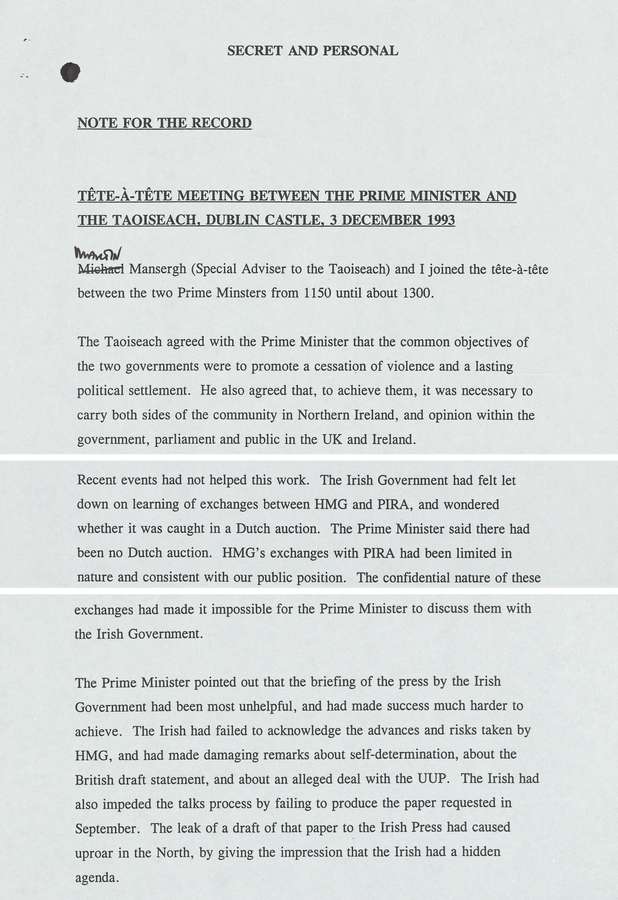
SECRET AND PERSONAL
NOTE FOR THE RECORD
TÊTE-À-TÊTE MEETING BETWEEN THE PRIME MINISTER AND
THE TAOISEACH, DUBLIN CASTLE, 3 DECEMBER 1993
Martin Mansergh (Special Adviser to the Taoiseach) and I joined the tête-à-tête between the two Prime Minsters [sic] from 1150 until about 1300.
The Taoiseach agreed with the Prime Minister that the common objectives of the two governments were to promote a cessation of violence and a lasting political settlement. He also agreed that, to achieve them, it was necessary to carry both sides of the community in Northern Ireland, and opinion within the government, parliament and public in the UK and Ireland.
The Prime Minister and the Taoiseach had been working towards these objectives since their first meeting in Downing Street soon after the Taoiseach took office – and long before people had heard of the Hume/Adams dialogue. Since June 1993, they had been working on a draft Joint Declaration originally put forward by the Taoiseach, but since amended towards a more balanced document.
Recent events had not helped this work. The Irish Government had felt let down on learning of exchanges between HMG and PIRA, and wondered whether it was caught in a Dutch auction. The Prime Minister said there had been no Dutch auction. HMG’s exchanges with PIRA had been limited in nature and consistent with our public position. The confidential nature of these exchanges had made it impossible for the Prime Minister to discuss them with the Irish Government.
The Prime Minister pointed out that the briefing of the press by the Irish Government had been most unhelpful, and had made success much harder to achieve. The Irish had failed to acknowledge the advances and risks taken by HMG, and had made damaging remarks about self-determination, about the British draft statement, and about an alleged deal with the UUP. The Irish had also impeded the talks process by failing to produce the paper requested in September. The leak of a draft of that paper to the Irish Press had caused uproar in the North, by giving the impression that the Irish had a hidden agenda.
Record of a meeting between the UK Prime Minister and the Irish Taoiseach December 1993. Catalogue reference: CJ 4/10560
Content
- What did the two sides agree was a priority?
- What did they agree was necessary to achieve their aims?
Inferences from the content
- What can a historian infer from this document about relations between the British and Irish governments at this time?
- What can a historian infer about the differing concerns of the two governments?
Inferences from the context
- Is it significant that the two leaders met face to face (tête-à-tête)?
-
-
Source 6: Briefing notes
This document was written by a senior adviser to the Prime Minister. The document was sent to the Private Secretaries of the members of the Cabinet. Private Secretaries are senior civil servants in government departments and work closely with ministers. The document was designed to alert these officials that the Prime Minister and the Taoiseach would be announcing the Downing Street Declaration and to provide officials and minsters with some important background information and advice on possible questions from the media.
-
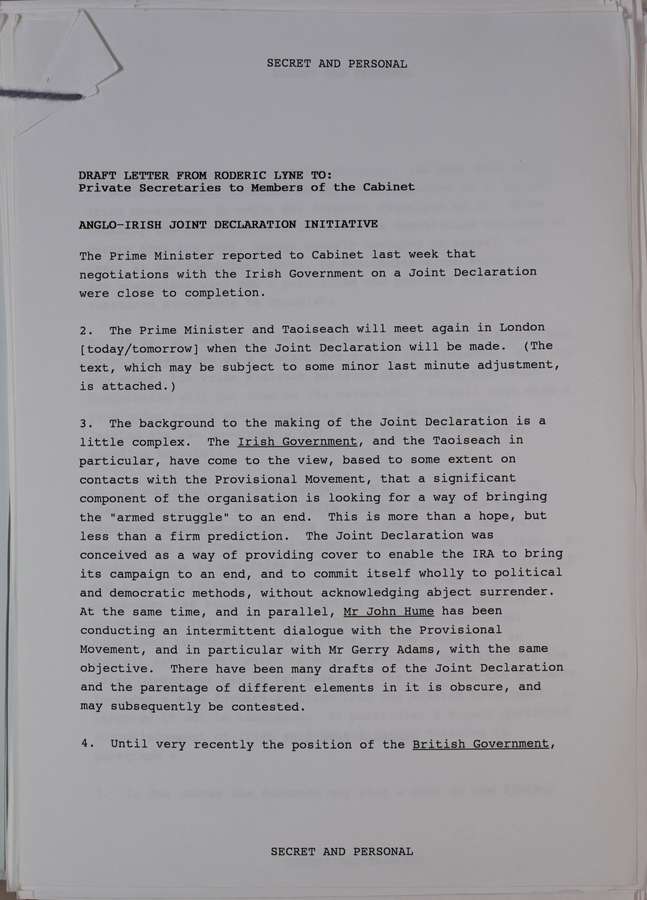
SECRET AND PERSONAL
DRAFT LETTER FROM RODERIC LYNE TO:
Private Secretaries to Members of the Cabinet
ANGLO-IRISH JOINT DECLARATION INITIATIVE
The Prime Minister reported to Cabinet last week that negotiations with the Irish Government on a Joint Declaration were close to completion.
2. The Prime Minister and Taoiseach will meet again in London [today/tomorrow] when the Joint Declaration will be made. (The text, which may be subject to some minor last minute adjustment, is attached.
3. The background to the making of the Joint Declaration is a little complex. The Irish Government, and the Taoiseach in particular, have come to the view, based to some extent on contacts with the Provisional Movement, that a significant component of the organisation is looking for a way of bringing the “armed struggle” to an end. This is more than a hope, but less than a firm prediction. The Joint Declaration was conceived as a way of providing cover to enable the IRA to bring its campaign to an end, and to commit itself wholly to political and democratic methods, without acknowledging abject surrender. At the same time, and in parallel, Mr John Hume has been conducting an intermittent dialogue with the Provisional Movement, and in particular with Mr Gerry Adams, with the same objective. There have been many drafts of the Joint Declaration and the parentage of different elements in it is obscure, and may subsequently be contested.
4. Until very recently the position of the British Government, […]
Briefing notes sent to senior civil servants explaining the proposed Downing Street Declaration December 1993. Catalogue reference: CJ 4/10562
Content
- What event is being announced and who is being informed about it?
- What is the view of the Irish government about the PIRA?
- What is the intention of the British and Irish Governments behind the Declaration?
Inferences from the content
- Would a historian find this document useful as evidence about the Republican movement at this time?
- What can a historian infer about the approach taken by the British and Irish governments towards the PIRA?
- Is this source useful as evidence about the Hume Adams talks?
Inferences from the context
- Is it significant that this document is being sent to all members of the British Cabinet?
-








Teachers’ notes
The resource takes a twin-track approach.
Track 1: The significance of the Downing Street Declaration
The six documents raise awareness and understanding of key events, developments and processes which contributed in some way to the Downing Street Declaration and the wider peace process. The main question is :
What was the significance of the Downing Street Declaration?
In one sense the answer to this is simple: the Declaration, as Source 6 clearly states, was designed to offer the Republican movement in Northern Ireland a pathway towards an end to violent action. Of course, the process of reaching a point where the Declaration could be made was far from simple. There were many contributory factors: individuals, groups, movements; developments in Ireland and the USA. These documents provide an insight into the workings and impact of just a few of these factors.
Track 2: How historians use sources
Making effective use of sources is not some mechanical process or skill which is separate from knowledge and context. It is a craft which experts take many years to develop and constantly look to improve on. The examination paper for this part of the CCEA GCSE History course places great stock on asking students to assess how the sources they are given would be useful and/or reliable in the context of particular questions. This resource is NOT an examination practice paper. It is designed to take one step back from the exam question-based approach and to explore how historians think about documents and make use of them. The aim is that by understanding this set of fundamentals, students will be better equipped for the inevitably more limited approaches which examination conditions place on them.
Connections to the curriculum
Key stage 4 (Ages 14–16)
This resource is designed to support students tackling the CCEA GCSE Unit 1 Section B Local Study Option 2: Changing Relations: Northern Ireland and its Neighbours, 1965–98.
Extension activities
Students should look at each document and record:
- Reasons why the Downing Street Declaration came about, why key groups or individuals were involved, why and progress was difficult;
- Impact of particular events, actions, individuals;
- Changes taking place at the time;
- How the process worked which eventually led to the Downing Street Declaration came – meetings, discussions, documents; and
- Attitudes of the various groups and individuals involved.
Once students have decided on a line of argument, they should develop an extended paragraph in response to the question “What was the significance of the Downing Street Declaration?” Their answer should explain why they have come to their conclusion what evidence from the sources supports their assessment.