Teaching resource
The Belfast (Good Friday) Agreement
This resource for key stage 4 students looks at the significance of The Belfast (Good Friday) Agreement and examines how historians use sources.
- Age range
- Key stage 4 (Ages 14–16)

About this image
UK Prime Minister Tony Blair (left) and Irish Taoiseach (Prime Minister) Bertie Ahern (right) sign the Belfast (Good Friday) peace agreement, 10 April 1998.
Reuters/Dan Chung
About this resource
Time period
- Post-War and modern
Themes
- Local history
- Power, politics and reform
- Significant people, places and events
Investigate the sources
-
Source 1: Speech by Bertie Ahern
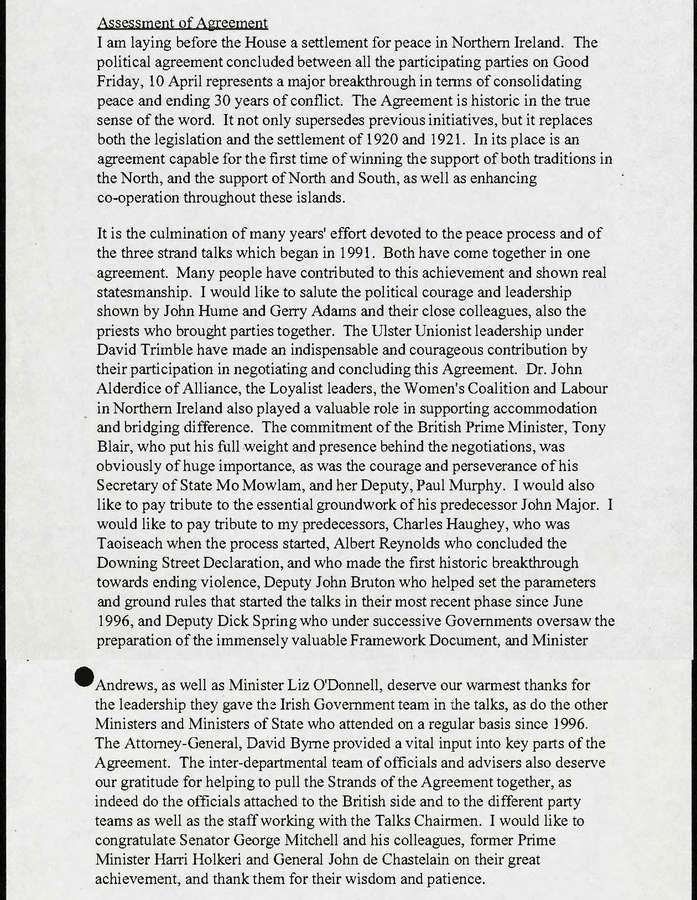
Bertie Ahern was the Irish Taoiseach, the Prime Minister of Ireland. In this speech he was setting out the Agreement to the Irish Seanad, the upper house of the Irish Dáil. The Agreement was the culmination of years of political initiatives, negotiations and many setbacks. It involved politicians from Northern Ireland, Britain, Ireland, the USA and the European Union.
-
Assessment of Agreement
I am laying before the House a settlement for peace in Northern Ireland. The political agreement concluded between all the participating parties on Good Friday, 10 April represents a major breakthrough in terms of consolidating peace and ending 30 years of conflict. The Agreement is historic in the true sense of the word. It not only supersedes previous initiatives, but it replaces both the legislation and the settlement of 1920 and 1921. In its place is an agreement capable for the first time of winning the support of both traditions in the North, and the support of North and South, as well as enhancing co-operation throughout these islands.
It is the culmination of many years’ effort devoted to the peace process and of the three strand talks which began in 1991. Both have come together in one agreement. Many people have contributed to this achievement and shown real statesmanship. I would like to salute the political courage and leadership shown by John Hume and Gerry Adams and their close colleagues, also the priests who brought parties together. The Ulster Unionist leadership under David Trimble have made an indispensable and courageous contribution by their participation in negotiating and concluding this Agreement. Dr. John Alderdice of Alliance, the Loyalist leaders, the Women’s Coalition and Labour in Northern Ireland also played a valuable role in supporting accommodation and bridging-difference. The commitment of the British Prime Minister, Tony Blair, who put his full-weight and presence behind the negotiations, was obviously of huge importance, as was the courage and perseverance of his Secretary of State Mo Mowlam, and her Deputy, Paul Murphy. I would also like to pay tribute to the essential groundwork of his predecessor John Major. I would like to pay tribute to my predecessors, Charles Haughey, who was Taoiseach when the process started, Albert Reynolds who concluded the Downing Street Declaration, and who made the first historic breakthrough towards ending violence, Deputy John Bruton who helped set the parameters and ground rules that started the talks in their most recent phase since June 1996, and Deputy Dick Spring who under successive Governments oversaw the preparation of the immensely valuable Framework Document, and Minister Andrews, as well as Minister Liz O’Donnell, deserve our warmest thanks for the leadership they gave the Irish Government team in the talks, as do the other Ministers and Ministers of State who attended on a regular basis since 1996. The Attorney-General, David Byrne provided a vital input into key parts of the Agreement. The inter-departmental team of officials and advisers also deserve our gratitude for helping to pull the Strands of the Agreement together, as indeed do the officials attached to the British side and to the different party teams as well as the staff working with the Talks Chairmen. I would like to congratulate Senator George Mitchell and his colleagues, former Prime Minister Harri Holkeri and General John de Chastelain on their great achievement and thank them for their wisdom and patience.
Text of a speech by the Taoiseach Mr. Bertie Ahern, TD on the Approval of the Multi-Party Agreement in Belfast on Good Friday, 10 April 1998. The speech was delivered on 22 April 1998. National Archives of Ireland: TAOIS/2021/100/08 1998-04-22
National Archive of Ireland
Content
- Make a list of the individuals and groups who, according to Ahern, contributed to the Agreement.
Inferences from the content
- Is it reasonable for a historian to infer that Bertie Ahern was proud of the Agreement? Explain your answer.
- Is it reasonable to infer that the Agreement was the result of close co-operation between politicians in Britain, Northern Ireland and Ireland? Explain your answer.
Inferences from the context
- Why does Ahern believe that the Agreement is historic?
Lines of argument
- Which line(s) of argument could use this document as supporting evidence?
- The Agreement ended all of the tensions over Northern Ireland between the UK and Ireland.
- The Agreement failed to ease tensions over Northern Ireland between the UK and Ireland.
- Some groups actively opposed the Agreement even after it was signed.
- All sides gave up on the Agreement after it was signed.
- Despite the problems, all sides worked hard to make the Agreement work and this helped to ease tensions over Northern Ireland between the UK and Ireland.
-
-
Source 2: Letter from Bertie Ahern
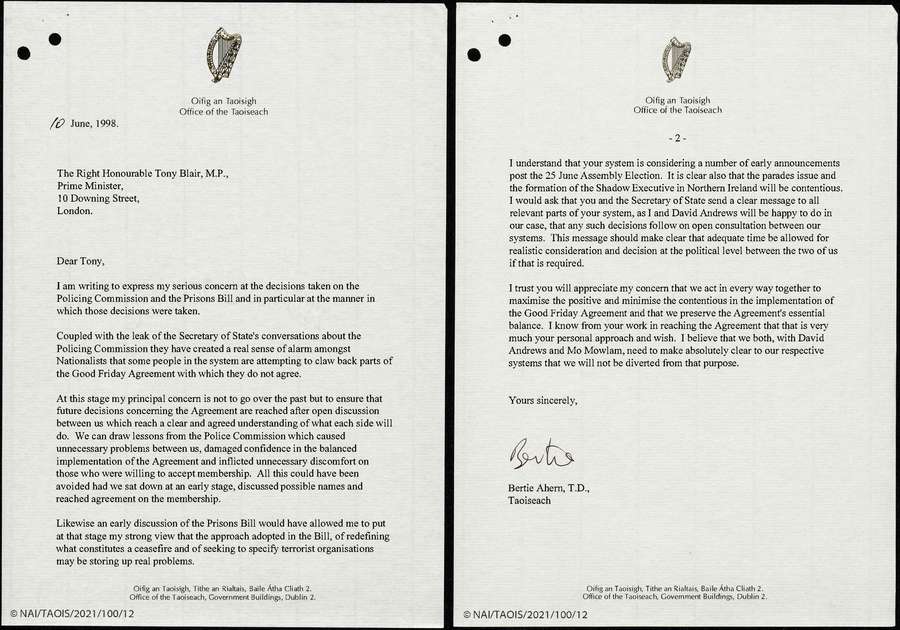
One of many controversial issues in the history of Northern Ireland was the system of policing. Many in the Nationalist community felt that the existing police force, the Royal Ulster Constabulary (RUC), did not represent them properly. As part of the Agreement, the RUC was to be replaced by a new force called the Police Service of Northern Ireland. An Independent Commission on Policing for Northern Ireland was set up to study policing and make recommendations about how Northern Ireland was to be policed in the future. There was a great deal of heated debate about who should be appointed to be part of this Commission. The situation was not helped when a confidential document about the Commission was leaked to the press on 4 June 1998 and revealed how tense and angry the debate was over the Commission.
-
Oifig an Taoisigh
Office of the Taoiseach
10 June, 1998
The Right Honourable Tony Blair, M.P.,
Prime Minister,
10 Downing Street,
London.
Dear Tony,
I am writing to express my serious concern at the decisions taken on the Policing Commission and the Prisons Bill and in particular at the manner in which those decisions were taken.
Coupled with the leak of the Secretary of State’s conversations about the Policing Commission they have created a real sense of alarm amongst Nationalists that some people in the system are attempting to claw back parts of the Good Friday Agreement with which they do not agree.
At this stage my principal concern is not to go over the past but to ensure that future decisions concerning the Agreement are reached after open discussion between us which reach a clear and agreed understanding of what each side will do. We can draw lessons from the Police Commission which caused unnecessary problems between us, damaged confidence in the balanced implementation of the Agreement and inflicted unnecessary discomfort on those who were willing to accept membership. All this could have been avoided had we sat down at an early stage, discussed possible names and reached agreement on the membership.
Likewise an early discussion of the Prisons Bill would have allowed me to put at that stage my strong view that the approach adopted in the Bill, of redefining what constitutes a ceasefire and of seeking to specify terrorist organisations may be storing up real problems.
2
I understand that your system is considering a number of early announcements post the 25 June Assembly Election. It is clear also that the parades issue and the formation of the Shadow Executive in Northern Ireland will be contentious. I would ask that you and the Secretary of State send a clear message to all relevant parts of your system, as I and David Andrews will be happy to do in our case, that any such decisions follow on open consultation between our systems. This message should make clear that adequate time be allowed for realistic consideration and decision at the political level between the two of us if that is required.
I trust you will appreciate my concern that we act in every way together to maximise the positive and minimise the contentious in the implementation of the Good Friday Agreement and that we preserve the Agreement’s essential balance. I know from your work in reaching the Agreement that that is very much your personal approach and wish. I believe that we both, with David Andrews and Mo Mowlam, need to make absolutely clear to our respective systems that we will not be diverted from that purpose.
Yours sincerely,
Bertie Ahern, T.D., Taoiseach
A letter from the Taoiseach Bertie Ahern to the UK Prime Minister Tony Blair, 10 June 1998. National Archives of Ireland: TAOIS/2021/100/12 1998-06-10
National Archives of Ireland
Content
- What is Ahern concerned about?
- According to Ahern, why are Nationalists alarmed?
Inferences from the content
- Would historians be able to infer that Ahern is more concerned about not being consulted than about the actual decisions which have been made? Explain your answer.
Inferences from the context
- Is this source evidence that relations between the UK, Ireland and groups and politicians in Northern Ireland have broken down? Explain your answer.
Lines of argument
- Which line(s) of argument could use this document as supporting evidence?
- The Agreement ended all of the tensions over Northern Ireland between the UK and Ireland.
- The Agreement failed to ease tensions over Northern Ireland between the UK and Ireland.
- Some groups actively opposed the Agreement even after it was signed.
- All sides gave up on the Agreement after it was signed.
- Despite the problems, all sides worked hard to make the Agreement work and this helped to ease tensions over Northern Ireland between the UK and Ireland.
-
-
Source 3: Letter from the Irish Ambassador
The author of this letter was Ted Barrington, Ireland’s Ambassador to the UK. He was reporting back to his superiors in the Foreign Affairs Department of the Irish Government about a phone conversation with Mo Mowlam. Mowlam was the UK Government’s Secretary of State for Northern Ireland. Paul Murphy MP was a UK Government Minister, a senior UK official, who worked in Mo Mowlam’s department as Political Development Minister of State for Northern Ireland. A major part of Murphy’s job was liaising with officials from Ireland.
-

AMBASAID NA hEIREANN. LONDAIN
IRISH EMBASSY, LONDON
17 Grosvenor Place
SW1X 7HR
18 June 1998
Mr. Dermot Gallagher
Second Secretary
Anglo-Irish Division
Department of Foreign Affairs
Dublin 2
Dear Secretary,
Conversations with Mo Mowlam and Tony Blair
Mo Mowlam telephoned me late last night. She said she was concerned at what she saw as emerging difficulties between the British and Irish sides; her feeling was that things were “different” in recent weeks and that there was not the same level of trust between us as before. As an instance of this she wondered whether that British Ministers were having some difficulties in arranging meetings with the Irish side. Although she herself would be seeing Minister Andrews on 7 July, they wondered whether their inability to arrange a meeting with Paul Murphy today was deliberate on our part. She thought that it would be of the utmost importance to stay close in the period ahead.
I said that it was true that confidence had been dented by the handling of the Police Commission and the failure to consult adequately on the prisoners legislation. But she should not exaggerate. The Taoiseach had written to the Prime Minister outlining our views, and it was important that we explain frankly our concerns. This itself was a sign of the maturity in the relationship. (Mowlam incidentally could not recall the letter, but she put this down to the fact that she sees too many papers). I emphasised that the key thing for the future was that we be consulted properly on initiatives which lay at the heart of the process. The Irish Government could not be seen to be wrong footed on matters of such importance. As for meetings between Ministers I said that there were no problems on our side and Ministers were available as in the past,
2
especially if urgent matters needed discussion.
Mowlam said she was reassured by what I said and put her concern down to tiredness and congenital paranoia.
The discussion then touched on some issues of current concern.
3
Comment
l think our concerns about consultation have registered. When I met Blair in Downing Street on Saturday the first thing he said was that he knew that we were “sore” over the Police Commission and the prisoners legislation. He tried to justify their proceeding on both issues by pointing to the need to support Trimble and maximise the pro-Agreement vote within the UUP – “without that everything will fail.” I said that our main point was not that they had gone ahead but that they had failed to consult adequately and that problems could be avoided if both sides discussed issues at an early stage. He acknowledged the point.
Yours sincerely,
Ted Barrington Ambassador
Extracts from a letter from the Irish Ambassador in London to Dermot Gallagher, a senior official in the Department of Foreign Affairs in Ireland June 1998. National Archives of Ireland: TAOIS/2021/100/12 1998-06-17
National Archives of Ireland
Content
- According to Barrington what concerns does Mo Mowlam have?
- What issues had “dented” relations between the UK and Ireland?
- What was the underlying concern that Barrington said that the Irish Government had about how the UK had acted?
Inferences from the content
- Would historians be able to infer that on the whole Barrington was optimistic about relations between the UK and Irish governments?
Inferences from the context
- Can a historian make any inferences from this document about how well the UK and Irish governments were communicating or co-operating?
Lines of argument
- Which line(s) of argument could use this document as supporting evidence?
- The Agreement ended all of the tensions over Northern Ireland between the UK and Ireland.
- The Agreement failed to ease tensions over Northern Ireland between the UK and Ireland.
- Some groups actively opposed the Agreement even after it was signed.
- All sides gave up on the Agreement after it was signed.
- Despite the problems, all sides worked hard to make the Agreement work and this helped to ease tensions over Northern Ireland between the UK and Ireland.
-
-
Source 4: Letter from a government official
This letter was written in October 1998, by the Principal Private Secretary to the Prime Minister, a very senior figure in the UK civil service. He had been talking to David Trimble, leader of the Ulster Unionist Party, the largest Unionist Party in Northern Ireland at that time, about the Loyalist Volunteer Force (LVF), a Loyalist paramilitary organisation whose activities were causing concern. In the course of the conversation, they had talked about several other issues as well. The letter is reporting Trimble’s views to a colleague in the Northern Ireland Office.
-

10 DOWNING STREET
LONDON SW1A 2AA
29 October 1998
PS/SCSBAL
PS/Mr Murphy Bal
PS/ Mr Ingram BAL
PS/All Bas
PS/Mr Semple Mr Hill
Mar Watkins
Mr Jeffrey
Mr McCabe
Mr Leach
Mr Walker
Mr Scholfield
Mr Bell
Dear Nick
ALL PARTY MEETINGS, 29 OCTOBER:
TRIMBLE’S VIEWS
When I spoke with Trimble about the LVF, I took the opportunity to ask him about today’s meetings. Trimble confirmed that the morning session on departmental structures had gone well, and had resulted in a focussed discussion. Eleven key points of difficulty had been identified, but many of them were simply a question of making decisions.
In contrast, the afternoon session had been messy. Many of those around the table did not understand the distinction between areas of cooperation and implementation bodies. They had wanted to transfer functions to implementation bodies, and retain them at the same time. Part of the problem had been that. perhaps because of the presence of Sinn Fein, the SDLP had raised their sights. This did not make things any easier. So the meeting had been unsatisfactory. They had ended up with a list of areas where more technical work was needed.
Trimble said that he hoped that they could have a more focussed meeting on Monday involving the UUP, SDLP, Irish and British. I said that I did not think the Irish and the SDLP would be keen on this format, because of their desire to be inclusive. Trimble claimed to be unaware of this difficulty. He was willing to make some side arrangement to keep Sinn Fein involved but he could not attend a meeting with them but without the DUP. He added that, when he had spoken to Ahern earlier in the week, Ahem had focussed on training and the Irish language, and had acknowledged that economic development was difficult for Trimble. Ahern had also promised to send a full list of possible implementation bodies, but this had not yet turned up. Finally, Trimble said that he had had discussions at the beginning of the day with Mallon. They had agreed that they should try to reach a private conclusion on the implementation bodies, but park this. They would say in public that they had not yet sorted this out, but were confident they could do so quickly, and use this to put pressure on Sinn Fein.
2
Comment
We clearly need to work hard on Trimble to take a more positive line on North/South, and get across that the quadripartite meeting be has in mind poses huge difficulties for the Irish and the SDLP, if Sinn Fein are not there. I will try to get the Prime Minister to speak to him about this, probably over the weekend, and to encourage further all party meetings on North/South issues, or at least some alternative process to the same effect.
Extracts from a letter between the UK Prime Minister’s Office and the Northern Ireland Office. The letter was sent in October 1998. Public Record Office Northern Ireland, CENT/3/268A 1998-10-29
Content
- According to this account, did Trimble seem happy with the morning session of the meeting he had? Explain your answer.
- Why was the afternoon session less successful?
- What did Trimble want to happen?
- Why would this be a problem for the Irish government?
Inferences from the Content
- Would historians infer from this document that the meetings were going well, badly or somewhere in between? Explain your answer.
Inferences from the Context
- What inferences could a historian make from the fact that the meetings were happening at all?
Lines of Argument
- Which line(s) of argument could use this document as supporting evidence?
- The Agreement ended all of the tensions over Northern Ireland between the UK and Ireland.
- The Agreement failed to ease tensions over Northern Ireland between the UK and Ireland.
- Some groups actively opposed the Agreement even after it was signed.
- All sides gave up on the Agreement after it was signed.
- Despite the problems, all sides worked hard to make the Agreement work and this helped to ease tensions over Northern Ireland between the UK and Ireland.
-
-
Source 5: Report of a meeting between the Taoiseach and the UK Secretary of State for Northern Ireland
This extract comes from the notes taken at a meeting between Taoiseach Bertie Ahern and Northern Ireland Secretary Mo Mowlam. They discuss a wide range of issues, but these extracts focus on two issues. In section 3 they are discussing the challenges being faced by David Trimble, leader of the Ulster Unionist Party. Decommissioning meant the process of paramilitary groups giving up their weapons. The Shadow Executive was the term used for the new Northern Ireland devolved government before it officially took up its full powers. In section 13 the British-Irish Interparliamentary Body was an organisation formed in 1990. It was made up of 25 UK MPs and 25 Deputies of the Irish Parliament. They met to discuss issues of common interest and to promote understanding.
-
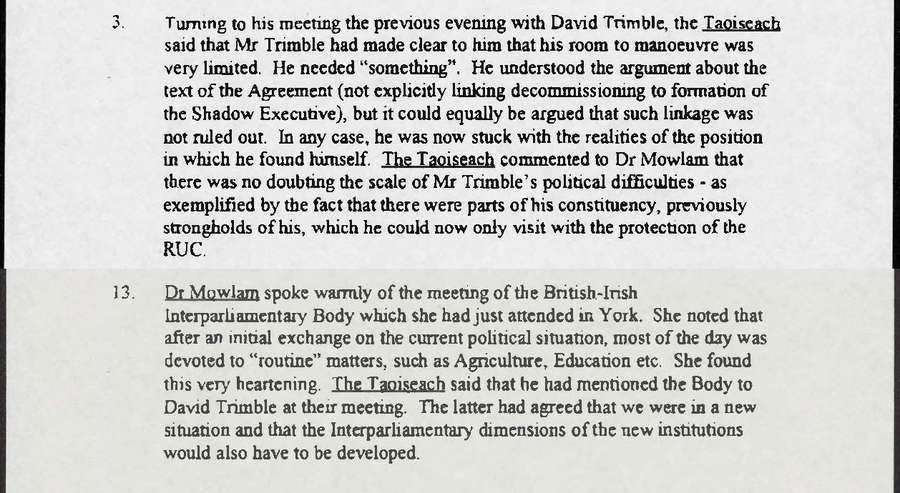
3 Turning to his meeting the previous evening with David Trimble, the Taoiseach said that Mr Trimble had made clear to him that his room to manoeuvre was very limited. He needed “something”. He understood the argument about the text of the Agreement (not explicitly linking decommissioning to formation of the Shadow Executive), but it could equally be argued that such linkage was not ruled out. In any case, he was now stuck with the realities of the position in which he found himself. The Taoiseach commented to Dr Mowlam that there was no doubting the scale of Mr Trimble’s political difficulties – as exemplified by the fact that there were parts of his constituency, previously strongholds of his, which he could now only visit with the protection of the RUC.
13 Dr Mowlam spoke warmly of the meeting of the British-Irish Interparliamentary Body which she had just attended in York. She noted that after an initial exchange on the current political situation, most of the day was devoted to “routine” matters, such as Agriculture, Education etc. She found this very heartening. The Taoiseach said that he had mentioned the Body to David Trimble at their meeting. The latter had agreed that we were in a new situation and that the Interparliamentary dimensions of the new institutions would also have to be developed.
Extract from a report of a meeting between the Taoiseach and the UK Secretary of State for Northern Ireland in September 1998. National Archives of Ireland, TAOIS/2021/100/16 1998-09-23
National Archives of Ireland
Content
- What does Trimble mean when he says he ‘needs something’?
Inferences from the Content
- What can a historian infer from the comment that Trimble needed RUC protection in parts of his own constituency.
- What would you say was the attitude of Mo Mowlam and David Trimble towards the British Irish Interparliamentary body?
Inferences from the Context
- What inferences could a historian make from the fact that this meeting was happening?
Lines of Argument
- Which line(s) of argument could use this document as supporting evidence?
- The Agreement ended all of the tensions over Northern Ireland between the UK and Ireland.
- The Agreement failed to ease tensions over Northern Ireland between the UK and Ireland.
- Some groups actively opposed the Agreement even after it was signed.
- All sides gave up on the Agreement after it was signed.
- Despite the problems, all sides worked hard to make the Agreement work and this helped to ease tensions over Northern Ireland between the UK and Ireland.
-
-
Source 6: A note by a UK government official
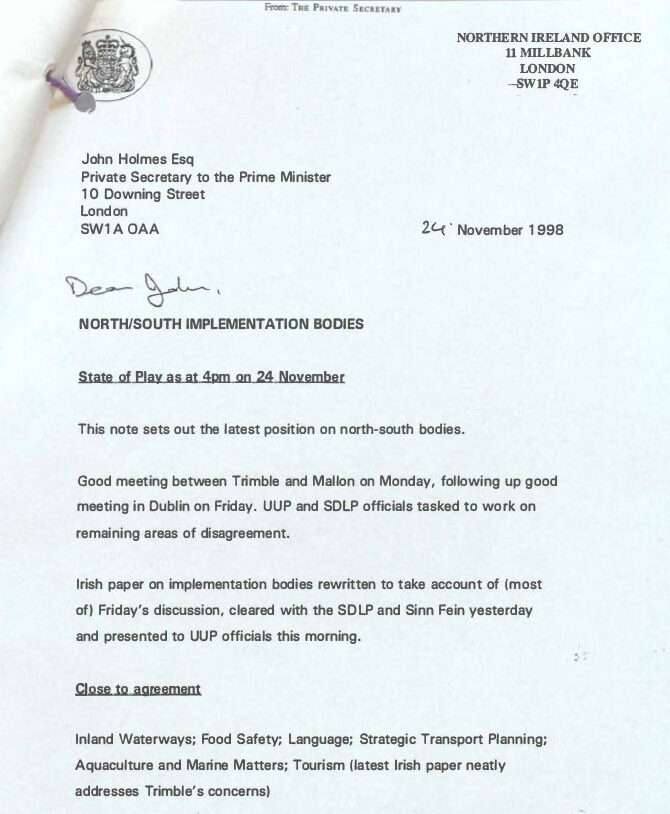
Part of the Belfast Agreement of 1998 was the setting up of cross border bodies – organisations which took responsibility for a range of issues across the whole island of Ireland. For example, the North/South Ministerial Council was established. The Council takes the form of meetings between ministers from both Ireland and Northern Ireland and is responsible for twelve policy areas. Six of these areas are the responsibility of corresponding North/South Implementation Bodies. For Unionists in particular, agreeing to these bodies was a massive step as it allowed for deeper cooperation with the Irish government on matters affecting Northern Ireland and Ireland. Trimble was the leader of the Ulster Unionist Party. Mallon was Seamus Mallon, Deputy Leader of the Social and Democratic Labour Party (SDLP), the main Nationalist party at this time.
-
NORTHERN IRELAND OFFICE
11 MILLBANK
LONDON
SW1P4QE
John Holmes Esq
Private Secretary to the Prime Minister
10 Downing Street
London
SW1A OAA
24 November 1998
Dear John
NORTH/SOUTH IMPLEMENTATION BODIES
State of Play as at 4pm on 24 November
This note sets out the latest position on north-south bodies. Good meeting between Trimble and Mallon on Monday, following up good meeting in Dublin on Friday. UUP and SDLP officials tasked to work on remaining areas of disagreement. Irish paper on implementation bodies rewritten to take account of (most of) Friday’s discussion, cleared with the SDLP and Sinn Fein yesterday and presented to UUP officials this morning.
Close to agreement
Inland Waterways; Food Safety; Language; Strategic Transport Planning; Aquaculture and Marine Matters; Tourism (latest Irish paper neatly addresses Trimble’s concerns)
Extract from a note by a UK government official on a meeting about cross-border bodies November 1998. Public Record Office Northern Ireland, CENT/3/236A 1998-11-24
Content
- Who was meeting and where did they meet?
- What areas of agreement were close?
Inferences from the Content
- What can a historian infer from the activities described in this document?
Inferences from the Context
- What inferences could a historian make from the fact that this meeting was happening?
Lines of argument
- Which line(s) of argument could use this document as supporting evidence?
- The Agreement ended all of the tensions over Northern Ireland between the UK and Ireland.
- The Agreement failed to ease tensions over Northern Ireland between the UK and Ireland.
- Some groups actively opposed the Agreement even after it was signed.
- All sides gave up on the Agreement after it was signed.
- Despite the problems, all sides worked hard to make the Agreement work and this helped to ease tensions over Northern Ireland between the UK and Ireland.
-



Teachers’ notes
This resource takes a twin track approach to the subject matter.
Track 1: The significance of the Belfast (Good Friday) Agreement of 1998
The Agreement was clearly an event of huge historical significance. However, it can sometimes be difficult to articulate why this was the case. This collection of documents aims to help students to meet this challenge. In the first instance, they are presented with two documents in which prominent political figures clearly think the Agreement was significant and successful. They are then asked to examine six more documents which all illuminate some aspect of the attempts to implement the Agreement and make it work. In the process the documents also provide evidence of the difficulties faced and the determination of the participants to overcome these difficulties.
Track 2: How historians use sources
This resource is not an examination practice paper. It is designed to take one step back from the exam question-based approach and to explore how historians think about documents and make use of them. The aim is that by understanding this set of fundamentals, students will be better equipped for the inevitably more limited approaches which examination conditions place on them. In this instance, students are introduced to the concept of a line of argument. This is a challenging idea, and it is difficult to master. With this in mind, we have provided some examples of lines of argument relating to the key issue of the significance of the Agreement for relations between Great Britain, Northern Ireland and Ireland.
Students should complete a table with the following headings:
- Source
- Date
- What is the source?
- Brief summary of content
- Could be used to support line of argument because
before discussing which of the lines of argument are supported by the sources. It is possible that several are supported so they will then need to make a judgement about which has the most evidence and is the most convincing.
For each document, there are additional questions to aid students in their analysis.
Connections to the curriculum
Key stage 4 (Ages 14–16)
CCEA GCSE Unit 1 Section B Local Study Option 2: Changing Relations: Northern Ireland and its Neighbours, 1965–98
Extension activities
Once students have decided on a line of argument, they should develop an extended paragraph in response to the question “What was the significance of the Belfast (Good Friday) Agreement?” Their answer should explain why they have chosen the line of argument and what evidence from the sources supports it.