Teaching resource
The road to the Belfast (Good Friday) Agreement
This lesson, designed for key stage 3, introduces students to two of the key moments on the road towards the Belfast (Good Friday) Agreement, and helps them to understand why it was so difficult to make peace.
- Age range
- Key stage 3 (Ages 11–14)

About this image
Young boys playing near burning car with St Peter’s Cathedral in the background, Belfast, Northern Ireland 1988.
Getty Images/David Turnley
About this resource
Time period
- Post-War and modern
Themes
- Local history
- Power, politics and reform
- Significant people, places and events
Investigate the sources
-
Source 1: Communication from Alastair Campbell to Jonathan Powell and John Holmes
This source can be used as a starter activity before examining the rest of the sources in more detail.
-

From: Alistair Campbell
Date: 29 November 1997
cc: Carol Allen
separate copies to:
JONATHAN POWELL
JOHN HOLMES
CHRISTMAS TREE
I am not sure what our arrangements are for putting up a Christmas tree, but can I alert you to a potential problem?
With Gerry Adams due on 11 December, we need to think through whether we want him photographed with the No 10 door and a Christmas tree.
Given the attacks we will have to fend off over him coming at all, do we want the added problem of the symbolism of Gerry Adams as a man of peace, bringing glad tidings, and all the other Christmas clichés that will be churned out?
ALASTAIR CAMPBELL
Communication from Alastair Campbell to Jonathan Powell and John Holmes, 29 November 1997. Catalogue reference: PREM 49/121
Examine the source
- What type of document is this?
- What three things are Alastair Campbell worried about?
- Can you suggest any reasons for this?
- What three questions would you like to ask Alastair Campbell about his letter?
-
-
Source 2: Letter from Gerry Adams 15 February 1996
-
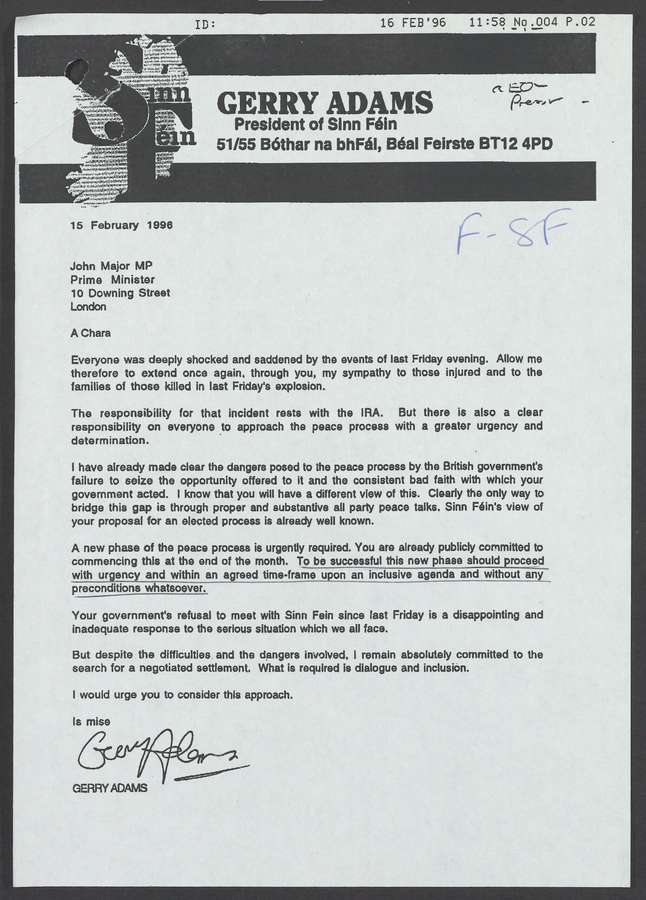
GERRY ADAMS
President of Sinn Féin
51/55 Bóthar na bhFál, Béal Feirste BT12 4PD15 February 1996
John Major MP
Prime Minister
10 Downing Street
LondonA Chara
Everyone was deeply shocked and saddened by the events of last Friday evening. Allow me therefore to extend once again, through you, my sympathy to those injured and to the families of those killed in last Friday’s explosion.
The responsibility for that incident rests with the IRA. But there is also a clear responsibility on everyone to approach the peace process with a greater urgency and determination.
I have already made clear the dangers posed to the peace process by the British government’s failure to seize the opportunity offered to it and the consistent bad faith with which your government acted. I know that you will have a different view of this. Clearly the only way to bridge this gap is through proper and substantive all party peace talks. Sinn Féin’s view of your proposal for an elected process is already well known.
A new phase of the peace process is urgently required. You are already publicly committed to commencing this at the end of the month. To be successful this new phase should proceed with urgency and within an agreed time-frame upon an inclusive agenda and without any preconditions whatsoever.
Your government’s refusal to meet with Sinn Fein since last Friday is a disappointing and inadequate response to the serious situation which we all face.
But despite the difficulties and the danger involved, I remain absolutely committed to the search for a negotiated settlement. What is required is dialogue and inclusion.
I would urge you to consider this approach.
Is mise
GERRY ADAMS
A letter from Gerry Adams, the leader of Sinn Féin, to John Major, the UK Prime Minister. Catalogue reference: CJ4/12375
Examine the source
- What can you suggest happened last Friday?
- Who was responsible?
- What does Adams think about the UK government?
- What does Adams say is now more urgent than ever?
-
-
Source 3: Letter from Gerry Adams 6 June 1996
-

Sinn Féin Ard Oifig
6 June 1996
Sir Patrick Mayhew
Secretary of State
Northern Ireland Office
Whitehall
LondonI understand from the media that invitations have been sent to party leaders to nominate their negotiating teams. Sinn Fein have not received such an invitation. I want to protest in the strongest possible terms at your discriminatory approach. Those who vote for our party gave us a negotiating mandate which you should respect and accept. I am therefore sending you the names of our negotiating team.
GERRY ADAMS
MARTIN McGUINNESS
GERRY KELLY
LUCILITA BHREATNACH
PAT DOHERTY
ANNE (DODIE) McGUINNESS
Martin McGuinness is our chief negotiator and in my absence he will lead the Sinn Fein negotiating panel. Note also that Siobhan OHanlon has been appointed by us to head up our secretariat and she can be contacted in the usual manner.
Is mise
GERRY ADAMS
A letter from Gerry Adams, the leader of Sinn Féin, to Sir Patrick Mayhew, the Secretary of State for Northern Ireland (a UK government minister). Catalogue reference: CJ4/12383
Examine the source
- What has Gerry Adams heard from the media?
- What was his reaction to hearing this news?
- Why does he feel Sinn Féin have a right to be involved?
- Thinking back to Source 2, can you suggest any reasons for the UK government’s decision?
-
-
Source 4: Northern Ireland Office record
-

CONFIDENTIAL
RECORD OF PLENARY SESSION, CASTLE BUILDINGS, 12 JUNE
Independent Chairman (after adjournment)
Senator Mitchell
General de Chastelain
Mr Holkeri
British government team
Secretary of State
Michael Ancram
Sir David Fell
Irish government team
Tanaíste
Mrs Owen
Mr de Rossa
Alliance Party
Dr Alderdice
Mr Close
Mr Neeson
Labour
Malachi Curran
NI Women’s Coalition
Ms Sagar
Ms McWilliams
PUP
Mr Smyth
Mr Ervine
SDLP
Mr Hume
Mr Mallon
Mr. McGrady
UDP
Mr McMichael
Mr White
UDUP (for part of meeting)
Dr Paisley
Mr Robinson
Rev McCrea
UK Unionist (for part of meeting)
Mr McCartney
Dr O’Brien
Mr Wilson
UUP
Mr Trimble
Mr Taylor
Mr Empey
1. The meeting began at 12.20 am.
5. When other delegates had arrived, the Secretary of State opened the meeting. The day had seen a long and useful period of deliberation, which had led the two Governments to put forward a paper which they believed offered a way forward (A possible approach to resolving procedural difficulties, 00.01am draft, annexed at A). On the basis of this, in particular paragraph 4.1, he invited Senator Mitchell to take over, following a five minute adjournment. Dr Paisley shouted ‘No, no, no’; and the rest of his delegation, and the UKUP’s, left, with disparaging comments about ‘British democracy’; Mr Wilson (UKUP) moved to take over one of the Independent Chairmen’s chairs.
6. As proceedings were about to resume after the adjournment, Dr Paisley addressed Senator Mitchell. He said he did not accept him in the chair; his name had not been put to the meeting, and he objected in the strongest manner to the intrusion. He repeated his points about undertakings that proposals put forward would have to be to the satisfaction of participants, undertakings which had not been met. The Secretary of State had not given an opportunity to discuss it. His lackey had seen to it that he had not visited the DUP room. (I was the lackey who had visited delegations to tell them a paper, then a meeting, were imminent, if that is what was referred to: there was no-one in the DUP office, and Dr Paisley was already in the Private Office).
7. Dr Paisley then left the room, shouting that he did not wish to sit with a member of the Irish Government who threatened that there would be bodies in the street, a remark ascribed to the ‘man with the beard’ [presumably Mr de Rossa. It had been reported around the building that he had made such a prediction, in the event that Senator Mitchell was not appointed and the process broke down].
Extracts from a Northern Ireland Office (UK government department) record of a morning session during the peace talks on 12 June 1996 in Stormont, Belfast. The notes were recorded by a UK government official. Catalogue reference: CJ4/12228
Examine the source
- How would you describe the range of parties present at the discussions?
- Which party is missing?
- Look at Point 5. What is the Secretary of State’s view about the talks the previous day?
- What did Dr Paisley and his delegation do when Senator Mitchell was invited to take over leading the meeting?
- Look at Point 6. After the adjournment, what did Dr. Paisley say to Senator Mitchell?
- What does the person recording these notes say about Dr. Paisley at this point?
- Look at Point 7. What did Dr. Paisley do next?
-
-
Source 5: Press Release
-
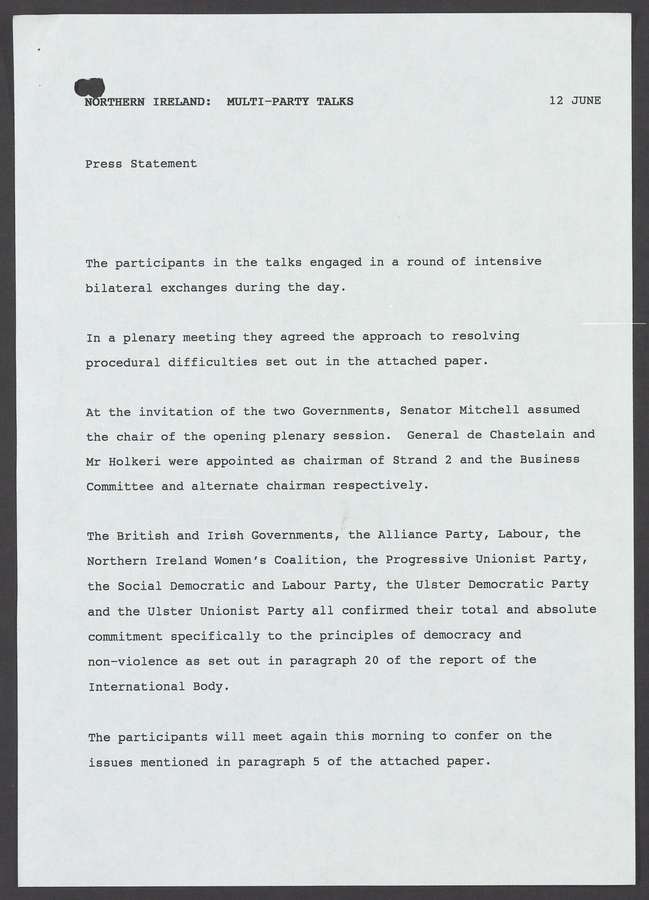
NORTHERN IRELAND: MULTI-PARTY TALKS
12 June
Press Statement
The participants in the talks engaged in a round of intensive bilateral exchanges during the day.
In a plenary meeting they agreed the approach resolving procedural difficulties set out in the attached paper.
At the invitation of the two Governments, Senator Mitchell assumed the chair of the opening plenary session. General de Chastelain and Mr Holkeri were appointed as chairman of Strand 2 and the Business Committee and alternate chairman respectively.
The British and Irish Governments, the Alliance Party, Labour, the Northern Ireland Women’s Coalition, the Progressive Unionist Party, the Social Democratic and Labour Party, the Ulster Democratic Party and the Ulster Unionist Party all confirmed their total and absolute commitment specifically to the principles of democracy and non-violence as set out in paragraph 20 of the report of the International Body.
The participants will meet again this morning to confer on the issues mentioned in paragraph 5 of the attached paper.
A copy of a press release concerning the peace talks so far. It was tabled by Senator Mitchell at the end of the meeting in Source 4 and there were no objections from those present. Catalogue reference: CJ4/1228
Examine the source
- What is the purpose of this document?
- What is the tone of the document?
- What impression do you get of the peace talks so far from this document? Is it similar or different to the impression you get from Source 4?
- Can you think of any reasons for this?
-
-
Source 6: Opening Statement by Martin McGuinness
-
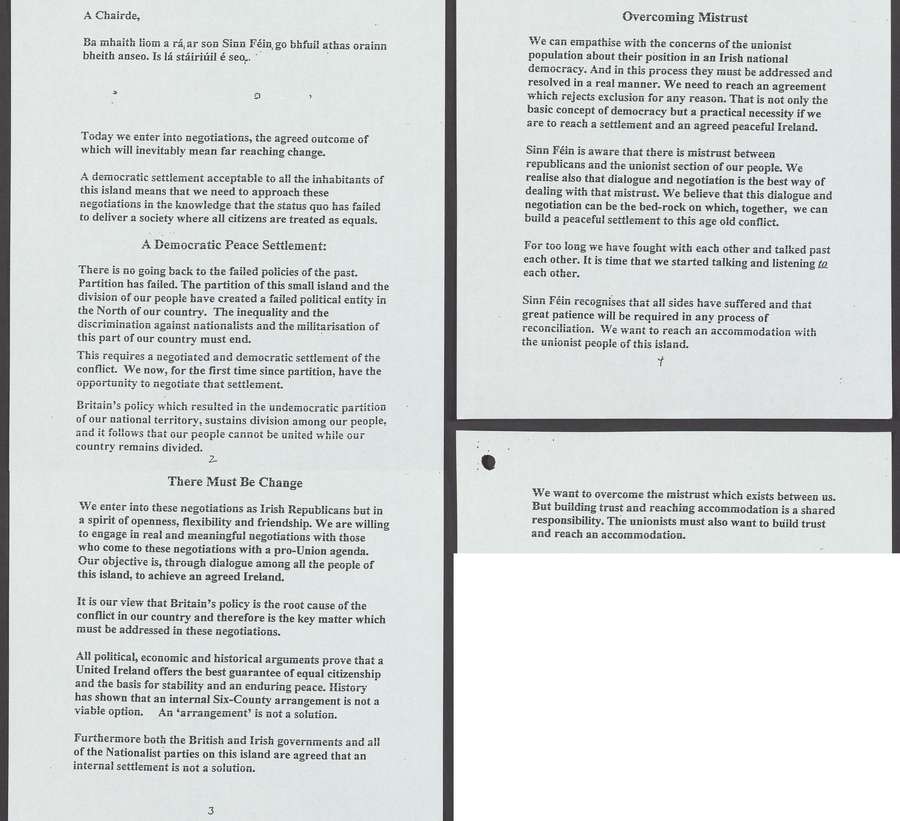
A Chairde,
Ba mhaith liom a rá ar son Sinn Féin, go bhfuil athas orainn bheith anseo. Is lá stáiriúil é seo.
Today we enter into negotiations, the agreed outcome of which will inevitably mean far reaching change.
A democratic settlement acceptable to all the inhabitants of this island means that we need to approach these negotiations in the knowledge that the status quo has failed to deliver a society where all citizens are treated as equals.
A Democratic Peace Settlement:
There is no going back to the failed policies of the past. Partition has failed. The partition of this small island and the division of our people have created a failed political entity in the North of our country. The inequality and the discrimination against nationalists and the militarisation of this part of our country must end.
This requires a negotiated and democratic settlement of the conflict. We now, for the first time since partition, have the opportunity to negotiate that settlement.
Britain’s policy which resulted in the undemocratic partition of our national territory, sustains division among our people, and it follows that our people cannot be united while our country remains divided.
There Must Be Change
We enter into these negotiations as Irish Republicans but in a spirit of openness, flexibility and friendship. We are willing to engage in real and meaningful negotiations with those who come to these negotiations with a pro-Union agenda. Our objective is, through dialogue among all the people of this island, to achieve an agreed Ireland.
It is our view that Britain’s policy is the root cause of conflict in our country and therefore is the key matter which must be addressed in these negotiations.
All political, economic and historical arguments prove that a United Ireland offers the best guarantee of equal citizenship and the basis for stability and an enduring peace. History has shown that an internal Six-County arrangement is not a viable option. An ‘arrangement’ is not a solution.
Overcoming Mistrust
We can empathise with the concerns of the unionist population about their position in an Irish national democracy. And in this process they must be addressed and resolved in a real manner. We need to reach an agreement which rejects exclusion for any reason. That is not only the basic concept of democracy but a practical necessity if we are to reach a settlement and an agreed peaceful Ireland.
Sinn Féin is aware that there is mistrust between republicans and the unionist section of our people. We realise also that dialogue and negotiation is the best way of dealing with that mistrust. We believe that this dialogue and negotiation can be the bed-rock on which, together, we can build a peaceful settlement to the age old conflict.
For too long we have fought with each other and talked past each other. It is time that we started talking to each other.
Sinn Féin recognises that all sides have suffered and that great patience will be required in any process of reconciliation. We want to reach an accommodation with the unionist people of this island.
We want to overcome the mistrust which exists between us. But building trust and reaching accommodation is a shared responsibility. The unionists must also want to build trust and reach an accommodation.
Extracts from an opening statement by Martin McGuinness, Sinn Féin’s Vice President and chief negotiator at the peace talks in Stormont, Belfast, 7 October 1997. The title of the statement was ‘A New Beginning.’ Catalogue reference: PREM 49/403
Examine the source
- Who wrote this document and what does this reveal about what has changed since the last round of peace talks (Sources 4 and 5)?
- The title of the statement is ‘A New Beginning’. What are the subtitles to the different sections? What do these suggest about the motivation or hopes of the author?
- The opening statement translates as, 'My friends, I want to say that we, Sinn Féin, are glad to be here. This is a historic day.' Why do you think the statement was made in the Irish language?
- Look at the section entitled, ‘A democratic peace settlement’. What does the author think about Partition and the UK government?
- Look at the section entitled, ‘There must be change.’ What is the tone of the first paragraph?
- Who or what does the author blame for conflict in Northern Ireland? What do they believe the solution to be?
- Look at the section entitled, ‘Overcoming mistrust.’ What is the general tone of this section?
- In the final paragraph, is there any evidence of continuing mistrust?
-
-
Source 7: Opening Statement by the Ulster Unionist Party (UUP)
-

Ulster Unionist Party (UUP)
Statement
by the
Ulster Unionist Party
Launch of Strand 1 Talks
7 October 1997
The Ulster Unionist Party is participating in these talks because the best way to defend and promote the cause of the Union is not by abstention, but by fighting for our cause from within the talks process. Too often, we have seen the wishes of the greater number of people of Northern Ireland ignored and the imposition of so-called solutions, such as the Anglo-Irish agreement, forced upon them. These talks require the principle of consent to be accepted by the participants and the reality that the Union will continue for as long as that is the wish of the greater number of the people in Northern Ireland. By attending these talks the Ulster Unionist Party is determined to challenge the sincerity of Sinn Fein/IRA’s declared commitment to peace and to the democratic process. We view consent and actual disarmament as a test of Sinn Fein’s commitment to exclusively peaceful means as required by the Mitchell Principles. Terrorists must not be allowed to use, or threaten to use, their weaponry in order to extract concessions at the table of democracy. If Sinn Fein/IRA is truly committed to democratic and exclusively peaceful means of achieving political accommodation within Northern Ireland, it no longer needs to retain its murderous arsenal.
The Ulster Unionist Party and its supporters oppose a United Ireland because we are British. We actively espouse the United Kingdom and the Union that exists between the people of England, Scotland and Wales and Northern Ireland. We believe that the United Kingdom, by adding up those four parts, equals more than the sum of those four parts, and it reflects the interaction which has existed in the British Isles throughout history. The Union with Great Britain is a Union in the hearts and minds of the Unionist people. The feeling of Britishness is not a device or artifice which has been imposed on an unsuspecting people by successive British governments. Britishness is at the heart of the Unionist philosophy, the feeling of belonging; the feeling of sharing with our fellow-citizens in Great Britain in great national events; of being part of something larger than simply the six counties in the north-eastern corner of this island It is a shared psychological bond; a shared emotional bond, common bonds of history and of shared adversities, shared triumphs and shared sacrifices.
Since 1177, when the Normans came to Ulster, eastern Ulster has been loyal to the crown of, firstly England, and then, Great Britain. But, our Britishness is more than loyalty to the Crown. It is a sense of communion with the rest of the peoples of the United Kingdom built up over centuries. Northern Ireland itself has been a part of the United Kingdom from before the time when Nelson defeated the French at Trafalgar and before Wellington defeated Napoleon at Waterloo. Our ancestors shared in the project of the Empire; sacrificed themselves for King and Country on the battlefields of Europe, whilst Republicans rose in revolt in Ireland; and stood alone with Britain during the Second World War, while our southern neighbour remained aloof from the battle to preserve European civilisation. Indeed, as Winston Churchill said,
But for the loyalty of Northern Ireland…the light which now shines so brightly throughout the World, would have been quenched ‘
In short, our sense of Britishness was forged in sweat and blood.
[Footer of the paper reads:]
3 glengall street
Belfast 12
tel 01232 324601
fax 01232 246738building your future within the union
Extracts from an opening statement by Ulster Unionist Party (UUP), which was led by David Trimble, at the peace talks in Stormont, Belfast, on 7 October 1997. Catalogue reference: PREM 49/403
Examine the source
- Read the first section. Why does the UUP say they are participating in these peace talks?
- What might we reasonably infer by the fact that they are defending their decision to take part?
- Do you think the UUP believes that Sinn Fein’s commitment to peace is sincere? How can you tell?
- Read the second section. What are the UUP opposed to?
- How would you sum up the theme of the second section?
- Read the third section. Which two historical figures are mentioned? Why do you think this is?
- What is the impact of the final sentence?
-








Teachers’ notes
The documents selected within this package reveal the difficulties of making peace at two selected snapshots of time in the peace process in Northern Ireland: June 1996 and June 1997, as well as how and when progress was made at these points.
Although this is ‘packaged’ as a single lesson, it is likely to take at least two lesson periods of learning time to complete if all students use all the sources. Alternatively the sources could be shared within small groups with each student working on a single source and feeding back.
Students are encouraged to analyse each document, looking for:
- any evidence that the talks are going well or that progress is being made;
- any evidence that there are still challenges or barriers to peace; and
- the reasons why making peace was difficult
Learning objectives
By the end of the session, students will:
- know two of the key moments on the road towards the Belfast (Good Friday) Agreement;
- understand why it was so difficult to make peace; and
- be able to use contemporary documents to deepen their understanding of the peace process.
Connections to the curriculum
Key stage 3 (Ages 11–14)
Challenges for Britain, Europe and the wider world, 1901 to the present day
Extension activities
Students should look at each document and complete a table with the below headings, so that they are making notes of:
- any evidence that the talks are going well or that progress is being made;
- any evidence that there are challenges or barriers to peace; and/or
- any clues to explain why making peace was so difficult.
| Source | Date | What is the source? | Evidence of progress | Evidence of challenges | Reasons achieving peace was difficult |
|---|
Review activity one
Review one requires students to analyse Sources 2-4 and then consider the key question of why making peace was so difficult.
- Look back over the last column in your table for Sources 2-4.
- List what you consider to be three important reasons why achieving peace was so difficult.
- Choose one and write a paragraph to explain how it made achieving peace difficult. You need to use support from at least two documents you have examined.
- These sentence starters may help:
- One of the most important reasons it was so difficult to make peace was …
- For example, in Source ___, we can see that …
- This is further supported by Source ___, which shows us that …
Review activity two
Review two requires students to analyse Sources 5-7 and then consider whether anything has changed between June 1996 and October 1997.
- Look back over the last column in your table for Sources 5-7.
- List what you consider to be three important reasons why achieving peace was so difficult.
- Consider whether anything has changed between your previous review for June 1996 and this review in October 1997.
- Choose one change and write a paragraph to explain what has changed and whether it made peace more or less likely. You need to use support from at least two documents you have examined.
- These sentence starters may help…
- One of the most important changes which helped / hindered the peace process was …
- For example, in Source ___, we can see that …
- This is further supported by Source ___, which shows us that …
Background information
Teachers may find the following background notes on the sources helpful for guiding students
Source 2
The explosion to which the letter refers was the London Docklands bombing of 9 February 1996. The Provisional IRA detonated a truck bomb which killed two people, injured over a hundred, and devastated a wide area.
The bomb signalled an end to the IRA ceasefire which hitherto had lasted since 31 August 1994. (This had followed the Downing Street Declaration, 1993 which allowed Sinn Féin to participate in peace talks on the condition that the IRA called a ceasefire).
In January 1996, the former US Senator George Mitchell (who was heading an international commission) had set out the ‘Mitchell Principles’. These required a commitment to non-violence to enter the talks process, and set out a plan for achieving decommissioning of weapons. Sinn Féin said it agreed to the Principles, but the IRA leadership did not, and refused to hand over any weapons. However, the UK government demanded a full IRA disarmament as a precondition for Sinn Féin involvement in the peace talks. Following this, the IRA conducted the London Docklands bombing. This was followed by another truck bomb in Manchester in June 1996.
Source 3
Following the bombing, the UK and Irish governments announced that all-party peace talks would resume in June 1996, following elections to a new body, the Northern Ireland Forum. The UK government dropped its demand for the IRA to disarm completely before Sinn Féin were allowed to take part in negotiations. However, the party was told that they would not be allowed to participate without a permanent IRA ceasefire. Sinn Féin, who had won 15.5% of the vote in Northern Ireland and 17 of the Forum’s 110 seats, claimed this electoral support gave them a mandate for involvement in the peace talks.
Sources 4 and 5
The talks began on 10 June 1996 at Stormont in Belfast. As expected, Sinn Féin were not allowed to enter the talks because the IRA had not resumed its ceasefire before the talks began.
The multi-party talks continued slowly and intermittently amongst further violence and heightening tension. In March 1997, the talks were suspended until June, to allow the parties to contest the forth-coming general electio
Sources 6 and 7
On 1 May 1997, the Labour Party won the UK General Election in a landslide victory. Tony Blair became the Prime Minister and Mo Mowlam became the new Secretary of State for Northern Ireland. Tony Blair said that the Northern Ireland peace process was one of the government’s top priorities.
In July 1997, the IRA announced a new ceasefire, and following this, Sinn Féin were allowed to enter the peace talks in September. In protest at this, both the Democratic Unionist Party (DUP) and the UK Unionist Party (UKUP) pulled out, meaning the talks still lacked representation from all parties. However, David Trimble and the Ulster Unionist Party (UUP), alongside the Progressive Unionist Party (PUP), remained, despite criticism from other Unionists.