Service phase: Beta

This is a new service. Help us improve it and give your feedback (opens in new tab).

Teaching resource

What led to the Belfast (Good Friday) Agreement?

This lesson for key stage 5 students investigates what were the most important factors that led to the achievement of the Belfast (Good Friday) Agreement. It also prompts students to think about how different historians interpret history.

Age range
Key stage 5 (Ages 16–18)
About this image

A newsagent sign from The Irish News reads ‘Moment of History’.

About this resource

Time period

  • Post-War and modern

Themes

  • Local history
  • Power, politics and reform
  • Significant people, places and events

Investigate the sources

  1. Source 1: Record of a meeting 7 May 1997

    This document was a record of a meeting between the UK Prime Minister Tony Blair and David Trimble, leader of the Ulster Unionist Party (UUP) and Jeffrey Donaldson, of the Ulster Unionist Party (UUP). Blair had only just won the UK election on 1 May. All sides were anxious to see whether the new government would maintain the same position as the previous Conservative government or whether Blair would take a different approach.

    1. A typed document on Downing Street headed paper.

      10 DOWNING STREET
      LONDON SWIA 2AA
      From the Private Secretary
      7 May 1997

      Dear Ken

      CALL BY THE UUP, 7 MAY

      The Prime Minister decided that, before he saw the Taoiseach, he would like to touch base in person with David Trimble. Trimble therefore called on the Prime Minister in the House of Commons for 10 minutes this afternoon, accompanied by Geoffrey Donaldson. Jonathan Powell and I were there on our side.

      Trimble began by thanking the Prime Minister for seeing him. This would be an important signal to the Unionist community. The Prime Minister said that in the ideal world he would not have been seeing the Taoiseach so soon, but he was in town anyway and a meeting could hardly be avoided. Trimble accepted this. But the Irish were busy trying to make something of the meeting and giving the impression that things were being done behind the backs of others.

      The Prime Minister said that his aim was to sort out the Northern Ireland problem. He had no predilection whatsoever for a united Ireland, and he would want to find the right way of making this clear in due course. Trimble welcomed this. There was considerable nervousness on doorsteps in Belfast about the views of the new government.

      Part of a record of a meeting on 7 May 1997 between the UK Prime Minister Tony Blair and David Trimble, leader of the Ulster Unionist Party (UUP) and Jeffrey Donaldson, of the Ulster Unionist Party (UUP). Catalogue reference: PREM 49/108

      Image details for "What led to the Belfast (Good Friday)..., source 1: Record of a meeting 7 May 1997" | Download image: "What led to the Belfast (Good Friday)..., source 1: Record of a meeting 7 May 1997"

    Content

    • Why was Trimble thanking Blair?
    • What were Blair’s views on the Northern Ireland situation?

    Inferences from the content

    • What can be inferred about Trimble’s concerns at this point?

    Inferences from the context

    • Can anything be inferred about the actions of the Irish government at this time?
    • Can anything be inferred from the fact that the meeting took place at all?
  2. Source 2: Record of a meeting 12 May 1997

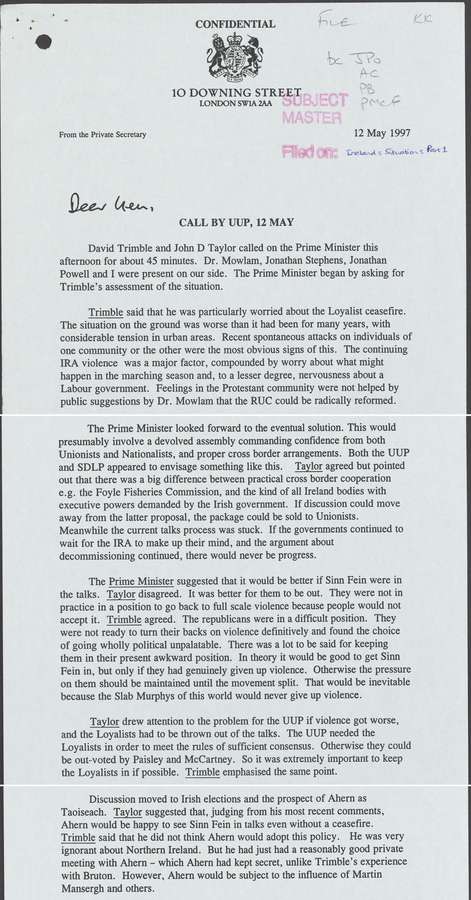
    This document was a record of a meeting between the UK Prime Minister Tony Blair and David Trimble, leader of the Ulster Unionist Party (UUP) and John Taylor, the Deputy Leader of the UUP. Blair had only just won the UK election on 1 May. All sides were anxious to see whether the new government would maintain the same position as the previous Conservative government or whether Blair would take a different approach. At the time all groups were making plans for talks to set up a new government in Northern Ireland which would be based in Northern Ireland and run by representatives elected in elections in Northern Ireland. One of the biggest issues was the inclusion in elections of parties which had not signed up to the principles of The Downing Street Declaration of 1993, which had made clear that a party which did not renounce violence could not be part of any talks. Another point of disagreement was on the issue of cross-border cooperation, which related to the role and degree of influence of the Irish Government in matters affecting Northern Ireland. Ahern refers to Bertie Ahern, leader of the Fianna Fáil party in Ireland. As this meeting was taking place an election was due in Ireland in June and Ahern was expected to win, which he did.

    1. A typed document on Downing Street headed paper.

      10 DOWNING STREET

      LONDON SWIA 2AA

      From the Private Secretary

      12 May 1997

      Dear Ken

      CALL BY THE UUP, 12 MAY

      David Trimble and John D Taylor called on the Prime Minister this afternoon for about 45 minutes. Dr. Mowlam, Jonathan Stephens, Jonathan Powell and I were present on our side. The Prime Minister began by asking for Trimble’s assessment of the situation.

      Trimble said that he was particularly worried about the Loyalist ceasefire. The situation on the ground was worse than it had been for many years, with considerable tension in urban areas. Recent spontaneous attacks on individuals of one community or the other were the most obvious signs of this. The continuing IRA violence was a major factor, compounded by worry about what might happen in the marching season and, to a lesser degree, nervousness about a Labour government. Feelings in the Protestant community were not helped by public suggestions by Dr. Mowlam that the RUC could be radically reformed.

      2

      The Prime Minister looked forward to the eventual solution. This would presumably involve a devolved assembly commanding confidence from both Unionists and Nationalists, and proper cross border arrangements. Both the UUP and SDLP appeared to envisage something like this. Taylor agreed but pointed out that there was a big difference between practical cross border cooperation e.g. the Foyle Fisheries Commission, and the kind of all Ireland bodies with executive powers demanded by the Irish government. If discussion could move away from the latter proposal, the package could be sold to Unionists. Meanwhile the current talks process was stuck. If the governments continued to wait for the IRA to make up their mind, and the argument about decommissioning continued, there would never be progress.

      The Prime Minister suggested that it would be better if Sinn Fein were in the talks. Taylor disagreed. It was better for them to be out. They were not in practice in a position to go back to full scale violence because people would not accept it. Trimble agreed. The republicans were in a difficult position. They were not ready to turn their backs on violence definitively and found the choice of going wholly political unpalatable. There was a lot to be said for keeping them in their present awkward position. In theory it would be good to get Sinn Fein in, but only if they had genuinely given up violence. Otherwise the pressure on them should be maintained until the movement split. That would be inevitable because the Slab Murphys of this world would never give up violence.

      Taylor drew attention to the problem for the UUP if violence got worse, and the Loyalists had to be thrown out of the talks. The UUP needed the Loyalists in order to meet the rules of sufficient consensus. Otherwise they could be out-voted by Paisley and McCartney. So it was extremely important to keep the Loyalists in if possible. Trimble emphasised the same point.

      3

      Discussion moved to Irish elections and the prospect of Ahern as Taoiseach. Taylor suggested that, judging from his most recent comments, Ahern would be happy to see Sinn Fein in talks even without a ceasefire. Trimble said that he did not think Ahern would adopt this policy. He was very ignorant about Northern Ireland. But he had just had a reasonably good private meeting with Ahern – which Ahern had kept secret, unlike Trimble’s experience with Bruton. However, Ahern would be subject to the influence of Martin Mansergh and others.

      Part of a record of a meeting on 12 May 1997 between the UK Prime Minister Tony Blair and David Trimble, leader of the Ulster Unionist Party (UUP) and John Taylor, the Deputy Leader of the UUP. Catalogue reference: PREM 49/108

      Image details for "What led to the Belfast (Good Friday)..., source 2: Record of a meeting 12 May 1997" | Download image: "What led to the Belfast (Good Friday)..., source 2: Record of a meeting 12 May 1997"

    Content

    • What were the main concerns of Trimble in his opening summary?
    • According to Blair, what would the ‘eventual solution’ look like?
    • What was the attitude of Trimble and Taylor to Sinn Féin?
    • What else was worrying the UUP?

    Inferences from the content

    • What can be inferred from Blair asking Trimble to summarise the situation?
    • What can be inferred about Blair’s attitude towards Taylor and Trimble?

    Inferences from the context

    • Can anything be inferred about the differences between this meeting and the meeting on 7 May (Source 1).
  3. Source 3: Report written 14 April 1997

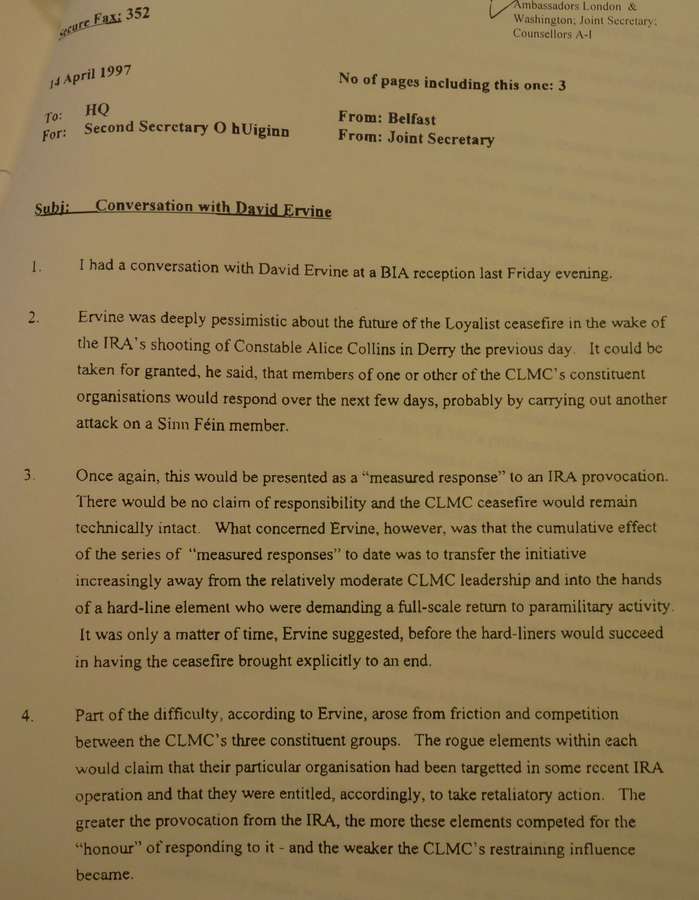
    For most of the 1970s, 1980s and early 1990s Loyalist paramilitary organisations had been active in Northern Ireland. They attacked IRA activists, Sinn Féin politicians, other Republican activists but also many who were simply members of the Catholic or Nationalist communities. By the 1990s Loyalist paramilitaries were becoming more active than the Provisional IRA in terms of the number of attacks carried out. However, an important group within the Loyalist paramilitaries favoured an end to conflict by the early 1990s. One of the most important was Gusty Spence of the Ulster Volunteer Force (UVF). Another was David Ervine, also a former paramilitary. Ervine met Spence in prison and was greatly influenced by him. He rejected violence and both Ervine and Spence became key figures in bringing about a Loyalist ceasefire in 1994. Leaders of the paramilitary groups the UVF, the Ulster Defence Association (UDA) and the Red Hand Commando formed an umbrella organisation called the Combined Loyalist Military Command (CLMC). This organisation co-ordinated the actions and statements of Loyalist organisations, although it was always a difficult job to control all of the factions within their respective organisations. Ervine himself went on to be a representative in the Northern Ireland government after the Agreement and was generally very well regarded by other politicians involved in the peace process.

    1. A typed document.

      14 April 1997

      No of pages including this one 3

      To: HQ

      For: Second Secretary O hUiginn

      From: Belfast

      From: Joint Secretary

      Subj:

      Conversation with David Ervine

      1. I had a conversation with David Ervine at a BIA reception last Friday evening.
      2. Ervine was deeply pessimistic about the future of the Loyalist ceasefire in the wake of the IRA’s shooting of Constable Alice Collins in Derry the previous day. It could be taken for granted, he said, that members of one or other of the CLMC’s constituent organisations would respond over the next few days, probably by carrying out another attack on a Sinn Féin member.
      3. Once again, this would be presented as a “measured response” to an IRA provocation. There would be no claim of responsibility and the CLMC ceasefire would remain technically intact. What concerned Ervine, however, was that the cumulative effect of the series of “measured responses” to date was to transfer the initiative increasingly away from the relatively moderate CLMC leadership and into the hands of a hard-line element who were demanding a full-scale return to paramilitary activity. It was only a matter of time, Ervine suggested, before the hard-liners would succeed in having the ceasefire brought explicitly to an end.
      4. Part of the difficulty, according to Ervine, arose from friction and competition between the CLMC’s three constituent groups. The rogue elements within each would claim that their particular organisation had been targetted in some recent IRA operation and that they were entitled, accordingly, to take retaliatory action. The greater the provocation from the IRA, the more these elements competed for the “honour” of responding to it – and the weaker the CLMC’s restraining influence became.

      Extract from a report written 14 April 1997 by an official to Seán Ó hUiginn, the Joint Secretary of the Anglo-Irish Secretariat in Belfast. National Archives of Ireland, DFA. 2021.53.15

      Image details for "What led to the Belfast (Good Friday)..., source 3: Report written 14 April 1997"

    Content

    • Why was Ervine pessimistic in May 1997?
    • What were Ervine’s concerns about successive ‘measured responses’?
    • What difficulty did Ervine identify for the CLMC?

    Inferences from the content

    • What can be inferred about the CLMC’s views and attitudes to the peace process?
    • What can be inferred about the challenges facing the CLMC?

    Inferences from the context

    • Can anything be inferred from the fact that this conversation took place at all?
  4. Source 4: Report summarising talks 14 October 1997

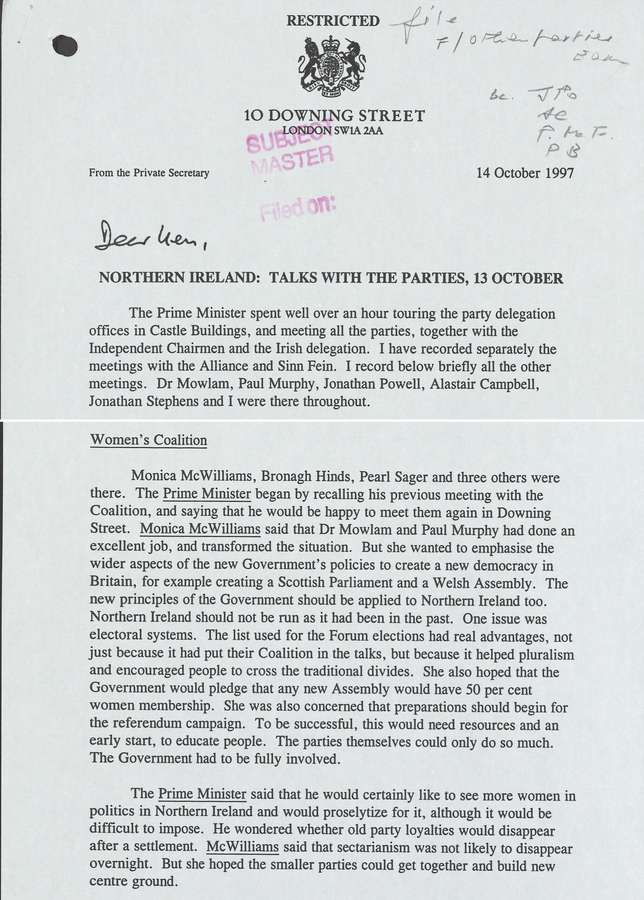
    This meeting took place about six months before the final Belfast (Good Friday) Agreement. The Prime Minister and Taoiseach met with all of the Northern Ireland parties. This extract records their discussions with the Northern Ireland Women’s Coalition (NIWC). This was a cross-community party founded in 1996 by a Catholic academic, Monica McWilliams and a Protestant social worker, Pearl Sagar. They did not campaign specifically as a feminist organisation, and they were not Nationalist or Unionist in their aims. The movement principally aimed to try to represent the views of the wider community and not the main political parties or the paramilitary groups.

    1. A typed document on Downing Street headed paper.

      From the Private Secretary

      14 October 1997

      Dear Ken

      NORTHERN IRELAND: TALKS WITH THE PARTIES, 13 OCTOBER

      The Prime Minister spent well over an hour touring the party delegation offices in Castle Buildings, and meeting all the parties, together with the Independent Chairmen and the Irish delegation. I have recorded separately the meetings with the Alliance and Sinn Fein. I record below briefly all the other meetings. Dr Mowlam, Paul Murphy, Jonathan Powell, Alastair Campbell, Jonathan Stephens and I were there throughout.

      Women’s Coalition

      Monica McWilliams, Bronagh Hinds, Pearl Sager and three others were there. The Prime Minister began by recalling his previous meeting with the Coalition, and saying that he would be happy to meet them again in Downing Street. Monica McWilliams said that Dr Mowlam and Paul Murphy had done an excellent job, and transformed the situation. But she wanted to emphasise the wider aspects of the new Government’s policies to create a new democracy in Britain, for example creating a Scottish Parliament and a Welsh Assembly. The new principles of the Government should be applied to Northern Ireland too. Northern Ireland should not be run as it had been in the past. One issue was electoral systems. The list used for the Forum elections had real advantages, not just because it had put their Coalition in the talks, but because it helped pluralism and encouraged people to cross the traditional divides. She also hoped that the Government would pledge that any new Assembly would have 50 per cent women membership. She was also concerned that preparations should begin for the referendum campaign. To be successful, this would need resources and an early start, to educate people. The parties themselves could only do so much. The Government had to be fully involved.

      The Prime Minister said that he would certainly like to see more women in politics in Northern Ireland and would proselytize for it, although it would be difficult to impose. He wondered whether old party loyalties would disappear after a settlement. McWilliams said that sectarianism was not likely to disappear overnight. But she hoped the smaller parties could get together and build new centre ground.

      Extract from a report summarising talks between the UK government and various political parties and community groups in Northern Ireland, 14 October 1997. Catalogue reference: PREM 49/119

      Image details for "What led to the Belfast (Good Friday)..., source 4: Report summarising talks 14 October 1997" | Download image: "What led to the Belfast (Good Friday)..., source 4: Report summarising talks 14 October 1997"

    Content

    • Who is talking to whom at this meeting?
    • What points were made about developments in the rest of the UK outside Northern Ireland?
    • What were the leaders of the NIWC hoping for?
    • How did Blair respond to the views of the NIWC leaders?

    Inferences from the content

    • Do you get the impression that the NIWC leaders are optimistic or pessimistic about the peace process?
    • How would you describe Blair’s attitude towards the NIWC?

    Inferences from the context

    • What inferences can be made from the fact that these talks were taking place?
    • Is it possible to make any inferences from the fact that this particular group (the NIWC) was involved in the talks?
  5. Source 5: Statement by the Secretary of State April 1998

    In 1972 the Northern Ireland Parliament (based at Stormont on the edge of Belfast) was suspended due to the political upheavals in the province. What followed was known as Direct Rule – Northern Ireland was governed directly by the UK Government, and the main responsibility for Northern Ireland lay with the Secretary of State for Northern Ireland. When Labour won the 1997 UK General Election, Dr Marjorie ‘Mo’ Mowlam became the Northern Ireland Secretary. In this document she set out the main terms of the Belfast (Good Friday) Agreement and in this extract gives credit to some of those who made it possible. Senator George Mitchell is an American politician. John de Chastelain is a Canadian diplomat and former army general. Harri Holkeri is a former prime minister of Finland. Tony Blair is the UK Prime Minister. Bertie Ahern is the Taoiseach (Prime Minister) of Ireland.

    1. A typed document.

      This agreement was made possible by the efforts of many people – most of all by the leaders of the political parties involved in the negotiations.

      The House will I am sure wish to join me in also paying tribute to them and to the exceptional chairmanship skills of Senator George Mitchell and his fellow independent Chairmen, former Prime Minister Harri Holkeri and General John de Chastelain.

      The patience, impartiality and the personal authority which Senator Mitchell showed over the months of difficult and tense negotiation were a major factor in the success of these talks.

      No less crucial was the constant support and the direct involvement of my Rt Hon Friend the Prime Minister, particularly over the last few days of the negotiations.

      The final 36 hours saw him engaged in a virtually non-stop round of intensive negotiations which were among the toughest of the whole process.

      His efforts were matched by those of the Taoiseach, Bertie Ahern, who rose above the personal tragedy of his mother’s death, to play an equally decisive role in the final intensive days of negotiation.

      Hon Members will also appreciate the enormous value of having a broad political consensus in support of the talks process, both here at Westminster and in the Irish Parliament.

      Extract from a statement by the UK Secretary of State for Northern Ireland, Dr Mo Mowlam in April 1998. Catalogue reference: PREM 49/412

      Image details for "What led to the Belfast (Good Friday)..., source 5: Statement by the Secretary of State April 1998" | Download image: "What led to the Belfast (Good Friday)..., source 5: Statement by the Secretary of State April 1998"

    Content

    • Who is given credit by Dr Mowlam in this extract?

    Inferences from the content

    • Would you agree that whether an individual or group is named implies that they played an important role?
    • Is it possible to infer whether Dr Mowlam thinks any individual or group played a particularly important role?

    Inferences from the context

    • Can any inferences be made from the fact that Dr Mowlam did not name any of the Northern Ireland political parties or their leaders?
  6. Source 6: Letter from US Senator 30 April 1998

    Mitchell was a US Senator who had a deep interest in Northern Ireland. President Clinton appointed him as US Special Envoy in 1995 to be an independent figure in the Northern Ireland peace process. He became the Co-Chairman of the Northern Ireland Peace Talks, an important figure in the talks which eventually led to the Agreement. His job was to be an independent and impartial individual who could help to resolve disputes. He was best known for his work in negotiating the decommissioning of paramilitary forces. However, he also worked with the political parties, persuading them to accept the Mitchell Principles. These were a set of limits on political parties, the most important of which was that unless they renounced violence they would not have any role in any of the talks or negotiations. The letter was written a few days after the Belfast (Good Friday Agreement) was agreed.

    1. A typed letter with hand-written additions.

      Office of the Independent Chairmen

      Castle Buildings Stormont Belfast BT4 3SG Northern Ireland

      Telephone 01232 522957 Facsimile 01232 768905

      April 30, 1998

      The Rt Hon Mr Tony Blair, MP

      Prime Minister

      10 Downing Street

      LONDON SW1A 2AA

      Dear Prime Minister

      It was a pleasure to work with you in the multi-party negotiations.

      I am sure there were times when you felt discouraged and uncertain (as we all did), but in the end your commitment and perseverance prevailed.

      I will always regard my participation in this process as one of the most meaningful things I’ve ever done. In large part that was due to the warmth and courtesy with which I was treated by all of the participants.

      With my gratitude and best wishes,

      GEORGE J. MITCHELL

      You demonstrated leadership of a rare and high quality, and you made this possible. The hand of history chose well!

      A letter from US Senator George Mitchell to UK Prime Minister Tony Blair on 30 April 1998, soon after the signing of the Agreement. Catalogue reference: PREM 49/412

      Image details for "What led to the Belfast (Good Friday)..., source 6: Letter from US Senator 30 April 1998" | Download image: "What led to the Belfast (Good Friday)..., source 6: Letter from US Senator 30 April 1998"

    Content

    • What was the main reason for Mitchell writing this letter?

    Inferences from the content

    • What inferences can be made about Mitchell’s views on the negotiations?
    • What can be inferred about Mitchell’s views of Tony Blair?

    Inferences from the context

    • Can anything be inferred from the timing of this letter?
  7. Source 7: Question and Answer session with President Clinton 13 April 1998

    The USA had a large population of Irish-Americans, descended from people who had emigrated to the USA since the 1600s. As a result, US Presidents tended to be very interested in the situation in Ireland, particularly Democratic Presidents as the Democratic Party had a large support among Irish-Americans. When he was first elected in 1995, President Clinton was relatively critical of the British government in Northern Ireland. However, over time his position changed and he worked to support the peace process alongside the UK and Irish governments and the political parties in Northern Ireland.

    1. A typed document.

      THE WHITE HOUSE

      Office of the Press Secretary

      For Immediate Release

      April 10, 1998

      REMARKS BY THE PRESIDENT ON THE NORTHERN IRELAND PEACE PROCESS

      The Oval Office

      2:30 P.M. EDT

      THE PRESIDENT: Good afternoon. After a 30-year winter of sectarian violence, Northern Ireland today has the promise of a springtime of peace. The agreement that has emerged from the Northern Ireland peace talks opens the way for the people there to build a society based on enduring peace, justice, and equality. The vision and commitment of the participants in the talks has made real the prayers for peace on both sides of the Atlantic and both sides of the peace line.

      On this Good Friday, we give thanks for the work of Prime Minister Ahern and Prime Minister Blair, two truly remarkable leaders who did an unbelievable job in these talks. We give thanks for the work of Senator George Mitchell, who was brilliant and unbelievably patient and long suffering. We give thanks especially to the leaders of the parties, for they had to make the courageous decisions. We also thank Prime Minister Blair and Prime Minister Ahern’s predecessors for starting and nurturing the process of peace.

      Q Mr. President, what promises or assurances did the United States make to help move this process along?

      THE PRESIDENT: Well, from the very beginning all I have tried to do is to help create the conditions in which peace could develop, and then to do whatever I was asked to do or whatever seemed helpful to encourage and support the parties in the search for peace. And that’s all I did last night.

      Q Did you offer any assistance in terms of financial aid, and what did you think —

      THE PRESIDENT: No.

      Q~ where did you really weigh in in all those phone calls.

      THE PRESIDENT: Well, first of all, the answer to your first question is no. Now, we have, as all of you know, an international fund for Ireland, which I have strongly supported. And I do believe that there will be very significant economic benefits flowing to the people of Ireland, both Protestant and Catholic, in Northern Ireland and in the Republic, if this peace takes hold. But there was no spec fic financial assurance sought, nor was any given.

      In terms of the give and take, you know, I made a lot of phone calls last night and up until this morning – actually until right before the last session. But I think the specifics are not all that important. I did what I was asked to do. Again, I was largely guided by the work of Prime Minister Blair and Prime Minister Ahern. I had a very — a long talk, in the middle of the night for me, last night with Senator Mitchell about his work there, and I’m looking forward to seeing him early next week I just did what I thought would help. And I tried to do what I was asked to do.

      Q Mr. President, will you be going to Belfast now that they’ve reached a deal?

      THE PRESIDENT: Well, I really haven’t had much discussion about it. No decision has been made. This is not even a day to think about that. This is a day to celebrate the achievement of the people and the peace talks.

      Q President Clinton, de you feel somewhat vindicated for the policies that – including giving

      Gerry Adams a visa here — that have come under scrutiny and at times have brought you some derision from other parts of the world for being too provocative.

      THE PRESIDENT: Well, when I did it, I thought it would help to create a climate in which peace might emerge. And I believe it was a positive thing to do. I believed it then, I believe it now.

      But make no mistake about it. Whenever peace is made by people anywhere, the credit belongs to the parties whose own lives and livelihoods and children and future are on the line. And that’s the way I feel today. If anything that I or the United States was able to do was helpful, especially because of our historic ties to Great Britain and because of the enormous number of Irish Americans we have and the feelings we have for the Irish and their troubles, then I am very grateful. But the credit for this belongs to the people who made the decisions.

      Extracts from a Question and Answer session between US President Bill Clinton and US journalists on 13 April 1998. National Archives of Ireland, TAOIS-2021-100-7 1998-04-10

      Image details for "What led to the Belfast (Good Friday)..., source 7: Question and Answer session with President Clinton 13 April 1998"

    Content

    • According to Clinton, who deserves most credit for the Agreement?
    • What actions did Clinton take to support the peace process?

    Inferences from the content

    • Is it reasonable to infer that Clinton’s contribution was more one of influence than specific actions?

    Inferences from the context

    • Can anything be inferred from the timing of this statement?
  8. Source 8: Letter from Prime Minister John Major September 1996

    One of the key dates in the peace process was the Downing Street Declaration of 1993. In this agreement, the UK and Irish governments enshrined the principle of consent – that Northern Ireland would remain in the United Kingdom unless the majority of the people of Northern Ireland decided otherwise. Another key principle was that only political parties which rejected violence would be included in talks about the future of Northern Ireland. In 1994 the Provisional IRA (PIRA) announced a ceasefire. This helped Sinn Féin to be accepted into discussions. However, the PIRA broke its ceasefire in February 1996. The Social Democratic and Labour Party (SDLP) leader, John Hume, had been in discussions with Sinn Féin leader Gerry Adams through the early 1990s and as this letter suggests, continued to try to encourage communication between Republicans and the UK government.

    1. A typed letter on 10 Downing Street headed paper.

      10 DOWNING STREET

      LONDON SWIA 1AA

      THE PRIME MINISTER

      27 September 1996

      Thank you for your letter of 8 August and the text which you faxed on 6 September.

      The IRA’s position, as you describe it, is that if we are ready to make this statement, and the IRA knew when we were going to make it, they would respond shortly afterwards, at a time specified in advance, with an unequivocal restoration of the August 1994 “total cessation”.

      When I wrote to you on 24 July. I said that the IRA should restore their ceasefire without any further prevarication. But, in response to the suggestion that reassurances from the British Government on certain issues in line with its established public policy would help to bring this about, l set out words which could be used.

      Now they have returned with one significant issue – the timeframe – which is simply not under our control, and an altogether longer text covering a host of other issues. Meanwhile, continued preparation for further IRA attacks goes on, as the arrests and arms finds on Monday demonstrated all too clearly. Intimidation and so-called punishment attacks also continue to increase in

      2

      number and brutality. As I have already said publicly, Sinn Fein’s talk of peace can have little credibility against this background.

      It remains the case that the IRA should restore their ceasefire without further ado and without the need for further statements. The Government is certainly not in the business of negotiating a restoration of the IRA ceasefire, nor in giving secret assurances to bring it about. Sinn Fein must understand that we mean in private what we say in public.

      Nevertheless, if there is genuine doubt or uncertainty over the Government’s policy, I am happy to look at that. Because I am in no doubt of the benefits, for the people of Northern Ireland and the negotiations, of a genuine and unequivocal restoration of the IRA ceasefire, we will repeat and reaffirm our approach on the key issues. The attached text has been prepared for this purpose, and will be published in the near future.

      Yours sincerely

      John M

      A letter from the UK Prime Minister John Major to the SDLP leader John Hume, September 1996. National Archives of Ireland, TAOIS-2021-98-18 1996-09-27

      Image details for "What led to the Belfast (Good Friday)..., source 8: Letter from Prime Minister John Major September 1996"

    Content

    • According to the letter, what was the IRA’s position?
    • How did Major respond to the IRA’s position?
    • What other IRA actions does Major refer to?

    Inferences from the content

    • How would you describe the attitude of Major towards the IRA and Sinn Fein?

    Inferences from the context

    • What can be inferred about the importance of SDLP leader John Hume from this letter?
  9. Source 9: Opening remarks of Gerry Adams October 1997

    When the peace process began there were three main strands of the discussions. Strand One concerned the Northern Ireland Assembly. Strand Two concerned issues within the island of Ireland and relations between the Irish government and Northern Ireland. Strand Three concerned relations between the British and Irish governments. This document sets out the opening comments made by the Sinn Féin leader Gerry Adams at the opening talks on Strand Two. Sinn Féin was a Republican party in Northern Ireland. Unionists and the British government regarded Sinn Féin as the political wing of the Provisional IRA. However, Sinn Féin always denied that there was an official connection.

    1. A typed document.

      P28

      Sinn Fein enters these negotiations as an Irish republican party seeking to promote the broad nationalist objective of an end to British rule in Ireland.

      It is our firm view that this Strand, which deals with north-south relations, is a critical area of negotiation because the resolution of this conflict will only be found in an all-Ireland context.

      British policy at present upholds the union. It enforces the partition of Ireland. Democratic opinion in Ireland and in Britain must seek to change this policy to one of ending the union.

      The issue of sovereignty, the claim of the British government to sovereignty in a part of Ireland, is a key matter which we will raise in the negotiations. Our objective is to achieve through dialogue among the Irish people an agreed Ireland. The political and historical evidence shows that political independence, a united Ireland, offers the best guarantee of equality and the most durable basis for peace and stability. An internal Six-County arrangement cannot work.

      Equality

      There are many issues which fuel the conflict. For example there needs to be equality of treatment in terms of employment, economic development and the Irish language and culture, as well as on the difficult issue of cultural symbols, of flags and emblems. In other words there needs to be equality in all sectors of society – in social, economic, cultural, education, justice, democratic and national rights issues.

      P29

      These issues do not require negotiation. They are issues of basic civil and human rights. The British government should act on these issues immediately by outlining a programmatic approach which delivers real change, which makes equality a reality and which builds confidence in the wider peace process. The immediate responsibility for equality rests with the British government and there should be no artificial distinctions, no arbitrary barriers placed in the way of these rights.

      But the Irish government and Irish nationalists also have a responsibility; a responsibility to ensure that the concerns and fears of the unionist population are addressed and resolved through negotiation. A process of national reconciliation must secure the political, religious and democratic rights of the northern unionist population. That is not only the democratic norm but a practical necessity if we are to advance the cause of peace in Ireland.

      Bridging the Gap of Distrust

      I welcome the contribution of Senator Mitchell and his colleagues to the negotiating process. Sinn Fein has long argued for an international dimension to the search for peace in Ireland. The international dimension is one which can play a crucial part in maintaining the momentum and dynamic through the negotiations. There is a huge gap of distrust between nationalists and unionists. It must be bridged. We need to secure an accommodation, based on equality. Building peace is a collective responsibility. In setting out the

      P30

      republican position I also want to stress our willingness to listen to other positions and to see and to uphold the dignity of all sections of our people.

      The British government also has a crucial and constructive role to play in persuading unionists to reach a democratic agreement on the issue of Irish national reunification with the rest of the people of this island and to encourage, facilitate and enable such agreement.

      Extracts from the opening remarks of Sinn Féin leader Gerry Adams to the first meeting of Northern Ireland parties and the UK and Irish governments in October 1997. National Archives of Ireland, TAOIS-2021-99-23 1997-10-07b

      Image details for "What led to the Belfast (Good Friday)..., source 9: Opening remarks of Gerry Adams October 1997"

    Content

    • What was Sinn Féin’s political position?
    • How did Adams describe his main objective?
    • According to Adams, which issues fuel the conflict?
    • According to Adams, what should the British government do?
    • What responsibility, according to Adams, do the Nationalists and the Irish government have?

    Inferences from the content

    • How would you describe the general tone of this statement?
    • How do you think other parties and the two governments might have viewed the statement?

    Inferences from the context

    • Can we infer anything from the fact that the statement is being made at all?
  10. Source 10: Notes from a meeting 28 March 1998

    Blair became Prime Minister in May 1997 and Ahern became Taoiseach in June 1997. The two leaders had a good working relationship which helped the peace process. In this conversation they refer to a number of developments. Strand One was the creation of a new Assembly to govern Northern Ireland. Strand Two concerned relations between the Irish government and Northern Ireland, and the creation of organisations which would have a role in issues which ran across the border between Northern Ireland and Ireland, such as heritage or cultural bodies.

    1. A typed document.

      CONVERSATION WITH THE TAOISEACH, 28 MARCH

      The Prime Minister and Ahern spoke for about 20 minutes this morning. Ahern began by saying he had been out and about selling the idea of change to Articles 2 and 3. It was a tough debate at times, but civilised and worth having now. He understood there had been a good Liaison Group meeting the previous day. For his part he was trying to bring Sinn Fein along into Strand 1. But it was not easy keeping the nervous horses of Sinn Fein and the SDLP on side, not least with the Hume/Mallon strains. The North-South bodies were his main concern, as a counterweight to Articles 2 and 3. There was a widespread fear that if they depended for their functioning on going back to the Northern Ireland Assembly regularly for agreement, Paisley and McCartney would team up with other troublemakers to ensure they never got off the ground.

      The Prime Minister agreed this was the toughest area. The Unionists feared things would be agreed in the North-South Council against their will. He had been putting pressure on them to accept actual implementation bodies up front in 5 or 6 areas, but they wanted a guarantee that the North-South Council would not become a kind of independent, self-standing body, which is why they wanted the Council itself to be consultative, with a work programme. He had told them there had to be an all-Ireland dimension and thought he could get them to agree to this (although some said he was over-optimistic). But they could not budge on the importance of the Assembly mandate.

      Ahern said he had made clear he did not envisage a third government. But a body in say the Arts or Heritage area should not have to go back to the full Assembly every time it wanted to move forward. He thought in practice there would not be these problems of obstruction, but these worries were real, and unless they were met, he could not sell Articles 2 and 3.

      Ahern said he was working hard on Sinn Fein to be a constructive part of the Assembly. There had to be some voting safeguard to avoid the old Unionist monolith.

      The Prime Minister agreed, although Trimble would naturally be hard to persuade of Sinn Fein good faith. In any case he saw his own task as persuading Trimble to accept that North-South bodies, once established, could function, and that the Assembly could not be a Unionist ramp. Policing and prisoners would also be very difficult, and might have to be left to last. We had to be careful on policing. The immediate priorities were to get in the right areas on Strands 1 and 2. Mitchell wanted an overall text down on Wednesday but that was almost certainly too soon. He might have to talk to Mitchell to persuade him of that. Meanwhile he proposed that the Taoiseach should come to London a little early for ASEM and have dinner on Wednesday night, with just Teahon and myself there. (Comment: I had prewarned Teahon of this idea). Ahern said he would be delighted to do this, but he might want another official there, to keep his team in the picture. We should not publicise the idea for now.

      CONFIDENTIAL

      Notes from a meeting between the UK Prime Minister Tony Blair and the Taoiseach Bertie Ahern, 28 March 1998. Catalogue reference: PREM 49/410

      Image details for "What led to the Belfast (Good Friday)..., source 10: Notes from a meeting 28 March 1998" | Download image: "What led to the Belfast (Good Friday)..., source 10: Notes from a meeting 28 March 1998"

    Content

    • What was the main concern about the North-South bodies?
    • Did Ahern and Trimble agree on this issue?
    • What other activities of Ahern are described in the notes?

    Inferences from the content

    • What can be inferred about Ahern’s influence on Nationalist groups in Northern Ireland?

    Inferences from the context

    • What can be inferred about the relationship between Blair and Ahern from this document?

Teachers’ notes

Historians substantiate their interpretations of the past by supporting their claims with evidence from primary sources. This is why two of the key assessment objectives at A Level are:

  1. Understanding and evaluating historical interpretations
  2. Using and assessing a range of historical sources

This resource is NOT an exam practice paper. It is designed to explore how historians think about documents and make use of them. Students are introduced to the concept of a line of argument and to testing this against evidence from a range of documents. This will enable them to respond more effectively to the source and interpretation papers in their examinations.

All of the documents come from either:

  • The National Archives of the United Kingdom
  • The National Archives of Ireland
  • The Public Record Office of Northern Ireland

For each document a number of discussion questions are posed which are designed to engage students in focused reading of the text. Students are then asked to consider whether the document could be used as evidence to support a particular view.

Connections to the curriculum

Key stage 5 (Ages 16–18)

This resource is designed to support students tackling the AQA Component 2S The Making of Modern Britain, 1951-2007

Extension activities

Historians' interpretations

Whilst very few historians would argue that only one individual or group was primarily responsible for bringing about the Belfast (Good Friday) Agreement, a range of experts were asked to highlight what they consider to be the most important factor. The first task for the students is to really understand the detail and the emphasis of these views before they test them against the sources.

Study each interpretation and summarise the key points made by the historian.

  1. What do they argue is the most important factor, individual or group?
  2. How did this contribute to the peace process and Belfast (Good Friday) Agreement?
  3. What challenges and obstacles had to be overcome?
  4. What evidence is given to support this interpretation?
  5. Does the historian’s biographical information help to explain their interpretation?
  6. From your own knowledge how convincing do you find this interpretation?
  7. What further evidence would you want to find in the documents to make the interpretation convincing?
  8. If you were to provide a one-word summary of this individual’s contribution, which of these would you choose, or can you think of a better word?
    • Obstructive
    • Unhelpful
    • Marginal
    • Constructive
    • Helpful
    • Pragmatic
    • Visionary
    • Essential

The most important factor that led to the achievement of the Good Friday Agreement was David Trimble’s leadership of the Ulster Unionist Party. Trimble led a naturally conservative force to  embrace an accord which involved a share in government for Sinn Féin, a party which unionists regarded as spokespersons for a terrorist campaign that accounted for over sixty per cent of deaths during the Troubles.

His predecessor,  James Molyneaux, had pronounced the IRA ceasefire of 1994 the most destabilising event in the history of Northern Ireland.  He feared that any subsequent negotiations would see unionists pressed to make unacceptable political concessions to prevent a return to violence.

When Molyneaux resigned in 1995 David Trimble, was perceived as the most right wing of the contenders . However, once Leader, Trimble broke decisively with Molyneaux’s passive approach. Convinced that he had obtained acceptance of Northern Ireland’s constitutional position by nationalists and republicans he  was prepared to go into government with Sinn Féin, agree to the early release of paramilitary prisoners and the radical reform of policing. Without this willingness to go over the heads of many of his party members and activists the Agreement would not have been possible.

Henry Patterson, Ulster University

One of the most important factors which led to the achievement of the Good Friday Agreement was the inclusion of the people who were conducting the violence, which were the Republicans and the Loyalists. In the past, there had been other attempts at peace such as the Sunningdale Agreement of 1973. Whilst this agreement had many of the key ideas of the Good Friday Agreement of 1998, one of the main things missing were the groups who were conducting the violence. This meant that Republicans and Loyalists, who were not part of the agreement, had no incentive to stop their violent campaigns. Subsequently, making peace in the 1970s was very difficult and resulted in thousands of more people being killed.

In the Good Friday Agreement of 1998, the Republican and Loyalist groups were part of the negotiations and agreement. This was difficult for all groups involved. People had to negotiate with groups who were responsible for killing their loved ones, friends, and people within their own community. However, it meant that some of their key grievances could be resolved, as well as having to compromise too with key issues such as decommissioning. By involving the Loyalists and Republicans, those who were responsible for the violence now had a stake in peace and led them to signing the Good Friday Agreement.

Eleanor Williams – University of Cardiff and Researcher, The National Archives (UK)

A key turning point was the Republican movement’s dropping of the demand for a declaration by the British of intent to withdraw from Northern Ireland. This was a traditional Republican demand, and its ending can be traced back to a speech given by Jim Gibney of Sinn Féin, in 1992, at Bowdenstown, the burial place of the great Irish Republican, Wolfe Tone, where they make major announcements, when he said: “We know and accept that the British government’s departure must be preceded by a sustained period of peace and will arise out of negotiations. We know and accept that such negotiations will involve the different shades of Irish nationalism, and Irish unionism engaging the British government either together or separately to secure an all-embracing and durable peace process.”

Jim Gibney was part of Gerry Adams’ think tank at Sinn Féin and he was setting the scene that there would be a longer process which would not require the British to agree to withdrawal up front. This marks a key change by the republican movement and a change in the thinking about the role of armed struggle against the British.

Tom Hennessey – Canterbury Christ Church University

When thinking about the key contributors who shaped the peace process at various points Bertie Ahern is absolutely crucial because he is a deal maker. He comes from a background of undertaking very effective trade union negotiations and is instinctively oriented towards outcomes and getting deals done. He understands the importance of making key concessions. In particular, the amending of articles two and three of the Irish Constitution, which removed the claim to Northern Ireland as part of its national territory is absolutely crucial. Making that concession at an early stage of the negotiations and getting the people of Ireland to agree to it was key to building unionist confidence because they saw there was a new relationship between North and South. A long-standing Unionist fear was that they were bordered by an aggressive state waiting to swamp them. So the changing of articles two and three seems to me to be an important turning point because it handed Trimble the commitment necessary for him to convince the unionists that Ireland was serious about change.

Dr Caoimhe Nic Dháibhéid, University of Sheffield

Unlike all the previous attempts at finding a solution to the conflict in Northern Ireland, the negotiations of the Belfast Good Friday Agreement were overseen by an external chairperson acting as a sort of referee on who could participate, the agenda for talks, and how to conduct them.  That person was neutral, with no prior affiliation to any group in Northern Ireland or the two governments.  He was former U.S. Senator, George Mitchell, a lawyer and politician with a strong record of achievement, and in 1995 he was proposed for the role by U.S. President, Bill Clinton.

The idea of such an appointment came from Irish-American pressure during the US presidential election in 1992 and on election, President Clinton appointed Mitchell, recently retired, first as advisor on Northern Ireland and then proposed to the British and Irish government leaders that Mitchell oversee all-party talks on the conflict.

It took almost a year to secure the agreement of all involved to Mitchell’s appointment.  On the thorny issue of admission to talks of representatives of paramilitary groups, Mitchell drew up the Mitchell Principles, requiring a solemn pledge to non-violence and the use of only democratic means.  For two years, with endless patience, Mitchell oversaw talks with the parties, slowly nudging them towards agreement and securing the involvement, usually by telephone calls from the White House to party leaders, of President Clinton, in support of his efforts which culminated in the Belfast Good Friday Agreement on 10th April, 1998.

Frank Sheridan – Irish Government Diplomat and Researcher, The National Archives (Ireland)

Carefully study the 10 sources about the peace process.

  1. Decide whether each document could be used as evidence to support views 1, 2, 3, 4 or 5.
  2. Remember that documents may support more than one view
  3. Decide whether they constitute strong, convincing evidence or whether more evidence is required to substantiate the interpretation and support the historian’s line of argument.

Other resources