






















Teaching resource
Belfast (Good Friday) Agreement 1998 Themed Collection Part 1

This resource includes all the original documents used to create our resources about the signing of the Belfast (Good Friday) Agreement.
Teaching resource
This themed collection includes all the original documents used to create The National Archives' resources about the signing of the Belfast (Good Friday) Agreement. Teachers and students can use these sources to find their own themes and conduct independent research.

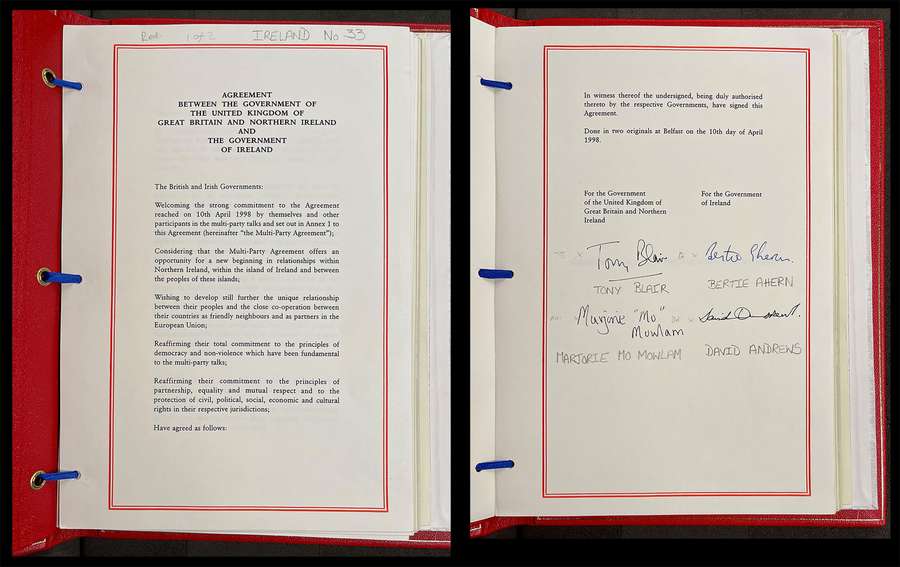
The Belfast (Good Friday Agreement) signed by the UK Prime Minister, Tony Blair, the Secretary of State for Northern Ireland, Dr Mo Mowlam, the Taoiseach, Bertie Ahern and the Tánaiste, David Andrews, 10 April 1998. Catalogue reference: FO 93/171/33
Explore these sources alongside those found in part 1 of this resource.

From: Alistair Campbell
Date: 29 November 1997
cc: Carol Allen
separate copies to:
JONATHAN POWELL
JOHN HOLMES
CHRISTMAS TREE
I am not sure what our arrangements are for putting up a Christmas tree, but can I alert you to a potential problem?
With Gerry Adams due on 11 December, we need to think through whether we want him photographed with the No 10 door and a Christmas tree.
Given the attacks we will have to fend off over him coming at all, do we want the added problem of the symbolism of Gerry Adams as a man of peace, bringing glad tidings, and all the other Christmas clichés that will be churned out?
ALASTAIR CAMPBELL
Memo from Alastair Campbell to Jonathan Powell and John Holmes, 29 November 1997. Catalogue reference: PREM 49/121

CONVERSATION WITH THE TAOISEACH, 28 MARCH
The Prime Minister and Ahern spoke for about 20 minutes this morning. Ahern began by saying he had been out and about selling the idea of change to Articles 2 and 3. It was a tough debate at times, but civilised and worth having now. He understood there had been a good Liaison Group meeting the previous day. For his part he was trying to bring Sinn Fein along into Strand 1. But it was not easy keeping the nervous horses of Sinn Fein and the SDLP on side, not least with the Hume/Mallon strains. The North-South bodies were his main concern, as a counterweight to Articles 2 and 3. There was a widespread fear that if they depended for their functioning on going back to the Northern Ireland Assembly regularly for agreement, Paisley and McCartney would team up with other troublemakers to ensure they never got off the ground.
The Prime Minister agreed this was the toughest area. The Unionists feared things would be agreed in the North-South Council against their will. He had been putting pressure on them to accept actual implementation bodies up front in 5 or 6 areas, but they wanted a guarantee that the North-South Council would not become a kind of independent, self-standing body, which is why they wanted the Council itself to be consultative, with a work programme. He had told them there had to be an all-Ireland dimension and thought he could get them to agree to this (although some said he was over-optimistic). But they could not budge on the importance of the Assembly mandate.
Ahern said he had made clear he did not envisage a third government. But a body in say the Arts or Heritage area should not have to go back to the full Assembly every time it wanted to move forward. He thought in practice there would not be these problems of obstruction, but these worries were real, and unless they were met, he could not sell Articles 2 and 3.
Ahern said he was working hard on Sinn Fein to be a constructive part of the Assembly. There had to be some voting safeguard to avoid the old Unionist monolith.
The Prime Minister agreed, although Trimble would naturally be hard to persuade of Sinn Fein good faith. In any case he saw his own task as persuading Trimble to accept that North-South bodies, once established, could function, and that the Assembly could not be a Unionist ramp. Policing and prisoners would also be very difficult, and might have to be left to last. We had to be careful on policing. The immediate priorities were to get in the right areas on Strands 1 and 2. Mitchell wanted an overall text down on Wednesday but that was almost certainly too soon. He might have to talk to Mitchell to persuade him of that. Meanwhile he proposed that the Taoiseach should come to London a little early for ASEM and have dinner on Wednesday night, with just Teahon and myself there. (Comment: I had prewarned Teahon of this idea). Ahern said he would be delighted to do this, but he might want another official there, to keep his team in the picture. We should not publicise the idea for now.
CONFIDENTIAL
Notes from a meeting between the UK Prime Minister Tony Blair and the Taoiseach Bertie Ahern, 28 March 1998. Catalogue reference: PREM 49/410

Comments from Jeffrey Donaldson (UUP) and David Adams (UDP)
UTV Live at Six – 7 April 1998
Interviewer: Mr Donaldson what is the main problem for your party?
Mr Donaldson: We are not going to sign up for some sort of charter for a United Ireland. What we require, especially from the Irish Government, is some movement. Last week, the Irish Prime Minister said he would not compromise and the result has been the kind of proposals in this document which cannot form the basis of an agreement acceptable to Unionists. We are now prepared to negotiate in good faith and if they don’t, then we are not going to get agreement.
Interviewer: David Adams, is your party unhappy?
Mr Adams: Well, we are unhappy with the document as it sits and Jeffrey is quite right to say that it doesn’t form the basis of an agreement that Unionism could buy into and we, as Unionist parties, will refuse to give our acquiescence to anything which the Unionist population could not be happy with.
Interviewer: Could you walk away from it this week?
Mr Adams: We, at this stage, have no desire or inclination whatsoever to walk away from the negotiations. Jeffrey is quite right when he says what has to happen now is people have to plug in to “planet reality” and try to understand the position that we are in and create a real agreement that Unionism could happily buy into.
Interviewer: Jeffrey Donaldson, what does the Prime Minister have to do?
Mr Donaldson: I think the prime Minister and for that matter the Irish Government, have take a long look at these proposals. There has got to be fundamental changes if we are going to get agreement, if there is to be an agreement to which Unionists can put their hand to we must see fundamental changes to be made to the kind of ideas that are being put forward. Otherwise, unfortunately, if people are not prepared to compromise, we are not going to get agreement.
A transcript of an interview from a TV news programme in Northern Ireland, Live at Six, 7 April 1998. National Archives of Ireland, DFA. 2021.53.15
National Archives of Ireland

Agreement between the Government of the United Kingdom of Great Britain and Northern Ireland and the Government of Ireland
The British and Irish Governments:
Welcoming the strong commitment to the Agreement reached on 10th April 1998 by themselves and other participants in the multi-party talks and set out in Annex 1 to this agreement (hereinafter “the Multi-Party Agreement”);
Considering that the Multi-Party agreement offers an opportunity for a new beginning in relationships within Northern Ireland, within the island of Ireland and between the peoples of these islands;
Wishing to develop still further the unique relationship between their peoples and the close co-operation between their countries as friendly neighbours and as partners in the European Union;
Reaffirming their commitment to the principles of partnership, equality and mutual respect and to the protection of civil, political, social, economic and cultural rights in their respective jurisdictions;
Have agreed as follows:
–
In witness thereof the undersigned, being duly authorised thereto by the respective Governments, have signed this Agreement.
Done in two originals at Belfast on the 10th day of April 1998.
For the Government of the United Kingdom of Great Britain and Northern Ireland
Tony Blair
Marjorie "Mo" Mowlam
For the Government of Ireland
Bertie Ahern
David Andrews
The Belfast (Good Friday Agreement) signed by the UK Prime Minister, Tony Blair, the Secretary of State for Northern Ireland, Dr Mo Mowlam, the Taoiseach, Bertie Ahern and the Tánaiste, David Andrews, 10 April 1998. Catalogue reference: FO 93/171/33

THE WHITE HOUSE
Office of the Press Secretary
For Immediate Release
April 10, 1998
REMARKS BY THE PRESIDENT ON THE NORTHERN IRELAND PEACE PROCESS
The Oval Office
2:30 P.M. EDT
THE PRESIDENT: Good afternoon. After a 30-year winter of sectarian violence, Northern Ireland today has the promise of a springtime of peace. The agreement that has emerged from the Northern Ireland peace talks opens the way for the people there to build a society based on enduring peace, justice, and equality. The vision and commitment of the participants in the talks has made real the prayers for peace on both sides of the Atlantic and both sides of the peace line.
On this Good Friday, we give thanks for the work of Prime Minister Ahern and Prime Minister Blair, two truly remarkable leaders who did an unbelievable job in these talks. We give thanks for the work of Senator George Mitchell, who was brilliant and unbelievably patient and long suffering. We give thanks especially to the leaders of the parties, for they had to make the courageous decisions. We also thank Prime Minister Blair and Prime Minister Ahern’s predecessors for starting and nurturing the process of peace.
Q Mr. President, what promises or assurances did the United States make to help move this process along?
THE PRESIDENT: Well, from the very beginning all I have tried to do is to help create the conditions in which peace could develop, and then to do whatever I was asked to do or whatever seemed helpful to encourage and support the parties in the search for peace. And that’s all I did last night.
Q Did you offer any assistance in terms of financial aid, and what did you think —
THE PRESIDENT: No.
Q~ where did you really weigh in in all those phone calls.
THE PRESIDENT: Well, first of all, the answer to your first question is no. Now, we have, as all of you know, an international fund for Ireland, which I have strongly supported. And I do believe that there will be very significant economic benefits flowing to the people of Ireland, both Protestant and Catholic, in Northern Ireland and in the Republic, if this peace takes hold. But there was no spec fic financial assurance sought, nor was any given.
In terms of the give and take, you know, I made a lot of phone calls last night and up until this morning – actually until right before the last session. But I think the specifics are not all that important. I did what I was asked to do. Again, I was largely guided by the work of Prime Minister Blair and Prime Minister Ahern. I had a very — a long talk, in the middle of the night for me, last night with Senator Mitchell about his work there, and I’m looking forward to seeing him early next week I just did what I thought would help. And I tried to do what I was asked to do.
Q Mr. President, will you be going to Belfast now that they’ve reached a deal?
THE PRESIDENT: Well, I really haven’t had much discussion about it. No decision has been made. This is not even a day to think about that. This is a day to celebrate the achievement of the people and the peace talks.
Q President Clinton, de you feel somewhat vindicated for the policies that – including giving
Gerry Adams a visa here — that have come under scrutiny and at times have brought you some derision from other parts of the world for being too provocative.
THE PRESIDENT: Well, when I did it, I thought it would help to create a climate in which peace might emerge. And I believe it was a positive thing to do. I believed it then, I believe it now.
But make no mistake about it. Whenever peace is made by people anywhere, the credit belongs to the parties whose own lives and livelihoods and children and future are on the line. And that’s the way I feel today. If anything that I or the United States was able to do was helpful, especially because of our historic ties to Great Britain and because of the enormous number of Irish Americans we have and the feelings we have for the Irish and their troubles, then I am very grateful. But the credit for this belongs to the people who made the decisions.
Extracts from a Question and Answer session between US President Bill Clinton and US journalists on 13 April 1998. National Archives of Ireland, TAOIS-2021-100-7 1998-04-10
National Archives of Ireland

Tuesday 7 April
The situation looked bleak as we arrived in Belfast late on Tuesday afternoon. The decision by Mitchell to insist on including in the text put on the table late on Monday night two long unagreed annexes of issues for North-South co-operation had pushed the Unionists over the edge. They also found the sections on rights, policing, prisoners etc, which they had not seen before, too green for their taste. We therefore invited Trimble to Hillsborough immediately after our arrival, to allow him to explain at length his objections to the text. With the important exceptions of the North-South section and decommissioning, these objections did not seem insuperable. As important, he still seemed interested in a deal.
In the light of all this we worked overnight on proposed amendments to put to the Irish the following morning.
Extract from a report written by John Holmes, who was Principal Private Secretary (a senior official) to the UK Prime Minister, Tony Blair on the final 72 days of negotiations, Tuesday 7 April 1998. Catalogue reference: PREM 49/412

Wednesday 8 April
The Prime Minister spoke to Trimble first thing to reassure him that we would be pressing Ahern for radical change. When Ahern arrived from Dublin for breakfast (before returning to Dublin for his mother’s funeral), the Prime Minister stressed that there would have to be radical change, particularly to the North-South Annexes, if there was to be a real hope of a deal. Ahern made clear in response that he and his team were ready to have a crack at amending the paper, in particular the North-South part. But he also stressed his own difficulties, and his fear that if one Unionist set of demands was met, another one would quickly appear.
Subsequent negotiation on the North-South text between Gallagher, Teahon, myself and Bill Jeffrey, while the Prime Minister went to Castle Buildings to meet other parties, showed that the Irish had indeed been shaken by the Unionist and other reaction and were ready to make significant changes. The infamous Annexes were deleted, and the text moved a considerable way towards Unionist concerns. The process therefore looked as if it might get back on track, although there was great concern on the nationalist side that the Unionists were refusing to engage on Strand 1 until their Strand 2 (North/South) concerns were sorted out.
Extract from a report written by John Holmes, who was Principal Private Secretary (a senior official) to the UK Prime Minister, Tony Blair on the final 72 days of negotiations, Wednesday 8 April 1998. Catalogue reference: PREM 49/412

This was followed by a difficult meeting with the UUP team. Empey was particularly insistent that, unless the Irish were prepared to consider radical change, not only in strand 2, the process was going nowhere. Unionist annoyance with hardline Irish public statements in previous days was very clear. The Prime Minister underlined the need to meet the Irish fear that there would never be any North-South implementation bodies because of Unionist sabotage. Trimble suggested (for the first but not last time) that the Irish actually wanted to damage the UUP politically, but that the UUP were nevertheless ready to talk to the Irish if they were ready to make serious change. Maginnis stressed UUP difficulties over policing, decommissioning and security. It was left that we would talk to the Irish again about the text. (By prior agreement with the Irish, we did not give the UUP the new Strand 2 text at this stage for fear of simply triggering further Unionist demands).

A frustrating period followed, with no real negotiation underway on the key fronts. Ahern did not get back from Dublin until the early evening. Until he had approved the Strand 2 text negotiated earlier, so that we could prove to the Unionists that the Irish really were up for serious change, the process was effectively stuck. When he eventually did arrive for a bilateral with the Prime Minister, the initial atmosphere was chilly, because the Irish mistakenly thought we had been trying to negotiate with Mitchell behind their back over policing and decommissioning. Apologies from the Prime Minister quickly restored relations, and Ahern confirmed he was ready to sign up to the paper on Strand 2, contingent on the Unionists being ready to do a reasonable deal on other issues, notably Strand 1.

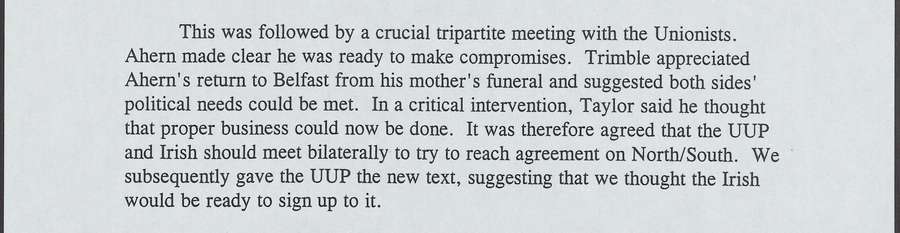
This was followed by a crucial tripartite meeting with the Unionists. Ahern made clear he was ready to make compromises. Trimble appreciated Ahern’s return to Belfast from his mother’s funeral and suggested both sides’ political needs could be met. In a critical intervention, Taylor said he thought that proper business could now be done. It was therefore agreed that the UUP and Irish should meet bilaterally to try to reach agreement on North/South. We subsequently gave the UUP the new text, suggesting that we thought the Irish would be ready to sign up to it.

The UUP and Irish eventually met late that evening, for a long and evidently tense discussion. It did not focus on the new text, as we had hoped, but on the difficult issues, in particular the Irish need for guarantees about the establishment of North-South implementation bodies and preference for Westminster legislation, and the UUP reluctance to contemplate anything “pre-cooked”, before the Assembly could take a view. It was agreed that both sides would go away overnight to draft words to reflect their respective ideas. Some of the Irish side seemed encouraged by the meeting, but Ahern himself commented that it had finished just in time, before blows were exchanged. Andrews and Liz O’Donnell in particular had clearly taken a negative line – a problem which was to plague us further in the next 24 hours.
The Prime Minister was furious that the Irish and UUP had not been prepared to stay up all night to sort out the problems and agree a text. He feared that the delay would make things worse — a fear which proved amply justified the following morning. But Ahern was clearly too tired for an all-night session to be possible.

The end of the evening was marked by Gerry Adams wandering in to see the Prime Minister on his own. He was friendly and philosophical, as always, but his underlying message was worrying: Sinn Fein wanted to sign up to a deal, but we had to give them a deal they could sign up to — and this had to involve more than just prisoner release. The Prime Minister took the opportunity to ask Hume and Mallon immediately afterwards whether he thought Sinn Fein would sign up. They thought Adams genuinely wanted to. But this question was to be a constant preoccupation for the next 36 hours.
We eventually returned to Hillsborough after midnight, frustrated that so little progress had been made during the day. We had arranged to meet Ahern again for breakfast the following morning.

Thursday 9 April
At breakfast with Ahern, the Irish went through the North-South problems again. They were angry that, having made concessions in negotiation with us the previous day, these had been set aside by the Unionists. Not for the first time, the Taoiseach revealed his extreme suspicion of Unionist intentions, based on nationalist experience of many years. He recalled Unionist failure to deliver on the North-South front in both 1921 and 1973. He was worried at the idea that he could change Articles 2 and 3, and then get nothing for it. There was consequently great stress on the Irish side on the need for Westminster legislation to ensure that the North-South bodies would definitely be established. The Irish also showed further concern about Sinn Fein’s position.
Extract from a report written by John Holmes, who was Principal Private Secretary (a senior official) to the UK Prime Minister, Tony Blair on the final 72 days of negotiations, Thursday 9 April 1998. Catalogue reference: PREM 49/412

The Prime Minister put the Unionist North-South proposal to Ahern, and pushed him hard. Ahern accepted that the basis of a deal was there, but repeated that Westminster legislation had to be part of this, even if the Assembly helped to draft the legislation. The Prime Minister saw no reason why we should not reintroduce the previous reference to the two governments making all necessary legislative and other preparations. After Teahon and Gallagher had studied the Unionist text in more detail, and suggested some more changes, the Irish reluctantly agreed to it, together (apparently) with the list of proposed subjects for co-operation / implementation bodies.
The Prime Minister then put the proposed Irish amendments to Trimble, who accepted the essential ones. So a deal appeared to have been struck on Strand 2, and a breakthrough achieved. Strand 1 negotiation could start in earnest, together with efforts to resolve the remaining textual problems over rights, policing, decommissioning, etc.
However problems soon appeared. Word began to reach us of serious difficulties about the new text in the Irish camp, fuelled by Andrews, O’Donnell and Mansergh, and unhappiness on the part of Sinn Fein and the SDLP. The Prime Minister explained at length to both parties why the new text was satisfactory from their point of view. The SDLP seemed reasonably convinced. Sinn Fein were not.

After a long period of silence from the Irish, during which the Prime Minister tried in vain to contact the Taoiseach,
It was a disaster — the Irish had altered the balance fundamentally, reintroducing the necessity for Westminster legislation throughout the text and putting all the responsibility in the hands of the two governments. There was fury on our side that the deal had so quickly fallen apart. The Prime Minister quickly told Ahern that the text could not be seriously reopened, but he was ready to see whether the UUP might accept one or two amendments. A difficult negotiation between me and Teahon/Gallagher followed. I agreed to try on the Prime Minister and, if he agreed, the UUP, half a dozen small but significant textual changes.

The Prime Minister met Trimble and Taylor, and put the Irish changes to them. Since they did not fundamentally alter the balance of the text, they accepted four of the six amendments, to our relief. The Irish were in turn satisfied. So the deal seemed to be back on, and attention could switch back to the wider problem of whether Sinn Fein would sign up to a deal, not least since Ahern had made increasingly clear that a deal would be almost impossible for the Irish if they did not. Ahern had already spent hours with Adams trying to persuade him that the deal was worth accepting, and listening to Sinn Fein demands for improvements, particularly on policing, security, the Irish language and prisoners (whom they insisted all had to be out in a year). Dr Mowlam had also been engaged in tough negotiations over the latter point for two days, with us deliberately refusing to reveal our hand. Sinn Fein’s public line had meanwhile turned very negative and it looked as if they were preparing to disassociate themselves from any agreement.

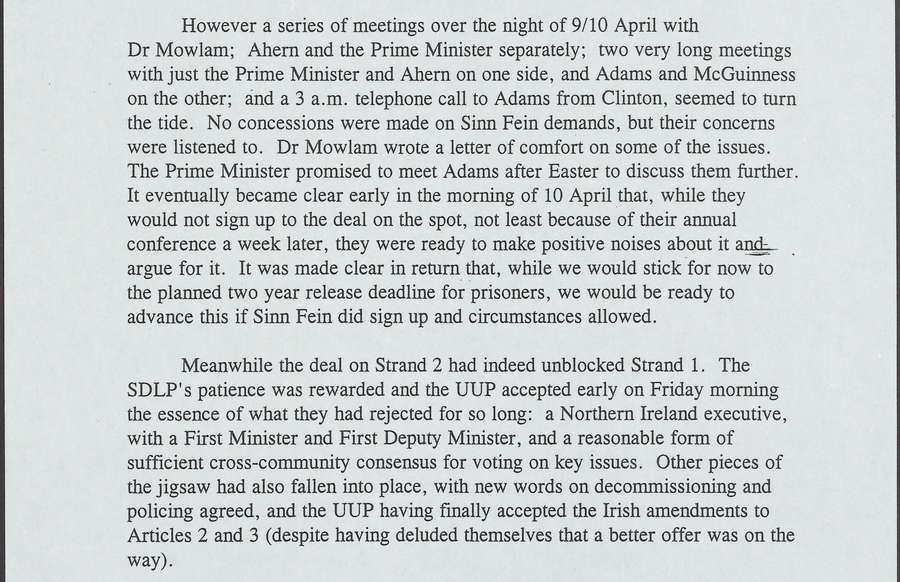
However a series of meetings over the night of 9/10 April with Dr Mowlam; Ahern and the Prime Minister separately; two very long meetings with just the Prime Minister and Ahern on one side, and Adams and McGuinness on the other; and a 3 a.m. telephone call to Adams from Clinton, seemed to turn the tide. No concessions were made on Sinn Fein demands, but their concerns were listened to. Dr Mowlam wrote a letter of comfort on some of the issues. The Prime Minister promised to meet Adams after Easter to discuss them further. It eventually became clear early in the morning of 10 April that, while they would not sign up to the deal on the spot, not least because of their annual conference a week later, they were ready to make positive noises about it and argue for it. It was made clear in return that, while we would stick for now to the planned two year release deadline for prisoners, we would be ready to advance this if Sinn Fein did sign up and circumstances allowed.
Meanwhile the deal on Strand 2 had indeed unblocked Strand 1. The SDLP’s patience was rewarded and the UUP accepted early on Friday morning the essence of what they had rejected for so long: a Northern Ireland executive, with a First Minister and First Deputy Minister, and a reasonable form of sufficient cross-community consensus for voting on key issues. Other pieces of the jigsaw had also fallen into place, with new words on decommissioning and policing agreed, and the UUP having finally accepted the Irish amendments to Articles 2 and 3 (despite having deluded themselves that a better offer was on the way).

Friday 10 April
All now looked set for agreement, and the early morning of Good Friday was spent tidying up texts for later circulation to the parties (most of whom had seen no new text since Monday and knew little of what had been going on); and preparing words for use if and when agreement was reached. Exhaustion was combined with a degree of satisfaction and optimism. But we were also uncomfortably aware that there was bound to be a last minute obstacle, and that the UUP would no doubt find reasons to dislike the texts when they saw them again.
Extract from a report written by John Holmes, who was Principal Private Secretary (a senior official) to the UK Prime Minister, Tony Blair on the final 72 days of negotiations, Friday 10 April 1998. Catalogue reference: PREM 49/412

Before they could even be circulated, a mini-crisis arose over the Annex listing the areas where separate or joint North-South implementation bodies would be set up. The Irish had been unhappy with the number of areas on this list (12), together with the fact that few of them were what they wanted. They had pressed throughout for an Irish Language Promotion Body and a Trade Promotion and Indigenous Company Development Body. The UUP had resisted both fiercely, one on political grounds and the other because of competition worries.
The Irish claimed to have persuaded the UUP at some time during the night to accept both
We stupidly took their word for it. When the UUP saw the new list, they blew a fuse, accused the Irish of duplicity and refused to accept any more than the original list. The Irish in turn dug in their heels, and a lengthy impasse followed, with Mitchell unable to circulate a new text and getting increasingly angry. We were also tearing our hair out.

Eventually, the Prime Minister brought Ahern and Trimble together again. Trimble had been given fierce instructions by his colleagues not to accept another body, or not to bother coming back. He was adamant. Ahern pressed but in was persuaded to propose again vain. Eventually Trimble, was persuaded to propose again a pretty meaningless health body. We sold this to an unhappy Ahern on the basis of an additional reference in the text to other bodies being considered, and an exchange of letters with Trimble where Ahern set out four Irish requests again, and Trimble agreed to consider them later.
This fudge allowed the text to be circulated around midday. We sat back and waited for the next problems. They were not long in arriving but were worse than we had anticipated. First the UUP insisted that the Anglo-Irish Secretariat at Maryfield be closed by the end of the year. But the Irish were resistant to further concessions to the UUP. Then the Unionists wanted to change the wording on decommissioning. We told them it was impossible.
But it quickly became clear that Trimble’s troops were in general revolt, particularly his young staffers, but also major figures like Donaldson. Faced with the prospect of selling to their community a deal involving Sinn Fein at the Assembly and Government table with no guarantee of decommissioning, with all prisoners out in two years, at least severe doubts about the future of the RUC, a new relationship with Dublin, and a nationalist hold on major Assembly decisions, they were losing their nerve. The precise cause varied over the hours. First, it was prisoners. We provided written comfort on how the scheme would work. Then it was policing. Then it was decommissioning.

The Prime Minister spoke to Trimble several times on the phone. He wrote to Trimble unilaterally agreeing that Maryfield would close by the end of the year. We enlisted David Montgomery. We deployed the big picture arguments we could. But Trimble still seemed to be losing the argument (and to share most of his colleagues’ reservation). It began to look hopeless, and despair took hold.

Trimble eventually brought Taylor, Empey, Maginnis and Donaldson up to see the Prime Minister. All effectively said the text was unacceptable and unsaleable to Unionists. The Prime Minister let his despair show, but said he was ready to help if he could, but not by reopening the text itself. The delegation made clear that the single biggest issue was the prospect of sitting round the Cabinet table with Sinn Fein when there had been no decommissioning. The Prime Minister promised to consider this.
When they had left, we concocted a letter to Trimble making clear that, if after 6 months of the Assembly the present rules to promote non-violent methods had proved ineffective, we would support changing the rules to give them teeth. We sent this off without much hope, and meanwhile enlisted Clinton’s help through a direct phone call to Trimble. The cause still looked all but hopeless, although Trimble had said one or two things which suggested he was determined to make his colleagues swallow the agreement. Meanwhile the other delegations were getting restive and suspicious that Mitchell had still not been able to call the expected plenary to ratify agreement; and the press outside, who had thought it was all over bar the shouting, were just beginning to get wind that we might be in serious trouble.

Suddenly, at about 1630, the picture changed again. Rumours reached us that, following the Prime Minister’s letter, and Clinton’s call, Trimble had taken renewed heart and called a vote, which he had narrowly won. This seemed too good to be true, but Trimble quickly rang to confirm that the way was now clear for the plenary to be held, and Mitchell arranged it for 1700.

The plenary itself was relatively devoid of drama. No-one pressed any amendments, though Adams insisted that a paper on Sinn Fein “Issues of Concern” be entered into the record. The vote was swift. All said yes except Adams, who said he was “very positive” about the text but would have to consult his Annual Conference first. Trimble said he would have to consult his Executive Committee and full Executive Council, but was voting yes anyway. And that was it. There was no applause when sufficient consensus was achieved – just a stunned silence.

After votes of thanks from all parties to Mitchell and his co-chairmen, the Prime Minister and Ahern rushed out to make their planned statements to the waiting media, while Mitchell held a ceremonial closing meeting to allow all the participants to say their piece. Immediately after the press conference, we left for London completely drained by the roller-coaster nightmare of the previous three days and scarcely able to believe what had happened.

This agreement was made possible by the efforts of many people – most of all by the leaders of the political parties involved in the negotiations.
The House will I am sure wish to join me in also paying tribute to them and to the exceptional chairmanship skills of Senator George Mitchell and his fellow independent Chairmen, former Prime Minister Harri Holkeri and General John de Chastelain.
The patience, impartiality and the personal authority which Senator Mitchell showed over the months of difficult and tense negotiation were a major factor in the success of these talks.
No less crucial was the constant support and the direct involvement of my Rt Hon Friend the Prime Minister, particularly over the last few days of the negotiations.
The final 36 hours saw him engaged in a virtually non-stop round of intensive negotiations which were among the toughest of the whole process.
His efforts were matched by those of the Taoiseach, Bertie Ahern, who rose above the personal tragedy of his mother’s death, to play an equally decisive role in the final intensive days of negotiation.
Hon Members will also appreciate the enormous value of having a broad political consensus in support of the talks process, both here at Westminster and in the Irish Parliament.
Extract from a statement by the UK Secretary of State for Northern Ireland, Dr Mo Mowlam in April 1998. Catalogue reference: PREM 49/412

Assessment of Agreement
I am laying before the House a settlement for peace in Northern Ireland. The political agreement concluded between all the participating parties on Good Friday, 10 April represents a major breakthrough in terms of consolidating peace and ending 30 years of conflict. The Agreement is historic in the true sense of the word. It not only supersedes previous initiatives, but it replaces both the legislation and the settlement of 1920 and 1921. In its place is an agreement capable for the first time of winning the support of both traditions in the North, and the support of North and South, as well as enhancing co-operation throughout these islands.
It is the culmination of many years’ effort devoted to the peace process and of the three strand talks which began in 1991. Both have come together in one agreement. Many people have contributed to this achievement and shown real statesmanship. I would like to salute the political courage and leadership shown by John Hume and Gerry Adams and their close colleagues, also the priests who brought parties together. The Ulster Unionist leadership under David Trimble have made an indispensable and courageous contribution by their participation in negotiating and concluding this Agreement. Dr. John Alderdice of Alliance, the Loyalist leaders, the Women’s Coalition and Labour in Northern Ireland also played a valuable role in supporting accommodation and bridging-difference. The commitment of the British Prime Minister, Tony Blair, who put his full-weight and presence behind the negotiations, was obviously of huge importance, as was the courage and perseverance of his Secretary of State Mo Mowlam, and her Deputy, Paul Murphy. I would also like to pay tribute to the essential groundwork of his predecessor John Major. I would like to pay tribute to my predecessors, Charles Haughey, who was Taoiseach when the process started, Albert Reynolds who concluded the Downing Street Declaration, and who made the first historic breakthrough towards ending violence, Deputy John Bruton who helped set the parameters and ground rules that started the talks in their most recent phase since June 1996, and Deputy Dick Spring who under successive Governments oversaw the preparation of the immensely valuable Framework Document, and Minister Andrews, as well as Minister Liz O’Donnell, deserve our warmest thanks for the leadership they gave the Irish Government team in the talks, as do the other Ministers and Ministers of State who attended on a regular basis since 1996. The Attorney-General, David Byrne provided a vital input into key parts of the Agreement. The inter-departmental team of officials and advisers also deserve our gratitude for helping to pull the Strands of the Agreement together, as indeed do the officials attached to the British side and to the different party teams as well as the staff working with the Talks Chairmen. I would like to congratulate Senator George Mitchell and his colleagues, former Prime Minister Harri Holkeri and General John de Chastelain on their great achievement and thank them for their wisdom and patience.
The text of a speech by the Taoiseach Mr. Bertie Ahern, TD on the Approval of the Multi-Party Agreement in Belfast on Good Friday, 10 April 1998. The speech was delivered on 22 April 1998. National Archives of Ireland: TAOIS/2021/100/08 1998-04-22
National Archives of Ireland

NORTHERN IRELAND: LETTERS OF CONGRATULATIONS FROM
HEADS OF STATE AND VIPs (As at 27 April)
A list of head of state and other politicians who sent letters of congratulations to Tony Blair, UK Prime Minister, on the signing of the Agreement, April 1998. Catalogue reference: PREM 49/412

Office of the Independent Chairmen
Castle Buildings Stormont Belfast BT4 3SG Northern Ireland
Telephone 01232 522957 Facsimile 01232 768905
April 30, 1998
The Rt Hon Mr Tony Blair, MP
Prime Minister
10 Downing Street
LONDON SW1A 2AA
Dear Prime Minister
It was a pleasure to work with you in the multi-party negotiations.
I am sure there were times when you felt discouraged and uncertain (as we all did), but in the
end your commitment and perseverance prevailed.
I will always regard my participation in this process as one of the most meaningful things I’ve
ever done. In large part that was due to the warmth and courtesy with which I was treated by all
of the participants.
With my gratitude and best wishes,
GEORGE J. MITCHELL
You demonstrated leadership of a rare and high quality, and you made this possible. The hand
of history chose well!
A letter from US Senator George Mitchell to UK Prime Minister Tony Blair on 30 April 1998, soon after the signing of the Agreement. Catalogue reference: PREM 49/412

Oifig an Taoisigh
Office of the Taoiseach
10 June, 1998
The Right Honourable Tony Blair, M.P.,
Prime Minister,
10 Downing Street,
London.
Dear Tony,
I am writing to express my serious concern at the decisions taken on the Policing Commission and the Prisons Bill and in particular at the manner in which those decisions were taken.
Coupled with the leak of the Secretary of State’s conversations about the Policing Commission they have created a real sense of alarm amongst Nationalists that some people in the system are attempting to claw back parts of the Good Friday Agreement with which they do not agree.
At this stage my principal concern is not to go over the past but to ensure that future decisions concerning the Agreement are reached after open discussion between us which reach a clear and agreed understanding of what each side will do. We can draw lessons from the Police Commission which caused unnecessary problems between us, damaged confidence in the balanced implementation of the Agreement and inflicted unnecessary discomfort on those who were willing to accept membership. All this could have been avoided had we sat down at an early stage, discussed possible names and reached agreement on the membership.
Likewise an early discussion of the Prisons Bill would have allowed me to put at that stage my strong view that the approach adopted in the Bill, of redefining what constitutes a ceasefire and of seeking to specify terrorist organisations may be storing up real problems.
2
I understand that your system is considering a number of early announcements post the 25 June Assembly Election. It is clear also that the parades issue and the formation of the Shadow Executive in Northern Ireland will be contentious. I would ask that you and the Secretary of State send a clear message to all relevant parts of your system, as I and David Andrews will be happy to do in our case, that any such decisions follow on open consultation between our systems. This message should make clear that adequate time be allowed for realistic consideration and decision at the political level between the two of us if that is required.
I trust you will appreciate my concern that we act in every way together to maximise the positive and minimise the contentious in the implementation of the Good Friday Agreement and that we preserve the Agreement’s essential balance. I know from your work in reaching the Agreement that that is very much your personal approach and wish. I believe that we both, with David Andrews and Mo Mowlam, need to make absolutely clear to our respective systems that we will not be diverted from that purpose.
Yours sincerely,
Bertie Ahern, T.D., Taoiseach
A letter from the Taoiseach Bertie Ahern to the UK Prime Minister Tony Blair, 10 June 1998. National Archives of Ireland: TAOIS/2021/100/12 1998-06-10
National Archives of Ireland

AMBASAID NA hEIREANN. LONDAIN
IRISH EMBASSY, LONDON
17 Grosvenor Place
SW1X 7HR
18 June 1998
Mr. Dermot Gallagher
Second Secretary
Anglo-Irish Division
Department of Foreign Affairs
Dublin 2
Dear Secretary,
Conversations with Mo Mowlam and Tony Blair
Mo Mowlam telephoned me late last night. She said she was concerned at what she saw as emerging difficulties between the British and Irish sides; her feeling was that things were “different” in recent weeks and that there was not the same level of trust between us as before. As an instance of this she wondered whether that British Ministers were having some difficulties in arranging meetings with the Irish side. Although she herself would be seeing Minister Andrews on 7 July, they wondered whether their inability to arrange a meeting with Paul Murphy today was deliberate on our part. She thought that it would be of the utmost importance to stay close in the period ahead.
I said that it was true that confidence had been dented by the handling of the Police Commission and the failure to consult adequately on the prisoners legislation. But she should not exaggerate. The Taoiseach had written to the Prime Minister outlining our views, and it was important that we explain frankly our concerns. This itself was a sign of the maturity in the relationship. (Mowlam incidentally could not recall the letter, but she put this down to the fact that she sees too many papers). I emphasised that the key thing for the future was that we be consulted properly on initiatives which lay at the heart of the process. The Irish Government could not be seen to be wrong footed on matters of such importance. As for meetings between Ministers I said that there were no problems on our side and Ministers were available as in the past,
2
especially if urgent matters needed discussion.
Mowlam said she was reassured by what I said and put her concern down to tiredness and congenital paranoia.
The discussion then touched on some issues of current concern.
3
Comment
l think our concerns about consultation have registered. When I met Blair in Downing Street on Saturday the first thing he said was that he knew that we were “sore” over the Police Commission and the prisoners legislation. He tried to justify their proceeding on both issues by pointing to the need to support Trimble and maximise the pro-Agreement vote within the UUP – “without that everything will fail.” I said that our main point was not that they had gone ahead but that they had failed to consult adequately and that problems could be avoided if both sides discussed issues at an early stage. He acknowledged the point.
Yours sincerely,
Ted Barrington Ambassador
Extracts from a letter from the Irish Ambassador in London to Dermot Gallagher, a senior official in the Department of Foreign Affairs in Ireland June 1998. National Archives of Ireland: TAOIS/2021/100/12 1998-06-17
National Archives of Ireland

3 Turning to his meeting the previous evening with David Trimble, the Taoiseach said that Mr Trimble had made clear to him that his room to manoeuvre was very limited. He needed “something”. He understood the argument about the text of the Agreement (not explicitly linking decommissioning to formation of the Shadow Executive), but it could equally be argued that such linkage was not ruled out. In any case, he was now stuck with the realities of the position in which he found himself. The Taoiseach commented to Dr Mowlam that there was no doubting the scale of Mr Trimble’s political difficulties – as exemplified by the fact that there were parts of his constituency, previously strongholds of his, which he could now only visit with the protection of the RUC.
13 Dr Mowlam spoke warmly of the meeting of the British-Irish Interparliamentary Body which she had just attended in York. She noted that after an initial exchange on the current political situation, most of the day was devoted to “routine” matters, such as Agriculture, Education etc. She found this very heartening. The Taoiseach said that he had mentioned the Body to David Trimble at their meeting. The latter had agreed that we were in a new situation and that the Interparliamentary dimensions of the new institutions would also have to be developed.
Extract from a report of a meeting between the Taoiseach and the UK Secretary of State for Northern Ireland in September 1998. National Archives of Ireland, TAOIS/2021/100/16 1998-09-23
National Archives of Ireland

10 DOWNING STREET
LONDON SW1A 2AA
29 October 1998
PS/SCSBAL
PS/Mr Murphy Bal
PS/ Mr Ingram BAL
PS/All Bas
PS/Mr Semple Mr Hill
Mar Watkins
Mr Jeffrey
Mr McCabe
Mr Leach
Mr Walker
Mr Scholfield
Mr Bell
Dear Nick
ALL PARTY MEETINGS, 29 OCTOBER:
TRIMBLE’S VIEWS
When I spoke with Trimble about the LVF, I took the opportunity to ask him about today’s meetings. Trimble confirmed that the morning session on departmental structures had gone well, and had resulted in a focussed discussion. Eleven key points of difficulty had been identified, but many of them were simply a question of making decisions.
In contrast, the afternoon session had been messy. Many of those around the table did not understand the distinction between areas of cooperation and implementation bodies. They had wanted to transfer functions to implementation bodies, and retain them at the same time. Part of the problem had been that. perhaps because of the presence of Sinn Fein, the SDLP had raised their sights. This did not make things any easier. So the meeting had been unsatisfactory. They had ended up with a list of areas where more technical work was needed.
Trimble said that he hoped that they could have a more focussed meeting on Monday involving the UUP, SDLP, Irish and British. I said that I did not think the Irish and the SDLP would be keen on this format, because of their desire to be inclusive. Trimble claimed to be unaware of this difficulty. He was willing to make some side arrangement to keep Sinn Fein involved but he could not attend a meeting with them but without the DUP. He added that, when he had spoken to Ahern earlier in the week, Ahem had focussed on training and the Irish language, and had acknowledged that economic development was difficult for Trimble. Ahern had also promised to send a full list of possible implementation bodies, but this had not yet turned up. Finally, Trimble said that he had had discussions at the beginning of the day with Mallon. They had agreed that they should try to reach a private conclusion on the implementation bodies, but park this. They would say in public that they had not yet sorted this out, but were confident they could do so quickly, and use this to put pressure on Sinn Fein.
2
Comment
We clearly need to work hard on Trimble to take a more positive line on North/South, and get across that the quadripartite meeting be has in mind poses huge difficulties for the Irish and the SDLP, if Sinn Fein are not there. I will try to get the Prime Minister to speak to him about this, probably over the weekend, and to encourage further all party meetings on North/South issues, or at least some alternative process to the same effect.
Extracts from a letter between the UK Prime Minister’s Office and the Northern Ireland Office, October 1998. Public Record Office Northern Ireland, CENT/3/268A 1998-10-29

NORTHERN IRELAND OFFICE
11 MILLBANK
LONDON
SW1P4QE
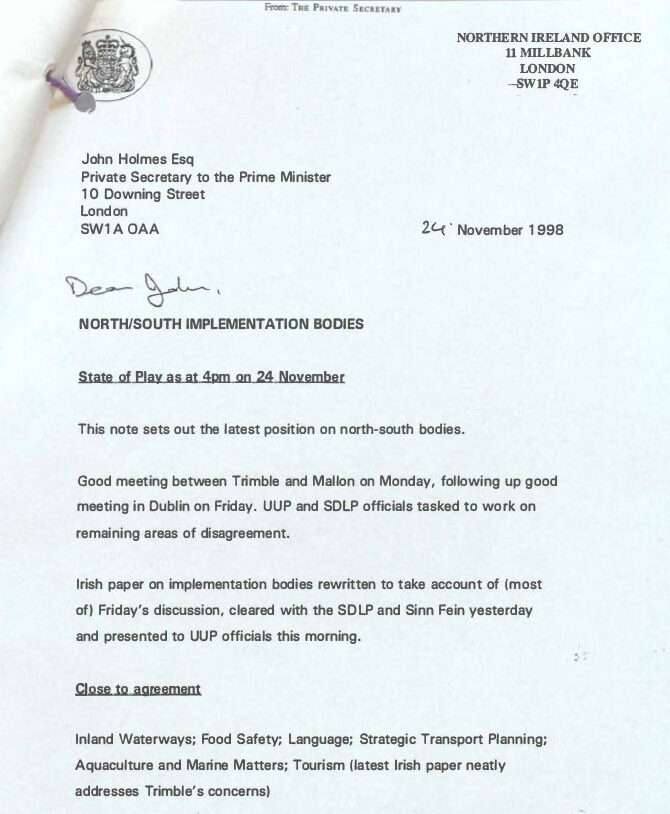
John Holmes Esq
Private Secretary to the Prime Minister
10 Downing Street
London
SW1A OAA
24 November 1998
Dear John
NORTH/SOUTH IMPLEMENTATION BODIES
State of Play as at 4pm on 24 November
This note sets out the latest position on north-south bodies. Good meeting between Trimble and Mallon on Monday, following up good meeting in Dublin on Friday. UUP and SDLP officials tasked to work on remaining areas of disagreement. Irish paper on implementation bodies rewritten to take account of (most of) Friday’s discussion, cleared with the SDLP and Sinn Fein yesterday and presented to UUP officials this morning.
Close to agreement
Inland Waterways; Food Safety; Language; Strategic Transport Planning; Aquaculture and Marine Matters; Tourism (latest Irish paper neatly addresses Trimble’s concerns)
Extract from a note by a UK government official on a meeting about cross-border bodies November 1998. Public Record Office Northern Ireland, CENT/3/236A 1998-11-24
This themed collection includes all the original documents used in The National Archives' resources on the Belfast (Good Friday) Agreement which ended the conflict in Northern Ireland.
This themed collection allows teachers to create their own differentiated resources.
Students can also be encouraged to do their own research within an archival collection for their own individual projects and enquiries. Using the themed collection, students could ‘curate’ their own ‘exhibition’ of the most significant sources on the topic.
Students could also use the documents to substantiate or dispute points made in the introduction to the collection. The collection allows students to work independently with a group of sources or source type, ranging from documents from the Prime Minister’s Office, Secretary of State or Northern Ireland, press releases, newspapers and so on.
Working with original documents should offer students a chance to develop their powers of evaluation and analysis and support their course work. Please note, the transcripts of the resources retain any typographical errors included in the original documents.
Possible questions/themes to explore using the documents collection:
Challenges for Britain, Europe, and the wider world, 1901 to the present day
Challenges for Britain, Europe, and the wider world, 1901 to the present day
Once students are familiar with the collection it would be worth discussing as a group:
The Belfast (Good Friday) Agreement (BGFA) of 10 April 1998, is the most significant attempt, since partition in Ireland, to address division in Northern Ireland.
It was the third agreement between the United Kingdom and Ireland (following the Sunningdale Agreement of 1973 and the Anglo-Irish Agreement of 1985) focused on securing a solution to divisions and an end to the campaign of violence in Northern Ireland and, at times, across the two countries, particularly since 1969, although there had been occasional violent campaigns since the Fenian bombing campaign in the UK in the nineteenth century. The violence in Northern Ireland had endured for centuries involving the native Irish and descendants of British colonists who had arrived with the Plantation in the seventeenth century, thus as long in Ireland as Europeans in North America.
The Sunningdale Agreement of 1973 was negotiated between the UK and Irish governments as well as the then government in Northern Ireland and the main opposition party. It failed to secure broad support from the unionist community and collapsed the following year in 1974.
The Anglo-Irish Agreement of 1985 was between the two governments alone. It endured until the Belfast Good Friday Agreement in 1998 and secured the right of the Irish government to have an input on issues in Northern Ireland, a right underpinned by international law through the registration of the Agreement with the United Nations.
The BGFA differed in a number of important respects from the earlier agreements, not least its far-reaching nature, seeking to address all the dimensions of division.
Firstly, in terms of inclusion, it was close to comprehensive. The two governments, as well as all political parties bar one, the Democratic Unionist Party, were involved. That inclusivity meant that, for the first time, subject to strict conditions on non-violence and eventually on putting all weapons beyond use, representatives of paramilitary groups, which had been engaged in violent campaigns, were involved in the negotiations.
The second way in which the BGFA differed from earlier agreements was in external arbitration, the appointment of an experienced outsider, United States Senator George Mitchell, as the Chair of the talks. His presence, as a respected outsider with no prior engagement on Ireland, together with his wide experience as a senior member of the US Senate (Majority Leader 1989-1995), helped keep the focus on the issues.
The BGFA, as mentioned, embraced a wide agenda, dealing with issues like sovereignty, discrimination, the disbandment and disarmament of paramilitary groups, reform of justice and policing, self-government in the province, the release of prisoners. It established two institutions in Northern Ireland – the Assembly and the Executive – and three North-South institutions – North-South Ministerial Council, the North-South Inter-Parliamentary Association and the North-South Consultative Forum. Three institutions were set up to facilitate interaction between the UK and Irish governments – British–Irish Intergovernmental Conference, the British–Irish Council and the British–Irish Interparliamentary Body.
Thus, by creating this broad system of interaction, the Agreement provided institutional mechanisms for cooperation on a broad level and for dealing with divisive issues as they arise.
Importantly, the BGFA addressed the consent principle in a fundamental way.
Through two referendums on the 22 May, 1998, held simultaneously in both Ireland and Northern Ireland – thus, island-wide – it secured agreement to there being no change in the sovereign status of Northern Ireland until and unless a majority there so voted. But, equally and no less importantly, by gaining a significant majority for the Agreement in Northern Ireland (70%), implicitly it secured, for the first time since partition, the consent of a significant nationalist minority to being part of Northern Ireland. Moreover, because of the island-wide referendums, the BGFA has a huge majority mandate of support from the people of Ireland.
This project, From Conflict to Peace, aims to acquaint students at secondary school level (GCSE and A level) with the BGFA, to demonstrate the enormous benefits of the Agreement to society in Northern Ireland and to sensitise them to the fact that their generation is one of the first to go through school and live in peace, with no intrusive security industry impinging on their daily lives, and, importantly, without ever hearing the sound of a gunshot or an explosion.
Moreover, the Agreement has created the drivers which offer the prospect over time of a blurring of communal and traditional identity and a greater degree of finding common social cause across communities. Equally, the Agreement’s emphasis on parity of esteem and fair employment, as well as its reforms in law enforcement, removes the impulse to see challenges in communal, sectarian terms and shifts the focus to the same drivers as in a settled, unified community.
Obviously, there is no guarantee that the BGFA will hold and not be threatened by the actions of the minority still committed to violence. Yet, as demonstrated by this project, there is a dramatic and popular contrast in society post-BGFA and the divided society which preceded it.
The historically strong popular mandate given to the Agreement in 1998 needs bolstering, not least through projects like From Conflict to Peace which remind the generations which follow of the division which went before and of the huge benefits of an Agreement involving all the main elements of society. The current generation of young people have the opportunity to bed down the Agreement further and continue the process of helping social division to wither.
Background information written by Frank Sheridan, a retired Irish Government Diplomat who participated in the Peace Process.
Teaching resource
This resource includes all the original documents used to create our resources about the signing of the Belfast (Good Friday) Agreement.
Teaching resource
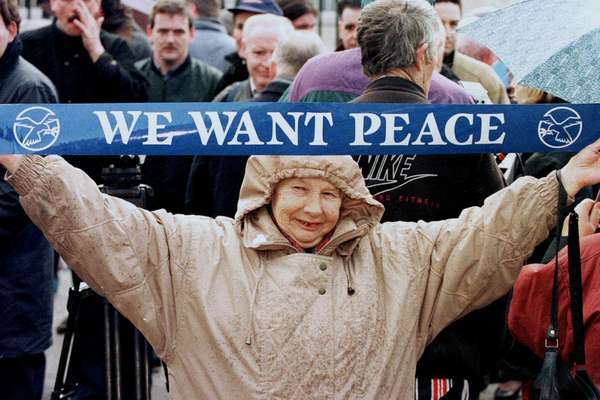
This resource looks at two documents in depth that trace the final 72 hours leading up to the Belfast (Good Friday) Agreement.
Teaching resource

This lesson for key stage 5 students investigates what was the most important factor which led to the achievement of the Belfast (Good Friday) Agreement.
Teaching resource

This lesson, aimed at key stage 3 students introduces students to two of the key moments on the road towards the Belfast (Good Friday) Agreement.
Teaching resource

This resource for key stage 4 students looks at the significance of The Belfast (Good Friday) Agreement and looks at how historians use sources.
Teaching resource
This resource, designed for key stage 4, looks at the significance of the Downing Street Declaration and how historians use sources.