1. Why use this guide?
Use this guide for advice on how to find records of pensions paid to warrant and commissioned officers in the Royal Navy. The records go back as far as the 16th century and the most recent are from the 1980s.
Though very varied, generally awkward to find and not always very detailed, pension records can nevertheless sometimes provide key details about an officer’s life and career. Details recorded varies considerably between record types and even within the same record type there can be variation. Most only record the payment, name and rank but you can potentially find out from pension records:
- the names of an officer’s widow or children
- the officer’s dates of employment
- the officer’s home address
- the names of ships on which an officer served
2. Where and how to start
Very few of these records can be viewed online and to see them or even to simply search for them you may need to visit The National Archives at Kew. However, you can usually at least make a start online by searching for document references and descriptions in our catalogue. If you find references you can pay for copies of the records to be sent to you but you will not be able to view the records beforehand unless you visit us.
2.1 Search for a certificate of service where pension issued before 1894
When an officer applied for a commission, warrant or pension, the Navy Pay Office would issue a certificate to prove his qualifying service. These were the only official evidence of a Navy career until service registers were introduced in the mid 19th century.
The National Archives holds collections of the certificates issued to the requesting departments and also the Navy Pay Office’s entry books showing that certificates had been issued. The certificates give rank, ships served on and length of time in each, but they only record service up to the date they were issued. Sometimes the departments in receipt of the certificates made further notes on them.
See our other guide to records of Royal Navy commissioned and warrant officers for advice on searching for certificates of service online.
2.2 Search for document references in our online catalogue using the links in this guide
To view original records at The National Archives you must know their document references. To locate document references you must use our catalogue but rather than search across the tens of millions of records which a basic catalogue search provides, you can target specific series of Admiralty records to narrow your search significantly. All document references consist of a department code (the code for the Admiralty department is ADM), a series number and a piece number (each piece is a single file or bundle of files). The series and piece numbers are separated by a forward slash – for example ADM 23/32.
The majority of Royal Navy pension record series are listed in the following sections of this guide. Click on the series links in any section (for example, ADM 7) and follow the advice on how that series can be searched. Many of these records are not searchable by the name of an officer in our catalogue. You will sometimes have to search by year only and in these cases, even if you locate a document reference for the year/s you are interested in, you will have no way of knowing whether your officer appears in the record until you see the record itself.
You can also try browsing an entire series in reference order. You can do this by clicking on the series links and then clicking on ‘reference’ near the top of the page.
2.3 Consult our printed publications on Royal Navy records
For a more detailed explanation of the content and arrangement of these records we recommend the following publications:
- B Pappalardo, Tracing Your Naval Ancestors (PRO, 2002)
- NAM Rogers, Naval Records for Genealogists (PRO, 1998)
3. Government bodies responsible for paying Naval pensions
The arrangement of Royal Navy pension records is complicated by the number of government bodies that have had responsibility for administering pensions at different times. While all of these bodies were overseen by the Admiralty, each office created its own records and these are now spread across a wide range of different record series. The different bodies have been:
- The Navy Pay Office/Admiralty
- The Royal Greenwich Hospital
- The charity for the payment of pensions to widows of sea officers
- The Compassionate Fund/List (from 1885)
- The Chatham Chest, later the Greenwich Chest (warrant officers only)
4. Records organised by rank and role
If you know the rank of an officer, you can target one of the specific documents listed in this section.
| Armourers | |
|---|---|
| 1911-1932 | ADM 23/151, ADM 23/164 |
| Artificers | |
|---|---|
| 1831-1837 | ADM 22/52 |
| Artificer engineers | |||
|---|---|---|---|
| 1897-1899 | ADM 23/121-123 | 1897-1920 | PMG 16/25 |
| 1899-1932 | ADM 23/145, ADM 23/151, ADM 23/161-164 | ||
| Boatswains | |||
|---|---|---|---|
| 1653-1657 | ADM 82/1-2 | 1675-1799 | ADM 82/12 |
| 1831-1837 | ADM 22/52 | 1867-1921 | PMG 16/3 |
| 1871-1900 | ADM 23/89 | 1885-1921 | PMG 18/21 |
| 1916-1931 | ADM 23/206-207, ADM 23/144 | 1917-1919 | PMG 42/13-14 |
| Cadets | |
|---|---|
| 1836-1921 | PMG 16/1, PMG 16/3, PMG 16/8, PMG 16/13 |
| Canteen managers | |
|---|---|
| 1914-1928 | PMG 56 |
| Captains | |||
|---|---|---|---|
| 1673-1781 | ADM 18/53 | 1689-1785 | ADM 7/809 |
| 1809-1836 | ADM 6/222, ADM 6/323 | 1809-1851 | ADM 22/22, ADM 22/239, ADM 22/253 |
| 1836-1850 | PMG 16/1, PMG 16/3 | 1837-1921 | PMG 18 |
| 1837-1837 | ADM 23/23 | 1851-1920 | PMG 16/8 |
| 1857-1900 | ADM 23/24, ADM 23/32, ADM 23/42, ADM 23/76-77, ADM 23/89, ADM 23/95 | 1916-1928 | ADM 23/206-207 |
| 1917-1919 | PMG 42/13-14 | 1928-1931 | ADM 23/144 |
| Carpenters | |||
|---|---|---|---|
| 1653-1657 | ADM 82/1-2 | 1675-1799 | ADM 82/12 |
| 1831-1837 | ADM 22/52 | 1867-1921 | PMG 16/13 |
| 1871-1900 | ADM 23/89 | 1885-1921 | PMG 18/21 |
| 1916-1931 | ADM 23/206-207, ADM 23/144 | 1917-1919 | PMG 42/13-14 |
| 1928-1931 | ADM 23/144 | ||
| Chaplains | |||
|---|---|---|---|
| 1653-1657 | ADM 82/1-2 | 1830-1878 | ADM 23/29, ADM 23/45-46, ADM 23/55, ADM 23/106-107 |
| 1836-1870 | PMG 16/2-5, PMG 16/7 | 1866-1909 | ADM 6/446 |
| 1871-1932 | ADM 23/84, ADM 23/89, ADM 23/161-164, ADM 23/144-145, ADM 23/168, ADM 23/206-207 | 1882-1919 | PMG 20/6, PMG 20/8, PMG 20/10, PMG 20/12, PMG 20/17, PMG 20/22-23 |
| 1916-1920 | PMG 43/1 | 1916-1920 | PMG 44/8-9 |
| 1917-1919 | PMG 42/13-14 | ||
| Chief masters at arms | |
|---|---|
| 1911-1932 | ADM 23/151, ADM 23/164 |
| Coastguard | |
|---|---|
| 1830-1878 | ADM 23/106-107 |
| Commanders | |||
|---|---|---|---|
| 1673-1781 | ADM 18/53 | 1809-1851 | ADM 22/239, ADM 22/253, ADM 22/22 |
| 1809-1836 | ADM 6/323, ADM 6/222 | 1836-1920 | PMG 16/1, PMG 16/3, PMG 16/8 |
| 1837-1921 | PMG 18 | 1857-1900 | ADM 23/76-77, ADM 23/32, ADM 23/42, ADM 23/95, ADM 23/24, ADM 23/89 |
| 1916-1931 | ADM 23/206-207, ADM 23/144 | 1917-1919 | PMG 42/13-14 |
| Cooks | |||
|---|---|---|---|
| 1653-1657 | ADM 82/1-2 | 1831-1837 | ADM 22/52 |
| 1675-1799 | ADM 82/12 | ||
| Electricians | |
|---|---|
| 1911-1932 | ADM 23/151, ADM 23/164 |
| Engineers | |||
|---|---|---|---|
| 1847-1921 | PMG 18/7 | 1848-1920 | PMG 16/6, PMG 16/8 |
| 1857-1880 | ADM 23/30, ADM 23/31, ADM 23/76-77 | 1870-1882 | PMG 20/1-4 |
| 1871-1900 | ADM 23/89 | 1874-1924 | PMG 69 |
| 1916-1931 | ADM 23/206-207, ADM 23/144 | 1917-1919 | PMG 42/13-14 |
| Flag officers | |||
|---|---|---|---|
| 1673-1781 | ADM 18/53 | 1809-1836 | ADM 6/323, ADM 6/222 |
| 1809-1851 | ADM 22/239, ADM 22/253, ADM 22/22 | 1836-1920 | PMG 16/1, PMG 16/3, PMG 16/8 |
| 1837-1921 | PMG 18 | 1837-1837 | ADM 23/23 |
| 1857-1900 | ADM 23/76-77, ADM 23/32, ADM 23/42, ADM 23/95, ADM 23/24, ADM 23/89 | 1916-1931 | ADM 23/206-207, ADM 23/144 |
| 1917-1919 | PMG 42/13-14 | ||
| Gunners | |||
|---|---|---|---|
| 1653-1657 | ADM 82/1-2 | 1675-1799 | ADM 82/12 |
| 1831-1837 | ADM 22/52 | 1867-1921 | PMG 16/13 |
| 1871-1900 | ADM 23/89 | 1885-1921 | PMG 18/21 |
| 1916-1931 | ADM 23/206-207, ADM 23/144 | 1917-1919 | PMG 42/13-14 |
| Lieutenants | |||
|---|---|---|---|
| 1673-1781 | ADM 18/53 | 1689-1785 | ADM 7/809 |
| 1781-1821 | ADM 22/1, ADM 22/16 | 1809-1836 | ADM 6/323, ADM 6/222 |
| 1809-1851 | ADM 22/239, ADM 22/253, ADM 22/22 | 1836-1920 | PMG 16/1, PMG 16/3, PMG 16/8 |
| 1837-1921 | PMG 18 | 1857-1900 | ADM 23/89, ADM 23/76-77, ADM 23/32, ADM 23/42, ADM 23/95, |
| 1916-1931 | ADM 23/206-207, ADM 23/144 | 1917-1919 | PMG 42/13-14 |
| Masters | |||
|---|---|---|---|
| 1653-1657 | ADM 82/1-2 | 1675-1799 | ADM 82/12 |
| 1689-1785 | ADM 7/809 | 1708-1818 | ADM 181/1 |
| 1809-1836 | ADM 6/323 | 1809-1851 | ADM 22/239, ADM 22/253, ADM 22/22 |
| 1836-1920 | PMG 16/1, PMG 16/3, PMG 16/8 | 1837-1921 | PMG 18 |
| 1866-1900 | ADM 23/24, ADM 23/32, ADM 23/76-77, ADM 23/89 | 1916-1931 | ADM 23/144, ADM 23/206-207 |
| Mates | |||
|---|---|---|---|
| 1840-1920 | PMG 16/3-6, PMG 16/8 | 1867-1876 | ADM 23/76-77 |
| 1882-1919 | PMG 20/6, PMG 20/8, PMG 20/10, PMG 20/12, PMG 20/17, PMG 20/22-23 | 1899-1932 | ADM 23/144-145, ADM 23/161-164, ADM 23/168-169 |
| 1916-1920 | PMG 43/1 | 1916-1920 | PMG 44/8-9 |
| 1916-1928 | ADM 23/206-207 | 1917-1919 | PMG 42/13-14 |
| Midshipmen | |||
|---|---|---|---|
| 1857-1900 | ADM 23/24, ADM 23/76-77, ADM 23/89 | 1867-1921 | PMG 16/13 |
| 1874-1920 | PMG 16/18 | 1917-1919 | PMG 42/14 |
| 1916-1931 | ADM 23/144, ADM 23/206-207 | ||
| Ordnance officers | |
|---|---|
| 1911-1932 | ADM 23/151, ADM 23/164 |
| Pursers | |||
|---|---|---|---|
| 1653-1657 | ADM 82/1-2 | 1809-1836 | ADM 6/323 |
| 1830-1836 | ADM 22/22-23 | 1836-1920 | PMG 16/1, PMG 16/3, PMG 16/8 |
| 1837-1921 | PMG 18 | 1866-1900 | ADM 23/24, ADM 23/32, ADM 23/76-77, ADM 23/89 |
| 1916-1928 | ADM 23/144, ADM 23/206-207 | 1917-1919 | PMG 42/13-14 |
| RFA officers | |
|---|---|
| 1914-1928 | PMG 56 |
| Schoolmasters | |||
|---|---|---|---|
| 1889-1932 | ADM 23/115, ADM 23/145, ADM 23/161-164 | 1889-1920 | PMG 16/23 |
| Stewards | |
|---|---|
| 1911-1932 | ADM 23/151, ADM 23/164 |
| Sub-lieutenants | |||
|---|---|---|---|
| 1851-1920 | PMG 16/8 | 1857-1900 | ADM 23/14, ADM 23/32, ADM 23/76-77, ADM 23/89 |
| 1916-1931 | ADM 23/144, ADM 23/206-207 | 1917-1919 | PMG 42/13-14 |
| Surgeons | |||
|---|---|---|---|
| 1675-1799 | ADM 82/12 | 1689-1785 | ADM 7/809 |
| 1708-1818 | ADM 181/1 | 1809-1836 | ADM 6/323 |
| 1809-1851 | ADM 22/239, ADM 22/253, ADM 22/22 | 1836-1920 | PMG 16/1, PMG 16/3, PMG 16/8 |
| 1837-1921 | PMG 18 | 1866-1900 | ADM 23/24, ADM 23/32, ADM 23/76-77, ADM 23/89 |
| 1916-1931 | ADM 23/144, ADM 23/206-207 | 1917-1919 | PMG 42/13-14 |
| Ward masters | |||
|---|---|---|---|
| 1900-1915 | ADM 23/161-164 | 1900-1932 | ADM 23/145 |
| 1900-1920 | PMG 16/26 | ||
| Warrant officers | |||
|---|---|---|---|
| 1874-1924 | PMG 69 | 1909-1928 | PMG 36 |
| 1909-1928 | PMG 33 | ||
| Writers | |
|---|---|
| 1911-1932 | ADM 23/151, ADM 23/164 |
| Wireless telegrapher ranks | |||
|---|---|---|---|
| Instructors in cookery | 1911-1923 | ADM 23/151, ADM 23/164 | |
| Mechanicians | 1910-1920 | PMG 16/28-31 | |
| Stewards | 1910-1920 | PMG 16/28-31 | |
| Telegraphists | 1911-1932 | ADM 23/151, ADM 23/164 | |
| Telegraphists | 1910-1920 | PMG 16/28-31 | |
| Writers | 1910-1920 | PMG 16/28-31 | |
5. Superannuation (retirement) pensions
Superannuation, or retirement pensions, became available to different ranks at various points in the Navy’s history, but there was no general retirement pension for officers until 1836. A summary of when superannuation was introduced to different ranks is shown below:
- 1666 yard officers and some captains
- 1672 some of the most senior warrant officers
- 1737 most senior lieutenants
- 1747 yellow admirals
- 1786 captains
- 1836 all officers
Key series for records of superannuation are:
| Description of records | Dates | Catalogue references | Tips for searching our catalogue |
|---|---|---|---|
| Miscellaneous files from the Admiralty | 1563-1956 | ADM 7 | Search using keyword ‘pension’ |
| Office of bills and accounts: bill books | 1642-1831 | ADM 18 | Search by date |
| Registers of salaries and pensions | 1734-1934 | ADM 22 | Search by date and keyword ‘pension’ |
| Registers of pensions and allowances | 1830-1934 | ADM 23 | Search using keyword ‘pension’ |
| Miscellaneous services, wounds, widows and pensions | 1836-1920 | PMG 16 | Browse |
6. Full and half pay pensions
Full pay records show payments made to officers who were actively employed. They give the name and dates of employment and can be used to compile a record of an officer’s career.
Half pay was a retainer paid to officers who were no longer serving. These records are mainly lists of names and the money paid but they sometimes include addresses and other information. Half pay was abolished in 1938.
| Description of records | Dates | Catalogue reference | Tips for searching our catalogue |
|---|---|---|---|
| Service records, registers, returns and certificates | 1673-1960 | ADM 6 | Search with keywords ‘half pay’ |
| Officers’ half pay registers | 1693-1924 | ADM 25 | Search by date |
| Registers of pensions and allowances | 1830-1934 | ADM 23 | Search using keywords ‘half pay’ |
| Half pay and retired pay Naval officers | 1836-1920 | PMG 15 | Browse or search by date |
| Salaried officers’ civil pensions | 1836-1929 | PMG 24 | Search by date |
7. Royal Greenwich hospital pensions
‘Out-pensions’ were paid by the Royal Greenwich hospital to those who had served in the Navy or Marines. The pensions were small but recipients were allowed to earn extra money by working.
The Royal Greenwich hospital admitted a fixed number of former servicemen to live as ‘in-pensioners’ of the hospital, many of whom were still young men in full employment.
Both in and out-pensioners could re-enter the Navy. Their pensions would stop while they served, but would start again when they were discharged.
To find records relating to the in and out pensions from the Royal Greenwich hospital, search or browse the following record series in our catalogue:
| Description of records | Dates | Catalogue reference | Tips for searching our catalogue |
|---|---|---|---|
| Royal Greenwich hospital out-pensions pay books and miscellaneous registers | 1704-1981 | ADM 73 | Search by date |
| Registers of salaries and pensions | 1734-1934 | ADM 22 | Search by keywords ‘gunner’, ‘carpenter’, ‘engineer’, ‘boatswain’ or search by date |
| Registers of pensions and allowances | 1830-1934 | ADM 23 | Search by date |
| Miscellaneous services, wounds, widows and pensions | 1836-1920 | PMG 16 | Browse |
| Greenwich out-pensions and pensions & gratuities to seamen and marines. Also masters out-pensions | 1846-1921 | PMG 71 | Browse |
| Greenwich hospital pensions and civil superannuation allowances | 1866-1928 | PMG 70 | Browse |
| Royal Greenwich hospital pensions to Naval marine officers | 1871-1961 | ADM 165 | Browse |
8. Wounds and disability pensions
Wounds and disability pensions were paid by the Admiralty to masters and surgeons, and by the Chatham Chest to warrant officers.
The key records relating to these pensions are:
| Description of records | Dates | Catalogue reference | Tips for searching our catalogue |
|---|---|---|---|
| Indexes to pensioners receiving payments | 1695-1797 | ADM 82/120-123 | Not applicable |
| Registers of pensions and allowances | 1830-1934 | ADM 23 | Search using keyword ‘wounds’ |
| Miscellaneous services, wounds, widows and pensions | 1836-1920 | PMG 16 | Browse |
| Disability pay | 1917-1920 | PMG 42 | Browse |
9. Widows’ pensions
In 1732 the ‘Charity for the payment of pensions to the widows of sea officers’ was established. It paid pensions to the poor widows of all sea officers regardless of how or when they died, but not to those who were left comfortably off.
The charity received money from parliamentary grants and from a compulsory deduction of three pence in the pound from officers’ wages. It was administered by trustees but in reality it was more an official pension fund than a private charity.
Between 1830 and 1864 widows of warrant officers lost their entitlement to a widows’ pension. This change applied to widows of warrant officers appointed in 1830 or afterwards, and not to the widows of men killed in service. In 1864 the entitlement to a pension was reinstated.
In 1836 the Admiralty took over responsibility for widows’ pensions and made them payable regardless of the widows’ income.
From 1848, widows of engineers became eligible for pensions.
For information relating to pensions to widows and other relatives, the following records series will be useful and can be searched in our catalogue by date, name or keywords:
| Description of records | Dates | Catalogue reference | Tips for searching our catalogue |
|---|---|---|---|
| Chatham Chest pay books | 1617-1807 | ADM 82 | Search by date or browse |
| Papers of the commission of the charity for relief of officers’ widows | 1673-1960 | ADM 6 | Search by name |
| Registers of salaries and pensions, pay books of widows’ pensions | 1734-1934 | ADM 22 | Search by date |
| Marriage certificates of officers | 1806-1861 | ADM 13/70 | Search by name |
| Registers of pensions and allowances | 1830-1934 | ADM 23 | Search with keywords ‘widow’ and/or ‘relative’ |
| Miscellaneous services, wounds, widows and pensions | 1836-1920 | PMG 16 | Search with keyword ‘widow’ and/or ‘relative’ |
| Widows of Naval officers’ pensions | 1836-1929 | PMG 19 | Search by date (arranged alphabetically) |
You can browse the following series in our catalogue to identify pension records relating to widows and other relatives:
| Description of records | Dates | Catalogue reference | Tips for searching our catalogue |
|---|---|---|---|
| Bill books | 1673-1826 | ADM 18/53-154 | Browse |
| Salary and pension books | 1694-1832 | ADM 7/809-822 | Browse |
| Marriage certificates | 1866-1902 | ADM 13/186-192 | Browse |
| Pensions and allowances to widows and relatives of officers, pilots and others killed on duty | 1870-1919 | PMG 20 | Browse |
| Pensions to relatives of deceased officers | 1916-1920 | PMG 44 | Browse |
| Widows’ pensions | 1917-1919 | PMG 45 | Browse |
The following records might also be of interest:
| Description of records | Dates | Catalogue reference |
|---|---|---|
| Documents relating to Royal Marines’ widows’ pensions | 1712-1831 | ADM 96/523 |
| Sworn statements relating to applications to charity for relief of sea officers’ widows | 1801-1818 | ADM 30/57 |
| Widows’ pensions | 1831-1840 | ADM 7/615 |
10. Royal bounty and compassionate fund
10.1 Royal bounty 1675-1822
The royal bounty was a lump sum of one year’s wages which was paid to widows, dependent children or mothers (aged over 50) of officers killed in action. When relatives applied for a payment they often submitted marriage and death certificates as well as documents to prove their age, relationship or poor financial situation.
Pay lists of the royal bounty give the name, address and relation of the payee, the name, rank and ship of the dead man, and the sum paid.
| Description of records | Dates | Catalogue reference |
|---|---|---|
| Papers submitted to the Royal Bounty | 1675-1822 | ADM 106/3023-3028 |
| Pay lists of the Royal Bounty | 1739-1787 | ADM 106/3018-3020 |
10.2 Compassionate fund
The compassionate fund (later the compassionate list) was voted by Parliament and administered by the Admiralty. From 1809 it paid grants and pensions to the orphans or other dependents of officers killed in action. Warrant officers’ dependents became eligible for the compassionate list from 1885.
Search or browse through the following record series in our catalogue for records relating to the compassionate fund and compassionate list:
| Description of records | Dates | Catalogue reference | Search tips |
|---|---|---|---|
| Registers of pensions and allowances | 1830-1934 | ADM 23 | Search using keyword ‘compassionate’ |
| Service records, registers, returns and certificates | 1673-1960 | ADM 6 | Search by name |
| Naval establishment compassionate list | 1837-1921 | PMG 18 | Browse |
| Compassionate fund | 1810-1836 | ADM 22/239-253 | Browse |
| Letters to compassionate fund | 1809-1845 | ADM 2/1085 | Not applicable |
11. Miscellaneous pension records
From 1871 some Greenwich hospital pensions (including pensions paid from special funds like Travers, Popeley and Canada) were paid to deserving warrant officers.
From 1837 good service pensions were paid to deserving flag officers and captains, and later to civil officers of equivalent rank. They could be paid even if the officer was receiving full or half pay, but not once he was promoted.
| Description of records | Dates | Catalogue reference | Search tips |
|---|---|---|---|
| Travers estate pensions | 1866-1928 | PMG 70 | Browse or search by date |
| Victoria Cross and conspicuous bravery medal pensions | 1857-1859 | PMG 16/10 | Not applicable |
| Accountant General’s department: officers and civilians’ effects papers | 1830-1860 | ADM 45 | Search by name, online records |
| Alphabetical register of pensions paid to French pilots | 1802-1809 | ADM 30/40 | Not applicable |
| Medical officers on retired list | 1805-1875 | ADM 104/66 | Not applicable |
| Superannuation lists | 1809-1814 | ADM 106/3009 | Not applicable |
| Officers in Holy Orders | 1836-1840 | PMG 15/4, PMG 15/8 | Not applicable |
1. Why use this guide?
Use this guide if you are looking for trench maps or other military maps of the First World War. The National Archives holds many thousands of military maps from the First World War period. Many of them are official maps made by or for the British government and armed services. Others are foreign maps that were acquired and used by the War Office.
You may find it useful to look at maps alongside written records about First World War events, strategy and operations.
This guide also includes brief outlines of how the systems of map sheet numbers and grid references work for maps of the Western Front.
Most of these records are not viewable online. To view records which are not online you will need to visit The National Archives at Kew or request copies.
2. How to use this guide and get a search for maps started
A search for records of any kind, including maps, at The National Archives usually begins in our online catalogue. The following sections of this guide provide links to key record series that you can search within our catalogue, helping you to target your searches more precisely. By clicking on the series links (for example, WO 300) you will arrive on the respective ‘series description’ pages from where you can search the series, using dates/years and keywords such as:
- place name
- the name of a battle or operation
- the name of a regiment or other army unit
It’s usually worth including the phrase AND (map OR plan) after the other words that you are searching with. In some cases, the best way to search for maps is by map sheet number. You may need to use an index map to identify sheet numbers. Where index maps exist, we have flagged this in the guide.
There are some record series made up solely of First World War maps (see ‘Main map collections’ section) and these tend to be easier to find. However, there are also lots of military maps within wider record series, containing, for example, all kinds of operational records, and many of the maps in these kinds of series have not been identified in the catalogue description.
Use the advanced catalogue search to restrict your search results to all the records of a specific government department, including its predecessors (for example, the War Office). Use the department reference, which is always a letter code, to do this (the code for the War Office is WO).
Catalogue search results provide short descriptions of our records and a document reference for each one – you will need the document references to see the maps themselves. Very few of the maps covered in this guide are available to view online so to see them you will have to either visit us in Kew or order copies.
3. Main map collections of the First World War
The record series WO 153 contains maps showing the progress of the war in various parts of the world. Many of these are printed maps with manuscript annotations.
Most of these maps are bound portfolios, not individual sheets. Try searching by one of the following:
- theatre of war (for instance, “East Africa”)
- name of major operation or battle (for instance, “Vimy Ridge”)
- number of army or corps (for instance, “Third Army” or “XIV Corps”)
Restrict your search by date to the relevant year or years.
We also have separate accumulations of maps for the following individual theatres of war:
- WO 300 for East Africa. Index maps are in WO 300/1-12
- WO 369 for Italy. Index maps are in WO 369/1-28
- WO 301 for Gallipoli and Dardanelles. Index maps are in WO 301/1-44
- WO 302 for Mesopotamia. Index maps are in WO 302/1-37
- WO 303 for Palestine. Index maps are in WO 303/1-12
- WO 298 for Salonika
- WO 297 for the Western Front. A useful index map is available in the reading rooms at The National Archives and in Peter Chasseaud’s Topography of Armageddon (Lewes, 1991). Other index maps are in WO 297/1-56.
Most of these maps are individual sheets. Try searching our catalogue by sheet number or place name. Restrict your search by date to the relevant year or years.
Alternatively, browse the relevant sections of the catalogue using the ‘browse by hierarchy’ option.
For guidance on searching for trench maps of the Western Front by sheet number, see the separate section below.
4. First World War maps within war diaries
Many war diaries in WO 95 include printed or hand-drawn maps and plans to illustrate the text. These maps and plans are not noted individually in the catalogue.
For guidance on searching for war diaries, please see our guide to British Army Operations in the First World War.
Some maps were taken out of the war diaries after the war for the use of the authors of the Official History of the Great War. These are now among the maps in WO 153.
War diaries often refer to specific locations on maps by grid reference (for example, R20 b 8.5). See Appendix 3 for more information on how the grid referencing system works.
If there is no map in the war diary itself, you can search our catalogue for one within record series WO 297 or WO 153.
Unless the war diary specifies the map sheet number as well as the grid reference, you may need to check the index map to identify the relevant map sheet. See Section 7. on how to find trench maps by sheet number.
5. Other record series containing First World War military maps
Other record series of files also contain some First World War maps. Search speculatively within the following series:
You can also search by place name within the following general series of maps:
Catalogues of printed War Office maps from the First World War period are in WO 401/5-10.
6. How to find trench maps of the Western Front by sheet number
Searching for a 1:10,000-scale trench map covering a specific area involves several stages.
Step 1
Use the index map in the reading rooms at The National Archives to find the relevant sheet number. The sheet number will look something like 57C SW 3. See Appendix 2 for more information about how the sheet numbering system works.
The index map is not very detailed. You may need to look for the names of nearby towns. If necessary, look at a modern printed atlas or modern online map first to work out the approximate position of the area that you want.
Step 2
You can search the catalogue for the sheet number. For instance, search for “57C SW 3” AND “WO 297”. (The search may not work correctly without this spacing and double quotation marks.) It may be helpful to sort your search results by reference or by date.
Alternatively, you can browse the relevant portions of the catalogue: WO 297/513-1661 and WO 297/6543-6649. There is also a typescript index in the reading rooms at The National Archives.
Step 3
Choose the map with the nearest available date. Look for the words ‘trenches corrected to’ in the catalogue entry.
If you want a map that shows both British and German trenches, look for a catalogue entry that includes ‘(S)’ (for Secret Edition) or ‘Lines A/G’ (for Allied and German lines).
Looking at the map
Once you have ordered the correct map, it is not normally difficult to understand. Most of the 1:10,000-scale maps include keys to the symbols and abbreviations used at the bottom of the sheet. Sometimes there is more information on the back.
For most of the war, German trenches are marked in red and Allied trenches (where shown) are marked in blue. From July 1918 onwards, the colours are reversed: German trenches are shown in blue and Allied trenches in red.
Alternative means of searching
If you cannot find a suitable map using this method, try one of the following alternatives:
- Look for a map that is slightly earlier or later in date. Some map sheets were updated less often than others
- Look for a map at the scale of 1:20,000. For instance, search for 57C SW (instead of 57C SW 3) in our catalogue or browse the section of the catalogue covering WO 297/2551-4164
- Look in the separate sequence of maps arranged by sheet title. Browse the section of the catalogue covering WO 297/1662-2460, or search by place name or operation title
- Search for maps within WO 153, WO 95 or one of the other record series mentioned in this guide
7. First World War maps held elsewhere
Other libraries and archives hold significant collections of trench maps and other published First World War maps. These include:
- Imperial War Museum
- British Library and other legal deposit libraries
- Royal Geographical Society
- National Library of Scotland which has images of some First World War military maps on its website
Use Library Hub Discover to find maps in the collections of some major UK research libraries.
8. Reproductions and published facsimiles of First World War military maps
Reproductions of trench maps in digital form include:
- Imperial War Museum Trench Map Archive (London, 2000) CD-ROM
- British Trench Map Atlas: The Western Front, 1914-18 (London, 2008) DVD-ROM
Facsimile reproductions of some trench maps have been published in paper form. A selection is available from The National Archives’ bookshop. Copies of these maps are also available in the reading rooms at The National Archives.
High-quality reproductions of some First World War maps are available from The National Archives’ Image Library.
9. Appendix 1: The usage of maps on the Western Front
About 34 million official British military maps were produced for the Western Front. They were produced at various scales for different purposes. The main scales are:
- 1:40,000 (1 inch to 0.63 miles). Administration maps
- 1:20,000 (1 inch to 0.31 miles). Heavy/Medium artillery maps, used as a precise locational aid for pinpointing particular targets
- 1:10,000 (1 inch to 0.16 miles). Trench maps, used for patrols and raids at a local level
- 1:5,000 (1 inch to 0.08 miles). Local operations maps, used for similar purposes to the trench maps
Most of the larger-scale maps showed the German trench systems in detail but not the British trench systems.
‘Secret’ editions of some maps were produced from September 1915 onwards. These showed the British trenches in detail too.
10. Appendix 2: The sheet numbering system for maps of the Western Front
Many maps at the scales of 1:40,000, 1:20,000 and 1:10,000 were made according to a common sheet numbering system.
The relevant parts of France and Belgium are divided in large numbered rectangles, each measuring about 20 miles west-to-east by 12.5 miles north-to-south. Each of these corresponds to a 1:40,000-scale map sheet.
Sheets covering France only are given a two-figure number followed by a letter. Sheets covering Belgium only or parts of both countries are given a two-figure number.
Examples of 1:40,000 sheet numbers: 36, 57B, 62C.
Each 1:20,000-scale map sheet corresponds to a quarter of a 1:40,000-scale sheet, indicated with the letters NW, NE, SW or SE.
Examples of 1:20,000 sheet numbers: 36 NE, 57B NW, 62C SW.
Each 1:10,000-scale map sheet corresponds to a quarter of a 1:20,000-scale sheet or a sixteenth of a 1:40,000-scale sheet. These sheets are distinguished with the numbers 1-4.
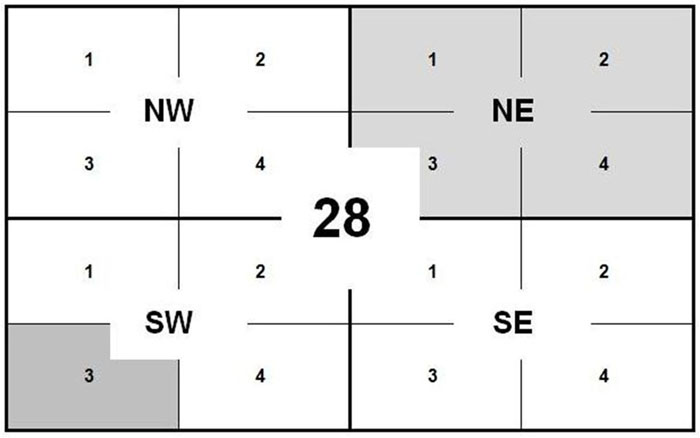
The shaded areas in the diagram above correspond to the 1:20,000 sheet 28 NE and the 1:10,000 sheet 28 SW 3.
Sometimes ‘combined sheets’ were produced, covering parts of two of the ordinary sheets. Examples include: 36 NW 2 & NE 1, 57D SE 1 & 2.
Many 1:10,000-scale maps have titles (which are place names) as well as sheet numbers. For example, sheet 28 SW 3 is also called Bailleul. These sheet titles are not currently included in our catalogue entries.
Maps without sheet numbers
Maps at the scale of 1:5,000 and some maps made at the other scales did not correspond to the sheet numbering system. Instead, these maps have titles, which are listed in our catalogue. These sheet titles are often obscure, Some of them refer to operations or battlefield features.
Examples of map sheet titles: Second Army Front Map F, Lone Tree.
Examples of 1:10,000 sheet numbers: 36 NE 3, 57B NW 1, 62C SW 4.
11. Appendix 3: The grid referencing system for maps of the Western Front
The system of grid references is used to identify specific locations on printed British military maps. The same grid referencing system is marked on maps at different scales.
The grid references are separate from but related to the system of map sheet numbers. If an entry in a war diary includes a grid reference but not a map sheet number, you will need to identify a suitable map before you can make sense of the grid reference.
The area covered by each 1:40,000-scale map sheet is divided in large squares, each identified by a capital letter. These large squares are divided into either 30 or 36 smaller squares, each measuring 1000 yards by 1000 yards. The smaller squares are given numbers.
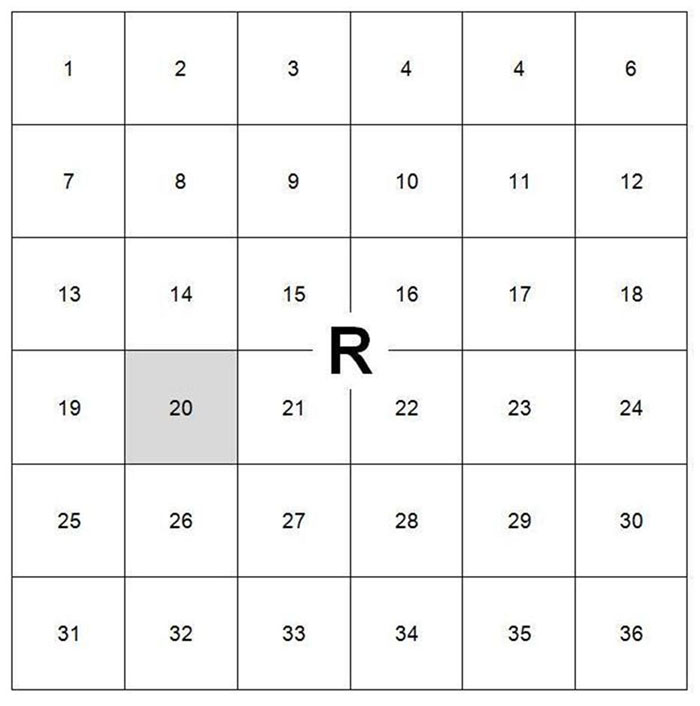
The shaded square in the diagram above is R20.
Each numbered square is further divided into four squares, each measuring 500 yards by 500 yards. These small squares are identified by the lower-case letters, a, b, c and d. These letters are not normally marked on the maps.
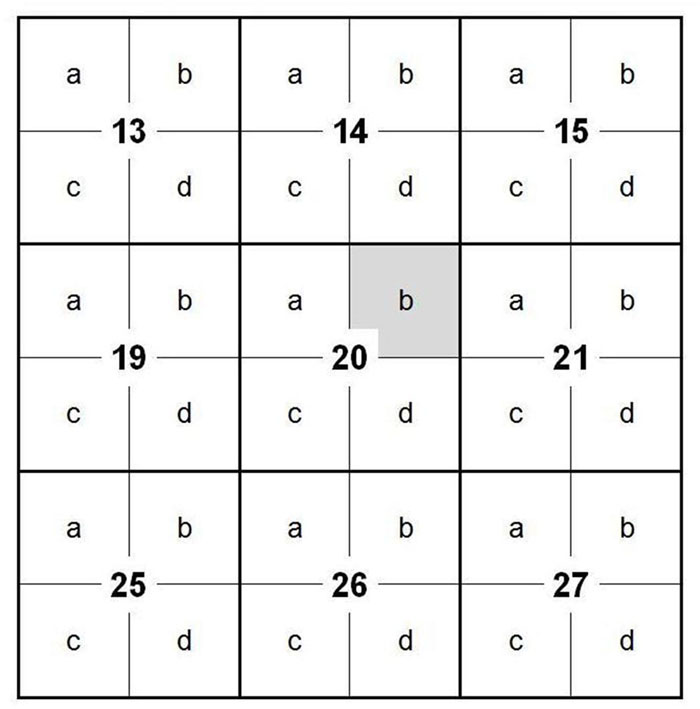
The shaded square in the diagram above is R20 b.
Within these small squares, specific points can be identified by numbers. These numbers work by dividing the square into an imaginary 10 by 10 grid. On some of the maps the grid lines are marked out in tenths to make working out grid references easier.
The divisions going horizontally west to east are called ‘eastings’. Those going vertically south to north are called ‘northings’. The eastings figure is written first, followed by the northings figure. The two may or may not be separated by a dot.
For example, to find the point specified by grid reference R 20 b 8.5:
- Find square R 20 b on the map
- Count or estimate 8/10 of the way across the square (from west to east)
- Count or estimate 5/10 of the way up the square (from south to north)
This point is accurate to within an area of 50 yards square.
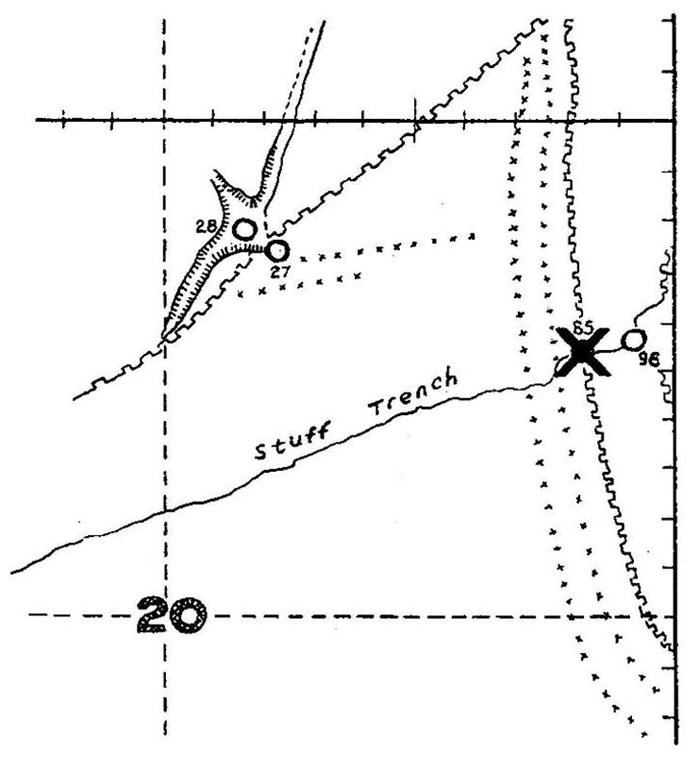
A reduced-size copy of part of a map of St Pierre Divion. (TNA reference WO 297/318)
The diagram above shows the location (marked ‘X’) of R 20 b 8.5 on a 1:5,000-scale map. (This is a reduced-size copy of part of a map of St Pierre Divion. Reference WO 297/318).
On some 1:5,000-scale maps, points of interest (such as a junction between two trenches) are labelled with partial grid references.
Sometimes grid references are made more specific for greater accuracy. If a grid reference ends with four figures instead of two, the first two are the eastings and the remaining two are the northings.
For example, to find the point specified by grid reference R 20 b 82.53:
- Find square R 20 b on the map
- Estimate 82% of the way across the square (from west to east)
- Estimate 53% of the way up the square (from south to north)
This point is accurate to within an area of 5 yards square.
12. Further reading
A A Banks and A Palmer, A Military Atlas of the First World War (London, 1975)
Geraldine Beech: Military Maps of the Western Front in Ancestors, no 8, June/July 2002
P Chausseaud, Trench Maps: A Collectors Guide. vol 1: British Regular Series. 1:10,000 Trench Maps (GSGS 3062) (Lewes, 1986)
Peter Chasseaud, Topography of Armageddon (Lewes, 1991)
Peter Chasseaud, Artillery’s Astrologers (Lewes, 1999)
Peter Chasseaud, Mapping the First World War : the Great War through maps from 1914-1918 (Collins, 2013)
P Doyle and M R Bennett, ‘Military Geography: Terrain Evaluation and the British Western Front, 1914-1918’, Geographical Journal 163, 1997, pp1-24
J E Edmonds, Military Operations in the Western Theatre of War 1914-18 (History of the Great War) (London, HMSO, 1922)
S Forty Mapping the First World War: Battlefields of the Great Conflict from Above (London, 2013)
A R Hinks, ‘German War Maps and Survey’, Geographical Journal 53, 1919, pp30-44
W B R King, ‘Geological Work on the Western Front’, Geographical Journal 54, 1919, pp201-221
Documentation about military surveying during the First World War is available on the Defence Surveyors’ Association website.
1. Why use this guide?
This is a guide to records of the Cabinet held at The National Archives. The Cabinet is the supreme decision-making body in government, dealing with the major issues of the day and the Government’s overall strategy.
During the course of the 18th and 19th Centuries, power was transferred from the Monarch to the Cabinet and the Prime Minister. The evolution of the Cabinet into the centre-piece of the British political system was a gradual process: by the mid-nineteenth century it was firmly established as the most senior decision-making body in government. The modern Cabinet system (including the Cabinet Office) was introduced in 1916-1922 by David Lloyd George.
The guide provides details of the changing ways in which the affairs and decisions of Cabinet have been recorded since 1916, and what you need to know to find these records either online or at The National Archives’ site in Kew. If you are interested in why and how major decisions of the British Government have been made since the First World War, then this guide will prove useful.
2. How to access records of the Cabinet
Our records are grouped by ‘departments’, each with its own unique catalogue reference (a letter code). Each department is made up of multiple record series, all with their own unique references based on the department reference. The department reference for Cabinet papers in our catalogue is CAB and our catalogue references begin with CAB followed by two or three numbers, e.g. CAB 68/5/1 a memorandum on civil defence.
You should use the National Archives reference when requesting documents or copies or citing references.
Some Cabinet papers between 1916 and 1993 can be accessed and downloaded by browsing the archived Cabinet Papers website (see section 16 below).
2.1 Use our catalogue to search for Cabinet Minutes and Memoranda
The Cabinet Minutes and Memoranda are digitised and downloadable from The National Archives catalogue. Catalogue descriptions are made up of agenda items discussed at each Cabinet meeting or titles of the memoranda (papers discussed by the Cabinet), which makes limited keyword searching possible.
To narrow your search to a specific series of records within the CAB department, use this guide to identify the CAB series covering the period or type of document you are interested in.
Search from our advanced search screen
- Enter a keyword (bear in mind catalogue descriptions may just be agenda items) in the advanced search in our catalogue
- Include the relevant CAB series reference in your search terms (you can include more than one series but be aware that a search term that finds minutes from a meeting, may not find memoranda from the same meeting)
- Enter a year (or range of years)
- Sort your search results into Reference order, this will sort them by date and by series (the type of document)
- Click on the relevant search result to download or order the document
Example of a search:
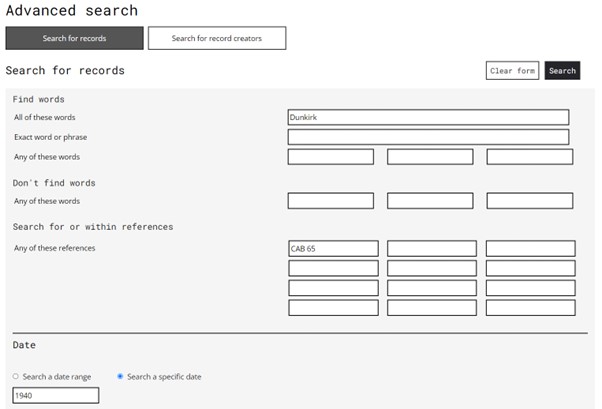
Advanced search with Dunkirk as search term, CAB 65 as reference to search within and 1940 as date.
The search above finds these results
Your search is unlikely to find all the documents relating to a particular meeting, if you want to find other documents you may need to use the original departmental references of the papers.
2.2 Published guides
The Public Record Office, the predecessor of The National Archives, published a number of handbooks describing the papers of the Cabinet Office and the CAB series in which they can be found. These handbooks will help you to find your way around Cabinet records. They are available at our site in Kew and in major reference libraries. You can search for the availability of each title on The National Archives’ library catalogue by clicking on the links below.
They are:
- PRO Handbook No 4 – List of Cabinet Papers, 1880-1914 (Her Majesty’s Stationery Office, 1964)
- PRO Handbook No 6 – List of Papers of the Committee of Imperial Defence to 1914 (Her Majesty’s Stationery Office, 1964)
- PRO Handbook No 9 – List of Cabinet Papers, 1915-1916 (Her Majesty’s Stationery Office, 1966)
- PRO Handbook No 11 – The Records of the Cabinet Office to 1922 (Her Majesty’s Stationery Office, 1966)
- PRO Handbook No 15 – The Second World War: A Guide to Documents in the Public Record Office (Her Majesty’s Stationery Office, 1972)
- PRO Handbook No 17 – The Cabinet Office to 1945 (Her Majesty’s Stationery Office, 1975)
3. Original references
The Cabinet Office had its own reference system to identify documents and these codes are present in our catalogue descriptions. The references are made up of three elements
- A letter code for the type of document, for example, WM
- The last two digits of the year in brackets, (40)
- A number denoting the meeting for that year, 148
WM (40) 148, is the original reference for Conclusions of the 148th War Cabinet meeting of 1940. The National Archives reference is CAB 65/7/43.
To find other documents from the same meeting look for the year and meeting number. CAB 66/7/28 has the original reference WP (40) 148 and is a memorandum presented at the same meeting. It can be found by browsing CAB 66 for memoranda in 1940 and looking for the code which includes (40) 148
The letter codes used and the format of the original reference varies over time but the year and meeting number is a constant feature. The codes are useful because they may be cited in publications and are used as references within cabinet papers.
4. Cabinet Minutes and Memoranda
Cabinet Minutes and Memoranda are probably the most important categories of Cabinet Papers, for researchers who want to find records discussing the major issues of the day and government strategy.
Cabinet memoranda are circulated to members of the Cabinet and other ministers for information or as a basis for discussion. There are indexes to memoranda at The National Archives in Kew, together with the memoranda of the War Cabinet of 1939 to 1945, in CAB 66, and the post-war Cabinet, in CAB 129. The memoranda of the pre-war Cabinets are in CAB 24 and the copies of Cabinet papers from 1880 to 1916 are in CAB 37.
These records are arranged in the following series (click on the series link for a fuller description of contents).
Series |
Description and letter code |
Dates |
|
| CAB 23 | Minutes and conclusions, WC | 1916-1939 | |
| CAB 24 | Memoranda (War Cabinet, | 1915-1939 | |
| CAB 65 | Minutes and conclusions (War Cabinet, WM and Cabinet, CM Series)
|
1939-1945 | |
| CAB 66 | Memoranda (War Cabinet, WP and Cabinet, CP Series)
|
1939-1945 | |
| CAB 67 | Memoranda (WP(G) Series, war cabinet memoranda that were more widely distributed)
|
1939-1941 | |
| CAB 68 | Memoranda (WP(R) Series), reports to Cabinet from other government departments
|
1939-1942 | |
| CAB 128 | Minutes and conclusions (CM and CC Series) | 1945-2002 | |
| CAB 129 | Cabinet: Memoranda (CP and C Series) | 1945-2002 | |
5. Cabinet conclusions
Cabinet conclusions (called minutes until August 1919) are normally taken by the Secretary to the Cabinet or one of the Secretary’s assistants. They are not verbatim accounts of meetings but consist of summaries of the discussion together with a note of the decisions reached.
Cabinet minutes or conclusions were also prefixed with a letter code. During peacetime the codes alternate with Prime Ministers between CM (Cabinet minutes) and CC (Cabinet conclusions). During the First World War WC was used and WM in the Second World War.
5.1 Confidential annexes
Certain conclusions were regarded as being especially secret and were recorded in the Secretary’s Standard File and became Confidential Annexes. Those for 1917-1939 are in CAB 23/13. Those from 1939 to 1948 are contained in separate volumes for each year located in CAB 65 and CAB 128. Confidential annexes for 1949 to September 1951 are in CAB 128/21. From October 1951 they are included with each volume of Cabinet conclusions. From this period the Confidential Annexes are also described in our catalogue as ‘most confidential’ records.
6. Cabinet records before 1916
Until the Cabinet Secretariat was formed in December 1916 no formal records of Cabinet meetings, such as minutes and conclusions, were kept. The only record of Cabinet decisions was contained in letters written by the Prime Minister to the Sovereign after each meeting.
These letters vary a great deal in length and detail and are now preserved in the Royal Archives at Windsor. Microfilms of the letters from 1837 to 1867 have been published by Harvester Press and can be viewed at the British Library at Boston Spa and other academic institutions. Photocopies of the letters for 1868-1916 are available at The National Archives at Kew in record series CAB 41. Photocopies of Cabinet papers held in private and other collections for 1880-1916 are in record series CAB 37. For detailed lists of these papers see PRO Handbooks 4 and 9.
Some eight hundred Cabinet papers that had been returned to the Cabinet Office by former Ministers or their executors are in CAB 1, which to a great extent duplicates CAB 37.
7. Cabinet records during the First World War
In November 1914 the Cabinet established the War Council to advise on the general conduct of the war, but the Council met infrequently and was replaced in May 1915 by the Dardanelles Committee which was concerned, as the name suggests, mainly with the Gallipoli expedition. The Dardanelles Committee in turn was replaced in November 1915 by the War Committee, with responsibility for the whole range of naval and military operations and war policy in general. These various bodies were assisted by the permanent secretariat of the Committee for Imperial Defence (CID), which kept detailed minutes and organised the issuing of memoranda. The papers and minutes are in CAB 22, with photocopies chronologically arranged in CAB 42. A more detailed account of the Cabinet at this time, together with a list of the papers issued by the Cabinet can be found in PRO Handbook 9. For more advice on the records of the CID see Section 8 below.
Records of Cabinet meetings until 1916 can be found in Prime Minister’s Letters in CAB 41 and in papers circulated for discussion in CAB 37. It soon became clear that a better system was needed for conducting Cabinet business.
When Lloyd George became Prime Minister on 7 December 1916, the secretariat of the CID, under Sir Maurice Hankey, became the nucleus of a new Cabinet Office serving a small War Cabinet. The main series of papers circulated to the War Cabinet, classified as GT, are in CAB 24. The minutes and conclusions of the War Cabinet were noted for the first time and are in CAB 23.
The personal political papers of David Lloyd George contain a large amount of Cabinet papers and papers relating to Cabinet. Search for ‘cabinet’ under the reference YLG. There are also Cabinet papers in the papers of Andrew Bonar Law and Lord Beaverbrook. See our separate research guides to Lloyd George papers, Bonar Law papers and Beaverbrook papers.
8. The Committees of Imperial Defence
8.1 What were the Committees of Imperial Defence?
The Committee of Imperial Defence, established in 1902, was an advisory body with no executive powers. With the assistance of numerous sub-committees it advised the Cabinet and government departments on both the general principles of defence policy and their detailed application. The Prime Minister was its Chairman and only permanent member. A permanent secretariat established in 1904 became the Cabinet Secretariat in 1916.
During the First World War the functions of the CID were transferred to other committees and departments. Its first post-war meeting was in June 1920, and subsequently the CID met regularly until September 1939 when its functions were assumed by the War Cabinet. It was not revived after the war.
8.2 Records of the Committees of Imperial Defence
Minutes of the CID and the Standing Defence Sub-Committee are in CAB 2. Circulated papers of the CID are in CAB 3-6 and those of the Standing Defence Sub-Committee in CAB 34. Files of the CID before December 1916 are in CAB 17, and inter-war files in CAB 21. There are some miscellaneous records in CAB 18.
Before 1914 the CID had four permanent sub committees: Colonial (later Overseas) Defence (whose papers are in CAB 7-11); Home Ports (later Home) Defence (CAB 12-13); Co-ordination of Departmental Action (CAB 15) and Air (CAB 14). After 1918 only the first three were revived and they were subsequently augmented by a number of standing and ad hoc committees whose papers are in CAB 16, CAB 34-36, CAB 46-57 and CAB 60.
A list of papers of the CID until 1914 can be found in PRO Handbook 6 and there is a detailed history in PRO Handbook 17.
9. Cabinet records in the inter-war years
With the return of peace, Lloyd George replaced the small War Cabinet with a traditional Cabinet of 20 members. At its first meeting on 4 November 1919, the new Cabinet decided to retain the methods of record keeping used by the War Cabinet.
The Cabinet conclusions of the inter-war years continue in CAB 23 and Cabinet memoranda are in CAB 24. Further information about the Cabinet in the inter-war years can be found in PRO Handbook 17.
10. The War Cabinet 1939-1945
From September 1939 to May 1945 the Cabinet was replaced by a smaller War Cabinet with a membership varying between five and ten and including both departmental and non-departmental ministers. There was no change in the way in which decisions were recorded and papers circulated.
Conclusions of the War Cabinet are in CAB 65 and memoranda circulated to its members are in CAB 66. There are two other small series of memoranda, WP(G) in CAB 67 and WP(R) in CAB 68.
Further details about the War Cabinet are to be found in PRO Handbooks 15 and 17.
11. Cabinet records of the post-war period
On the defeat of Germany in May 1945 the War Cabinet was dissolved and a caretaker Cabinet was formed by Churchill. The conclusions and memoranda of this Cabinet are to be found in CAB 65 and CAB 66 respectively.
Under Prime Minister Clement Attlee (1945-1951), the functions of the Cabinet Office remained much as before. The conclusions of post-war Cabinets are in CAB 128 and the memoranda are in CAB 129.
12. Cabinet committees
12.1 What are Cabinet committees?
To assist the work of Cabinet, the government relies on the employment of numerous Cabinet committees. These committees reduce the burden on the Cabinet itself by enabling collective decisions to be taken by a smaller group of Ministers. Cabinet committees are of two types: standing committees which last for the duration of a Prime Minister’s term of office; and ad hoc committees which are convened to handle a single issue and are usually short lived.
12.2 Records of standing committees
Examples of standing committees, for which there are substantial sets of records at The National Archives, include the Committee of Imperial Defence (1904-1939), the Joint Intelligence Committee (1947-1968; see also our research guide to Intelligence records), the Defence Committee (1946-1963) and its successor the Defence and Overseas Policy Committee (1964-1980) The records of other standing committees, including the Atomic Energy Committee, the Economic Policy Committee and Home Affairs Committee, are to be found in CAB 134. Standing committees can be further divided into ministerial committees composed of members of parliament and official committees composed of senior civil servants. Every individual committee was allocated a series of letters by which it was identified. The Economic Policy Committee was designated EPC while the Home Affairs Committee was known as HA. These can be searched on the catalogue using the original file reference.
12.3 Records of ad hoc committees
The records of ad hoc committees are found in CAB 130. Each ad hoc committee is given a unique prefix, either MISC (miscellaneous) or GEN (general) and a number. The Committee on Subversive Activities, for example, was known as GEN 183. If a GEN or MISC number is known, the committee can be located in the catalogue using its original file reference.
12.4 Other records of Cabinet committees
The details of most committees and sub-committees comprising the Cabinet committee structure from 1945 are to be found in the Committee Organisation Books located in CAB 161. Additionally, some of the PRO Handbooks listed in section 2 can also provide helpful insights into Cabinet committees.
13. Cabinet Secretaries’ Notebooks (CAB 195)
The Cabinet Secretaries’ Notebooks (CAB 195) are the handwritten notes which the Cabinet Secretary makes when he attends Cabinet Meetings as the Senior Secretary. They are longhand notebooks compiled by Norman Brook, Burke Trend, John Hunt, and Robert Armstrong at Cabinet meetings and some other meetings of ministers, during their respective terms of office, and they begin in 1942 and extend to 1965.
The notebooks provide more detailed accounts of the meetings than appear in the printed records, so they are closer to a verbatim account of who said what, as compared with the formal minutes.
There are gaps for the period 1942 to 1945 – there are no Notebooks for the whole of 1944, for example. Cabinet Secretary Edward Bridges destroyed them, following the security protocols of the time. The CAB 195 records have been digitised, but they have not been itemised on the Catalogue.
Images of the handwritten originals can be downloaded from the Cabinet Papers website while modern transcriptions are available through the National Archives catalogue.
14. Records of the Cabinet Secretariat
The Registered Files of the Cabinet and War Cabinets beginning in 1916 and containing papers on many aspects of British policy both domestic and foreign are in CAB 21. The records continue from 1966 in CAB 164 and CAB 165. These series also contain papers about the machinery of the Cabinet Secretariat. There is also a supplementary series of registered files (CAB 104) that were originally closed for 50 or 75 years.
15. Macmillan Cabinet Papers, 1957-1963
Prime Minister’s papers and Cabinet Office conclusions and memoranda (CAB 128 and CAB 129) for the years of the Macmillan Administration 1957-1963, can be accessed at AMDigital (institutional subscription required or free to view onsite at The National Archives at Kew). Also available through this resource are the records of some key Cabinet committees from series CAB 134, including matters related to defence and nuclear policy, and changes affecting Britain’s relationship with former dependent colonies.
See also our Prime Minister’s Office research guide.
16. Cabinet papers website
The Cabinet Papers website is a useful educational resource for students and other researchers looking for examples of crucial Cabinet documents which are easy to find and downloadable and relate to particular subject themes, for example, ‘law, liberty and society’.
In line with our general policy for older web resources, the Cabinet Papers website is now hosted securely in the UK Government Web Archive. Please note that this resource only has material up to 1993, so the Catalogue on the National Archives website remains the best means of access to digitised Cabinet papers.
Large pdf files of some Cabinet papers can be downloaded from the archived website. Although large and not itemised, as they are in our catalogue, many of these files can be word searched within the downloaded pdf.
17. Further reading
Some of the publications below may be available to buy from The National Archives’ bookshop. Alternatively, search The National Archives’ library catalogue to see what is available to consult at Kew.
Tessa Blackstone and William Plowden, Inside the Think Tank: Advising the Cabinet 1971-1983 (William Heinemann Ltd, 1988)
Peter Hennessy, Cabinet (Basil Blackwell, 1986)
Peter Hennessy, Whitehall (Pimlico, 2001)
Arthur Berriedale Keith, The British Cabinet System (Stevens and Son, 1952)
John P Mackintosh, The British Cabinet (Stevens and Son, 1977)
Richard Rose, Ministers and Ministries: A Functional Analysis (Clarendon Press, 1987)
1. Why use this guide?
Use this guide if you are researching the policy and administration of central government services which dealt with:
- the health of children in schools
- special educational needs
- nursery schools
We do not hold personal files on pupils or personnel records of teachers – read our guide to records of schools for guidance on this.
2. What are special services?
From the end of the 19th century there was a gradual development of services in this area.
The Medical Branch of the Board of Education was set up in 1907 with responsibility for the administration of all special services. Its responsibilities included:
- special educational treatment for disabled children
- the school medical service
- the provision of school meals and milk
- the organisation and inspection of physical training
- the supervision of evening play centres
- maternity and infant welfare (until 1919 when transferred to the Ministry of Health)
- nursery education
After the Second World War the Medical Branch was renamed the Special Services Branch. In 1974 its health functions transferred to the NHS.
3. How to use this guide and get a search started
A search for documents at The National Archives usually begins in our online catalogue. The following sections of this guide provide links to key record series that you can search within our catalogue, helping you to target your searches more precisely. By clicking on the series links (for example, ED 50) you will arrive on the respective ‘series description’ pages from where you can search the series, using dates/years and keywords such as:
- type of special service, for example ‘nursery’ or ‘open air school’
- name of school
Two key series for this subject area are:
On series description pages there is the the option to ‘browse by reference’, allowing you to browse the series piece by piece. It’s worth doing this to familiarise yourself with the language used in document descriptions. Descriptive terms for disability have changed over time and the terms used in these historical records reflect the language of the time and may now be considered derogatory or offensive.
Use the advanced catalogue search to restrict your search results to all the records of a specific government department, including its predecessors (for example, the Department of Education, from where most records related to special services originate). Use the department reference, which is always a letter code, to do this (the code for Department of Education is ED).
Catalogue search results provide short descriptions of our records and a document reference for each one – you will need the document reference to see the record itself. Most of the records covered in this guide are not available to view online so to see them you will have to either visit us in Kew or order copies. Bear in mind that a search in our catalogue will also search for records in other archives around the country – keep your eye on the ‘Held by’ field to establish whether the records are here or elsewhere. Read our Discovery search help for more guidance.
4. Special educational treatment in the 19th and 20th century
Individual schools and school boards took an interest in education for disabled children from the middle of the 19th century.
Consult ED 50/9 (1872-1893) which contains papers on the activities of school boards in respect of blind and of deaf children and information about arrangements in London.
The first piece of legislation ensuring special educational provision for disabled children was the Elementary Education (Blind and Deaf Children) Act 1893, which obliged every school authority to provide education for blind and deaf children between the ages of 7 and 16.
More legislation followed and related papers on these pieces of legislation are in ED 50 and ED 24:
- Elementary Education (Defective and Epileptic Children) Act 1899 – local authorities enabled to provide for the training of physically and mentally disabled and epileptic children
- Special Schools Education Act 1914 made these powers mandatory for mentally disabled and epileptic children
- Education Act 1918 made these powers mandatory for the physically disabled
- Education Act 1921 – compulsory education for children with these disabilities extended to 16
- New procedures were laid down in the Handicapped Pupils and School Health Service Regulations 1945 and later regulations
4.1 Searching for special schools, homes and training establishments
You can use the advanced search option in our catalogue and search by name of institution within:
- ED 32 for special schools in England
- ED 224 for special schools in Wales
- ED 62 for training establishments providing further education for disabled people
- ED 122 for boarding homes for maladjusted, educationally subnormal and diabetic children (75-year closure)
- ED 195 for reports of HM Inspectorate on special education establishments after 1948
Browse records relating to the provision of special schools in some local education authorities in ED 133 (very few pre-1936 papers have survived).
4.2 The Warnock Report and after (1978 onwards)
The Committee of Inquiry into the Education of Handicapped Children and Young People (Warnock Committee) met for over three years and reported in 1978.
The Committee’s report covered all aspects of special needs from pre-school to postgraduate research and can be accessed on Proquest UK Parliamentary Papers. This is a subscription service available to access at The National Archives. You may also be able to access it via a large reference library, such as a university library.
The main provisions of the resulting Education Act 1981 were
- the replacement of the category of handicapped pupil by special educational needs
- the introduction of a statement for each such pupil
an emphasis on integrated provision
Browse:
- the Warnock Committee’s terms of reference in ED 269
- the Warnock Committee’s minutes and papers in ED 285
- papers on the establishment of the Warnock Committee in ED 269/63-66
The white paper Special Needs in Education was published in 1980 and can also be accessed on Parliamentary Papers online.
The Council for National Academic Awards set up its own Special Education Panel – minutes in DB 3/2333-2346 and DB 3/3149-3151 (1981-1987).
An Institute of Education report to the Department of Education and Science on special educational needs provision (1987) is in BL 6/190 (although this is a closed document).
National and district surveys carried out by the Department of Education and Science between 1987 and 1990 are in ED 235.
Annual reports for the eight regional special educational needs tribunals (set up under the Education Act 1993 for parents to appeal against LEA decisions on special educational provision) are in KH 1. The tribunals cover all types of disability in both England and Wales.
5. School health service
The school medical service was introduced following the Education (Administrative Provisions) Act 1907.
This act and the Local Education Authorities (Medical Treatment) Act 1909 were both influenced by the findings of the Interdepartmental Committee on Physical Deterioration (1904). The 1907 act made medical inspection of children mandatory, with any necessary treatment to be provided by the Local Education Authority (LEA).
For related files, browse:
- general policy files on the school medical service in ED 50 and ED 269
- correspondence with LEAs on the school health service ED 137
The school medical service transferred to the Ministry of Health in 1919.
6. School meals service
The Education (Provision of Meals) Act 1906 led to the development of the school meals service. The act gave LEAs the right to provide premises for and assist the work of voluntary associations which had begun to provide meals and hot drinks for needy schoolchildren.
Subsidised milk was introduced by the Milk in Schools Act 1934 and it was freely provided from 1946.
The school meals service became fully established during the Second World War.
For relevant records, browse:
- general policy files in ED 50 and ED 269
- LEA files in ED 123
- information on wartime services in ED 138
- reports and surveys on the school meals service between 1954 and 1965 in ED 194
7. Physical training
Under the 1918 and 1921 Education Acts, local authorities could promote both social and physical training.
Facilities provided included evening swimming instruction, visits to theatres and music festivals, school camps and school journeys.
Browse:
- LEA files on the provision of these facilities in ED 101
Papers relating to the appropriate sections of the Education Acts are in ED 11. For:
- records of the 1918 act consult ED 11/28-29
- records of the 1921 act consult ED 11/118-120, ED 11/250-252
The Physical Training and Recreation Act 1937 extended these provisions to young people and adults not in full-time education. This extension was suspended during the Second World War and the 1944 Education Act limited the use of facilities to those attending educational institutions.
Browse:
- papers on the provision by LEAs of community centres, playing fields, swimming baths, recreation centres and courses 1937 to 1940 in ED 56
Responsibility for post-school social and recreational training passed to the Further Education Branch of the Ministry of Education in 1945.
Browse:
8. Nursery education
8.1 Nursery education before the Second World War
Nursery schools were first established by voluntary effort at the beginning of the 20th century. Following the creation of the Medical Branch in 1907, government attention initially focused on nursery provision for ‘neglected’ children in deprived areas.
Under the 1918 and 1921 Education Acts local education authorities could provide or aid the provision of nursery schools and classes for children aged two to five.
Government grants also became available from 1919 but the development of nursery provision was hampered by financial crises.
Expansion was urged by a joint Ministry of Health and Board of Education circular of 1929. This was:
- encouraged by the report of the Consultative Committee on Infant and Nursery Education in 1933 (Hadow Committee)
- further emphasised by a 1936 LEA survey on the need for nursery provision for the under-fives
For related records browse:
- nursery education general files in ED 102 for regulations, circulars, letters, administrative memoranda, and correspondence with other departments on matters of common policy
- LEA files on nursery education in ED 66 for proposals to establish nursery schools and classes, correspondence relating to expenditure, policy and individual schools
- papers of the 1933 Hadow Committee in ED 10/149-150
Search by name of nursery within ED 69 for files on individual nursery schools.
8.2 Nursery expansion during the Second World War
It was only with the wartime emergency that greater provision was made for nursery-aged children from a wider range of backgrounds. The Second World War led to the establishment of:
- nursery centres in evacuation reception areas
- day nurseries for the children of women war workers
- evening play centres for children of school age whose mothers were war workers
Browse:
- surviving LEA files in ED 66
- the ‘under fives’ sections of the wartime history of education in ED 138 for evidence of activities at individual schools and in different parts of the country
- documents relating to the provision of evening play centres in ED 65
8.3 Post-war expansion and research
The post-war ‘baby boom’ increased the number of pre-school children and encouraged the expansion of nursery provision.
The 1944 Education Act extended the provision of nursery schools and classes. LEAs were asked to include such provision in their development plans for post-war education which are in ED 152.
The 1967 report Children and their Primary Schools (or the Plowden Report) included numerous recommendations for the expansion of nursery education. Related papers are in ED 207/6-7 and ED 207/122-124.
The need to expand nursery accommodation encouraged research into nursery care. For information on research into this area between 1968 and 1984:
- Search within ED 181 and ED 282 using the keyword ‘nursery’
- Browse ED 207/106-111
The School Census (Form 7) Datasets in CRDA 13/ED 267 contain statistical details of nursery schools. You can sometimes identify entries for individual schools by using the Register of Educational Establishments in CRDA 47/NV 2.
9. Further reading
Read Education and the State from 1833, by Ann Morton (PRO 1997) for background information and for guidance on other original sources.
The School Health Service, 1908-1974, a report by the Chief Medical Officer of the Department of Education and Science, published in 1975.
1. Why use this guide?
Use this guide if you are researching records of businesses and industry held in other archives other than The National Archives.
The National Archives holds business records from several sectors of the economy which were nationalised in the mid twentieth century, such as the predecessor companies of British Rail and other parts of the transport network are particularly strongly represented. Read our guide on Railways for more guidance.
Most business records where they survive are held by local archives but if you want to find out what records The National Archives hold, please read our guide on Companies and Businesses instead.
2. Searching for records
Search Discovery, our catalogue, to find records from over 2,500 archives across the UK, as well as from The National Archives itself. Your search results will tell you which archives currently hold the records. You can then refine your results.
Use the ‘record creator’ tab to find where records created by a particular business or individual are held. Alternatively use the filters to find where records are held which mention the business/individual you searched for.
For further tips on searching see our catalogue help pages.
The majority of historic business and trade records in the UK are held by local record offices. Use the Find an archive tool to find contact details of archives/repositories across the UK. This tool also includes details of some repositories abroad which hold substantial collections relating to British history.
3. Records recently collected by other archives
Many archives regularly take in new records to add to their collections – this process is known as accessioning. Every year, The National Archives collects information about new accessions from 250 archives across Britain and Ireland. This is known as the annual Accessions to Repositories’ survey.
This information is added to Discovery, our catalogue. It is also edited and used to produce thematic digests, including one relating to education history. The digests are made available through this website and distributed for publication in a number of learned journals and newsletters. Further information is available at Accessions to Repositories.
4. Major collections
The following list includes some of the repositories and institutions that hold major collections relating to business history.
British Library, Sound Archive
The National Sound Archive holds a growing collection of oral history records of participants in a variety of industries, most recently steel, financial services and the oil industry.
Many collections relating to business in Scotland, especially engineering and textiles.
Glasgow University Archives Services
The principal centre for business records in Scotland, with particularly strong holdings for industry in the West of Scotland.
The Centre collects the records of farms, agricultural engineers and ancillary industries on a national basis.
Museum of Science and Industry in Manchester
A centre for the records of business in the North West. The engineering trades are particularly well covered.
The National Records of Scotland holds a wide range of business records. Also, like The National Archives, it holds a variety of business records that were produced in evidence in civil actions and not reclaimed; these are listed in Scottish Record Office Court of Session Productions c1760-1840 (List & Index Society, special series volume 23, 1987). In addition, the NRS holds the records of dissolved companies which were registered in Scotland in its class BT2.
National Maritime Museum, Manuscripts Section
Holds the records of numerous shipping and shipbuilding companies.
Public Record Office of Northern Ireland
PRONI holds extensive business collections. It also holds details of dissolved companies which were registered in Northern Ireland in class COM 40.
A local authority record office particularly strong in shipbuilding and industrial records.
Victoria and Albert Museum, Archive of Art and Design
Holds the archives of many firms engaged in the manufacture and sale of furniture, textiles, precious metal wares and other areas in which design plays a prominent role.
Warwick University Modern Records Centre
Specialises in collections relating to the history of industrial relations. Holds the records of numerous employers’ and trade associations, including the Confederation of British Industry. Motor manufacture and related industries form another primary collecting area.
5. Other useful resources and catalogues
Archives in London and the M25 area (AIM25)
AIM25 is a major project to provide electronic access to collection level descriptions of the archives of over 50 higher education institutions and learned societies within the greater London area.
Archives Wales is an online index to archival collections held by record offices, universities, museums and libraries in Wales. The ANW provides information and descriptions of collections only including; corporate papers and business archives, personal papers and diaries of prominent literary, artistic, political or other figures (living and dead), estate archives, council, academic and church records. It is possible to search and browse these collections by person, place, subject, or repository – however, it does not provide access to online materials. The Archives and Records Council Wales is responsible for the ANW.
Founded in 1934, the objectives of the Council are to promote the preservation of business records of historical importance; supply advice and information on the administration and management of both archives and modern records and to encourage interest in the history of business in Britain.
BHE is an online bibliography on the history of specific businesses and industries in the UK. Accessible by subscription.
The British Library has one of the most comprehensive collections of current and historical business information sources in the UK. It has long runs of company, trade and business directories and has actively collected published market research reports since the late 1970s (some earlier reports may also be found). The Library also has a major collection of trade literature, manufacturers’ catalogues and promotional material which is particularly strong for the late 19th and early 20th centuries and for the period 1980 to 2000. A large collection of company annual reports is also held. For enquiries you can Ask the Reference Team in the first instance and your question will be forwarded to collection specialists as appropriate.
Holds information concerning live companies registered in England and Wales and brief details concerning dissolved ones. Although there are separate registers for Scotland and Northern Ireland this information is consolidated on their online database. References to assist in tracing statutory documents deposited in The National Archives are also available from Companies House. It is important to know the exact legal name of the company concerned. Indexes are arranged so that JG Kincaid & Co Ltd is alphabetised under J rather than K.
Files relating to dissolved companies have been transferred to respectively The National Archives, National Archives of Scotland and Public Record Office of Northern Ireland.
A constantly updated online resource for company information in the area of industry and manufacturing in Britain since the Industrial Revolution.
Described as the open database of the corporate world, Open Corporates offers the possibility of searching for over 50 million companies in 65 jurisdictions.
Scottish Archive Network (SCAN)
The Scottish Archive Network allows online searching of over 20,000 collections in 52 Scottish repositories.
6. Further reading
Business Reference
- John Armstrong and Stephanie Jones, Business documents, their origin, sources and uses in historical research (1987)
- Gordon Boyce and Simon Ville, The development of modern business (2002)
- Francis Goodall, Bibliography of British business histories (1987)
- D J Jeremy (ed), Dictionary of business biography (5 vols, 1984-1986)
- John Orbell, A Guide to Tracing the History of a Business (1987)
- Eric D Probert, Company and Business Records for Family Historians (Federation of Family History Societies 1994)
- Anthony Slaven and Sydney Checkland (eds), Dictionary of Scottish business biography 1860-1960 (2 vols, 1986-1990)
- A Turton (ed) Managing Business Archives (1991)
- Stephanie Zarach, Debrett’s bibliography of business history (1987)
- The Stock Exchange Official Year-Book. Published annually since 1876 this deals with publicly quoted companies and gives an outline of their history and functions, though the details tend to be concise and formal
- Register of Defunct and Other Companies. Published annually this was a cumulative publication dealing with those companies removed from The Stock Exchange Official Year-Book. It gives only the barest details such as dates of registration and liquidation. The last year in which the company was listed is given. No separate issue of this publication has appeared since 1980 and the Register is now published as a supplement to The Stock Exchange Official Year-Book
- Macmillan’s Unquoted Companies. Provides basic details and financial profiles of Britain’s top 20,000 unquoted companies
- Kelly’s Business Directory. The best single volume business directory with coverage of over 82,000 businesses. Published annually
- Who Owns Whom. United Kingdom and Republic of Ireland. This is useful for linking subsidiaries to their parent companies, it includes many dormant companies
- The Red Book of Commerce or Who’s Who in Business. No longer published, the Red Book appeared between 1906 and 1939. It differed considerably from all other such reference works in that the entries were not standardised and descriptions were often more vivid and informative than in other directories. Coverage of companies changed between issues and it is worth looking at different editions for a particular company
Guides to Archives
- Rebecca M Bailey, Scottish architects’ papers. A source book (1996)
- Rosemary Boyns, Trevor Boyns and John Richard Edwards, Historical Accounting Records: A guide for archivists and researchers: London Society of Archivists
- Rita V Bryon and Terence N Bryon, Maritime Information: a guide to libraries and sources of information in the United Kingdom(third ed, 1993)
- Charles Ralph Clinker, Railway history sources: a handlist of the principle sources of original material with notes and guidance on its use (1976)
- H A L Cockerell and Edwin Green, The British Insurance Business: A Guide to its History and Archives (1994)
- C R H Cooper, ‘The archives of the City of London Livery Companies and related organisations’, in Archives 72 (1984)
- Jennifer Green, Philip Ollerenshaw and Peter Wardley, Business in Avon and Somerset: a survey of archives (1991)
- Wendy Habgood, Chartered accountants in England and Wales: a guide to historical records (1994)
- Patricia Hudson, The West Riding wool textile industry: a catalogue of business records from the sixteenth to the twentieth century (Edington, Pasold Research Fund Ltd, Pasold occasional papers vol 3, 1975)
- Patricia Hudson, The genesis of industrial capital: a study of the West Riding wool textile industry c1750-1850 (1986)
- R M James, ‘Brewing records: an inquiry and its lessons’, in Archives VII (1965-1966), pp 215-220
- Charles A Jones, Britain and the Dominions: a guide to business and related records in the United Kingdom concerning Australia, Canada, New Zealand, and South Africa (1978)
- S Kelly, ‘Report of a survey of the archives of British commercial computer manufacturers 1950-1970’ (Unpublished typescript, Institution of Electrical Engineers, 1985)
- Peter Mathias and Alan W H Pearsall, Shipping: a survey of historical records (1971)
- Peter J T Morris, Colin A Russell and John Graham Smith, Archives of the British chemical industry 1750-1914: a handlist (1988)
- The National Archives, Records of British business and industry 1760-1914: textiles and leather (HMSO, 1990)
- The National Archives, Records of British business and industry 1760-1914: engineering and metal processing (HMSO, 1994)
- John Orbell and Alison Turton, British Banking: a guide to historical records (2001)
- George Ottley, Railway history: guide to 61 collections in libraries and archives in Great Britain (1973)
- Public Record Office of Northern Ireland, The Ulster textile industry: a catalogue of business records in PRONI relating principally to the linen industry in Ulster (1978)
- Lesley Richmond, Juliet Stevenson and Alison Turton, The Phamaceutical Industury: a guide to historical records (2003)
- Lesley Richmond and Alison Turton, The brewing industry: a guide to historical records (1990)
- Lesley Richmond and Bridget Stockford, Company archives: a survey of the records of 1000 of the first registered companies in England and Wales (1986)
- Lesley Richmond & Alison Turton (eds), Directory of corporate archives (Business Archives Council, 4th ed, 1996)
- L A Ritchie, The shipbuilding industry: a guide to historical records (1992)
- Peter Scott, ‘Sources on communities of British manufacturing plants and their activities’ in Business Archives Sources and History (2004)
- Alexis Weedon and Michael Bott, British book trade archives 1830-1939: a location register (1996)
- Chirstine Wiskin ‘Women, business and credit: sources for the historian’ in Business Archives Sources and History (1997)
1. Why use this guide?
This guide will help you to locate historical maps, held at The National Archives, of towns, cities, regions and countries around the world. There is also some advice on how to find old plans of buildings, fortifications, harbours, and countless other installations, many in English and British colonies but others elsewhere around the globe.
For advice on finding maps and other documents specific to borders, boundaries and boundary commissions, see our guide to records of international boundaries.
For guidance on finding maps and charts of international and British waters produced by the Admiralty Hydrographic Department, see our guide to sea charts.
High resolution copies of the maps and plans pictured in this guide are available to purchase, along with many hundreds of others, through our Image Library.
2. What we do and don’t hold
We hold maps and plans generated or collected by the various departments of state responsible for the foreign relations of England, Wales and the United Kingdom since the 16th century. These include:
A Colonial Office map from 1880 of Adelaide and its environs, in South Australia (catalogue reference CO 700/SOUTHAUSTRALIA29)
- The State Paper Office (the offices of the Secretaries of State up to 1782)
- The Foreign Office (created in 1782)
- The Colonial Office (created in 1854)
- The Dominions Office (created in 1925)
- The Commonwealth Relations Office (succeeded the Dominions Office in 1947)
- The Foreign and Commonwealth Office (created in 1968)
Though maps were usually placed in the custody of departmental libraries, no section, division or unit within the departments listed above was created solely for the care of maps and they were acquired on something of an ad hoc basis.
Many maps were gathered by diplomats when abroad or by colonial governors and civil servants. Often they accompanied reports and despatches. A number were commissioned or purchased from map sellers in the United Kingdom, sometimes to assist comprehension of diplomatic and territorial relations abroad.
We don’t hold the records of the India Office and Burma Office – these are at the British Library. Many of the maps collected by the Foreign Office after 1940 have been transferred to the Royal Geographical Society.
3. How to search for and see our maps and plans
A ground plan of the Hong Kong Mint from 1864 (catalogue reference MR 1/895/2-3). This comes from a Colonial Office collection.
Very few maps and plans held here are available to view online and in most cases you will need to visit us or order copies to see them. First, however, you will need to find them among the tens of millions of records held at The National Archives. You can do this by:
3.1 Using our online catalogue
There are short descriptions of many maps and plans in our online catalogue. You can search for these using keywords and dates. Each description is accompanied by a document reference and details of how you can view the map or plan.
To narrow your search, use the advanced search and target records from specific government departments and from a specific year or range of years. To target a specific department you will need to enter the appropriate department reference in the reference fields. For example:
- For maps primarily before 1782 try targeting your search to the State Paper Office using SP as your department reference
- For maps primarily from 1782 to 1968 of territory outside of the British Empire try targeting your search to the Foreign Office using FO as your department reference
- For maps of British colonies try targeting your search to the Colonial Office using CO as your department reference
Alternatively, try a broad search first and narrow your search results following the search by using the filter options.
A map of the ‘Ottoman Dominions in Asia’ from 1828 (catalogue reference FO 925/2841). This map is from FO 925, one of the major collections of overseas maps held at The National Archives (see section 4).
Some maps and plans are held within larger files or volumes whose catalogue descriptions contain no mention of them. To find these you will need to visit us to search speculatively among records relating to a specific subject, country or territory. For example, given that treaties between nations can relate to territory, the correspondence and papers relating to treaties sometimes include maps used for illustrative purposes. Searching the catalogue with the name of a country or territory and the word ‘treaty’ could, therefore, lead to documents which contain maps.
3.2 Using printed map catalogues and indexes
There are several published catalogues of maps held at The National Archives. Each catalogue is arranged by region and country and contains lists of maps accompanied by short descriptions and catalogue references. All of these catalogues are available in The National Archives Library.
- P A Penfold, ed, Maps and Plans in the Public Record Office, Part 2: America and West Indies (London, 1974)
- P A Penfold, ed, Maps and Plans in the Public Record Office, Part 3: Africa (London 1982)
- Geraldine Beech, ed, Maps and Plans in the Public Record Office, Part 4: Europe and Turkey (London 1998)
In addition, there is a card index to the ‘Supplementary Map Catalogue’ in the reading rooms at The National Archives. It comprises catalogue references for maps and plans held outside of the major collections covered in section 4. It is arranged alphabetically by country, continent and map maker.
4. Major collections covering multiple territories
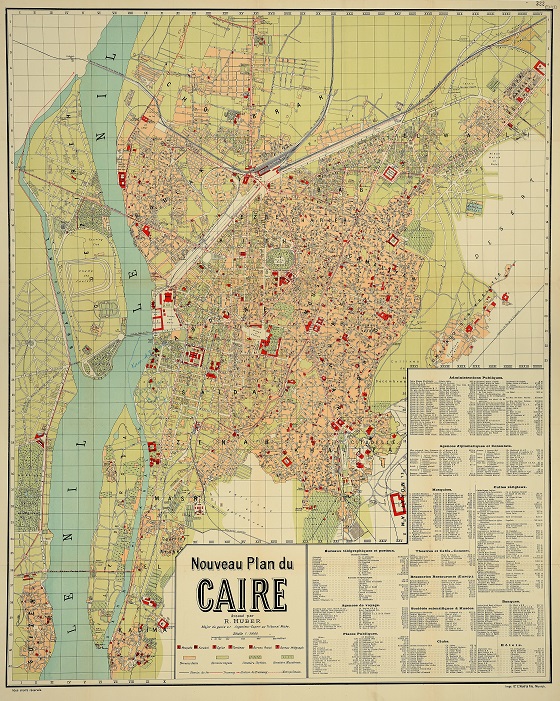
A city plan of Cairo from 1914 (catalogue reference MFQ 1/1379/59). This is a Foreign Office map, extracted from series FO 371 to be stored in series MFQ 1.
The vast quantity of maps held at The National Archives, numbering over a million, is scattered throughout the collection and is not restricted to the government departments listed in section 2. However, there have been some attempts, both by those government departments and by The National Archives itself, to gather together maps by theme, or sometimes format, and create coherent map series and departments.
The Public Record Office, the predecessor of The National Archives, created several dozen record departments during the 20th century in which were accumulated maps, plans and drawings extracted from the records of other departments following their transfer to the archives. This was done primarily as a preservation measure, usually for maps, plans and diagrams which exceeded the size of the document of which they formed a part. In the table below, they are the series whose references begin with an ‘M’.
| Collection | Series dates | Series reference | Search advice |
|---|---|---|---|
| Foreign Office library maps and plans
One of the largest collections of maps for the 18th and 19th centuries |
1700-1944 | FO 925 | Click on the series reference and search by place. |
| State Paper Office domestic and foreign maps
Maps of countries in Europe, the Americas, Asia and Africa and a few naval charts, town plans and atlases |
c1590-c1888 | SP 112 | Click on the series reference and search by place or browse by reference for a better sense of the regions described (the first 65 pieces have been transferred to other series so browse from piece 66). |
| Colonial Office maps and plans Series I | 1595-1927 | CO 700 | Click on the series reference and search by place, or browse by reference for a better sense of the regions described, including some descriptions in other languages, such as ‘Atlas des Colonies Francaises’ and ‘Deeutscher Kolonial-Atlas’. |
| Colonial Office maps and plans Series II | 1779-1947 | CO 1047 | Click on the series reference and search by name of colony, continent or by region (regions include Aden and Arabia; East Africa; South Africa; West Africa and Western Europe). |
| Colonial Office maps and plans post-1940 collection
As well as material from the Colonial Office, includes maps and plans collected by the Foreign Office, the Dominions Office, the Commonwealth Relations Office, the Commonwealth Office and the Foreign and Commonwealth Office |
1897-1984 but predominantly post-1940 | CO 1054 | Click on the series reference and search by name of country, continent or region (regions include Middle East; Indian Sub-Continent, Pacific, Central America and West Indies). There are maps of a number of Asian, African, South American and European countries and not just British colonies or ex-colonies. |
| Maps, charts, plans, and a small number of architectural and technical drawings collected together from various Foreign Office records | c1800-1966 but predominantly 19th century;
1798-1940 |
MPK 1; | Click on the series references and search for catalogue descriptions which include not just the name of the place depicted on the map but details of the original document from which the map was extracted. For example, the ‘Map of the Hedjas and the route of the [Egyptian] Army to Assir’ listed for MPK 1/36 includes the detail ‘enclosure to Col Campbell’s despatch of 8 November 1836’. You can also browse either series: browse MPK 1; browse MPKK 1. |
| Maps and plans collected together from various Colonial Office records | 1612-1949 | MPG 1 | Click on the series references and search for catalogue descriptions which include not just the name of the place depicted on the map but details of the original document from which the map was extracted. You can also browse either series: browse MPG 1; browse MPGG 1. |
| Maps, plans, topographical views, architectural and technical drawings from dozens of government departments including Foreign Office, Colonial Office and Dominions Office | 1500s-1966;
1565-1962 but predominantly post-1800 |
MR 1 | Click on the series references and search for catalogue descriptions by the name of the place depicted on the map. You can also browse either series: browse MR 1; browse MFQ 1. There is nothing from overseas before 1600. |
| Maps, plans, architectural and technical drawings from government departments including Foreign Office and Colonial Office | 1587-1966
1770-1954 |
MF 1 | Click on the series references and search for catalogue descriptions by the name of the place depicted on the map. You can also browse either series: browse MF 1; browse MRQ 1. There is nothing from outside of Britain and Ireland before 1775. |
| Maps, plans, architectural and technical drawings from government departments including Dominions Office and State Paper Office | c1509-1960
c1679-1952 |
MPI 1 | Click on the series references and search for catalogue descriptions by the name of the place depicted on the map. You can also browse either series: browse MPI 1; browse MPII 1. |
5. Australia, New Zealand, Canada, South Africa and other Dominions Office territories
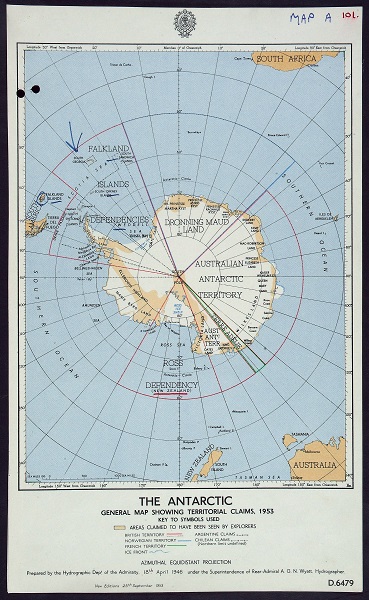
A Dominions Office map showing territorial claims on the Antarctic in 1953 (catalogue reference DO 35/6984).
In 1925 the Dominions Office was established to administer the semi-autonomous territories of the Commonwealth as well as a number of anomalous territories. This included:
- Australia
- New Zealand
- Canada
- South Africa
- Southern Rhodesia
- the Irish Free State
For a more detailed breakdown of the territories see the administrative background of the Dominions Office.
Before 1925 and since 1907, administration of the dominions had been undertaken by the Dominions Division of the Colonial Office.
There are many record series containing maps and plans from the Dominions Office and its predecessors but the following three hold significant quantities:
| Collection | Series dates | Series reference | Search advice |
|---|---|---|---|
| General correspondence of both the Dominions Office and Commonwealth Relations Office | 1915-1971 | DO 35 | Click on the series reference and search by name of country, continent or region and the word ‘map’. |
| Documents relating to treaties and agreements with various Commonwealth countries | 1856-1965 | DO 118 | Only some of the documents in this series contain maps but whether a map is included with a file is not always noted in the catalogue. Searching is therefore largely speculative and inclusion of the word ‘map’ in your search does not provide definitive results. Click on the series reference and search by name of country, continent or region – it will only be once the file is in front of you that you will know whether or not it contains maps. |
| Correspondence of the High Commissioners of southern African states | 1843-1965 | DO 119 | Only some of the documents in this series contain maps but whether a map is included with a file is not always noted in the catalogue. Searching is therefore largely speculative and inclusion of the word ‘map’ in your search does not provide definitive results. Click on the series reference and search by name of country, continent or region – it will only be once the file is in front of you that you will know whether or not it contains maps. |
6. India, Pakistan and Burma (Myanmar)
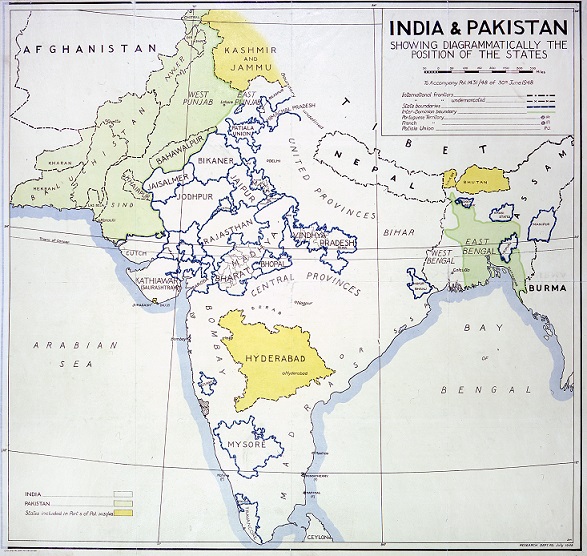
A 1948 map of India and Pakistan used by the Foreign Office (catalogue reference MFQ 1/1145). As is the case with large numbers of our maps, this map has been extracted from a Foreign Office series (in this case, FO 371) to be held with other maps and plans stored together.
The India Office was established in 1858. Before then British administration in India had been undertaken by the East India Company and the Commissioners for the Affairs of India. Records, including maps, of the India Office and the East India Company are held at the British Library (though at The National Archives there are a few maps used by the India Office which were inherited by successor departments in CO 1047 and CO 1054).
In 1937 responsibility for Burma passed to the Burma Office. Maps and other records of the Burma Office are also held within the India Office collection at the British Library. Burma did not join the Commonwealth when it attained independence in 1948 and responsibility for relations with Burma consequently passed to the Foreign Office.
Responsibility for relations with India and Pakistan passed to the Commonwealth Relations Office on their independence in 1947. The new department was formed that year by the merger of the Dominions Office and the India Office.
For maps of post-independence India, Pakistan and Burma use the advanced search in our catalogue to search by year or range of years and target your search to the following department references:
- FO, FCO and MFQ for Burma
- DO, FO, FCO and MFQ for India and Pakistan
7. Other notable collections
7.1 Post-First World War maps
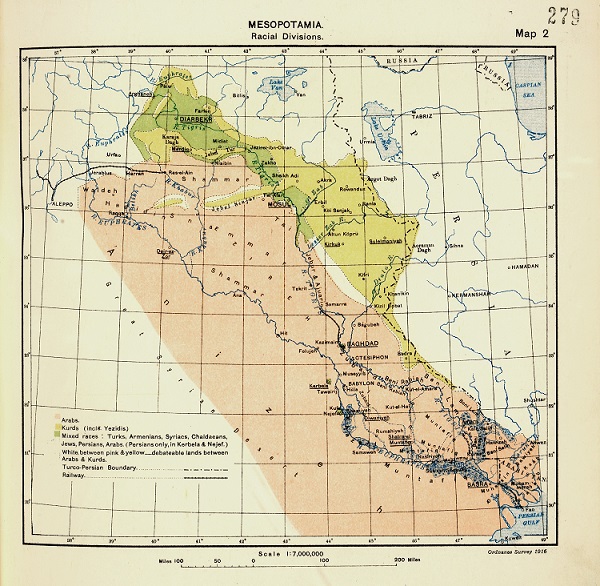
A map employed at the Paris Peace Conference in 1919, showing the ‘racial divisions’ in Mesopotamia (catalogue reference FO 608/96).
Search in FO 373 and FO 608 for maps produced during the Peace Conference following the First World War.
7.2 Plans of 16th-century towns and harbours
SP 46 contains a small collection, numbering ten or fewer, of maps and plans of the time of Elizabeth I. They are mostly plans of towns and harbours.
7.3 Maps of 17th-century Europe and America
Maps and plans collected by Sir Joseph Williamson, Keeper of the State Papers from 1661 to 1702, including maps of America and Europe and plans of forts, are in SP 9.
8. Further reading
The following books are available in The National Archives’ Library at Kew. They may also be available to buy from The National Archives’ shop.
Mandy Banton, Administering the Empire, 1801-1968: A Guide to the Records of the Colonial Office in The National Archives of the UK (Institute of Historical Research and The National Archives, 2008) – this title is also available from our shop
Michael Roper, The Records of the Foreign Office 1782-1968, Public Record Office Handbooks No.33 (Public Record Office 2002)
1. Why use this guide?
This is a guide to locating letters received by the Treasury and other papers, such as reports and minutes, created in the business of the Treasury Board between 1557 and 1920. The Treasury Board was the main decision-making body in the Treasury.
As the government’s economic and finance ministry, responsible for maintaining control over public spending, virtually every area of government action involves the Treasury at some stage and the records, therefore, cover a very wide range of subjects.
For advice on post-1920 records, see our guide to records of Economic policy and government spending in the 20th century.
2. How to search for letters and papers: an overview
Most of the advice in this guide is for records in series T 1, the main record series for letters received by the Treasury (known as ‘in-letters’). T 1 does not contain letters sent from the Treasury to other government departments until the late 19th century (these are in out-letter books held in series T 5-T 29).
Locating records can be very time consuming. The process differs depending on the time period you are interested in but when searching for a letter it is usually useful to know the date of the letter and who sent the letter. For most records before 1920 you cannot search T 1 by keyword on our catalogue. Instead you need to start by consulting finding aids, explained in more detail in the subsequent sections of this guide.
The following flow chart provides an overview of the necessary finding aids for locating 19th century letters and papers in T 1:
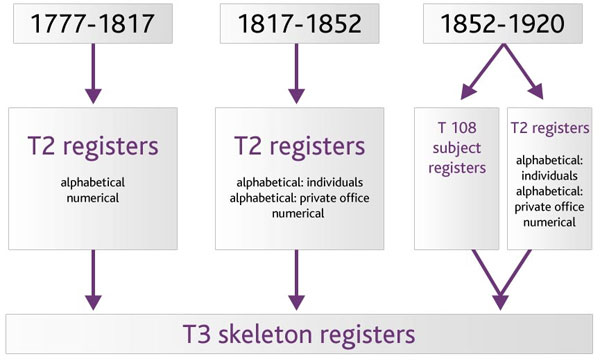
Finding aids for 19th century Treasury papers
3. How to find letters and papers, 1557-1745
3.1 Calendars
There are several published calendars for finding Treasury records from these years. They are well indexed and are freely available in the reading rooms and library at The National Archives. The calendars and the dates they cover are as follows:
| 1555-1728 | Calendar of Treasury Papers |
| 1660-1718 | Calendar of Treasury Books |
| 1729-1745 | Calendar of Treasury Books and Papers |
3.2 How to convert calendar references
Each entry in the calendars comes with a corresponding volume or book number, expressed in Roman numerals (for example, CCCXVII) and an item or page/paper number, expressed in standard decimal numbers (for example, no.8 or p.52).
- Convert the Roman numerals into decimal numbers (for example, CCCXVII becomes 317). This gives you a T1 document reference (in this example, T 1/317).
- Request the letters/papers by searching for the reference in our catalogue
- Find the item or page/paper number within the box of letters and papers
4. How to find letters and papers, 1746-1782
Use the T 1 series search in our catalogue to look for letters and papers using keywords. Letters and papers from 1746-1758 and 1764 are easiest to find as they have been described in more detail in our catalogue. Entries for other years are described in less detail.
When choosing which keywords to search with you should think laterally and consider possible broader subject matters within which your subject may be found. For example, to find Boston Tea Party papers look under ‘North America’ and the relevant date; searching for ‘Boston Tea Party’ will not work.
5. How to find letters and papers, 1777-1817
For this period you will need to first consult the Treasury registers. For each year there is an alphabetical and a numerical register. The alphabetical register is organised by name of sender. The numerical register is organised by date. The registers are held in series T 2. Follow the steps below to move from the registers in T 2 to the skeleton registers in T 3 and finally the letter or paper itself.
Example: you are looking for a letter from the Surveyor General of Woods about Hyde Park sent in August 1807.
Step 1: Order the appropriate T 2 registers by searching T 2 by year. For 1807 the appropriate registers are T 2/48 and T 2/49.
Step 2: Find a reference to the letter in the T 2 registers – you may need to check both.
- In the T2/48 alphabetical index you might look under ‘Surveyor General’
- In the T2/49 numerical index you would look under ‘August’ – if you know the date of the letter but can’t find a reference to it for that date, try other dates close by
In our example, there is a reference to the letter on 8 August.
Step 3: Note the number next to the reference to the letter. In our example, the number is 6022.
Step 4: Search T 3 by year to find and order the corresponding skeleton register. For 1807 the skeleton register is T 3/3.
Step 5: Find your number from step 3 within the skeleton register. In our example you would look for 6022 within T3/3. A black tick indicates the document has survived, a red symbol means it has been destroyed and you will not find the letter.
Step 6: If there is a black tick search T 1 for the right year and paper range. In our example, T 1/1009 is the reference for 1807 covering paper numbers 5890-6261, within which paper 6022 falls. Order T 1/1009 to see the letter or paper.
6. How to find letters and papers, 1817-1852
Follow the steps in section 5 but, at Step 1, allow for the fact that T 2 alphabetical registers are, for this period, split into ‘alphabetical: individuals’ and ‘alphabetical: public offices’. Keeping these separate lists in mind, you may need to think laterally about the kind of reference you search for. For example, a letter from the Duke of Clarence in 1823 is filed under Royal Family within the alphabetical index of letters received from public offices for that year (held in T 2/101).
7. How to find letters and papers, 1852-1920
For this period the T 108 register, a register organised by subject, makes searching easier. The T 108 register can be used alongside, or instead of, the T2 registers. Not every letter corresponded to an obvious subject category and some correspondence was therefore filed as ‘miscellaneous.’
Follow the steps below, or the steps outlined in section 5, to find a letter or paper.
Example: you are looking for incoming letters relating to a flood at Holmfirth in 1852.
Step 1: Search T 108 by year to find the appropriate subject register for that year. For 1852, the subject register (covering 1852-1856) is T 108/1.
Step 2: Find a reference to the letter relating to the flood. In our example, the subject appears under ‘Miscellaneous: F’.
Step 3: Note the paper number next to the reference. In our example, the number is 7217.
Step 4: Search T 3 by year to find and order the corresponding skeleton register. For 1852, the skeleton register is T 3/41.
Step 5: Find your number from step 3 in the skeleton register. In our example, you are looking for 7217.
Step 6: If another number is written to the right of it, look for this number in the skeleton register. In our example, 17275 appears to the right of 7217.
Step 7: Continue this process until you find a number with no number to the right of it. In our example, to the right of 17275 the number 20366 appears and to the right of that 24989. There is no number to the right of 24989 so that is the paper number we look for. If a black tick is next to this number the file has been kept. If a red symbol exists the file has been destroyed.
Step 8: If you see a black tick, search T 1 for the right year and paper range. In our example, the T 1 reference for 1852 and paper range 24940-24992, within which 24989 falls, is T 1/5778A. Order T 1/5778A to see the letter or paper.
Short video guide
View transcript (PDF, 0.06 MB)
For further help searching our catalogue please read our Discovery help pages.
8. Troubleshooting and alternative sources
If you can’t find what you’re looking for, the following tips may help:
- Try looking at nearby dates within the register. Sometimes letters were registered a few days after they were received.
- Think laterally. Topics may be filed under various subject headings. If the correspondence covers another government department try consulting their records.
- Check ‘miscellaneous’ within the T 108 subject registers. Letters were frequently filed under this heading.
- Check the long bundles (T 1/3411-T 1/4404). These are not covered by the registers. They contain correspondence on subjects which generated large quantities of important correspondence from 1777-1840. Subjects include: slavery, distress in the Highlands and the Charles Babbage calculator.
- From 1849 only important decisions of the Treasury Board were recorded. Find them in T 29.
You can also try other Treasury sources:
- Look for the corresponding out-letter. Browse the 25 out-letter series from T 5-T 29 (letters from the Treasury to other government departments).
- Look for Leeds Papers, mainly journals and minute books. For records from February 1668/9 until Michaelmas 1689 look in PRO 30/32. For Leeds Papers from 1690 onwards, contact the British Library.
- From June 1920 look in series T 160-T 164 and T 268 for personnel records, if they survived. However, some of the records were wrongly incorporated into these series.
9. Further reading
Thomas L Heath, The Treasury (The Whitehall Series, 1927, GP Putnam’s Sons Ltd, London and New York)
This is a short guide to records of Royal Navy ratings that enlisted and served after the First World War. Many of the records of ratings who served in the Second World War and all of the records for ratings that enlisted after 1928, are held by the Ministry of Defence. However, the records of ratings that enlisted with the Royal Navy in or before 1928 and went on to serve in the Second World War may be held at The National Archives.
A rating is the most junior class of seaman in the Royal Navy – below both commissioned officers and warrant officers in seniority.
How to get started
If you are looking for records of a seaman who enlisted in 1929 or later you should contact the Ministry of Defence for his records. For anyone that enlisted before 1929 you should try the registers of seamen’s services.
For details of where specific Royal Navy ships were operating during the Second World War and where and when ships were involved in combat, you should consult our guide to Royal Navy operations in the Second World War.
Online records
Registers of seamen’s services (enlisted 1853-1928)
For a Royal Navy rating who served after the First World War there may be a record among the registers of seamen’s services. The online records are for ratings that enlisted during or before 1928. Some of these ratings went on to serve into the 1950s and the online service records reflect this.
Search and download the Royal Navy Registers of seamen’s services for ratings , by name or official number, on our catalogue (£) within the series ADM 188.
These registers of seamen’s services can include information such as:
- date and place of birth
- ships served on with dates
- character and ability
- medals awarded
Medal rolls (1793-1972)
Search by name for information about the award of campaign, long service and good conduct medals in the Royal Navy medal roll (ADM 171) using Ancestry.co.uk (£). These rolls do not usually contain biographical information. Digital microfilm copies of these records are also available to download and browse from our website free of charge.
Records in other archives and organisations
Service records (1929-present)
Other resources
Books
Search The National Archives’ shop to see whether the publication below may be available to buy. Alternatively, look in The National Archives’ library catalogue to see what is available to consult at Kew.
JJ Colledge and Ben Warlow, Ships of the Royal Navy: The Complete Record of all Fighting Ships of the Royal Navy from the 15th Century to the Present (Casemate Publishers, 2010)
Kenneth J Douglas-Morris, Naval Long Service Medals 1830-1990 (The Naval & Military Press, 2002)
Bruno Pappalardo, Tracing your Naval Ancestors (The National Archives, 2003)
Bruno Pappalardo, Using Navy Records: Public Record Office Pocket Guides to Family History (Public Record Office, 2001)
NAM Rodger, Naval Records for Genealogists: Public Record Office Handbooks, XXII (Public Record Office, 1998)
This is a brief guide to researching records of UFOs. The surviving records consist mainly of documents relating to official policy, Parliamentary business (including responses to Parliamentary Questions), correspondence between the public and the Ministry of Defence, and UFO sighting reports.
What do I need to know before I start?
In 1947 a private pilot reported seeing nine strange objects moving at speed across the sky ‘like a saucer skipping on water’ over Washington State, USA. This was the first report of ‘flying saucers’.
UFO is an abbreviation for the US Air Force term ‘unidentified flying object’. To the military forces the term means something in the sky that can be seen but not recognised, rather than something ‘extraterrestrial’. Some branches of the Ministry of Defence prefer the term UAP (unidentified aerial phenomena).
Official reporting, analysis and recording of UFO sightings began in the early 1950s. Until 1967 Ministry of Defence policy was to destroy UFO files at five yearly intervals, so many records have been lost. Since 1970 most surviving Ministry of Defence UFO files have been reviewed for eventual release at The National Archives because of public interest in the subject.
Online records
UFO reports and correspondence (1950-2002)
Browse the digital records available through our archived webpage.
Records available only at The National Archives in Kew
To access these records you will either need to visit us, pay for research (£) or, where you can identify a specific record reference, order a copy (£).
UFO reports, correspondence and parliamentary business (1950-1995)
Search Discovery, our catalogue in DEFE, AIR, FCO and BJ for records of UFOs, using keywords such as ‘UFO’, ‘unidentified flying’ and ‘saucers’.
Records in other archives and organisations
Records held locally
The National Archives’ catalogue has details of collections held by over 2,500 archives across the UK. Search our catalogue using keywords; you may need to refine your results using the filters.
Other resources
Websites
Read the article on Unidentified Flying Objects (UFOs) on Your Archives.
Books
Visit The National Archives’ bookshop for a range of publications on UFOs.
1. Why use this guide?
Use this guide for advice on how to search for Foreign Office correspondence dating from 1906 to 1919 and now held at The National Archives. In most cases you can search for references to the records online but you will need to visit us to view the correspondence itself. For advice on other types of Foreign Office records see our broader overview guide.
Foreign Office correspondence is a rich source of information on the history of British relations with foreign states and can also provide insights into past domestic issues in countries around the world.
2. The Foreign Office card index
Correspondence received by the Foreign Office was numbered and categorised. The numbers and categories were recorded on small cards and these cards served as the index to the correspondence.
This Foreign Office card index is still used today, at The National Archives, to identify correspondence relevant to a particular country, person or subject area. Nowadays, however, the index is accessed online, in the downloadable record series FO 1111. Each category also has a corresponding National Archives’ record series (see the table in Section 3.2).
In 1910 the Foreign Office changed its registry system, making the search method for 1906-1909 slightly different to the method for 1911-1919. For 1910 itself you may need to try both methods.
Not all the correspondence to which the index refers was sent for preservation to The National Archives so today some index entries refer to documents which no longer exist.
3. Searching for correspondence 1906-1910
For 1906-1909 (and part of 1910) you will first need to use the card index and then the general registers of correspondence before you can identify an individual piece of correspondence. Unlike the index, the registers have not been digitised and therefore you cannot view them online. To view them you will need to visit The National Archives.
Follow these steps to find correspondence:
Step 1: Identify a section of the index to download from our catalogue
- Use the FO 1111 series search in our catalogue to search by year only.
- Sort your results by reference – this will put them into alphabetical (as well as reference) order.
- Look for the letter (or alphabetical range) that covers your subject, name or place of interest. You may have to do some lateral thinking to find your way around the terms used for subjects in the index – you will often have to guess at how the Foreign Office would have originally categorised a subject. You may, therefore, need to download multiple sections of the index.
- Download your selected section of the index.
Step 2: Identify a card index entry of interest
- Scroll through the downloaded cards until you find an entry of interest.
- A typical index card looks like this:
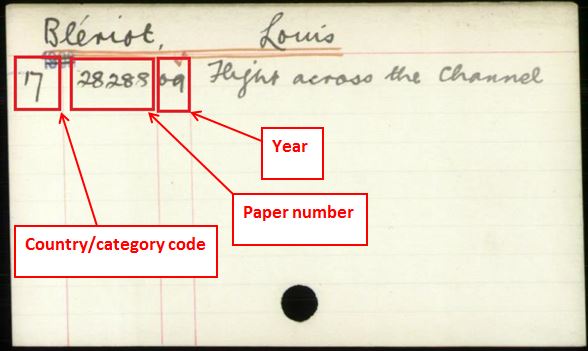
Foreign Office index card for 1909. The index reference is for correspondence about Louis Blériot’s flight across the English Channel
Step 3: Convert the country/category code and note down the paper number
- Use the tables in section 5 to convert the country/category code into a National Archives series
In the example above the country code is 17, meaning it refers to political/diplomatic correspondence about France which, as the table in section 5.2 indicates, is in FO 371. The paper number is 28288.
Step 4: Identify the relevant section of the registers of correspondence for your paper number
The general registers of correspondence are held in FO 566.
- Use the FO 566 series search to search for registers by country and year.
- From your search results, identify the category (diplomatic, consular, commercial, treaty, or Africa) that matches the country/category code on the index card.
In this example, it is diplomatic and therefore FO 566/745.
Step 5: Order the register and identify the file number
- Within the relevant FO 566 register find the appropriate date. Then, on the left hand page in the second column, find the paper number.
- Note the number in the ‘Kept with’ column – this gives you the file where the paper is now kept.
In this example the numbers are the same therefore 28288 is the file number you need.
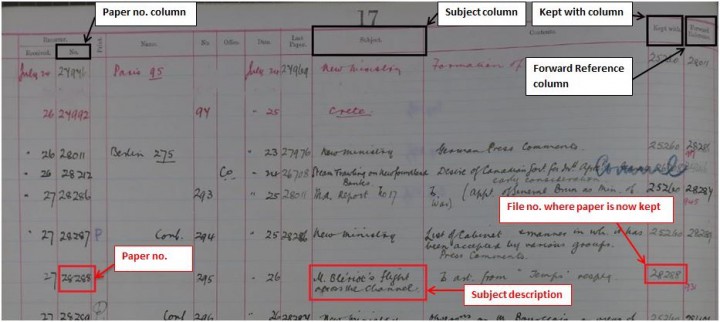
Foreign Office register of diplomatic correspondence – National Archives reference FO 566/745
Step 6 Convert the file number into a National Archives document reference
Search our catalogue for the country, and year within the relevant series reference listed in the table in section 5.2 (FO 371, FO 367, FO 368, FO 369 or FO 372).
Sort your search results by reference and look for the range of file numbers which covers the file number you identified in Step 4.
For file number 28288, in the example above, the relevant document is FO 371/668 as it covers files 17645-29484.
4. Searching for correspondence 1910-1919
Searching for correspondence from these years is a little easier as the file number is provided on the index cards (removing the need for a register).
Follow these steps to find correspondence:
Step 1:Identify a card index entry of interest
- Use the FO 1111 series search to search by year only.
- Sort your results by reference – this will put them into alphabetical (as well as reference) order.
- Look for the letter (or alphabetical range) that covers your subject, name or place of interest. You may have to do some lateral thinking to find your way around the terms used for subjects in the index – you will often have to guess at how the Foreign Office would have originally categorised a subject (the card below, for example, could be categorised under Portugal, Spain or Reformista Party; or under all three). You may, therefore, need to download multiple records.
- Download the record and identify a card of interest within the record.
Step 2: Note the country code, paper and file numbers from the card
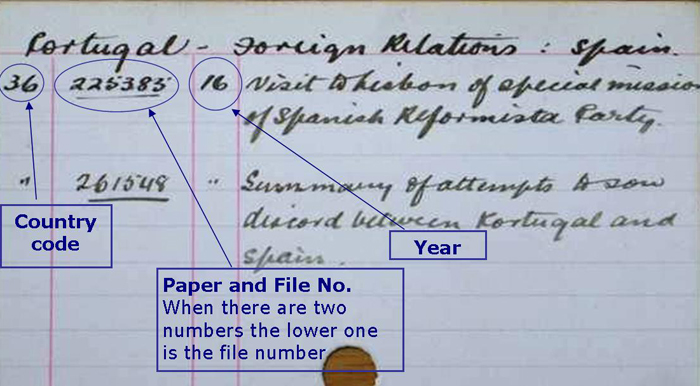
An index card for correspondence about the Spanish Reformista Party visit to Lisbon
Using the tables in section 5 you can see that country code 36 is for political correspondence about Portugal and is held in series FO 371.
Sometimes, as in the example above, there is just one number for both the paper and file. If there are two numbers, the file number is usually the lower of the two and appears below the paper number.
Step 3: Search our catalogue
- Use the advanced search to search by the country code within the relevant series in the relevant year.
For the file indexed in the card above you would search for “code 36”, restrict your search to the year 1916, and search within reference FO 371, like this:
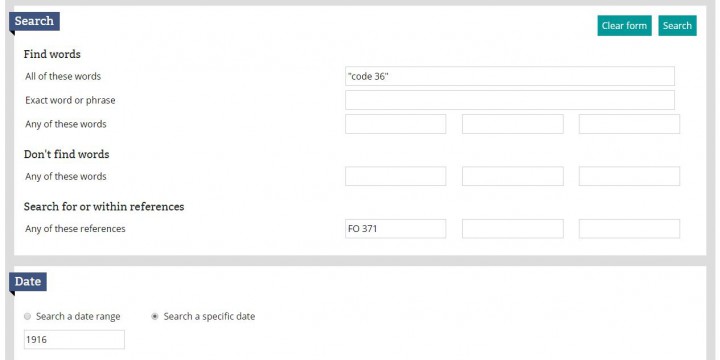
An advanced search of our catalogue for Code 36 in FO 371 covering 1916
Step 4: Identify and order the appropriate record for your file number
- Among your search results, identify the reference for the record which covers your file number. File numbers appear in ranges. For file number 225385, from the example above, the reference you need is FO 371/2740, as shown here:
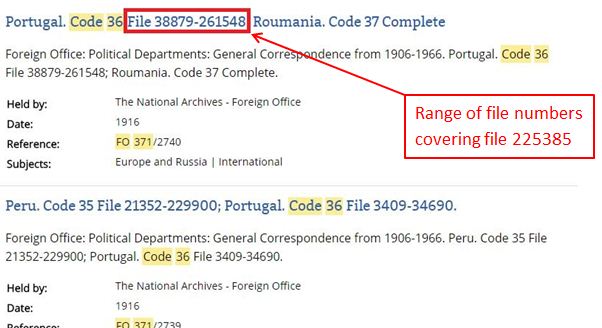
Catalogue search results of a search for Code 36 in FO 371 for 1916
- You can now order the document
Step 5: Identify relevant papers within the file
When you have ordered your document, you will see each volume is arranged in file order number, and each file is then arranged by paper number.
- Find your file number and within that file find your paper number.
5. Key to codes on the index cards
Each entry in the card index has a country/category code and a paper number. The card index from 1910-1919 also contains a file number. The codes have to be converted into National Archives document references.
Each country had its own code, composed of a unique stem number:
5.1 The country code stem numbers
| Stem code | Country | Stem code | Country | Stem code | Country |
|---|---|---|---|---|---|
| 1 | Abyssinia to 1914; Africa from 1914 |
21 | Hungary | 41 | Spain |
| 2 | Argentina | 22 | Italy | 42 | Sweden |
| 3 | Austria | 23 | Japan | 43 | Switzerland |
| 4 | Belgium and Congo | 24 | Liberia | 44 | Turkey |
| 5 | Bolivia from 1911 | 25 | Maskat [Muscat] | 45 | United States of America |
| 6 | Brazil | 26 | Mexico | 46 | Uruguay |
| 7 | Bulgaria | 27 | Montenegro | 47 | Venezuela |
| 8 | Central America (Guatemala, Honduras, Nicaragua) | 28 | Morocco | 48 | Zanzibar |
| 9 | Chile | 29 | Netherlands | 49 | – |
| 10 | China | 30 | Norway to 1914 Scandinavia from 1914 |
50 | General (W50N = War Miscellaneous News) |
| 11 | Colombia | 31 | Pacific Islands to 1913 | 51 | America: General from 1912 |
| 12 | – | 32 | Panama and Costa Rica | 52 | Contract Labour from 1914 |
| 13 | Crete to 1913 | 33 | Paraguay | 53 | Albania 1914-1916 |
| 14 | Cuba | 34 | Persia | 54 | Ecuador from 1914 |
| 15 | Denmark | 35 | Peru (includes Bolivia to 1910 and Ecuador to 1913 ) | 55 | Poland from 1918 |
| 16 | Egypt | 36 | Portugal | 56 | Finland from 1918 |
| 17 | France | 37 | Roumania [Romania] | 57 | Siberia from 1918 |
| 18 | Germany | 38 | Russia | 58 | Caucasus from 1918 |
| 19 | Greece to 1914 Balkans from 1914 |
39 | Serbia to 1914War from 1914. Please note after 1914 this becomes the code for the First World War however you can find some post 1914 Serbia related material within it | 59 | Baltic State 1919 only |
| 20 | Hayti [Haiti] and San Domingo | 40 | Siam | – | – |
5.2 Country codes with more than two digits (category codes)
Extra numbers or letters were added to indicate which category the papers were placed in. The category corresponds to a particular National Archives record series (see table below). If no extra number is added then the correspondence was categorised as ‘Political’ (Diplomatic) – the most commonly used category.
For example, Germany had 18 for its stem number, so references to Germany in the card index have the following codes:
| Code | Category | Series | |
| 18 | Political (Diplomatic) | FO 371 | |
| 118 | Commercial | FO 368 | |
| 218 | Consular | FO 369 | |
| 318 | Treaty | FO 372 | |
| 418 | Africa to 1913 | FO 367 | |
| New code added in 1914 | 1118 | Contraband | FO 382 |
| New code added in 1914 | 18W or W 18 | War records in FO 371 | FO 371 |
| New code added in 1915 | 1218 | Prisoners | FO 383 |
| New code added in 1916 | N18 | News | FO 395 |
| New code added in 1917 | 2118 | Coal and tonnage | FO 382 |
| Pr | Prize (spoils of war) records in FO 372 | FO 372 |
6. How to find related correspondence 1906-1910
Once you have found a relevant entry in the FO 566 registers you can sometimes find related correspondence by identifying cross-references.
Left hand pages of registers refer to incoming correspondence and right hand pages to outgoing correspondence. Entries in black in the ‘forward reference’ column (highlighted in the image at Step 5 in section 3) refer to incoming correspondence numerically arranged on the left page. Entries in red usually refer to outgoing correspondence arranged numerically on the right page.
The file number can then be traced to a document reference as in step 2 above.
7. Other types of Foreign Office correspondence and related records
Some Foreign Office correspondence from this period is not covered by the card index. This includes:
7.1 Correspondence from the Foreign Office Library and Research department
Search for correspondence to and from the Foreign Office Library and Research department in FO 370.
7.2 Correspondence from the Chief Clerk’s department
The Foreign Office Chief Clerk’s department focused mainly on expenditure issues and therefore covers many topics. Search for correspondence and other records in FO 366.
8. Further reading
Some of the publications below may be available to buy from The National Archives’ bookshop. Alternatively, search The National Archives’ library catalogue to see what is available to consult at Kew.
James Cronan and Keith Mitchell (eds.), Foreign Office Records, 1782 to 1986, An index to country series (List and Index Society, 2017)
Michael Roper, The records of the Foreign Office, 1782-1968 (Public Record Office Publications, 2002)
L Atherton, ‘Never complain, never explain’, Records of the Foreign Office and State Paper Office 1500-c.1960, Public Record Office Readers’ Guide No7 (PRO publications, 1994)
The records of the Foreign Office, 1782-1939, Public Record Office Handbooks No13 (HMSO, 1969)