What are these records?

These records are digitised cards recording the movements of British and Allied merchant ships during the Second World War.

In 1939 the Admiralty instructed the Board of Trade, for reasons of security, to prevent masters of merchant vessels from using ships’ logs or crew lists and agreements to record destinations or ports of call. However, it was still important to record the movements of merchant vessels and so the Registrar General of Shipping and Seamen established this series of cards, now held by The National Archives in series BT 389.

What information do the records contain?

The cards record the movements of both British-registered and Allied vessels engaged in the war effort. They do not contain details of any passengers or crew. Each set of cards records:

  • name of the ship
  • former name/s of the ship (if any)
  • size (tonnage) of ship
  • to whom ship was registered
  • ship’s destination
  • date of arrival at destination
  • sometimes ports of call
  • any cargo carried on board

The cards also show if the ship was torpedoed, mined, damaged or sunk.

What do the records look like?

Unfortunately, many cards contain a lot of abbreviations and there is no known key for them.

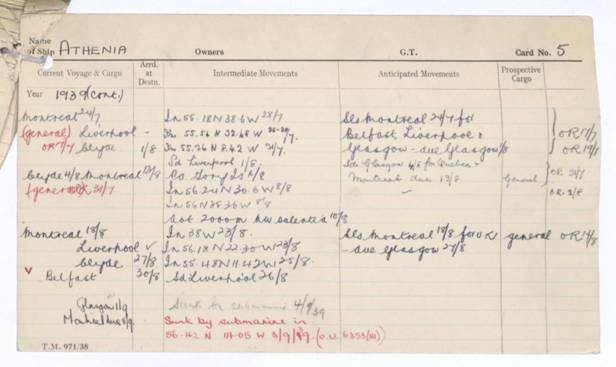
Below is the last movement card for the SS Athenia. On 1 September 1939 this passenger liner set sail from Glasgow with over 1400 passengers and crew aboard. She was torpedoed and shelled by the German U-boat U30 without warning, becoming the first merchant vessel casualty of the Second World War.

Image of Merchant ship movement card (catalogue reference: BT 389)

Merchant ship movement card (catalogue reference: BT 389)

In the top left corner of the record is the ship’s name. If a ship had a former name this would be written in brackets. Owners and gross tonnage (G.T.) are also recorded at the top of the card.From left to right, the six columns on the card will tell you:

  • the year, current voyage and cargo
  • the date of arrival at the destination
  • the day by day movements of the ship (in Athenia’s case the final entry records her sinking)
  • anticipated movements, i.e. the intended destination
  • details of the cargo expected to be collected at the next port of call
  • the initials of the clerk making the entry and the date it was made

 How do I search the records?

You can search the records in Discovery, our catalogue, by using the search box below.

Why can’t I find what I’m looking for?

You may be searching for a vessel for which these cards were never used. This collection records the movements of ships ordinarily engaged in foreign going trade. It does not, however, include:

  • vessels normally employed in home trade
  • vessels requisitioned for military service
  • small craft

You may be searching for a ship using a former name. Not all changes in ships’ names are logged on the cards and in such cases it will be necessary to obtain the ship’s official number (not usually recorded on the cards) and check against that number for all possible name changes. The Miramar ship index can be useful for obtaining this information.

You may be searching for a ship on dates before or after movement cards were in use on that vessel. The card entries do not all start or end at the same time. If there is no entry on a card for the early or later part of the war, check the crew lists and agreements in series BT 99, BT 100, BT 380 or BT 381 which may hold further details.

What are these records?

Available here are digital versions of First World War service records for officers and ratings, from series ADM 337, of the Royal Naval Volunteer Reserve (RNVR).

They include the service records of ratings who joined the RNVR between 1903, when the RNVR was formed, and 1919, and officers who joined between 1914 and 1922.

How do I search the records?

You can search and download the records in Discovery (£) by filling in the form below.

You don’t need to complete every field to find a record.

Details of individual:

What information do the records contain?

The ratings’ records contain the following details:

  • name
  • division and service number
  • date of birth
  • former occupation, whether formerly in the Royal Navy or Royal Marines
  • a physical description
  • dates and periods of engagements
  • ships or units served in
  • period of service
  • remarks about character and ability
  • very occasionally a record may reveal the place of birth

The officers’ records typically contain the following details:

  • name
  • rank
  • appointments
  • honours and awards
  • dates of promotion
  • name and address of next of kin
RNVR record in ADM 337/5

RNVR record in ADM 337/5

What do the records look like?

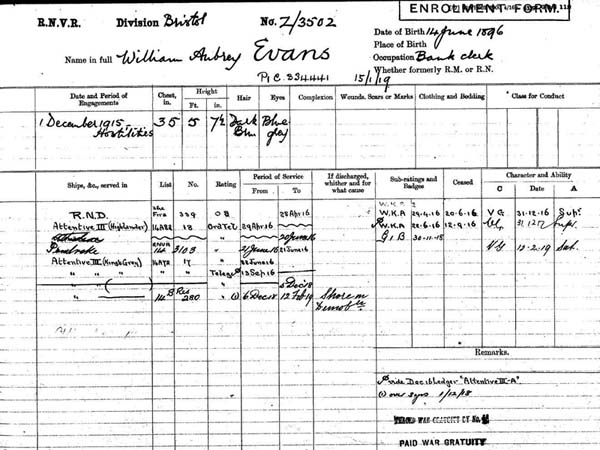
The service records of ratings and officers are different in appearance. The right-hand image is the record of William Aubrey Evans (from ADM 337/5), who was a rating in the RNVR.

It is on a pre-printed form, with the details listed in headed columns. The form shows that he gives his date of birth as 14 June 1896, and there is also a description of his appearance. Below this we find out the ships Evans served in for the duration of the First World War.

RNVR record in ADM 337/117

RNVR record in ADM 337/117

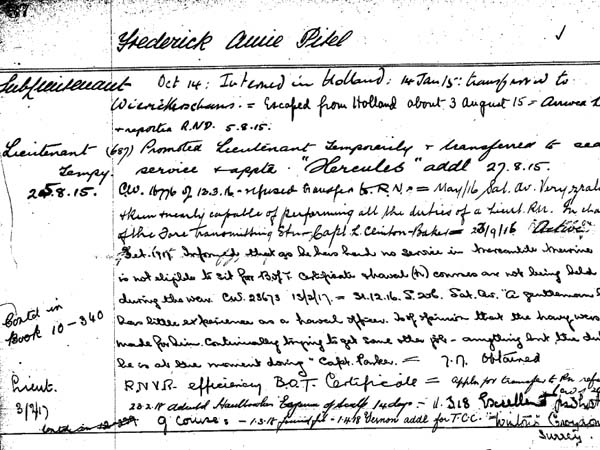
The right-hand image is the record of Frederick Awe Pitel (from ADM 337/117), who was an officer in the RNVR. This record lists his promotions, honours and awards during the First World War.

Ratings’ records are arranged by division and then by divisional service numbers. On joining the RNVR, men were assigned to divisions and allocated service numbers prefixed by a ‘distinguishing letter’ indicating the division they had entered. If a man joined after the outbreak of the First World War they may have a Z in their service number. This usually appeared after the letter indicating the Division.

You can identify the division using the table below:

Letter

Letter Division
AA Anti-Aircraft
B or BZ Bristol Division
C or CZ Clyde Division
E Birmingham Electrical Volunteers
KP, KW, KX Crystal Palace (entered from Kitchener’s Army)
L or LZ London Division
M or MZ Mersey Division
MB Motor Boat Service
MC Mine Clearance Service
PZ Crystal Palace (entered from civilian life or from the Royal Navy)
R Royal Naval Division
S or St Sussex Division
SWS Shore Wireless Service
T or TZ Tyne Division
WZ Wales Division
Y On occasion a Y number is found. These numbers seem to have been allocated when men volunteered, to be replaced by a service number when they were called up. If only a Y number is found, the implication is that the man did not actually serve.

Why can’t I find what I’m looking for?

It is important to note that not all RNVR service records have survived. If you are unable to find the service record of someone who joined the RNVR, the reason may be that he saw service with the Royal Naval Division.

For some divisions, the Fleet Air Arm Museum holds the engagement papers that men signed upon joining the RNVR. These can be useful if you need details about ratings whose records have not survived in series ADM 337, or to supplement information given in service records.

This is a brief guide to help you find records of personnel in African armed forces under British control.

What do I need to know before I start?

When former British colonies gained independence from the United Kingdom, their governments assumed responsibility for all records relating to their armed forces, with a few exceptions. Most records are therefore held by the national archive of the African countries in question.

Online records

Campaign and award medals (1877-1953)

Look in the regimental medal rolls (WO 100) for a person in the African forces who received a medal using Ancestry.co.uk (£).

Browse the long service and good conduct award registers (WO 102) in Discovery (£), our catalogue.

Medal index cards (1914-1920)

Search the First World War army medal index cards (WO 372) for a soldier serving in African force who received a campaign medal or gallantry award.

Records available only at The National Archives in Kew

To access these records you will either need to visit us, pay for research (£) or, where you can identify a specific record reference, order a copy (£).

South African War (1899-1902)

Browse our catalogue for service records and attestation papers for men who joined the Imperial Yeomanry, a British regiment raised specifically for the Boer War, in WO 128. The records are arranged by regimental number. There are indexes to these records in WO 129.

Look in WO 126 and WO 127 for records of units raised in South Africa which include details of men who enrolled. These are arranged alphabetically by unit name.

King’s African Rifles (1897-1953)

The King’s African Rifles was formed from various East African forces in 1902 and was based in Kenya.

Browse the registers of correspondence relating to the formation and affairs of the King’s African Rifles in CO 581, CO 582, CO 623, CO 624, and CO 820.

Royal West African Frontier Force (1900-1912)

The Royal West African Frontier Force was formed from various West African forces in 1900.

Browse correspondence relating to the formation and affairs of the Royal West African Frontier Force in CO 442 and CO 820.

Royal African Corps (1800-1819 and 1822-1840)

The Royal African Corps was formed in 1800 under Colonel John Fraser.

Browse the general muster books and pay lists of the Royal African Corps and Royal African Colonial Corps in WO 12.

Other resources

Websites

Find the service number of a man in the Imperial Yeomanry, Lovats Scouts and Scottish Horse in the Boer War, 1899-1902 on the BritishMedals website.

Books

Search The National Archives’ bookshop to see whether any of the publications below may be available to buy. Alternatively, look in The National Archives’ library catalogue to see what is available to consult at Kew.

William Spencer, ‘Army Records’ (The National Archives, 2008)

‘South African Field Force Casualty List, 1899-1902’ (London, 1972)

1. Why use this guide?

Use this guide if you are looking for records of railways, including:

  • records of English and Welsh railway companies before they were nationalised in 1947
  • railway accident reports
  • records of the British Transport Commission, British Railways Board and related bodies

The National Archives holds many railway records, but others are in:

  • specialist museums
  • university collections
  • local preservation societies
  • private hands
  • records of railways built by Act of Parliament

Locating records of a particular railway may be difficult unless you know which company owned it.

(more…)

Most surviving historical business and trade records in the UK are held by local archives.

From 1851 trades could be listed in the census in order of importance and these records are held at The National Archives. People often had multiple seasonal occupations. Records of seasonal, casual, or part-time work in the census are erratic, particularly the work of women and children, and in agriculture. Very general terms are sometimes used in the census – such as ‘labourer’ – making it difficult to find a person’s exact occupation.

Online records

Historical trade directories for England and Wales, 1760s-1910s

Search by business name, place or trade type in the University of Leicester’s collection of online local and trade directories for England and Wales from the 1760s to the 1910s. Arranged by county, the collection includes at least one directory for every English and Welsh county.

City and county directories across the United Kingdom, 1766-1946

Search by business name, business owner, place or trade type in the collection of commercial, trade and residential directories, 1766-1946 at Ancestry.co.uk (£).

Business indexes of Britain, 1892-1987

Search by place or business owner in these Business Indexes, 1892 – 1987, a collection of  published book entries listing shopkeepers, businessmen and women, industrial magnates and their companies at Findmypast.co.uk (£).

Each shop or company is described in short detail, often accompanied by a photograph of it or the proprietor, along with details of when and from whom the business was acquired. Family members working in the business are usually listed too.

Records available only at The National Archives in Kew

To access these records you will either need to visit us, pay for research (£) or, where you can identify a specific record reference, order a copy (£).

The National Archives does hold some records for a few select trades and occupations. To learn more consult our list of research guides covering occupations.

Records in other archives and organisations

The National Archives’ catalogue contains collections and contact details of local archives around the UK and beyond. To locate these records, search our catalogue with keywords and refine your results to ‘Other archives’ using the filters.

Other resources

Website

Browse GENUKI for a list of occupations in the UK and Ireland, with sources of further information for each.

What are these records?

This collection of records, BT 395, lists the medals awarded to merchant seamen for their service in the Second World War (1939-1945), with the exception of the Arctic Star. For details of the Arctic Star see our guide to Merchant seaman’s medals and honours.

The medals were claimed and issued from 1946 to 2002. Medals were not automatically issued, but had to be claimed by the merchant seaman. You can find out whether a medal was issued by looking at the markings on the records.

What information do the records contain?

Each entry provides:

  • the seaman’s name
  • medals
  • ribbons and clasps issued
  • reference to the medal papers file (held at the Registry of Shipping and Seamen)

The seamen’s discharge book numbers are usually listed, and you may find the date and place of birth too.

How do I search the records?

You can search (£) the records in Discovery, our catalogue, by filling in the form below.

You do not have to fill in all fields to search.

Types of medals

Nine types of medals were awarded to British merchant seamen who served in the Second World War and who met the qualifications for each medal. Eight of them are searchable here whilst the ninth, the Arctic Star, was not awarded until 2012 and records of its award do not exist at The National Archives. For more information on the Arctic Star and advice on how you can still apply for it, see our guide to Merchant seaman’s medals and honours.

Medal Qualification
War Medal (1939-1945) Generally awarded if the seaman qualified for one of the Stars. A merchant seaman had to have served a minimum of 28 days at sea. Also awarded, with no minimum service requirement, if service was terminated by death, disability due to service or capture as a prisoner-of-war.
Atlantic Star (1939-1945) Awarded after the Battle of the Atlantic for service between 3 September 1939 and 8 May 1945. The qualifying service period for the Atlantic Star could only begin after the 1939-1945 Star had been earned by six months’ service. A merchant seaman had to serve in the Atlantic, home waters, North Russia Convoys or South Atlantic waters. The Atlantic Star was also awarded to those awarded a gallantry medal, with no minimum qualifying period. There was also no minimum qualifying period if service was terminated due to death or disability while on active duty.
1939-1945 Star Awarded for service between 3 September 1939 and 2 September 1945. A merchant seaman could qualify after six months’ service with at least one voyage in an operational area. The 1939-1945 Star was also awarded to recipients of a gallantry medal, with no minimum qualifying period. There was also no minimum qualifying period if service was terminated due to death or disability while on active duty.
Africa Star (1940-1943) Awarded for service between 10 June 1940 and 12 May 1943, serving in the Mediterranean. A merchant seaman might also qualify serving in operations off the Moroccan coast between 8 November 1942 and 12 May 1943. The minimum qualifying period was one day.
Pacific Star (1941-1945) Awarded for service in the Pacific Ocean, South China Sea or the Indian Ocean between 8 December 1941 and 2 September 1945. Generally the qualifying service period for the Pacific Star could only begin after the 1939-1945 Star had been earned by six months’ service.
Burma Star (1941-1945) Awarded for service in the Burma Campaign between 11 December 1941 and 2 September 1945. A merchant seaman qualified serving within a restricted area in the Bay of Bengal. Generally the qualifying service period for the Burma Star could only begin after the 1939-1945 Star had been earned by six months’ service.
France and Germany Star (1944-1945) Awarded for service between 6 June 1944 and 8 May 1945, in direct support of land operations in France, Belgium, Holland or Germany, in the North sea, the English Channel or the Bay of Biscay (service off the coast of the south of France could qualify for the Italy Star, see below). There was no minimum time qualification for a Merchant Seaman.
Italy Star (1943-1945) Awarded for service between 11 June 1943 and 8 May 1945, in the Mediterranean and the Aegean Sea. Operations in and around the Dodecanese, Corsica, Greece, Sardinia and Yugoslavia after 11 June 1943 would also qualify. Generally the qualifying service period for the Italy Star could only begin after the 1939-1945 Star had been earned by six months’ service. There were no clasps awarded with the Italy Star.

What do the records look like?

The image you order will usually come with a number of medal records for other seamen. If you are ordering more than one record for seamen with similar names, you should check if their records are on the same page. If they appear on the same page, you should only pay one fee.

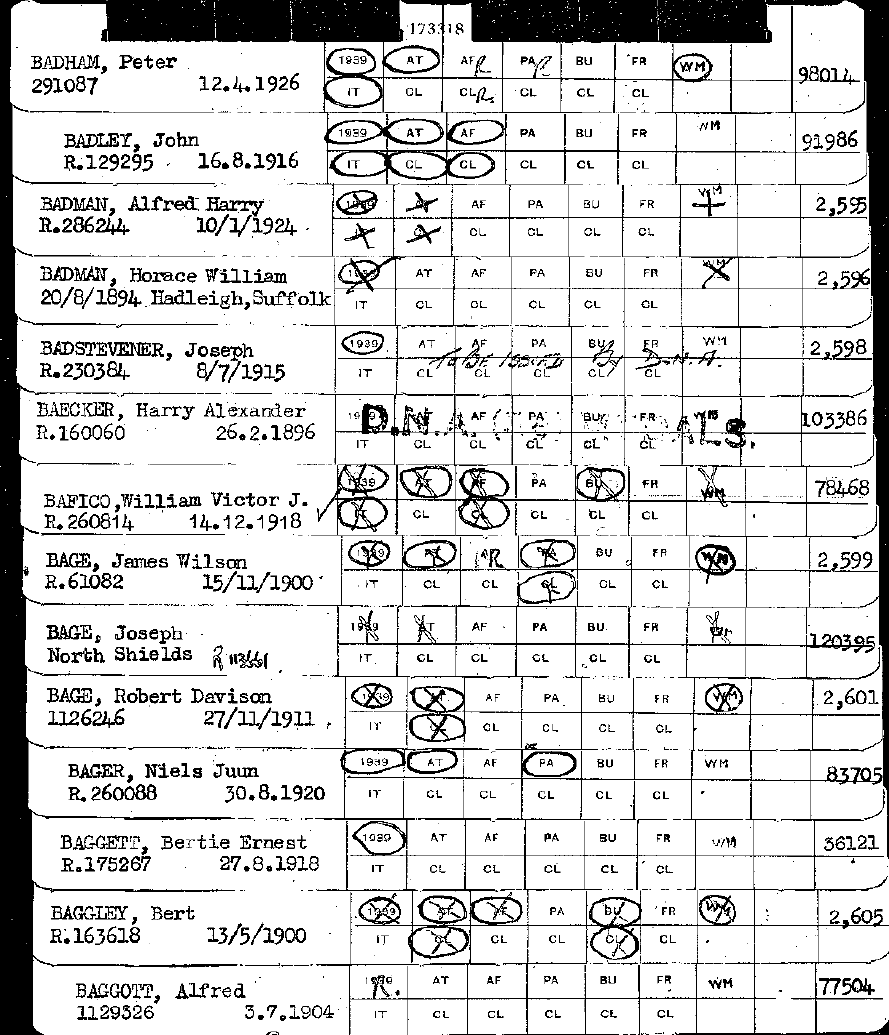
Image of medal record for Alfred Harry Badman, BT 395/1

Medal record of Alfred Harry Badman, BT 395/1

The column on the right of each record contains a reference number to the entitlement file held by the Registry of Shipping and Seamen.

The following codes may be found on the record:

  • WM (War Medal)
  • AT (Atlantic Star)
  • 1939 (1939-1945 Star)
  • AF (Africa Star)
  • PA (Pacific Star)
  • BU (Burma Star)
  • FR (France & Germany Star)
  • IT (Italy Star)
  • CL (Clasp)
  • OLE (Oak Leaf Emblem)

Markings found on the record may include:

  • a cross through a code, indicating that the medal was issued
  • a circle over a code, indicating that only the ribbon for that medal has been issued
  • a cross and a circle, indicating that both a medal and a ribbon have been issued

The letter ‘R’ over a code can signify that an application for that medal was reviewed and refused.

Other terms you may find include:

  • DNA: Director of Naval Accounts (the Royal Navy medal issuing authority) or, more recently, Do Not Authorise
  • Refer to Aust: the medals were not issued to an individual by the Registry of Shipping but referred on to the Australian authorities
  • Refer to NZ: the medals were not issued to an individual by the Registry of Shipping but referred on to the New Zealand authorities

A single oak leaf emblem attached to the War Medal ribbon denotes a Mention-in-Despatches; the silver oak leaf, a King’s Commendation for Brave Conduct. Even if a person had several ‘mentions’, he would only have one emblem.

Anyone who qualified for both the Pacific Star and the Burma Star would be awarded the first Star earned. A Clasp would be worn to signify service for the other Star.

Anyone who qualified for both the France & Germany Star and the Atlantic Star would be awarded the first Star earned, with a Clasp. A silver rose on the ribbon bar signifies the award of a bar.

Why can’t I find what I’m looking for?

If a seaman is not listed, it may be because they have not claimed their medal entitlement. To find out about a seaman’s entitlement, contact the Registrar General of Shipping and Seamen.


1. Why use this guide?

This guide will help you to find:

  • historical Ordnance Survey maps
  • records created or maintained by the Ordnance Survey, the national mapping agency of Great Britain, including records documenting the Ordnance Survey’s work

The National Archives is not the best place to start a search for published Ordnance Survey maps – check libraries and other archives first if you are looking for these. See section 2 of this guide for some of the major libraries where published maps are held.

2. Ordnance Survey maps held elsewhere and published online

For published Ordnance Survey maps you should head elsewhere before searching at The National Archives as our collection is not comprehensive and you are less likely to find a published map here than online or at libraries and other archives, including local archives. You can find contact details for archives elsewhere using Find an archive.

Major libraries, including Legal Deposit Libraries, where published maps are held include:

Digitised copies of many Ordnance Survey maps are available on several websites including:

You can view Ordnance surveyors’ drawings online at the British Library website.

3. Ordnance Survey maps at The National Archives

The National Archives, though not the routine place of deposit for published Ordnance Survey maps (see the Legal Deposit Libraries in section 2 for this) does, however, hold many Ordnance Survey maps used during the working life of various government departments. These include maps used by the Ordnance Survey itself, a government agency since the late 18th century. Some maps are ordinary editions but others are special editions or special printings. Many include additions made by hand.

Although the first Ordnance Survey map was published in 1801, it was many years before it produced detailed maps of the whole country. For many places, the oldest large-scale Ordnance Survey map dates from the 1860s, 1870s or 1880s. Many different editions of Ordnance Survey maps have been produced since then.

4. How to find Ordnance Survey maps at The National Archives

There is no single, comprehensive index of Ordnance Survey maps held here so to find a map you will need to try one of the following search methods:

4.1 Using index maps to find sheet numbers and grid references

Finding maps, as well as written records, often involves identifying a sheet number or a National Grid reference. You can use the following websites to help you identify sheet numbers or National Grid references on the various different scales and editions of published Ordnance Survey maps. These websites feature online index maps:

There is also a selection of index maps available at The National Archives and at many other archives and libraries.

4.2 Searching our online catalogue

Use the advanced search to search for maps, either using the sheet number (for example, “Devon VIII”) or using a combination of place names with “OS”.

4.3 Browsing or searching in specific record series

You can browse our catalogue for published Ordnance Survey maps in the following series, all of which contain significant numbers of Ordnance Survey maps:

5. Place names and topographical features

If you want to know how a place name was or is ‘officially’ or historically spelled or whether a place or feature of the landscape existed at a particular date, the records and maps of the Ordnance Survey may provide you with the answers.  Various kinds of ‘name books’ were created and used by the staff of the Ordnance Survey to establish the names of places and features on maps, whether buildings or villages, hills or rivers, roads, railways or canals and numerous other ‘objects’ shown on maps, both natural and man-made. To decide on the spelling of names the surveyor would ask a local authority, such as a vicar or landowner, for their version and this would be recorded in the name books.

5.1 Object Name Books

These printed log books relate to the older six-inch and 1:2,500-scale County Series maps. They are arranged and described by the Ordnance Survey map sheet number to which they relate and by the names of civil parishes which were shown, or more often partially shown, on that map sheet. They list the names of places and features in columns and, for each one, details of who provided the authoritative spelling and what their job or position was – often they were the local vicar or estate manager. The date of the initial record and any subsequent amendments may be given. There are also sometimes ‘Descriptive Remarks or other General Observations which may be considered of interest’ for the place in question.

Search our incomplete set of Object Name Books (it is thought that some were destroyed during air raids in the Second World War), compiled at various dates between 1896 and 1938, by date, name of county and map sheet in OS 35. While you can also search by parish name, please note that the records are not arranged by parish but by map sheet, so you may need to consult a number of Object Name Books to ensure total coverage of the parish in question.

There are further object name books for 1943-1983 in OS 67 but you cannot search these by place. Instead, you must search for them using map sheet numbering – advice on this is contained within the OS 67 series description under ‘Arrangement’.

Object Name Books compiled at various dates between 1943 and 1983 relating to the newer National Grid Series map sheets are in OS 67. You cannot search these by place, but by map sheet numbering; advice on this is found in the OS 67 series description under ‘Arrangement’.  These records are held offsite and require at least three working days’ notice to produce.

5.2 Other kinds of name books

The following series all contain variations of the Object Name Books described above – click on the references to learn more about each series and to search for name books within them:

  • Parish Name Books 1850-1945 in OS 23 (search by county and parish)
  • Original Name Books 1853-1866 for Cumberland, Durham, Hampshire, Northumberland and Westmorland in OS 34 (search by county and parish)
  • One-Inch Scale Name Books in OS 50 for 1951-1970 and OS 52 for 1948-1975 (search by county)

6. Parish, county and other public boundaries

As well as producing maps, the Ordnance Survey, from 1841, was responsible for the Public Boundary Archive for Great Britain. Its files show each change to a public boundary (county, parish, parliamentary and local government boundaries). There are large numbers of Ordnance Survey reports and other files describing and defining boundaries. They include:

  • Local government area boundaries 1852-1936 in OS 12
  • Poor Law Union boundaries 1820-1940 (and less than half a dozen files from 1940-1971) in OS 24 (search by name of Poor Law Union and/or county)
  • Local government boundaries as depicted and described in sketch maps, reports and remarks books in OS 26 to OS 29 and OS 30 to OS 33 (search by place name)
  • County boundaries and other local government boundaries in OS 37 to OS 42 and OS 76 to OS 79

7. Other administrative and technical records

7.1 Pre-1841 records

Ordnance Survey was not a separate government department until 1841. For information about earlier records in WO 44, WO 47, WO 55, read our guide on Board of Ordnance.

Other records before 1841 are in:

7.2 Post-1841 records

After 1841, many records are arranged and listed by:

  • county or parish name
  • sheet number or National Grid square

Search or browse the following series in our catalogue for:

Read our guide on Public rights of way for information on records of public rights of way maintained by Ordnance Survey.

You can browse the full list of Ordnance Survey records series in our catalogue.

8. Staff records

We hold a relatively small number of records for Ordnance Survey staff.

Up to 1946, some Ordnance Survey staff were military personnel and some were civilians.

If you are looking for records of military staff, start by reading the relevant guides:

You can also consult the records in:

  • WO 54/208 for men who served in the Royal Corps of Military Surveyors and Draughtsman which lists dates of appointment and promotions
  • OS 1/1/1 for a list of Royal Engineer Officers who served in the Survey between 1791 and 1927
  • OS 3/300 for a register of deceased soldiers serving in 13 Survey Company between 1829 and 1892, which gives information on cause of death and disposal of the man’s effects
  • OS 1/1/4 for a list of all Royal Engineers officers serving with the Survey on 1 July 1890
  • OS 3/341 for a register of marriages, births and baptisms for  men serving in 16 Survey Company Royal Engineers between 1885 and 1939; you can search for these by name using the OS 3 series search
  • OS 3/275-277 for seniority lists of the Survey Battalion (1935-1942)

Very few records exist for civilian staff:

  • OS 3/285 for a register of civil assistants (many of whom were former Royal Engineers who had previously been with military survey companies) which provide dates of entry into the Survey and of retirement
  • OS 1/1/4 for a list of all civil assistants as well as Royal Engineers in post on 1 July 1890
  • OS 10 for selected personal files on senior staff

Search Proquest UK Parliamentary Papers for a complete list of civilian staff in post in the Survey on 31 March 1863 (reference 1862 (xxxiii) 505). This is a subscription website you can access on The National Archives’ computers by visiting us at Kew. You may also be able to access it via a large reference library such as a university library.

9. Further reading

For general information, browse:

Read A brief history of Ordnance Survey on the Charles Close Society website.

There are many books and articles about Ordnance Survey maps and the history of Ordnance Survey. Some of the most useful include:

You can also access PDF copies of the following publications from the history pages of the Ordnance Survey website:

  • Tim Owen and Elaine Pilbeam, Ordnance Survey: Map Makers to Britain Since 1791 (Southampton, 1992)
  • W A Seymour, ed, A History of the Ordnance Survey (Folkestone, 1980)

1. Why use this guide?

Use this guide to find out about the different forms of customs duty – a type of taxation – that were applied in the medieval period, how they were collected, and how you can search for relevant records.

The records are of most use in understanding and researching overseas trade and finance in this period, although people such as customs officials are sometimes mentioned by name.

2. Using our catalogue to find records

For tips on searching the catalogue, use the help page.

Use the advanced search function of our catalogue, with relevant keywords and dates, to identify the records that will help you with your research.

The catalogue contains descriptions of the documents we have rather than their content. Only a few documents are available to view online. To see most documents you will need to either visit The National Archives at Kew or pay for copies to be sent to you. Alternatively, you can pay for research.

3. The principal medieval customs

The right to collect customs on imported or exported goods was one of the most ancient prerogatives enjoyed by English kings.

The earliest evidence that such dues were regularly collected comes from the Pipe Rolls during the twelfth century. However, during the thirteenth and fourteenth century the customs were expanded to meet the cost of expensive foreign wars.

A national custom, agreed by parliament, on wool (England’s principal medieval export) was established by the end of the thirteenth century.

Further customs – on cloth, wax and wine – were agreed during the course of the fourteenth century.

3.1 The ancient custom and butlerage

The ancient custom was imposed on all staple goods – principally wool, skins and leather, but also lead, tin, butter, cheese, lard and grease, from 1275.

It was a duty of

  • 6s 8d on every sack of wool and every 300 (later 240) fells or skins
  • 13s 4d on each last (200 hides) of leather

Butlerage was a duty on wine imports that formed part of the ancient custom, but from the beginning of Edward III’s reign it was collected by the King’s Chief Butler. As this office was usually granted to a figure of national political importance, a deputy in each of the ports actually collected the butlerage.

3.2 The new (or petty) custom

In 1303 the new (or petty) custom was applied to foreign merchants who had to pay an extra 50% on top of the ancient custom. In 1347 it was extended to include imported cloth and was payable by aliens and denizens.

Originally it included specific dues, paid by merchants to collectors in each port, on wool, leather and wax (later collected at the same time as the ancient custom) and an ad valorem duty of 3d in the pound on all other goods.

3.3 The subsidy

‘The subsidy’ was introduced in 1353 through the Statute of the Staple. Initially, it was a fluctuating subsidy on top of the ancient or new customs, but it became a fixed charge in 1471.

The accounts of these duties were amalgamated to form the Custom and Subsidy on Wool. They provide information about local officials who assessed and accounted for the duties and are a key source for the history of medieval trade.

3.4 Tunnage and poundage

Tunnage was a temporary levy on wine imports which was granted to the King for life in 1415.

Poundage was an extra ad valorem duty imposed on all non-staple goods exported or imported by aliens or denizens (except the German Hanse merchants).

4. Local taxes

As well as national customs there was a wide range of local dues imposed by ports and communities. These were either

  • collected and disbursed locally
  • collected for the King and accounted for at the Exchequer
  • farmed out for a fixed annual amount

Some of these records can be found at The National Archives. Miscellaneous accounts sometimes survive in the pipe rolls E 372, or on foreign account or subsidy rolls in E364 and E359 but they are very scattered. Other records are in county record offices.

5. Collection of the customs

The collection of the customs required an elaborate system of revenue collectors in local areas working in conjunction with the Exchequer. The following record series contain useful material:

  • C 66 – patent rolls. Royal grants for customs posts – collectors, surveyors and occasionally the auditors were sometimes enrolled on these
  • C 60 – fine rolls. Some references to newly appointed customs officials can be found on these. This is because they had to tell the Exchequer about the customs they collected. Fine rolls for the period 1216–1272 (C 60/8-C60/69), are available and searchable online at Henry III fine rolls
  • E 122 – Exchequer records. Some customs officials are named in the descriptions of these records

6. Customs’ accounts: the particulars

6.1 The Exchequer sent out books for the customs’ officers of each port to record the dues they collected. Three sets – the customer’s, controller’s and surveyor’s – were usually compiled. These recorded:

  • the number and names of ships using the port
  • the name of the master
  • date of arrival or departure
  • the name of the merchant in whose name the goods were shipped (with an annotation denoting denizen, alien or Hanse)
  • each item of cargo that was subject to customs charges, often with its value and, in the case of the collectors’ accounts, the amount payable

Only a small sample of books relating to the customs and subsidy on wool, the petty custom and tunnage and poundage have survived. They are in the Particulars of Customs’ Accounts in E 122, and a small number have been printed.

This series also contains Exchequer type rolls which were drawn up after the audit of the accunts and before their enrolment. They give less information than the books of particulars. The files in E 122 are arranged by port, and then by date of account. The catalogue description explains the arrangement more fully.

Search using the name of the port and the date by entering them into the search box within E 122. Sometimes customer names are listed in the catalogue description so a search of E122 using the name might be worth trying.

6.2 The Exchequer Various Accounts in E 101 include:

  • accounts for the collection of Butlerage from 8 Edw I
  • wine accounts for Bordeaux
  • other customs’ accounts relating to English possessions in France
  • accounts for the collection of Ulnage (a subsidy on the sale of cloth first granted in 1353)
  • collection of the subsidy on wool
  • particulars of those local customs which were accounted for at the Exchequer – these are also in the Ministers’ and Receivers’ Accounts in SC 6

7. Customs’ accounts: the enrolled accounts

The catalogue description of E356 gives useful background information to customs enrolled accounts.

Customs officials would account to the Exchequer for the customs under their charge by:

  • presenting their books or rolls of particulars for auditing
  • drawing up a compotus, usually in the form of a roll, that would represent the final statement of their accounts for that period
  • having the comptus enrolled – a process marked by a single vertical line drawn through it

The enrolled accounts record the total quantities imported or exported and the value of the customs. Individual merchants are only named if they were exempt from payment in a particular instance.

Until 1323 customs’ accounts were enrolled on the Pipe Rolls in E 372 and a duplicate on the Chancellor’s Rolls in E 352. From 1323 they were enrolled on special ‘foreign’ rolls and form the Enrolled Customs’ Accounts in E 356.

Some of the key sources for enrolled accounts are:

  • foreign account rolls in E 364 – these include the collection of the customs and subsidy on wool by the merchants of the Staple from 1466 until 1531
  • Duchy of Cornwall accounts in E 306 – these include some accounts for duties on wine collected in ports in the Duchy
  • declared accounts 1500–1817 in E 351
  • declared accounts of taxes from 1640–1822 in E 360
  • declared excise accounts 1829–1849 in E 139
  • stray enrolments in the Pipe Office in E 389
  • miscellaneous enrolled accounts in E 358
  • enrolments of the state of the customs’ accounts from the reign of Henry VII in E 102
  • cases of merchants or customs officials attempting to defraud the customs revenue on the Exchequer memoranda rolls in E 159 and E 368

8. Further reading

Some of the publications below may be available to buy from The National Archives’ shop. Alternatively, search The National Archives’ library catalogue to see what is available to consult at Kew.

N S B Gras, The Early English Customs Systems (Cambridge, Mass, 1918)

E E Power and M M Postan (eds), Studies in English Trade in the Fifteenth Century (1933)

H S Cobb, ‘Local Port Customs’ accounts prior to 1550′, Journal of the Society of Archivists (1955–1959)

E M Carus-Wilson and O Coleman (eds), England’s Export Trade 1275–1547 (Oxford, 1963)

Printed customs’ accounts can be found in:

E M Carus-Wilson (ed), The Overseas Trade of Bristol in the Later Middle Ages, British Record Society, VII (1937)

D M Owen (ed), The Making of King’s Lynn: A Documentary Survey, British Academy, Records of Social and Economic History, IX (1984)

W Childs (ed), The Customs’ accounts of Hull 1453–1490, Yorkshire Archaeological Society 144 (1986)

H S Cobb (ed), The Overseas Trade of London 1480–1, London Record Society (1990)

S H Rigby (ed), The Overseas Trade of Boston in the reign of Richard III, Lincoln Record Society (2005)

1. Why use this guide?

This guide will help you find records at The National Archives relating to military operations in the Second World War, planned and carried out by the:

  • British Army
  • Indian Army
  • Canadian, New Zealand, South African or Indian forces (also known as dominion forces) under British command
  • Allied and colonial troops under British command

The focus of the guide is on War Office records. However, as the army, naval and air services were more integrated than ever before during the war, you can also find many other related operational files in the records of Royal Air Force operations and Royal Navy operations.

The records include details of:

  • invasions
  • battles
  • secret operations
  • daily activities of army units (as recorded in unit war diaries)

The guide does not cover records of:

2. How to search

A search for documents at The National Archives usually begins in our online catalogue. The catalogue contains short descriptions of the records and a document reference for each – you will need the document reference before you can see the record itself. You can search the catalogue using keywords and dates. Use the advanced search option to restrict your search results to records of a specific government department (and its predecessors) – departments are identified by a letter code. The department in which to focus searches for British Army records is the War Office –  department code WO.

For a general description of the records, read The Second World War: A Guide to Documents in the Public Record Office by John Cantwell (PRO, 1998).

Only a small percentage of these records are available to view online so, in most cases, to see them you will have to either visit us in Kew or, if you can locate document references, order copies.

Try searching the catalogue by:

  • name of battle (for example, ‘Gazala’)
  • name of operation (for example, ‘Overlord’)
  • name of country or region where an operation took place (for example, Sicily or Belgium)
  • name of army unit – many army units have been catalogued using abbreviations (for example, ‘Fd. Regt.’ instead of ‘Field Regiment’), and the formatting is not consistent (sometimes, for example, you should search for ‘8th army’, other times for ‘8 army’); you may have to format your search in multiple different ways to ensure greater success

Keep in mind that not all records have been catalogued in detail and that speculative searching in documents is often necessary. There is more search advice in the following sections of this guide should help you to focus searches

3. Unit war diaries

All units, from battalions and brigades to divisions and whole armies, maintained a daily record of events, often with appendices of signals and orders.

There are three ways that you can use our catalogue to search for a unit war diary but whichever way you search, keep in mind the advice in section 2 on searching for army units.

Search method 1

Using the advanced search, search with the name and number of the unit, restricting your search results to records of the War Office (department reference WO – see section 2) and to a specific date, year or range of years.

Search method 2

If you know the theatre of war where the unit was fighting (see section 9 for help with this) you can target your search to a specific series.  For example, if you know a regiment was fighting in Mesopotamia, you can target your search to the diaries of the Middle East forces by searching in record series WO 169.

Search method 3

There is an ongoing project to make Second World War unit war diaries (1939-1946) available online. Search for these records online, by soldiers’ names, units and other details, at Ancestry.co.uk (charges apply).

Click on the appropriate record series in the table below to target your search to a theatre of operations. Search with the unit name and number.

Description Record series
War Office directorates WO 165
Home forces WO 166
British expeditionary force WO 167
North-West expeditionary force WO 168
Middle East forces WO 169
Central Mediterranean forces WO 170
North-West Europe WO 171
South-East Asia command WO 172
West Africa forces WO 173
Madagascar WO 174
British North Africa forces WO 175
Various smaller theatres WO 176
Medical services WO 177
Military missions WO 178
Dominion forces WO 179
GHQ Liaison Regiment* WO 215
Special services WO 218
Ships Signals sections* WO 257
Royal Marine Commandos DEFE 2

*These series include associated papers

4. Headquarters papers

The records of the military headquarters of each theatre of operation, and of the forces under their command, are the most important sources of information on the planning and conduct of military operations. Search or browse the following record series:

Description Record series
British expeditionary force in France 1939-1940 WO 197
North West expeditionary force in Norway 1940 WO 198
Home forces WO 199
Middle East forces WO 201
Military missions WO 202
Far East forces including ABDA and SEAC WO 203
Allied forces in North Africa, Italy and France 1942-1945 WO 204, WO 228
21st Army Group in Northern Europe 1943-1945 WO 205, WO 229
SHAEF WO 219, WO 229
North African and Mediterranean theatres: maps WO 234
East Africa command WO 276
Combined operations DEFE 2

5. War Office directorates

While the directorates were primarily concerned with administration, their records frequently include reports on actions and campaigns. Use our catalogue to search the following series, or browse them by clicking on the links:

Description Record series
Directorate of military operations and intelligence WO 106
Quarter-master general including exercises and plans, especially combined operations WO 107
Directorate of military operations: appreciation files WO 190
Directorate of military operations: collation files WO 193
Directorate of artillery WO 196
Directorate of military intelligence including weekly intelligence summaries and intelligence reviews WO 208
Directorate of military training particularly lessons learned from operations WO 231
Directorate of tactical investigation particularly studies of individual operations WO 232
Directorate of air WO 233
Directorate of army psychiatry WO 241
Directorate of signals including signal plans and instructions for operations WO 244
Directorate of staff duties WO 260
Directorate of supplies and transport WO 272
Engineer in Chief papers including reports on planning and operations WO 227

6. Records of Cabinet and high command

6.1 Cabinet

To find records of the Cabinet Office, search our catalogue restricted to the department CAB and the relevant year range. Our research guide Cabinet and its committees gives more guidance.

The records include:

  • defence committees, for example in CAB 69
  • Chiefs of Staff committees, for example in CAB 79
  • War Cabinet daily situation reports in CAB 100
  • War Cabinet telegrams in CAB 105
  • Secretariat files in CAB 120 – these document the personal intervention of the Prime Minister

The archived Cabinet Papers site has themed pages on war, the empire and diplomacy, which you can browse, some with links to downloadable documents.

6.2 Prime Minister’s Office

Browse Prime Minister’s Office operational papers in PREM 3. The confidential (policy) papers in PREM 4 may also contain operational information.

6.3 War Office councils and committees

Browse the following series:

  • minutes of War Office council, Army council and their committees in WO 163
  • Inter-Services security board minutes in WO 283 (contain information on the co-ordination of operational security and the control of code names)
  • secret papers concerning defence issues in CAB 121

7. Other operational records

Search within WO 32 for reports of operations, using the following search terms in our catalogue:

  • ‘Code 0’ (for overseas operations)
  • ‘Code 46′(for narratives of operations)
  • ‘Code 95’ (for reports of invasions)

Browse WO 33 for reports on actions with the enemy.

Browse the combined operations headquarters records in DEFE 2 or search by special service brigade, commando unit or the code name of the operation. This record series covers all amphibious and some airborne operations.

Search by operation codename or browse WO 233 and AIR 39 for airborne operations.

8. Official histories and narratives

Search or browse the following record series:

  • narratives and reports written by the official historians of the Second World War in CAB 106 and CAB 101
  • official historical studies of the war, mostly published in the 1950s, in WO 277
  • notes and papers of a 1947 course on the D-Day landings and ensuing campaigns in WO 223
  • medical historians’ papers that include narratives of medical units in action in WO 222

9. Orders of battle

The Orders of Battle and related records give the overseas locations of units during a particular battle or campaign. They show the distribution of divisions and regiments in numerical order and provide the station of each battalion or company. This information can help you trace a unit war diary.

Browse, search or consult the following for the locations of British and Dominions forces:

Browse or search the following for the locations of Allied and enemy forces:

10. Private papers

Private and private office papers contain some information about operations. Consult the papers of:

  • Field-Marshal Earl Alexander of Tunis in WO 214
  • the Chief of the (Imperial) General Staff in WO 216
  • the Permanent Under Secretary in WO 258
  • the Secretary of State in WO 259

11. Parliamentary records

Discussions in Parliament on army operations can be found in Hansard, which is available online on the Parliament website. Please note there are some volumes missing from the online data.

Other relevant records may be found in published Parliamentary papers. You can access these online via Proquest UK Parliamentary Papers. This is a subscription website you can access on The National Archives computers by visiting us at Kew. You may also be able to access it via a large reference library such as a university library.

The personal political papers of Lord Beaverbrook, who was a minister during the Second World War, contain a large amount of material relating to Second World War operations. See our separate research guide on Beaverbrook papers.

1. Why use this guide?

This is a guide to records of government involvement in the mining industry and how to search within them at The National Archives. These records cover a wide variety of topics, from nationalisation, labour relations, welfare and accidents to general policy and administration.

The National Archives does not hold personnel records for miners. Records containing information about individual miners and other mining industry staff, if they survive, are more likely to be found in local record offices.

2. The origins of the records

The direct involvement of the State with mines and quarries began in 1842 with the Mines Act, under which inspectors were appointed to regulate employment conditions in mines. The records of the mining industry held at The National Archives are primarily the records of the government departments that have had responsibility for the industry since the 1842 Mines Act. These are:

  • Home Office: Mines Inspectorate 1843-1920
  • Board of Trade: Mines Department, 1920-1942
  • Ministry of Fuel and Power 1942-1957
  • Ministry of Power 1957-1969
  • Ministry of Technology 1969-1970
  • Department of Trade and Industry, 1970-1974
  • Department of Energy 1974-1992
  • Department of Trade and Industry 1992 to date

Other departments have exercised a variety of specific powers and have also produced records:

  • Board of Inland Revenue – collected mineral rights duties
  • Board of Trade and the Ministry of Works – retained responsibility for the quarrying of certain materials
  • Ministry of Labour – handled questions relating to industrial relations and to health, safety and welfare
  • Ministry of National Insurance – assessed and allocated compensation for industrial diseases

Bodies within the industry have been responsible for day-to-day executive functions and some of their records are held here too:

  • Coal Mines Reorganisation Commission 1930-1936
  • Coal Commission 1938-1947
  • National Coal Board (NCB) 1946-1986
  • British Coal Corporation (commonly called simply ‘British Coal’) 1987-1997
  • Coal Authority 1994 to date

The inspectors’ responsibilities were extended by a succession of statutes:

  • Ironstone mines (Mines Act 1860)
  • Metalliferous mines (Metalliferous Mines Regulation Act 1872)
  • Stratified ironstone mines (Stratified Ironstone Mines (Gunpowder) Act 1881)
  • Slate mines (Slate Mines (Gunpowder) Act 1882)
  • Quarries (Quarries Act 1894)

Following the Quarries Act 1894, mines inspectors were given responsibility for all quarries, whereas previously factory inspectors had been responsible for quarries using steam power.

3. How to use this guide and search for records

A search for documents at The National Archives usually begins in our online catalogue. The following sections of this guide provide links to key record series that you can search within our catalogue, helping you to target your searches more precisely. By clicking on the series links (for example, POWE 4) you will arrive on the respective ‘series description’ pages from where you can search the series, using keywords (such as ‘mine’ or ‘mining’ combined with ‘research’, ‘compensation’, ‘accident’ or ‘plans’, depending on your research interests) and/or dates/years. Series description pages also provide information on the arrangement of the records and sometimes some of the historical context in which they were created, as well as suggesting related series you could explore.

Use the advanced catalogue search to restrict your search results to the records of a specific government department, including its predecessors (for example, the Ministry of Power).  Use the department reference, which is always a letter code, to do this (the code for the Ministry of Power is POWE).

Catalogue search results provide short descriptions of our records and a document reference for each one – you will need the document reference to see the record itself. The records covered in this guide are not available to view online so to see them you will have to either visit us in Kew or order copies. Bear in mind that a search in our catalogue will also search for records in other archives around the country – keep your eye on the ‘Held by’ field to establish whether the records are here or elsewhere.

4. Records of individual collieries, mines, quarries and coal mining companies

Local archives are the best source of information about individual mines and quarries. The National Archives does hold some information but it is not the best place to start.

Try searching our catalogue using keywords such as the name of the colliery or mining company, or using the keyword ‘mine’ and a geographical area. To narrow your results try searching within specific department codes such as those listed below.

4.1 Mines and quarries in the 19th century and up until 1920

The record series below include some references to individual mines and quarries.

  • HO 42 general registers, registered papers, warrant and entry books and correspondence 1782-1820
  • HO 44 domestic correspondence 1820-1861
  • HO 45 registered papers 1841 onwards (including reports on explosions and accidents)
  • POWE 4 Home Office out-letters relating to mines and quarries 1873-1920
  • POWE 6 registered files on mines and quarries 1887-1920
  • J 75 and POWE 22 papers relating to decisions by Railway and Canal Commissioners to grant permission to search for and to mine minerals

4.2 Records of mining companies dissolved by or before nationalisation in 1946

The Coal Industry Nationalisation Act 1946 meant the winding up of many private mining companies. The following record series contain details:

  • BT 31 and BT 41 records from colliery companies dissolved before nationalisation. Use our catalogue to search by company name for relevant files. The files normally contain items such as articles of incorporation and lists of shareholders rather than records of the companies themselves.
  • J 13 High Court files relating to the winding up of companies. Search by company name in our catalogue
  • POWE 35 and POWE 36 papers relating to 32 sample companies showing how company assets were settled and compensation awarded at the time of nationalisation
  • COAL 34 papers relating to the registration of assets, estimates of value and statements of interest
  • POWE 42 records of the Central Valuation Board, which settled and apportioned compensation

4.3 Other sources

  • AN 210 records from the British Transport Commission and the British Railways Board relating to Meldon quarry
  • MT 6 Board of Trade papers about branch lines to collieries
  • HLG 89 a very few Ministry of Town and Country Planning files on NCB applications to mine in specific locations
  • RAIL 1057 British Transport Historical Records (BTHR) include references to mines, mineral workings, statistics, mining accident reports and the provision of transport for mines. A card index is available at The National Archives, giving references under the headings ‘Mines’ and ‘Minerals’
  • The Mines Department published lists of all quarries and mines in the United Kingdom, their owners, and the metals or other substances they produced. Copies of these lists for 1937-1938 are available in The National Archives’ library
  • ADM 75, ADM 79 and ADM 169 Greenwich Hospital records which include references to mines in Cumberland, Northumberland and County Durham – land forfeited by Lord Derwentwater and added to the endowments of the Hospital in 1716

5. Maps and plans of mines and quarries

The 1954 Mines and Quarries Act required working mines to deposit maps and plans with the Mining Record Office. Plans deposited under this and earlier statutes were distributed to local record offices in the 1990s. Enquiries concerning them should now be directed to the appropriate local record office. The National Archives holds many maps and some plans from before this time. Early examples include 16th century maps showing open-cast mines.

The Metalliferous Mines Regulation Act 1872 required owners to deposit plans of abandoned mines with the Home Secretary. This requirement applied to mines of all description except coal (for which legal obligation already existed under the Coal Mines Inspection Act 1850), stratified ironstone, shale, salt and firestone. Catalogues of the plans deposited under the 1872 Act were published in the 1920s by HMSO. The Home Office files in HO 45 include a few plans of abandoned mines.

5.1 National Coal Board maps

Search the following record series from the National Coal Board using ‘map’ with a geographical area as your keywords:

  • COAL 40 maps relating to the registration of assets. Registers are in COAL 39
  • COAL 10 coal seam surveys (1957-1967)
  • COAL 38 plans of some collieries
  • COAL 4 Coal Mines Act 1930: Central Coal Mines Scheme and District Coal Mines Scheme
  • COAL 12 Coal Mines Reorganisation Commission
  • COAL 17 Coal Commission administrative files
  • COAL 29 National Coal Board and British Coal Corporation: Production Department

5.2 Other map sources

  • Tithe maps (IR) – some tithe maps in IR 30 show pits and shafts, but it is usually only the surface entrance which is shown, not the underground workings. Roger J P Kain, The Tithe Maps of England and Wales: A Cartographic Analysis and County-by-County Catalogue (Cambridge, 1995) lists tithe maps where this is the case
  • Crown Estates (CRES) – search our catalogue using keywords such as mine or map within the CRES record series
  • Land Revenue Office (LRRO) – particularly LRRO 1. Many of the maps have been removed from their original files so they can be stored appropriately. Where this is the case there is a link to the new reference
  • Mines Inspectorate – maps of several counties dated 1895 are in POWE 6/85

6. Labour relations and disputes

The National Archives holds a considerable amount of material on industrial relations in the coal industry.

Search our catalogue using keywords and dates. You can narrow your results by searching specifically within records from the departments listed below.

6.1 Ministry of Labour (LAB)

  • LAB 2 general correspondence files
  • LAB 3/35 trade disputes record books
  • LAB 8 Employment Department files
  • LAB 10 industrial relations files
  • LAB 27 coal-mining industry dispute and general strike
  • LAB 34 record books of trade disputes

6.2 Cabinet Office (CAB)

6.3 Ministry of Fuel and Power (POWE)

  • POWE 8 labour and trade unions (search within POWE 8 using keyword ‘9’)
  • POWE 16 labour relations (search within POWE 16 using keyword ‘9’)
  • POWE 20 Coal Division correspondence and papers
  • POWE 22 production and labour relations (search within POWE 22 using keyword ‘5’)
  • POWE 26 records of the Coal Division, ‘A’ series files,
  • POWE 37 records of the Coal Division, ‘B’ series files

6.4 National Coal Board (COAL)

  • COAL 26 records of the National Coal Board Industrial Relations Department
  • COAL 11 records of the Mining Association of Great Britain
  • COAL 31 and COAL 95 numerous files about the coal-miners’ strike of 1984

7. Health and safety, industrial diseases and accidents

7.1 Health and Safety

Search our catalogue using keywords such as ‘mine’ or ‘mining’ with ‘accident’ or ‘industrial disease’. Narrow your search by entering a date range or specific government department codes such as those listed below.

  • Home Office (HO) – particularly HO 34 letters to government departments, HO 45 explosions and accidents, HO 81 and HO 95 inspections
  • Ministry of Power (POWE) – particularly POWE 4 and POWE 6 mines and quarries, POWE 25 Safety in Mines Research Board (search POWE 25 using keyword ‘4’), POWE 75 Safety and Health Division
  • Mines inspectorate – particularly HO 87 out-letters from inspectors, HO 87/53 and POWE 7 inspectors reports, POWE 8 (search POWE 8 using keyword ’11’), POWE 10 (search POWE 10 using keyword ‘7’ and ’12’), Parliamentary Papers include many reports of inspections (free access at The National Archives)
  • Health and Safety Commission and Executive – particularly EF 2 and EF 4 Explosives Inspectorate
  • Ministry of Labour (LAB) – particularly LAB 104 Occupational Safety and Health, LAB 96 Committee on Safety and Health at Work (Robens Committee), LAB 15/22-25 mines inspectors and the Mines Department

7.2 Compensation

Compensation for industrial diseases was administered by the Home Office until 1947 and then by the Ministry of National Insurance (PIN) and its successors. Relevant files series are shown below.

  • Ministry of National Insurance (PIN) – particularly PIN 12, PIN 20 and PIN 900 compensation schemes and industrial diseases, PIN 21 industrial injuries, PIN 11 workmen’s compensation, PIN 39 Medical Department
  • Ministry of Power (POWE) – particularly POWE 26 workmen’s compensation schemes and industrial diseases
  • Home Office (HO) – particularly HO 157 workmen’s compensation entry books
  • Ministry of Labour (LAB) – particularly LAB 56 registers of industrial diseases
  • Coal Board (COAL) – particularly COAL 26
  • Lord Chancellor’s Office (LCO) – particularly LCO 2/1934-1952 Workmen’s Compensation Regulations

7.3 Accidents

The National Archives has a number of files relating to the Aberfan disaster of 1966. Search our catalogue using the keyword ‘Aberfan’ and to narrow your results search within files from the Welsh Office (BD), the National Coal Board (NCB), the Treasury Solicitor (TS) or the Ministry of Power (POWE). The records below may be of particular use.

  • The report of the Tribunal of Inquiry into the Aberfan disaster in BD 52/154
  • PIN 21 contains a file concerning injury benefit claims made by rescue workers at the Aberfan disaster, 1966
  • COAL 73 correspondence to the Chairman of the National Coal Board on the subject of the Aberfan disaster and subsequent events

Reports on many major mining disasters can be found in Proquest UK Parliamentary Papers. This is a subscription website you can access for free at The National Archives at Kew. You may also be able to access it from a large reference library such as a university library. Other useful record series are shown below.

  • POWE 8 – accidents and accident prevention and papers on the Royal Commission on Safety in Coal-mines (search using keyword ‘8’)
  • POWE 6 includes files on accidents from 1889 to 1919
  • COAL 27 subseries ‘Litigation and Arbitration’ of the Legal Department files
  • EF 2 and EF 4 Health and Safety Commission Explosives Inspectorate
  • EF 7 Health and Safety Commission’s policy on various matters
  • HO 45 records on explosions and accidents in the 19th century
  • COAL 43 National Coal Board Headquarters’ Medical Department

7.4 Miners’ Welfare

The Miners’ Welfare Fund was extablished in 1920 and was administered successively by the Miners’ Welfare Commission, the Miners’ Welfare Committee and the Coal Industry Social Welfare Organisation.

Search our catalogue, particularly within files from the Ministry of Power (POWE) and the Coal Industry Social Welfare Organisation (BX), using keywords such as ‘miners’ and ‘welfare’ together. The record series listed below may particularly useful.

  • POWE 1 Miners’ Welfare Committee and Commission
  • POWE 8/278 Miners’ Welfare Commission Rheumatism Committee
  • POWE 10 Minstry of Power correspondence and papers. Search using keyword ‘6’ to find Miners’ Welfare Commission
  • T224 material on redundancies in the coal and steel industry in the 1970s

8. Policy, administration and finance

There are many policy, administration and finance files relating to mining at The National Archives. Search our catalogue using keywords and dates to find relevant files (some very recent records are already available). Narrow down your results by searching within records from specific departments such as those listed below.

  • Ministry of Power (POWE) – browse the POWE record series to find relevant files
  • Prime Minister’s Office (PREM) – browse the PREM record series to find relevant files
  • Department of Industry (PV) – particularly PV 14 Regional Support and Inward Investment Division and PV 15 Iron and Steel Division and Minerals and Metals Division
  • Department of Energy (EG) – particularly EG 16 Energy Technology Division, EG 2 Sizewell B Inquiry and EG 4 Hinkley Point C Inquiry
  • Home Office (HO) – particularly HO 42, HO 44 and HO 45 domestic correspondence including general registers, registered papers, warrant and entry books and HO 87 factory and mines entry books
  • Cabinet Office (CAB) – particularly CAB 27 policy files, CAB 27/597-598 Committee on the Reorganisation of the Coal Industry 1935-1938, CAB 134/62 and CAB 134/523-524 files relating to the post-nationalised coal industry
  • Coal Board (COAL) – browse the COAL record series to find relevant files
  • Coal Authority (KD) – browse the KD record series to find relevant files
  • Treasury (T) – particularly T 228 Trade and Industry Division, T 230 Economic Advisory Section, T 233 Home Finance Division, T 319 Public Enterprises Division, T 370 Public Enterprises Group
  • Lands Tribunal (LT) – particularly LT 8, specimen case files including Wombwell Foundry and Engineering and National Coal Board
  • Treasury Solicitor (TS) – particularly TS 49, Treasury Solicitor’s outstation at the Department of Energy

9. The First World War

During the First World War the government increased its control over mines and mineral resources.

Search our catalogue using keywords such as ‘mine’ and/or ‘mining’. To focus your search enter relevant dates and/or search specifically within the departments shown below.

  • Ministry of Munitions (MUN)
  • Ministry of Power (POWE) – particularly POWE 10, POWE 22 and POWE 26. Papers from the Coal Division in POWE 16 are arranged into numbered subdivisions with records from the First World War numbered 13. To search within POWE 16 for these files use the key word ’13’.
  • Board of Trade (BT) – particularly BT 189 Coal Controller’s Advisory Council, BT 62 Controller of Trading Accounts and BT 55/46 Non-Ferrous Metals Committee
  • Ministry of Reconstruction (RECO) – particularly records of the Central Materials Supply Committee in RECO 1/357 to RECO 1/409 and records from the Mining Sub-Committee of the Acquisition and Valuation of Land Committee in LCO 3/34-39.

10. Between the wars

10.1 The Mines Department

The Mines Department was created in 1920. Search our catalogue within department code POWE. In particular try searching for records from the Production Division and Labour Division in POWE 16, POWE 20POWE 22 and POWE 26.

10.2 Mineral commodities

After the First World War, authority over the exploitation and supply of certain mineral commodities was divided among a number of government departments. Search our catalogue using the names of specific commodities as keywords to identify relevant documents. In particular, search within BT 11 using keyword ‘3f’ to find files on commodities.

10.3 Records from other departments

Search our catalogue using keywords and specifying a date range to find relevant records. In particular try searching the record series below:

  • BT 64 Board of Trade Industries and Manufactures Division
  • SUPP 14 Ministry of Supply
  • T 161 Treasury supply files
  • T 228 Treasury Trade and Industry Division files
  • CAB 27/453 Mines Department Organisation Committee (1931)
  • POWE 26 and POWE 22 Metalliferous Mining Industry Advisory Committee, 1921-32. Search our catalogue using keywords ‘7’ or ‘metalliferous mining’

10.4 Regulation and legislation

In 1925, the Royal Commission on the Coal Industry (or the Samuel Commission) recommended the amalgamation of small mines. The Coal Mines Act of 1930 created the Coal Mines Reorganisation Commission to try and achieve this, but colliery owners blocked the scheme and the Commission was dissolved in 1936.

The Coal Act of 1938 nationalised coal deposits and created the Coal Commission to take over the role of the Coal Mines Reorganisation Commission, but the outbreak of war in 1939 prevented any progress being made.

Search our catalogue using keywords such as ‘royal commission’ or ‘coal mines reorganisation’ within the department code COAL. The record series listed below are particularly relevant:

  • COAL 4 Central Coal Mines Scheme and District Coal Mines Sceme 1930-1949
  • COAL 12 Coal Mines Reorganisation Commission1926-1939
  • COAL 17 Coal Commission: Administrative files 1931-1949
  • COAL 29 Production Department, later the Mining Dept, 1935-1995

11. The Second World War

11.1 Key sources

The following sources are particularly useful for research covering the Second World War:

  • Board of Trade Official History (available in The National Archives library)
  • Eric Lyde Hargreaves and Margaret Mary Gowing, Civil industry and trade (London, 1952)
  • J Hurstfield, The Control of Raw Materials (London, 1953)
  • Copies of documents extracted from registered files by the official historians in the course of their work in BT 131

11.2 Ministry of Fuel and Power (POWE)

Prior to the Second World War, responsibilities for sources of power and energy had been split between several government departments. In June 1942 these were brought together under the new Ministry of Fuel and Power to manage the demand for energy supplies. Search our catalogue within department codes COAL and/or POWE using keywords and dates to identify relevant records. The following record series may be particularly useful:

  • COAL 4 minute books of the War Emergency Committee on Coal Mines 1939 -1946
  • POWE 6 solid fuel control and rationing 1939-1959
  • POWE 7 and POWE 10 records of the Mines Inspectorate
  • POWE 8, POWE 10 and POWE 25 health and safety in mines
  • POWE 16 wartime emergency measures and production policy files. Search our catalogue within POWE 16 using the keyword ’13’ to find records from the war years and keyword ‘2’ for files on Coal Bunkering
  • POWE 17 emergency services 1941-1946
  • POWE 20 regulated labour relations
  • POWE 21 control of supplies of coal and coal products

11.3 Cabinet Office (CAB)

Try searching our catalogue within department code ‘CAB’ using keywords and dates to identify relevant records. The following record series may be particularly useful:

  • CAB 87/92 and CAB 87/93 War Cabinet Committees on Reconstruction
  • CAB 117/243 War Cabinet Reconstruction Secretariat
  • CAB 123/33 Office of the Lord President of the Council
  • CAB 124/704-45 Offices of the Minister of Reconstruction, Lord President of the Council and Minister for Science

11.4 Other departments

Other departments worth searching in our catalogue include:

  • Treasury Solicitor (TS) – particularly TS 49 with files relating to the regulation of coal and other fuels during and after the Second World War
  • Ministry of Transport (MT) – particularly MT 39 with information on stone, slag and lime quarries.
  • Board of Trade (BT) – particularly BT 96 Industrial Supplies Department and BT 161 Ministry of Materials

12. After the Second World War

Search the catalogue using keywords and specifying a post-war date range. To narrow your results search within specific departments or topics such as those mentioned below.

  • Mineral Development Committee – set up in 1946 to investigate mineral resources in the United Kingdom and to recommend how they might be exploited
  • Town and Country Planning Act 1947 – introduced new controls over the extraction of minerals. Existing workings were subject to review and planning and permission was made compulsory for new workings
  • Housing and Local Government (HLG) – in particular HLG 71 correspondence and papers, HLG 79 files documenting dealings with local authorities, HLG 89 Minerals Divisions, HLG 98 Central Land Board, HLG 104 planning and redevelopment, HLG 107 regional office files, HLG 132 records relating to applications for payments from the Ironstone Restoration Fund
  • Cabinet Office (CAB) – in particular CAB 129/36, CAB 128/16 and CAB 134/498
  • Ministry of Power (POWE) – records of the Coal Division in POWE 16 may be particularly useful
  • Board of Trade – in particular record series BT 177 which contains records on mineral workings in development areas

13. Records before 1850

From the middle ages the Crown was entitled not only to gold and silver mines, but also to any other mines where gold and silver were found – such as those producing copper, tin, iron or lead. Many mines and quarries were on land owned by the Crown, the Duchy of Lancaster or the Duchy of Cornwall. The Royal Mines Act 1688 revoked royal rights to these other mines, but duties on the ores produced there continued to be levied.

The Exchequer, and subsequently the Auditors of Land Revenues and the Commissioners of Woods, Forests and Land Revenues, administered the revenues from royal mines and quarries.

The National Archives holds records of these mines as well as some privately owned mines and quarries. It is often not obvious from the record description in the catalogue that these records contain material on mines

13.1 Exchequer records

The following record series may have useful material within them.

  • E 101 accounts various (particularly on the stannaries of Devon and Cornwall). Search within E101 using keywords such as ‘mine’
  • E 317 parliamentary surveys
  • E 372 pipe rolls
  • E 364 foreign accounts
  • E 363/4 – Devon stannaries
  • E 36/53 – crown tenants and tinners in stannaries of Foweymoor
  • List and Index XI has a section on documents relating to mines in E 372, E 352 (Chancellor’s Roll) and E364
  • C 197/18 Draft letters patent of the Steward of the duchy of Cornwall, warden and vice warden of the stannaries

13.2 Land Revenue Record Office (LRRO)

In 1554, the Auditors of the Land Revenues took over from the Court of Augmentations the responsibility for managing the Crown lands. From 1625 they worked in conjunction with the Surveyor General of Land Revenues, whose task it was to survey and value royal estates.

Between 1810 and 1924 these functions were carried out by the Commissioners of Woods, Forests and Land Revenues, and subsequently by the Commissioners of Crown Lands (1925-1956) and the Crown Estate Commissioners.

The record series listed below may be useful.

It is worth noting that rentals relating to mines (including iron, tin and fireclay mines, and stone quarries) are accounted separately. LRRO 3/84, for example, is a set of accounts relating to Yorkshire lead mines 1697-1831.

13.3 Crown Estate Commissioners (CRES)

Browse the record series from the Crown Estate (CRES) in our catalogue. Specifically, records in CRES 55 (royal gold and silver mines) may be relevant.

13.4 State Papers (SP), Home Office (HO) and Treasury (T)

Browse our catalogue for relevant files within State Papers Domestic (SP), early Home Office (HO) and Treasury Board (T 1).

For all these series of records you can identify relevant papers by using the indexes to the printed Calendars in The National Archives in Kew. The calendars of documents for State Papers can be searched using State Papers Online and British History Online, available on the public computers at The National Archives.

You may find the research guide Treasury Board letters and papers useful, as well as the guides on State Papers domestic for the periods 1547-1649, 1642-1660, 1660-1714 and 1714-1782.

13.5 Forestry Commission (F)

F 17 contains material on ironstone mining and stone quarrying in the Forest of Dean.

Other relevant files previously held in F 3, F 16 and F 26 were transferred to Gloucestershire record office in 2002.

13.6 Palatinates of Durham (DURH)

References to mining may be found in:

  • DURH 3 Cursitor’s Records
  • PL 2 Close rolls
  • PL 3 Chancery warrants
  • PL 4 Inquisitions post mortem
  • PL 5 Commissions and inquisitions of lunacy

13.7 Duchy of Lancaster (DL)

References to mining may be found in:

  • DL 14 Drafts and particulars for leases
  • DL 25 Deeds
  • DL 37 Enrolments
  • DL 39 Justice of the Forest South of the Trent: Forest Records
  • DL 41 Miscellanea
  • DL 34 Letters and diplomatic documents
  • DL 44 Special commissions and returns

14. Overseas

Search our catalogue using keywords to identify records relating to overseas mining. Alternatively, browse the specific record series shown below.

  • POWE 41 import and export of coal and coal products in the post war period
  • PJ 5 Export Projects and Export Policy Divisions 1979-1987
  • BT 241 files from the Commercial Relations and Export Division 1934-1987
  • COAL 95 correspondence, minutes and reports relating to all aspects of the International Department’s work 1949-1995
  • FO, CO and FCO records are rich in material relating to the exploitation of minerals overseas such as bauxite in South America, gold in West Africa and diamonds in South Africa. For more guidance on using the records of the Foreign Office and the Colonial Office, see Foreign and Commonwealth correspondence and records research guide
  • PRO 30/76, ED 26 and ED 121 records of the Imperial Institute relating to mineral resources in British possessions overseas

15. Records held elsewhere

The pre-nationalisation records of colliery companies operating in 1946 are deemed to be public records but are usually held in local authority record offices along with any surviving deeds and evidences of the companies. Some records of the National Coal Board and British Coal are also held in local authority record offices. Search our catalogue and click on the record creators tab within your search results for details.

The Coal Authority Mining Records Office holds records including all the coal-mine abandonment plans. These show areas of coal extraction, the extent of coaling operations and locations of mine entrances.

Reports from the National Coal Board can be found in Proquest UK Parliamentary Papers. This is a subscription website you can access for free at The National Archives at Kew. You may also be able to access it from a large reference library such as a university library.

16. Further reading and useful websites

Also in Help with your research