The Departmental Record Officer (DRO) leads on compliance with the Public Records Act and plays an important role in the management of information within government departments.
Why is this role needed?
- All information created in government is managed through the provisions of the Public Records Act and related legislation
- The DRO leads on departmental compliance with the Public Records Act
- The DRO maintains the department’s statutory relationship with The National Archives and the Advisory Council on National Records and Archives
What does this person do?
The DRO is responsible for information to be:
1. MANAGED from the point of creation until it is destroyed or transferred. The DRO needs to:
- know what information is being created and held
- understand the value of the information held, what it’s needed for, and the technology needed to support it
- determine how long information should be kept, agree a policy for retention with the business, and ensure that information is disposed of in line with policy
- ensure there are policies and processes to support compliance with information legislation
- keep it safe – implementing digital continuity principles into departmental record-keeping process, as well as identifying and escalating risks to the availability and completeness of information arising from changes in technology or the business.
2. SELECTED for permanent preservation. The DRO needs to:
- follow guidance from The National Archives on appraising records as part of good practice for information management under the Code of Practice (FOI s46)
- identify information worthy of historical preservation under supervision of the Keeper and in line with The National Archives’ Records Collection Policy
3. TRANSFERRED at the appropriate time. The DRO needs to:
- comply with the 20-year rule and the reporting requirements for it
- ensure the access status of information (under FoI) has been determined before transfer
- comply with standards as set by The National Archives for description and preparation
- oversee its transfer to The National Archives or a place of deposit, in line with legislative obligations
A successful DRO will:
- have clear lines of reporting to the Senior Information Risk Owner (SIRO), and be integrated within wider systems of corporate governance
- champion a culture of good information management across the organisation, acting as a centre of excellence for advice and a hub for local information managers
- work with colleagues across information management, ICT, information assurance and risk management e.g. Head of KIM, CIO, Security
- build and maintain good working relationships with users in order to influence changes affecting the management or availability of departmental records
- manage the relationship with arm’s-length bodies and agencies
The role of the DRO was first established in 1954 as part of the principle conclusions from the Committee on Departmental Records chaired by Sir James Grigg. In his report Grigg recommended that within each organisation a DRO be appointed directly responsible for ‘the care of its papers from the time when they are created or first received by the department, until they are disposed of, either by destruction or by transfer’.
This section has useful information for Departmental Record Officers.
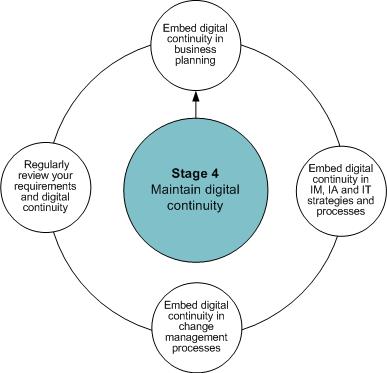
This section explains the ongoing process of embedding digital continuity in your organisation’s business processes and strategies in a way that maintains the usability of your information.
Read more information about Stage 4:
Stage 4: Maintain digital continuity (PDF, 0.09Mb)
Guidance for Stage 4
Embedding digital continuity in information management
This guidance explains how you can maintain digital continuity through good management of information, and ensure these actions are supported at a senior level.
Embedding Digital Continuity in Information Management (PDF, 0.18Mb)
Incorporating digital continuity into your IT strategy
This guidance will help you to understand the principles to follow when including digital continuity in the planning and development of your IT infrastructure.
Incorporating Digital Continuity into your IT Strategy (PDF, 0.10Mb)
Embedding digital continuity in your IT environment
This guidance will help you to embed digital continuity thinking into your organisation’s IT operational management.
Embedding Digital Continuity in your IT Environment (PDF, 0.10Mb)
Change guidance
Our change guidance below helps those responsible for implementing digital continuity across their organisations to manage and protect their digital continuity through change, to ensure business-critical information remains usable.
Change Management for Digital Continuity SROs (PDF, 0.19Mb)
Digital Continuity for Change Managers (PDF, 0.17Mb)
Migrating information between EDRMS
This guidance will help you prepare for migrating information between record management systems. This could be the migration between Electronic Document and Record Management Systems (EDRMS), Enterprise Content Management (ECM) or Content Management Systems (CMS), or from one to the other. It focuses on maintaining the continuity of your information.
Migrating information between records management systems (PDF, 0.29Mb)
Project checklist for records management system migration (PDF, 0.09Mb)
Evaluating your file formats
The guidance below will help you to evaluate your file formats from a digital continuity perspective and employ strategies to maintain the continuity of your digital information.
DROID: user guide (PDF, 0.64 Mb)
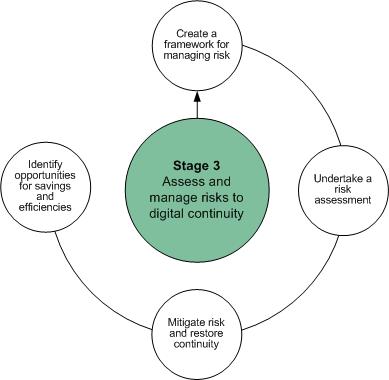
You can manage the risk of losing digital continuity by:
- setting out appropriate governance and risk management structures
- assigning responsibility for the management of risk to digital continuity
- assessing your current level of risk
Read more information about Stage 3:
Stage 3: Assess and manage risks to digital continuity (PDF, 0.13Mb)
Risk assessment handbook
Our risk assessment handbook will help you identify where your information is at risk and take active steps to manage these risks:
Risk Assessment Handbook (PDF, 0.33Mb)
Testing for continuity checklist
The checklist below helps you test that your information asset meets your users’ needs to find, open, work with, understand and trust the information it contains. This is aimed primarily at information asset owners.
Testing for Continuity Checklist (PDF, 0.06Mb)
Managing digital continuity loss
Already lost the ability to use your information as you need? Our guidance below will help you to examine why you have lost continuity, how you may be able to restore it, and how you can prevent it from happening again.
Managing Digital Continuity Loss (PDF, 0.25Mb)
Self-assessment tool
The Information Management Assessment (IMA) programme has produced a tool to assist government organisations in self-assessing the effectiveness of their approach to information and records management. Find out more on our risk assessment page, or register for the tool.
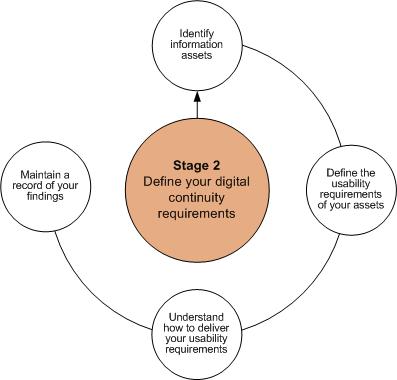
This involves understanding your information, its business value and the nature of the technical and information environment that supports it.
Read more information about Stage 2:
Stage 2: Define your digital continuity requirements (PDF, 0.14Mb)
These two pieces of guidance will help you to define your digital continuity requirements:
Identify information assets and business requirements
This guidance will help you understand the information your organisation holds and how it needs to be used to support your business. It will also help you to document the relationship between your information assets and their business requirements, including how to record that information in an Information Asset Register (IAR).
Identify Information Assets and Business Requirements (PDF, 0.26Mb)
Information Asset Register template (XLS, 0.06Mb)
Mapping the technical dependencies of information assets
The guidance above helps your organisation to identify its information assets and business needs. This guidance will help you to take the next step in Stage 2 of managing digital continuity: mapping these assets to their technical dependencies.
It will help you understand how your technical environment and the way you manage your information assets support your business needs and to understand the risks to your digital continuity.
Mapping the Technical Dependencies of Information Assets (PDF, 0.26Mb)
See our factsheets below for more information on key terms such as information assets, Information Asset Registers (IARs) and Configuration Management Databases (CMDB).
Information assets factsheet (PDF, 0.06Mb)
IAR factsheet (PDF, 0.06Mb)
Configuration management factsheet (PDF, 0.05Mb)
Digital continuity in ICT services procurement and contracts
This guidance provides you with practical information and support to help you maintain the digital continuity of your information when updating ICT services contracts or creating new ones, as well how Information Asset Registers can help you.
Digital Continuity in ICT Services Procurement and Contract Management (PDF, 0.14Mb)
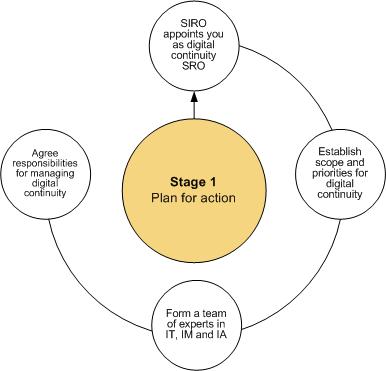
This section of the guidance will help you establish your objectives, who you need to work with, and how to manage digital continuity across the organisation.
Read more information about stage 1:
Stage 1: Plan for action (PDF, 0.11Mb)
If you are involved in managing digital continuity in your organisation, or simply want to know more about digital information management and digital continuity, these key pieces of guidance are a good starting point.
Understanding Digital Continuity (PDF, 0.29Mb)
Managing Digital Continuity (PDF, 0.31Mb)
At a high level, transferring born digital records to The National Archives looks like a familiar process; it follows some of the same steps as transferring paper records. However, the process might not be as linear as for paper records, and you might perform some of these steps in parallel rather than strictly one after the other.
Before digital records can be transferred to The National Archives they must be appraised and selected for permanent preservation and reviewed for sensitivity. Once these steps have been completed and the records prepared, they may be delivered to The National Archives. Open born digital records and their metadata will then be free to view and download from anywhere in the world from our online catalogue, Discovery.
The following pages will provide you with more details on the steps to be taken in the digital transfer process, aligned with the gateways you might be familiar with from transferring paper records.
With regard to digital records, this includes digital continuity, which covers digital records management from the moment digital records are created to when they are ready to be transferred to The National Archives. Digital continuity is about making sure that your information is complete, available and therefore usable for your business needs. For more information on digital continuity see our separate suite of guidance.
To manage digital continuity, you must understand your organisation’s specific issues and risks. As part of our service development, we’re undertaking a risk and opportunities assessment with all central government departments. The assessment will highlight specific risks to the continuity of your digital information, and opportunities that can be realised from mitigating these risks. This will result in recommendations tailored to specific departmental needs.
The assessment is part of a four-stage process to help you manage digital continuity. Carrying out a risk assessment forms part of Stage 3: Assess and manage risks to digital continuity.
For the wider public sector we have built a self-assessment tool that links to the digital continuity guidance and framework of solutions and services.
For more information on risks relating to cyber security, see our guidance on Information security.
For more information on managing your information through change, see our guidance on Machinery of government change.
Risk assessment guidance
Our risk assessment handbook will help you identify where your information is at risk and take active steps to manage these risks:
Risk Assessment Handbook (PDF, 0.33Mb)
For more guidance on assessing and managing risks to your digital continuity, including managing digital continuity loss, see Stage 3 guidance.
Self-assessment tool
The Information Management Assessment (IMA) programme has built an Information Management Self-Assessment Tool. This tool has been developed to assist government organisations in self-assessing the effectiveness of their approach to information and records management.
The tool is free to use and is divided into five modules which will give you the flexibility to target the assessment in the areas where you need it most. It has a section dedicated to Digital Continuity.
Click here to register for the tool.
There is a four-stage process which we recommend you use for managing digital continuity. You can tailor activities to suit your organisation’s specific requirements and priorities. If you have been appointed Senior Responsible Owner (SRO), you have been given overall responsibility for ensuring digital continuity and driving action forward in your organisation.
Digital continuity is the ability to use digital information in the way that you need, for as long as you need. If you do not actively work to ensure digital continuity, your information can easily become unusable. Digital continuity is about making sure that your information is complete, available and therefore usable for your business needs. Your information is usable if you can:
- find it when you need it
- open it as you need it
- work with it in the way you need to
- understand what it is and what it is about
- trust that it is what it says it is
Why digital continuity is important
Managing digital continuity protects the information you need to do business. This enables you to operate accountably, legally, effectively and efficiently. It helps you to protect your reputation, make informed decisions, reduce costs, and deliver better public services. If you lose information because you haven’t managed your digital continuity properly, the consequences can be as serious as those of any other information loss.
Digital continuity in practice
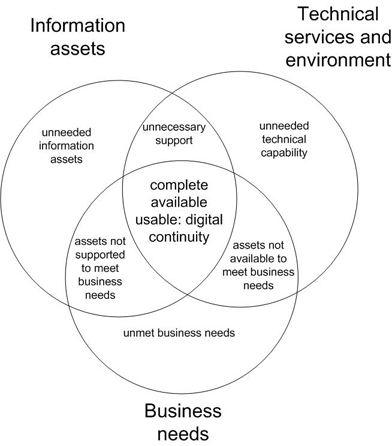
You must keep your information complete and available in the way you need to meet your usability requirements.
Usable
Your information meets your requirements for how you want to use your information (for example, to read, edit, or manipulate information).
Complete
You have everything you need to use, understand and trust the information, including the content, context and all the necessary metadata.
Available
You can find what you need and you have the correct technology to open it and work with it in the way you need. Digital continuity depends on understanding how you use your information to support business needs, and then making sure that your technical environment and your information asset management support that business use. Where they overlap, you have digital continuity; information that is cost-effective, efficiently managed, and usable.
Next steps
For more information please read our guidance below:
Understanding Digital Continuity (PDF, 0.29Mb)
This guidance is aimed at anyone who wants to know more about digital information management and digital continuity. Whether you have been given a specific role to fulfil, or if you are just reading to improve your knowledge, this is a good starting point.