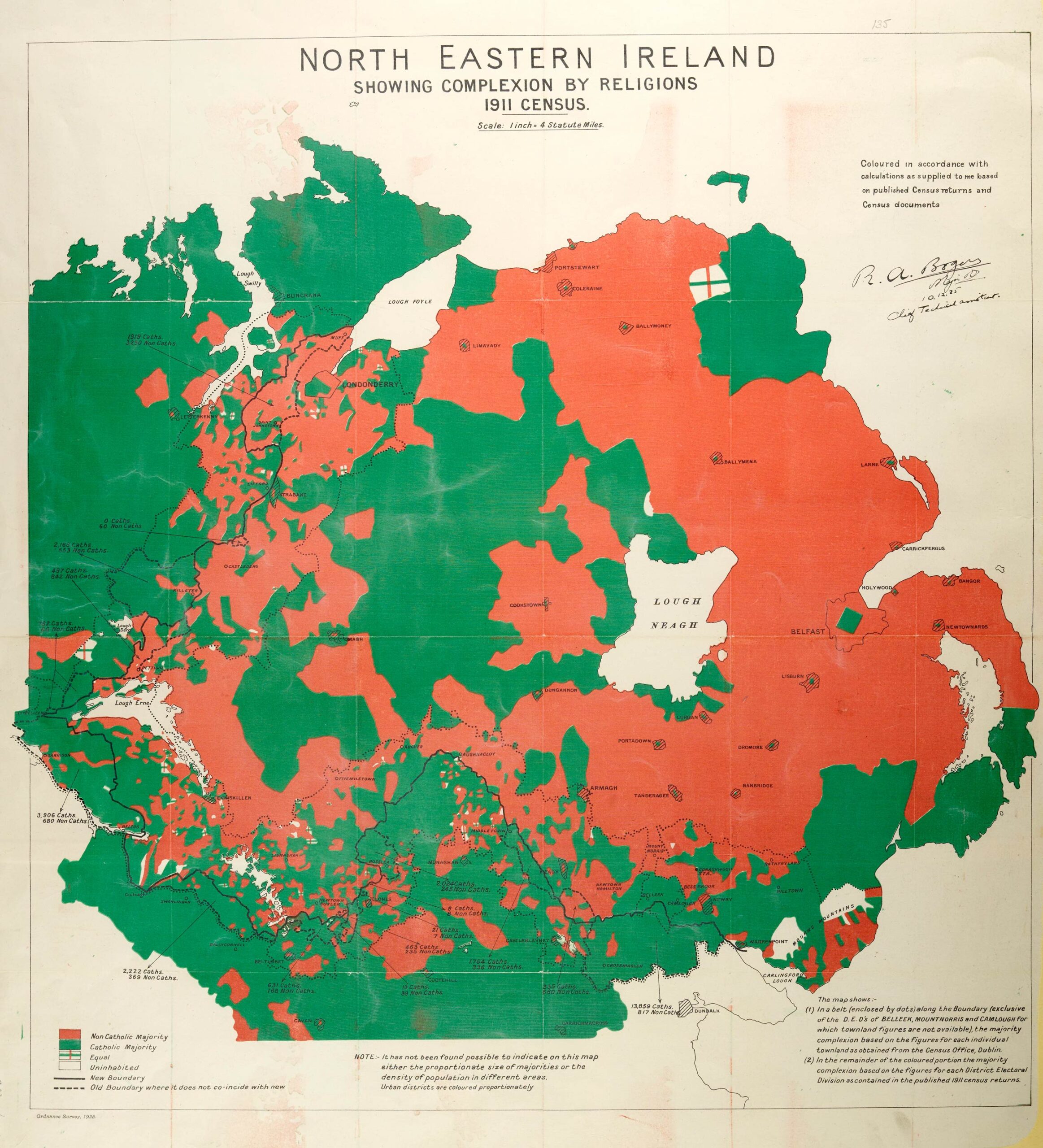
Map of Northern Ireland showing the religious breakdown taken from the Irish Boundary Commission, Catalogue ref: MPI 1/402
The Anglo-Irish Treaty had set out that an Irish Boundary Commission would be formed to finalise the border between the Irish Free State and Northern Ireland. It did not report until 1925, and recommended only minor changes to the border which had been set out in 1922.
It was feared that the decisions made by the Commission might cause additional unrest and so it was agreed by the Irish Free State, Northern Ireland, and the British Government, that the borders would remain as originally drawn. The Commission’s report was not made public until 1969.
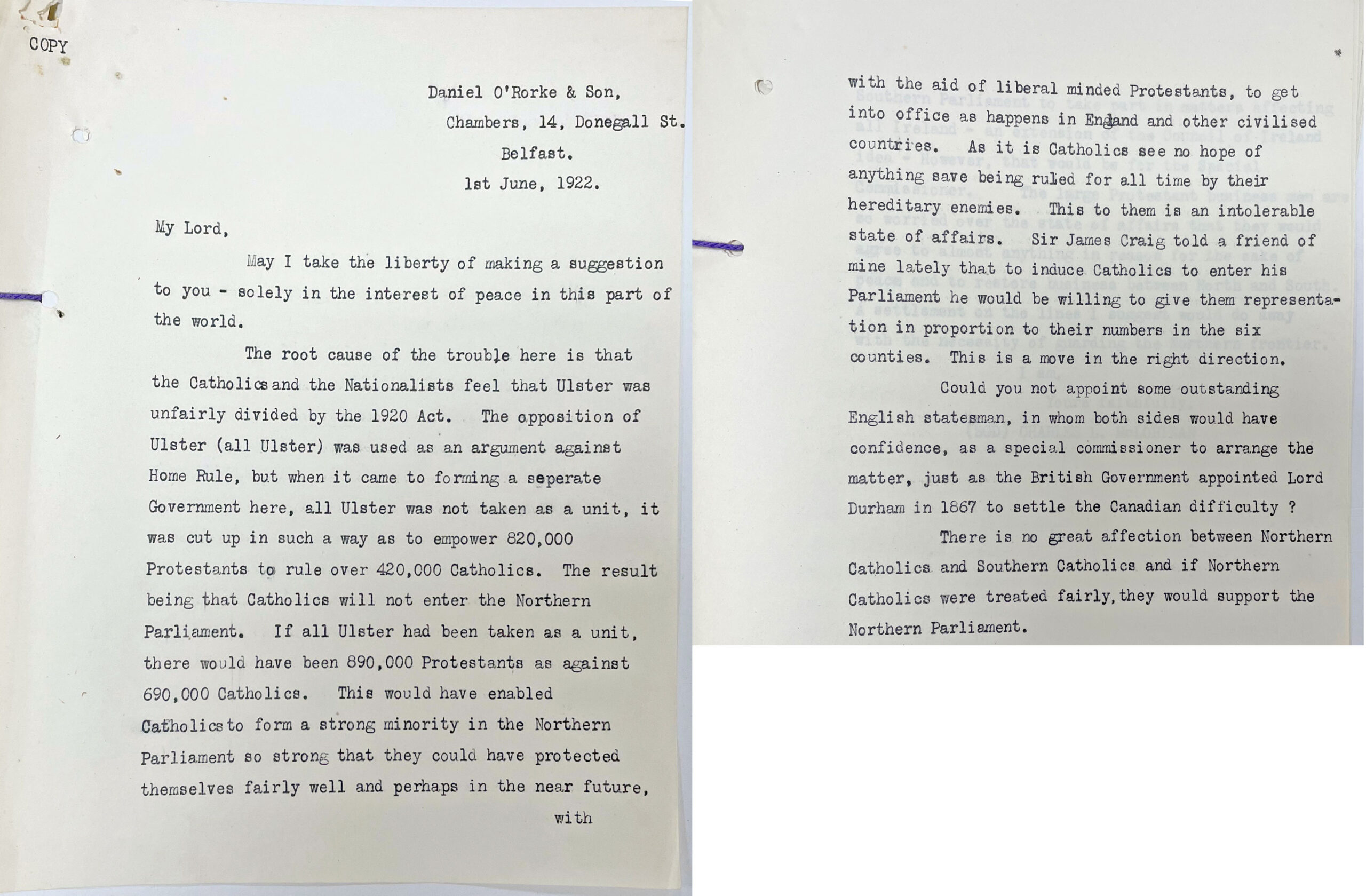
Letter addressed to the British Lord Chancellor from Charles McLorinan, a Catholic living in Northern Ireland, 1 June 1922, Catalogue ref: HO 45/24812
When Northern Ireland was formed in 1920, it was decided, partly because of where Catholic and Protestant populations lived, to only include six of the nine counties of Ulster within the new state. Thus, the remaining three counties eventually formed part of the Irish Free State.
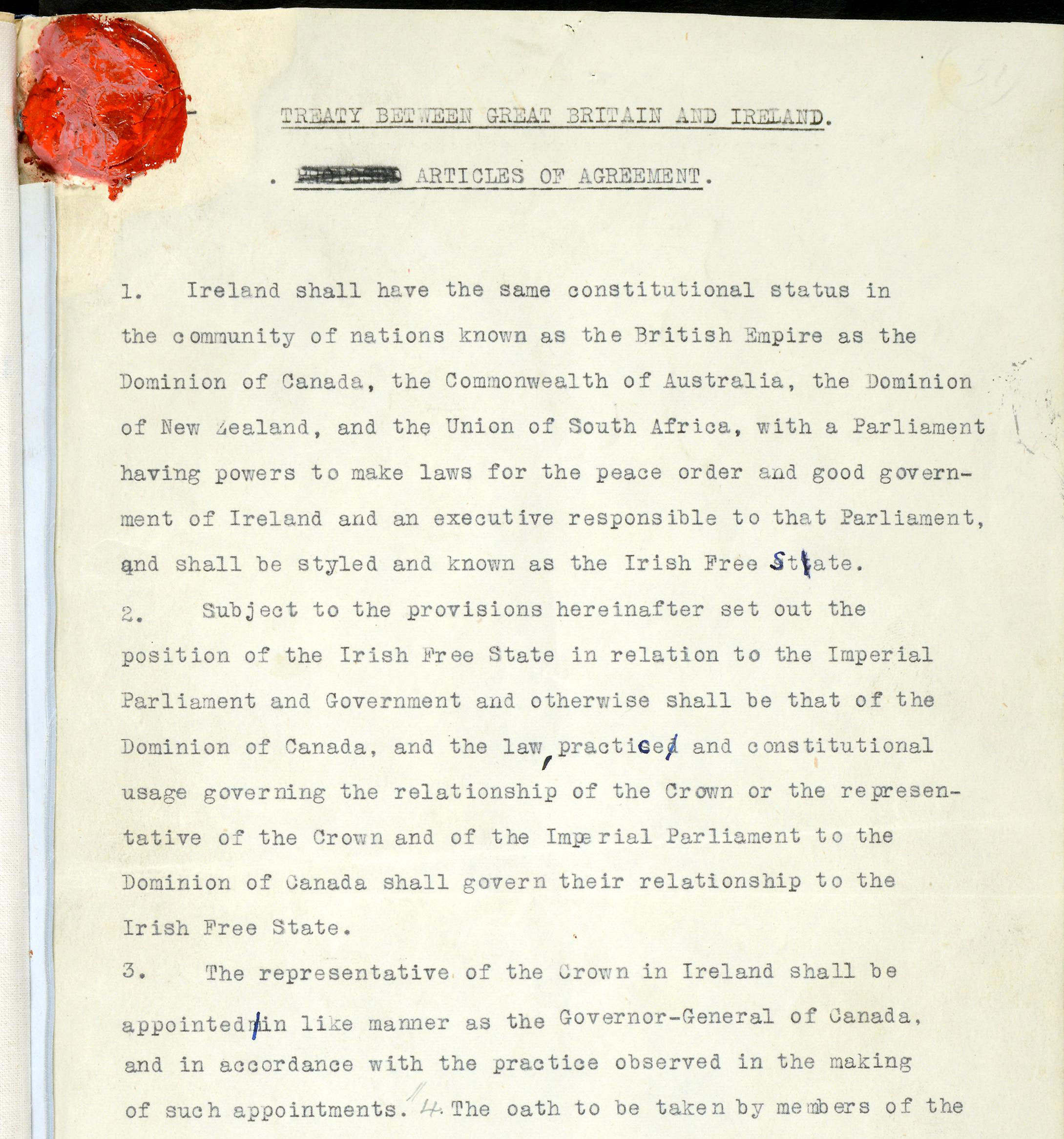
First page of the Article of the Anglo-Irish Treaty, December 1921, Catalogue ref: DO 118/51
Immediately after the First World War, Home Rule was further delayed. Therefore, Irish nationalists led by Sinn Fein, meaning ‘we ourselves’, an Irish Republican party, took up arms against British rule. This would become the Irish War of Independence.
After over two years of fighting, a treaty was finally signed in late 1921, which set out terms for an Irish Free State, free from direct British rule.
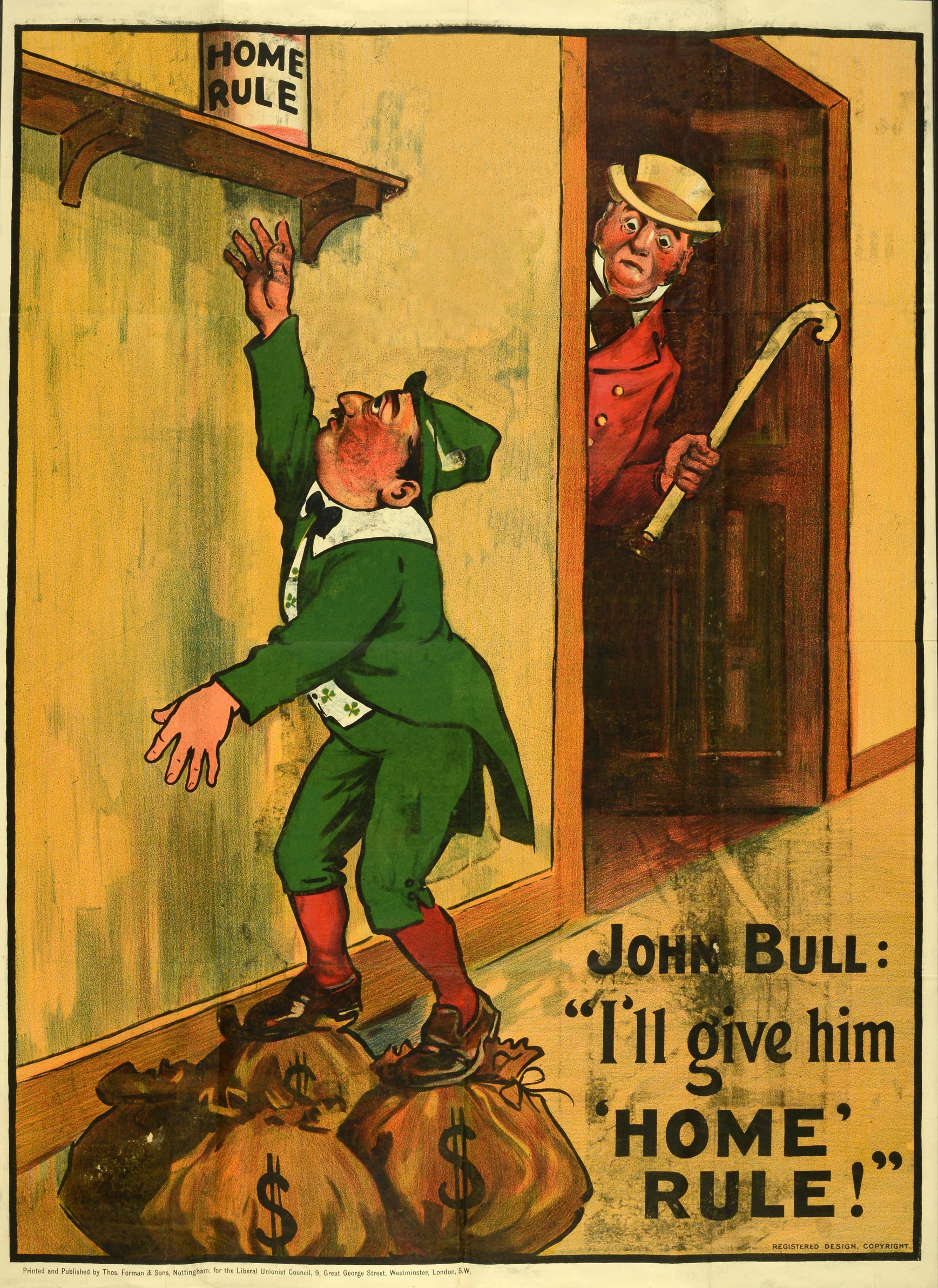
This poster from 1910 shows the Irish nationalist leader, John Redmond, who had been pressing the Liberal Party Government to pass the Home Rule Bill, giving self-government for Ireland. Catalogue ref: COPY 1/353
Herbert Asquith’s Liberal government remained in power after two General Elections in January 1910 and December 1910 with the support of the Irish Parliamentary Party led by John Redmond. Liberals did not have a majority of seats in the House of Commons and the Irish Parliamentary Party held the balance of power in Parliament. They were in a strong position to push for Home Rule.
Irish Home Rule was finally granted in 1914, but was delayed because of the start of the First World War, and partly also because Unionists, especially in the north-eastern province of Ulster, were not happy with this outcome, and continued to threaten civil war.
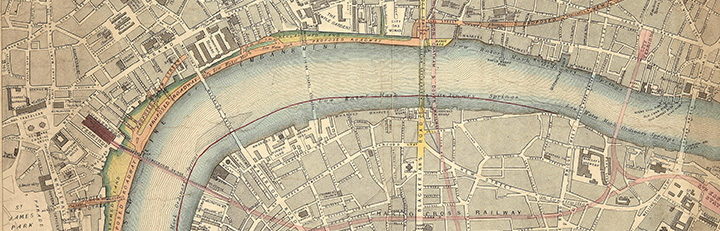
We hope you enjoyed watching our Education Service video with Christopher Day Modern Domestic Records Specialist looking at records from the Office of Works, WORK. This video focusses on two plans concerning the development of the Thames embankment and the construction of the sewer system in the mid nineteenth century.
Watch the video then try and answer the following questions:
- When did the office of works begin as a government department?
- What type of building plans would you expect to find in the early days of the office of works?
- By the eighteen and nineteenth centuries what public building plans can be found in this collection?
- Why do you think these types of plans are useful for finding out about the past?
Plans: WORK 38/89-108
- What is the date of this map of the redevelopment of the Thames embankment?
- What does the map show?
- Why has the map been coloured green, pink and yellow in different areas by officials?
- What does the second ‘close-up’ document show us?
- Give two reasons why these plans were produced.
- How did Joseph Bazalgette develop plans for London’s sewage system?
- Can you give three reasons why the plan to develop London’s sewers took longer than expected?
- What was the total cost of the project?
- How do you think the new sewer system improved health in the city of London?
- How has Joseph Bazalgette been commemorated?
- What other types of sources are used in this video to give context to the plans discussed by our specialist?
Related Resources
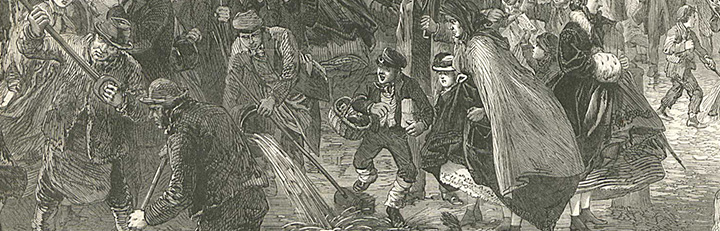
- What made them unhealthy?
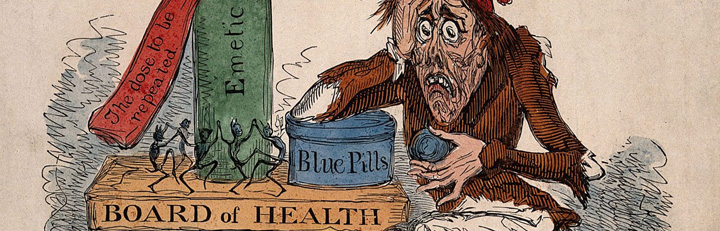
- How did the authorities react in 19th century?
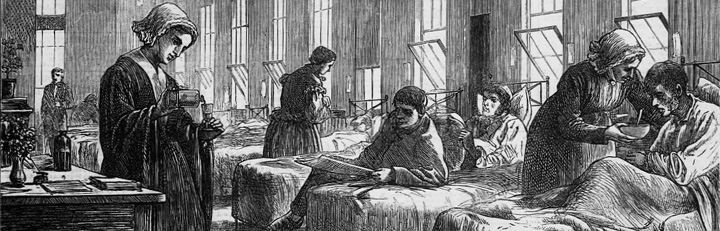
- How did the Victorians view compulsory vaccination?
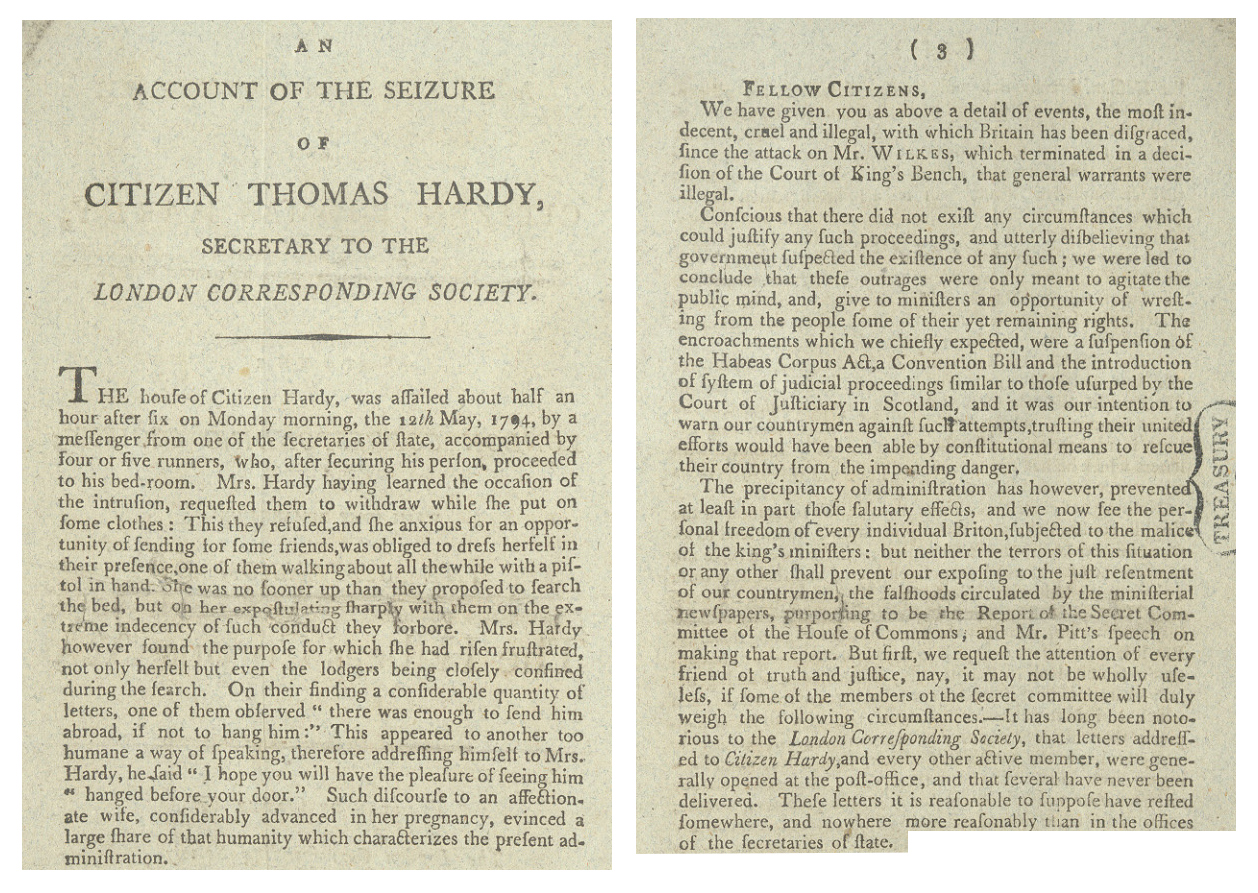
Extract from a printed account by the London Corresponding Society on the arrest of Thomas Hardy, 12 May 1794, Catalogue ref: TS 24/3/33
Very few people had the right to vote in the late eighteenth century. Politics and the running of the government was limited to a small number of wealthy people and certain people later called radicals, questioned if this was the best way of government.
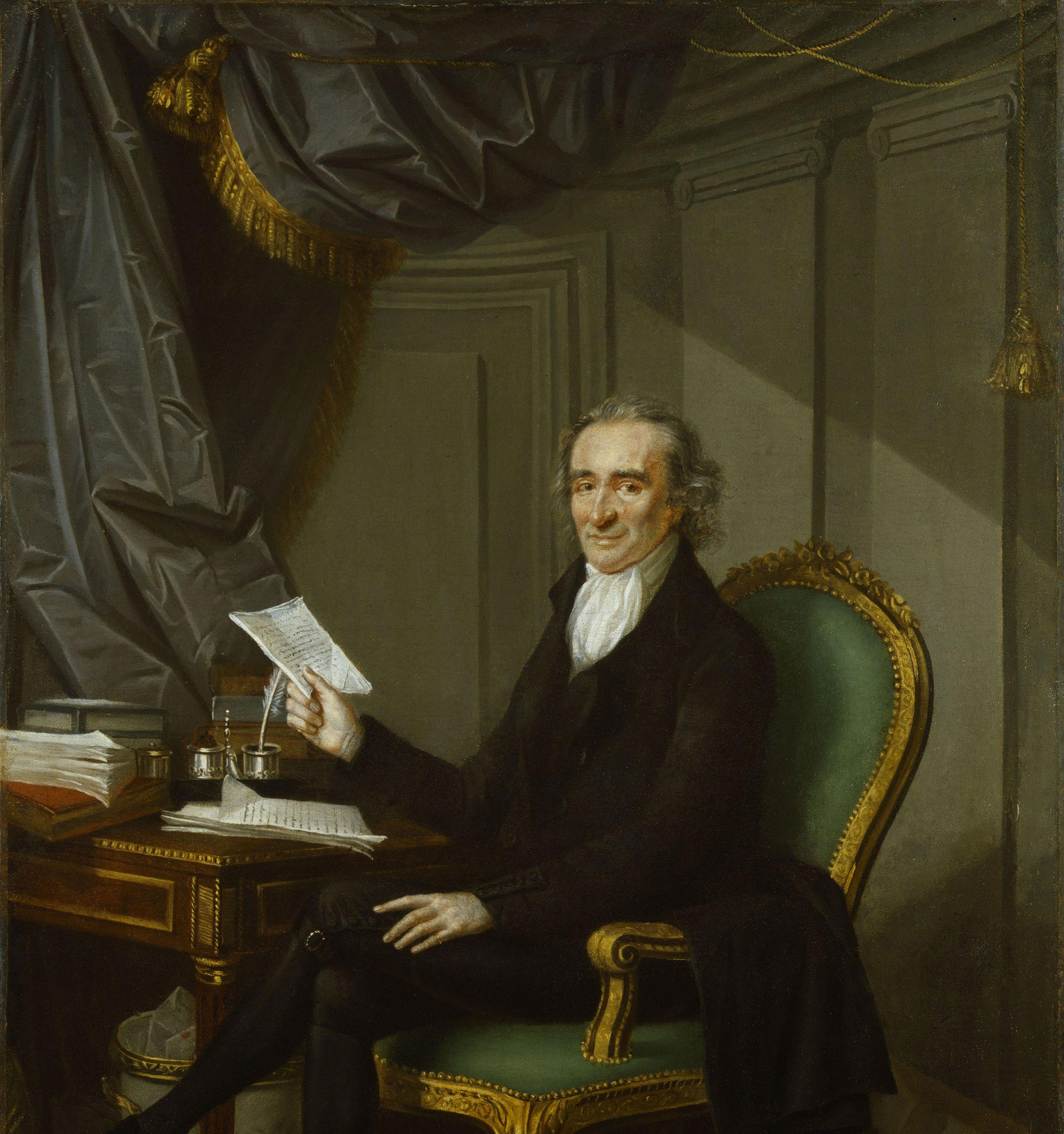
The most important radical writer at this time was Thomas Paine (1737-1809). Paine was born in Thetford in Norfolk and later moved to America where he played an influential role in drafting the Declaration of Independence. He later travelled to France and became involved in the French Revolution, working with the leaders to produce the ‘Declaration of the Rights of Man’. Paine wrote a book called ‘The Rights of Man’ which said that everybody should have the right to be involved in government. His book sold half a million copies and was read by many more. It was frequently used as the discussion topic for political groups called corresponding societies.
Thomas Paine supported the development of corresponding societies, which grew up across the country in the 1790s in Derby, Dundee, Edinburgh, Glasgow London, Perth, Norwich, Nottingham and Sheffield. The societies aimed to gain public support for parliamentary reform including annual parliaments and universal suffrage.
Using the original documents in this lesson, find out how Thomas Paine and other radicals demanded change in how the country was to be governed. How did the government respond?
Political and social reform in 18th century BritainThe second half of the eighteenth century saw a blossoming of ideas concerning popular rights. In ‘The North Briton Radical’, a newspaper founded in 1762 by radical John Wilkes attacked on King George III and his Government. Wilkes was arrested on a general warrant: a document detailing the crime but not the name of the suspected criminal. Wilkes challenged the general warrant and eventually won his case. These events launched the cries of “Wilkes and Liberty!” and other popular slogans for free speech as a resistance to illegitimate power. Wilkes eventually fled to France but returned in 1768, becoming Member of Parliament for Middlesex. After a spell in prison and a series of expulsions and re-elections, Wilkes returned to popular campaigning arguing for the freedom for parliamentary debates to be reported and in favour of parliamentary reform.
This period was not marked by huge gains in rights but it re-introduced the idea of popular rights as an important aspiration. Parliament was pressurised to bring in a number of (unsuccessful) bills for reform. Pressure came from publications such as Major Cartwright’s Take Your Choice (1776), which argued for manhood suffrage, the secret ballot, annual elections and equal electoral districts.
Following the French Revolution, the idea that ‘political ‘rights’ meant the participation in the political process beyond the rights of the elite, became popular. The Rights of Man by Thomas Paine became the most famous expression of this idea and was very important for the corresponding societies. They began to meet at the same time that a revolution was taking place in France, during the late 1780s and the 1790s. The radicals, thought that citizenship came from universal ‘natural rights’. This meant that all men (though not necessarily all women) had a right to take part in politics, whatever their social class, political background or religious beliefs. They referred to each other as ‘citizens’. The government in Britain was worried that the corresponding societies might start a revolution. They became very concerned when the French revolutionaries executed their king. Many radicals were arrested and laws passed to ban corresponding societies and unions.
Thomas Hardy was a radical and the Secretary of the London Corresponding Society. It was the first radical group to be open to everyone. Their motto was that ‘our members be unlimited’. Hardy wanted to send a petition to Parliament in the hope that the political system would be reformed. Alarmed by the events in France and by the popularity of the London Corresponding Society, officials arrested Thomas Hardy in May 1794 for high treason. Shortly after Hardy’s arrest, supporters of the government attacked his home and the shock resulted in the death of his pregnant wife.
Along with the political clampdown against individual radicals, the Government faced the Royal Naval mutinies in 1797 and increased trade union activity. In quick succession the Government passed legislation against ‘unlawful oaths’ (naval mutineers had made such oaths to each other in 1797), corresponding societies and finally ‘combinations’ or trade unions.
Food prices rose and some common lands were enclosed in the second half of the eighteenth century. There were food riots from the 1750s to the 1770s and in the 1790s until 1801. Some historians have described those who took part in food riots as protecting their rights within a ‘moral economy’. These ideas also informed opposition to the continued reduction and removal of the common rights of the small farmer and landless workers. The loss of rights caused by enclosure resulted in various enclosure riots at places such as Charnwood Forest (1748-51), West Haddon (1765), Sheffield (1791), and Burton on Trent (1771-72). Such events also informed the democratic ideals of Thomas Paine and later movements such as the Chartists.
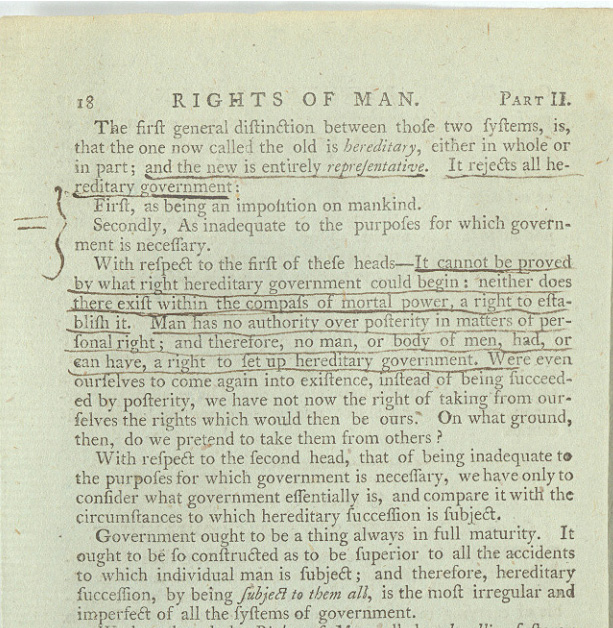
Extract from the second part of ‘The Rights of Man’ by Thomas Paine, 1792
Catalogue ref: TS 24/3/10, pp.18-19
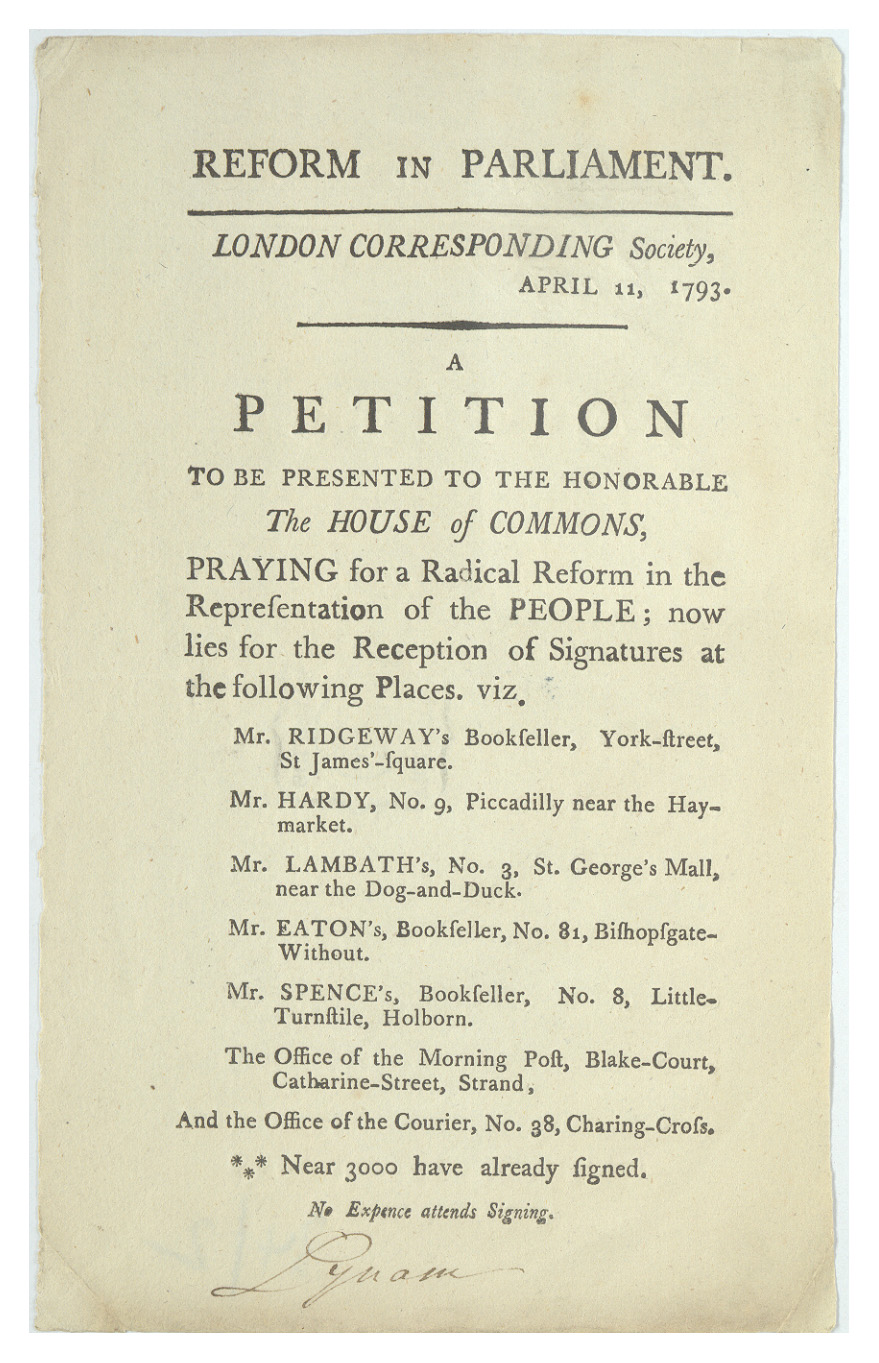
London Corresponding Society handbill, 1793 , Catalogue ref: TS 24/3/34
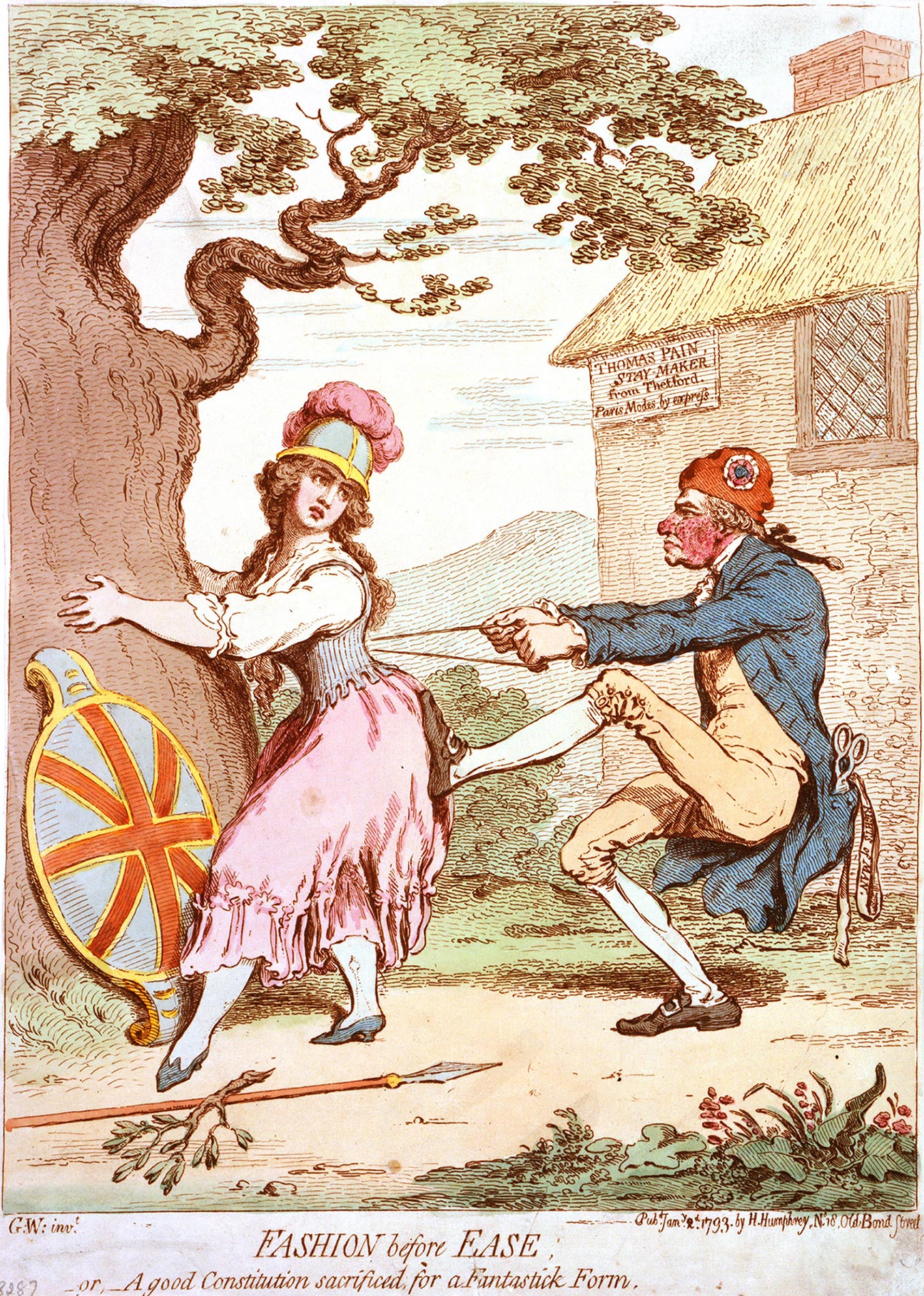
Political cartoon by James Gillray entitled: ‘Fashion before Ease;—or,—A good Constitution sacrificed for a Fantastick Form’, London, Published by H. Humphrey, 1793. © Library of Congress