

It has previously been assumed that paupers themselves had little knowledge nor understanding of the legislation governed their position, yet letters sent to the poor law commission from across England and Wales challenge this notion. In fact there is evidence that paupers were frequently writing to contest the way that they were being treated, complain about actions of their Guardians and in some instances even quoted specific parts of legislation in an attempt to change their lives.
The legal terminology contained in the letters written by the poor, and the inferences that historians can make from this is a fascinating challenge to students of both History and Law related subjects. This resource aims to demonstrate, through a selection of letters and accompanying tasks, how paupers were active in exercising what they believe to be their ‘right to relief’ and were in fact agents who held the Poor Law to account.
In what ways did paupers hold the Poor Law to account?After the passing of the 1834 Poor Law Amendment Act, the Poor Law Commissioners in London were tasked with implementing changes how poor relief was administered across England and Wales. However, discrepancies between poor law unions grew more apparent over time, meaning the experiences of paupers and the operation of the New Poor Law might have varied hugely depending upon the area one resided in.
Attempts were made to regulate the implementation of the New Poor Law via orders and circular letters that were sent to individual unions, collections of unions and indeed all unions, from the Centre. Some of were sent as directions – “what local unions should do” – and some were sent as permissions –“what local union could do” – should they wish. Knowledge of such regulations (of both types) quickly began to specify the day-to-day operations of out-relief as well as the conditions that should be set down for the workhouse inmate. Thus many paupers built up a picture of their “rights” under the law. In their letters to the Centre paupers and the wider poor complained about their treatment, and how it did not match what they believed was their entitlement, often referencing the Poor Law despite its often ambiguous phrasing. From this we learn that paupers were not oblivious to their position and became more vocal in challenging what they believed were social injustices.


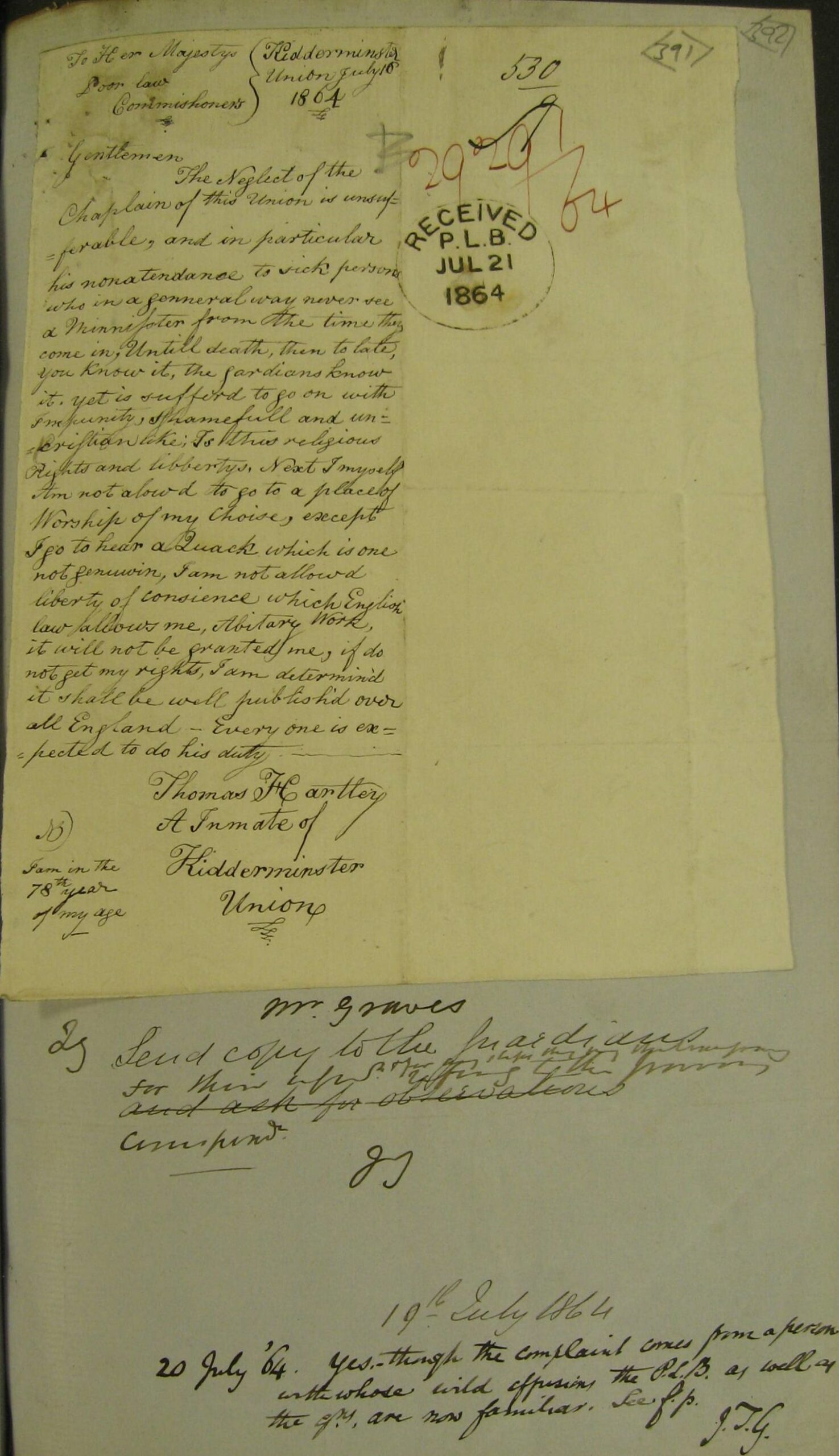
The document below is the letter referred to in the catalogue entry. The entry is the item of study.


